"The Forest Exiles" (continued 3)
Reading edition
He had gone out to the forest, and returned carrying a bundle of slender rods. They were pieces of a lliana, or creeping plant. It was the bejuco de curare, or “mavacure,” as it is sometimes called. The leaves he had stripped off, and left behind as useless. Had he brought them with him, they would have been seen to be small leaves of an oblong-oval shape, sharp at the points, and of a whitish-green colour. Don Pablo knew the plant to be a species of Strychnos.
Guapo with his knife first scraped all the bark, as well as the alburnum or white coating, from the rods, which last he flung away. The mixture of bark and alburnum was next placed upon a smooth stone, and mashed into a fibre of a yellowish colour. This done, it was gathered into a heap, and placed within a funnel, which had already been made out of a plantain-leaf. The funnel was a long narrow cone, and to strengthen it, it was set within another funnel made of the thick leaf of the “bussu” palm, and then both were supported by a framework of palm fibres. Underneath the apex was placed a small pan—which could afterwards be put over the fire—and then cold water was thrown into the funnel along with the bark. A yellowish liquid soon commenced to filter and drip into the pan, and this liquid was the curare, the arrow-poison. It still required, however, to be concentrated by evaporation; and for this purpose the pan was transferred to a slow fire, where it was kept until the liquid became thickened by the heat.
Another process was yet required before the curare was ready for the arrows. It was sufficiently concentrated and deadly, but still too thin to adhere properly to their tips, and for this purpose a mixture of some gummy juice was necessary. This Guapo soon prepared from the large leaves of a tree called the “kiracaguero,” and poured it into the infusion; and then the curare turned from its yellow colour to black, and was ready for use. The change of colour was produced by the decomposition of a hydruret of carbon; the hydrogen was burned, and the carbon set free.
Guapo now dipped a few of his arrows, and carefully deposited them in a large joint of bamboo, which served as a quiver. I say carefully, for had one of these arrows dropped with its poisoned point upon his naked foot, or wounded him elsewhere, he never would have prepared any more curare. But he handled them with care, and the remainder of the liquid he poured into a small gourd (similar to that in which he carried his coca-lime), which he closely corked up with a piece of the pith from a palm.
Don Pablo, with Doña Isidora and the children, had watched with interest all this process. At first, they were afraid to go near, believing that the fumes of the liquid might be injurious. This was long believed to be the case, in consequence of the absurd tales spread abroad by the old missionaries, and even at a later period by the traveller La Condamine. These asserted, that when the Indians wished to make the curare poison, they selected for this purpose the old women of the tribe, whose lives were not deemed of any value; and that several of these always fell a sacrifice while “cooking” the curare! This silly story is now refuted; and Guapo not only assured his companions that there was no danger, but even tasted the curare from time to time while in the pan, in order to judge when it was sufficiently concentrated. This he could tell by its taste, as it grew more and more bitter as the evaporation proceeded. The arrow-poisons of South America are not all made from the creeping plant, the mavacure. Among some Indian tribes a root is used called “curare de raiz;” and with others the poison is produced by a mixture of several species of juices from the plant Ambihuasca, tobacco, red pepper, a bark called “barbasco,” from a tree of the genus Jacquinia, and a plant of the name “sarnango.” Of all these the juice of the Ambihuasca is the most powerful ingredient, but the making of this species of poison is a most complicated process.
Guapo was not long in having an opportunity to test his gravatána, and this was just what he desired, for the old Indian was not a little vain of his skill, and he wished to make a show of it in the eyes of his companions. His vanity, however, was the more pardonable, as he was in reality a first-rate shot, which he proved to the satisfaction of everybody within half-an-hour. The instrument had scarcely been finished and laid aside, when a loud screaming and chattering was heard in the air, and on looking up a flock of large birds was seen flying over the heavens. They were still high up, but all of a sudden they darted down together and alit on a tall tree that stood nearly alone. Here they continued their chattering, only in a lower and more confidential tone; and they could be seen, not hopping, but climbing about, sometimes with their backs and heads turned downwards, and, in short, clinging to the branches in every imaginable way. These birds were all of one kind, each of them full eighteen inches in length, and of a uniform colour over the body, which was a purple, or deep indigo—their beaks only being white. In the sun their plumage glistened with a metallic lustre. They were, in fact, a rare species,—the ana, or purple macaw.
Without saying a word, Guapo seized his gravatána and arrows, and stole off through the underwood towards the tree upon which the macaws had perched. In a few minutes he stood under it, screened from the view of the birds by the broad leaves of a plantain that happened to grow beneath. This cover was necessary, else the macaws, which are shy birds, might have uttered one of their wild, choral screams, and flown off. They did not however, and Guapo had a fair chance at them. All his movements could be observed by the party at the house, as he was on that side of the plantain.
He was seen to adjust an arrow into the tube, and then raise the gravatána to his lips. Strange to say, he did not hold it as we do a common gun,—that is, with the left hand advanced along the tube. On the contrary, both hands were held nearly together, at the lower end, and close to his mouth. Now, you will wonder how he could hold such a long tube steady in this way. It is, indeed, a very difficult thing, and much practice alone can accomplish it. As they watched him narrowly, his chest was seen to expand, his cheeks rose with a strong “puff,” and some of them thought they could perceive the passage of the little arrow out of the tube. However this might be, they soon after saw something sticking in the side of one of the macaws, and could see the bird pecking at it with its great beak, and trying to pull it out. In this it appeared to have succeeded after a short while, for something fell from the tree. It was the shaft with its cotton “boss” that fell down. The point, broken off where it had been notched, was still in the body of the bird, and was infusing the deadly venom into its veins. In about two minutes’ time the wounded bird seemed to grow giddy, and began to stagger. It then fell over, still clutching the branch with its strong, prehensile claws; but after hanging a moment, these too relaxed, and the body fell heavily to the ground. It was quite dead.
Long before it came down Guapo had pushed a fresh arrow into the tube, and given a fresh puff through it, wounding a second of the macaws. Then another arrow was chosen, and another victim, until several had been shot, and the creatures upon the tree could be seen in all stages of dying. Some, on receiving the wound, uttered a cry and flew off, but the poison soon brought them down, and they invariably fell at no great distance from the tree.
At length Guapo was seen to desist, and walk boldly out from his ambush. To the surprise of all, the remaining macaws, of which there were still six or seven upon the tree, showed no fear of him, nor did they attempt to fly away! This was explained, however, by their subsequent conduct; for in a few seconds more they were seen, one by one, falling to the ground, until not a single bird was left upon the tree. All of them had been killed by the arrows of the blow-gun!
Leon now ran out to assist Guapo in gathering his game. There were no less than eight couple of them in all, and they were all quite dead—some of them shot in the thigh, some in the neck or wing, and others through the body. None of them had lived over two minutes after receiving the wound. Such is the quickness with which the “curare” does its work!
As a hunting instrument for most species of game the South American Indian prefers the gravatána to any other; and with good reason. Had Guapo been armed with a rifle or fowling-piece, he would have shot one macaw, or perhaps a pair, and then the rest would have uttered a tantalising scream, and winged their way out of his reach. He might have missed the whole flock too, for on a high tree, such as that on which they had alit, it is no easy matter to kill a macaw with a shot-gun. Now the gravatána throws its arrow to a height of from thirty to forty yards, and the least touch is sufficient to do the business. Its silence, moreover, enables the hunter to repeat the shot, until several head of game reward his skill. The Indians use it with most effect in a vertical or upward direction; and they are always surer to kill a bird with it when perched on a high tree, than when seated on a low shrub or on the ground.
As we have observed that the curare can be taken inwardly without any danger, it will be evident to all that game killed by the poisoned arrows may be eaten with safety. Indeed, there are many epicures in South America who prefer it in this way; and when a chicken is wanted for the table, these people require that it should be killed by an arrow dipped in curare.
Chapter Twenty.
The Milk-Tree.
Guapo kept his promise with the tapir, and on that very same day. Shortly after the macaws had been brought in, little Leona, who had been straying down by the water’s edge, came running back to the house, and in breathless haste cried out, “Mamma, mamma! what a big hog!”
“Where, my pet?” inquired her mother, with a degree of anxiety, for she fancied that the child might have seen some fierce beast of prey instead of a hog.
“In the water,” replied Leona; “among the great lilies.”
“It’s the tapir,” cried Leon. “Carrambo! it’s our tapir!”
Guapo was busy plucking his macaws, but at the word tapir he sprang to his feet, making the feathers fly in all directions.
“Where, señorita?” he asked, addressing little Leona.
“Down below,” replied the child; “near the edge of the river.”
Guapo seized his gravatána, and crouched down towards the bank, with Leon at his heels. On nearing the water, he stopped; and, with his body half bent, looked down stream. There, sure enough, was the huge brown beast standing with his body half out of the water, and pulling up the roots of the flags with his great teeth and long moveable snout. It was not likely he would return to his former den after the chase he had had; and fancying, no doubt, that all the danger lay upon the opposite shore, he had come to this side to browse awhile.
Guapo cautioned Leon to remain where he was, while he himself, almost crawling upon his belly, proceeded along the bank. In a few minutes he was out of sight, and Leon, seeing nothing more of him, kept his eyes sharply fixed upon the tapir.
The latter remained quietly feeding for about ten minutes, when the boy saw him give a little start. Perhaps, thought he, he has heard Guapo among the weeds—for the tapir has good ears—and that was what caused him to make the motion. The tapir stopped feeding for a moment, but then recommenced, though evidently not with as much eagerness as before. Presently he stopped a second time, and seemed undetermined as to whether he should not turn and take to the clear water. In this way he hesitated for several minutes; then, to the astonishment of Leon, his body began to rock from side to side, and the next moment, with a plunge, he fell heavily backward, making the waves undulate on all sides of him. The arrow had done its work—he was dead!
A loud shout from Guapo echoed along the river, and the Indian was seen plunging forward to the dead tapir, which the next moment he had seized by the leg, and was dragging towards the bank. He was here met by the whole party, all of whom were anxious to see this rare and singular creature. Ropes were soon attached to the legs, and Guapo, assisted by Don Pablo and Leon, drew the huge carcass out upon the shore; and dragged it up to the house.
Guapo at once skinned it, carefully preserving the hide to made soles for his sandals and other purposes; and that night all of them tried a “tapir-steak” for supper. All, however, Guapo alone excepted, preferred the flesh of the purple macaws, which, cooked as they were with onions and red pepper, were excellent eating, particularly for Spanish-American palates. Guapo had all the tapir to himself.
The bamboo palm-house was now quite finished, and several articles of furniture too—for during the nights both Don Pablo and his trusty man Guapo had worked at many things. You will, no doubt, be asking where they procured lights,—will you not? I shall tell you. One of the loftiest and most beautiful of the palm-trees—the wax-palm (Ceroxylon Andicola)—grew in these very parts, for the lower slopes of the Andes are its favourite habitat. Out of its trunk exudes wax, which has only to be scraped off and made into candles, that burn as well as those made of the wax of bees. Indeed, the missionaries, in their various religious ceremonies,—or “mummeries,” as they might be better styled,—have always made large use of these palm-candles. Another “wax-palm,” called “Carnauba” (Copernicia cerifera), is found in South America. In this one, the wax—of a pure white colour, and without any admixture of resin—collects upon the under-side of the leaves, and can he had in large quantities by merely stripping it off. But even, had neither of these palms been found, they needed not to have gone without lights, for the fruits of the “patawa,” already described, when submitted to pressure, yield a pure liquid oil, without any disagreeable smell, and most excellent for burning in lamps. So, you see, there was no lack of light in the cheerful cottage.
But there were two things, you will say, still wanting—one of them a necessary article, and the other almost so—and which could not possibly be procured in such a place. These two things were salt and milk. Now there was neither a salt-mine, nor a lake, nor a drop of salt water, nor yet either cow, goat, or ass, within scores of miles of the place, and still they had both salt and milk!
The milk they procured from a tree which grew in the woods close by, and a tree so singular and celebrated, that you have no doubt heard of it before now. It was the palo de vaca, or “cow-tree,” called sometimes by an equally appropriate name arbol del leche, or “milk-tree.” It is one of the noblest trees of the forest, rising, with its tall straight stem, to a great height, and adorned with large oblong pointed leaves, some of which are nearly a foot in length. It carries fruit which is eatable, about the size of a peach, and containing one or two stones; and the wood itself is valuable, being hard, fine-grained, and durable. But it is the sap which gives celebrity to the tree. This is neither more nor less than milk of a thick creamy kind, and most agreeable in flavour. Indeed, there are many persons who prefer it to the milk of cows, and it has been proved to be equally nutritious, the people fattening upon it in districts where it grows. It is collected, as the sugar-water is from the maple, simply by making a notch or incision in the bark, and placing a vessel underneath, into which the sap runs abundantly. It runs most freely at the hour of sunrise; and this is also true as regards the sap of the sugar-tree, and many other trees of that kind. Sometimes it is drunk pure as it flows from the tree; but there are some people who, not relishing it in its thick gummy state, dilute it with water, and strain it before using it. It is excellent for tea or coffee, quite equal to the best cream, and of a richer colour. When left to stand in an open vessel, a thick coagulum forms on the top, which the natives term cheese, and which they eat in a similar manner, and with, equal relish. Another virtue of this extraordinary tree is that the cream, without any preparation, makes a glue for all purposes as good as that used by cabinet-makers, and, indeed, Don Pablo and Guapo had already availed themselves of it in this way.
So much for the palo de vaca.
It still remains for me to tell you where the salt came from; and although the milk-tree was ever so welcome, yet the salt was a thing of still greater necessity. Indeed, the latter might be looked upon as an indispensable article in household economy. You, my young reader, know not what it is to be without salt. With whole sacks of this beautiful mineral within your reach, almost as cheap as sand, you cannot fancy the longing—the absolute craving—for it, which they feel who are for a period deprived of it. Even the wild animals will make long journeys in search of those salt-springs—or, as they are called, “licks”—which exist in many places in the wilderness of America. For salt, Don Pablo and his companions would have exchanged anything they had,—their sugar, plantains, cocoa, coffee, or even the cassava, which was their bread. They longed for salt, and knew not how they could get on without it. The only substitute was the “aji,” or capsicum, of which several species grew around, and almost every dish they ate was strongly spiced with it. But still this was not salt, and they were not contented with it.
It was now that they found a friend in Guapo. Guapo knew that among many of the Indian tribes the fruit of a certain species of palm was manufactured into salt; and he knew the palm, too, if he could only get his eyes upon it. Seeing his master and the rest so troubled upon this head, Guapo rose one morning early and stole off among the groves of palm, on the other side of the river. There, in a marshy place, with its roots even growing in the water, stood the very tree,—a small palm of about four inches in diameter and twenty to thirty feet high. It was thicker at the base than the top, and the top itself rose several feet above the tuft of pinnate, feathery fronds, ending in a pointed spike. It was the “jara” palm, of the genus Leopoldinia.
It was the fruits upon which Guapo bent his eyes with earnestness. Each one was as large as a peach, of an oval shape, slightly flattened, and of a yellowish green colour. They grew in large clusters among the bases of the leaves; and Guapo was not long in ascending several trees—for the jara is a smooth-skinned palm, and can be climbed—and breaking off the spadices, and flinging them to the ground. He had soon collected a bag-full, with which he hurried back to the house.
All wondered what Guapo meant to do with these fruits, for they tasted them and found them very bitter. Guapo soon showed them his intention. Having prepared a sort of furnace, he set the nuts on fire; and when they were thoroughly reduced to ashes, to the great joy and astonishment of all, these ashes, which were as white as flour, had the taste of salt! It is true it was not equal to “Turk’s Island,” nor yet to “Bay” salt, but it proved to be good enough for cooking purposes, and satisfied the craving which all had felt for this indispensable article.
Chapter Twenty One.
The Cannibal Fish and the Gymnotus.
About this time an incident occurred that was very near having a fatal termination for one of the party—Leon. The day was a very hot one, and as the cool water looked inviting, Leon could not resist the temptation of taking a bath. Having undressed himself, he plunged into the river nearly in front of where the house stood, and began splashing about quite delighted. The rest were not heeding him, as each was engaged with some occupation within the house.
Leon at first kept wading about in a place that was not beyond his depth, but, by little and little, he took short swims, as he wished to practise, and become a good swimmer like Guapo. His father had not only given him permission, but had even advised him to do so. And it may be here remarked that all parents would do well to take the same course with their children and allow them to acquire this healthful and useful art. No one can deny that thousands of lives are annually sacrificed, because so few have taken the trouble to learn swimming.
Well; Leon was determined to be a swimmer, and at each attempt he made a wider stretch into the deep water, swam around, and then back again to the bank.
In one of these excursions, just as he had got farthest out, all at once he felt a sharp pain as if from the bite of some animal, and then another, and another, upon different parts of the body, as if several sets of teeth were attacking him at once!
Leon screamed—who wouldn’t have done so?—and his scream brought the whole household to the edge of the water in less than a score of seconds. All of them believed that he was either drowning or attacked by a crocodile. On arriving at the bank, however, they saw that he was still above water, and swimming boldly for the shore—no signs of a crocodile were to be seen!
What was the matter?
Of course that question was asked him by all of them in a breath. His reply was that “he could not tell—something was biting him all over!”
The quick eye of the mother now caught sight of blood—around the swimmer the water was tinged with it—her piercing shriek rent the air.
“O God! my child—my child! Save him—save him!”
Both Don Pablo and Guapo dashed into the water and plunged forward to meet him. In the next moment he was raised in their arms, but the blood streamed down his body and limbs, apparently from a dozen wounds. As they lifted him out of the water they saw what had caused these wounds. A shoal of small fish, with ashy-green backs and bright orange bellies and fins, was seen below. With large open mouths they had followed their victim to the very surface, and now that he was lifted out of their reach, they shot forward and attacked the legs of his rescuers, causing Don Pablo and Guapo to dance up in the water, and make with all haste for the bank. As soon as they had reached it, they turned round and looked into the water. There were these blood-thirsty pursuers that had followed them up to the very bank, and now swam about darting from point to point, and ready for a fresh attack on any one that might enter the water!
“They are the ‘cannibal fish!’” said Guapo, in an angry tone, as he turned to attend to Leon. “I shall punish them yet for it. Trust me, young master, you shall be revenged!”
Leon was now carried up to the house, and it was found that in all he had received nearly a dozen wounds! Some of them were on the calves of his legs, where the piece of flesh was actually taken out! Had he been farther out in the river, when first attacked, he might never have reached the shore alive, as the fierce creatures were gathering in far greater numbers when he was rescued, and would most undoubtedly have torn him to pieces and eaten him up! Such has been the fate of many persons who have fallen among the “cannibal fish” in the midst of wide rivers where they had no chance of escape. These ferocious little “caribes,” or “caribitos,” as they are called (for the word carib signifies cannibal), lie at the bottom of rivers, and are not easily seen; but the moment an attack is made by one of them, and a drop of blood stains the water, the whole shoal rises to the surface, and woe to the creature that is assailed by their sharp triangular teeth!
Of course the wounds of Leon, although painful, were not dangerous, but the chief danger lay in the loss of blood which was pouring from so many veins. But Guapo found ready to his hand the best thing in the world for stopping it. On some mimosa-trees, not far from the house, he had already observed—indeed, so had all of them—a very singular species of ants’ nests of a yellowish brown colour. The ants themselves were of a beautiful emerald green. They were the Formica spinicollis. These nests were composed of a soft cotton-down, which the ants had collected from a species of Melastoma, a handsome shrub found growing in these regions; and this down Guapo knew to be the best for blood-stopping. Even Don Pablo had heard of its being used by the Indians for this purpose, and knew it by the name of “yesca de hormigas,” or “touchwood of ants.” He had heard, moreover, that it was far superior even to the ants’ nests of Cayenne, which form an article of commerce and are highly prized in the hospitals of Europe. Guapo, therefore, ran off and robbed the green ants of their nests, and speedily returned with the full of his hands of the soft “yesca.” This was applied to the wounds, and in a few minutes the bleeding was effectually stopped, and Leon, although still suffering pain, had now only to be patient and get well.
Strange to say, another incident occurred that very evening, which taught our party a further lesson of the danger of taking to the water without knowing more of its inhabitants. Just as they had finished supper, and were seated in front of their new house, the mule, that had been let loose, stepped into the river to drink and cool its flanks. It was standing in the water, which came up to its belly, and, having finished its drink, was quietly gazing around it. All at once, it was observed to give a violent plunge, and make with hot haste for the bank. It snorted and looked terrified, while its red nostrils were wide open, and its eyes appeared as if they would start from their sockets. At length it reached the bank, and, staggering forward, rolled over in the sand, as if it was going to die!
What could all this mean? Had it, too, been attacked by the “caribes?” No; that was not likely, as the bite of these creatures upon the hard shanks of the mule could not have produced such an effect. They might have frightened it, but they could not have thrown it into “fits”—for it was evidently in some sort of a fit at that moment.
It might have been a puzzle to our party not easily solved, had Guapo not been upon the spot. But Guapo had witnessed such an incident before. Just before the mule gave the first plunge Guapo’s eyes had been wandering in that direction. He had noticed an odd-looking form glide near the mule and pass under the animal’s belly. This creature was of a greenish-yellow colour, about five feet in length, and four or five inches thick. It resembled some kind of water-snake more than a fish, but Guapo knew it was not a snake, but an eel. It was the great electric eel—the “temblador,” or “gymnotus.”
This explained the mystery. The gymnotus, having placed itself under the belly of the unsuspecting mule, was able to bring its body in contact at all points, and hence the powerful shock that had created such an effect.
The mule, however, soon recovered, but from that time forward, no coaxing, nor leading, nor driving, nor whipping, nor pushing, would induce that same mule to go within twenty feet of the bank of that same piece of water.
Guapo now bethought himself of the narrow escape he himself had had while swimming across to the palm-woods; and the appearance of the gymnotus only rendered him more determined to keep the promise he had made to Leon,—that is, that he would revenge him of the caribes.
None of them could understand how Guapo was to get this revenge without catching the fish, and that would be difficult to do. Guapo, however, showed them how on the very next day.
During that evening he made an excursion into the wood, and returned home carrying with him a large bundle of roots.
They were the roots of two species of plants—one of the genus Piscidea, the other a Jacquinia. Out of these, when properly pounded together, Guapo intended to make the celebrated “barbasco,” or fish-poison, which is used by all the Indians of South America in capturing fish. Guapo knew that a sufficient quantity of the barbasco thrown into the water would kill either “temblador,” caribe, or any fish that ever swam with fins.
And so it proved. In the morning Guapo having prepared his barbasco, proceeded to the upper end of the lake-like opening of the river, and there flung his poison into the stream. The slow current through the valley greatly favoured him, and from the large quantity of roots he had used, the whole pool was soon infected with it. This was seen from the whitish tinge which the water assumed. The barbasco had scarcely time to sink to the bottom when small fish were seen coming to the surface, and turning “wrong side uppermost.” Then larger ones appeared, and in a few minutes all the fish in that particular stretch of water, with several gymnoti, were seen floating on the surface quite dead. To the great joy of Guapo and Leon, who sat by the bank watching, hundreds of the little caribes, with their bronze gills quite open, and their yellow bellies turned up, were seen among the rest.
But Guapo had not made this great slaughter purely out of revenge. He had another object. They were not too well off for meat, and a dish of fish would be welcome. Guapo and Don Pablo had already provided themselves with long-handled nets, and they soon scooped out several basketfuls of fish. Among others they netted numerous “caribes,” for these little monsters, fierce as they are, are not surpassed for delicacy of flavour by any fish in the South American rivers. The gymnoti approached the bank, where Guapo fished them out, not to eat—although they are often eaten. There was not a spark of electricity in them now. The barbasco had cured them of that; any one might have handled them with safety, as there was not a charge left in their whole battery.
The lake was quite cleared of all its dangerous denizens, and Leon might bathe with safety, as soon as he got well; and over the fish-dinner they could now laugh at the adventures both of Leon and the electrified mule.
Chapter Twenty Two.
The Cinchona-Trees.
In about two weeks from their arrival in the valley, the house, with a stable for the horse and mule, was completed, and all the necessary furniture as well. Had you entered the establishment about this time, you would have observed many odd articles and implements, most of them quite new. You would have seen boxes woven out of palm-leaves, and bags made of the fibrous, cloth-like spathe of the “bussu,” filled with the soft, silky cotton of the bombax, to be afterwards spun and woven for shirts and dresses. You would have seen baskets of various shapes and sizes woven out of the rind of the leaf-stalks of a singular palm called “Iú” (Astrocaryum), which has no stem, but only leaves of ten feet long, growing directly out of the ground. You would have seen chairs made of split palms and bamboo, and a goodsized table, upon which, at meal-time, might be noticed a table-cloth, not of diaper, but, what served equally well, the broad smooth silken leaves of the plantain. There were cups, too, and plates, and bowls, and dishes, and bottles, of the light gourd-shell (Crescentia cujete), some of the bottles holding useful liquids, and corked with the elastic pith of a palm. Other vessels of a boat-shape might be noticed. There were large wooden vessels pointed at the ends like little canoes. They were nothing more than the spathes or flower-sheaths of one of the largest of palms, the “Inaga” (Maximiliana regia). This noble tree rises to the height of one hundred feet, and carries feathery fronds of more than fifty feet in length. The spathes are so large that they are used by the Indian women for cradles and baskets; and their wood is so hard, that hunters often cook meat in them, hanging them over the fire when filled with water! Many other singular implements might have been noticed in the new home. One, a cylinder of what appeared to be wood, covered thickly with spinous points, hung against the wall. That was a grater, used for the manioc, or yucca roots; and it was a grater of nature’s own making, for it was nothing more than a piece of one of the air roots of the “pashiuba” palm, already described. Another curious object hung near this last. It was a sort of conical bag, woven out of palm-fibre, with a loop at the bottom, through which loop a strong pole was passed, that acted as a lever when the article was in use. This wicker-work bag was the “tipiti.” Its use was to compress the grated pulp of the manioc roots, so as to separate the juice from it, and thus make “cassava.” The roots of the yucca, or manioc plant, grow in bunches like potatoes. Some of them are oblong—the length of a man’s arm—and more than twenty pounds in weight. When required for use, the bark is scraped off, and they are grated down. They are then put into the tipiti, already mentioned; and the bag is hung up to a strong pin, while the lever is passed through the loop at the bottom. Its short end goes under a firm notch, and then some one usually sits upon the long end until the pulp is squeezed sufficiently dry. The bag is so formed that its extension, by the force of the lever, causes its sides to close upon the pulp, and thus press out the juice. The pulp is next dried in an oven, and becomes the famous “cassava” or “farinha,” which, throughout the greater part of South America, is the only bread that is used. The juice of course runs through the wickerwork of the tipiti into a vessel below, and there produces a sediment, which is the well-known “tapioca.”
There are two kinds of the yucca or manioc-root,—the yucca dulce, and yucca amarga—the sweet and bitter. One may be eaten raw without danger. The other, which very closely resembles it, if eaten raw, would produce almost instant death, as its juice is one of the deadliest of vegetable poisons. Even while it is dripping from the tipiti into the vessel placed below, great care is always taken lest children or other animals should drink of it.
There were no beds—such things are hardly to be found in any part of tropical America—at least not in the low hot countries. To sleep in a bed in these climates is far from being pleasant. The sleeper would be at the mercy of a thousand crawling things,—insects and reptiles. Hammocks, or “redes,” as they are there called, take the place of bedsteads; and five hammocks, of different dimensions, could be seen about the new house. Some were strung up within, others in the porch in front, for, in building his house, Don Pablo had fashioned it so that the roof protruded in front, and formed a shaded verandah—a pleasant place in which to enjoy the evenings. Guapo had made the hammocks, having woven the cords out of the epidermis of the leaf of a noble palm, called “tucum” (Astrocaryum).
Their home being now sufficiently comfortable, Don Pablo began to turn his attention to the object for which he had settled on that spot. He had already examined the cinchona-trees, and saw that they were of the finest species. They were, in fact, the same which have since become celebrated as producing the “Cuzconin,” and known as “Cascarilla de Cuzco” (Cuzco bark).
Of the Peruvian-bark trees there are many species,—between twenty and thirty. Most of these are true cinchona-trees, but there are also many kinds of the genus Exostemma, whose bark is collected as a febrifuge, and passes in commerce under the name of Peruvian bark. All these are of different qualities and value. Some are utterly worthless, and, like many other kinds of “goods,” form a sad commentary on the honesty of commerce.
The species, which grew on the sides of the adjacent hills, Don Pablo recognised as one of the most valuable. It was a nearly-allied species to the tree of Loxa (Cinchona condaminea), which produces the best bark. It was a tall slender tree—when full grown, rising to the height of eighty feet; but there were some of every age and size. Its leaves were five inches long and about half that breadth, of a reddish colour, and with a glistening surface, which rendered them easily distinguished from the foliage of the other trees. Now it is a fortunate circumstance that the Peruvian-bark trees differ from all others in the colour of their leaves. Were this not the case, “bark-hunting” would be a very troublesome operation. The labour of finding the trees would not be repaid with double the price obtained for the bark. You may be thinking, my young friend, that a “cascarillero,” or bark-hunter, has nothing to do but find a wood of these trees; and then the trouble of searching is over, and nothing remains but to go to work and fell them. So it would be, did the cinchona-trees grow together in large numbers, but they do not. Only a few—sometimes only a single tree—will be found in one place; and I may here remark that the same is true of most of the trees of the great Montaña of South America. This is a curious fact, because it is a different arrangement from that made by nature in the forests of North America. There a whole country will be covered with timber of a single, or at most two or three species; whereas, in South America, the forests are composed of an endless variety. Hence it has been found difficult to establish saw-mills in these forests, as no one timber can be conveniently furnished in sufficient quantity to make it worth while. Some of the palms, as the great morichi, form an exception to this rule. These are found in vast palmares, or palm-woods, extending over large tracts of country, and monopolising the soil to themselves.
Don Pablo, having spent the whole of a day in examining the cinchonas, returned home quite satisfied with them, both as regarded their quantity and value. He saw, from a high tree which he had climbed, “manchas,” or spots of the glistening reddish leaves, nearly an acre in breadth. This was a fortune in itself. Could he only collect 100,000 pounds of this bark, and convey it down stream to the mouth of the Amazon, it would there yield him the handsome sum of 40,000 or 50,000 dollars! How long before he could accomplish this task he had not yet calculated; but he resolved to set about it at once.
A large house had been already constructed for storing the bark, and in the dry hot climate of the high Montaña, where they now were, Don Pablo knew it could be dried in the woods, where it was stripped from the trees.
Chapter Twenty Three.
A Pair of slow Goers.
At length, all things being ready, Don Pablo and party set out for a day’s work among the cinchonas. As it was the first day of bark-gathering all went along to enjoy the novelty of the thing. A “mancha” of the cinchona-trees was not far off, so their journey would be a short one. For this reason, the horse and mule remained in the stable eating the fruits of the “murumuru” palm, (another species of Astrocaryum), of which all cattle are exceedingly fond. Even the hard undigested stones or nuts, after passing through the bodies of horses and cattle, are eagerly devoured by wild or tame hogs, and the zamuros, or black vultures (Cathartes aura and atratus), when hungered, take to the pulpy fruit of this thorny palm-tree.
It was a very early hour when they set out, for Don Pablo and his people were no sluggards. Indeed, in that climate, the early morning hours are the pleasantest, and they had made it a rule to be always up by daybreak. They could thus afford to take a siesta in their hammocks during the hot noontide,—a custom very common, and almost necessary, in tropical countries. Their road to the cinchonas led up the stream, on the same side with the house. After going a few hundred yards, they entered a grove of trees that had white trunks and leaves of a light silvery colour. The straight, slender stems of these trees, and the disposition of their branches,—leaning over at the tops,—gave them somewhat the appearance of palms. They were not palms, however, but “ambaïba” trees (Cecropia peltata). So said Don Pablo, as they passed under their shade.
“I shouldn’t wonder,” added he, “if we should see that strange animal the aï. The leaves of these trees are its favourite food, and it lives altogether among their branches.”
“You mean the ‘nimble Peter,’ do you not, papa?”
This inquiry was put by Leon, who had read about the animal under this name, and had read many false stories of it, even in the works of the great Buffon.
“Yes,” replied Don Pablo; “it goes by that name sometimes, on account of its sluggish habits and slow motions. For the same reason the English call it ‘sloth,’ and it is known among naturalists as bradypus. There are two or three species, but all with very similar habits, though, as usual, the French classifiers have separated them into distinct genera.”
“Why, Buffon says,” rejoined Leon, “that it is the most miserable creature in the world; that it can scarcely get from tree to tree; that some remain in the same tree all their lives, or, that when one has eaten all the leaves off a tree, it drops to the ground, to save itself the trouble of getting down by the trunk, and, that when on the ground it cannot move a yard in an hour! Is all this true?”
“Totally untrue. It is true the aï does not move rapidly over the ground, but the ground is not its proper place, no more than it is that of the orang-outang, or other tree-monkeys. Its conformation shows that nature intended it for an inhabitant of the trees, where it can move about with sufficient ease to procure its food. On the branches it is quite at home, or, rather, I should say, under the branches, for, unlike the squirrels and monkeys, it travels along the under sides of the horizontal limbs, with its back downward. This it can do with ease, by means of its great curving claws, which are large enough to span the thickest boughs. In this position, with a long neck of nine vertebrae,—the only animal which has that number,—it can reach the leaves on all sides of it; and, when not feeding, this is its natural position of repose. Its remaining during its whole life in one tree, or suffering itself to fall from the branches, are romances of the early Spanish voyagers, to which Monsieur Buffon gave too much credit. The aï does not descend to the ground at all when it can help it, but passes from one tree to another by means of the outspreading branches. Sometimes, when these do not meet, it has cunning enough to wait for a windy day, and then, taking advantage of some branch blown nearer by the wind, it grasps it and passes to the next tree. As it requires no drink, and can live without any other food than the leaves of the cecropia, of course it remains on a single tree so long as it has plenty of leaves. See!” exclaimed Don Pablo, pointing up; “here are several trees stripped of their leaves! I’ll warrant that was done by the aï.”
“A-ee!” echoed a voice in the most lugubrious tones.
“I thought so,” cried Don Pablo, laughing at the surprise which the voice had created among the rest of the party. “That’s the very fellow himself,—this way,—here he is!”
All of them ran under the tree to which Don Pablo pointed, and looked up. There, sure enough, was an animal about the size of a cat, of a dark hay colour, with a patch of dirty orange and black upon the back. This could be easily seen, for the creature was hanging along a horizontal branch with its back downward, and its huge curving claws, all in a bunch, were hooked over the branch. Its hair was thick and rough, and no tail was visible, but its small round head and flat face was almost as like the human face as is that of any monkey. Indeed, the others would have taken it for a monkey,—Guapo excepted,—had they not been already talking about it.
“Oh, yonder’s another!” cried Leon, pointing higher up in the tree; and, sure enough, there was, for the aï is usually found in company with its mate. The other was a copy of the one already observed, with some slight difference in size—no doubt it was the female one. Both had observed the approach of the party, and now uttered their melancholy “Ayee—a-ee!” that sounded anything but agreeable. In fact, so very disagreeable is the voice of this creature, that it has been considered its best weapon of defence. Beside the utterance of their cry, neither of them made any effort to escape or defend themselves.
Don Pablo and the rest were about to pass on and leave the aïs to their leaf diet, but Guapo had other notions on that subject. Ugly as these creatures were, Guapo intended to have one of them for his dinner. He, therefore, begged Don Pablo to stop a moment until he should get them down. How was this to be done? Would he climb up and drag them from the tree? That is not so easily accomplished, for the aïs, with their crescent claws, can hold on with terrible force. Besides, they were out upon the slender branches, where it would have been difficult to get at them. But Guapo did not intend to climb. The tree was a slender one—he had his axe with him—and the next moment its keen blade was crashing through the bark of the ambaïa wood. A few minutes served to bring the tree down, and down it came, the aïs screaming as it fell. Guapo now approached to seize them, but about this he used some caution. Both finding themselves without hope of escape, prepared for defence. Buffon asserts that they make none. That is not true, as was seen by all the party. Throwing themselves on their backs, they struck out with their fore-arms in a sort of mechanical manner. These with the long horny claws they kept playing in front of their bodies, striking alternately with them, and rapidly, as a dog will do when suddenly plunged into water. Guapo did not put his hands near them. He knew they would not bite, but he also knew that he might get a scratch with the sharp claws, and that he did not wish for. But Guapo had a way to take them, and that he now put in practice. Lopping a couple of branches from the tree, he held one out to each of the aïs, and touched them with it on the breast. Each, as soon as it felt the branch, clutched it tightly between its powerful fore-arms and held on as if for life and death. It would have taken a stronger man than Guapo to have pulled either of the branches away again. The thing was now done. Giving his axe to Leon to carry for him, Guapo lifted an aï, still clinging to the branch, in each hand, and carried them off as if they had been a pair of water-pots. He did not wish to kill them until he got them home, alleging that they were better for eating when freshly butchered.
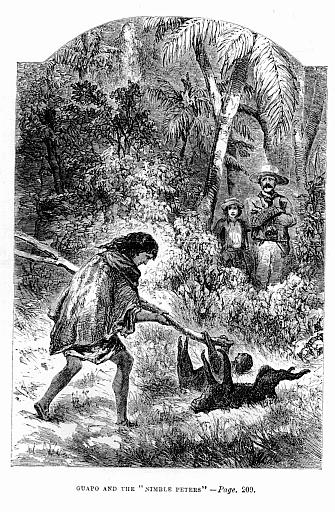
The bark-hunters now continued their route, and shortly after entered a little glade or opening in the forest, about an acre in size. When they had reached the middle of this, Guapo threw his aïs upon the ground and marched on.
“Why do you leave them?” inquired the others.
“No fear for them,” replied Guapo; “they’ll be there when we come back. If I carried them into the woods, they might steal off while we were at work, but it would take them six hours to get to the nearest tree.”
All laughed at this, and went on, leaving the aïs to themselves. Before passing out from the glade, they stopped a moment to look at the great, conical nests of the termites, or white ants, several of which, like soldiers’ tents, stood near the edge of the glade. It was yet early, the air was chilly, and the ants were not abroad; so that, after gazing for a while on these singular habitations, the bark-gatherers pursued their way, and were soon under the shadow of the cinchona-trees.
Chapter Twenty Four.
The Bark-Hunters.
In a few minutes the work began—that work which was to occupy them, perhaps, for several years. The first blow of Guapo’s axe was the signal to begin the making of a fortune. It was followed by many others, until one of the cinchonas lay along the sward. Then Guapo attacked another, as near the root as was convenient for chopping.
Don Pablo’s part of the work now began. Armed with a sharp knife, he made circular incisions round the trunk, at the distance of several feet from each other, and a single longitudinal one intersecting all the others. The branches were also served in a similar way, and then the tree was left as it lay. In three or four days they would return to strip off the bark both from trunk and branches, and this would be spread out under the sun to dry. When light and dry it would be carried to the store-house. So the work went merrily on. The trees were taken as they stood—the very young ones alone being left, as the bark of these is useless for commerce.
The Doña Isidora sat upon a fallen trunk, and, conversing with her husband, watched the proceedings with interest. A new and happy future seemed at no great distance off. Little Leona stood beside Guapo, watching the yellow chips as they flew, and listening to some very fine stories with which Guapo was regaling her. Guapo loved little Leona. He would have risked his life for her, would Guapo, and Leona knew it.
Leon was not particularly engaged on that day. When the bark was ready for peeling he intended to take a hand with the rest. He could then employ himself in spreading it, or could lead the mule in carrying it to the storehouse. Leon did not intend to be idle, but there happened to be no work for him just then; and after watching the bark-cutters for awhile, he sauntered back along the path, in order to have a little fun with the aïs. Leon had no very great confidence that he would find them in the place where they had been left, and yet he believed in Guapo. But it was hard to understand that two animals, each endowed with a full set of legs and feet, should not be able to make their way for a distance of twenty paces, and escape! After the rough handling they had had, too! He would have a peep at them, anyhow, to see how they were coming on. So back he went.
On getting near the glade their voices reached him. They were there, after all! He could hear them utter their pitiful “ay-ee—ay-ee!” and, as he thought, in a louder and more distressing tone than ever. What could be the matter? They had been silent for some time, he was sure, for such cries as they now uttered could have been heard easily where the rest were. What could be the meaning of this fresh outburst? Had some new enemy attacked them? It seemed like enough.
Leon stole forward, and peeped into the glade. No—there was nothing near them! But what was the matter with the creatures? Instead of lying quietly, as they had done when left behind, they were now rolling and tumbling backward and forward, and pitching about, and dancing first on their feet and then on their heads, and cutting all sorts of strange capers! Could it be for their own amusement? No; their lamentable cries precluded that supposition; besides, their odd attitudes and contortions bespoke terror and pain!
“Carrambo!” muttered Leon. “What’s the matter with them?”
They seemed inclined to escape towards the trees; but, after making a few lengths, they would fall to the ground, tumble about, and then, getting up again, head in the opposite direction!
Leon was puzzled,—no wonder. He looked around for a solution of this queer conduct on the part of the aïs. No explanation appeared. At length he bethought himself of going up to them. Perhaps, when nearer, he might learn what set them a-dancing.
“Ha!” he ejaculated, struck with some sudden thought. “I know now; there’s a snake at them.”
This conjecture—for it was only a conjecture—caused him to stop short. It might be some venomous snake, thought he. The grass was not long, and he could have seen a very large snake; but still a small coral snake, or the little poisonous viper, might have been there. He fancied he saw something moving; but to get a better view he passed slowly around the edge of the glade, until he was nearly on the opposite side to that where he had entered. He still kept at a good distance from the aïs, but as yet discovered no snake.
To his great surprise, the aïs now lay stretched along the grass, their struggles appeared each moment to grow less violent, and their melancholy cries became weaker and weaker. Their contortions at length came to an end. A feeble effort to raise themselves alone could be perceived,—then a spasmodic motion of their long crooked limbs,—their cries became indistinct; and, after a while, both lay motionless and silent! Were they dead? Surely so, thought Leon.
He stood gazing at them for some minutes. Not a motion of their bodies could be perceived. Surely they no longer lived! But, then, what could have killed them? There was no snake to be seen; no animal of any kind except themselves! Had they been taken with some sudden disease,—some kind of convulsions that had ended fatally? This seemed the most probable thing, judging from the odd manner in which they had acted. Maybe they had eaten some sort of plant that had poisoned them!
These conjectures passed rapidly through the mind of Leon. Of course, he resolved to satisfy himself as to the cause of their death, if dead they actually were. He began to draw nearer, making his advances with stealth and caution—as he was still apprehensive about the snake.
After he had made a few paces in a forward direction, he began to perceive something moving around the bodies of the animals. Snakes? No. What then? A few paces nearer. See! the whole ground is in motion. The bodies of the aïs, though dead, are covered with living, moving objects! Ha! it is a “chacu” of the white ants.
Leon now comprehended the whole affair. The ground was literally alive with the terrible termites. They had made their foray, or “chacu,” as it is called, from the neighbouring cones; they had attacked the helpless aïs, and put them to death, with their poisonous stings! Already they were tearing them to pieces, and bearing them off to their dark caves! So thick were they on the bodies of the animals, that the latter had suddenly changed their colour, and now appeared to be nothing more than living heaps of crawling insects!
It was a hideous sight to behold, and Leon felt his flesh creep as he looked upon it. Still he felt a curiosity to witness the result, and he stood watching the busy crowd that had gathered about the aïs. He had heard strange accounts of these white ants; how that, in a few minutes, they will tear the carcasses of large animals to pieces, and carry them away to their dens; and he was determined to prove the truth of this by observation. He did not go any nearer, for he was not without some dread of these ugly creatures; but, happening to find himself beside a small tree, with low horizontal branches, he climbed up, and sat down upon one of the branches, resting his feet upon another. He was inclined to take the thing as easily as possible. His perch commanded a full view of the operations of the termites, and for a long time he sat watching them with interest. He could see that it was not the same set that were always on the carcasses of the aïs. On the contrary, one host were always leaving the spot, while another took their places, and from the great conical houses fresh bands appeared to issue. In fact, two great parallel belts of them, like army columns, stretched from the “hills” to the aïs, going in opposite directions. Those which travelled towards the cells presented a very different appearance to the others. These were loaded with pieces of torn flesh, or skin with tufts of hair adhering to it; and each ant carried a piece by far larger than its own body. Their bodies, in fact, were quite hidden under their disproportionate burdens. The others—those which were coming from the conical hills—were empty-handed, and presented the appearance of a whitish stream flowing along the surface of the ground!
It was a most singular sight; and Leon sat watching the creatures until his head was giddy, and he felt as though the ground itself was in motion.
Chapter Twenty Five.
The Puma and the great Ant-Bear.
All at once the attention of the boy was called away from the crawling millions. A rustling among some dead leaves was heard. It appeared to proceed from the edge of the glade, not far from the ant-hills. The branches of the underwood were seen to move, and the next moment a slender cylindrical object, about a foot and a half in length, was protruded out from the leaves. Had there not been a pair of small eyes and ears near the farther end of this cylindrical object, no one would have taken it for the head and snout of an animal. But Leon saw the little sparkling black eyes, and he therefore conjectured that it was some such creature. The next moment the body came into view, and a singular creature it was. It was about the size of a very large Newfoundland dog, though of a different shape. It was covered all over with long brownish hair, part of which looked so coarse as to resemble dry grass or bristles. On each shoulder was a wide stripe of black, bordered with whitish bands; and the tail, which was full three feet long, was clothed with a thick growth of coarse hair, several inches in length, that looked like strips of whalebone. This was carried aloft, and curving over the back. But the most curious feature of the animal was its snout. Talk of the nose of a greyhound. It would be a “pug” in comparison! That of this animal was full twice as long, and not half so thick, with a little mouth not over an inch in size, and without a single tooth! It was certainly the oddest snout Leon had ever seen. The legs, too, were remarkable. They were stout and thick, the hinder ones appearing much shorter than the fore-legs; but this was because the creature in its hind feet was plantigrade, that is, it walked with the whole of its soles touching the surface, which only bears and a few other sorts of quadrupeds do. Its fore-feet, too, were oddly placed upon the ground. They had four long claws upon each, but these claws, instead of being spread out, as in the dog or cat, were all folded backward along the sole, and the creature, to avoid treading on them, actually walked on the sides of its feet! The claws were only used for scraping up the ground, and then it could bring them forward in a perpendicular position, like the blade of a hoe, or the teeth of a garden-rake. Of course, with feet furnished in such an out-of-the-way fashion, the animal moved but slowly over the ground. In fact it went very slowly, and with a stealthy pace.
Although Leon had never seen the creature before, he had read about it, and had also seen pictures of it. He knew it, therefore, at a glance. That proboscis-looking snout was not to be mistaken. It could belong to no other creature than the tamanoir, or great ant-eater, by the people of South America called the ant-bear (Myrmecophaga jubata). It was, in fact, that very thing; but to Leon’s astonishment, as soon as it got fairly out of the bushes, he noticed a singular-looking hunch upon its back, just over the shoulder. At first he could not make out what this was, as he had never heard of such a protuberance, besides, the tail half hid it from his view. All of a sudden the animal turned its head backwards, touched the hunch with its snout, gave itself a shake, and then the odd excrescence fell to the ground, and proved to be a young ant-eater, with bushy tail and long snout, the “very image of its mother.” The large one was thus seen to be a female that had been carrying her infant upon her shoulders.
It was close to one of the ant-hills where the old tamanoir placed her young upon the ground, and turning away from it, she approached the great cone. Erecting herself upon her hind-feet, she stood with the fore ones resting against the hill, apparently examining it, and considering in what part of it the shell or roof was thinnest and weakest. These cones, composed of agglutinated sand and earth, are frequently so stoutly put together that it requires a pickaxe or crowbar to break them open. But the ant-eater knew well that her fore-feet were armed with an implement equal to either pick or crow, and she would certainly have made a hole there and then, had she not noticed, on looking around to the other side, that the inhabitants of the hill were all abroad upon one of their forays. This seemed to bring about a sudden change in her determination, and, dropping her fore-feet to the ground, she once more threw up her great tail, and returned to where she had left her young one. Partly pushing it before her with her snout, and partly lifting it between her strong fore-arms, she succeeded in bringing the latter to the border of the path along which travelled the ants. Here she squatted down, and placed herself so that the point of her nose just touched the selvedge of the swarming hosts, having caused the youngster by her side to do the same. Then throwing out a long worm-like tongue, which glittered with a viscous coating, she drew it back again covered with ants. These passed into her mouth, and thence, of course, into her capacious stomach. The tongue, which was more than a foot in length, and nearly as thick as a quill, was again thrown out, and again drawn back, and this operation she continued, the tongue making about two “hauls” to every second of time! Now and then she stopped eating, in order to give some instructions to the little one that was seen closely imitating her, and with its more slender tongue dealing death among the termites.
So very comic was the sight that Leon could not help laughing at it, as he sat upon his perch.
An end, however, was put to his merriment, by the sudden appearance of another animal—one of a different character. It was a large cat-like creature, of a reddish-yellow, or tawny colour, long body and tail, round head, with whiskers, and bright gleaming eyes. Leon had seen that sort of animal before. He had seen it led in strings by Indians through the streets of Cuzco, and he at once recognised it. It was the Puma—the maneless lion of America.
The specimens which Leon had seen with the Indians had been rendered tame and harmless. He knew that, but he had also been told that the animal in its wild state is a savage and dangerous beast. This is true of the puma in some districts, while in others the creature is cowardly, and will flee at the sight of man. In all cases, however, when the puma is brought to bay, it makes a desperate fight, and both dogs and men have been killed in the attack.
Leon had not been frightened at the tamanoir. Even had it been a savage creature, he knew it could not climb a tree—though there are two smaller species of ant-bears in South America that can—and he therefore knew he was quite safe on his perch. But his feelings were very different when the red body of the puma came in sight. It could run up the smoothest, trunk in the forest with as much ease and agility as a cat, and there would be no chance of escaping from it if it felt disposed to attack him. Of this the boy was fully conscious, and no wonder he was alarmed.
His first thought was to leap down, and make for the cinchona-trees, where the others were; but the puma had entered the glade from that side, and it was therefore directly in his way: he would have run right in its teeth by going toward the cinchona-trees. He next thought of slipping quietly down, and getting into the woods behind him. Unfortunately, the tree on which he was stood out in the glade quite apart from any others, the puma would see him go off, and, of course, could overtake him in a dozen leaps. These thoughts passed through the boy’s mind in a few seconds of time; and in a few seconds of time he was convinced that his best course would be to remain where he was, and keep quiet. Perhaps the puma would not notice him—as yet he had not.
No doubt he would have done so, had there been nothing else on the spot to take off his attention; but just as he came into the open ground, his eyes fell upon the ant-eaters, where they lay squatted and licking up the termites. He had entered the glade in a sort of skulking trot, but the moment he saw the tamanoirs he halted, drew his body into a crouching attitude, and remained thus for some moments, while his long tail oscillated from side to side, as that of a cat when about to spring upon a mouse or a sparrow. Just at this moment the tamanoir, having turned round to address some conversation to her young companion, espied him, and sprang to her feet. She recognised in the puma—as in others of his race—a deadly enemy. With one sweep of her fore-arm she flung the young one behind her, until it rested against the wall of the ant-hill, and then, following in all haste, threw herself into an erect attitude in front of her young, covering it with her body. She was now standing firm upon her hind-feet—her back resting against the mud wall—but her long snout had entirely disappeared! That was held close along her breast, and entirely concealed by the shaggy tail, which for this purpose had been brought up in front. Her defence rested in her strong fore-arms, which, with the great claws standing at right angles, were now held out in a threatening manner. The young one, no doubt aware of some danger, had drawn itself into its smallest bulk, and was clewed up behind her.
The puma dashed forward, open-mouthed, and began the attack. He looked as though he would carry everything by the first assault; but a sharp tear from the tamanoir’s claws drew the blood from his cheek, and although it rendered him more furious, it seemed to increase his caution. In the two or three successive attempts he kept prudently out of reach of these terrible weapons. His adversary held her fore-legs wide open, as though she was desirous of getting the other to rush between them, that she might clutch him, after the manner of the bears. This was exactly what she wanted, and in this consists the chief mode of defence adopted by these animals. The puma, however, seemed to be up to her trick.
This thrust-and-parry game continued for some minutes, and might have lasted longer, had it not been for the young tamanoir. This foolish little creature, who up to that moment was not very sure what the fuss was all about, had the imprudent curiosity to thrust out its slender snout. The puma espied it, and making a dart forward, seized the snout in his great teeth, and jerked the animal from under. It uttered a low squall, but the next moment its head was “crunched” between the muscular jaws of the puma.
The old one now appeared to lose all fear and caution. Her tail fell down. Her long snout was unsheathed from under its protection, and she seemed undecided what to do. But she was not allowed much time to reflect. The puma, seeing the snout, the most vulnerable part, uncovered, launched himself forward like an arrow, and caught hold of it in his bristling fangs. Then having dragged his victim forward, he flung her upon her breast, and mounting rapidly on her back, proceeded to worry her at his pleasure.
Although Leon pitied the poor tamanoir, yet he dared not interfere, and would have permitted the puma to finish his work, but at that moment a sharp pain, which he suddenly felt in his ankle, caused him to start upon his seat, and utter an involuntary scream.
Chapter Twenty Six.
Attack of the White Ants.
Leon looked down to ascertain what had caused him such a sudden pain. The sight that met his eyes made his blood run cold. The ground below was alive and moving. A white stratum of ants covered it on all sides to the distance of several yards. They were ascending the tree! Nay, more; a string of them had already crawled up; the trunk was crowded by others coming after; and several were upon his feet, and legs, and thighs! It was one of these that had stung him!
The fate of the aïs—which he had just witnessed—and the sight of the hideous host, caused him again to scream out. At the same time he had risen to his feet, and was pulling himself up among the upper branches. He soon reached the highest; but he had not been a moment there, when he reflected that it would be no security. The creatures were crawling upwards as fast as they could come.
His next thought was to descend again, leap from the tree, and crushing the vermin under his feet, make for the bark-cutters. He had made up his mind to this course, and was already half-down, when he remembered the puma! In his alarm at the approach of the ants he had quite forgotten this enemy, and he now remembered that it was directly in the way of his intended escape. He turned his eyes in that direction. It was not there! The ant-bears were still upon the ground—the young one dead, and the mother struggling in her last agonies; but no puma!
The boy began to hope that his cries had frightened him off. His hope was short-lived; for on glancing around the glade, he now beheld the fierce brute crouching among the grass, and evidently coming towards him! What was to be done? Would the puma attack him in the tree? Surely he would; but what better would he be on the ground? No better, but worse. At all events he had not time for much reflection, for before two seconds the fierce puma was close to the tree. Leon was helpless—he gave himself up for lost. He could only cry for help, and he raised his voice to its highest pitch.
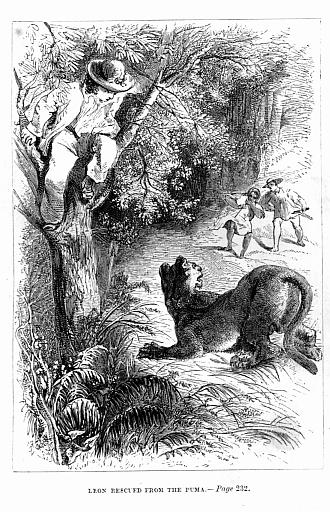
The puma did not spring up the tree at once, as Leon had expected. On the contrary, it crouched round and round with glaring eyes and wagging tail, as if calculating the mode of attack. Its lips were red—stained with the blood of the ant-eaters—and this added to the hideousness of its appearance. But it needed not that, for it was hideous enough at any time.
Leon kept his eyes upon it, every moment expecting it to spring up the tree. All at once he saw it give a sudden start, and at the same instant he heard a hissing noise, as if something passed rapidly through the air. Ha! something sticking in the body of the puma! It is an arrow,—a poisoned arrow! The puma utters a fierce growl—it turns upon itself—the arrow is crushed between its teeth. Another “hist!”—another arrow! Hark! a well-known voice—well-known voices—the voices of Don Pablo and Guapo! See! they burst into the glade—Don Pablo with his axe, and Guapo with his unerring gravatána!
The puma turns to flee. He has already reached the border of the wood; he staggers—the poison is doing its work. Hurrah! he is down; but the poison does not kill him, for the axe of Don Pablo is crashing through his skull. Hurrah! the monster is dead, and Leon is triumphantly borne off on the shoulders of the faithful Guapo!
Don Pablo dragged the puma away, in order that they might get his fine skin. The ant-eaters, both of which were now dead, he left behind, as he saw that the termites were crawling thickly around them, and had already begun their work of devastation. Strange to say, as the party returned that way, going to dinner, not a vestige remained either of the aïs or the ant-eaters, except a few bones and some portions of coarse hair. The rest of all these animals had been cleared off by the ants, and carried into the cells of their hollow cones!
It was, no doubt, the noise of the bark-hunters that had started the ant-eaters abroad, for these creatures usually prowl only in the night. The same may have aroused the fierce puma from his lair, although he is not strictly a nocturnal hunter.
A curious incident occurred as they approached the glade on their way home. The male tamanoir was roused from his nest among the dry leaves, and Guapo, instead of running upon him and killing the creature, warned them all to keep a little back, and he would show them some fun. Guapo now commenced shaking the leaves, so that they rattled as if rain was falling upon them. At this the ant-eater jerked up its broad tail, and appeared to shelter itself as with an umbrella! Guapo then went towards it, and commenced driving it before him just as if it had been a sheep or goat, and in this manner he took it all the way to the house. Of course Guapo took care not to irritate it; for, when that is done, the ant-eater will either turn out of his way or stop to defend itself.
The tamanoir is not so defenceless a creature as might at first sight be imagined by considering his small toothless mouth and slow motions. His mode of defence is that which has been described, and which is quite sufficient against the tiger-cat, the ocelot, and all the smaller species of feline animals. No doubt the old female would have proved a match for the puma had she not been thrown off her guard by his seizing upon her young. It is even asserted that the great ant-bear sometimes hugs the jaguar to death; but this I believe to be a mistake, as the latter is far too powerful and active to be thus conquered. Doubtless the resemblance of the jaguar to some of the smaller spotted cats of these countries, leads to a great many misconceptions concerning the prowess of the American tiger.
Besides the tamanoir there are two, or perhaps three, other species of ant-bears in the forests of South America. These, however, are so different in habits and appearance, that they might properly be classed as a separate genus of animals. They are tree-climbers, which the tamanoir is not, spite of his great claws. They pursue the ants that build their nests upon the high branches, as well as the wasps and bees; and to befit them for this life, they are furnished with naked prehensile tails, like the opossums and monkeys. These are characteristics entirely distinct from those of the Myrmecophaga jubata, or great ant-eater.
One of these species is the tamandua, called by the Spano-Americans Osso hormiguero (ant-bear). The tamandua is much less than the tamanoir, being only three and a half feet in length, while the latter is over seven. The former is of a stouter build, with neither so long a snout in proportion, nor such claws. The claws, moreover, are made for tree-climbing, and are not so much in the way when the animal walks on the ground. It is, therefore, a more active creature, and stands better upon its limbs. Its fur is short and silky, but the tail is nearly naked, and, as already stated, highly prehensile, although it does not sleep hanging by the tail as some other animals do.
The tamandua is usually of a dull straw-colour, although it varies in this respect, so that several species have been supposed to exist. It spends most of its time upon the trees; and in addition to its ant-diet, it feeds upon wild honey, and bees too, whenever it can catch them. The female, like the tamanoir, produces only one young at a birth, and like the other species, carries it upon her back until it is able to provide for itself. The tamandua has sometimes been called tridactyla, or the “three-toed ant-eater,” because it has only three claws upon each of its fore-feet, whereas the tamanoir is provided with four.
Another species of “ant-bear,” differing from both in size and in many of its habits, is the “little ant-eater” (Myrmecophaga didactyla). This one has only two claws on each fore-foot, hence its specific name. It is a very small creature—not larger than the common grey squirrel—with a prehensile tail like the tamandua. The tail, however, is not entirely naked—only on the under side near the point. It is not so good a walker as the three-toed kind, though more active on its feet than the tamanoir. Standing upon its hind-feet, and supporting itself also by the tail—which it has already thrown around some branch—the little ant-eater uses its fore-feet as hands to carry food to its mouth. It lives among the trees, and feeds upon wasps, bees, and especially the larvae of both; but it does not use the tongue to any great extent. It is, on this account, an essentially different sort of animal.
The little ant-eater is usually of a bright yellow colour, brownish on the back; but there are many varieties in this respect, and some are of a snowy whiteness. Its fur is soft and silky, sometimes slightly curled or matted at the points, and the tail fur is annulated, or ringed, with the prevailing colours of the body.
So much for the ant-bears of America.
Chapter Twenty Seven.
The Ant-Lion.
Ants are disagreeable insects in any country, but especially so in warm tropical climates. Their ugly appearance, their destructive habits, but, above all, the pain of their sting, or rather bite—for ants do not sting as wasps, but bite with the jaws, and then infuse poison into the wound—all these render them very unpopular creatures. A superficial thinker would suppose that such troublesome insects could be of no use, and would question the propriety of Nature in having created them. But when we give the subject a little attention, we find that they were not created in vain. Were it not for these busy creatures, what would become of the vast quantities of decomposing substances found in some countries? What would be done with the decaying vegetation and the dead animal matter? Why, in many places, were it not consumed by these insects, and reorganised into new forms of life, it would produce pestilence and death; and surely these are far more disagreeable things than ants.
Of ants there are many different kinds; but the greatest number of species belong to warm countries, where, indeed, they are most useful. Some of these species are so curious in their habits, that whole volumes have been written about them, and naturalists have spent a lifetime in their study and observation. Their social and domestic economy is of the most singular character, more so than that of the bees; and I am afraid here to give a single trait of their lives, lest I should be led on to talk too much about them. I need only mention the wonderful nests or hills which some species build—those great cones of twenty feet in height, and so strong that wild bulls run up their sides and stand upon their tops without doing them the least injury! Others make their houses of cylindrical form, rising several feet from the surface. Others, again, prefer nesting in the trees, where they construct large cellular masses of many shapes, suspending them from the highest branches; while many species make their waxen dwellings in hollow trunks, or beneath the surface of the earth. There is not a species, however, whose habits, fully-observed and described, would not strike you with astonishment. Indeed, it is difficult to believe all that is related about these insects by naturalists who have made them their study. One can hardly understand how such little creatures can be gifted with so much intelligence, or instinct, as some choose to call it.
Man is not the only enemy of the ants. If he were so, it is to be feared that these small insignificant creatures would soon make the earth too hot for him. So prolific are they, that if left to themselves our whole planet would, in a short period, become a gigantic ants’ nest?
Nature has wisely provided against the over increase of the ant family. No living thing has a greater variety of enemies than they. In all the divisions of animated nature there are ant-destroyers—ant-eaters! To begin with the mammalia, man himself feeds upon them—for there are tribes of Indians in South America, the principal part of whose food consists of dried termites, which they bake into a kind of “paste!” There are quadrupeds that live exclusively on them, as the ant-bear already described, and the pangolins, or scaly ant-eaters of the Eastern continent. There are birds, too, of many sorts that devour the ants; and there are even some who make them exclusively their food, as the genus Myothera, or “ant-catchers.” Many kinds of reptiles, both snakes and lizards, are ant-eaters; and, what is strangest of all, there are insects that prey upon them!
No wonder, then, with such a variety of enemies that the ants are kept within proper limits, and are not allowed to overrun the earth.
The observations just made are very similar to those that were addressed by Doña Isidora to the little Leona, one day when they were left alone. The others had gone about their usual occupation of bark-cutting, and these, of course, remained at home to take care of the house and cook the dinner. That was already hanging over a fire outside the house; for in these hot countries it is often more convenient to do the cooking out-of-doors.
Doña Isidora, busy with some sewing, was seated under the shadow of the banana-trees, and the pretty little Leona was playing near her. Leona had been abusing the ants, partly on account of their having so frightened Leon, and partly because one of the red species had bitten herself the day before; and it was for this reason that her mother had entered into such explanations regarding these creatures, with a view of exculpating them from the bitter accusations urged against them by Leona. Talking about ants very naturally led them to cast their eyes to the ground to see if any of the creatures were near; and sure enough there were several of the red ones wandering about. Just then the eyes of Doña Isidora rested upon a very different insect, and she drew the attention of her daughter to it. It was an insect of considerable size, being full an inch in length, with an elongated oval body, and a small flat head. From the head protruded two great horny jaws, that bore some resemblance to a pair of calliper compasses. Its legs were short and very unfitted for motion. Indeed they were not of much use for that purpose, as it could make very little way on them, but crawled only sidewards, or backwards, with great apparent difficulty. The creature was of a greyish or sand colour; and in the sand, where it was seated, it might not have been observed at all had not the lady’s eyes been directed upon the very spot. But Doña Isidora, who was a very good entomologist, recognised it; and, knowing that it was a very curious insect, on this account called the attention of her daughter to it.
“What is it, mamma?” inquired the little Leona, bending forward to examine it.
“The ant-lion.”
“The ant-lion! Why, mamma, it is an insect! How then can it be called lion?”
“It is a name given it,” replied the lady, “on account of its fierce habits, which, in that respect, assimilate it to its powerful namesake,—the king of the beasts; and, indeed, this little creature has more strength and ferocity in proportion to its size than even the lion himself.”
“But why the ant-lion, mamma?”
“Because it preys principally on ants. I have said there are insect ant-eaters. This is one of them.”
“But how can such a slow creature as that get hold of them? Why the ants could crawl out of its way in a moment!”
“That is true. Nevertheless it manages to capture as many as it requires. Remember ‘the ace is not always to the swift.’ It is by stratagem it succeeds in taking its prey—a very singular stratagem too. If you will sit back and not frighten it, I have no doubt it will soon give you an opportunity of seeing how it manages the matter.”
Leona took a seat by the side of her mother. They were both at just such a distance from the ant-lion that they could observe every movement it made; but for a considerable time it remained quiet; no doubt, because they had alarmed it. In the interval Doña Isidora imparted to her daughter some further information about its natural history.
“The ant-lion (Myrmeleori),” said she, “is not an insect in its perfect state, but only the larva of one. The perfect insect is a very different creature, having wings and longer legs. It is one of the neuropterous tribe, or those with nerved wings. The wings of this species rest against each other, forming a covering over its body, like the roof upon a house. They are most beautifully reticulated like the finest lace-work, and variegated with dark spots, that give the insect a very elegant appearance. Its habits are quite different to those which it follows when a larva, or in that state when it is the ant-lion. It flies but little during the day, and is usually found quietly sitting amongst the leaves of plants, and seems to be one of the most pacific and harmless of insects. How very different with the larva—the very reverse—See!”
Doña Isidora pointed to the ant-lion that was just then beginning to bestir itself, and both sat silent regarding it attentively.
First, then, the little creature going backwards, and working with its callipers, traced a circle on the surface of the sand. This circle was between two and three inches in diameter. Having completed it, it now commenced to clear out all the sand within the circle. To accomplish this, it was seen to scrape up the sand with one of its fore-feet, and shovel a quantity of it upon its flat head; then, giving a sudden jerk of the neck, it pitched the sand several inches outside the traced circumference. This operation it repeated so often, and so adroitly, that in a very short time a round pit began to show itself in the surface of the ground. Wherever it encountered a stone, this was raised between its callipers and pitched out beyond the ring. Sometimes stones occurred that were too large to be thrown out in this way. These it managed to get upon its back, and, then crawling cautiously up the sides of the pit, it tumbled them upon the edge and rolled them away. Had it met with a stone so large as to render this impossible, it would have left the place, and chosen another spot of ground. Fortunately this was not the case, and they had an opportunity of watching the labour to its conclusion.
For nearly an hour they sat watching it—of course not neglecting their other affairs—and, at the end of that time, the ant-lion had jerked out so much sand, that a little funnel-shaped pit was formed nearly as deep as it was wide. This was its trap, and it was now finished and ready for action.
Having made all its arrangements, it had nothing more to do than remain at the bottom of the pit and wait patiently until some unfortunate ant should chance to come that way and fall in; and where these insects were constantly wandering over the ground, such an accident would, sooner or later, be certain to take place.
Lest the ant should peep into the pit, discover its hideous form below, and then retreat, this ant-lion had actually the cunning to bury its body in the sand, leaving only a small portion of its head to be seen.
Both Doña Isidora and the little Leona remained watching with increased interest. They were very anxious to witness the result. They were not kept long in suspense. I have already stated that many ants were crawling about. There were dozens of them “quartering” the ground in every direction in search of their own prey; and they left not an inch of it unsearched. At last one was seen to approach the trap of the ant-lion. Curiosity brings it to the very edge of that terrible pit-fall. It protrudes its head and part of its body over the brink—it is not such a terrible gulf to look into—if it should slip down, it could easily crawl out again. Ha! it little knows the enemy that is ambushed there. It perceives something singular—an odd something—perhaps it might be something good to eat. It is half-resolved to slide down and make a closer examination of this something. It is balancing on the brink, and would, no doubt, have gone down voluntarily, but that is no longer left to its own choice. The mysterious object at the bottom of the funnel suddenly springs up and shows itself—it is the ant-lion in all its hideous proportions; and before the little ant can draw itself away, the other has flung around it a shower of sand that brings it rolling down the side of the pit. Then the sharp callipers are closed upon the victim—all the moisture in his body is sucked out—and his remains, now a dry and shapeless mass, are rested for a moment upon the head of the destroyer, and then jerked far outside the pit!
The ant-lion now dresses his trap, and, again burying himself in the sand, awaits another victim.
Chapter Twenty Eight.
The Tatou-Poyou and the Deer Carcass.
Doña Isidora and Leona had watched all the manoeuvres of the ant-lion with great interest, and Leona, after the bite she had had, was not in any mood to sympathise with the ants. Indeed, she felt rather grateful to the ant-lion, ugly as he was, for killing them.
Presently Leon returned from the woods, and was shown the trap in full operation; but Leon, upon this day, was full of adventures that had occurred upon the hills to himself, Guapo, and Don Pablo. In fact, he had hastened home before the others to tell his mamma of the odd incidents to which he had been a witness.