"The Forest Exiles" (continued 4)
Reading edition
That morning they had discovered a new mancha of cinchona-trees. When proceeding towards them they came upon the dead carcass of a deer. It was a large species, the Cervus antisensis, but, as it had evidently been dead several days, it was swollen out to twice its original size, as is always the case with carcasses of animals left exposed in a warm climate. It was odd that some preying animals had not eaten it up. A clump of tall trees that shaded it, had, no doubt, concealed it from the sharp sight of the vultures, and these birds, contrary to what has so often been alleged, can find no dead body by the smell. Neither ants nor animals that prey upon carrion had chanced to come that way, and there lay the deer intact.
So thought Don Pablo and Leon. Guapo, however, was of a different opinion, and, going up to the body, he struck it a blow with his axe. To the surprise of the others, instead of the dead sound which they expected to hear, a dry crash followed the blow, and a dark hole appeared where a piece of thin shell-like substance had fallen off. Another blow from Guapo’s axe, and the whole side went in. Not a bit of carcass was there; there were bones—clean bones—and dry hard skin, but no flesh, not an atom of flesh!
“Tatou-poyou!” quietly remarked Guapo.
“What!” said Don Pablo, “an armadillo, you think?” recognising, in Guapo’s words, the Indian name for one of the large species of armadillos.
“Yes,” replied Guapo. “All eaten by the tatou-poyou. See! there’s his hole.”
Don Pablo and Leon bent over the sham carcass, and, sure enough, under where its body had been they could see a large hole in the ground. Outside the carcass, also, at the distance of several feet was another.
“That is where he entered,” said Guapo, pointing to the second. “He’s not about hero now,” continued he, “no, no,—ate all the meat, and gone long ago.”
This was evident, as the hollow skeleton was quite dry, and had evidently been empty for a good while.
Don Pablo was pleased at this incident, as it gave him an opportunity of verifying a curious habit of the armadillos. These creatures are among the finest burrowers in the world, and can bury themselves in the earth in a few seconds’ time; but, being badly toothed,—some of them altogether without teeth,—they can only feed upon very soft substances. Putrid flesh is with them a favourite “dish,” and in order to get at the softest side of a carcass, they burrow under, and enter it from below, rarely leaving their horrid cave until they have thoroughly cleared it out.
The bark-hunters now passed on, Don Pablo making many inquiries about the armadillos, and Guapo giving replies, while Leon listened with interest. Guapo knew a good deal about these curious creatures, for he had eaten many a dozen of them in his time, and as many different kinds of them too. Their feeding upon carrion had no effect on Guapo’s stomach, and, indeed, white people in South America relish them as much as Indians. The white people, however, make a distinction in the species, as they suppose some kinds to be more disposed to a vegetable diet than others. There are some in the neighbourhood of the settlements, that occasionally pay a visit to the graveyards or cemeteries, and these kinds do not go down well. All of them will devour almost any sort of trash that is soft and pulpy, and they are more destructive to the ant than even the ant-eaters themselves. How so? Because, instead of making a nice little hole in the side of the ant-hill, as the tamanoirs do, and through this hole eating the ants themselves, the armadillos break down a large part of the structure and devour the larva. Now the ants love these larva more than their own lives, and when these are destroyed, they yield themselves up to despair, refuse to patch up the building, the rain gets in, and the colony is ruined and breaks up.
It does not follow, however, that the flesh of the armadillo should be “queer” because the animal itself eats queer substances. Among carnivorous creatures the very opposite is sometimes the truth; and some animals—as the tapir, for instance—that feed exclusively on sweet and succulent vegetables, produce a most bitter flesh for themselves. About this there is no standing law either way.
The flesh of the armadillo is excellent eating, not unlike young pork, and, when “roasted in the shell” (the Indian mode of cooking it), it is quite equal, if not superior, to a baked “pig,” a dish very much eaten in our own country.
Guapo did not call them armadillos—he had several Indian names for different kinds of them. “Armadillo” is the Spanish name, and signifies the “little armed one,” the diminutive of “armado” or “armed.” This name is peculiarly appropriate to these animals, as the hard bony casing which covers the whole upper parts of their bodies, bears an exceeding resemblance to the suits of plate armour worn in the days of Cortez and chivalry.
On the head there is the helmet, the back is shielded by a corslet, and even the limbs are covered with greaves. Of course, this armour is arranged differently in the different species, and there is more or less hair upon all, between the joinings of the plates.
These points were not touched upon by Guapo, but others of equal interest were. He went on to say that he knew many different kinds of them;—some not bigger than a rat, and some as large as a full-grown sheep; some that were slow in their paces, and others that could outrun a man; some that were flat, and could squat so close as hardly to be seen against the ground,—(these were tatou-poyous, the sort that had hollowed out the deer); and some again that were high-backed and nearly globe-shaped. Such was Guapo’s account of these curious animals which are found only in the warmer regions of North and South America.
Chapter Twenty Nine.
An Armadillo Hunt.
Conversing in this way, the bark-hunters, at length, reached the cinchona-trees, and then all talk about armadillos was at an end. They went lustily to their work—which was of more importance—and, under Guapo’s axe, several of the cinchonas soon “bit the dust.”
There was a spot of open ground just a little to one side of where these trees stood. They had noticed, on coming up, a flock of zamuros, or black vultures, out upon this ground, clustered around some object. It was the carcass of another deer. The first blow of the axe startled the birds, and they flapped a short way off. They soon returned, however, not being shy birds, but the contrary.
There was nothing in all this to create surprise, except, perhaps, the dead deer. What had been killing these animals? Not a beast of prey, for that would have devoured them, unless, indeed, it might be the puma, that often kills more than he can eat.
The thought had occurred to Don Pablo that they might have died from the poisoned arrows of an Indian. This thought somewhat disquieted him, for he knew not what kind of Indians they might be,—they might be friendly or hostile;—if the latter, not only would all his plans be frustrated, but the lives of himself and party would be in danger. Guapo could not assure him on this head; he had been so long absent from the Great Montaña that he was ignorant of the places where the tribes of these parts might now be located. These tribes often change their homes. He knew that the Chunchos sometimes roamed so far up, and they were the most dangerous of all the Indians of the Montaña,—haters of the whites, fierce and revengeful. It was they who several times destroyed the settlements and mission stations. If Chunchos were in the woods they might look out for trouble. Guapo did not think there were any Indians near. He would have seen some traces of them before now, and he had observed none since their arrival. This assurance of the knowing Indian quite restored Don Pablo’s confidence, and they talked no longer on the subject. After a while, their attention was again called to the vultures. These filthy creatures had returned to the deer, and were busily gorging themselves, when, all at once, they were seen to rise up as if affrighted. They did not fly far,—only a few feet,—and stood with outstretched necks looking towards the carrion, as if whatever had frightened them was there.
The bark-hunters could perceive nothing. It was the body of a small deer, already half eaten, and no object bigger than a man’s hand could have been concealed behind it. The zamuros, however, had seen something strange—else they would hardly have acted as they did—and, with this conviction, the bark-hunters stopped their work to observe them.
After a while the birds seemed to take fresh courage, hopped back to the carrion, and recommenced tearing at it. In another moment they again started and flew back, but, this time, not so far as before, and then they all returned again, and, after feeding another short while, started back a third time.
This was all very mysterious, but Guapo, guessing what was the matter, solved the mystery by crying out—
“Tatou-poyou!”
“Where?” inquired Don Pablo.
“Yonder, master,—yonder in the body of the beast.”
Don Pablo looked, and, sure enough, he could see something moving; it was the head and shoulders of an armadillo. It had burrowed and come up through the body of the deer, thus meeting the vultures half-way! No doubt, it was the mysterious mode by which it had entered on the stage that had frightened them.
They soon, however, got over their affright, and returned to their repast.
The armadillo—a very large one—had, by this time, crept out into the open air, and went on eating.
For a while the zamuros took no heed of him, deeming, perhaps, that, although he had come in by the back-door, he might have as good a right upon the premises as themselves. Their pacific attitude, however, was but of short duration; something occurred to ruffle their temper—some silent affront, no doubt,—for the bark-hunters heard nothing. Perhaps the tatou had run against the legs of one, and scraped it with the sharp edge of his corslet. Whether this was the cause or no, a scuffle commenced, and the beast in armour was attacked by all the vultures at once.
Of course he did not attack in turn, he had no means; he acted altogether on the defensive; and this he was enabled to do by simply drawing in his legs and flattening himself upon the ground. He was then proof, not only against the beaks and weak talons of a vulture, but he might have defied the royal eagle himself.
After flapping him with their wings, and pecking him with their filthy beaks, and clawing him with their talons, the zamuros saw it was all to no purpose, and desisted. If they could not damage him, however, they could prevent him from eating any more of the deer; for the moment he stretched out his neck, several vultures sprang at him afresh, and would have wounded him in the tender parts of his throat had he not quickly drawn in his head again. Seeing that his feast was at an end—at least above ground,—he suddenly raised his hind-quarters, and in a brace of seconds buried himself in the earth. The vultures pecked him behind as he disappeared, but the odd manner of his exit, like that of his entrée, seemed to mystify them, and several of them stood for some moments in neck-stretched wonder.
This scene had scarcely ended when a pair of fresh armadillos were espied, coming from the farther edge of the opening, and, in fact, from the edge of a precipice, for the river flowed close by, and its channel was at that point shut in by cliffs. These two were large fellows, and were making speedily towards the carrion, in order to get up before it was all gone. Guapo could stand it no longer Guapo had tasted roast armadillo, and longed for more. In an instant, therefore, axe in hand, he was off to intercept the new comers. Don Pablo and Leon followed to see the sport and assist in the capture.
The armadillos, although not afraid of the vultures, seeing the hunters approach, turned tail and made for the precipice. Guapo took after one, while Don Pablo and Leon pursued the other. Guapo soon overhauled his one, but, before he could lay his hands upon it, it had already half buried itself in the dry ground. Guapo, however, seized the tail and held on; and, although not able to drag it out, he was resolved it should get no deeper.
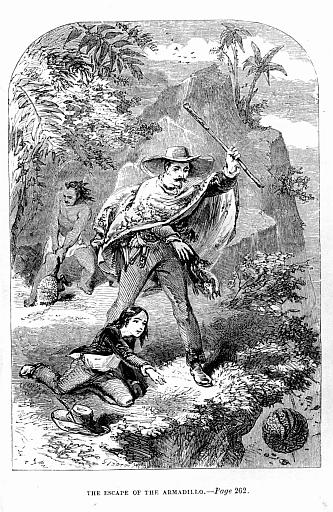
The one pursued by Don Pablo had got close to the edge of the precipice, before either he or Leon could come up with it. There it stood for a moment, as if in doubt what plan to pursue. Don Pablo and Leon were congratulating themselves that they had fairly “cornered” it, for the cliff was a clear fall of fifty feet, and, of course, it could get no farther in that direction, while they approached it from two sides so as to cut off its retreat. They approached it with caution, as they were now near the edge, and it would not do to move too rashly. Both were bent forward with their arms outstretched to clutch their prey; they felt confident it was already in their grasp. Judge their astonishment, then, at seeing the creature suddenly clew itself into a round ball, and roll over the cliff!
They looked below. They saw it upon the ground; they saw it open out again, apparently unharmed, for, the next moment, it scuttled off and hid itself among the rocks by the edge of the water!
They turned toward Guapo, who was still holding his one by the tail, and calling for help. Although it was but half buried, all three of them could not have dragged it forth by the tail. That member would have pulled out before the animal could have been dislodged; and such is not an unfrequent occurrence to the hunters of the armadillo. Don Pablo, however, took hold of the tail and held fast until Guapo loosened the earth with his axe, and then the creature was more easily “extracted.” A blow on its head from Guapo made all right, and it was afterwards carried safely to the house, and “roasted in the shell.”
That was a great day among the “armadillos.”
Chapter Thirty.
The Ocelot.
During the whole summer, Don Pablo, Guapo, and Leon, continued bark-gathering. Every day they went out into the woods, excepting Sunday of course. That was kept as a day of rest; for, although far from civilised society, there was not the less necessity for their being Christians. God dwells in the wilderness as well as in the walled city, and worship to Him is as pleasing under the shadow of the forest leaves, as with sounding organ beneath the vaulted dome of the grand cathedral.
During week-days, while the others were abroad, Doña Isidora and the little Leona were not idle at home; yet their whole time was not taken up by the mere concerns of the cuisine. They had an industry of their own, and, in fact, one that promised to be almost as profitable in its results as the bark-gathering. This was neither more nor less than preparing vanilla.
Some days after arriving in the valley, while exploring a wood that lay at the back of the cultivated ground, Don Pablo discovered that every tree carried a creeper or parasite of a peculiar kind. It was a small creeper not unlike ivy, and was covered with flowers of a greenish-yellow colour, mixed with white. Don Pablo at once recognised in this parasitical plant one of the many species of llianas that produce the delicious and perfumed vanilla. It was, in fact, the finest of the kind—that which, among the French, is called leq vanilla; and, from the fact that every tree had a number of these parasites, and no other climbing vines, Don Pablo came to the conclusion that they had been planted by the missionaries. It is thus that vanilla is usually cultivated, by being set in slips at the root of some tree which may afterwards sustain it.
In the course of the summer, these vanilla vines exhibited a different appearance. Instead of flowers, long bean-like capsules made their appearance. These capsules or pods were nearly a foot in length, though not much thicker than a swan’s quill. They were a little flattish, wrinkled, and of a yellow colour, and contained inside, instead of beans, a pulpy substance, surrounding a vast quantity of small seeds, like grains of sand. These seeds are the perfumed vanilla so much prized, and which often yield the enormous price of fifty dollars a pound! To preserve these, therefore, was the work of Doña Isidora and Leona; and they understood perfectly how to do it.
First, they gathered the pods before they were quite ripe. These they strung upon a thread, taking cane to pass the thread through that end nearest the foot-stalk. The whole were next plunged for an instant into boiling water, which gave them a blanched appearance. The thread was then stretched from tree to tree, and the pods, hanging like a string of candles, were then exposed to the sun for several hours. Next day, they were lightly smeared with an oiled feather, and then wrapped in oiled cotton of the Bombax ceiba, to prevent the valves from opening. When they had remained in this state for a few days, the string was taken out, and passed through the other ends, so that they should hang in an inverted position. This was to permit the discharge of a viscid liquid from the foot-stalk end; and in order to assist this discharge, the pods were several times lightly pressed between the fingers. They now became dry and wrinkled. They had also shrunk to less than half their original size, and changed their colour to a reddish-brown. Another delicate touch of the oil-feather, and the vanilla was ready for the market. Nothing remained but to pack them in small cases, which had already been prepared from the leaf of a species of palm-tree.
In such a way did the lady Isidora and her daughter pass their time; and before the summer was out they had added largely to the stock of wealth of our exiles.
Although these two always remained by the house, they were not without their adventures as well, one of which I shall describe. It occurred while they were getting in their crop of vanilla. Leona was in the porch in front, busy among the vanilla-beans. She had a large needle and a thread of palm-leaf fibre, with which she was stringing the long pods, while her mother was inside the house packing some that had been already dried.
Leona rested for a moment, and was looking over the water, when, all at once, she exclaimed, “Maman—Maman! come out and see! oh! what a beautiful cat!”
The exclamation caused Doña Isidora to start, and with a feeling of uneasiness. The cause of her uneasiness was the word “cat.” She feared that what the innocent child had taken for a “beautiful cat” might prove to be the dreaded jaguar. She ran at once out of the door, and looked in the direction pointed out by Leona. There, sure enough, on the other side of the water, was a spotted creature, looking in the distance, very much like a cat; but Doña Isidora saw at a glance that it was a far larger animal. Was it the jaguar? It was like one, in its colour and markings. It was of a yellowish colour, and covered all over with black spots, which gave it the semblance of the jaguar. Still Doña Isidora thought that it was not so large as these animals usually are; and this, to some extent, restored her confidence. When first seen, it was close down to the water’s edge, as if it had come there to drink; and Doña Isidora was in hopes that, after satisfying its thirst, it would go away again. What was her consternation to see it make a forward spring, and, plunging into the water, swim directly for the house!
Terrified, she seized Leona by the hand, and retreated inside. She shut the door, and bolted it. If it were a jaguar, what protection would that be? Such a creature could dash itself through the frail bamboo wall, or tear the door to pieces with his great claws in a moment. “If it be a jaguar,” thought she, “we are lost!”
Doña Isidora was a woman of courage. She was determined to defend the lives of herself and daughter to the last. She looked around the house for a weapon. The pistols of Don Pablo were hanging against the wall. She knew they were loaded. She took them down, and looked to the flints and priming, and then stationed herself at a place where she could see out through the interstices of the bamboos. The little Leona kept by her side, though she knew, that in a struggle with a ferocious jaguar, she could give no help.
By this time the animal had crossed the river, and she could see it spring out on the bank, and come on towards the house. In a few seconds it was close to the porch, where it halted to reconnoitre. Doña Isidora saw it very plainly, and would now have had a very good chance to fire at it; but she did not wish to begin the combat. Perhaps it might go away again, without attempting to enter the house. In order not to draw its attention, she stood perfectly quiet, having cautioned Leona to do the same.
It was not a large animal, though its aspect was fierce enough to terrify any one. Its tiger-like eyes, and white teeth, which it showed at intervals, were anything but pleasant to look upon. Its size, however, was not so formidable; and Doña Isidora had understood the jaguar to be a large animal; but there is also a smaller species of jaguar. This might be the one.
After halting a moment, the creature turned to one side, and then proceeded at a skulking trot around the house. Now and then it stopped and looked toward the building, as if searching for some aperture by which it might get in. Doña Isidora followed it round on the inside. The walls were so open that she could mark all its movements; and, with a pistol in each hand, she was ready for the attack, determined to fire the moment it might threaten to spring against the bamboos.
On one side of the house, at a few paces distance, stood the mule. The horse had been taken to the woods, and the mule was left alone. This animal was tied to a tree, which shaded her from the sun. As soon as the fierce creature got well round the house, it came in full view of the mule, which now claimed its attention. The latter, on seeing it, had started, and sprung round upon her halter, as if badly terrified by the apparition.
Whether the beast of prey had ever before seen a mule was a question. Most likely it had not; for, half-innocently, and half as if with the intention of making an attack, it went skulking up until it was close to the heels of the latter. It could not have placed itself in a better position to be well kicked; and well kicked it was, for, just at that moment, the mule let fling with both her heels, and struck it upon the ribs. A loud “thump” was heard by those within the house, and Doña Isidora, still watching through the canes, had the satisfaction to see the spotted creature take to its heels, and gallop off as if a kettle had been tied to its tail! It made no stop, not even to look back; but having reached the edge of the water, plunged in, and swam over to the opposite shore. They could see it climb out on the other side, and then, with a cowed and conquered look, it trotted off, and disappeared among the palm-trees.
Doña Isidora knew that it was gone for good; and having now no further fear, went on with her work as before. She first, however, carried out a large measure of the murumuru nuts, and gave them to the mule, patting the creature upon the nose, and thanking her for the important service she had rendered.
When Don Pablo and the rest returned, the adventure was, of course, related; but from the description given of the animal, neither Don Pablo nor Guapo believed it could have been the jaguar. It was too small for that. Besides, a jaguar would not have been cowed and driven off by a mule. He would more likely have killed the mule, and dragged its body off with him across the river, or perhaps have broken into the house, and done worse.
The animal was, no doubt, the “ocelot,” which is also spotted, or rather marked with the eye-like rosettes which distinguish the skin of the jaguar. Indeed, there are quite a number of animals of the cat genus in the forests of the Montaña; some spotted like the leopard, others striped as the tiger, and still others of uniform colour all over the body. They are, of course, all preying animals, but none of them will attack man, except the jaguar and the puma. Some of the others, when brought to bay, will fight desperately, as would the common wild cat under like circumstances; but the largest of them will leave man alone, if unmolested themselves. Not so with the jaguar, who will attack either man or beast, and put them to death, unless he be himself overpowered.
The jaguar, or, as he is sometimes called, “ounce” (Felis onça), and by most Spanish-Americans “tiger,” is the largest and most ferocious of all the American Felidae. He stands third in rank as to these qualities—the lion and tiger of the Eastern continent taking precedence of him. Specimens of the jaguar have been seen equal in size to the Asiatic tiger; but the average size of the American animal is much less. He is strong enough, however, to drag a dead horse or ox to his den—often to a distance of a quarter of a mile—and this feat has been repeatedly observed.
The jaguar is found throughout all the tropical countries of Spanish America, and is oftener called tiger (tigre) than jaguar. This is a misapplied name; for although he bears a considerable likeness to the tiger, both in shape and habits, yet the markings of his skin are quite different. The tiger is striated or striped, while the black on the jaguar is in beautiful eye-like rosettes. The leopard is more like the jaguar than any other creature; and the panther and cheetah of the Eastern continent also resemble him. The markings of the jaguar, when closely examined, differ from all of these. The spots on the animals of the old world are simple spots or black rings, while those of the American species are rings with a single spot in the middle, forming ocellae, or eyes. Each, in fact, resembles a rosette.
Jaguars are not always of the same colour. Some have skins of an orange yellow, and these are the most beautiful. Others are lighter-coloured; and individuals have been killed that were nearly white. But there is a “black jaguar,” which is thought to be of a different species. It is larger and fiercer than the other, and is found in the very hottest parts of the Great Montaña. Its skin is not quite jet-black, but of a deep maroon brown; and upon close inspection, the spots upon it can be seen of a pure black. This species is more dreaded by the inhabitants of those countries than the other; and it is said always to attack man wherever it may encounter him.
In the forests of South America, the jaguar reigns with undisputed sway. All the other beasts fear, and fly from him. His roar produces terror and confusion among the animated creation, and causes them to fly in every direction. It is never heard by the Indian without some feeling of fear,—and no wonder; for a year does not pass without a number of these people falling victims to the savage ferocity of this animal.
There are those, however, among them who can deal single-handed with the jaguar,—regular “jaguar-hunters” by profession,—who do not fear to attack the fierce brute in his own haunts. They do not trust to fire-arms, but to a sharp spear. Upon this they receive his attack, transfixing the animal with unerring aim as he advances. Should they fail in their first thrust, their situation is one of peril; yet all hope is not lost. On their left arm they carry a sort of sheepskin shield. This is held forward, and usually seized by the jaguar; and while he is busy with it, the hunter gains time for a second effort, which rarely fails to accomplish his purpose.
The jaguars are killed for many reasons. Their beautiful skins sell for several dollars; besides, in many places a price is set upon their heads, on account of their destructive habits. Thousands are destroyed every year. For all this, they do not seem to diminish in numbers. The introduction of the large mammalia into America has provided them with increased resources; and in many places, where there are herds of half-wild cattle, the number of the jaguars is said to be greater than formerly. It is difficult for one, living in a country where such fierce animals are unknown, to believe that they may have an influence over man to such an extent as to prevent his settling in a particular place; yet such is the fact. In many parts of South America, not only plantations, but whole villages, have been abandoned solely from fear of the jaguars!
Chapter Thirty One.
A Family of Jaguars.
As yet none of the exiles had seen any tracks or indications of the terrible jaguar, and Don Pablo began to believe that there were none in that district of country. He was not allowed to remain much longer in this belief, for an incident occurred shortly after proving that at least one pair of these fierce animals was not far off.
It was near the end of the summer, and the cinchona-trees on the side of the river on which stood the house had been all cut down and “barked.” It became necessary, therefore, to cross the stream in search of others. Indeed, numerous “manchas” had been seen on the other side, and to these the “cascarilleros” now turned their attention. They, of course, reached them by crossing the tree-bridge, and then keeping up the stream on the farther side.
For several days they had been at work in this new direction, and were getting bark in by the hundredweight.
One day Guapo and Leon had gone by themselves—Guapo to fell the trees as usual, and Leon, who was now an expert bark-peeler, to use the scalping-knife. Don Pablo had remained at home, busy with work in the great magazine, for there was much to do there in the packing and storing.
An hour or two after, Guapo was seen to return alone. He had broken the handle of his axe, and, having several spare ones at the house, he had returned to get one. Leon had remained in the woods.
Now Leon had finished his operations on such trees as Guapo had already cut down, and not finding a good seat near, had walked towards the precipice which was farther up the hill, and sat down upon one of the loose rocks at its base. Here he amused himself by watching the parrots and toucans that were fluttering through the trees over his head.
He noticed that just by his side there was a large hole or cave in the cliff. He could see to the farther end of it from where he sat, but curiosity prompted him to step up to its mouth, and give it a closer examination. On doing so, he heard a noise, not unlike the mew of a cat. It evidently came from the cave, and only increased his curiosity to look inside. He put his head to the entrance, and there, in a sort of nest, upon the bottom of the cave, he perceived two creatures, exactly like two spotted kittens, only larger. They were about half as big as full-grown cats.
“Two beauties!” said Leon to himself; “they are the kittens of some wild cat—that’s plain. Now we want a cat very much at home. If these were brought up in the house, why shouldn’t they do? I’ll warrant they’d be tame enough. I know mamma wants a cat. I’ve heard her say so. I’ll give her an agreeable surprise by taking this pair home.—The beauties!”
Without another word Leon climbed up, and taking hold of the two spotted animals, returned with them out of the cave. They were evidently very young creatures, yet for all that they growled, and spat, and attempted to scratch his hands; but Leon was not a boy to be frightened at trifles, and after getting one under each arm, he set off in triumph, intending to carry them direct to the house.
Guapo was in front of the house busy in new-hafting his axe. Don Pablo was at his work in the store-room. Doña Isidora and the little Leona were occupied with some affair in the porch. All were engaged one way or other. Just then a voice sounded upon their ears, causing them all to stop their work, and look abroad. It even brought Don Pablo out of the store-house. It was the voice of Leon, who shouted from the other side of the lake, where they all saw him standing, with a strange object under each arm.
“Hola!” cried he. “Look, mamma! See what I’ve got! I’ve brought you a couple of cats—beauties, ain’t they?” And as he said this, he held the two yellow bodies out before him.
Don Pablo turned pale, and even the coppery cheek of Guapo blanched at the sight. Though at some distance, both knew at a glance what they were. Cats, indeed! They were the cubs of the jaguar!
“My God!” cried Don Pablo, hoarse with affright. “My God! the boy will be lost!” and as he spoke he swept the upper edge of the lake with an anxious glance.
“Run, little master!” shouted Guapo. “Run for your life; make for the bridge—for the bridge!”
Leon seemed astonished. He knew by the words of Guapo, and the earnest gestures of the rest, that there was some danger:—but of what? Why was he to run? He could not comprehend it. He hesitated, and might have stayed longer on the spot, had not his father, seeing his indecision, shouted out to him in a loud voice—
“Run, boy! run! The jaguars are after you!”
This speech enabled Leon to comprehend his situation for the first time, and he immediately started off towards the bridge, running as fast as he was able.
Don Pablo had not seen the jaguars when he spoke, but his words were prophetic, and that prophecy was speedily verified. They had hardly been uttered when two yellow bodies, dashing out of the brushwood, appeared near the upper end of the lake. There was no mistaking what they were. Their orange flanks and ocellated sides were sufficiently characteristic. They were jaguars!
A few springs brought them to the edge of the water, and they were seen to take the track over which Leon had just passed. They were following by the scent—sometimes pausing—sometimes one passing the other—and their waving tails and quick energetic movements showed that they were furious and excited to the highest degree. Now they disappeared behind the palm-trunks, and the next moment their shining bodies shot out again like flashes of light.
Doña Isidora and the little Leona screamed with affright. Don Pablo shouted words of encouragement in a hoarse voice. Guapo seized his axe—which fortunately he had finished hafting—and ran towards the bridge, along the water’s edge. Don Pablo followed with his pistols, which he had hastily got his hands upon.
For a short moment there was silence on both sides of the river. Guapo was opposite Leon, both running. The stream narrowed as it approached the ravine, and Leon and Guapo could see each other, and hear every word distinctly. Guapo now cried out—
“Drop one! young master—only one!”
Leon heard, and, being a sharp boy, understood what was meant. Up to this moment he had not thought of parting with his “cats”—in fact, it was because he had not thought of it. Now, however, at the voice of Guapo, he flung one of them to the ground, without stopping to see where it fell, he ran on, and in a few seconds again heard Guapo cry out—“Now the other!”
Leon let the second slip from his grasp, and kept on for the bridge.
It was well he had dropped the cubs, else he would never have reached that bridge. When the first one fell the jaguars were not twenty paces behind him. They were almost in sight, but by good fortune the weeds and underwood hid the pursued from the pursuers.
On reaching their young, the first that had been dropped, both stopped, and appeared to lick and caress it. They remained by it but a moment. One parted sooner than the other—the female it was, no doubt, in search of her second offspring. Shortly after the other started also, and both were again seen springing along the trail in pursuit. A few stretches brought them to where the second cub lay, and here they again halted, caressing this one as they had done the other.
Don Pablo and Doña Isidora, who saw all this from the other side, were in hopes that having recovered their young, the jaguars might give over the chase, and carry them off. But they were mistaken in this. The American tiger is of a very different nature. Once enraged, he will seek revenge with relentless pertinacity. It so proved. After delaying a moment with the second cub, both left it, and sprang forward upon the trail, which they knew had been taken by whoever had robbed them.
By this time Leon had gained the bridge—had crossed it—and was lifted from its nearer end by Guapo. The latter scarce spoke a word—only telling Leon to hurry toward the house. For himself he had other work to do than run. The bridge he knew would be no protection. The jaguars would cross over it like squirrels, and then—
Guapo reflected no further, but bending over the thick branch, attacked it with his axe. His design was apparent at once. He was going to cut it from the cliff!
He plied the axe with all his might. Every muscle in his body was at play. Blow succeeded blow. The branch was already creaking, when, to his horror, the foremost of the jaguars appeared in sight on the opposite side! He was not discouraged. Again fell the axe—again and again; the jaguar is upon the bank; it has sprung upon the root of the tree! It pauses a moment—another blow of the axe—the jaguar bounds upon the trunk—its claws rattle along the bark—it is midway over the chasm! Another blow—the branch crackles—there is a crash—it parts from the cliff—it is gone! Both tree and jaguar gone—down—down to the sharp rocks of the foaming torrent!
A loud yell from the Indian announced his triumph. But it was not yet complete. It was the female jaguar—the smaller one that had fallen. The male still remained—where was he? Already upon the opposite brink of the chasm!
He had dashed forward, just in time to see his mate disappearing into the gulf below. He saw and seemed to comprehend, all that had passed. His eyes glared with redoubled fury. There was vengeance in his look, and determination in his attitude.
For a moment he surveyed the wide gulf that separated him from his enemies. He seemed to measure the distance at a glance. His heart was bold with rage and despair. He had lost his companion—his faithful partner—his wife. Life was nothing now—he resolved upon revenge or death!
He was seen to run a few paces back from the edge of the chasm, and then turning suddenly, set his body for the spring.
It would have been beautiful to have beheld the play of his glistening flanks at that moment had one been out of danger; but Guapo was not, and he had no pleasure in the sight. Guapo stood upon the opposite brink, axe in hand, ready to receive him.
The Indian had not long to wait. With one desperate bound the jaguar launched his body into the air, and, like lightning, passed to the opposite bank. His fore-feet only reached it, and his claws firmly grasped the rock. The rest of his body hung over, clutching the cliff!
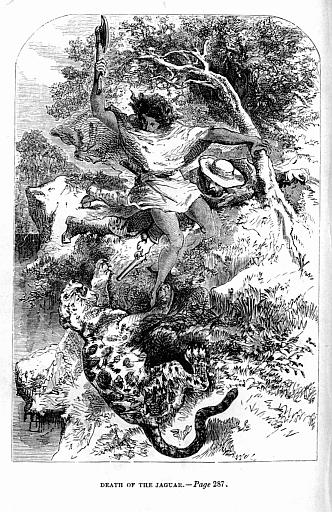
In a moment he would have sprung up, and then woe to his antagonist! but he was not allowed that moment, for he had scarcely touched the rock when the Indian leaped forward and struck at his head with the axe. The blow was not well aimed, and although it stunned the jaguar, he still clung to the cliff. In setting himself for a second blow, Guapo came too near, and the next moment the great claws of the tiger were buried in his foot!
It is difficult to tell what might have been the result. It would, no doubt, have been different. Guapo would have been dragged over, and that was certain death; but at this moment a hand was protruded between Guapo’s legs—the muzzle of a pistol was seen close to the head of the jaguar—a loud crack rang through the ravine, and when the smoke cleared away the jaguar was seen no more!
Guapo, with his foot badly lacerated, was drawn back from the cliff into the arms of Don Pablo.
Chapter Thirty Two.
The Raft.
This was the most exciting day that had been passed since their arrival in the Montaña; and considering the result it was well that the occurrence had taken place. It had rid them of a pair of bad neighbours—there would soon have been four—that some time or other would have endangered the lives of some of the party. It was the opinion of Guapo that they need not, at least for a while, have any fear of jaguars. It was not likely there was another pair in that district; although, from the roaming disposition of this animal, fresh ones might soon make their appearance; and it was deemed best always to act as though some were already in the neighbourhood.
The cubs were disposed of. It was not deemed advisable to bring them up as “cats.” After what had occurred that was voted, even by Leon, a dangerous experiment—too dangerous to be attempted. They were still on the other side of the river, and the bridge was now gone. If left to themselves, no doubt they would have perished, as they were very young things. Perhaps some carnivorous creature—wolf, coati, eagle, or vulture—would have devoured them, or they might have been eaten up by the ants. But this was not to be their fate. Guapo swam across, and strangled them. Then tying them together, he suspended the pair over his shoulders, and brought them with him to be exhibited as a curiosity. Moreover Guapo had a design upon their skins.
It was not long after that a pleasanter pet than either of them was found, and this was a beautiful little saimiri monkey, about the size of a squirrel, which Guapo and Leon captured one day in the woods. They heard a noise as they were passing along, and going up to the spot, saw on the branch of a low tree nearly a dozen little monkeys all rolled up together in a heap, with their tails warped round each other as if to keep themselves warm! Nearly another dozen were running about, whining and apparently trying to get in among the rest. Guapo and Leon made a sudden rush upon them, and were able to capture three or four before the creatures could free themselves; but only one lived, and that became a great pet and favourite. It was a beautiful little creature—a true saimiri, or squirrel monkey, called the “titi.” Its silky fur was of a rich olive-green colour; and its fine large eyes expressed fear or joy—now filling with tears, and now brightening again—just like those of a child.
During the summer our bark-gatherers continued their labour without interruption, and on account of the great plenty of the cinchona-trees, and their proximity to the house, they were enabled to accumulate a very large store. They worked like bees.
Although this forest life was not without its pleasures and excitements, yet it began to grow very irksome both to Don Pablo and Doña Isidora. Life in the wilderness, with its rude cares and rude enjoyments, may be very pleasant for a while to those who seek it as amateurs, or to that class who as colonists intend to make it a permanent thing. But neither Don Pablo nor his wife had ever thought of colonisation. With them their present industry was the result of accident and necessity. Their tastes and longings were very different. They longed to return to civilised life; and though the very misfortune which had driven them forth into the wilderness had also guided them to an opportunity of making a fortune, it is probable they would have passed it by, had they not known that, penniless as they were, they would have fared still worse in any city to which they might have gone. But before the first year was out, they yearned very much to return to civilisation, and this desire was very natural. But there were other reasons that influenced them besides the mere ennui of the wilderness. The lives of themselves and their children were constantly in danger from jaguars, pumas, and poisonous reptiles. Even man himself might at any moment appear as their destroyer. As yet no Indian—not even a trace of one—had been seen. But this was not strange. In the tangled and impenetrable forests of the Great Montaña two tribes of Indians may reside for years within less than a league’s distance of each other, without either being aware of the other’s existence! Scarcely any intercourse is carried on, or excursions made, except by the rivers—for they are the only roads—and where two of these run parallel, although they may be only at a short distance from each other, people residing on one may never think of crossing to the other.
Notwithstanding that no Indians had yet appeared to disturb them, there was no certainty that these might not arrive any day, and treat them as enemies. On this account, Don Pablo and Doña Isidora were never without a feeling of uneasiness.
After mutual deliberation, therefore, they resolved not to prolong their stay beyond the early part of spring, when they would carry out their original design of building a balza raft, and commit themselves to the great river, which, according to all appearance, and to Guapo’s confident belief, flowed directly to the Amazon. Guapo had never either descended or ascended it himself, and on their first arrival was not so sure about its course; but after having gone down to its banks, and examined its waters, his recollections revived, and he remembered many accounts which he had heard of it from Indians of his own tribe. He had no doubt but it was the same which, under the name of the “Purus,” falls into the Amazon between the mouths of the Madeira and the Coary.
Upon this stream, therefore, in a few months they would embark. But these intervening months were not spent in idleness. Although the season for bark-gathering was past, another source of industry presented itself. The bottom lands of the great river were found to be covered with a network of underwood, and among this underwood the principal plant was a well-known briar, Smilax officinalis. This is the creeping plant that yields the celebrated “sarsaparilla;” and Don Pablo, having made an analysis of some roots, discovered it to be the most valuable species—for it is to be remembered, that, like the cinchona, a whole genus, or rather several genera, furnish the article of commerce. The briar which produces the sarsaparilla is a tall creeping plant, which throws out a large number of long wrinkled roots of a uniform thickness, and about the size of a goose-quill. Nothing is required further than digging and dragging these roots out of the ground, drying them a while, and then binding them in bundles with a small “sipo,” or tough forest creeper. These bundles are made up, so as to render the roots convenient for packing and transport.
During several months this branch of industry occupied Don Pablo, Guapo, and Leon; so that when the time drew nigh for their departure, what with the cinchona-bark, the sarsaparilla, and the vanilla-beans, there was not an empty inch in the large store-house.
Guapo had not been all the time with them. For several days Guapo was not to be seen at the house, nor anywhere around it. Where had Guapo been all this time? I will tell you; Guapo had been to the mountains!
Yes, Don Pablo had sent him on an important mission, which he had performed with secrecy and despatch. Don Pablo, before braving the dangers of the vast journey he had projected, had still a lingering hope that something might have happened—some change in the government of Peru—perhaps a new Viceroy—that might enable him to return with safety to his native land. To ascertain if such had taken place, Guapo had made his journey to the mountains.
He went no farther than the Puna—no farther than the hut of his friend the vaquero—who, by a previous understanding with Guapo, had kept himself informed about political matters.
There was no hope; the same Council, the same Viceroy, the same price upon the head of Don Pablo—who, however, was believed to have escaped in an American ship, and to have taken refuge in the great republic of the North.
With this news Guapo returned, and now the preparations for the river voyage were set about in earnest. A balza raft was built out of large trunks of the Bombax ceiba, which, being light wood, was the best for the purpose. Of course these trunks had been cut long ago with a view to using them in this way. A commodious cabin, or “toldo,” was constructed on the raft, built of palm and bamboos, and thatched with the broad leaves of the bussu. A light canoe was also hollowed out, as a sort of tender to the raft, and a couple of very large canoes for the purpose of giving buoyancy to it, were lashed one upon each side. The “merchandise” was carefully “stowed” and covered with “tarpaulins” of palm-leaves, and the stores laid in with every providential care and calculation.
You will be wondering what was done with the horse and mule,—those creatures that had served the exiles so faithfully and so well? Were they left behind to become a prey to the jaguars and the large blood-sucking bats, that kill so many animals in these parts? No—they were not to be left to such a fate. One of them—the mule—had been already disposed of. It was a valuable beast, and partly on that account, and partly from gratitude felt towards it for the well-timed kick it had given the ocelot, it was to be spared. Guapo had taken both the mule and the horse on his mountain journey, and presented the former to his friend the vaquero.
But the horse was still on hand. What was to be done with him? Leave him behind? That would be certain death, for no horse, that was not cared for, could exist in the Montaña ten days without being eaten up by the fierce creatures that inhabit it. The bats would surely have destroyed him. Well, what was done? He could not be carried on the raft. But he was, though,—in a way. Guapo was resolved that the bats should not have him, nor the jaguars neither. He was in fine condition—fat as a pig. The fruit of the murumuru had agreed with him. He was just in the condition in which an Indian thinks a horse “good for killing,” and Guapo killed him! Yes, Guapo killed him! It is true it was a sort of a Virginius tragedy, and Guapo had great difficulty in nerving himself for the task. But the blow-gun was at length levelled, and the curare did its work. Then Guapo skinned him, and cut him into strips, and dried him into “charqui,” and carried him on board the raft. That was the closing scene.
All left the house together, carrying with them the remains of their hastily-created penates. On reaching the end of the valley, they turned and threw back a last glance at a home that had to them been a happy one; and then, continuing their journey, they were soon upon the balza. The only living creature that accompanied them from their valley-home was the pretty saimiri, carried on the shoulder of the little Leona.
The cable of piassaba-palm was carefully taken in and coiled, the raft was pushed out, and the next moment floated lightly upon the broad bosom of the river.
Chapter Thirty Three.
The Guardian Brother.
The current of the river flowed at the rate of about four miles an hour, and at this speed they travelled. They had nothing to do but guide the raft in the middle part of the stream. This was effected by means of a large stern-oar fixed upon a pivot, and which served the purpose of a rudder. One was required to look after this oar, and Don Pablo and Guapo took turns at it. It was not a very troublesome task, except where some bend had to be got round, or some eddy was to be cleared, when both had to work at it together. At other times the balza floated straight on, without requiring the least effort on the part of the crew; and then they would all sit down and chat pleasantly, and view the changing scenery of the forest-covered shores. Sometimes tall palms lined the banks, and sometimes great forest trees netted together by thick parasites that crept from one to the other, and twined around the trunks like monster serpents. Sometimes the shores were one unbroken thicket of underwood, where it would have been almost impossible to make a landing had they wished it. At other places there were sand-bars, and even little islets with scarce any vegetation upon them; and they also passed many other islets and large islands thickly wooded. The country generally appeared to be flat, though at one or two places they saw hills that ran in to the banks of the river.
Of course the change of scenery, and the many fresh vistas continually opening before them, rendered their voyage both cheerful and interesting. The many beautiful birds too, and new kinds of trees and animals which they saw, were a constant source of varied enjoyment, and furnished them with themes of conversation.
During the first day they made a journey of full forty miles. Having brought their balza close to the shore, and secured it to a tree, they encamped for the night. There was no opening of any extent, but for some distance the ground was clear of underwood, and the trunks of great old trees rose like columns losing themselves amidst the thick foliage overhead. A dark forest only could be seen, and, as night drew on, the horrid cries of the alouattes, or howling monkeys, mingling with the voices of other nocturnal animals, filled the woods. They had no fear of monkeys, but now and then they thought they could distinguish the cry of the jaguar, and of him they had fear enough. Indeed the jaguar possesses the power of imitating the cry of the other animals of the forest, and often uses it to draw them within reach of him.
In addition to the fire upon which they had cooked their supper, as soon as night had fairly set in, they kindled others, forming a sort of semicircle, the chord of which was the bank of the river itself. Within this semicircle the hammocks were stretched from tree to tree; and, as all were fatigued with the day’s exertions, they climbed into them at an early hour, and were soon asleep. One alone sat up to keep watch. As they thought they had heard the jaguar, this was deemed best; for they knew that fire will not always frighten off that fierce animal. As the neighbourhood looked suspicious, and also as it was their first encampment, they, like all travellers at setting out, of course were more timid and cautious.
To Leon was assigned the first watch; for Leon was a courageous boy, and it was not the first time he had taken his turn in this way. He was to sit up for about two hours, and then wake Guapo, who would keep the midnight-watch; after which Don Pablo’s turn would come, and that would terminate in the morning at daybreak. Leon was instructed to rouse the others in case any danger might threaten the camp.
Leon from choice had seated himself by the head of the hammock in which slept the little Leona; in order, no doubt, to be nearer her, as she was the most helpless of the party, and therefore required more immediate protection. He had both the pistols by him—ready to his hand and loaded—and in case of danger he knew very well how to use them.
He had been seated for about half-an-hour, now casting his eyes up to the red and wrinkled trunks of the trees, and then gazing into the dark vistas of the surrounding forest, or at other times looking out upon the glistening surface of the river. Many a strange sound fell upon his ear. Sometimes the whole forest appeared to be alive with voices—the voices of beasts and birds, reptiles, and insects—for the tree-frogs and ciendas were as noisy as the larger creatures. At other times a perfect stillness reigned, so that he could distinctly hear the tiny hum of the mosquito; and then, all at once, would fall upon his ear the melancholy wailing of the night-hawk—the “alma perdida,” or “lost soul”—for such is the poetical and fanciful name given by the Spanish Americans to this nocturnal bird.
While thus engaged Leon began to feel very drowsy. The heavy day’s work, in which he had borne part, had fatigued him as well as the others; and, in spite of the odd voices that from time to time fell upon his ear, he could have lain down upon the bare ground and slept without a feeling of fear. Snakes or scorpions, or biting lizards or spiders, would not have kept him from going to sleep at that moment. It is astonishing how the desire of sleep makes one indifferent to all these things, which at other times we so much dread. Leon did not fear them a bit, but kept himself awake from a feeling of pride and honour. He reflected that it would never do to be unfaithful to the important trust confided to him. No that would never do. He rubbed his eyes, and rose up, and approached the bank, and dipped his hands in the water, and came back to his former place, and sat down again. Spite of all his efforts, however, he felt very heavy. Oh! when would the two hours pass that he might rouse Guapo?
“Car–r–ambo! I nev-er was so s–s–sleepy. Vamos! Leon! you mustn’t give in!”
And striking himself a lively slap on the chest, he straightened his back, and sat upright for a while.
He was just beginning to get bowed about the shoulders again, and to nod a little, when he was startled by a short sharp exclamation uttered by the little Leona. He looked up to her hammock. He could perceive it had moved slightly, but it was at rest again, and its occupant was evidently asleep.
“Poor little sis! she is dreaming,” he muttered half aloud. “Perhaps some horrid dream of jaguars or serpents. I have half a mind to awake her. But, no, she sleeps too soundly; I might disturb them all;” and with these reflections Leon remained upon his seat.
Once more his head was beginning to bob, when the voice of Leona again startled him, and he looked up as before. The hammock moved slightly, but there was no appearance of anything wrong. From where he sat he could not see well into it, but he outlines of the child’s body were easily discernible through the elastic netting; and at the farther end he could just perceive one of her little feet, where it had escaped from the covering, and rested partly over the edge.
As he continued to gaze upon the delicate member, thinking whether he had not better cover it against the mosquitoes, all at once his eye was attracted by something red—a crooked red line that traversed from the toe downward along the side of the foot. It was red and glittering—it was a stream of blood!
His first feeling was one of horror. His next was a resolve to spring to his feet and rouse the camp, but this impulse was checked by one of greater prudence. Whatever enemy had done it, thought he, must still be about the hammock; to make a noise would, perhaps, only irritate it, and cause it to inflict some still more terrible wound. He would remain quiet, until he had got his eyes upon the creature, when he could spring upon it, or fire his pistol before it could do further harm.
With these ideas, quickly conceived, he rose silently to his feet, and standing, or rather crouching forward, bent his eyes over the hammock.
Chapter Thirty Four.
The Vampire.
Leon’s head was close to that of the sleeper, whose sweet breath he felt, and whose little bosom rose and fell in gentle undulation. He scanned the inside of the hammock from head to foot. He gazed anxiously into every fold of the cover. Not an object could he see that should not have been there—no terrible creature—no serpent—for it was this last that was in his mind. But something must have been there. What could have caused the stream of blood, that now being closer he could more plainly see trickling over the soft blue veins? Some creature must have done it!
“Oh! if it be the small viper,” thought he, “or the coral snake, or the deadly macaurel! If these—”
His thoughts at this moment were interrupted. A light flapping of wings sounded in his ear—so light, that it appeared to be made by the soft pinions of the owl, or some nocturnal bird. It was not by the wings of a bird that that sound was produced, but by the wings of a hideous creature. Leon was conscious, from the continued flapping, that something was playing through the air, and that it occasionally approached close to his head. He gazed upward and around him, and at length he could distinguish a dark form passing between him and the light; but it glided into the darkness again, and he could see it no more. Was it a bird? It looked like one—it might have been an owl—it was full as large as one; but yet, from the glance he had had of it, it appeared to be black or very dark, and he had never heard of owls of that colour. Moreover, it had not the look nor flight of an owl. Was it a bird at all? or whatever it was, was it the cause of the blood? This did not appear likely to Leon, who still had his thoughts bent upon the snakes.
While he was revolving these questions in his mind, he again turned and looked toward the foot of the hammock. The sight caused him a thrill of horror. There was the hideous creature, which he had just seen, right over the bleeding foot. It was not perched, but suspended in the air on its moving wings, with its long snout protruded forward and pressed against the toe of the sleeper! Its sharp white teeth were visible in both jaws, and its small vicious eyes glistened under the light of the fires. The red hair covering its body and large membranous wings added to the hideousness of its aspect, and a more hideous creature could not have been conceived. It was the vampire,—the blood-sucking phyllostoma!
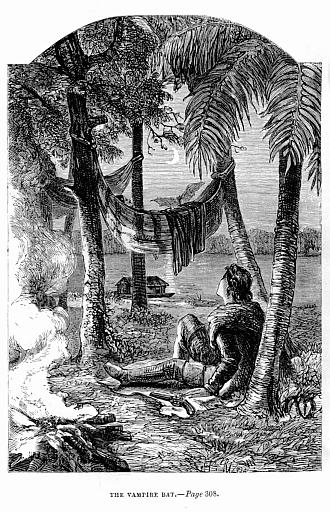
A short cry escaped from the lips of Leon. It was not a cry of pain, but the contrary. The sight of the great bat, hideous as the creature was, relieved him. He had all along been under the painful impression that some venomous serpent had caused the blood to flow, and now he had no farther fear on that score. He knew that there was no poison in the wound inflicted by the phyllostoma—only the loss of a little blood; and this quieted his anxieties at once. He resolved, however, to punish the intruder; and not caring to rouse the camp by firing, he stole a little closer, and aimed a blow with the butt of his pistol. The blow was well aimed, and brought the bat to the ground, but its shrill screeching awoke everybody, and in a few moments the camp was in complete confusion. The sight of the blood on the foot of the little Leona quite terrified Doña Isidora and the rest; but when the cause was explained, all felt reassured and thankful that the thing was no worse. The little foot was bound up in a rag; and although, for two or three days after, it was not without pain, yet no bad effects came of it.
The “blood-sucking” bats do not cause death either to man, or any other animal, by a single attack. All the blood they can draw out amounts to only a few ounces, although after their departure, the blood continues to run from the open wound. It is by repeating their attacks night after night that the strength of an animal becomes exhausted, and it dies from sheer loss of blood and consequent faintness. With animals this is far from being a rare occurrence. Hundreds of horses and cattle are killed every year in the South American pastures. These creatures suffer, perhaps, without knowing from what cause, for the phyllostoma performs its cupping operation without causing the least pain—at all events the sleeper is very rarely awakened by it. It is easy to understand how it sucks the blood of its victim, for its snout and the leafy appendage around its mouth—from whence it derives the name “phyllostoma”—are admirably adapted to that end. But how does it make the puncture to “let” the blood? That is as yet a mystery among naturalists, as it also is among the people who are habitually its victims. Even Guapo could not explain the process. The large teeth—of which it has got quite a mouthful—seem altogether unfitted to make a hole such as is found where the phyllostoma has been at work. Their bite, moreover, would awake the soundest sleeper. Besides these, it has neither fangs, nor sting, nor proboscis, that would serve the purpose. How then does it reach the blood? Many theories have been offered; some assert that it rubs the skin with its snout until it brings it to bleeding: others say that it sets the sharp point of one of its large tusks against the part, and then by plying its wings wheels round and round, as upon a pivot, until the point has penetrated—that during this operation the motion of the wings fans and cools the sleeping victim, so that no pain is felt. It may be a long while before this curious question is solved, on account of the difficulty of observing a creature whose habits are nocturnal, and most of whose deeds are “done in the dark.”
People have denied the existence of such a creature as the blood-sucking bat—even naturalists have gone so far. They can allege no better grounds for their incredulity than that the thing has an air of the fabulous and horrible about it. But this is not philosophy. Incredulity is the characteristic of the half-educated. It may be carried too far, and the fables of the vulgar have often a stratum of truth at the bottom. There is one thing that is almost intolerable, and that is the conceit of the “closet-naturalist,” who sneers at everything as untrue that seems to show the least design on the part of the brute creation—who denies everything that appears at all singular or fanciful, and simply because it appears so. With the truthful observations that have been made upon the curious domestic economy of such little creatures as bees, and wasps, and ants, we ought to be cautious how we reject statements about the habits of other animals, however strange they may appear.
Who doubts that a mosquito will perch itself upon the skin of a human being, pierce it with his proboscis, and suck away until it is gorged with blood? Why does it appear strange that a bat should do the same?
Now your closet-naturalist will believe that the bat does suck the blood of cattle and horses, but denies that it will attack man! This is sheer nonsense. What difference to the vampire, whether its victim be a biped or quadruped? Is it fear of the former that would prevent it from attacking him? Perhaps it may never have seen a human being before: besides, it attacks its victim while asleep, and is rarely ever caught or punished in the act. Where these creatures are much hunted or persecuted by man, they may learn to fear him, and their original habits may become changed, but that is quite another thing. As nature has formed them, the blood-sucking bats will make their attack indifferently, either upon man or large quadrupeds. There are a thousand proofs to be had in all the tropical regions of America. Every year animals are killed by the phyllostoma hastatum, not in hundreds, but in thousands. It is recorded that on one extensive cattle-farm several hundred head were killed in the short period of six months by the bats; and the vaqueros, who received a bounty upon every bat they should capture, in one year succeeded in destroying the enormous number of seven thousand! Indeed, “bat-hunting” is followed by some as a profession, so eager are the owners of the cattle-farms to get rid of these pests.
Many tribes of Indians and travellers suffer great annoyance from the vampire-bats. Some persons never go to sleep without covering themselves with blankets, although the heat be ever so oppressive. Any part left naked will be attacked by the phyllostoma, but they seem to have a preference for the tip of the great toe—perhaps because they have found that part more habitually exposed. Sometimes one sleeper is “cupped” by them, while another will not be molested; and this, I may observe, is true also of the mosquitoes. There may be some difference as to the state of the blood of two individuals, that leads to this fastidious preference. Some are far more subject to their attack than others—so much so that they require to adopt every precaution to save themselves from being bled to death. Cayenne pepper rubbed over the skin is used to keep them off, and also to cure the wound they have made; but even this sometimes proves ineffective.
Of course there are many species of bats in South America besides the vampire; in fact, there is no class of mammalia more numerous in genera and species, and no part of the world where greater numbers are found than in the tropical regions of America. Some are insect-eaters, while others live entirely on vegetable substances; but all have the same unsightly and repulsive appearance. The odour of some kinds is extremely fetid and disagreeable. Notwithstanding this, they are eaten by many tribes of Indians, and even the French Creoles of Guiana have their “bat-soup,” which they relish highly. The proverb “De gustibus non disputandum est” seems to be true for all time. The Spanish Americans have it in the phrase “Cada uno a su gusto;” “Chacun à son goût,” say the French; and on hearing these tales about “ant-paste,” and “roast monkey,” and “armadillo done in the shell,” and “bat-soup,” you, boy reader, will not fail to exclaim “Every one to his liking.”
The vampire appeared to be to Guapo’s liking. It was now his turn to keep watch, and as the rest of them got into their hammocks, and lay awake for a while, they saw him take up the bat, spit it upon a forked stick, and commence broiling it over the fire. Of course he ate it!
When morning came, and they had got up, what was their astonishment to see no less than fourteen bats lying side by side! They were dead, of course: Guapo had killed them all during his watch. They had appeared at one period of the night in alarming numbers, and Guapo had done battle manfully without awaking anybody.
Another curious tableau came under their notice shortly after. Just as they were about to embark, a singular-looking tree was observed growing near the bank of the river. At first they thought the tree was covered with birds’-nests, or pieces of some kind of moss. Indeed, it looked more like a tree hung over with rags than anything else. Curiosity led them to approach it. What was their astonishment to find that the nests, moss, or rags, were neither more nor less than a vast assemblage of bats suspended, and asleep! They were hanging in all possible positions; some with their heads down, some by the claws upon either wing, and some by both, while a great many had merely hooked over the branch the little horny curvature of their tails. Some hung down along the trunk, suspended by a crack in the bark, while others were far out upon the branches.
It was certainly the oddest “roost” that any of the party (Guapo, perhaps, excepted) had ever witnessed; and, after gazing at it for some time, they turned away without disturbing the sleepers, and getting on board once more, floated adown the stream swiftly and silently.
Chapter Thirty Five.
The Marimondas.
That day they made good progress, having dropped down the river a distance of fifty miles at least. They might even have gone farther, but a good camping-place offered, and they did not like to pass it, as they might not find another so convenient. It was a muddy bank, or rather a promontory that ran out into the river, and was entirely without trees, or any other vegetation, as it was annually overflowed, and formed, in fact, part of the bed of the river. At this time the mud was quite dry and smooth, and appeared as if it had been paddled and beaten down by the feet of animals and birds. This was, in fact, the case, for the point was a favourite resting-place for the “chiguires,” or “capivaras,” on their passage to and from the water. There were tracks of tapirs, too, and peccaries, and many sorts of wading birds, that had been there while the mud was still soft.
There were no trees to which to hang their hammocks, but the ground was smooth and dry, and they could sleep well enough upon it. They would not be troubled with the bats, as these creatures keep mostly in the dark shadowy places of the forest; and snakes would not likely be found out on the bare ground. They thought they would there be safer from jaguars, too. In fact, it was from these considerations that they had chosen the place for their camp. They could go to the woods for an armful or two of sticks to cook supper with, and that would suffice.
The balza was brought close in on the upper side of the promontory, so as to be out of the current; and then all landed and made their preparations for passing the night. Guapo marched off with his axe to get some firewood, and Leon accompanied him to assist in carrying it. They had not far to go—only a hundred yards or so, for up at the end of the promontory the forest began, and there were both large trees and underwood.
As they walked forward one species of trees caught their attention. They were palm-trees, but of a sort they had not yet met with. They were very tall, with a thick, globe-shaped head of pinnate, plume-like leaves. But what rendered these trees peculiar was the stem. It was slender in proportion to the height of the tree, and was thickly covered with long needle-shaped spines, not growing irregularly, but set in bands, or rings, around the tree. This new palm was the “pupunha,” or “peach-palm,” as it is called, from the resemblance which its fruits bear to peaches. It is also named “pirijao” in other parts of South America, and it belongs to the genus “Gullielma.”
At the tops of these trees, under the great globe of leaves, Guapo and Leon perceived the nuts. They were hanging in clusters, as grapes grow; but the fruits were as large as apricots, of an oval, triangular shape, and of a beautiful reddish yellow colour. That they were delicious eating, either roasted or boiled, Guapo well knew; and he was determined that some of them should be served at supper. But how were they to be reached? No man could climb such a tree as they grew upon! The needles would have torn the flesh from any one who should have attempted it.
Guapo knew this. He knew, moreover, that the Indians, who are very fond of the fruit of this tree,—so much so that they plant large palmares of it around their villages—have a way of climbing it to get at the ripe clusters. They tie cross pieces of wood from one tree to the other, and thus make a sort of step-ladder, by which they ascend to the fruit. It is true, they might easily cut down the trees, as the trunks are not very thick; but that would be killing the goose that gave the golden eggs. Guapo, however, had no farther interest in this wild orchard than to make it serve his turn for that one night; so, laying his axe to one of the “pupunhas,” he soon levelled its majestic stem to the ground. Nothing more remained than to lop off the clusters, any one of which was as much as Leon could lift from the ground. Guapo found the wood hard enough even in its green state, but when old it becomes black, and is then so hard that it will turn the edge of an axe. There is, perhaps, no wood in all South America harder than that of the pirijao palm.
It is with the needle-like spines of this species that many tribes of Indians puncture their skins in tattooing themselves, and other uses are made by them of different parts of this noble tree. The macaws, parrots, and other fruit-eating birds, are fonder of the nuts of the pupunha than perhaps any other species; and so, too, would be the fruit-eating quadrupeds if they could get at them. But the thorny trunk renders them quite inaccessible to all creatures without wings, excepting man himself. No; there is one other exception, and that is a creature closely allied to man, I mean the monkey. Notwithstanding the thorny stem, which even man cannot scale without a contrivance; notwithstanding the apparently inaccessible clusters—inaccessible from their great height—there is a species of monkey that manages now and then to get a meal of them. How do these monkeys manage it? Not by climbing the stem, for the thorns are too sharp even for them. How then? Do the nuts fall to the ground and allow the monkeys to gather them? No. This is not the case. How then? We shall see!
Guapo and Leon had returned to the camp, taking with them the pupunha fruit and the firewood. A fire was kindled, the cooking-pot hung over it on a tripod, and they all sat around to wait for its boiling.
While thus seated, an unusual noise reached their ears coming from the woods. There were parrots and macaws among the palms making noise enough, and fluttering about, but it was not these. The noise that had arrested the attention of our travellers was a mixture of screaming, and chattering, and howling, and barking, as if there were fifty sorts of creatures at the making of it. The bushes, too, were heard “switching about,” and now and then a dead branch would crack, as if snapped suddenly. To a stranger in these woods such a blending of sounds would have appeared very mysterious and inexplicable. Not so to our party. They knew it was only a troop of monkeys passing along upon one of their journeys. From their peculiar cries, Guapo knew what kind of monkeys they were.
“Marimondas,” he said.
The marimondas are not true “howlers,” although they are of the same tribe as the “howling monkeys” (Stentor). They belong to the genus Ateles, so called because they want the thumb, and are therefore imperfect or unfinished as regards the hands. But what the ateles want in hands is supplied by another member—the tail, and this they have to all perfection. It is to them a fifth hand, and apparently more useful than the other four. It assists them very materially in travelling through the tree-tops. They use it to bring objects nearer them. They use it to suspend themselves in a state of repose, and thus suspended, they sleep—nay more, thus suspended, they often die! Of all the monkey tribe the ateles are those that have most prehensile power in their tails.
There are several species of them known—the coaita, the white-faced, the black cayou, the beelzebub, the chamek, the black-handed, and the marimonda. The habits of all are very similar, though the species differ in size and colour.
The marimonda is one of the largest of South American monkeys, being about three feet standing upon its hind-legs, with a tail of immense length, thick and strong near the root, and tapering to a point. On its under side, for the last foot or so from the end, there is no hair, but a callous skin, and this is the part used for holding on to the branches. The marimonda is far from being a handsome monkey. Its long, thin arms and thumb-less hands give it an attenuated appearance, which is not relieved by the immense disproportioned tail. It is reddish, or of a parched coffee colour, on the upper part of the body, which becomes blanched on the throat, belly, and insides of the thighs. Its colour, in fact, is somewhat of the hue of the half-blood Indian and Negro,—hence the marimonda is known in some parts of Spanish America by the name of “mono zambo,” or “zambo” monkey—a “zambo” being the descendant of Indian and Negro parents.
The noise made by the marimondas which had been heard by our party seemed to proceed from the bank of the river, some distance above the promontory; but it was evidently growing louder every minute, and they judged that the monkeys were approaching.
In a few minutes they appeared in sight, passing along the upper part of a grove of trees that stood close to the water. Our travellers had now an excellent view of them, and they sat watching them with interest. Their mode of progression was extremely curious. They never came to the ground, but where the branches interlocked they ran from one to the other with the lightning speed of squirrels, or, indeed, like birds upon the wing. Sometimes, however, the boughs stood far apart. Then the marimonda, running out as far as the branch would bear him, would warp a few inches of his tail around it and spring off into the air. In the spring he would give himself such an impetus as would cause the branch to revolve, and his body following this circular motion, with the long thin arms thrown out in front, he would grasp the first branch that he could reach. This, of course, would land him on a new tree, and over that he would soon spring to the next.
Among the troop several females were perceived with their young. The latter were carried on the backs of the mothers, where they held on by means of their own little tails, feeling perfectly secure. Sometimes the mothers would dismount them, and cause them to swing themselves from branch to branch, going before to show them the way. This was witnessed repeatedly. In other places, where the intervening space was too wide for the females with their young to pass over, the males could be seen bending down a branch of the opposite tree, so as to bring it nearer, and assist them in crossing. All these movements were performed amidst a constant gabble of conversation, and shouting, and chattering, and the noise of branches springing back to their places.
The grove through which the troop was passing ended just by the edge of the promontory. The palm-trees succeeded, with some trees of large size that grew over them.
The marimondas at length reached the margin of the grove, and then they were all seen to stop, most of them throwing themselves, heads down, and hanging only by their tails. This is the position in which they find themselves best prepared for any immediate action; and it is into this attitude they throw themselves when suddenly alarmed. They remained so for some minutes; and from the chattering carried on among them, it was evident that they were engaged in deliberation. A loud and general scream proclaimed the result; and all of them, at one and the same instant, dropped down to the ground, and were seen crossing over among the palm-trees.
They had to pass over a piece of open ground with only some weeds upon it; but their helplessness on the ground was at once apparent. They could not place their palms on the surface, but doubled them up and walked, as it were, on the backs of their hands in the most awkward manner. Every now and again, they flung out their great tails, in hopes of grasping something that would help them along; and even a large weed was a welcome support to them. On the ground they were evidently “out of their element.” In fact, the ateles rarely descend from the trees, which are their natural habitat.
At length they reached the palms; and, seated in various attitudes, looked up at the tempting fruit, all the while chattering away. How were they to reach it? Not a tree that was not covered with long needles—not a bunch of the luscious fruit that was not far above the height of the tallest marimonda! How were they to get at it?—that was the question. It might have been a puzzling question to so many boys—to the monkeys it was not; for in less than a score of seconds they had settled it in their minds how the pupunhas were to be plucked.
Rising high over the palms grew a large tree, with long out-reaching branches. It was the “zamang” tree—a species of mimosa, and one of the most beautiful trees of South America. Its trunk rose full seventy feet without a branch; and then it spread out in every direction in numerous horizontal limbs, that forked and forked again until they became slender boughs. Those branches were clad with the delicate pinnate leaves that characterise the family of the mimosas.
Many of the pupunha palms grew under the shadow of this zamang, but not the tallest ones. These were farther out. There were some, however, whose tufted crowns reached within a few yards of the lower limbs of the mimosa.
The monkeys, after a short consultation, were seen scampering up the zamang. Only some of the old and strong ones went—the rest remained watching below.
From the earnestness of their looks it was evident they felt a lively interest in the result. So, too, did the party of travellers; for these watched so closely, that the pot was in danger of boiling over.
The marimondas, having climbed the trunk, ran out upon the lowermost limbs, until they were directly above the palms. Then one or two were seen to drop off, and hang down by their tails. But, although, with their fore-arms at full stretch, they hung nearly five feet from the branch, they could not even touch the highest fronds of the palms, much less the fruit-clusters that were ten or twelve feet farther down. They made repeated attempts; suspending themselves over the very tallest palms, but all to no purpose.
One would have supposed they would have given it up as a bad job. So thought Doña Isidora, Leon, and the little Leona. Don Pablo knew better by his reading, and Guapo by his experience. Whey they saw that no one of them could reach the nuts, several were seen to get together on one of the branches. After a moment one dropped down head-foremost as before, and hung at his full length. Another ran down the body of this one, and taking a turn of his tail round his neck and fore-arm, skipped off and also hung head downwards. A third joined himself on to the second in a similar manner, and then a fourth. The fore-arms of the fourth rested upon the fruit-cluster of the pupunha!
The chain was now long enough for the purpose. In a few minutes the last monkey on the chain, with his teeth and hands, had separated the foot-stalk of the spathes, and the great clusters—two of them there were—fell heavily to the bottom of the tree. The marimondas on the ground ran forward; and, in the midst of loud rejoicings, began to pull off the “peaches” and devour them. But the monkeys above did not cease their labours. There were many mouths to feed, and they wanted more nuts. Without changing their position, they, by means of their arms and legs, threw themselves into a vibrating motion, and by this means the last on the string soon seized upon another pupunha, and also detached its fruit. In this way they continued, until they had stripped every tree within their reach; when, judging they had got enough, the lowermost monkey climbed back upon himself, then up his companions to the branch, and in the same style was followed by the other three in succession. As soon as they were clear of one another, the whole party tame down by the trunk to the ground, and joined their comrades below in the luxurious repast.
Chapter Thirty Six.
The Monkey Mother.
Now you will, perhaps, imagine that Guapo, having sat so quiet during all this scene, had no desire for a bit of roast-monkey to supper. In that fancy, then, you would be quite astray from the truth. Guapo had a strong desire to eat roast marimonda that very night; and, had he not been held back by Don Pablo, he would never have allowed the monkeys to get quietly out of the zamang—for it being an isolated tree, it would have afforded him a capital opportunity of “treeing” them. His blow-gun had been causing his fingers to itch all the time; and as soon as Don Pablo and the rest were satisfied with observing the monkeys, Guapo set out, blow-gun in hand, followed by Leon.
There was no cover by which he might approach the group; and, therefore, no course was left for him but to run up as quickly forward as possible and take his chance of getting a shot as they made off.
This course he pursued; but, before he was within anything like fair range, the monkeys, uttering their shrill screams, scampered over the open ground, much faster than before, and took to the grove, from which they had approached the spot.
Guapo followed at a slashing pace, and was soon under the trees, Leon at his heels. Here they were met by a shower of sticks, pieces of bark, half-eaten “peaches,” and something that was far less pleasant to their olfactory nerves! All these came from the tops of the trees—the very tallest ones—to which the monkeys had retreated, and where they were now hidden among the llianas and leaves.
You may fancy that it is easy to pursue a troop of monkeys in a forest. But it is not easy—in most cases it is not possible. The tangled underwood below puts a stop to the chase at once, as the monkeys can make their way through the branches above much quicker than the hunter can through the creeping plants below.
The pursuit would have been all up with Guapo, for the marimondas had soon got some way beyond the edge of the grove; but just as he was turning to sulk back, his keen Indian eye caught sight of one that was far behind the rest—so far, indeed, that it seemed determined to seek its safety rather by hiding than by flight. It had got under cover of a bunch of leaves, and there it lay quiet, uttering neither sound nor syllable. Guapo could just see a little bit of its side, and at this in an instant the gravatána was pointed. Guapo’s chest and cheeks were seen to swell out to their fullest extent, and off went the arrow. A shriek followed—the monkey was hit—beyond a doubt. Guapo coolly waited the result.
A movement was visible among the leaves; the marimonda was seen to turn and double about, and pluck something from its side; and then the broken arrow came glancing among the twigs, and fell to the ground. The monkey was now perceived to be twisting and writhing upon the branches, and its wild death-scream was answered by the voices of the others farther off.