"The Forest Exiles" (continued 2)
Reading edition
As yet the half-dozen condors hovering about kept well off from the hut; and Leon could not understand how any one of them was to be caught.
The vaquero, however, had a good many “dodges,” and after the ruse he had just practised upon the vicuñas, Leon suspected he would employ some similar artifice with the condors. Leon was right. It was by a stratagem the bird was to be taken.
The vaquero laid hold of a long rope, and lifting the bull’s hide upon his shoulders, asked Guapo to follow him with the two horses. When he had got out some four or five hundred yards from the hut, he simply spread himself flat upon the ground, and drew the skin over him, the fleshy side turned upward. There was a hollow in the ground about as big as his body—in fact, a trench he had himself made for a former occasion—and when lying in this on his back, his breast was about on a level with the surrounding turf. His object in asking Guapo to accompany him with the horses was simply a ruse to deceive the condors, who from their high elevation were all the while looking down upon the plain. But the vaquero covered himself so adroitly with his red blanket, that even their keen eyes could scarcely have noticed him; and as Guapo afterwards left the ground with the led horses, the vultures supposed that nothing remained but the skin, which from its sanguinary colour to them appeared to be flesh.
The birds had now nothing to fear from the propinquity of the hut. There the party were all seated quietly eating their breakfast, and apparently taking no notice of them. In a few minutes’ time, therefore, they descended lower, and lower,—and then one of the very largest dropped upon the ground within a few feet of the hide. After surveying it for a moment, he appeared to see nothing suspicious about it, and hopped a little closer. Another at this moment came to the ground—which gave courage to the first—and this at length stalked boldly on the hide, and began to tear at it with his great beak.
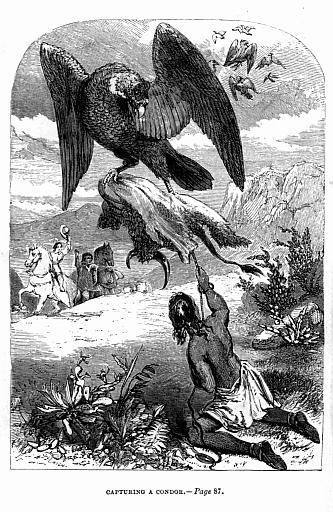
A movement was now perceived on the part of the vaquero—the hide “lumped” up, and at the same time the wings of the condor were seen to play and flap about as if he wanted to rise into the air, but could not. He was evidently held by the legs!
The other bird had flown off at the first alarm, and the whole band were soon soaring far upward into the blue heavens.
Leon now expected to see the vaquero uncover himself. Not so, however, as yet. That wily hunter had no such intention, and although he was now in a sitting posture, grasping the legs of the condor, yet his head and shoulders were still enveloped in the bull’s hide. He knew better than to show his naked face to the giant vulture, that at a single “peck” of his powerful beak would have deprived him of an eye, or otherwise injured him severely. The vaquero was aware of all this, and therefore did not leave his hiding-place until he had firmly knotted one end of the long cord around the shank of the bird—then slipping out at one side, he ran off to some distance before stopping. The condor, apparently relieved of his disagreeable company, made a sudden effort, and rose into the air, carrying the hide after him. Leon shouted out, for he thought the vulture had escaped; but the vaquero knew better, as he held the other end of the cord in his hand; and the bird, partly from the weight of the skin, and partly from a slight tug given by the hunter, soon came heavily to the ground again. The vaquero was now joined by Guapo; and, after some sharp manoeuvring, they succeeded between them in passing the string through the nostrils of the condor, by which means it was quietly conducted to the hut, and staked on the ground in the rear—to be disposed of whenever its captor should think fit.
Chapter Eleven.
The Perils of a Peruvian Road.
It was as yet only an hour or so after daybreak—for the vicuña hunt had occupied but a very short time and the capture of the condor a still shorter. Don Pablo was anxious to be gone, as he knew he was not beyond the reach of pursuit. A pair of the vicuñas were hastily prepared, and packed upon a llama for use upon their journey. Thus furnished, the party resumed their route.
The vaquero did not accompany them. He had an office to perform of far more importance to their welfare and safety. As soon as they were gone he let loose his four snarling curs, and taking them out to where the pile of dead vicuñas lay upon the plain, he left them there with instructions to guard the carcasses from foxes, condors, or whatever else might wish to make a meal off them. Then mounting, he rode off to the place where the road leading from Cuzco ascended upon the table-land, and having tied his horse to a bush, he climbed upon a projecting rock and sat down. From this point he commanded a view of the winding road to the distance of miles below him. No traveller—much less a party of soldiers—could approach without his seeing them, even many hours before they could get up to where he sat; and it was for that reason he had stationed himself there. Had Don Pablo been pursued, the faithful Indian would have galloped after and given him warning, long before his pursuers could have reached the plain.
He sat until sunset—contenting himself with a few leaves of coca. No pursuer appeared in sight. He then mounted his horse, and rode back to his solitary hut.
Let us follow our travellers.
They crossed the table-plain during the day, and rested that night under the shelter of some overhanging rocks on the other side. They supped upon part of the vicuñas, and felt more cheerful, as they widened the distance between themselves and danger. But in the morning they did not remain longer by their camp than was necessary to get breakfast. Half-an-hour after sunrise saw them once more on their route.
Their road led through a pass in the mountains. At first it ascended, and then began to go downward. They had crossed the last ridge of the Andes, and were now descending the eastern slopes. Another day’s journey, or two at most, would bring them to the borders of that wild forest, which stretches from the foot-hills of the Andes to the shores of the Atlantic Ocean—that forest with scarcely a civilised settlement throughout all its wide extent—where no roads exist—whose only paths are rivers—whose dark jungles are in places so impenetrable that the Indian cannot enter them, and even the fierce jaguar, embarrassed by the thick underwood, has to take to the tree-tops in pursuit of his prey. Another day’s journey or so would bring them to the borders of the “Montaña”—for such is the name which, by a strange misapplication of terms, has been given to this primeval wood. Yes, the Montaña was before them, and although yet distant, it could now and then be seen as the road wound among the rocks, stretching far towards the sky like a green and misty ocean.
In that almost boundless region there dwelt none but the aborigines of the soil—the wild Indians—and these only in sparse and distant bands. Even the Spaniards in their day of glory had failed to conquer it; and the Portuguese from the other side were not more successful. Here and there a lone missionary attempted to wheedle the simple natives into a belief in his monkish religion, or when able to do so forced it upon them, by fire and sword! But most of these efforts, both of conquest and conversion, had failed; and now, with the exception of some isolated trading post, or decayed mission station, on the banks of the great rivers, the whole “Montaña” was as wild and savage as when the keels of Columbus first ploughed the waters of the Carib Sea.
The Spanish colonists, on the Peruvian or western border of this immense forest, had never been able to penetrate it as colonists or settlers. Expeditions from time to time had passed along its rivers in search of the fabled gold country of Manoa, whose king each morning gave himself a coating of gold dust, and was hence called El Dorado (the gilded); but all these expeditions ended in mortification and defeat. The settlements never extended beyond the sierras, or foot-hills of the Andes, which stretch only a few days’ journey (in some places but a score of leagues) from the populous cities on the mountain-heights. Even at this present time, if you travel thirty leagues eastward of the large town of Cuzco, in the direction taken by Don Pablo, you will pass the boundaries of civilisation, and enter a country unexplored and altogether unknown to the people of Cuzco themselves! About the “Montaña” very little is known in the settlements of the Andes. Fierce tribes of Indians, the jaguar, the vampire bat, swarms of mosquitoes, and the hot atmosphere, have kept the settler, as well as the curious traveller, out of these wooded plains.
Don Pablo had already passed the outskirts of civilisation. Any settlement he might find beyond would be the hut of some half-wild Indian. There was no fear of his encountering a white face upon the unfrequented path he had chosen, though had he gone by some other route he might have found white settlements extending farther to the eastward. As it was, the wilderness lay before him, and he would soon enter it.
And what was he to do in the wilderness? He knew not. He had never reflected on that. He only knew that behind him was a relentless foe thirsting for his life. To go back was to march to certain death. He had no thoughts of returning. That would have been madness. His property was already confiscated—his death decreed by the vengeful Viceroy, whose soldiers had orders to capture or slay, wherever they should find him. His only hope, then, was to escape beyond the borders of civilisation—to hide himself in the great Montaña. Beyond this he had formed no plan. He had scarcely thought about the future. Forward, then, for the Montaña!
The road which our travellers followed was nothing more than a narrow path, or “trail” formed by cattle, or by some party of Indians occasionally passing up from the lower valleys to the mountain-heights. It lay along the edge of a torrent that leaped and foamed over its rocky bed. The torrent was no doubt on its way to join the greatest of rivers, the mighty Amazon—the headwaters of which spring from all parts of the Andes, draining the slopes of these mountains through more than twenty degrees of latitude!
Towards evening the little party were beginning to enter among the mountain spurs, or foot-hills. Here the travelling grew exceedingly difficult, the path sometimes running up a steep acclivity and then descending into deep ravines—so deep and dark that the sun’s rays seemed hardly to enter them. The road was what Spanish-Americans term, “Cuesta arriba, cuesta abajo” (up hill, down hill).
In no part of the world are such roads to be met with as among the Andes Mountains, both in South America and in their Mexican continuation through the northern division of the continent. This arises from the peculiar geological structure of these mountains. Vast clefts traverse them, yawning far into the earth. In South America these are called quebradas. You may stand on the edge of one of them and look sheer down a precipice two thousand feet! You may fancy a whole mountain scooped out and carried away, and yet you may have to reach the bottom of this yawning gulf by a road which seems cut out of the face of the cliff, or rather has been formed by a freak of Nature—for in these countries the hand of man has done but little for the roads. Sometimes the path traverses a ledge so narrow that scarce room is found for the feet of your trusty mule. Sometimes a hanging bridge has to be crossed, spanning a horrid chasm, at the bottom of which roars a foaming torrent—the bridge itself, composed of ropes and brambles, all the while swinging like a hammock under the tread of the affrighted traveller!
He who journeys through the tame scenery of European countries can form but little idea of the wild and dangerous highways of the Andes. Even the passes of the Alps or Carpathians are safe in comparison. On the Peruvian road the lives of men and animals are often sacrificed. Mules slide from the narrow ledges, or break through the frail “soga” bridges, carrying their riders along with them, whirling through empty air to be plunged into foaming waters or dashed on sharp rocks below. These are accidents of continual occurrence; and yet, on account of the apathy of the Spano-Indian races that inhabit these countries, little is done for either roads or bridges. Every one is left to take care of himself, and get over them as he best may. It is only now and then that positive necessity prompts to a great effort, and then a road is repaired or a broken bridge patched with new ropes.
But the road that was travelled by Don Pablo had seen no repairs—there were no bridges. It was, in fact, a mere pathway where the traveller scrambled over rocks, or plunged into the stream, and forded or swam across it as he best could. Sometimes it lay along the water’s edge, keeping in the bottom of the ravine; at other places no space was left by the water, and then the path ascended and ran along some ledge perhaps for miles, at the end of which it would again descend to the bed of the stream.
Chapter Twelve.
Encounter upon a Cliff.
That night they encamped in the bottom of the ravine close to the water’s edge. They found just enough of level ground to enable them to stretch themselves, but they were contented with that. There was nothing for the animals to eat except the succulent, but thorny, leaves of the Cactus opuntia, or the more fibrous blades of the wild agave. This evening there were no quiñoa seeds to be had, for none of these trees grew near. Even the botanist, Don Pablo, could find no vegetable substance that was eatable, and they would have to sup upon the vicuña meat, without bread, potatoes, or other vegetables. Their stock of ocas, ullucas, and macas, was quite out. They had cooked the last of the macas for that morning’s meal.
Guapo here came to their relief. Guapo’s experience went beyond the theoretical knowledge of the botanist. Guapo knew a vegetable which was good to eat—in fact, a most delicious vegetable when cooked with meat. This was no other than the fleshy heart of the wild maguey (agave), with part of the adhering roots. Among naked rocks, in the most barren parts of the desert wilderness, the wild agave may be found growing in luxuriance. Its thick, succulent blades, when split open, exude a cool liquid, that often gives considerable relief to the thirsty traveller; while the heart, or egg-shaped nucleus from which spring the sheathing leaves—and even parts of the leaves themselves—when cooked with any sort of meat, become an excellent and nourishing food. The Indians make this use of the aloe on the high plains of Northern Mexico, among the roving bands of the Apache, Navajo, and Comanche. These people cook them along with horse’s flesh, for there the wild horse is the principal food of whole tribes. Their mode of cooking, both the flesh and the aloe, is by baking them together in little ovens of stones sunk in the ground, and then heated by fire until they are nearly red-hot. The ashes are then cleared out, the meat and vegetables placed in the ovens, and then buried until both are sufficiently done. In fact, there is one tribe of the Apaches who have obtained the name of “Mezcaleros,” from the fact of their eating the wild aloe, which in those countries goes under the name of “mezcal” plant.
In many parts of the Andes, where the soil is barren, the wild maguey is almost the only vegetation to be seen, and in such places the Indians use it as food. It seems to be a gift of Nature to the desert, so that even there man may find something on which to subsist.
Guapo with his knife had soon cleared off several large pieces of the maguey, and these, fried along with the vicuña meat, enabled the party to make a supper sufficiently palatable. A cup of pure water from the cold mountain stream, sweeter than all the wine in the world, washed it down; and they went to rest with hearts full of contentment and gratitude.
They rose at an early hour, and, breakfasting as they had supped, once more took the road.
After travelling a mile or two, the path gradually ascended along one of those narrow ledges that shelve out from the cliff, of which we have already spoken. They soon found themselves hundreds of feet above the bed of the torrent, yet still hundreds of feet above them rose the wall of dark porphyry, seamed, and scarred, and frowning. The ledge or path was of unequal breadth—here and there forming little tables or platforms. At other places, however, it was so narrow that those who were mounted could look over the brink of the precipice into the frothing water below—so narrow that no two animals could have passed each other. These terrible passes were sometimes more than an hundred yards in length, and not straight, but winding around buttresses of the rock, so that one end was not visible from the other.
On frequented roads, where such places occur, it is usual for travellers, entering upon them, to shout, so that any one, who chances to be coming from the opposite side, may have warning and halt. Sometimes this warning is neglected, and two trains of mules or llamas meet upon the ledge! Then there is a terrible scene—the drivers quarrel—one party has to submit—their animals have to be unloaded and dragged back by the heels to some wider part of the path, so that each party can get past in its turn!
Near the highest part of the road, our travellers had entered upon one of these narrow ledges, and were proceeding along it with caution. The trusty mule, that carried Doña Isidora and Leona, was in front, the horse followed, and then the llamas. It is safer to ride than walk on such occasions, especially upon mules, for these animals are more sure-footed than the traveller himself. The horse that carried Leon, however, was as safe as any mule. He was one of the small Spanish-American breed, almost as sure-footed as a chamois.
The torrent rushed and thundered beneath. It was fearful to listen and look downward; the heads of all were giddy, and their hearts full of fear. Guapo, alone accustomed to such dangers, was of steady nerve. He and Don Pablo afoot were in the rear.
They had neared the highest point of the road, where a jutting rock hid all beyond from their view. They were already within a few paces of this rock, when the mule—which, as we have stated, was in the front—suddenly stopped, showing such symptoms of terror that Doña Isidora and the little Leona both shrieked!
Of course all the rest came to a halt behind the terrified and trembling mule. Don Pablo, from behind, shouted out, inquiring the cause of the alarm; but before any answer could be given the cause became apparent to all. Around the rock suddenly appeared the head and horns of a fierce bull, and the next moment his whole body had come into view, while another pair of horns and another head were seen close behind him!
It would be difficult to describe the feelings of our travellers at that moment. The bull came on with a determined and sullen look, until he stood nearly head to head with the mule. The smoke of his wide steaming nostrils was mingled with the breath of the terrified mule, and he held his head downward, and evidently with the intention of rushing forward upon the latter. Neither could have gone back, and of course the fierce bull would drive the mule into the abyss. The other bull stood close behind, ready to continue the work if the first one failed, and, perhaps, there were many others behind!
The mule was sensible of her danger, and, planting her hoofs firmly on the hard rock, she clung closely to the precipice. But this would not have served her, had not a hand interposed in her behalf. Amidst the terrified cries of the children, the voice of Guapo was heard calling to Don Pablo,—“Your pistols, master! give me your pistols!”
Something glided quickly among the legs of the animals. It was the lithe body of the Indian. In a second’s time he appeared in front of the mule. The bull was just lowering his head to charge forward—his horns were set—the foam fell from his lips—and his eyes glanced fire out of their dark orbs. Before he could make the rush, there came the loud report of a pistol—a cloud of sulphury smoke—a short struggle on the cliff—and then a dead plunge in the torrent below!
The smoke partially cleared away; then came another crack—another cloud—another short struggle—and another distant plash in the water!
The smoke cleared away a second time. The two bulls were no longer to be seen!
Guapo, in front of the mule, now ran forward upon the ledge, and looked round the buttress of rock. Then, turning suddenly, he waved his hand, and shouted back—
“No more, master; you may come on—the road is clear!”
Chapter Thirteen.
The lone Cross in the Forest.
After two more days of fatiguing travel, the road parted from the bank of the river, and ran along the ridge of a high mountain spur in a direction at right angles to that of the Andes themselves. This spur continued for several miles, and then ended abruptly. At the point where it ended, the path, which for the whole of the day had been scarcely traceable, also came to an end. They were now of course in a forest-covered country—in the Ceja de la Montaña—that is, the forest that covers the foot-hills of the mountains. The forest of the plains, which were yet lower down, is known as the “Montaña” proper.
During that day they had found the road in several places choked up with underwood, and Guapo had to clear it with his macheté—a sort of half-sword, half-knife, used throughout all Spanish America, partly to cut brushwood and partly as a weapon of defence. Where the ridge ended, however, what had once been a road was now entirely overgrown—vines and llianas of large size crossed the path. Evidently no one had passed for years. A road existed no longer; the luxuriant vegetation had effaced it.
This is no unusual thing on the borders of the Montaña. Many a settlement had existed there in former times, and had been abandoned. No doubt the road they had been following once led to some such settlement that had long since fallen into ruin.
It is a melancholy fact that the Spanish-Americans—including the Mexican nation—have been retrograding for the last hundred years. Settlements which they have made, and even large cities built by them, are now deserted and in ruins; and extensive tracts of country, once occupied by them, have become uninhabited, and have gone back to a state of nature. Whole provinces, conquered and peopled by the followers of Cortez and Pizarro, have within the last fifty years been retaken from them by the Indians: and it would be very easy to prove, that had the descendants of the Spanish conquerors been left to themselves, another half century would have seen them driven from that very continent which their forefathers so easily conquered and so cruelly kept. This reconquest on the part of the Indian races was going on in a wholesale way in the northern provinces of Mexico. But it is now interrupted by the approach of another and stronger race from the East—the Anglo-American.
To return to our travellers. Don Pablo was not surprised that the road had run out. He had been expecting this for miles back. What was to be done? Of course they must halt for that night at least. Indeed it was already near camping-time. The sun was low in the sky, and the animals were all much jaded. The llamas could not have gone much farther. They looked as if they should never go farther. The heat of the climate—it had been getting warmer every hour—was too much for them. These animals, whose native home is among the high cool mountain valleys, as already observed, cannot live in the low tropical plains. Even as they descended the Sierras they had shown symptoms of suffering from the heat during all that day. Their strength was now fairly exhausted.
The party halted. A little open space was chosen for the camp. The animals were relieved of their burdens and tied to the trees, lest they might stray off and be lost in the thick woods. A fire was kindled, and part of the vicuña meat cooked for supper.
It was not yet night when they had finished eating, and all were seated on the ground. The countenance of the father was clouded with a melancholy expression. Doña Isidora sat by his side and tried to cheer him, endeavouring to force a smile into her large black eyes. The little Leona, with her head resting on her mother’s lap, overcome with the heat and fatigue, had fallen asleep. Leon, seeing the dejected look of his father, was silent and thoughtful. Guapo was busy with his llamas.
“Come, dear husband!” said the lady, trying to assume a cheerful tone, “do not be so sad. We are now safe. Surely they will never pursue us here.”
“They may not,” mechanically replied Don Pablo; “but what then? We have escaped death, for what purpose? Either to live like savages in these wild woods—perhaps to be killed by savages—perhaps to die of hunger!”
“Do not say so, Don Pablo. I have never heard that the Indians of these parts were cruel. They will not injure poor harmless people such as we are. And as for starving, are not these luxuriant woods filled with roots and fruits that will sustain life a long while? You, too, know so well what they are! Dear husband, do not despond; God will not forsake us. He has enabled us to escape from our enemies, from fearful dangers on our journey. Fear not! He will not leave us to perish now.”
The cheering words of his beautiful wife had their effect upon Don Pablo. He embraced and kissed her in a transport of love and gratitude. He felt inspired with new hope. The vigour of mind and body, that for days had deserted him, now suddenly returned; and he sprang to his feet evidently with some newly-formed resolution.
The country both before and behind them was shut out from their view by the thick foliage and underwood. A tall tree grew by the spot, with branches down to the level of a man’s head. Don Pablo approached this tree, and seizing the branches drew himself up, and then climbed on towards its top. When he had reached a sufficient height, to overlook the surrounding woods, he stopped; and, resting himself upon one of the branches, looked abroad toward the east. All the rest stood watching him from below.
He had been gazing but a few seconds when his face brightened up, and a smile of satisfaction was seen to play upon his countenance. He evidently saw something that pleased him. Isidora, impatient, called out to him from below; but Don Pablo waved his hand to her, as if admonishing her to be silent.
“Have patience, love,” he cried down. “I shall descend presently and tell you all. I have good news, but be patient.”
It required a good share of patience, for Don Pablo after this remained a full half-hour upon the tree. He was not all the time looking abroad, however. Part of it he sat upon his perch—his head leaning forward, and his eyes not appearing to be particularly engaged with anything. He was busy with his thoughts, and evidently meditating on some great project. Perhaps the going down of the sun admonished him, as much as the desire of satisfying his wife’s curiosity, but just as the bright orb was sinking among the far tree-tops he descended.
“Now, Don Pablo,” said the fair Isidora, pretending to frown and look angry, “you have tried our patience, have you not? Come, then, no more mystery, but tell us all. What have you seen?”
“Forgive me, wife; you shall know all.”
Both sat down upon the trunk of a dead tree that Guapo had felled, and was cutting up for firewood: not that it was at all cold, but they had now arrived in the country of the terrible jaguar, and it would be necessary to keep up a blazing fire throughout the night.
“Your words were true, love,” began Don Pablo. “God has not forsaken us. I have seen three things that have inspired me with fresh life and hope.
“First, I looked out upon the Montaña, which I expected to see stretching away to the horizon, like a green ocean. I saw this in fact; but, to my surprise, I saw more. I beheld a broad river winding like an immense serpent through the distant forest. It ran in a direction north-east, as far as the eye could reach. Even upon the horizon I could distinguish spots of its bright water glancing like silver under the rays of the setting sun. My heart leaped with joy, for I recognised a river whose existence has been doubted. It can be no other, thought I, than the Madre de Dios. I have often heard that there existed such a river in these parts, that runs on to the Amazon. A missionary is said to have visited it, but with the destruction of the missions the record has been lost. I have no doubt the river I have seen is the Madre de Dios of that missionary.
“The thought of being so near the banks of this river suggested other thoughts. At once a design entered into my mind. ‘We can build a raft,’ thought I, ‘launch it upon this noble river, and float down to the Amazon, and thence to the mouth of the great stream itself. There is a Portuguese settlement there—the town of Grand Para. There we shall be safe from our foes.’
“Such were my first thoughts on beholding the new river. I reflected farther. ‘Our fortune is gone,’ I reflected; ‘we have nothing in the wide world—what should we do at Para, even if we arrived there in safety? How could we attempt such a journey without provisions. It would be impossible.’
“My hopes fell as quickly as they had sprung up.”
“I noticed your countenance change as you sat upon the tree.”
“True, you might easily have done so: the prospect of reaching Para penniless, and becoming a beggar in the streets—the nearer prospect of starving in the wilderness of the Amazon—were before my mind.
“My eyes for awhile were bent mechanically upon the green ocean of tree-tops. All at once an object arrested them. It was a patch of bright rose-coloured foliage, easily distinguishable amid the green leaves that surrounded it. It was not down in the Montaña—for that is a thousand feet below us. It was upon the side of the Sierra. My eyes glanced quickly around. I beheld other patches of similar foliage, some of them nearly an acre in breadth. My heart again leaped with joy. I knew well what these red spots of the forest were. They were clumps of cinchona trees—those trees that yield the celebrated febrifuge—the Peruvian bark!
“New ideas passed rapidly through my mind. ‘Our fortune is gone,’ thought I. ‘Here is a fortune in those valuable trees. Here is a mine that only requires to be worked. I shall turn cascarillero—I shall be a bark-hunter.’
“At first I thought that we might gather the bark, and send Guapo to sell it in the towns of the Sierra. Then the idea came into my mind that it might be possible to collect an immense quantity, store it up, build a great raft, float it down the rivers, and dispose of it in Para. I knew that in this way it would more than quadruple its price—for the traders of the Sierra purchase it from the poor cascarilleros, and have enormous profits upon it from the larger merchants.
“But how to live while making this store? Yes, how to live even on the morrow? Could we support ourselves by hunting, or find sustenance from fruits and roots, as you have suggested? This was the most important question of all, for our present necessities far outweighed our future prospects.
“The very thought of our necessity caused me once more to glance over the forest, and I continued to scan it on all sides. My eye was again arrested, and fixed upon a point where I saw there existed a different vegetation from any that could be seen elsewhere. There is a small valley about five hundred feet below us. It is a sort of table valley, and the stream along which we have been travelling runs through it, afterwards dashing over a fall to join the river below. In this valley I saw huge broad leaves of a brilliant yellowish green. I knew them at once to be the leaves of the great musaceae, either plantains or bananas. I thought, too, I could distinguish the form of the yucca plant. These are the certain signs of some settlement, or where one has existed. I fancy the latter is the correct idea, as I could distinguish neither house nor smoke. It may be some deserted Indian ‘chacra,’ or it may be the grounds of an old mission. In either case, we shall be likely to find those useful plants from which we may obtain food.”
“Oh, papa! mamma!” cried Leon, running up and interrupting the conversation. “See what is here among the trees! I declare it is a great cross!”
Don Pablo and Isidora walked toward the spot. There, sure enough, was a large wooden cross planted in the ground, and leaning to one side. The wood was much decayed, but the inscription that had been deeply cut in the transverse beam was still legible. It was simply the Spanish phrase:—
“Brazos de Dios” (The arm of God).
Isidora took Don Pablo by the hand, and looking steadfastly in his face, pointed to the inscription.
“It is true,” said she, “God protects us!”
Chapter Fourteen.
The deserted Mission.
That night all went to rest with hope in their hearts, though still not without some anxiety.
If you reflect upon the situation in which they were placed, you will not wonder that they were anxious about the future. Their first care had been to fly into the wilderness, without thinking upon the necessities they might encounter there—without reflecting that they had made no provision of food to sustain them. It is true that in the great Montaña there are many plants and trees whose roots and fruits can be eaten; but a traveller may go for days without finding one of these. Indeed, to pass through this great forest, in most places, is impossible, so completely are the creeping parasites matted and laced together. It is necessary to keep along the rivers in a canoe or raft, else you cannot get from place to place. You cannot even walk along the banks of many of these rivers, as the underwood hangs into the very water! For the same reason game is hard to be procured, and neither Don Pablo nor Guapo were provided with proper weapons to hunt with. Don Pablo’s pistols were all the fire-arms they had, and Guapo had no other weapon than his macheté. With their present means, then, there was very little chance of their killing any game, even should they have fallen in with it. But they saw none as yet, except some birds, such as parrots, macaws, and toucans, that fluttered among the leaves. No wonder, then, they were anxious about what they should find to eat, or whether they should find anything at all.
Don Pablo considered the cross a good omen, or rather a good sign. Some missionary must have planted it in years gone by. No doubt a missionary station must have been near; and it was highly probable that what he had seen in the little valley below would turn out to be the very place where it had stood.
As soon as it became day, therefore, Don Pablo again ascended the tree to take the bearings of the valley, so that they should proceed towards it. Guapo also climbed up, so that both might make sure of the route they ought to take—for in the tangled forests of South America it is no easy matter to reach any object, which you may have only seen at a distance from the top of a tree. Without a compass, the traveller soon loses his direction; and, after hours of vain exertion and devious wandering, often finds himself at the very place from which he had started.
After carefully noting the direction of the valley, Don Pablo and Guapo came down from the tree; and while the former, assisted by Leon, packed and saddled the animals, Guapo was busy with his macheté in clearing away the brush-wood that obstructed the path. This did not turn out such a task after all. It was only at the brow of the ridge, where the undergrowth had choked up the way. A little farther down it was quite passable, and the party, animals and all, were soon winding down the Sierra towards the valley. Half-an-hour’s travelling brought them to their destination; and then a shout of joy, coming simultaneously from all of them, announced their arrival upon the spot.
What was it that caused them to utter this shout of joy? Before them towered the great musaceae—plantains and bananas (Musa paradisiaca and Sapientum). There were both: their broad yellow-green and wax-like leaves sheathing their succulent stems, and bending gracefully over to a length of twenty feet. But beautiful as were the leaves of these giant plants, more attractive still to the eyes of our travellers were the huge clusters of fruit-pods that hung from beneath them. Each of these would have weighed nearly an hundred-weight! There was food for hundreds. These plants grew by the water’s edge, in a damp soil—their natural habitat. Their leaves drooped over the stream. Another plant, equally interesting, was seen farther back, in a dry place. There were many of these ten or fifteen feet high, and as thick as a man’s wrist. This was the yucca plant (Jatropha manihot). All of them knew it. They knew that its roots produced the far-famed cassava. Cassava is bread. Hurrah! the staff of life was secure!
But, more than this, there were fruits in abundance: there were mangoes and guavas, oranges and the celebrated cherimoya—the favourite of Peru. There were shaddocks and sweet limes; and see! yonder is a clump of sugar-canes, with their thin silken leaves and yellow tassels waving in the wind. Oh, look here! Here is a coffee-shrub, with its ripe, aromatic berries; and here is the cacao-tree (Theobroma cacao). Coffee and chocolate—there was a choice of beverages! Ha! what have we here—this plant like an orange-tree? It is a species of holly. As I live, it is the yerba maté, the “Paraguay tea” (Ilex Paraguensis). What shall we light upon next?
And so the delighted travellers went on, over the ground, through the thick-tangled weeds and convolvuli, making new discoveries at every step. Even Guapo’s favourite, the coca-shrub, was found growing among the rest, and the eyes of the old Indian sparkled at the sight of it.
Don Pablo’s first conjecture had been right. They had arrived at the ruin of some old missionary station, long since deserted. Some zealous monk had planted all these plants and trees; had for years, no doubt, tended them with care; had dreamt of establishing around this lonely spot a great hierarchy, and making the “wilderness blossom as the rose.” An evil day had come—perhaps during the revolt of Juan Santos, or maybe in the later revolution of Tupac Amaru. The hand of the savage had been turned against the priest, who had fallen a victim, and his roof—the mission-house—had been given to the flames. Not a vestige of building was to be seen—neither stick nor stone—and had it not been for the curious variety of vegetation collected on the spot, this once cultivated and flourishing garden might have been taken for part of the primeval forest.
It must have been a long time since the place was inhabited, for great trees and parasites had grown up in the midst of the cultivated plants.
After the first transports of delight had to some extent subsided, a consultation was held as to future proceedings. They were not long in coming to a conclusion. It was resolved that a house should be built in the middle of this wild garden, which should be, for a time at least, their home.
The poor llamas had made their last journey. They were to be killed. Guapo, although reluctant to part with his old favourites, knew that they could not live in the warm climate of the valley, and therefore consented. Their flesh, it is true, is none of the best, but it would taste the better that no other was to be had; and their wool and skins would be found useful. The llamas were killed.
Chapter Fifteen.
The Guaco and the Coral Snake.
It was Guapo himself that killed the llamas, and, having skinned them, he cut the flesh into thin strips, and hung it upon the branches to dry in the sun. This, of course, was necessary, as they had no salt to cure it with; but meat well dried under a hot sun will keep good for a long time. It is curious, that in all Spanish-American countries they preserve most of their meat in this way, whereas in North America, among the people of our own race, “jerked beef” (for that is the name we give it) is very rare. Now, in Spanish America there are vast depositories of salt—both in mines and on plains, with salt lakes—called salinas; yet, for want of a proper commercial activity existing among these people, in many places the valuable article, salt, is both scarce and dear. In Mexico dried or “jerked” beef is called “tasajo.” In Peru, as we have stated, it is “charqui;” but mutton cured in this way is distinguished by the name “chalona.” Now as the llamas are a species of sheep, it was “chalona” that Guapo was making out of their mutton.
The others were not idle; Don Pablo, assisted by Leon, was clearing a place on which they intended to build the house, while the Doña Isidora, with her soft slender fingers (for the first time in her life, perhaps), was acting as laundress, and the little Leona assisted her as much as she was able. Where did they get their soap, for they had not brought so much as a single cake along with them? But Don Pablo was too good a botanist not to know the nature of the trees that grew around, and the uses to which they could be applied. Near by grew a curious tree, which is known among the Indians as the parapara. It was the soap-berry of botanists (Sapindus saponaria), and Don Pablo knew that the bark of the berries, when rubbed, produces a lather that will wash linen equal to the best “Castile.” Doña Isidora was not long in making a trial of it, and found this to be true. The little round stones of the berries, when cleared of the pulp, are very pretty, and are much used by the missionaries in making rosaries. Leon found, dropping one of them on a stone, that it was as elastic as a ball of India rubber, for it rebounded several times to the height of a man’s head! In the evening they all rested from their various occupations, and seated themselves upon the new-cleared ground, upon the trunk of a tree that had been felled. They were one and all quite cheerful. They felt no more apprehension of pursuit. It would have been a very revengeful enemy, indeed, who would have followed them so far into the wilderness. They had no fear of that. Doña Isidora had just cooked a kettle of coffee—they had both pots and kettles, for these were some of the utensils with which Guapo, even in the hurry of flight, had taken the precaution to load his llamas. This coffee turned out to be of the finest quality. It was of a peculiar species, which has long been cultivated by the missionaries of Peru, and which yields a very high price. It used to be sent by the viceroys as a valued present to the kings of Spain. To sweeten the coffee some joints of sugar-cane had been crushed, and boiled in a rough manner; and for bread they had roasted plantains. During the repast they were all quite merry, and pleasant jokes were passed for the first time in many days.
While thus engaged a singular sound fell upon their ears. It was like a voice repeating the word “Guaco!” They all listened. “Guaco—Guaco!” again came the voice.
“Hola!” cried Leon, “Guapo—Guapo! there’s some one calling you, Guapo. There again!—no—it’s ‘Guaco’—listen! ‘Guaco—Guaco!’ What is it, I wonder?”
“That’s the snake-bird,” quietly answered Guapo, who, it must be remembered, was a native of the Montaña, and knew a great deal both about the birds and beasts of these regions.
“The snake-bird?” exclaimed Leon, evidently interested in the name.
“Yes, young master!” replied Guapo; “look! yonder it goes!”
The eyes of all were instantly turned in the direction pointed out by Guapo. There sure enough was a bird, not much larger than a common pigeon, but which had all the appearance of a sparrow-hawk. It was “swallow-tailed,” however, and this, with its peculiar form and the manner of its flight, showed that it was one of the kite-hawks. When first noticed, it was perched upon the top of a high tree, but it soon flew to another not so high, uttering as it went, the “Guaco—Guaco!” It then pitched itself to a still lower branch, and was evidently after something which none of the party could see. That something, however, soon became apparent. The ground had been cleared in a broad track down to the water’s edge, and near the middle of the open space an object was observed in motion, making towards the weeds. That object was a snake. It was not a large one—not more than three feet in length—and its beautiful body, variegated with bands of black, red, and bright yellow, glistened as it moved. Its predominating colour was a fleshy red, or coral, from whence it has its name, for both Don Pablo and Guapo, as soon as they saw it, pronounced it the “coral snake.” Beautiful as it appeared, all knew that it was one of the most poisonous of serpents—one of the most dreaded of South American reptiles.
The first thought of Guapo and Leon was to spring up, seize upon some weapon, and kill the creature. Don Pablo, however, restrained them.
“Stay where you are,” said he; “be patient; we shall have a scene. Look at the hawk,—see!”
As Don Pablo spoke, the guaco, which had hopped down to the lowest branches of a neighbouring tree, swooped suddenly at the snake, evidently aiming to clutch it around the neck. The latter, however, had been too quick, and coiling itself, like a flash of lightning darted its head out towards the bird in a threatening manner. Its eyes sparkled with rage, and their fiery glitter could be seen even at many yards distance.
The bird diverged from its course, and after passing the snake, turned and swooped again from the opposite direction. But the reptile had shifted its body so as to meet the attack, and its threatening head once more was reared high above its coiled body. The guaco was foiled a second time.
This second failure seemed to enrage the bird, as it turned at shorter intervals, and apparently losing all fear, fluttered over the reptile, striking both with beak and claws. The latter still kept in its coil, but its head moved hastily from side to side, so as always to “show front” to its active antagonist.
After this play had continued for some time, the snake was seen to draw in its head farther than usual, and the hawk, evidently somewhat off his guard, deeming this a fair opportunity, pounced forward to seize it. But he was met half way. The head of the serpent shot forward like a rapier, and reached his breast. The hawk felt that he was wounded; and uttering a wild scream, he flew suddenly away.
All eyes watched him as he flew off, expecting that he would fall—for the bite of the coral snake will kill even a man in a few minutes, and a bird or small animal in much less time. It is not correct to say that all of them expected to see him fall. Guapo, from experience, knew better, and even Don Pablo, as a naturalist, had heard a strange account of this singular bird, and was curious to witness the result. The hawk, therefore, was narrowly watched.
It flew directly for a tree, up against the trunk of which, and clinging to its branches, grew a parasite or creeping plant. The latter was of the thickness of a willow rod, with long slender leaves, of a dark green colour. The bird did not alight upon the top of the tree, but on a branch where it could reach the leaves of the creeper, which it began immediately to pluck and devour. In a short while it had eaten as many as a dozen of these long leaves, when it again took to wing, and flew back in the direction of the snake.
All had, for the moment, forgotten the snake, in their eagerness to watch the movements of the bird. To their astonishment the reptile was still in the same place, and coiled up as when last seen. This was easily explained, however, as snakes who defend themselves in that attitude usually remain coiled, until they are certain that their enemy has gone away and will not return to the attack.
The contest was now renewed with redoubled fury. The bird fought with fresh courage, knowing that he had taken precautions against a fatal result, while the snake defended itself with the energy of despair. This time the battle was a short one. The guaco, using its wings, succeeded in striking its antagonist upon the upraised head, and quickly following up the blow, planted his talons so as to encircle the throat of his victim. The effect of his gripe was instantly apparent. The reptile unfolded itself, and the slender coral body was seen writhing and twisting along the ground. But it did not remain long upon the ground, for in a few moments the guaco rose into the air, and carried the struggling victim into the woods to devour it at his leisure.
Now Guapo was exceedingly pleased at what had occurred. Why? It was not because such a scene was at all new to him. No; he had often witnessed such, and was no longer curious upon that head. It was something more than mere curiosity that moved Guapo. When the affair was over, he rose from his seat, and stalking off to the place where the bird had been seen to eat the leaves, he gathered a quantity of them, and then returned to the fire. Don Pablo recognised them as the leaves of a plant of the genus Mikania, and known popularly as the “vejuco de guaco.” Guapo knew nothing of the scientific designation of the plant, but he had long ago been taught the valuable properties of its leaves as an antidote against the bite of the most poisonous snakes. He had known them to cure the bite of the cascabel (rattle-snake), and even of the small spotted viper (Echidna ocellata), the most poisonous of all the American snakes.
What, then, did Guapo with the leaves of the vejuco? First, he chopped them up as fine as he could, and then, tying them tightly in a piece of cotton cloth, he expressed from them a quantity of juice—enough for his purpose. That done, with the point of a knife he made small incisions between his toes, and also upon his breast and fingers. Into each of these incisions, even while the blood was flowing from them, he dropped the juice of the Mikania, and rubbed it in with fresh leaves of the plant itself; and then, with some tufts of the soft floss of the silk-cotton tree (Bombax ceiba), he covered the incisions, so as to stop the bleeding. He wound up this strange performance, by chewing some of the leaves, and swallowing about a spoonful of the juice. This made the “inoculation” complete, and Guapo, as he himself declared, was now invulnerable to the bite of the most venomous serpent!
He offered to “inoculate” the others in the same way. They at first refused—Don Pablo among the rest—but after a day or two, when each of the party had met with several narrow escapes from vipers, coral snakes, and the much-dreaded “jararaca” (craspedo-cephalus), Don Pablo thought it prudent that all should submit to the operation, and accordingly Guapo “doctored” the party without more ado.
Chapter Sixteen.
The Palm-Woods.
It happened, that upon the opposite side of the stream there was a broad track covered with palm-trees, while not one was to be seen on that side where they intended building their house. As these are the most convenient trees for constructing a house to suit the hot climate of the Montaña, it appeared necessary that they should use them. But how were they to get at them? The stream flowed between them and the camp; and although not a large river, yet at that place it was very wide and deep, for in the flat table valley it expanded to the dimensions of a little lake. Below, where it issued out of the valley, it ran for some distance in a deep cleft between rocky banks almost or quite perpendicular, and above the valley it came dashing through an impassable ravine. If they could only get over to cut the palms, they knew they could roll them to the bank, and float them across the stretch of still water. But how to get over required some consideration. Guapo could swim like a water-dog, but Don Pablo could not; and Leon, having been brought up as a town boy, had had but little practice, and consequently was but a poor swimmer. What, then, was to be done, as Guapo could not well manage the palms without help?
After examining the stream, both above and below, no crossing place could be found, but just at the point where it ran out of the valley, the space between the high banks was very narrow. A good long plank would have reached across it—had they only had one—but that they had not. Now, upon the opposite bank there grew a tall tree. It was one of the beautiful silk-cotton trees already mentioned. It stood upon the very edge of the chasm. Both Don Pablo and Guapo saw at a glance that this tree could be felled, and made to fall across the stream, so as to form the very bridge they wanted.
Not much time was lost about it. Guapo, tying his axe upon his shoulders, ran up the near side, until he was opposite the still running water; and then plunging in, swam across in a few seconds. He soon after appeared on the opposite bank, at the root of the bombax, which he attacked in such a manner that one who did not know what he was about might have fancied he was angry at it. In a few minutes a great notch appeared in the side of the tree, and Guapo continuing his sturdy blows, made the yellow chips fly out in showers. Of course the notch was cut on the side next the stream, so that the tree would fall in that direction. The beaver understands that much, and Guapo had considerably more intelligence than any beaver.
In about half-an-hour the bombax began to creak and lean a little. Then Don Pablo threw over a lasso, which had been brought along. Guapo noosed one end over a high limb, and tying a stone to the other, pitched it back to Don Pablo, who hauled it taut. Then a few cuts of the axe broke the skin of the tree on the other side, Don Pablo pulled by the rope, and with a loud tear and a crash, and a vast deal of crackling among the branches, the great bombax settled into a horizontal position across the chasm. The bridge was built.
After all, it was no slight adventure to cross it. The rounded trunk was anything but sure footing, and even had it been a flat plank, the depth of the chasm—nearly an hundred feet clear—and the white roaring torrent below, were enough to shake the stoutest nerves. All, however, got over in safety, and proceeded up to the palm-woods. I say all—but I mean only the male population of the new settlement. Doña Isidora and the little Leona remained by the camp, both of them busy scraping yucca roots, to be manufactured into cassava, and then into bread.
On arriving among the palm-trees, Don Pablo was struck with a singular fact. He observed (indeed, he had already noticed as much from the opposite side of the river) that instead of one species of palm, there were not less than a dozen kinds growing in this wood. This was a very unusual circumstance, as although two or three species are often found together, such a varied collection as were there could only have been made by human hands. Here, again, was recognised the work of the missionary monk, who had no doubt planted most of the species, having received them very likely from many distant stations of his fellow-labourers in other parts of the Amazon valley.
Whether Franciscan, Jesuit, or Dominican (for all three have had their missions in this part of the world), the holy father who resided here, thought Don Pablo, must have been an ardent horticulturist. Whether or not he converted many Indians to his faith, he seemed to have exerted himself to provide for their temporal necessities, for there was hardly a useful plant or tree suitable to the climate that was not to be found growing near the spot. Such were the reflections of Don Pablo.
“What a variety of beautiful palms!” said he, looking around upon these by far the fairest forms of the vegetable creation.
Now, my boy reader, I have not the slightest doubt but that you, too, think the palms the fairest forms of the vegetable creation. I have not the shadow of a doubt that your heart beats joyfully at the very word “palm;” that you love to gaze at one of these stately trees, and that you would give all your pocket-money for an afternoon’s ramble through a real palm-wood. Would you not? Yes. I am sure of it. Now I could tell you a great deal about palms if I would; and I would, too, if my space and time allowed me, but neither will, alas! Why, if I were only to give you even the shortest and dryest botanic description of all the different palms that are known to us, that mere dry catalogue would fill a book as big as this one!
How many species do you think there are? Up to this time you have thought, perhaps, there was only one, and that was the palm-tree itself. Maybe you had heard of more, such as the sago-palm, the cocoa-nut palm, the date-palm, or the cabbage-palm; and you fancied there might be others—perhaps as many as a dozen! Now you will hardly credit me when I tell you that we know of no less than six hundred species of palms, all differing from each other! I may add, further, that it is my belief that there exist on the earth as many more—that is, the enormous number of twelve hundred. The reason why I entertain this belief is, that in all cases where similar guesses have been hazarded—whether with regard to plants, or birds, or mammalia—they have eventually proved far below the mark; and as the palm countries are the very regions of the earth least known and least explored by botanists, it is but reasonable to conclude that great numbers of species have never yet been described, nor even seen. Another fact which strengthens this probability is, that peculiar species of palms are sometimes found only in a limited district, and nowhere else in the same country. A small river even sometimes forms the boundary-line of a species; and although whole groves may be seen on the one side, not a tree of the same sort grows on the other. Some botanists even prognosticate that more than two thousand species of palms will yet become known. Of the six hundred species known, about half belong to the Old World, and half to America. In America they are chiefly found growing on the Continent—although several species are natives of the West India Islands—while on the Eastern hemisphere the greatest number of species belong to the islands.
I might tell you a great deal of the importance of these noble trees to the human race, for they are as useful as they are beautiful. Almost every sort has its particular use in the economy of human life. Not only do they serve certain purposes in Africa, Asia, America, and Oceanica, but in all these divisions of the earth there are whole nations who live almost exclusively upon one or another species of palm.
A discovery has lately been made in regard to an African species, which it is to be hoped will have an important influence in doing away with the infamous slave traffic so long existing in that unhappy country. You have heard of palm-oil. Well, it is extracted from the nuts of a species of palm. The oil is no new discovery, but it is only lately that it has been found to be as quite as good for the manufacture of candles as either spermaceti or wax. The consequence has been a great increase in the traffic of this article on the western coast of Africa; and the native princes, finding that it is more profitable than slave-selling, have in many parts given up the last-named atrocious commerce, and have taken to gathering palm-oil. If a palm-tree can effect what has baffled the skill of the combined philanthropists and powers of Europe, then, indeed, we shall say, “All honour to the noble palms.”
But I might go on talking of palms until our little volume came to an end. I must, therefore, no longer speak generally of these beautiful trees, but confine myself to such species as came under the observation, and ministered to the wants, of the new settlers.
Chapter Seventeen.
A House of Palms.
The first species of palms that attracted the observation of Don Pablo and his party, was that known as the “patawa” palm. It belongs to the genus Cenocarpus. There are several species of this genus in South America, but none more beautiful than the “patawa.” It is a palm with a straight smooth stem, and pinnate leaves—the stem being sixty feet in height, and about a foot in diameter. The stem becomes smooth only in old trees. In the young ones, and even in those that stand in a thick shady forest, it presents a very shaggy appearance, and is completely hidden by the bases of the old leaves that have decayed and fallen off. From the margins of these bases grow spinous processes of nearly three feet in length, which point upward. These are used by the Indians to make the arrows of their “blow-guns,” of which more hereafter. From the fruits of this palm a most delicious drink is manufactured with very little trouble. The fruit itself is about the size of a plum, but of an oval shape and deep violet colour. It grows in large clusters just under the leaves. To make the drink, the fruits are thrown into a vessel of hot water, where they remain for a few minutes until the pulp becomes soft. The hot water is next poured off, and cold water is substituted. In this the fruits are crushed and rubbed with the hands until all the pulp is washed from the stones. The liquid is then strained so as to separate the stones and other substances, when it is ready for use, and a most luxurious beverage it is,—in its taste bearing some resemblance to filberts and cream.
A palm called the “assai” has a small sloe-like fruit which produces a similar beverage—thick and creamy, and of a fine plum colour. In all the Portuguese settlements the “assai” is a favourite drink, and is taken along with cassava bread, as we use milk or coffee.
It was not on account of its fruit, however, that Don Pablo rejoiced at beholding the “patawa” palms. Perhaps Leon thought more about the rich clusters of oval plums, but his father looked only to the straight smooth stems which were designed for corner-posts, beams, and the heavier woodwork of the house.
In a few minutes Guapo was busy with his axe, and one after another fell the princely trunks of the “patawa” until enough were cut down for their purpose.
Don Pablo next looked out for some palm of a more slender trunk for the rafters and joists.
This was soon found in the “catinga,” which is a species of the “assai” palm (Euterpe), the one of which we have just spoken as producing the “assai wine.” The catinga was the very thing for the rafters. It is tall, nearly forty feet high, but quite slender. It is one of the smooth palms, with pinnate leaves, not unlike those of the “patawa.” There is a peculiarity about its top,—that is, there is a column or sheath of several feet in length, out of which the leaves spring, and, at the lower end of this column, and not immediately at the root of the leaves, the fruit clusters grow. This sheathing column is of a red colour, which gives the tree a strange look. Another peculiarity of the catinga is that its roots grow out of the ground, and from a little cone from the top of which rises the stem. The fruits of this sort are smaller than the true assai, but a drink is also made from them which some people consider more delicious than that either of the assai or patawa. The rafters then were got from the catinga.
Now for the thatch, that was the next consideration.
“Master!” cried Guapo, pointing off into the woods. “Yonder’s ‘bussu,’—very thing for thatch!”
Guapo indicated a very singular-looking tree, with a thick, clumsy, crooked, and deeply ringed stem. It was not a bit like either of the palm-trees they had already cut down. Its trunk was not over ten or a dozen feet high, but then, such leaves! They were not pinnated like those already described, but what is termed “entire,” that is, all in one piece, and thirty feet in length by full five in width! Fancy two or three dozen of these gigantic leaves standing up almost erect from the top of the thick trunk, and you may form some idea of the “bussu” palm. There are many palm-trees whose leaves are used for thatching houses, but of all others for that purpose the bussu is the best. These great fronds have a mid-rib, and from this, on both sides, run veins in a diagonal direction to the edge. When they are used for thatch the leaf is split up the mid-rib, and then each half is laid upon the rafters, not straight, but in such a way that the veins of the leaf will lie in a vertical direction, and thus serve as gutters to guide the rain-water down the roof. A very few leaves will thatch a house, and a covering of this kind, when properly laid on, will last for ten or twelve years. So much are the bussu-leaves prized for thatch, that the Indians, in parts where this palm does not grow, often make a canoe voyage of a week to procure them!
The spathe which contains the flowers is also put to many uses. It is of a long spindle shape, of fibrous, cloth-like texture, and brown colour. The Indians use it as cloth. It makes an excellent bag, in which the native carries his paints or other articles; and a large one, stretched out, makes a very comfortable cap. Indeed, Guapo used the first spathe he laid his hands upon for this very purpose.
There remained now to be found some palm-tree that would split easily, and make laths for the roof, as well as planks for the door, shelves, and benches. They soon discovered the very palm for these purposes. It was one of the genus Iriartea, and known as the “pashiuba” palm. It was a tree that differed from all the others in its aspect. It was a noble-looking tree, rising with a smooth stem, to the height of seventy feet. At its top, there was a sheathing column swollen larger than the stem, and not unlike the sheathing column of the catinga already mentioned, except that that of the pashiuba was of a deep green colour. Its leaves, however, differed materially from those of the catinga. It is true, that, like them, they were pinnate, but the leaflets, instead of being slender and tapering, were of a triangular shape, notched along the edges, and not growing very regularly out from the mid-rib. Their general arrangement, as well as the form, therefore, gave the tree a different, and, perhaps, more beautiful aspect. But the most singular characteristic of the pashiuba was its roots. I have said that the roots of the catinga rose above the surface of the soil. So did they, but only to a limited height, forming a little cone. Now the roots of the pashiuba stood up to the height of ten or a dozen feet! Each root was nearly straight in itself, but there were a number of them, and they sloped upwards so as to make a sort of pyramid, out of the apex of which grew the stem. There were wide spaces between the roots—so wide that you could easily pass through, and a full-grown man might stand upright with his head under the very base of the stem. Fancy a man standing under the trunk of a tree that rose seventy feet above his head!
There were young trees of the same species growing around, and these were miniature models of the older ones. Sometimes these lesser ones are supported on three roots, like the tripod of a surveyor’s compass, and this gives them a somewhat ludicrous appearance. There are many species of this sort of palms, which are classed under the genus Iriartea. In most of them the fruit, which is small oval and red or yellow, is bitter and uneatable; but their wood is prized for many purposes. The wood of the species which Don Pablo had found is hard on the outside, but soft within, and splits readier into laths and planks than any other kind of palm.
Guapo attacked the roots with his axe, and enough trunks were soon felled to make laths, doors, and all sorts of benches.
The different kinds were now collected on the edge of the stream, and were tied together by a rope-like, creeping plant, called a “Sipo,” so that they formed a rude raft. The leaves of the “bussu,” with great clusters of the fruits of the catinga and patawa, were laid upon the raft; and then, Guapo, mounting himself on top of all, pushed out with his long pole, and ferried the whole across. The others walked round by the bridge, and were just in time to assist Guapo in mooring his somewhat unwieldy craft.
Next day the framework of the house was put up, and on the day after the walls. These were made of bamboo-canes (Bambusa guadua), plenty of which grew near the bottom of the valley. They grew wild, for the slopes of the Andes are the favourite soil of these gigantic grasses. They were set on end, side by side, and then tied to each other and to the beams of palm-trees. On the third day the “bussu” leaves were laid on, and the house was finished.
Chapter Eighteen.
Tracking the Tapir.
It has been already mentioned that the stream in front of the house was wider than at other parts, forming a sort of lake. There was a slow current down the middle, but at the sides the water was nearly stagnant, and there grew in some places bunches of flags interspersed with beautiful white lilies. Among these could be distinguished that gigantic nympha so celebrated under the name of Victoria regia—for South America is the native country of this rare plant.
Every night, as our party were resting from their labours, they heard strange noises proceeding from the water. There was plunging and plashing, and now and then a snorting sound like that sometimes uttered by frightened swine. Perhaps it would have puzzled any of them to tell whence these sounds proceeded, or what animal gave utterance to them, for there could be no doubt they were caused by an animal. Some of them guessed “alligators;” but that was not a correct guess, for although there are plenty of alligators in all the rivers of tropical America, there seemed to be none in that particular place. In truth, they might have remained long in the dark about what creature they thus heard sweltering about nightly, for they could neither see nor hear anything of it in the day; but Guapo, who knew every sound of the Montaña, enlightened them at once. Guapo had been a keen tapir-hunter in his time, and understood all the habits of that strange animal. It was a tapir, then, which they had heard taking his regular nightly bath, and regaling himself on the roots of the flags and nymphae.
Have you ever seen a tapir? Not a living one, I fancy; perhaps the skin of one in a museum. He is an interesting creature, for this reason—that he is the largest land animal indigenous to South America. The llama and guanaco stand higher, because their legs are longer, but they are far inferior to the tapir in bulk and weight: while the bears of South America, of which there are two or three species, are small-sized bears, and therefore less than the tapir. In fact, no very large land animals were found indigenous in the southern division of the American continent. There were none of the bovine tribe, as the buffalo and musk-ox of North America; and no large deer, as the elk and moose of the Northern latitudes. The deer of South America, of which there are several undescribed species, are all small animals. The tapir, then, in point of size takes precedence in the South-American fauna.
His rounded body gives him some resemblance to a great hog, or a donkey with its hair shaved off; but, in fact, he is not very like either; he is more like a tapir than anything else—that is, he is a creature sui generis. Perhaps, if you were to shave a large donkey, cut off most part of his ears and tail, shorten his limbs—and, if possible, make them stouter and clumsier—lengthen his upper jaw so that it should protrude over the under one into a prolonged curving snout, and then give him a coat of blackish-brown paint, you would get something not unlike a tapir. To complete the resemblance, however, you would have to continue the erect mane over the forehead, between the ears, and down to the level of the eyes, which would give that crested appearance that characterises the tapir. Instead of hoofs, moreover, you would give your donkey large toes—four upon the fore feet, and upon the hind ones three. A little silky hair upon the stumped tail, and a few thinly scattered hairs of a brown colour over the body, would make the likeness still more striking; and it would be necessary, too, that the donkey be one of the very biggest kind to be as big as a big tapir.
The tapir is a harmless creature, and although it has a good set of teeth, it never uses them for the purpose of defending itself. When attacked by either men or fierce animals, it tries to escape by flight, and if that fails, submits to be killed; but there is no “light” to be got out of a tapir.
The tapir leads a very solitary life, being met with alone, or sometimes in the company of the female. The latter has but one young at a birth, which follows her until able to provide for itself; when they associate no longer together, but part company, each taking its own way.
This animal is called amphibious, because it spends part of its time in the water; but, although it has been called the American representative of the rhinoceros and hippopotamus, it is not so much a water animal as either of these. It seeks its food in the river, or the marshes that border it, and can remain for several minutes under water; but for all that most of its time is passed on dry land. It sleeps during the day in some dry spot upon a bed of withered leaves, from whence it sallies every evening, and makes to the marshy banks of some well-known stream. It frequently leaves its lair during rain, and goes in search of food. Like hogs it is very fond of wallowing in a muddy place; but, unlike these slovenly animals, it does not return to its bed until it has plunged into the clear water, and thoroughly purified itself of the mud.
One habit of the tapir—and an unfortunate one for itself—is that in going its rounds it always follows the old track. In this way a path is soon formed from its lair to its feeding-place, so conspicuous that a hunter might trail it upon the run. It is easy, therefore, to “waylay” a tapir. Guapo knew this well, and had already, while over among the palms, marked the track of the one that came nightly to the stream, and had settled it in his mind that that particular tapir had not many days to live. In fact, Leon coaxed him to fix the tapir-hunt for the next morning, which Guapo, with Don Pablo’s permission, accordingly did. Guapo was anxious as any of them to kill the tapir, for, like many Indians, he was fond of its flesh, though that is by no means a palatable article of food. On the contrary, it is dry, and to most people tastes disagreeably. Guapo, however, liked it exceedingly; and, moreover, he wanted the tough skin for some purpose of his own. The wild Indians value the skin highly, as it is the best thing they can procure for “viches,” or shields, to ward off the poisoned arrows of their enemies.
Next morning, an hour or so after daybreak, Guapo started for the hunt, accompanied by Leon. Don Pablo remained at home with his wife and the little Leona. Now, had the tapir-hunter possessed a gun, or even a bow and arrows, his plan of proceeding would have been different, and he would no doubt have chosen a different hour for the hunt. He would have chosen the twilight of the evening or morning, and would have hid himself in the bushes, so as to command a view of the track which the tapir would be certain to take on his way to or from the water. He would then have simply shot the creature as it was going past; but this is not so easy a matter neither, for the tapir, fearful of enemies while on land, always travels at a trot. As Guapo had neither bow nor gun, nothing in fact but his macheté, how was he to get near enough to use this weapon? Clumsy-looking as the tapir certainly is, he can shuffle over the ground faster than the fastest Indian.
Guapo knew all this, but he also knew a stratagem by which the amphibious brute could be outwitted, and this stratagem he designed putting in practice. For the purpose he carried another weapon besides the macheté. That weapon was a very pacific one—it was a spade! Fortunately he had one which he had brought with him from the mountains.
Now what did Guapo mean to do with the spade? The tapir is not a burrowing animal, and therefore would not require to be “dug out.” We shall presently see what use was made of the spade.
After crossing the bridge, and getting well round among the palms, the hunter came upon a path well tracked into the mud. It was the path of the tapir,—that could be easily seen. There were the broad footmarks—some with three, and others with four toes—and there, too, were places where the animal had “wallowed.” The tracks were quite fresh, and made, as Guapo said, not an hour before they had arrived on the spot.
This was just what the tapir-hunter wanted; and, choosing a place where the track ran between two palm-trees, and could not well have gone round either of them, he halted, rested his macheté against a tree, and took a determined hold of the spade. Leon now began to see what use he intended to make of the spade. He was going to dig a pit!
That was, in fact, the very thing he was going to do, and in less than an hour, with the help of Leon, it was done—the latter carrying away the earth upon “bussu” leaves as fast as Guapo shovelled it out. When the pit was sunk to what Guapo considered a sufficient depth, he came out of it; and then choosing some slender poles, with palm-leaves, branches, and grass, he covered it in such a manner that a fox himself would not have known it to be a pit-trap. But such it was—wide enough and deep enough, as Guapo deemed, to entrap the largest tapir.
It now only remained to get the tapir into it, but therein lay the difficulty. Leon could not understand how this was to be managed. He knew that at night, as the animal was on its way to the water, it might step on the covering, and fall in. But Guapo had promised him that he should see the tapir trapped in an hour’s time. Guapo had a plan of his own for bringing it that way, and he at once proceeded to put his plan into execution.
They started along the trail going from the water, and towards the lair of the beast. The hunter knew it would not be very distant—perhaps a quarter or half a mile, perhaps less. Before starting he cautioned Leon to keep close behind him, and not to make the least noise. So little as a whisper or the rustling of the brush, he alleged, might spoil all his plans. Guapo marched, or rather crouched, along; at first freely, but after some time his step grew more stealthy and cautious. He knew that he was getting near to the sleeping victim. After stopping and repeating his caution to his companion, he proceeded as before until they had got better than a quarter of a mile from the water. Here they began to ascend a gentle hill, where the ground was dry, and strewed with fallen trees. At some places the trail was difficult to make out, and Leon would soon have lost it had he been left to himself. But there was no fear of Guapo losing it. A hound could not have followed it more surely.
Suddenly Guapo stopped—then went on a few steps—then stopped a second time, and made a sign for Leon to come up. Without speaking, he pointed to a little thicket of scrubby bushes, through the leaves of which they could just make out some large brown object perfectly at rest. That was the tapir himself—sound asleep.
Guapo had already instructed his companion that when they should arrive near the den of the animal, they were to make a wide circuit around—Leon going one way, while he himself took the other. Both now drew back a little, and then parted—the hunter going to one side, and Leon in the opposite direction. After making their circuit, they met at some distance beyond the back of the den; and then Guapo, telling the other to follow him, and, without observing any further caution, walked straight towards where the tapir lay. The Indian knew by experience that the latter, when roused, would make directly along its accustomed trail to the water, for to the water it always flies when alarmed by an enemy. When they had got within a few paces of the den, a movement was seen among the leaves—then a crackling noise was heard, as the huge body of the animal broke through the bushes, and took to flight. He did not trot according to his usual gait, but went off in a gallop, with his head carried in a singular and awkward manner between his fore-legs! You have, no doubt, seen a donkey sometimes gallop in a similar style.
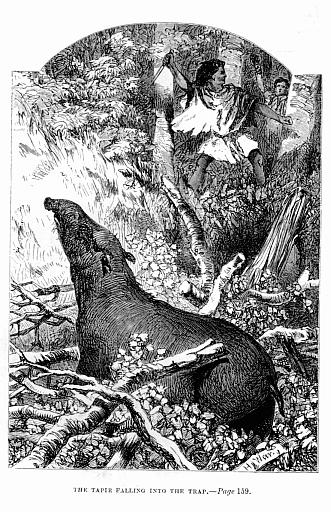
Guapo bounded after, followed by Leon, who kept close at his heels. Of course the tapir was in sight only a few seconds, but the hunter knew that he would take the beaten track, and therefore was at no loss. They made no unnecessary noise—lest the tapir might be frightened from its path—but ran on in silence.
They soon got back to the pit-fall, Guapo of course leading the way.
“Hola!” cried the latter, when he came in sight of it, “hola, young master! he’s in the trap!”
Sure enough he was; and the next moment they stood upon the edge of the pit, and beheld the great brown body struggling and tumbling about at the bottom.
Guapo did not pause a moment, but leaped in, macheté in hand. He had no fear of the animal biting him, for he knew it would not do so; but Guapo, in his hurry, had leaped carelessly, and his foot slipping, he fell over the smooth body of the tapir. The latter in its fright jumped upward, and the next moment Guapo was undermost at the bottom of the pit!
The animal had no design of trampling the hunter; but seeing that it could easily leap out—the pit being shallowed for it by Guapo’s body and the fallen branches—it made a spring, and came out on the edge. Leon had got round upon the side next the river, but he chanced to be on the wrong side just then; for the heavy tapir dashing past, knocked against him, and sent him sprawling among the trees. Before he could recover himself, or Guapo climb out of the pit, a loud plunge in the water announced that the animal had escaped to an element where it might defy their pursuit.
Both were quite crest-fallen and disappointed, but Guapo especially so. He had prided himself very much on his skill as a tapir-hunter, and his pride was mortified at the result. He seemed very much chagrined; and as he and Leon returned toward the house, he stopped at intervals and looked into the water. Then shaking his macheté in a threatening manner, cried out—
“Dive away, old thick-skin! Dive deep as you will, I’ll have your hide yet!”
Chapter Nineteen.
The poisoned Arrows.
The result of the tapir chase determined Guapo to have himself better armed. There was one weapon—and a very efficient one too—which he knew how both to make and use. That weapon was a “gravatána,” or blow-gun, sometimes called “pocuna.” He had had an eye to this weapon all along, and had already provided the materials necessary for making it. These materials were of a varied character, and had cost him some trouble in getting them together.
First, then, for the blow-tube itself he had cut stems of a slender palm-tree,—a species of Iriartea, but not that sort already described. It was the Pashiuba miri of the Indians. This little palm grows to the height of from twelve to twenty feet, and is never thicker than a man’s wrist. Its roots, like the others of its genus, rise above the ground, but only a few inches. The sterns which Guapo had chosen were of different sizes. One was about the thickness of the handle of a garden-rake, while the other was not over the diameter of a walking-cane. Both were hollow in the heart, or rather they contained pith like the alder-tree, which when forced out left a smooth bore.
Having cut these stems to a length of about ten feet, and pushed out the pith, Guapo inserted the smaller one into the bore of the larger, which fitted tightly all the way—for he had chosen it of the proper thickness to this end. The object of thus using two stems instead of one will not, at first, be understood. It was for the purpose of making the tube perfectly straight, as this is a most important consideration in the gravatána. The outer and stronger stem corrected any bend that there might be in the inner one, and they were carefully arranged so that the one should straighten the other. Had it not been perfectly straight, Guapo would have bound it to a post and made it so; but it happened to come quite right without further trouble. The tube of the lesser one was now cleaned out thoroughly, and polished by a little bunch of the roots of a tree-fern, until it was as smooth and hard as ebony. A mouthpiece of wood was placed at the smaller end of the tube, and a sight was glued on the outside. This “sight” was the tooth of an animal,—one of the long curving incisors of a rodent animal called the “paca,” which is found in most parts of tropical America. To make the instrument look neater, Guapo had procured the tough shining bark of a creeping plant, which he wound spirally around the outside from the mouthpiece to the muzzle; and then the gravatána was finished.
There was yet much to be done before it could be used. Arrows were to be made, and a quiver in which to carry them, and poison to dip their points in—for the arrows of the blow-gun do not kill by the wound they inflict, but by the poison with which they are charged.
The next thing, then, to which Guapo turned his attention was the manufacture of the arrows. These can be made of cane, reeds, and other kinds of wood; but the best materials for the purpose are the long spines of the patawa palm, of which I have already spoken. These spines grow out from the lower part of the leaf-petioles, and, in young trees and those much sheltered, remain upon the trunk, giving it a very shaggy appearance. They are often three feet in length, about as thick as large wire, rather flattish, and of a black colour. To make the arrows, Guapo cut them to the length of fifteen or eighteen inches, and then pointed them sharply at one end. About three inches from the points he notched them all, so that they would break in the wound rather than drop out again, in consequence of the struggles of the animal. About two or three inches from the thick end of the arrow Guapo wrapped lightly around the shaft some strands of the soft silky cotton, which he had procured from the pods of the great “ceiba,” or silk-cotton tree, already mentioned. This he fastened on with a fibre of an aloe plant—one of the bromelias; and the cotton, when thus secured, assumed a conical or spindle shape, having its larger end toward the butt of the arrow. When inserted into the gravatána, the swell of the cotton filled the tube exactly,—not so tightly as to impede the passage of the arrow, nor so loosely as to allow of “windage” when blown upon through the mouthpiece.
The arrows were now ready, with the exception of the poison for their tips; and this was the most important of all, for without it both blow-gun and arrows would have been useless weapons, indeed. But Guapo was just the man who knew how to make this poison, and that is more than could be said of every Indian, for it is only the “piaches” (priests, or “medicine-men”) who understand the process. Nay, more, there are even some tribes where not an individual knows how the arrow-poison is made; and these have to procure it by barter from others, paying a high price, and sometimes going a great distance for it.
This celebrated poison is known under different names, but those of “curare,” “ticuna,” and “wouraly,” are the principal.
It is one of the most deadly poisons yet discovered—as much so as the upastiente of Java, or the bean of Saint Ignatius—but it is perfectly harmless when swallowed, and, indeed, it is often taken by the Indians as an excellent stomachic. Should it get into the blood, however, by means of an arrow-wound, or a sore, no remedy has yet been discovered that will cure it. Death is certain, and a death similar to that caused by the bite of a venomous serpent. So say those who have suffered from it, but recovered on account of their having been only slightly wounded, or lightly inoculated with it. Let us see, then, how Guapo prepared this deadly mixture.