"The Forest Exiles" (continued 6)
Reading edition
The vultures paid no attention to these demonstrations, but only kept out of the way of the teeth and claws of their antagonist; and then, when he became still again, both returned to the attack as before. One after the other was seen dashing repeatedly forward—using both legs and wings to effect their object, and each time darting out their great beaks towards the eyes of the reptile. The head of the latter kept continuously moving from side to side; but move where it would, the beaks of the vultures were ready to meet it, and to pierce into the sockets of those deep lurid eyes.
This terrible contest lasted all the time the balza was floating by. It was a slow current at this place, and our travellers were a long time in passing, so that they had a good opportunity of witnessing the strange spectacle. Long after they had glided past, they saw that the conflict continued. They could still perceive the black body of the reptile upon the white sandbank, writhing and struggling, while the flapping wings of the vultures showed that they still kept up their terrible attack. But the head of the crocodile was no longer directed towards the water. At the first onset the reptile had used every effort to retreat in that direction. He knew that his only safety lay in getting into the river, and sinking beyond the reach of his adversaries. At every interval between their assaults, he had been seen to crawl forward, stopping only when compelled to defend himself. Now, however, his head was seen turned from the water; sometimes he lay parallel with the stream; and sometimes he appeared to be heading back for the woods, while his struggles and contortions betrayed the agony he was undergoing. But his turning in this way was easily accounted for. He knew not in what direction lay the river. He could no longer see. His eyes were mutilated by the beaks of the birds. He was blind!
Guapo said the vultures would not leave him until they had made a meal of his eyes, and that was all they wanted. He would then remain on shore, perhaps without finding his way back to the water, and most likely be attacked by jaguars, or other preying creatures, who could conquer him the easier now that he was deprived of his sight!
As the balza glided on, Guapo told our travellers many strange stories of crocodiles. He stated, what is well known to be true, that in the rivers of South America many people are every year killed by these ravenous creatures; in fact, far more than have ever fallen victims to the salt-sea sharks. In some places they are much fiercer than in others; but this may arise from different species being the inhabitants of these different places. There is the true crocodile, with long sharp snout, and large external tusks; and the caiman, with a snout broader and more pike-shaped; and the former is a much more courageous and man-eating creature. Both are often found in the same river; but they do not associate together, but keep in distinct bands or societies; and they are often mistaken for each other. This may account for the difference of opinion that exists in regard to the fierceness of these reptiles—many asserting that they are utterly harmless, and will not attack man under any circumstances; while others, who have witnessed their attacks, of course bearing testimony to the contrary. There are many places in South America, where the natives will fearlessly enter a lake or river known to be full of crocodiles, and drive these creatures aside with a piece of a stick; but there are other districts where nothing will tempt an Indian to swim across a river infested with these reptiles. In the Amazon districts, in every Indian village, several people may be seen who have been maimed by crocodiles. No wonder that among author-travellers there should be such a difference of opinion.
Guapo stated, that when an Indian has been seized by a crocodile in its great jaws, he has only one chance of escape, and that is, by thrusting his fingers into the eyes of the reptile. This will invariably cause it to let go its hold, and generally frighten it, so as to enable the person to escape. It, of course, requires great presence of mind to effect this, as the person who has been seized will himself be in great pain from the tearing teeth of the monster, and, perhaps, will have been drawn under the water, before he can gather his senses. But it has often occurred that Indians, and even women, have escaped in this way.
The eyes of the crocodile are its most tender parts,—in fact, the only parts that can be made to feel pain. A crocodile may be disabled by cutting at the root of its tail, but it can only be frightened by an attack upon the eyes; and this appears to be a well-known fact, not only to the Indians, but to all its other enemies among the birds and quadrupeds.
The young crocodiles are often attacked, and have their eyes pecked out, by the small gallinazo or “zamuro” vultures (aura and cathartes), just in the same way that we have seen one of a larger size become the victim of the more powerful king vultures (Sarcoramphus papa).
Chapter Forty Six.
The “Gapo.”
After many days of rafting our travellers arrived in a most singular country. They were now approaching the mighty Amazon, and the river upon which they had hitherto been travelling appeared to divide into many branches, where it formed deltas with the Amazon. Every day, and sometimes two or three times in the day, they passed places where the river forked, as though each branch passed round an island, but our travellers perceived that these branches did not meet again; and they conjectured that they all fell into the Amazon by separate embouchures. They were often puzzled to know which one to take, as the main river was not always broadest, and they might get into one that was not navigable below. A curious region it was through which they passed; for, in fact, they were now travelling in the country of the “Gapo.”
What is the “Gapo?” you will ask. The “Gapo,” then, is the name given to vast tracts of country upon the Amazon and some of its tributary streams, that are annually inundated, and remain under water for several months in the year. It extends for hundreds of miles along the Amazon itself, and up many of the rivers, its tributaries also, for hundreds of miles.
But the whole country does not become one clear sheet of water, as is the case with floods in other parts of the world. On the contrary, high as is the flood, the tree-tops and their branches rise still higher, and we have in the “Gapo” the extraordinary spectacle of a flooded forest, thousands of square miles in extent!
In this forest the trees do not perish, but retain life and verdure. In fact, the trees of this part are peculiar, most of them differing in kind from the trees of any other region. There are species of palms growing in the “Gapo” that are found nowhere else; and there are animals and birds, too, that remain in this region during the whole season of flood. It has been further asserted that there are tribes of “Gapo” Indians, who live in the middle of the inundation, making their dwellings upon the trees, and who can pass from branch to branch and tree to tree almost as nimbly as monkeys. This may or may not be true. It would not be a new thing, if true, for it is well known that the Guarano Indians, at the mouth of the Orinoco, dwell among the tops of the murichi palms (Mauritia flexuosa) during many months of the season of flood. These people build platforms on the palms, and upon these erect roofs, and sling their hammocks, and, with little fireplaces of mud, are enabled to cook their provisions upon them. But they have canoes, in which they are able to go from place to place, and capture fish, upon which they principally subsist. The murichi palm furnishes them with all the other necessaries of life.
This singular tree is one of the noblest of the palms. It rises to a height of more than one hundred feet, and grows in immense palmares, or palm-woods, often covering the bank of the river for miles. It is one of those called “fan-palms,”—that is, the leaves, instead of being pinnate or feathery, have long naked stalks, at the end of which the leaflets spread out circularly, forming a shape like a fan. One of the murichi leaves is a grand sight. The leaf-stalk, or petiole, is a foot thick where it sprouts from the trunk; and before it reaches the leaflets it is a solid beam of ten or twelve feet long, while the circular fan or leaf itself is nine or ten in diameter! A single leaf of the murichi palm is a full load for a man.
With a score of such leaves,—shining and ever verdant as they are,—at the top of its column-like trunk, what a majestic tree is the murichi palm!
But it is not more beautiful than useful. Its leaves, fruit, and stem, are all put to some use in the domestic economy of the Indians. The leaf-stalk, when dried, is light and elastic, like the quill of a bird—owing to the thin, hard, outer covering and soft internal pith. Out of the outer rind, when split off, the Indian makes baskets and window-blinds. The pithy part is separated into laths, about half an inch thick, with which window-shutters, boxes, bird-cages, partitions, and even entire walls, are constructed. The epidermis of the leaves furnishes the strings for hammocks and all kinds of cordage. From the fruits a favourite beverage is produced, and these fruits are also pleasant eating, somewhat resembling apples. They are in appearance like pine-cones, of a red colour outside and yellow pulp. The trunk itself furnishes a pith or marrow that can be used as sago; and out of the wood the Indian cuts his buoyant canoe! In short, there are tribes of Indians that not only live, in a literal sense, on the murichi palms, but that almost subsist on them.
Although the flood had, to a considerable extent, subsided, the river in most places was still beyond its banks; and this made it difficult for our travellers to find a place for their night-camps. Several nights they were obliged to sleep, as they best could, on the balza,—the latter being secured to a tree. Sometimes, by pushing some distance up the mouth of an “igaripé,” or creek, they were able to find dry ground, on which to encamp. During their passage through this labyrinth of rivers, they travelled but very slowly, and their provisions were fast running out. There was no chance for increasing their stock, as they could not find either wild-hogs (peccaries) or capivaras. These creatures, although they can swim well enough, would only be found upon the banks of the river, when it returned within its proper channel.
Now and then Guapo brought down a parrot, a macaw, or an aracari, with his blow-gun; but these were only temporary supplies. They had often heard howling monkeys in the trees, but had not been able to see them; and none of the party would have refused to eat roast-monkey now, as they had all tried it and found it quite palatable. Guapo, blow-gun in hand, was continually peering up among the tree-tops in search of monkeys or other game. He was, at length, rewarded for his vigilance.
One night they had pushed the balza up an “igaripé” for a hundred yards or so, where a dry bank gave them an opportunity of landing. The creek itself was not much wider than the balza, and tall trees stood upon both banks. In one or two places the thorny “jacitara” palm—which is a sort of climbing plant, often hanging over the branches of other trees—nearly reached across the stream. These curious palms had even to be cautiously pushed to one side as the balza passed,—for the arrowy claws upon them, if once hooked into the clothes of the passengers, would either have dragged the latter from off the raft, or have torn out the piece of cloth.
Chapter Forty Seven.
The Araguatoes.
Our party had passed several of these jacitaras, made the balza fast, landed, and were just cooking their scanty supper, when they heard a band of howling monkeys afar off in the woods. There was nothing unusual in this; for these creatures are heard at all times among the forests of the Amazon, especially at sunrise and before sunset, or whenever there is any appearance of the approach of a rain-storm. Our travellers would not have noticed their voices on this occasion, but that they seemed to be approaching in that direction; and as they were coming along the bank of the main river, Guapo concluded that on arriving at the “igaripé,” they would turn up it and pass near where the balza was, and thus he might have them within reach of his gravatána. It was certain they were coming down the river side—of course upon the tree-tops, and would, no doubt, turn up as Guapo expected, for the trees on the opposite side of the igaripé stood too far apart even for monkeys to spring across.
After waiting for half-an-hour or so, the hideous howling of the monkeys could be heard at no great distance, and they were taking the desired route. In fact, in a few minutes after, the troop appeared upon some tall trees that stood on the edge of the creek, not fifty yards from where the balza was moored. They were large animals, of that lanky and slender shape that characterises the prehensile-tailed monkeys; but these were different from the ateles already mentioned. They were true howlers, as they had already proved by the cries they had been uttering for the half-hour past. There are several species of howling monkeys, as we have already stated. Those that had arrived on the igaripé Guapo pronounced to be araguatoes. Their bodies are of a reddish-brown colour on the body and shoulders, lighter underneath, and their naked wrinkled faces are of a bluish black, and with very much of the expression of an old man. Their hair is full and bushy, and gives them some resemblance to a bear, whence their occasional name of “bear-ape,” and also their zoological designation, Simia ursina. The araguato is full three feet without the tail, and that powerful member is much longer. When the band made its appearance on the igaripé, they were seen to come to a halt, all of them gathering into a great tree that stood by the water’s edge. This tree rose higher than the rest, and the most of the monkeys having climbed among the top branches, were visible from the balza. There were about fifty in the troop, and one that seemed larger than any of the others appeared to act as leader. Many of them were females, and there were not a few that had young ones, which they carried upon their backs just as the Indian mothers and those of other savage nations carry their children. Most of the little monkeys lay along the backs of their mothers, clasping them around the neck with their fore-arms, while their hind ones girdled the middle of the body. But it was in their tails the little fellows seemed to place most reliance. The top parts of these were firmly lapped around the thick base of the tails of the old ones, and thus not only secured their seat, but made it quite impossible for them to drop off. No force could have shaken them from this hold, without dragging out their tails or tearing their bodies to pieces. Indeed, it was necessary they should be thus firmly seated, as the exertions of the mothers,—their quick motions and long springing leaps from tree to tree—would otherwise have been impossible.
On reaching the bank of the igaripé, the araguatoes were evidently at fault. Their intention had been to proceed down along the main river, and the creek now interfered. Its water lay directly across their course, and how were they to get over it? Swim it, you may say. Ha! little do you know the dread these creatures have of water. Yes; strange to say, although many species of them pass their lives upon trees that overhang water, or even grow out of it, they are as much afraid of the water beneath them as if it were fire. A cat is not half so dainty about wetting her feet as some monkeys are; and besides a cat can swim, which the monkeys cannot—at best so badly that in a few minutes they would drown. Strange, is it not, that among animals, those that approach nearest to man, like him are not gifted by nature with the power of swimming? It is evident, then, that that is an art left to be discovered by the intellect of man. To fall into the water would be a sad mishap for a monkey, not only on account of the ducking, but of the danger. There is not much likelihood of an araguato falling in. Even though one branch may have broken and failed it, in the great concave sphere which it can so quickly trace around it by means of its five long members, it is sure of finding a second. No; the araguatoes might spend a lifetime in the flooded forest without even wetting a hair farther than what is wetted by the rain.
From their movements, it was evident the igaripé had puzzled them; and a consultation was called among the branches of the tall tree already mentioned. Upon one of the very highest sat the large old fellow who was evidently leader of the band. His harangue was loud and long, accompanied by many gestures of his hands, head, and tail. It was, no doubt, exceedingly eloquent. Similar speeches delivered by other old araguato chiefs, have been compared to the creaking of an ungreased bullock-cart, mingled with the rumbling of the wheels!
Our party thought the comparison a just one. The old chief finished at length. Up to this point not one of the others had said a word. They all sat silent, observing perfect decorum; indeed, much greater than is observed in the great British Parliament or the Congress of America. Occasionally one of the children might utter a slight squeak, or throw out its hand to catch a mosquito; but in such cases a slap from the paw of the mother, or a rough shaking, soon reduced it to quiet. When the chief had ended speaking, however, no debate in either Congress or Parliament could have equalled the noise that then arose. Every araguato seemed to have something to say, and all spoke at the same time. If the speech of the old one was like the creaking of a bullock-cart, the voices of all combined might appropriately be compared to a whole string of these vehicles, with half the quantity of grease and a double allowance of wheels!
Once more the chief, by a sign, commanded silence, and the rest became mute and motionless as before.
This time the speech of the leader appeared to refer to the business in hand—in short, to the crossing of the igaripé. He was seen repeatedly pointing in that direction, as he spoke, and the rest followed his motions with their eyes.
Chapter Forty Eight.
Bridging an Igaripé.
The tree upon which the araguatoes were assembled stood near the edge of the water, but there was another still nearer. This was also a tall tree free of branches for a great way up. On the opposite bank of the igaripé was a very similar tree, and the long horizontal branches of the two were separated from each other by a space of about twenty feet. It was with these two trees that the attention of the araguatoes appeared to be occupied; and our travellers could tell by their looks and gestures that they were conversing about, and calculating, the distance between their upper branches. For what purpose? Surely they do not expect to be able to make a crossing between them? No creature without wings could pass from the one to the other! Such were the questions and doubts expressed by Leon, and indeed by all except Guapo, but Guapo had seen araguatoes before, and knew some of their tricks. Guapo, therefore, boldly pronounced that it was their intention to cross the igaripé by these two trees. He was about to explain the manner in which they would accomplish it, when the movement commenced, and rendered his explanation quite unnecessary.
At a commanding cry from the chief, several of the largest and strongest monkeys swung themselves into the tree that stood on the edge of the water. Here, after a moment’s reconnoissance, they were seen to get upon a horizontal limb—one that projected diagonally over the igaripé. There were no limbs immediately underneath it on the same side of the tree; and for this very reason had they selected it. Having advanced until they were near its top, the foremost of the monkeys let himself down upon his tail, and hung head downward. Another slipped down the body of the first, and clutched him around the neck and fore-arms with his strong tail, with his head down also. A third succeeded the second, and a fourth the third, and so on until a string of monkeys dangled from the limb. A motion was now produced by the monkeys striking other branches with their feet, until the long string oscillated back and forwards like the pendulum of a clock. This oscillation was gradually increased, until the monkey at the lower end was swung up among the branches of the tree on the opposite side of the igaripé. After touching them once or twice, he discovered that he was within reach; and the next time when he had reached the highest point of the oscillating curve, he threw out his long thin fore-arms, and firmly clutching the branches, held fast.
The oscillation now ceased. The living chain stretched across the igaripé from tree to tree, and, curving slightly, hung like a suspension-bridge. A loud screaming, and gabbling, and chattering, and howling, proceeded from the band of araguatoes, who, up to this time, had watched the manoeuvres of their comrades in silence—all except the old chief, who occasionally had given directions both with voice and gestures. But the general gabble that succeeded was, no doubt, an expression of the satisfaction of all that the bridge was built.
The troop now proceeded to cross over, one or two old ones going first—perhaps to try the strength of the bridge. Then went the mothers carrying their young on their backs, and after them the rest of the band.
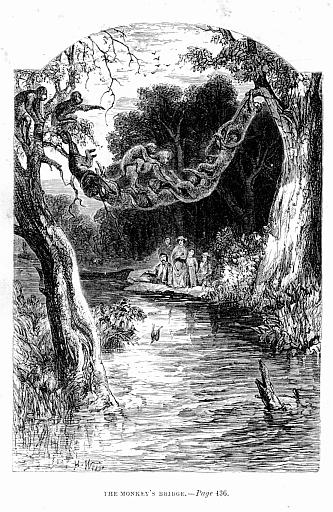
It was quite an amusing scene to witness, and the behaviour of the monkeys would have caused any one to laugh. Even Guapo could not restrain his mirth at seeing those who formed the bridge biting the others that passed over them, both on the legs and tails, until the latter screamed again!
The old chief stood at the near end and directed the crossing. Like a brave officer, he was the last to pass over. When all the others had preceded him, he crossed after, carrying himself in a stately and dignified manner. None dared to bite at his legs. They knew better than play off their tricks on him, and he crossed quietly and without any molestation.
Now the string still remained suspended between the trees. How were the monkeys that formed it to get themselves free again? Of course the one that had clutched the branch with his arms might easily let go, but that would bring them back to the same side from which they had started, and would separate them from the rest of the band. Those constituting the bridge would, therefore, be as far from crossing as ever!
There seemed to be a difficulty here—that is, to some of our travellers. To the monkeys themselves there was none. They knew well enough what they were about, and they would have got over the apparent difficulty in the following manner:—The one at the tail end of the bridge would simply have let go his hold, and the whole string would then have swung over and hung from the tree on the opposite bank, into which they could have climbed at their leisure. I say they would have done so had nothing interfered to prevent them from completing the manoeuvre. But an obstacle intervened which brought the affair to a very different termination.
Guapo had been seated along with the rest, gravatána in hand. He showed great forbearance in not having used the gravatána long before, for he was all the while quite within reach of the araguatoes; but this forbearance on his part was not of his own free-will. Don Pablo had, in fact, hindered him, in order that he and the others should have an opportunity of witnessing the singular manoeuvres of the monkeys. Before the scene was quite over, however, the Indian begged Don Pablo to let him shoot, reminding him how much they stood in need of a little “monkey-meat.” This had the effect Guapo desired; the consent was given, and the gravatána was pointed diagonally upwards. Once more Guapo’s cheeks were distended—once more came the strong, quick puff—and away went the arrow. The next moment it was seen sticking in the neck of one of the monkeys.
Now, the one which Guapo had aimed at and hit was that which had grasped the tree on the opposite side with its arms. Why did he choose this more than any other? Was it because it was nearer, or more exposed to view? Neither of these was the reason. It was, that had he shot any of the others in the string—they being supported by their tails—it would not have fallen; the tail, as we have already seen, still retaining its prehensile power even to death. But that one which held on to the tree by its fore-arms would in a second or two be compelled from weakness to let go, and the whole chain would drop back on the near side of the igaripé. This was just what Guapo desired, and he waited for the result. It was necessary only to wait half-a-dozen seconds. The monkey was evidently growing weak under the influence of the curare, and was struggling to retain its hold. In a moment it must let go.
The araguato at the “tail-end” of the bridge, not knowing what had happened, and thinking all was right for swinging himself across, slipped his tail from the branch just at the very same instant that the wounded one let go, and the whole chain fell “souse” into the water! Then the screaming and howling from those on shore, the plunging and splashing of the monkeys in the stream, mingled with the shouts of Leon, Guapo, and the others, created a scene of noise and confusion that lasted for several minutes. In the midst of it, Guapo threw himself into the canoe, and with a single stroke of his paddle shot right down among the drowning monkeys. One or two escaped to the bank, and made off; several went to the bottom; but three, including the wounded one, fell into the clutches of the hunter.
Of course roast-monkey was added to the supper; but none of the travellers slept very well after it, as the araguatoes, lamenting their lost companions, kept up a most dismal wailing throughout the whole of the night.
Chapter Forty Nine.
The Manati.
The araguatoes, with dried plantains and cassava, were the food of our travellers for several days after. On the evening of the third day they had a change. Guapo succeeded in capturing a very large turtle, which served for relish at several meals. His mode of taking the turtle was somewhat curious, and deserves to be described.
The balza had been brought to the bank, and they were just mooring it, when something out on the water attracted the attention of Leon and Leona. It was a small, darkish object, and would not have been observed but for the ripple that it made on the smooth surface of the river, and by this they could tell that it was in motion.
“A water-snake!” said Leon.
“Oh!” ejaculated the little Leona, “I hope not, brother Leon.”
“On second thoughts,” replied Leon, “I don’t think it is a snake.”
Of course the object was a good distance off, else Leon and Leona would not have talked so coolly about it. But their words had reached the ear of Doña Isidora, and drawn her attention to what they were talking about.
“No; it is not a snake,” said she. “I fancy it is a turtle.”
Guapo up to this had been busy with Don Pablo in getting the balza made fast. The word “turtle,” however, caught his ear at once, and he looked up, and then out on the river in the direction where Leon and Leona were pointing. As soon as his eye rested upon the moving object he replied to the remark of Doña Isidora.
“Yes, my mistress,” said he, “it is a turtle, and a big one too. Please all keep quiet—I think I can get him.”
How Guapo was to get the turtle was a mystery to all. The latter was about thirty paces distant, but it would be difficult, if not impossible, to hit his small snout—the only part above water—with the arrow of the blow-gun. Moreover, they thought that the arrow would not penetrate the hard, bony-substance, so as to stick there and infuse its poison into the wound.
These conjectures were true enough, but his gravatána was not the weapon which Guapo was about to use. He had other weapons as well—a fish-spear or harpoon, and a regular bow and arrows, which he had made during his leisure hours in the valley.
The latter was the weapon with which the tortoise was to be killed.
Taking the bow, and adjusting an arrow to the string, Guapo stepped forward to the water’s edge. All watched him, uttering their hopes of his success. It was still not clear with them how the turtle was to be killed by an arrow shot from a bow any more than by one sent from a blow-gun. Would it not glance from the shell even should he succeed in hitting it under water? Surely it would!
As they stood whispering their conjectures to one another, they observed Guapo, to their great astonishment, pointing his arrow upward, and making as if he was going to discharge it in the air! This he, in fact, did do a moment after; and they would have been puzzled by his apparently strange conduct, had they not observed, in the next instant, that the arrow, after flying high up, came down again head-foremost and stuck upright in the back of the turtle.
The turtle dived at once, and all of them expected to see the upright arrow carried under water. What was their surprise as well as chagrin to see that it had fallen out, and was floating on the surface! Of course the wound had only been a slight one, and the turtle would escape, and be none the worse for it.
But Guapo shared neither their surprise nor chagrin. Guapo felt sure that the turtle was his, and said nothing; but, jumping into the canoe, began to paddle himself out to where the creature had been last seen. What could he be after? thought they.
As they watched him, they saw that he made for the floating arrow. “Oh!” said they, “he is gone to recover it.”
That seemed probable enough, but, to their astonishment, as he approached the weapon it took a start, and ran away from him! Something below dragged it along the water. That was clear, and they began to comprehend the mystery. The head of the arrow was still sticking in the shell of the turtle. It was only the shaft that floated, and that was attached to the head by a string! The latter had been but loosely put on, so that the pressure of the water, as the turtle dived, should separate it from the shaft, leaving the shaft with its cord to act as a buoy, and discover the situation of the turtle.
Guapo, in his swift canoe, soon laid hold of the shaft, and after a little careful manoeuvring, succeeded in landing his turtle high and dry upon the bank. A splendid prize it proved. It was a “jurara” tortoise—the “tataruga,” or great turtle of the Portuguese, and its shell was full three feet in diameter.
Guapo’s mode of capturing the “jurara” is the same as that generally practised by the Indians of the Amazon, although strong nets and the hook are also used. The arrow is always discharged upwards, and the range calculated with such skill, that it falls vertically on the shell of the turtle, and penetrates deep enough to stick, and detach itself from the shaft. This mode of shooting is necessary, else the jurara could not be killed by an arrow, because it never shows more than the tip of its snout above water, and any arrow hitting it in a direct course would glance harmlessly from its shell. A good bowman among the Indians will rarely miss shooting in this way,—long practice and native skill enabling him to guess within an inch of where his weapon will fall.
In the towns of the Lower Amazon, where turtles are brought to market, a small square hole may be observed in the shells of these creatures. That is the mark of the arrow-head.
Guapo lost no time in turning his turtle inside out, and converting part of it into a savoury supper, while the remainder was fried into sausage-meat, and put away for the following day.
But on that following day a much larger stock of sausage-meat was procured from a very different animal, and that was a “cow.”
“How?” you exclaim,—“a cow in the wild forests of the Amazon! Why, you have said that no cattle—either cows or horses—can exist there without man to protect them, else they would be devoured by pumas, jaguars, and bats. Perhaps they had arrived at some settlement where cows were kept?”
Not a bit of it; your conjecture, my young friend, is quite astray. There was not a civilised settlement for many hundreds of miles from where Guapo got his cow—nor a cow neither, of the sort you are thinking of. But there are more kinds of cows than one; and, perhaps, you may have heard of a creature called the “fish-cow?” Well, that is the sort of cow I am speaking of. Some term it the “sea-cow,” but this is an improper name for it, since it also inhabits fresh-water rivers throughout all tropical America. It is known as the Manati, and the Portuguese call it “peixe hoi,” which is only “fish-cow” done into Portuguese.
It is a curious creature the fish-cow, and I shall offer you a short description of it. It is usually about seven feet in length, and five round the thickest part of the body, which latter is quite smooth, and tapers off into a horizontal flat tail, semicircular in shape. There are no hind-limbs upon the animal, but just behind the head are two powerful fins of an oval shape. There is no neck to be perceived; and the head, which is not very large, terminates in a large mouth and fleshy lips, which are not unlike those of a cow: hence its name of “cow-fish.” There are stiff bristles on the upper lip, and a few thinly scattered hairs over the rest of the body. Behind the oval fins are two mamma, or breasts, from which, when pressed, flows a stream of beautiful white milk. Both eyes and ears are very small in proportion to the size of the animal, but, nevertheless, it has full use of these organs, and is not easily approached by its enemy.
The colour of the skin is a dusky lead, with some flesh-coloured marks on the belly, and the skin itself is an inch thick at its thickest part, on the back. Beneath the skin is a layer of fat, of great thickness, which makes excellent oil when boiled. As we have said, the manati has no appearance of hind-limbs. Its fore-limbs, however, are highly developed for a water animal. The bones in them correspond to those in the human arm, having five fingers with the joints distinct, yet so enclosed in an inflexible sheath that not a joint can be moved.
The cow-fish feeds on grass, coming in to the borders of the lakes and rivers to procure it. It can swim very rapidly by means of its flat tail and strong fins, and is not so easily captured as might be supposed. All the art of the hunter is required to effect its destruction. The harpoon is the weapon usually employed, though sometimes they are caught in strong nets stretched across the mouths of rivers or the narrow arms of lakes. The flesh of the manati is much esteemed, and tastes somewhat between beef and pork, altogether different from “fish.” Fried in its own oil, and poured into pots or jars, it can be preserved for many months.
As already stated, on the day after Guapo shot the turtle—in fact, the next morning—just as they were going to shove off, some of the party, in gazing from the edge of the balza, noticed a queer-looking animal in the clear water below. It was no other than a “fish-cow;” and, as they continued to examine it more attentively, they were astonished to observe that, with its short paddle-like limbs, it hugged two miniature models of itself close to its two breasts. These were the “calves” in the act of suckling, for such is the mode in which the manati nourishes her young.
All the others would have watched this spectacle for a while, interested in the maternal and filial traits thus exhibited by a subaqueous creature, but while they stood looking into the water, something glanced before their eyes, and glided with a plunge to the bottom. It was the harpoon of Guapo.
Blood rose to the surface immediately, and there was a considerable plashing as the strong manati made its attempt to escape; but the head of the harpoon was deeply buried in its flesh, and, with the attached cord, Guapo soon hauled the animal ashore. It was as much as he and Don Pablo could do to drag it on dry land; but the knife soon took it to pieces; and then several hours were spent in making it fit for preservation. Its fat and flesh yielded enough to fill every spare vessel our travellers had got; and, when all were filled, the balza was pushed off, and they continued their voyage without any fear of short rations for some time to come.
Chapter Fifty.
The Closing Chapter.
After many days of difficult navigation the balza floated upon the broad and mighty Amazon, whose yellowish-olive flood flowed yet fifteen hundred miles farther to the Atlantic Ocean.
The current was in most places over four miles an hour, and the navigation smooth and easy—so that our travellers rarely made less than fifty miles a-day. There was considerable monotony in the landscape, on account of the absence of mountains, as the Amazon, through most of its course, runs through a level plain. The numerous bends and sudden windings of the stream, however, continually opening out into new and charming vistas, and the ever-changing variety of vegetation, formed sources of delight to the travellers.
Almost every day they passed the mouth of some tributary river—many of these appearing as large as the Amazon itself. Our travellers were struck with a peculiarity in relation to these rivers—that is, their variety of colour. Some were whitish, with a tinge of olive, like the Amazon itself; others were blue and transparent; while a third kind had waters as black as ink. Of the latter class is the great river of the Rio Negro—which by means of a tributary (the Cassiquiare) joins the Amazon with the Orinoco.
Indeed, the rivers of the Amazon valley have been classed into white, blue, and black. Red rivers, such as are common in the northern division of the American continent, do not exist in the valley of the Amazon.
There appears to be no other explanation for this difference in the colour of rivers, except by supposing that they take their hue from the nature of the soil through which these channels run.
But the white rivers, as the Amazon itself, do not appear to be of this hue merely because they are “muddy.” On the contrary, they derive their colour, or most of it, from some impalpable substance held in a state of irreducible solution. This is proved from the fact, that even when these waters enter a reservoir, and the earthy matter is allowed to settle, they still retain the same tinge of yellowish olive. There are some white rivers, as the Rio Branco, whose waters are almost as white as milk itself!
The blue rivers of the Amazon valley are those with clear transparent waters, and the courses of these lie through rocky countries where there is little or no alluvium to render them turbid.
The black streams are the most remarkable of all. These, when deep, look like rivers of ink; and when the bottom can be seen, which is usually a sandy one, the sand has the appearance of gold. Even when lifted in a vessel, the water retains its inky tinge, and resembles that which may be found in the pools of peat-bogs. It is a general supposition in South America that the black-water rivers get their colour from the extract of sarsaparilla roots growing on their banks. It is possible the sarsaparilla roots may have something to do with it, in common with both the roots and leaves of many other vegetables. No other explanation has yet been found to account for the dark colour of these rivers, except the decay of vegetable substances carried in their current; and it is a fact that all the black-water streams run through the most thickly wooded regions.
A curious fact may be mentioned of the black rivers; that is, that mosquitoes—the plague of tropical America—are not found on their banks. This is not only a curious, but an important fact, and might be sufficient to determine any one on the choice of a settlement. You may deem a mosquito a very small thing, and its presence a trifling annoyance. Let me tell you that settlements have been broken up and deserted on account of the persecution experienced from these little insects! They are the real “wild beasts” of South America, far more to be dreaded than pumas, or crocodiles, or snakes, or even the fierce jaguar himself.
Day after day our travellers kept on their course, meeting with many incidents and adventures—too many to be recorded in this little volume. After passing the mouth of the Rio Negro, they began to get a peep now and then of high land, and even mountains, in the distance; for the valley of the Amazon, on approaching its mouth, assumes a different character from what it has farther up-stream. These mountains bend towards it both from the Brazilian country on the south, and from Guiana on the north, and these are often visible from the bosom of the stream itself.
It was about a month from their entering the main stream of the Amazon, and a little more than two from the first launching of their vessel, when the balza was brought alongside the wharf of Grand Para, and Don Pablo and his party stepped on shore at this Brazilian town. Here, of course, Don Pablo was a free man—free to go where he pleased—free to dispose of his cargo as he thought best. But he did not dispose of it at Grand Para. A better plan presented itself. He was enabled to freight part of a vessel starting for New York, and thither he went, taking his family and cargo along with him. In New York he obtained a large price for his bark, roots, and beans; in fact, when all were disposed of, he found himself nearly twenty thousand dollars to the good. With this to live upon, he determined to remain in the great Republic of the North until such time as his own dear Peru might be freed from the Spanish oppressor.
Ten years was the period of his exile. At the end of that time the Spanish-American provinces struck almost simultaneously for liberty; and in the ten years’ struggle that followed, not only Don Pablo, but Leon—now a young man—bore a conspicuous part. Both fought by the side of Bolivar at the great battle of Junin, which crowned the patriot army with victory.
At the close of the War of Independence, Don Pablo was a general of division, while Leon had reached the grade of a colonel. But as soon as the fighting was over, both resigned their military rank, as they were men who did not believe in soldiering as a mere profession. In fact, they regarded it as an unbecoming profession in time of peace, and in this view I quite agree with them.
Don Pablo returned to his studies; but Leon organised an expedition of cascarilleros, and returned to the Montaña, where for many years he employed himself in “bark-hunting.” Through this he became one of the richest of Peruvian “ricos.”
Guapo, who at this time did not look a year older than when first introduced, was as tough and sinewy as ever, and was at the head of the cascarilleros; and many a coceada did Guapo afterwards enjoy with his mountain friend the “vaquero” while passing backward and forward between Cuzco and the Montaña.
Doña Isidora lived for a long period an ornament to her sex, and the little Leona had her day as the “belle of Cuzco.”
But Leon and Leona both got married at length; and were you to visit Cuzco at the present time, you might see several little Leons and Leonas, with round black eyes, and dark waving hair—all of them descendants from our family of—
“Forest Exiles.”
The End.
| Chapter 1 | | Chapter 2 | | Chapter 3 | | Chapter 4 | | Chapter 5 | | Chapter 6 | | Chapter 7 | | Chapter 8 | | Chapter 9 | | Chapter 10 | | Chapter 11 | | Chapter 12 | | Chapter 13 | | Chapter 14 | | Chapter 15 | | Chapter 16 | | Chapter 17 | | Chapter 18 | | Chapter 19 | | Chapter 20 | | Chapter 21 | | Chapter 22 | | Chapter 23 | | Chapter 24 | | Chapter 25 | | Chapter 26 | | Chapter 27 | | Chapter 28 | | Chapter 29 | | Chapter 30 | | Chapter 31 | | Chapter 32 | | Chapter 33 | | Chapter 34 | | Chapter 35 | | Chapter 36 | | Chapter 37 | | Chapter 38 | | Chapter 39 | | Chapter 40 | | Chapter 41 | | Chapter 42 | | Chapter 43 | | Chapter 44 | | Chapter 45 | | Chapter 46 | | Chapter 47 | | Chapter 48 | | Chapter 49 | | Chapter 50 |