7. Exploration of Tibesti.
Reading edition
In the month of September 1916 I was authorized to proceed from Borkou to Tibesti for the purpose of getting in touch with the rebel tribes who intended to attack the caravans fitted out in Kanem and Wadaï for the carrying of supplies to the garrisons of Borkou and Ennedi. The garrison of Tibesti was to attempt, to the best of its ability, to co-operate with this action in such a way that the hostile bands, threatened at once on the south, the west, and the north, might either be induced to submit or else to disperse in the eastern part of the Tibestian massif, the part furthest away from the region to be traversed by our convoys of supplies.
The rebels were comparatively few in number—about 2000 combatants—and divided into clans living in different regions; but they were of extreme mobility, well armed, and abundantly supplied with ammunition. Their tactics, which were very skilful, consisted in avoiding on all occasions a fight in the open, in hiding in the labyrinth of their well-nigh inaccessible rocks to fire at short range on the enemy when he passed near enough, in decamping at top speed to hide again a little further on, and so draw little groups of adversaries in the direction of death-traps, where of course well-planned ambuscades lay in wait for them.
The strength of the reconnoitring detachment was forty-four black soldiers, officered by four Europeans—one of them a doctor—and accompanied by some thirty auxiliaries (guides, goumiers,[1] camel drivers, and servants). It carried food for two months, and the barrels and skins required for three days’ water. The train included about 120 camels.
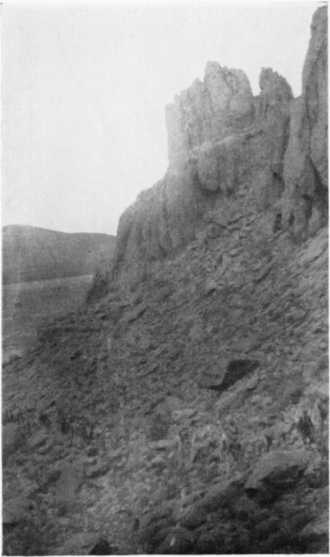
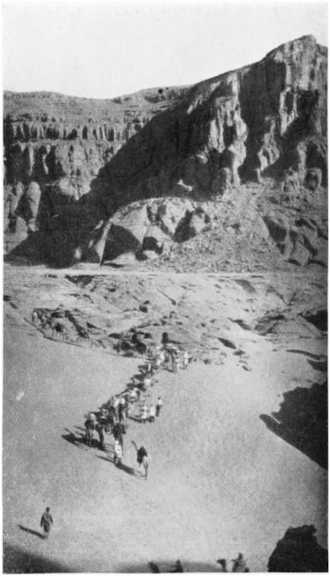
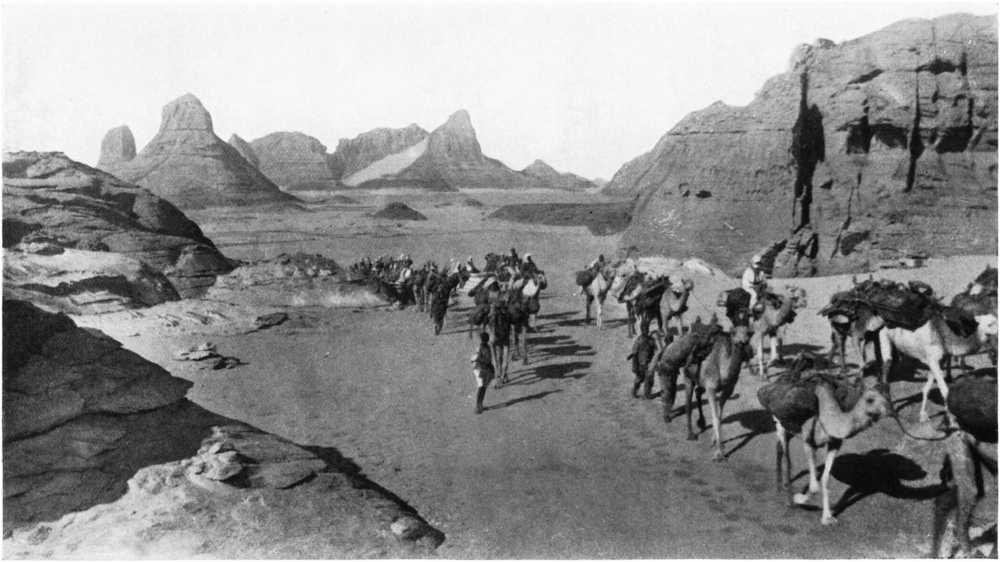
The mountainous country to be crossed set an extremely awkward problem: many points where water would have to be found were often hard for the camels to reach. Pasture-grounds were rare and scanty. The tracks, inexistent or deceptive, would now stretch away across successive heaps of sharp-edged pebbles, and now twist and turn endlessly along winding torrent beds, deep sunk between sheer banks. To cross from one valley to the next one had to climb a succession of cliff ledges, rising tier on tier to several hundred metres by the merest suggestion of paths winding along the sides of spurs formed by the rolling down of débris from above; when the slopes grew too steep, the baggage had to be carried up from one shelf to the next on men’s heads. Our camels, used to the easy going of the great sandy plains, were discouraged by the asperities of the sharp-angled rocks, by the narrow ledges, the steep and slippery steps, the loose pebbles, the excessively sharp turns; and so only short distances could be covered in spite of long hours under way and intense fatigue.
It goes without saying that we had no sort of map of these unknown regions, and that we were utterly at the mercy of the guides whom by good or evil fortune the patrols put at our disposition. Accordingly, the choice of our routes was dictated to us at once by the necessity of reducing to a minimum the efforts and privations of our camels and by that of keeping within the limits familiar to our ordinary and occasional guides. It may be added that the latter showed the utmost unwillingness to lead us into regions where the unsubdued tribes habitually take refuge; for these tribes are in the habit of holding them responsible, on their own heads and those of the members of their families, for all the harm and losses incurred when fights arise with our detachments.
The general plan of this series of operations included, first of all, the reconnoitring of Emi Koussi, an extinct volcano 3400 metres high, followed by an inroad into the valley of Miski, the usual meeting-ground of the Tibestian freebooters threatening the roads to Kanem. The central position of the valley is strengthened by the natural shelter afforded by high mountains and almost impassable rocky foothills, through which lead only two defiles, both of them long and dangerous.
From Miski I meant to make a rapid plunge into the valley of Yebbi, in the heart of central Tibesti, firstly to try to get into connection with a detachment of the garrison of Bardai, and then to make an attempt to reach the plateaux of Goumeur. Lastly, I thought I might be able to get over on to the western slope of the massif, explore its chief valleys, and effect a junction with the Zouar camel corps before returning to Borkou. I succeeded in carrying out this programme in its main lines, except for the operation in the direction of Goumeur, which had to be replaced at the last minute by a reconnaissance pushed as far as the post of Bardai. I was away, in all, for seventy-two days, or barely a fortnight in excess of my estimate.
From the Plains of Borkou to the Foot of Emi Koussi.—The name of Borkou is given by geographers to the group of low-lying stretches of country separating the mountain mass of Tibesti from that of Ennedi; it was confined at first to the depression, some 10 kilometres wide by 100 in length, that extends from east to west, from Faya to Ain Galakka.
This hollow was long filled by a lake, of which numerous and conclusive traces are still found: beds of lake shells, whole skeletons of fishes up to a yard and half long, calcareous crust covering long streaks of rock, platforms of white clay marking the line of flats where the last pools left by the waters of the former lake have held out longest before drying up, and so forth. This lake was fed by mighty watercourses, coming down from the mountains of Tibesti and Ennedi; it poured its overflow through the valley of the Jurab into the Kirri, the deepest, largest, and most recently dried up among the ancient lakes and lowlands of the Chad.
From Borkou to Emi Koussi there is a large choice of routes. The best, owing to the number of points at which water and pasturage may be found, is that which passes by way of Yarda to Yono. Hereabouts we leave behind the region of the oases characterized by numerous depressions in which water is found close to the soil in practically unlimited quantities, in wells less than a yard deep and in salt pools. From that point one enters the rocky zone where there is no more water underground, but only natural cisterns forming reservoirs with the water that streams down into them, and dries up a longer or shorter time after the passage of the accidental rains that filled them.
The general look of the country is fairly uniform. It is a vast sandstone plateau sloping from north to south, ravined with narrow gullies running in a general direction from north-east to south-west, and which are real rivers of sand in which the shifting dunes pile themselves up and overlap to the point of being impassable at times to laden beasts of burden. This direction, from north-east to south-west, being that of the prevailing wind in Borkou, the parallelism of these gullies and the general appearance of the landscape give colour to the supposition that they were hollowed out of the sandstone by the erosive action of the dunes driven before the wind.
The rocky plateau is commanded at intervals by a few blackish peaks of low relief, among which the most noticeable are those of Kazzar, near Yarda, 75 metres above the surrounding country; Olochi, near Dourkou, 130 metres; Ehi Kourri, near Kouroudi, 350 metres in relief. From the height of these natural observatories nothing is to be seen, in whatever direction one turns, but vast dark-tinted expanses strewn with stones, where no sort of topographical order can be discerned. So confused and scattered are the rocky masses that the impression they leave is less that of a sequence of alternating plateaux and valleys than of a chaos of disconnected reefs rising above a sea of sand, amid breakers of billowy dunes. Much going and coming was needed before I could form an exact notion of the physiognomy of these regions, for the fact is that their valleys are more or less blocked, at longish intervals, by heaps of rock debris and sand, and so divided into a succession of elongated hollows communicating only by subterranean infiltration. In these hollows may be found, here and there, layers of shells that enable us to fix the period when they were still underwater at a comparatively recent and no doubt Quaternary epoch. From place to place there still exist permanent salt pools, of greater or less depth, and usually at the foot of the cliffs that shut in some of these valleys on the east. One supposes that the strong back draughts of the north-east wind have mainly concentrated their action on those points of the surface where the sandstone was softest; in the excavations thus produced the sheet of subterranean water has been able to make its appearance in the open air, and under the influence of a persistent evaporation, due to the extreme dryness of the air and the intensity of the solar heat, the salts in solution in the water have undergone a progressive concentration, sometimes to the point of floating on the surface of the pool with the appearance of translucent blocks of ice.
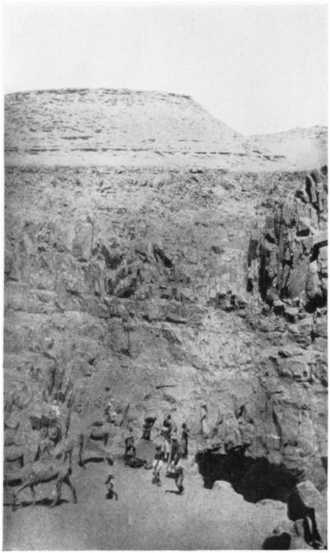
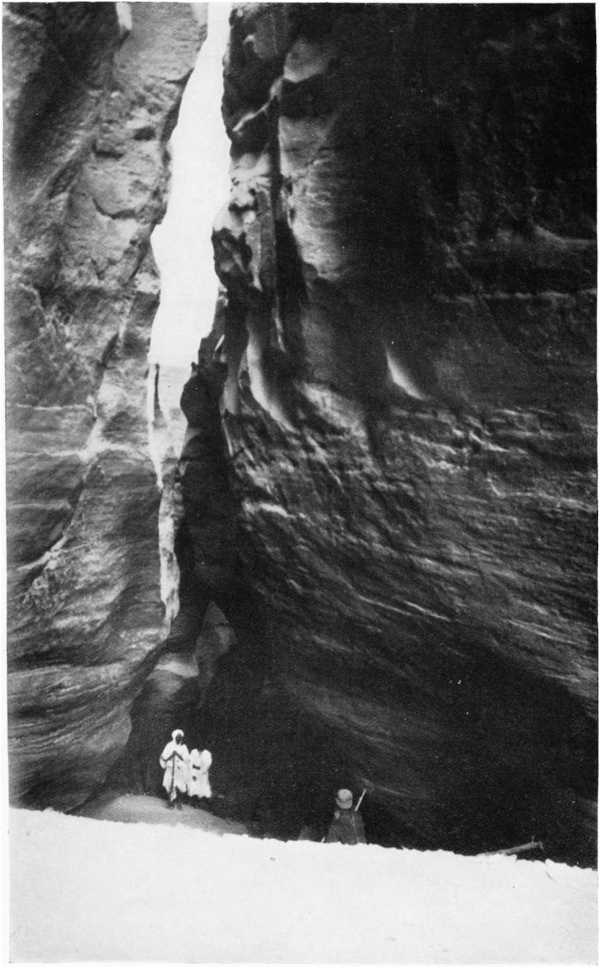
Having left Faya on September 4 we arrived on the 11th at the foot of Emi Koussi, 125 miles to the north, passing on our way by Korou Koranga, where we renewed our supply of water. The spot is one of the most picturesque I saw during this journey to Tibesti; it is a natural cistern hollowed by the action of the falling waters in the deep and narrow bed of the wadi Elleboe, a torrential river that comes down from Emi Koussi. The way to it lies through a defile more than a mile long, so narrow that two men cannot walk abreast. The water lies at the bottom of a grotto, dark in spite of being open to the sky, and whose walls wind in and out in such a way that not only the drying desert winds cannot get to it, but that even the sun’s rays only penetrate to it for a few minutes each day about noon, and only get down to the level of the water during May and July, when the sun reaches the local zenith. I had neither the time nor the means to measure the length and depth, the approach between precipitous walls being so difficult; but the supply of water is such that the cistern has never been dry so long as the guides can remember, however long may have been the drought during which the torrent has ceased to flow; the water stays clear, cool, and pleasant to the taste, without the slightest salty flavour.
The cistern of Derso, on the contrary, at the foot of Emi Koussi, near the pasturage of Yono, is broad, spacious, and subject to the drying action of sun and winds; a score of yards deep, it is easy to get at; but its greenish water, stagnant and thick with organic matter, has to be filtered before it can be drunk without disgust, and a period of twelve or fifteen months’ drought is usually enough to dry it up altogether.
Ascent of Emi Koussi.—In all probability the rebels of the regions we had just come through had withdrawn towards their strongholds on the top of Emi Koussi. A light detachment was sent out to make sure that this was so, while the greater number of our camels were left to rest in the pasturage of Yono, where I had a little zeriba built for the storage of our baggage and provisions and the security of the men I left to guard them.
On the morning of September 13 we betook ourselves to the ascent of the mountain by a track strewn with boulders, the gradient being fairly easy for the first five hours’ march, as far as the salt springs of Erra Shounga. From that point it stiffened, and grew very steep indeed between 6000 and 9000 feet. The last part of the ascent to the entrance of the pass that leads into the interior of the crater required the utmost effort on the part of our camels, unaccustomed as they were to the going in mountainous countries.
Sixteen or eighteen hours must be allowed to reach the summit of the ancient volcano, and one does well to spread them over two days if one does not want to leave any camels on the way. The first stage should get one to Fada, a little pasturage at the bottom of a ravine accessible to camels, and where the animals should be allowed to rest and feed. Afterwards a fairly long halt should be made at an altitude of about 6000 feet, to renew the supply of water at the natural cistern of Lantai-Kourou, for there is no hope of finding water in the interior of the crater; the operation is a long and toilsome one, for the track leading to the reservoir is inaccessible except to men. Along the whole way there is hardly any vegetation, such as there is being confined to deep ravines, almost always inaccessible, except at the pasturage of Fada, on account of the steepness of their sides. Towards the foot of the mountain only stunted plants are to be found, with tiny leaves often sharpened into thorns; while nearer the top the boughs are thicker, the bark tenderer, the sap more abundant, and the leaves longer and greener. No trees are to be found on Emi Koussi in the crater itself; on the other hand, the herbaceous vegetation is comparatively abundant, and marked especially by the “erendi,” a yellow-flowered plant reminding one of the St. John’s wort of our regions. We bivouacked, in a good position for observing all the approaches, in the midst of these bright-hued flowers, and I cannot tell you with what fascinated eyes we gazed on them, for none of us had seen their like for three long years.
The temperature was mild and cool like that of a fine spring in France; but in the clear sky there were no birds, and the sight of the scowling cliffs around us soon broke the charm under which our fancy would have gladly lingered.
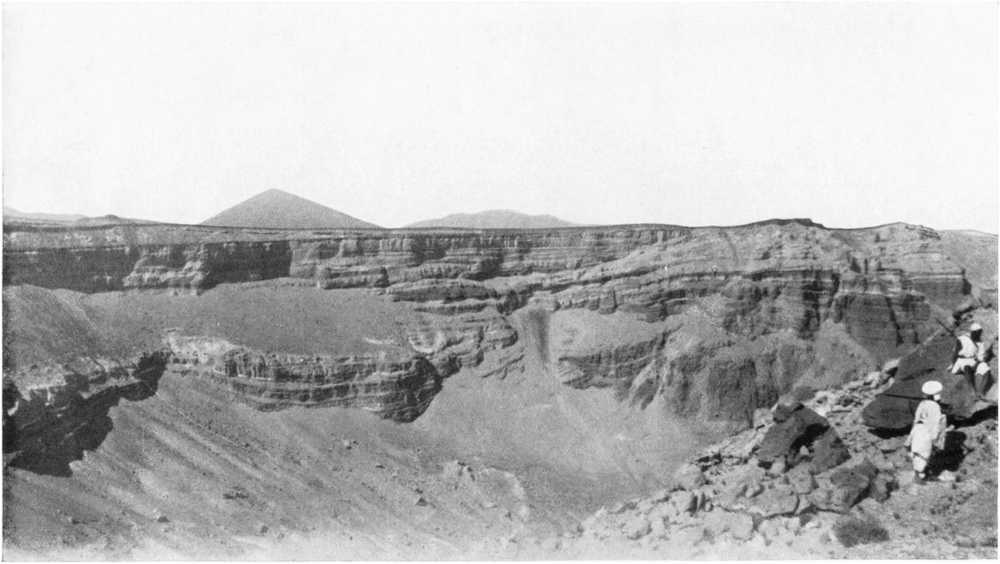
We stayed only three days in the crater of Emi Koussi. The afternoon of the first day was devoted to the exploration of a pit, 300 yards deep and 2 miles in diameter, which was once the chimney of the volcano. A vast expanse of carbonate of soda covers the bottom, which one can reach only by a very steep path.
The second day was spent, firstly in exploring, both inside and out, the western slopes of the crater, where there is a natural cistern that enabled us to make a fresh provision of water, though the track leading to the reservoir is very perilous for the camels; and afterwards in taking certain measurements, such as the height of the cliffs and the depth and extent of the central pit, called by the natives Era-Kohor, or Natron Hole.
The third day was given up to explorations in several directions, which allowed us to visit some recently abandoned troglodyte villages, to capture two prisoners, and to reach the summit of the northern side of the volcano, a point from which the whole of the Tibestian mountains can be seen.
The evenings, nights, and mornings were icy-cold, though the thermometer never fell below freezing-point. Our camels, taken aback by the novelty of the grass offered them, cropped it very sparsely; our provisions were giving out, and the rebels had fled before our arrival into exceptionally difficult mountainous tracts, where we could not dream of following them. In a word, in spite of the geographical interest there would have been in prolonging our stay on the summit of Emi Koussi, when the fourth day came we had to think about getting back to Yono.
STEEP SLOPES ON THE FLANK OF EMI KOUSSI, TIBESTI
NATURAL CISTERN OF DERSO AT THE FOOT OF EMI KOUSSI
THE GREAT CLIFF, TIBESTI
THE CRATER OF EMI KOUSSI (3400 m.), TIBESTI
From this excursion on the highest peak of the highest mountain in the Sahara I brought away an abiding impression of wild magnificence, and most of all when one’s thoughts go back to the panorama of the Tibestian mountains. There may, I fear, be something of presumption in attempting even a short description; still, I will ask your permission to make a short extract from my diary on the day in question:
“. . . Continuing our march northwards, we soon reach the foot of the cliffs of the northern wall, where, by a natural staircase, nearly 600 feet in height, one can reach the Tiribon pass, through which run the difficult paths that lead to Miski, Tozeur, and Goumeur.
“In front of us the volcano slopes steeply downwards, leaving open to view the Tibestian massif with the endless succession of points of its serrated ridges outlined against the sky and stretching away out of sight. On our left the crater-wall loses itself in a confused mass of rocks, while on the right rise a number of sharp peaks, one of which seems to be the culminating point of this part of the ring of heights that shut in the volcano.
“A last effort got us to the top of this lofty summit, 10,000 feet above the sea, where we found a narrow platform strewn with boulders, with big clusters of red and lilac tinted flowers growing in the gaps between the stones. Toilsomely enough, I managed to scramble on to the highest rock, and as I stood on it, there lay before my eyes, for the first time, the mysterious Tibestian chains that no explorer had ever gazed on yet in their majestic entirety. The grandeur and beauty of the sight so far outdid all I had anticipated that I could not turn my eyes from watching the harmonious hues thrown over the landscape by the rays of the declining sun. The intense clearness of the air made it easy to see distinctly the remotest peaks; all around lay long ridges, their successive summits rising and falling in regular points like lace; scattered rocks, deep gorges, dizzy precipices, jagged peaks. Each mountain range, though all were turned by the sun to the purest rose colour, had its distinct shade, brightest in the foreground, softening into mauve as distance melted into distance away to the far horizon.
“Eastwards, the Tibestian massifs fell by giant steps whose sharp-angled lines, blurred by the first shadows of the waning day, ran into one another in inextricable tangles; while to the west the mountains bordered an endless plain, a forbidding waste of stones, over which brooded and deepened a gloom that threw into beautiful contrast the rosy-mantled chains whose lofty summits soared into a sky of calm and exquisite blue.”
Tearing myself away, not without reluctance, from the dreamy fancies called up by all these glories, I made haste to take a few observations with compass and thermometer and make a few notes. The Tibestian reliefs appeared to me to be included in a right angle, the apex of which is marked by the volcano, and the two sides by the directions W.N.W. and N.N.E.; such being the case, the appearance of Tibesti was totally different from what I had till then supposed it to be, on the strength of the statements put forward by the explorer Nachtigal. The rest of my journey was to afford me the opportunity of unravelling the skeins of the succession of ranges, whose apparent position and extent I could now approximately fix.
On September 18, towards noon, we struck camp, to go down again into the plain by the route we had followed on our upward march. While the camels, weary and emaciated, were painfully climbing the slopes of the pass leading out of the volcano, I took a last all-embracing look at this huge crater, 10,000 feet above the sea; few others in the world are so immense, for it is 5 miles wide and 8 miles long, and looks like a gigantic funnel, almost elliptical in outline, 25 miles round and 800 yards deep; on all sides it is shut in by a rampart of unbroken wall, rising sheer almost everywhere for 500 or 600 feet, and which can be got over only at two points, by openings that are very hard to reach.
Behind this tremendous natural bulwark, 200 or 300 Koussadas live miserably, after the manner of cave-dwellers, divided into two clans, and possessing only a few camels, asses, and goats, and a small number of date palms in the neighbourhood of a few barely accessible springs dispersed here and there about the outer slopes of the volcano. Their staple food is a wild herb, the “Mouni,” that grows among the rocks, and yields a coarse flour that looks like coal-dust; and in the plains at the foot of Emi Koussi they collect the seeds of a sort of bitter gourd, the “hamdal,” which become eatable after undergoing a long preparation intended to take away their extremely bitter taste. At times they procure meat by hunting the “Meschi,” a kind of wild sheep which is only to be met with in the high mountains, and of which throughout my journey I did not see a single specimen. They are supplied with stuffs, arms, and ammunition by the Senoussists of Koufra, to whom, profiting by the cool season, they bring goats in exchange; but the greater part of their scanty resources comes from the brigandage they practised until quite recently, with more or less success, on the routes that lead from Kanem to Borkou and Bilma. Untiring on the look-out, though not particularly brave fighters, they succeeded in keeping up an unremitting watch on our movements during our exploration, and in this way they were able to get possession of one of our camels, too tired to keep up with us when we came down again towards the pasture-land of Yono.
We got back to our bivouac on September 20, and I had to stay there nearly a week to let the camels recuperate and to give them time to get better of the wounds to their feet caused by the sharp edges of the boulders they had had to walk on during that expedition.
I spent the week’s rest in making calculations drawn from my different observations, and in exploring the hot springs of Yi-Erra, highly esteemed in the whole region for their medicinal virtues. Their temperature is 100·5° Fahr. (38·1° Cent.), and their flow of water by no means abundant. They can only be approached on foot and by a difficult path, in about an hour: their altitude is 3100 feet above the sea.
Central Tibesti.—When our camels had had a rest and feed in the pasture-lands of Yono, I decided to transfer my quarters to the great valley of Miski, 100 miles further north, skirting the western foot of Emi Koussi. This valley of Miski is one of the most important of the Tibestian massif, not in the matter of its alimentary products, which hardly exist, but from a military point of view, for the Tibestian rebels use it as a convenient meeting-place from which—with no great difficulty and without our knowledge—they can attack our southern and western lines of communication. In the course of our march (between 25 September and 1 October 1915) our patrols had a few small engagements with the rebels, and some prisoners were taken who supplied us with useful information: the Toubous, informed that our expedition was on the march, were gathering their crop of dates—though the dates were not fully ripe—and meant to seek refuge 100 miles further north-east, in the Tarso of Ouri.
The pasture-lands of Miski were already abandoned by the rebels, and so we were able to march without fighting through the two long passes that command the entrance to the valley. A number of reconnoitring patrols showed us the exactitude of the information mentioned above, except in respect of the palm plantation of Modra, where Lieut. Fouché’s detachment, consisting of only fifteen men, had to put up a pretty hard fight in order to avoid being surrounded and cut to pieces.
The scarcity of food and the jaded condition of part of my camels forced me at this point to divide my forces and send part of them back to Borkou, after planning a new route. I remained alone with my secretary and thirty black soldiers to go on with my exploration of the heart of the unknown Tibesti. My aim was to effect a junction with the troops of Bardai in the valley of Yebbi, and to explore the gorges of Kozen and Goumeur in the east of the massif, where several rebellious tribes had taken refuge.
I left Miski on October 4, and on the 6th I reached the watershed between the basins of the Chad and the Mediterranean. At sunset I reached the Mohi pass, 5000 feet high, but the gathering darkness prevented me making as good use (topographically speaking) of my presence at this spot as I should have been able to do if I had arrived there in full daylight. In that case, I might have climbed a commanding height of apparently easy ascent situated 2 or 3 miles east of the pass, from which position I should have been able to grasp the general character of this orographic centre. As it was, I had to cover the few miles that lay between us and the palm plantations of Yebbi in complete darkness, partly in the evening, and partly on the following morning. But through a mistake made by the guide it was only at half-past six that we saw the first palm tree, at the bottom of a dark valley shut in between almost vertical walls from 700 to 1500 feet high. The landscape on every side was inky black and beyond all expression desolate; the valley was covered with dark boulders, glistening in the sun; no trace of green could be seen, except two thin lines of palms bordering a stagnant watercourse hardly a dozen yards wide. High mountains were visible to the east, rising (so far as I could judge) to 6000 or 7000 feet.
To get down to the bottom of the valley there was only a narrow track littered with sharp blocks, on which our camels did not know where to set their feet. The vanguard that covered our toilsome descent was already exchanging shots with the Toubous, but was finally able to get possession of the palm grove; towards 9 o’clock we could pitch our tents, with no more fighting to do. A few goats and donkeys were our only booty. But soon there appeared three prisoners, almost naked, whose pitiable physical condition was strangely in keeping with the appalling wretchedness of a landscape that one might have taken for a vision of hell. They were miserable slaves, stolen by the Toubous during their forays against the inhabitants of Kanem and Wadai. Their state of mind was no better than that of their bodies, and there was little to be got out of them about the country and its inhabitants. At any rate, they enabled us to unearth a few hiding-places where we found some dates, a great boon to the members of the expedition, whose rations were growing daily shorter.
Towards 11 o’clock a Toubou envoy came, sent by the rebels to make terms for their submission; I offered very easy ones, and treated them with consideration. After half an hour’s interview, I sent him back to the rebels on whose behalf he had come, but waited in vain for his return till evening.
Towards five in the afternoon I struck camp to seek a bivouac for the night, in a better position than the death-trap where we had spent the afternoon, and we halted, in complete darkness and without lighting fires, on a rocky platform that gave us 300 or 400 yards of open ground to fire over on all sides. Thanks to these measures, we were able to spend the rest of the night in peace.
Next day we went a little further down the valley in search of pasturage for our camels, worn out with hunger and fatigue; their condition left small hope of undertaking the excursion I had planned in the direction of Kozen and Goumeur, from which we were still separated by two or three ridges very difficult to cross, and where—so at least our prisoners said—neither pasture nor water could be found in readily accessible situations. When it is added that I had no news of the Bardai detachment which I had hoped to meet there, it will be understood that I thought best to advance in its direction two days’ march further west, into the valley of Zoumri, where I was informed of the presence of friendly tribes who could probably supply me with some information about its movements.
These two marches were very hard on our animals. To cross from one valley to the other we had to make our way up a wearisome succession of ravines and steep slopes, one of which, on the sides of a spur of a precipitous cliff, cost the detachment a hard piece of work in making a flight of rough steps up which the camels, though completely unloaded, had the utmost difficulty in climbing. On the other hand, I had the good luck to see before me, on the east and north-east, a vast horizon of mountains which extended and confirmed the observations made on the summit of Emi Koussi, and made certain that the Tibestian massif, far from being limited to the simple mountain chain hitherto marked on the maps of Africa, stretched away for more than 100 miles into the interior of the Lybian desert. During the two hours required for the hard climb up this cliff I kept on taking observations of the numerous summits visible in the limpid distances of that ocean of rocks, summits that seemed to rise like a succession of landmarks along each of two or three long ridges in sharp and jagged peaks, equal in bulk and perhaps in height with those of the great western chain, of which a few outlines appeared in the gaps between the nearer ranges. But in face of this accumulation of lofty peaks I felt a bitter vexation, a sort of resentment against my own littleness and powerlessness to set in order their apparent chaos. For it would have needed many a long excursion made with two or three fresh camel-trains, and a further provision of supplies, to enable me to straighten out the seeming tangle of these valleys and the confusing intersection of the hills.
Towards eight o’clock in the morning we resumed our westward march, skirting on the north an isolated mountain more than 8000 feet high, the Toh de Zoumri, which by its conical outline and the circular shape of its top looks like an old volcano, a supposition I had not time to verify. Our route crossed numerous tracks converging towards the mountains, which were used as a refuge by large numbers of Têda rebels, subjects of the former Dordeï of Bardai, whose revolt was aided by the encouragement and the supplies of arms and ammunition furnished by the Turco-Senoussists. Next day, October 11, we entered the valley of Zoumri by a pass 4800 feet high, and towards ten o’clock we bivouacked near the palm plantation of Yountiou, where I was hoping to meet with friendly Têdas who would put me in touch with the commander of the Bardai post. Unfortunately the village was deserted.
This fresh disappointment caused me little or no surprise; I expected my coming to Miski and thence to Yebbi to be known by all the hillmen, and that our skirmishes with the rebels would have been related with no small exaggeration as mighty combats; still, I felt that I was too near the goal to give up the attempt to reach it, so I sent out patrols to scour the neighbourhood and especially to capture a few Têdas who could guide me towards Bardai. Presently an old woman was brought to me, gaunt, stooping, and half crippled, but with intelligent eyes. After long reticence she confided to me that she was the mother of the chief of that village, and that her son had gone over to the French a few weeks earlier. Messengers had come during the two preceding days, announcing the coming of an expedition from Borkou, and when that morning the watchers saw our camels at the summit of the pass, all the Têdas—men, women, and children—fled panic-stricken into the neighbouring rocks; she alone had remained hidden in the palm plantation, because she said she was too feeble to follow them and too old to be afraid of death. I calmed her fears about my intentions as best I could, telling her that all the Têdas who submitted to French authority could count on my good will, and urging her to bring me her son as soon as she could, promising her that she should be treated with friendship and consideration; but as I had to continue my journey to Bardai as soon as possible, she must understand that I should be obliged to procure guides by force if I could not get them otherwise. “You shall have a guide to take you to Bardai,” she said, “and, if it please Allah, without needing to use your guns; I will go and tell my son.” Soon after there came up a little man with the same intelligent eyes, young and timid looking. He handed me the certificate of submission given him only a few days before by the officer commanding the French forces in Tibesti. After a fairly long talk he declared himself ready to serve me, but begged me not to insist on trying to get any other men of his village, for they were grimly determined to stay in their hiding-places. I trusted him, and was rewarded for doing so, for he stayed at my disposition upwards of a week, and thanks to his knowledge of the country I was able to go on with my exploration as rapidly as possible, and to collect interesting geographical information about the regions that lay off the track of my journey. To go to Bardai we had only to follow the sandy bed of the dried-up river, along which from time to time we passed by palm plantations and villages, the headmen of which came to bid me welcome, pleading their poverty as an excuse for not offering me the customary presents. After twelve hours’ march, when I had just passed through the village of Zoui, I met Lieut. Blaizot, commanding the troops of Tibesti, coming on foot to meet and welcome me and to express his regret that he had not been able, for want of camels, to come to Zoumri and Yebbi to help me against the rebels. To see him and to listen to his voice as he spoke were a great joy to me. In spite of all difficulties, I had just effected the junction so long desired between the troops of Borkou and those of Tibesti; in a few more minutes I was going at last to enter the palm plantation of Bardai that I had been dreaming of seeing for twenty years, ever since I had read in Nachtigal’s impressive story of his travels about the difficulties he had to get over in order to enter it forty-six years before, and above all to get out of it alive. On the way I had been able to make a mass of observations, topographical, geodetic, and hypsometric, and to fix with a very satisfactory degree of precision the situation and height of the chief summits of the great western chain that Nachtigal had only been able to locate by guesswork, and often without having even seen them.
At Bardai, where I arrived on October 13 a little before noon, I stayed only twenty-four hours, for I was in a hurry to get back to Miski, where the little detachment left in charge of the broken-down camels and of my last reserves of food must have been in a situation of some insecurity since the 10th. During the afternoon of the 13th I was able to examine in detail with the commander of the garrison the various questions regarding the means of combining the efforts of the troops of Borkou and those of the Tibesti against the rebels. The night having been favourable to my astronomical observations and the morning to measurements of angles on the principal peaks visible from Bardai, I had been able in that short space of time to collect all the essential elements needed for fixing on the map with satisfactory exactitude the position of the most important points of Central Tibesti.
The geographical interest of my journey to Bardai did not consist solely in the discovery, to the east of the great chain traversed by Nachtigal, of mountains whose existence had not previously been suspected; it was greatly enhanced by the fact that my observations corrected serious errors of position and altitude committed by the famous German explorer on the itinerary he followed amid so many hardships. Thus, for example, in the site of Bardai there is an error of 50 miles in latitude and 30 in longitude; it is nearer 3000 than 2500 feet above sea-level; the height of the peaks of Toussidé and Timi is as much as 10,000 feet; the name of Tarso, which Nachtigal restricts to the massif he traversed, is a general term applied by the Tibestians to all mountainous regions consisting of high plateaux difficult of access, but on which the going is easy when once one has climbed to the top. Lastly, to the east of Bardai, instead of the great zone of plains shown on the maps there lies a succession of important massifs the culminating point of which rises as high as 8000 feet above the sea.
Refusing, albeit with extreme reluctance, to listen to the urgent insistence of my amiable host Lieut. Blaizot, I left the post of Bardai on the evening of October 14, and by a moonlight march lasting almost all night I was able to get back on the 15th to my bivouac at Yountiou to make the observations, astronomical and other, requisite for checking those of the previous days; from that point I counted on returning to Miski, not by the already reconnoitred route passing through Yebbi, but by the Modra route lying further west, which was to afford me the opportunity of reconnoitring another passage. But a piece of news had just come which very much upset my Têda guide Mohammed: there had been fighting in the Modra valley between the Borkou troops and the hillmen, and he had very little fancy for guiding me through that region, where my detachment would presumably have to fight its way by main force. For me, on the contrary, it was a further reason for insisting on going there with all speed, in order to afford my companions, if need was, the help of the thirty rifles of my detachment.
Mohammed allowed himself to be convinced by the promise of a suitable reward, and by the use of certain outer and visible signs indicating clearly that he did not guide me of his own free will: he adjusted a cord loosely round his neck, and one of my black soldiers seized hold of the other end. In the eyes of his own people his Têda honour was safe, and his responsibility for the consequences of the subsequent proceedings reduced to vanishing-point.
Mohammed guided us to perfection; the chain was crossed on the second day by the pass of Kidomma at an altitude of more than 6000 feet, and on the evening of the third day, after a very tiring march, we reached the point where the track leaves the plateau to go down into the bottom of the Modra valley. We got down a first drop of some 60 yards without very much trouble, in spite of the quarters of sharp-edged rock that rolled under the hesitating feet of our camels. Then, after perhaps a third of a mile of almost level going, I suddenly came in sight of the palm plantation of Modra lying at the bottom of a dark narrow gorge deep sunken between two almost vertical walls more than 1500 feet high.
I was not without uneasiness at this sight, and came within a very little of thinking that the worthy Mohammed had deliberately lured me into some trap when he had said to me: “The descent into the Modra valley is rather difficult, but good camels can get down.” The descent into the valley of Yebbi, which I had found so arduous eleven days previously, seemed to me now quite a reasonable sort of descent compared with this one. Already the valley was echoing with the reports of rifles; here and there I saw Toubous climbing the cliff-sides like goats and stopping now and then to favour us from afar with noisy but harmless shots, and vigorous volleys of bad language more harmless still.
There being no conceivable alternative to consider we had to go forward. Covered by an advanced guard that returned the Toubous’ fire with a fusillade of doubtful efficacy, and by a rear-guard that watched the points from which the rebels could have rolled down tons of rock on our heads, we crawled downwards in a circumspect advance along a path that was no path—that clung to the face of a steep cliff, now plunging sharply downwards in short zigzags, now hanging, a narrow ledge, above the abyss towards which great stones dislodged by our camels rolled rumbling or leapt clattering down from tier to tier. The camels were frightened; they had to be led forward one by one, and could only be got round corners with many stripes and voluble cursing. A little group of men went ahead of them, thrusting aside the most awkward blocks, and, where the natural steps in the rock were too steep, laying flat stones at the foot so as to break them in two. The descent was so toilsome and so slow that at sunset we were only halfway down. I had to call a halt, profiting by a little rocky spur that afforded us a narrow rugged platform where we found just room enough to make our camels kneel and to install our bivouac. The firing had almost ceased: our advanced guard came in soon afterwards after forcing the rebels to abandon their villages, the conical roofs of which could be seen shining in the moonlight more that 400 feet below. Still further down, below the palms, ran an invisible stream, forming a monotonous waterfall that we heard murmur in the neighbouring rocks.
A WATER-HOLE IN TIBESTI
FIRST BUTTRESSES OF THE MASSIF OF TIBESTI
Above our heads little patrols, relieved from hour to hour, kept watch on the upper slopes from which the Toubous might have sent undesirable avalanches rolling into our camp. The narrow band of sky that we could see was filled with shining stars, by which I could make the observations needed for calculating the point where we had stopped. The night passed, calm and silent, and next morning, after an hour and a half of fresh efforts, we were able to take up our quarters quietly on the banks of the stream.
After which the excellent Mohammed, having received the promised reward, took leave of us to return to his palm grove at Yountiou. But his prudence led him to take quite another route, accessible only to men and goats. All the luggage he carried was a little skin bottle half full of water hanging from his right shoulder, together with a tiny bag containing a few handfuls of dates and about a pound of millet flour. On his left shoulder, swinging triumphantly from the two ends of his staff, were two fine large-sized biscuit tins that glittered in the sun and resounded like beaten gongs whenever they knocked against the corner of a rock.
Toubous in small numbers still showed themselves on the cliff-sides, but did not wait for the patrols I sent to parley with them. After a few hours spent in watering the camels and in filling our barrels and skin bottles, we resumed our route towards Miski. The little river of Modra ran hardly more than a mile further down the valley, and the dry bed of the torrent, at first littered with boulders, soon turned into a fine winding road of sand from 200 to 300 yards wide. Twenty miles further on we had to leave the river-bed and plunge into a chaos of little ridges of schist, intersected by narrow valley-ways leading into valleys that came down from neighbouring high mountains of an altitude exceeding 9000 feet: our camels had much trouble in making headway among sharp edges of slaty rock upturned almost vertically. They zigzagged from pass to pass, climbing steep slopes, dropping into rocky ravines, beyond which fresh ridges separated by fresh ravines rose in endless succession. At last on the 21st, very early in the morning, we came out into the wide flat valley of Miski, where we made a brief halt to allow the stragglers to come in. All our camels were there except one, and I may say that I felt much satisfaction at having succeeded in bringing them back to the starting-point after this toilsome flying expedition of more than 300 miles, carried out in seventeen days in the unknown and exceptionally difficult mountain region of which I have tried to give you as closely exact a description as I can.
For another 15 miles we pursued our way in the great valley of Miski, of an average width of 4 to 5 miles, finding it pleasant to look once more on the well-known landscape of peaks, domes, and cliffs of the Tarso Koussi. The clearness of the air was such that all these mountains seemed to be within walking distance, and that in this vast bare basin where not a breath of air stirred and where the sun blazed his hottest, we had the impression of marching without making any progress, so unchanging did the perspective remain.
Towards 10 o’clock we found the first siwak bushes with their characteristic peppery smell, and clumps of hamal, or bitter melon, with their dried-up fruits; then, a little further on, a few stunted and scattered talhas, a sort of acacia. At noon I got back at last to the bivouac where my secretary was waiting for me. For five days, since the departure for Borkou of Lieut. Fouché’s detachment, he had been left alone with seven soldiers and seven camel-drivers to guard the supplies and the reserve camels. And when I asked him whether the Toubous had not worried him during that spell of isolation, he showed me his zeriba, well organized for defence, with cartridge-boxes ready opened, and replied sadly, “No such luck.”
To console him for his long inactivity I put him in charge of a patrol sent against Youdou, a palm plantation still held by rebels, and of which the site was not known; but he had not the good fortune of coming to grips with them, for the alarm was given by their sentries, and they drew off northwards into a rocky country where we should have had much difficulty and lost a great deal of time in pursuing them. None the less, this rush of 80 miles in less than forty hours across the awkward country of the Tarso Koussi foothills achieved its purpose of forcing the rebels to withdraw and fixing the site of Youdou with the desired precision.
Western Tibesti.—Thus the most important part of my geographical and military programme in the Tibesti was carried to an end; at no point had the Toubous offered a serious resistance to our march, in spite of the magnificent defensive positions their country afforded them. The most unruly among them had fled away to the north-east, more anxious to get to a safe distance than to carry out their aggressive schemes against our convoys of supplies; the rest, beaten off at every encounter, had let us explore their wild valleys without subjecting us to any surprises, whether in the shape of ambuscades or of the capture of camels in grazing-time. Lastly, the general physiognomy of the Tibestian massif was revealed with sufficient clearness by my various observations, and its real position determined with all desirable precision. It only remained, before returning to Borkou, to explore the valleys of the western slope, and try to form a junction with the camel corps of Zouar.
I accordingly set out for Tottous, an important water point 70 miles further west, in the Wadi Domar where it comes out of the last foothills of the Tibesti. The distance was covered in four days with little trouble by following the lower valley of the Wad Miski, of which I was thus enabled to cross in succession all the tributaries on the right bank, till then unknown. The officer in command of the Zouar camel corps, having been informed after my visit to Bardai that I was desirous of seeing him, came to meet me, and we reached Tottous on the same day. He was accompanied by the chief of the Tomagras, the noblest tribe among the Têda-tous, the aged Guetty, who had made his submission to the French authorities a few months earlier. Guetty was a handsome old man with a white beard and a skin less dark than usual. He was tall and regular featured, but his keen sly face inspired me with no great confidence; he was suspected of double-dealing, and of supplying the rebels with fuller information about our movements than us about theirs. During two days we had long conversations about the restitution to their families of the women and children that his fellow-tribesmen had carried off in 1913 in the course of a razzia on an Arab tribe of Kanem; but the old rascal either could not or would not fall in with my wishes, declaring truly or falsely that the luckless captives had been sold as slaves and sent away for the most part to the Senoussists of Cyrenaica.
The Return Journey to Borkou.—The exhaustion of my camels had reached such a point that I had to stay five days in the grazing-grounds of Tottous. I profited by the delay to explore the course of the Wadi Domar for about a score of miles in company of the Zouar camel corps, who were going back to their station. My food supplies, which had not been renewed for two months, were coming to an end, and I could not further prolong my excursions in the valleys of Tibesti. Besides, the greater part of the rebels had concentrated in the region of Abo, at the north-western end of the massif, twelve whole days’ march away from Tottous.
Starting on November 4 for Faya, by a route hitherto unreconnoitred, we covered 120 miles of desert in six days before reaching the oasis of Kirdimi, near Ain Galakka, by the last and utmost effort our camels were capable of. On November 12 at nightfall I found myself back in my post of Faya, whose stout clay huts seemed to me for a whole week afterwards, if not absolutely the last word, at least the last word but one of comfort and civilization in the heart of the Sahara.