4. The Oasis of Borkou.
Reading edition
Faya.—The zawia of Faya had been chosen as the military and administrative centre of French Borkou, in preference to those of the Senoussists (Ain Galakka and Gouro), because it offers the least unfavourable lines of communication with the garrisons of Gouro, Fada, and Ounianga, and the best position for joining Borkou by wireless telegraphy to the nearest post of the Chad territory, 350 miles to the south.
The huts of the Senoussist zawia sheltered us from the sun and the sand-storms, but they were in such a state of ruin and decay that we were obliged to begin at once and make bricks—unbaked, of course. Unluckily, for constructing our buildings we were obliged to depend on the work of the few black soldiers who were not employed in exterior operations; so that many months elapsed before we could build a sufficient number of habitable houses, and complete the detached works of our defensive arrangements, including three rows of rope network, supposed to be barbed, by means of the addition of long thorns from the date-trees.
The landscape from the summit of the square donjon which overtopped the fort, though wanting in charm and beauty, was not without a style of its own; the post was built in the middle of a broad valley, closed in on the east, but opening spaciously towards the west; its rugged, steep, rocky sides plunging into shifting sands and wind-swept dunes, each dune curved into the form of a crescent.
At the foot of the fort the axis of the valley was delineated by fine rows of date-bearing palms, about 500 yards wide by 20,000 long, broken at intervals by heaps of moving dunes. On either side of the palm-grove there stretched green meadows, which looked as though they would afford fine pasturage for cattle, but which in reality were covered with sharp, hard grasses and herbs of no nutritive value: the most characteristic and the least bad was akul, a regular little bush of sharp thorns, which the camels would eat, but not without making a funny grimace at every mouthful.
All along the valley there lies a sheet of subterranean water, which rises in some places so near to the surface that the gazelles and jackals easily slake their thirst by scraping away with their feet a few inches of the soil; here and there, indeed, a little stream of water flows out of the sand, and runs a few yards towards a neighbouring depression, and little pools are formed in natural or artificial hollows made in the soil.
These jackals and gazelles are the only wild animals found in Borkou; the latter are quite unapproachable by hunters, while the former remain hidden in the daytime, but come in bands at night, yelping round the villages, and penetrate boldly into inhabited enclosures to seek their prey. So cunning are they that they avoid the most ingenious traps the natives can set. The lion, the panther, the hyena, and the wild boar never pass beyond the desert boundaries of Kanem and Wadaï; even the antelope and the ostrich, though bearing thirst so well, cannot venture so far into the Sahara.
The winged domestic tribe is seen among the villages in the shape of rare squads of lean fowls; and flights of turtledoves and pigeons roost in the palm trees. A graceful species of sparrow, with black plumage and white tails, fly in and out of the rocks, and even come into our clayhouses; they sing like nightingales when building their nests, and chirp like sparrows while they watch their young beginning to fly. All round the inhabited houses the black crows may be heard croaking: they are extremely audacious, whether attempting to snatch pieces of meat roasting before a kitchen fire, or settling on the back of a wounded camel and tearing off with their beaks morsels of bleeding flesh.
Snakes are fairly common, the largest being hardly more than a yard in length and one or two inches thick; the most dangerous is the short bulky viper that lies hidden in clumps of grass, and whose bite is fatal even to camels. Scorpions abound, generally of a greenish hue, sometimes black; their sting is very painful, and may be eventually mortal to women and children.
Amidst the rocks one may find a curious eatable lizard, the “dundou”; it is inoffensive, but when it does bite, it bites so fiercely that the only way of making it let go is to pinch its tail sharply, either with pincers or with one’s teeth.
There are very few domestic animals save the ass and the goat; but small herds of oxen manage to cross the desert from November to February, when cool days, pools remaining from the rainy season, and the scanty pasturages of grasses produced here and there by the few summer showers allow them to pursue their march by short stages.
Where the animal kingdom exhibits its greatest vitality, however, is in the insect world: the common fly, dirty and worrying, rules despotically by day, together with gad-flies and big stinging flies of a pretty greenish hue. At nightfall, the very time when one might enjoy a little rest on the terrace of the houses, moths, coleopters, locusts, dragonflies, and bugs become very lively, and whirl madly round the table where a light is shining, so that it is far preferable to dine lighted only by the moon and the stars. When there is no wind at night there are swarms of mosquitoes, and also of a kind of little sand-fly that pass between the meshes of the best mosquito-nets.
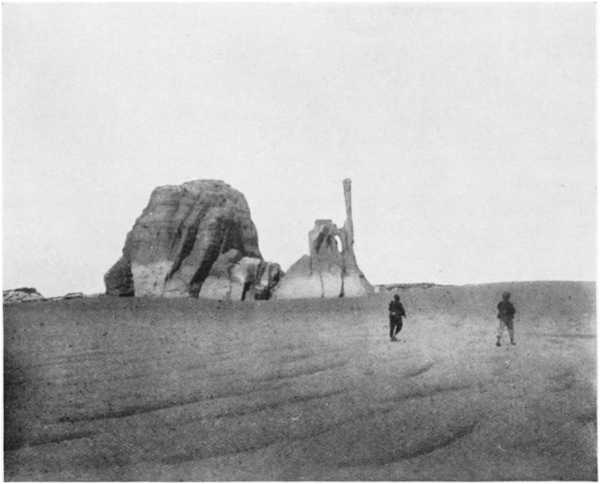
SANDSTONE ROCKS NEAR ORORI, BORKOU
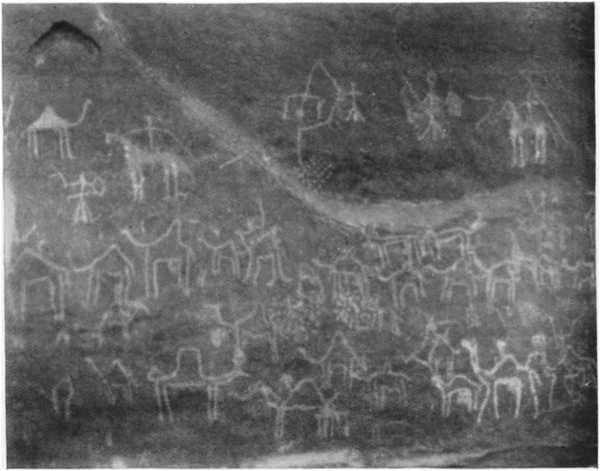
ROCK DRAWINGS, OASIS OF YARDA, BORKOU
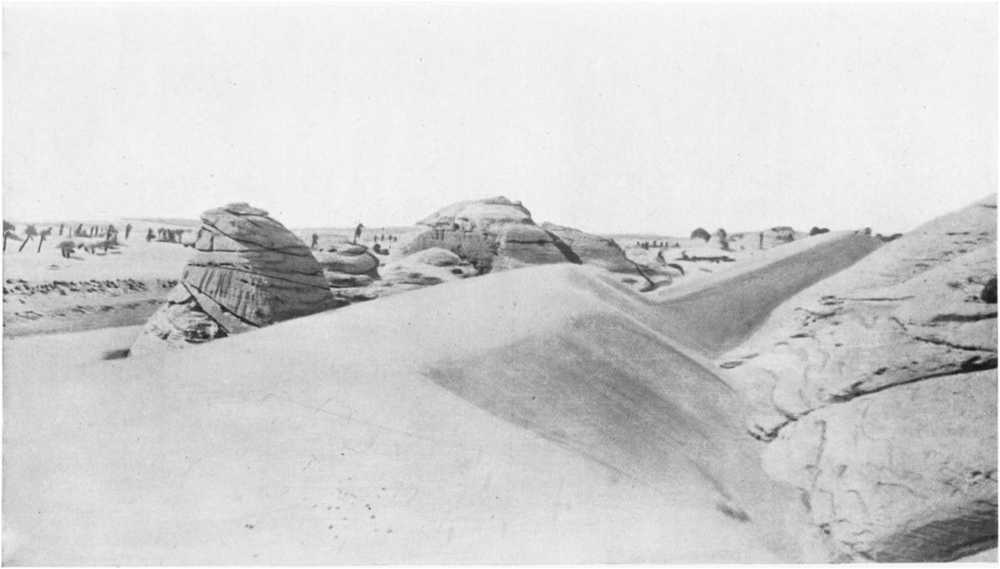
SANDSTONE ROCKS ATTACKED BY MOVING DUNES, OASIS OF YARDA, BORKOU
Cultivation.—The soil indeed is not very fertile, which is the reverse of the account given of most oases in the north of the Sahara. It is especially favourable to the cultivation of the date-bearing palm, which loves to have its foot in the water and its summit in the burning sun, but does not stand rain well. The first dates ripen in the month of May, while the latest are gathered in September; they vary in size, and are dark or light in colour according to their variety, but nearly all are of a very good quality, as sweet and fleshy as one could wish. The greater part of the crop is put to dry, while the most luscious are gathered into heaps and pressed into goatskins, to be carried to Wadai and Kanem and other places farther off.
After the date-gathering the natives prepare their gardens for the sowing of corn, which takes place in November and December. The ground is arranged in small squares, ingeniously adapted for irrigation; but the produce is meagre owing to the want of manure; this is remedied, to a certain extent, by an addition of virgin soil, containing more or less soda, which is fetched from some distance on donkey-back. The gardens are intersected with long parallel hedges, which shelter the ears from the withering violence of the north-east wind. The harvest is gathered in towards the end of March, and a short time later the ground is prepared for the sowing of millet, which yields a still smaller crop than the corn. When we add that in some gardens there grow a few onions and tomatoes, as well as a kind of spinach, scarcely appreciated anywhere but in Borkou, we shall have enumerated nearly all the available food-stuffs of the oases.
I must not forget to mention that the Senoussists had succeeded in importing to Gouro and Faya some fig-trees and a few vines; and on our side we managed to acclimatize the sweet potato, a precious resource which came from Kanem. We were less fortunate in our repeated attempts to acclimatize French vegetables, which succeed so well in the neighbourhood of Lake Chad during the cool season; the poverty of the soil, the want of manure, the extreme dryness of the north-east wind, the voracity of the grasshoppers and other destructive insects, were no doubt the causes of our lamentable failure as agriculturists.
Winds and Rain.—In the heart of the Sahara, where rain is so rare a meteorological phenomenon, the wind is the high arbiter of each day’s weather. The weather is fine when the wind is light, and bad when it is strong; in the latter case nothing is to be seen but whirling columns of sand, raised by the north-east wind, blowing in stormy gusts and covering the whole landscape with a thick dry mist of brownish dust that penetrates everywhere and is very painful to the eyes, so that one does well on such occasions to wear motor-goggles to avoid ophthalmia. These north-east winds blow more or less violently for a great part of the year, sometimes for a few hours only each morning, sometimes for whole days and nights. I may say that we were able to note a fair correlation between the oscillations of the curves of the registering barometer and thermometer and the force and duration of these winds; they usually coincide with low temperatures and high atmospheric pressure, while the light winds or the dead calm accompany low pressure and high temperatures. Taking as a basis the information furnished by the natives, borne out by our four years of regular observations, it may be said that, as a general rule, the north-east wind reigns supreme over Borkou and the neighbouring districts from October to May or June (that is to say, from about the autumnal equinox to the summer solstice); whereas in July, August, and September still weather prevails, alternating with gentle west-south-westerly winds.
It is these latter winds that bring with them from the Atlantic what little moisture nature measures out each year so parsimoniously to these dried-up lands. Then the sky clouds over almost every afternoon, but one’s hope of refreshing showers is vain; the heat thrown up from the scorched ground, and the rapidly rising temperature through which the raindrops fall towards the earth (a rise of about 3° Fahr. per 1000 feet), are enough to bring about their more or less complete evaporation before they reach the ground, and one sees long frayed streaks of grey cloud trailing almost along the ground, like unravelled skeins of wool, from which a few rare drops fall on the thirsty earth. When we took possession of Borkou the inhabitants assured us with one voice that it had not rained in their country for eleven years, thus putting back the date of the last rain to the year 1902; by a curious chance our entry into Faya (on 1 December 1913) was greeted by a little shower of utterly unlooked-for rain. The inhabitants saw in this downfall (unusual not only for that region, but for that season of the year) a happy omen for the rainy season of 1914, an omen which was realized, for in the month of August 1914 we had the satisfaction of registering about 90 mm. of rain at Faya. In 1915 the rainfall was hardly worth mentioning, and in 1916 about 35 mm.
Though Borkou is more than 300 miles south of the Tropic of Cancer, and very low-lying (650 feet above sea-level), the heat is really excessive only for six or seven months of the year, from mid-March to mid-October. During our observations, extending over three years, the maxima registered in the hot season never exceeded 117° Fahr., but temperatures of 110° to 115° were frequent. During the cool season, from December to February, the minima sometimes fall below 50° Fahr. without ever getting down to freezing-point. The dryness of the air is very noticeable from November to June, when a difference of more than two to one may regularly be observed between the simultaneous indications of the dry and wet thermometers: for instance, when the former stands at 44° C. the second often reads less than 20°. On the other hand, in August and September, under the influence of the winds blowing from the Atlantic Ocean, the air becomes very damp and the heat grows stifling.
In spite of its excessive heat, the climate of Borkou is comparatively healthy; very relaxing during the hot and damp season, it is extremely pleasant in the months corresponding to our autumn and winter. During my stay, lasting from 1913 to 1917, none of my European fellow-workers had any serious illness, and my black troops, though kept hard at work in the shape of arduous reconnoitring and escort duty, and with barely enough to eat, showed a percentage of sickness and deaths below the average of the other garrisons throughout the Chad Territory.
Population and Commerce.—The population of Borkou consists of nomads, the Tedas and the Nakazzas—the great nobles of the desert—and of a sedentary tribe, the Dozzas, who are only half noble, for want of the few camels whose possession would enable them to take a share in the profitable plundering raids in the desert. There is also a third category of inhabitants, the Kamajas, half serfs, half slaves, whose duty it is to attend to the gardens and the plantations of palms, and who are profoundly despised by the other two categories. The total population of Borkou would not appear to exceed some ten thousand souls, distributed among a score of more or less flourishing palm plantations.
The commercial activity of the oases of Borkou is far from negligible; they export towards the south salt, soda, and dates, and receive in exchange cereals, butter, cattle, and smoke-dried meat. Caravans of two hundred camels may often be seen coming to load up with salt at the Arouelli salt-pits near Ounianga; and Arab caravans pass by on the way from Cyrenaica, by Koufra and Sarra wells, importing to Wadai stuffs, sugar, coffee, tea, mercery, and (in time past) arms and ammunition; and exporting principally millet, butter, smoked meat, hides raw or tanned, ostrich feathers, elephants’ tusks, and so forth. The slave-trade, formerly carried on through Borkou between Wadai and Cyrenaica on a great scale, has almost entirely ceased since we took possession of the country.