3. In Borkou.
Reading edition
The Conquest of Borkou.—Our expedition consisted of 400 black soldiers, with two mountain-guns; about 200 Arab and Toubou volunteers, forming a “goum” or party of scouts, accompanied the column. We carried with us provisions for forty days, and the total number of our camels was about 2000. By a rather extraordinary piece of good luck, our forward march was not disturbed by the enemy. The season was favourable, the days not being over-hot, and the nights fairly cool; the usual temperature at sunrise was about 60° Fahr., but a very strong wind, blowing from the north-east and raising blinding clouds of sand, made it seem a great deal colder. Our march was skilfully concealed as far as Kourouadi, a point from which we could threaten the fortress of Ain Galakka as easily as that of Faya. There, after allowing the troops a day for rest and final preparation, it was decided to strike a decisive blow at Ain Galakka, the principal centre of the Senoussist forces.
Our column, leaving its convoy a dozen kilometres in the rear, under a guard of fifty men, appeared before Ain Galakka on the morning of 27 November 1913; the enemy were completely surprised. The attack began by a bombardment of no more than about a hundred shells, which did great damage inside the zawia, and made in the outer wall many a breach for the infantry to pass through. The assault was opened at ten o’clock; the defenders, though not numerous, offered a vigorous resistance, preferring to die rather than surrender; by mid-day the entire fortress was in our hands. We had about forty casualties, of which a third were killed.
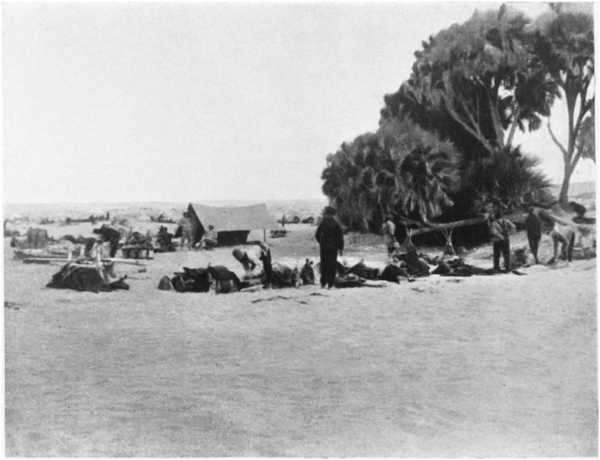
THE COLUMN HALTED AT THE WELLS OF KOUROUADI, BORKOU
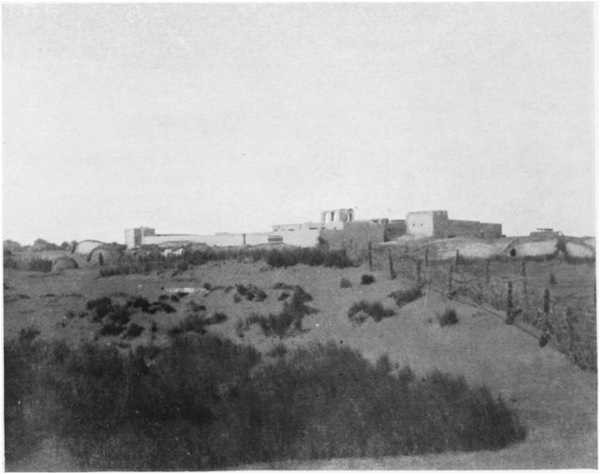
THE FORT OF BERRIER-FONTAINE, OASIS OF FAYA
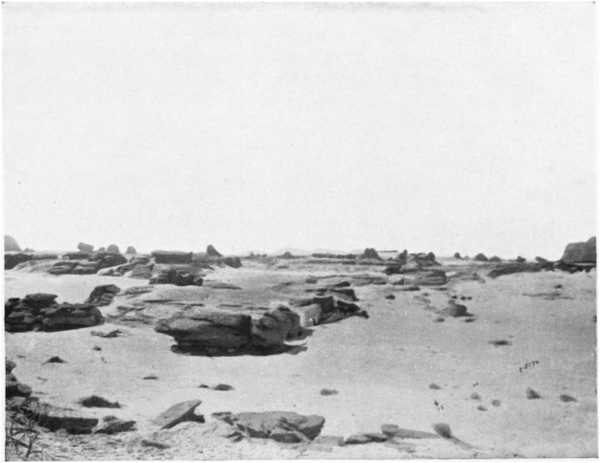
ROCKY COUNTRY BETWEEN THE OASES OF YARDA AND BÉDO, BORKOU
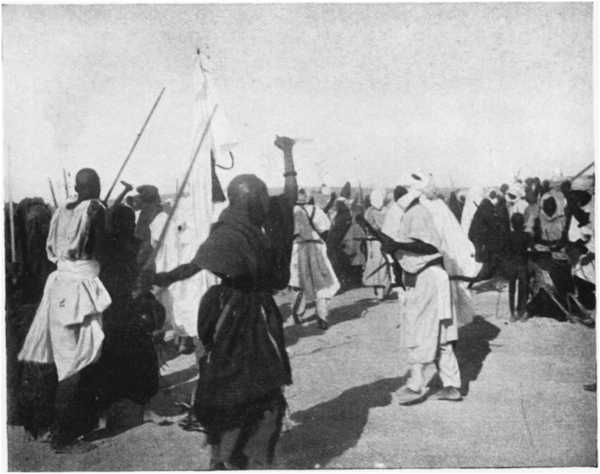
DANCE OF THE NAKAZZAS, OASIS OF FAYA, BORKOU
Leaving our wounded in Ain Galakka with a small garrison, we marched on the zawia of Faya, which we entered without striking a blow on December 1. Thence proceeding still farther into the desert, we reached in a week’s time Gouro, a point 200 kilometres north, the religious and political centre of the Senoussists in Central Africa, which was seized after a short struggle. Then, continuing its successful march towards the east, the column took possession unopposed of the oasis of Ounianga, 60 miles from Gouro, and leaving a small garrison there we returned to Faya, the best place to be chosen for the military and political centre of the newly conquered territory.
Importance of the Conquest of Borkou.—This laborious campaign had the very important result of depriving the Senoussists of the valuable tête de pont on the south side of the Sahara which Borkou constituted for them, enabling them to distribute over Central Africa arms, ammunition, and propagandists of the holy war.
The great value of our conquest appeared plainly a few months later, when the German Emperor let loose on the world the most awful war that ever convulsed the Universe: a Germano-Turkish mission, headed by Nuri Bey, a brother of Enver Pasha, the Turkish Minister of War, landed in Cyrenaica for the purpose of organizing, with the help of the Senoussists, an outbreak in Central Africa against the protectorates of France and Great Britain. This would have been an easy matter if our enemies had been able to establish their headquarters in Borkou, for they would then have been only a few hundred miles from German Bornou on one side, and on another from Dar Four and Dar Sula, which showed a certain hostility towards us. There is no doubt that, in this case, the Anglo-French campaign in the Cameroons would have been conducted in very different circumstances; when we take into consideration the large stock of arms and ammunition prepared by the Germans in their colony, and the care they had taken to fortify the mountain of Mora, we may suppose that the German staff had hoped to establish by main force a continental junction between the Cameroons and Turkey, through Kanem, Borkou, and Libya, in case of the communication by sea being cut off. And I do not think I shall betray any State secret by informing you that the Chad territory, with its modest resources in men and ammunition, would have been very difficult to defend with any chance of success against such an attack. I may also add that, had the Turco-Germans been able to accomplish their design, the result would have been exceedingly perilous for Franco-British rule throughout the whole of Dark Africa.
By uniting, under my command, our frontier territories of the Libyan desert, the French Government’s aim was to constitute a force able to resist any attempts that might be made to retake from us the excellent base of operations that Borkou afforded.
Four Years in Borkou (1913-1917).—I do not think it would be of any great interest to lengthen this geographical lecture by explaining to you the difficulties of every kind that I was obliged to overcome during about four consecutive years, in order to fulfil the military task allotted to me. As Borkou produces little else but dates, and Ennedi scarcely anything at all, I was compelled to procure from Kanem and from Wadaï the corn, meat, and other food-stuffs necessary for the maintenance of my civil and military subordinates. Now, the organizing of the commissariat transport became more and more difficult every six months; the want of pasture along the roads we had to take, the incessant raids of the nomads and the counter-raids of my troops, caused irreparable losses among our camels. From the end of 1913 to the first months of 1917, the activity of the rebels was so great, owing to the instigation of the Turco-Senoussists, that my troops could get no rest.
A Bird’s-eye View of the Country.—When on leaving the shores of Lake Chad we proceeded towards the north-east, we first entered into a sandy region, with parallel valleys running between grassy downs that rose to a height of not more than 300 feet: this was Kanem, the country of corn and cattle, where subterranean water abounds and where it is easy to live.
After marching for about 100 miles, we left this fertile country and dropped quite suddenly into the desert itself, with its dull, empty, vague horizons, so monotonous that the slightest details interested us, such as a line of stones on the sand, the sight of a crescent of sand-dunes, or a poor, solitary, half-dead shrub; also our passing through a meagre pasturage of dusty had was quite an event, or the discovery in the distance of a few green bushes of siwak, till we reached the wells, where we were to rest all day long, to lead the camels to drink, and renew our own provision of water, which was often brackish and evil-smelling. This was the deceptive desert of the Lowlands of the Chad, the region I mentioned above as being lower in level than Lake Chad itself.
After a further march of about 250 miles we entered the country of rocks; at first scarcely visible above the sands, they soon rose in sharp peaks that looked like mediæval ruins, and then shot up into long steep cliffs bordering rugged plateaux, that formed ledges one above the other to the foot of the mountains: this was the region of Borkou, Tibesti, and Ennedi, the very heart of the desert, situated at almost the same distance from the shores of Lake Chad, the Nile, and the Mediterranean. This rocky belt forms, from the Tripolitain to Dar Four, a long broken wall, encircling on the north-east the basin of the Chad, which it divides from the dismal and unexplored waste of the Lybian Desert. Tibesti and Ennedi form the highest and almost inaccessible parts of this region, while another part, Borkou, consists of a wide depression between the basins of the Chad and of the Nile.