6. Exploration of Ennedi.
Reading edition
Having reached the well of Diona on 11 November 1914 in the morning, I was joined next day by the camel-corps section of Borkou and Ennedi, which brought me fresh supplies and were charged with the mission of getting into touch with the nomads of eastern and central Ennedi, who refused to acknowledge our authority and committed acts of brigandage on our lines of communication. A few patrols in the neighbourhood having made it clear that the rebels had decamped before us and taken refuge on the high plateaux, the camel corps under the command of Captain Châteauvieux climbed the heights of Erdébé, where they began an active pursuit of the rebels. At the same time I reconnoitred the water-point of Aga, 30 miles further east on the route from Erdi to Dar Four, a route followed at that period by a certain number of Senoussist emissaries on their way to exhort the Sultan Ali-Dinar to join in the Holy War! For it will be remembered that Turkey had just at that date entered into the war against us, and that the plan of the German general staff included a vast Musulman rising destined to drive the French and British out of their African possessions.
Eastern Ennedi.—Finding no traces of the rebels at Aga, I rejoined the camel corps in their occupation of the cisterns of Keïta on the plateau of Erdébé, and until the end of November our reconnoitring columns explored the labyrinth of gorges and rocky valleys over which the refractory natives had scattered, without offering serious resistance anywhere. The cold was beginning to be rather unpleasant, especially when the north-east wind blew, but the thermometer did not fall as low as zero. The water-points were extremely numerous, a fact which favoured the break-up into small fractions of the rebel bands, whose chief anxiety appeared to be the getting of their herds of camels and oxen and their flocks of goats into a safe place. They did not seem to worry much about their women and children, and let us capture them with the serenest unconcern, being well aware that we should do them no harm, and that their sustenance would be assured for the time being by our black troops, always glad to leave the preparation of the daily cousscouss to the other sex. To conclude this series of operations we had to fix the limits of eastern Ennedi. An expedition was sent to Bao, 60 miles southwards, the last water-point in the region, and thence to Kapterko in the south-east, where a few rebels were captured. Another expedition fixed the position of the well of Koïnaména some 50 miles east, and went a stage further, to the beginning of the great plain without water or vegetation that stretches out of sight to the eastward.
The general physiognomy of the country was that of a rocky tableland intersected by a great number of valleys, more or less deep, and gorges, separated by many little jagged chains of sandstone running in all directions, and varying in height between about 200 and 500 feet. All those depressions are covered with grass and shrubs, affording excellent pasturage for the hillman’s flocks. Of plants useful for human food we found gramineæ such as the Kreb and Anselik; what is more, the soil of the valleys was literally covered in places with water-melons and colocynths. Though I found no traces of tillage anywhere, I even had the surprise of noticing from time to time hardy stalks of the wild cotton plant, some reaching 6 feet in height.
Almost every year at the end of the rainy season temporary rivers flow through these depressions, some of them turning northwards (and consequently tributaries of the Chad basin), the others southwards, where they once used to feed some great tributary of the Nile basin. Numerous pools formed during the rains hold out for a longer or shorter time in the flats of the more considerable of these valleys, while in the narrower parts the water is stored in natural reservoirs, more or less hard to get at, hollowed in the sandstone by the falling waters as each torrent makes its way down from one ledge to the next.
The greatest altitude I noticed in the course of my surveys on the plateaux of Erdébé was found in the water-parting between the slope towards the Chad and the slope towards the Nile: it was of 3600 feet. The highest summits in the neighbourhood rising only from 250 to 400 feet above the general level of the country, it may be estimated that the chief altitudes of that region vary between 4000 and 4200 feet. Twenty miles east of Koïnaména, in the transition zone between the mountains and the plains, the altitudes of the bottom of the valley was still superior to 3000 feet. It is possible, moreover, that 40 miles away to the north-east certain summits of the water-parting rise to 5000 feet.
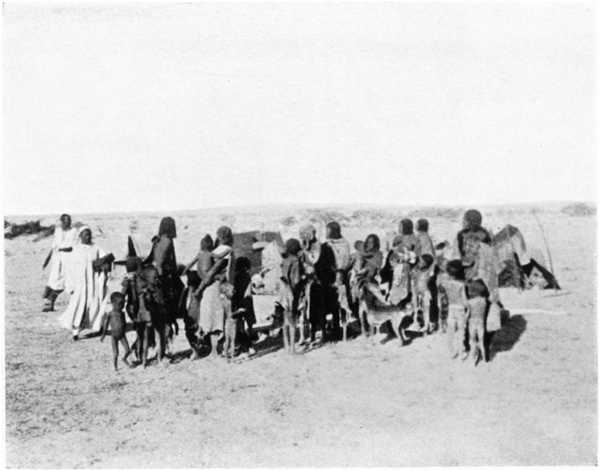
The natives who live a nomadic life on the plateaux of Erdébé amount in number to several hundred families. Their settlement, meagre in the extreme, usually consists of a few pieces of matting stretched on stakes in a corner of a ravine, round a thorn enclosure in which their flock of sheep and goats is shut up; at the slightest alarm men and beasts stampede among the rocks. If I had to seek in the animal kingdom a term of comparison for these tribes, I think I should choose their fellow-denizen the jackal: they possess its cunning, its audacity, its cowardice, its mischievousness, its endurance, its speed, and its predatory instincts.
The only other wild animals we saw were gazelles, antelopes, and ostriches; it is reported that as long as the above-mentioned pools remain, boars, panthers, and lions may be found, but we had no opportunity of testing the truth of this assertion.
On December 9, in the afternoon, having made preparations for our departure next morning, we set free our prisoners, imposing no conditions beyond that of telling their fellows our desire to see peace and quiet reign throughout the country. “Let the nomads devote themselves to the raising of their flocks and to trading in salt and millet,” I said; “let them give up raiding the peaceful tribes of the Sudan and the Nile, and the caravans that cross the desert, and I will leave them at liberty in their mountains.” Whereupon an old woman answered me, “We will carry your words faithfully to our husbands and sons, and we will bid them come and submit to your authority; we are all weary of our perpetual insecurity; we desire peace and justice. You have treated us well, you have given us millet and meat; we have eaten all we wanted to eat, and now we know that you are strong and generous. Allah reward you!”
Alas! my reward was that for two years longer these inveterate brigands did not cease raiding in every direction, and that the camel corps had a particularly difficult task in guarding convoys and putting down pillaging.
Western Ennedi.—It only remained to me to cross the central part of Ennedi in order to have a clear outline of the general physiognomy of the country, thanks to the aid of surveys previously executed on its western borders by several officers who had taken part in military operations in Western Ennedi under the orders of Major Hilaire and Major Colonna de Léca. With this end in view, I marched in the direction of the military post of Fada by Boro and Archeï.
For a week our route lay through a maze of sandstone rocks where no track existed, and through which our guides zigzagged from crest to crest with remarkable sureness. Sometimes we made a long détour to cross a wadi near its source; sometimes we marched straight for the obstacle, dropping down steep ledges that inspired little confidence in our animals, or crossing difficult ridges that the camels could only climb after being unloaded. Everywhere were narrow gorges and jagged crests, with here and there a few leagues of easy going in the neighbourhood of the temporary pools that usually marked the convergence of certain important ravines.
In this uneven ground with its narrow horizons one pasture-ground succeeded another, but we saw no trace of inhabitants. And yet water was not wanting, whether in natural cisterns or in great pools like that of Kossom Yasko. We skirted on the south the tableland of Basso, higher, according to our guides, and harder to climb than that of Erdébé, but, so far as I could judge at a guess, its height is not likely to be as much as 5000 feet.
We took a day’s rest in the excellent pastures of Boro before leaving the central plateau of Ennedi to drop down to the next level, 400 or 500 feet below. Then our way lay along a fine river of white sand, between banks 60 or 80 yards high, where the traces of the last flow of water could be seen 6 or 7 feet up the bank. The coming of the floods is so sudden, and the banks so steep and smooth, that it is dangerous to take that road in the rainy season. No winter passes without some heedless wayfarers being surprised and carried away by the rushing torrent that comes sweeping down the valley with the speed of a galloping horse.
After this splendid sand-road came a stretch of rocky going, followed by a zone of waterfalls we had to get round by a march on the plateau. The lower we got the more picturesque the landscape became; the cliffs, gaining in height what we lost in altitude, grew more and more imposing, the crests more jagged, the ridges more often broken by gaps. Isolated peaks appeared here and there, whose pure outlines and bold summits put climbing out of the question. On all sides there rose in the distance rocks, some broad, some slender, but all of the same height and grouped irregularly, so that sometimes, when very close together, they looked like groups of men.
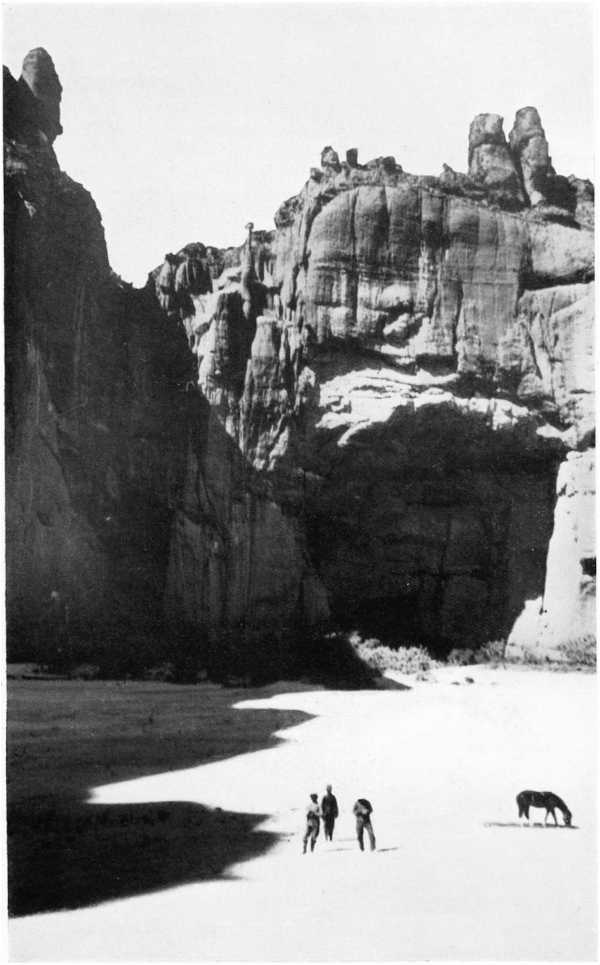
On the 17th of December we reached the foot of the last ledges, on the western borders of Ennedi, at the altitude of about 1800 feet—that is to say, about that of the depression separating Erdi from the plateaux of Erdebe—and pitched our tents in the valley of Archeï, the most picturesque of the beautiful valleys of the Ennedi. The century-long erosion of wind and water, carving the great sandstone masses that line the valley, lavished throughout the landscape the most admirable effects of natural architecture. The approaches of the great grotto, above all, and of the sheet of water teeming with little fish, were a pure delight for the eyes: the sheer cliffs, fretted into colonnades crowned with turrets and belfries, were burnt to tones of faded ochre that made the blue of the sky seem deeper and more luminous still.
MOURDIA WOMEN AND CHILDREN, PLATEAU OF ERDÉBÉ (1000 m.), ENNEDI
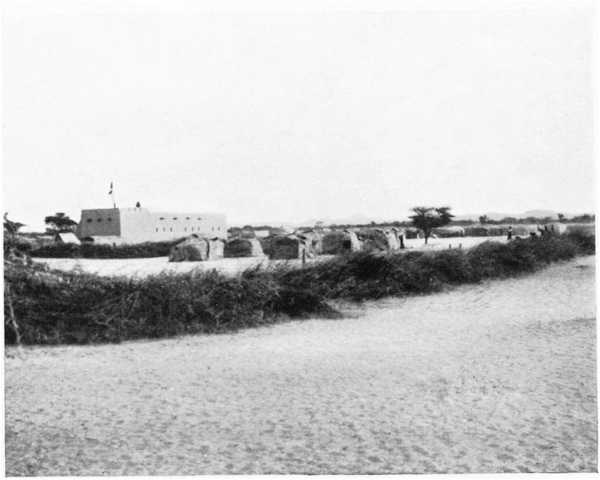
THE FORT OF FADA, ENNEDI
CAVES OF ARCHEÏ, ENNEDI
From this exploration it became apparent that Ennedi is, roughly speaking, a triangle covering about 12,000 square miles (30,000 square kilometres). It consists of a succession of sandstone plateaux rising in tiers from the base level of 1600 feet to that of 4300 and possibly even 4800 or 5000 feet in the parts of the country which had to be left out of our investigations (Basso and eastern Erdébé). It falls by steep slopes to the plains of the Libyan desert. The plateaux of Ennedi are ravined by many valleys, most of them very deep, whose waters only flow for a few days or weeks each year after the rains (August and September). These waters hurl themselves from ledge to ledge in waterfalls, hollowing out at the foot of each fall natural cisterns in the rock, where the water remains a longer or shorter time according as it is well or ill sheltered from the torrent beds. The roads usually follow the torrent beds, except when blocked by masses of crumbled rock, in which case a more or less awkward circuit has to be made. At the points where the main valleys converge great muddy ponds are usually formed, but they are shallow and short-lived. In all the valleys splendid grazing-land is found, where not only camels but also thousands of oxen could live if the problem of drinking-troughs did not present itself every year in the height of the dry season. For at that moment the natural cisterns that have still kept some store of water are grown few in number, and are nearly always very hard to get at. Most of the great temporary pools are dry, and subterranean water is no longer found except in the great wadis, where the wells (that have to be dug out afresh every year) go as deep as 20 or 25 yards.
The inhabitants of Ennedi, nomads or semi-nomads, are very poor; the chief tribes are the Bideyats (or Annas), the Gaedas, and the Mourdias, which all together represent hardly more than 2000 souls. But they are by tradition so addicted to brigandage and so untamable that as large a troop of police is needed to keep them in hand as for a population of 40,000 in the settled regions.
Ennedi has no vegetable food resources; there are neither palm plantations, nor native gardens, nor millet fields. And yet the soil is more fertile than in Borkou and the periods of drought shorter. The chief agricultural interest of the region lies in its excellent pasture, where the camels find abundant provender of very good quality.
In Mortcha.—From Archei I went to the post of Fada, 40 miles or so to the north-west, for a few days’ rest, after which I undertook a new series of reconnaissances westwards, for the purpose of exploring the still imperfectly known desert regions of northern Mortcha, too often visited by the raids of the refractory tribes. I was thus enabled during the early days of January 1915 to trace the course of the temporary rivers that receive the waters from the western slopes of Ennedi. For a few days every year these rivers roll down a volume of water sufficient to stop the march of caravans and convoys for a longer or shorter time, and continue their course for 200 or 300 kilometres before each of them reaches the pool in which it ends. As they have not force enough to go further, all one finds beyond the terminal pool is a valley-way more or less clearly marked, and blocked with sand from place to place, but still visible for fairly long distances. It has been concluded that they formerly ran into the ancient lake of Djourab, the level of which is from 200 to 300 yards lower. The most interesting of these rivers from the geographical point of view is the wadi Soala, which in the central and lower parts of its course separates the granitic zone of Mortcha from the sandstone of Ennedi.
The whole region is one succession of good grazing-grounds for camels, but which can be made use of only a few months a year while there is water in the temporary pools. The one that lasts longest, that of Elléla, in which the wadi Oum-Hadjar comes to an end, is not entirely dry till April or May when the annual rains have been normal, in which case it makes direct communication possible between Borkou and Wadaï.
Between Ennedi and Borkou.—I next set out northwards from Ennedi in the direction of Madadi and Wadi-Doum, which had been adopted for the time being as their headquarters by some rebel bands from Tibesti, which attacked indifferently the caravans from Wadaï going to Arouelli for salt and our unescorted convoys of supplies circulating between the posts of Faya, Fada, and Ounianga. At the moment when I arrived in the neighbourhood they had just carried out successfully several of these surprise attacks, and were making off to their mountains to get their booty into a safe place. Unable to go after them, for my camels, exhausted by three months’ reconnoitring and hard fare, could not challenge those of the rebels for speed, I decided to return without delay to Faya to organize reprisals.
On the way I passed through a low-lying zone of country once occupied by lakes and marshes of considerable extent and of about 1000 feet in altitude, or 250 or 300 feet higher than the region of the ancient lakes of Borkou and Djourab, with which it is connected by a continuous valley, the bed of which, very clearly visible in places, is often buried in sand. This lake-zone seems to be the end of the great depression I had crossed two months earlier, between the massifs of Erdi and Ennedi. Except in the immediate neighbourhood of the springs of Madadi and around the permanent pool of the Wadi Doum (or Touhou) the soil is absolutely barren, consisting either of very pure siliceous sand or of soft friable earth, whitish in colour and as fine as flour, into which we sank to the ankles at every step, raising thick clouds of stifling dust. Towards the south stretched chains of shifting sand-dunes, separating that depression from the last foothills of Ennedi, while to the north extended endless rocky terraces, in which were hollowed here and there basins of 1 or 2 square miles, wells of water impregnated with soda.
The Holy War.—The Turco-Senoussist propaganda against the French and English was beginning to make its pernicious effects felt among the nomads of Borkou and Ennedi. The easy successes achieved by the rebels against caravans and convoys unprotected by escorts had just given them a great idea of their military power, and increased their numbers and audacity. The withdrawal towards their base of the Italian forces in Tripoli, and particularly the abandonment of Mourzouk, where a Senoussist governor had taken up his residence, had inflamed the minds of the Toubous, whose warlike ardour had never burnt so fiercely: it seemed to them likely that a backward movement of the French occupying Tibesti, Borkou, and Ennedi would speedly take place if their commissariat lines were seriously threatened in the direction of Lake Chad and Wadaï. Turkey’s entrance into the war on the side of Germany against France and England had counterbalanced the successes won over the Germans in the Cameroons and deeply stirred the imaginations of these devout Mohammedans, who refused to recognize any other chief than the distant Sultan of Stamboul, Caliph of the Prophet and Commander of the Faithful. And one after another the Duzzas of Borkou, the Gouras of Gouro, the Arnas of Tibesti, and the Gaïdas of Ennedi fell from their allegiance.
Now, at that moment the requirements of the escort-service for our convoys of supplies were such that out of the hundred and sixty men of each of my companies in Borkou and Ennedi, less than twenty rifles were sometimes left to guard the posts of Faya and Fada. It was hardly before the month of April 1915, when the food-transport was almost finished, that it became possible to remedy this dispersal of our forces and organize the punitive expeditions rendered indispensable by the incessant raids of the rebels. That task was an awkward one, for we were short of good camels and above all of good agents of information, while our elusive adversary was kept acquainted with our slightest movement by certain elements of the population theoretically faithful to us.
It would evidently have been too much for us to hope that we should speedily obtain the submission of the malcontents, given the very considerable extent of their space for movements of all kinds, and also their extreme mobility; but we could henceforth return blow for blow, chase them to their mountain lairs, and give them the impression that, after playing for some time the pleasant part of hunters, they were henceforth going to play the much less pleasant one of game.
One after another Captains Lauzanne and Châteauvieux, Lieutenants Lafage and Calinon, at the head of mixed detachments of regular soldiers and Arab and Toubou auxiliaries, made their way into the wildest fastnesses of Eastern Tibesti, Borkou, and Ennedi. Captain Lauzanne, in particular, succeeded in tracking the Gourmas into the distant solitudes of Ouri, 200 miles north of Gouro, at the foot of the eastern spurs of the Tibesti, and after them their cousins the Koussadas into the very crater of Emi Koussi, till then regarded as impregnable. The fame of these two expeditions was noised abroad in the country to such an extent that by the end of the month of July the general situation of Borkou had greatly improved, and we could turn our thoughts to the consolidation of our prestige by an offensive action against the rebels of Miski, and by a junction of our troops with those of Zouar and Bardaï, the two military posts entrusted with the supervision and pacification of western and central Tibesti.