THREE PAPERS PRESENTED TO THE ROYAL SOCIETY AGAINST DR. WALLIS.
Reading edition
TOGETHER WITH
CONSIDERATIONS
ON DR. WALLIS’S ANSWER TO THEM,
BY
THOMAS HOBBES,
OF MALMESBURY.
434THREE PAPERS
PRESENTED TO THE ROYAL SOCIETY.
TO THE RIGHT HONOURABLE AND OTHERS, THE LEARNED MEMBERS OF THE ROYAL SOCIETY, FOR THE ADVANCEMENT OF SCIENCES.
Presenteth to your consideration, your most humble servant, Thomas Hobbes, (who hath spent much time upon the same subject), two propositions, whereof the one is lately published by Dr. Wallis, a member of your Society, and Professor of Geometry; which if it should be false, and pass for truth, would be a great obstruction in the way to the design you have undertaken. The other is a problem, which, if well demonstrated, will be a considerable advancement of geometry; and though it should prove false, will in no wise be an impediment to the growth of any other part of philosophy.
435
Dr. Wallis,
De Motu, Cap. v. Prop. 1.
If there be understood an infinite row of quantities beginning with 0 or 1 0, and increasing continually according to the natural order of numbers, 0, 1, 2, 3, &c. or according to the order of their squares, as, 0, 1, 4, 9, &c. or according to the order of their cubes, as, 0, 1, 8, 27, &c. whereof the last is given; the proportion of the whole, shall be to a row of as many, that are equal to the last, in the first case, as 1 to 2; in the second case, as 1 to 3; in the third case, as 1 to 4, &c.
This proposition is the ground of all his doctrine concerning the centres of gravity of all figures. Wherein may it please you to consider:
First, whether there can be understood an infinite row of quantities, whereof the last can be given. Secondly, whether a finite quantity can be divided into an infinite number of lesser quantities, or a finite quantity can consist of an infinite number of parts, which he buildeth on as received from Cavallieri. Thirdly, whether (which in consequence he maintaineth) there be any quantity greater than infinite. Fourthly, whether there be, as he saith, any finite magnitude of which there is no centre of gravity. Fifthly, whether there be any number infinite. For it is one thing to say, that a quantity may be divided perpetually without end, and another thing to say, that a quantity may be divided into an infinite number of parts. Sixthly, if all this be false, whether that whole book of Arithmetica Infinitorum, and that definition which he buildeth on, and supposeth to be the doctrine of Cavallieri, be of any use for the confirming or confuting of any propounded doctrine.
Humbly praying you would be pleased to declare herein your judgment, the examination thereof being so easy, that there needs no skill either in geometry, or in the Latin tongue, or in the art of logic, but only of the common understanding of mankind to guide your judgment by.
Thomas Hobbes,
Roset. Prop. v.
To find a straight line equal to two-fifths of the arc of a quadrant.
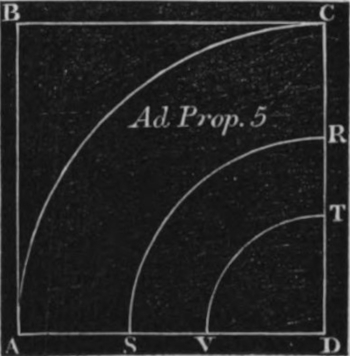
I describe a square A B C D, and in it a quadrant D A C. Suppose D T be two-fifths of D C, then will the quadrantal arc T V be two-fifths of the arc C A. Again let D R be a mean proportional between D C and D T; then will the quadrantal arc R S be a mean proportional between the arc C A and the arc T V.
Suppose further a right line were given equal to the arc C A, and a quadrantal arc therewith described; then will D C, C A, the arc on C A be continually proportional. Set these proportionals in order by themselves.
D C, C A, arc on C A∺
D R, R S, arc on R S∺
D T, T V, arc on T V∺
which are in continual proportion of the semi-diameter of the arc. And D C, D R, D T are in a continual proportion by construction, and therefore also C A, R S, T V, and arc on C A, arc on R S, arc on T V, in continual proportion.
Therefore as D C to R S, so is R S to the arc on T V. And D C, R S, the arc on T V will be continually proportional. And because D C, C A, the arc on C A are also continually proportional, and have the first antecedent D C common; the proportion of the arc on C A to the arc on T V is (by Eucl. xiv. 28) duplicate of the proportion of C A to R S, and the arc on R S a mean proportional between the arc on C A and the arc on T V.
Now if D C be greater than R S, also R S must be greater than the arc on T V; and the arc C A greater than the arc on R S. Therefore seeing D C, C A, arc on C A, are continually proportional; the arc on T V, the arc on R S, the arc on C A cannot be continually proportional, which is contrary to what has been demonstrated. Therefore D C is not greater than R S. Suppose, then, R S to be greater than D C, then will the arc on R S be a mean proportional between the arc on T V, and a greater arc than that on C A; and so the inconvenience returneth. Therefore the semidiameter D C is equal to the arc R S, and D R equal to T V, that is to say to two-fifths of the arc C A, which was to be demonstrated. Nor needeth there much geometry for examining of this demonstration. Therefore I submit them both to your censure, as also the whole Rosetum, a copy whereof I have caused to be delivered to the secretary of your society.
437TO THE
RIGHT HONOURABLE AND OTHERS,
THE LEARNED MEMBERS
OF
THE ROYAL SOCIETY,
FOR THE ADVANCEMENT OF THE SCIENCES.
Presenteth to your consideration, your most humble servant Thomas Hobbes, a confutation of a theorem which hath a long time passed for truth; to the great hinderance of Geometry, and also of Natural Philosophy, which thereon dependeth.
THE THEOREM.
The four sides of a square being divided into any number of equal parts, for example into 10; and straight lines drawn through the opposite points, which will divide the square into 100 lesser squares; the received opinion, and which Dr. Wallis commonly useth, is, that the root of those 100, namely 10, is the side of the whole square.
THE CONFUTATION.
The root 10 is a number of those squares, whereof the whole containeth 100, whereof one square is an unity; therefore the root 10, is 10 squares: Therefore the root of 100 squares is 10 squares, and not the side of any square; because the side of a square is not a superficies, but a 438line. For as the root of 100 unities is 10 unities, or of 100 soldiers 10 soldiers: so the root of 100 squares is 10 of those squares. Therefore the theorem is false; and more false, when the root is augmented by multiplying it by other greater numbers.
Hence it followeth, that no proposition can either be demonstrated or confuted from this false theorem. Upon which, and upon the numeration of infinites, is grounded all the geometry which Dr. Wallis hath hitherto published.
And your said servant humbly prayeth to have your judgment hereupon: and that if you find it to be false, you will be pleased to correct the same: and not to suffer so necessary a science as geometry to be stifled, to save the credit of a professor.
439TO THE
RIGHT HONOURABLE AND OTHERS,
THE LEARNED MEMBERS
OF
THE ROYAL SOCIETY,
FOR THE ADVANCEMENT OF THE SCIENCES.
Your most humble servant Thomas Hobbes presenteth, that the quantity of a line calculated by extraction of roots is not to be truly found. And further presenteth to you the invention of a straight line equal to the arc of a circle.
A square root is a number which multiplied into itself produced a number.
DEFINITION.
And the number so produced is called a square number. For example: Because 10 multiplied by 10 makes 100; the root is 10, and the square number 100.
CONSEQUENT.
In the natural row of numbers, as 1, 2, 3, 4, 5, 6, 7, 8, 9, 10, 11, 12, 13, 14, 15, 16, &c. every one is the square of some number in the same row. But square numbers (beginning at 1) intermit first two numbers, then four, then six, &c. So that none of the intermitted numbers is a square number, nor has any square root.
440PROP. I.
A square root (speaking of quantity) is not a line, such as Euclid defines, without latitude, but a rectangle.
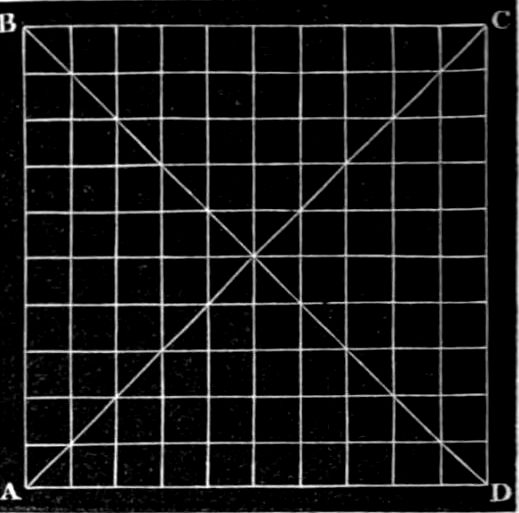
Suppose A B C D be the square, and A B, B C, C D, D A, be the sides, and every side divided into 10 equal parts, and lines drawn through the opposite points of division; there will then be made 100 lesser squares, which taken altogether are equal to the square A B C D. Therefore the whole square is 100, whereof one square is an unit; therefore 10 units, which is the root, is ten of the lesser squares, and consequently has latitude; and therefore it cannot be the side of a square, which, according to Euclid, is a line without latitude.
CONSEQUENT.
It follows hence, that whosoever taketh for a principle, that a side of a square is a mere line without latitude, and that the root of a square is such a line (as Dr. Wallis continually does) demonstrates nothing. But if a line be divided into what number of equal parts soever, so the line have breadth allowed it (as all lines must, if they be drawn), and the length be to the breadth as number to an unit; the side and the roof will be all of one length.
441PROP. II.
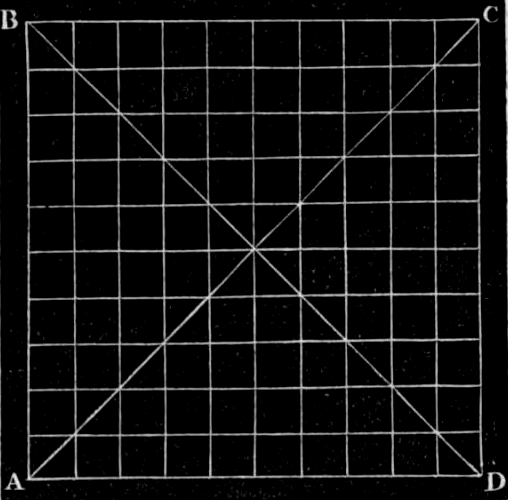
Any number given is produced by the greatest root multiplied into itself, and into the remaining fraction. Let the number given be two hundred squares, the greatest root is 144 14 squares. I say that 200 is equal to the product of 14 into itself, together with 14 multiplied into 4 14. For 14 multiplied into itself makes 196. And 14 into 4 14 makes 56 14 which is equal to 4. And 4 added to 196 maketh 200; as was to be proved. Or take any other number 8, the greatest root is 2; which multiplied into itself is 4, and the remainder 2 4 multiplied into 2, is 4, and both together 8.
PROP. III.
But the same square calculated geometrically by the like parts, consisteth (by Euclid II. 4) of the same numeral great square 196, and of the two rectangles under the greatest side 14, and the remainder of the side, or (which is all one) of one rectangle under the greatest side, and double the remainder of the side; and further of the square of the less segment; which altogether make 200, and moreover 1 49 of those 200 squares, as by the operation itself appeareth thus:
The side of the greater segment is 144 14
144 14
Which multiplied into itself makes 200.
442The product of 14, the greatest segment, into the two fractions 4 14, that is, into 4 14 (or into twice 2 14) is 56 14 (that is 4); and that 4 added to 196 makes 200.
Lastly, the product of 2 14 into 2 14 or 1 7 into 1 7 is 1 49. And so the same square calculated by roots is less by 1 49 of one of those two hundred squares, than by the true and geometrical calculation; as was to be demonstrated.
CONSEQUENT.
It is hence manifest, that whosoever calculates the length of an arc or other line by the extraction of roots, must necessarily make it shorter than the truth, unless the square have a true root.
443The Radius of a Circle is a Mean Proportion between the Arc of a Quadrant and two-fifths of the same.
Describe a square A B C D, and in it a quadrant D C A. In the side D C take D T two-fifths of D C, and between D C and D T a mean proportional D R, and describe the quadrantal arcs R S, T V. I say the arc R S is equal to the straight line D C. For seeing the proportion of D C to D T is duplicate of the proportion of D C to D R, it will be also duplicate of the proportion of the arc C A to the arc R S, and likewise duplicate of the proportion of the arc R S to the arc T V.
Suppose some other arc, less or greater than the arc R S, to be equal to D C, as for example r s: then the proportion of the arc r s to the straight line D T will be duplicate of the proportion of R S to T V, or D R to D T. Which is absurd; because D r is by construction greater or less than D R. Therefore the arc R S is equal to the side D C, which was to be demonstrated.
COROL.
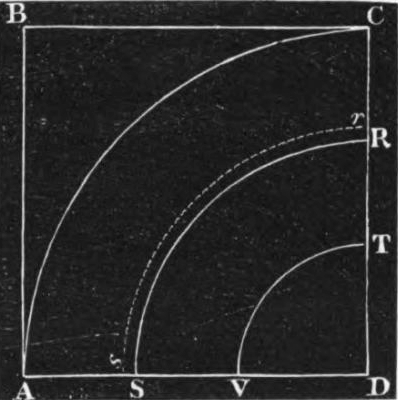
Hence it follows that D R is equal to two-fifths of the arc C A. For R S, T V, D T, being continually proportional, and the arc T V being described by D T, the arc R S will be described by a straight line equal to T V. But R S is described by the straight line D R. Therefore D R is equal to T V, that is to two-fifths of C A.
444And your said servant most humbly prayeth you to consider, if the demonstration be true and evident, whether the way of objecting against it by square root, used by Dr. Wallis; and whether all his geometry, as being built upon it, and upon his supposition of an infinite number, be not false.
445