SIX LESSONS TO THE PROFESSORS OF THE MATHEMATICS, (continued 2)
Reading edition
To supply this want, I thought it necessary to seek out some way, whereby the proportion of two lines, commensurable or incommensurable, might be continued perpetually the same. And this I 245found might be done by the proportion of two lines described by some uniform motion, as by an efficient cause both of the said lines, and also of their proportions; which motions continuing, the proportions must needs be all the way the same. And therefore I defined those magnitudes to have the same geometrical proportion, when some cause producing in equal times equal effects, did determine both the proportions. This, you say, needs an Œdipus to make it understood. You are, I see, no Œdipus; but I do not see any difficulty, neither in the definition nor in the demonstration. That which you call perplexity in the explication, is your prejudice, arising from the symbols in your fancy. For men that pretend no less to natural philosophy than to geometry, to find fault with bringing motion and time into a definition, when there is no effect in nature which is not produced in time by motion, is a shame. But you swim upon other men’s bladders in the superficies of geometry, without being able to endure diving, which is no fault of mine; and therefore I shall, without your leave, be bold to say, I am the first that hath made the grounds of geometry firm and coherent. Whether I have added anything to the edifice or not, I leave to be judged by the readers. You see, you that profess with the pricking of bladders the letting out of their vapour, how much you are deceived. You make them swell more than ever.
For the corollaries that follow this sixth article, you say they contain nothing new. Which is not true. For the ninth is new, and the demonstrations of all the rest are new, being grounded upon a new definition of proportion; and the corollaries 246themselves, for want of a good definition of proportion, were never before exactly demonstrated. For the truth of the sixth definition of the fifth Element of Euclid cannot be known but by this definition of mine; because it requires a trial in all numbers possible, that is to say, an infinite time of trial, whether the quimultiples of the first and third, and of the second and fourth, in all multiplications, do together exceed, together come short, and are together equal; which trial is impossible.
In objecting against the thirteenth and sixteenth article, I observe that you bewray together, both the greatest ignorance and the greatest malice; and it is well, for they are suitable to one another, and fit for one and the same man. In the thirteenth article my proposition is this: If there be three magnitudes that have proportion one to another, the proportions of the first to the second, and of the second to the third, taken together (as one proportion), are equal to the proportion of the first to the third. This demonstrated, there is taken away one of those moles which Sir Henry Savile complaineth of in the body of geometry. Let us see now what you say, both against the enunciation and against the demonstration.
Against the enunciation you object, that other men would say (not the proportions of the first to the second, and of the second to the third, taken together, &c. but) the proportion which is compounded of the proportion of the first to the second, and of the second to the third, &c. Is not the compounding of any two things whatsoever the finding of the sum of them both, or the taking of them together as one total? This is that absurdity 247of which Mersennus, in the general preface to his Cogitata Physico-Mathematica, hath convinced Clavius, who, at the end of Euclid’s ninth Element, denieth the composition of proportion to be a composition of parts to make a total; which, therefore, he denied, because he did not observe, that the addition of a proportion of defect to a proportion of excess, was a subtraction of magnitude; and because he understood not that to say, composition is not the making a whole of parts, was contradiction; which all but too learned men would as soon as they heard abhor. Therefore, in saying that other men would not speak in that manner, you say in effect they would speak absurdly. You do well to mark what other geometricians say; but you would do better if you could by your own meditation upon the things themselves, examine the truth of what they say. But you have no mind, you say, to contend about the phrase. Let us see, therefore, what it is you contend about.
The proportion, you say, which is compounded of double and triple proportion, is not, as I would have it, quintuple, but sextuple, as in these numbers, six, three, one; where the proportion of six to three is double, the proportion of three to one triple, and the proportion of six to one sextuple, not quintuple. Tell me, egregious professors, how is six to three double proportion? Is six to three the double of a number, or the double of some proportion? All men know the number six is double to the number three, and the number three triple to an unity. But is the question here of compounding numbers, or of compounding proportions? 248Euclid, at the last proposition of his ninth Element, says indeed, that these numbers, one, two, four, eight, are ἐν διπλασίονι ἀναλογία, in double proportion; yet there is no man that understands it otherwise, than if he had said in proportion of the single quantity to the double quantity; and after the same rate, if he had said three, nine, twenty-seven, &c. had been in triple proportion, all men would have understood it, of the proportion of any quantity to its triple. Your instance, therefore, of six, three, one, is here impertinent, there being in them no doubling, no tripling, no sextupling of proportions, but of numbers. You may observe also, that Euclid never distinguished between double and duplicate, as you do. One word διπλάσιον serves him every where for either. Though, I confess, some curious grammarians take διπλάσιον for duplicate in number, and διπλοῦν for double in quantity; which will not serve your turn. Your geometry is not your own, but you case yourselves with Euclid’s; in which, as I have showed you, there be some few great holes; and you by misunderstanding him, as in this place, have made them greater. Though the beasts that think your railing roaring, have for a time admired you; yet now that through these holes of your case I have showed them your ears, they will be less affrighted. But to exemplify the composition of proportions, take these numbers, thirty-two, eight, one, and then you shall see that the proportion of thirty-two to one is the sum of the proportions of thirty-two to eight, and of eight to one. For the proportion of thirty-two to eight is double the proportion of thirty-two to sixteen; and the 249proportion of eight to one, is triple the proportion of thirty-two to sixteen; and the proportion of thirty-two to one is quintuple of thirty-two to sixteen; but double and triple added together maketh quintuple. What can be here denied?
My demonstration consisteth of three cases: the first is when both the proportions are of defect, which is then when the first quantity is the least; as in these three quantities, A B, A C, A D. The first case I demonstrated thus: A B C D a Let it be supposed that the point A were moved uniformly through the whole line A D. The proportions, therefore, of A B to A C, and of A C to A D, are determined by the difference of the times in which they are described. And the proportion also of A B to A D, is that which is determined by the difference of the times in which they are described; but the difference of the times in which A B and A C are described, together with the difference of the times wherein A C and A D are described, is the same with the difference of the times wherein are described A B and A D. The same cause, therefore, which determines both the proportions of A B to A C, and of A C to A D, determines also the proportion of A B to A D. Wherefore, by the definition of the same proportion, article six, the proportion of A B to A C, together with the proportion of A C to A D, is the same with the proportion of A B to A D.
Consider now your argumentation against it. “Let there be taken,” say you, “between A and B the point a; and then in your own words, I argue thus: The difference of the times wherein are described A B and A C, together with the difference 250of the times wherein are described A C and A D, is the same with the difference of the times in which are described a B and a C (namely, B D, or B C + C D); wherefore, the same cause which determines the two proportions of A B to A C, and of A C to A D, determines also the proportion of a B to a D.” Let me ask you here whether you suppose the motion from a to B, or from a to D, to have the same swiftness with the motion from A to B, or from A to D? If you do not, then you deny the supposition. If you do, then B C, which is the difference of the times A B and A C, cannot be the difference of the times in which are described a B and a C, except A B and a B are equal. Let any man judge now whether there be any paralogism in Orontius that can equal this. And whether all that follows in the rest of this, and the next two whole pages, be not all a kind of raving upon the ignorance of what is the meaning of proportion, which you also make more ill-favoured by writing it; not in language, but in gambols; I mean in the symbols, which have made you call those demonstrations short, which put into words so many as a true demonstration requires, would be longer than any of those of Clavius upon the twelfth Element of Euclid.
To the sixteenth article you bring no argument, but fall into a loud oncethmus (the special figure wherewith you grace your oratory), offended with my unexpected crossing of the doctrine you teach, that proportion consisteth in a quotient. For that being denied you, your a b - c d + e f - g h + i k comes to nothing, that is, to just as much as it is worth. But are not you very simple men, to say that all 251mathematicians speak so, when it is not speaking? When did you see any man but yourselves publish his demonstrations by signs not generally received, except it were not with intention to demonstrate, but to teach the use of signs? Had Pappus no analytics? or wanted he the wit to shorten his reckoning by signs? Or has he not proceeded analytically in a hundred problems (especially in his seventh book), and never used symbols? Symbols are poor unhandsome, though necessary, scaffolds of demonstration; and ought no more to appear in public, than the most deformed necessary business which you do in your chambers. “But why,” say you, “is this limitation to the proportion of the greater to the less?” I will tell you; because iterating of the proportion of the less to the greater, is a making of the proportion less, and the defect greater. And it is absurd to say that the taking of the same quantity twice should make it less. And thence it is, that in quantities which begin with the less, as one, two, four, the proportion of one to two is greater than that of one to four, as is demonstrated by Euclid, Elem. 5, prop. 8; and by consequent the proportion of one to four, is a proportion of greater littleness than that of one to two. And who is there, that when he knoweth that the respective greatness of four to one, is double to that of the respective greatness of four to two, or of two to one, will not presently acknowledge that the respective greatness of one to two, or two to four, is double to the respective greatness of one to four? But this was too deep for such men as take their opinions, not from weighing, but from reading.
252Lastly you object against the corollary of art. 28; which you make absurd enough by rehearsing it thus: Si quantitas aliqua divisa supponatur in partes aliquot æquales numero infinitas, &c. Do you think that of partes aliquot, or of partes aliquotæ, it can be said without absurdity, that they are numero infinitæ? And then you say I seem to mean, that if of the quantity A B, there be supposed a part C B, infinitely little; and that between A C and A B be taken two means, one arithmetical, A E, the other geometrical, A D, the difference between A D and A E, will be infinitely little. My meaning is, and is sufficiently expressed, that the said means taken everywhere (not in one place only) will be the same throughout: and you that say there needed not so much pains to prove it, and think you do it shorter, prove it not at all. For why may not I pretend against your demonstration, that B E, the arithmetical difference, is greater than B D, the geometrical difference. You bring nothing to prove it; and if you suppose it, you suppose the thing you are to prove. Hitherto you have proceeded in such manner with your Elenchus, as that so many objections as you have made, so many false propositions you have advanced. Which is a peculiar excellence of yours, that for so great a stipend as you receive, you will give place to no man living for the number and grossness of errors you teach your scholars.
At the fourteenth chapter your first exception is to the second article; where I define a plane in this manner: A plane superficies is that which is described by a straight line so moved, as that every point thereof describe a several straight line. In 253which you require, first, that instead of describe, I should have said can describe. Why do you not require of Euclid, in the definition of a cone, instead of continetur, is contained, he say contineri potest, can be contained ? If I tell you how one plane is generated, cannot you apply the same generation to any other plane? But you object, that the plane of a circle may be generated by the motion of the radius, whose every point describeth, not a straight, but a crooked line, wherein you are deceived; for you cannot draw a circle (though you can draw the perimeter of a circle) but in a plane already generated. For the motion of a straight line, whose one point resting, describeth with the other points several perimeters of circles, may as well describe a conic superficies, as a plane. The question, therefore, is, how you will, in your definition, take in the plane which must be generated before you begin to describe your circle, and before you know what point to make your centre. This objection, therefore, is to no purpose; and besides, that it reflecteth upon the perfect definitions of Euclid before the eleventh Element, it cannot make good his definition (which is nothing worth) of a plane superficies, before his first Element.
In the next place, you reprehend briefly this corollary, that two planes cannot enclose a solid. I should, indeed, have added, with the base on whose extremes they insist: but this is not a fault to be ashamed of; for any man, by his own understanding, might have mended my expression without departing from my meaning. But from your doctrine, that a superficies has no thickness, it is 254impossible to include a solid, with any number of planes whatsoever, unless you say that solid is included which nothing at all includes.
At the third article, where I say of crooked lines, some are everywhere crooked, and some have parts not crooked. You ask me what crooked line has parts not crooked; and I answer, it is that line which with a straight line makes a rectilineal triangle. But this, you say, cannot stand with what I said before, namely, that a straight and crooked line cannot be coincident; which is true, nor is there any contradiction; for that part of a crooked line which is straight, may with a straight line be coincident.
To the fourth article, where I define the centre of a circle to be that point of the radius, which in the description of the circle is unmoved; you object as a contradiction, that I had before defined a point to be the body which is moved in the description of a line: foolishly, as I have already shown at your objection to Chap. VIII. art. 12.
But at the sixth article, where I say, that crooked and incongruous lines touch one another but in one point, you make a cavil from this, that a circle may touch a parabola in two points. Tell me truly, did you read and understand these words that followed? “A crooked line cannot be congruent with a straight line; because if it could, one and the same line should be both straight and crooked.” If you did, you could not but understand the sense of my words to be this: when two crooked lines which are incongruous, or a crooked and a straight line touch one another, the contact is not in a line, but only in one point; and then 255your instance of a circle and a parabola was a wilful cavil, not befitting a doctor. If you either read them not, or understood them not, it is your own fault. In the rest that followeth upon this article, with your diagram, there is nothing against me, nor anything of use, novelty, subtlety, or learning.
At the seventh article, where I define both an angle, simply so called, and an angle of contingence, by their several generations; namely, that the former is generated when two straight lines are coincident, and one of them is moved, and distracted from the other by circular motion upon one common point resting, &c.; you ask me “to which of these kinds of angle I refer the angle made by a straight line when it cuts a crooked line?” I answer easily and truly, To that kind of angle which is called simply an angle. This you understand not. “For how”, will you say, “can that angle which is generated by the divergence of two straight lines, be other than rectilineal? or how can that angle which is not comprehended by two straight lines, be other than curvilineal?” I see what it is that troubles you; namely, the same which made you say before, that if the body which describes a line be a point, then there is nothing which is not moved that can be called a point. So you say here, “If an angle be generated by the motion of a straight line, then no angle so generated can be curvilineal;” which is as well argued, as if a man should say, the house was built by the carriage and motion of stone and timber, therefore, when the carriage and that motion is ended, it is no more a house. Rectilineal and curvilineal hath 256nothing to do with the nature of an angle simply so called, though it be essential to an angle of contact. The measure of an angle, simply so called, is a circumference of a circle; and the measure is always the same kind of quantity with the thing measured. The rectitude or curvity of the lines, which drawn from the centre, intercept the arch, is accidentary to the angle, which is the same, whether it be drawn by the motion circular of a straight line or of a crooked. The diameter and the circumference of a circle make a right angle, and the same which is made by the diameter and the tangent. And because the point of contact is not, as you think, nothing, but a line unreckoned, and common both to the tangent and the circumference; the same angle computed in the tangent is rectilineal, but computed in the circumference, not rectilineal, but mixed: or, if two circles cut one another, curvilineal. For every chord maketh the same angle with the circumference which it maketh with the line that toucheth the circumference at the end of the chord. And, therefore, when I divide an angle, simply so called, into rectilineal and curvilineal, I respect no more the generation of it, than when I divide it into right and oblique. I then respect the generation, when I divide an angle into an angle simply so called, and an angle of contact. This that I have now said, if the reader remember when he reads your objections to this, and to the ninth article, he will need no more to make him see that you are utterly ignorant of the nature of an angle; and that if ignorance be madness, not I, but you, are mad: and when an angle is comprehended between a straight 257and a crooked line (if I may compute the same angle as comprehended between the same straight line and the point of contact), that it is consonant to my definition of a point by a magnitude not considered. But when you, in your treatise, De Angulo Contactus (chap. III. p. 6, l. 8) have these words: “Though the whole concurrent lines incline to one another, yet they form no angle anywhere but in the very point of concourse:” you, that deny a point to be anything, tell me how two nothings can form an angle; or if the angle be not formed, neither before the concurrent lines meet, nor in the point of concourse, how can you apprehend that any angle can possibly be framed? But I wonder not at this absurdity; because this whole treatise of yours is but one absurdity, continued from the beginning to the end, as shall then appear when I come to answer your objections to that which I have briefly and fully said of that subject in my 14th chapter.
At the twelfth article, I confess your exception to my universal definition of parallels to be just, though insolently set down. For it is no fault of ignorance (though it also infect the demonstration next it), but of too much security. The definition is this: Parallels are those lines or superficies, upon which two straight lines falling, and wheresoever they fall, making equal angles with them both, are equal; which is not, as it stands, universally true. But inserting these words the same way, and making it stand thus: parallel lines or superficies, are those upon which two straight lines falling the same way, and wheresoever they fall, making equal angles, are equal, it is both true 258and universal; and the following consectary, with very little change, as you may see in the translation, perspicuously demonstrated. The same fault occurreth once or twice more; and you triumph unreasonably, as if you had given therein a very great proof of your geometry.
The same was observed also upon this place by one of the prime geometricians of Paris, and noted in a letter to his friend in these words (Chap. XIV. art. 12): “The definition of parallels wanteth somewhat to be supplied.” And of the consectary he says, “It concludeth not, because it is grounded on the definition of parallels.” Truly and severely enough, though without any such words as savour of arrogance, or of malice, or of the clown.
At the thirteenth article you recite the demonstration by which I prove the perimeters of two circles to be proportional to their semidiameters; and with esto, fortasse, recte, omnino, noddying to the several parts thereof, you come at length to my last inference: Therefore, by Chap. XIII. art. 6, the perimeters and semidiameters of circles are proportional; which you deny; and therefore deny, because you say it followeth by the same ratiocination, that circles also and spheres are proportional to their semidiameters. “For the same distance, you say, of the perimeter from the centre which determines the magnitude of the semidiameter, determines also the magnitude both of the circle and of the sphere.” You acknowledge that perimeters and semidiameters have the cause of their determination such as in equal times make equal spaces. Suppose now a sphere generated by the semidiameters, whilst the semicircle 259is turned about. There is but one radius of an infinite number of radii, which describes a great circle; all the rest describe lesser circles parallel to it, in one and the same time of revolution. Would you have men believe, that describing greater and lesser circles, is according to the supposition (temporibus æqualibus æqualia facere) to make equal spaces in equal times? Or, when by the turning about of the semidiameter is described the plane of a circle, does it, think you, in equal times make the planes of the interior circles equal to the planes of the exterior? Or is the radius that describes the inner circles equal to the radius that describes the exterior? It does not, therefore, follow from anything I have said in this demonstration, that either spheres or planes of circles, are proportional to their radii; and consequently, all that you have said, triumphing in your own incapacity, is said imprudently by yourselves to your own disgrace. They that have applauded you, have reason by this time to doubt of all the rest that follows, and if they can, to dissemble the opinion they had before of your geometry. But they shall see before I have done, that not only your whole Elenchus , but also your other books of the Angle of Contact , &c. are mere ignorance and gibberish.
To the fourteenth article you object, that (in the sixth figure) I assume gratis, that F G, D E, B C, are proportional to A F, A D, A B; and you refer it to be judged by the reader: and to the reader I refer it also. The not exact drawing of the figure (which is now amended) is it that deceived you. For A F, F D, D B, are equal by construction. Also, 260A G, G E, E C, are equal by construction. And F G, D K, B H, K E, H I, I C, are equal by parallelism. And because A F, F G, are as the velocities wherewith they are described; also 2 A F (that is A D) and 2 F G (that is D E) are as the same velocities. And finally, 3 A F (that is A B) and 3 F G (that is B C) are as the same velocities. It is not therefore assumed gratis, that F G, D E, B C are proportional to A F, A D, A B, but grounded upon the sixth article of the thirteenth chapter; and consequently your objection is nothing worth. You might better have excepted to the placing of D E, first at adventure, and then making A D two-thirds of A B; for that was a fault, though not great enough to trouble a candid reader; yet great enough to be a ground, to a malicious reader, of a cavil.
That which you object to the third corollary of art. 15, was certainly a dream. There is no assuming of an angle C D E, for an angle H D E, or B D E, neither in the demonstration, nor in any of the corollaries. It may be you dreamt of somewhat in the twentieth article of chapter XVI. But because that article, though once printed, was afterwards left out, as not serving to the use I had designed it for, I cannot guess what it is: for I have no copy of that article, neither printed nor written; but am very sure, though it were not useful, it was true.
Article the sixteenth. Here we come to the controversy concerning the angle of contact, which, you say, you have handled, in a special treatise published; and that you have clearly demonstrated, in your public lectures, that Peletarius 261was in the right. But that I agree not sufficiently, neither with Peletarius nor with Clavius. I confess I agree not in all points with Peletarius, nor in all points with Clavius. It does not thence follow that I agree not with the truth. I am not, as you, of any faction, neither in geometry nor in politics. If I think that you, or Peletarius, or Clavius, or Euclid, have erred, or been too obscure, I see no cause for which I ought to dissemble it. And in this same question I am of opinion that Peletarius did not well in denying the angle of contingence to be an angle. And that Clavius did not well to say, the angle of a semicircle was less than a right-lined right angle. And that Euclid did not well to leave it so obscure what he meant by inclination in the definition of a plane angle, seeing elsewhere he attributeth inclination only to acute angles; and scarce any man ever acknowledged inclination in a straight line, to any other line to which it was perpendicular. But you, in this question of what is inclination, though you pretend not to depart from Euclid, are, nevertheless, more obscure than he; and also are contrary to him. For Euclid by inclination meaneth the inclination of one line to another; and you understand it of the inclination of one line from another; which is not inclination, but declination. For you make two straight lines, when they lie one on another, to lie ἁκλινῶς, that is, without any inclination (because it serves your turn); not observing that it followeth thence, that inclination is a digression of one line from another. This is in your first argument in the behalf of Peletarius (p. 10, l. 22), and destroys his opinion. For, according to Euclid, 262the greatest angle is the greatest inclination; and an angle equal to two right angles by this ἀκλισία, should not be the greatest inclination, as it is, but the least that can be. But if by the inclination of two lines, we understand that proceeding of them to a common point, which is caused by their generation, which, I believe, was Euclid’s meaning; then will the angle of contact be no less an angle than a rectilineal angle, but only (as Clavius truly says it is) heterogeneous to it; and the doctrine of Clavius more conformable to Euclid than that of Peletarius. Besides, if it be granted you, that there is no inclination of the circumference to the tangent, yet it does not follow that their concourse doth not form some kind of angle; for Euclid defineth there but one of the kinds of a plane angle. And then you may as much in vain seek for the proportion of such angle to the angle of contact, as seek for the focus or parameter of the parabola of Dives and Lazarus. Your first argument therefore is nothing worth, except you make good that which in your second argument you affirm, namely, that all plane angles, not excepting the angle of contact, are (homogeneous) of the same kind. You prove it well enough of other curvilineal angles; but when you should prove the same of an angle of contact, you have nothing to say but (p. 17, l. 15), “Unde autem illa quam somniet heterogenia oriatur, neque potest ille ullatenus ostendere, neque ego vel somniare:” “Whence should arise that diversity of kind which he dreams of, neither can he at all show, nor I dream;” as if you knew what he could do if he were to answer you; or all were false which you 263cannot dream of. So that besides your customary vanity, here is nothing hitherto proved, neither for the opinion of Peletarius, nor against that of Clavius. I have, I think, sufficiently explicated, in the first lesson, that the angle of contact is quantity, namely, that it is the quantity of that crookedness or flexion, by which a straight line is bent into an arch of a circle equal to it; and that because the crookedness of one arch may be greater than the crookedness of another arch of another circle equal to it; therefore the question quanta est curvitas, how much is the crookedness, is pertinent, and to be answered by quantity. And I have also shown you in the same lesson, that the quantity of one angle of contact is compared with that of another angle of contact by a line drawn from the point of contact, and intercepted by their circumferences; and that it cannot be compared by any measure with a rectilineal angle.
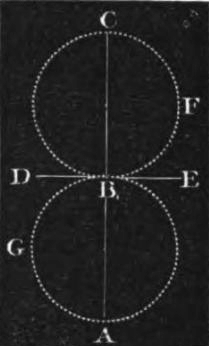
But let us see how you answer to that which Clavius has objected already. “They are heterogeneous,” says he, “because the angle of contact, how oft soever multiplied, can never exceed a rectilineal angle.” To answer which, you allege it is no angle at all; and that therefore, it is no angle at all, because the lines have no inclination one to another. How can lines that have no inclination one to another, ever come together? But you answer, at least they have no inclination in the point of contact. And why have two straight lines inclination before they come to touch, more than a straight line and an arch of a circle? And in the point of contact itself, how can it be that there is less inclination of the two points of a 264straight line and an arch of a circle, than of the points of two straight lines? But the straight lines, you say, will cut; which is nothing to the question; and yet this also is not so evident, but that it may receive an objection. Suppose two circles, A G B and C F B, to touch in B, and have a common tangent through B. Is not the line C F B G A a crooked line? and is it not cut by the common tangent D B E? What is the quantity of the two angles F B E and G B D, seeing you say neither D B G nor E B F is an angle? It is not, therefore, the cutting of a crooked line, and the touching of it, that distinguisheth an angle simply, from an angle of contact. That which makes them differ, and in kind, is, that the one is the quantity of a revolution, and the other, the quantity of flexion.
In the seventh chapter of the same treatise, you think you prove the angle of contact, if it be an angle, and a rectilineal angle to be (homogeneous) of the same kind; when you prove nothing but that you understand not what you say. Those quantities which can be added together, or subtracted one from another, are of the same kind; but an angle of contact may be subtracted from a right angle, and the remainder will be the angle of a semicircle, &c. So you say, but prove it not, unless you think a man must grant you that the superficies contained between the tangent and the arch, which is it you subtract, is the angle of contact; and that the plane of the semicircle is the angle of the semicircle, which is absurd; though, as absurd as it is, you say it directly in your Elenchus , 265p. 35, l. 14, in these words: “When Euclid defines a plane angle to be the inclination of two lines, he meaneth not their aggregate, but that which lies between them.” It is true, he meaneth not the aggregate of the two lines; but that he means that which lies between them, which is nothing else but an indeterminate superficies, is false, or Euclid was as foolish a geometrician as either of you two.
Again, you would prove the angle of contact, if it be an angle, to be of the same kind with a rectilineal angle, out of Euclid (III. 16); where he says, it is less than any acute angle. And it follows well, that if it be an angle, and less than any rectilineal angle, it is also of the same kind with it. But, to my understanding, Euclid meant no more, but that it was neither greater nor equal; which is as truly said of heterogeneous, as of homogeneous quantities. If he meant otherwise, he confirms the opinion of Clavius against you, or makes the quantity of an angle to be a superficies, and indefinite. But I wonder how you dare venture to determine whether two quantities be homogeneous or not, without some definition of homogeneous (which is a hard word), that men may understand what it meaneth.
In your eighth chapter you have nothing but Sir H. Savile’s authority, who had not then resolved what to hold; but esteeming the angle of contact, first, as others falsely did, by the superficies that lies between the tangent and the arch, makes the angle of contact and a rectilineal angle homogeneous; and afterwards, because no multiplication of the angle of contact 266can make it equal to the least rectilineal angle, with great ingenuity returneth to his former uncertainty.
In your ninth and tenth chapters you prove with much ado, that the angles of like segments are equal; as if that might not have been taken gratis by Peletarius, without demonstration. And yet your argument, contained in the ninth chapter, is not a demonstration, but a conjectural discourse upon the word similitude. And in the eleventh chapter, wherein you answer to an objection, which might be made to your argument in the precedent page, taken from the parallelism of two concentric circles, though objection be of no moment, yet you have in the same treatise of yours that which is much more foolish, which is this, (p. 38, l. 12): “Non enim magnitudo anguli,” &c. “The“The magnitude of an angle is not to be estimated by that straddling of the legs, which it hath without the point of concourse, but by that straddling which it hath in the point of the concourse itself.” I pray you tell me what straddling there is of two coincident points, especially such points as you say are nothing? When did you ever see two nothings straddle?
The arguments in your twelfth and thirteenth chapters are grounded all on this untruth, that an angle is that which is contained between the lines that make it; that is to say, is a plane superficies, which is manifestly false; because the measure of an angle is an arch of a circle, that is to say, a line; which is no measure of a superficies. Besides this gross ignorance, your way of demonstration, by putting N for a great number of sides of an equilateral 267polygon, is not to be admitted; for, though you understand something by it, you demonstrate nothing to anybody but those who understand your symbolic tongue, which is a very narrow language. If you had demonstrated it in Irish or Welsh, though I had not read it, yet I should not have blamed you, because you had written to a considerable number of mankind, which now you do not.
In your last chapters you defend Vitellio without need; for there is no doubt but that whatsoever crooked line be touched by a straight line, the angle of contingence will neither add anything to, nor take anything from, a rectilineal right angle; but that it is because the angle of contact is no angle, or no quantity, is not true. For it is therefore an angle, because an angle of contact; and therefore quantity, because one angle of contact may be greater than another; and therefore heterogeneal, because the measure of an angle of contact cannot (congruere) be applied to the measure of a rectilineal angle, as they think it may, who affirm with you that the nature of an angle consisteth in that which is contained between the lines that comprehend it, viz., in a plane superficies. And thus you see in how few lines, and without brachygraphy, your treatise of the angle of contingence is discovered for the greatest part to be false, and for the rest, nothing but a detection of some errors of Clavius grounded on the same false principles with your own. To return now from your treatise of the angle of contact back again to your Elenchus .
The fault you find at art. 18, is, that I understand 268not that Euclid makes a plane angle to be that which is contained between the two lines that form it. It is true, that I do not understand that Euclid was so absurd, as to think the nature of an angle to consist in superficies; but I understand that you have not had the wit to understand Euclid.
The nineteenth article of mine in this fourteenth chapter, is this: “All respect or variety of position of two lines, seemeth to be comprehended in four kinds. For they are either parallel, or (being if need be produced) make an angle; or, (if drawn out far enough) touch; or, lastly, they are asymptotes”; in which you are first offended with the word It seems. But I allow you, that never err, to be more peremptory than I am. For to me it seemed (I say again seemed) that such a phrase, in case I should leave out something in the enumeration of the several kinds of position, would save me from being censured for untruth; and yet your instance of two straight lines in divers planes, does not make my enumeration insufficient. For those lines, though not parallels, nor cutting both the planes, yet being moved parallelly from one plane to another, will fall into one or other of the kinds of position by me enumerated; and consequently, are as much that position, as two straight lines in the same plane, not parallel, make the same angle, though not produced till they meet, which they would make if they were so produced: for you have nowhere proved, nor can prove, that two such lines do not make an angle. It is not the actual concurrence of the lines, but the arch of a circle, drawn upon that point for centre, in which 269they would meet if they were produced, and intercepted between them, that constitutes the angle.
Also your objection concerning asymptotes in general is absurd. You would have me add, that their distance shall at last be less than any distance that can be assigned; and so make the definition of the genus the same with that of the species. But because you are not professors of logic, it is not necessary for me to follow your counsel. In like manner, if we understand one line to be moved towards another always parallelly to itself, which is, though not actually, yet potentially the same position, all the rest of your instances will come to nothing.
At the two-and-twentieth article you object to me the use of the word figure, before I had defined it: wherein also you do absurdly; for I have nowhere before made such use of the word figure, as to argue anything from it; and therefore your objection is just as wise as if you had found fault with putting the word figure in the titles of the chapters placed before the book. If you had known the nature of demonstration, you had not objected this.
You add further, that by my definition of figure, a solid sphere, and a sphere made hollow within, is the same figure; but you say not why, nor can you derive any such thing from my definition. That which deceived your shallowness, is, that you take those points that are in the concave superficies of a hollowed sphere, not to be contiguous to anything without it, because that whole concave superficies is within the whole sphere. Lastly, for the fault you find with the definition of like 270figures in like positions, I confess there wants the same word which was wanting in the definition of parallels; namely, ad easdem partes (the same way) which should have been added in the end of the definition of like figures, &c., and may easily be supplied by any student of geometry, that is not otherwise a fool.
At the fifteenth chapter, art. 1, number 6, you object as a contradiction, that I make motion to be the measure of time; and yet, in other places, do usually measure motion and the affections thereof by time. If your thoughts were your own, and not taken rashly out of books, you could not but, (with all men else that see time measured by clocks, dials, hour-glasses, and the like), have conceived sufficiently, that there cannot be of time any other measure besides motion; and that the most universal measure of motion, is a line described by some other motion; which line being once exposed to sense, and the motion whereby it was described sufficiently explicated, will serve to measure all other motions and their time: for time and motion (time being but the mental image or remembrance of the motion) have but one and the same dimension, which is a line. But you, that would have me measure swiftness and slowness by longer and shorter motion, what do you mean by longer and shorter motion? Is longer and shorter in the motion, or in the duration of the motion, which is time? Or is the motion, or the duration of the motion, that which is exposed, or designed by a line? Geometricians say often, let the line A B be the time; but never say, let the line A B be the motion. There is no unlearned man that understandeth 271not what is time, and motion, and measure; and yet you, that undertake to teach it (most egregious professors) understand it not.
At the second article you bring another argument (which it seems in its proper place you had forgotten), to prove that a point is not quantity not considered, but absolutely nothing; which is this, That if a point be not nothing, then the whole is greater than its two halves. How does that follow? Is it impossible when a line is divided into two halves, that the middle point should be divided into two halves also, being quantity?
At the seventh article, I have sufficiently demonstrated, that all motion is infinitely propagated, as far as space is filled with body. You allege no fault in the demonstration, but object from sense, that the skipping of a flea is not propagated to the Indies. If I ask you how you know it, you may wonder perhaps, but answer you cannot. Are you philosophers, or geometricians, or logicians, more than are the simplest of rural people? or are you not rather less, by as much as he that standeth still in ignorance, is nearer to knowledge, than he that runneth from it by erroneous learning?
And, lastly, what an absurd objection is it which you make to the eighth article, where I say that when two bodies of equal magnitude fall upon a third body, that which falls with greater velocity, imprints the greater motion? You object, that not so much the magnitude is to be considered as the weight; as if the weight made no difference in the velocity, when notwithstanding weight is nothing else but motion downward. Tell me, when a weighty body thrown upwards worketh on the 272body it meeteth with, do you not then think it worketh the more for the greatness, and the less for the weight.
OF THE FAULTS THAT OCCUR IN
DEMONSTRATION.
TO THE SAME EGREGIOUS PROFESSORS OF THE MATHEMATICS IN
THE UNIVERSITY OF OXFORD.
LESSON IV.
Of twenty articles which you say (of nineteen which I say) make the sixteenth chapter, you except but three, and confidently affirm the rest are false. On the contrary, except three or four faults, such as any geometrician may see proceed not from ignorance of the subject, or from want of the art of demonstration, (and such as any man might have mended of himself) but from security; I affirm that they are all true, and truly demonstrated; and that all your objections proceed from mere ignorance of the mathematics.
The first fault you find is this, that I express not (art. 1) what impetus it is, which I would have to be multiplied into the time.
The last article of my thirteenth chapter was this, “If there be a number of quantities propounded, howsoever equal or unequal to one another; and there be another quantity which so often taken as there be quantities propounded, is equal to their whole sum; that quantity I call the mean arithmetical of them all.” Which definition I did there insert to serve me in the explication of those 273propositions of which the sixteenth chapter consisted, but did not use it here as I intended. My first proposition therefore as it standeth yet in the Latin, being this, “the velocity of any body moved during any time, is so much as is the product of the impetus in one point of time, multiplied into the whole time;” to a man that hath not skill enough to supply what is wanting, is not intelligible. Therefore I have caused it in the English to go thus: “the velocity of any body in whatsoever time moved, hath its quantity determined by the sum of all the several (impetus) quicknesses, which it hath in the several points of the time of the body’s motion. And added, that all the impetus together taken through the whole time is the same thing with the mean impetus (which mean is defined (Chapter XIII. art. 29) multiplied into the whole time.” To this first article, as it is uncorrected in the Latin, you object, that meaning by impetus some middle impetus, and assigning none, I determine nothing. And it is true. But if you had been geometricians sufficient to be professors, you would have shewed your skill much better, by making it appear that this middle impetus could be none but that, which being taken so often, as there be points in the line of time, would be equal to the sum of all the several impetus taken in the points of time respectively; which you could not do.
To the corollary, you ask first how impetus can be ordinately applied to a line; absurdly. For does not Archimedes sometimes say, and with him many other excellent geometricians, let such a line be the time? And do they not mean, that that 274line, or the motion over it, is the measure of the time? And may not also a line serve to measure the swiftness of a motion? You thought, you say, only lines ought to be said to be ordinately applied to lines. Which I easily believe; for I see you understand not that a line, though it be not the time itself, may be the quantity of a time. You thought also, all you have said in your Elenchus , in your doctrine of the angle of contact, in your Arithmetica Infinitorum, and in your Conics , is true; and yet it is almost all proved false, and the rest nothing worth.
Secondly, you object, that I design a parallelogram by one only side. It was indeed a great oversight, and argueth somewhat against the man, but nothing against his art. For he is not worthy to be thought a geometrician that cannot supply such a fault as that, and correct his book himself. Though you could not do it, yet another from beyond sea took notice of the same fault in this manner, “He maketh a parallelogram of but one side; it should be thus: vel denique per parallelogrammum cujus unum latus est medium proportionale inter impetum maximum (sive ultimo acquisitum) et impetus ejusdem maximi semissem; alterum vero latus, medium proportionale, inter totum tempus, et ejusdem totius temporis semissem.” Which I therefore repeat, that you may learn good manners; and know, that they who reprehend, ought also, when they can, to add to their reprehension the correction.
At the second article, you are pleased to advise me, instead of in omni motu uniformi, to put in in omnibus motibus uniformibus. You have a strange 275opinion of your own judgment, to think you know to what end another man useth any word, better than himself. My intention was only to consider motions uniform, and motions from rest uniformly, or regularly accelerated, that I might thereby compute the lengths of crooked lines, such as are described by any of those motions. And therefore it was enough to prove this theorem to be true in all uniform or uniformly accelerated motion, not motions; though it be true also in the plural. It seems you think a man must write all he knows, whether it conduce, or not, to his intended purpose. But that you may know that I was not (as you think), ignorant how far it might be extended, you may read it demonstrated at the same article in the English universally. Against the demonstration itself you run into another article, namely, the thirteenth, which is this problem: “the length being given, which is passed over in a given time by uniform motion, to find the length which shall be passed over by motion uniformly accelerated in the same time, so as that the impetus last acquired be equal to the time.” Which you recite imperfectly, thereby to make it seem that such a length is not determined. Whether you did this out of ignorance, or on purpose, thinking it a piece of wit, as your pretended mystery which goes immediately before, I cannot tell, for in neither place can any wit be espied by any but yourselves. To imagine motions with their times and ways, is a new business, and requires a steady brain, and a man that can constantly read in his own thoughts, without being diverted by the noise of words. The want of this ability, made you stumble and fall unhandsomely 276in the very first place (that is in Chap. XIII. art. 13), where you venture to reckon both motion and time at once; and hath made you in this chapter to stumble in the like manner at every step you go. As, for example, when I say, as the product of the time, and impetus, to the product of the time and impetus, so the space to the space when the motion is uniform; you come in with, nay, rather as the time to the time; as if the parallelograms A I, and A H, were not also as the times A B, and A F. Thus it is, when men venture upon ways they never had been in before, without a guide.
In the corollary, you are offended with the permutation of the proportion of times and lines, because you think, (you that have scarce one right thought of the principles of geometry), that line and time are heterogeneous quantities. I know time and line are of divers natures; and more, that neither of them is quantity. Yet they may be both of them quanta, that is, they may have quantity; but that their quantities are heterogeneous is false. For they are compared and measured both of them by straight lines. And to this there is nothing contrary in the place cited by you out of Clavius; or if there were, it were not to be valued. And to your question, what is the proportion of an hour to an ell? I answer, it is the same proportion that two hours have to two ells. You see your question is not so subtle as you thought it. By and bye you confess that in times and lines there is quid homogeneum (this quid is an infallible sign of not fully understanding what you say); which is false if you take it of the lines 277themselves; though if you take it of their quantities, it is true without a quid. Lastly, you tell m”e how I might have expressed myself so as it might have been true. But because your expressions please me not, I have not followed your advice.
To the third article, which is this: “In motu uniformiter a quiete accelerato,” etc. “In motion uniformly accelerated from rest, that is, when the impetus increaseth in proportion to the times, the length run over in one time is to the length run over in another time, as the product of the impetus multiplied by the time, to the product of the impetus multiplied by the time;” you object, “that the lengths run over are in that proportion which the impetus hath to the impetus; not that which the impetus hath to the time, because impetus to time has no proportion, as being heterogeneous.” First, when you say the impetus, do you mean some one impetus designed by some one of the unequal straight lines parallel to the base B I? That is manifestly false. You mean the aggregate of all those unequal parallels. But that is the same thing with the time multiplied into the mean impetus. And so you say the same that I do. Again, I ask, where it is that I say or dream that the lengths run over are in the proportion of the impetus to the times? Is it you or I that dream? And for your heterogeneity of the quantities of time and of swiftness, I have already in divers places showed you your error. Again, why do you make B I represent the lengths run over, which I make to be represented by D E, a line taken at pleasure; and you also a few lines before make the same 278B I to design the greatest acquired impetus? These are things which show that you are puzzled and entangled with the unusual speculation of time and motion, and yet are thrust on with pride and spite to adventure upon the examination of this chapter.
Secondly, you grant the demonstration to be good, supposing I mean it, as I seem to speak, of one and the same motion. But why do I not mean it of one and the same motion, when I say not in motions, but in motion uniform? Because, say you, in that which follows, I draw it also to different motions. You should have given at least one instance of it; but there is no such matter. And yet the proposition is in that case also true; though then it must not be demonstrated by the similitude of triangles, as in the case present. And therefore the objections you make from different impetus acquired in the same time, and from other cases which you mention, are nothing worth.
At the fourth article, you allow the demonstration all the way (except the faults of the third, which I have already proved to be none) till I come to say, “that because the proportion of F K to B I is double to the proportion of A F to A B, therefore the proportion of A B to A F is double to the proportion of B I to F K.” This you deny, and wonder at as strange, (for it is indeed strange to you), and in many places you exclaim against it as extreme ignorance in geometry. In this place you only say, “no such matter; for though one proportion be double to another, yet it does not follow that the converse is the double of the converse.” So that this is the issue to which the 279question is reduced, whether you have any or no geometry. I say, if there be three quantities in continual proportion, and the first be the least, the proportion of the first to the second is double to the proportion of the first to the third; and you deny it. The reason of our dissent consisteth in this, that you think the doubling of a proportion to be the doubling of the quantity of the proportion, as well in proportions of defect, as in proportions of excess; and I think that the doubling of a proportion of defect, is the doubling of the defect of the quantity of the same. As for example in these three numbers, 1, 2, 4, which are in continual proportion, I say the quantity of the proportion of one to two, is double the quantity of the proportion of one to four. And the quantity of the proportion of one to four, is half the quantity of the proportion of one to two. And yet deny not but that the quantity of the defect in the proportion of one to two is doubled in the proportion of one to four. But because the doubling of defect makes greater defect, it maketh the quantity of the proportion less. And as for the part which I hold in this question, first, there is thus much demonstrated by Euclid, El. v. prop. 8; that the proportion of one to two, is greater than the proportion of one to four, though how much it is greater be not there demonstrated. Secondly, I have demonstrated (Chap, XIII. art. 16); that it is twice as great, that is to say, (to a man that speaks English), double. The introducing of duplicate, triplicate, &c. instead of double, triple, &c. (though now they be words well understood by such as understand what proportion is), proceeded at first from such as durst not for 280fear of absurdity, call the half of any thing double to the whole, though it be manifest that the half of any defect is a double quantity to the whole defect; for want added to want maketh greater want, that is, a less positive quantity. This difference between double and duplicate, lighting upon weak understandings, has put men out of the way of true reasoning in very many questions of geometry. Euclid never used but one word both for double and duplicate. It is the same fault when men call half a quantity subduplicate, and a third part subtriplicate of the whole, with intention (as in this case) to make them pass for words of signification different from the half and the third part. Besides, from my definition of proportion (which is clear, and easy to be understood by all men, but such as have read the geometry of others unluckily) I can demonstrate the same evidently and briefly thus. My definition is this, proportion is the quantity of one magnitude taken comparatively to another. Let there be therefore three quantities, 1, 2, 4, in continual proportion. Seeing therefore the quantity of four in respect of one, is twice as great as the quantity of the same four in respect of 2, it followeth manifestly that the quantity of 1 in respect of 4, is twice as little as the quantity of the same 1 in respect of 2; and consequently the quantity of 1 in respect of 2, is twice as great as the quantity of the same 1 in respect of 4; which is the thing I maintain in this question. Would not a man that employs his time at bowls, choose rather to have the advantage given him of three in nine, thanthan of one in nine? And why, but that three is a greater quantity in respect of nine, than 281is one? Which is as much as to say, three to nine hath a greater proportion than one to nine; as is demonstrated by Euclid, El. v. prop. 8. Is it not therefore (you that profess mathematics, and theology, and practise the depression of the truth in both) well owled of you, to teach the contrary? But where you say “that the point K (in the second figure of the table belonging to this sixteenth chapter) is not in the parabolical line whose diameter is A B, and base B I, but in the parabolical line of the complement of my semiparabola (as I may learn from the twenty-third proposition of your Arithmetica Infinitorum) whose diameter is A C, and base I C.” What line is that? Is it the same line with that of my semiparabola, or not the same? If the same, why find you fault? If not the same, you ought to have made a semiparabola on the diameter A C, and base I C, and following my construction made it appear that K is not in the line wherein I say it is; which you have not done, nor could do.
Then again, running on in the same blindness of passion, you pretend I make the proportion of B I to F K double to that of A B to A F, and then confute it; when you knew I made the proportion of F K to B I, double to that of F N, to B I, that is, of A F to A B; and this was it you should have confuted. That which followeth is but a triumphing in your own ignorance, wherein you also say, “that all that I afterwards build upon this doctrine is false.” You see whether it be like to prove so or not. As for your Arithmetica Infinitorum, I shall then read to you a piece of a lesson on it when I come to your objections against the next 282Chapter. In the mean time let me tell you, it is not likely you should be great geometricians, that know not what is quantity, nor measure, nor straight, nor angle, nor homogeneous, nor heterogeneous, nor proportion, as I have already made appear in this and the former lessons.
To the first corollary of this fourth article your exception I confess is just, and (which I wonder at) without any incivility. But this argues not ignorance, but security. For who is there that ever read any thing in the Conics, that knows not that the parts of a parabola cut off by lines parallel to the base, are in triplicate proportion to their bases? But having hitherto designed the time by the diameter, and the impetus by the base; and in the next chapter (where I was to calculate the proportion of the parabola, to the parallelogram) intending to design the time by the base, I mistook and put the diameter again for the time; which any man but you might as easily have corrected as reprehended.
To the second corollary, which is this, that the lengths run over in equal times by motion so accelerated, as that the impetus increase in double proportion to their times, are as the differences of the cubic numbers beginning at unity, that is, as seven, nineteen, thirty-seven, &c. you say it is false. But why? “Because” say you “portions of the parabola of equal altitude, taken from the beginning, are not as those numbers seven, nineteen, thirty-seven, &c.” Does this, think you, contradict any thing in this proposition of mine? Yes, because, you think, the lengths gone over in equal times, are the same with the parts of the 283diameter cut off from the vertex, and proportional to the numbers one, two, three, &c. Whereas the lengths run over, are as the aggregates of their velocities, that is, as the parts of the parabola itself, that is, as the cubes of their bases, that is, as the numbers one, eight, twenty-seven, sixty-four, &c., and consequently the lengths run over in equal times, are as the differences of those cubic numbers, one, eight, twenty-seven, sixty-four, whose differences are seven, nineteen, thirty-seven, &c. The cause of your mistake was, that you cannot yet, nor perhaps ever will, contemplate time and motion (which requireth a steady brain) without confusion.
The third corollary you also say is false, “whether it be meant of motion uniformly accelerated (as the words are) or (as perhaps, you say, I meant it) of such motion as is accelerated in double proportion to the time.” You need not say perhaps I meant it. The words of the proposition are enough to make the meaning of the corollary understood. But so also you say it is false. Methinks you should have offered some little proof to make it seem so. You think your authority will carry it. But on the contrary I believe rather that they that shall see how your other objections hitherto have sped, will the rather think it true, because you think it false. The demonstration as it is, is evident enough; and therefore I saw no cause to change a word of it.
To the fifth article you object nothing, but that it dependeth on this proposition (Chap. XIII. art. 16): “That when three quantities are in continual proportion, and the first is the least, as in 284these numbers, four, six, nine, the proportion of the first to the second, is double to the proportion of the same first to the last;” which is there demonstrated, and in the former lessons so amply explicated, as no man can make any further doubt of the truth of it. And you will, I doubt not, assent unto it. But in what estate of mind will you be then? A man of a tender forehead after so much insolence, and so much contumelious language grounded upon arrogance and ignorance, would hardly endure to outlive it. In this vanity of yours, you ask me whether I be angry, or blush, or can endure to hear you. I have some reason to be angry; for what man can be so patient as not to be moved with so many injuries? And I have some reason to blush, considering the opinion men will have beyond sea, (when they shall see this in Latin) of the geometry taught in Oxford. But to read the worst you can say against me, I can endure, as easily at least, as to read any thing you have written in your treatises of the Angle of Contact, of the Conic Sections, or your Arithmetica Infinitorum.
The sixth, seventh, eighth articles, you say are sound. True. But never the more to be thought so for your approbation, but the less; because you are not fit, neither to reprehend, nor praise; and because all that you have hitherto condemned as false, hath been proved true. Then you show me how you could demonstrate the sixth and seventh articles a shorter way. But though there be your symbols, yet no man is obliged to take them for demonstration. And though they be granted to be dumb demonstrations, yet when they are taught 285to speak as they ought to do, they will be longer demonstrations than these of mine.
To the ninth article, which is this, “If a body be moved by two movents at once, concurring in what angle soever, of which, one is moved uniformly, the other, with motion uniformly accelerated from rest, till it acquire an impetus equal to that of the uniform motion, the line in which the body is carried, shall be the crooked line of a semiparabola,” you lift up your voice again, and ask, what latitude? what diameter? what inclination of the diameter to the ordinate lines? If your founder should see this, or the like objections of yours, he would think his money ill bestowed. When I say, in what angle soever, you ask, in what angle? When I say two movents, one uniform, the other uniformly accelerated, make the body describe a semiparabolical line; you ask, which is the diameter? as not knowing that the accelerated motion describes the diameter, and the other a parallel to the base. And when I say the two movents meet in a point, from which point both the motions begin, and one of them from rest, you ask me what is the altitude? As if that point where the motion begins from rest were not the vertex; or that the vertex and base being given, you had not wit enough to see that the altitude of the parabola is determined? When Galileo’s proposition, which is the same with this of mine, supposed no more but a body moved by these two motions, to prove the line described to be the crooked line of a semiparabola, I never thought of asking him what altitude, nor what diameter, nor what angle, nor what base, had his parabola. And when 286Archimedes said, let the line A B be the time, I should never have said to him, do you think time to be a line, as you ask me whether I think impetus can be the base of a parabola. And why, but because I am not so egregious a mathematician, as you are. In this giddiness of yours, caused by looking upon this intricate business of motion, and of time, and the concourse of motion uniform, and uniformly accelerated, you rave upon the numbers 1, 4, 9, 16, &c. without reference to any thing that I had said; insomuch as any one that had seen how much you have been deceived in them before, in your scurvy book of Arithmetica Infinitorum, would presently conclude, that this objection was nothing else but a fit of the same madness which possessed you there.
My tenth article is like my ninth; and your objections to it are the same which are to the former. Therefore you must take for answer just the same which I have given to your objection there.
To the eleventh, you say first, you have done it better at the sixty-fourth article of your Arithmetica Infinitorum. But what you have done there, shall be examined when I come to the defence of my next chapter. And whereas I direct the reader for the finding of the proportions of the complements of those figures to the figures themselves, to the table of art. 3, Chap, XVII., you say that if the increase of the spaces, were to the increase of the times, as one to two, then the complement should be to the parallelogram as one to three, and say you find not 1 3 in the table. Did you not see that the table is only of those figures which are 287described by the concourse of a motion uniform with a motion accelerated? You had no reason therefore to look for 1 3 in that table; for your case is of motion uniform concurring with motion retarded, because you make not the proportions of the spaces to the proportions of the times as two to one, but the contrary; so that your objection ariseth from want of observing what you read. But I “may learn” you say, “these, and greater matters than these, in your twenty-third and sixty-fourth propositions of your Arithmetica Infinitorum.” This, which you say here is a great absurdity; but if you mean I shall find greater there, I will not say against you. This 1 3 you looked for, belongs to the complements of the figures calculated in that table; which because you are not able to find out of yourselves, I will direct you to them. Your case is of 1 3 for the complement of a parabola. Take the denominator of the fraction which belongs to the parabola, namely three, and for numerator take the numerator of the fraction which belongs to the triangle, namely one, and you have the fraction sought. And in like manner for the complement of any other figure. As, for example, of the second parabolaster, whose fraction hath for denominator five, take the numerator of the fraction of the same triangle which is one, and you have 1 3 for the fraction sought for; and so of the rest, taking always one for the numerator.
The twelfth article, which you say is miserably false, I have left standing unaltered. For not comprehending the sense of the proposition, you make a figure of your own, and fight against your 288own fancied motions, different from mine. Other geometricians that understand the construction better, find no fault. And if you had in your own fifth figure drawn a line through N parallel to A E, and upon that line supposed your accelerated motion, you would quickly have seen that in the time A E, the body moved from rest in A, would have fallen short of the diagonal A D; and that all your extravagant pursuing of your own mistake had been absurd.
My thirteenth article you say is ridiculous. But why? “The impetus last acquired cannot” you say, “be equal to a time.” But the quantity of the impetus may be equal to the quantity of a time, seeing they are both measured by line. And when they are measured by the same described line, each of their quantities is equal to that same line, and consequently to one another. But when I meet with this kind of objection again, since I have so often already shown it to be frivolous, and no less to be objected against all the ancients that ever demonstrated any thing by motion, than against me, I purpose to neglect it.
Secondly, you object “that motion uniformly accelerated does no more determine swiftness, than motion uniform.” True; you needed not have used sixteen lines to set down that. But suppose I add, as I do, so as the last acquired impetus be equal to the time. But that, you say, is not sense; which is the objection I am to neglect. But, you say again, supposing it sense, this limitation helps me nothing. Why? Because, you say, a parabola may be described upon a base given, and yet have any altitude, or any diameter 289one will. Who doubts it? But how follows it from thence, that when a parabolical line is described by two motions, one uniform, the other uniformly accelerated from rest, that the determining of the base does not also determine the whole parabola? But fifthly, you say, that this equality of the impetus to the time does not determine the base. Why not? Because, you say, it is an error proceeding from this, that I understand not what is ratio subduplicata. I looked for this. I have shown and inculcated sufficiently before, but the error is on your side; and therefore must tell you, that this objection, and also a great part of the rest of your errors in geometry, proceedeth from this, that you know not what proportion is. But see how wisely you argue about this duplication of proportion. For thus you say verbatim. “Stay a little. What proportion has duplicate proportion to single proportion? Is it always the same? I think not for example, duplicate proportion 4 1 = (2 in 2)/(1 in 1) is double to the single 2 1. Duplicate proportion 9 1 = (3 in 3)/(1 in 1) is triple to its single 3 1.” Let any man, even of them that are most ready in your symbols, say in your behalf (if he be not ashamed) that the proportion of nine to one is triple to the proportion of three to one, as you do.
In the fourteenth, fifteenth, and sixteenth articles, you bid me repeat your objections to the thirteenth. I have done it; and find that what you have objected to the thirteenth, may as well be objected to these; and consequently, that my answer there will also serve me here. Therefore, if you can endure it, read the same answer over again.
290But you have not yet done, you say, with these articles. Therefore (after you had for a while spoken perplextly, conjecturing, not without just cause, that I could not understand you) you say that to the end I may the better perceive your meaning, I should take the example following. “Let a movent (in the first figure of this chapter) be moved uniformly in the time A B, with the continual impetus A C, or B I, whose whole velocity shall therefore be the parallelogram A C I B. And another movent be uniformly accelerated, so as in the time A B it acquire the same impetus B I. Now as the whole velocity, is to the whole velocity, so is the length run over, to the length run over.” All this I acknowledge to be according to my sense, saving that your putting your word movens instead of my word mobile hath corrupted this article. For in the first article, I meddle not with motion by concourse, wherein only I have to do with two movents to make one motion; but in this I do, wherein my word is not movens but mobile; by which it is easy to perceive you understand not this proposition. Then you proceed: “But the length run over by that accelerated motion is greater than the length run over by that uniform motion.” Where do I say that? You answer, “in the ninth and thirteenth article, in making A B (in the fifth figure) greater than A C; and A H (in the eighth figure) greater than A B; and consequently, the triangle A B I, greater than the parallelogram A C I B.” That consequently is without consequence; for it importeth nothing at all in this demonstration, whether A B, or A C in the fifth figure be the greater. 291Besides I speak there of the concourse of two movents, that describe the parabolical line A G D; where the increasing impetus (because it increaseth as the times) will be designed by the ordinate lines in the parabola A G D B. And if both the motions in A B and A C were uniform, the aggregate of the impetus would be designed by the triangle A B D, which is less than the parallelogram A C D B. But you thought that the motion made by A C uniformly, is the same with the motion made uniformly in the same time by the motions in A B and A C concurring; so likewise, in the eighth figure, there is nothing hinders A H from being greater than A B, unless I had said that A B had been described in the time A C with the whole impetus A C maintained entire; of which there is nothing in the proposition, nor would at all have been pertinent to it. Therefore all this new undertaking of the thirteenth, fourteenth, fifteenth, and sixteenth articles, is to as little purpose as your former objections. But I perceive that these new and hard speculations, though they turn the edge of your wit, turn not the edge of your malice.
At the seventeenth article, you show again the same confusion. Return to the eighth figure: “if in a time given a body run over two lengths, one with uniform, the other with accelerated motion”; as for example, if in the same time A C, a body, run over the line A B with uniform motion, and the line A H with motion accelerated; “and again in a part of that time it run over a part of the length A H, with uniform motion, and another part of the same with motion accelerated;” as for 292example, in the time A M it run over with uniform motion the line A I, and with motion accelerated the line A B. I say the excess of the whole A H above the part A B, is to the excess of the whole A B above the part A I, as the whole A H to the whole A B. But first you will say, that these words as the whole A H to the whole A B, are left out in the proposition. But you acknowledge that it was my meaning; and you see it is expressed before I come to the demonstration. And therefore it was absurdly done to reprehend it. Let us therefore pass to the demonstration. Draw I K parallel to A C, and make up the parallelogram A I K M. And supposing first the acceleration to be uniform, divide I K in the midst at N; and between I N, and I K, take a mean proportional I L. And the straight line A L, drawn and produced, shall cut the line B D in F, and the line C G in G (which lines C G, and B D, as also H G and B F, are determined, though you could not carry it so long in memory, by the demonstration of the thirteenth article). For seeing A B is described by motion uniformly accelerated, and A I by motion uniform in the same time A M; and I L is a mean proportional between I N (the half of I K) and I K; therefore by the demonstration of the thirteenth article, A I is a mean proportional between A B and the half of A B, namely A O. Again, because A B is described by uniform motion, and A H by motion uniformly accelerated, both of them in the same time A C, B F is a mean proportional between B D and half B D, namely B E; therefore by the demonstration of the same thirteenth article, the straight line A L F produced 293will fall on G; and the line A H will be to the line A B, as the line A B to the line A I. And consequently as A H to A B, so H B to B I; which was to be demonstrated. And by the like demonstration the same may be proved, where the acceleration is in any other proportion that can be assigned in numbers, saving that whereas this demonstration dependeth on the construction of the thirteenth article, if the motion had been accelerated in double proportion to the times, it would have depended on the fourteenth, where the lines are determined. Which determinations being not repeated, but declared before, in the thirteenth article, to which this diagram belongeth, you take no notice of, but go back to a figure belonging to another article, where there was no use of these determinations. But because I see that the words of the proposition, are as of four motions, and not of two motions made by twice two movents, I must pardon them that have not rightly understood my meaning; and I have now made the proposition according to the demonstration. Which being done, all that you have said in very near two leaves of your Elenchus comes to nothing; and the fault you find comes to no more than a too much trusting to the skill and diligence of the reader. And whereas after you had sufficiently troubled yourself upon this occasion, you add, “that if Sir H. Savile had read my Geometry, he had never given that censure of Joseph Scaliger, in his lecture upon Euclid, that he was the worst geometrician of all mortal men, not exceptioning so much as Orontius, but that praise should have been kept for me.” You see by this time, at least 294others do, how little I ought to value that opinion; and that though I be the least of geometricians, yet my geometry is to yours as 1 to 0. I recite these words of yours, to let the world see your indiscretion in mentioning so needlessly that passage of your founder. It is well known that Joseph Scaliger deserved as well of the state of learning, as any man before or since him; and that though he failed in his ratiocination concerning the quadrature of the circle, yet there appears in that very failing so much knowledge of geometry, that Sir H. Savile could not but see that there were mortal men very many that had less; and consequently he knew that that censure of his in a rigid sense (without the license of an hyperbole) was unjust. But who is there that will approve of such hyperboles to the dishonour of any but of unworthy persons, or think Joseph Scaliger unworthy of honour from learned men? Besides, it was not Sir H. Savile that confuted that false quadrature, but Clavius. What honour was it then for him to triumph in the victory of another? When a beast is slain by a lion, is it not easy for any of the fowls of the air to settle upon, and peck him? Lastly, though it were a great error in Scaliger, yet it was not so great a fault as the least sin; and I believe that a public contumely done to any worthy person after his death, is not the least of sins. Judge therefore whether you have not done indiscreetly, in reviving the only fault, perhaps that any man living can lay to your founder’s charge; and yet this error of Scaliger’s was no greater than one of your own of the like nature, in making the true spiral of Archimedes equal to 295half the circumference of the circle of the first revolution; and then thinking to cover your fault by calling it afterwards an aggregate of arches of circles (which is no spiral at all of any kind) you do not repair but double the absurdity. What would Sir Henry Savile have said to this?
The eighteenth article is this, “in any parallelogram, if the two sides that contain the angle be moved to their opposite sides, the one uniformly, the other uniformly accelerated; the side that is moved uniformly, by its concourse through all its longitude, hath the same effect which it would have if the other motion were also uniform, and the line described were a mean proportional between the whole length, and the half of the same.”
To the proposition you object first, “that it is all one whether the other motion be uniform or not, because the effect of each of their motions, is but to carry the body to the opposite side.” But do you think that whatsoever be the motions, the body shall be carried by their concourse always to the same point of the opposite side? If not, then the effect is not all one when a motion is made by the concourse of two motions uniform and accelerated, and when it is made by the concourse of two uniform or of two accelerated motions.
Secondly, you say that these words, and the line described were a mean proportional between the whole length, and the half of the same, have no sense, or that you are deceived. True. For you are deceived; or rather you have not understanding enough distinctly to conceive variety of motions though distinctly expressed. For when a line is gone over with motion uniformly accelerated, 296you cannot understand how a mean proportional can be taken between it and its half; or if you can, you cannot conceive that that mean can be gone over with uniform motion in the same time that the whole line was run over by motion uniformly accelerated. Yet these are things conceivable, and your want of understanding must be made my fault.
My demonstration is this, in the parallelogram A B C D, (Fig. 11). Let the side A B be conceived to be moved uniformly till it lie in C D; and let the time of that motion be A C, or B D. And in the same time let it be conceived that A C is moved with uniform acceleration, till it lie in B D. To which you object, that then the acceleration last acquired must be far greater than that wherewith A B is moved uniformly: else it shall never come to the place you would have it in the same time. What proof bring you for this? None here. Where then? Nowhere that I remember. On the contrary I have proved (Art. 9 of the chapter) that the line described by the concourse of those two motions, namely, uniform from A B to C D, and uniformly accelerated from A C to B D, is the crooked line of the semiparabola A H D. And though I had not, yet it is well known that the same is demonstrated by Galileo. And seeing it is manifest that in what proportion the motion is accelerated in the line A B, in the same proportion the impetus beginning from rest in A is increased in the same times (which impetus is designed all the way by the ordinate lines of the semiparabola), the greatest impetus acquired must needs be the base of the semiparabola, namely B D, 297equal to A C, which designs the whole time. I cannot therefore imagine what should make you say without proof, that the greatest acquired impetus is greater than that which is designed by the base B D. Next you say, “you see not to what end I divide A B in the middle at E.” No wonder; for you have seen nothing all the way. Others would see it is necessary for the demonstration; as also that the point F is not to be taken arbitrarily; and likewise that the thirteenth article, which you admit not for proof, is sufficiently demonstrated, and your objections to it answered. By the way you advise me, where I say percursam eodem motu uniformi, cum impetu ubique, &c. to blot out cum; because the impetus is not a companion in the way, but the cause. Pardon me in that I cannot take your learned counsel; for the word motu uniformi is the ablative of the cause, and impetu the ablative of the manner. But to come again to your objections, you say, I make “a greater space run over in the same time by the slower motion than by the swifter.” How does that appear? because there is no doubt, but the swiftness is greater where the greatest impetus is always maintained, than where it is attained to in the same time from rest. True, but that is, when they are considered asunder without concourse, but not then when by the concourse they debilitate one another, and describe a third line different from both the lines, which they would describe singly. In this place I compare their effects as contributing to the description of the parabolical line A H D. What the effects of their several motions are, when they are considered asunder, is sufficiently shown before in 298the first article. You should first have gotten into your minds the perfect and distinct ideas of all the motions mentioned in this chapter, and then have ventured upon the censure of them, but not before. And then you would have seen that the body moved from A, describeth not the line A C, nor the line A B, but a third, namely the semiparabolical line A H D.
Again, where I say, Wherefore, if the whole A B be uniformly moved to C D, in the same time wherein A C is moved uniformly to F G; you ask me “whether with the same impetus or not?” How is it possible that in the same time two unequal lengths should be passed over the same impetus? “But why,” say you, “do you not tell us with what impetus A C comes to F G?” What need is there of that, when all men know that in uniform motion and the same time, impetus is to impetus, as length to length? Which to have expressed had not been pertinent to the demonstration. That which follows in the demonstration, rursus suppono quod latus A C, &c. to these words, ut ostensum est, Art. 12, you confute with saying you have proved that article to be false. But you may see now, if you please, at the same place that I have proved your objection to be frivolous.