SIX LESSONS TO THE PROFESSORS OF THE MATHEMATICS, (continued 3)
Reading edition
After this you run on without any argument against the rest of the demonstration, showing nothing all the way, but that the variety and concourse of motions, the speculations whereof you have not been used to, have made you giddy.
To the nineteenth article you apply the same objection which you made to the eighteenth. 299Which having been answered, it appears that from the very beginning of your Elenchus to this place all your objections (except such as are made to three or four mistakes of small importance in setting down my mind), are mere paralogisms, and such are less pardonable than any paralogism in Orontius, both because the subject as less difficult is more easily mastered, and because the same faults are most shamefully committed by a reprehender than by any other man.
I had once added to these nineteen articles a twentieth, which was this: “If from a point in the circumference there be drawn a cord, and a tangent equal to it, the angle which they make shall be double to the aggregate of all the angles made by the cords of all the equal arches into which the arch given can possibly be divided.” Which proposition is true, and I did when I writ it think I might have use of it. But be it, or the demonstration of it true or false, seeing it was not published by me, it is somewhat barbarous to charge me with the faults thereof. No doctor of humanity but would have thought it a poor and wretched malice, publicly to examine and censure papers of geometry never published, by what means soever they came into his hands. I must confess that in these words, in such kind of progression arithmetical (that is, which begins with 0) the sum of all the numbers taken together, is equal to half the number that is made by multiplying the greatest into the least, there is a great error; for by this account these numbers, 0, 1, 2, 3, 4, taken together, should be equal to nothing. I should have said they are equal to that number which is made 300by multiplying half the greatest into the number of the terms. There was therefore, if those words were mine (for truly I have no copy of them, nor have had since the book was printed, and I have no great reason, as any man may see, to trust your faith) a great error in the writing, but not an erroneous opinion in the writer. The demonstration so corrected is true. And the angles that have the proportions of the numbers 1, 2, 3, 4, are in the table of your Elenchus , fig. 12, the angles G A D, H D E, I E F, K F B. And if the divisions were infinite, so that the first were not to be reckoned but as a cypher, the angle C A B would be double to them altogether. This mistake of mine, and the finding that I had made no use of it in the whole book, was the cause why I thought fit to leave it quite out. But your professorships, could not forbear to take occasion thereby, to commend your zeal against Leviathan to your doctorships of divinity, by censuring it.
OF THE FAULTS THAT OCCUR IN
DEMONSTRATION.
TO THE SAME EGREGIOUS PROFESSORS OF THE MATHEMATICS IN
THE UNIVERSITY OF OXFORD.
LESSON V.
At the seventeenthseventeenth chapter, your first exception is to the definition of proportional proportions, which is this: “Four proportions are then proportional, when the first is to the second, as the third to the 301fourth.” The reader will hardly believe that your exception is in earnest. You say, I mean not by proportionality the “quantity of the proportions.” Yes I do. Therefore I say again, that four proportions are then proportional, when the quantity of the first proportion, is to the quantity of the second proportion, as the quantity of the third proportion, to the quantity of the fourth proportion. Is not my meaning now plainly enough expressed? Or is it not the same definition with the former. But what do I mean, you will say, by the quantity of a proportion? I mean the determined greatness of it, that is, for example, in these numbers, the quantity of the proportion of two to three, is the same with the quantity of the proportion of four to six, or six to nine; and again, the quantity of the proportion of six to four, is the same with the quantity of the proportion of nine to six, or of three to two. But now what do you mean by the quantity of a proportion? You mean that two and three, are the quantities of the proportion of two to three (for so Euclid calls them) and that six and four are the quantities of the proportion of six to four, which is the same with the proportion of three to two. And by this rule, one and the same proportion shall have an infinite number of quantities; and consequently the quantity of a proportion can never be determined. I call one proportion double to another, when one is equal to twice the other; as the proportion of four to one, is double to the proportion of two to one. You call that proportion double where one number, line, or quantity absolute, is double to the other; so that with you the proportion 302of two to one is a double proportion. It is easy to understand how the number two is double to one, but to what, I pray you, is double the proportion of two to one, or of one to two? Is not every double proportion double to some proportion? See whether this geometry of yours can be taken by any man of sound mind for sense. “But it is known,” you say, “that in proportions, double is one thing, and duplicate another;” so that it seems to you, that in talking of proportion men are allowed to speak senselessly. “It is known,” you say. To whom? It is indeed in use at this day to call double duplicate, and triple triplicate. And it is well enough; for they are words that signify the same thing, but that they differ (in what subject soever) I never heard till now. I am sure that Euclid, whom you have undertaken to expound, maketh no such difference. And even there where he putteth these numbers, one, two, four, eight, &c. for numbers in double proportion (which is the last proposition of the ninth element) he meaneth not that one to two, or two to one, is a double proportion, but that every number in that progression is double to the number next before it; and yet he does not call it analogia dupla, but duplicate. This distinction in proportions between double and duplicate, proceeded long after from want of knowledge that the proportion of one to two is double to the proportion of one to four; and this from ignorance of the different nature of proportions of excess, and proportions of defect. And you that have nothing but by tradition saw not the absurdities that did hang thereon.
In the second article I make E K, (fig. 1) the 303third part of L K, which you say is false; and consequently the proposition undemonstrated. And thus you prove it false: “Let A C be to G C, or G K to G L, as eight to one (for seeing the point G is taken arbitrarily, we may place it where we will, &c.)” and upon this placing of G arbitrarily, you prove well enough that E K is not a third part of L K. But you did not then observe, that I make the altitude A G, less than any quantity given, and by consequence E K to differ from a third part by a less difference than any quantity that can be given. Therefore as yet the demonstration proceedeth well enough. But perceiving your oversight, you thought fit (though before, you thought this confutation sufficient) to endeavour to confute it another way; but with much more evidence of ignorance. For when I come to say, the proportion therefore between A C and G C is triple, in arithmetical proportion, to the proportion between G K and G E, &c. you say, “the proportion of A C to G C is the proportion of identity, as also that of G K to G E.”G E.” But why? Does my construction make it so? Do not I make G C less than A C, though with less difference than any quantity that can be assigned? And then where I say, therefore E K is the third part of L K, you come in, by parenthesis, with (or a fourth, or a fifth, &c.). Upon what ground? Because you think it will pass for current, without proof, that a point is nothing. Which if it do, geometry also shall pass for nothing, as having no ground nor beginning but in nothing. But I have already in a former lesson sufficiently showed you the consequence of that opinion. To which I may 304add, that it destroys the method of indivisibles, invented by Bonaventura; and upon which, not well understood, you have grounded all your scurvy book of Arithmetica Infinitorum; where your indivisibles have nothing to do, but as they are supposed to have quantity, that is to say, to be divisibles. You allow, it seems, your own nothings to be somethings, and yet will not allow my somethings to be considered as nothing. The rest of your objections having no other ground than this, “that a point is nothing,” my whole demonstration standeth firm; and so do the demonstrations of all such geometricians, ancient and modern, as have inferred any thing in the manner following, viz. If it be not greater nor less, then it is equal. But it is neither greater nor less. Therefore, &c. If it be greater, say by how much. By so much. It is not greater by so much. Therefore it is not greater. If it be less, say how much, &c. Which being good demonstrations are together with mine overthrown by the nothingness of your point, or rather of your understanding; upon which you nevertheless have the vanity of advising me what to do, if I demonstrate the same again; meaning I should come to your false, impossible, and absurd method of Arithmetica Infinitorum, worthy to be gilded, I do not mean with gold.
And for your question, why I set the base of my figure upwards, you may be sure it was not because I was afraid to say, that the proportions of the ordinate lines beginning at the vertex were triplicate, or otherwise multiplicate of the proportions of the intercepted parts of the diameter. For I never doubted to call double duplicate, nor 305triple triplicate, &c., or if I had, I should have avoided it afterwards at the tenth article of the same chapter. But because when I went about to compare the proportions of the ordinate lines with those of their contiguous diameters, the first thing I considered in them was in what manner the base grew less and less till it vanished into a point. And though the base had been placed below, it had not therefore required any change in the demonstration. But I was the more apt to place the base uppermost, because the motion began at the base, and ended at the vertex. To proceed which way I pleased was in my own choice; and it is of grace that I give you any account of it at all.
To the third article, together with its table, you say, “it falls in the ruin of the second; and that the same is to be understood of the sixth, seventh, eighth, and ninth.” For confutation whereof I need to say no more, but that they all stand good by the confutation of your objections to the second.
To the fourth article you say, “the description of those curvilineal figures is easy.” True, to some men; and now that I have showed you the way, it is easy enough for you also. For the way you propound is wholly transcribed out of the figure of the second article, which article you had before rejected. For seeing the lines H F, G E, A B, &c. are equal to the lines C Q, C O, C D; and the lines Q F, O E, B D, equal to the lines C H, C G, C A; the proportion of D B to O E, will be triple (that is, triplicate) to the proportion of C O to G E; and the proportion of D B to Q F, triple to the proportion of C D to C Q; and consequently, 306because the complement B D C F E B is made by the decrease of A C in triple proportion to that of the decrease of C D, it will be (by the second article) a third part of the figure A B E F C A. So that it comes all to one pass, whether we take triple proportion in decreasing to make the complement, or triple proportion in increasing to make the figure; for the proportion of H F to B A, is triple to the proportion of C H to C A. Wherefore you have done no more but what you have seen first done, saving that from your construction you prove not the figure to be triple to the complement; perhaps because you have proved the contrary in your Arithmetica Infinitorum. But your way differs from mine, in that you call the proportion subtriplicate, which I call triplicate; as if the divers naming of the same thing made it differ from itself. You might as well have said briefly, the proposition is true, but ill proved, because I call the proportion of one or two triple, or triplicate of that of one to eight; which you say is false, and hath infected the fourth, fifth, ninth, tenth, eleventh, thirteenth, fourteenth, fifteenth, sixteenth, seventeenth, and nineteenth articles of the sixteenth chapter. But I say, and you know now, that it is true; and that all those articles are demonstrated.
Lastly you add, “Tu vero, in presente articulo, &c. id est, you bid find as many mean proportionals as one will, between two given lines; as if that could not be done by the geometry of planes, &c.” You might have left out Tu vero to seek an Ego quidem. But tell me, do you think that you can find two mean proportionals (which is less than 307as many as one will) by the geometry of planes? We shall see anon how you go about it. I never said it was impossible, and if you look upon the places cited by you more attentively, you will find yourself mistaken. But I say, the way to do it has not been yet found out, and therefore it may prove a solid problem for anything you know.
The fifth article you reject, because it citeth the corollary of the twenty-eighth article of the thirteenth chapter, where there is never a word to that purpose. But there is in the twenty-sixth article; which was my own fault, though you knew not but it might have been the printer’s.
To the tenth you object for almost three leaves together, against these words of mine, because, in the sixth figure, B C is to B F in triplicate proportion of C D to F E, therefore inverting, F E is to C D in triplicate proportion of B F to B C. This you objected then. But now that I have taught you so much geometry, as to know that of three quantities, beginning at the least, if the third be to the first in triplicate proportion of the second to the first, also by conversion the first to the second shall be in triplicate proportion of the first to the third; if it were to do again, you would not object it.
My eleventh article you would allow for demonstrated, if my second had been demonstrated, upon which it dependeth. Therefore seeing your objections to that article are sufficiently answered, this article also is to be allowed.
The twelfth also is allowed upon the same reason. What falsities you shall find in such following propositions as depend upon the same second 308article, we shall then see when I come to the places where you object against them.
To the thirteenth article you object, “that the same demonstration may be as well applied to a portion of any conoeides, parabolical, hyperbolical, elliptical, or any other, as to the portion of a sphere.” By the truth of this let any man judge of your and my geometry. Your comparison of the sphere and conoeides, so far holds good, as to prove that the superficies of the conoeides is greater than the superficies of the cone described by the subtense of the parabolical, hyperbolical, or elliptical line. But when I come to say, that the cause of the excess of the superficies of the portion of the sphere above the superficies of the cone, consists in the angle D A B, and the cause of the excess of the circle made upon the tangent A D, above the superficies of the same cone, consists in the magnitude of the same angle D A B, how will you apply this to your conoeides? For suppose that the crooked line A B (in the seventh figure) were not an arch of a circle, do you think that the angles which it maketh with the subtense A B, at the points A and B, must needs be equal? Or if they be not, does the excess of the superficies of the circle upon A D above the superficies of the cone, or the excess of the superficies of the portion of the conoeides above the superficies of the same cone, consist in the angle D A B, or rather in the magnitude of the two unequal angles D A B, and A B A? You should have drawn some other crooked line, and made tangents to it through A and B, and you would presently have seen your error. See how you can answer this; for if this demonstration of 309mine stand firm, I may be bold to say, though the same be well demonstrated by Archimedes, that this way of mine is more natural, as proceeding immediately from the natural efficient causes of the effect contained in the conclusion; and besides, more brief and more easy to be followed by the fancy of the reader.
To the fourteenth article you say that I “commit a circle in that I require in the fourth article the finding of two mean proportionals, and come not till now to show how it is to be done.” Nor now neither. But in the mean time you commit two mistakes in saying so. The place cited by you in the fourth article is, in the Latin, p. 215, line 26, in the English, p. 255, line 24. Let any reader judge whether that be a requiring it, or a supposing it to be done; this is your first mistake. The second is, that in this place the proportion itself, which is, “If these deficient figures could be described in a parallelogram exquisitely, there might be found thereby between any two lines given, as many mean proportionals as one would,” is a theorem, upon supposition of these crooked lines exquisitely drawn; but you take it for a problem.
And proceeding in that error, you undertake the invention of two mean proportionals, using therein my first figure, which is of the same construction with the eighth that belongeth to this fourteenth article. Your construction is, “Let there be taken in the diameter C A, (fig. 1) the two given lines, or two others proportional to them, as C H, C G, and their ordinate lines H F, G E (which by construction are in subtriplicate proportion of the intercepted diameters). These 310lines will show the proportions which those four proportionals are to have.” But how will you find the length of H F or G E, the ordinate lines? Will you not do it by so drawing the crooked line C F E, as it may pass through both the points F and E? You may make it pass through one of them, but to make it pass through the other, you must find two mean proportionals between G K and G L, or between H I and H P; which you cannot do, unless the crooked line be exactly drawn; which it cannot be by the geometry of planes. Go shew this demonstration of yours to Orontius, and see what he will say to it.
I am now come to an end of your objections to the seventeenth chapter, where you have an epiphonema not to be passed over in silence. But because you pretend to the demonstration of some of these propositions by another method in your Arithmetica Infinitorum, I shall first try whether you be able to defend those demonstrations as well as I have done these of mine by the method of motion.
The first proposition of your Arithmetica Infinitorum is this lemma: “In a series, or row of quantities, arithmetically proportional, beginning at a point or cypher, as 0, 1, 2, 3, 4, &c. to find the proportion of the aggregate of them all, to the aggregate of so many times the greatest, as there are terms.” This is to be done by multiplying the greatest into half the number of the terms.
The demonstration is easy. But how do you demonstrate the same? “The most simple way,” say you, “of finding this and some other problems, is to do the thing itself a little way, and to 311observe and compare the appearing proportions, and then by induction to conclude it universally.” Egregious logicians and geometricians, that think an induction, without a numeration of all the particulars sufficient, to infer a conclusion universal, and fit to be received for a geometrical demonstration! But why do you limit it to the natural consecution of the numbers, 0, 1, 2, 3, 4, &c? Is it not also true in these numbers, 0, 2, 4, 6, &c. or in these, 0, 7, 14, 21, &c? Or in any numbers where the difference of nothing and the first number is equal to the difference between the first and second, and between the second and third, &c.? Again, are not these quantities, 1, 3, 5, 7, &c. in continual proportion arithmetical? And if you put before them a cypher thus, 0, 1, 3, 5, 7, do you think that the sum of them is equal to the half of five times seven? Therefore though your lemma be true, and by me (Chap. XIII. art. 5) demonstrated; yet you did not know why it is true; which also appears most evidently in the first proposition of your Conic Sections , where first you have this, “that a parallelogram whose altitude is infinitely little, that is to say, none, is scarce anything else but a line.” Is this the language of geometry? How do you determine this word scarce? The least altitude, is somewhat or nothing. If somewhat, then the first character of your arithmetical progression must not be a cypher; and consequently the first eighteen propositions of this your Arithmetica Infinitorum are all nought. If nothing, then your whole figure is without altitude, and consequently your understanding nought. Again, in the same proposition, you say thus: 312“We will sometimes call those parallelograms rather by the name of lines than of parallelograms, at least when there is no consideration of a determinate altitude; but where there is a consideration of a determinate altitude (which will happen sometimes) there that little altitude shall be so far considered, as that being infinitely multiplied it may be equal to the altitude of the whole figure.” See here in what a confusion you are when you resist the truth. When you consider no determinate altitude, that is no quantity of altitude, then you say your parallelogram shall be called a line. But when the altitude is determined, that is, when it is quantity, then you will call it a parallelogram. Is not this the very same doctrine which you so much wonder at and reprehend in me, in your objections to my eighth chapter, and your word considered used as I used it? It is very ugly in one that so bitterly reprehendeth a doctrine in another, to be driven upon the same himself by the force of truth when he thinks not on it. Again, seeing you admit in any case those infinitely little altitudes to be quantity, what need you this limitation of yours, “so far forth as that by multiplication they may be made equal to the altitude of the whole figure?” May not the half, the third, the fourth, or the fifth part, &c. be made equal to the whole by multiplication? Why could you not have said plainly, so far forth as that every one of those infinitely little altitudes be not only something but an aliquot part of the whole? So you will have an infinitely little altitude, that is to say, a point to be both nothing and something and an aliquot part. And all this proceeds from 313not understanding the ground of your profession. Well, the lemma is true. Let us see the theorems you draw from it. The first is (p. 3) “that a triangle to a parallelogram of equal base and altitude is as one to two.” The conclusion is true, but how know you that? “Because,” say you, “the triangle consists as it were [as it were, is no phrase of a geometrician] of an infinite number of straight parallel lines.” Does it so? Then by your own doctrine, which is, that “lines have no breadth,” the altitude of your triangle consisteth of an infinite number of no altitudes, that is of an infinite number of nothings, and consequently the area of your triangle has no quantity. If you say that by the parallels you mean infinitely little parallelograms, you are never the better; for if infinitely little, either they are nothing, or if somewhat, yet seeing that no two sides of a triangle are parallel, those parallels cannot be parallelograms. I see they may be counted for parallelograms by not considering the quantity of their altitudes in the demonstration. But you are barred of that plea, by your spiteful arguing against it in your Elenchus . Therefore this third proposition, and with it the fourth, is undemonstrated.
Your fifth proposition is, “the spiral line is equal to half the circle of the first revolution.” But what spiral line? We shall understand that by your construction, which is this: “The straight line M A [in your figure which I have placed at the end of the fifth lesson] turned round (the point M remaining unmoved) is supposed to describe with its point A the circle A O A, whilst some point, in the same M A, whilst it goes about, 314is supposed to be moved uniformly from M to A, describing the spiral line.” This therefore, is the spiral line of Archimedes; and your proposition affirms it to be equal to the half of the circle A O A; which you perceived not long after to be false. But thinking it had been true, you go about to prove it, “by inscribing in the circle an infinite multitude of equal angles, and consequently an infinite number of sectors, whose arches will therefore be in arithmetical proportion;” which is true. “And the aggregate of those arches equal to half the circumference A O A;” which is true also. And thence you conclude “that the spiral line is equal to half the circumference of the circle A O A;” which is false. For the aggregate of that infinite number of infinitely little arches, is not the spiral line made by your construction, seeing by your construction the line you make is manifestly the spiral of Archimedes; whereas no number, though infinite, of arches of circles, how little soever, is any kind of spiral at all; and though you call it a spiral, that is but a patch to cover your fault, and deceiveth no man but yourself. Besides, you saw not how absurd it was, for you that hold a point to be absolutely nothing, to make an infinite number of equal angles (the radius increasing as the number of angles increaseth) and then to say, “that the arches of the sectors whose angles they are, are as 0, 1, 2, 3, 4, &c.” For you make the first angle 0, and all the rest equal to it; and so make 0, 0, 0, 0, 0, &c. to be the same progression with 0, 1, 2, 3, 4, &c. The influence of this absurdity reacheth to the end of the eighteenth proposition. So many are therefore false, 315or nothing worth. And you needed not to wonder that the doctrine contained in them was omitted by Archimedes, who never was so senseless as to think a spiral line was compounded of arches of circles.
Your nineteenth proposition is this other lemma: “In a series, or a row, of quantities, beginning from a point, or cypher, and proceeding according to the order of the square numbers, as 0, 1, 4, 9, 16, &c. to find what proportion the whole series hath to so many times the greatest.” And you conclude “the proportions to be that of 1 to 3.” Which is false, as you shall presently see. First, let the series of squares with the prefixed cypher, and under every one of them the greatest 4 be 0 . 1 . 4 4 . 4 . 4. And you have for the sum of the squares 5, and for thrice the greatest 12, the third part whereof is 4. But 5 is greater than 4, by 1, that is, by one twelfth of 12; which quantity is somewhat, let it be called A. Again, let the row of squares be lengthened one term further, and the greatepm divst set under every one of them as 0 . 1 . 4 . 9 9 . 9 . 9 . 9. The sum of the squares is 14, and the sum of four times the greatest is 36, whereof the third part is 12. But 14 is greater than 12 by two unities, that is, by two twelfths of 12, that is, by 2 A. The difference therefore between the sum of the squares, and the sum of so many times the greatest square, is greater, when the cypher is followed by three squares, than when by but two. Again, let the row have five terms, as in these numbers 0 . 1 . 4 . 9 . 16 16 . 16 . 16 . 16 . 16 with the greatest five times described, and the sum of the squares will be 30, the sum of all the greatest will be 80. The third part whereof is 262 3. 316But 30 is greater than 262 3 by 31 3, that is, by three twelfths of twelve, and 1 3 of a twelfth, that is, by 31 3 A. Likewise in the series continued to six places with the greatest six times subscribed, as 0 . 1 . 4 . 9 . 16 . 25 25 . 25 . 25 . 25 . 25 . 25 the sum of the squares is 55, and the sum of the greatest six times taken is 150, the third part whereof is 50. But 55 is greater than 50 by 5, that is, by five-twelfths of 12, that is by 5 A. And so continually as the row groweth longer, the excess also of the aggregate of the squares above the third part of the aggregate of so many times the greatest square, growing greater. And consequently if the number of the squares were infinite, their sum would be so far from being equal to the third part of the aggregate of the greatest as often taken, as that it would be greater than it by a quantity greater than any that can be given or named.
That which deceived you was partly this, that you think, as you do in your Elenchus , that these fractions 1 12 1 18 1 24 1 30 1 36 &c. are proportions, as if 1 12 were the proportion of one to twelve, and consequently 2 12 double the proportion of one to twelve; which is as unintelligible as school-divinity; and I assure you, far from the meaning of Mr. Ougthred in the sixth chapter of his Clavis Mathematica, where he says that 43 7 is the proportion of 31 to 7; for his meaning is, that the proportion of 43 7 to one, is the proportion of 31 to 7; whereas if he meant as you do, then 86 7 should be double the proportion of 31 to 7. Partly also because you think (as in the end of the twentieth proposition) that if the proportion of the numerators of 317these fractions 1 12 1 18 1 24 1 30 1 36 to their denominators decrease eternally, they shall so vanish at last as to leave the proportion of the sum of all the squares to the sum of the greatest so often taken, (that is, an infinite number of times), as one to three, or the sum of the greatest to the sum of the increasing squares, as three to one; for which there is no more reason than for four to one, or five to one, or any other such proportion. For if the proportions come eternally nearer and nearer to the subtriple, they must needs also come nearer and nearer to subquadruple; and you may as well conclude thence that the upper quantities shall be to the lower quantities as one to four, or as one to five, &c. as conclude they are as one to three. You can see without admonition, what effect this false ground of yours will produce in the whole structure of your Arithmetica Infinitorum; and how it makes all that you have said unto the end of your thirty-eighth proposition, undemonstrated, and much of it false.
The thirty-ninth is this other lemma: “In a series of quantities beginning with a point or cypher, and proceeding according to the series of the cubic numbers, as O. 1. 8. 27. 64, &c. to find the proportion of the sum of the cubes to the sum of the greatest cube, so many times taken as there be terms.” And you conclude that “they have a proportion of 1 to 4;” which is false.
Let the first series be of three terms subscribed with the greatest (0. 1. 8.)/(8. 8. 8.); the sum of the cubes is nine; the sum of all the greatest is 24; a quarter whereof is 6. But 9 is greater than 6 by three unities. An unity is something. Let it be therefore 318A. Therefore the row of cubes is greater than a quarter of three times eight, by three A. Again, let the series have four terms, as (0. 1. 8. 27)/(27. 27. 27. 27); the sum of the cubes is 36; a quarter of the sum of all the greatest is twenty-seven. But thirty-six is greater than twenty-seven by nine, that is, by 9 A. The excess therefore of the sum of the cubes above the fourth part of the sum of all the greatest, is increased by the increase of the number of terms. Again, let the terms be five, as (0. 1. 8. 27. 64)/(64. 64. 64. 64. 64), the sum of the cubes is one hundred; the sum of all the greatest three hundred and twenty; a quarter whereof is eighty. But one hundred is greater than eighty by twenty, that is, by 20 A. So you see that this lemma also is false. And yet there is grounded upon it all that which you have of comparing parabolas and paraboloeides with the parallelograms wherein they are accommodated. And therefore though it be true, that the parabola is 2 3 and the cubical paraboloeides 3 4 of their parallelograms respectively, yet it is more than you were certain of when you referred me, for the learning of geometry, to this book of yours. Besides, any man may perceive that without these two lemmas (which are mingled with all your compounded series with their excesses) there is nothing demonstrated to the end of your book: which to prosecute particularly, were but a vain expense of time. Truly, were it not that I must defend my reputation, I should not have showed the world how little there is of sound doctrine in any of your books. For when I think how dejected you will be for the future, and how the grief of so much time irrecoverably lost, together 319with the conscience of taking so great a stipend, for mis-teaching the young men of the University, and the consideration of how much your friends will be ashamed of you, will accompany you for the rest of your life, I have more compassion for you than you have deserved. Your treatise of the Angle of Contact , I have before confuted in a very few leaves. And for that of your Conic Sections , it is so covered over with the scab of symbols, that I had not the patience to examine whether it be well or ill demonstrated.
Yet I observed thus much, that you find a tangent to a point given in the section by a diameter given; and in the next chapter after, you teach the finding of a diameter, which is not artificially done.
I observe also, that you call the parameter an imaginary line, as if the place thereof were less determined than the diameter itself; and then you take a mean proportional between the intercepted diameter, and its contiguous ordinate line, to find it. And it is true, you find it: but the parameter has a determined quantity, to be found without taking a mean proportional. For the diameter and half the section being given, draw a tangent through the vertex, and dividing the angle in the midst which is made by the diameter and tangent, the line that so divideth the angle, will cut the crooked line. From the intersection draw a line (if it be a parabola) parallel to the diameter, and that line shall cut off in the tangent from the vertex the parameter sought. But if the section be an ellipsis, or an hyperbole, you may use the same method, saving that the line drawn from the intersection 320must not be parallel, but must pass through the end of the transverse diameter, and then also it shall cut off a part of the tangent, which measured from the vertex is the parameter. So that there is no more reason to call the parameter an imaginary line than the diameter.
Lastly, I observe that in all this your new method of conics, you show not how to find the burning points, which writers call the foci and umbilici of the section, which are of all other things belonging to the conics most useful in philosophy. Why therefore were they not as worthy of your pains as the rest, for the rest also have already been demonstrated by others? You know the focus of the parabola is in the axis distant from the vertex a quarter of the parameter. Know also that the focus of an hyperbole, is in the axis, distant from the vertex, as much as the hypotenusal of a rectangled triangle, whose one side is half the transverse axis, the other side half the mean proportional between the whole transverse axis and the parameter, is greater than half the transverse axis.
The cause why you have performed nothing in any of your books (saving that in your Elenchus you have spied a few negligences of mine, which I need not be ashamed of) is this, that you understood not what is quantity, line, superficies, angle, and proportion; without which you cannot have the science of any one proposition in geometry. From this one and first definition of Euclid, “a point is that whereof there is no part,” understood by Sextus Empiricus, as you understand it, that is to say misunderstood, Sextus Empiricus had utterly destroyed most of the rest, and demonstrated, 321that in geometry there is no science, and by that means you have betrayed the most evident of the sciences to the sceptics. But as I understand it for that whereof no part is reckoned, his arguments have no force at all, and geometry is redeemed. If a line have no latitude, how shall a cylinder rolling on a plane, which it toucheth not but in a line, describe a superficies? How can you affirm that any of those things can be without quantity, whereof the one may be greater or less than the other? But in the common contact of divers circles the external circle maketh with the common tangent a less angle of contact than the internal. Why then is it not quantity? An angle is made by the concourse of two lines from several regions, concurring, by their generation, in one and the same point. How then can you say the angle of contact is no angle? One measure cannot be applicable at once to the angle of contact, and angle of conversion. How then can you infer, if they be both angles, that they must be homogeneous? Proportion is the relation of two quantities. How then can a quotient or fraction, which is quantity absolute, be a proportion? But to come at last to your Epiphonema , wherein, though I have perfectly demonstrated all those propositions concerning the proportion of parabolasters to their parallelograms, and you have demonstrated none of them (as you cannot now but plainly see), but committed most gross paralogisms, how could you be so transported with pride, as insolently to compare the setting of them forth as mine, to the act of him that steals a horse, and comes to the gallows for it. You have read, I 322think, of the gallows set up by Haman. Remember therefore also who was hanged upon it.
After your dejection I shall comfort you a little, a very little, with this, that whereas this eighteenth chapter containeth two problems, one, “the finding of a straight line equal to the crooked line of a semi-parabola;” the other, “the finding of straight lines equal to the crooked lines of the parabolasters, in the table of the third article of the seventeenth chapter;” you have truly demonstrated that they are both false; and another hath also demonstrated the same another way. Nevertheless, the fault was not in my method, but in a mistake of one line for another and such as was not hard to correct; and is now so corrected in the English as you shall not be able (if you can sufficiently imagine motions) to reprehend. The fault was this, that in the triangles which have the same base and altitude with the parabola and parabolaster, I take for designation of the mean uniform impetus, a mean proportional, in the first figure, between the whole diameter and its half, and, in the second figure, a mean proportional between the whole diameter and its third part; which was manifestly false, and contrary to what I had shown in the sixteenth chapter. Whereas I ought to have taken the half of the base, as now I have done, and thereby exhibited the straight lines equal to those crooked lines, as I undertook to do. Which error therefore proceeded not from want of skill, but from want of care; and what I promised (as bold as you say the promise was), I have now performed.
The rest of your exceptions to this chapter, are to these words in the end: “There be some that 323say, that though there be equality between a straight and crooked line, yet now, they say, after the fall of Adam, it cannot be found without the especial help of divine grace.” And you say you think there be none that say so. I am not bound to tell you who they are. Nevertheless, that other men may see the spirit of an ambitious part of the clergy, I will tell you where I read it. It is in the Prolegomena of Lalovera, a Jesuit, to his Quadrature of the Circle, p. 13 and 14, in these words: “Quamvis circuli tetragonismus sit φύσει possibilis, an tamen etiam πρός ἡμᾶς, hoc est, post Adæ lapsum homo ejus scientiam absque speciali divinæ gratiæ auxilio, possit comparare, jure merito inquirunt theologi, pronunciantque; hanc veritatem tanta esse caligine involutam ut illam videre nemo possit, nisi ignorantiæ ex primi parentis prævaricatione propagatas tenebras indebitus divinæ lucis radius dissipet; quod verissimum esse sentio.” Wherein I observed that he, supposing he had found that quadrature, would have us believe it was not by the ordinary and natural help of God (whereby one man reasoneth, judgeth and remembereth better than another), but by a special (which must be a supernatural) help of God, that he hath given to him of the order of Jesus above others that have attempted the same in vain. Insinuating thereby, as handsomely as he could, a special love of God towards the Jesuits. But you taking no notice of the word special, would have men think I held, that human sciences might be acquired without any help of God. And thereupon proceed in a great deal of ill language to the end of your objections to this chapter. But 324I shall take notice of your manners for altogether in my next lesson.
At the nineteenth chapter you see not, you say, the method. Like enough. In this chapter I consider not the cause of reflection, which consisteth in the resistance of bodies natural; but I consider the consequences, arising from the supposition of the equality of the angle of reflection, to that of incidence; leaving the causes both of reflection, and of refraction, to be handled together in the twenty-fourth chapter. Which method, think what you will, I still think best.
Secondly, you say I define not, here, but many chapters after, what an angle of incidence, and what an angle of reflection is. Had you not been more hasty than diligent readers, you had found that those definitions of the angle of incidence, and of reflection, were here set down in the first article, and not deferred to the twenty-fourth. Let not therefore your own oversight be any more brought in for an objection.
Thirdly, you say there is no great difficulty in the business of this chapter. It may be so, now it is down; but before it was done, I doubt not but you that are a professor would have done the same, as well as you have done that of the Angle of Contact , or the business of your Arithmetica Infinitorum . But what a novice in geometry would have done I cannot tell.
To the third, fourth, and fifth article, you object a want of determination; and show it by instance, as to the third article. But what those determinations should be, you determine not, because you could not. The words in the third 325article, are first these, if there fall two straight lines parallel, &c. which is too general. It should be, if there fall the same way two straight lines parallel, &c. Next these, their reflected lines produced inwards shall make an angle, &c. This also is too general. I should have said, their reflected lines produced inwards, if they meet within, shall make an angle, &c. Which done, both this article and the fourth and fifth are fully demonstrated. And without it, an intelligent reader had been satisfied, supplying the want himself by the construction.
To the eighth, you object only the too great length and labour of it, because you can do it a shorter way. Perhaps so now, as being easy to shorten many of the demonstrations both of Euclid, and other the best geometricians that are or have been. And this is all you had to say to my nineteenth chapter. Before I proceed, I must put you in mind that these words of yours, “adducis malleum, ut occidas muscam,” are not good Latin, malleum affers, malleum adhibes, malleo uteris, are good. When you speak of bringing bodies animate, ducere and adducere are good, for there to bring, is to guide or lead. And of bodies inanimate, adducere is good for attrahere, which is to draw to. But when you bring a hammer, will you say adduco malleum, I lead a hammer? A man may lead another man, and a ninny may be said to lead another ninny, but not a hammer. Nevertheless, I should not have thought fit to reprehend this fault upon this occasion in an Englishman, nor to take notice of it, but that I find you in some places nibbling, but causelessly, at my Latin.
326Concerning the twentieth chapter, before I answer to the objections against the propositions themselves, I must answer to the exception you first take to these words of mine, “Quæ de dimensione circuli et angulorum pronuntiata sunt tanquam exactè inventa, accipiat lector tanquam dicta problematicè.”problematicè.” To which you say thus: “We are wont in geometry to call some propositions theorems, others problems, &c. of which a theorem is that wherein some assertion is propounded to be proved; a problem that wherein something is commanded to be done.” Do you mean to be done, and not proved? By your favour, a problem in all ancient writers signifies no more but a proposition uttered, to the end to have it, by them to whom it is uttered, examined whether it be true or not true, faisable or not faisable; and differs not amongst geometricians from a theorem but in the manner of propounding. For this proposition, to make an equilateral triangle, so propounded they call a problem. But if propounded thus: If upon the ends of a straight line given be described two circles, whose radius is the same straight line, and there be drawn from the intersection of the circles to their two centres, two straight lines, there will be made an equilateral triangle, then they call it a theorem; and yet the proposition is the same. Therefore these words, accipiat lector tanquam dicta problematicè signify plainly this, that I would have the reader, take for propounded to him to examine, whether from my construction the quadrature of the circle can be truly inferred or not; and this is not to bid him, as you interpret it, to square the circle. And if 327you believe that problematicè signifies probably, you have been very negligent in observing the sense of the ancient Greek philosophers in the word problem. Therefore your solemus in geometria, &c. is nothing to the purpose; nor had it been though you had spoken more properly, and said solent, leaving out yourselves.
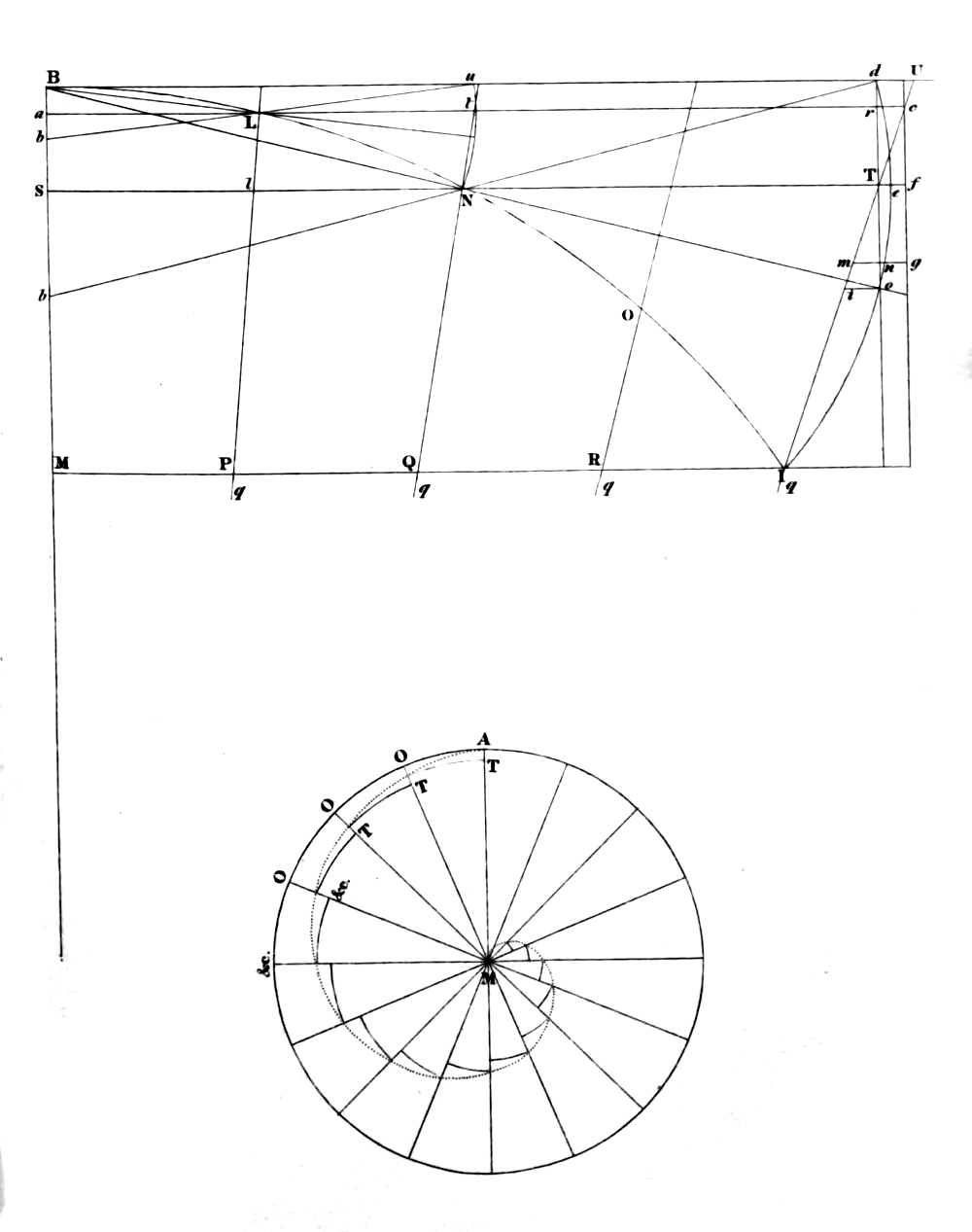
Six Lessons. Vol. VII. Eng. p.310_II. 325
My first article hath this title, “from a false supposition, a false quadrature of the circle.” Seeing therefore you were resolved to show where I erred, you should have proved either that the supposition was true, and the conclusion falsely inferred, or contrarily, that though the supposition be false, yet the conclusion is true; for else you object nothing to my geometry, but only to my judgment, in thinking fit to publish it; which nevertheless you cannot justly do, seeing it was likely to give occasion to ingenious men (the practice of it being so accurate to sense) to inquire wherein the fallacy did consist. And for the problem as it was first printed, but never published, and consequently ought to have passed for a private paper stolen out of my study, your public objecting against it (in the opinion of all men that have conversed so much with honest company as to know what belongs to civil conversation), was sufficiently barbarous in divines. And seeing you knew I had rejected that proposition, it was but a poor ambition to take wing as you thought to do, like beetles from my egestions. But let that be as it will, you will think strange now I should resume, and make good, at least against your objection, that very same proposition. So much of the figure as is needful you will find noted with the 328same letters, and placed at the end of this fifth lesson. Wherein let B I, be an arch not greater than the radius of the circle, and divided into four equal parts, in L, N, O. Draw S N, the sine of the arch B N, and produce it to T, so as S T be double to S N, that is, equal to the chord B I. Draw likewise a L, the sine of the arch B L, and produce it to c, so as a c be quadruple to a L, that is, equal to the two chords B N, N I. Upon the centre N with the radius N I, draw the arch I d, cutting B U the tangent in d. Then will B N produced cut the arch I d, in the midst at o. In the line B S produced take S b, equal to B S; then draw and produce b N, and it will fall on the point d. And B d, S T, will be equal; and d T joined and produced will fall upon o, the midst of the arch I d. Join I T, and produce it to the tangent B U in U. I say, that the straight line I T U shall pass through c. For seeing B S, S b, are equal, and the angle at S a right angle, the straight lines B N, and b N, are also equal, and the triangles B N b, d N o like and equal; and the lines d T, T o equal. Draw o i parallel to d U, cutting I U in i; and the triangles d T U, o T i will also be like and equal. Produce S T to the arch d o I in e, and produce it further to f, so that the line e f be equal to T e; and then S f will be equal to a c. Therefore f c joined will be parallel to B S. In c f produced take f g equal to c f; and draw g m parallel to d U, cutting I U in m, and d o in n; and let the intersection of the two lines a c and d o be in r; which being done, the triangles m n T, r c T will be like and equal. Therefore m n and r c are equal; and consequently 329the straight line I m T U shall pass through c. Dividing therefore a c in the midst at t, and S N in the midst at l, and joining t N, L l, the lines L l, t N, and c T produced, will all meet in one and the same point of B S produced; suppose at q. Therefore the point q being given by the two known points T and I, the lines drawn from q through equal parts of the sine of the arch B I, (for example through the points P, Q, R, of the sine M I), shall cut off equal arches, as B L, L N, N O, O I. And this is enough to make good that problem, as to your objection.
The straight line therefore B U, for any thing you have said, is proved equal to the arch B I, and the division of any angle given into any proportion given, the quadrature of any sector, and the construction of any equilateral polygon is also given. And though in this also I should have erred, yet it cannot be denied but that I have used a more natural, a more geometrical, and a more perspicuous method in the search of this so difficult a problem, than you have done in your Arithmetica Infinitorum. For though it be true that the aggregate of all the mean proportionals between the radius, together with an infinitely little part of the same, and the radius wanting an infinitely little part of the same; and again, between the radius, together with two infinitely little parts, and the radius wanting two infinitely little parts, and so on eternally, will be equal to the quadrant (a thing which every mean geometrician knew before); yet it was absurd to think those means could be calculated in numbers by interpoling of a symbol; especially when you make that symbol to stand for 330a number neither true nor surd; as if there were a number that could neither be uttered in words, nor not be uttered in words. For what else is surd, but that which cannot be spoken?
To the fifth article, though your discourse be long, you object but two things. One is, that “Whereas the spiral of Archimedes is made of two motions, one straight, the other circular, both uniform, I taking the motion compounded of them both for one of those that are compounded, conclude falsely, that the generation of the spiral is like to the generation of the parabola.” What heed you use to take in your reprehensions, appears most manifestly in this objection. For I say in that demonstration of mine, that the velocity of the point A in describing the spiral increaseth continually in proportion to the times. For seeing it goes on uniformly in the semidiameter, it is impossible it should not pass into greater and greater circles, proportionally to the times, and consequently it must have a swifter and swifter motion circular, to be compounded with the uniform motion in every point of the radius as it turneth about. This objection therefore is nothing but an effect of a will, without cause, to contradict.
The other objection is, that “Granting all to be true hitherto, yet because it depends upon the finding of a straight line equal to a parabolical line in the eighteenth chapter, where I was deceived, I am also deceived here.” True. But because in the eighteenth chapter of this English edition I have found a straight line equal to the spiral line of Archimedes. I must here put you in mind that by these words in your objections to the 331fifth article at your number two, Quatenus verum est, etc., we have demonstrated prop. 10, 11, 13, Arithmetica Infinitorum; you make it appear that you thought your spiral (made of arches or circles) was the true spiral of Archimedes; which is fully as absurd as the quadrature of Joseph Scaliger, whose geometry you so much despise.
To the sixth article, which is a digression concerning the analytics of geometricians, you deny that the efficient cause of the construction ought to be contained in the demonstration. As if any problem could be known to be truly done, otherwise than by knowing first how, that is to say, by what efficient cause, and in what manner, it is to be done. Whatsoever is done without that knowledge, cannot be demonstrated to be done; as you see in your computation of the parabola, and paraboloeides, in your Arithmetica Infinitorum.
And whereas I said that the ends of all straight lines drawn from a straight line, and passing through one and the same point, if their parts be proportional, shall be in a straight line; is true and accurate; as also, if they begin in the circumference of a circle, they shall also be in the circumference of another circle. And so is this: if the proportion be duplicate, they shall be in a parabola. All this I say is true and accurately spoken. But this was no place for the demonstration of it. Others have done it. And I perceive by that you put in by parenthesis (“Intelligis credo inter duas peripherias concentricas”) that you understand not what I mean.
Hitherto reach your objections to my geometry: for the rest of your book, it containeth nothing 332but a collection of lies, wherewith you do what you can, to extenuate as vulgar, and disgrace as false, that which followeth, and to which you have made no special objection.
I shall therefore only add in this place concerning your Analytica per Potestates, that it is no art. For the rule, both in Mr. Ougthred, and in Des Cartes, is this: “When a problem or question is propounded, suppose the thing required done, and then using a fit ratiocination, put A or some other vowel for the magnitude sought.” How is a man the better for this rule without another rule, how to know when the ratiocination is fit? There may therefore be in this kind of analysis more or less natural prudence, according as the analyst is more or less wise, or as one man in choosing of the unknown quantity with which he will begin, or in choosing the way of the consequences which he will draw from the hypothesis, may have better luck than another. But this is nothing to art. A man may sometimes spend a whole day in deriving of consequences in vain, and perhaps another time solve the same problem in a few minutes.
I shall also add, that symbols, though they shorten the writing, yet they do not make the reader understand it sooner than if it were written in words. For the conception of the lines and figures (without which a man learneth nothing) must proceed from words either spoken or thought upon. So that there is a double labour of the mind, one to reduce your symbols to words, which are also symbols, another to attend to the ideas which they signify. Besides, if you but consider how none of 333the ancients ever used any of them in their published demonstrations of geometry, nor in their books of arithmetic, more than for the roots and potestates themselves; and how bad success you have had yourself in the unskilful using of them, you will not, I think, for the future be so much in love with them as to demonstrate by them that first part you promise of your Opera Mathematica. In which, if you make not amends for that which you have already published, you will much disgrace those mathematicians you address your epistles to, or otherwise have commended; as also the Universities, as to this kind of learning, in the sight of learned men beyond sea. And thus having examined your pannier of Mathematics, and finding in it no knowledge, neither of quantity, nor of measure, nor of proportion, nor of time, nor of motion, nor of any thing, but only of certain characters, as if a hen had been scraping there; I take out my hand again, to put it into your other pannier of theology, and good manners. In the mean time I will trust the objections made by you the astronomer (wherein there is neither close reasoning, nor good style, nor sharpness of wit, to impose upon any man) to the discretion of all sorts of readers.
334
OF MANNERS.
TO THE SAME EGREGIOUS PROFESSORS OF THE MATHEMATICS IN
THE UNIVERSITY OF OXFORD.
LESSON VI.
Having in the precedent lessons maintained the truth of my geometry, and sufficiently made appear that your objections against it are but so many errors of your own, proceeding from misunderstanding of the propositions you have read in Euclid, and other masters of geometry; I leave it to your consideration to whom belong, according to your own sentence, the unhandsome attributes you so often give me upon supposition, that you yourselves are in the right, and I mistaken; and come now to purge myself of those greater accusations which concern my manners. It cannot be expected that there should be much science of any kind in a man that wanteth judgment; nor judgment in a man that knoweth not the manners due to a public disputation in writing; wherein the scope of either party ought to be no other than the examination and manifestation of the truth. For whatsoever is added of contumely, either directly or scommatically, is want of charity and uncivil, unless it be done by way of reddition from him that is first provoked to it. I say unless it be by way of reddition; for so was the judgment given by the emperor Vespasian in a quarrel between a senator and a knight of Rome which had given him ill language. For when the knight had proved that the first ill language proceeded from the senator, 335the emperor acquitted him in these words: “Maledici senatoribus non oportere; remaledicere, fas et civile esse.” Nevertheless, now-a-days, uncivil words are commonly and bitterly used by all that write in matter of controversy, especially in divinity, excepting now and then such writers as have been more than ordinarily well bred, and have observed how heinous and hazardous a thing such contumely is amongst some sorts of men, whether that which is said in disgrace be true or false. For evil words by all men of understanding are taken for a defiance, and a challenge to open war. But that you should have observed so much, who are yet in your mother’s belly, was not a thing to be much expected.
The faults in manners you lay to my charge are these: 1. Self-conceit. 2. That I will be very angry with all men that do not presently submit to my dictates. 3. That I had my doctrine concerning Vision, out of papers which I had in my hands of Mr. Warner’s. 4. That I have injured the universities. 5. That I am an enemy to religion. These are great faults; but such as I cannot yet confess. And therefore I must, as well as I can, seek out the grounds upon which you build your accusation. Which grounds (seeing you are not acquainted with my conversation) must be either in my published writings, or reported to you by honest men, and without suspicion of interest in reporting it. As for my self-conceit and ostentation, you shall find no such matter in my writings. That which you allege from thence is first, that in the epistle dedicatory I say of my book De Corpore, “though it be little, yet it is 336full; and if good may go for great, great enough.” When a man presenting a gift great or small to his betters, adorneth it the best he can to make it the more acceptable; he that thinks this to be ostentation and self-conceit, is little versed in the common actions of human life. And in the same epistle, where I say of civil philosophy: “It is no ancienter than my book De Cive;” these words are added: “I say it provoked, and that my detractors may see they lose their labour.” But that which is truly said, and upon provocation, is not boasting, but defence. A short sum of that book of mine, now publicly in French, done by a gentleman I never saw, carrieth the title of Ethics Demonstrated . The book itself translated into French, hath not only a great testimony from the translator Sorberius, but also from Gassendus, and Mersennus, who being both of the Roman religion had no cause to praise it, or the divines of England have no cause to find fault with it. Besides, you know that the doctrine therein contained is generally received by all but those of the clergy, who think their interest concerned in being made subordinate to the civil power; whose testimonies therefore are invalid. Why therefore, if I commend it also against them that dispraise it publicly, do you call it boasting? “You have heard,” you say, “that I had promised the quadrature of the circle, &c.” You heard then that which was not true. I have been asked sometimes, by such as saw the figure before me, what I was doing, and I was not afraid to say I was seeking for the solution of that problem; but not that I had done it. And afterwards being asked of the success, I have 337said, I thought it done. This is not boasting; and yet it was enough, when told again, to make a fool believe it was boasting. But you, the astronomer, in the epistle before your philosophical essay, say “You had a great expectation of my philosophical and mathematical works, before they were published.” It may be so. Is that my fault? Can a man raise a great expectation of himself by boasting? If he could, neither of you would be long before you raised it of yourselves; saving that what you have already published, has made it now too late. For I verily believe there was never seen worse reasoning than in that philosophical essay; which any judicious reader would believe proceeded from a prevaricator, rather than from a man that believed himself; nor worse principles, than those in your books of Geometry. The expectation of that which should be written by me, was raised partly by the Cogitata Physica-Mathematica of Mersennus, wherein I am often named with honour; and partly by others with whom I then conversed in Paris, without any ostentation. That no man has a great expectation of any thing that shall proceed from either of you two, I am content to let it be your praise.
Another argument of my self-conceit, you take from my contempt of the writers of metaphysics and school-divinity. If that be a sign of self-conceit, I must confess I am guilty; and if your geometry had then been published, I had contemned that as much. But yet I cannot see the consequence (unless you lend me your better logic) from despising insignificant and absurd language, to self-conceit.
338And again, in your Vindiciæ Academiarum, you put for boasting, that in my Leviathan , page 331, I would have that book by entire sovereignty imposed upon the Universities; and in my Review , p. 713, that I say of my Leviathan , “I think it may be profitably printed, and more profitably taught in the University.” The cause of my writing that book, was the consideration of what the ministers before, and in the beginning of, the civil war, by their preaching and writing did contribute thereunto. Which I saw not only to tend to the abatement of the then civil power, but also to the gaining of as much thereof as they could (as did afterwards more plainly appear) unto themselves. I saw also that those ministers, and many other gentlemen who were of their opinion, brought their doctrines against the civil power from their studies in the Universities. Seeing therefore that so much as could be contributed to the peace of our country, and the settlement of sovereign power without any army, must proceed from teaching; I had reason to wish, that civil doctrine were truly taught in the Universities. And if I had not thought that mine was such, I had never written it. And having written it, if I had not recommended it to such as had the power to cause it to be taught, I had written it to no purpose. To me therefore that never did write anything in philosophy to show my wit, but, as I thought at least, to benefit some part or other of mankind, it was very necessary to commend my doctrine to such men as should have the power and right to regulate the Universities. I say my doctrine; I say not my Leviathan . For wiser men may so digest the same 339doctrine as to fit it better for a public teaching. But as it is, I believe it hath framed the minds of a thousand gentlemen to a conscientious obedience to present government, which otherwise would have wavered in that point. This therefore was no vaunting, but a necessary part of the business I took in hand. You ought also to have considered, that this was said in the close of that part of my book which concerneth policy merely civil. Which part, if you, the astronomer, that now think the doctrine unworthy to be taught, were pleased once to honour with praises printed before it, you are not very constant nor ingenuous. But whether you did so or not, I am not certain, though it was told me for certain. If it were not you, it was somebody else whose judgment has as much weight at least as yours.
And for anything you have to say from your own knowledge, I remember not that I ever saw either of your faces. Yet you, the professor of geometry, go about obliquely to make me believe that Vindex hath discoursed with me, once at least, though I remember it not. I suppose it therefore true; but this I am sure is false, that either he or any man living did ever hear me brag of my science, or praise myself, but when my defence required it. Perhaps some of our philosophers that were at Paris at the same time, and acquainted with the same learned men that I was acquainted with, might take for bragging the maintaining of my opinions, and the not yielding to the reasons alledged against them. If that be ostentation, they tell you the truth. But you that are so wise should have considered, that even such men as 340profess philosophy are carried away with the passions of emulation and envy (the sole ground of this your accusation) as well as other men, and instanced in yourselves. And this is sufficient to shake off your aspersions of ostentation and self-conceit. For if I added, that my acquaintance know that I am naturally of modest rather than of boasting speech, you will not believe it; because you distinguish not between that which is said upon provocation, and that which is said without provocation, from vain glory.
The next accusation is: “That I will be very angry with all men that do not presently submit to my dictates; and that for advancing the reputation of my own skill, I care not what unworthy reflections I cast on others.” This is in the epistle placed before the Vindiciæ Academiarum, subscribed by N S, as the plain song for H D in the rest of the book to descant upon. I know well enough the authors’ names; and am sorry that N S has lent his name to be abused to so ill a purpose. But how does this appear? What argument, what witness is there of it? You offer none; nor am I conscious of any. I begin to suspect since you, the professor of geometry, have in your objections to the twentieth chapter these words concerning “Vindex, ocularis ille testis de quo hic agitur, erat, ni fallor, ille ipse,”--that Vindex himself, in other company, has bestowed a visit on me. Seeing you will have me believe it, let it be so; and, as it is likely, not long after my return into England. At which time (for the reputation, it seems, I had gotten by my boasting) divers persons that professed to love philosophy 341and mathematics, came to see me; and some of them to let me see them, and hear and applaud what they applauded in themselves. I see now it hath happened to me with Vindex, as it happened to Dr. Harvey with Moranus. Moranus, a jesuit, came out of Flanders hither, especially, as he says, to see what learned men in divinity, ethics, physics, and geometry, were here yet alive, to the end that by discoursing with them in these sciences, he might correct either his own, or their errors. Amongst others he was brought, he says, to that most civil and renowned old man Dr. Harvey. That is very well. And in good earnest if he had made good use of the time which was very patiently afforded him, he might have learned of him (or of no man living) very much knowledge concerning the circulation of the blood, the generation of living creatures, and many other difficult points of natural philosophy. And if he had had anything in him but common and childish learning, he could have showed it nowhere more to his advantage, than before him that was so great a judge of such matters. But what did he? That precious time (which was but little, because he was to depart again presently for Flanders) he bestowed wholly in venting his own childish opinions, not suffering the Doctor scarce to speak; losing thereby the benefit he came for, and discovering that he came not to hear what others could say, but to show to others how learned he was himself already. Why else did he take so little time, and so misspendmisspend it? Or why returned he not again? But when he had talked away his time, and found (though patiently and civilly heard) he was not much admired, he 342took occasion, writing against me, to be revenged of Dr. Harvey, by slighting his learning publicly; and tells me that his learning was only experiments; which he says I say have no more certainty than civil histories. Which is false. My words are: “Ante hos nihil certi in physica erat præter experimenta cuique sua, et historias naturales, si tamen et hæ dicendæ certæ sint, quæ civilibus historiis certiores non sunt.” Where I except expressly from uncertainty the experiments that every man maketh to himself. But you see the near cut, by which vain glory joined with ignorance passeth quickly over to envy and contumely.
Thus it seems by your own confession I was used by Vindex. He comes with some of my acquaintance in a visit. What he said I know not, but if he discoursed then, as in his philosophical essay he writeth, I will be bold to say of myself, I was so far from morosity, or, to use his phrase, from being tetrical, as I may very well have a good opinion of my own patience. And if there passed between us the discourse you mention in your Elenchus, page 116, it was an incivility in him so great, that without great civility I could not have abstained from bidding him be gone. That which passed between us you say was this: “I complained that whereas I made sense, nothing but a perception of motion in the organ, nevertheless, the philosophy schools through all Europe, led by the text of Aristotle, teach another doctrine, namely, that sensation is performed by species.” This is a little mistaken. For I do glory, not complain, that whereas all the Universities of Europe hold sensation to proceed from species, I 343hold it to be a perception of motion in the organ. The answer of Vindex, you say, was: “That the other hypothesis, whereby sense was explicated by the principles of motion, was commonly admitted here before my book came out, as having been sufficiently delivered by Des Cartes, Gassendus, and Sir Kenelm Digby, before I had published anything in this kind.” This then, it seems, was it that made me angry. Truly I remember not an angry word that ever I uttered in all my life to any man that came to see me, though some of them have troubled me with very impertinent discourse; and with those that argued with me, how impertinently soever, I always thought it more civility to be somewhat earnest in the defence of my opinion, than by obstinate and affected silence to let them see I contemned them, or hearkened not to what they said. If I were earnest in making good, that the manner of sensation by such motion as I had explicated in my Leviathan , is in none of the authors by him named, it was not anger, but a care of not offending him, with any sign of the contempt which his discourse deserved. But it was incivility in him to make use of a visit, which all men take for a profession of friendship, to tell me that that which I had already published for my own, was found before by Des Cartes, Gassendus, and Sir Kenelm Digby. But let any man read Des Cartes; he shall find, that he attributeth no motion at all to the object of sense, but an inclination to action, which inclination no man can imagine what it meaneth. And for Gassendus, and Sir Kenelm Digby, it is manifest by their writings, that their opinions are not different from 344that of Epicurus, which is very different from mine. Or if these two, or any of those I conversed with at Paris, had prevented me in publishing my own doctrine, yet since it was there known and declared for mine by Mersennus in the preface to his Ballistica (of which the three first leaves are employed wholly in the setting forth of my opinion concerning sense, and the rest of the faculties of the soul) they ought not therefore to be said to have found it out before me. And consequently this answer which you say was given me by Vindex was nothing else but untruth and envy; and, because it was done by way of visit, incivility. But you have not alleged, nor can allege, any words of mine, from which can be drawn that I am so angry as you say I am with those that submit not to my dictates. Though the discipline of the University be never so good; yet certainly this behaviour of yours and his are no good arguments to make it thought so. But you the professor of geometry, that out of my words spoken against Vindex in my twentieth chapter, argue my angry humour, do just as well, as when (in your Arithmetica Infinitorum) from the continual increase of the excess of the row of squares above the third part of the aggregate of the greatest, you conclude they shall at last be equal to it. For though you knew that Vindex had given me first the worst words that possibly can be given, yet you would have that return of mine to be a demonstration of an angry humour; not then knowing what I told you even now in the beginning of this lesson, of the sentence given by Vespasian. But to this point I shall speak again hereafter.
345Your third accusation is: “That I had my doctrine of vision, which I pretended to be my own, out of papers which I had a long time in my hands of Mr. Warner’s.” I never had sight of Mr. Warner’s papers in all my life, but that of Vision by Refraction (which by his approbation I carried with me to Park, and caused it to be printed under his own name, at the end of Mersennus his Cogitata Physico-Mathematica, which you may have there seen, and another treatise of the proportions of alloy in gold and silver coin; which is nothing to the present purpose)purpose). In all my conversation with him, I never heard him speak of anything he had written, or was writing, De penicillo optico. And it was from me that he first heard it mentioned that light and colour were but fancy. Which he embraced presently as a truth, and told me it would remove a rub he was then come to in the discovery of the place of the image. If after my going hence he made any use of it (though he had it from me, and not I from him), it was well done. But wheresoever you find my principles, make use of them, if you can, to demonstrate all the symptoms of vision; and I will do (or rather have done and mean to publish) the same; and let it be judged by that, whether those principles be of mine, or other men’s invention. I give you time enough, and this advantage besides, that much of my optics hath been privately read by others. For I never refused to lend my papers to my friends, as knowing it to be a thing of no prejudice to the advancement of philosophy, though it be, as I have found it since, some prejudice to the advancement of my own reputation in those 346sciences; which reputation I have always postposed to the common benefit of the studious.
You say further (you the geometrician) that I had the proposition of the spiral line equal to a parabolical line from Mr. Robervall: true. And if I had remembered it, I would have taken also his demonstration; though if I had published his, I would have suppressed mine. I was comparing in my thoughts those two lines, spiral and parabolical, by the motions wherewith they were described; and considering those motions as uniform, and the lines from the centre to the circumference, not to be little parallelograms, but little sectors, I saw that to compound the true motion of that point which described the spiral, I must have one line equal to half the perimeter, the other equal to half the diameter. But of all this I had not one word written. But being with Mersennus and Mr. Robervall in the cloister of the convent, I drew a figure on the wall, and Mr. Robervall perceiving the deduction I made, told me that since the motions which make the parabolical line, are one uniform, the other accelerated, the motions that make the spiral must be so also; which I presently acknowledged; and he the next day, from this very method, brought to Mersennus the demonstration of their equality. And this is the story mentioned by Mersennus, prop. 25, corol. 2, of his Hydraulica; which I know not who hath most magnanimously interpreted to you in my disgrace.
The fourth accusation is: “That I have injured the Universities.” Wherein? First, “In that I would have the doctrine of my Leviathan by entire 347sovereignty be imposed on them.” You often upbraid me with thinking well of my own doctrine; and grant by consequence, that I thought this doctrine good; I desired not therefore that anything should be imposed upon them, but what (at least in my opinion) was good both for the Commonwealth and them. Nay more, I would have the state make use of them to uphold the civil power, as the Pope did to uphold the ecclesiastical. Is it not absurdly done to call this an injury? But to question, you will say, whether the civil doctrine there taught be such as it ought to be, or not, is a disgrace to the Universities. If that be certain, it is certain also that those sermons and books, which have been preached and published, both against the former and the present government, directly or obliquely, were not made by such ministers and others as had their breeding in the Universities; though all men know the contrary. But the doctrine which I would have to be taught there, what is it? It is this: “That all men that live in a Commonwealth, and receive protection of their lives and fortunes from the supreme governor thereof, are reciprocally bound, as far as they are able, and shall be required, to protect that governor.” Is it, think you, an unreasonable thing to impose the teaching of such doctrine upon the Universities? Or will you say they taught it before, when you know that so many men which came from the Universities to preach to the people, and so many others that were not ministers, did stir the people up to resist the then supreme civil power? And was it not truly therefore said, that the Universities receiving their discipline from the 348authority of the pope, were the shops and operatories of the clergy? Though the competition of the papal and civil power be taken now away, yet the competition between the ecclesiastical and the civil power hath manifestly enough appeared very lately. But neither is this an upbraiding of an University (which is a corporation or body artificial), but of particular men, that desire to uphold the authority of a Church, as of a distinct thing from the Commonwealth. How would you have exclaimed, if, instead of recommending my Leviathan to be taught in the Universities, I had recommended the erecting of a new and lay-university, wherein lay-men should have the reading of physics, mathematics, moral philosophy, and politics, as the clergy have now the sole teaching of divinity? Yet the thing would be profitable, and tend much to the polishing of man’s nature, without much public charge. There will need but one house, and the endowment of a few professions. And to make some learn the better, it would do very well that none should come thither sent by their parents, as to a trade to get their living by, but that it should be a place for such ingenuous men, as being free to dispose of their own time, love truth for itself. In the mean time divinity may go on in Oxford and Cambridge to furnish the pulpit with men to cry down the civil power, if they continue to do as they did. If I had, I say, made such a motion in my Leviathan , though it would have offended the divines, yet it had been no injury. But it is an injury, you will say, to deny in general the utility of the ancient schools, and to deny that we have received from them our 349geometry. True, if I had not spoken distinctly of the schools of philosophy, and said expressly, that the geometricians passed not then under the name of philosophers; and that in the school of Plato (the best of the ancient philosophers) none were received that were not already in some measure geometricians. Euclid taught geometry; but I never heard of a sect of philosophers called Euclidians, or Alexandrians, or ranged with any of the other sects, as Peripatetics, Stoics, Academics, Epicureans, Pyrrhonians, &c. But what is this to the Universities of Christendom? Or why are we beholden for geometry to our universities, more than to Gresham College, or to private men in London, Paris, and other places, which never taught or learned it in a public school? For even those men that living in our Universities have most advanced the mathematics, attained their knowledge by other means than that of public lectures, where few auditors, and those of unequal proficiency, cannot make benefit by one and the same lesson. And the true use of public professors, especially in the mathematics, being to resolve the doubts, and problems, as far as they can, of such as come unto them with desire to be informed.
That the Universities now are not regulated by the Pope, but by the civil power, is true, and well. But where say I the contrary? And thus much for the first injury.
Another, you say, is this, that in my Leviathan , p. 670, I say: “The principal schools were ordained for the three professions of Roman religion, Roman law, and the art of medicine.” Thirdly, that I say: “Philosophy had no otherwise place 350there than as a hand-maid to Roman religion.” Fourthly: “Since the authority of Aristotle was received there, that study is not properly philosophy, but Aristotelity.” Fifthly: “That for geometry, till of late times it had no place there at all.” As for the second, it is too evident to be denied; the fellowships having been all ordained for those professions; and (saving the change of religion) being so yet. Nor hath this any reflection upon the Universities, either as they now are, or as they then were, seeing it was not in their own power to endow themselves, or to receive other laws and discipline than their founder and the state was pleased to ordain. For the third, it is also evident. For all men know that none but the Roman religion had any stipend or preferment in any university, where that religion was established? No, nor for a great while, in their commonwealths; but were everywhere persecuted as heretics. But you will say, the words of my Leviathan are not, philosophy “had no place,” but “hath no place.” Are you not ashamed to lay to my charge a mistake of the word hath for had? which was either a mistake of the printer, or if it were so in the copy, it could be no other than the mistake of a letter in the writing, unless you think you can make men believe that after fifty years being acquainted with what was publicly professed and practised in Oxford and Cambridge, I knew not what religion they were of. This taking of advantage from the mistake of a word, or of a letter, I find also in the Elenchus, where for prætendit se scire, there is prætendit scire, which you the geometrician sufficiently mumble, mistaking it I 351think for an anglicism, not for a fault of the impression.
To the fourth, you pretend, that men are not now so tied to Aristotle as not to enjoy a liberty of philosophising, though it were otherwise when I was conversant in Magdalen Hall. Was it so then? Then am I absolved, unless you can show some public act of the university made since that time to alter it. For it is not enough to name some few particular ingenuous men that usurp that liberty in their private discourses, or, with connivance, in their public disputations. And your doctrine, that even here you avow, of abstracted essences, immaterial substances, and of nunc-stans; and your improper language in using the word (not as mine, for I have it nowhere) successive eternity; as also your doctrine of condensation, and your arguing from natural reason the incomprehensible mysteries of religion, and your malicious writing, are very shrewd signs that you yourselves are none of those which you say do freely philosophise; but that both your philosophy and your language are under the servitude, not of the Roman religion, but of the ambition of some other doctors, that seek, as the Roman clergy did, to draw all human learning to the upholding of their power ecclesiastical. Hitherto therefore there is no injury done to the universities. For the fifth, you grant it, namely, “that till of late there was no allowance for the teaching of geometry.” But lest you should be thought to grant me anything, you say, you the astronomer, “geometry hath now so much place in the universities, that when Mr. Hobbes shall have published his philosophical and 352geometrical pieces, you assure yourself you shall be able to find a greater number in the university who will understand as much, or more, of them than he desired they should,” &c. But though this be true of the now, yet it maketh nothing against my then. I know well enough that Sir Henry Savile’s lectures were founded and endowed since. Did I deny then that there were in Oxford many good geometricians? But I deny now, that either of you is of the number. For my philosophical and geometrical pieces are published, and you have understood only so much in them, as all men will easily see by your objections to them, and by your own published geometry, that neither of you understand anything either in philosophy or in geometry. And yet you would have those books of yours to stand for an argument, and to be an index of the philosophy and geometry to be found in the universities. Which is a greater injury and disgrace to them, than any words of mine, though interpreted by yourselves.