THE PROPORTION OF A STRAIGHT LINE TO HALF THE ARC OF A QUADRANT.
Reading edition
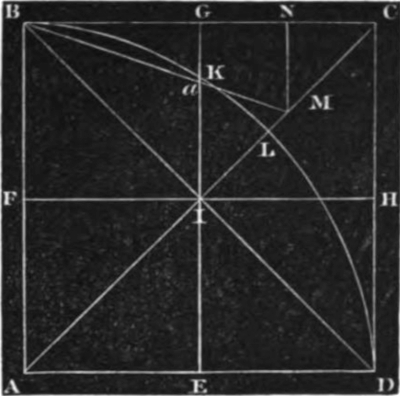
Describe the square A B C D, and divide it by the diagonals A C and B D, as also by the straight lines E G, F H, meeting in the centre I at right angles, into four equal parts. Then with the radius A B describe the quadrant B D cutting E G in K, and the diagonal A C in L; and so B L will be half the arc B D, equal to which we are to find a straight line. Divide I C into halves at M, and draw B M cutting E G in a. I say B M is equal to the arc B L. For the demonstration whereof we are to assume certain known truths and dictates of common-sense.
1. That the arc B K is the third part of the arc B D, and consequently two-thirds of the arc B L, and B K to K L as two to one.
2. That if a straight line be equal to the arc B L, and one end in B, the other will be somewhere in I C, and higher than the point L.
3. That wheresoever it be, two-thirds of it must 181be equal to the arc B K, and one-fifth to the arc K L.
4. That the arc of a quadrant described in the third part of the radius, or of E G, is equal to the third part of the arc B D, viz. to the arc B K. I may therefore call a third part of E G, the radius of B K; and a sixth part of E G, the radius of the arc K L, &c.
5. And lastly, that any straight line drawn from B to I C, if it be equal to the arc B L, it must cut the half radius I G, whose quadrantal arc is B L, into the proportion of two to one. For as the whole arc to the whole E G, so are the parts of it to the parts of E G.
These premises granted, which I think cannot be denied, I say again, that the straight line B M is equal to the arc B L.
DEMONSTRATION.
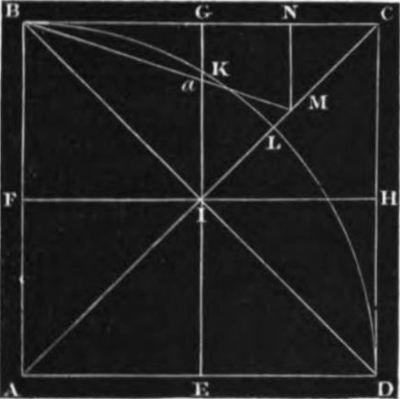
Because B I is to I M, by construction, as two to one, and the line I G divides the angle B I C in the midst, B a will be to a M as two to one, that is to say, as the arc B K to the arc K L. From the point M to the side B C erect a perpendicular M N. And because C M is half C I, the line M N will be half G C; and B N will be three-quarters of B C; and the square of B M equal to ten squares of a quarter of B C; and because B M is to B a as three to two, M N will be to a G as three to two. But M N is a quarter of E G, therefore a G is two-thirds of a quarter of E G; that is, one-third of I G; that is, one-sixth of the whole E G. And I a one-third of E G. Therefore I a is the radius of the arc B K; and a G the radius of the arc 182K L; and E G the radius of the whole arc B L D. Lastly, if a straight line be drawn from B to any other point of the line I C, though any line may be divided into the proportion of two to one, it shall not pass through the point a, and therefore not divide the radius of B L, which is I G, into the proportion of two to one. Therefore no straight line can be drawn from B to I C, except B M, so as to be equal to the arc B L. Therefore the straight line B M and the arc B L are equal.
Hence it follows, that seeing the square of B M is equal to ten squares of a quarter of B C, that a straight line equal to the quadrantal arc B L D is equal to ten squares of half the radius, as I have divers ways demonstrated heretofore.
183