LETTERS AND OTHER PIECES.
Reading edition
453LETTERS AND OTHER PIECES.
I. A LETTER FROM MR. HOBBS TO MY MR.[2]
Honorable Sir,
Though I may goe whither and when I will for anie necessity you have of my service, yet there is a necessity of good manners that obliges me as yor servant to lett you knowe att all times where to find me. Wee goe out of Paris 3 weekes hence, or sooner, towards Venice, but by what way I knowe not, because the ordinary high way through the territory of Milan is encumbered with the warre betweene the French and the Spaniards. Howsoever, wee have to be there in October next. If you require anie service that I can doe there, it may please you to convey your command by Devonshire house. But if you command me nothing, I have forbidden my letters to look for answer: their busines being only to informe and to lett you knowe that the image of your noblenes decayes not in my memory, but abides fresh to keepe me eternally
Your
Tho. Hobbs.
454
II. TO A FRIEND IN ENGLAND.
Worthy Sir,
I have been behind hand with you a long time for a letter I received of yours at Angers, that place affording nothing wherewith to pay a debt of that kind, all matter of news being sooner known in England than here: and the news you writ me was of that kind, that none from England could be more welcome, because it concerned the honour of Welbeck and Clifton, two houses in which I am very much obliged.
Monsieur having given the slip to the Spaniards at Bruxelles, came to the King about ten days ago at St. Germains, where he was received with great joy. The next day the Cardinal entertained him at Ruelle: and the day after that he went to Limours, where he is now, and from thence he goes away shortly to Bloys, to stay there this winter. The Cardinal of Lyons is going to Rome to treat about the annulling of Monsieur’s marriage, which is here by Parliament declared void, but yet they require the sentence of the Pope. There goes somebody thither on the part of his wife, to get the marriage approved: but who that is, I ’know not. The Swedish party in Germany is in low estate, but the French prepare a great army for those parts, pretending to defend the places which the Swedes have put into the King of France his protection, whereof Philipsbourgh is one; a place of importance for the Lower Palatinate. This is all the French news.
For your question, why a man remembers less 455his own face, which he sees often in a glass, than the face of a friend that he has not seen of a great time, my opinion in general is, that a man remembers best those faces whereof he has had the greatest impressions, and that the impressions are the greater for the oftener seeing them, and the longer staying upon the sight of them. Now you know men look upon their own faces but for short fits, but upon their friends’ faces long time together, whilst they discourse or converse together; so that a man may receive a greater impression from his friend’s face in a day, than from his own in a year; and according to this impression, the image will be fresher in his mind. Besides, the sight of one’s friend’s face two hours together, is of greater force to imprint the image of it, than the same quantity of time by intermissions. For the intermissions do easily deface that which is but lightly imprinted. In general, I think that lasteth longer in the memory which hath been stronglier received by the sense.
This is my opinion of the question you propounded in your letter. Other new truths I have none, at least they appear not new to me. Therefore if this resolution of your first question seems probable, you may propound another, wherein I will endeavour to satisfy you, as also in any thing of any other nature you shall command me, to my utmost power; taking it for an honour to be esteemed by you, as I am in effect,
Your humble and faithful servant
Tho. Hobbes.
Paris, Oct. 21/31, 1634.
My Lord Fielding and his Lady came to Paris on Saturday night last.
456
III. TO MY WORTHY FRIEND MR. GLEN.[3]
Worthy Sir,
I received here in Florence, two days since, a letter from you of the 19th of January. It was long by the way; but when it came it did thoroughly recompence that delay. For it was worth all the pacquets I had received a great while together. All that passeth in these parts is equally news, and therefore no news; else I would labour to requite your letter in that point, though in the handsome setting down of it, I should still be your inferior.
I long infinitely to see those books of the Sabbaoth[4], and am of your mind they will put such thoughts into the heads of vulgar people, as will confer little to their good life. For when they see one of the ten commandments to be jus humanum merely, (as it must be if the Church can alter it), they will hope also that the other nine may be so too. For every man hitherto did believe that the ten commandments were the moral, that is, the eternal law.
I desire also to see Selden’s Mare Clausum, having already a great opinion of it.
You may perhaps, by some that go to Paris, send me those of the Sabbaoth, for the other being in Latin, I doubt not to find it in the Rue St. Jaques.
457We are now come hither from Rome, and hope to be in Paris by the end of June. I thank you for your letter, and desire you to believe that I can never grow strange to one, the goodness of whose acquaintance I have found by so much experience. But I have to write to so many, that I write to you seldomer than I desire; which I pray pardon, and esteem me
Your most affectionate friend
and humble servant
Tho. Hobbes.
Florence, Apr. 6 16 1636.
My Lord and Mr. Nicholls, and all our company commend them to you.
IV. LETTER TO SIR CHARLES CAVENDISH.[5]
Honorable Sir,
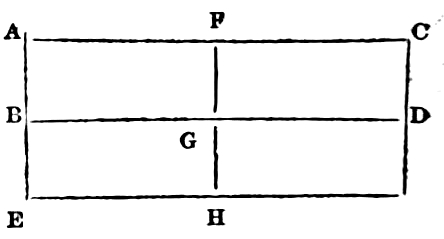
The last weeke I had the honor to receave two letters from you at once, one of the 30 of Dec., the other of the 7th of Jan., wch I acknowledged, but could not answer in my last. In the first you begin with a difficulty on the principle of Monsr de Cartes, that it is all one to move a weight two spaces, or the double of that waight one space, and so on in other proportions: to wch you object the difference of swiftnesse, wch is greater when a waight is moved two spaces thanthan when double waight is moved one space. Certenly de Cartes his meaning was by force the same that mine, 458namely, a multiplication of the weight of a body in to the swiftnesse wherewth it is moved. So that when I move a pound two foote atat the rate of a mile an howre, I do the same as if of 2 poundes I moved one pound a foote at ye rate of a mile an howrehowre, the other pound another foote at the same rate, not in directū, but parallell to the first pound. As if the wayt A B were moved to C D at the rate of a mile an howre, ’tis all one as if the waight A E were moved to F H at the same rate. Here is all the difference: this swiftnesse or rate of a mile an howre is, in the first case, layd out in the 2 spaces A G, G C, the latter, in the 2 spaces A G, E G. The first case, as like as if a footman should run wth double swiftnesse endwayes, wch is ye doubling of swiftnesse in one man: in the other, it is as if you doubled the swiftnesse by doubling the man: for every man has his owne swiftnesse. And so A H is the swiftnesse A G doubled, as well as A D. For that, that Monsr de Cartes will not have just twice the force requisite to move the same weight twice as fast, I can say nothing. The papers I have of his touching that are in my trunk, wch hath bene taken by Dunkerkers, and taken againe from them by French, and at length recovered by frends I made: but I shall not have it yet this fortnight. In the meane time I am not in that opinion, but do assure myself, the patient being the same, double force in the agent shall worke upon it double effect.
In the same letter you require a better explication of ye proportion I gather betweene wayght 459and swiftnesse: wherein, because you have not my figure, I imagine you have mistaken me very much. And first, you thinke, I suppose, D E equall to A B: wch I am sure is a mistake. For I put A B for any line you will to expresse a minutū secundum. I will, therefore, go over againe the demonstration I sent you before, and see if I can do it cleerer.
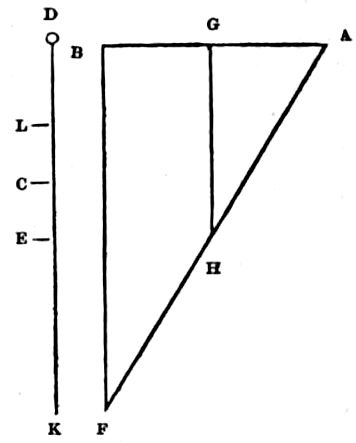
Let A B stand for the time knowne wherein the waight D descendeth to E. And let there bee a cylinder of the same matter the waight D consisteth of, and let the altitude of that cylinder be D C: wch I shew before was the swiftnesse wherewth that cylinder presseth, not wherewth it falleth. And wee are now to enquire how farre such matter as the cylinder is made of must descend from D, before it attayne a swiftnesse equall to this pressing swiftnesse D C. And I say it must fall to L. For in the time A B it is knowne that the waight in D will fall to E: and it is demonstrated by Gallileo, that when such waight comes to E, it shall be able to go twice the space it hath fallen in the same time. Therefore the waight D being in E, hath velocity to carry him the space D K (wch I put double to D E) in the same time A B. But I put B F equall to D K. Therefore, in the time A B, the waight’s velocity acquired in E shall be such as to go from B to F without decrease of velocity by the way. Hence I go on to finde in what point the waight in D comes to where it getteth a velocity equall to 460C D. Therefore, I apply D C to G H, parallel to B F: and then it is, as the time A B to the time A G, so the velocity acquired at the end of the time A B to the velocity acquired at the end of the time A G. For the swiftnesse acquired from time to time (I say, not from place to place, but from time to time) are proportionable to the times wherein they are acquired: wch is the postulate on wch Galileo builds all his doctrine. And as A B to A G, so the line B F to the line G H. But, at the end of the time A B, the waight D is by supposition in E, in that degree of velocity as to go B F or D K in the same time A B. The question therefore is, where the waight D shall be at the end of the time A G. For there it hath the velocity of going G H or D C in the same time, because the velocity G H is to the velocity B F as the line G H to the line B F, or as the time of descent A G to the time A B. But, because the spaces of the descent are in double the proportion of the times of descent, make it as B F to G H, that is, D K to D C, so D C to another, D L. The velocity, therefore, acquired in the point of descent E, namely the velocity D K or B F, is to the velocity acquired in the point L, namely, the velocity G H or D C, (wch is the velocity of the cylinder’s waight), as D K to D L. And therefore in L the waight D has acquired a velocity equal to the velocity of the waight of the cylinder.
In the same letter you desire to knowe, how any mediū, as water, retardeth the motion of a stone that falls into it. To wch I answer out of that you say afterwards, that nothing can hinder motion but contrary motion: that the motion of the water, 461when a stone falls into it, is point blanke contrary to the motion of the stone. For the stone by descent causeth so much water to ascend as the bignesse of the stone comes to. For imagine so much water taken out of the place wch the stone occupies, and layd upon the superficies of the water: it presseth downeward as the stone does, and maketh the water that is below to rise upwards, and this rising upwards is contrary to the descent, and is no other operation than we see in scales, when of two equal bullets in magnitude that wch is of heavier metal maketh the other to rise. And thus farre goes your letter of Dec. 30.
For the first quære in your second letter, concerning how we see in the time the lucide body contracts itselfe, I have no other solution but that wch your selfe hath given: wch is, that the reciprocation is so quicke, that the effect of the first motion lasteth till the next comes, and longer. For by experience we observe that the end of a firebrand swiftely moved about in circle, maketh a circle of fire: wch could not be, if the impression made at the beginning of the circulation did not last till the end of it. For if the same firebrand be moved slower, there will appear but a peece of a circle, bigger or lesser according to the swiftnesse or slownesse of ye motion. For the cause of such reciprocation, it is hard to guess what it is. It may well be the reaction of the medium. For though the mediū yeld, yet it resisteth to: for there can be no passion wthout reaction. And if a man could make an hypothesis to salve that contraction of ye sun, yet such is the nature of naturall thinges, as a cause may be againe demanded of such hypothesis: and never should one come to an end wthout assigning 462the immediate hand of God. Whereas in mathematicall sciences wee come at last to a definition, wch is a beginning or principle, made true by pact and consent amongst ourselves. Further, you conceave a difficulty how the medium can be continually driven on, if there be such an alternate contraction. To wch, first I answer, that the motion forward is propagated to the utmost distance in an instant, and the first push is therefore enough, and in another instant is made the returne back in ye like manner. And though it were not done in an instant, yet we see by experience in rivers, as in ye Thames, that the tide goes upward towards London pushed by the water below, and yet at the same instant the water below is going backe to the sea. For seeing it is high-water at Blackwall before ’tis so at Greenwich, the water goes backe from Blackwall when it goes on at Greenwich. And so it would happen, though Blackwall and Greenwich were nerer together then that any quantity given could come betweene.
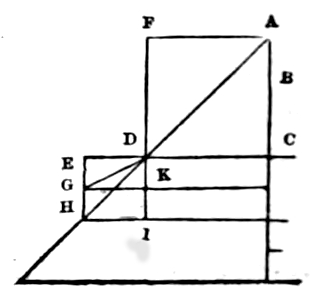
In my letter from London, speaking of the refraction of a bullet, I thinke I delivered my opinion to be, that a bullet falling out of a thinner medium into a thicker, looseth in the entring nothing but motion perpendicular: but being entred, he looseth proportionably both of one and the other. For suppose a bullet, whose diameter is A B, be in the thiner mediū, and enter at C into the thicker medium. The thicker medium, at the first touch of B in the point C, worketh nothing upon the line A B. And when the diameter A B is entred, suppose halfe way, 463yet the thicker medium operates laterally but on one halfe of it. So that in the somme there is a losse of velocity perpendicular (to the quantity that the diameter A B requires) without any offence to the motion laterall, but so much of the diameter as is within the thicker mediū is retarded both wayes, and looses of his absolute motion, wch is compounded of perpendicular and laterall, and that proportionally. Suppose now that a bullet passe from A to D, and receave a peculiar losse of his perpendicular motion by entring at D, so great that he proceed in the perpendicular but halfe so farre, as for example from D to I: and then being in, the thicknesse of the medium take away more of his velocity both perpendicular and laterall, suppose halfe that wch was left of the perpendicular motion and halfe of his first laterall motion, so that the perpendicular motion is but D K, and the laterall motion D E. Then will the line of refraction be D G. As for that argumentation of Des Cartes, it is, in my opinion, as I have heretofore endeavored to shew you, a mere paralogism.
Lastly, you make this quære, why light hath not at severall inclinations severall swiftnesses as well as a bullet. The bullet itself passeth through the severall media: whereas in the motion of light, the body moved, wch is the mediū, entreth not into the other medium, but thrusteth it on: and so the parts of that medium thrust on one another, whereby the laterall motion of the thicker medium hath nothing to worke upon, because nothing enters, but stoppes onely and retardes, in oblique incidence, that end wch comes first to it, and thereby causes a refraction the contrary way to 464that of a bullet, in such manner as I set forth to you in one of my letters from hence concerning the cause of refraction. And this is all I can say for the present to the quæres of yr two last letters.
I have enquired concerning perspectives after the manner of De Cartes. Mydorgius tells me there is none that goes about them, as a thing too hard to do. And I believe it. For here is one Monsr de Bosne in towne, that dwells at Bloys, an excellent workman, but by profession a lawier, and is counsellor of Bloys, and a better philosopher in my opinion then De Cartes, and not inferior to him in the analytiques. I have his acquaintance by Pere Mersenne. He tells me he hath tryed De Cartes his way, but cannot do it: and now he workes upon a crooked line of his owne invention. He sayes he shall have made one wthin a moneth after he shall returne to Bloys: after that he will see what he can discover in the heavens himselfe, and then if he discover any new thing he will let his way be publique together wth the effects. This is all the hope I can give you yet. So wth my prayers to God to keepe you in prosperity this troublesome time, I rest
Your most humble and obedient servant
Th. Hobbes.
Paris, Feb. 8, stile no. 1641.
To the Right Honorable
Sr Charles Cavendysshe
present these
at Wellinger.
465
V. LETTER TO MR. BEALE.[6]
Sir,
The young woman at Over-Haddon hath been visited by divers persons of this house. My Lord himself hunting the hare one day at the Town’s end, with other gentlemen and some of his servants, went to see her on purpose: and they all agree with the relation you say was made to yourself. They further say on their own knowledge, that part of her Belly touches her Back-bone. She began (as her Mother says) to loose her appetite in December last, and had lost it quite in March following: insomuch as that since that time she has not eaten nor drunk any thing at all, but only wetts her lips with a feather dipt in water. They were told also that her gutts (she alwayes keeps her bed) lye out by her at her fundament shrunken. Some of the neighbouring ministers visit her often: others that see her for curiosity give her mony, sixpence or a shilling, which she refuseth, and her mother taketh. But it does not appear they gain by it so much as to breed a suspition of a cheat. The woman is manifestly sick, and ’tis thought she cannot last much longer. Her talk (as the gentlewoman that went from this house told me) is most heavenly. To know the certainty, there bee many things necessary which cannot honestly be pryed into by a man. First, whether her gutts (as ’tis said) lye out. Secondly, whether any excrement 466pass that way, or none at all. For if it pass, though in small quantity, yet it argues food proportionable, which may, being little, bee given her secretly and pass through the shrunken intestine, which may easily be kept clean. Thirdly, whether no urine at all pass: for liquors also nourish as they go. I think it were somewhat inhumane to examin these things too nearly, when it so little concerneth the commonwealth: nor do I know of any law that authoriseth a Justice of peace, or other subject, to restrain the liberty of a sick person so farr as were needful for a discovery of this nature. I cannot therefore deliver any judgment in the case. The examining whether such a thing as this bee a miracle, belongs I think to the Church. Besides, I myself in a sickness have been without all manner of sustenance for more than six weeks together: which is enough to make mee think that six months would not have made it a miracle. Nor do I much wonder that a young woman of clear memory, hourely expecting death, should bee more devout then at other times. ’Twas my own case. That which I wonder at most, is how her piety without instruction should bee so eloquent as ’tis reported.
Tho. Hobbes.
Chatsworth, Oct. 20. 68.
467
VI. LETTER TO MR. OLDENBURG.[7]
Worthy Sr
In the last Transactions for September and October I find a letter addressed to you from Dr Wallis, in answer to my LUX MATHEMATICA. I pray you tell me that are my old acquaintance, whether it be (his words and characters supposed to be interpreted) intelligible. I know very well you understand sense both in Latine, Greeke, and many other languages. He shows you no ill consequence in any of my arguments. Whereas I say there is no proportion of infinite to finite. He answers, he meant indefinite; but derives not his conclusion from any other notion than simply infinite. I said the root of a square number cannot be the length of the side of a square figure, because a root is part of a square number, but length is no part of a square figure. To which he answers nothing. In like manner, he shuffles off all my other objections, though he know well enough that whatsoever he has written in Geometry (except what he has taken from me and others) dependeth on the truth of my objections. I perceive by many of his former writings that I have reformed him somewhat as to the Principles of Geometry, though he thanke me not. He shuffles and struggles in vaine, he has the hooke in his guills, I will give him line enough: for (which I pray you tell him) I will no more teach him by 468replying to any thing he shall hereafter write, whatsoever they shall say that are confident of his Geometry. Qui volunt decipi, decipiuntur. He tells you that I bring but crambe sæpe cocta. For which I have a just excuse, and all men do the same; they repeat the same words often when they talk with them that cannot heare.
I desire also this reasonable favour from you: that, if hereafter I shall send you any paper tending to the advancement of physiques or mathematiques, and not too long, you will cause it to be printed by him that is printer to the Society, as you have done often for Dr Wallis: it will save me some charges.
I am, Sr,
Your affectionate frend and humble seruant
Thomas Hobbes.
November the 26th, 1672.
ffor my worthy and much honoured
frend Mr Henry Oldenburgh,
Secretary to the Royal Society.
469
VII. TO THE RIGHT HONOURABLE THE MARQUIS OF NEWCASTLE.[8]
The passions of man’s mind, except onely one, may bee observed all in other living creatures. They have desires of all sorts, love, hatred, feare, hope, anger, pitie, æmulation, and ye like: onely of curiositie, which is ye desire to know ye causes of thinges, I never saw signe in any other living creature but in man. And where it is in man, I find alwaies a defalcation or abatement for it of another passion, which in beastes is commonly predominant, namely, a ravenous qualitie, which in man is called avarice. The desire of knowledge and desire of needlesse riches are incompatible, and destructive one of another. And therefore as in the cognitive faculties reason, so in the motive curiositie, are the markes that part ye bounds of man’s nature from that of beastes. Which makes mee, when I heare a man, upon the discovery of any new and ingenious knowledge or invention, aske gravely, that is to say, scornefully, what ’tis good for, meaning what monie it will bring in, (when he knows as little, to one that hath sufficient what that overplus of monie is good for), to esteeme that man not sufficiently removed bn 484.png 470from brutalitie. Which I thought fit to say by way of anticipation to ye grave scorners of philosophie, and that your lordship, after having performed so noble and honourable acts for defence of your countrie, may thinke it no dishonour in this unfortunate leasure to have employed some thoughts in the speculation of the noblest of the senses, vision.
That which I have written of it is grounded especially upon that wch about 16 yeares since I affirmed to your LoPP at Welbeck, that light is a fancy in the minde, caused by motion in the braine, which motion againe is caused by the motion of ye parts of such bodies as we call lucid: such as are the sunne and ye fixed stars, and such as here on earth is fire. By putting you in mind hereof, I doe indeed call you to witnesse of it: because, the same doctrine having since been published by another, I might bee challenged for building on another man’s ground. Yett philosophical ground I take to be of such a nature, that any man may build upon it that will, especially if the owner himselfe will nott. But upon this ground, with the helpe of some other speculations drawne from the nature of motion and action, I have, I thinke, derived ye reason of all the phænomena I have mett with concerning light and vision, both solidly enough nott to be confuted, and withall easilie enough to be understood by such as can give that attention thereto which the figures, whereby such motion as causeth vision is described, do require. All that I shall bee ever able to adde to it, is polishing: for, being the first draught, it could nott bee so perfect as I hope hereafter to make it in Latin. 471Butt as it is, it will sufficiently give your LoPP satisfaction in those quæres you were pleased to make concerning this subject. I am content that it passe, in respect of some drosse that yett cleaves to it, for ore: wch is much better than old ends raked out of the kennell of sophisters’ bookes. And for such I commend it to your Lop, and myselfe to your accustomed good opinion: which hath beene hitherto so greate honour to mee, as I am nott known to the world by any thing so much as by being,
My most noble lord,
Your Lop’s most humble
and most obliged servant
Tho. Hobbes.
The treatise ends with the following passage:--
To conclude, I shall doe like those that build a new house where an old one stood before, that is to say, carry away the rubbish.
And first, away goes the old opinion that the shewes (which they call visible species) of all objects, are in all places, and all the babble de extramittendo et intromittendo. For their species are nothing else but fancie, made by the light proceeding directly or by repurcussion or refraction 472made from the object to ye eye, and so moving the braine and other parts within.
Secondly, the opinion which Vitellio takes for an axiome and foundation of his Catoptricques, that ye place of ye image by reflexion is in the perpendicular drawn from the object to the glasse. For it is false both in plaine glasses and in sphæricall, whether convexe or concave.
Thirdly, the opinion that light is engendred faster in hard bodies, as glasse, than in thin and fluid, as aire.
Fourthly, that objects are seen by penicilli that have their common base in the pupills: for ye center of ye eye is in their common base.
Fifthly, the opinion that there bee other visuali lines by which wee see distinctly besides ye optique axis.
Sixthly, the opinion that perspective glasses and amplifying glasses are best made of hyperbolicall figures.
Seventhly, the opinion that light is a bodie, or any other such thing than such light as wee have in dreames.
Eighthly, that ye object appeares greater and lesse in ye same proportion that ye angles have under which they are seene.
Lastly, is to be cast away the conceipt of millions of strings in ye optique nerve, by which the object playes upon the braine, and makes ye soule listen unto it, and other innumerable such trash.
How doe I feare that ye attentive reader will find that which I have delivered concerning ye Optiques fitt to bee cast outt as rubbish among the rest. If hee doe, hee will recede from ye authoritie 473of experience, which confirmeth all I have said. Butt if it bee found true doctrine, (though yett it wanteth polishing), I shall deserve the reputation of having beene ye first to lay the grounds of two sciences; this of Optiques, ye most curious, and yt other of Natural Justice, which I have done in my booke DE CIVE, ye most profitable of all other.
VIII. TO THE KING’S MOST EXCELLENT MAJESTY THE HUMBLE PETITION OF THOMAS HOBBES[9]
Sheweth, that though your Majesty hath been pleased to take off the restraint of late years laid upon the pensions payable out of your privy purse, yet your Majesty’s Officers refuse to pay the pension of your petitioner without your Majesty’s express command.
And humbly beseaceth your Majesty, (considering his extreme age, perpetual infirmity, frequent and long sickness, and the aptness of his enemies to take any occasion to report that your petitioner by some ill behaviour hath forfeited your 474wonted favour), that you would be pleased to renew your order for the payment of it in such manner as to his great comfort he hath for many years enjoyed it.[10]
And daily prayeth to God Almighty to bless your Majesty with long life, constant health, and happinesse.
END OF VOL. VII.
RICHARDS, PRINTER, 100, ST. MARTIN’S LANE.
Transcriber’s Note
Some Greek passages employ the stigma ligature (‘st’). The available Unicode character (ϛ) is nearly indistinguishable from the final form of sigma (ς). Occasionally, the ‘ου’ ligature is employed. The only available character (ᴕ) is a Latin, not a Greek character. It is rendered here as ‘ου’. There were also a number of instances of improper placement of diacritical marks, particularly in cases where the breathing mark and accents appear on the first rather than the second of two leading vowels, e.g. ‘ὅυτως’ rather than ‘οὕτως’.
At 93.4, the response ‘No sure’ is obviously incorrect. It is most likely that it should have read ‘Not sure.’, but it may also have been an unfinished line.
Other errors deemed most likely to be the printer’s have been corrected, and are noted here. Given the age of the text, any corrections were made sparingly. The references are to the page and line in the original.
8.35 with increasing [s]wiftness? Restored.
12.34 being so very heavy[?] Added.
54.8 too much or too[l i/ li]ttle Replaced.
62. was to be demonst[r]ated. Inserted.
65.33 which is 72[.] Added.
67.1 and multip[l]ying lines Inserted.
72.5 and subtil doc[t]rines. Inserted.
74.1 who begi[u/n]s his history Inverted.
91.16 the space be[t]ween. Inserted.
91.18 whose tap[-]hole is very little Inserted.
96.5 and th[a/e]n H will be east Replaced.
114.27 a spring[ ]upon the top Inserted.
158.19 the air which[ which] was Redundant.
163.11 8 degrees 30 minutes[.]? Removed.
192.19 (called by him [ε/ἐ]φαρμόζοντα) Replaced.
200.5 may so precisely deter[ter]mine Removed.
206.1 lines whi[e/c]h shall never meet Replaced.
208.10 [ὅυ/οὕ]τως ἔχει Replaced.
208.13 [ὅυ/οὕ]τως ἔχει Replaced.
225.8 as by raref[r]action and condensation. Removed.
263.17 [“]The magnitude of an angle Added.
277.33 th[e/a]n of one in nine? Replaced.
297.26 At the seventee[n]th chapter Inserted.
300.22 that of G K to G [E,/E.]” Replaced.
323.7 tanquam dicta problematicè.[”] Added.
338.31 and so mis[s]pend it? Inserted.
351.16 by which you live[,/.] Replaced.
376.4 propositione præcedente.[”] Added.
376.22 it shall quite vanish. [And so] Missing?
342.12 to the present purpose[)]. Added (likely).
382.12 whether διπλάσιος and διπλασ[ι]ίων be one Removed.
391.5 by the word Σημ[~ε/εῖ]ον in Euclid Replaced.
412.17 κα[ι/ὶ] ἡ Ἔμπουσα Replaced.
413.26 τῶν θεῶν [Α/Ἀ]ιγύπτιοι Replaced.
413.27 κα[ἱ/ὶ] ἅτε Ἀιγύπτιος, Replaced.
413.30 ποδῶν [ὴ/ἠ]δέ κνημάων Replaced.
414.1 ῥᾳδίως[ ]ἔγνων ὑπολαμβάνοντες. Inserted.
414.4 ἀλλὰ κατὰ ῥύμην [ὰ/ἀ]έριον Replaced.
415.23 deriveth it [τ/π]αρὰ τὸ ἐμποδιζειν Replaced.
415.25 it saith, [Ἕ/Ἔ]μπουσα Ψιλοῦπαι Replaced.
415.33 some had no legs, &c[.] Added.
416.7 τύχη [ὲ/ἐ]μποδιζουσα Replaced.
416.16 [Ἕ/Ἔ]μποῦσα is also a name for Lamia Replaced.
418.16 [ὁι/οἱ] δὲ ὑπέφευγον Transposed.
418.20 καὶ τὸ [ὲ/ἐ]πιπηδᾶν Replaced.
419.13 γαρ [ὅι/οἵ]νου πληροῦντες, Replaced.
419.14.1 εἶχε τὸν [ὅι/οἵ]νου. Replaced.
419.14.2 [Α/Ἀ]σκωλιάζειν Replaced.
423.1 καὶ ζώων παντοδαπῶν [ἐι/εἰ]κόσι Replaced.
455.27 two spaces th[e/a]n when double Replaced.
456.3 a pound two foote a[t] the rate of Added.
456.6 rate of a mile an how[er/re] Transposed.