Chapter I
P. Le Page (Peter Le Page) Renouf translation
(1)The Beginning of the Chapters of Coming forth by Day, of the (2)Words which bring about Resurrection and Glory, and of Coming out of and entering into Amenta. Said upon the Day of Burial of N, the Victorious,(3) who entereth after coming forth.(4) Here is N the Victorious. He saith—
O (5)Bull of Amenta, It is Thoth, the everlasting King, who is here.
I am the great god in the Bark, who have fought for thee.
I am one of those gods, the (6)Powers who effect the triumph of Osiris over his adversaries on the day of the Weighing of the Words: I am thy kinsman, Osiris.
I am one of those gods to whom Nut hath given birth, who slay the adversaries of Osiris and imprison the (7)Sebau, on his behalf: I am thy kinsman, Horus.
I have fought for thee, and have prevailed for thy name.
I am Thoth who effect the triumph of Osiris over his adversaries on that day of Weighing of the Words in the (8)House of the Prince, which is in Heliopolis.
I am (9)Tatti, the son of Tatti, conceived in Tattu and born in Tattu; and Tattu is my name.
I am with the mourners and weepers who wail over Osiris in (10)Rechit, and who effect the triumph of Osiris over his adversaries.
Rā issued the mandate to Thoth, that he should effect the triumph of Osiris against his adversaries, and the mandate is what Thoth hath executed.
I am with Horus on the day of covering (11)Teshtesh and of opening the fountains for the refreshment of (12)the god whose heart is motionless, and closing the entrance to the hidden things in (13)Restau.
2I am with Horus, as the avenger of that left arm of Osiris which is in (14)Sechem.
I enter in, and I come forth from the (15)Tank of Flame on the day when the adversaries are annihilated at Sechem.
I am with Horus on the day when the festivals of Osiris are celebrated, and when offerings are made [to Rā], on the Feast of the Sixth day of the Month, and on the Feast of Tenait(16) in Heliopolis.
I am the Prophet in Abydos on the day when the earth is raised.
I am he who seeth what is shut up at Restau.(19)
I am he who reciteth the liturgies of the (20)Soul who is Lord of Tattu.
I am the Sem-priest in all that pertaineth to his office.
I am the Arch-Craftsman, on the day in which the Ship of Sokaru is laid upon its stocks.(21)
I am he who seizeth the mattock, on the day of the Feast of Hoeing in Suten-henen.(22)
O ye who bring beneficent souls into the house of Osiris, do ye bring the soul of N together with you into the house of Osiris; let him see as you see, let him hear as youyou hear, let him stand as you stand, and sit as you sit [in the house of Osiris].
O ye who give bread and beer to beneficent souls in the house of Osiris, do you give bread and beer at the two periods to the soul of N who is with you.
O ye who unclose the ways and open the roads to beneficent souls in the house of Osiris, unclose then the ways and open the roads to the soul of N who is with you, let him enter boldly and come forth in peace at the house of Osiris, without hindrance and without repulse. Let him enter at his pleasure and go forth at his will, triumphantly with you; and let that be executed which he shall order in the house of Osiris.
No lightness of his in the scale has been found and the Balance is (23)relieved of his case.
PLATE I.
PLATE II.
3Notes.
The text taken for the basis of the translation of Chapter I is that of the papyrus of Huneferu; Ag of M. Naville’s edition.
The most common, indeed the only true, meaning of is ‘rising,’ and even ‘raising.’ This is too well-known to require proof. is ‘causing to rise.’ The Pyramid text of Teta says (l. 270), “Horus hath given his children that they may raise thee up .” In the same religious text, l. 248, is the rising from the funereal couch after the , the recitations made over the dead.


The ‘raising up’ or ‘resurrection’ here spoken of is said not only of the soul but of the body of the deceased person. The papyrus of Nebseni has preserved two chapters, to which M. Naville has assigned the numbers 177 and 178.
4177. .


Chapter of raising up the Chu, and giving life to the Soul in the Netherworld.
178. .


Chapter of raising up the body, of giving it eyes and the possession of ears, and establishing the head, made firm on its props.
, ḫat, is not simply the body; it is the dead body, that which has fallen, like the Latin cadaver, the Greek πτῶμα, the Hebrew מַפֶלֶח. (See Transactions Soc. Bib. Arch., Vol. VIII, p. 221, note 2.)
The true meaning of ḫu is not ‘luminous’ but ‘clear, distinct, glittering, ‘coruscans,’ and hence ‘bright, splendid, illustrious, glorious,’ and the like. Like the Greek λαμπρός, the Latin clarus, the Hebrew עהל, or the French éclat, it is applied to sound as well as to light. It is said of Thoth (in the wretched orthography[5] of a tablet of the XIXth dynasty) “he glorified them with the clear utterances of his mouth.” corresponds to the Greek λαμπροφωνία. As a verb is clareo, and is clarifico, glorifico.


5There are, it is true, variants in the title of Chapter 17, giving the form . In spite of the excellent authority of these variants, they must be considered as giving an erroneous reading. The words ‘remember,’ and are different in origin and meaning. The latter signifies ‘confer glory,’ and the are religious formularies recited by priests, identifying the deceased person with Osiris and other divinities. There are numerous pictures in the tombs representing priests performing this office.[6]


maāt ḫeru really signifies “one whose voice is Law.” It is essentially a divine title (see “Altar at Turin,” Transactions, III, pl. II, line 10, appended to Mr. Bonomi’s article), and in no Egyptian text is it used of mortals supposed to be living. The translation “juste de voix,” limits the conception of maāt to one of its secondary acceptations.


semaāt ḫeru is also, and necessarily so, a divine act, that of Thoth; and it is done through his utterances.

‘En rex Edwardus debacchans ut leopardus.’
When I translate , “It is Thoth—who is here,” I do not wish to imply that is the verb to be, any more than I should in the frequent expression “It is his son who revives his name.” is a demonstrative particle and nothing else.


Instead of looking out for moods and tenses and paradigms, Egyptologists ought to wake to the consciousness that the Egyptians never rose to the conception of what we mean by a verb.
Instead of exalt, several MSS. have , which has been rendered anoint with oil. One might translate the Turin text, “I lustrate with water in Tattu and with oil in Abydos, exalting him who is in the heights (in excelsis),” for this text combines different readings. But , as it is written, may have another meaning. beq, signifies ‘clear, bright, shining,’ and the olive tree derives its name from this. The determinative 8 and the causative furnish the sense, ‘I make bright, illustrious, glorious,’ ‘I celebrate or glorify.’ ‘He is who on the height’ (= עליון) is, according to Chapter 17, the Sun.


The word is ideographically written or ,[8] both the Ram and the cranelike bird being called ba. Some have cleverly inferred that the Egyptians thought that the soul was of a birdlike form, and others have not hesitated to consider ba as expressive of the cry of the ram. The odd thing is that only the ram has this name, not the sheep or the lamb, who nevertheless indulge in the same cry. The truth is that in spite of appearances the word ba is not onomatopoeic here. Whether applied to the ram or to the heron, the word is expressive of human action and signifies ‘digging through, cleaving, piercing, splitting.’ The hieroglyphic variants are very expressive: , , , , , (the last is already found in Denkm. II, 51).


The Ram is called in Egyptian ba on account of the digs which he makes with his head, and a force which has occasioned the name of ‘ram’ to be given to powerful engines.
9The Heron is also called ba because with its bill it cleaves the fishes which it attacks.
And the word which we translate Soul or Spirit is called ba, because it is conceived as something which ‘pierces, penetrates and divides.’
It is right to point out (to those who may wonder at this Egyptian etymology) that the Latin scio ‘I know’ is etymologically akin to seco ‘cut,’ securis ‘an axe,’ and the Greek κείω, κεάζω ‘split, cleave.’
In the later recensions this chapter is lengthened out by other petitions. The deceased asks, among other things, to appear “before thee, O Lord of the gods, to attain the region of Maāt, may I rise up a living god, let me shine like the divine host which is in heaven, let me be as one of you. Let my steps be lifted up in Cher-ābaut. Let me see the ship[9] of the holy Sahu [Orion], traversing the sky; let me not be prevented from seeing the lords of the Tuat [the Netherworld], smelling the fragrance of the sacrificial 10offerings made to the divine host, and sitting with them. Let the Cher-heb [the priestly ministrant] make invocation over my coffin. Let me hear the prayers of propitiation. Let the divine ship Neshemet advance for me, let not my soul and its possessor suffer repulse.”
An invocation to Osiris follows.
“Hail to thee, Prince of Amenta, Osiris, lord of Nifura; grant that I may advance in peace towards Amenta, and that the Lords of Tasert may receive me and say to me, ‘Salutation! Salutation! in Peace!’ let them make for me a seat by the Prince of the divine Powers, let the two Chenemta goddesses [Isis and Nephthys] receive me, in presence of Unneferu, the Victorious. Let me be a follower of Horus in Re-stau, and of Osiris in Tattu. Let me assume all forms for the satisfaction of my heart in every place that my Genius [Ka] wisheth.”
The following rubric is found as early as the XIXth dynasty in connection with this chapter, but it seems to have originally been attached to Chapter 72.
“If this discourse is learnt upon earth, or is written upon the coffin, he (the deceased) may come forth upon every day that he pleaseth and again enter his house without impediment. And there shall be given to him bread and beer and flesh meat upon the table of Râ: he shall receive allotment in the Fields of Aarru [the Elysian fields of Egyptian mythology], and there shall be given to him there wheat and barley, for he shall be flourishing as when he was upon earth.”
Chapter 1 is followed in M. Naville’s edition by another, which the learned editor calls 1 B. This chapter is found in so very few copies that the text cannot as yet be restored. The two texts published by M. Naville differ widely from each other. It was known however down to the Roman period, though not inserted into copies of the Book of the Dead.
It is called Chapter of introducing the Mummy into the Tuat on the day of burial. The 124th chapter bears a similar title. The word here translated mummy is probably not to be understood of the visible mummy, but of the living personality which it enclosed. The chapter opens with an invocation, “Hail to thee, who art in the sacred region of Amenta, the Osiris, [the deceased] knows thee and thy name, defend him from those Worms which are in Restau, 11who live upon the flesh of men and swallow their blood.” The names of the Worms were given, but in consequence of the gaps in the text they cannot now be recovered. The chapter finished with prayers in which the deceased identifies himself with Horus, who has taken possession of the throne which his father has given him; he has taken possession of heaven, and inherited the earth, and neither heaven nor earth shall be taken from him, for he is Râ, the eldest of the gods. His mother suckles him and offers him her breast, which is on the horizon at Dawn.
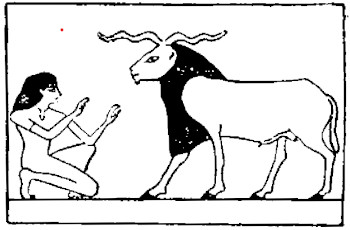
VIGNETTE TO CHAPTER IX.