(7) PRODUCTION OF COLOUR DIRECT UPON COTTON FIBRES.
Reading edition
By the action of nitrous acid upon the salts of the primary organic amines the so-called diazo compounds are formed. An example of this important process is that of nitrous acid on aniline hydrochloride shown in the following equation:—
C6H5NH2 + HCl + HNO2 2H2O + C6H5N:NCl Hydrochloric acid Nitrous Water, Diazo-benzene aniline, acid, chloride.
These diazo compounds are distinguished by their active properties, especially in combining with amines in acid solutions, or with phenols in alkaline solution to form the azo dyes, thus diazobenzene chloride will combine with naphthol to form naphthol-azo-benzene, thus:—
C6H5N:NCl + C10H7OH + NaOH = Diazo-benzene chloride, Naphthol, Caustic soda.
C10H6OHN:NC6H5 + NaCl + H2O Naphthol-azo-benzene, Salt, Water.
These azo compounds are coloured, but are perfectly insoluble in water, alkalies, or acids; on the other hand the sulphonates of these bodies are easily soluble and form the numerous azo dyes now so largely made and used in wool and silk dyeing, but which on account of their being sulphonates cannot be used for cotton dyeing.
Methods have been devised for producing the insoluble azo colours direct upon the fibres. They are also called naphthol colours from the use of beta-and alpha-naphthol in their production. Although these azo dyes, when produced on the fibre, do not possess the fastness of the alizarine dyes, yet, on account of their cheapness and relative great fastness to soap and the action of sunlight, they are better than many of the newer cotton dyes.
By this method (first introduced in England by Holliday) colours of exceptional brightness and fastness can be obtained which were not obtainable with the dyes then known. Those which are obtained from phenols are of the first importance.
The Diazotisation of the Amido Bases.
With most bases this must be accomplished as cold as possible below 65° F. At a higher temperature, and when allowed to stand, most diazo compounds decompose quickly with evolution of nitrogen, which decomposition results in the mixture losing its power of producing colour, or at the most gives unsatisfactory results. For this reason it is therefore always necessary to work as cold and as quickly as possible.
The amido-azo bodies, whose compounds with the phenols are also distinguished by their great fastness, are in this respect an exception. They can be diazotised at the ordinary temperature, and their diazo compounds are much stabler than those, for example, of alpha-and beta-naphthylamine or of aniline, which must always be used as quickly as possible.
From anisidine, phenetidine and amido-diphenylamine, still more stable diazo compounds can be obtained, but the prices of these bases are rather high, and the colours produced with them are not fast to light.
The cheapest and most convenient method of obtaining nitrous acid for diazotising is by the action of a mineral acid, preferably hydrochloric acid, upon nitrite of soda.
For diazotising one molecule of base requires one molecule of hydrochloric acid to form a salt of the base, a molecule of nitrite of soda, and another molecule of hydrochloric acid to decompose the nitrite. The diazotisation is better carried out and the diazo solution rendered more stable if another molecule of hydrochloric acid and an excess of nitrite of soda are used. The presence of an excess of nitrite can be determined by testing the diazo solution with potassium iodide starch paper, which in the presence of excess of nitrite gives the blue iodine starch reaction.
In carrying out the diazotisation, the base is first dissolved in the whole amount of hydrochloric acid which has to be used, and the solution is filtered. The diazotisation takes place in the manner shown in the equation:—
C6H5NH2 + HCl + HCl + NaNO2 =
Aniline hydrochloride, Hydrochloric acid, Sodium nitrite,
NaCl + C6H5N:NCl + H20
Salt, Diazo-benzene chloride, Water.
The bases which form salts soluble with difficulty, such as nitroaniline and the amido-azo bodies, offer special difficulties in diazotising.
It has been found that the operation with these is best carried out if the chemically pure bases in paste form are mixed with the requisite amount of nitrite, and the diluted paste then poured into the hydrochloric acid.
It has been found by experience that the colour is developed much brighter upon the fibre when the diazo solution contains acetic acid and no free mineral acid. However, the diazotisation is better carried out with hydrochloric acid, and the presence of the latter is necessary to give stability to the solution. If before the diazo solution is used a quantity of acetate of soda be added to it, the free hydrochloric acid liberates acetic acid from the acetate, and the chloride of the diazo body changes into its acetate. It is better to add an excess above the two molecules of acetate of soda which are required.
The combination when aniline and beta-naphthol are used, as the amine and phenol respectively, is shown in the following equations:—
C6H5N:NCl + C10H7OH +
Diazo-benzene chloride, B. naphthol,
NaOH = 2NaCl + C6H5N:NC10H6OH + H2O Caustic soda, Benzene- azo-naphthol, Water.
Or, with naphthylamine and naphthol, thus:—
C10H7N:NCl + C10H7OH + NaOH =
NaCl + C10H7N:NC10H6OH + H2O
Naphthalene azo-naphthol.
By the action of nitrous acid upon amido-azo bodies a group of bodies called diazo-azo compounds are obtained which contain the group N:N twice over, thus:—
C6H5N:NC6H4NH2HCl + NaNO2 + 2HCl =
Benzene-azo-aniline-hydrochloride,
NaCl + C
6
H
5
N:NC
6
H
4
N:NCl + 2H
2
O.
Diazo-azo-benzene-chloride.
When this compound is combined with naphthol diazo-azo dyes are produced.
C6H5N:NC6H4N:NC10H6OH. Benzene-azo-benzene-azo-naphthol.
The molecular weights of the bases, phenols and chemicals employed are the following:—
1. Hydrochloric acid, HCl—36.5. 2. Caustic soda, NaOH—40. 3. Nitrite of soda, NaNO2—69. 4. Acetate of soda, NaC2H3O23H2O—136.
1. Commercial hydrochloric acid at 32° Tw. contains about 365 grams of HCl in a litre, or 3½ lb. in a gallon.
2. The commercial 77 per cent. soda must always be used, and for practical purposes it may be taken as pure. It is best to make a solution which contains 160 grams NaOH in a litre of water.
3. The nitrite supplied is almost chemically pure, and is easily soluble in water. In order to make a solution 140 or 290 grams are dissolved per litre.
4. Crystallised acetate of soda contains 3 molecules of water of crystallisation, and is usually somewhat moist. Instead of 136 grams 140 are taken to allow for moisture. The amount is dissolved in about 500 cubic centimetres of water.
Bases.
1. Aniline, C6H5NH2—93. 2. Toluidine, C7H7NH2—107. 3. Alpha-and beta-naphthylamine, C10H7NH2—143. 4. Para-or meta-nitroaniline, C6H4NO2NH2—138. 5. Nitro-para-toluidine, C7H6NO2NH2—152. 6. Amidoazobenzene (base), C6H5N:NC6H4NH2—197. 7. Orthoamidoazotoluol (base), C7H7N:NC7H6NH2—225. 8. Alpha-or beta-naphthol C10H7OH—144.
Example of Quantities Taken.
Molecular Weight.
1. Molecule nitrite 69 grams.
2. Molecule aniline 93 "
3. Molecule hydrochloric acid 365 "
4. Molecule acetate of soda 136 "
5. Molecule of naphthol 144 "
6. Molecule caustic soda 40 "
Applying the principles which have just been described to the dyeing of cotton, it is found that the cotton may be dyed by taking the base and preparing the diazo body, impregnating the cotton with this, and developing the colour by passing into a bath of the phenol. On the other hand, the cotton can be prepared with the phenol and the colour developed by passing into a bath of the diazotised base, and practice has shown that this latter proceeding is the best. Practically the only phenol that is used is the beta-naphthol; alpha-naphthol is occasionally used, but not often.
The purer the beta-naphthol the better, especially for producing the paranitroaniline red. Various preparations of beta-naphthol have been brought out by colour makers.
The process of dyeing cotton with a naphthol colour takes place in two stages, the first being the grounding or preparing with the naphthol, the second the developing with the diazotised base. Some of the effects which can be obtained from the two naphthols and various bases are given in the following table:—
Base. With beta-naphthol, gives With alpha-naphthol, gives
1. Aniline, Orange yellow; Cutch brown.
2. Paratoluidine, Full yellow orange; Cutch brown.
3. Metanitroaniline, Fiery yellowish red; Brownish orange.
4. Paranitroaniline, Bright scarlet; " "
Base. With beta-naphthol, gives With alpha-naphthol, gives 5. Nitroparatoluidine, Orange; Very bright catechu. 6. Alpha-naphthylamine, Bluish claret red; Reddish puce. 7. Beta-naphthylamine, Turkey red; " 8. Amidoazobenzene, Red; " 9. Orthoamidoazotoluene, Yellowish claret red; "
By mixing alpha-and beta-naphthols together a variety of grenat and claret reds and browns can be obtained.
With regard to the fastness of the shades produced the following may be considered:—
Fast to Soaping.
Combination of A-Naphthol with Toluidine.
" " A-Naphthylamine.
" " B-Naphthylamine.
" " Amidoazobenzene.
" B-Naphthol with Toluidine.
" " Paranitroaniline.
" " Nitroparatoluidine.
" " B-Naphthylamine.
" " A-Naphthylamine.
Moderately Fast.
Combination of A-Naphthol with Aniline.
" " Paranitroaniline.
" " Orthoamidoazotoluene.
" B-Naphthol with Metanitroaniline.
" " Amidoazobenzene.
Very Loose.
Combination of A-Naphthol with Paratoluidine.
" " Metanitroaniline.
" " Nitroparatoluidine.
" B-Naphthol with Aniline.
" " Paratoluidine.
" " Orthoamidoazotoluene.
The samples were tested for fastness to light by exposing them for nine days with the following results:—
Fast.
Combination of A-Naphthol with Aniline.
" " Toluidine.
" " Metanitroaniline.
" " Paranitroaniline.
" " Nitroparatoluidine.
" " B-Naphthylamine.
" " Amidoazobenzol.
" " Orthoamidoazotoluol.
" B-Naphthol with Aniline.
" " Paratoluidine.
" " Metanitroaniline.
" " Paranitroaniline.
" " B-Naphthylamine.
" " A-Naphthylamine.
Moderately Fast.
Combination of B- Naphthol with Nitroparatoluidine.
Very Loose.
Combination of A-Naphthol with Toluidine.
" " A-Naphthylamine
" B-Naphthol with Toluidine.
" " Amidoazobenzene.
" " Orthoamidoazotoluene.
The most important of the naphthol colours is undoubtedly paranitroaniline red, produced by the combination of paranitroaniline and beta-naphthol. In order to produce the best and brightest shades these two bodies must be quite pure. The following directions may be followed:—
Dyeing Paranitroaniline Red on Yarn.
It unfortunately happens that this red does not admit of being worked in large quantities at a time, particularly in the diazo bath where the colour is developed, as the previous operations seem to render the yarn slightly waterproof, and hence if large quantities of yarn were dealt with at one time some would be found to be dyed all right, others would be defective. It has, therefore, been found best to work only about 2 lb. of yarn at a time, carefully carrying out each operation with this quantity. As, however, the process can be quickly worked it follows that in the course of a day a fairly large quantity of yarn can be treated.
1. Grounding. The grounding or preparing bath for 100 lb. of yarn is best made in the following manner: 4 lb. of beta-naphthol are stirred in 2½ lb. of caustic soda liquor 70° Tw., then 1½ quarts of boiling water is added, when dissolved 1½ quarts of cold water. In a separate vessel dissolve 5 lb. Turkey-red oil in 11 quarts of water, then mix the two liquors together and add sufficient water to make up the whole to 12 gallons.
In working sufficient of this liquor is taken and put into a deep tub in which 2 lb. of yarn can be conveniently worked. It is best to work at a tepid heat, say 100° to 110° F.; 2 lb. of the yarn are worked in this liquor, so that it becomes thoroughly impregnated, then it is gently wrung out and hung up. This operation is repeated with each 2 lb. until the whole 100 lb. has been treated, adding from time to time some of the naphthol liquor to make up for that taken up by the cotton. When all the yarn has been through the liquor, give it another dip through the same liquor. Place the yarn in a hydro-extractor for five to seven minutes. Next open out the yarn well, and hang on sticks and dry in a stove at 140° to 150° F. The stove should be heated with iron pipes, through which steam at 30 lb. to 40 lb. pressure passes. This stove should be reserved entirely for this work, for if other goods be dried in it along with the naphthol-prepared cotton, any steam or acid vapours which might be given off from the former might damage the latter.
When thoroughly dry the yarn is ready for the next operation.
2. Developing. The developing bath is made in the following manner: 1½ lb. paranitroaniline is mixed with 1½ gallons of boiling water, and 1¾ quarts of hydrochloric acid at 30° to 32° Tw. Stir well until the paranitroaniline is completely dissolved, add 3½ gallons of cold water, which will cause a precipitation of the hydrochlorate of paranitroaniline as a yellow powder. Let the mixture thoroughly cool off, best by allowing to stand all night; 1¼ lb. of nitrite of soda is dissolved in 4 quarts of cold water, and this solution is added to the paranitroaniline solution slowly and with constant stirring; in about fifteen to twenty minutes the diazotisation will be complete. At this and following stages the temperature of working should be kept as low as possible. Some dyers use ice in preparing their diazo solutions, and certainly the best results are attained thereby, but with paranitroaniline the ice can be dispensed with. After the end of the time sufficient cold water is added to bring the volume of the liquor up to 10 gallons. This diazo liquor will keep for some days, but it decomposes in time, so that it should not be kept too long.
Another liquor is made by dissolving 4 lb. acetate of soda in 11 quarts of water.
The developing bath is made by taking 4 gallons of the diazo liquor and 1 gallon of the acetate liquor and mixing together, and in this bath the prepared yarn, 2 lb. at a time, is worked. The colour develops immediately. The yarn when dyed is lifted out, wrung, and then it is well washed with water, soaped in a bath at 120° F., with a liquor containing ½ oz. soap per gallon, then dried. As the cotton yarn is being passed through the developing bath, the latter is freshened up from time to time by suitable additions of the diazo and acetate liquors in the proportions given above.
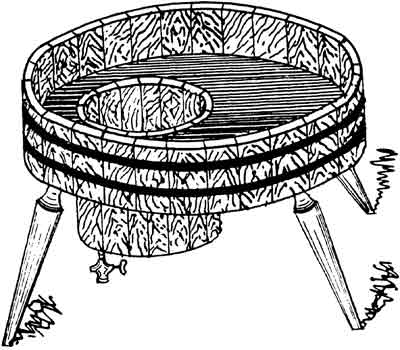
Some dyers use a special form of dye vat for dyeing paranitroaniline red on yarn, whose construction can be seen from Fig. 27.
FIG. 27.—Dye-tub for Paranitroaniline Red.
The beta-naphthol bath does not keep well and in time tends to grow brown, and when this occurs stains are invariably produced on the cotton. When the yarn or cloth has been prepared with the beta-naphthol, and dried, the developing should be immediately proceeded with, for it is found that by allowing the prepared cotton to lie about it becomes covered with brown stains, and when such stained cotton is passed through the developing bath stains and defective dyeing result.
It has been found that by adding a little tartar emetic to the beta-naphthol bath this is largely if not entirely prevented, and the prepared cloth may be kept for a reasonable length of time before proceeding with the development without fear of stains being formed.
Various additions have been made from time to time to the naphthol bath. Some of these take the form of special preparations of the colour manufacturers, and are sold as naphthol D, naphthol X, red developer C, etc., sometimes gum tragacanth has been added, at others in place of Turkey-red oil there is used a soap made from castor oil with soda and ammonia, but such complicated baths do not yield any better results than the simple preparing liquor given above.
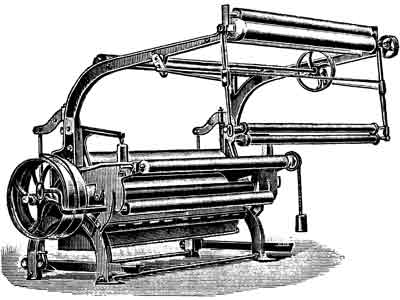
FIG. 28.—Padding Machine for Paranitroaniline Red.
Dyeing Paranitroaniline Red on Piece Goods.
The dyeing of this red on to piece goods only differs from that on yarn by reason of the difference in the form of material that is dealt with.
1. Preparing or Grounding.—The same liquor may be used. This operation is best done on a padding machine, a sketch of which is given in Fig. 26, showing the course of the cloth through the liquor. This is contained in the box of the machine, and this is kept full by a constant stream flowing in from a store vat placed beside the machine. After going through the liquor, the cloth passes between a pair of squeezing rollers which squeeze out the surplus liquor. Fig. 28 shows a view of a padding machine adapted for grounding paranitroaniline reds. After the padding, the cloth is dried by being sent over a set of drying cylinders, or through what is known as the hot flue.
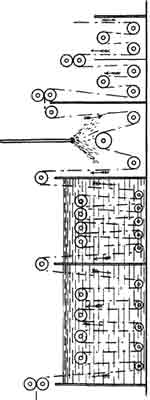
2. The Developing.—After being dried, the pieces are sent through a padding machine charged with the developing liquor made as described above, after which the cloth is rinsed, then soaped, and then washed. Some dyers use a continuous machine for these operations, such as shown in Fig. 29.
While the developing bath used for piece goods may be the same as that used for yarns, some dyers prefer to use one made somewhat differently, thus 6¼ lb. paranitroaniline are mixed with 7 gallons boiling-water and 1½ gallons hydrochloric acid; when dissolved 16 gallons of cold water are added, then, after completely cooling, 3½ lb. sodium nitrite dissolved in 3 gallons cold water. After twenty minutes, when the diazotisation is complete, water is added to make the whole up to 40 gallons. The acetate liquor is made from 13¼ lb. acetate of soda in 13½ gallons of water.
Equal quantities of these two liquors are used in making the developing bath.
Of late years, under the names of Azophor red P N, Nitrazol C, Nitrosamine, etc., there has been offered to dyers preparations of diazotised paranitroaniline in the form of a powder or paste, readily soluble in water, that will keep in a
FIG. 29—Developing Machine for Paranitroaniline Red.
cool and dry place for any reasonable length of time. These are prepared in various ways, and to any dyer who does not want the trouble of diazotising the paranitroaniline they offer some advantages. They produce a red equal in every respect to that obtained from paranitroaniline. The following details show the method to be followed with some of these products, others are very similar to make the developing baths.
Paranitroaniline Red with Nitrazol C.—Dissolve 25 lb. Nitrazol C in 12 gallons of cold water with constant stirring, then add sufficient cold water to make 37 gallons. In another vessel dissolve 11 lb. of acetate of soda in 5½ gallons water, then add 1½ gallons caustic soda, 36° Tw., mixed with 5½ gallons water. The developing bath is made by mixing both these solutions. It will suffice for both yarn and piece goods.
Paranitroaniline Red with Azophor Red P N.—Dissolve 5½ lb. of Azophor red P N in 4 gallons of water—it dissolves almost completely but usually a few particles of a flocculent character remain undissolved, these can be removed; 2¼ gallons of caustic soda lye of 36° Tw. are diluted with water to 10 gallons, and this is added with constant stirring to the azophor red P N solution. When all is mixed and a clear solution obtained, the developing bath is ready for use, and is used in the same way as the paranitroaniline bath.
Metanitroaniline Orange.—This orange is produced in the same way as the paranitroaniline red, using metanitroaniline or Azophor orange M N in place of the paranitroaniline or the Azophor red P N given for the red. The quantities of all the materials used are identical.
Nitrosamine Red.—Dissolve 5 lb. Nitrosamine red in 5 gallons of water and 2¼ lb. hydrochloric acid, when well mixed there is added 2½ lb. acetate of soda, when all is dissolved add sufficient water to make 6½ gallons. This bath is used exactly in the same way as the paranitroaniline developing bath, and it produces identical results in every way.
Paranitroaniline Brown.—By boiling the paranitroaniline red dyed cotton in a weak bath of copper sulphate a very fine fast brown resembling a cutch brown is produced. A better plan, however, is to prepare the cotton with a ground containing an alkaline solution of copper, 3 lb. beta-naphthol are dissolved in 5 pints of caustic soda lye of 36° Tw., to which is added 5 lb. Turkey-red oil and 10 pints alkaline copper solution, water being added to make 13 gallons of liquor. The cotton is treated in this way as with the ordinary beta-naphthol preparation. The alkaline copper solution is made by taking 5 pints of copper chloride solution at 76° Tw., adding 3¼ lb. tartaric acid, 6 pints caustic soda lye, 70° Tw., and 2 pints of glycerine. The developing bath for the brown is the same as for the paranitroaniline red, or the Azophor red P N bath may be used.
Toluidine Orange.—For this colour the cotton is prepared with the beta-naphthol in the ordinary way. The developing bath is made from 2 lb. orthonitrotoluidine mixed with 12 pints boiling water and 2¼ pints hydrochloric acid; when dissolved allow to cool and then add 12½ lb. ice. When thoroughly cold stir in 2½ pints of sodium nitrite solution containing 3 lb. per gallon. Stir well for twenty minutes, then filter; add 4 lb. sodium acetate and sufficient ice-cold water to make 13 gallons. Use this bath in the same way as the paranitroaniline bath.
Beta-naphthylamine Red.—This red is a good one, but is not so bright or so fast as the paranitroaniline red, hence although somewhat older in point of time it is not dyed to the same extent. The developing bath is made from 1¾ lb. beta-naphthylamine dissolved with the aid of 10 pints boiling water and 1 pint hydrochloric acid. When dissolved allow to cool; add 27 lb. ice and 2 pints hydrochloric acid. When cooled to 32° to 36° Tw., add 3 pints sodium nitrite solution (3 lb. per gallon) and 4 lb. sodium acetate, making up to 13 gallons with water. This also is used in precisely the same way as the paranitroaniline red developing liquor.
Alpha-Naphthylamine Claret.—This is a very fine and fairly fast red, and next to the paranitroaniline red may be considered the most important of the naphthol colours. The developing bath is a little more difficult to make, owing to the fact that it is more difficult to get the alpha-naphthylamine into solution. The best way of proceeding is the following: Heat 1¾ lb. of alpha-naphthylamine in 10 pints of boiling water, agitating well until the base is very finely divided in the water, then 1¼ pints of hydrochloric acid is added, and the heat and stirring continued until the base is dissolved, then the mass is allowed to cool, 27 lb. of ice is added and 1½ pints of hydrochloric acid. When cooled down to 32° to 36° F., there is added 3 pints sodium nitrite solution (3 lb. per gallon), and after allowing the diazotisation to be completed, 4 lb. sodium acetate and sufficient water to make 13 gallons of liquor.
The bath is used in the same manner as the previous developing baths.
Dianisidine Blue.—Dianisidine develops with beta-naphthol, a violet blue, which is not very fast, but by the addition of some copper to the developing bath a very fine blue is got which has a fair degree of fastness. The developing bath is made as follows: Mix 10½ oz. dianisidine with 7 oz. hydrochloric acid and 7½ pints of boiling water, when complete solution is obtained it is allowed to cool, then 20 lb. of ice is added. Next 1¾ pints of nitrite of soda solution, containing 1½ lb. per gal. and 2½ pints of cold water. Stir for thirty minutes, then add 1¼ pints copper chloride solution at 72° Tw., and sufficient water to make up 6½ gallons.
The cotton is prepared with beta-naphthol in the usual way, and then passed through this developing bath.
Amidoazotoluol Garnet.—Amidoazotoluol produces with beta-naphthol a fine garnet red in the usual way.
The developing bath is made from 14 oz. amidoazotoluol, mixed with 1½ pints of sodium nitrite solution containing 1½ lb. per gallon, when well mixed add 1 pint of hydrochloric acid diluted with 2 pints water, when this is well mixed add sufficient water to make up a gallon, then add 1 lb. acetate of soda.
The cotton is passed through this dye-bath, then washed well, passed through a weak acid bath, then soaped well, washed and dried.
(8) DYEING COTTON BY IMPREGNATION WITH DYE-STUFF SOLUTION.
Indigo is a dye-stuff which requires special processes for its application to the cotton or wool fibre.
Its peculiarity is that in the form in which it comes to the dyer it is insoluble in water, and to enable it to be dissolved and therefore to be used as a dye, the indigo has to go under a special treatment. The colouring principle of indigo is a body named indigotin, to which the formula C16H16N2O2 has been given. When indigo is mixed with substances like lime and copperas, lime and zinc, zinc and bisulphite of soda, which cause the evolution of nascent hydrogen, it takes up this body and passes into another substance which is called indigo white that has the formula C16H12N2O2, leuco, or white indigo; this substance is soluble in water, and so when it is formed the indigo passes into solution and can then be used for dyeing. But indigo white is an unstable substance on exposure to air, the oxygen of the latter attacks the hydrogen which it has taken up, and indigotin is reformed, the indigo white changing again into indigo blue.
Indigo dyeing consists of three operations:—
(1) Preparation of the indigo solution, or, as it is called,
setting the dye vat. (2) Steeping the cotton in this vat. (3)
Exposing to the air.
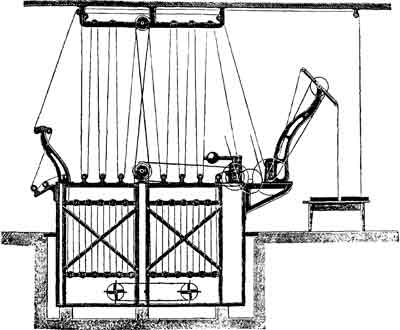
FIG. 30.—Indigo Dye-vat for Cloth.
There are several methods of preparing, or setting the dye vat, and of each of these modifications are in use in every indigo dye-house:—
(1) With lime and copperas. (2) Zinc and lime vat. (3) Zinc and
bisulphite of soda.
In all cases it is necessary for the indigo to be ground to the form of a fine paste with water; this is usually done in what is known as the ball-grinding mill. The finer it is ground the more easy is it to make the dye-vats.
The dye-vats may be either round tubs or square wooden tanks; when cloths or warps are being dyed these may be fitted with winces and guide rollers, so as to draw the materials through the liquor. In the case of yarns in hanks these appliances are not necessary.
Fig. 30 is a sketch of an indigo dye-vat for cloth or warps.
(1) Lime and Copperas Vat.—To prepare this vat take 75 gallons of water, 4 lb. of indigo, 8 lb. copperas, and 10 lb. of good quicklime. Put these into the vat in the order shown. The amount of indigo is added in proportion to the shade which is required to be dyed: for pale shades, 2 lb. to 3 lb. will be sufficient; while for deep shades, 6 lb. to 7 lb. may be used. The amount of copperas should be from one and a half to twice that of the indigo. The vat should be stirred very well and then left to stand. The changes which occur are probably the following: The lime acts upon the copperas and produces ferrous hydrate—this is unstable and tends to take up oxygen and hydrogen from the water, particularly when there is some indigo present, and forms ferric hydrate; hydrogen is at the same time liberated, and combines with the indigo to form the soluble indigo white. It takes about twenty-four hours to make an indigo vat. When properly made and in good condition, the liquor will be clear and of a brownish-yellow colour, a bluish scum may collect on the surface. If the liquor appears at all greenish it is an indication that the indigo has not been completely reduced, and the vat needs a further addition of lime and copperas, which should be of good quality. Too much of each should not be used, because with them there is formed at the bottom of the vat a sediment of calcium sulphate and ferric hydrate, and it is not wise to increase this to too great an extent, which would be the case if too much lime and copperas were added.
To Use this Vat.—Any scum on the surface is raked on one side, the cotton yarn immersed for a few minutes, then it is taken out, wrung, allowing the excess liquor to flow back into the vat, and the yarn hung up in the air for the blue to develop. The depth of shade which is dyed depends chiefly upon the amount of indigo in the vat, and also upon the time during which the hanks are dipped in the liquor. Light and medium shades can be readily and conveniently got by a single dip, but deep shades are best got by repeating the dipping once or twice as occasion demands. Deep shades got by using a strong bath at a single dip are found to rub badly, while by repeated dips the dye gets more into the substance of the fibre, and therefore the colour is more firmly fixed and it rubs less.
Some indigo dyers have quite a range of vats, using those fresh made for dyeing deep shades, while the old vats being nearly exhausted are used only for light shades and finally when completely exhausted are thrown away. After the day's work the vat should be stirred up and then allowed to stand. If necessary it may be strengthened by the addition of fresh quantities of indigo, lime and copperas, the next morning it will be ready for use. Generally a lime-copperas vat will remain in good working order for about a month, when it will be necessary to throw it away.
(2) Zinc and Lime Vat.—Zinc dust is a bye-product in the process of zinc extraction. It is a grey, very heavy powder, consisting mostly of finely divided metallic zinc, with traces of oxide and sulphide of zinc. Of these only the metallic zinc is active in reducing the indigo, the rest of the ingredients are not of any consequence. The valuation of zinc dust is a very difficult operation, but it is desirable that this be done, as the product is liable to be very variable in the proportion of actual zinc it contains, and it will pay large buyers always to have it tested. Zinc dust must always be kept in a dry place.
For the reduction of zinc powder lime is chiefly used. The following are two good mixtures.
Vat with zinc and lime:—
10 lb. indigo, dry and ground fine; 5½ lb. zinc dust; 22 lb. slaked lime, dry.
The vat is set as follows, a part of the lime is mixed with the indigo, and the two bodies are well mixed together and allowed to stand for ten minutes, then the zinc powder is added. It is best to make this into a smooth paste with water before adding it to the other ingredients, then the rest of the lime is added and the whole is thoroughly stirred together with the necessary quantity of water.
Vat with zinc powder, lime and soda:—
10 lb. indigo, dry and ground fine; 10 lb. zinc powder; 10 lb. slaked lime, dry; 35 lb. caustic soda at 11° Tw.
Add the lime to the ground indigo, then add the zinc and finally the soda lye.
Soon after the various ingredients of the vats are added together the whole mass becomes hot, when it must be well stirred. It soon begins to evolve gas and the mixture froths. In from two to four hours the evolution of gas ceases. The dark blue solution now becomes yellow and the liquor shows all the characteristics of the indigo vat. It is necessary to keep the vat well stirred up during the time of setting, which takes from five to six hours. If there is much evolution of gas after this time it indicates that too much zinc powder has been added; this is a common fault with dyers, and such excess causes the vat to be too much disturbed and to work dirty. A lime-zinc vat, with occasional additions of new materials, keeps good for three months, and even then is in a better condition than the copperas vat.
This vat is used in precisely the same way as the copperas vat; as it contains no sediment, or but little, it works cleaner than the copperas vat and as a rule the indigo blues dyed in it are faster to rubbing.
After a day's work it can be well stirred up and fresh additions of lime, zinc and indigo made to bring it up to its original dyeing strength.
(3) Zinc-Bisulphite Indigo Vat.—When zinc dust and bisulphite of soda are mixed together a reaction sets in, the zinc dissolves, and there is formed sodium hydrosulphite and zinc and sodium sulphites. If now indigo is mixed with this solution the sodium hydrosulphite exerts a reducing action on it, forming white indigo and sodium sulphite, a perfectly clear solution being obtained, which may be used in dyeing cotton or wool.
With this vat it is customary to prepare a strong stock solution of reduced indigo, and to add this to the dyeing vats as may be required.
To Make the Stock Liquor.—Take 20 lb. of indigo, grind into a paste with 20 gallons of boiled water, then add 25 lb. lime slaked into a milk. In a separate tub there is mixed 80 lb. bisulphite of soda, 70° Tw., with 9 lb. zinc dust; this mixture is well stirred and every care taken to prevent it getting hot. When the zinc has dissolved and the mixture is free from any sulphurous smell it is run into the indigo mixture given above. The whole is well stirred together for some time, and then at intervals, until the indigo has become dissolved, sufficient water is added to make up 50 gallons, when the stock liquor will be ready. It should have a deep yellow colour. The surface may have a scum of a bronzy colour collect on it. This stock liquor should be kept in casks free from exposure to the air.
To make the working vat from this stock liquor the following is the method of proceeding:—
Water is run into the vat, and this is heated from 70° to 80° C. in order to expel air from it, after which it may be allowed to cool, then for each 1,000 gallons contained in the vat there is added 30 lb. bisulphite of soda, 3 lb. zinc dust and 3 lb. lime, made into a cream. When all these ingredients are dissolved a quantity of the stock liquor is added in proportion to the shade that it is desired to dye. The whole is well stirred, then the vat is allowed to rest for half an hour to enable any sediment to settle, and then the dyeing is proceeded with.
Should the vat show signs of becoming green in colour it is a good plan to add a mixture of 1 lb. zinc dust and 10 lb. bisulphite of soda. The vat should be kept alkaline, and so a little lime may be added from time to time.
After a day's work it is well to add a little of the zinc and bisulphite mixture, to stir well and allow to stand overnight; the next morning strengthen up the vat by adding fresh stock liquor.
In place of using lime in making up the vat it is possible to use a mixture of caustic soda and ammonia. The lime will tend to cause some sediment to form in the vat, whereas the soda and ammonia will not. When they are used the following mode of working may be followed:—
Stock Liquor.—Soda zinc vat: Put in a tub 26 gallons cold water, 15 lb. zinc powder ground into a paste with 6 gallons water, then stir in 8 gallons bisulphite of soda at 60° Tw., stir well, keeping the heat down as much as possible, after which add 8 pints caustic soda lye at 70° Tw. and 14 pints 20 per cent. liquor ammonia. When all is thoroughly mixed add 30 lb. indigo, ground into a paste with 7 gallons water, allow to stand for half an hour, then add water to make 100 gallons, stir at intervals for twelve hours or so, when the stock liquor will be ready for use.
This is used to make the vat in the same way as the first above described. It is needful before adding the stock liquor in making a vat to destroy any oxygen or air which is present in the vat. This may most conveniently be done by adding thereto a solution of hydrosulphite of soda, which may be made by mixing 4½ lb. zinc dust with 5 gallons of water and 3 gallons bisulphite of soda at 70° Tw., stirring well, so that the temperature does not rise too high, there is then added 2 pints caustic soda and 3 pints liquor ammonia, 20 per cent.; when all is dissolved, water is added to make up 13 gallons.
Should the vat show signs of becoming charged with indigo, indicated by its becoming of a green colour, a little of this hydrosulphite added from time to time will correct it.
The hydrosulphite-indigo vat made by either of the two methods indicated above works well, and with due care may be kept in work for months. It gives good shades of indigo, although some dyers consider that these have not the rich bronze hue got from the lime and copperas vat. The shades are rather faster to rubbing.
It has been proposed to employ the dye-stuff indophenol in conjunction with indigo, in which case the method of making the vat is with zinc, bisulphite of soda, caustic soda and ammonia as last described, only in place of using all indigo a mixture of 22 lb. indigo and 7½ lb. indophenol is used. Good blue shades of considerable fastness can thus be got.
Aniline Black.—This black is produced direct upon the cotton fibre by various processes which entail the oxidation of aniline. The chemical composition and constitution of aniline black has not yet been worked out. It is not by any means an easy colour to dye, but still with careful attention to carrying out the various operations in detail excellent results can be attained.
Aniline black is the fastest black which is known, it resists when well dyed exposure to air and light, is quite fast to washing and soaping. Its disadvantages are that there is, with some methods of working, a tendency to tender the cotton fibre, making it tear easily; secondly, on exposure to air it tends to turn green, this however only happens when the black has not been dyed properly.
At the present day it is perhaps without doubt the most used of all blacks. The methods for producing it are many and varied, the following recipes show how some of the finest aniline blacks can be dyed:—
Ungreenable black is formed when the aniline is by the action of the oxidising agents converted into a substance named nigraniline. This compound when formed will not turn green on the fibre under the influence of acids.
1. The most usual oxidising agent employed for dyeing aniline black is bichromate of soda, which salt will be found much better for all purposes than bichromate of potash. Two separate solutions are prepared: (1) 61 lb. aniline, 9 lb. hydrochloric acid and 10 gallons of water; and (2) 12 lb. bichromate of soda and 20 gallons of water. After cooling, equal quantities of these solutions are mixed and the cotton worked rapidly through the mixture, in a few minutes it assumes a bronze black. The material is then wrung out and steamed for twenty minutes at 3½ lb. pressure, which process renders it jet black and also ungreenable.
2. Another aniline black: For 100 lb. cotton use 11 lb. aniline oil, 15 lb. bichromate of soda, 40 lb. hydrochloric acid and 160 gallons water or 12 lb. sulphuric acid. The dye-bath is filled with the water and the cold solution of aniline oil and a part of the hydrochloric acid in water is first added, afterwards the bichromate is dissolved in a small quantity of water, working cold at first and gradually rising to the boil.
3. Another method is the following and gives a black that is fast and ungreenable and will not rub: 10 lb. chlorate of soda, 10 lb. ammonium chloride, 10 lb. copper sulphate, 35 lb. aniline salt, 101 lb. aniline oil and 20 gallons water. The sodium chlorate and ammonium chloride are dissolved in 6½ gallons and the copper sulphate separately in 5½ gallons water. The aniline salt is dissolved in as little hot water as possible and neutralised with a small amount of aniline oil (10 lb.). The solution of aniline salt is first added to the bath, then the sodium chlorate and ammonium chloride, and lastly the copper sulphate, dilute the whole to 14° Tw. and then enter the goods. Next steam, then run through a solution containing 10 lb. bichromate and 5 lb. soda per 100 gallons water at 160° F., after which the goods are washed and dry steamed at 15 lb. pressure.
4. A very good black is the prussiate or steam aniline black whose cheapness should recommend it. Prepare concentrated solutions of 1¾ lb. aniline salt in 1 gallon water, 1½ lb. ferrocyanide of potash in ¾ gallons water and 1½ lb. potassium chlorate in 1½ gallons water. Mix the solutions and work in a jigger, then steam in a Mather & Platt apparatus for two minutes, then work hot in a jigger in a solution of 2 lb. bichromate per 50 gallons water, dry and finish.
Either of these methods yields a good full black; with a little experience and care perfectly uniform shades will be got.