Chapter III · DECIPHERMENT OF THE FIRST OR PERSIAN COLUMN—TYCHSEN TO LASSEN, A.D. 1798-1836. (continued 2)
Reading edition
It will be recollected that Grotefend had called attention to this inscription in 1832, and had pointed out that it evidently contained a long list of proper names.[392] Whether this suggestion ever reached Burnouf it is impossible to say, but it is certain he made it an early object of study; and from it he derived the cuneiform sign ‘B,’ with which he signed his letters to Lassen.
The method he pursued to determine the value of an unknown sign was to collect all the words in which it occurred, and endeavour to assign to it a letter, from among those not already rigorously determined, that would produce a word for which some meaning might be found by comparing it with Zend. For example, the word with which the Darius at Hamadan begins consists of only two letters, which, according to Grotefend, would yield vu. But Burnouf could make no sense out of this, and he accordingly substituted a b for the first letter (𐎲). The result was that he could not only extract a sense out of bu—which he compared with the Sanscrit bhû and bû ‘to be,’ but two or three other words were also rendered intelligible by the same change.[393] The consideration, however, that finally settled the matter was the discovery of a name in the I inscription, which, upon the supposition that the letter in question was a b would yield ‘Bakhtroch,’ and this he had no difficulty in identifying with Bactria. Hence he altered the v of Grotefend into a b without apparently recognising that he merely restored the value originally given to that sign by Münter.[394]
Unfortunately, his method did not lead to very important results, for it only enabled him to add two additional values correctly. Both of these were suggested to him by the second word in this same Hamadan Inscription.[395] The word occurs also in the B and G inscriptions, where it was transliterated by Grotefend e gh r e. Burnouf accepted the change of the initial e (𐎺) into i, which was made by St. Martin, without approaching nearer to the correct value, which is in fact a v. The emendation of the second letter lay ready at hand, and could not well be longer overlooked. Since Rask had identified the sign for m, this particular sign (𐏀) was the only one that required alteration in order to read Aur m z da,[396] and it was therefore inevitable that Grotefend’s gh should at length be surrendered for a z; the only wonder is that this change should have been so long delayed.[397] The emendation of the last letter of the word (𐎣) displays an entirely different order of ingenuity. The letter occurs in only seven different words in all the inscriptions of Niebuhr, Le Bruyn, and Schulz but in one instance it is the initial sign in a word of which the others are t p d h u k. It was certainly no common feat of imagination that led Burnouf to see that if a k were to precede this remarkable agglomeration, the province of Kappadocia would turn up. By these means, however, he got rid of another of Grotefend’s e’s, and altered it into a k, which proved to be correct. Having thus changed e gh r e into i z r k, the next step was to find some similar word in Zend that might suggest its meaning. This, however, was not easy; the nearest he could think of was ‘yazata,’ which might bear to be translated ‘divine.’[398]
Such was the method that enabled Burnouf to restore one correct value, b, that had been recently neglected, and to add two others, z and k, to the alphabet. He was on the point of increasing the number of correct values by two or three others, but unfortunately he hesitated to yield to his first intuition. In the twelfth line of the I inscription he found a word which, according to his alphabet he transliterated ‘Arion.’[399] It occurred in a position in the geographical list that would naturally suggest that it indicated ‘Armenia,’ and to obtain this result it was only necessary to change the sign (𐎷) which he read i into m. There was a farther reason that appeared to justify this alteration. In the Hamadan inscription the same sign occurs in bu i om, which he translated ‘excellent’; but if it were permitted to alter the i into m we should obtain bumom, ‘earth.’ The meaning of the sentence would then be: ‘He has given [or created] this earth; he has given [or created] this heaven,’ which would be an evident improvement in the sense.[400] He would not, however, allow that the alphabet could include more than one m, and he was not prepared to sacrifice the m (𐎶) discovered by Rask in the genitive termination anam. Thus he narrowly missed adding the m (𐎷) before i to the number of his correct values. So also in line 11 there occurs a word he reads ayura, but by the change of the y into th he would arrive at ‘Athura,’ the ancient ‘Aturia.’[401] This change was farther sanctioned by another name, which his system transliterated pryi; but by the hypothesis under consideration, it would become prthi, a manifest form for ‘Parthia.’ Moreover, the same alteration would introduce an important improvement in the word for ‘king,’ which would then read khchâhthôh (from the Zend khchathrô) in place of khchâhyôh.[402] Notwithstanding all these probabilities, he finally rejected the alteration and lost the addition of another correct value. It is interesting also to observe how nearly he approached the correct value of Grotefend’s h (𐎹, No. 27). He perceived that if it were changed into a y, it would yield yuna in the twelfth line, which there could be no doubt would indicate ‘Ionia.’ As it is, however, he retained the incorrect value; and he could find no satisfactory explanation of huna; for he, of course, rejected ‘Huns’ as an evident anachronism.[403] It would be tedious and unnecessary to go through the other signs to which he gave new values, for they unfortunately all turned out to be wrong. Indeed, if his services to decipherment were to be estimated by this test alone, they would not rank higher than those of St. Martin or Rask; for although he lays claim to have ascertained the value of twelve characters, eight of these are erroneous, one (the b) fairly belongs to Münter, another (the a) to Grotefend, and only two remain to be placed to his own credit: precisely the same number as were contributed by St. Martin and Rask. His alphabet gives definite values to thirty cuneiform signs and an uncertain value to three others.[404] Following the analogy of Zend, he allots a separate sign to the long and short values of each of the vowels a, i, u, and in this he considers he has reached ‘a result that should satisfy criticism.’ With respect to the consonants, however, he agrees with the maxim of Rask, and strives as far as possible to avoid according more than one sign to each. He has, however, found it difficult to avoid giving two signs to l and h, and no less than four to gh. As regards l or h, he introduces the second signs apologetically, followed by a mark of interrogation, indicating that they may be variants or defective signs. We now know there is no well-authenticated l in the language, and his first sign turned out to be d before i (𐎮) and the other r before u (𐎽). He was equally unfortunate with regard to h, neither of his signs for that letter being correct. He felt that the four signs for gh required explanation. He places only one among the thirty definite values in his alphabet. The others he labels as uncertain. (These are 𐎦, 𐎪, 𐎸.) He thought that a comparison of these would convince the student that they are composed of exactly the same elements, so that they seem to differ from each other only by the caprice of the engraver, who has arranged the wedges according to his fancy, while he has neither altered their form nor increased nor diminished their number.[405] He recognised, however, the objection that all cuneiform writing consists of the same elements, and that the sole difference of one sign from another consists in the arrangement of the wedges. He was forced to fall back upon the impossibility of assigning different values to these signs and at the same time preserving any sense in the words where they occur. The second gh (𐎦) he considered justified by its occurrence in the word he thought must be ‘çughd,’[406] the third (𐎪) because it would enable him to read ‘baghem,’ ‘destiny,’ and the fourth (𐎸) by its completing the sense of ‘ghudraha,’ which he thought denoted the Gordyans.[407] In this latter case the correct transliteration is ‘m’udray’; but it is not likely, even if he had read the word correctly, he would have detected in this form the name of Egypt. As a matter of fact, the first gh, which he has put in his alphabet (𐎯, 34) as the usual form, is d before u; the second (𐎦) is g before u; the third (𐎪, 32) is j before i; the fourth (𐎸, 33) is m before u.
Grotefend thought he found four and St. Martin six signs for e, but Burnouf correctly excluded that letter altogether from his alphabet. He, however, incorrectly admits one sign for ô long. He considers the absence of th, a form that occurs frequently in Zend, is probably due to the scarcity of documents. The want of the palatals, tch and dj, may perhaps be assigned to the same cause; though more probably it arises from the nature of the alphabet itself, for these letters are only developments of the consonants k and g.[408]
Burnouf acknowledges his obligation to Grotefend for twelve letters; but these should properly be raised to fifteen.[409] The twelve he admits include eight correct values and four incorrect. The three he leaves unacknowledged are t (24), u (36), and a (41), all of which are correct, and they raise the number of correct values accepted from this source to eleven. Burnouf attributes three of his letters to St. Martin, namely t, u and i: the first two are already accounted for from Grotefend; the i is indeed due to St. Martin, but it is wrong. Burnouf rejected the only absolutely correct value found by St. Martin, viz. v. Two letters, the m and n, he refers to Rask, from whom also he must have derived the q (25) which he erroneously substitutes for Grotefend’s k.
The twelve values which Burnouf credits to his own account include the a of Grotefend and the b of Münter.[410] There remain the two values which he was the first to fix correctly, viz. k (4) and z (18); the others are all incorrect. We have thus accounted for twenty-nine signs out of the thirty of his alphabet;[411] the other, the ng (28) of Grotefend, he treated as uncertain, but suggested h, the true value being j(a)[412] Besides the thirty just mentioned he gives three other signs, to which he hesitates to assign any value, though he thought they might all represent the sound of gh. These are, as we have already explained, the dj (32) and the ‘k?’ (33) of Grotefend, now ascertained to be j before i, and m before u. The other does not appear in Niebuhr’s list, and Lassen is the first to assign it a value, g, which turned out correct (g before u).
Burnouf dropped one letter entirely out of his alphabet (𐏂, No 13): the n that completed the bun or ‘stirps’ of Grotefend. Since Rask had found the true sign for n, a second n might well seem to be redundant;[413] and this supposition was confirmed by finding the sign written at Hamadan with three horizontal wedges instead of with two: a difference that transformed it into a p. Burnouf accordingly thought the other form was an error of the copyist, and he read pup, upon which he confesses neither Zend nor Sanscrit could throw any light; though from the context it evidently means ‘son,’ and may therefore possibly be a monogram for the Zend puthra.[414] He trusted, however, that future research would re-establish the ejected sign; in which case he proposed to give it the value of th, and to read puth. It was, in fact, afterwards found to be a genuine sign entirely distinct from p, and it has received the value of tr or thr, which has completed the transformation of bun or pun into puthra.
To sum up: of the thirty-three different cuneiform signs in Niebuhr’s list for which values have been ultimately found, Burnouf knew only sixteen correctly (two from Münter, a and b; ten from Grotefend; two from Rask and two from himself), or not quite one half.[415] Yet with such imperfect materials to work with he was able to render important service in the matter of translation. It is obvious that, according as the letters became known, and the words of the new language began to be made out, the task of finding their meaning would depend upon the knowledge of the languages most nearly akin, and upon the acumen with which the interpreter could apply the resources at his disposal. In other words, the task would pass from the decipherer to the translator; and it is in this department that Burnouf has earned the greatest distinction. Although he could command only a limited number of correct values, and consequently his transliteration was still extremely imperfect, yet his knowledge of Zend, which was greater than that of any other scholar then living, enabled him to make sense of many of these crude forms and for the first time to approach to a correct translation of the words that were not simply proper names. When he began his labours, there were apparently only two words, ‘king’ and ‘son,’ that were correctly read, in addition to a few proper names, such as Achaemenian, Hystaspes, Darius, Xerxes, Cyrus and Persia;[416] but to these both Grotefend and St. Martin had accumulated a vast number of worthless and misleading meanings, from ‘the constellation of Moro’ down to ‘Jamshid.’ Burnouf added several correct words to the vocabulary, and he was always able to avoid falling into extravagant error. He showed, for example, that the word Grotefend had taken for the conjunction ‘and’ was in reality a form of the verb ‘to give or create.’[417] He overcame the chief difficulty in the word he read ‘aqunuch’ = ‘generator,’ really ‘ak’unaush,’ ‘to make,’ and read by Grotefend ‘florentem.’[418] The word Grotefend translated ‘Dominus’ he rendered ‘this is,’ and suggested the possibility of its being ‘I am,’ which turned out to be its correct meaning. Besides these contributions, he recognised the demonstrative pronoun ‘this’ (aim for avam, ‘ce’); and he added the words ‘heaven,’ ‘man,’ ‘master,’ ‘province,’ ‘world,’ and some others.[419] The great improvement in translation that resulted will be best appreciated by a comparison. The text of the first paragraph in the Hamadan inscription, translated by Burnouf, is word for word the same as that of the Le Bruyn (No. 131) translated by Grotefend, except that ‘Darius’ in the former is ‘Xerxes’ in the latter. We have placed the translation of Burnouf opposite that of Grotefend.
Paragraph I
Pius probus[422] Oromasdis cultor hanc constellationem sanctam et hunc diem coelestem et illum defunctum eumque lumine fulgentem et defuncti [filium] hunc Xerxem regem florentem summum quorumlibet regem summum quorumlibet amplificet L’être divin [est] Ormuzd il le Homa excellent a donné; il ce ciel a donné; il l’homme a donné; il la nourriture a donné à l’homme; il Darius roi a engendré ce des braves roi, ce des braves chef.
Ormuzd [est] l’être divin; il a donné le Homa excellent: il a donné le ciel: il a donné l’homme: il a donné la nourriture à l’homme: il a engendré Darius roi, ce roi des braves, ce chef des braves. Great God is Ormuzd who this earth created, who that heaven created, who man created, who happiness has created for man: who has made Darius king, the one king of many, the one Lord of many.
Paragraph II
Grotefend Burnouf
Dominus Xerxes rex fortis rex regum rex populorum quorumlibet purorum rex collegii puri probi vi maxima [praediti] Darii stirps mundi rectoris Djemschidis Ceci est Darius roi divin roi des rois Roi des provinces qui produisent les braves, roi du monde excellent divin redoubtable protecteur, de Goshtasp fils, Achéménide
Paraphrase of above Correct Version of Inscription O
Ceci [est] Darius roi divin, roi des rois, roi des provinces, qui produisent les braves, roi du monde excellent [et] divin; redoutable, protecteur: fils du Goshtasp Achéménide. I am Darius the great King, King of Kings, King of countries which consist of many races, king of this great earth afar and near, son of Hystaspes the Achaemenian.
A comparison of the two translations with the final version will show at a glance how vastly superior Burnouf’s rendering was to that of his predecessor. Not the least important of his contributions to the work of translation was the identification of the names of some of the provinces of Darius, which are contained in the I inscription. We have already observed that Grotefend had attempted a translation of this inscription in 1832;[425] and in 1836 he again drew attention to the circumstance that it contained a series of geographical names. The list included no less than twenty-four proper names, some of which were entirely beyond Burnouf’s power to decipher; but he made an attempt to read sixteen, and out of these eight were correct. He thus added Persia, Media, Babylon, Arabia, Cappadocia, Sarangia, Bactria and Sogdiana to the names deciphered from the cuneiform;[426] and we have seen how nearly he arrived at four more—Athura (or Assyria), Armenia, Ionia[427] and Parthia.
Among his contributions to a knowledge of the grammar, he pointed out that the change of Grotefend’s o into m brought the accusative singular into line with the Zend and Sanscrit; the genitive aha is also found in Zend, and both languages alike use it as a dative. A nominative ending in oh has also its counterpart in the Zend termination in o. He indicated the apparent barbarism that treats the nominative case as inherent in the word itself; so that the case-ending is appended to it without modification, as if we wrote ‘dominus-um’ for ‘dominum,’ or ‘dominus-i’ for ‘domini.’[428]
He inferred from the two words ‘Aurmzda’ and ‘izrk’ that cases occur in which both the vowels and the aspirate are suppressed; and he concluded that the system of cuneiform writing could not have been originally applied to express a Sanscrit or Zend language, in both of which the vowel is rigorously represented. He conjectured also that the cuneiform signs for the vowels might include an aspirate that rendered its separate expression unnecessary.[429] ‘There is therefore an evident disagreement between the language of the inscriptions and the characters in which they are written’; and this he ascribed ‘to the influence of a system of transcription of Semitic origin.’[430] The discovery that there was a marked discrepancy between the mode of writing and the characteristics of an Indo-European language, now announced for the first time, was soon to receive very ample confirmation, though it was no small surprise to most scholars when the origin of the writing was traced, not to Semitic, but to Turanian sources. In opposition to the opinion of Grotefend, Burnouf thought that the greater simplicity of the mode of writing in the first Persepolitan column indicated its later development, and he showed that the language was not identical with Zend, as Grotefend at first imagined, but a dialect less pure than Zend, and in actual process of developing into a later form.[431] Indeed it already exhibited by its interchange of letters some of the peculiarities noticed in modern Persian. He has no doubt that it was the living language of the court of Darius; and it is peculiarly interesting, inasmuch as its existence fully establishes the greater antiquity of Zend, and removes for ever all the doubts that had arisen as to the authenticity of that sacred language.[432]
We have already said that Burnouf was connected by ties of friendship with Lassen from an early age. Lassen was a Norwegian, born at Bergen in 1800, and consequently a year older than his friend. He was educated at Christiania, and at the age of twenty-two he left Norway to continue his studies at Heidelberg. He obtained a travelling studentship from the Prussian Government, and visited London and Paris in the years 1824-6. During his stay in the latter capital he made the acquaintance of Burnouf, and collaborated with him in the production of the ‘Essai sur le Pali’ (1826). On his return to Germany he settled at Bonn, whither he was attracted by the presence of Schlegel and Bopp. Like them, he was devoted to the study of Sanscrit and the literature of India; and in conjunction with Schlegel he became the founder of Sanscrit philology in Germany. In 1829, he assisted him in the publication of the Râmâyana, and subsequently edited other ancient texts. In 1830, he received a Professorship at the University with the munificent stipend of three hundred thalers, or about forty-five pounds, a year; and ten years later, when he had attained a wide celebrity, a chair of Indian Languages and Literature was created for him with a salary of seven hundred thalers. Here he spent his life, writing and lecturing on his favourite studies, which also included modern Persian and English literature. His chief works were the ‘Prakrit Grammatik’ (1837), the Vendidad (1852), and notably the ‘Indische Alterthumskunde,’ begun in 1847 and continued down to 1867.
Lassen was troubled during the greater portion of his life by a weakness of sight, which from 1840 became a serious impediment to his studies. His last lectures were delivered in the session 1868-9, but he lived on to 1876, when he died in the city which partly from his own labours had acquired the name of ‘the second Benares, on the shore of a second Ganges.’
When he left Paris in 1826 he continued to correspond with Burnouf, and received letters from him subscribed with the cuneiform sign for B (𐎲). Burnouf had in fact long devoted himself to cuneiform studies, as is apparent from his edition of the Yaçna in 1833; but it is not stated when Lassen first directed his attention to the same subject. Both scholars published their essays upon it in 1836. When Burnouf communicated his Memoir to the Academy of Inscriptions, in March 1836, Lassen confesses that he was entirely taken by surprise.[433] His own Memoir on the subject was already in the press, and his preface is dated in May. Both essays were published about the same time, though we cannot say which had the actual priority of appearance. It is perfectly certain that neither scholar was dependent upon the published work of the other, and if they had not been personal friends, the question of the complete independence of their discoveries could never have arisen. As it is, however, we know that in the summer preceding the publication of the Memoirs, Burnouf visited Bonn, and had much conversation with Lassen on the subject of their common pursuits.[434] He told him that he had ‘deciphered the names of all the old Persian provinces,’ which sufficiently indicated the direction of his studies; and it is quite possible that he told him also of his identification of the letters k and z as well as b. At all events, his Memoir preceded by a clear month (April) the writing of Lassen’s preface, and he is entitled to claim these two letters. Whatever confidences Burnouf may have imparted, Lassen was evidently more reticent, for although the discoveries of the Bonn professor embraced the re-discovered b of Münter and the k and z of Burnouf, they include also several other correct values of which Burnouf had no knowledge.
Lassen was not without enemies, and among them the bitterest was Holtzmann, whom we shall afterwards meet as a contributor to cuneiform studies. It appears that Lassen, writing to a friend in November 1835, expressed great surprise to find that Burnouf had deciphered the names of the Persian provinces. Holtzmann took this to mean that Lassen had till then known nothing of either the I inscription or the Persian provinces, and that he had borrowed the whole idea of his book and part of its substance from his friend. There is, however, nothing inconsistent with the far more probable assumption that he had been at work upon it long before the summer visit of Burnouf, and was possibly annoyed as well as surprised to find that his friend had gone so far upon the same track. Much has been said of this matter, and it has even been attempted to raise it to the dignity of a grave literary scandal; but it seems to have originated in a misunderstanding of Holtzmann, prompted possibly by personal antipathy, and to have been fostered by those unamiable persons who love to sow discord, and whose delight it is to sever friendships that are the chief joy of life. Happily, in this case their efforts were unsuccessful. It is certain at least that the friendly relations between the two scholars were never interrupted, and M. Jacquet, who knew both, said that they had worked simultaneously and without communication with each other.[435] It is quite possible also that Grotefend’s previous mention of the inscription had escaped Lassen’s notice. However this may be, we give his own account of the discovery. He tells us he was attracted to the I inscription by recollecting the statement of Herodotus that Darius set up a column on the banks of the Bosphorus with an inscription in Assyrian and Greek, recording the names of the nations that had followed his banner. He considered that the sculptured staircase at Persepolis undoubtedly portrayed the representatives of various nations bearing tribute to the great King, and he thought that there must be a record of their names somewhere among the ruins. Accordingly, with such assistance as he could obtain from Grotefend’s alphabet, he examined the various inscriptions in Niebuhr and Le Bruyn, till at length he discovered what he sought in the I inscription of the former.[436] It was natural to suppose that the nations would be arranged in geographical order and follow somewhat the same succession as in Herodotus. The names given by the Greek historian, some of which are also found in the Zend-Avesta, would afford a clue to their pronunciation in the cuneiform language, and he might hope with this assistance to carry on the work so successfully begun by Grotefend. It was in consequence of the discovery of the names of the three kings in the B and G inscriptions that Grotefend had been able to fix the values of some of the signs; and it was natural to suppose that the list now brought to light, which contained twenty-four proper names, would yield results of proportionately greater importance. Indeed Lassen believed that he had by this means found the values of almost all the signs that still remained doubtful or unknown. Many other scholars had already indulged the same delusion. St. Martin boasted that his system was ‘à l’abri de la critique.’[437] Burnouf felt convinced that after his own labours ‘there could be no further doubt except with reference to the letters that rarely occur.’[438] Lassen was certainly more successful than any of his predecessors, Grotefend alone excepted. He can lay an indisputable claim to having correctly deciphered six additional signs; and this number may be raised to eight if, as is not improbable, he independently discovered the k and z of Burnouf; and to ten, if we allow two other letters to pass, the w (𐎺, No. 10) and the t (𐏂, No. 13), which he brought very close to their true values of v and tr—or ti as Spiegel writes it.[439]
At the time we have now reached, the forty-two signs collected by Niebuhr had been reduced to thirty-three by the elimination of the diagonal and of eight others found to be defective. Lassen accounted for all the thirty-three that remained, and he added three others he found elsewhere. Of these one (𐎦) is treated by Grotefend as a defective sign for n; but it turned out to be a genuine letter.[440] Burnouf was the first to recognise its claim, and it figures as one of his three conjectural signs for gh. Lassen gives it the definite value of g, which was correct, for it was eventually determined as g before u. The two other signs he added, () t and () v, were both ascertained to be defective, and he subsequently dropped them from his alphabet. At this period, therefore, he admitted thirty-four genuine signs and two defective. His alphabet contained twenty-three correct values as opposed to the thirteen of Grotefend and the sixteen of Burnouf. It was made up of the
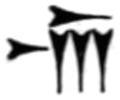
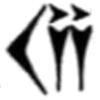
2 from Münter—a and b;
10 from Grotefend—s (or ç), r, d, p, t (24), u (36), sch (or š[441]), f, a (41) and kh or k—the same as those accepted by Burnouf;
1 from St. Martin—v;
2 from Rask—m and n;
2 deciphered simultaneously with Burnouf—k and z;
6 added by himself—i, t (22), m, d, g (35), g (44)—
twenty-three in all. There were also two added by himself nearly correct—w (10), t (13), which, as approximate values, may be allowed to pass, especially in consideration of the German pronunciation of w. Nine were incorrect—i (16), k (19), o (25), z (26), h (27), n (28), g (32), g (33), s (40).
But it contained a peculiarity of its own into which Lassen was betrayed by a desire to press the grammatical forms of Zend upon the cuneiform language. In the first place he insisted with not less force than Burnouf, in distinguishing the long and short vowels. Each of the vowels a, i, u are accordingly allotted two distinct signs, and one of his defective signs is pressed into the service in order to secure a û. But in addition to this his a (𐏃), when it occurs in the middle of a word, takes the value of ang; and in a similar position his î and û may become y and v. Still more remarkable is his treatment of diphthongs. He observed three instances in which two signs are seen frequently to follow each other. Of one of these accidental combinations he made a long ê,[442] of the second an ô[443] and of the third a q.[444] He forfeited much of the advantage of his greater command of correct values by falling into these errors. He, however, boldly recognised that some consonants are represented by more than one cuneiform sign, among which he includes t with four signs; s, v, n and m with two each. He was not uniformly correct in the signs he allotted nor in their number; but if he gave too many to t, which has only two, he did not give enough to m, which has three.
Lassen gave full credit to Grotefend for his ingenious discovery, and he admitted that the values established upon the authority of the three proper names were in all probability correct. But, so far as was known, Grotefend had never published any account of the method he followed to determine the other signs, a method that resulted in the production of words that had no resemblance to any human language, and that could not in fact be pronounced by any human tongue. Lassen did not put himself forward as an opponent of Grotefend, but as a continuator of his work from the point where he considered his predecessor had left it.[445] He would not even accept his reading of ‘Cyrus’ in the Murgab inscription, and in this his scepticism landed him in serious error. Lassen’s method was much the same as that of Burnouf. The signs not explained in the three proper names he regarded as doubtful or unknown, and he sought for them elsewhere especially in the proper names in the I inscription, where it might be possible to determine their sound by their occurrence in a word identified as that of some well-known country or province. The result of his special study of this text was that he made out correctly no less than nineteen of the twenty-four names it contains, which compares favourably with the eight of Burnouf. But in addition to these he added three that are not to be found in the original, by fancying he saw proper names in what are in fact merely common words. His nineteen names, however, provided him with abundant material to continue the work of decipherment.
One result of his study became immediately apparent to him. The constant agglomeration of consonants without the intervention of a vowel proved that in some cases the vowel must be inherent in the consonant. He arrived at this conclusion from the word ‘Çprd,’ which he found as the name of a country in his inscription, and which he concluded was Çapardia, or the Sapeires of Herodotus.[446]. We have seen that Burnouf was led to the same inference from the appearance of such forms as ‘izrk’ and ‘Aurmzda.’[447] Lassen also observed instances, such as the word ‘imam,’ where the word is sometimes written with and sometimes without the a (𐎠).[448] He at length laid down the rule that an a is only distinctly expressed at the beginning of a word, and in the middle before h or another vowel. On all other occasions, he says, it is inherent in all the consonants, unless distinctly excluded by the occurrence of another vowel.[449] This rule he afterwards applied more distinctly to the short a (𐏃), and adds that it is expressed when it follows the long â (𐎠), never after i or u.[450] In his transliterations he assumes the truth of this rule, and he invariably separates two consonants by the interposition of an a.
We have said that he may indisputably claim to have added six new values correctly to the alphabet, i, t, m, d, g (25), g (44).[451] The sign for i is the second letter in ‘Hystaspes,’ and it had been variously given the value of o by Grotefend and y by St. Martin, according as they followed the form ‘Goshtasp’ or ‘Vyschtaspo.’ But Lassen pointed out that the correct Zend form is ‘Vistaçpa,’ and he consequently, preferred i, a rendering confirmed by the word ‘imam,’ ‘this,’ which corresponds exactly to the Zend and Sanscrit word.[452] This alteration got rid of Burnouf’s (h)ôma (‘excellent’), which went to join the goodly company of Jamshid and the constellation of Moro.
The name ‘Katpatuk’ for Cappadocia, which Burnouf had already cited with good effect, was turned to farther account by Lassen. He not only used it to confirm the sign for k (𐎣) with which it begins and ends; but it enabled him to find a true sign for t, by comparison with other words in which it occurs.[453]
We have already said that Burnouf suspected that m was the true value of the sign Grotefend made an h, and that he only rejected it because he could not reconcile himself to the existence of two signs for the same sound. Lassen was less influenced by such considerations, and when he came to a word that transliterated ‘A r—i n,’ he had no scruple in completing it by writing an m for the unknown letter. Indeed the word occurred exactly where, from geographical considerations he would be led to expect ‘Armenia,’ and the conclusion would have been irresistible even if it had not been confirmed by the name ‘Chorasmia’ which he observed a little farther down in his list.[454] He made the useful remark that the sign was always preceded by i, the full signification of which was not then apparent. We now know that it is precisely the m before i.
The discovery of the sign for d was a happy intuition, and rested on slight evidence. He found in the eighteenth line a name of which he knew four letters, a i—u s, and he divined that the unknown letter was d, which enabled him to read ‘Aidus’ = India.[455] This guess was confirmed by one other instance only, where the same sign will make ‘daquista,’ which he thought was Zend for ‘the wisest.’ The word is really ‘duvaishtam’ and has quite another signification.
We have not noticed how he arrived at the value g for Grotefend’s u, or for the sign which Grotefend thought was a defective n. We find them without explanation in the place where they appear to be mentioned for the first time.[456] The first is g before a; the other g before u.
In addition to the six correct values just enumerated, Lassen was also very nearly successful in two others—w (𐎺, 10) and t (𐏂, 13), really v before a and tr before a. The latter he correctly acknowledged in a later work.
The first is the e of Grotefend in his ‘Darheusch.’ Lassen had the Hebrew form of the name ‘Darjavesch’ in his mind, and no doubt he suspected the presence of the sound of v in the Old Persian word. The discovery of the w was certainly ingenious, though scarcely convincing, if it had not been supported from other sources.[457] At the end of the B inscription there is a word in the nominative, ‘Akunush,’ which is found elsewhere with the accusative termination m, but, instead of the u, the sign now under discussion is substituted—that is, instead of ‘nus,’ we have n 𐎺 m. Now, he argued, it is impossible either in Zend or Sanscrit for a word whose theme ends with u to lose it in the accusative; and therefore the unknown sign must either be a u or the corresponding half-vocal v.[458] But in Darius, the letter that follows is a u, and therefore it must be the half-vocal—the only question being whether it is the Zend v or w. He eventually erroneously decided for the w, and pointed to two other words wᵃsna and wᵃzᵃrk, where as a w it would make excellent sense.[459]
With regard to the t, it will be recollected that Grotefend gave the value of n to a sign that completed the word ‘bun,’ to which he gave the meaning ‘stirps.’ This word had long been a stumbling-block to Zend scholars, and Lassen determined to get rid of it. He showed in the first place that the b or p at the beginning could not be interchangeable, and the word must at all events be treated as ‘pun’; but he proposed to alter it still further by reading ‘put.’ By this means he came nearer to its obvious meaning, ‘son’—that is, to the Zend ‘putra.’ He found this innovation supported by another word, k s t m, to which he thought he could attach a Zend meaning.[460]
The nine incorrect values he admitted into his alphabet[461] show little or no improvement on those suggested by Grotefend or Burnouf; and unfortunately the decipherer himself can rarely distinguish the incorrect values from the correct. A glance over a page of Lassen’s transliteration will show the havoc these nine incorrect letters have made in his work. But, as we have said, he introduced errors peculiar to himself that were even more fatal than his failure to identify all the signs correctly. For example, he remarked that the sign he took for a short a (𐏃) seemed composed of the sign for n (𐎴) and an angular wedge which might be an abbreviation of the sign itself. He was led to this hypothesis by comparison with the Zend, where ă is clearly a combination of a and n.[462] He goes farther and gives the short a and n the guttural sound of ang, when it is found before the letter he thought was h (𐎹, 27; really y), and he cites several instances which he thinks will justify this opinion. He recognises, however, that the rule even thus limited is not always applicable.[463]
Another error, due also to the deference he professed for Zend analogies, arose from the supposition that the two letters which he took for u and w had together the value of q. He compared them to the sound of q which is produced in Zend by the two letters sv or hv, the latter being modified into uv in the Old Persian.[464] Equally disastrous was his introduction of the two diphthongs hi for ê, and au for ô. He observed that these two letters are occasionally found together, and he concluded they must correspond to the Sanscrit diphthong ai = ê and au = ô. The occurrence of an h for an a in one of them was a matter of small difficulty. Indeed he had actually found the ai = ê in Aidus = India; and suggests that hi may be the form it assumes as a medial.[465] The most eccentric peculiarities of his transliteration may be traced to these unfortunate errors. His transformation of a into ng appears in his ‘Aurᵃngha Mᵃzdanga’ for ‘Aurahya Mazdaha.’ The diphthong uv with the sound of q seemed at first to yield a better result. By it he was able to read ‘Quarᵃzmiᵃh’ and ‘Arᵃqᵃtis,’ which are more suggestive of the true words Chorasmia and Arachosia than the correct forms ‘Uvarazamiya’ and ‘Harauvatish.’[466] But, on the other hand, it led him to read ‘qan’ or ‘qwan’ (Chaonia) for ‘Uvaja’ (Susa), ‘Aqᵃ’ for ‘Hauv,’ Patᵃqᵃ for ‘patuv,’ ‘Dᵃqistᵃn’ for ‘duvaishtam,’ and so forth. The diphthong hi (really yi) for the long ê produced ‘tesam’ in the place of ‘tyᵃisham.’ The diphthong au (really ku) for the long ô was still more disastrous. Burnouf, when he wrote ‘aqunuch,’ had nearly reached the correct transliteration of ‘akunaush,’ but it becomes scarcely recognisable in the ‘aônus’ of Lassen. The first sign of this diphthong had been long since correctly determined by Grotefend as a k. But its identification depended in great measure on the belief that Murgab, where it is the first letter in the inscription, represents the ancient Pasargadae, the city of Cyrus. Lassen would by no means accept this as sufficient proof, for even upon that hypothesis the inscription might not necessarily belong to Cyrus. St. Martin read it ‘Houschousch,’ and conjectured that this name referred to ‘Ochus.’ Lassen accepted this view, and saw in the first two signs, which he took for au, the strongest confirmation that they had the value of the ô long in Ochus. In 1845, when the result of his farther studies were published, we find that his original alphabet has undergone considerable improvement. He has suppressed the second signs for each of the vowels a, i and u, and the two diphthongs for the long ê and ô, that caused so much trouble, have disappeared. We hear no more of the double letters for q, nor of the second value ng which he ascribed to his initial a, now found to be more correctly h. He has also struck out the two defective signs he admitted for t and û. For the rest, the improvement consists chiefly in sweeping away the errors into which his love of Zend analogies had at first hurried him. The only addition he made to the number of his correct values was thr, suggested by Grotefend, to which, as we have said, he had previously nearly approached. The remaining signs now correctly represented are due to M. Beer and M. Jacquet, who wrote in the interval that separated the two Memoirs by Lassen.
Lassen’s translations are naturally much affected by the nine incorrect values he still retained, and by the errors he introduced himself. Yet if we compare the transliteration and translation of the Le Bruyn No. 131, as given by Burnouf and Lassen, we cannot fail to recognise the superiority of the latter. For the ‘Bu izrk’ of the one we have ‘Baga wazark’ of the other, which closely anticipates the ‘Baga vazraka’ of the correct version. The ‘Omam buiom,’ the ‘Homa excellent,’ is replaced by ‘imam buvam,’ ‘this earth;’ and many similar improvements may be noted throughout. Both writers succeeded fairly well in rendering the simple phrases, but great diversity still existed as to the meaning of the obscurer passages. Both alike declare that Auramazda is the creator of heaven and of man; and that he has established Darius or Xerxes as King. But when we proceed to the second paragraph of the inscription our translators go far astray. The passage beginning ‘king of countries’ is thus variously rendered:[467]
B. oahunâm pl. ôznânam.
L. dᵃnghunâm ps‘uwᵃznânâm.
S. dahyunâm . par’uv . zanânâm.
Trans. B. [roi] des provinces qui produisent les braves.
L. [rex] populorum bene parentium.
S. [König] der Länder die aus vielen Stämmen bestehen [or more simply by Menant: des pays bien peuplés].
B. âahâhâ buîôhâ izrkâhâ rurôh âpôh.
L. aᵃnghâhâ bu‘mihâ wᵃzᵃrkâhâ d’uriᵃh âpyᵃh.
S. ahyâyâ . bu‘miyâ . vazrakâyâ . d’uraiy . apiy.
Trans. B. [roi] du monde excellent, divin, redoutable, protecteur.
L. [rex] existentis orbis terrarum magni, sustentator, auctor.
S. [König] dieser grossen Erde auch fernhin [or, with Menant: ‘de cette vaste terre (qui commande) au loin et auprès’].
Lassen finishes thus: ‘Xerxes, rex magnus: ex voluntate Auramazdis (palatium) domitor Darius rex constituit. Is meus pater. Memet tuere, Auramazdes, heic felicitate: tum hoc ibi palatium, tum hoc patris Darii regis palatium, excelse Auramazdes, tuere heic felicitate’—a passage rendered by Menant: ‘Xerxès, le grand roi, déclare: Par la volonté d’Ormuzd, Darius mon père a construit cette demeure. Qu’Ormuzd me protège avec les autres Dieux, qu’Ormuzd avec les autres Dieux protègent mon œuvre et l’œuvre de mon père le roi Darius.’ The I inscription, from which Lassen derived so much assistance, fared badly at his hands when he attempted to translate its concluding lines. Even in the list of proper names he committed what must now appear to be the stupendous blunder of mistaking three common words for the names of three provinces of the Empire. The words so honoured are: ‘ushkahyâ,’ ‘darayahyâ,’ ‘parauvaiy,’ which figure as ‘Uscangha’ (the Uxii), ‘Drangha’ (the Drangii) and ‘Parutah’ (the Aparyten).[468]
His transliteration of the others is naturally frequently defective, but nevertheless he identified twenty correctly. The four he failed in are Susa, Arabia, Egypt and Ionia. It would have been difficult for him to recognise either Susa or Egypt, even if his transliteration had been more perfect. The first is represented in the cuneiform by three signs—u v j—and reads ‘uvaja,’ which certainly does not suggest Susa. But Lassen turned the uv into q; as the last letter in his opinion was n (𐎩, 28) he evolved q’n, from whence Chaona. The word for Egypt, as correctly transliterated ‘M’udray,’ would perhaps have been even more embarrassing than his own ‘Gudraha,’ in which he agreed with Burnouf in recognising ‘Gordyene.’ The word he read ‘Arbela’ was correctly translated ‘Arabia’ by Burnouf; and a somewhat too pedantic learning reconciled him to ‘Huns,’ which Burnouf had rightly rejected.[469]