Chapter III · DECIPHERMENT OF THE FIRST OR PERSIAN COLUMN—TYCHSEN TO LASSEN, A.D. 1798-1836.
Reading edition
We have already called attention to the important services rendered by Niebuhr to the study of the cuneiform inscriptions. The copies he made at Persepolis were by far the most accurate that had hitherto appeared, and the scholars who first applied themselves to the difficult task of decipherment worked chiefly upon them. He pointed out that the inscriptions generally occur in groups of three columns, and that in each the cuneiform signs are different. He pointed out also that the three different systems always recur in the same definite order: the signs characteristic of the first, second and third columns in one inscription always correspond to those of the first, second and third columns in the others. He observed also that the signs characteristic of the first column are evidently much simpler than those in the other two. After a careful comparison of the various places where they are found, he remarked that they were limited to forty-two in number; and these he collected and published together in his Plate 23, where they occupy a position that might at first sight lead the reader to suppose that they formed a part of the ornamentation of the sculptured staircase.[243] This is the first cuneiform alphabet ever published, and it was not the least important service rendered by Niebuhr to the study. Its formation was not so simple as might be supposed, and it would have been difficult to accomplish it except by a minute study of the monuments themselves. The inscriptions had hitherto been so imperfectly copied that no mere collation of them, however carefully made, could have succeeded in eliminating the whole of the faulty signs arising from the errors of the transcriber. The accidental addition or omission of a wedge, or an alteration in its direction, had the effect of magnifying the apparent number of the letters. It is a singular proof of the accuracy of Niebuhr’s judgment that he should have been so successful in this first attempt to distinguish between the genuine and the defective letters. In his list of forty-two signs, he has only introduced nine that are not true letters, including the sign that was afterwards found to be the mark of separation between the words.[244] On the other hand, amid all the conflicting signs found in the copyists, he passed over only two that are genuine: one (𐎦) is included by Grotefend in his list of defective signs; the other (𐎵) was first added to the alphabet by Rawlinson.[245] It proved of great advantage to concentrate the attention of scholars upon signs that were for the most part genuine, and to save them the dissipation of energy that would have resulted if they had been left to wander unguided among the inscriptions themselves. Niebuhr rendered a farther service by separating each group of wedges that formed a letter by a colon, an idea he copied from the Zend; and the eye thus soon becomes accustomed to recognise the complicated combinations that belong to each other. While he contributed so much to the correct apprehension of the alphabet, it is singular that he never remarked that the words themselves are regularly separated from each other by a diagonal wedge.
This fundamental fact also escaped the notice of Tychsen, who was the first to make a serious attempt at decipherment. Tychsen’s family was of Norwegian descent, but he was born in the small town of Tondern, in Schleswig Holstein, in 1734. Although of humble origin, he was sent to the University of Halle, where he early acquired a taste for Oriental languages. He was appointed a lecturer in the University of Bützow (1760) and subsequently transferred to the more important post of librarian and curator of the Museum at Rostock (1789). He attained a great reputation by his knowledge of Hebrew and Rabbinical archæology; and he was the first to lay the foundation of modern Biblical criticism. His Oriental studies embraced Arabic and Syriac; and he also wrote on the Cufic inscriptions preserved in Venice and London. His works include six volumes of archæological papers, which he calls ‘Pastimes of Bützow,’ ‘A History of the Rostock Library’ (1790), and two treatises on Arabic and Syriac (1791 and 1793). He is also mentioned as having written a treatise on Zoroaster. His opinions on cuneiform are contained in a curious tract entitled ‘De Cuneatis Inscriptionibus Persepolitanis Lucubratio’ (1798). He agreed with Niebuhr that the inscriptions are to be read from left to right, and that the three columns contain three different kinds of writing, which he thought concealed three different languages, probably the Parthian, Median and Bactrian.[246] He recognised that the characters in the first column are by far the simplest, and it is on them that he fastened his attention. By some means which he has failed adequately to explain,[247] he professes to be able to transliterate the cuneiform signs, and he has gratified the curiosity of the reader by presenting him with a table showing the values he has found for a great variety of signs, among which he admitted several that are defective. He saw that more than one sign may be used for the same sound; and he assigned four each to the letters l, r, s and x. Conversely, he thought that the same sign might express the most diverse sounds. E, n, t, are given as the different values of a single sign, No. 5 (𐎿). B, k, r, and b, x, y, are assigned respectively to two others, Nos. 27 (𐎹) and 31 (𐎴); while two different values for the same sign are quite common. Like many of his successors, he recognised a profusion of vowels, and he has allotted nine different signs to his three forms a, ä, ă. It is scarcely surprising that out of the nine, one turned out to be correct, No. 21 (𐎠); and of the four signs he allotted to s, one was correct, No. 38 (𐏁). He was also successful in detecting the signs for d and u: but as his system was based upon no intelligible principle, these results were purely accidental, and could not afford a guide to future inquirers.[248] Having succeeded to his satisfaction in finding known equivalents for the unknown signs, and being thereby enabled to transliterate the cuneiform text, the next step was to endeavour to make some sense of it. This he sought to do by comparing the singular words that resulted from his system with those of languages he thought must be the most nearly allied, such as Zend, Pehlevi, Chaldee, Arabic, Syriac and Armenian.[249] He failed to recognise fully the intention of the diagonal wedge, so that upon some occasions he rendered it by the conjunction ‘and.’ He had, however, the merit of pointing out that a particular group of seven cuneiform letters were continually recurring, often followed by the same group with three or four other letters added to the termination. These are enclosed by diagonal wedges, and we now know they are single words, the simplest form being the nominative singular of ‘King,’ and the two longer the same word with the addition of the genitive singular and the genitive plural terminations. But Tychsen had no suspicion, at this time at least, that the letters occurring between the diagonals must be treated as one word,[250] nor that the terminal variation was a grammatical inflexion. Accordingly he makes the simple form of seven letters represent two words, which he transliterates and translates Osch Aksak, ‘is Aksak’; and the two longer groups he treats as three words—Osch Aksak yka, ‘is Aksak divus,’ for the first; and Osch Aksak acha, ‘is Aksak perfectus,’ for the second.[251] The personage named Aksak, whom he had thus evolved, he took to be Arsaces, the founder of the Parthian dynasty; and he accordingly found himself compelled to attribute the inscriptions and monuments to that comparatively late date.[252] Tychsen’s efforts at translation were exhausted by his rendering of the B and G Inscriptions of Niebuhr both of which he found to belong to Aksak; but he has transliterated the Inscriptions A, H, I, and L, for the benefit of other scholars who may wish to read some meaning into them. The curious feature of his system is that some of his letters actually turned out to be correct, such as his a, u, s, or sch. But as these results are purely accidental he cannot be allowed to have made any real contribution to cuneiform decipherment.
Immediately after the appearance of his tract, it was assailed by Witte, a professor of his own university, who seized that occasion to revive the old view of Dr. Hyde that the cuneiform characters were simply designed as a fantastic ornamentation and had no other signification.[253] On the appearance of Grotefend’s system, Tychsen had the singular magnanimity to abandon his own and he became one of the principal exponents of the theories of the younger scholar.
In the same year (1798) that Tychsen published his ‘Lucubratio,’ a paper on the same subject was read before the Royal Academy of Copenhagen, by Dr. Münter. Münter’s father, who was a clergyman and a poet, was born at Lübeck and died at Copenhagen, where he was pastor of the German church. His son Frederick was born at Gotha, in 1761, but his youth was passed at Copenhagen, and many of his works were written in Danish and subsequently translated into German. Like his father, he entered the Church, and became a Professor of Theology at Copenhagen, and eventually rose to be the Bishop of Seeland (1808). He was a very prolific writer, especially upon theological subjects. His works include a ‘History of Dogma’ (1801), a ‘History of the Danish Reformation’ (1802), and the last, which is considered to be the most important, was on the ‘Symbols and Works of Art of the Early Christians,’ published in Altona, 1824. He also acquired considerable reputation as a philologist and Orientalist. His paper on the Cuneiform Inscriptions was published in Danish in 1800, and translated into German in 1802. It was not till then that it became accessible to the general reading public, and very soon afterwards M. de Sacy noticed it in the ‘Magasin Encyclopédique.’[254] Münter had long been in correspondence with Tychsen on the subject of their common studies; but the two scholars arrived at widely different results. While the latter invented a system of interpretation that enabled him to transliterate the inscriptions with comparative facility, the former could not admit that the solution of the difficulty rested upon any satisfactory basis. His own contribution, if much more modest, is not on that account less valuable.
Münter, in the first place, rendered important service to his successor, Grotefend, by sweeping away the foolish conjecture that the inscriptions belonged to the Parthian age, and with it the misleading inference that the name of Arsaces was to be sought for among them. In a few masterly pages, remarkable alike for wide knowledge and accurate judgment, he showed that Persepolis could only be referred to the Achaemenian kings, an opinion that had already gained the support of Heeren, in opposition to the authority of Herder, who ascribed it to the mythological age of Jamshid.[255] It might be thought that the claims of Darius or Jamshid to be the founder of Persepolis would not give rise to heated discussion; yet in the beginning of last century the tranquillity of Göttingen was convulsed by the fierce controversy that raged between the two learned advocates of the rival theories.[256]
Münter did not profess to be able to transliterate and still less to translate the inscriptions. His pretensions were limited to a very tentative endeavour to assign values to thirteen characters; and of these, four were not derived from Niebuhr’s list, and they turned out to be merely errors of the copyist. Having fixed the date of Persepolis and presumably therefore of the inscriptions, he inferred that the language must be closely allied to the Zend or the Pehlevi. He made a minute investigation of all the cuneiform inscriptions that were known in his day in Europe, and studied Kaempfer and Le Bruyn with the same attention as he studied Niebuhr. He accepted Niebuhr’s division of the Persepolitan inscriptions into three different kinds of writing; and he conjectured that the first was alphabetical, the second syllabic, and the third ideographic. The latter he thought bore some resemblance to Chinese. He saw that the language of the first column admitted of too many vowels to be closely related to the Pehlevi. He was, on the whole, disposed to think that the three columns contained translations of the same text into different languages, which might probably be Zend, Pehlevi and Parsi.[257] On this point, however, he did not consider the evidence sufficient to exclude all doubt. Indeed, he said the three columns might turn out to be in the same language, expressed in different characters.[258] He studied carefully the inscriptions that occur on vases, cylinders and bricks from Babylon, a few of which were then beginning to find their way to the European museums and the private collections of Sir W. Ouseley and Mr. Townley. The most important of these was upon the vase described by Caylus, which, in addition to the cuneiform inscription, was also inscribed with Egyptian hieroglyphics.[259] Tychsen pronounced the latter to be Phoenician, and he believed that the urn itself had formerly contained the ashes of his friend Aksak.[260] Münter made the more important remark that the characters on the Babylonian relics were nearly identical with that of the third Persepolitan column.
Meanwhile, he devoted his attention exclusively to the simplest form of writing, which is found in the first column; and he speedily recognised that the diagonal wedge which occurs so frequently was evidently intended to separate one word from the other. He compared it to the cypress tree that divides the groups in the procession on the sculptured staircase seen at Persepolis; and adds that in one of the old Hindu alphabets the words are similarly separated by a small oval.[261] This discovery, now announced for the first time, had till then escaped the observation of Tychsen, who, it will be remembered, fancied he found three different words enclosed within the same diagonals. In order to find values for the cuneiform letters, he had recourse to a twofold method. He sought out the signs that recurred the most frequently and that were the most uniformly repeated in the same word, for he concluded that these would naturally turn out to be vowels. He soon identified three in particular (𐎠, 𐎹, 𐏂) that were constantly recurring: the first in almost every word, and occasionally several times in the same word.[262] In the inscriptions analysed, he found that the first was repeated 183 times, the second 146, and the third 107 times.[263] He then proceeded to compare the forms of these letters with those of the vowels in other kindred languages; and he thought he discerned a strong resemblance between the first and third in the Zend character for a and in the Armenian for o.[264] He could not find a letter anywhere that resembled the second. However, he observed another cuneiform sign that also recurred with great frequency (𐎶), and which might easily bear comparison with the Zend letter for a long.[265] A likeness between a defective cuneiform sign () and the Zend letter for i gave him a fourth vowel. Similar considerations led him to assign the values of ou w ii y to another sign (𐏁), a conjecture that turned out to be less happy than that of Tychsen, who accidentally hit upon its correct value, s. Münter had now pointed out six signs he thought expressed vowels (viz. 𐎠 e or a, 𐎹?, 𐎡 o, 𐎶 a, i, 𐏁 ou, &c.). The second he dropped out of his alphabet, for after careful search he could find no letter in any other alphabet to give him a clue to its value. The fifth was not a genuine letter; and of the four that remained two were, as he surmised, vowels (Nos. 1 and 3). The other two were both consonants. Only one of the former—the first, a—was found to be correct; but it had already been recognised by Tychsen. The other—the o—was afterwards found to be i. He also identified seven other signs with the consonants p, kh (two), r, r strong, s and b, which he obtained by the simple process of comparing them with other letters found in Zend, Armenian and Georgian, to which they had ‘no small similarity.’[266] Three of the signs he selected were not genuine; and of the four others the only one that was correct was b (𐎲). His efforts in this direction were thus limited to finding correct values for two signs (a and b).[267]


Like Tychsen, he was attracted by the frequent repetition of the word of seven letters. In one short inscription it may be found five times, and it is repeated at least twenty-eight times in the inscriptions copied by Niebuhr. He also observed that the same seven letters occur frequently with a terminal addition of three or four other letters, and this word is immediately preceded by the simpler form in seven letters. He concluded that the additional letters must be an inflexion: not, as Tychsen thought, an independent word, such as ‘pius’ or ‘perfectus.’ Münter confessed his inability to read the word, but he regarded it as the key of the whole alphabet.[268] His first impression corresponded with that of Tychsen, in so far as he supposed it to be a proper name.[269] But its recurrence so frequently seemed to discredit this supposition, particularly as no name of any king of the Achaemenian dynasty appeared to fit into seven letters.[270] Then he assumed it must be a title, possibly ‘king of kings,’ and in that case he clearly saw that the preceding word must be the name of the king. Here he had got on the right track, for the word does in fact signify ‘king,’ and the one that precedes it, at the beginning of the inscriptions, was afterwards found to be the royal name; but he ultimately rejected this explanation, because in Niebuhr’s Table A it followed a word of two letters, which could not possibly express the name of any of the Achaemenian kings. The passage he refers to happens to be erroneously copied, for a diagonal wedge has been introduced where there should be a letter, and Münter was misled by this unfortunate mistake. He thus abandoned an hypothesis that, if persevered in, might have led to some result. He may also have thought that the word of seven letters was too long to be simply ‘king,’ and consequently he made the unfortunate guess that it signified ‘king of kings.’ This assumption stood greatly in the way of his arriving at the correct meaning. The truth is that the two words already referred to as occurring together are required to make up the signification of ‘king of kings,’ the second being merely a repetition of the first with the addition of the genitive termination, corresponding to ‘rex’ and ‘regum.’ Münter could derive no assistance from a Zend grammar, for at that time none had been written.[271] What information he collected by his own study afforded him no help in the present matter. According to his transliteration, he knew three out of the four letters with which the longer word terminates: these were e; an unknown sign, possibly a j, followed by ea; but Zend could not guide him to the signification of the inflexion ‘ejea.’ The transliteration was at fault, for the four letters are really ‘anam,’ which corresponds exactly to the Zend genitive plural. To be thus baffled when so near the truth is a curious illustration of how completely even an exceptionally keen inquirer may fail to recognise what might seem self-evident. With the very phrase ‘king of kings’ constantly present to his mind, it never struck him that two words occurring one after the other, and differing in only what he recognised to be an inflexion, were precisely the ‘king of kings’ he was in search of.[272]
In this dilemma De Sacy suggested that the word or words were probably a religious formula, such as an invocation of God or the Ferhouer, and this opinion gained confirmation by its occurrence on cylinders and bricks which Münter had no doubt were inscribed with magical incantations. He was thus led far away from the true solution.[273]
Münter made a careful study of the words that showed a change of termination, and he drew up a list of seven of the most common inflexions.[274] The two last in this list are the ones added so often to the enigmatical word he vainly sought to read, and which are, as we now know, the signs of the genitive singular and plural.
His inquiries did not pretend to go beyond the first or simplest species of writing, but he took occasion to point out the signs in the second and third columns that correspond to the word of seven letters. Their identification, he argued, is indisputable, for when the word occurs twice in succession in the first column the corresponding signs are similarly repeated in the second and third; and their restricted form clearly indicates that they must be syllabic or ideographic.[275]
The Persepolitan inscriptions were now tolerably well known to persons interested in such matters, by the plates of Le Bruyn and more especially by those of Niebuhr. But the inscriptions from Babylon had only just begun to attract notice. So far back indeed as the beginning of the seventeenth century Della Valle, as we have seen, had sent a few inscribed bricks to Rome, but they had received little attention.[276] Later travellers do not appear to have mentioned the existence of these curious relics till the end of the eighteenth century, when Père Emanuel, a Carmelite, who resided at Bagdad, gave a description of them in a manuscript referred to by D’Anville in the Memoirs of the Academy of Inscriptions.[277] Soon afterwards the Abbé Beauchamp, in his account of Hillah, says he found ‘large and thick bricks imprinted with unknown characters, specimens of which I have presented to the Abbé Barthélemy.’[278] His account excited some interest, and it was translated into English in 1792, and also into German by Witte of Rostock. Several of the bricks were deposited in the National Library at Paris, and plaster casts of them were sent to Herder and Münter. Shortly afterwards the same collection was enriched by the Egyptian vase already mentioned, which Count Caylus had discovered, and which he described in his ‘Recueil d’Antiquités.’[279] About the same time also various cylinders and bricks found their way to different European museums and private collections. Drawings of a few of these were also to be found in Caylus; and in 1800 Münter published two others from Babylonian bricks that had not seen the light before.[280]
Meanwhile the directors of the East India Company gave instructions to the Resident at Bussorah to secure ten or a dozen specimens for their museum (1797). They said they had heard that near Hillah ‘there exist the remains of a very large and magnificent city, supposed to be Babylon, and that the bricks contain an indented scroll or label in letters totally different from any now made use of in the East.’[281] The bricks reached London in 1801, and the task of copying and describing them was entrusted to Joseph Hager. Hager was a curious specimen of the wandering scholar, and he enjoyed a reputation that appears to have been quite out of proportion to his acquirements. He was of Austrian descent, but he was born at Milan in 1757, and died at Pavia in 1819. He early took to the study of Oriental languages, and especially Chinese. He roamed about Europe, visiting all the libraries from Constantinople to Madrid, and from Leyden and Oxford to the south of Italy. He wrote both in Italian and German, and apparently also in English and French. One of his first works was in German on a Literary Imposture (1799), and he became known in England as a contributor to Ouseley’s Oriental Collections, and by a book on the ‘Elementary Characters of the Chinese’ (1801). It was in this year that his Memoir on the Babylonian Inscriptions was written, and shortly afterwards he settled in Paris, and was commissioned by Napoleon to compile a Dictionary of Chinese in Latin and French (1802). For this he was to receive 6,000 francs a year; but after some time a suspicion arose as to his qualifications and industry. The result of an inquiry was that he was removed from his post, and he left France in 1806. We afterwards find him a teacher of German at Oxford, and in 1809 he retired to Pavia to fill the chair of Oriental Languages. He wrote several books on Chinese, including a Grammar, a Prospectus of a Dictionary, a ‘Panthéon Chinois,’ and the like; but they were severely handled by the most competent critics. He, however, accomplished his work on the Inscriptions with a fair degree of merit. He began by publishing one of them in the ‘Monthly Magazine’ (August 1801) without note or commentary. It fell into the hands of a M. Lichtenstein, and gave rise to a very foolish essay, to which reference will shortly be made. Next year Hager published the others, accompanied by a learned Dissertation on the subject.[282] He pointed out, as indeed had been already done by Münter, that the characters on the bricks are ‘formed of nearly the same elements and nail-headed strokes’ as at Persepolis; but he showed for the first time that the system of writing must have originated among the Chaldæans, who ‘were a celebrated people when the name of the Persians was scarcely known.’[283] He considered that many ancient alphabets were derived from the cuneiform, even including Devanagari, the oldest Sanscrit character, which was popularly ascribed to Divine revelation.[284] He finds many of the Babylonian characters the prototypes of Samaritan or Cuthean, and the similar Phoenician letters. Finally he shows with striking effect the wedge-like and angular origin of our own alphabetical system.[285] He called attention to the ancient custom of cutting inscriptions upon pillars and columns, and he considers it natural on that account to find that ‘the writing of the ancients was perpendicular rather than horizontal, columns and pillars being much fitter for the former manner of writing than for the latter.’[286] Such at least was the direction of the Egyptian, Ethiopian and Chinese. On account of the absence of stone in Babylon, it was necessary to substitute bricks, and we learn from Clement of Alexandria that Democritus took his treatise on Morals from an inscription written on a brick column.[287] The columnar origin of writing is perhaps the reason that the inscription on the Babylonian bricks is, as Hager asserts, ‘perpendicular rather than horizontal,’ an opinion he thinks he can prove by the gems he has studied. Various conjectures as to the subject of the legend on the bricks had been put forward. Münter and Grotefend thought it was a talisman;[288] others that it recorded some historical event or an astronomical observation; but Hager suggested that the subject was probably the same as that on the Roman bricks: that is to say, that it recorded the name and the place of the maker—a suggestion that turned out to be very nearly correct. He had no doubt that the writing was the same as that discussed by Democritus in his lost treatise, and which is referred to by many of the classical writers.[289] He considers that it is ideographic, ‘for we find single groups composed of abundance of nails, like the various strokes in the Chinese characters, all different from each other and different from the Persepolitan.’ Nor does he consider that they were developed from hieroglyphics, but deliberately ‘formed and combined by an arbitrary institution, and designed to express, not letters nor syllables, but either whole sentences or whole words.’[290] Finally he suggests that the Persepolitan mode of writing was directly derived from the Babylonian by simply laying the perpendicular inscription upon its side; by that means the heads of the wedges that were originally at the top are now all turned to the left, and the inscription that was originally read from top to bottom becomes by its changed position always read from left to right. ‘If we turn our perpendicular characters in such a manner as to make them lie in a horizontal direction, the effect will be exactly what takes place in the Persian writing.’[291] This is a remarkable anticipation of a much later discovery.
Hager’s book was still going through the press when another important inscription was added to the Paris Library (1802). It is on a stone found by M. Michaux at Tak Kasra below Bagdad. The Vase of Caylus and the Caillou Michaux continued for a time to be the two most celebrated samples of the Persepolitan and Babylonian styles in Europe. Later on, the Persepolitan collection was enriched by the discovery of the ‘Suez Stone,’ published in the ‘Travels of Denon,’ in 1807. But all these were entirely eclipsed by the long inscription found at Babylon and sent by Sir Harford Jones to the India House. It was long known simply as the India House Inscription, till later knowledge proved it to be the Standard Inscription of Nebuchadnezzar. Shortly afterwards (1808) the Library of Trinity College, Cambridge, received an inscription from Sir John Malcolm of which we hear little till a much later period.
We have said that an inscription published by Hager without commentary in 1801 fell into the hands of Lichtenstein, who made it the subject of a Memoir published in the ‘Brunswick Magazine.’[292] This eccentric writer put forward the theory that the bricks concerning which so much noise was being made were in fact not older than the seventh or eighth century A.D., and that the characters bore a ‘striking resemblance’ to Cufic.[293] Nothing more was necessary than to remove the arbitrary additions of unnecessary wedges, in order to detect the Cufic symbols they concealed. Unlike most other scholars, he chiefly studied the Babylonian bricks and the most complicated of the Persepolitan systems; and he regarded an entire group of characters as only one letter. Having reduced it to the necessary simplicity by simply dropping out all the inconvenient wedges till he could discover something that suggested the appearance of a Cufic letter, he was enabled to draw up an alphabet by which he read all the cuneiform inscriptions with the greatest ease.[294] He then discovered that the language was an ancient form of Arabic and should be read from right to left. He was quite surprised that Hager should have been so deluded by wild dreams of Belus and Semiramis that he failed to see that his bricks ‘contained only a few miserable sentences in Arabic.’ What the Arabic words really were he did not consider it necessary to disclose to the public, but he communicated a few of them to De Sacy, who pronounced that they were not Arabic at all. Lichtenstein was good enough to translate Hager’s brick, and found that it was a prayer; from thence he passed on to Niebuhr’s inscriptions, and selected the difficult specimens (C, E, and L, Pl. 24). From C he obtained the most astonishing result. The words ran as follows: ‘The King, the Sovereign, Prince of all Princes, the Lord Saleh, Jinghis, son of Armerib, governor-general for the Emperor of China, Orkhan Saheb.’[295] Encouraged by this striking success, he next took in hand the long inscription on the Caillou Michaux. It was written, he says, in Armenian, and contains an exhortation addressed by a priest of the ‘Temple of the God of the Dead’ to certain women mourning their departed friends.[296] De Sacy, from whom our information is taken, gives more than a page of this pious effusion, which he says is not more than a sixth part of the translation. It is needless to say that the whole is a pure invention. Indeed it does not clearly appear whether the Memoir was intended by Lichtenstein as a jeu d’esprit, or whether it was simply an impudent imposture. It is certainly curious that he succeeded in getting himself treated seriously. Besides the solemn review and confutation by De Sacy from which we quote, we find so late as 1820 that Grotefend still thought it necessary to combat his theories, and De Sacy even at that period classified together ‘the conjectures of Lichtenstein and the labours of Grotefend’ as equally open to suspicion.[297]
We now come to the scholar to whose ingenuity we owe the first real success that was achieved in deciphering the cuneiform letters.
George Frederick Grotefend was born at Münden, Hanover, in 1775. He was sent to the University of Göttingen in 1795, where two years later he obtained a tutorship. He applied himself to the study of philology under Heyne, and in 1803 he became Pro-Rector. Soon afterwards he was transferred to the Gymnasium of Frankfort on the Maine; and in 1821 he became Rector of the Lyceum at Hanover, where he died in 1853. He was always an industrious student, but he failed in after life to follow up his first great success; and if it had not been for it, his name would probably never have been known. In 1817 he published a Latin Grammar, which was translated into English under the supervision of Dr. Arnold; and subsequently he did some useful service by his inquiries into the early Italian languages. In 1835 he published a book on the Rudiments of the Umbrian, and, in 1837, another on the Oscan, and these were followed in 1840 by a Geography and History of Ancient Italy. The paper on the Cuneiform Inscriptions that first brought him into notice was read before the Göttingen Academy on September 4, 1802; and, curiously enough, at the same sitting Heyne first called attention to the Greek inscription on the Rosetta Stone, from which the reading of Egyptian hieroglyphics takes its departure.[298]
Grotefend himself informs us that he had no special knowledge of Oriental languages,[299] and many of his critics, who were probably quite as ignorant as himself, took care that the fact should not be forgotten. Although he had no special qualification in this respect for the task he undertook, yet he early displayed a remarkable aptitude for the solution of riddles: a peculiar talent which he shared in common with Dr. Hincks, who also acquired great distinction as a cuneiform scholar. In consequence of this peculiarity a friend induced him to turn his attention to Niebuhr’s enigmatical inscriptions, which were then exciting very general curiosity;[300] and he now disclosed the result to the Academy. He communicated the substance of it to the ‘Göttingen Literary Gazette’ (Sept. 18, 1802); and in the following year Silvestre de Sacy, the well-known Arabic scholar, gave a full account of it in the ‘Magasin Encyclopédique’ of Millin.[301] It was subsequently reported in the well-known Vienna periodical, the ‘Fundgruben des Orients’;[302] and in 1815 Grotefend had the opportunity of explaining the matter in his own words in an appendix to Heeren’s ‘Historical Researches.’[303]
The careful investigations of Münter were found of great service by his more successful follower. Münter had already pointed out that the inscriptions belonged without doubt to the period of the Achaemenian dynasty; that the words were separated from each other by a diagonal wedge, and that the writing ran from left to right. He had directed special attention to the word of seven letters, and to the fact that it preceded in many cases another identical to it but terminating with some unknown grammatical inflexion. He had suggested that the former probably signified some such title as ‘king of kings’ and that the royal name must be looked for in the word that precedes it, an opinion he only abandoned in view of the difficulties already explained.
Such was the state of the inquiry when Grotefend entered upon it. The Memoirs on the Antiquities of Persia, published by M. de Sacy in 1793, afforded a sort of text-book to the decipherer. De Sacy had succeeded in reading some inscriptions at Naksh-i-Rustam, written in Pehlevi. Like those at Persepolis, they were engraved above the sculptured representations of kings, and they were found to contain the royal name and title. Grotefend inferred that the cuneiform inscriptions had very probably served as models for these later legends. The simplest of these and, from its brevity, the one that afforded the most striking resemblance to the B and G of Niebuhr ran: ‘N N rex magnus rex regum [rex-um] Filius ... [regis] stirps Achaemenis[?]’[304] The first step Grotefend made in advance of his predecessor was to perceive that it required two words to make up the phrase ‘king of kings,’ and that these two words no doubt corresponded to the two in the cuneiform: the one with seven letters and the longer form of the same word that followed it. This apparently obvious necessity had, as we have seen, wholly escaped Münter. When it was once recognised that the word of seven letters was clearly ‘king,’ it became obvious that, according to the analogy of the Pehlevi model, the first word of the inscription was the name of the sovereign, the third a qualifying title corresponding to ‘magnus’ and the two following, where he found the word of seven letters again repeated, and on this occasion followed by the longer form, evidently corresponded to ‘rex’ and ‘rex-um’ (‘regum’).
Comparing the two inscriptions (B and G), he found they began with different words, which he now inferred were the names of two different kings; but he observed that the name in B, which was presumably in the nominative case, also occurred in the third line of G with a case-ending, followed by the word for ‘king.’ also with a case-ending. The termination differed from that already observed in the phrase ‘king of kings,’ and it marked, no doubt, the genitive singular, as the other denoted the genitive plural. Referring to his Pehlevi model, he inferred that the passage indicated the relationship of the two monarchs, and that the king of the second inscription (G) here declared himself to be the son of the king of the first inscription (B). This little bit of ingenuity solved the whole mystery. In the corresponding place in B he found another word in the genitive case, which was no doubt the name of the father of the king of that inscription; and he remarked that this name was not followed by the royal title. He had thus discovered the cuneiform signs that, with little doubt, expressed the names of three Achaemenian princes, and he had recognised that these personages stood to each other in the relation of father, son and grandson, and that the first was probably not of royal rank. That is to say, from ‘G’ he found that ‘King Z’ was son of ‘King Y’; and from ‘B’ he found that ‘King Y’ was son of ‘X’ without the addition of ‘King.’ It only remained to determine who these three princes were most likely to be: and as the Achaemenian dynasty was a short one and their names already known from history, the task was not a difficult one. The two kings at the head of the inscriptions could not be Cyrus and Cambyses, because their names did not begin with the same cuneiform letter; they could not be Cyrus and Artaxerxes, because there is no such discrepancy in the length of the cuneiform words. There thus only remained Darius and Xerxes for the names occurring first in the two inscriptions; and this result was confirmed by the absence of the royal title from the name of the father of the king in one of the inscriptions, for he recollected that Hystaspes is not called king by the Greek writers. He assumed, therefore, that the first word in B was Darius (and it must have been satisfactory to notice that the second letter, a, was precisely the a of Münter) and the other Hystaspes; while the first word in G he assumed was Xerxes.
From these three known words he now set himself to get at least the approximate values for the letters they contained. According to De Sacy, Grotefend first transliterated Darius and then Xerxes, from which two names he obtained the word for ‘king,’ and finally he transliterated Hystaspes. But according to Grotefend’s own account of the matter, he fastened in the first instance on the word that should read ‘Hystaspes.’ It consists of ten cuneiform signs, including the inflexion. He learned from Anquetil’s Zend-Avesta that the Zend form of the name was Goshtasp, Gustasp, Kistasp. Placing a letter of the name under each cuneiform sign, he arrived at the following result:
𐎻 · 𐎡 · 𐏁 · 𐎫 · 𐎠 · 𐎿 · 𐎱·
G o sh t a s p.
Here, then, were seven letters of the cuneiform alphabet for which values were provisionally assigned and three left over for the genitive termination. The word for Darius also consisted of seven letters, which he at first read thus:
𐎭 · 𐎠 · 𐎼 · 𐎹 · 𐎺 · 𐎢 · 𐏁·
D a r — — u sh.
The process so far was confirmed by the repetition of the same letters a and sh in both words in the position in which they were to be expected. There was more difficulty with Xerxes. The cuneiform word consisted of seven letters:
𐎧 · 𐏁 · 𐎷 · 𐎠 · 𐎲 · 𐏁 · 𐎠
— sh — e r [305] sh e
of which he already knew, or guessed, five, and these known values occurred in the order he expected; the first and third letters remained to be determined. It happens that Herodotus mentions that the name of Xerxes corresponded in sound to that of the Persian for ‘warrior’ or ‘king’; and Grotefend noted that the first two letters in the words for ‘Xerxes’ and ‘king’ were the same in the inscriptions. He ascertained that the Greek letter ξ transliterates the Zend ‘kshe’; but he could find nothing in the Zend vocabulary under ‘kshe.’ There were, however, several forms under ‘kh,’ ‘sh,’ which left no doubt that the first letter required should be read ‘kh.’ This assumption also enabled him to read the word for ‘king’ which had so long attracted attention. Of the seven letters that composed it he now knew four, which occurred in the order
𐎧 · 𐏁 · 𐎠 · 𐎹 · 𐎰 · 𐎡 · 𐎹.
kh sh e — — o —.
The Zend word for ‘king,’ ‘khsheio,’ corresponds almost exactly to the form thus reached,[306] and it enabled him to add i conjecturally to his alphabet (𐎰). No explanation of the third letter in ‘Xerxes’ had yet presented itself; but it nearly resembled the fourth and seventh in the word for ‘king,’ and the fourth in the signs for ‘Darius’; and Grotefend presumed—erroneously, as it turned out—that they were the same. He observed that in Zend the aspirate is sometimes left out, and he thought the Zend kh sh e i o might very well be supposed occasionally to take an h. He accordingly conjectured that this was the value of the unknown letter, and he read kh sh e h i o h for ‘king,’ kh sh h e r sh e for ‘Xerxes,’ and D a r h e u sh for ‘Darius.’ It was not, therefore, till this point had been reached that he completed ‘Darius’ by the addition of h. He was led to decide for e as the value of the fifth letter, 𐎺, by the pronunciation of the name of Darius in Hebrew.[307] The form for Xerxes must have seemed at first sight rather disconcerting; but by the time the Appendix was republished, in 1824, Grotefend was able to announce that his conjecture was fully confirmed by Champollion, who spelt out the hieroglyphics for Xerxes on the Vase of Caylus to read Kh sh h a r sh a.
The result of his labours on the three proper names was that he arrived at the values of thirteen cuneiform signs: G o sh t a s p from Goshtasp or Hystaspes; D r e u from Darius, and kh and h from Xerxes. Of these thirteen letters, nine turned out ultimately to be correct; but the a had been previously recognised by Tychsen and by Münter: so that Grotefend now added eight correct values to the cuneiform alphabet, viz. sh t s p—d r u—kh.
He did not, however, rest satisfied with this achievement. He sought to transliterate and translate the remainder of the two inscriptions, but in this his fortune failed him. He does not explain in his own Memoir the method he pursued, but de Sacy has given us an insight into the process which no doubt rests on good authority.[308] We may suppose that he kept the Pehlevi inscription before him and continued to be guided by its analogy. He accordingly expected to find that the word after ‘king’ would express some honorary epithet corresponding to ‘magnus’ in the example before him. It was in fact composed of four letters of which he already knew the first and third, e — r —. The nearest word in Zend to suit his purpose was e gh r e, ‘strong.’ He therefore considered himself entitled to add a gh and another e to his list—both wrong.
So also in the position in the cuneiform where he should expect to find a word corresponding to the one translated ‘stirps,’ in the Pehlevi he observed a word of three letters of which he knew the first two, p, u —. He hit upon a word in Pehlevi—bun—that had precisely the signification of ‘stirps.’[309] So he gave his p the alternate value of b, and added n to his list. These also were both wrong. His attention was next turned to the two different inflexions which had been remarked at the end of ‘king.’ In the one consisting of three signs, he already knew the two last, — h a, and, for some reason we have not found explained, he assumed the first (𐏃) was a second sign for a. In this addition to his alphabet he was nearly right, for the letter has the value of h before a, i, u. In the second inflexion of four letters the first and third signs are the same, his e or a; and he learned from Anquetil that the Zend has a genitive ending e tsch a o. This was sufficient to add tsch and another o to his alphabet—both wrong. Here, then, are six more letters, gh, e, n, a, tsch and o, to be added to the thirteen already found, making nineteen in all. There are twenty-five letters in the two inscriptions given by De Sacy in 1803; and there is no doubt that before that time Grotefend had, with two exceptions, completed his alphabet, as it is found in the Appendix to Heeren in 1815.[310] According to it we see that he had already attempted to assign values to thirty-seven cuneiform signs, three of which are not to be found in Niebuhr’s list and are due to defective copying. Two others occur in Niebuhr’s list, but are also defective (e, , and r, letter No. 8), so that there remain thirty-two genuine signs for which he has now found values. Several signs are, however, allotted to express the same sound. Thus he gives three signs for e (Nos. 3 [defective], 4 and 10) besides the sign for e or a which he generally transliterates e. He also gives three signs for o (Nos. 12, 16 and 23). It was afterwards found that these signs, which he took to be synonymous, are very far from being so: for example, not one of his three signs for o has that value, being respectively i, ch(a), and m(a). Indeed, among all the additions we are now considering he only succeeded in arriving at two correct values, 𐎳, f (No. 39) and 𐏃, a (No. 41), if indeed the second may be allowed to pass. Its true value is the aspirate h. But, as we shall afterwards see, it takes an inherent a, and it is very commonly used to express the sound ‘Ha,’ the vowel a being altogether omitted. In an inquiry of this kind it is necessary to admit approximate values as correct; and in the present case the value allotted to this sign by Grotefend ultimately led to the important identification of the word ‘Achaemenian.’ Here the first syllable, ‘Ach,’ is represented by the two signs for h and kh; and before it was known that the first letter had the sound of ‘Ha’ it was a comparatively slight error to drop the aspirate and set it down as a. We have therefore added this letter to the number of Grotefend’s correct discoveries. He also observed that the word for ‘king’ is often represented by an ideogram (𐏋) which, like the word, is subject to inflexions. This discovery he, however, generously attributes to Tychsen;[311] but we have not found it in the ‘Lucubratio.’ De Sacy was not aware of the origin attributed to it, and he has given the credit entirely to Grotefend himself.[312]
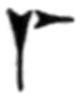
Soon after the completion of the alphabet, but still before the appearance of the Appendix in 1815, he was induced to change the value of two of the signs.[313] One of these he now fixed correctly, k (25), and the other approximately sr (40).
It will be recollected that Sir William Ouseley visited Murgab in 1811 and made a copy of the inscription that is found repeated there several times. His book did not appear till 1821; but Grotefend had the advantage of seeing a copy of the inscription in time to include it in his Memoir. According to the alphabet as it then stood, the transliteration would render z u sch u d sh;[314] but if we follow his own account, he saw reasons, which he does not explain, to change the first letter from z to k and the third from sch to sr; with the result that he produced k u sr u e sch, which he read ‘Kurus.’ He does not mention the change of the d into e, but a more correct copy of the same inscription showed that that sign did not exist in the original, which consists of five signs only. After he had arrived at this result, he tells us, he came across the French translation of Morier’s first Memoir, published in 1813, where, it will be recollected, that acute traveller suggested that Murgab was Pasargadae, the city of Cyrus.[315] This confirmation of his own studies was certainly satisfactory, though the sequence of events as he describes them is remarkable. Grotefend had now contributed eight correct values from the inscriptions B and G, two from the Murgab inscriptions, and two from other sources—that is, twelve in all (if we admit the sr, really r before u, and the a which is h before a, i, u). In addition to these the a and b of Münter were known, though Grotefend erroneously changed the b into v; and hence in 1815 fourteen correct values had been reached.
Grotefend was now able to transliterate after his own fashion all the inscriptions in the first style of writing. It was quite a different matter to translate the mass of strange words that began to pour in upon him. He had to seek for analogous words in Zend or Pehlevi, or in other languages he considered akin; and he was assured by many candid friends that this was an undertaking for which he was incompetent. In the excitement of the first discovery he was much more reckless in this matter than he afterwards became, when he had more experience of the difficulties of the task. We find that he contributed the following translation of the B and G inscriptions to the ‘Göttingen Literary Gazette,’ August 1802. B: ‘Darius, the valiant King, the King of Kings, the Son of Hystaspes, the Successor of the Ruler of the World, in the constellation of Moro.’ This figures in De Sacy in 1803 as follows: ‘Darius, rex fortis, rex regum, rex populorum, Hystaspis stirps, mundi rectoris in constellatione mascula Moro τοῦ Ized.’ For G we have: ‘Xerxes, the valiant King, the King of Kings, the Son of Darius the King, the successor of the ruler of the world.’[316]
His next attempt at translation appeared in the ‘Göttingen Literary Gazette’ of August 1803. In the interval he had made a study of Niebuhr’s inscriptions A, H and I, and compared the A with Le Bruyn’s inscription No. 131, which it nearly resembles.[317] The translation of the second paragraph of A he gives thus: ‘Xerxes the Monarch, the valiant King, the King of Kings, the King of all pure nations, the King of the pure, the pious, the most potent assembly, the Son of Darius the King, the descendant of the Lord of the Universe, Jemsheed.’[318] The H of Darius ran to much the same effect and also culminated in Jamshid. Subsequently he attempted the inscription on the windows of the Palace of Darius that remained for so long a stumbling-block to his successors, and also the one on the royal robe in the Palace of Xerxes given by Le Bruyn (No. 133). He likewise allowed the complete translation of the Le Bruyn No. 131 to appear in the Appendix to Heeren in 1815.[319] Many of these attempts excited well-deserved ridicule, and even in 1815 we find him much less eager to gratify public curiosity, and perhaps less confident in his own ability to do so adequately. He willingly furnished Heeren with the transliteration of the texts, but it was only by special request that he added some of his translations. ‘If I have,’ he says, ‘as a decipherer established the value of the signs, it belongs to the Orientalist to complete the interpretation of the writing now for the first time made intelligible.’[320] He, however, still thought he could answer for the general sense of his rendering, though not for its verbal accuracy, and subject to that limitation the window inscription and the Le Bruyn plate No. 131 appeared in 1815. In the later edition of 1824 they are, however, suppressed.
We have now given an account of this once famous discovery and the results that were first attained. We have credited Grotefend with having found correct, or at least nearly correct, values for twelve characters; and the achievement may be allowed to merit the fame it still confers upon its ingenious author. Each step in the process now appears simple enough, and it is not easy for us to estimate the full magnitude of the difficulties he surmounted. They can indeed only be realised by remembering how completely a man like Münter had failed. Yet it is exceedingly curious to consider how so ingenious a person was baffled when he might seem to be on the point of farther success. Grotefend was harassed by the continued recurrence of the two words he transliterated ‘Bun Akeotscheschoh.’ There was, of course, no punctuation to guide the translator, and he constantly connected these two words together. His translation usually ran: ‘Darii regis [filius] stirps mundi rectoris.’[321] He was quite satisfied from the beginning that ‘bun’ signified ‘stirps,’ and in the Pehlevi inscription, which was his constant model, he had before him the very appropriate reading ‘stirps Achaemenis.’ No phrase, he well knew, was more likely to appear in these inscriptions than this very one. He had already arrived at the first three letters of this word, a, k, e or a, and it is strange the suspicion never entered his mind that the rest of his transliteration should be modified in accordance with the apparently inevitable conclusion that the mysterious word was in fact ‘Achaemenian.’ This is all the more remarkable from another consideration. De Sacy had expressly exhorted him to keep a look out for ‘Ormuzd,’ which was certain to occur frequently in the cuneiform, as it did in the Sassanian inscriptions. In the Le Bruyn No. 131 he found a word which, according to his alphabet read ‘euroghde’; and in this with singular acuteness he fancied he detected some trace of Ormuzd.[322] But he identified the first portion of the word with the Zend of Anquetil ‘éhoré,’ and read for the whole ‘Oromasdis cultor.’[323] Yet, according to his own transliteration the word gave him a u r . . d a,
𐎠 · 𐎢 · 𐎼 · 𐎶 · 𐏀 · 𐎭 · 𐎠·
a u r . . d a.
He knew that a vowel may be omitted; and it is certainly strange that he never suspected that the two intervening letters might express ‘muz,’ and the whole give him ‘Aurmuzda.’ In deference to the Murgab inscription he had already changed his original z into a k, and his sch into sr; and we should think he might have seen sufficient ground in what has been said to justify his abandoning the o gh. His singular attachment to o gh prevented him from observing that the fourth letter in this word is the same as the letter that follows ‘aka’ in the other; and it is curious he did not see that an m in one case would help him on with ‘Ormuzd,’ just as an m in the other would lead up to ‘Akam[enian].’ There was an additional reason indeed for his changing his o into m, for he knew that (according to Anquetil) m was the sign of the accusative—a form from which he was forced to depart when he made o an accusative termination.[324] If he had advanced to ‘akam,’ we can scarcely suppose that he would have failed to recognise ‘Achaemenian,’ and would have modified his transliteration in accordance with this new discovery. It was the identification of m and n long afterwards by Rask that to a great extent facilitated the way for farther progress towards completing the alphabet, an opportunity that Grotefend unfortunately allowed to escape him.
One of the chief services rendered by Grotefend to the alphabet was to draw up a long list of the various signs he found in the inscriptions which were evidently due to errors on the part of the copyist. These he ascertained by a careful collation of the inscriptions as they appeared in the works of Le Bruyn, Niebuhr, and others.[325] Even Niebuhr had admitted eight of these into his corrected list of forty-two letters, but they existed in great numbers in the inscriptions, and till cleared out of the way, they presented a serious obstacle to the decipherer. Some of his detractors, like St. Martin, have accused him of wilfully excluding these signs, or of changing them arbitrarily to suit the exigencies of his own system; but the charge is entirely without foundation, as De Sacy recognised from the first.
Grotefend was of opinion that the cuneiform system was intended only for engraving, and that some other writing must have been in use for ordinary purposes.[326] He divided the various specimens that had come under his notice into three classes. The first included the Persepolitan inscriptions; the second was to be seen upon the stone recently published by Millin, which he says partly resembles the third Persepolitan and partly the Babylonian bricks;[327] and the third the Babylonian inscriptions, the most important being that published by the East India Company. ‘These are the most complicated,’ and are to be ‘distinguished by the number of the strokes of union and by the eight-rayed star.’ The first class—namely, the Persepolitan—he again subdivided into three kinds, according to the relative complexity of the writing. He considers they represent different languages: the first or simplest is the ‘Zend, which is apparently the Median language’; the second the Parsi, or language of the true Persians; the third ‘perhaps a Persian dialect, perhaps Pehlevi; but in consequence of the absence of prefixes it cannot belong to the Aramean family,’ a reason also that excluded the two others from the same classification. He thought the first system of writing was the Old Assyrian; the second differs from it by having a greater number of oblique and fewer angular wedges; while it differs from the third system by avoiding, like the first, wedges placed diagonally, and by having more wedges that cross each other.[328] He held that all the three systems of Persepolitan are alphabetical and not merely syllabic or ideographic; in the first system he finds words composed of eleven characters, in the second of nine, and in the other of seven. On account of the number of signs required in the second system to compose a word, he concludes that it employs separate letters for long and short vowels; and also to express the combination of a consonant and vowel. He thought the number of letters in its alphabet was about forty, and he observed that the monogram for ‘king’ is always used; neither here nor in the third system is the royal title ever written alphabetically. In the Plate (No. 2, 1815) he gives three short inscriptions: the Xerxes (G, Niebuhr), the Cyrus (Murgab) and the Xerxes on the Vase of Caylus, arranged word for word to show the signs in the three systems that correspond to each other; and he found that the second system corresponds word for word to the first, but that the third differs considerably. In the third system he remarked also that a word could be formed with so few signs that he thought it avoided the use of vowel signs as far as possible, and employed a single character to express the threefold combination of consonant, vowel and consonant; and to that extent he concedes that it may be called syllabic.[329]
It is a very singular circumstance that Grotefend seems to have spent the whole of his ingenuity upon his first efforts; from that time he was unable to make any farther contribution of importance, and the work of decipherment was carried on entirely by other scholars. Yet he never withdrew his attention from the subject, and when he died, in 1853, all the difficulties of the Persian column had been overcome with but little farther assistance from him, and sufficient was already known of the Babylonian to disclose a wonderland of new and unexpected knowledge. Grotefend made a careful study of all the available inscriptions as they came to light, and from first to last his interest in them never flagged.
We have already seen how carefully he analysed the three Persepolitan columns, seeking out in each the signs that might be supposed to correspond to each other. The classification of the Babylonian inscriptions as they now began rapidly to accumulate afforded him fresh material for the exercise of his ingenuity. It seems to have been some time before he would admit the practical identity of the writing of the third Persepolitan column with that of the simplest of the Babylonian styles. According to his earliest classification the three Persepolitan systems were kept entirely apart from the two that had been remarked at Babylon. But it was not long before the similarity of the most complicated of the Persepolitan with the simplest of the Babylonian became apparent. This was fully recognised by Rich, in 1811, and we cannot suppose that Grotefend was far behind.[330] Rich was the first to announce that Grotefend had come to the important conclusion that the two or three different forms which had been observed at Babylon were mere varieties of one and the same method of writing, analogous to our Roman and Gothic character. Grotefend’s attention was now chiefly directed to the Babylonian inscriptions, mainly in consequence of the articles contributed by Rich to the ‘Fundgruben des Orients,’ and afterwards by the constant correspondence he maintained with Bellino, the German secretary Rich had brought out with him to Bagdad.[331] Grotefend now abandoned the idea that the third column was written in Pehlevi. He described the language as Median Persian, and he called it the ‘Babylonian column.’ He showed also that the many differences in the writing of the simple Babylonian were due no doubt to the idiosyncrasies of the engravers; but they added greatly to the difficulty of the decipherment.[332] He noted also the frequent occurrence of different ideograms for the same word, such, for example, as for ‘son.’ He sharply contrasted it with such writing as is found in the India House Inscription which he called ‘the complex’ (zusammengesetzt). Mr. Rich had lately obtained several specimens of cylinders; two of these were found on the site of Nineveh and a few others at Borsippa. The account he gave of them in the ‘Fundgruben’ speedily attracted attention, and the facsimile of one in red jasper from Nineveh was published by Dorow in 1820. Grotefend called attention to the well-marked differences in the cuneiform writing that characterise these specimens, and which remove the third Persepolitan still farther from them than even from the most complicated Babylonian.[333] These opinions he expressed in his letter to Dorow, and in a tract on the ‘Elucidation of certain Babylonian Cylinders’ included in the same publication (1820).[334]
After his promotion, in the following year, to the rectorship of the Lyceum at Hanover (1821) other studies began to engage his time. He wrote a History of his Academy (1833); he edited the fragments of Sanchoniathon (1836); and he dabbled somewhat deeply in such matters as the Oscan and Umbrian languages (1835-1838). He had not, however, entirely forgotten his old subject, and in 1832 he attempted a translation of the I inscription, which he sent to the ‘Göttingen Gazette.’ He recognised that it contained a list of geographical names, which, however, he was unable to render correctly; but he had the merit of attracting the attention of other scholars to their existence, and it was from them that Lassen was afterwards enabled to make such remarkable progress.[335] In 1837 he began to contribute a succession of papers to the Scientific Society of Göttingen on his old subject, many of which were afterwards republished in separate form. He was now sixty-two years of age, and his mind was, no doubt, less able to grapple with the series of discoveries that were just on the point of being made. In the previous year (1836) Burnouf and Lassen had simultaneously published their Memoirs on the cuneiform decipherment that soon carried the subject far beyond the point at which Grotefend had left it some thirty years before. Grotefend accepts the general results, but without much evidence of enthusiasm.[336] The reading of ‘Auromazda’ is now satisfactorily established; but he clings to his ogh with unabated affection.[337] On the other hand, he suggests the surrender of the sr in ‘Kurus,’ and reads r or rh. As regards ‘Achaemenian,’ the utmost he will concede is that the Greeks probably derived it from ‘Akhâosô-schôh,’[338] and to do this he reluctantly softens his tsch to a soft c to give the s; but he will on no account admit the true reading, n.[339] He still contends that the languages of the three Persepolitan columns are related to each other, but he sees that the first, though resembling Zend, is not identical with it. He entirely rejects the idea already broached that the third is Semitic, and he adheres to his conviction that none of the three can be called syllabic or ideographic in the strict sense of those terms.[340]
Notwithstanding the tenacity with which he adhered to some of his old errors, his later contributions were not entirely without result. He devoted great attention to the comparison of the language of the first with those of the other two columns, and in this task he exhibited a considerable amount of penetration.[341] For example the word ‘adam,’ which is constantly recurring in the Old Persian, continued to be translated, even by Lassen in 1836, as ‘posui.’[342] It was Grotefend who first observed that it was rendered in the other two columns by words that were certainly elsewhere used for the pronoun, ‘mân, manâ,’ and the suggestion led to the recognition of ‘adam’ as the first person singular, ‘ego.’[343] The writings of Burnouf and Lassen revived an interest in cuneiform studies, and Grotefend was enabled for the first time to publish inscriptions which he had received twenty or even thirty years before from Bellino, and which had lain till now unseen in his desk. He was still regarded as the chief authority upon the subject, and newly discovered inscriptions were invariably forwarded to him. Among these he received one that had recently found its way to the British Museum, and in which he was able to read the name of Artaxerxes, a king not previously met with in the inscriptions (1837). But his chief triumph in this respect was the publication, in 1848, of an inscription of Sennacherib. The original cylinder was said to have come from Kouyunjik,[344] but Bellino had long ago made a copy of the inscription and the cylinder is now called after him. When the inscription was at length translated by Mr. Fox Talbot in 1856, it was found to relate the first two years of the Annals of the King. Grotefend caused an admirable engraving of it to be made on copper, and this, said the translator, not without a tinge of irony, ‘was, I think, the greatest service that painstaking savant rendered to the science of archæology.’[345]
Grotefend continued to write upon these subjects down to his death in 1853. He endeavoured to keep abreast of the new discoveries in Assyria. He was familiar with the writings of Botta and Layard. He studied the disquisitions of Westergaard, Hincks, and Rawlinson. He contributed articles on the builder of the Khorsabad Palace; on the age of the Nimrud Obelisk; on the foundation and destruction of the buildings of Nimrud; and on inscriptions found at Babylon and Nimrud. When M. Mohl, the well-known secretary to the French Asiatic Society, visited him shortly before his death, he found his table littered with inscriptions, chiefly those received from Bellino in the early years of the century.[346] He professed to have given up his Persepolitan studies in favour of the new Assyrian inscriptions; and he saw no reason why he should not succeed in unravelling their mystery. It is somewhat pathetic to observe the old man of seventy-eight, still animated by the recollection of a success he had achieved fifty years before, but had never been able to repeat, vainly hoping that at the last moment he might be rewarded by another fortunate guess that would redeem the long failure of so many years. The new discoveries were coming upon him with extraordinary rapidity and magnitude, and he could not but feel crushed and helpless beneath such an accumulation of fresh materials. The solution of the difficulties they involved had passed into younger and abler hands than his, and he had to comfort himself as best he might with the recognition so freely accorded to him, that he had laid the foundation upon which others were now building; and with the assurance that the recollection of his services would not wholly pass away from the remembrance of men.[347]
Grotefend’s method of decipherment, when it first appeared, met with a varying degree of success in different quarters. In Germany, as we have seen, it was at once adopted by Tychsen, who became one of its chief exponents; and it also secured the favour of Heeren, who allowed it to share in the wide popularity accorded to his own writings. But even in Germany it was some time before it gained general recognition. The theory of Lichtenstein, absurd as it may now appear, continued to command attention, and even in 1820 Grotefend still thought it necessary to defend his own opinions against those of his rival.[348] His views, however, gradually gained the ascendant, and in 1824 he felt he could now allow the controversy to drop; and in the new edition of Heeren he left out a large portion of the criticism he published in 1815. Since then his merits have been fully acknowledged by his own countrymen, who are rarely disposed to underrate any of the achievements of their kindred. In England his system never had to contend with the rivalry of Lichtenstein. It was received at once with general approval by all who were best qualified to form a judgment. The learned Ouseley, the more brilliant Morier, Sir R. K. Porter and Mr. Rich never doubted for a moment that Grotefend had deciphered the names of Hystaspes, Darius and Xerxes. Very different was its reception in France. De Sacy, who was really the first to introduce it to the notice of Europe, could never feel any real conviction that it rested upon solid grounds. He was quite uninfluenced by the jealousies that blind the judgment of smaller men, and he would gladly have given it his approval if he could have brought himself to accept the evidence. But this he was entirely unable to do; and it was certainly not because he failed to apprehend the process by which it was reached. The explanation he has given of it greatly excels in lucidity and in logical precision the account of Grotefend himself—so much so, indeed, that we are inclined to think that Grotefend never thoroughly understood his own system till it was explained to him by De Sacy. The French scholar was fully acquainted with the subject, for he had himself made frequent attempts at decipherment, always, he frankly acknowledges, with a ‘total absence of success.’ The only point he considers tolerably certain is that the word with seven signs is the title of King.[349] He doubts altogether that the names of the kings had been correctly ascertained, and he points out the difficulty of accepting an alphabet that contains three or four signs for e, three for o, and so on. The opinion he formed in 1803 he repeats in 1820. In his letter to M. Dorow, he confesses that he is still unable to find the names of the Persian kings or of the god Ormuzd in the cuneiform inscriptions; and he declares he does not believe that anything hitherto published on the subject is worthy of confidence.[350]
While the cuneiform inscriptions were thus engaging the attention of European scholars, English travellers had begun the investigation of the sites of Babylon and Nineveh that were so soon to yield such surprising results. In 1808, Kinneir visited Hillah, accompanied by Captain Frederick, of the Royal Navy; and two years later they extended their explorations to the mounds near Mosul. Kinneir’s ‘Geographical Memoir,’ published in 1813, contains an excellent account of both these historic ruins. Soon after his visit, Mr. Rich went to Hillah and began his investigations (1811). He found the surface of the ground covered with ‘broken pans and bricks, some of which have writing on them.’[351] He was able to make a small collection of antiquities, including a curious basaltic stone covered with cuneiform characters, and these specimens eventually found their way to the British Museum.[352] The Memoir he published on the subject made its first appearance in the ‘Fundgruben des Orients,’ but was, republished in England by Sir James Mackintosh. A second Memoir, written in 1817 and printed soon afterwards, was enriched by three plates containing several cuneiform inscriptions that now appeared for the first time.[353] Rich considered there were three different kinds of writing to be found at Babylon, which he divided ‘according to the order of their complication.’[354] The first, he observed, corresponds to the third Persepolitan; and in Plate 8 he gives three specimens of it, all found upon stones resembling the ‘Caillou Michaux’ described by Millin. The second occurs rarely, and Mr. Rich says he was the first to publish an example, although Grotefend had already seen a copy of a similar kind. It is on a piece of baked clay in shape like a barrel, about 4¾ in. long and 1½ in. in diameter (Plate 9, No. 4). The third species is that generally found on bricks and cylinders, of which he gives four examples.[355] While he wrote, he learned that the three different kinds of Babylonian writing had been submitted to Grotefend, and that ‘learned and ingenious person’ had come to the conclusion that they ‘are only varieties of different modes of writing the same character, and that there is in fact but one real kind of Babylonian writing.’[356] Although Rich found a vast number of bricks at Babylon, he observed that the inscriptions were nearly all alike: in fact only four different legends had up to that time been noticed on the Babylonian bricks. The most common consists of seven lines. The others are in six, four and three lines; of these Grotefend had seen copies of the inscriptions in seven and three lines. The other two are comparatively rare. The inscribed bricks are generally about 13 in. square by 3 in. thick, and are of different colours, red, white and black.[357] They were usually found with the inscriptions downwards, and when they occur in a different position there is a strong presumption that they have been moved from their original place. The cylinders found by Mr. Rich varied from 1 to 3 in. in length and were of different materials—some of stone, others of paste or composition.[358] They are perforated to admit of the passage of a cord, and were carried about to be used for seals. Rich was among the earliest to recognise that this was their purpose; and he thus accounted for the writing being from right to left, contrary to the invariable custom. He also made the useful suggestion that, as the language of the first Persepolitan was no doubt that of the court of Darius, the languages of the other two columns were in all probability those of Susa and Babylon.[359] Rich exercised considerable influence in Germany by his contributions to periodical literature, and his cordial assent to the opinions of Grotefend was of importance at that time. We have seen that his first Memoir was published in Vienna before it appeared in London; and he continued to write to the ‘Fundgruben des Orients’ to describe the inscriptions he had procured from Babylon and Nineveh. The cylinder from Nineveh is said to have been the earliest specimen brought to light, and it was the first to attract the attention of Grotefend to the Babylonian system of writing.[360] It was published by Dorow in 1820, when inscriptions of that kind were almost unknown. Rich’s secretary, Bellino, was also in constant correspondence with Grotefend down to the period of his early death.[361] He sent him a copy of the first column of one of the inscriptions at Hamadan, which Grotefend presented to the University Library of Tübingen, where Bellino had been educated.[362] He also sent him copies of inscriptions on forty bricks in Mr. Rich’s collection, many of them of service by illustrating slight differences in the writing of words and characters.[363]
We have said that De Sacy remained unconvinced that the names of Darius and Xerxes were to be found in the Persepolitan inscriptions. Two years after he had solemnly repeated this confession, a M. St. Martin announced that he had made the same discovery as Grotefend, which he professed to have reached by an entirely different and far more scientific method: a circumstance which, if true, would have afforded a strong confirmation of the reality of the original discovery. St. Martin was born in 1791, and died of cholera in 1832, at the early age of forty-one. He rose from a comparatively humble sphere of life, and the aristocratic prefix to his name seems to have been merely assumed. He was for a time a traveller to his father, who was a tailor, but his talent for languages soon transferred him from the mercantile to the learned world, and, combined with his strong Monarchical opinions, enabled him to secure a fair amount of success. He was especially devoted to Oriental studies, and he learned Arabic, Persian, Turkish and Armenian; but his attainments seem to have struck his contemporaries as more pretentious than profound. He was appointed, when only nineteen, to be secretary to the Society of Antiquaries (1810), and at thirty-one he became Curator of the Library of the Arsenal (1824) and afterwards an Inspector of the Royal Printing House, a position that enabled him to introduce the Zend and cuneiform type. He was a very precocious scholar, for one of the writings on which his fame rests was published at the age of twenty—‘Egypt under the Pharaohs’ (1811). Seven years later his most important work appeared: ‘An Historical and Geographical Memoir on Armenia’ (1818). He is remembered also as one of the founders of ‘L’Universel’ (1829), a strong organ of the Legitimist party.
His paper on the cuneiform inscriptions was read before the Académie des Inscriptions, of which he was a member, in 1822, and it was afterwards published in the ‘Journal Asiatique’ (February 1823). A more detailed account of his discoveries was promised, but it never seems to have appeared; and the only other authoritative expression of his opinion occurs in Klaproth’s ‘Aperçu de l’Origine des diverses Ecritures’ (1832), where we are favoured with the latest development of his cuneiform alphabet. His treatment of this subject is not calculated to raise his reputation as a scholar; and it certainly exposes him to the charge of want of candour.
He is good enough to begin the account of his original discoveries by a reference to the previous labours of Grotefend, of which he had a very poor opinion. He has seen the analysis of Grotefend’s system given by Tychsen in the ‘Göttingen Gazette’ of September 1802, and the Essay of De Sacy, written in the following year. These publications, he says, produced little impression at the time, and they were farther discredited by Grotefend’s own contribution to Heeren, in 1805.[364] None of the papers since contributed by Grotefend to periodical literature have shown any improvement upon his earliest writings, and St. Martin lays it down that the contents of the inscriptions are rightly regarded as still wholly unknown. But in addition to this unfavourable opinion, which was shared also by De Sacy, he brings charges of his own against Grotefend’s system that are wholly without foundation. He accuses him of frequently varying the values he assigned to the characters, whereas it was in consequence of the extreme tenacity with which he clung to the values he originally assigned that his progress was in great measure arrested. St. Martin says Grotefend attributed five or six entirely different values to the same character, and that he considered that each character is susceptible of assuming a variety of different forms, both statements being equally without foundation.[365] He affects to regard the corrections introduced into the texts by Grotefend—which is one of his most valuable services—as purely arbitrary, and he professes to believe that interpretations based upon these emendations can inspire no confidence, and can only be regarded as an exercise of the imagination. He was surprised to find that his own interpretations, which he reached by ‘proceeding in an entirely different way,’ should have conducted, so far as they went, to precisely the same result: and he will not dispute that Grotefend is entitled to the priority of merit in detecting the royal names.[366] It does not appear that St. Martin got any farther himself, and we may be permitted to doubt whether he would have accomplished even this but for the labours of the predecessor he is so careful to disparage. When we come to inquire into ‘the entirely different way’ followed by St. Martin we find that in fact it is precisely the same as that with which we are already familiar. He worked on the same two inscriptions, the B and G of Niebuhr; he treats us over again to the analogy of the Sassanian inscriptions: the well-known phrase ‘king of kings’; the genitive suffix; the position of the royal names; the evident relationship of father and son, and so on. Our original investigator continues to carry us over all the old ground. He is struck by the similarity of the wedges in the word for ‘king’ and in one of the royal names; he is guided by the Zend khsheio to the cuneiform words for ‘king’ and ‘Xerxes,’ and he tells us how dexterously he proceeded from this to the decipherment of the names of Darius and Hystaspes. In one name only he differed from his predecessor. It will be remembered that Grotefend deciphered ‘Cyrus’ in the Murgab inscription. St. Martin preferred to transliterate ‘Houschousch’ and to read ‘Ochus’;[367] but in this single attempt at originality he turned out to be wrong and Grotefend right. He has spared us all the reasons that led him to these important results, as well as many grammatical and literary considerations which he promised to publish in a more extended Memoir. One success he may indeed claim. In reading the name of Hystaspes he compared it to a Zend form ‘Vyschtaspo,’ which gave a more correct result than the ‘Goshtasp’ of Grotefend.[368] This happy accident enabled him to assign the correct value of v instead of g to one cuneiform sign; and in the second letter of the same word he substituted y for Grotefend’s o, and thereby approached nearer the correct value, which is i. These are the sole contributions he made to the work of decipherment.
It must not, however, be supposed that his treatment of the alphabet was wanting in originality. It will be recollected that Grotefend was in possession of thirteen correct values; but of these St. Martin rejected five.[369] The eight that remained added to the two he determined himself (v and y or i) gave him an alphabet of ten correct values, as opposed to the thirteen in the possession of Grotefend. He altered the values Grotefend had incorrectly assigned to nine other characters, without making any improvement upon them.[370] He confessed with admirable modesty that there were twelve characters of which he could make nothing; and this struck Lassen as being the most satisfactory portion of his work.[371] Among them Grotefend had already condemned four as defective; one he had determined correctly as f, and he had nearly approximated to two others, th for t before u (22) and dj for j before i (32). St. Martin’s alphabet in its complete form consists of twenty-five letters, represented by twenty-seven cuneiform signs.[372] But of these letters he has three different modifications of the sound of e, which alone monopolise six cuneiform signs. Three signs are allotted to h, two to a, two to ou, two to ch, and two to r. In its latest form ten of the letters of our alphabet are left without equivalents in cuneiform—b, f, g, i, l, q, u, w, x, z. He was not, however, always without a b.[373] It was probably not till after 1826 that he saw reason to substitute an m. Rask had recently suggested that the word which Grotefend transliterated ‘Akeotchoschoh’ should be ‘Aqamnosoh,’ and signified ‘Achaemenian.’ St. Martin had no suspicion of this when he first wrote his paper, and he translated the phrase ‘race illustrious and very excellent.’[374] But when Klaproth appeared, in 1832, the transliteration and translation were made to run as follows: ‘Poun Oukhaamychye,’ ‘race d’Achémènes,’ which differs from the first only by the substitution of an m where b occurred before.[375] This is a farther instance of unacknowledged borrowing. St. Martin accommodates himself to the view taken by Rask; but, as ill luck would have it, he changed the wrong letter: the sign he altered into m is in fact the n in the word ‘Achaemenian.’[376] With this our notice of St. Martin’s Memoir may fitly close. It is indeed a singular production for a scholar of repute. He begins by assuring his readers that the contents of the Persepolitan inscriptions were still entirely unknown; he censures the method adopted by Grotefend that had yielded him the names of three of the Achaemenian kings; for himself, he leads us to suppose that he is about to announce an entirely different and more scientific method. He then proceeds, without a word of warning and in simple confidence in our ignorance, to follow precisely the method he has just denounced, and he affects astonishment that it should lead him to precisely the same result. He can make no progress beyond the three names already known. In the case of the Murgab inscription he ventures to take a step upon his own account and immediately blunders into error. His alphabet is remarkable for its inferiority to the one he desires to supersede. It has at most ten correct values to Grotefend’s thirteen or fourteen.[377] Eight cuneiform letters are abandoned altogether in simulated despair. Nine are changed without being improved, and ten of the most important sounds in human language are left without expression. We do not condemn him for being inferior to his master: many pupils suffer from that disability; but we censure him for denying his obligation and for affecting an originality he did not possess. One service indeed he rendered. If he made no new discoveries in cuneiform, he at least has the merit of discovering Grotefend’s discovery to France. Many of his countrymen were willing to take upon his authority what they would not accept from the German writer, and it gradually came to be believed (though even yet by no means universally) that the names of Hystaspes, Darius and Xerxes were to be read in the Persepolitan inscriptions.[378]
The first advance in cuneiform decipherment after Grotefend was made by Rask, a distinguished Danish scholar. He was born in 1782, and at first he devoted himself entirely to Icelandic. He spent two years in the island, and on his return, in 1817, he published an edition of the Edda. Subsequently he added Oriental languages to the range of his acquirements. For a time his serious attention was devoted to Sanscrit, Persian and Arabic, while his leisure moments were diverted by the acquisition of Russian and Finnish. He then went to India for three months, to perfect himself in such trifling matters as Sanscrit, Hindustani, Zend and Pehlevi. A short visit to Ceylon was devoted to Cingalese, Pali and Elu. On his return to Copenhagen he filled two professorial chairs—those of Oriental Languages and Icelandic. He is regarded as one of the earliest founders of Comparative Philology, and the number of his writings is very large. Among them are Grammars of Anglo-Saxon, Icelandic, Cingalese, Acra, Lapp, Danish and Italian. But it is to the little volume ‘Ueber das Alter der Zend-Sprache’ that we have now to refer.[379] Some writers contended that Zend is merely a dialect of Sanscrit, restricted in its use to sacred literature, and never employed as a spoken language. It was also asserted that the Zend-Avesta was of comparatively recent date, possibly not earlier than the third century A.D.[380] One of the many arguments adduced by Rask to confute these theories was the similarity between the Zend and the language of the first Persepolitan column. He pointed out that, so far as it had been deciphered by Grotefend, it bore a strong resemblance to that of ‘Father Zoroaster’; and he argued that where they differed to a marked degree in their case-endings, the probability was that the divergence is due to an error in the values assigned to the letters by Grotefend. Thus, the genitive plural as given by Grotefend ends in e or a, ch (tsch), a, o, which bears no resemblance to anything to be found in Zend; and he casually threw out the suggestion that it should read a-n-a-m, which is a usual Zend form.[381] He farther showed, in support of this view, that the change of an o into m would go a long way to solve the difficulty of the word that follows ‘stirps’; and he hazarded the improved transliteration ‘aqamnosoh,’ from which ‘Achaemenian’ might be derived. The change of tsch into n, and o into m, which was at once accepted and ultimately proved to be correct, was of great importance; and both Burnouf and Lassen admit the extent of their obligations. Rask’s own studies lay in an entirely different direction, and he made no attempt to follow up his success in decipherment; but he took occasion to point out that there must be some radical error in an alphabet that assigns two different sounds—e and a—to the same sign, and two signs to the same sound, a; and he lays down the rule ‘that one letter should have only a single sound, and two or more letters can never denote one and the same sound.’ The last maxim was not, however, verified, for it is found that some letters are represented by two and even three signs, according to the vowel they precede. He added the useful warning that the language of the inscription is probably Old Persian, and not, therefore, identical with the language of Zoroaster. Hence, while they are similar, and may be usefully compared, it by no means follows that the grammatical forms and the vocabulary are always identical.[382]
We now come to the two great scholars, Burnouf and Lassen, to whom, after Grotefend, the decipherment of the cuneiform is chiefly to be ascribed.
Eugène Burnouf was the son of a distinguished father, who was a Professor at the Collège de France. Eugène was born in 1801, and died in 1852. At the age of twenty-five he acquired a great reputation for Oriental scholarship by the publication of his essay ‘Sur le Pali,’ which he wrote in collaboration with Lassen.[383] But his fame rests principally upon his Zend studies, the first of which, the Vendidad, appeared in 1830. More than a hundred years had elapsed since the first copy of the original text was brought to Europe by George Bouchier, an Englishman (1718), who had obtained it from the Parsees at Surat. Bouchier presented it to the University of Oxford, where it might be seen long afterwards chained to a wall in the Bodleian. No one, however, could read a word of it. At length a young Frenchman, Anquetil de Perron, determined if possible to overcome the difficulty. He went to Surat in 1758, and put himself under the tutorship of the learned Parsees. He was, however, surprised to find that, although they knew the value of the characters, they were completely ignorant of the language itself. Yet their sacred books were written in it, and they daily recited the meaningless sounds in their ritual. It was sufficient, they said, that God should understand the prayers they were enjoined to repeat. By an ingenious comparison with the Pehlevi and Persian vocabularies Anquetil at length arrived at a probable translation; and after his return to Paris he published a French version of the Zend-Avesta (1771).[384] His work was very unduly depreciated by Sir W. Jones, the leading English Orientalist, but it attracted a larger degree of esteem on the Continent, and a German edition by Kleuker appeared at Riga, in 1777, which enjoyed a fair amount of popularity.[385] Both the language and the subject-matter of the Zend-Avesta began to receive the attention of scholars, and those especially who were interested in cuneiform recognised their importance. Tychsen, for example, wrote on the religion of Zoroaster,[386] and Rask on the relation of the language to Sanscrit;[387] and the same conjunction of studies was preserved in later times by Burnouf, Westergaard, Oppert and Spiegel. Down to the time of Burnouf, however, the knowledge of Zend continued to be very imperfect, and Grotefend was constantly impeded in his attempt to elucidate the language of the cuneiform inscriptions by reference to the very defective work of Anquetil. Burnouf was appointed to the chair of Sanscrit in the Collège de France in 1832, and the idea occurred to him to connect his Sanscrit and Zend Studies. He found that a translation of the Yaçna into Sanscrit had been made by two Persian scholars some four hundred years before, while the recollection of Zend was still preserved; and it is entirely due to his labours upon this text that such remarkable progress was made in the study. His ‘Commentaire sur le Yaçna’ appeared in 1834; and in addition to its other merits it was at once recognised that it afforded the most valuable assistance to the cuneiform student. Indeed, Sir Henry Rawlinson admitted that it was to a great extent in consequence of the knowledge he derived from it that he was enabled to overcome the difficulties of the Behistun inscription. Burnouf’s ‘Mémoire sur deux Inscriptions cunéiformes’ appeared in 1836. It was submitted to the Académie des Inscriptions in March, and finally given to the world on June 1. He considered that the Inscriptions B and G of Niebuhr had been sufficiently worked upon; and if additional results were to be obtained they should be sought from fresh materials.[388] Although Schulz’s papers were not yet published, Burnouf obtained access to them; and found they included two trilingual inscriptions from Elvend near Hamadan, copied by Mr. Stewart, and a trilingual from Van.[389] The two Hamadan inscriptions reproduce precisely the same text, except that the name of Darius occurs in one in the place of Xerxes in the other. Comparing these with the trilingual of Xerxes at Van, he found that the first two paragraphs are the same in both; but the last paragraph of the Van inscription is not found at Hamadan. At Persepolis the whole of the Hamadan inscription is repeated on the Anta of the Porch to the Palace of Darius; and considerably more besides. But the additional portion does not correspond to that found in the last paragraph at Van. The whole of it was copied long before by Le Bruyn (No. 131). Burnouf next observed that the inscription on the sculptured stairs—the A of Niebuhr—bears a strong resemblance to those just mentioned; but the beginning is clearly imperfect. Ouseley, however, had published a five-lined inscription from Persepolis, which corresponds exactly to the Darius at Hamadan; and Grotefend pointed out that it was probably the beginning of the A inscription.[390] With this addition the A runs for a time parallel to the Hamadan, while at its close it corresponds to the Le Bruyn. Burnouf had thus a considerable number of copies of the same text, and by careful collation he sought to eliminate the errors due to the engraver or the transcriber. By these means he obtained a correct recension of the Hamadan inscription upon which his work was chiefly founded. But there was another to which he made frequent reference, especially towards the close of his Memoir. This is the I inscription of Niebuhr, which is copied from the outside wall, on the southern side of the great platform of Persepolis.[391]