THE MAN WITHOUT A COUNTRY. [Abridged.] EDWARD EVERETT HALE.
Reading edition
Edward Everett Hale was born in Boston in 1822. He was named for his uncle, Edward Everett, the celebrated orator. When six years of age he had begun the study of Latin, and entered Harvard College when he was thirteen. Though young Hale was a diligent student, he excelled in athletic sports, and his great physical strength is shown even now in his large frame and powerful hands and arms.

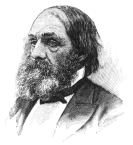
The future author and preacher was graduated from Harvard with honors when he was seventeen years old. He assisted his father in newspaper work, and was able to write editorials, keep the books, or set type, as the occasion required. He afterwards studied theology.
His first pastorate was at Worcester, Mass. He remained there for ten years. He then settled in Boston. He was with the Massachusetts Rifle Corps when the Civil War broke out, and it was upon an incident of that war that he founded his story of “The Man without a Country.” This is one of the strongest stories of patriotism ever written, and has been reprinted in several languages.
For many years Dr. Hale has been pastor of the South Congregational Church in Boston. He has written many books; among them the best known are “Ten Times One is Ten” and “In His Name.”
One can hardly imagine a busier life than he leads. His daily tasks consist in aiding public and private charities, lecturing, editing, writing, and preparing his sermons.
He was once asked how he was able to accomplish so much, and he replied: “If you are working with Aladdin’s lamp, or with Monte Cristo’s treasures, you are not apt to think you will fail. Far less is your risk with the omnipotence of the Lord God behind you.”
Philip Nolan was as fine a young officer as there was in the “Legion of the West,” as the Western division of our army was then called. When Aaron Burr made his first dashing expedition down to New Orleans, or somewhere above on the river, he met this gay, dashing, bright young fellow, at some dinner party, I think. Burr marked him, talked to him, walked with him, took him a day or two’s voyage in his flatboat, and, in short, fascinated him, and led him to turn traitor to his country.
Nolan was proved guilty; yet you and I would never have heard of him, reader, but that when the president of the court asked him at the close whether he wished to say anything to show that he had always been faithful to the United States, he cried out in a fit of frenzy: “Curse the United States! I wish I may never hear of the United States again!”
I suppose he did not know how the words shocked old Colonel Morgan, who was holding the court. Half the officers who sat in it had served through the Revolution, and their lives, not to say their necks, had been risked for the very idea which he so cavalierly cursed in his madness.
Morgan called the court into his private room, and returned in fifteen minutes with a face like a sheet, to say: “Prisoner, hear the sentence of the Court! The Court decides, subject to the approval of the President, that you never hear the name of the United States again.”
Nolan laughed; but nobody else laughed. Old Morgan was too solemn, and the whole room was hushed dead as night for a minute. Even Nolan lost his swagger in a moment. Then Morgan added: “Mr. Marshal, take the prisoner to Orleans in an armed boat, and deliver him to the naval commander there.” The marshal gave his orders and the prisoner was taken out of court.
“Mr. Marshal,” continued old Morgan, “see that no one mentions the United States to the prisoner. Mr. Marshal, make my respects to Lieutenant Mitchell at Orleans, and request him to order that no one shall mention the United States to the prisoner while he is on board ship.”
Nolan had the freedom of the ship he was on, so long as he heard nothing of his country. No mess liked to have him permanently, because his presence cut off all talk of home or of the prospect of return, of politics or letters, of peace or of war—cut off more than half the talk men liked to have at sea.
Sometimes, when the marines or sailors had any special jollification, they were permitted to invite “Plain-Buttons,” as they called him. Then Nolan was sent with some officer, and the men were forbidden to speak of home while he was there. I believe the theory was that the sight of his punishment did them good. They called him “Plain-Buttons,” because, while he always chose to wear a regulation army uniform, he was not permitted to wear the army button, for the reason that it bore either the initials or the insignia of the country he had disowned.
As he was almost never permitted to go on shore, even though the vessel lay in port for months, his time at the best hung heavy; and everybody was permitted to lend him books, if they were not published in America and made no allusion to it. He had almost all the foreign papers that came into the ship, sooner or later; only somebody must go over them first, and cut out any advertisement or stray paragraph that alluded to America.
Among these books was the “Lay of the Last Minstrel,” which they had all of them heard of, but which most of them had never seen. I think it could not have been published long. Well, nobody thought there could be any risk of anything national in that, so Nolan was permitted to join the circle one afternoon when a lot of them sat on deck smoking and reading aloud. Well, so it happened that in his turn Nolan took the book and read to the others; and he read very well, as I know. Nobody in the circle knew a line of the poem, only it was all magic and Border chivalry, and was ten thousand years ago. Poor Nolan read steadily through the fifth canto, stopped a minute and then began, without a thought of what was coming:—
“Breathes there the man, with soul so dead, Who never to himself hath said.”
It seems impossible to us that anybody ever heard this for the first time, but all these fellows did then, and poor Nolan himself went on, still unconsciously or mechanically:—
“ ‘This is my own, my native land!’ ”
Then they all saw something was to pay; but he expected to get through, I suppose, turned a little pale, but plunged on:—
“Whose heart hath ne’er within him burned, As home his footsteps he hath turned, From wandering on a foreign strand? If such there breathe, go, mark him well.”
By this time the men were all beside themselves, wishing there was any way to make him turn over two pages; but he had not quite presence of mind for that; he colored crimson and staggered on:—
“For him no minstrel raptures swell; High though his titles, proud his name, Boundless his wealth as wish can claim; Despite those titles, power, and pelf, The wretch, concentered all in self,”—
And here the poor fellow choked, could not go on, but started up, swung the book into the sea, vanished into his stateroom, and we did not see him for two months again. He never read aloud again unless it was the Bible or Shakespeare, or something else he was sure of. But it was not that merely. He never entered in with the other young men exactly as a companion again.
. . . . . . . . . . . . . . . . . . . . . . . . . . . . . . . . . . .
In one of the great frigate duels with the English, it happened that a round-shot from the enemy entered one of our ports square, and took right down the officer of the gun himself, and almost every man of the gun’s crew. Now you may say what you choose about courage, but that is not a nice thing to see. But, as the men who were not killed picked themselves up, and as they and the surgeon’s people were carrying off the bodies, there appeared Nolan, in his shirt sleeves, with the rammer in his hand, and, just as if he had been the officer, told them off with authority—who should go to the cockpit with the wounded men, who should stay with him—perfectly cheery, and with that way which makes men feel sure all is right and is going to be right. And he finished loading the gun with his own hands, aimed it, and bade the men fire. And there he stayed, captain of that gun, keeping those fellows in spirits, till the enemy struck,—sitting on the carriage while the gun was cooling, though he was exposed all the time,—showing them easier ways to handle heavy shot, making the raw hands laugh at their own blunders, and when the gun cooled again, getting it loaded and fired twice as often as any other gun on the ship. The captain walked forward by way of encouraging the men, and Nolan touched his hat and said: “I am showing them how we do this in the artillery, sir.”
The commodore said: “I see you are, and I thank you, sir; and I shall never forget this day, sir, and you never shall, sir.”
And after the whole thing was over, and he had the Englishman’s sword, in the midst of the state and ceremony of the quarter-deck, he said: “Where is Mr. Nolan? Ask Mr. Nolan to come here.”
And when Nolan came he said: “Mr. Nolan, we are all very grateful to you to-day; you are one of us to-day; you will be named in the dispatches.”
And then the old man took off his own sword of ceremony and gave it to Nolan, and made him put it on. The man told me this who saw it. Nolan cried like a baby, and well he might. He had not worn a sword since that day at Fort Adams. But always afterwards, on occasions of ceremony, he wore that quaint old French sword of the commodore’s.
. . . . . . . . . . . . . . . . . . . . . . . . . . . . . . . . . . .
I first came to understand anything about “the man without a country” one day when we overhauled a dirty little schooner which had slaves on board. An officer was sent to take charge of her, and after a few minutes he sent back his boat to ask that some one might be sent him who could speak Portuguese. Nolan stepped out and said he should be glad to interpret if the captain wished, as he understood the language.
“Tell them they are free,” said Vaughan.
Then there was a yell of delight, clinching of fists, leaping and dancing, kissing of Nolan’s feet.
“Tell them,” said Vaughan, well pleased, “that I will take them all to Cape Palmas.”
This did not answer so well. Cape Palmas was practically as far from the homes of most of them as New Orleans or Rio Janeiro was; that is, they would be eternally separated from home there. And their interpreters, as we could understand, instantly said: “Ah, non Palmas.” The drops stood on poor Nolan’s white forehead as he hushed the men down and said: “He says, ‘Not Palmas.’ He says, ‘Take us home, take us to our own country, take us to our own house, take us to our own pickaninnies and our own women.’ He says he has an old father and mother who will die if they do not see him. And this one says he left his people all sick, and paddled down to Fernando to beg the white doctor to come and help them, and that these caught him in the bay just in sight of home, and that he has never seen anybody from home since then. And this one says,” choked out Nolan, “that he has not heard a word from his home in six months, while he has been locked up in a barracoon.”
As quick as Vaughan could get words, he said: “Tell them yes, yes, yes; tell them they shall go to the mountains of the Moon, if they will. If I sail the schooner through the Great White Desert, they shall go home.”
And after some fashion Nolan said so. And then they all fell to kissing him again, and wanted to rub his nose with theirs.
But he could not stand it long; and getting Vaughan to say he might go back, he beckoned me down into our boat. As we lay back in the stern sheets and the men gave way, he said to me: “Youngster, let that show you what it is to be without a family, without a home, and without a country. And if you are ever tempted to say a word or to do a thing that shall put a bar between you and your family, your home and your country, pray God in his mercy to take you that instant home to his own heaven. Stick by your family, boy; forget you have a self, while you do everything for them. Think of your home, boy; write and send, and talk about it. Let it be nearer and nearer to your thought, the farther you have to travel from it; and rush back to it when you are free, as that poor black slave is doing now. And for your country, boy,” and the words rattled in his throat, “and for that flag,” and he pointed to the ship, “never dream a dream but of serving her as she bids you, though the service carry you through a thousand hells. No matter what happens to you, no matter who flatters you or who abuses you, never look at another flag, never let a night pass but you pray God to bless that flag. Remember, boy, that behind all these men you have to do with, behind officers and government, and people even, there is the Country Herself, your Country, and that you belong to Her as you belong to your own mother. Stand by Her, boy, as you would stand by your mother.”
I was frightened to death by his calm, hard passion; but I blundered out that I would by all that was holy, and that I had never thought of doing anything else. He hardly seemed to hear me; but he did, almost in a whisper, say: “Oh, if anybody had said so to me when I was of your age!”
. . . . . . . . . . . . . . . . . . . . . . . . . . . . . . . . . . .
Extract from a letter written in 1863:—
“Levant, 2° 2´ S. @ 131° W.
“Dear Fred:
“I try to find heart and life to tell you that it is all over with dear old Nolan. The doctor has been watching him very carefully, and yesterday morning came to me and told me that Nolan was not so well, and he said he should like to see me. Well, I went in, and there, to be sure, the poor fellow lay in his berth, smiling pleasantly as he gave me his hand, but looking very frail. I could not help a glance round, which showed me what a little shrine he had made of the box he was lying in. The stars and stripes were triced up above and around a picture of Washington, and he had painted a majestic eagle, with lightnings blazing from his beak, and his foot just clasping the whole globe, which his wings overshadowed. The dear old boy saw my glance and said with a sad smile: ‘Here, you see, I have a country!’
. . . . . . . . . . . . . . . . . . . . . . . . . . . . . . . . . . .
“An hour after I had left him, when the doctor went in gently, he found Nolan had breathed his life away with a smile.
“We looked in his Bible, and there was a slip of paper at the place where he had marked the text: ‘They desire a country, even a heavenly: wherefore God is not ashamed to be called their God: for He hath prepared for them a city.’
“On this slip of paper he had written: ‘Bury me in the sea; it has been my home, and I love it. But will not some one set up a stone for my memory at Fort Adams, or at Orleans, that my disgrace may not be more than I ought to bear? Say on it:
In Memory of PHILIP NOLAN, Lieutenant in the Army of the United States. He loved his country as no other man has loved her; but no man deserved less at her hands.’ ”