STORMING THE FORTRESS. WILLIAM HICKLING PRESCOTT.
Reading edition
The cheering words and courageous bearing of the cavaliers went to the hearts of their followers. All now agreed to stand by their leader to the last. But, if they would remain longer in their present position, it was absolutely necessary to dislodge the enemy from the fortress; and, before venturing on this dangerous service, Hernando Pizarro resolved to strike such a blow as should intimidate the besiegers from further attempts to molest his present quarters.
He communicated his plan of attack to his officers and formed his little troop into three divisions. The Indian pioneers were sent forward to clear away the rubbish, and the several divisions moved up the principal avenues towards the camp of the besiegers; and the three bodies, bursting impetuously on the disordered lines of the Peruvians, took them completely by surprise. For some moments there was little resistance, and the slaughter was terrible. But the Indians gradually rallied, and, coming into something like order, returned to the fight with the courage of men who had long been familiar with danger. They fought hand to hand with their copper-headed war clubs and poleaxes, while a storm of darts, stones, and arrows rained on the well-defended bodies of the Christians.
The barbarians showed more discipline than was to have been expected; for which it is said they were indebted to some Spanish prisoners, from several of whom the Inca, having generously spared their lives, took occasional lessons in the art of war. The Peruvians had also learned to manage with some degree of skill the weapons of their conquerors; and they were seen armed with bucklers, helmets, and swords of European workmanship, and even in a few instances mounted on the horses which they had taken from the white men. The young Inca in particular, accoutered in the European fashion, rode a war horse which he managed with considerable address, and, with a long lance in his hand, led on his followers to the attack.
After a gallant struggle, in which the natives threw themselves fearlessly on the horsemen, endeavoring to tear them from their saddles, they were obliged to give way before the repeated shock of their charges. Many were trampled under foot, others cut down by the Spanish broadswords, while the arquebusiers, supporting the cavalry, kept up a running fire that did terrible execution on the flanks and rear of the fugitives. At length, trusting that the chastisement he had inflicted on the enemy would secure him from further annoyance for the present, the Castilian general drew back his forces to their quarters in the capital.
His next step was the recovery of the citadel. It was an enterprise of danger. The fortress, which overlooked the northern section of the city, stood high on a rocky eminence, where it was defended only by a single wall. Towards the open country it was more easy of approach; but there it was protected by two semicircular walls, each about twelve hundred feet in length and of great thickness. Within the interior wall was the fortress, consisting of three strong towers, one of great height, which, with a smaller one, was now held by the enemy, under the command of an Inca noble, a warrior of well-tried valor, prepared to defend it to the last.
As the fortress was to be approached through the mountain passes, it became necessary to divert the enemy’s attention to another quarter. A little while before sunset Juan Pizarro left the city with a picked corps of horsemen, and took a direction opposite to that of the fortress, that the besieging army might suppose the object was a foraging expedition. But, secretly countermarching in the night, he fortunately found the passes undefended and arrived before the outer wall of the fortress without giving the alarm to the garrison.
The entrance was through a narrow opening in the center of the rampart; but this was now closed up with heavy stones that seemed to form one solid work with the rest of the masonry. It was an affair of time to dislodge these huge masses in such a manner as not to rouse the garrison. The Indian natives, who rarely attacked in the night, were not sufficiently acquainted with the art of war even to provide against surprise by posting sentinels. When the task was accomplished, Juan Pizarro and his gallant troop rode through the gateway and advanced towards the second parapet.
But their movements had not been conducted so secretly as to escape notice, and they now found the interior court swarming with warriors, who, as the Spaniards drew near, let off clouds of missiles that compelled them to come to a halt. Juan Pizarro, aware that no time was to be lost, ordered one-half of his corps to dismount, and, putting himself at their head, prepared to make a breach as before in the fortifications. Leading on his men, he encouraged them in the work of demolition in the face of such a storm of stones, javelins, and arrows as might have made the stoutest heart shrink from encountering it. The good mail of the Spaniards did not always protect them; but others took the place of such as fell, until a breach was made, and the cavalry, pouring in, rode down all who opposed them.
The parapet was now abandoned, and the Indians, hurrying with disorderly flight across the enclosure, took refuge on a kind of platform or terrace, commanded by the principal tower. Here, rallying, they shot off fresh volleys of missiles against the Spaniards, while the garrison in the fortress hurled down fragments of rock and timber on their heads. Juan Pizarro, still among the foremost, sprang forward on the terrace, cheering on his men by his voice and example; but at this moment he was struck by a large stone on the head, not then protected by his buckler, and was stretched on the ground. The dauntless chief still continued to animate his followers by his voice till the terrace was carried and its miserable defenders were put to the sword. His sufferings were then too much for him, and he was removed to the town below, where, notwithstanding every exertion to save him, he survived the injury but a fortnight. He had served in the conquest of Peru from the first, and no name on the roll of its conquerors is less tarnished by the reproach of cruelty or stands higher in all the attributes of a true and valiant knight.
STORMING THE FORTRESS.

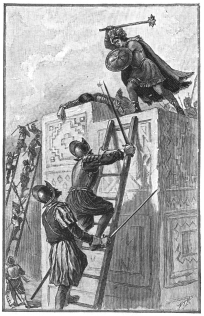
Though deeply sensible to his brother’s disaster, Hernando Pizarro saw that no time was to be lost in profiting by the advantages already gained. Committing the charge of the town to Gonzalo, he put himself at the head of the assailants and laid vigorous siege to the fortresses. One surrendered after a short resistance. The other and more formidable of the two still held out under the brave Inca noble who commanded it. He was a man of an athletic frame, and might be seen striding along the battlements, armed with a Spanish buckler and cuirass, and in his hand wielding a formidable mace, garnished with points or knobs of copper. With this terrible weapon he struck down all who attempted to force a passage into the fortress. Some of his own followers who proposed a surrender he is said to have slain with his own hand. Ladders were planted against the walls; but no sooner did a Spaniard gain the topmost round than he was hurled to the ground by the strong arm of the Indian warrior. His activity was equal to his strength; and he seemed to be at every point the moment that his presence was needed.
The Spanish commander was filled with admiration at this display of valor; for he could admire valor even in an enemy. He gave orders that the chief should not be injured, but be taken alive, if possible. This was not easy. At length, numerous ladders having been planted against the tower, the Spaniards scaled it on several quarters at the same time, and, leaping into the place, overpowered the few combatants who still made a show of resistance. But the Inca chieftain was not to be taken; and, finding further resistance ineffectual, he sprang to the edge of the battlements, and casting away his war club, wrapped his mantle around him and threw himself headlong from the summit. He died like an ancient Roman. He had struck his last stroke for the freedom of his country, and he scorned to survive her dishonor. The Castilian commander left a small force in garrison to secure his conquest, and returned in triumph to his quarters.
From “History of the Conquest of Peru.”