THE BATTLE OF QUEBEC. FRANCIS PARKMAN.
Reading edition
Francis Parkman was born in Boston in 1823. He was graduated from Harvard College when he was twenty-one. He visited Europe and on his return went on a tour in the far West, across the prairies and among the Rocky Mountains. He became well acquainted with the Indians, sharing their camps and hunting buffaloes with them. His book, “The California and Oregon Trail,” contains a vivid account of his explorations. This book was followed by “The History of the Conspiracy of Pontiac” and a novel called “Vassal Morton.”

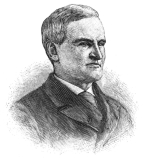
Mr. Parkman devoted a number of years to writing histories of the attempts of the French and English to settle North America. His qualities as a writer were of a high order. His style is marked by uncommon vigor. His pages are alive with thrilling adventure, brilliant description, and romantic episodes. He has left no room for a competitor in the same field. Mr. Parkman died in 1893.
The eventful night of the 12th was clear and calm, with no light but that of the stars. Within two hours before daybreak thirty boats, crowded with sixteen hundred soldiers, cast off from the vessels and floated downward, in perfect order, with the current of the ebb tide. To the boundless joy of the army, Wolfe’s malady had abated, and he was able to command in person. His ruined health, the gloomy prospects of the siege, and the disaster at Montmorenci had oppressed him with the deepest melancholy, but never impaired for a moment the promptness of his decisions or the impetuous energy of his action. He sat in the stern of one of the boats, pale and weak, but borne up to a calm height of resolution. Every order had been given, every arrangement made, and it only remained to face the issue. The ebbing tide sufficed to bear the boats along, and nothing broke the silence of the night but the gurgling of the river and the low voice of Wolfe, as he repeated to the officers about him the stanzas of Gray’s “Elegy in a Country Churchyard,” which had recently appeared and which he had just received from England. Perhaps, as he uttered those strangely appropriate words,—
“The paths of glory lead but to the grave,”
the shadows of his own approaching fate stole with mournful prophecy across his mind. “Gentlemen,” he said as he closed his recital, “I would rather have written those lines than take Quebec to-morrow.”
As they approached the landing-place, the boats edged closer in towards the northern shore, and the woody precipices rose high on their left, like a wall of undistinguished blackness.
They reached the landing-place in safety—an indentation in the shore about a league above the city, and now bearing the name of Wolfe’s Cove. Here a narrow path led up the face of the heights, and a French guard was posted at the top to defend the pass. By the force of the current the foremost boats, including that which carried Wolfe himself, were borne a little below the spot. The general was one of the first on shore.
Meanwhile the vessels had dropped downward with the current, and anchored opposite the landing-place. The remaining troops were disembarked, and, with the dawn of day, the whole were brought in safety to the shore.
THE ASCENT TO THE PLAINS OF ABRAHAM.
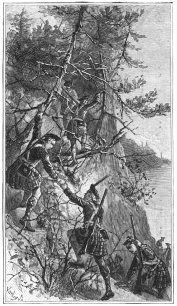
The sun rose, and, from the ramparts of Quebec, the astonished people saw the Plains of Abraham glittering with arms, and the dark-red lines of the English forming in array of battle. Breathless messengers had borne the evil tidings to Montcalm, and far and near his wide-extended camp resounded with the rolling of alarm drums and the din of startled preparation. He, too, had his struggles and his sorrows. The civil power had thwarted him; famine, discontent, and disaffection were rife among his soldiers; and no small portion of the Canadian militia had dispersed from sheer starvation. In spite of all, he had trusted to hold out till the winter frosts should drive the invaders from before the town, when, on that disastrous morning, the news of their successful temerity fell like a cannon shot upon his ear. Still he assumed a tone of confidence. “They have got to the weak side of us at last,” he is reported to have said, “and we must crush them with our numbers.”
At a little before ten the English could see that Montcalm was preparing to advance, and in a few moments all his troops appeared in rapid motion. They came on in three divisions, shouting, after the manner of their nation, and firing heavily as soon as they came within range. In the British ranks not a trigger was pulled, not a soldier stirred; and their ominous composure seemed to damp the spirits of the assailants. It was not till the French were within forty yards that the fatal word was given, and the British muskets blazed forth at once in one crashing explosion. Like a ship at full career, arrested with sudden ruin on a sunken rock, the ranks of Montcalm staggered, shivered, and broke before that wasting storm of lead. The smoke, rolling along the field, for a moment shut out the view; but when the white wreaths were scattered on the wind, a wretched spectacle was disclosed; men and officers tumbled in heaps, battalions resolved into a mob, order and obedience gone; and when the British muskets were leveled for a second volley, the masses of the militia were seen to cower and shrink with uncontrollable panic. For a few minutes the French regulars stood their ground, returning a sharp and not ineffectual fire. But now, echoing cheer on cheer, redoubling volley on volley, trampling the dying and the dead, and driving the fugitives in crowds, the British troops advanced and swept the field before them. The ardor of the men burst all restraint. They broke into a run and with unsparing slaughter chased the flying multitude to the gates of Quebec. Foremost of all, the light-footed Highlanders dashed along in furious pursuit, hewing down the Frenchmen with their broadswords, and slaying many in the very ditch of the fortifications. Never was victory more quick or more decisive; yet the triumph of the victors was mingled with sadness as the tidings went from rank to rank that Wolfe had fallen.
In the heat of the action, as he advanced at the head of the grenadiers of Louisburg, a bullet shattered his wrist; but he wrapped his handkerchief about the wound and showed no sign of pain. A moment more and a ball pierced his side. Still he pressed forward, waving his sword and cheering his soldiers to the attack, when a third shot lodged deep within his breast. He paused, reeled, and, staggering to one side, fell to the earth. Brown, a lieutenant of the grenadiers, Henderson, a volunteer, an officer of artillery, and a private soldier raised him together in their arms, and, bearing him to the rear, laid him softly on the grass. They asked him if he would have a surgeon; but he shook his head and answered that all was over with him. His eyes closed with the torpor of approaching death, and those around sustained his fainting form. Yet they could not withhold their gaze from the wild turmoil before them and the charging ranks of their companions rushing through fire and smoke. “See how they run!” one of the officers exclaimed as the French fled in confusion before the leveled bayonets. “Who run?” demanded Wolfe, opening his eyes, like a man aroused from sleep. “The enemy, sir,” was the reply; “they give way everywhere.” “Then,” said the dying general, “tell Colonel Burton to march Webb’s regiment down to Charles River, to cut off their retreat from the bridge. Now, God be praised! I will die in peace,” he murmured; and, turning on his side, he calmly breathed his last.
From “Montcalm and Wolfe.”