Part 2 / Book 4 — JOAN OF ARC. [Abridged.] THOMAS DE QUINCEY.
Reading edition
Thomas De Quincey was the son of a prosperous merchant in England. He was born at Manchester on the 15th of August, 1785, but spent his childhood in a country house near the town.
He was a shy, dreamy boy, and his later writings record many impressions which he received in these early years. His father died when he was about seven years old, and his mother, a stately lady with fine intellect, cared for her little ones at their country home, doing her best for their education.
De Quincey learned to read and write while he was a very little child, but his first schooling was given him by one of his guardians, who was curate in Salford, two miles from De Quincey’s home.
After the father’s death William De Quincey, a boy of twelve, returned from boarding school. He was five years older than Thomas, boisterous, frank, and clever, and led his younger brother a hard life. William waged war with the factory boys on his way to and from school, and poor little Thomas was forced to join in their battles. The hours of reverie and poetical thought were interrupted, for William took possession of him like a whirlwind.
Four years later the old home was sold, De Quincey’s mother went to live at Bath, and Thomas entered the grammar school of the town, where he remained for two years.
He was very popular among the teachers because of his aptness as a Latin scholar.
He was next sent to a private school, where he was a favorite because of his kind and friendly disposition and his willingness to help any of the boys with their Latin or Greek. He was a leader in their games, but showed his literary turn of mind in mimic fights between the Greeks and Trojans.
He had become acquainted with young Lord Westport, who invited him to travel with him about England and Ireland. While with Lord Westport he met King George III., who chatted with him, asking if he was of French descent. Thomas proudly assured his majesty that the English De Quinceys dated back to the Conquest. He met the king several times at fêtes to which he was invited with Lord Westport.
On his return home, De Quincey desired to attend the grammar school at Bath. He did not care for the private school, for there was no one there with whom he could contend. It was decided, however, that he should attend the grammar school at Manchester, where he studied for a year and a half, and then, after appealing in vain to his guardians, ran away.
He first intended to wander among the English Lakes. He had read some of Wordsworth’s poems and longed to meet the poet, but, recognizing that a runaway would hardly be looked upon with favor, returned to his home.
Here he found an uncle who furnished him with funds and gave him permission to travel about for a season and enjoy his liberty.
De Quincey traveled about North Wales from July until the late fall of 1802, and then went to London. Here he lived a wretched life,—his money gone,—and he was dependent on charity, living from hand to mouth.
He was finally discovered and reclaimed by some friends and went back to Chester, where his mother resided.
In the autumn of 1803 he accepted an offer made by his guardians and entered Worcester College, Oxford. Little is known of De Quincey’s life at college beyond the fact that he spent much of his time in quiet reading and study.
It was during these days as a student that De Quincey began to take opium,—first as a release from pain and later for its effect as a stimulant.
In 1807 lie made the acquaintance of Coleridge, whom he regarded with the love of a son. This friendship led to an introduction to Wordsworth. Two years later he took up his abode at the Lakes, in the pretty cottage at Grasmere, where Wordsworth had been living, and this was his home for more than twenty years.
Coleridge, Southey, and John Wilson (“Christopher North”) had their homes in this region, and De Quincey spent many hours in walks and talks with his friends.
For seven years De Quincey lived alone in his pretty cottage and then married a lovely young girl named Margaret Simpson.
The habit of opium taking had almost mastered him, so that he lost ambition and capacity for work. Three years after his marriage he determined to break off this terrible habit. His family were in need, and he must support them.
He was offered the position of editor of a Westmoreland newspaper. He aroused from his life of indulgence and opium dreams and became connected with the magazines.
His connection with Blackwood drew him to Edinburgh, where he was often a guest at the home of his old friend “Christopher North.” He became acquainted here with Carlyle.
At length, in 1830, he took his family to Edinburgh, which was his home until his death in December of 1859.
Joanna, as we in England should call her, but, according to her own statement, Jeanne D’Arc, was born at Domremy, a village on the marches of Lorraine and Champagne. Here lay two roads, not so much for travelers that were few, as for armies that were too many by half.
After the painting by Guizard. JOAN OF ARC.

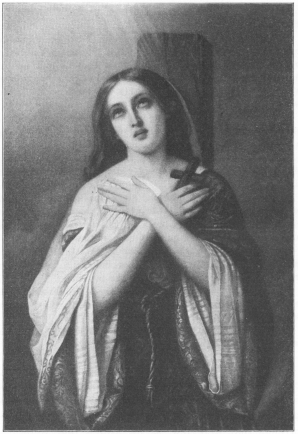
The situation of Joanna was full of profound suggestions to a heart that listened for the stealthy steps of change and fear that too surely were in motion. But, if the place were grand, the time, the burden of the time, was far more so. The air overhead in its upper chambers was hurtling with the obscure sound; was dark with sullen fermenting of storms that had been gathering for a hundred and thirty years.
It was not wonderful that in such a haunted solitude, with such a haunted heart, Joanna should see angelic visions and hear angelic voices. These voices whispered to her forever the duty, self-imposed, of delivering France. Five years she listened to these monitory voices with internal struggles. At length she could resist no longer. Doubt gave way, and she left her home forever in order to present herself at the dauphin’s court.
. . . . . . . . . . . . . . . . . . . . . . . . . . . . . . . . . . .
Joanna was a girl of natural piety, that saw God in forests, and hills, and fountains, but did not the less seek him in chapels and consecrated oratories. This peasant girl was self-educated through her own meditativeness. If the reader turns to that divine passage in “Paradise Regained,” which Milton has put into the mouth of Christ when first entering the wilderness,—
Oh, what a multitude of thoughts at once Awakened in me swarm, while I consider What from within I feel myself, and hear What from without comes often to my ears, Ill sorting with my present state compared! When I was yet a child, no childish play To me was pleasing; all my mind was set Serious to learn and know, and thence to do What might be public good; myself I thought Born to that end—
he will have some notion of the vast reveries which brooded over the heart of Joanna in early girlhood, when the wings were budding that should carry her from Orleans to Rheims; when the golden chariot was dimly revealing itself that should carry her from the kingdom of France Delivered to the eternal kingdom.
When Joanna appeared, the dauphin had been on the point of giving up the struggle with the English, distressed as they were, and of flying to the south of France. She taught him to blush for such abject counsels. She liberated Orleans, that great city, so decisive by its fate for the issue of the war. Entering the city after sunset, on the 29th of April, she sang mass on Sunday, May 8, for the entire disappearance of the besieging force.
On the 29th of June, she fought and gained over the English the decisive battle of Patay; on the 9th of July, she took Troyes by a coup-de-main from a mixed garrison of English and Burgundians; on the 15th of that month, she carried the dauphin into Rheims; on Sunday, the 17th, she crowned him; and there she rested from her labor of triumph. All that was to be done she had now accomplished; what remained was—to suffer.
But she, the child that, at nineteen, had wrought wonders so great for France, was she not elated? Did she not lose, as men so often have lost, all sobriety of mind when standing upon the pinnacle of success so giddy? Let her enemies declare. During the progress of her movement, and in the center of ferocious struggles, she had manifested the temper of her feelings, by the pity which she had everywhere expressed for the suffering enemy.
She forwarded to the English leaders a touching invitation to unite with the French, as brothers in a common crusade against infidels, thus opening the road for a soldierly retreat. She interposed to protect the captive or the wounded—she threw herself off her horse to kneel by the dying English soldier, and to comfort him with such ministrations, physical or spiritual, as his situation allowed. She sheltered the English, that invoked her aid, in her own quarters.
On the day when she had finished her work, she wept; for she knew that, when her triumphal task was done, her end must be approaching. Her aspirations pointed only to a place, which seemed to her more than usually full of natural piety, as one in which it would give her pleasure to die. And she uttered, between smiles and tears, as a wish that inexpressibly fascinated her heart, a broken prayer that God would return her to the solitudes from which he had drawn her, and suffer her to become a shepherdess once more.
It was a half fantastic prayer, because, from childhood upwards, visions that she had no power to mistrust, and the voices which sounded in her ear forever, had long since persuaded her mind that for her no such prayer could be granted.
All went wrong from this time. More than one military plan was entered upon which she did not approve. At length she was made prisoner by the Burgundians, and finally surrendered to the English.
Now came her trial. Never from the foundations of the earth was there such a trial as this, if it were laid open in all its beauty of defense, and all its hellishness of attack. Oh, child of France! shepherdess, peasant girl! trodden under foot by all around thee, how I honor thy flashing intellect, quick as God’s lightning, and true as God’s lightning to its mark, that ran before France and laggard Europe by many a century, confounding the malice of the ensnarer, and making dumb the oracles of falsehood!
On the Wednesday after Trinity Sunday in 1431, being then about nineteen years of age, the Maid of Arc underwent her martyrdom. She was conducted before midday, guarded by eight hundred spearmen, to a platform of prodigious height, constructed of wooden billets supported by occasional walls of lath and plaster, and traversed by hollow spaces in every direction for the creation of air currents.
What else, I demand, than mere weight of metal, absolute nobility of deportment, broke the vast line of battle then arrayed against her? What else but her meek, saintly demeanor won, from the enemies that till now had believed her a witch, tears of rapturous admiration? What else was it but her constancy, united with her angelic gentleness, that drove the fanatic English soldier—who had sworn to throw a fagot on her scaffold, as his tribute of abhorrence, that did so, that fulfilled his vow—suddenly to turn away a penitent for life, saying everywhere that he had seen a dove rising upon wings to heaven from the ashes where she had stood?
What else drove the executioner to kneel at every shrine for pardon to his share in the tragedy! And if this were insufficient, then I cite the closing act of her life. The executioner had been directed to apply his torch from below. He did so. The fiery smoke rose in billowing volumes. A Dominican monk was then standing almost at her side. Wrapped up in his sublime office, he saw not the danger, but still persisted in his prayers.
Even then, when the last enemy was racing up the fiery stairs to seize her, even at that moment did this noblest of girls think only for him, the one friend that would not forsake her, and not for herself; bidding him with her last breath to care for his own preservation, but to leave her to God.
The shepherd girl that had delivered France—she, from her dungeon, she, from her duel with fire, as she entered her last dream—saw Domremy, saw the fountain of Domremy, saw the pomp of forests in which her childhood had wandered. That Easter festival, which man had denied to her languishing heart—that resurrection of springtime, which the darkness of dungeons had intercepted from her, hungering after the glorious liberty of forests—were by God given back into her hands, as jewels that had been stolen from her by robbers.
By special privilege, for her might be created, in this farewell dream, a second childhood, innocent as the first; but not, like that, sad with the gloom of a fearful mission in the rear. This mission had now been fulfilled.
The hatred to herself in all eyes had been faced steadily, had been suffered, had been survived. And in her last fight upon the scaffold she had triumphed gloriously; victoriously she had tasted the stings of death. For all, except this comfort from her farewell dream, she had died—died, amidst the tears of ten thousand enemies—died, amidst the drums and trumpets of armies—died amidst peals redoubling upon peals, volleys upon volleys, from the saluting clarions of martyrs.
From “Biographies.”