LETTERS AND PAPERS ON PHILOSOPHICAL SUBJECTS. (continued 7)
Reading edition
The glasses being thus tuned, you are to be provided with a case for them, and a spindle on which they are to be fixed. My case is about three feet long, eleven inches every way wide within at the biggest end, and five inches at the smallest end; for it tapers all the way, to adapt it better to the conical figure of the set of glasses. This case opens in the middle of its height, and the upper part turns up by hinges fixed behind. The spindle, which is of hard iron, lies horizontally from end to end of the box within, exactly in the middle, and is made to turn on brass gudgeons at each end. It is round, an inch diameter at the thickest end, and tapering to a quarter of an inch at the smallest.—A square shank comes from its thickest end through the box, on which shank a wheel is fixed by a screw. This wheel serves as a fly to make the motion equable, when the spindle, with the glasses, is turned by the foot like a spinning-wheel. My wheel is of mahogany, eighteen inches diameter, and pretty thick, so as to conceal near its circumference about 25lb of lead.—An ivory pin is fixed in the face of this wheel, and about four inches from the axis. Over the neck of this pin is put the loop of the string that comes up from the moveable step to give it motion. The case stands on a neat frame with four legs.
To fix the glasses on the spindle, a cork is first to be fitted in each neck pretty tight, and projecting a little without the neck, that the neck of one may not touch the inside of another when put together, for that would make a jarring.—These corks are to be perforated with holes of different diameters, so as to suit that part of the spindle on which they are to be fixed. When a glass is put on, by holding it stiffly between both hands, while another turns the spindle, it may be gradually brought to its place. But care must be taken that the hole be not too small, lest in forcing it up the neck should split; nor too large, lest the glass not being firmly fixed should turn or move on the spindle, so as to touch and jar against its neighbouring glass. The glasses thus are placed one in another, the largest on the biggest end of the spindle which is to the left hand; the neck of this glass is towards the wheel, and the next goes into it in the same position, only about an inch of its brim appearing beyond the brim of the first; thus proceeding, every glass when fixed shews about an inch of its brim (or three quarters of an inch, or half an inch, as they grow smaller) beyond the brim of the glass that contains it; and it is from these exposed parts of each glass that the tone is drawn, by laying a finger upon one of them as the spindle and glasses turn round.
My largest glass is G, a little below the reach of a common voice, and my highest G, including three compleat octaves.—To distinguish the glasses the more readily to the eye, I have painted the apparent parts of the glasses within side, every semitone white, and the other notes of the octave with the seven prismatic colours, viz. C, red; D, orange; E, yellow; F, green; G, blue; A, indigo; B, purple; and C, red again;—so that glasses of the same colour (the white excepted) are always octaves to each other.
This instrument is played upon, by sitting before the middle of the set of glasses as before the keys of a harpsichord, turning them with the foot, and wetting them now and then with a spunge and clean water. The fingers should be first a little soaked in water, and quite free from all greasiness; a little fine chalk upon them is sometimes useful, to make them catch the glass and bring out the tone more readily. Both hands are used, by which means different parts are played together.—Observe, that the tones are best drawn out when the glasses turn from the ends of the fingers, not when they turn to them.
The advantages of this instrument are, that its tones are incomparably sweet beyond those of any other; that they may be swelled and softened at pleasure by stronger or weaker pressures of the finger, and continued to any length; and that the instrument, being once well tuned, never again wants tuning.
In honour of your musical language, I have borrowed from it the name of this instrument, calling it the Armonica.
With great esteem and respect, I am, &c.
B. FRANKLIN.
TO A FRIEND[63].
Respecting the best Mediums for conveying Sound.
July 20, 1762.
Dear Sir,
I have perused your paper on sound, and would freely mention to you, as you desire it, every thing that appeared to me to need correction:—But nothing of that kind occurs to me, unless it be, where you speak of the air as "the best medium for conveying sound." Perhaps this is speaking rather too positively, if there be, as I think there are, some other mediums that will convey it farther and more readily.—It is a well-known experiment, that the scratching of a pin at one end of a long piece of timber, may be heard by an ear applied near the other end, though it could not be heard at the same distance through the air.—And two stones being struck smartly together under water, the stroke may be heard at a greater distance by an ear also placed under water, than it can be heard through the air. I think I have heard it near a mile; how much farther it may be heard I know not; but suppose a great deal farther, because the sound did not seem faint, as if at a distance, like distant sounds through air, but smart and strong, and as if present just at the ear.—I wish you would repeat these experiments now you are upon the subject, and add your own observations.—And if you were to repeat, with your naturally exact attention and observation, the common experiment of the bell in the exhausted receiver, possibly something new may occur to you, in considering,
1. Whether the experiment is not ambiguous; i. e. whether the gradual exhausting of the air, as it creates an increasing difference of pressure on the outside, may not occasion in the glass a difficulty of vibrating, that renders it less fit to communicate to the air without, the vibrations that strike it from within; and the diminution of the sound arise from this cause, rather than from the diminution of the air?
2. Whether, as the particles of air themselves are at a distance from each other, there must not be some medium between them, proper for conveying sound, since otherwise it would stop at the first particle?
3. Whether the great difference we experience in hearing sounds at a distance, when the wind blows towards us from the sonorous body, or towards that from us, can be well accounted for by adding to or subtracting from the swiftness of sound, the degree of swiftness that is in the wind at the time? The latter is so small in proportion, that it seems as if it could scarce produce any sensible effect, and yet the difference is very great. Does not this give some hint, as if there might be a subtle fluid, the conductor of sound, which moves at different times in different directions over the surface of the earth, and whose motion may perhaps be much swifter than that of the air in our strongest winds; and that in passing through air, it may communicate that motion to the air which we call wind, though a motion in no degree so swift as its own?
4. It is somewhere related, that a pistol fired on the top of an exceeding high mountain, made a noise like thunder in the valleys below. Perhaps this fact is not exactly related: but if it is, would not one imagine from it, that the rarer the air, the greater sound might be produced in it from the same cause?
5. Those balls of fire which are sometimes seen passing over a country, computed by philosophers to be often thirty miles high at least, sometimes burst at that height; the air must be exceeding rare there, and yet the explosion produces a sound that is heard at that distance, and for seventy miles round on the surface of the earth, so violent too as to shake buildings, and give an apprehension of an earthquake. Does not this look as if a rare atmosphere, almost a vacuum, was no bad conductor of sound?
I have not made up my own mind on these points, and only mention them for your consideration, knowing that every subject is the better for your handling it.
With the greatest esteem, I am, &c.
B. FRANKLIN.
FOOTNOTE:
TO LORD KAIMS, AT EDINBURGH.
On the Harmony and Melody of the old Scotch Tunes.
June 2, 1765.
**** In my passage to America I read your excellent work, the Elements of Criticism, in which I found great entertainment. I only wished you had examined more fully the subject of music, and demonstrated that the pleasure artists feel in hearing much of that composed in the modern taste, is not the natural pleasure arising from melody or harmony of sounds, but of the same kind with the pleasure we feel on seeing the surprising feats of tumblers and rope-dancers, who execute difficult things. For my part I take this to be really the case, and suppose it the reason why those who are unpractised in music, and therefore unacquainted with those difficulties, have little or no pleasure in hearing this music. Many pieces of it are mere compositions of tricks. I have sometimes, at a concert, attended by a common audience, placed myself so as to see all their faces, and observed no signs of pleasure in them during the performance of a great part that was admired by the performers themselves; while a plain old Scotch tune, which they disdained, and could scarcely be prevailed on to play, gave manifest and general delight. Give me leave, on this occasion, to extend a little the sense of your position, that "melody and harmony are separately agreeable, and in union delightful," and to give it as my opinion, that the reason why the Scotch tunes have lived so long, and will probably live for ever (if they escape being stifled in modern affected ornament) is merely this, that they are really compositions of melody and harmony united, or rather that their melody is harmony. I mean the simple tunes sung by a single voice. As this will appear paradoxical, I must explain my meaning. In common acceptation, indeed, only an agreeable succession of sounds is called melody, and only the co-existence of agreeable sounds, harmony. But since the memory is capable of retaining for some moments a perfect idea of the pitch of a past sound, so as to compare with it the pitch of a succeeding sound, and judge truly of their agreement or disagreement, there may and does arise from thence a sense of harmony between the present and past sounds, equally pleasing with that between two present sounds. Now the construction of the old Scotch tunes is this, that almost every succeeding emphatical note is a third, a fifth, an octave, or in short some note that is in concord with the preceding note. Thirds are chiefly used, which are very pleasing concords. I use the word emphatical to distinguish those notes which have a stress laid on them in singing the tune, from the lighter connecting notes, that serve merely, like grammar articles in common speech, to tack the whole together.
That we have a most perfect idea of a sound just past, I might appeal to all acquainted with music, who know how easy it is to repeat a sound in the same pitch with one just heard. In tuning an instrument, a good ear can as easily determine that two strings are in unison by sounding them separately, as by sounding them together; their disagreement is also as easily, I believe I may say more easily and better distinguished, when sounded separately; for when sounded together, though you know by the beating that one is higher than the other, you cannot tell which it is. I have ascribed to memory the ability of comparing the pitch of a present tone with that of one past. But if there should be, as possibly there may be, something in the ear, similar to what we find in the eye, that ability would not be entirely owing to memory. Possibly the vibrations given to the auditory nerves by a particular sound may actually continue some time after the cause of those vibrations is past, and the agreement or disagreement of a subsequent sound become by comparison with them more discernible. For the impression made on the visual nerves by a luminous object will continue for twenty or thirty seconds. Sitting in a room, look earnestly at the middle of a window a little while when the day is bright, and then shut your eyes; the figure of the window will still remain in the eye, and so distinct that you may count the panes. A remarkable circumstance attending this experiment, is, that the impression of forms is better retained than that of colours; for after the eyes are shut, when you first discern the image of the window, the panes appear dark, and the cross bars of the sashes, with the window frames and walls, appear white or bright; but if you still add to the darkness in the eyes by covering them with your hand, the reverse instantly takes place, the panes appear luminous and the cross bars dark. And by removing the hand they are again reversed. This I know not how to account for.—Nor for the following; that after looking long through green spectacles, the white paper of a book will on first taking them off appear to have a blush of red; and after long looking through red glasses, a greenish cast; this seems to intimate a relation between green and red not yet explained. Farther, when we consider by whom these ancient tunes were composed, and how they were first performed, we shall see that such harmonical successions of sounds was natural and even necessary in their construction. They were composed by the minstrels of those days to be played on the harp accompanied by the voice. The harp was strung with wire, which gives a sound of long continuance, and had no contrivance like that in the modern harpsichord, by which the sound of the preceding could be stopt, the moment a succeeding note began. To avoid actual discord, it was therefore necessary that the succeeding emphatic note should be a chord with the preceding, as their sounds must exist at the same time. Hence arose that beauty in those tunes that has so long pleased, and will please for ever, though men scarce know why. That they were originally composed for the harp, and of the most simple kind, I mean a harp without any half notes but those in the natural scale, and with no more than two octaves of strings, from C to C, I conjecture from another circumstance, which is, that not one of those tunes, really ancient, has a single artificial half note in it, and that in tunes where it was most convenient for the voice to use the middle notes of the harp, and place the key in F, there the B, which if used should be a B flat, is always omitted, by passing over it with a third. The connoisseurs in modern music will say, I have no taste, but I cannot help adding, that I believe our ancestors, in hearing a good song, distinctly articulated, sung to one of those tunes, and accompanied by the harp, felt more real pleasure than is communicated by the generality of modern operas, exclusive of that arising from the scenery and dancing. Most tunes of late composition, not having this natural harmony united with their melody, have recourse to the artificial harmony of a bass, and other accompanying parts.[64] This support, in my opinion, the old tunes do not need, and are rather confused than aided by it. Whoever has heard James Oswald play them on his violoncello, will be less inclined to dispute this with me. I have more than once seen tears of pleasure in the eyes of his auditors; and yet, I think, even his playing those tunes would please more, if he gave them less modern ornament.
I am, &c.
B. FRANKLIN.
FOOTNOTE:
TO MR. PETER FRANKLIN, NEWPORT, NEW ENGLAND.
On the Defects of Modern Music.
[No date.]
Dear Brother,
**** I like your ballad, and think it well adapted for your purpose of discountenancing expensive foppery, and encouraging industry and frugality. If you can get it generally sung in your country, it may probably have a good deal of the effect you hope and expect from it. But as you aimed at making it general, I wonder you chose so uncommon a measure in poetry, that none of the tunes in common use will suit it. Had you fitted it to an old one, well known, it must have spread much faster than I doubt it will do from the best new tune we can get composed for it. I think too, that if you had given it to some country girl in the heart of the Massachusets, who has never heard any other than psalm tunes, or Chevy Chace, the Children in the Wood, the Spanish Lady, and such old simple ditties, but has naturally a good ear, she might more probably have made a pleasing popular tune for you, than any of our masters here, and more proper for your purpose, which would best be answered, if every word could as it is sung be understood by all that hear it, and if the emphasis you intend for particular words could be given by the singer as well as by the reader; much of the force and impression of the song depending on those circumstances. I will however get it as well done for you as I can.
Do not imagine that I mean to depreciate the skill of our composers of music here; they are admirable at pleasing practised ears, and know how to delight one another; but, in composing for songs, the reigning taste seems to be quite out of nature, or rather the reverse of nature, and yet like a torrent, hurries them all away with it; one or two perhaps only excepted.
You, in the spirit of some ancient legislators, would influence the manners of your country by the united powers of poetry and music. By what I can learn of their songs, the music was simple, conformed itself to the usual pronunciation of words, as to measure, cadence or emphasis, &c. never disguised and confounded the language by making a long syllable short, or a short one long when sung; their singing was only a more pleasing, because a melodious manner of speaking; it was capable of all the graces of prose oratory, while it added the pleasure of harmony. A modern song, on the contrary, neglects all the proprieties and beauties of common speech, and in their place introduces its defects and absurdities as so many graces. I am afraid you will hardly take my word for this, and therefore I must endeavour to support it by proof. Here is the first song I lay my hand on. It happens to be a composition of one of our greatest masters, the ever-famous Handel. It is not one of his juvenile performances, before his taste could be improved and formed: it appeared when his reputation was at the highest, is greatly admired by all his admirers, and is really excellent in its kind. It is called, "The additional favourite song in Judas Maccabeus." Now I reckon among the defects and improprieties of common speech, the following, viz.
1. Wrong placing the accent or emphasis, by laying it on words of no importance, or on wrong syllables.
2. Drawling; or extending the sound of words or syllables beyond their natural length.
3. Stuttering; or making many syllables of one.
4. Unintelligibleness; the result of the three foregoing united.
5. Tautology; and
6. Screaming, without cause.
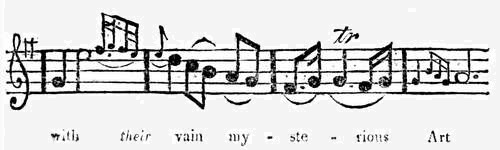
For the wrong placing of the accent, or emphasis, see it on the word their instead of being on the word vain.
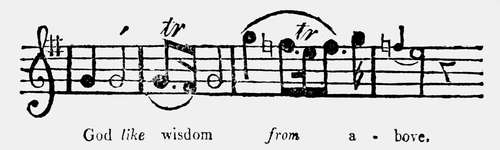
And on the word from, and the wrong syllable like.
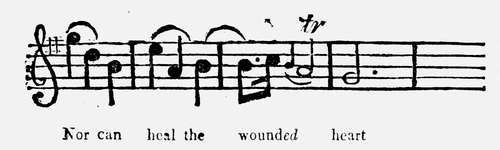
For the drawling, see the last syllable of the word wounded.
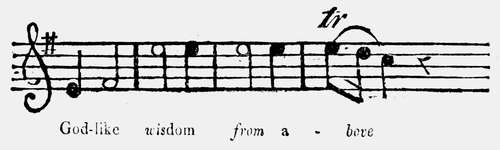
And in the syllable wis, and the word from, and syllable bove
For the stuttering, see the words ne'er relieve, in
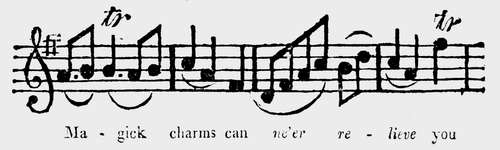
Here are four syllables made of one, and eight of three; but this is moderate. I have seen in another song that I cannot now find, seventeen syllables made of three, and sixteen of one: the latter I remember was the word charms; viz. cha, a, a, a, a, a, a, a, a, a, a, a, a, a, a, arms. Stammering with a witness!
For the unintelligibleness; give this whole song to any taught singer, and let her sing it to any company that have never heard it; you shall find they will not understand three words in ten. It is therefore, that at the oratorios and operas one sees with books in their hands all those who desire to understand what they hear sung by even our best performers.
For the tautology; you have, with their vain mysterious art, twice repeated; magic charms can ne'er relieve you, three times. Nor can heal the wounded heart, three times. Godlike wisdom from above, twice; and, this alone can deceive you, two or three times. But this is reasonable when compared with the Monster Polypheme, the Monster Polypheme, a hundred times over and over, in his admired Acis and Galatea.
As to the screaming; perhaps I cannot find a fair instance in this song; but whoever has frequented our operas will remember many. And yet here methinks the words no and e'er, when sung to these notes, have a little of the air of screaming, and would actually be screamed by some singers.
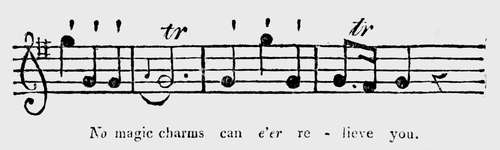
I send you inclosed the song with its music at length. Read the words without the repetitions. Observe how few they are, and what a shower of notes attend them: you will then perhaps be inclined to think with me, that though the words might be the principal part of an ancient song, they are of small importance in a modern one; they are in short only a pretence for singing.
I am, as ever,
Your affectionate brother,
B. FRANKLIN.
P. S. I might have mentioned inarticulation among the defects in common speech that are assumed as beauties in modern singing. But as that seems more the fault of the singer than of the composer, I omitted it in what related merely to the composition. The fine singer in the present mode, stifles all the hard consonants, and polishes away all the rougher parts of words that serve to distinguish them one from another; so that you hear nothing but an admirable pipe, and understand no more of the song, than you would from its tune played on any other instrument. If ever it was the ambition of musicians to make instruments that should imitate the human voice, that ambition seems now reversed, the voice aiming to be like an instrument. Thus wigs were first made to imitate a good natural head of hair;—but when they became fashionable, though in unnatural forms, we have seen natural hair dressed to look like wigs.
Description of the Process to be observed in making large Sheets of Paper in the Chinese Manner, with one smooth surface.[65]
In Europe to have a large surface of paper connected together and smooth on one side, the following operations are performed.
1. A number of small sheets are to be made separately.
2. These are to be couched, one by one, between blankets.
3. When a heap is formed it must be put under a strong press, to force out the water.
4. Then the blankets are to be taken away, one by one, and the sheets hung up to dry.
5. When dry they are to be again pressed, or if to be sized, they must be dipped into size made of warm water, in which glue and alum are dissolved.
6. They must then be pressed again to force out the superfluous size.
7. They must then be hung up a second time to dry, which, if the air happens to be damp, requires some days.
8. They must then be taken down, laid together, and again pressed.
9. They must be pasted together at their edges.
10. The whole must be glazed by labour, with a flint.
In China, if they would make sheets, suppose of four and a half ells long and one and a half ells wide, they have two large vats, each five ells long and two ells wide, made of brick, lined with a plaster that holds water. In these the stuff is mixed ready to work.
Between these vats is built a kiln or stove, with two inclining sides; each side something larger than the sheet of paper; they are covered with a fine stucco that takes a polish, and are so contrived as to be well heated by a small fire circulating in the walls.
The mould is made with thin but deep sides, that it may be both light and stiff: it is suspended at each end with cords that pass over pullies fastened to the cieling, their ends connected with a counterpoise nearly equal the weight of the mould.
Two men, one at each end of the mould, lifting it out of the water by the help of the counterpoise, turn it and apply it with the stuff to the smooth surface of the stove, against which they press it, to force out great part of the water through the wires. The heat of the wall soon evaporates the rest, and a boy takes off the dried sheet by rolling it up. The side next the stove receives the even polish of the stucco, and is thereby better fitted to receive the impression of fine prints. If a degree of sizing is required, a decoction of rice is mixed with the stuff in the vat.
Thus the great sheet is obtained, smooth and sized, and a number of the European operations saved.
As the stove has two polished sides, and there are two vats, the same operation is at the same time performed by two other men at the other vat; and one fire serves.
FOOTNOTE:
TO NOAH WEBSTER, JUN. ESQ. AT HARTFORD[66].
On Modern Innovations in the English Language and in Printing.
Philadelphia, Dec.26, 1789.
Dear Sir,
I received, some time since, your Dissertations on the English Language. It is an excellent work, and will be greatly useful in turning the thoughts of our countrymen to correct writing. Please to accept my thanks for it, as well as for the great honour you have done me in its dedication. I ought to have made this acknowledgment sooner, but much indisposition prevented me.
I cannot but applaud your zeal for preserving the purity of our language both in its expression and pronunciation, and in correcting the popular errors several of our states are continually falling into with respect to both. Give me leave to mention some of them, though possibly they may already have occurred to you. I wish, however, that in some future publication of yours, you would set a discountenancing mark upon them. The first I remember, is the word improved. When I left New England in the year 1723, this word had never been used among us, as far as I know, but in the sense of ameliorated, or made better, except once in a very old book of Dr. Mather's, entitled Remarkable Providences. As that man wrote a very obscure hand, I remember that when I read that word in his book used instead of the word employed, I conjectured that it was an error of the printer, who had mistaken a short l in the writing for an r, and a y with too short a tail for a v, whereby employed was converted into improved: but when I returned to Boston in 1733, I found this change had obtained favour, and was then become common; for I met with it often in perusing the newspapers, where it frequently made an appearance rather ridiculous. Such, for instance, as the advertisement of a country house to be sold, which had been many years improved as a tavern; and in the character of a deceased country gentleman, that he had been, for more than thirty years, improved as a justice of the peace. This use of the word improve is peculiar to New England, and not to be met with among any other speakers of English, either on this or the other side of the water.
During my late absence in France, I find that several other new words have been introduced into our parliamentary language. For example, I find a verb from the substantive notice. I should not have noticed this, were it not that the gentleman, &c. Also another verb, from the substantive advocate; The gentleman who advocates, or who has advocated that motion,&c. Another from the substantive progress, the most awkward and abominable of the three: the committee having progressed, resolved to adjourn. The word opposed, though not a new word, I find used in a new manner, as, the gentlemen who are opposed to this measure, to which I have also myself always been opposed. If you should happen to be of my opinion with respect to these innovations, you will use your authority in reprobating them.
The Latin language, long the vehicle used in distributing knowledge among the different nations of Europe, is daily more and more neglected; and one of the modern tongues, viz. French, seems, in point of universality, to have supplied its place. It is spoken in all the courts of Europe; and most of the literati, those even who do not speak it, have acquired enough knowledge of it, to enable them easily to read the books, that are written in it. This gives a considerable advantage to that nation. It enables its authors to inculcate and spread through other nations, such sentiments and opinions, on important points, as are most conducive to its interests, or which may contribute to its reputation, by promoting the common interests of mankind. It is, perhaps, owing to its being written in French, that Voltaire's Treatise on Toleration has had so sudden and so great an effect on the bigotry of Europe, as almost entirely to disarm it. The general use of the French language has likewise a very advantageous effect on the profits of the bookselling branch of commerce, it being well known, that the more copies can be sold, that are struck off from one composition of types, the profits increase in a much greater proportion, than they do in making a greater number of pieces in any other kind of manufacture. And at present there is no capital town in Europe without a French bookseller's shop corresponding with Paris. Our English bids fair to obtain the second place. The great body of excellent printed sermons in our language, and the freedom of our writings on political subjects, have induced a great dumber of divines of different sects and nations, as well as gentlemen concerned in public affairs, to study it, so far at least as to read it. And if we were to endeavour the facilitating its progress, the study of our tongue might become much more general. Those, who have employed some part of their time in learning a new language, must have frequently observed, that while their acquaintance with it was imperfect, difficulties, small in themselves, operated as great ones in obstructing their progress. A book, for example, ill printed, or a pronunciation in speaking, not well articulated, would render a sentence unintelligible, which, from a clear print, or a distinct speaker, would have been immediately comprehended. If, therefore, we would have the benefit of seeing our language more generally known among mankind, we should endeavour to remove all the difficulties, however small, that discourage the learning of it. But I am sorry to observe, that, of late years, those difficulties, instead of being diminished, have been augmented.
In examining the English books, that were printed between the restoration and the accession of George the Second, we may observe, that all the substantives were begun with a capital, in which we imitated our mother tongue, the German. This was more particularly useful to those, who were not well acquainted with the English, there being such a prodigious number of our words, that are both verbs and substantives, and spelt in the same manner, though often accented differently in pronunciation. This method has, by the fancy of printers, of late years been entirely laid aside; from an idea, that suppressing the capitals shows the character to greater advantage; those letters prominent above the line, disturbing its even, regular appearance. The effect of this change is so considerable, that a learned man of France, who used to read our books, though not perfectly acquainted with our language, in conversation with me on the subject of our authors, attributed the greater obscurity he found in our modern books, compared with those of the period above mentioned, to a change of style for the worse in our writers: of which mistake I convinced him, by marking for him each substantive with a capital, in a paragraph, which he then easily understood, though before he could not comprehend it. This shows the inconvenience of that pretended improvement.
From the same fondness for an uniform and even appearance of characters in the line, the printers have of late banished also the Italic types, in which words, of importance to be attended to in the sense of the sentence, and words, on which an emphasis should be put in reading, used to be printed. And lately, another fancy has induced other printers to use the round s instead of the long one, which formerly served well to distinguish a word readily by its varied appearance. Certainly the omitting this prominent letter makes a line appear more even, but renders it less immediately legible; as the paring of all men's noses might smooth and level their faces, but would render their physiognomies less distinguishable. Add to all these improvements backwards, another modern fancy, that grey printing is more beautiful than black. Hence the English new books are printed in so dim a character, as to be read with difficulty by old eyes; unless in a very strong light and with good glasses. Whoever compares a volume of the Gentleman's Magazine, printed between the years 1731 and 1740, with one of those printed in the last ten years, will be convinced of the much greater degree of perspicuity given by black than by the grey. Lord Chesterfield pleasantly remarked this difference to Faulkener, the printer of the Dublin Journal, who was vainly making encomiums on his own paper, as the most complete of any in the world. "But Mr. Faulkener," says my lord, "don't you think it might be still farther improved, by using paper and ink not quite so near of a colour?"—For all these reasons, I cannot but wish, that our American printers would, in their editions, avoid these fancied improvements, and thereby render their works more agreeable to foreigners in Europe, to the great advantage of our bookselling commerce.
Farther, to be more sensible of the advantage of clear and distinct printing, let us consider the assistance it affords in reading well aloud to an auditory. In so doing, the eye generally slides forward three or four words before the voice. If the sight clearly distinguishes what the coming words are, it gives time to order the modulation of the voice to express them properly. But if they are obscurely printed or disguised, by omitting the capitals and long ʃ's, or otherwise, the reader is apt to modulate wrong; and finding he has done so, he is obliged to go back and begin the sentence again; which lessens the pleasure of the hearers. This leads me to mention an old error in our mode of printing. We are sensible, that when a question is met with in the reading, there is a proper variation to be used in the management of the voice. We have therefore a point, called an interrogation, affixed to the question, in order to distinguish it. But this is absurdly placed at its end, so that the reader does not discover it till he finds, that he has wrongly modulated his voice, and is therefore obliged to begin again the sentence. To prevent this, the Spanish printers, more sensibly, place an interrogation at the beginning as well as at the end of the question. We have another error of the same kind in printing plays, where something often occurs, that is marked as spoken aside. But the word aside is placed at the end of the speech, when it ought to precede it, as a direction to the reader, that he may govern his voice accordingly. The practice of our ladies in meeting five or six together, to form little busy parties, where each is employed in some useful work, while one reads to them, is so commendable in itself, that it deserves the attention of authors and printers to make it as pleasing as possible, both to the reader and hearers.
My best wishes attend you, being, with sincere esteem,
Sir,
Your most obedient and very humble servant,
B. FRANKLIN.
FOOTNOTE:
A Scheme for a New Alphabet and reformed Mode of Spelling; with Remarks and Examples concerning the same; and an Enquiry into its Uses, in a Correspondence between Miss S——[67] and Dr. Franklin, written in the Characters of the Alphabet[68].
TABLE OF THE REFORMED ALPHABET
To face page 357, Vol. II.
Characters Sounded respectively, as in the Words in the Column below. Names of Letters as expressed in the reformed Sounds and Characters. Manner of pronouncing the Sounds.
o Old. o The first Vowel naturally, and deepest sound; requires only the mouth, and breathe through it.
* John, folly; awl, ball. The next requiring the mouth opened a little more, or hollower.

a Man, can. a The next, a little more.
e Men, lend, name, lane. e The next requires the tongue to be a little more elevated.
i Did, sin, deed, seen. i The next still more.
u Tool, fool, rule. u The next requires the lips to be gathered up, leaving a small opening.
* Um, un; as in umbrage, unto, &c. and as in er. The next a very short vowel, the sound of which we should express in our present letters thus, uh; a short, and not very strong aspiration.

h Hunter, happy, high. huh A stronger or more forcible aspiration.
g Give, gather, gi The first Consonant; being formed by the root of the tongue; this is the present hard g.
k Keep, kick. ki A kindred sound; a little more acute; to be used instead of the hard c.
* (sh) Ship, wish. ish A new letter wanted in our language; our sh, separately taken, not being proper elements of the sound.

* (ng) ing, repeating, among, ing A new letter wanted for the same reason:—These are formed back in the mouth.

n End. en Formed more forward in the mouth; the tip of the tongue to the roof of the mouth.
r Art. r The same; the tip of the tongue a little loose or separate from the roof of the mouth, and vibrating.
t Teeth. ti The tip of the tongue more forward; touching, and then leaving, the roof.
d Deed. di The same; touching a little fuller.
l ell, tell. el The same; touching just about the gums of the upper teeth.
s Essence. es This sound is formed by the breath passing between the moist end of the tongue and the upper teeth.
z (ez) Wages. ez The same; a little denser and duller.
* (th) Think e The tongue under, and a little behind, the upper teeth; touching them, but so as to let the breath pass between.

* (dh) Thy. e The same; a little fuller.

f Effect. ef Formed by the lower lip against the upper teeth.
v Ever. ev The same; fuller and duller.
b Bees. b The lips full together, and opened as the air passes out.
p Peep. pi The same; but a thinner sound.
m Ember. em The closing of the lips, while the e [here annexed] is sounding.
* N. B. The six new letters are marked with an asterisk (*) to distinguish them, and show how few new characters are proposed. B. V.
Remarks [on the Alphabetical Table.]
o It is endeavoured to give the alphabet a more natural order; beginning first with the simple sounds formed by the breath, with none or very little help of tongue, teeth, and lips, and produced chiefly in the windpipe.
to
huh
g k Then coming forward to those, formed by the roof of the tongue next to the windpipe.
r n Then to those, formed more forward, the forepart of the tongue against the roof of the mouth.
t d
l Then those, formed still more forward in the mouth, by the tip of the tongue applied first to the roots of the upper teeth.
s z
Then to those, formed by the tip of the tongue applied to the ends or edges of the upper teeth.
f Then to those, formed still more forward, by the under lip applied to the upper teeth.
v
b Then to those, formed yet more forward by the upper and under lip opening to let out the sounding breath.
p
m And lastly, ending with the shutting up of the mouth, or closing the lips while any vowel is sounding.
In this alphabet c is omitted as unnecessary; k supplying its hard sound, and s the soft; k also supplies well the place of q, and with an s added the place of x: q and x are therefore omitted. The vowel u being sounded as oo makes the w unnecessary. The y, where used simply, is supplied by i, and where as a dipthong, by two vowels: that letter is therefore omitted as useless. The jod j is also omitted, its sound being supplied by the new letter , ish, which serves other purposes, assisting in the formation of other sounds;—thus the with a d before it gives the sound of the jod j and soft g, as in "James, January, giant, gentle," "deems, dhanueri, diant, dentel;" with a t before it, it gives the sound of ch, as in "cherry, chip," "teri, tip;" and with a z before it, the French sound of the jod j, as in "jamais," "zame."
Thus the g has no longer two different sounds, which occasioned confusion, but is, as every letter ought to be, confined to one. The same is to be observed in all the letters, vowels, and consonants, that wherever they are met with, or in whatever company, their sound is always the same. It is also intended, that there be no superfluous letters used in spelling; i. e. no letter that is not sounded; and this alphabet, by six new letters, provides, that, there be no distinct sounds in the language, without letters to express them. As to the difference between short and long vowels, it is naturally expressed by a single vowel where short, a double one where long; as for "mend," write "mend," but for "remain'd," write "remeen'd;" for "did" write "did," but for "deed" write "diid," &c.
What in our common alphabet is supposed the third vowel, i, as we sound it, is as a dipthong, consisting of two of our vowels joined; [viz.] as sounded in "unto," and i in its true sound. Any one will be sensible of this who sounds those two vowels i quick after each other; the sounds begins and ends ii. The true sound of the i is that we now give to e in the words "deed, keep—[69]."
FOOTNOTES:
Examples [of writing in this Character.]
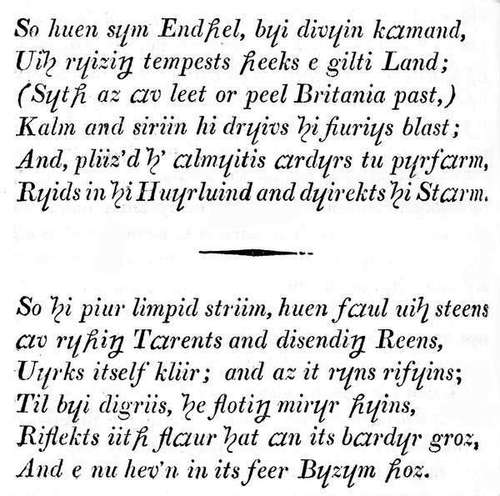
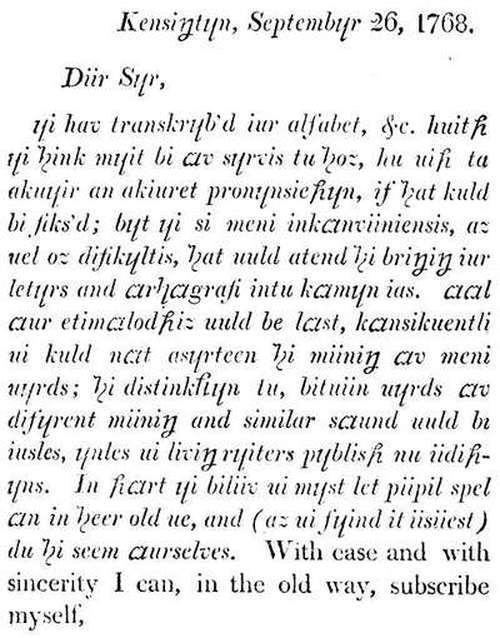
Dear Sir,
Your faithful and affectionate Servant,
M. S.
Dr. Franklin.
ANSWER TO MISS S****.
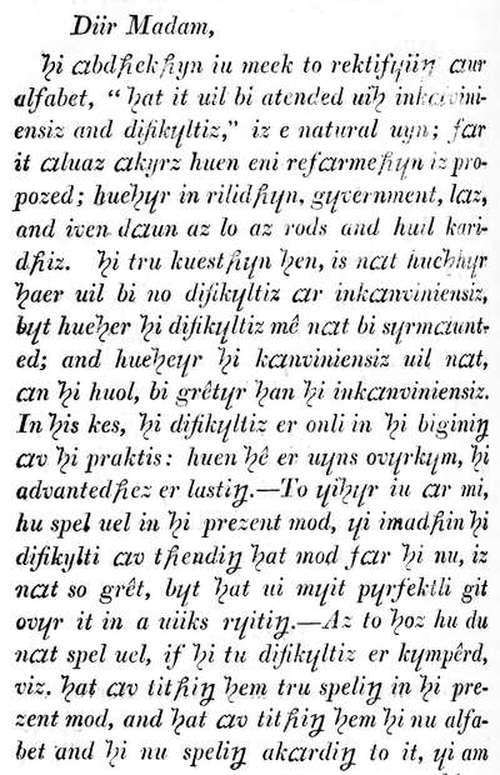
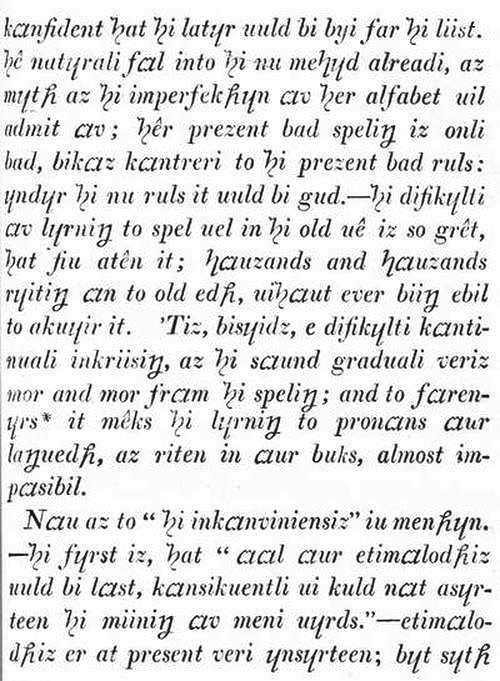
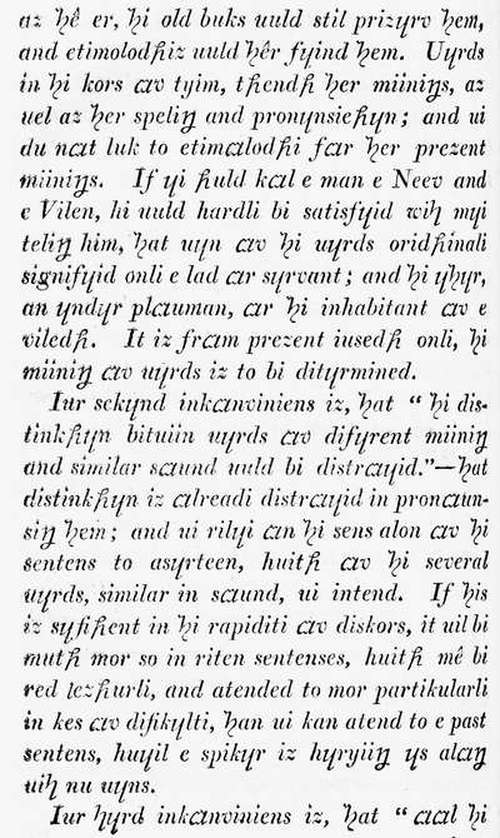
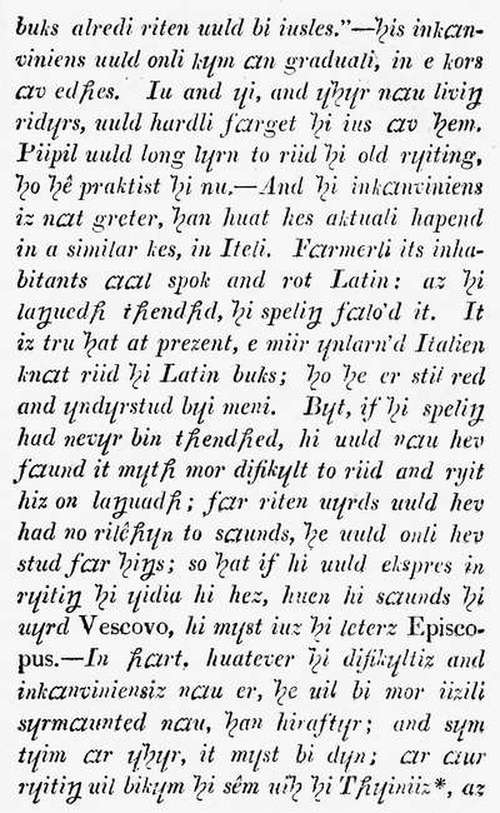
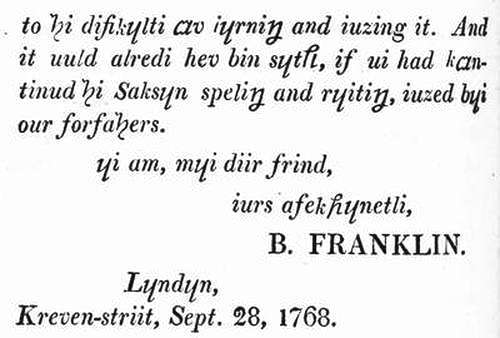
FOOTNOTES:
Rules for a Club formerly established in Philadelphia[72].
Previous question, to be answered at every meeting.
Have you read over these queries this morning, in order to consider what you might have to offer the Junto [touching] any one of them? viz.
1. Have you met with any thing, in the author you last read, remarkable, or suitable to be communicated to the Junto? particularly in history, morality, poetry, physic, travels, mechanic arts, or other parts of knowledge.
2. What new story have you lately heard agreeable for telling in conversation?
3. Hath any citizen in your knowledge failed in his business lately, and what have you heard of the cause?
4. Have you lately heard of any citizen's thriving well, and by what means?
5. Have you lately heard how any present rich man, here or elsewhere, got his estate?
6. Do you know of any fellow citizen, who has lately done a worthy action, deserving praise and imitation? or who has lately committed an error, proper for us to be warned against and avoid?
[7. What unhappy effects of intemperance have you lately observed or heard? of imprudence? of passion? or of any other vice or folly?
8. What happy effects of temperance? of prudence? of moderation? or of any other virtue?]
9. Have you or any of your acquaintance been lately sick or wounded? If so, what remedies were used, and what were their effects?
10. Who do you know that are shortly going voyages or journies, if one should have occasion to send by them?
11. Do you think of any thing at present, in which the Junto may be serviceable to mankind? to their country, to their friends, or to themselves?
12. Hath any deserving stranger arrived in town since last meeting, that you heard of? and what have you heard or observed of his character or merits? and whether think you, it lies in the power of the Junto to oblige him, or encourage him as he deserves?
13. Do you know of any deserving young beginner lately set up, whom it lies in the power of the Junto any way to encourage?
14. Have you lately observed any defect in the laws of your country, [of] which it would be proper to move the legislature for an amendment? or do you know of any beneficial law that is wanting?
15. Have you lately observed any encroachment on the just liberties of the people?
16. Hath any body attacked your reputation lately? and what can the Junto do towards securing it?
17. Is their any man whose friendship you want, and which the Junto, or any of them, can procure for you?
18. Have you lately heard any member's character attacked, and how have you defended it?
19. Hath any man injured you, from whom it is in the power of the Junto to procure redress?
20. In what manner can the Junto, or any of them, assist you in any of your honourable designs?
21. Have you any weighty affair in hand, in which you think the advice of the Junto may be of service[73]?
22. What benefits have you lately received from any man not present?
23. Is there any difficulty in matters of opinion, of justice, and injustice, which you would gladly have discussed at this time?
24. Do you see any thing amiss in the present customs or proceedings of the Junto, which might be amended?
Any person to be qualified, to stand up, and lay his hand on his breast, and be asked these questions; viz.
1. Have you any particular disrespect to any present members?—Answer. I have not.
2. Do you sincerely declare, that you love mankind in general; of what profession or religion soever? Ans. I do.
3. Do you think any person ought to be harmed in his body, name or goods, for mere speculative opinions, or his external way of worship?—Ans. No.
4. Do you love truth for truth's sake, and will you endeavour impartially to find and receive it yourself and communicate it to others?—Ans. Yes.
FOOTNOTES:
Questions discussed by the Junto forming the preceding Club[74].
Is sound an entity or body?
How may the phenomena of vapours be explained?
Is self-interest the rudder that steers mankind, the universal monarch to whom all are tributaries?
Which is the best form of government, and what was that form which first prevailed among mankind?
Can any one particular form of government suit all mankind?
What is the reason that the tides rise higher in the Bay of Fundy than the Bay of Delaware?
Is the emission of paper-money safe?
What is the reason that men of the greatest knowledge not the most happy?
How may the possession of the Lakes be improved to our advantage?
Why are tumultuous, uneasy sensations, united with our desires?
Whether it ought to be the aim of philosophy to eradicate the passions?
How may smoaky chimneys be best cured?
Why does the flame of a candle tend upwards in a spire?
Which is least criminal, a bad action joined with a good intention, or a good action with a bad intention?
Is it consistent with the principles of liberty in a free government, to punish a man as a libeller, when he speaks the truth?
FOOTNOTE:
Sketch of an English School; for the Consideration of the Trustees of the Philadelphia Academy[75].
It is expected that every scholar, to be admitted into this school, be at least able to pronounce and divide the syllables in reading, and to write a legible hand. None to be received, that are under [ ] years of age.
First, or lowest Class.
Let the first class learn the English Grammar rules, and at the same time let particular care be taken to improve them in orthography. Perhaps the latter is best done by pairing the scholars; two of those nearest equal in their spelling to be put together. Let these strive for victory; each propounding ten words every day to the other to be spelled. He that spells truly most of the other's words is victor for that day; he that is victor most days in a month, to obtain a prize, a pretty neat book of some kind, useful in their future studies. This method fixes the attention of children extremely to the orthography of words, and makes them good spellers very early. It is a shame for a man to be so ignorant of this little art, in his own language, as to be perpetually confounding words of like sound and different significations; the consciousness of which defect makes some men, otherwise of good learning and understanding, averse to writing even a common letter.
Let the pieces read by the scholars in this class be short; such as Croxal's fables, and little stories. In giving the lesson, let it be read to them; let the meaning of the difficult words in it be explained to them; and let them con over by themselves before they are called to read to the master or usher, who is to take particular care, that they do not read too fast, and that they duly observe the stops and pauses. A vocabulary of the most usual difficult words might be formed for their use, with explanations; and they might daily get a few of those words and explanations by heart, which would a little exercise their memories; or at least they might write a number of them in a small book for the purpose, which would help to fix the meaning of those words in their minds, and at the same time furnish every one with a little dictionary for his future use.
The Second Class
To be taught, reading with attention, and with proper modulations of the voice, according to the sentiment and the subject.
Some short pieces, not exceeding the length of a Spectator, to be given this class for lessons (and some of the easier Spectators would be very suitable for the purpose). These lessons might be given every night as tasks; the scholars to study them against the morning. Let it then be required of them to give an account, first of the parts of speech, and construction of one or two sentences. This will oblige them to recur frequently to their grammar, and fix its principal rules in their memory. Next, of the intention of the writer, or the scope of the piece, the meaning of each sentence, and of every uncommon word. This would early acquaint them with the meaning and force of words, and give them that most necessary habit, of reading with attention.
The master then to read the piece with the proper modulations of voice, due emphasis, and suitable action, where action is required; and put the youth on imitating his manner.
Where the author has used an expression not the best, let it be pointed out; and let his beauties be particularly remarked to the youth.
Let the lessons for reading be varied, that the youth may be made acquainted with good styles of all kinds, in prose and verse, and the proper manner of reading each kind—sometimes a well-told story, a piece of a sermon, a general's speech to his soldiers, a speech in a tragedy, some part of a comedy, an ode, a satire, a letter, blank verse, Hudibrastic, heroic, &c. But let such lessons be chosen for reading, as contain some useful instruction, whereby the understanding or morals of the youth may at the same time be improved.
It is required that they should first study and understand the lessons, before they are put upon reading them properly; to which end each boy should have an English dictionary, to help him over difficulties. When our boys read English to us, we are apt to imagine they understand what they read, because we do, and because it is their mother tongue. But they often read, as parrots speak, knowing little or nothing of the meaning. And it is impossible a reader should give the due modulation to his voice, and pronounce properly, unless his understanding goes before his tongue, and makes him master of the sentiment. Accustoming boys to read aloud what they do not first understand, is the cause of those even set tones, so common among readers, which, when they have once got a habit of using, they find so difficult to correct; by which means, among fifty readers we scarcely find a good one. For want of good reading, pieces published with a view to influence the minds of men, for their own or the public benefit, lose half their force. Were there but one good reader in a neighbourhood, a public orator might be heard throughout a nation with the same advantages, and have the same effect upon his audience, as if they stood within the reach of his voice.
The Third Class
To be taught speaking properly and gracefully; which is near a-kin to good reading, and naturally follows it in the studies of youth. Let the scholars of this class begin with learning the elements of rhetoric from some short system, so as to be able to give an account of the most useful tropes and figures. Let all their bad habits of speaking, all offences against good grammar, all corrupt or foreign accents, and all improper phrases, be pointed out to them. Short speeches from the Romans, or other history, or from the parliamentary debates, might be got by heart, and delivered with the proper action, &c. Speeches and scenes in our best tragedies and comedies (avoiding every thing, that could injure the morals of youth) might likewise be got by rote, and the boys exercised in delivering or acting them: great care being taken to form their manner after the truest models.
For their farther improvement, and a little to vary their studies, let them now begin to read history, after having got by heart a short table of the principal epochs in chronology. They may begin with Rollin's ancient and Roman histories, and proceed at proper hours, as they go through the subsequent classes, with the best histories of our own nation and colonies. Let emulation be excited among the boys, by giving, weekly, little prizes, or other small encouragements to those, who are able to give the best account of what they have read, as to time, places, names of persons, &c. This will make them read with attention, and imprint the history well in their memories. In remarking on the history, the master will have fine opportunities of instilling instruction of various kinds, and improving the morals, as well as the understandings, of youth.
The natural and mechanic history, contained in the Spectacle de la Nature, might also be begun in this class, and continued through the subsequent classes, by other books of the same kind; for, next to the knowledge of duty, this kind of knowledge is certainly the most useful, as well as the most entertaining. The merchant may thereby be enabled better to understand many commodities in trade; the handicraftsman, to improve his business by new instruments, mixtures and materials; and frequently hints are given for new manufactures, or new methods of improving land, that may be set on foot greatly to the advantage of a country.
The Fourth Class
To be taught composition. Writing one's own language well, is the next necessary accomplishment after good speaking. It is the writing-master's business, to take care that the boys make fair characters, and place them straight and even in the lines: but to form their style, and even to take care that the stops and capitals are properly disposed, is the part of the English master. The boys should be put on writing letters to each other on any common occurrences, and on various subjects, imaginary business, &c. containing little stories, accounts of their late reading, what parts of authors please them, and why; letters of congratulation, of compliment, of request, of thanks, of recommendation, of admonition, of consolation, of expostulation, excuse, &c. In these, they should be taught to express themselves clearly, concisely, and naturally, without affected words or high-flown phrases. All their letters to pass through the master's hand, who is to point out the faults, advise the corrections, and commend what he finds right. Some of the best letters published in our own language, as sir William Temple's, those of Pope and his friends, and some others, might be set before the youth as models, their beauties pointed out and explained by the master, the letters themselves transcribed by the scholar.
Dr. Johnson's Ethices Elementa, or First Principles of Morality, may now be read by the scholars, and explained by the master, to lay a solid foundation of virtue and piety in their minds. And as this class continues the reading of history, let them now, at proper hours, receive some farther instruction in chronology, and in that part of geography (from the mathematical master) which is necessary to understand the maps and globes. They should also be acquainted with the modern names of the places they find mentioned in ancient writers. The exercises of good reading, and proper speaking, still continued at suitable times.
Fifth Class
To improve the youth in composition, they may now, besides continuing to write letters, begin to write little essays in prose, and sometimes in verse; not to make them poets, but for this reason, that nothing acquaints a lad so speedily with variety of expression, as the necessity of finding such words and phrases as will suit the measure, sound and rhyme of verse, and at the same time well express the sentiment. These essays should all pass under the master's eye, who will point out their faults, and put the writer on correcting them. Where the judgment is not ripe enough for forming new essays, let the sentiments of a Spectator be given, and required to be clothed in the scholar's own words; or the circumstances of some good story, the scholar to find expression. Let them be put sometimes on abridging a paragraph of a diffuse author: sometimes on dilating or amplifying what is wrote more closely. And now let Dr. Johnson's Noetica, or First Principles of Human Knowledge, containing a logic, or art of reasoning, &c. be read by the youth, and the difficulties, that may occur to them, be explained by the master. The reading of history, and the exercises of good reading and just speaking still continued.
Sixth Class
In this class, besides continuing the studies of the preceding in history, rhetoric, logic, moral and natural philosophy, the best English authors may be read and explained; as Tillotson, Milton, Locke, Addison, Pope, Swift, the higher papers in the Spectator and Guardian, the best translations of Homer, Virgil and Horace, of Telemachus, travels of Cyrus, &c.
Once a year, let there be public exercises in the hall; the trustees and citizens present. Then let fine gilt books be given as prizes to such boys, as distinguish themselves, and excel the others in any branch of learning, making three degrees of comparison: giving the best prize to him, that performs best; a less valuable one to him, that comes up next to the best, and another to the third. Commendations, encouragement, and advice to the rest; keeping up their hopes, that, by industry, they may excel another time. The names of those, that obtain the prize, to be yearly printed in a list.
The hours of each day are to be divided and disposed in such a manner, as that some classes may be with the writing-master, improving their hands; others with the mathematical master, learning arithmetic, accounts, geography, use of the globes, drawing, mechanics, &c. while the rest are in the English school, under the English master's care.
Thus instructed, youth will come out of this school fitted for learning any business, calling, or profession, except such wherein languages are required: and, though unacquainted with any ancient or foreign tongue, they will be masters of their own, which is of more immediate and general use, and withal will have attained many other valuable accomplishments: the time usually spent in acquiring those languages, often without success, being here employed in laying such a foundation of knowledge and ability, as, properly improved, may qualify them to pass through and execute the several offices of civil life, with advantage and reputation to themselves and country.
FOOTNOTE:
TO MISS S——N[76], AT WANSTEAD.
Advice to Youth in Reading.
Craven-street, May 17, 1760.
I send my good girl the books I mentioned to her last night. I beg her to accept of them as a small mark of my esteem and friendship. They are written in the familiar easy manner for which the French are so remarkable, and afford a good deal of philosophic and practical knowledge, unembarrassed with the dry mathematics, used by more exact reasoners, but which is apt to discourage young beginners. I would advise you to read with a pen in your hand, and enter in a little book short hints of what you find, that is curious, or that may be useful; for this will be the best method of imprinting such particulars in your memory, where they will be ready, either for practice on some future occasion, if they are matters of utility, or at least to adorn and improve your conversation, if they are rather points of curiosity. And as many of the terms of science are such, as you cannot have met with in your common reading, and may therefore be unacquainted with, I think it would be well for you to have a good dictionary at hand, to consult immediately when you meet with a word you do not comprehend the precise meaning of. This may at first seem troublesome and interrupting; but it is a trouble that will daily diminish, as you will daily find less and less occasion for your dictionary as you become more acquainted with the terms; and in the mean time you will read with more satisfaction, because with more understanding. When any point occurs, in which you would be glad to have farther information than your book affords you, I beg you would not in the least apprehend, that I should think it a trouble to receive and answer your questions. It will be a pleasure, and no trouble. For though I may not be able, out of my own little stock of knowledge, to afford you what you require, I can easily direct you to the books, where it may most readily be found. Adieu, and believe me ever, my dear friend,
Yours affectionately,
B. FRANKLIN.