LETTERS AND PAPERS ON PHILOSOPHICAL SUBJECTS. (continued 6)
Reading edition
I have thus gone through all the common causes of the smoking of chimneys that I can at present recollect as having fallen under my observation; communicating the remedies that I have known successfully used for the different cases, together with the principles on which both the disease and the remedy depend, and confessing my ignorance wherever I have been sensible of it. You will do well, if you publish, as you propose, this letter, to add in notes, or as you please, such observations as may have occurred to your attentive mind; and if other philosophers will do the same, this part of science, though humble, yet of great utility, may in time be perfected. For many years past, I have rarely met with a case of a smoky chimney, which has not been solvable on these principles, and cured by these remedies, where people have been willing to apply them; which is indeed not always the case; for many have prejudices in favour of the nostrums of pretending chimney-doctors and fumists, and some have conceits and fancies of their own, which they rather chuse to try, than to lengthen a funnel, alter the size of an opening, or admit air into a room, however necessary; for some are as much afraid of fresh air as persons in the hydrophobia are of fresh water. I myself had formerly this prejudice, this aerophobia, as I now account it, and dreading the supposed dangerous effects of cool air, I considered it as an enemy, and closed with extreme care every crevice in the rooms I inhabited. Experience has convinced me of my error. I now look upon fresh air as a friend: I even sleep with an open window. I am persuaded that no common air from without, is so unwholesome as the air within a close room that has been often breathed and not changed. Moist air too, which formerly I thought pernicious, gives me now no apprehensions: for considering that no dampness of air applied to the outside of my skin can be equal to what is applied to and touches it within, my whole body being full of moisture, and finding that I can lie two hours in a bath twice a week, covered with water, which certainly is much damper than any air can be, and this for years together, without catching cold, or being in any other manner disordered by it, I no longer dread mere moisture, either in air or in sheets or shirts: and I find it of importance to the happiness of life, the being freed from vain terrors, especially of objects that we are every day exposed inevitably to meet with. You physicians have of late happily discovered, after a contrary opinion had prevailed some ages, that fresh and cool air does good to persons in the small pox and other fevers. It is to be hoped, that in another century or two we may all find out, that it is not bad even for people in health. And as to moist air, here I am at this present writing in a ship with above forty persons, who have had no other but moist air to breathe for six weeks past; every thing we touch is damp, and nothing dries, yet we are all as healthy as we should be on the mountains of Switzerland, whose inhabitants are not more so than those of Bermuda or St. Helena, islands on whose rocks the waves are dashed into millions of particles, which fill the air with damp, but produce no diseases, the moisture being pure, unmixed with the poisonous vapours arising from putrid marshes and stagnant pools, in which many insects die and corrupt the water. These places only, in my opinion (which however I submit to yours) afford unwholesome air; and that it is not the mere water contained in damp air, but the volatile particles of corrupted animal matter mixed with that water, which renders such air pernicious to those who breathe it. And I imagine it a cause of the same kind that renders the air in close rooms, where the perspirable matter is breathed over and over again by a number of assembled, people so hurtful to health. After being in such a situation, many find themselves affected by that febricula, which the English alone call a cold, and, perhaps from the name, imagine that they caught the malady by going out of the room, when it was in fact by being in it.
You begin to think that I wander from my subject, and go out of my depth. So I return again to my chimneys.
We have of late many lecturers in experimental philosophy. I have wished that some of them would study this branch of that science, and give experiments in it as a part of their lectures. The addition to their present apparatus need not be very expensive. A number of little representations of rooms composed each of five panes of sash glass, framed in wood at the corners, with proportionable doors, and moveable glass chimneys, with openings of different sizes, and different lengths of funnel, and some of the rooms so contrived as to communicate on occasion with others, so as to form different combinations, and exemplify different cases; with quantities of green wax taper cut into pieces of an inch and half, sixteen of which stuck together in a square, and lit, would make a strong fire for a little glass chimney, and blown out would continue to burn and give smoke as long as desired. With such an apparatus all the operations of smoke and rarified air in rooms and chimneys might be seen through their transparent sides; and the effect of winds on chimneys, commanded or otherwise, might be shown, by letting the entering air blow upon them through an opened window of the lecturer's chamber, where it would be constant while he kept a good fire in his chimney. By the help of such lectures our fumists would become better instructed. At present they have generally but one remedy, which perhaps they have known effectual in some one case of smoky chimneys, and they apply that indiscriminately to all the other cases, without success,—but not without expence to their employers.
With all the science, however, that a man shall suppose himself possessed of in this article, he may sometimes meet with cases that shall puzzle him. I once lodged in a house at London, which, in a little room, had a single chimney and funnel. The opening was very small, yet it did not keep in the smoke, and all attempts to have a fire in this room were fruitless. I could not imagine the reason, till at length observing that the chamber over it, which had no fire-place in it, was always filled with smoke when a fire was kindled below and that the smoke came through the cracks and crevices of the wainscot; I had the wainscot taken down, and discovered that the funnel, which went up behind it, had a crack many feet in length, and wide enough to admit my arm, a breach very dangerous with regard to fire, and occasioned probably by an apparent irregular settling of one side of the house. The air entering this breach freely, destroyed the drawing force of the funnel. The remedy would have been, filling up the breach or rather rebuilding the funnel: but the landlord rather chose to stop up the chimney.
Another puzzling case I met with at a friend's country house near London. His best room had a chimney in which, he told me, he never could have a fire, for all the smoke came out into the room. I flattered myself I could easily find the cause, and prescribe the cure. I had a fire made there, and found it as he said. I opened the door, and perceived it was not want of air. I made a temporary contraction of the opening of the chimney, and found that it was not its being too large that caused the smoke to issue. I went out and looked up at the top of the chimney: its funnel was joined in the same stack with others, some of them shorter, that drew very well, and I saw nothing to prevent its doing the same. In fine, after every other examination I could think of, I was obliged to own the insufficiency of my skill. But my friend, who made no pretension to such kind of knowledge, afterwards discovered the cause himself. He got to the top of the funnel by a ladder, and looking down, found it filled with twigs and straw cemented by earth, and lined with feathers. It seems the house, after being built, had stood empty some years before he occupied it; and he concluded that some large birds had taken the advantage of its retired situation to make their nest there. The rubbish, considerable in quantity, being removed, and the funnel cleared, the chimney drew well, and gave satisfaction.
In general smoke is a very tractable thing, easily governed and directed when one knows the principles, and is well informed of the circumstances. You know I made it descend in my Pensylvania stove. I formerly had a more simple construction, in which the same effect was produced, but visible to the eye (Plate, Figure 7). It was composed of two plates A B and C D, placed as in the figure. The lower plate A B rested with its edge in the angle made by the hearth with the back of the chimney. The upper plate was fixed to the breast, and lapped over the lower about six inches wide and the length of the plates (near two feet) between them. Every other passage of air into the funnel was well stopped. When therefore a fire was made at E, for the first time with charcoal, till the air in the funnel was a little heated through the plates, and then wood laid on, the smoke would rise to A, turn over the edge of that plate, descend to D, then turn under the edge of the upper plate, and go up the chimney. It was pretty to see, but of no great use. Placing therefore the under plate in a higher situation, I removed the upper plate C D, and placed it perpendicularly (Plate, Figure 8) so that the upper edge of the lower plate A B came within about three inches of it, and might be pushed farther from it, or suffered to come nearer to it, by a moveable wedge between them. The flame then ascending from the fire at E, was, carried to strike the upper plate, made it very hot, and its heat rose and spread with the rarefied air into the room.
I believe you have seen in use with me, the contrivance of a sliding-plate over the fire, seemingly placed to oppose the rising of the smoke, leaving but a small passage for it, between the edge of the plate and the back of the chimney. It is particularly described, and its uses explained, in my former printed letter, and I mention it here only as another instance of the tractability of smoke[57].
What is called the Staffordshire chimney, (see the Plate, facing page 238) affords an example of the same kind. The opening of the chimney is bricked up, even with the fore-edge of its jams, leaving open only a passage over the grate of the same width, and perhaps eight inches high. The grate consists of semicircular bars, their upper bar of the greatest diameter, the others under it smaller and smaller, so that it has the appearance of half a round basket. It is, with the coals it contains, wholly without the wall that shuts up the chimney, yet the smoke bends and enters the passage above it, the draft being strong, because no air can enter that is not obliged to pass near or through the fire, so that all that the funnel is filled with is much heated, and of course much rarefied.
Much more of the prosperity of a winter country depends on the plenty and cheapness of fuel, than is generally imagined. In travelling I have observed, that in those parts where the inhabitants can have neither wood nor coal nor turf but at excessive prices, the working people live in miserable hovels, are ragged, and have nothing comfortable about them. But when fuel is cheap (or where they have the art of managing it to advantage) they are well furnished with necessaries, and have decent habitations. The obvious reason is, that the working hours of such people are the profitable hours, and they who cannot afford sufficient fuel have fewer such hours in the twenty four, than those who have it cheap and plenty: for much of the domestic work of poor women, such as spinning, sewing, knitting; and of the men in those manufactures that require little bodily exercise, cannot well be performed where the fingers are numbed with cold, those people, therefore, in cold weather, are induced to go to bed sooner, and lie longer in a morning, than they would do if they could have good fires or warm stoves to sit by; and their hours of work are not sufficient to produce the means of comfortable subsistence. Those public works, therefore, such as roads, canals, &c. by which fuel may be brought cheap into such countries from distant places, are of great utility; and those who promote them may be reckoned among the benefactors of mankind.
I have great pleasure in having thus complied with your request, and in the reflection, that the friendship you honour me with, and in which I have ever been so happy, has continued so many years without the smallest interruption. Our distance from each other is now augmented, and nature must soon put an end to the possibility of my continuing our correspondence: but if consciousness and memory remain in a future state, my esteem and respect for you, my dear friend, will be everlasting.
B. FRANKLIN.
Notes for the Letter upon Chimneys.
No. I.
The latest work on architecture that I have seen, is that entitled Nutshells, which appears to be written by a very ingenious man, and contains a table of the proportions of the openings of chimneys; but they relate solely to the proportions he gives his rooms, without the smallest regard to the funnels. And he remarks, respecting those proportions, that they are similar to the harmonic divisions of a monochord.[58] He does not indeed lay much stress on this; but it shows that we like the appearance of principles; and where we have not true ones, we have some satisfaction in producing such as are imaginary.
No. II.
The description of the sliding plates here promised, and which hath been since brought into use under various names, with some immaterial changes, is contained in a former letter to J. B. Esq. as follows:
TO J. B.[59] ESQ. AT BOSTON, IN NEW-ENGLAND.
London, Dec. 2, 1758,
Dear Sir,
I have executed here an easy simple contrivance, that I have long since had in speculation, for keeping rooms warmer in cold weather than they generally are, and with less fire. It is this. The opening of the chimney is contracted, by brick-work faced with marble slabs, to about two feet between the jams, and the breast brought down to within about three feet of the hearth. An iron frame is placed just under the breast, and extending quite to the back of the chimney, so that a plate of the same metal may slide horizontally backwards and forwards in the grooves on each side of the frame. This plate is just so large as to fill the whole space, and shut the chimney entirely when thrust quite in, which is convenient when there is no fire. Drawing it out, so as to leave a space between its further edge and the back, of about two inches; this space is sufficient for the smoke to pass; and so large a part of the funnel being stopt by the rest of the plate, the passage of warm air out of the room, up the chimney, is obstructed and retarded, and by that means much cold air is prevented from coming in through crevices, to supply its place. This effect is made manifest three ways. First, when the fire burns briskly in cold weather, the howling or whistling noise made by the wind, as it enters the room through the crevices, when the chimney is open as usual, ceases as soon as the plate is slid in to its proper distance. Secondly, opening the door of the room about half an inch, and holding your hand against the opening, near the top of the door, you feel the cold air coming in against your hand, but weakly, if the plate be in. Let another person suddenly draw it out, so as to let the air of the room go up the chimney, with its usual freedom where chimneys are open, and you immediately feel the cold air rushing in strongly. Thirdly, if something be set against the door, just sufficient, when the plate is in, to keep the door nearly shut, by resisting the pressure of the air that would force it open: then, when the plate is drawn out, the door will be forced open by the increased pressure of the outward cold air endeavouring to get in to supply the place of the warm air, that now passes out of the room to go up the chimney. In our common open chimneys, half the fuel is wasted, and its effect lost; the air it has warmed being immediately drawn off. Several of my acquaintance, having seen this simple machine in my room, have imitated it at their own houses, and it seems likely to become pretty common. I describe it thus particularly to you, because I think it would be useful in Boston, where firing is often dear.
Mentioning chimneys puts me in mind of a property I formerly had occasion to observe in them, which I have not found taken notice of by others; it is, that in the summer time, when no fire is made in the chimneys, there is, nevertheless, a regular draft of air through them, continually passing upwards, from about five or six o'clock in the afternoon, till eight or nine o'clock the next morning, when the current begins to slacken and hesitate a little, for about half an hour, and then sets as strongly down again, which it continues to do till towards five in the afternoon, then slackens and hesitates as before, going sometimes a little up, then a little down, till, in about a half an hour, it gets into a steady upward current for the night, which continues till eight or nine the next day; the hours varying a little as the days lengthen and shorten, and sometimes varying from sudden changes in the weather; as if, after being long warm, it should begin to grow cool about noon, while the air was coming down the chimney, the current will then change earlier than the usual hour, &c.
This property in chimneys I imagine we might turn to some account, and render improper, for the future, the old saying, as useless as a chimney in summer. If the opening of the chimney, from the breast down to the hearth, be closed by a slight moveable frame or two, in the manner of doors, covered with canvas, that will let the air through, but keep out the flies; and another little frame set within upon the hearth, with hooks on which to hang joints of meat, fowls, &c. wrapt well in wet linen cloths, three or four fold, I am confident, that if the linen is kept wet, by sprinkling it once a day, the meat would be so cooled by the evaporation, carried on continually by means of the passing air, that it would keep a week or more in the hottest weather. Butter and milk might likewise be kept cool, in vessels or bottles covered with wet cloths. A shallow tray, or keeler, should be under the frame to receive any water that might drip from the wetted cloths. I think, too, that this property of chimneys might, by means of smoke-jack vanes, be applied to some mechanical purposes, where a small but pretty constant power only is wanted.
If you would have my opinion of the cause of this changing current of air in chimneys, it is, in short, as follows. In summer time there is generally a great difference in the warmth of the air at mid-day and mid-night, and, of course, a difference of specific gravity in the air, as the more it is warmed the more it is rarefied. The funnel of a chimney, being for the most part surrounded by the house, is protected, in a great measure, from the direct action of the sun's rays, and also from the coldness of the night air. It thence preserves a middle temperature between the heat of the day, and the coldness of the night. This middle temperature it communicates to the air contained in it. If the state of the outward air be cooler than that in the funnel of the chimney, it will, by being heavier, force it to rise, and go out at the top. What supplies its place from below, being warmed, in its turn, by the warmer funnel, is likewise forced up by the colder and weightier air below, and so the current is continued till the next day, when the sun gradually changes the state of the outward air, makes it first as warm as the funnel of the chimney can make it (when the current begins to hesitate) and afterwards warmer. Then the funnel, being cooler than the air that comes into it, cools that air, makes it heavier than the outward air, of course it descends; and what succeeds it from above being cooled in its turn, the descending current continues till towards evening, when it again hesitates and changes its course, from the change of warmth in the outward air, and the nearly remaining same middle temperature in the funnel.
Upon this principle, if a house were built behind Beacon-hill, an adit carried from one of the doors into the hill horizontally, till it meet with a perpendicular shaft sunk from its top, it seems probable to me, that those who lived in the house would constantly, in the heat even of the calmest day, have as much cool air passing through the house, as they should chuse; and the same, though reversed in its current, during the stillest night.
I think, too, this property might be made of use to miners; as, where several shafts or pits are sunk perpendicularly into the earth, communicating at bottom by horizontal passages, which is a common case, if a chimney of thirty or forty feet high were built over one of the shafts, or so near the shaft, that the chimney might communicate with the top of the shaft, all air being excluded but what should pass up or down by the shaft, a constant change of air would, by this means, be produced in the passages below, tending to secure the workmen from those damps, which so frequently incommode them. For the fresh air would be almost always going down the open shaft, to go up the chimney, or down the chimney, to go up the shaft. Let me add one observation more, which is, that if that part of the funnel of a chimney, which appears above the roof of a house, be pretty long, and have three of its sides exposed to the heat of the sun successively, viz. when he is in the east, in the south, and in the west, while the north side is sheltered by the building from the cool northerly winds; such a chimney will often be so heated by the sun, as to continue the draft strongly upwards, through the whole twenty-four hours, and often for many days together. If the outside of such a chimney be painted black, the effect will be still greater, and the current stronger.
No. III.
It is said the northern Chinese have a method of warming their ground floors, which is ingenious. Those floors are made of tiles, a foot square and two inches thick, their corners being supported by bricks set on end, that are a foot long and four inches square; the tiles, too, join into each other, by ridges and hollows along their sides. This forms a hollow under the whole floor, which on one side of the house has an opening into the air, where a fire is made, and it has a funnel rising from the other side to carry off the smoke. The fuel is a sulphurous pitcoal, the smell of which in the room is thus avoided, while the floor, and of course the room, is well warmed. But as the underside of the floor must grow foul with soot, and a thick coat of soot prevents much of the direct application of the hot air to the tiles, I conceive that burning the smoke, by obliging it to descend through red coals, would in this construction be very advantageous, as more heat would be given by the flame than by the smoke, and the floor being thereby kept free from soot would be more heated with less fire. For this purpose I would propose erecting the funnel close to the grate, so as to have only an iron plate between the fire and the funnel, through which plate, the air in the funnel being heated, it will be sure to draw well, and force the smoke to descend, as in the figure (Plate, Figure 9.) where A is the funnel or chimney, B the grate on which the fire is placed, C one of the apertures through which the descending smoke is drawn into the channel D of figure 10, along which channel it is conveyed by a circuitous route, as designated by the arrows, until it arrives at the small aperture E, figure 10, through which it enters the funnel F. G in both figures is the iron plate against which the fire is made, which, being heated thereby, will rarefy the air in that part of the funnel, and cause the smoke to ascend rapidly. The flame thus dividing from the grate to the right and left, and turning in passages, disposed, as in figure 10, so as that every part of the floor may be visited by it before it enters the funnel F, by the two passages E E, very little of the heat will be lost, and a winter room thus rendered very comfortable.
No. IV.
Page 265. Few can imagine, &c. It is said the Icelanders have very little fuel, chiefly drift wood that comes upon their coast. To receive more advantage from its heat, they make their doors low, and have a stage round the room above the door, like a gallery, wherein the women can sit and work, the men read or write, &c. The roof being tight, the warm air is confined by it and kept from rising higher and escaping; and the cold air, which enters the house when the door is opened, cannot rise above the level of the top of the door, because it is heavier than the warm air above the door, and so those in the gallery are not incommoded by it. Some of our too lofty rooms might have a stage so constructed as to make a temporary gallery above, for the winter, to be taken away in summer. Sedentary people would find much comfort there in cold weather.
No. V.
Page 285. Where they have the art of managing it, &c. In some houses of the lower people among the northern nations of Europe, and among the poorer sort of Germans in Pensylvania, I have observed this construction, which appears very advantageous. (Plate Figure 11.) A is the kitchen with its chimney; B an iron stove in the stove-room. In a corner of the chimney is a hole through the back into the stove, to put in fuel, and another hole above it to let the smoke of the stove come back into the chimney. As soon as the cooking is over, the brands in the kitchen chimney are put through the hole to supply the stove, so that there is seldom more than one fire burning at a time. In the floor over the stove-room, is a small trap door, to let the warm air rise occasionally into the chamber. Thus the whole house is warmed at little expence of wood, and the stove-room kept constantly warm; so that in the coldest winter nights, they can work late, and find the room still comfortable when they rise to work early. An English farmer in America, who makes great fires in large open chimneys, needs the constant employment of one man to cut and haul wood for supplying them; and the draft of cold air to them is so strong, that the heels of his family are frozen while they are scorching their faces, and the room is never warm, so that little sedentary work can be done by them in winter. The difference in this article alone of economy shall, in a course of years, enable the German to buy out the Englishman, and take possession of his plantation.
Miscellaneous Observations.
Chimneys, whose funnels go up in the north wall of a house and are exposed to the north winds, are not so apt to draw well as those in a south wall; because, when rendered cold by those winds, they draw downwards.
Chimneys, enclosed in the body of a house, are better than those whose funnels are exposed in cold walls.
Chimneys in stacks are apt to draw better than separate funnels, because the funnels, that have constant fires in them, warm the others, in some degree, that have none.
One of the funnels, in a house I once occupied, had a particular funnel joined to the south side of the stack, so that three of its sides were exposed to the sun in the course of the day, viz. (Plate, Figure 12.) the east side E during the morning, the south side S in the middle part of the day, and the west side W during the afternoon, while its north side was sheltered by the stack from the cold winds. This funnel, which came from the ground-floor, and had a considerable height above the roof, was constantly in a strong drawing state day and night, winter and summer.
Blacking of funnels, exposed to the sun, would probably make them draw still stronger.
In Paris I saw a fire-place so ingeniously contrived as to serve conveniently two rooms, a bedchamber and a study. The funnel over the fire was round. The fire-place was of cast iron (Plate, Figure 13.) having an upright back A, and two horizontal semicircular plates B C, the whole so ordered as to turn on the pivots D E. The plate B always stopped that part of the round funnel that was next to the room without fire, while the other half of the funnel over the fire was always open. By this means a servant in the morning could make a fire on the hearth C, then in the study, without disturbing the master by going into his chamber; and the master, when he rose, could, with a touch of his foot, turn the chimney on its pivots, and bring the fire into his chamber, keep it there as long as he wanted it, and turn it again, when he went out, into his study. The room which had no fire in it was also warmed by the heat coming through the back plate, and spreading in the room, as it could not go up the chimney.
FOOTNOTES:
Plate X.
Vol. II. page 297.
Stove for Burning Pit-Coal.
View larger image here
Published as the Act directs, April 1, 1806, by Longman, Hurst, Rees & Orme, Paternoster Row.
Description of a new Stove for burning of Pitcoal, and consuming all its smoke.[60]
By Dr. B. Franklin.
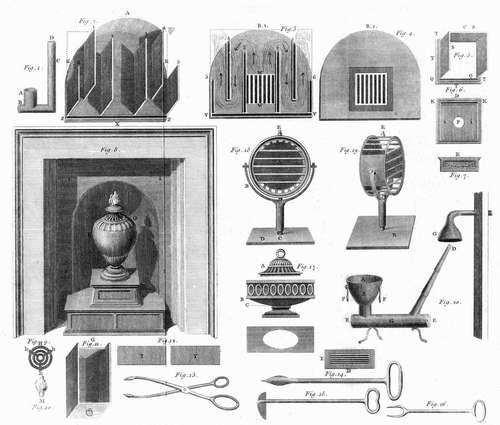
Towards the end of the last century an ingenious French philosopher, whose name I am sorry I cannot recollect, exhibited an experiment to show, that very offensive things might be burnt in the middle of a chamber, such as woollen rags, feathers, &c. without creating the least smoke or smell. The machine in which it was made, if I remember right, was of this form, (Plate X. Figure 1.) made of plate iron. Some clear burning charcoals were put into the opening of the short tube A, and supported there by the grate B. The air, as soon as the tubes grew warm, would ascend in the longer leg C and go out at D, consequently air must enter at A descending to B. In this course it must be heated by the burning coals through which it passed, and rise more forcibly in the longer tube, in proportion to its degree of heat or rarefaction, and length of that tube. For such a machine is a kind of inverted syphon; and as the greater weight of water in the longer leg of a common syphon in descending is accompanied by an ascent of the same fluid in the shorter; so, in this inverted syphon, the greater quantity of levity of air in the longer leg, in rising is accompanied by the descent of air in the shorter. The things to be burned being laid on the hot coals at A, the smoke must descend through those coals, be converted into flame, which, after destroying the offensive smell, came out at the end of the longer tube as mere heated air.
Whoever would repeat this experiment with success must take care that the part A, B, of the short tube, be quite full of burning coals, so that no part of the smoke may descend and pass by them without going through them, and being converted into flame; and that the longer tube be so heated as that the current of ascending hot air is established in it before the things to be burnt are laid on the coals; otherwise there will be a disappointment.
It does not appear either in the Memoirs of the Academy of Sciences, or Philosophical Transactions of the English Royal Society, that any improvement was ever made of this ingenious experiment, by applying it to useful purposes. But there is a German book, entitled Vulcanus Famulans, by Joh. George Leutmann, P. D. printed at Wirtemberg in 1723, which describes, among a great variety of other stoves for warming rooms, one, which seems to have been formed on the same principle, and probably from the hint thereby given, though the French experiment is not mentioned. This book being scarce, I have translated the chapter describing the stove, viz.
"Vulcanus Famulans, by John George Leutmann, P. D. "Wirtemberg, 1723.
"CHAP. VII.
"On a Stove, which draws downwards.
"Here follows the description of a sort of stove, which can easily be removed and again replaced at pleasure. This drives the fire down under itself, and gives no smoke, but however a very unwholesome vapour.
"In the figure, A is an iron vessel like a funnel, (Plate X. Figure 20.) in diameter at the top about twelve inches, at the bottom near the grate about five inches; its height twelve inches. This is set on the barrel C, which is ten inches diameter and two feet long, closed at each end E E. From one end rises a pipe or flue about four inches diameter, on which other pieces of pipe are set, which are gradually contracted to D, where the opening is but about two inches. Those pipes must together be at least four feet high. B is an iron grate. F F are iron handles guarded with wood, by which the stove is to be lifted and moved. It stands on three legs. Care must be taken to stop well all the joints, that no smoke may leak through.
"When this stove is to be used, it must first be carried into the kitchen and placed in the chimney near the fire. There burning wood must be laid and left upon its grate till the barrel C is warm, and the smoke no longer rises at A, but descends towards C. Then it is to be carried into the room which it is to warm. When once the barrel C is warm, fresh wood may be thrown into the vessel A as often as one pleases, the flame descends and without smoke, which is so consumed that only a vapour passes out at D.
"As this vapour is unwholesome, and affects the head, one may be freed from it, by fixing in the wall of the room an inverted funnel, such as people use to hang over lamps, through which their smoke goes out as through a chimney. This funnel carries out all the vapour cleverly, so that one finds no inconvenience from it, even though the opening D be placed a span below the mouth of the said funnel G. The neck of the funnel is better when made gradually bending, than if turned in a right angle.
"The cause of the draft downwards in the stove is the pressure of the outward air, which, falling into the vessel A in a column of twelve inches diameter, finds only a resisting passage at the grate B, of five inches, and one at D, of two inches, which are much too weak to drive it back again; besides, A stands much higher than B, and so the pressure on it is greater and more forcible, and beats down the frame to that part where it finds the least resistance. Carrying the machine first to the kitchen fire for preparation, is on this account, that in the beginning the fire and smoke naturally ascend, till the air in the close barrel C is made thinner by the warmth. When that vessel is heated, the air in it is rarefied, and then all the smoke and fire descends under it.
"The wood should be thoroughly dry, and cut into pieces five or six inches long, to fit it for being thrown into the funnel A." Thus far the German book.
It appears to me, by Mr. Leutmann's explanation of the operation of this machine, that he did not understand the principles of it, whence I conclude he was not the inventor of it; and by the description of it, wherein the opening at A is made so large, and the pipe E, D, so short, I am persuaded he never made nor saw the experiment, for the first ought to be much smaller and the last much higher, or it hardly will succeed. The carrying it in the kitchen, too, every time the fire should happen to be out, must be so troublesome, that it is not likely ever to have been in practice, and probably has never been shown but as a philosophical experiment. The funnel for conveying the vapour out of the room would besides have been uncertain in its operation, as a wind blowing against its mouth would drive the vapour back.
The stove I am about to describe was also formed on the idea given by the French experiment, and completely carried into execution before I had any knowledge of the German invention; which I wonder should remain so many years in a country, where men are so ingenious in the management of fire, without receiving long since the improvements I have given it.
Description of the Parts.
A, the bottom plate which lies flat upon the hearth, with its partitions, 1, 2, 3, 4, 5, 6, (Plate X. Figure 2.) that are cast with it, and a groove Z Z, in which are to slide, the bottom edges of the small plates Y, Y, figure 12; which plates meeting at X close the front.
B 1, figure 3, is the cover plate showing its under side, with the grooves 1, 2, 3, 4, 5, 6, to receive the top edges of the partitions that are fixed to the bottom plate. It shows also the grate W W, the bars of which are cast in the plate, and a groove V V, which comes right over the groove Z Z, figure 2, receiving the upper edges of the small sliding plates Y Y, figure 12.
B 2, figure 4, shows the upper side of the same plate, with a square impression or groove for receiving the bottom mouldings T T T T of the three-sided box C, figure 5, which is cast in one piece.
D, figure 6, its cover, showing its under side with grooves to receive the upper edges S S S of the sides of C, figure 5, also a groove R, R, which when the cover is put on comes right over another Q Q in C, figure 5, between which it is to slide.
E, figure 7, the front plate of the box.
P, a hole three inches diameter through the cover D, figure 6, over which hole stands the vase F, figure 8, which has a corresponding hole two inches diameter through its bottom.
The top of the vase opens at O, O, O, figure 8, and turns back upon a hinge behind when coals are to be put in; the vase has a grate within at N N of cast iron H, figure 9, and a hole in the top, one and a half inches diameter, to admit air, and to receive the ornamental brass guilt flame M, figure 10, which stands in that hole, and, being itself hollow and open, suffers air to pass through it to the fire.
G, figure 11, is a drawer of plate iron, that slips in between in the partitions 2 and 3, figure 2, to receive the falling ashes. It is concealed when the small sliding plates Y Y, figure 12, are shut together.
I, I, I, I, figure 8, is a niche built of brick in the chimney and plastered. It closes the chimney over the vase, but leaves two funnels, one in each corner, communicating with the bottom box K K, figure 2.
Dimensions of the Parts.
Feet. In.
Front of the bottom box, 2 0
Height of its partitions, 0 4¼
Length of No. 1,2, 3 and 4, each, 1 3
Length of No. 5 and 6, each, 0 8¼
Breadth of the passage between No. 2 and 3, 0 6
Breadth of the other passages each, 0 3½
Breadth of the grate, 0 6½
Length of ditto, 0 8
Bottom moulding of box C, square, 1 0
Height of the sides of ditto, 0 4
Length of the back side, 0 10
Length of the right and left sides, each, 0 9½
Length of the front plate E, where longest, 0 11
The cover D, square, 0 12
Hole in ditto, diameter, 0 3
Sliding plates Y Y, their length, each, 1 0
——————— their breadth, each, 0 4½
Drawer G, its length, 1 0
–————— breadth, 0 5¾
–————— depth, 0 4
–————— depth of its further end, only, 0 1
Grate H in the vase, its diameter to the extremity of its knobs, 0 5¾
Thickness of the bars at top, 0 0¼
–———————— at bottom, less, 0 0
Depth of the bars at the top, 0 0¾
Height of the vase, 1 6
Diameter of the opening O, O, in the clear, 0 8
Diameter of the air-hole at top, 0 1½
–——— of the flame hole at bottom, 0 2
To fix this Machine.
Spread mortar on the hearth to bed the bottom plate A, then lay that plate level, equally distant from each jamb, and projecting out as far as you think proper. Then putting some Windsor loam in the grooves of the cover B, lay that on: trying the sliding plates Y Y, to see if they move freely in the grooves Z Z, V V, designed for them.
Then begin to build the niche, observing to leave the square corners of the chimney unfilled; for they are to be funnels. And observe also to leave a free open communication between the passages at K K, and the bottom of those funnels, and mind to close the chimney above the top of the niche, that no air may pass up that way. The concave back of the niche will rest on the circular iron partition 1 A 4, figure 2, then, with a little loam, put on the box C over the grate, the open side of the box in front.
Then, with loam in three of its grooves, the groove R R being left clean, and brought directly over the groove Q Q in the box, put on the cover D, trying the front plate E, to see if it slides freely in those grooves.
Lastly, set on the vase, which has small holes in the moulding of its bottom to receive two iron pins that rise out of the plate D at I I, for the better keeping it steady.
Then putting in the grate H, which rests on its three knobs h h h against the inside of the vase, and slipping the drawer into its place; the machine is fit for use.
To use it.
Let the first fire be made after eight in the evening or before eight in the morning, for at those times and between those hours all night, there is usually a draft up a chimney, though it has long been without fire; but between those hours in the day there is often, in a cold chimney, a draft downwards, when, if you attempt to kindle a fire, the smoke will come into the room.
But to be certain of your proper time, hold a flame over the air-hole at the top. If the flame is drawn strongly down for a continuance, without whiffling, you may begin to kindle a fire.
First put in a few charcoals on the grate H.
Lay some small sticks on the charcoals,
Lay some pieces of paper on the sticks,
Kindle the paper with a candle,
Then shut down the top, and the air will pass down through the air-hole, blow the flame of the paper down through the sticks, kindle them, and their flame passing lower kindles the charcoal.
When the charcoal is well kindled, lay on it the sea-coals, observing not to choak the fire by putting on too much at first.
The flame descending through the hole in the bottom of the vase, and that in plate D into the box C, passes down farther through the grate W W in plate B 1, then passes horizontally towards the back of the chimney; there dividing, and turning to the right and left, one part of it passes round the far end of the partition 2, then coming forward it turns round the near end of partition 1, then moving backward it arrives at the opening into the bottom of one of the upright corner funnels behind the niche, through which it ascends into the chimney, thus heating that half of the box and that side of the niche. The other part of the divided flame passes round the far end of partition 3, round the near end of partition 4, and so into and up the other corner funnel, thus heating the other half of the box, and the other side of the niche. The vase itself, and the box C will also be very hot, and the air surrounding them being heated, and rising, as it cannot get into the chimney, it spreads in the room, colder air succeeding is warmed in its turn, rises and spreads, till by the continual circulation the whole is warmed.
If you should have occasion to make your first fire at hours not so convenient as those above mentioned, and when the chimney does not draw, do not begin it in the vase, but in one or more of the passages of the lower plate, first covering the mouth of the vase. After the chimney has drawn a while with the fire thus low, and begins to be a little warm, you may close those passages and kindle another fire in the box C, leaving its sliding shutter a little open; and when you find after some time that the chimney being warmed draws forcibly, you may shut that passage, open your vase, and kindle your fire there, as above directed. The chimney well warmed by the first day's fire will continue to draw constantly all winter, if fires are made daily.
You will, in the management of your fire, have need of the following implements:
A pair of small light tongs, twelve or fifteen inches long, plate, figure 13.
A light poker about the same length with a flat broad point, figure 14.
A rake to draw ashes out of the passages of the lower plate, where the lighter kind escaping the ash-box will gather by degrees, and perhaps once in a week or ten days require being removed, figure 15.
And a fork with its prongs wide enough to slip on the neck of the vase cover, in order to raise and open it when hot, to put in fresh coals, figure 16.
In the management of this stove there are certain precautions to be observed, at first with attention, till they become habitual. To avoid the inconvenience of smoke, see that the grate H be clear before you begin to light a fresh fire. If you find it clogged with cinders and ashes, turn it up with your tongs and let them fall upon the grate below; the ashes will go through it, and the cinders may be raked off and returned into the vase when you would burn them. Then see that all the sliding plates are in their places and close shut, that no air may enter the stove but through the round opening at the top of the vase. And to avoid the inconvenience of dust from the ashes, let the ash-drawer be taken out of the room to be emptied; and when you rake the passages, do it when the draft of the air is strong inwards, and put the ashes carefully into the ash-box, that remaining in its place.
If, being about to go abroad, you would prevent your fire burning in your absence, you may do it by taking the brass flame from the top of the vase, and covering the passage with a round tin plate, which will prevent the entry of more air than barely sufficient to keep a few of the coals alive. When you return, though some hours absent, by taking off the tin plate and admitting the air, your fire will soon be recovered.
The effect of this machine, well managed, is to burn not only the coals, but all the smoke of the coals, so that while the fire is burning, if you go out and observe the top of your chimney, you will see no smoke issuing, nor any thing but clear warm air, which as usual makes the bodies seen through it appear waving.
But let none imagine from this, that it may be a cure for bad or smoky chimneys, much less, that as it burns the smoke it may be used in a room that has no chimney. It is by the help of a good chimney, the higher the better, that it produces its effect; and though a flue of plate iron sufficiently high might be raised in a very lofty room, the management to prevent all disagreeable vapour would be too nice for common practice, and small errors would have unpleasing consequences.
It is certain that clean iron yields no offensive smell when heated. Whatever of that kind you perceive, where there are iron stoves, proceeds therefore from some foulness burning or fuming on their surface. They should therefore never be spit upon, or greased, nor should any dust be suffered to lie upon them. But as the greatest care will not always prevent these things, it is well once a week to wash the stove with soap lees and a brush, rinsing it with clean water.
The Advantages of this Stove.
1. The chimney does not grow foul, nor ever need sweeping; for as no smoke enters it, no soot can form in it.
2. The air heated over common fires instantly quits the room and goes up the chimney with the smoke; but in the stove, it is obliged to descend in flame and pass through the long winding horizontal passages, communicating its heat to a body of iron plate, which, having thus time to receive the heat, communicates the same to the air of the room, and thereby warms it to a greater degree.
3. The whole of the fuel is consumed by being turned into flame, and you have the benefit of its heat, whereas in common chimneys a great part goes away in smoke which you see as it rises, but it affords you no rays of warmth. One may obtain some notion of the quantity of fuel thus wasted in smoke, by reflecting on the quantity of soot that a few weeks firing will lodge against the sides of the chimney, and yet this is formed only of those particles of the column of smoke that happen to touch the sides in its ascent. How much more must have passed off in the air? And we know that this soot is still fuel; for it will burn and flame as such, and when hard caked together is indeed very like and almost as solid as the coal it proceeds from. The destruction of your fuel goes on nearly in the same quantity whether in smoke or in flame: but there is no comparison in the difference of heat given. Observe when fresh coals are first put on your fire, what a body of smoke arises. This smoke is for a long time too cold to take flame. If you then plunge a burning candle into it, the candle instead of inflaming the smoke will instantly be itself extinguished. Smoke must have a certain degree of heat to be inflammable. As soon as it has acquired that degree, the approach of a candle will inflame the whole body, and you will be very sensible of the difference of the heat it gives. A still easier experiment may be made with the candle itself. Hold your hand near the side of its flame, and observe the heat it gives; then blow it out, the hand remaining in the same place, and observe what heat may be given by the smoke that rises from the still burning snuff. You will find it very little. And yet that smoke has in it the substance of so much flame, and will instantly produce it, if you hold another candle above it so as to kindle it. Now the smoke from the fresh coals laid on this stove, instead of ascending and leaving the fire while too cold to burn, being obliged to descend through the burning coals, receives among them that degree of heat which converts it into flame, and the heat of that flame is communicated to the air of the room, as above explained.
4. The flame from the fresh coals laid on in this stove, descending through the coals already ignited, preserves them long from consuming, and continues them in the state of red coals as long as the flame continues that surrounds them, by which means the fires made in this stove are of much longer duration than in any other, and fewer coals are therefore necessary for a day. This is a very material advantage indeed. That flame should be a kind of pickle, to preserve burning coals from consuming, may seem a paradox to many, and very unlikely to be true, as it appeared to me the first time I observed the fact. I must therefore relate the circumstances, and shall mention an easy experiment, by which my reader may be in possession of every thing necessary to the understanding of it. In the first trial I made of this kind of stove, which was constructed of thin plate iron, I had instead of the vase a kind of inverted pyramid like a mill-hopper; and fearing at first that the small grate contained in it might be clogged by cinders, and the passage of the flame sometimes obstructed, I ordered a little door near the grate, by means of which I might on occasion clear it: though after the stove was made, and before I tried it, I began to think this precaution superfluous, from an imagination, that the flame being contracted in the narrow part where the grate was placed, would be more powerful in consuming what it should there meet with, and that any cinders between or near the bars would be presently destroyed and the passage opened. After the stove was fixed and in action, I had a pleasure now and then in opening that door a little, to see through the crevice how the flame descended among the red coals, and observing once a single coal lodged on the bars in the middle of the focus, a fancy took me to observe by my watch in how short a time it would be consumed. I looked at it long without perceiving it to be at all diminished, which surprised me greatly. At length it occurred to me, that I and many others had seen the same thing thousands of times, in the conservation of the red coal formed in the snuff of a burning candle, which while envelloped in flame, and thereby prevented from the contact of passing air, is long continued and augments instead of diminishing, so that we are often obliged to remove it by the snuffers, or bend it out of the flame into the air, where it consumes presently to ashes. I then supposed, that to consume a body by fire, passing air was necessary to receive and carry off the separated particles of the body: and that the air passing in the flame of my stove, and in the flame of a candle, being already saturated with such particles, could not receive more, and therefore left the coal undiminished as long as the outward air was prevented from coming to it by the surrounding flame, which kept it in a situation somewhat like that of charcoal in a well luted crucible, which, though long kept in a strong fire, comes out unconsumed.
An easy experiment will satisfy any one of this conserving power of flame envelloping red coal. Take a small stick of deal or other wood the size of a goose quill, and hold it horizontally and steadily in the flame of the candle above the wick, without touching it, but in the body of the flame. The wood will first be inflamed, and burn beyond the edge of the flame of the candle, perhaps a quarter of an inch. When the flame of the wood goes out, it will leave a red coal at the end of the stick, part of which will be in the flame of the candle and part out in the air. In a minute or two you will perceive the coal in the air diminish gradually, so as to form a neck; while the part in the flame continues of its first size, and at length the neck being quite consumed it drops off; and by rolling it between your fingers when extinguished you will find it still a solid coal.
However, as one cannot be always putting on fresh fuel in this stove to furnish a continual flame as is done in a candle, the air in the intervals of time gets at the red coals and consumes them. Yet the conservation while it lasted, so much delayed the consumption of the coals, that two fires, one made in the morning, and the other in the afternoon, each made by only a hatfull of coals, were sufficient to keep my writing room, about sixteen feet square and ten high, warm a whole day. The fire kindled at seven in the morning would burn till noon; and all the iron of the machine with the walls of the niche being thereby heated, the room kept warm till evening, when another smaller fire kindled kept it warm till midnight.
Instead of the sliding plate E, which shuts the front of the box C, I sometimes used another which had a pane of glass, or, which is better, of Muscovy talc, that the flame might be seen descending from the bottom of the vase and passing in a column through the box C, into the cavities of the bottom plate, like water falling from a funnel, admirable to such as are not acquainted with the nature of the machine, and in itself a pleasing spectacle.
Every utensil, however properly contrived to serve its purpose, requires some practice before it can be used adroitly. Put into the hands of a man for the first time a gimblet or a hammer (very simple instruments) and tell him the use of them, he shall neither bore a hole or drive a nail with the dexterity and success of another who has been accustomed to handle them. The beginner therefore in the use of this machine will do well not to be discouraged with little accidents that may arise at first from his want of experience. Being somewhat complex, it requires as already said a variety of attentions; habit will render them unnecessary. And the studious man who is much in his chamber, and has a pleasure in managing his own fire, will soon find this a machine most comfortable and delightful. To others who leave their fires to the care of ignorant servants, I do not recommend it. They will with difficulty acquire the knowledge necessary, and will make frequent blunders that will fill your room with smoke. It is therefore by no means fit for common use in families. It may be adviseable to begin with the flaming kind of stone coal, which is large, and, not caking together, is not so apt to clog the grate. After some experience, any kind of coal may be used, and with this advantage, that no smell, even from the most sulphurous kind can come into your room, the current of air being constantly into the vase, where too that smell is all consumed.
The vase form was chosen as being elegant in itself, and very proper for burning of coals: where wood is the usual fuel, and must be burned in pieces of some length, a long square chest may be substituted, in which A is the cover opening by a hinge behind, B the grate, C the hearth-box with its divisions as in the other, D the plan of the chest, E the long narrow grate. (Plate, Figure 17.) This I have not tried, but the vase machine was completed in 1771, and used by me in London three winters, and one afterwards in America, much to my satisfaction; and I have not yet thought of any improvement it may be capable of, though such may occur to others. For common use, while in France, I have contrived another grate for coals, which has in part the same property of burning the smoke and preserving the red coals longer by the flame, though not so completely as in the vase, yet sufficiently to be very useful, which I shall now describe as follows.
A, is a round grate, one foot (French) in diameter, and eight inches deep between the bars and the back; (Plate, Figure 18.) the sides and back of plate iron; the sides having holes of half an inch diameter distant three or four inches from each other, to let in air for enlivening the fire. The back without holes. The sides do not meet at top nor at bottom by eight inches: that square is filled by grates of small bars crossing front to back to let in air below, and let out the smoke or flame above. The three middle bars of the front grate are fixed, the upper and lower may be taken out and put in at pleasure, when hot, with a pair of pincers. This round grate turns upon, an axis, supported by the crotchet B, the stem of which is an inverted conical tube five inches deep, which comes on as many inches upon a pin that fits it, and which is fixed upright in cast iron plate D, that lies upon the hearth; in the middle of the top and bottom grates are fixed small upright pieces E E about an inch high, which as the whole is turned on its axis stop it when the grate is perpendicular. Figure 19 is another view of the same machine.
In making the first fire in a morning with this grate, there is nothing particular to be observed. It is made as in other grates, the coals being put in above, after taking out the upper bar, and replacing it when they are in. The round figure of the fire when thoroughly kindled is agreeable, it represents the great giver of warmth to our system. As it burns down and leaves a vacancy above, which you would fill with fresh coals, the upper bar is to be taken out, and afterwards replaced. The fresh coals, while the grate continues in the same position, will throw up as usual a body of thick smoke. But every one accustomed to coal fires in common grates must have observed, that pieces of fresh coal stuck in below among the red coals have their smoke so heated as that it becomes flame as fast as it is produced, which flame rises among the coals and enlivens the appearance of the fire. Here then is the use of this swivel grate. By a push with your tongs or poker, you turn it on its pin till it faces the back of the chimney, then turn it over on its axis gently till it again faces the room, whereby all the fresh coals will be found under the live coals, and the greater part of the smoke arising from the fresh coals will in its passage through the live ones be heated so as to be converted into flame: whence you have much more heat from them, and your red coals are longer preserved from consuming. I conceive this construction, though not so complete a consumer of all the smoke as the vase, yet to be fitter for common use, and very advantageous. It gives too a full sight of the fire, always a pleasing object, which we have not in the other. It may with a touch be turned more or less from any one of the company that desires to have less of its heat, or presented full to one just come out of the cold. And supported in a horizontal position, a tea-kettle may be boiled on it.
The author's description of his Pensylvania fireplace, first published in 1744, having fallen into the hands of workmen in Europe, who did not, it seems, well comprehend the principles of that machine, it was much disfigured in their imitations of it; and one of its main intentions, that of admitting a sufficient quantity of fresh air warmed in entering through the air-box, nearly defeated, by a pretended improvement, in lessening its passages to make more room for coals in a grate. On pretence of such improvements, they obtained patents for the invention, and for a while made great profit by the sale, till the public became sensible of that defect, in the expected operation. If the same thing should be attempted with this vase stove, it will be well for the buyer to examine thoroughly such pretended improvements, lest, being the mere productions of ignorance, they diminish or defeat the advantages of the machine, and produce inconvenience and disappointment.
The method of burning smoke, by obliging it to descend through hot coals, may be of great use in heating the walls of a hot-house. In the common way, the horizontal passages or flues that are made to go and return in those walls, lose a great deal of their effect when they come to be foul with soot; for a thick blanket-like lining of soot prevents much of the hot air from touching and heating the brick work in its passage, so that more fire must be made as the flue grows fouler: but by burning the smoke they are kept always clean. The same method may also be of great advantage to those businesses in which large coppers or caldrons are to be heated.
Written at Sea, 1785.
FOOTNOTE:
TO MISS STEPHENSON.
Method of Contracting Chimneys. Modesty in Disputation.
Craven-Street, Saturday Evening, past 10.
The question you ask me is a very sensible one, and I shall be glad if I can give you a satisfactory answer. There are two ways of contracting a chimney; one, by contracting the opening before the fire; the other, by contracting the funnel above the fire. If the funnel above the fire is left open in its full dimensions, and the opening before the fire is contracted; then the coals, I imagine, will burn faster, because more air is directed through the fire, and in a stronger stream; that air which before passed over it, and on each side of it, now passing through it. This is seen in narrow stove chimneys, when a sacheverell or blower is used, which still more contracts the narrow opening.—But if the funnel only above the fire is contracted, then, as a less stream of air is passing up the chimney, less must pass through the fire, and consequently it should seem that the consuming of the coals would rather be checked than augmented by such contraction. And this will also be the case, when both the opening before the fire, and the funnel above the fire are contracted, provided the funnel above the fire is more contracted in proportion than the opening before the fire.—So you see I think you had the best of the argument; and as you notwithstanding gave it up in complaisance to the company, I think you had also the best of the dispute. There are few, though convinced, that know how to give up, even an error, they have been once engaged in maintaining; there is therefore the more merit in dropping a contest where one thinks one's self right; it is at least respectful to those we converse with. And indeed all our knowledge is so imperfect, and we are from a thousand causes so perpetually subject to mistake and error, that positiveness can scarce ever become even the most knowing; and modesty in advancing any opinion, however plain and true we may suppose it, is always decent, and generally more likely to procure assent. Pope's rule
To speak, though sure, with seeming diffidence,
is therefore a good one; and if I had ever seen in your conversation the least deviation from it, I should earnestly recommend it to your observation.
I am, &c.
B. FRANKLIN.
TO MICHAEL HILLEGRAS ESQ.
Respecting covering Houses with Copper.[61]
London, March 17, 1770.
Dear Sir,
I received your favour of November 25, and have made enquiries, as you desired, concerning the copper covering of houses. It has been used here in a few instances only, and the practice does not seem to gain ground. The copper is about the thickness of a common playing card, and though a dearer metal than lead, I am told, that, as less weight serves, on account of its being so much thinner, and as slighter woodwork in the roof is sufficient to support it, the roof is not dearer on the whole, than one covered with lead. It is said, that hail and rain make a disagreeable drumming noise on copper; but this I suppose is rather fancy; for the plates being fastened on the rafters, must, in a great measure, deaden such sound. The first cost, whatever it is, will be all, as a copper covering must last for ages; and when the house decays, the plates will still have intrinsic worth. In Russia, I am informed many houses are covered with plates of iron tinned, such as our tin pots and other vases are made of, laid on over the edges of one another like tiles; and which, it is said, last very long, the tin preserving the iron from much decay by rusting. In France and the Low Countries, I have seen many spouts or pipes for conveying the water down from the roofs of houses, made of the same kind of tin plates soldered together; and they seem to stand very well.
With sincere regard, I am,
Yours, &c.
B. FRANKLIN.
FOOTNOTE:
TO SAMUEL RHOADS, ESQ.
On the same Subject.
London, June 26, 1770.
Dear Friend,
It is a long time since I had the pleasure of hearing from you directly. Mrs. Franklin has indeed now and then acquainted me of your welfare, which I am always glad to hear of. It is, I fear, partly, if not altogether, my fault, that our correspondence has not been regularly continued. One thing I am sure of, that it has been from no want of regard on either side, but rather from too much business, and avocations of various kinds, and my having little of importance to communicate.
One of our good citizens, Mr. Hillegras, anxious for the future safety of our town, wrote to me some time since, desiring I would enquire concerning the covering of our houses here with copper. I sent him the best information I could then obtain, but have since received the inclosed from an ingenious friend, who is what they call here a civil engineer. I should be glad you would peruse it, think of the matter a little and give me your sentiments of it. When you have done with the paper, please to give it to Mr. Hillegras. I am told by Lord Despencer, who has covered a long piazza, or gallery, with copper, that the expence is charged in this account too high, for his cost but one shilling and ten-pence per foot, all charges included. I suppose his copper must have been thinner. And, indeed, it is so strong a metal, that I think it may well be used very thin.
It appears to me of great importance, to build our dwelling houses, if we can, in a manner more secure from danger by fire. We scarcely ever hear of fire in Paris. When I was there I took particular notice of the construction of their houses, and I did not see how one of them could well be burnt, the roofs are slate or tile, the walls are stone, the walls generally lined with stucco or plaster, instead of wainscot, the floors of stucco, or of six square tiles painted brown, or of flag stone, or of marble; if any floors were of wood, it was of oak wood, which is not so inflammable as pine. Carpets prevent the coldness of stone or brick floors offending the feet in winter, and the noise of treading on such floors, overhead, is less inconvenient than on boards. The stairs too, at Paris, are either stone or brick, with only a wooden edge or corner for the step; so that on the whole, though the Parisians commonly burn wood in their chimneys, a more dangerous kind of fuel than that used here, yet their houses escape extremely well, as there is little in a room that can be consumed by fire except the furniture: whereas in London, perhaps scarcely a year passes in which half a million of property and many lives are not lost by this destructive element. Of late, indeed, they begin here to leave off wainscoting their rooms, and instead of it cover the walls with stucco, often formed into pannels like wainscot, which being painted, is very strong and warm. Stone staircases too, with iron rails, grow more and more into fashion here: but stone steps cannot, in some circumstances, be fixed; and there, methinks, oak is safer than pine; and I assure you, that in many genteel houses here, both old and new, the stairs and floors are oak, and look extremely well. Perhaps solid oak for the steps would be still safer than boards; and two steps might be cut diagonally out of one piece. Excuse my talking to you on a subject with which you must be so much better acquainted than I am. It is partly to make out a letter, and partly in hope, that, by turning your attention to the point, some methods of greater security in our future building may be thought of and promoted by you, whose judgment I know has deservedly great weight with our fellow-citizens. For though our town has not hitherto suffered very greatly by fire, yet I am apprehensive, that some time or other, by a concurrence of unlucky circumstances, such as dry weather, hard frost, and high winds, a fire then happening may suddenly spread far and wide over our cedar roofs, and do us an immense mischief. I am,
Yours, &c.
B. FRANKLIN.
Paper referred to in the preceding Letter.
The carpentry of the roof being formed with its proper descents, is, in the first place, sheeted or covered with deals, nailed horizontally upon the rafters, after the same manner as when intended to be covered with lead. The sheets of the copper for this covering are two feet by four, and for covering the slopes of the roof are cast so thin, as to weigh eight or nine pounds, and for covering the flats or gutters, ten or eleven pounds each, or about one pound, or a pound and a quarter, to the superficial foot.
A string of strong cartridge paper (over-lapping a little at its joints) is regularly tacked down upon the sheeting, under the copper covering, as the work proceeds from eaves to ridge. It prevents the jingling sound of hail or rain falling upon the roof, and answers another purpose to be mentioned by-and-by.
In order to shew the regular process of laying down the roof, we must begin with fastening two sheets together lengthwise. The edges of two sheets are laid down so as to lap or cover each other an inch, and a slip of the same copper, about three and a half inches broad, called the reeve, is introduced between them. Four oblong holes, or slits, are then cut or punched through the whole, and they are fastened or riveted together by copper nails, with small round shanks and flat heads. Indents are then cut 1¾ inch deep upon the seam at top and bottom. The right hand sheet and the reeve are then folded back to the left. The reeve is then folded to the right, and the sheets being laid on the roof in their place, it is nailed down to the sheeting with flat-headed short copper nails. The right hand sheet is then folded over the reeve to the right, and the whole beat down flat upon the cartridge paper covering the sheeting, and thus they are fastened and laid in their places, by nailing down the reeve only; and by reason of the oblong holes through them and the reeve, have a little liberty to expand or contract with the heat and cold, without raising themselves up from the sheeting, or tearing themselves or the fastening to pieces. Two other sheets are then fixed together, according to the first and second operations above, and their seam, with the reeve, introduced under the upper ends of the seam of the former, so as to cover down about two inches upon the upper ends of the former sheets: and so far the cartridge paper is allowed to cover the two first sheets. This edge of the paper is dipped in oil, or in turpentine, so far before its application, and thus a body between the sheets is formed impenetrable to wet, and the reeve belonging to the two last sheets is nailed down to the sheeting as before, and the left hand sheet is turned down to the right. Four sheets are now laid down, with the seam or joint rising to the ridge; and thus the work is continued, both vertically and horizontally, till the roof be covered, the sides and ends of each sheet being alternately each way, undermost and uppermost.
The price for copper, nails, and workmanship, runs at about eight pounds ten shillings per hundred weight, or two shillings and three-pence per foot, superficial, exclusive of the lappings; and about two shillings and eight-pence per foot upon the whole; which is rather above half as much more as the price of doing it well with lead.
TO PETER COLLINSON, ESQ. AT LONDON.
Magical Square of Squares.
Sir,
According to your request I now send you the arithmetical curiosity, of which this is the history.
Being one day in the country, at the house of our common friend, the late learned Mr. Logan, he showed me a folio French book filled with magic squares, wrote, if I forget not, by one M. Frenicle, in which he said the author had discovered great ingenuity and dexterity in the management of numbers; and though several other foreigners had distinguished themselves in the same way, he did not recollect that any one Englishman had done any thing of the kind remarkable.
I said, it was, perhaps, a mark of the good sense of our English mathematicians, that they would not spend their time in things that were merely difficiles nugæ, incapable of any useful application. He answered, that many of the arithmetical or mathematical questions, publicly proposed and answered in England, were equally trifling and useless. Perhaps the considering and answering such questions, I replied, may not be altogether useless, if it produces by practice an habitual readiness and exactness in mathematical disquisitions, which readiness may, on many occasions, be of real use. In the same way, says he, may the making of these squares be of use. I then confessed to him, that in my younger days, having once some leisure (which I still think I might have employed more usefully) I had amused myself in making these kind of magic squares, and, at length, had acquired such a knack at it, that I could fill the cells of any magic square of reasonable size, with a series of numbers as fast as I could write them, disposed in such a manner as that the sums of every row, horizontal, perpendicular, or diagonal, should be equal; but not being satisfied with these, which I looked on as common and easy things, I had imposed on myself more difficult tasks, and succeeded in making other magic squares, with a variety of properties, and much more curious. He then shewed me several in the same book, of an uncommon and more curious kind; but as I thought none of them equal to some I remembered to have made, he desired me to let him see them; and accordingly, the next time I visited him, I carried him a square of 8, which I found among my old papers, and which I will now give you, with an account of its properties. (See Plate V. Fig. 3.)
The properties are,
1. That every strait row (horizontal or vertical) of 8 numbers added together makes 260, and half each row half 260.
2. That the bent row of 8 numbers, ascending and descending diagonally, viz. from 16 ascending to 10, and from 23 descending to 17; and every one of its parallel bent rows of 8 numbers make 260.—Also the bent row from 52 descending to 54, and from 43 ascending to 45; and every one of its parallel bent rows of 8 numbers make 260.—Also the bent row from 45 to 43, descending to the left, and from 23 to 17, descending to the right, and every one of its parallel bent rows of 8 numbers, make 260.—Also the bent row from 52 to 54, descending to the right, and from 10 to 16, descending to the left, and every one of its parallel bent rows of 8 numbers make 260.—Also the parallel bent rows next to the above-mentioned, which are shortened to 3 numbers ascending, and 3 descending, &c. as from 53 to 4 ascending, and from 29 to 44 descending, make, with the two corner numbers, 260.—Also the 2 numbers 14, 61 ascending, and 36, 19 descending, with the lower 4 numbers situated like them, viz. 50, 1, descending, and 32, 47, ascending, make 260.—And, lastly, the 4 corner numbers, with the 4 middle numbers, make 260.
Plate XI.
Vol. II. page 327.
A Magic Square of Squares.
View larger image here
Published as the Act directs, April 1, 1806, by Longman, Hurst, Rees & Orme, Paternoster Row.
So this magical square seems perfect in its kind. But these are not all its properties; there are 5 other curious ones, which, at some other time, I will explain to you.
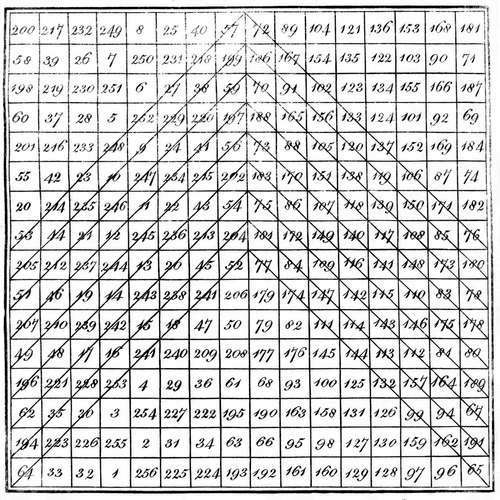
Mr. Logan then shewed me an old arithmetical book, in quarto, wrote, I think, by one Stifelius, which contained a square of 16, that he said he should imagine must have been a work of great labour; but if I forget not, it had only the common properties of making the same sum, viz. 2056, in every row, horizontal, vertical, and diagonal. Not willing to be out-done by Mr. Stifelius, even in the size of my square, I went home, and made, that evening, the following magical square of 16, which, besides having all the properties of the foregoing square of 8, i. e. it would make the 2056 in all the same rows and diagonals, had this added, that a four-square hole being cut in a piece of paper of such a size as to take in and show through it just 16 of the little squares, when laid on the greater square, the sum of the 16 numbers so appearing through the hole, wherever it was placed on the greater square, should likewise make 2056. This I sent to our friend the next morning, who, after some days, sent it back in a letter with these words: "I return to thee thy astonishing or most stupendous piece of the magical square, in which——" but the compliment is too extravagant, and therefore, for his sake, as well as my own, I ought not to repeat it. Nor is it necessary; for I make no question but you will readily allow this square of 16 to be the most magically magical of any magic square ever made by any magician. (See the Plate.)
I did not, however, end with squares, but composed also a magic circle, consisting of 8 concentric circles, and 8 radial rows, filled with a series of numbers from 12 to 75 inclusive, so disposed as that the numbers of each circle, or each radial row, being added to the central number 12, they make exactly 360, the number of degrees in a circle; and this circle had, moreover, all the properties of the square of 8. If you desire it, I will send it; but at present, I believe, you have enough on this subject. I am, &c.
B. FRANKLIN.
TO THE SAME.
Magical Circle.
Sir,
I am glad the perusal of the magical squares afforded you any amusement. I now send you the magical circle. (See Plate XII.)
Its properties, besides those mentioned in my former, are these.
Half the number in any radial row, added with half the central number, make 180, equal to the number of degrees in a semi-circle.
Also half the numbers in any one of the concentric circles, taken either above or below the horizontal double line, with half the central number, make 180.
And if any four adjoining numbers, standing nearly in a square, be taken from any part, and added with half the central number, they make 180.
Plate XII.
Vol. II. page 328.
A Magic Circle of Circles
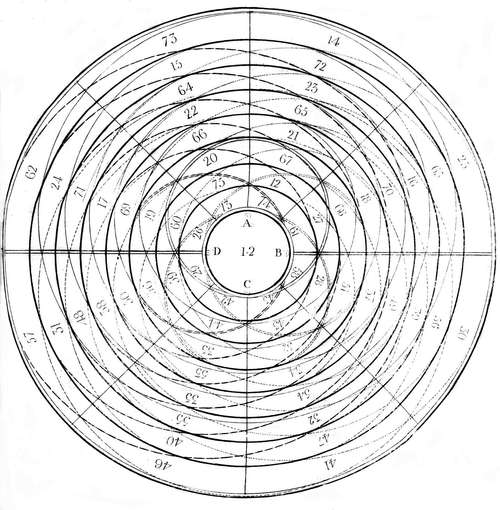
View larger image here
Published as the Act directs, April 1, 1806, by Longman, Hurst, Rees & Orme, Paternoster Row.
There are, moreover, included four other sets of circular spaces, excentric with respect to the first, each of these sets containing five spaces. The centres of the circles that bound them, are at A, B, C, and D. Each set, for the more easy distinguishing them from the first, are drawn with a different coloured ink, red, blue, green, and yellow.[62]
These sets of excentric circular spaces intersect those of the concentric, and each other; and yet the numbers contained in each of the twenty excentric spaces, taken all around, make, with the central number, the same sum as those in each of the 8 concentric, viz. 360. The halves, also of those drawn from the centres A and C, taken above or below the double horizontal line, and of those drawn from centres B and D, taken to the right or left of the vertical line, do, with half the central number, make just 180.
It may be observed, that there is not one of the numbers but what belongs at least to two of the different circular spaces; some to three, some to four, some to five; and yet they are all so placed as never to break the required number 360, in any of the 28 circular spaces within the primitive circle.
These interwoven circles make so perplexed an appearance, that it is not easy for the eye to trace every circle of numbers one would examine, through all the maze of circles intersected by it; but if you fix one foot of the compasses in either of the centres, and extend the other to any number in the circle you would examine belonging to that centre, the moving foot will point the others out, by passing round over all the numbers of that circle successively. I am, &c.
B. FRANKLIN.
FOOTNOTE:
TO THE REV. FATHER BECCARIA.
Describing a new musical Instrument composed of Glasses.
London, July 13, 1762.
Rev. Sir,
I once promised myself the pleasure of seeing you at Turin, but as that is not now likely to happen, being just about returning to my native country, America, I sit down to take leave of you (among others of my European friends that I cannot see) by writing.
I thank you for the honourable mention you have so frequently made of me in your letters to Mr. Collinson and others, for the generous defence you undertook and executed with so much success, of my electrical opinions; and for the valuable present you have made me of your new work, from which I have received great information and pleasure. I wish I could in return entertain you with any thing new of mine on that subject; but I have not lately pursued it. Nor do I know of any one here that is at present much engaged in it.
Perhaps, however, it may be agreeable to you, as you live in a musical country, to have an account of the new instrument lately added here to the great number that charming science was before possessed of.—As it is an instrument that seems peculiarly adapted to Italian music, especially that of the soft and plaintive kind, I will endeavour to give you such a description of it, and of the manner of constructing it, that you or any of your friends, may be enabled to imitate it, if you incline so to do, without being at the expence and trouble of the many experiments I have made in endeavouring to bring it to its present perfection.
You have doubtless heard the sweet tone that is drawn from a drinking glass, by passing a wet finger round its brim. One Mr. Puckeridge, a gentleman from Ireland, was the first who thought of playing tunes, formed of these tones. He collected a number of glasses of different sizes, fixed them near each other on a table, and tuned them by putting into them water more or less, as each note required. The tones were brought out by passing his fingers round their brims.—He was unfortunately burned here, with his instrument, in a fire which consumed the house he lived in. Mr. E. Delaval, a most ingenious member of our Royal Society, made one in imitation of it, with a better choice and form of glasses, which was the first I saw or heard. Being charmed with the sweetness of its tones, and the music he produced from it, I wished only to see the glasses disposed in a more convenient form, and brought together in a narrower compass, so as to admit of a greater number of tones, and all within reach of hand to a person sitting before the instrument, which I accomplished, after various intermediate trials, and less commodious forms, both of glasses and construction, in the following manner.
The glasses are blown as near as possible in the form of hemispheres, having each an open neck or socket in the middle. The thickness of the glass near the brim about a tenth of an inch, or hardly quite so much, but thicker as it comes nearer the neck, which in the largest glasses is about an inch deep, and an inch and half wide within, these dimensions lessening as the glasses themselves diminish in size, except that the neck of the smallest ought not to be shorter than half an inch.—The largest glass is nine inches diameter, and the smallest three inches. Between these three are twenty-three different sizes, differing from each other a quarter of an inch in diameter.—To make a single instrument there should be at least six glasses blown of each size; and out of this number one may probably pick thirty-seven glasses (which are sufficient for three octaves with all the semitones) that will be each either the note one wants or a little sharper than that note, and all fitting so well into each other as to taper pretty regularly from the largest to the smallest. It is true there are not thirty-seven sizes, but it often happens that two of the same size differ a note or half note in tone, by reason of a difference in thickness, and these may be placed one in the other without sensibly hurting the regularity of the taper form.
The glasses being chosen, and every one marked with a diamond the note you intend it for, they are to be tuned by diminishing the thickness of those that are too sharp. This is done by grinding them round from the neck towards the brim, the breadth of one or two inches, as may be required; often trying the glass by a well tuned harpsichord, comparing the tone drawn from the glass by your finger, with the note you want, as sounded by that string of the harpsichord. When you come nearer the matter, be careful to wipe the glass clean and dry before each trial, because the tone is something flatter when the glass is wet, than it will be when dry;—and grinding a very little between each trial, you will thereby tune to great exactness. The more care is necessary in this, because if you go below your required tone, there is no sharpening it again but by grinding somewhat off the brim, which will afterwards require polishing, and thus increase the trouble.