LETTERS AND PAPERS ON PHILOSOPHICAL SUBJECTS. (continued 3)
Reading edition
In No. 4. our author goes on and says, "the body a requires a certain force to be impressed on it to be moved with a celerity as c, or such a force is necessary; and therefore makes a certain resistance, &c. A body as 2 a requires twice that force to be moved with the same celerity, or it makes twice that resistance; and so on."—This I think is not true; but that the body 2 a moved by the force 1 f (though the eye may judge otherwise of it) does really move with the same celerity as it did when impelled by the same force; for 2 a is compounded of 1 a+1 a: and if each of the 1 a's or each part of the compound were made to move with 1 c (as they might be by 2 f) then the whole would move with 2 c, and not with 1 c, as our author supposes. But 1 f applied to 2 a, makes each a move with ½ c; and so the whole moves with 1 c; exactly the same as 1 a was made to do by 1 f before. What is equal celerity but a measuring the same space by moving bodies in the same time?—Now if 1 a impelled by 1 f measures 100 yards in a minute; and in 2 a impelled by 1 f, each a measures 50 yards in a minute, which added make 100; are not the celerities as the forces equal? and since force and celerity in the same quantity of matter are always in proportion to each other, why should we, when the quantity of matter is doubled, allow the force to continue unimpaired, and yet suppose one half of the celerity to be lost?—I wonder the more at our author's mistake in this point, since in the same number I find him observing: "We may easily conceive that a body as 3 a, 4 a, &c. would make 3 or 4 bodies equal to once a, each of which would require once the first force to be moved with the celerity c." If then in 3 a, each a requires once the first force f to be moved with the celerity c, would not each move with the force f and celerity c; and consequently the whole be 3 a moving with 3 f and 3 c? After so distinct an observation, how could he miss of the consequence, and imagine that 1 c and 3 c were the same? Thus as our author's abatement of celerity in the case of 2 a moved by 1 f is imaginary, so must be his additional resistance.—And here again, I am at a loss to discover any effect of the vis inertiæ.
In No. 6, he tells us, "that all this is likewise certain when taken the contrary way, viz. from motion to rest; for the body a moving with a certain velocity, as c, requires a certain degree of force or resistance to stop that motion, &c. &c." that is, in other words, equal force is necessary to destroy force. It may be so. But how does that discover a vis inertiæ? would not the effect be the same if there were no such thing? A force 1 f strikes a body 1 a, and moves it with the celerity 1 c, i. e. with the force 1 f: It requires, even according to our author, only an opposing 1 f to stop it. But ought it not (if there were a vis inertiæ) to have not only the force 1 f, but an additional force equal to the force of vis inertiæ, that obstinate power by which a body endeavours with all its might to continue in its present state, whether of motion or rest? I say, ought there not to be an opposing force equal to the sum of these?—The truth however is, that there is no body, how large soever, moving with any velocity, how great soever, but may be stopped by any opposing force, how small soever, continually applied. At least all our modern philosophers agree to tell us so.
Let me turn the thing in what light I please, I cannot discover the vis inertiæ, nor any effect of it. It is allowed by all, that a body 1 a moving with a velocity 1 c, and a force 1 f striking another body 1 a at rest, they will afterwards move on together, each with ½ c and ½ f; which, as I said before, is equal in the whole to 1 c and 1 f. If vis inertiæ, as in this case, neither abates the force nor the velocity of bodies, what does it, or how does it discover itself?
I imagine I may venture to conclude my observations on this piece, almost in the words of the author; that if the doctrines of the immateriality of the soul and the existence of God and of divine providence are demonstrable from no plainer principles, the deist [i.e. theist] has a desperate cause in hand. I oppose my theist to his atheist, because I think they are diametrically opposite; and not near of kin, as Mr. Whitfield seems to suppose; where (in his journal) he tells us, "M. B. was a deist, I had almost said an atheist;" that is, chalk, I had almost said charcoal.
The din of the market[19] increases upon me; and that, with frequent interruptions, has, I find, made me say some things twice over; and, I suppose, forget some others I intended to say. It has, however, one good effect, as it obliges me to come to the relief of your patience with
Your humble servant,
B. FRANKLIN.
FOOTNOTES:
TO JOHN PRINGLE, M. D. AND F. R. S.
On the different Strata of the Earth.
Craven-Street, Jan. 6, 1758.
Sir,
I return you Mr. Mitchell's paper on the strata of the earth[20] with thanks. The reading of it, and perusal of the draft that accompanies it, have reconciled me to those convulsions which all naturalists agree this globe has suffered. Had the different strata of clay, gravel, marble, coals, lime-stone, sand, minerals, &c. continued to lie level, one under the other, as they may be supposed to have done before those convulsions, we should have had the use only of a few of the uppermost of the strata, the others lying too deep and too difficult to be come at; but the shell of the earth being broke, and the fragments thrown into this oblique position, the disjointed ends of a great number of strata of different kinds are brought up to day, and a great variety of useful materials put into our power, which would otherwise have remained eternally concealed from us. So that what has been usually looked upon as a ruin suffered by this part of the universe, was, in reality, only a preparation, or means of rendering the earth more fit for use, more capable of being to mankind a convenient and comfortable habitation.
I am, Sir, with great esteem, yours, &c.
B. FRANKLIN.
FOOTNOTE:
TO THE ABBE SOULAVIE.
Occasioned by his sending me some notes he had taken of what I had said to him in conversation on the Theory of the Earth. I wrote it to set him right in some points wherein he had mistaken my meaning.[21]
Passy, September 22, 1782.
Sir,
I return the papers with some corrections. I did not find coal mines under the calcareous rock in Derbyshire. I only remarked, that at the lowest part of that rocky mountain which was in sight, there were oyster shells mixed in the stone; and part of the high county of Derby being probably as much above the level of the sea, as the coal mines of Whitehaven were below it, seemed a proof, that there had been a great bouleversement in the surface of that island, some part of it having been depressed under the sea, and other parts, which had been under it, being raised above it. Such changes in the superficial parts of the globe, seemed to me unlikely to happen, if the earth were solid to the centre. I therefore imagined, that the internal parts might be a fluid more dense, and of greater specific gravity than any of the solids we are acquainted with, which therefore might swim in or upon that fluid. Thus the surface of the globe would be a shell, capable of being broken and disordered by the violent movements of the fluid on which it rested. And as air has been compressed by art so as to be twice as dense as water, in which case, if such air and water could be contained in a strong glass vessel, the air would be seen to take the lowest place, and the water to float above and upon it; and as we know not yet the degree of density to which air may be compressed, and M. Amontons calculated, that its density increasing as it approached the centre, in the same proportion as above the surface, it would at the depth of [ ] leagues, be heavier than gold, possibly the dense fluid occupying the internal parts of the globe might be air compressed. And as the force of expansion in dense air when heated is in proportion to its density, this central air might afford another agent to move the surface, as well as be of use in keeping alive the subterraneous fires; though, as you observe, the sudden rarefaction of water coming into contact without those fires, may also be an agent sufficiently strong for that purpose, when acting between the incumbent earth and the fluid on which it rests.
If one might indulge imagination in supposing how such a globe was formed, I should conceive, that all the elements in separate particles being originally mixed in confusion, and occupying a great space, they would (as soon as the almighty fiat ordained gravity, or the mutual attraction of certain parts, and the mutual repulsion of others, to exist) all move to their common centre: that the air being a fluid whose parts repel each other, though drawn to the common centre by their gravity, would be densest towards the centre, and rarer as more remote; consequently all matters lighter than the central parts of that air, and immersed in it, would recede from the centre, and rise till they arrived at that region of the air which was of the same specific gravity with themselves, where they would rest; while other matter, mixed with the lighter air, would descend, and the two meeting would form the shell of the first earth, leaving the upper atmosphere nearly clear. The original movement of the parts towards their common centre would naturally form a whirl there; which would continue upon the turning of the new-formed globe upon its axis, and the greatest diameter of the shell would be in its equator. If by any accident afterwards the axis should be changed, the dense internal fluid, by altering its form, must burst the shell, and throw all its substance into the confusion in which we find it. I will not trouble you at present with my fancies concerning the manner of forming the rest of our system. Superior beings smile at our theories, and at our presumption in making them. I will just mention, that your observation of the ferruginous nature of the lava which is thrown out from the depths of our volcanoes, gave me great pleasure. It has long been a supposition of mine, that the iron contained in the surface of the globe has made it capable of becoming, as it is, a great magnet; that the fluid of magnetism perhaps exists in all space; so that there is a magnetical north and south of the universe, as well as of this globe, and that if it were possible for a man to fly from star to star, he might govern his course by the compass; that it was by the power of this general magnetism this globe became a particular magnet. In soft or hot iron the fluid of magnetism is naturally diffused equally; when within the influence of the magnet it is drawn to one end of the iron, made denser there and rarer at the other. While the iron continues soft and hot, it is only a temporary magnet; if it cools or grows hard in that situation, it becomes a permanent one, the magnetic fluid not easily resuming its equilibrium. Perhaps it may be owing to the permanent magnetism of this globe, which it had not at first, that its axis is at present kept parallel to itself, and not liable to the changes it formerly suffered, which occasioned the rupture of its shell, the submersions and emersions of its lands and the confusion of its seasons. The present polar and equatorial diameters differing from each other near ten leagues, it is easy to conceive, in case some power should shift the axis gradually, and place it in the present equator, and make the new equator pass through the present poles, what a sinking of the waters would happen in the present equatorial regions, and what a rising in the present polar regions; so that vast tracts would be discovered, that now are under water, and others covered, that are now dry, the water rising and sinking in the different extremes near five leagues. Such an operation as this possibly occasioned much of Europe, and among the rest this Mountain of Passy on which I live, and which is composed of limestone, rock and sea-shells, to be abandoned by the sea, and to change its ancient climate, which seems to have been a hot one. The globe being now become a perfect magnet, we are, perhaps, safe from any change of its axis. But we are still subject to the accidents on the surface, which are occasioned by a wave in the internal ponderous fluid; and such a wave is producible by the sudden violent explosion you mention, happening from the junction of water and fire under the earth, which not only lifts the incumbent earth that is over the explosion, but impressing with the same force the fluid under it, creates a wave, that may run a thousand leagues, lifting, and thereby shaking, successively, all the countries under which it passes. I know not, whether I have expressed myself so clearly, as not to get out of your sight in these reveries. It they occasion any new enquiries, and produce a better hypothesis, they will not be quite useless. You see I have given a loose to imagination; but I approve much more your method of philosophising, which proceeds upon actual observation, makes a collection of facts, and concludes no farther than those facts will warrant. In my present circumstances, that mode of studying the nature of the globe is out of my power, and therefore I have permitted myself to wander a little in the wilds of fancy. With great esteem,
I have the honour to be, Sir, &c.
BENJ. FRANKLIN.
P. S. I have heard, that chymists can by their art decompose stone and wood, extracting a considerable quantity of water from the one, and air from the other. It seems natural to conclude from this, that water and air were ingredients in their original composition: for men cannot make new matter of any kind. In the same manner may we not suppose, that when we consume combustibles of all kinds, and produce heat or light, we do not create that heat or light; but only decompose a substance, which received it originally as a part of its composition? Heat may be thus considered as originally in a fluid state; but, attracted by organized bodies in their growth, becomes a part of the solid. Besides this, I can conceive, that in the first assemblage of the particles of which this earth is composed, each brought its portion of the loose heat that had been connected with it, and the whole, when pressed together, produced the internal fire that still subsists.
FOOTNOTE:
TO DAVID RITTENHOUSE, ESQ.
New and curious Theory of Light and Heat.
[No date.]
Universal space, as far as we know of it, seems to be filled with a subtle fluid, whose motion, or vibration, is called light.
This fluid may possibly be the same with that, which, being attracted by, and entering into other more solid matter, dilates the substance by separating the constituent particles, and so rendering some solids fluid, and maintaining the fluidity of others; of which fluid, when our bodies are totally deprived, they are said to be frozen; when they have a proper quantity, they are in health, and fit to perform all their functions; it is then called natural heat; when too much, it is called fever; and when forced into the body in too great a quantity from without, it gives pain, by separating and destroying the flesh, and is then called burning, and the fluid so entering and acting is called fire.
While organised bodies, animal or vegetable, are augmenting in growth, or are supplying their continual waste, is not this done by attracting and consolidating this fluid called fire, so as to form of it a part of their substance? And is it not a separation of the parts of such substance, which, dissolving its solid state, sets that subtle fluid at liberty, when it again makes its appearance as fire?
For the power of man relative to matter, seems limited to the separating or mixing the various kinds of it, or changing its form and appearance by different compositions of it; but does not extend to the making or creating new matter, or annihilating the old. Thus, if fire be an original element or kind of matter, its quantity is fixed and permanent in the universe. We cannot destroy any part of it, or make addition to it; we can only separate it from that which confines it, and so set it at liberty; as when we put wood in a situation to be burnt, or transfer it from one solid to another, as when we make lime by burning stone, a part of the fire dislodged in the fuel being left in the stone. May not this fluid, when at liberty, be capable of penetrating and entering into all bodies, organised or not, quitting easily in totality those not organised, and quitting easily in part those which are; the part assumed and fixed remaining till the body is dissolved?
Is it not this fluid which keeps asunder the particles of air, permitting them to approach, or separating them more, in proportion as its quantity is diminished or augmented?
Is it not the greater gravity of the particles of air, which forces the particles of this fluid to mount with the matters to which it is attached, as smoke or vapour?
Does it not seem to have a greater affinity with water, since it will quit a solid to unite with that fluid, and go off with it in vapour, leaving the solid cold to the touch, and the degree measurable by the thermometer?
The vapour rises attached to this fluid, but at a certain height they separate, and the vapour descends in rain, retaining but little of it, in snow or hail less. What becomes of that fluid? Does it rise above our atmosphere, and mix with the universal mass of the same kind?
Or does a spherical stratum of it, denser, as less mixed with air, attracted by this globe, and repelled or pushed up only to a certain height from its surface, by the greater weight of air, remain there surrounding the globe, and proceeding with it round the sun?
In such case, as there may be a continuity or communication of this fluid through the air quite down to the earth, is it not by the vibrations given to it, by the sun, that light appears to us? And may it not be, that every one of the infinitely small vibrations, striking common matter with a certain force, enters its substance, is held there by attraction, and augmented by succeeding vibrations, till the matter has received as much as their force can drive into it?
Is it not thus, that the surface of this globe is continually heated by such repeated vibrations in the day, and cooled by the escape of the heat when those vibrations are discontinued in the night, or intercepted and reflected by clouds?
Is it not thus, that fire is amassed and makes the greatest part of the substance of combustible bodies?
Perhaps, when this globe was first formed, and its original particles took their place at certain distances from the centre, in proportion to their greater or less gravity, the fluid fire, attracted towards that centre, might in great part be obliged, as lightest, to take place above the rest, and thus form the sphere of fire above supposed, which would afterwards be continually diminishing by the substance it afforded to organised bodies, and the quantity restored to it again, by the burning or other separating of the parts of those bodies.
Is not the natural heat of animals thus produced, by separating in digestion the parts of food, and setting their fire at liberty?
Is it not this sphere of fire which kindles the wandering globes that sometimes pass through it in our course round the sun, have their surface kindled by it, and burst when their included air is greatly rarefied by the heat on their burning surfaces?
May it not have been from such considerations that the ancient philosophers supposed a sphere of fire to exist above the air of our atmosphere?
B. FRANKLIN.
TO MR. BODOIN.
Queries and Conjectures relating to Magnetism and the Theory of the Earth.
[No date.]
Dear Sir,
I received your favours by Messrs. Gore, Hilliard, and Lee, with whose conversation I was much pleased, and wished for more of it; but their stay with us was too short. Whenever you recommend any of your friends to me, you oblige me.
I want to know whether your Philosophical Society received the second volume of our Transactions. I sent it, but never heard of its arriving. If it miscarried, I will send another. Has your Society among its books the French work Sur les Arts, et les Metiers? It is voluminous, well executed, and may be useful in our country. I have bequeathed it them in my will; but if they have it already, I will substitute something else.
Our ancient correspondence used to have something philosophical in it. As you are now more free from public cares, and I expect to be so in a few months, why may we not resume that kind of correspondence? Our much regretted friend Winthrop once made me the compliment, that I was good at starting game for philosophers, let me try if I can start a little for you.
Has the question, how came the earth by its magnetism, ever been considered?
Is it likely that iron ore immediately existed when this globe was first formed; or may it not rather be supposed a gradual production of time?
If the earth is at present magnetical, in virtue of the masses of iron ore contained in it, might not some ages pass before it had magnetic polarity?
Since iron ore may exist without that polarity, and by being placed in certain circumstances may obtain it, from an external cause, is it not possible that the earth received its magnetism from some such cause?
In short, may not a magnetic power exist throughout our system, perhaps through all systems, so that if men could make a voyage in the starry regions, a compass might be of use? And may not such universal magnetism, with its uniform direction, be serviceable in keeping the diurnal revolution of a planet more steady to the same axis?
Lastly, as the poles of magnets may be changed by the presence of stronger magnets, might not, in ancient times, the near passing of some large comet of greater magnetic power than this globe of ours have been a means of changing its poles, and thereby wrecking and deranging its surface, placing in different regions the effect of centrifugal force, so as to raise the waters of the sea in some, while they were depressed in others?
Let me add another question or two, not relating indeed to magnetism, but, however, to the theory of the earth.
Is not the finding of great quantities of shells and bones of animals (natural to hot climates) in the cold ones of our present world, some proof that its poles have been changed? Is not the supposition that the poles have been changed, the easiest way of accounting for the deluge, by getting rid of the old difficulty how to dispose of its waters after it was over? Since if the poles were again to be changed, and placed in the present equator, the sea would fall there about fifteen miles in height, and rise as much in the present polar regions; and the effect would be proportionable if the new poles were placed any where between the present and the equator.
Does not the apparent wreck of the surface of this globe, thrown up into long ridges of mountains, with strata in various positions, make it probable, that its internal mass is a fluid; but a fluid so dense as to float the heaviest of our substances? Do we know the limit of condensation air is capable of? Supposing it to grow denser within the surface, in the same proportion nearly as it does without, at what depth may it be equal in density with gold?
Can we easily conceive how the strata of the earth could have been so deranged, if it had not been a mere shell supported by a heavier fluid? Would not such a supposed internal fluid globe be immediately sensible of a change in the situation of the earth's axis, alter its form, and thereby burst the shell, and throw up parts of it above the rest? As, if we would alter the position of the fluid contained in the shell of an egg, and place its longest diameter where the shortest now is, the shell must break; but would be much harder to break; if the whole internal substance were as solid and hard as the shell.
Might not a wave, by any means raised in this supposed internal ocean of extremely dense fluid, raise in some degree, as it passes, the present shell of incumbent earth, and break it in some places, as in earthquakes? And may not the progress of such wave, and the disorders it occasions among the solids of the shell, account for the rumbling sound being first heard at a distance, augmenting as it approaches, and gradually dying away as it proceeds? A circumstance observed by the inhabitants of South America in their last great earthquake, that noise coming from a place, some degrees north of Lima, and being traced by enquiry quite down to Buenos Ayres, proceeded regularly from north to south at the rate of [ ] leagues per minute, as I was informed by a very ingenious Peruvian whom I met with at Paris.
B. FRANKLIN.
TO M. DUBOURG.
On the Nature of Sea Coal.[22]
**** I am persuaded, as well as you, that the sea coal has a vegetable origin, and that it has been formed near the surface of the earth; but as preceding convulsions of nature had served to bring it very deep in many places, and covered it with many different strata, we are indebted to subsequent convulsions for having brought within our view the extremities of its veins, so as to lead us to penetrate the earth in search of it. I visited last summer a large coal-mine at Whitehaven, in Cumberland; and in following the vein and descending by degrees towards the sea, I penetrated below the ocean, where the level of its surface was more than eight hundred fathom above my head, and the miners assured me, that their works extended some miles beyond the place where I then was, continually and gradually descending under the sea. The slate, which forms the roof of this coal mine, is impressed in many places with the figures of leaves and branches of fern, which undoubtedly grew at the surface when the slate was in the state of sand on the banks of the sea. Thus it appears that this vein of coal has suffered a prodigious settlement. ****
B. FRANKLIN.
FOOTNOTE:
TO DR. PRIESTLEY[23].
Effect of Vegetation on noxious Air.
**** That the vegetable creation should restore the air which is spoiled by the animal part of it, looks like a rational system, and seems to be of a piece with the rest. Thus fire purifies water all the world over. It purifies it by distillation, when it raises it in vapours, and lets it fall in rain; and farther still by filtration, when, keeping it fluid, it suffers that rain to percolate the earth. We knew before, that putrid animal substances were converted into sweet vegetables, when mixed with the earth, and applied as manure; and now, it seems, that the same putrid substances, mixed with the air, have a similar effect. The strong thriving state of your mint, in putrid air, seems to shew, that the air is mended by taking something from it, and not by adding to it. I hope this will give some check to the rage of destroying trees that grow near houses, which has accompanied our late improvements in gardening, from an opinion of their being unwholesome. I am certain, from long observation, that there is nothing unhealthy in the air of woods; for we Americans have every where our country habitations in the midst of woods, and no people on earth enjoy better health, or are more prolific. ****
B. FRANKLIN.
FOOTNOTE:
TO THE SAME[24].
On the Inflammability of the Surface of certain Rivers in America.
Craven-street, April 10, 1774.
Dear Sir,
In compliance with your request, I have endeavoured to recollect the circumstances of the American experiments I formerly mentioned to you, of raising a flame on the surface of some waters there.
When I passed through New Jersey in 1764, I heard it several times mentioned, that by applying a lighted candle near the surface of some of their rivers, a sudden flame would catch and spread on the water, continuing to burn for near half a minute. But the accounts I received were so imperfect, that I could form no guess at the cause of such an effect, and rather doubted the truth of it. I had no opportunity of seeing the experiment; but calling to see a friend who happened to be just returning home from making it himself, I learned from him the manner of it; which was to choose a shallow place, where the bottom could be reached by a walking-stick, and was muddy; the mud was first to be stirred with the stick, and when a number of small bubbles began to arise from it, the candle was applied. The flame was so sudden and so strong, that it catched his ruffle and spoiled it, as I saw. New Jersey having many pine-trees in many parts of it, I then imagined that something like a volatile oil of turpentine might be mixed with the waters from a pine-swamp, but this supposition did not quite satisfy me. I mentioned the fact to some philosophical friends on my return to England, but it was not much attended to. I suppose I was thought a little too credulous.
In 1765, the Reverend Dr. Chandler received a letter from Dr. Finley, President of the College in that province, relating the same experiment. It was read at the Royal Society, November 21 of that year, but not printed in the Transactions; perhaps because it was thought too strange to be true, and some ridicule might be apprehended, if any member should attempt to repeat it, in order to ascertain, or refute it. The following is a copy of that account.
"A worthy gentleman, who lives at a few miles distance, informed me, that in a certain small cove of a mill-pond, near his house, he was surprized to see the surface of the water blaze like inflamed spirits. I soon after went to the place, and made the experiment with the same success. The bottom of the creek was muddy, and when stirred up, so as to cause a considerable curl on the surface, and a lighted candle held within two or three inches of it, the whole surface was in a blaze, as instantly as the vapour of warm inflammable spirits, and continued, when strongly agitated, for the space of several seconds. It was at first imagined to be peculiar to that place; but upon trial it was soon found, that such a bottom in other places exhibited the same phenomenon. The discovery was accidentally made by one belonging to the mill."
I have tried the experiment twice here in England, but without success. The first was in a slow running water with a muddy bottom. The second in a stagnant water at the bottom of a deep ditch. Being some time employed in stirring this water, I ascribed an intermitting fever, which seized me a few days after, to my breathing too much of that foul air, which I stirred up from the bottom, and which I could not avoid while I stooped, endeavouring to kindle it. The discoveries you have lately made, of the manner in which inflammable air is in some cases produced, may throw light on this experiment, and explain its succeeding in some cases, and not in others. With the highest esteem and respect,
I am, dear Sir, your most obedient humble servant,
B. FRANKLIN.
FOOTNOTE:
TO DR. PERCIVAL[25].
On the different Quantities of Rain which fall at different Heights over the same Ground.
[No date.]
On my return to London I found your favour of the 16th of May (1771). I wish I could, as you desire, give you a better explanation of the phenomenon in question, since you seem not quite satisfied with your own; but I think we want more and a greater variety of experiments, in different circumstances, to enable us to form a thoroughly satisfactory hypothesis. Not that I make the least doubt of the facts already related, as I know both Lord Charles Cavendish, and Dr. Heberden to be very accurate experimenters: but I wish to know the event of the trials proposed in your six queries; and also, whether in the same place where the lower vessel receives nearly twice the quantity of water that is received by the upper, a third vessel placed at half the height will receive a quantity proportionable. I will however endeavour to explain to you what occurred to me, when I first heard of the fact.
I suppose it will be generally allowed, on a little consideration of the subject, that scarce any drop of water was, when it began to fall from the clouds, of a magnitude equal to that it has acquired, when it arrives at the earth; the same of the several pieces of hail; because they are often so large and so weighty, that we cannot conceive a possibility of their being suspended in the air, and remaining at rest there, for any time, how small soever; nor do we conceive any means of forming them so large, before they set out to fall. It seems then, that each beginning drop, and particle of hail, receives continual addition in its progress downwards. This may be several ways: by the union of numbers in their course, so that what was at first only descending mist, becomes a shower; or by each particle, in its descent through air that contains a great quantity of dissolved water, striking against, attaching to itself, and carrying down with it such particles of that dissolved water, as happen to be in its way; or attracting to itself such as do not lie directly in its course by its different state with regard either to common or electric fire; or by all these causes united.
In the first case, by the uniting of numbers, larger drops might be made, but the quantity falling in the same place would be the same at all heights; unless, as you mention, the whole should be contracted in falling, the lines described by all the drops converging, so that what set out to fall from a cloud of many thousand acres, should reach the earth in perhaps a third of that extent, of which I somewhat doubt. In the other cases we have two experiments.
1. A dry glass bottle filled with very cold water, in a warm day, will presently collect from the seemingly dry air that surrounds it a quantity of water, that shall cover its surface and run down its sides, which perhaps is done by the power wherewith the cold water attracts the fluid, common fire that had been united with the dissolved water in the air, and drawing the fire through the glass into itself, leaves the water on the outside.
2. An electrified body left in a room for some time, will be more covered with dust than other bodies in the same room not electrified, which dust seems to be attracted from the circumambient air.
Now we know that the rain, even in our hottest days, comes from a very cold region. Its falling sometimes in the form of ice, shows this clearly; and perhaps even the rain is snow or ice, when it first moves downwards, though thawed in falling: and we know that the drops of rain are often electrified: but those causes of addition to each drop of water, or piece of hail, one would think could not long continue to produce the same effect; since the air, through which the drops fall, must soon be stripped of its previously dissolved water, so as to be no longer capable of augmenting them. Indeed very heavy showers, of either, are never of long continuance; but moderate rains often continue so long as to puzzle this hypothesis: so that upon the whole I think, as I intimated before, that we are yet hardly ripe for making one. ****
B. FRANKLIN.
FOOTNOTE:
TO MR. NAIRNE, OF LONDON[26].
Proposing a slowly sensible Hygrometer for certain Purposes.
Passy, near Paris, Nov. 13, 1780.
Sir,
The qualities hitherto sought in a hygrometer, or instrument to discover the degrees of moisture and dryness in the air, seem to have been, an aptitude to receive humidity readily from a moist air, and to part with it is as readily to a dry air. Different substances have been found to possess more or less of this quality; but when we shall have found the substance that has it in the greatest perfection, there will still remain some uncertainty in the conclusions to be drawn from the degree shown by the instrument, arising from the actual state of the instrument itself as to heat and cold. Thus, if two bottles or vessels of glass or metal being filled, the one with cold and the other with hot water, are brought into a room, the moisture of the air in the room will attach itself in quantities to the surface of the cold vessel, while if you actually wet the surface of the hot vessel, the moisture will immediately quit it, and be absorbed by the same air. And thus, in a sudden change of the air from cold to warm, the instrument remaining longer cold may condense and absorb more moisture, and mark the air as having become more humid than it is in reality, and the contrary in a change from warm to cold.
But if such a suddenly changing instrument could be freed from these imperfections, yet when the design is to discover the different degrees of humidity in the air of different countries, I apprehend the quick sensibility of the instrument to be rather a disadvantage; since, to draw the desired conclusions from it, a constant and frequent observation day and night in each country will be necessary for a year or years, and the mean of each different set of observations is to be found and determined. After all which some uncertainty will remain respecting the different degrees of exactitude with which different persons may have made and taken notes of their observations.
For these reasons, I apprehend that a substance which, though capable of being distended by moisture and contracted by dryness, is so slow in receiving and parting with its humidity, that the frequent changes in the atmosphere have not time to affect it sensibly, and which therefore should gradually take nearly the medium of all those changes and preserve it constantly, would be the most proper substance of which to make such an hygrometer.
Such an instrument, you, my dear sir, though without intending it, have made for me; and I, without desiring or expecting it, have received from you. It is therefore with propriety that I address to you the following account of it; and the more, as you have both a head to contrive and a hand to execute the means of perfecting it. And I do this with greater pleasure, as it affords me the opportunity of renewing that antient correspondence and acquaintance with you, which to me was always so pleasing and so instructive.
You may possibly remember, that in or about the year 1758, you made for me a set of artificial magnets, six in number, each five and a half inches long, half an inch broad, and one eighth of an inch thick. These, with two pieces of soft iron, which together equalled one of the magnets, were inclosed in a little box of mahogany wood, the grain of which ran with, and not across, the length of the box: and the box was closed by a little shutter of the same wood, the grain of which ran across the box; and the ends of this shutting piece were bevelled so as to fit and slide in a kind of dovetail groove when the box was to be shut or opened.
I had been of opinion, that good mahogany wood was not affected by moisture so as to change its dimensions, and that it was always to be found as the tools of the workman left it. Indeed the difference at different times in the same country is so small as to be scarcely in a common way observable. Hence the box, which was made so as to allow sufficient room for the magnets to slide out and in freely, and, when in, afforded them so much play that by shaking the box one could make them strike the opposite sides alternately, continued in the same state all the time I remained in England, which was four years, without any apparent alteration. I left England in August 1762, and arrived at Philadelphia in October the same year. In a few weeks after my arrival, being desirous of showing your magnets to a philosophical friend, I found them so tight in the box, that it was with difficulty I got them out; and constantly during the two years I remained there, viz. till November 1764, this difficulty of getting them out and in continued. The little shutter too, as wood does not shrink lengthways of the grain, was found too long to enter its grooves, and, not being used, was mislaid and lost; and I afterwards had another made that fitted.
In December 1764 I returned to England, and after some time I observed that my box was become full big enough for my magnets, and too wide for my new shutter; which was so much too short for its grooves, that it was apt to fall out; and to make it keep in, I lengthened it by adding to each end a little coat of sealing-wax.
I continued in England more than ten years, and during all that time, after the first change, I perceived no alteration. The magnets had the same freedom in their box, and the little shutter continued with the added sealing-wax to fit its grooves, till some weeks after my second return to America.
As I could not imagine any other cause for this change of dimensions in the box, when in the different countries, I concluded, first generally that the air of England was moister than that of America. And this I supposed an effect of its being an island, where every wind that blew must necessarily pass over some sea before it arrived, and of course lick up some vapour. I afterwards indeed doubted whether it might be just only so far as related to the city of London, where I resided; because there are many causes of moisture in the city air, which do not exist to the same degree in the country; such as the brewers' and dyers' boiling caldrons, and the great number of pots and tea-kettles continually on the fire, sending forth abundance of vapour; and also the number of animals who by their breath continually increase it; to which may be added, that even the vast quantity of sea coals burnt there, do in kindling discharge a great deal of moisture.
When I was in England, the last time, you also made for me a little achromatic pocket telescope, the body was brass, and it had a round case (I think of thin wood) covered with shagrin. All the while I remained in England, though possibly there might be some small changes in the dimensions of this case, I neither perceived nor suspected any. There was always comfortable room for the telescope to slip in and out. But soon after I arrived in America, which was in May 1775, the case became too small for the instrument, it was with much difficulty and various contrivances that I got it out, and I could never after get it in again, during my stay there, which was eighteen months. I brought it with me to Europe, but left the case as useless, imagining that I should find the continental air of France as dry as that of Pennsylvania, where my magnet box had also returned a second time to its narrowness, and pinched the pieces, as heretofore, obliging me too, to scrape the sealing-wax off the ends of the shutter.
I had not been long in France, before I was surprised to find, that my box was become as large as it had always been in England, the magnets entered and came out with the same freedom, and, when in, I could rattle them against its sides; this has continued to be the case without sensible variation. My habitation is out of Paris distant almost a league, so that the moist air of the city cannot be supposed to have much effect upon the box. I am on a high dry hill, in a free air, as likely to be dry as any air in France. Whence it seems probable that the air of England in general may, as well as that of London, be moister than the air of America, since that of France is so, and in a part so distant from the sea.
The greater dryness of the air in America appears from some other observations. The cabinet work formerly sent us from London, which consisted in thin plates of fine wood glued upon fir, never would stand with us; the vaneering, as those plates are called, would get loose and come off; both woods shrinking, and their grains often crossing, they were forever cracking and flying. And in my electrical experiments there, it was remarkable, that a mahogany table, on which my jars stood under the prime conductor to be charged, would often be so dry, particularly when the wind had been some time at north-west, which with us is a very drying wind, as to isolate the jars, and prevent their being charged till I had formed a communication between their coatings and the earth. I had a like table in London, which I used for the same purpose all the time I resided there; but it was never so dry as to refuse conducting the electricity.
Now what I would beg leave to recommend to you, is, that you would recollect, if you can, the species of mahogany of which you made my box, for you know there is a good deal of difference in woods that go under that name; or if that cannot be, that you would take a number of pieces of the closest and finest grained mahogany that you can meet with, plane them to the thinness of about a line, and the width of about two inches across the grain, and fix each of the pieces in some instrument that you can contrive, which will permit them to contract and dilate, and will show, in sensible degrees, by a moveable hand upon a marked scale, the otherwise less sensible quantities of such contraction and dilatation. If these instruments are all kept in the same place while making, and are graduated together while subject to the same degrees of moisture or dryness, I apprehend you will have so many comparable hygrometers, which, being sent into different countries, and continued there for some time, will find and show there the mean of the different dryness and moisture of the air of those countries, and that with much less trouble than by any hygrometer hitherto in use.
With great esteem, I am,
Dear Sir, your most obedient,
And most humble servant,
B. FRANKLIN.
FOOTNOTE:
TO DR. P.[27] IN LONDON.
Relating a curious Instance of the Effect of Oil on Water.
Philadelphia, Dec. 1, 1762.
Sir,
During our passage to Madeira, the weather being warm, and the cabin windows constantly open for the benefit of the air, the candles at night flared and run very much, which was an inconvenience. At Madeira, we got oil to burn, and with a common glass tumbler or beaker, slung in wire, and suspended to the cieling of the cabin, and a little wire hoop for the wick, furnished with corks to float on the oil, I made an Italian lamp, that gave us very good light all over the table.—The glass at bottom contained water to about one third of its height; another third was taken up with oil; the rest was left empty that the sides of the glass might protect the flame from the wind. There is nothing remarkable in all this; but what follows is particular. At supper, looking on the lamp, I remarked, that though the surface of the oil was perfectly tranquil, and duly preserved its position and distance with regard to the brim of the glass, the water under the oil was in great commotion, rising and falling in irregular waves, which continued during the whole evening. The lamp was kept burning as a watch light all night, till the oil was spent, and the water only remained. In the morning I observed, that though the motion of the ship continued the same, the water was now quiet, and its surface as tranquil as that of the oil had been the evening before.
At night again, when oil was put upon it, the water resumed its irregular motions, rising in high waves almost to the surface of the oil, but without disturbing the smooth level of that surface. And this was repeated every day during the voyage.
Since my arrival in America, I have repeated the experiment frequently thus. I have put a pack-thread round a tumbler, with strings of the same, from each side, meeting above it in a knot at about a foot distance from the top of the tumbler. Then putting in as much water as would fill about one third part of the tumbler, I lifted it up by the knot, and swung it to and fro in the air; when the water appeared to keep its place in the tumbler as steadily as if it had been ice. But pouring gently in upon the water about as much oil, and then again swinging it in the air as before, the tranquility before possessed by the water, was transferred to the surface of the oil, and the water under it was agitated with the same commotions as at sea.
I have shewn this experiment to a number of ingenious persons. Those who are but slightly acquainted with the principles of hydrostatics, &c. are apt to fancy immediately that they understand it, and readily attempt to explain it; but their explanations have been different, and to me not very intelligible. Others, more deeply skilled in those principles, seem to wonder at it, and promise to consider it. And I think it is worth considering: for a new appearance, if it cannot be explained by our old principles, may afford us new ones, of use perhaps in explaining some other obscure parts of natural knowledge.
I am, &c.
B. FRANKLIN.
FOOTNOTE:
Of the Stilling of Waves by Means of Oil. Extracted from Sundry Letters between Benjamin Franklin, L. L. D. F. R. S. William Brownrigg, M. D. F. R. S. and the Rev. Mr. Farish.
Letters on the stilling of waves by means of oil
Read at the Royal Society, June 2, 1774.
Extract of a Letter from Dr. Brownrigg to Dr. Franklin, dated Ormathwait, January 27, 1773.
By the enclosed from an old friend, a worthy clergyman at Carlisle, whose great learning and extensive knowledge in most sciences would have more distinguished him, had he been placed in a more conspicuous point of view, you will find, that he had heard of your experiment on Derwent Lake, and has thrown together what he could collect on that subject; to which I have subjoined one experiment from the relation of another gentleman.
Extract of a Letter from the Rev. Mr. Farish, to Dr. Brownrigg.
I some time ago met with Mr. Dun, who surprised me with an account of an experiment you had tried upon the Derwent Water, in company with Sir John Pringle and Dr. Franklin. According to his representation, the water, which had been in great agitation before, was instantly calmed upon pouring in only a very small quantity of oil, and that to so great a distance round the boat as seemed incredible. I have since had the same accounts from others, but I suspect all of a little exaggeration. Pliny mentions this property of oil as known particularly to the divers, who made use of it in his days, in order to have a more steady light at the bottom.[28] The sailors, I have been told, have observed something of the same kind in our days, that the water is always remarkably smoother, in the wake of a ship that has been newly tallowed, than it is in one that is foul. Mr. Pennant also mentions an observation of the like nature made by the seal catchers in Scotland. Brit. Zool. Vol. IV. Article Seal. When these animals are devouring a very oily fish, which they always do under water, the waves alone are observed to be remarkably smooth, and by this mark the fishermen know where to look for them. Old Pliny does not usually meet with all the credit I am inclined to think he deserves. I shall be glad to have an authentic account of the Keswick experiment, and if it comes up to the representations that have been made of it, I shall not much hesitate to believe the old gentleman in another more wonderful phenomenon he relates of stilling a tempest only by throwing up a little vinegar into the air.
Extract of a Letter to Dr. Brownrigg from Dr. Franklin.
London Nov. 7, 1773.
Dear Sir,
I thank you for the remarks of your learned friend at Carlisle. I had, when a youth, read and smiled at Pliny's account of a practice among the seamen of his time, to still the waves in a storm by pouring oil into the sea; which he mentions, as well as the use made of oil by the divers; but the stilling a tempest by throwing vinegar into the air had escaped me. I think with your friend, that it has been of late too much the mode to slight the learning of the ancients. The learned, too, are apt to slight too much the knowledge of the vulgar. The cooling by evaporation was long an instance of the latter. This art of smoothing the waves by oil is an instance of both.
Perhaps you may not dislike to have an account of all I have heard, and learnt, and done in this way. Take it if you please as follows.
In 1757, being at sea in a fleet of 96 sail bound against Louisbourg, I observed the wakes of two of the ships to be remarkably smooth, while all the others were ruffled by the wind, which blew fresh. Being puzzled with the differing appearance, I at last pointed it out to our captain, and asked him the meaning of it. "The cooks," says he, "have, I suppose, been just emptying their greasy water through the scuppers, which has greased the sides of those ships a little;" and this answer he gave me with an air of some little contempt, as to a person ignorant of what every body else knew. In my own mind I at first slighted his solution, though I was not able to think of another, but recollecting what I had formerly read in Pliny, I resolved to make some experiment of the effect of oil on water, when I should have opportunity.
Afterwards being again at sea in 1762, I first observed the wonderful quietness of oil on agitated water, in the swinging glass lamp I made to hang up in the cabin, as described in my printed papers[29]. This I was continually looking at and considering, as an appearance to me inexplicable. An old sea captain, then a passenger with me, thought little of it, supposing it an effect of the same kind with that of oil put on water to smooth it, which he said was a practice of the Bermudians when they would strike fish, which they could not see, if the surface of the water was ruffled by the wind. This practice I had never before heard of, and was obliged to him for the information; though I thought him mistaken as to the sameness of the experiment, the operations being different as well as the effects. In one case, the water is smooth till the oil is put on, and then becomes agitated. In the other it is agitated before the oil is applied, and then becomes smooth. The same gentleman told me, he had heard it was a practice with the fisherman of Lisbon when about to return into the river (if they saw before them too great a surf upon the bar, which they apprehended might fill their boats in passing) to empty a bottle or two of oil into the sea, which would suppress the breakers, and allow them to pass safely. A confirmation of this I have not since had an opportunity of obtaining: but discoursing of it with another person, who had often been in the Mediterranean, I was informed, that the divers there, who, when under water in their business, need light, which the curling of the surface interrupts by the refractions of so many little waves, let a small quantity of oil now and then out of their mouths, which rising to the surface smooths it, and permits the light to come down to them. All these informations I at times revolved in my mind, and wondered to find no mention of them in our books of experimental philosophy.
At length being at Clapham, where there is, on the common, a large pond, which I observed one day to be very rough with the wind, I fetched out a cruet of oil, and dropt a little of it on the water. I saw it spread itself with surprising swiftness upon the surface; but the effect of smoothing the waves was not produced; for I had applied it first on the leeward side of the pond, where the waves were largest, and the wind drove my oil back upon the shore. I then went to the windward side where they began to form; and there the oil, though not more than a tea spoonful, produced an instant calm over a space several yards square, which spread amazingly, and extended itself gradually till it reached the lee side, making all that quarter of the pond, perhaps half an acre, as smooth as a looking-glass.
After this I contrived to take with me, whenever I went into the country, a little oil in the upper hollow joint of my bamboo cane, with which I might repeat the experiment as opportunity should offer, and I found it constantly to succeed.
In these experiments, one circumstance struck me with particular surprise. This was the sudden, wide and forcible spreading of a drop of oil on the face of the water, which I do not know that any body has hitherto considered. If a drop of oil is put on a highly polished marble table, or on a looking-glass that lies horizontally, the drop remains in its place, spreading very little. But when put on water, it spreads instantly many feet round, becoming so thin as to produce the prismatic colours, for a considerable space, and beyond them so much thinner as to be invisible, except in its effect of smoothing the waves at a much greater distance. It seems as if a mutual repulsion between its particles took place as soon as it touched the water, and a repulsion so strong as to act on other bodies swimming on the surface, as straw, leaves, chips, &c. forcing them to recede every way from the drop, as from a centre, leaving a large clear space. The quantity of this force, and the distance to which it will operate, I have not yet ascertained; but I think it a curious enquiry, and I wish to understand whence it arises.
In our journey to the north, when we had the pleasure of seeing you at Ormathwaite, we visited the celebrated Mr. Smeaton, near Leeds. Being about to show him the smoothing experiment on a little pond near his house, an ingenious pupil of his, Mr. Jessop, then present, told us of an odd appearance on that pond, which had lately occurred to him. He was about to clean a little cup in which he kept oil, and he threw upon the water some flies that had been drowned in the oil. These flies presently began to move, and turned round on the water very rapidly, as if they were vigorously alive, though on examination he found they were not so. I immediately concluded that the motion was occasioned by the power of the repulsion above mentioned, and that the oil issuing gradually from the spungy body of the fly continued the motion. He found some more flies drowned in oil, with which the experiment was repeated before us. To show that it was not any effect of life recovered by the flies, I imitated it by little bits of oiled chips and paper cut in the form of a comma, of the size of a common fly; when the stream of repelling particles issuing from the point made the comma turn round the contrary way. This is not a chamber experiment; for it cannot be well repeated in a bowl or dish of water on a table. A considerable surface of water is necessary to give room for the expansion of a small quantity of oil. In a dish of water, if the smallest drop of oil be let fall in the middle, the whole surface is presently covered with a thin greasy film proceeding from the drop; but as soon as that film has reached the sides of the dish, no more will issue from the drop, but it remains in the form of oil, the sides of the dish putting a stop to its dissipation by prohibiting the farther expansion of the film.
Our friend Sir John Pringle, being soon after in Scotland, learned there, that those employed in the herring-fishery could at a distance see where the shoals of herrings were, by the smoothness of the water over them, which might possibly be occasioned, he thought, by some oiliness proceeding from their bodies.
A gentleman from Rhode-island told me, it had been remarked, that the harbour of Newport was ever smooth while any whaling vessels were in it; which probably arose from hence, that the blubber which they sometimes bring loose in the hold, or the leakage of their barrels, might afford some oil, to mix with that water, which from time to time they pump out to keep their vessel free, and that some oil might spread over the surface of the water in the harbour, and prevent the forming of any waves.
This prevention I would thus endeavour to explain.
There seems to be no natural repulsion between water and air, such as to keep them from coming into contact with each other. Hence we find a quantity of air in water; and if we extract it by means of the air-pump, the same water, again exposed to the air, will soon imbibe an equal quantity.
Therefore air in motion, which is wind, in passing over the smooth surface of water, may rub, as it were, upon that surface, and raise it into wrinkles, which, if the wind continues, are the elements of future waves.
The smallest wave once raised does not immediately subside, and leave the neighbouring water quiet: but in subsiding raises nearly as much of the water next to it, the friction of the parts making little difference. Thus a stone dropped in a pool raises first a single wave round itself; and leaves it, by sinking to the bottom; but that first wave subsiding raises a second, the second a third, and so on in circles to a great extent.
A small power continually operating will produce a great action. A finger applied to a weighty suspended bell can at first move it but little; if repeatedly applied, though with no greater strength, the motion increases till the bell swings to its utmost height, and with a force that cannot be resisted by the whole strength of the arm and body. Thus the small first-raised waves, being continually acted upon by the wind, are, though the wind does not increase in strength, continually increased in magnitude, rising higher and extending their bases, so as to include a vast mass of water in each wave, which in its motion acts with great violence.
But if there be a mutual repulsion between the particles of oil, and no attraction between oil and water, oil dropped on water will not be held together by adhesion to the spot whereon it falls; it will not be imbibed by the water; it will be at liberty to expand itself; and it will spread on a surface that, besides being smooth to the most perfect degree of polish, prevents, perhaps by repelling the oil, all immediate contact, keeping it at a minute distance from itself; and the expansion will continue till the mutual repulsion between the particles of the oil is weakened and reduced to nothing by their distance.
Now I imagine that the wind, blowing over water thus covered with a film of oil, cannot easily catch upon it, so as to raise the first wrinkles, but slides over it, and leaves it smooth as it finds it. It moves a little the oil indeed, which being between it and the water, serves it to slide with, and prevents friction, as oil does between those parts of a machine, that would otherwise rub hard together. Hence the oil dropped on the windward side of a pond proceeds gradually to leeward, as may be seen by the smoothness it carries with it, quite to the opposite side. For the wind being thus prevented from raising the first wrinkles, that I call the elements of waves, cannot produce waves, which are to be made by continually acting upon, and enlarging those elements, and thus the whole pond is calmed.
Totally therefore we might suppress the waves in any required place, if we could come at the windward place where they take their rise. This in the ocean can seldom if ever be done. But perhaps something may be done on particular occasions, to moderate the violence of the waves when we are in the midst of them, and prevent their breaking where that would be inconvenient.
For when the wind blows fresh, there are continually rising on the back of every great wave a number of small ones, which roughen its surface, and give the wind hold, as it were, to push it with greater force. This hold is diminished, by preventing the generation of those small ones. And possibly too, when a wave's surface is oiled, the wind, in passing over it, may rather in some degree press it down, and contribute to prevent it, rising again, instead of promoting it.
This as mere conjecture would have little weight, if the apparent effects of pouring oil into the midst of waves were not considerable, and as yet not otherwise accounted for.
When the wind blows so fresh, as that the waves are not sufficiently quick in obeying its impulse, their tops being thinner and lighter are pushed forward, broken, and turned over in a white foam. Common waves lift a vessel without entering it; but these when large sometimes break above and pour over it, doing great damage.
That this effect might in any degree be prevented, or the height and violence of waves in the sea moderated, we had no certain account; Pliny's authority for the practice of seamen in his time being slighted. But discoursing lately on this subject with his excellency Count Bentinck, of Holland, his son the honourable Captain Bentinck, and the learned professor Allemand (to all whom I showed the experiment of smoothing in a windy day the large piece of water at the head of the Green Park) a letter was mentioned, which had been received by the Count from Batavia, relative to the saving of a Dutch ship in a storm by pouring oil into the sea. I much desired to see that letter, and a copy of it was promised me, which I afterward received.
FOOTNOTES:
Extract of a Letter from Mr. Tengnagel to Count Bentinck, dated at Batavia, the 5th of January, 1770.
"Near the islands Paul and Amsterdam, we met with a storm, which had nothing particular in it worthy of being communicated to you, except that the captain found himself obliged for greater safety in wearing the ship, to pour oil into the sea, to prevent the waves breaking over her, which had an excellent effect, and succeeded in preserving us. As he poured out but a little at a time, the East India Company owes perhaps its ship to only six demi-ames of oil-olive. I was present upon deck when this was done; and I should not have mentioned this circumstance to you, but that we have found people here so prejudiced against the experiment, as to make it necessary for the officers on board and myself to give a certificate of the truth on this head, of which we made no difficulty."
On this occasion, I mentioned to Captain Bentinck, a thought which had occurred to me in reading the voyages of our late circumnavigators, particularly where accounts are given of pleasant and fertile islands which they much desired to land upon, when sickness made it more necessary, but could not effect a landing through a violent surf breaking on the shore, which rendered it impracticable. My idea was, that possibly by sailing to and fro at some distance from such lee-shore, continually pouring oil into the sea, the waves might be so much depressed, and lessened before they reached the shore, as to abate the height and violence of the surf, and permit a landing; which, in such circumstances, was a point of sufficient importance to justify the expense of the oil that might be requisite for the purpose. That gentleman, who is ever ready to promote what may be of public utility, though his own ingenious inventions have not always met with the countenance they merited, was so obliging as to invite me to Portsmouth, where an opportunity would probably offer, in the course of a few days, of making the experiment on some of the shores about Spithead, in which he kindly proposed to accompany me, and to give assistance with such boats as might be necessary. Accordingly, about the middle of October last, I went with some friends to Portsmouth; and a day of wind happening, which made a lee-shore between Haslar-hospital and the point near Jillkecker, we went from the Centaur with the long-boat and barge towards that shore. Our disposition was this: the long-boat was anchored about a quarter of a mile from the shore; part of the company were landed behind the point (a place more sheltered from the sea) who came round and placed themselves opposite to the long-boat, where they might observe the surf, and note if any change occurred in it upon using the oil. Another party, in the barge, plied to windward of the long-boat, as far from her as she was from the shore, making trips of about half a mile each, pouring oil continually out of a large stone-bottle, through a hole in the cork, somewhat bigger than a goose-quill. The experiment had not, in the main point, the success we wished, for no material difference was observed in the height or force of the surf upon the shore; but those who were in the long-boat could observe a tract of smoothed water, the whole of the distance in which the barge poured the oil, and gradually spreading in breadth towards the long-boat. I call it smoothed, not that it was laid level; but because, though the swell continued, its surface was not roughened by the wrinkles, or smaller waves, before-mentioned; and none or very few white caps (or waves whose tops turn over in foam) appeared in that whole space, though to windward and leeward of it there were plenty; and a wherry, that came round the point under sail, in her way to Portsmouth, seemed to turn into that tract of choice, and to use it from end to end, as a piece of turnpike-road.
It may be of use to relate the circumstances of an experiment that does not succeed, since they may give hints of amendment in future trials: it is therefore I have been thus particular. I shall only add what I apprehend may have been the reason of our disappointment.
I conceive, that the operation of oil on water is, first, to prevent the raising of new waves by the wind; and, secondly, to prevent its pushing those before raised with such force, and consequently their continuance of the same repeated height, as they would have done, if their surface were not oiled. But oil will not prevent waves being raised by another power, by a stone, for instance, falling into a still pool; for they then rise by the mechanical impulse of the stone, which the greasiness on the surrounding water cannot lessen or prevent, as it can prevent the winds catching the surface and raising it into waves. Now waves once raised, whether by the wind or any other power, have the same mechanical operation, by which they continue to rise and fall, as a pendulum will continue to swing, a long time after the force ceases to act by which the motion was first produced: that motion will, however, cease in time; but time is necessary. Therefore, though oil spread on an agitated sea may weaken the push of the wind on those waves whose surfaces are covered by it, and so, by receiving less fresh impulse, they may gradually subside; yet a considerable time, or a distance through which they will take time to move, may be necessary to make the effect sensible on any shore in a diminution of the surf: for we know, that when wind ceases suddenly, the waves it has raised do not as suddenly subside, but settle gradually, and are not quite down till after the wind has ceased. So though we should, by oiling them, take off the effect of wind on waves already raised, it is not to be expected that those waves should be instantly levelled. The motion they have received will, for some time, continue; and if the shore is not far distant, they arrive there so soon, that their effect upon it will not be visibly diminished. Possibly, therefore, if we had begun our operations at a greater distance, the effect might have been more sensible. And perhaps we did not pour oil in sufficient quantity. Future experiments may determine this.
I was, however, greatly obliged to Captain Bentinck, for the chearful and ready aids he gave me: and I ought not to omit mentioning Mr. Banks, Dr. Solander, General Carnoc, and Dr. Blagden, who all assisted at the experiment, during that blustering unpleasant day, with a patience and activity that could only be inspired by a zeal for the improvement of knowledge, such especially as might possibly be of use to men in situations of distress.
I would wish you to communicate this to your ingenious friend, Mr. Farish, with my respects; and believe me to be, with sincere esteem,
Dear Sir,
Your most obedient, humble servant,
B. FRANKLIN.
TO SIR JOHN PRINGLE, BART.
On the Difference of Navigation in shoal and deep Water.
Craven-street, May 10, 1768.
Sir,
You may remember, that when, we were travelling together in Holland, you remarked, that the trackschuyt in one of the stages went slower than usual, and enquired of the boatman, what might be the reason; who answered, that it had been a dry season, and the water in the canal was low. On being again asked if it was so low as that the boat touched the muddy bottom; he said, no, not so low as that, but so low as to make it harder for the horse to draw the boat. We neither of us at first could conceive that if there was water enough for the boat to swim clear of the bottom, its being deeper would make any difference; but as the man affirmed it seriously as a thing well known among them; and as the punctuality required in their stages was likely to make such difference, if any there were, more readily observed by them, than by other watermen who did not pass so regularly and constantly backwards and forwards in the same track; I began to apprehend there might be something in it, and attempted to account for it from this consideration, that the boat in proceeding along the canal, must in every boat's length of her course, move out of her way a body of water, equal in bulk to the room her bottom took up in the water; that the water so moved must pass on each side of her and under her bottom to get behind her; that if the passage under her bottom was straitened by the shallows, more of that water must pass by her sides, and with a swifter motion, which would retard her, as moving the contrary way; or that the water becoming lower behind the boat than before, she was pressed back by the weight of its difference in height, and her motion retarded by having that weight constantly to overcome. But as it is often lost time to attempt accounting for uncertain facts, I determined to make an experiment of this when I should have convenient time and opportunity.
After our return to England, as often as I happened to be on the Thames, I enquired of our watermen whether they were sensible of any difference in rowing over shallow or deep water. I found them all agreeing in the fact, that there was a very great difference, but they differed widely in expressing the quantity of the difference; some supposing it was equal to a mile in six, others to a mile in three, &c. As I did not recollect to have met with any mention of this matter in our philosophical books, and conceiving that if the difference should really be great, it might be an object of consideration in the many projects now on foot for digging new navigable canals in this island, I lately put my design of making the experiment in execution, in the following manner.
I provided a trough of plained boards fourteen feet long, six inches wide and six inches deep, in the clear, filled with water within half an inch of the edge, to represent a canal. I had a loose board of nearly the same length and breadth, that, being put into the water, might be sunk to any depth, and fixed by little wedges where I would chuse to have it stay, in order to make different depths of water, leaving the surface at the same height with regard to the sides of the trough. I had a little boat in form of a lighter or boat of burthen, six inches long, two inches and a quarter wide, and one inch and a quarter deep. When swimming, it drew one inch water. To give motion to the boat, I fixed one end of a long silk thread to its bow, just even with the water's edge, the other end passed over a well-made brass pully, of about an inch diameter, turning freely on a small axis; and a shilling was the weight. Then placing the boat at one end of the trough, the weight would draw it through the water to the other.
Not having a watch that shows seconds, in order to measure the time taken up by the boat in passing from end to end, I counted as fast as I could count to ten repeatedly, keeping an account of the number of tens on my fingers. And as much as possible to correct any little inequalities in my counting, I repeated the experiment a number of times at each depth of water, that I might take the medium. And the following are the results.
Water 1½ inches deep.2 inches.4½ inches.
1st exp.1009479
21049378
31049177
41068779
51008879
6998680
71009079
81008881
——————
813717632
——————
Medium 101Medium 89Medium 79
I made many other experiments, but the above are those in which I was most exact; and they serve sufficiently to show that the difference is considerable. Between the deepest and shallowest it appears to be somewhat more than one fifth. So that supposing large canals and boats and depths of water to bear the same proportions, and that four men or horses would draw a boat in deep water four leagues in four hours, it would require five to draw the same boat in the same time as far in shallow water; or four would require five hours.
Whether this difference is of consequence enough to justify a greater expence in deepening canals, is a matter of calculation, which our ingenious engineers in that way will readily determine.
I am, &c.
B. FRANKLIN.
TO MR. ALPHONSUS LE ROY, MEMBER OF SEVERAL ACADEMIES AT PARIS.[30]
Containing sundry Maritime Observations.
At Sea, on board the London Packet, Capt. Truxton.
Aug. 1785.
Sir,
Your learned writings on the navigation of the antients, which contain a great deal of curious information, and your very ingenious contrivances for improving the modern sails (voilure) of which I saw with great pleasure a successful trial on the river Seine, have induced me to submit to your consideration and judgment, some thoughts I have had on the latter subject.
Those mathematicians, who have endeavoured to improve the swiftness of vessels, by calculating to find the form of least resistance, seem to have considered a ship as a body moving through one fluid only, the water; and to have given little attention to the circumstance of her moving through another fluid, the air. It is true that when a vessel sails right before the wind, this circumstance is of no importance, because the wind goes with her; but in every deviation from that course, the resistance of the air is something, and becomes greater in proportion as that deviation increases. I wave at present the consideration of those different degrees of resistance given by the air to that part of the hull which is above water, and confine myself to that given to the sails; for their motion through the air is resisted by the air, as the motion of the hull through the water is resisted by the water, though with less force as the air is a lighter fluid. And to simplify the discussion as much as possible, I would state one situation only, to wit, that of the wind upon the beam, the ship's course being directly across the wind; and I would suppose the sail set in an angle of 45 degrees with the keel, as in the following figure; wherein (Plate VI, Fig. 1.)
Plate VI.
Vol. II. page 163.
Maritime Observations.
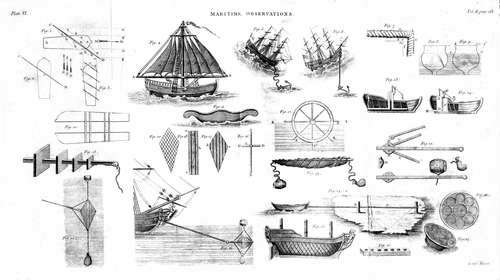
View larger image here
Published as the Act directs, April 1, 1806, by Longman, Hurst, Rees & Orme, Paternoster Row.
A B represents the body of the vessel, C D the position of the sail, EEE the direction of the wind, MM the line of motion. In observing this figure it will appear, that so much of the body of the vessel as is immersed in the water must, to go forward, remove out of its way what water it meets with between the pricked lines FF. And the sail, to go forward, must move out of its way all the air its whole dimension meets with between the pricked lines CG and DG. Thus both the fluids give resistance to the motion, each in proportion to the quantity of matter contained in the dimension to be removed. And though the air is vastly lighter than the water, and therefore more easily removed, yet the dimension being much greater its effect is very considerable.
It is true that in the case stated, the resistance given by the air between those lines to the motion of the sail is not apparent to the eye, because the greater force of the wind, which strikes it in the direction EEE, overpowers its effect, and keeps the sail full in the curve a, a, a, a, a. But suppose the wind to cease, and the vessel in a calm to be impelled with the same swiftness by oars, the sail would then appear filled in the contrary curve b, b, b, b, b, when prudent men would immediately perceive, that the air resisted its motion, and would order it to be taken in.
Is there any possible means of diminishing this resistance, while the same quantity of sail is exposed to the action of the wind, and therefore the same force obtained from it? I think there is, and that it may be done by dividing the sail into a number of parts, and placing those parts in a line one behind the other; thus instead of one sail extending from C to D, figure 2, if four sails containing together the same quantity of canvas, were placed as in figure 3, each having one quarter of the dimensions of the great sail, and exposing a quarter of its surface to the wind, would give a quarter of the force; so that the whole force obtained from the wind would be the same, while the resistance from the air would be nearly reduced to the space between the pricked lines a b and c d, before the foremost sail.
It may perhaps be doubted whether the resistance from the air would be so diminished; since possibly each of the following small sails having also air before it, which must be removed, the resistance on the whole would be the same.
This is then a matter to be determined by experiment. I will mention one that I many years since made with success for another purpose; and I will propose another small one easily made. If that too succeeds, I should think it worth while to make a larger, though at some expense, on a river boat; and perhaps time, and the improvements experience will afford, may make it applicable with advantage to larger vessels.
Having near my kitchen chimney a round hole of eight inches diameter, through which was a constant steady current of air, increasing or diminishing only as the fire increased or diminished, I contrived to place my jack so as to receive that current; and taking off the flyers, I fixed in their stead on the same pivot a round tin plate of nearly the same diameter with the hole; and having cut it in radial lines almost to the centre, so as to have six equal vanes, I gave to each of them the obliquity of forty-five degrees. They moved round, without the weight, by the impression only of the current of air, but too slowly for the purpose of roasting. I suspected that the air struck by the back of each vane might possibly by its resistance retard the motion; and to try this, I cut each of them into two, and I placed the twelve, each having the same obliquity, in a line behind each other, when I perceived a great augmentation in its velocity, which encouraged me to divide them once more, and, continuing the same obliquity, I placed the twenty-four behind each other in a line, when the force of the wind being the same, and the surface of vane the same, they moved round with much greater rapidity, and perfectly answered my purpose.
The second experiment that I propose, is, to take two playing cards of the same dimensions, and cut one of them transversely into eight equal pieces; then with a needle string them upon two threads one near each end, and place them so upon the threads that, when hung up, they may be one exactly over the other, at a distance equal to their breadth, each in a horizontal position; and let a small weight, such as a bird-shot, be hung under them, to make them fall in a straight line when let loose. Suspend also the whole card by threads from its four corners, and hang to it an equal weight, so as to draw it downwards when let fall, its whole breadth pressing against the air. Let those two bodies be attached, one of them to one end of a thread a yard long, the other to the other end. Extend a twine under the ceiling of a room, and put through it at thirty inches distance two pins bent in the form of fish-hooks. On these two hooks hang the two bodies, the thread that connects them extending parallel to the twine, which thread being cut, they must begin to fall at the same instant. If they take equal time in falling to the floor, it is a proof that the resistance of the air is in both cases equal. If the whole card requires a longer time, it shows that the sum of the resistances to the pieces of the cut card is not equal to the resistance of the whole one[31].
This principle so far confirmed, I would proceed to make a larger experiment, with a shallop, which I would rig in this manner. (Plate VI. Fig. 4.)
A B is a long boom, from which are hoisted seven jibs, a, b, c, d, e, f, g, each a seventh part of the whole dimensions, and as much more as will fill the whole space when set in an angle of forty-five degrees, so that they may lap when going before the wind, and hold more wind when going large. Thus rigged, when going right before the wind, the boom should be brought at right angles with the keel, by means of the sheet ropes C D, and all the sails hauled flat to the boom.
These positions of boom and sails to be varied as the wind quarters. But when the wind is on the beam, or when you would turn to windward, the boom is to be hauled right fore and aft, and the sails trimmed according as the wind is more or less against your course.
It seems to me, that the management of a shallop so rigged would be very easy, the sails being run up and down separately, so that more or less sail may be made at pleasure; and I imagine, that there being full as much sail exposed to the force of the wind which impels the vessel in its course, as if the whole were in one piece, and the resistance of the dead air against the foreside of the sail being diminished, the advantage of swiftness would be very considerable; besides that the vessel would lie nearer the wind.
Since we are on the subject of improvements in navigation, permit me to detain you a little longer with a small relative observation. Being, in one of my voyages, with ten merchant-ships under convoy of a frigate at anchor in Torbay, waiting for a wind to go to the westward; it came fair, but brought in with it a considerable swell. A signal was given for weighing, and we put to sea all together; but three of the ships left their anchors, their cables parting just as the anchors came a-peak. Our cable held, and we got up our anchor; but the shocks the ship felt before the anchor got loose from the ground, made me reflect on what might possibly have caused the breaking of the other cables; and I imagined it might be the short bending of the cable just without the hause-hole, from a horizontal to an almost vertical position, and the sudden violent jerk it receives by the rising of the head of the ship on the swell of a wave while in that position. For example, suppose a vessel hove up so as to have her head nearly over her anchor, which still keeps its hold, perhaps in a tough bottom; if it were calm, the cable still out would form nearly a perpendicular line, measuring the distance between the hause-hole and the anchor; but if there is a swell, her head in the trough of the sea will fall below the level, and when lifted on the wave will be much above it. In the first case the cable will hang loose and bend perhaps as in figure 5. In the second case, figure 6, the cable will be drawn straight with a jerk, must sustain the whole force of the rising ship, and must either loosen the anchor, resist the rising force of the ship, or break. But why does it break at the hause-hole?