LETTERS AND PAPERS ON PHILOSOPHICAL SUBJECTS. (continued 4)
Reading edition
Let us suppose it a cable of three inches diameter, and represented by figure 7. If this cable is to be bent round the corner A, it is evident that either the part of the triangle contained between the letters a, b, c, must stretch considerably, and those most that are nearest the surface; or that the parts between d, e, f, must be compressed; or both, which most probably happens. In this case the lower half of the thickness affords no strength against the jerk, it not being strained, the upper half bears the whole, and the yarns near the upper surface being first and most strained, break first, and the next yarns follow; for in this bent situation they cannot bear the strain all together, and each contributes its strength to the whole, as they do when the cable is strained in a straight line.
To remedy this, methinks it would be well to have a kind of large pulley wheel, fixed in the hause-hole, suppose of two feet diameter, over which the cable might pass; and being there bent gradually to the round of the wheel, would thereby be more equally strained, and better able to bear the jerk, which may save the anchor, and by that means in the course of the voyage may happen to save the ship.
One maritime observation more shall finish this letter. I have been a reader of news-papers now near seventy years, and I think few years pass without an account of some vessel met with at sea, with no living soul on board, and so many feet of water in her hold, which vessel has nevertheless been saved and brought into port: and when not met with at sea, such forsaken vessels have often come ashore on some coast. The crews, who have taken to their boats and thus abandoned such vessels, are sometimes met with and taken up at sea by other ships, sometimes reach a coast, and are sometimes never heard of. Those that give an account of quitting their vessels generally say, that she sprung a leak, that they pumped for some time, that the water continued to rise upon them, and that, despairing to save her, they had quitted her lest they should go down with her. It seems by the event that this fear was not always well founded, and I have endeavoured to guess at the reason of the people's too hasty discouragement.
When a vessel springs a leak near her bottom, the water enters with all the force given by the weight of the column of water, without, which force is in proportion to the difference of level between the water without and that within. It enters therefore with more force at first and in greater quantity, than it can afterwards when the water within is higher. The bottom of the vessel too is narrower, so that the same quantity of water coming into that narrow part, rises faster than when the space for it to flow in is larger. This helps to terrify. But as the quantity entering is less and less as the surfaces without and within become more nearly equal in height, the pumps that could not keep the water from rising at first, might afterwards be able to prevent its rising higher, and the people might have remained on board in safety, without hazarding themselves in an open boat on the wide ocean.(Fig. 8.)
Besides the greater equality in the height of the two surfaces, there may sometimes be other causes that retard the farther sinking of a leaky vessel. The rising water within may arrive at quantities of light wooden work, empty chests, and particularly empty water-casks, which if fixed so as not to float themselves may help to sustain her. Many bodies which compose a ship's cargo may be specifically lighter than water, all these when out of water are an additional weight to that of the ship, and she is in proportion pressed deeper into the water; but as soon as these bodies are immersed, they weigh no longer on the ship, but on the contrary, if fixed, they help to support her, in proportion as they are specifically lighter than the water. And it should be remembered, that the largest body of a ship may be so balanced in the water, that an ounce less or more of weight may leave her at the surface or sink her to the bottom. There are also certain heavy cargoes, that, when the water gets at them, are continually dissolving, and thereby lightening the vessel, such as salt and sugar. And as to water-casks mentioned above, since the quantity of them must be great in ships of war where the number of men consume a great deal of water every day, if it had been made a constant rule to bung them up as fast as they were emptied, and to dispose the empty casks in proper situations, I am persuaded that many ships which have been sunk in engagements, or have gone down afterwards, might with the unhappy people have been saved; as well as many of those which in the last war foundered, and were never heard of. While on this topic of sinking, one cannot help recollecting the well known practice of the Chinese, to divide the hold of a great ship into a number of separate chambers by partitions tight caulked (of which you gave a model in your boat upon the Seine) so that if a leak should spring in one of them the others are not affected by it; and though that chamber should fill to a level with the sea, it would not be sufficient to sink the vessel. We have not imitated this practice. Some little disadvantage it might occasion in the stowage is perhaps one reason, though that I think might be more than compensated by an abatement in the insurance that would be reasonable, and by a higher price taken of passengers, who would rather prefer going in such a vessel. But our seafaring people are brave, despise danger, and reject such precautions of safety, being cowards only in one sense, that of fearing to be thought afraid.
I promised to finish my letter with the last observation, but the garrulity of the old man has got hold of me, and as I may never have another occasion of writing on this subject, I think I may as well now, once for all, empty my nautical budget, and give you all the thoughts that have in my various long voyages occurred to me relating to navigation. I am sure that in you they will meet with a candid judge, who will excuse my mistakes on account of my good intention.
There are six accidents that may occasion the loss of ships at sea. We have considered one of them, that of foundering by a leak. The other five are, 1. Oversetting by sudden flaws of wind, or by carrying sail beyond the bearing. 2. Fire by accident or carelessness. 3. A heavy stroke of lightning, making a breach in the ship, or firing the powder. 4. Meeting and shocking with other ships in the night. 5. Meeting in the night with islands of ice.
To that of oversetting, privateers in their first cruize have, as far as has fallen within my knowledge or information, been more subject than any other kind of vessels. The double desire of being able to overtake a weaker flying enemy, or to escape when pursued by a stronger, has induced the owners to overmast their cruizers, and to spread too much canvass; and the great number of men, many of them not seamen, who being upon deck when a ship heels suddenly are huddled down to leeward, and increase by their weight the effect of the wind. This therefore should be more attended to and guarded against, especially as the advantage of lofty masts is problematical. For the upper sails have greater power to lay a vessel more on her side, which is not the most advantageous position for going swiftly through the water. And hence it is that vessels, which have lost their lofty masts, and been able to make little more sail afterwards than permitted the ship to sail upon an even keel, have made so much way, even under jury masts, as to surprize the mariners themselves. But there is besides, something in the modern form of our ships that seems as if calculated expressly to allow their oversetting more easily. The sides of a ship, instead of spreading out as they formerly did in the upper works, are of late years turned in, so as to make the body nearly round, and more resembling a cask. I do not know what the advantages of this construction are, except that such ships are not easily boarded. To me it seems a contrivance to have less room in a ship at nearly the same expense. For it is evident that the same timber and plank consumed in raising the sides from a to b, and from d to c, would have raised them from a to e, and from d to f, fig. 9. In this form all the spaces between e, a, b, and c, d, f, would have been gained, the deck would have been larger, the men would have had more room to act, and not have stood so thick in the way of the enemy's shot; and the vessel, the more she was laid down on her side, the more bearing she would meet with, and more effectual to support her, as being farther from the centre. Whereas in the present form, her ballast makes the chief part of her bearing, without which she would turn in the sea almost as easily as a barrel. More ballast by this means becomes necessary, and that sinking a vessel deeper in the water occasions more resistance to her going through it. The Bermudian sloops still keep with advantage to the old spreading form. The islanders in the great Pacific ocean, though they have no large ships, are the most expert boat-sailors in the world, navigating that sea safely with their proas, which they prevent oversetting by various means. Their sailing proas for this purpose have outriggers generally to windward, above the water, on which, one or more men are placed, to move occasionally further from or nearer to the vessel as the wind freshens or slackens. But some have their outriggers to leeward, which, resting on the water, support the boat so as to keep her upright when pressed down by the wind. Their boats moved by oars or rather by paddles are, for long voyages, fixed two together by cross bars of wood that keep them at some distance from each other, and so render their oversetting next to impossible. How far this may be practicable in larger vessels, we have not yet sufficient experience. I know of but one trial made in Europe, which was about one hundred years since, by Sir William Petty. He built a double vessel, to serve as a packet boat between England and Ireland. Her model still exists in the museum of the Royal Society, where I have seen it. By the accounts we have of her, she answered well the purpose of her construction, making several voyages; and though wrecked at last by a storm, the misfortune did not appear owing to her particular construction, since many other vessels of the common form were wrecked at the same time. The advantage of such a vessel is, that she needs no ballast, therefore swims either lighter or will carry more goods; and that passengers are not so much incommoded by her rolling: to which may be added, that if she is to defend herself by her cannon, they will probably have more effect, being kept more generally in a horizontal position, than those in common vessels. I think, however, that it would be an improvement of that model, to make the sides which are opposed to each other perfectly parallel, though the other sides are formed as in common thus, figure 10.
The building of a double ship would indeed be more expensive in proportion to her burthen; and that perhaps is sufficient to discourage the method.
The accident of fire is generally well guarded against by the prudent captain's strict orders against smoking between decks, or carrying a candle there out of a lanthorn. But there is one dangerous practice which frequent terrible accidents have not yet been sufficient to abolish; that of carrying store-spirits to sea in casks. Two large ships, the Seraphis and the Duke of Athol, one an East-Indiaman, the other a frigate, have been burnt within these two last years, and many lives miserably destroyed, by drawing spirits out of a cask near a candle. It is high time to make it a general rule, that all the ship's store of spirits should be carried in bottles.
The misfortune by a stroke of lightning I have in my former writings endeavoured to show a method of guarding against, by a chain and pointed rod, extending, when run up, from above the top of the mast to the sea. These instruments are now made and sold at a reasonable price by Nairne & Co. in London, and there are several instances of success attending the use of them. They are kept in a box, and may be ran up and fixed in about five minutes, on the apparent approach of a thunder gust.
Of the meeting and shocking with other ships in the night, I have known two instances in voyages between London and America. In one both ships arrived though much damaged, each reporting their belief that the other must have gone to the bottom. In the other, only one got to port; the other was never afterwards heard of. These instances happened many years ago, when the commerce between Europe and America was not a tenth part of what it is at present, ships of course thinner scattered, and the chance of meeting proportionably less. It has long been the practice to keep a look-out before in the channel, but at sea it has been neglected. If it is not at present thought worth while to take that precaution, it will in time become of more consequence; since the number of ships at sea is continually augmenting. A drum frequently beat, or a bell rung in a dark night, might help to prevent such accidents.
Islands of ice are frequently seen off the banks of Newfoundland, by ships going between North-America and Europe. In the day time they are easily avoided, unless in a very thick fog. I remember two instances of ship's running against them in the night. The first lost her bowsprit, but received little other damage. The other struck where the warmth of the sea had wasted the ice next to it, and a part hung over above. This perhaps saved her, for she was under great way; but the upper part of the cliff taking her foretopmast, broke the shock, though it carried away the mast. She disengaged herself with some difficulty, and got safe into port; but the accident shows the possibility of other ships being wrecked and sunk by striking those vast masses of ice, of which I have seen one that we judged to be seventy feet high above the water, consequently eight times as much under water; and it is another reason for keeping a good look-out before, though far from any coast that may threaten danger.
It is remarkable, that the people we consider as savages have improved the art of sailing and rowing-boats in several points beyond what we can pretend to. We have no sailing-boats equal to the flying proas of of the South Seas, no rowing or paddling-boat equal to that of the Greenlanders for swiftness and safety. The birch canoes of the North-American Indians have also some advantageous properties. They are so light that two men may carry one of them over land, which is capable of carrying a dozen upon the water; and in heeling they are not so subject to take in water as our boats, the sides of which are lowest in the middle where it is most likely to enter, this being highest in that part, as in figure 11.
The Chinese are an enlightened people, the most antiently civilized of any existing, and their arts are antient, a presumption in their favour: their method of rowing their boats differs from ours, the oars being worked either two a-stern as we scull, or on the sides with the same kind of motion, being hung parallel to the keel on a rail and always acting in the water, not perpendicular to the side as ours are, nor lifted out at every stroke, which is a loss of time, and the boat in the interval loses motion. They see our manner, and we theirs, but neither are disposed to learn of or copy the other.
To the several means of moving boats mentioned above, may be added the singular one lately exhibited at Javelle, on the Seine below Paris, where a clumsy boat was moved across that river in three minutes by rowing, not in the water, but in the air, that is, by whirling round a set of windmill vanes fixed to a horizontal axis, parallel to the keel, and placed at the head of the boat. The axis was bent into an elbow at the end, by the help of which it was turned by one man at a time. I saw the operation at a distance. The four vanes appeared to be about five feet long, and perhaps two and a half wide. The weather was calm. The labour appeared to be great for one man, as the two several times relieved each other. But the action upon the air by the oblique surfaces of the vanes must have been considerable, as the motion of the boat appeared tolerably quick going and returning; and she returned to the same place from whence she first set out, notwithstanding the current. This machine is since applied to the moving of air-balloons: an instrument similar may be contrived to move a boat by turning under water.
Several mechanical projectors have at different times proposed to give motion to boats, and even to ships, by means of circular rowing, or paddles placed on the circumference of wheels to be turned constantly on each side of the vessel; but this method, though frequently tried, has never been found so effectual as to encourage a continuance of the practice. I do not know that the reason has hitherto been given. Perhaps it may be this, that great part of the force employed contributes little to the motion. For instance, (fig. 12) of the four paddles a, b, c, d, all under water, and turning to move a boat from X to Y, c has the most power, b nearly though not quite as much, their motion being nearly horizontal; but the force employed in moving a, is consumed in pressing almost downright upon the water till it comes to the place of b; and the force employed in moving d is consumed in lifting the water till d arrives at the surface; by which means much of the labour is lost. It is true, that by placing the wheels higher out of the water, this waste labour will be diminished in a calm, but where a sea runs, the wheels must unavoidably be often dipt deep in the waves, and the turning of them thereby rendered very laborious to little purpose.
Among the various means of giving motion to a boat, that of M. Bernoulli appears one of the most singular, which was to have fixed in the boat a tube in the form of an L, the upright part to have a funnel-kind of opening at top, convenient for filling the tube with water; which, descending and passing through the lower horizontal part, and issuing in the middle of the stern, but under the surface of the river, should push the boat forward. There is no doubt that the force of the descending water would have a considerable effect, greater in proportion to the height from which it descended; but then it is to be considered, that every bucket-full pumped or dipped up into the boat, from its side or through its bottom, must have its vis inertiæ overcome so as to receive the motion of the boat, before it can come to give motion by its descent; and that will be a deduction from the moving power. To remedy this, I would propose the addition of another such L pipe, and that they should stand back to back in the boat thus, figure 13, the forward one being worked as a pump, and sucking in the water at the head of the boat, would draw it forward while pushed in the same direction by the force at the stern. And after all it should be calculated whether the labour of pumping would be less than that of rowing. A fire-engine might possibly in some cases be applied in this operation with advantage.
Perhaps this labour of raising water might be spared, and the whole force of a man applied to the moving of a boat by the use of air instead of water; suppose the boat constructed in this form, figure 14. A, a tube round or square of two feet diameter, in which a piston may move up and down. The piston to have valves in it, opening inwards to admit air when the piston rises; and shutting, when it is forced down by means of the lever B turning on the centre C. The tube to have a valve D, to open when the piston is forced down, and let the air pass out at E, which striking forcibly against the water abaft must push the boat forward. If there is added an air-vessel F properly valved and placed, the force would continue to act while a fresh stroke is taken with the lever. The boat-man might stand with his back to the stern, and putting his hands behind him, work the motion by taking hold of the cross bar at B, while another should steer; or if he had two such pumps, one on each side of the stern, with a lever for each hand, he might steer himself by working occasionally more or harder with either hand, as watermen now do with a pair of sculls. There is no position in which the body of a man can exert more strength than in pulling right upwards. To obtain more swiftness, greasing the bottom of a vessel is sometimes used, and with good effect. I do not know that any writer has hitherto attempted to explain this. At first sight one would imagine, that though the friction of a hard body, sliding on another hard body, and the resistance occasioned by that friction, might be diminished by putting grease between them, yet that a body sliding on a fluid, such as water, should have no need of, nor receive any advantage from such greasing. But the fact is not disputed. And the reason perhaps may be this—The particles of water have a mutual attraction, called the attraction of adhesion. Water also adheres to wood, and to many other substances, but not to grease: on the contrary they have a mutual repulsion, so that it is a question whether when oil is poured on water, they ever actually touch each other; for a drop of oil upon water, instead of sticking to the spot where it falls, as it would if it fell on a looking-glass, spreads instantly to an immense distance in a film extremely thin, which it could not easily do if it touched and rubbed or adhered even in a small degree to the surface of the water. Now the adhesive force of water to itself, and to other substances, may be estimated from the weight of it necessary to separate a drop, which adheres, while growing, till it has weight enough to force the separation and break the drop off. Let us suppose the drop to be the size of a pea, then there will be as many of these adhesions as there are drops of that size touching the bottom of a vessel, and these must be broken by the moving power, every step of her motion that amounts to a drop's breadth: and there being no such adhesions to break between the water and a greased bottom, may occasion the difference.
So much respecting the motion of vessels. But we have sometimes occasion to stop their motion; and if a bottom is near enough we can cast anchor: where there are no soundings, we have as yet no means to prevent driving in a storm, but by lying-to, which still permits driving at the rate of about two miles an hour; so that in a storm continuing fifty hours, which is not an uncommon case, the ship may drive one hundred miles out of her course; and should she in that distance meet with a lee shore, she may be lost.
To prevent this driving to leeward in deep water, a swimming anchor is wanting, which ought to have these properties.
1. It should have a surface so large as, being at the end of a hauser in the water, and placed perpendicularly, should hold so much of it, as to bring the ship's head to the wind, in which situation the wind has least power to drive her.
2. It should be able by its resistance to prevent the ship's receiving way.
3. It should be capable of being situated below the heave of the sea, but not below the undertow.
4. It should not take up much room in the ship.
5. It should be easily thrown out, and put into its proper situation.
6. It should be easy to take in again, and stow away.
An ingenious old mariner, whom I formerly knew, proposed, as a swimming anchor for a large ship, to have a stem of wood twenty-five feet long and four inches square, with four boards of 18, 16, 14, and 12, feet long, and one foot wide, the boards to have their substance thickened several inches in the middle by additional wood, and to have each a four inch square hole through its middle, to permit its being slipt on occasionally upon the stem, and at right angles with it; where all being placed and fixed at four feet distance from each other, it would have the appearance of the old mathematical instrument called a forestaff. This thrown into the sea, and held by a hauser veered out to some length, he conceived would bring a vessel up, and prevent her driving, and when taken in might be stowed away by separating the boards from the stem. Figure 15. Probably such a swimming anchor would have some good effect, but it is subject to this objection, that lying on the surface of the sea, it is liable to be hove forward by every wave, and thereby give so much leave for the ship to drive.
Two machines for this purpose have occurred to me, which, though not so simple as the above, I imagine would be more effectual, and more easily manageable. I will endeavour to describe them, that they may be submitted to your judgment, whether either would be serviceable; and if they would, to which we should give the preference.
The first is to be formed, and to be used in the water on almost the same principles with those of a paper kite used in the air. Only as the paper kite rises in the air, this is to descend in the water. Its dimensions will be different for ships of different size.
To make one of suppose fifteen feet high; take a small spar of that length for the back-bone, AB, figure 16, a smaller of half that length CD, for the cross piece. Let these be united by a bolt at E, yet so as that by turning on the bolt they may be laid parallel to each other. Then make a sail of strong canvas, in the shape of figure 17. To form this, without waste of sail-cloth, sew together pieces of the proper length, and for half the breadth, as in figure 18, then cut the whole in the diagonal lines a, b, c, and turn the piece F so as to place its broad part opposite to that of the piece G, and the piece H in like manner opposite to I, which when all sewed together will appear as in fig. 17. This sail is to be extended on the cross of figure 16, the top and bottom points well secured to the ends of the long spar; the two side points d, e, fastened to the ends of two cords, which coming from the angle of the loop (which must be similar to the loop of a kite) pass through two rings at the ends of the short spar, so as that on pulling upon the loop the sail will be drawn to its extent. The whole may, when aboard, be furled up, as in figure 19, having a rope from its broad end, to which is tied a bag of ballast for keeping that end downwards when in the water, and at the other end another rope with an empty keg at its end to float on the surface; this rope long enough to permit the kite's descending into the undertow, or if you please lower into still water. It should be held by a hauser. To get it home easily, a small loose rope may be veered out with it, fixed to the keg. Hauling on that rope will bring the kite home with small force, the resistance being small as it will then come end ways.
It seems probable that such a kite at the end of a long hauser would keep a ship with her head to the wind, and, resisting every tug, would prevent her driving so fast as when her side is exposed to it, and nothing to hold her back. If only half the driving is prevented, so as that she moves but fifty miles instead of the hundred during a storm, it may be some advantage, both in holding so much distance as is saved, and in keeping from a lee-shore. If single canvas should not be found strong enough to bear the tug without splitting, it may be doubled, or strengthened by a netting behind it, represented by figure 20.
The other machine for the same purpose, is to be made more in the form of an umbrella, as represented, figure 21. The stem of the umbrella a square spar of proper length, with four moveable arms, of which two are represented C, C, figure 22. These arms to be fixed in four joint cleats, as D, D, &c. one on each side of the spar, but so as that the four arms may open by turning on a pin in the joint. When open they form a cross, on which a four-square canvas sail is to be extended, its corners fastened to the ends of the four arms. Those ends are also to be stayed by ropes fastened to the stem or spar, so as to keep them short of being at right angles with it: and to the end of one of the arms should be hung the small bag of ballast, and to the end of the opposite arm the empty keg. This, on being thrown into the sea, would immediately open; and when it had performed its function, and the storm over, a small rope from its other end being pulled on, would turn it, close it, and draw it easily home to the ship. This machine seems more simple in its operation, and more easily manageable than the first, and perhaps may be as effectual[32].
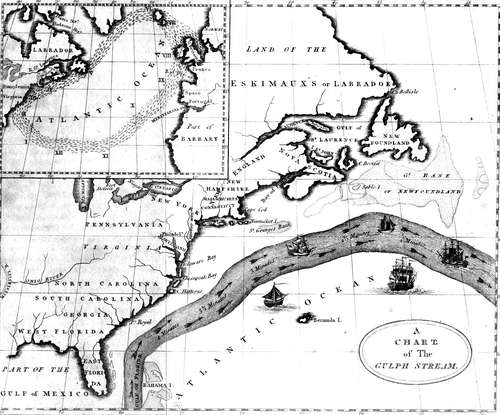
Vessels are sometimes retarded, and sometimes forwarded in their voyages, by currents at sea, which are often not perceived. About the year 1769 or 70, there was an application made by the board of customs at Boston, to the lords of the treasury in London, complaining that the packets between Falmouth and New-York, were generally a fortnight longer in their passages, than merchant-ships from London to Rhode-Island, and proposing that for the future they should be ordered to Rhode-Island instead of New-York. Being then concerned in the management of the American post-office, I happened to be consulted on the occasion; and it appearing strange to me that there should be such a difference between two places, scarce a day's run asunder, especially when the merchant-ships are generally deeper laden, and more weakly manned than the packets, and had from London the whole length of the river and channel to run before they left the land of England, while the packets had only to go from Falmouth, I could not but think the fact misunderstood or misrepresented. There happened then to be in London a Nantucket sea-captain of my acquaintance, to whom I communicated the affair. He told me he believed the fact might be true; but the difference was owing to this, that the Rhode-Island captains were acquainted with the gulf-stream, which those of the English packets were not. We are well acquainted with that stream, says he, because in our pursuit of whales, which keep near the sides of it, but are not to be met with in it, we run down along the sides, and frequently cross it to change our side: and in crossing it have sometimes met and spoke with those packets, who were in the middle of it, and stemming it. We have informed them that they were stemming a current, that was against them to the value of three miles an hour; and advised them to cross it and get out of it; but they were too wise to be counselled by simple American fishermen. When the winds are but light, he added, they are carried back by the current more than they are forwarded by the wind: and if the wind be good, the subtraction of 70 miles a day from their course is of some importance. I then observed it was a pity no notice was taken of this current upon the charts, and requested him to mark it out for me, which he readily complied with, adding directions for avoiding it in sailing from Europe to North-America. I procured it to be engraved by order from the general post-office, on the old chart of the Atlantic, at Mount and Page's, Tower-hill; and copies were sent down to Falmouth for the captains of the packets, who slighted it however; but it is since printed in France, of which edition I hereto annex a copy.
This stream is probably generated by the great accumulation of water on the eastern coast of America between the tropics, by the trade-winds which constantly blow there. It is known that a large piece of water ten miles broad and generally only three feet deep, has by a strong wind had its waters driven to one side and sustained so as to become six feet deep, while the windward side was laid dry. This may give some idea of the quantity heaped up on the American coast, and the reason of its running down in a strong current through the islands into the bay of Mexico, and from thence issuing through the gulph of Florida, and proceeding along the coast to the banks of Newfoundland, where it turns off towards and runs down through the Western Islands. Having since crossed this stream several times in passing between America and Europe, I have been attentive to sundry circumstances relating to it, by which to know when one is in it; and besides the gulph weed with which it is interspersed, I find that it is always warmer than the sea on each side of it, and that it does not sparkle in the night: I annex hereto the observations made with the thermometer in two voyages, and possibly may add a third. It will appear from them, that the thermometer may be an useful instrument to a navigator, since currents coming from the northward into southern seas, will probably be found colder than the water of those seas, as the currents from southern seas into northern are found warmer. And it is not to be wondered that so vast a body of deep warm water, several leagues wide, coming from between the tropics and issuing out of the gulph into the northern seas, should retain its warmth longer than the twenty or thirty days required to its passing the banks of Newfoundland. The quantity is too great, and it is too deep to be suddenly cooled by passing under a cooler air. The air immediately over it, however, may receive so much warmth from it as to be rarefied and rise, being rendered lighter than the air on each side of the stream; hence those airs must flow in to supply the place of the rising warm air, and, meeting with each other, form those tornados and water-spouts frequently met with, and seen near and over the stream; and as the vapour from a cup of tea in a warm room, and the breath of an animal in the same room, are hardly visible, but become sensible immediately when out in the cold air, so the vapour from the gulph stream, in warm latitudes is scarcely visible, but when it comes into the cool air from Newfoundland, it is condensed into the fogs, for which those parts are so remarkable.
The power of wind to raise water above its common level in the sea is known to us in America, by the high tides occasioned in all our sea-ports when a strong north-easter blows against the gulph stream.
The conclusion from these remarks is, that a vessel from Europe to North-America may shorten her passage by avoiding to stem the stream, in which the thermometer will be very useful; and a vessel from America to Europe may do the same by the same means of keeping in it. It may have often happened accidentally, that voyages have been shortened by these circumstances. It is well to have the command of them.
But may there not be another cause, independent of winds and currents, why passages are generally shorter from America to Europe than from Europe to America? This question I formerly considered in the following short paper.
On board the Pennsylvania Packet, Capt. Osborne.
At Sea, April 5, 1775.
"Suppose a ship to make a voyage eastward from a place in lat. 40° north, to a place in lat. 50° north, distance in longitude 75 degrees.
"In sailing from 40 to 50, she goes from a place where a degree of longitude is about eight miles greater than in the place she is going to. A degree is equal to four minutes of time; consequently the ship in the harbour she leaves, partaking of the diurnal motion of the earth, moves two miles in a minute faster, than when in the port she is going to; which is 120 miles in an hour.
"This motion in a ship and cargo is of great force; and if she could be lifted up suddenly from the harbour in which she lay quiet, and set down instantly in the latitude of the port she was bound to, though in a calm, that force contained in her would make her run a great way at a prodigious rate. This force must be lost gradually in her voyage, by gradual impulse against the water, and probably thence shorten the voyage. Query, In returning does the contrary happen, and is her voyage thereby retarded and lengthened?"[33]
Would it not be a more secure method of planking ships, if, instead of thick single planks laid horizontally, we were to use planks of half the thickness, and lay them double and across each other as in figure 23? To me it seems that the difference of expence would not be considerable, and that the ship would be both tighter and stronger.
The securing of the ship is not the only necessary thing; securing the health of the sailors, a brave and valuable order of men, is likewise of great importance. With this view the methods so successfully practised by Captain Cook in his long voyages cannot be too closely studied or carefully imitated. A full account of those methods is found in Sir John Pringle's speech, when the medal of the Royal Society was given to that illustrious navigator. I am glad to see in his last voyage that he found the means effectual which I had proposed for preserving flour, bread, &c. from moisture and damage. They were found dry and good after being at sea four years. The method is described in my printed works, page 452, fifth edition[34]. In the same, page 469, 470[35], is proposed a means of allaying thirst in case of want of fresh water. This has since been practised in two instances with success. Happy if their hunger, when the other provisions are consumed, could be relieved as commodiously; and perhaps in time this may be found not impossible. An addition might be made to their present vegetable provision, by drying various roots in slices by the means of an oven. The sweet potatoe of America and Spain is excellent for this purpose. Other potatoes, with carrots, parsnips and turnips, might be prepared and preserved in the same manner.
With regard to make-shifts in cases of necessity, seamen are generally very ingenious themselves. They will excuse however the mention of two or three. If they happen in any circumstance, such as after shipwreck, taking to their boat, or the like, to want a compass, a fine sewing-needle laid on clear water in a cup will generally point to the north, most of them being a little magnetical, or may be made so by being strongly rubbed or hammered, lying in a north and south direction. If their needle is too heavy to float by itself, it may be supported by little pieces of cork or wood. A man who can swim, may be aided in a long traverse by his handkerchief formed into a kite, by two cross sticks extending to the four corners; which, being raised in the air when the wind is fair and fresh, will tow him along while lying on his back. Where force is wanted to move a heavy body, and there are but few hands and no machines, a long and strong rope may make a powerful instrument. Suppose a boat is to be drawn up on a beach, that she may be out of the surf; a stake drove into the beach where you would have the boat drawn, and another to fasten the end of the rope to, which comes from the boat, and then applying what force you have to pull upon the middle of the rope at right angles with it, the power will be augmented in proportion to the length of rope between the posts. The rope being fastened to the stake A, and drawn upon in the direction C D, will slide over the stake B; and when the rope is bent to the angle A D B, represented by the pricked line in figure 24, the boat will be at B.
Some sailors may think the writer has given himself unnecessary trouble in pretending to advise them; for they have a little repugnance to the advice of landmen, whom they esteem ignorant and incapable of giving any worth notice; though it is certain that most of their instruments were the invention of landmen. At least the first vessel ever made to go on the water was certainly such. I will therefore add only a few words more, and they shall be addressed to passengers.
When you intend a long voyage, you may do well to keep your intention as much as possible a secret, or at least the time of your departure; otherwise you will be continually interrupted in your preparations by the visits of friends and acquaintance, who will not only rob you of the time you want, but put things out of your mind, so that when you come to sea, you have the mortification to recollect points of business that ought to have been done, accounts you intended to settle, and conveniencies you had proposed to bring with you, &c. &c. all which have been omitted through the effect of these officious friendly visits. Would it not be well if this custom could be changed; if the voyager after having, without interruption, made all his preparations, should use some of the time he has left, in going himself to take leave of his friends at their own houses, and let them come to congratulate him on his happy return.
It is not always in your power to make a choice in your captain, though much of your comfort in the passage may depend on his personal character, as you must for so long a time be confined to his company, and under his direction; if he be a sensible, sociable, good-natured, obliging man, you will be so much the happier. Such there are; but if he happens to be otherwise, and is only skilful, careful, watchful and active in the conduct of his ship, excuse the rest, for these are the essentials.
Whatever right you may have by agreement in the mass of stores laid in by him for the passengers, it is good to have some particular things in your own possession, so as to be always at your own command.
1. Good water, that of the ship being often bad. You can be sure of having it good only by bottling it from a clear spring or well and in clean bottles. 2. Good tea. 3. Coffee ground. 4. Chocolate. 5. Wine of the sort you particularly like, and cyder. 6. Raisins. 7. Almonds. 8. Sugar. 9. Capillaire. 10. Lemons. 11. Jamaica spirits. 12. Eggs greased. 13. Diet bread 14. Portable soup. 15. Rusks. As to fowls, it is not worth while to have any called yours, unless you could have the feeding and managing of them according to your own judgment under your own eye. As they are generally treated at present in ships, they are for the most part sick, and their flesh tough and hard as whit-leather. All seamen have an opinion, broached I supposed at first prudently, for saving of water when short, that fowls do not know when they have drank enough, and will kill themselves if you give them too much, so they are served with a little only once in two days. This is poured into troughs that lie sloping, and therefore immediately runs down to the lower end. There the fowls ride upon one another's backs to get at it, and some are not happy enough to reach and once dip their bills in it. Thus tantalized, and tormented with thirst, they cannot digest their dry food, they fret, pine, sicken and die. Some are found dead, and thrown overboard every morning, and those killed for the table are not eatable. Their troughs should be in little divisions, like cups, to hold the water separately, figure 25. But this is never done. The sheep and hogs are therefore your best dependance for fresh meat at sea, the mutton being generally tolerable and the pork excellent.
It is possible your captain may have provided so well in the general stores, as to render some of the particulars above recommended of little or no use to you. But there are frequently in the ship poorer passengers, who are taken at a lower price, lodge in the steerage, and have no claim to any of the cabin provisions, or to any but those kinds that are allowed the sailors. These people are sometimes dejected, sometimes sick, there may be women and children among them. In a situation where there is no going to market, to purchase such necessaries, a few of these your superfluities distributed occasionally may be of great service, restore health, save life, make the miserable happy, and thereby afford you infinite pleasure.
The worst thing in ordinary merchant ships is the cookery. They have no professed cook, and the worst hand as a seaman is appointed to that office, in which he is not only very ignorant but very dirty. The sailors have therefore a saying, that God sends meat and the devil cooks. Passengers more piously disposed, and willing to believe heaven orders all things for the best, may suppose, that, knowing the sea-air and constant exercise by the motion of the vessel would give us extraordinary appetites, bad cooks were kindly sent to prevent our eating too much; or that, foreseeing we should have bad cooks, good appetites were furnished to prevent our starving. If you cannot trust to these circumstances, a spirit-lamp, with a blaze-pan, may enable you to cook some little things for yourself; such as a hash, a soup, &c. And it might be well also to have among your stores some potted meats, which if well put up will keep long good. A small tin oven, to place with the open side before the fire, may be another good utensil, in which your own servant may roast for you a bit of pork or mutton. You will sometimes be induced to eat of the ship's salt beef, as it is often good. You will find cyder the best quencher of that thirst which salt meat or fish occasions. The ship biscuit is too hard for some sets of teeth. It may be softened by toasting. But rusk is better; for being made of good fermented bread, sliced and baked a second time, the pieces imbibe the water easily, soften immediately, digest more kindly, and are therefore more wholesome than the unfermented biscuit. By the way, rusk is the true original biscuit, so prepared to keep for sea, biscuit in French signifying twice baked. If your dry peas boil hard, a two-pound iron shot put with them into the pot, will by the motion of the ship grind them as fine as mustard.
The accidents I have seen at sea with large dishes of soup upon a table, from the motion of the ship, have made me wish, that our potters or pewterers would make soup-dishes in divisions, like a set of small bowls united together, each containing about sufficient for one person, in some such form as fig. 26; for then when the ship should make a sudden heel, the soup would not in a body flow over one side, and fall into people's laps and scald them, as is sometimes the case, but would be retained in the separate divisions, as in figure 27.
After these trifles, permit the addition of a few general reflections. Navigation, when employed in supplying necessary provisions to a country in want, and thereby preventing famines, which were more frequent and destructive before the invention of that art, is undoubtedly a blessing to mankind. When employed merely in transporting superfluities, it is a question whether the advantage of the employment it affords is equal to the mischief of hazarding so many lives on the ocean. But when employed in pillaging merchants and transporting slaves, it is clearly the means of augmenting the mass of human misery. It is amazing to think of the ships and lives risqued in fetching tea from China, coffee from Arabia, sugar and tobacco from America, all which our ancestors did well without. Sugar employs near one thousand ships, tobacco almost as many. For the utility of tobacco there is little to be said; and for that of sugar, how much more commendable would it be if we could give up the few minutes gratification afforded once or twice a day by the taste of sugar in our tea, rather than encourage the cruelties exercised in producing it. An eminent French moralist says, that when he considers the wars we excite in Africa to obtain slaves, the numbers necessarily slain in those wars, the many prisoners who perish at sea by sickness, bad provisions, foul air, &c. &c. in the transportation, and how many afterwards die from the hardships of slavery, he cannot look on a piece of sugar without conceiving it stained with spots of human blood! Had he added the consideration of the wars we make to take and retake the sugar islands from one another, and the fleets and armies that perish in those expeditions, he might have seen his sugar not merely spotted, but thoroughly dyed scarlet in grain. It is these wars that make the maritime powers of Europe, the inhabitants of London and Paris, pay dearer for sugar than those of Vienna, a thousand miles from the sea; because their sugar costs not only the price they pay for it by the pound, but all they pay in taxes to maintain the fleets and armies that fight for it.
With great esteem, I am, Sir,
Your most obedient humble servant,
B. FRANKLIN.
FOOTNOTES:
Plate VII.
Vol. II. page 197.
A CHART of The GULPH STREAM.
View larger image here
Published as the Act directs, April 1, 1806, by Longman, Hurst, Rees & Orme, Paternoster Row.
Remarks upon the Navigation from Newfoundland to New-York, in order to avoid the Gulph Stream on one hand, and on the other the Shoals that lie to the Southward of Nantucket and of St. George's Banks.
After you have passed the banks of Newfoundland in about the 44th degree of latitude, you will meet with nothing, till you draw near the Isle of Sables, which we commonly pass in latitude 43. Southward of this isle, the current is found to extend itself as far north as 41° 20′ or 30′, then it turns towards the E. S. E. or S. E. ¼ E.
Having passed the Isle of Sables, shape your course for the St. George's Banks, so as to pass them in about latitude 40°, because the current southward of those banks reaches as far north as 39°. The shoals of those banks lie in 41° 35′.
After having passed St. George's Banks, you must, to clear Nantucket, form your course so as to pass between the latitudes 38° 30′ and 40° 45′.
The most southern part of the shoals of Nantucket lie in about 40° 45′. The northern part of the current directly to the south of Nantucket is felt in about latitude 38° 30′.
By observing these directions and keeping between the stream and the shoals, the passage from the Banks of Newfoundland to New-York, Delaware, or Virginia, may be considerably shortened; for so you will have the advantage of the eddy current, which moves contrary to the Gulph Stream. Whereas if to avoid the shoals you keep too far to the southward, and get into that stream, you will be retarded by it at the rate of 60 or 70 miles a day.
The Nantucket whale-men being extremely well acquainted with the Gulph Stream, its course, strength, and extent, by their constant practice of whaling on the edges of it, from their island quite down to the Bahamas, this draft of that stream was obtained from one of them, Captain Folges, and caused to be engraved on the old chart in London, for the benefit of navigators, by
B. FRANKLIN.
Note, The Nantucket captains who are acquainted with this stream, make their voyages from England to Boston in as short a time generally as others take in going from Boston to England, viz. from twenty to thirty days.
A stranger may know when he is in the Gulph Stream, by the warmth of the water, which is much greater than that of the water on each side of it. If then he is bound to the westward, he should cross the stream to get out of it as soon as possible.
B. FRANKLIN.
Observations of the Warmth of the Sea-water, &c. by Fahrenheit's Thermometer, in crossing the Gulph Stream; with other Remarks made on board the Pennsylvania Packet, Capt. Osborne, bound from London to Philadelphia, in April and May, 1775.
DateHourTemp. of Air.Temp. of Wat. WindCourseDistanceLatitude N. Longitude W.Remarks
April 1062
1161
1264
1365
1465 ° ′° ′
266070 37 3960 38 Much gulph weed; saw a whale.
276070 SSEWbS37 1362 29 Colour of water changed.
288 A.M.7064 SWWNW37 4864 35 No gulph weed.
—6 P.M.6760 34 Sounded, no bottom.
298 A.M.6371 NW4437 2666 0 Much light in the water last night.
—5 P.M.6572 NE57 Water again of the usual deep sea colour, little or no light in it at night.
—11 dit.6666 NWbNWbS 57
308 A.M.6470 NEWbN69
—126270 EbS2437 2068 53 Frequent gulph weed, water continues of sea colour, little light.
—6 P.M.6472 ESEWbN43
—10 dit.6565 S25 Much light.
May 17 A.M.6863 60 Much light all last night.
—126556 SSWWNW4438 1372 23 Colour of water changed.
—4 P.M.6456 WbN21
—10 dit.6457 SWWNW31 Much light.
28 A.M.6253 1838 4374 3 Much light. Thunder-gust.
—126053 WSWNW18
—6 P.M.6455 NWWSW15
—106555 NbWWbN10
37 A.M.6254 3038 3075 0
Observations of the Warmth of the Sea-water, &c. by Fahrenheit's Thermometer; with other Remarks made on board the Reprisal, Capt. Wycks, bound from Philadelphia to France, in October and November, 1776.
DateHour A.M.Hour P.M.Temp. of AirTemp. of Water WindCourseDistanceLat. N.Long. W. Remarks
Octo. 31107670 SSEEbS13538 1270 30 Left the capes Thursday night, October 29, 1776
—471
Nov. 11078 WSWE½N109No ob.68 12
—47181
287175 N
—1278 141ditto.65 23
—46776 Some sparks in the water these two last nights.
3876 NWESE½E
—1276 EbS16037 062 7
—47076
496876 NbE Ditto.
—176 19436 2658 8
—46876
—878
586876 NE Ditto.
—127075 16335 2155 3
—475
—875
6876 EbNS50E
—1277 7535 3353 52
7878 SEbEN30W
—1277 10836 652 46
—477
897577 SbEN49E
—1277 17538 250 1
—477
997577
—127570 SWN33E17539 3946 55
OBSERVATIONS MADE ON BOARD THE REPRISAL, CONTINUED.
DateHour A.M.Hour P.M.Temp. of AirTemp. of Water WindCourseDistanceLatit. N.Long. W. Remarks.
Nov 9471
1087068
—1264 EN 17 E6440 3946 27
11863
—1261 S EN 8 E4141 1946 19
1285659
—469 NNWN 80 E12041 3943 42
13allday68 ES 82 E6941 2942 10
1487070 N 74 E11142 039 57
—Noon72 ESE
—471
1586169
—Noon68 WSWN 70 E18643 335 51
—467
16Noon6567 S WN 67 W4843 2234 50
—463
17863 ESEN 19 E5644 1534 25
18allday65 SbWN 75 E21045 629 43 Some gulph weed.
19Noon6564 S WN 80 E23845 4624 2
20862 NS 80 E15545 1920 30
—460
21962 SN 88 E9445 2218 17
22106062 SSWS 89 E13345 1915 19
23Noon61 WSWS 86 E19445 610 35
24do.60 NNEN 78 E19145 466 10
25do.60 N ES 76 E12545 43 23
26do.5660 EN 73 E3145 132 20
27do.58 Soundings off Bellisle.
28do.5456
A Journal of a Voyage from the Channel between France and England towards America.
DatesLatit. N.Long. W.Therm. A.M.Therm. P.M. WindsCourseDistanceVariation of the Needle
AirWaterAirWater
July 296257 { These are taken on an average of 24 hours. }
3062586358
3160586262 Miles.West.
Aug 149 154 1563626064 EastSW ½W6022° 0
248 288 5864646463 E S EWbS ½S174
347 012 136067omitted N ESW bW160
445 015 436666do.66 NWbWSW ½W190
543 517 2567656568 N ESW bS13120 0
641 319 4470687169 N ESW ½S16616 30
738 4521 3470706870 N ESSW ¾W16511 30
836 4223 1072717372 N ESSW ¾W14911 15
935 4025 4073737374 N EWSW ¼S137
1035 027 071737775 N WWSW ¾S76
1133 5128 4274747677 NorthSW ¾W112 Therm. Noon
1233 3031 3076757676 NorthW ¾S143 A.W.
1333 1733 3276767877 N EW ½ S103 7778
1433 2234 3176768179 S S EW ½ N50 8179
1533 4535 078797978 W N WSW ¼W35 7979
1634 1435 3079788180 WestNW ½N38 8180
1735 3736 480798078 W S WN N W75 8078
1836 737 168078omitted NW bWWNW ½N65 8079
1936 3838 078777877 W S WNW ½W49 7977
Journal of a Voyage, &c. continued.
DatesLatit. N.Long. W.Therm. A.M.Therm. P.M. WindsCourseDistanceVariation of the Needle Therm. Noon
AirWaterAirWaterA.W.
Aug 2037 3838 67876omitted WestN ¼ W62 7775
2136 1538 2673747876 W N WS b W82 7775
2235 4038 4477768077 W b SS S W38 8077
2335 3540 5279777875 NorthW ¼ S100 omitted.
2435 1241 3175737574 W N WS W b W41 7574
2535 4042 3379767976 W b NW N W ¾ N60 8076
2635 3042 4479768076 S W b WS W ½ S14 8076
2735 1443 2379778179 WestW S W ¼ S38 8178
2834 2344 078767878 N N ES W b S60 7878
2934 1245 5277787878 N EW ¼ S948 0 7978
3034 548 3178787878 EastW ½ S134 7878
3134 2051 480798179 EastW ¾ S129 8080
Sept 134 2052 478178omitted S S WW ¼ N86 8380
234 5555 1281808380 S WW b N ½ W125 8380
335 3057 2483808380 S W b SW b N ½ N1146 0 8481
435 5059 182808380 S W ½ WW b N ¼ N82 8381
535 5561 081808281 S S WW ¼ N96 8281
636 2062 3080817980 N W b NW b N75 7880
734 5063 1087807881 N W b NS S W86 7881
834 4564 4075797579 NorthW ¼ S74 7579
935 4366 4275797773 N EW N W108 7880
1037 2068 4077737770 E N EN W126 7872
N.B. Longitude is reckoned from London, and the Thermometer is according to Fahrenheit.
OBSERVATIONS.
July 31. At one P.M. the Start bore WNW. distant six leagues.
August 1. The water appears luminous in the ship's wake.
---- 2. The temperature of the water is taken at eight in the morning and at eight in the evening.
---- 6. The water appears less luminous.
---- 7. Formegas SW. dist 32½ deg. St. Mary's SW½S. 33 leagues.
---- 8. From this date the temperature of the water is taken at eight in the morning and at six in the evening.
---- 10. Moonlight, which prevents the luminous appearance of the water.
---- 11. A strong southerly current.
---- 12. Ditto. From this date the temperature of the air and water was taken at noon, as well as morning and evening.
---- 16. Northerly current.
---- 19. First saw gulph weed.
---- 21. Southerly current.
---- 22. Again saw gulph weed.
---- 24. The water appeared luminous in a small degree before the moon rose.
---- 29. No moon, yet very little light in the water.
---- 30. Much gulph weed to-day.
---- 31. Ditto.
Sept. 1. Ditto.
---- 2. A little more light in the water.
---- 4. No gulph weed to-day. More light in the water.
---- 5. Some gulph weed again.
---- 6. Little light in the water. A very hard thunder-gust in the night.
---- 7. Little gulph weed.
---- 8. More light in the water. Little gulph weed.
---- 9. Little gulph weed. Little light in the water last evening.
---- 10. Saw some beds of rock-weed; and we were surprised to observe the water six degrees colder by the thermometer than the preceding noon.
This day (10th) the thermometer still kept descending, and at five in the morning of the 11th, it was in water as low as 70, when we struck soundings. The same evening the pilot came on board, and we found our ship about five degrees of longitude a-head of the reckoning, which our captain accounted for by supposing our course to have been near the edge of the gulph stream, and thus an eddy-current always in our favour. By the distance we ran from Sept. 9, in the evening, till we struck soundings, we must have then been at the western edge of the gulph stream, and the change in the temperature of the water was probably owing to our suddenly passing from that current, into the waters of our own climate.
On the 14th of August the following experiment was made. The weather being perfectly calm, an empty bottle, corked very tight, was sent down 20 fathoms, and it was drawn up still empty. It was then sent down again 35 fathoms, when the weight of the water having forced in the cork, it was drawn up full; the water it contained was immediately tried by the thermometer, and found to be 70, which was six degrees colder than at the surface: the lead and bottle were visible, but not very distinctly so, at the depth of 12 fathoms, but when only 7 fathoms deep, they were perfectly seen from the ship. This experiment was thus repeated Sept. 11, when we were in soundings of 18 fathoms. A keg was previously prepared with a valve at each end, one opening inward, the other outward; this was sent to the bottom in expectation that by the valves being both open when going down, and both shut when coming up, it would keep within it the water received at bottom. The upper valve performed its office well, but the under one did not shut quite close, so that much of the water was lost in hauling it up the ship's side. As the water in the keg's passage upwards could not enter at the top, it was concluded that what water remained in it was of that near the ground, and on trying this by the thermometer, it was found to be at 58, which was 12 degrees colder than at the surface.
This last Journal was obligingly kept for me by Mr. J. Williams, my fellow-passenger in the London Packet, who made all the experiments with great exactness.
TO MR. O. N[36].
On the Art of Swimming.
[No date.]
Dear Sir,
I cannot be of opinion with you that it is too late in life for you to learn to swim. The river near the bottom of your garden affords a most convenient place for the purpose. And as your new employment requires your being often on the water, of which you have such a dread, I think you would do well to make the trial; nothing being so likely to remove those apprehensions as the consciousness of an ability to swim to the shore, in case of an accident, or of supporting yourself in the water till a boat could come to take you up.
I do not know how far corks or bladders may be useful in learning to swim, having never seen much trial of them. Possibly they may be of service in supporting the body while you are learning what is called the stroke, or that manner of drawing in and striking out the hands and feet that is necessary to produce progressive motion. But you will be no swimmer till you can place some confidence in the power of the water to support you; I would therefore advise the acquiring that confidence in the first place; especially as I have known several who, by a little of the practice necessary for that purpose, have insensibly acquired the stroke, taught as it were by nature.
The practice I mean is this. Chusing a place where the water deepens gradually, walk coolly into it till it is up to your breast, then turn round, your face to the shore, and throw an egg into the water between you and the shore. It will sink to the bottom, and be easily seen there, as your water is clear. It must lie in water so deep as that you cannot reach it to take it up but by diving for it. To encourage yourself in order to do this, reflect that your progress will be from deeper to shallower water, and that at any time you may, by bringing your legs under you and standing on the bottom, raise your head far above the water. Then plunge under it with your eyes open, throwing yourself towards the egg, and endeavouring by the action of your hands and feet against the water to get forward till within reach of it. In this attempt you will find, that the water buoys you up against your inclination; that it is not so easy a thing to sink as you imagined; that you cannot but by active force get down to the egg. Thus you feel the power of the water to support you, and learn to confide in that power; while your endeavours to overcome it, and to reach the egg, teach you the manner of acting on the water with your feet and hands, which action is afterwards used in swimming to support your head higher above water, or to go forward through it.
I would the more earnestly press you to the trial of this method, because, though I think I satisfied you that your body is lighter than water, and that you might float in it a long time with your mouth free for breathing, if you would put yourself in a proper posture, and would be still and forbear struggling; yet till you have obtained this experimental confidence in the water, I cannot depend on your having the necessary presence of mind to recollect that posture and the directions I gave you relating to it. The surprize may put all out of your mind. For though we value ourselves on being reasonable knowing creatures, reason and knowledge seem on such occasions to be of little use to us; and the brutes to whom we allow scarce a glimmering of either, appear to have the advantage of us.
I will, however, take this opportunity of repeating, those particulars to you, which I mentioned in our last conversation, as, by perusing them at your leisure, you may possibly imprint them so in your memory as on occasion to be of some use to you.
1. That though the legs, arms, and head, of a human body, being solid parts, are specifically something heavier than fresh water, yet the trunk, particularly the upper part, from its hollowness, is so much lighter than water, as that the whole of the body taken together is too light to sink wholly under water, but some part will remain above, until the lungs become filled with water, which happens from drawing water into them instead of air, when a person in the fright attempts breathing while the mouth and nostrils are under water.
2. That the legs and arms are specifically lighter than salt water, and will be supported by it, so that a human body would not sink in salt-water, though the lungs were filled as above, but from the greater specific gravity of the head.
3. That therefore a person throwing himself on his back in salt water, and extending his arms, may easily lie so as to keep his mouth and nostrils free for breathing; and by a small motion of his hands may prevent turning, if he should perceive any tendency to it.
4. That in fresh water, if a man throws himself on his back, near the surface, he cannot long continue in that situation but by proper action of his hands on the water. If he uses no such action, the legs and lower part of the body will gradually sink till he comes into an upright position, in which he will continue suspended, the hollow of the breast keeping the head uppermost.
5. But if, in this erect position, the head is kept upright above the shoulders, as when we stand on the ground, the immersion will, by the weight of that part of the head that is out of water, reach above the mouth and nostrils, perhaps a little above the eyes, so that a man cannot long remain suspended in water with his head in that position.
6. The body continuing suspended as before, and upright, if the head be leaned quite back, so that the face looks upwards, all the back part of the head being then under water, and its weight consequently in a great measure supported by it, the face will remain above water quite free for breathing, will rise an inch higher every inspiration, and sink as much every expiration, but never so low as that the water may come over the mouth.
7. If therefore a person unacquainted with swimming and falling accidentally into the water, could have presence of mind sufficient to avoid struggling and plunging, and to let the body take this natural position, he might continue long safe from drowning till perhaps help would come. For as to the cloaths, their additional weight while immersed is very inconsiderable, the water supporting it though, when he comes out of the water, he would find them very heavy indeed.
But, as I said before, I would not advise you or any one to depend on having this presence of mind on such an occasion, but learn fairly to swim; as I wish all men were taught to do in their youth; they would, on many occurrences, be the safer for having that skill, and on many more the happier, as freer from painful apprehensions of danger, to say nothing of the enjoyment in so delightful and wholesome an exercise. Soldiers particularly should, methinks, all be taught to swim; it might be of frequent use either in surprising an enemy, or saving themselves. And if I had now boys to educate, I should prefer those schools (other things being equal) where an opportunity was afforded for acquiring so advantageous an art, which once learned is never forgotten.
I am, Sir, &c.
B. FRANKLIN.
FOOTNOTE:
ON THE SAME SUBJECT,
In Answer to some Enquiries of M. Dubourg[37].
**** I am apprehensive that I shall not be able to find leisure for making all the disquisitions and experiments which would be desirable on this subject. I must, therefore, content myself with a few remarks.
The specific gravity of some human bodies, in comparison to that of water, has been examined by Mr. Robinson, in our Philosophical Transactions, volume 50, page 30, for the year 1757. He asserts, that fat persons with small bones float most easily upon the water.
The diving-bell is accurately described in our Transactions.
When I was a boy, I made two oval pallets, each about ten inches long, and six broad, with a hole for the thumb, in order to retain it fast in the palm of my hand. They much resembled a painter's pallets. In swimming I pushed the edges of these forward, and I struck the water with their flat surfaces as I drew them back. I remember I swam faster by means of these pallets, but they fatigued my wrists. I also fitted to the soles of my feet a kind of sandals; but I was not satisfied with them, because I observed that the stroke is partly given by the inside of the feet and the ancles, and not entirely with the soles of the feet.
We have here waistcoats for swimming, which are made of double sail-cloth, with small pieces of cork quilted in between them.
I know nothing of the scaphandre of M. de la Chapelle.
I know by experience, that it is a great comfort to a swimmer, who has a considerable distance to go, to turn himself sometimes on his back, and to vary in other respects the means of procuring a progressive motion.
When he is seized with the cramp in the leg, the method of driving it away is to give to the parts affected a sudden, vigorous and violent shock; which he may do in the air as he swims on his back.
During the great heats of summer there is no danger in bathing, however warm we may be, in rivers which have been thoroughly warmed by the sun. But to throw oneself into cold spring water, when the body has been heated by exercise in the sun, is an imprudence which may prove fatal. I once knew an instance of four young men, who, having worked at harvest in the heat of the day, with a view of refreshing themselves plunged into a spring of cold water: two died upon the spot, a third the next morning, and the fourth recovered with great difficulty. A copious draught of cold water, in similar circumstances, is frequently attended with the same effect in North America.
The exercise of swimming is one of the most healthy and agreeable in the world. After having swam for an hour or two in the evening, one sleeps coolly the whole night, even during the most ardent heat of summer. Perhaps the pores being cleansed, the insensible perspiration increases and occasions this coolness. It is certain that much swimming is the means of stopping a diarrhœa, and even of producing a constipation. With respect to those who do not know how to swim, or who are affected with a diarrhœa at a season which does not permit them to use that exercise, a warm bath, by cleansing and purifying the skin, is found very salutary, and often effects a radical cure. I speak from my own experience, frequently repeated, and that of others to whom I have recommended this.
You will not be displeased if I conclude these hasty remarks by informing you, that as the ordinary method of swimming is reduced to the act of rowing with the arms and legs, and is consequently a laborious and fatiguing operation when the space of water to be crossed is considerable; there is a method in which a swimmer may pass to great distances with much facility, by means of a sail. This discovery I fortunately made by accident, and in the following manner.
When I was a boy I amused myself one day with flying a paper kite; and approaching the bank of a pond, which was near a mile broad, I tied the string to a stake, and the kite ascended to a very considerable height above the pond, while I was swimming. In a little time, being desirous of amusing myself with my kite, and enjoying at the same time the pleasure of swimming, I returned; and loosing from the stake the string with the little stick which was fastened to it, went again into the water, where I found, that, lying on my back and holding the stick in my hands, I was drawn along the surface of the water in a very agreeable manner. Having then engaged another boy to carry my clothes round the pond, to a place which I pointed out to him on the other side, I began to cross the pond with my kite, which carried me quite over without the least fatigue, and with the greatest pleasure imaginable. I was only obliged occasionally to halt a little in my course, and resist its progress, when it appeared that, by following too quick, I lowered the kite too much; by doing which occasionally I made it rise again. I have never since that time practised this singular mode of swimming, though I think it not impossible to cross in this manner from Dover to Calais. The packet-boat, however, is still preferable. ****
B. FRANKLIN.
FOOTNOTE:
TO M. DUBOURG.
On the free Use of Air.
London, July 28, 1760.
**** I greatly approve the epithet which you give, in your letter of the 8th of June, to the new method of treating the small-pox, which you call the tonic or bracing method; I will take occasion, from it, to mention a practice to which I have accustomed myself. You know the cold bath has long been in vogue here as a tonic; but the shock of the cold water has always appeared to me, generally speaking, as too violent, and I have found it much more agreeable to my constitution to bathe in another element, I mean cold air. With this view I rise almost every morning, and sit in my chamber without any clothes whatever, half an hour or an hour, according to the season, either reading or writing. This practice is not in the least painful, but, on the contrary, agreeable; and if I return to bed afterwards, before I dress myself, as sometimes happens, I make a supplement to my night's rest of one or two hours of the most pleasing sleep that can be imagined. I find no ill consequences whatever resulting from it, and that at least it does not injure my health, if it does not in fact contribute much to its preservation. I shall therefore call it for the future a bracing or tonic bath. ****
B. FRANKLIN.
On the Causes of Colds.
March 10, 1773.
**** I shall not attempt to explain why damp clothes occasion colds, rather than wet ones, because I doubt the fact; I imagine that neither the one nor the other contribute to this effect, and that the causes of colds are totally independent of wet and even of cold. I propose writing a short paper on this subject, the first moment of leisure I have at my disposal. In the mean time I can only say, that having some suspicions that the common notion, which attributes to cold the property of stopping the pores and obstructing perspiration, was ill founded, I engaged a young physician, who is making some experiments with Sanctorius's balance, to estimate the different proportions of his perspiration, when remaining one hour quite naked, and another warmly clothed. He pursued the experiment in this alternate manner for eight hours successively, and found his perspiration almost double during those hours in which he was naked. ****
B. FRANKLIN.
Dr. Stark[38].
May 4, 1773.
**** The young physician whom I mentioned is dead, and all the notes which he had left of his curious experiments are by some accident lost between our friends Sir John Pringle and Dr. Huck (Saunders); but these gentlemen, if the papers cannot be recovered, it is to be presumed, will repeat the experiments themselves ****
B. FRANKLIN.
Dr. Lettsom.
London, August 30, 1769.
**** This letter will be forwarded to you by Dr. Lettsom, a young American physician of much merit, and one of the peaceable sect of Quakers: you will therefore at least regard him as a curiosity, even though you should have embraced all the opinions of the majority of your countrymen concerning these people ****
B. FRANKLIN.
FROM DR. ——[39] OF BOSTON, TO BENJAMIN FRANKLIN, ESQ. OF PHILADELPHIA.
Respecting the Number of Deaths in Philadelphia by Inoculation.
Boston, Aug. 3, 1752.
Sir,
This comes to you on account of Dr. Douglass: he desired me to write to you for what you know of the number that died of the inoculation in Philadelphia, telling me he designed to write something on the small-pox shortly. We shall both be obliged to you for a word on this affair.
The chief particulars of our visitation, you have in the public prints. But the less degree of mortality than usual in the common way of infection, seems chiefly owing to the purging method designed to prevent the secondary fever; a method first begun and carried on in this town, and with success beyond expectation. We lost one in eleven one-sixth, but had we been experienced in this way, at the first coming of the distemper, probably the proportion had been but one in thirteen or fourteen. In the year 1730 we lost one in nine, which is more favourable than ever before with us. The distemper pretty much the same then as now, but some circumstances not so kind this time.
If there be any particulars which you want to know, please to signify what they are, and I shall send them.
The number of our inhabitants decreases[40]. On a strict inquiry, the overseers of the poor find but fourteen thousand one hundred and ninety Whites, and one thousand five hundred and forty-four Blacks, including those absent, on account of the small-pox, many of whom, it is probable, will never return.
I pass this opportunity without any particulars of my old theme. One thing, however, I must mention, which is, that perhaps my last letters contained something that seemed to militate with your doctrine of the Origin, &c. But my design was only to relate the phenomena as they appeared to me. I have received so much light and pleasure from your writings, as to prejudice me in favour of every thing from your hand, and leave me only liberty to observe, and a power of dissenting when some great probability might oblige me: and if at any time that be the case, you will certainly hear of it.
I am, Sir, &c.
FOOTNOTES:
FROM BENJAMIN FRANKLIN, ESQ. OF PHILADELPHIA.
In Answer to the preceding.
Philadelphia, Aug. 13, 1752.
Sir,
I received your favour of the 3d instant. Some time last winter I procured from one of our physicians an account of the number of persons inoculated during the five visitations of the small-pox we have had in twenty-two years; which account I sent to Mr. W. V. of your town, and have no copy. If I remember right, the number exceeded eight hundred, and the deaths were but four. I suppose Mr. V. will show you the account, if he ever received it. Those four were all that our doctors allow to have died of the small-pox by inoculation, though I think there were two more of the inoculated who died of the distemper; but the eruptions appearing soon after the operation, it is supposed they had taken the infection before, in the common way.
I shall be glad to see what Dr. Douglass may write on the subject. I have a French piece printed at Paris, 1724, entitled, Observations sur la Saignée du Pied, et sur la Purgation au commencement de la Petite Verole, & Raisons de doubte contre l' Inoculation.—A letter of the doctor's is mentioned in it. If he or you have it not, and desire to see it, I will send it.—Please to favour me with the particulars of your purging method, to prevent the secondary fever.
I am indebted for your preceding letter, but business sometimes obliges one to postpone philosophical amusements. Whatever I have wrote of that kind, are really, as they are entitled, but Conjectures and Suppositions; which ought always to give place, when careful observation militates against them. I own I have too strong a penchant to the building of hypotheses; they indulge my natural indolence: I wish I had more of your patience and accuracy in making observations, on which, alone, true philosophy can be founded. And, I assure you, nothing can be more obliging to me, than your kind communication of those you make, however they may disagree with my pre-conceived notions.
I am sorry to hear that the number of your inhabitants decreases. I some time since, wrote a small paper of Thoughts on the peopling of Countries[41], which, if I can find, I will send you, to obtain your sentiments. The favourable opinion you express of my writings, may, you see, occasion you more trouble than you expected from,
Sir, yours, &c.
B. FRANKLIN.
FOOTNOTE:
TO BENJAMIN VAUGHAN, ESQ.
On the Effects of Lead upon the human Constitution.[42]
Philadelphia, July 31, 1786.
DEAR FRIEND,
I recollect that when I had last the pleasure of seeing you at Southampton, now a twelvemonth since, we had some conversation on the bad effects of lead taken inwardly; and that at your request I promised to send you in writing a particular account of several facts I then mentioned to you, of which you thought some good use might be made. I now sit down to fulfil that promise.
The first thing I remember of this kind was a general discourse in Boston when I was a boy, of a complaint from North Carolina against New-England rum, that it poisoned their people, giving them the dry-belly-ach, with a loss of the use of their limbs. The distilleries being examined on the occasion, it was found, that several of them used leaden still-heads and worms, and the physicians were of opinion, that the mischief was occasioned by that use of lead. The legislature of Massachussetts thereupon passed an act, prohibiting, under severe penalties, the use of such still-heads and worms hereafter.
In 1724, being in London, I went to work in the printing-house of Mr. Palmer, Bartholomew-close, as a compositor. I there found a practice, I had never seen before, of drying a case of types (which are wet in distribution) by placing it sloping before the fire. I found this had the additional advantage, when the types were not only dried but heated, of being comfortable to the hands working over them in cold weather. I therefore sometimes heated my case when the types did not want drying. But an old workman observing it advised me not to do so, telling me I might lose the use of my hands by it, as two of our companions had nearly done, one of whom, that used to earn his guinea a week, could not then make more than ten shillings, and the other, who had the dangles, but seven and sixpence. This, with a kind of obscure pain, that I had sometimes felt, as it were, in the bones of my hand when working over the types made very hot, induced me to omit the practice. But talking afterwards with Mr. James, a letter-founder in the same Close, and asking him if his people, who worked over the little furnaces of melted metal, were not subject to that disorder; he made light of any danger from the effluvia, but ascribed it to particles of the metal swallowed with their food by slovenly workmen, who went to their meals after handling the metal, without well washing their fingers, so that some of the metalline particles were taken off by their bread and eaten with it. This appeared to have some reason in it. But the pain I had experienced made me still afraid of those effluvia.
Being in Derbyshire at some of the furnaces for smelting of lead ore, I was told, that the smoke of those furnaces was pernicious to the neighbouring grass and other vegetables; but I do not recollect to have heard any thing of the effect of such vegetables eaten by animals. It may be well to make the enquiry.
In America I have often observed, that on the roofs of our shingled-houses, where moss is apt to grow in northern exposures, if there be any thing on the roof painted with white lead, such as balusters, or frames of dormant windows, &c. there is constantly a streak on the shingles from such paint down to the eaves, on which no moss will grow, but the wood remains constantly clean and free from it. We seldom drink rain-water that fall on our houses; and if we did, perhaps the small quantity of lead descending from such paint might not be sufficient to produce any sensible ill-effect on our bodies. But I have been told of a case in Europe, I forget the place, where a whole family was afflicted with what we call the dry-belly-ach, or colica pictorum, by drinking rain-water. It was at a country-seat, which, being situated too high to have the advantage of a well, was supplied with water from a tank, which received the water from the leaded roofs. This had been drank several years without mischief, but some young trees planted near the house growing up above the roof, and shedding their leaves upon it, it was supposed, that an acid in those leaves had corroded the lead they covered, and furnished the water of that year with its baneful particles and qualities.
When I was in Paris with Sir John Pringle in 1767, he visited La Charité, an hospital particularly famous for the cure of that malady, and brought from thence a pamphlet, containing a list of the names of persons, specifying their professions or trades, who had been cured there. I had the curiosity to examine that list, and found, that all the patients were of trades, that some way or other use or work in lead; such as plumbers, glaziers, painters, &c. excepting only two kinds, stone-cutters and soldiers. In them, I could not reconcile it to my notion, that lead was the cause of that disorder. But on my mentioning it to a physician of that hospital, he informed me, that the stone-cutters are continually using melted lead to fix the ends of iron balustrades in stone; and that the soldiers had been employed by painters as labourers in grinding of colours.
This, my dear friend, is all I can at present recollect on the subject. You will see by it, that the opinion of this mischievous effect from lead, is at least above sixty years old; and you will observe with concern how long a useful truth may be known and exist, before it is generally received and practised on.
I am, ever, yours most affectionately,
B. FRANKLIN.
FOOTNOTE:
TO M. DUBOURG[43].
Observations on the prevailing Doctrines of Life and Death.
**** Your observations on the causes of death, and the experiments which you propose for recalling to life those who appear to be killed by lightning, demonstrate equally your sagacity and your humanity. It appears, that the doctrines of life and death, in general, are yet but little understood.
A toad buried in sand will live, it is said, till the sand becomes petrified: and then, being inclosed in the stone, it may still live for we know not how many ages. The facts which are cited in support of this opinion are too numerous, and too circumstantial, not to deserve a certain degree of credit. As we are accustomed to see all the animals, with which we are acquainted, eat and drink, it appears to us difficult to conceive, how a toad can be supported in such a dungeon: but if we reflect, that the necessity of nourishment, which animals experience in their ordinary state, proceeds from the continual waste of their substance by perspiration, it will appear less incredible, that some animals in a torpid state, perspiring less because they use no exercise, should have less need of aliment; and that others, which are covered with scales or shells, which stop perspiration, such as land and sea-turtles, serpents, and some species of fish, should be able to subsist a considerable time without any nourishment whatever.—A plant, with its flowers, fades and dies immediately, if exposed to the air without having its root immersed in a humid soil, from which it may draw a sufficient quantity of moisture to supply that which exhales from its substance and is carried off continually by the air. Perhaps, however, if it were buried in quicksilver, it might preserve for a considerable space of time its vegetable life, its smell and colour. If this be the case, it might prove a commodious method of transporting from distant countries those delicate plants, which are unable to sustain the inclemency of the weather at sea, and which require particular care and attention. I have seen an instance of common flies preserved in a manner somewhat similar. They had been drowned in Madeira wine, apparently about the time when it was bottled in Virginia, to be sent hither (to London). At the opening of one of the bottles, at the house of a friend where I then was, three drowned flies fell into the first glass that was filled. Having heard it remarked, that drowned flies were capable of being revived by the rays of the sun, I proposed making the experiment upon these: they were therefore exposed to the sun upon a sieve, which had been employed to strain them out of the wine. In less than three hours, two of them began by degrees to recover life. They commenced by some convulsive motions of the thighs, and at length they raised themselves upon their legs, wiped their eyes with their fore-feet, beat and brushed their wings with their hind-feet, and soon after began to fly, finding themselves in Old England, without knowing how they came thither. The third continued lifeless till sunset, when, losing all hopes of him, he was thrown away.