LETTERS AND PAPERS ON PHILOSOPHICAL SUBJECTS. (continued 2)
Reading edition
In regard to water-spouts, having, in a long letter to a gentleman of the same sentiment with you as to their direction, said all that I have to say in support of my opinion; I need not repeat the arguments therein contained, as I intend to send you a copy of it by some other opportunity, for your perusal. I imagine you will find all the appearances you saw, accounted for by my hypothesis. I thank you for communicating the account of them. At present I would only say, that the opinion of winds being generated in clouds by fermentation, is new to me, and I am unacquainted with the facts on which it is founded. I likewise find it difficult to conceive of winds confined in the body of clouds, which I imagine have little more solidity than the fogs on the earth's surface. The objection from the freshness of rain-water is a strong one, but I think I have answered it in the letter above-mentioned, to which I must beg leave, at present, to refer you.
[In Mr. Collinson's edition, there followed here, several extracts, on water-spouts, from Dampier's Voyages, which, as Dampier's book is by no means scarce, and is consequently accessible to the reader, we have omitted, and shall content ourselves with giving the references. The extracts are three. The first is from Vol. I. p. 451. The second and third from Vol. III. p. 182 and 223.]
Gentleman of New York in Reply.
Read at the Royal Society, December 6, 1756.
April 2, 1754.
Any knowledge I have of the winds, and other changes which happen in the atmosphere, is so very defective, that it does not deserve the name; neither have I received any satisfaction from the attempts of others on this subject. It deserves then your thoughts, as a subject in which you may distinguish yourself, and be useful.
Your notion of some things conducting heat or cold better than others pleases me, and I wish you may pursue the scent. If I remember right, Dr. Boerhaave, in his chymistry, thinks that heat is propagated by the vibration of a subtle elastic fluid, dispersed through the atmosphere and through all bodies. Sir Isaac Newton says, there are many phenomena to prove the existence of such a fluid; and this opinion has my assent to it. I shall only observe that it is essentially different from that which I call ether; for ether, properly speaking, is neither a fluid nor elastic; its power consists in re-acting any action communicated to it, with the same force it receives the action.
I long to see your explication of water-spouts, but I must tell you before-hand, that it will not be easy for you to convince me that the principal phenomena were not occasioned by a stream of wind issuing with great force, my eyes and ears both concurring to give me this sentiment, I could have no more evidence than to feel the effects, which I had no inclination to do.
It surprises me a little, that wind, generated by fermentation, is new to you, since it may be every day observed in fermenting liquor. You know with what force fermenting liquors will burst the vessels which contain them, if the generated wind have not vent; and with what force it issues on giving it a small vent, or by drawing the cork of a bottle. Dr. Boerhaave says, that the steam issuing from fermenting liquors received through a very small vent-hole, into the nose, will kill as suddenly and certainly as lightning. That air is generated by fermentation, I think you will find fully proved in Dr. Hales's Analysis of the Air, in his Vegetable Statics. If you have not read the book, you have a new pleasure to come.
The solution you give to the objection I made from the contrary winds blowing from the opposite sides of the mountains, from their being eddies, does not please me, because the extent of these winds is by far too large to be occasioned by any eddy. It is forty miles from New York to our mountains, through which Hudson's River passes. The river runs twelve miles in the mountains, and from the north side of the mountains it is about ninety miles to Albany. I have myself been on board a vessel more than once, when we have had a strong northerly wind against us, all the way from New York, for two or three days. We have met vessels from Albany, who assured us, that, on the other side of the mountains, they had, at the same time, a strong continued southerly wind against them; and this frequently happens.
I have frequently seen, both on the river, in places where there could be no eddy-weeds, and on the open sea, two vessels sailing with contrary winds, within half a mile of each other; but this happens only in easy winds, and generally calm in other places near these winds.
You have, no doubt, frequently observed a single cloud pass, from which a violent gust of wind issues, but of no great extent. I have observed such a gust make a lane through the woods, of some miles in length, by laying the trees flat to the ground, and not above eight or ten chains in breadth. Though the violence of the wind be in the same direction in which the cloud moves and precedes it, yet wind issues from all sides of it; so that supposing the cloud moves south-easterly, those on the north-east side of it feel a south-west wind, and others on the south-west side, a north-east. And where the cloud passes over, we frequently have a south-east wind from the hinder part of it, but none violent, except the wind in the direction in which the cloud moves. To shew what it is which prevents the wind from issuing out equally on all sides, is not an easy problem to me, and I shall not attempt to solve it; but when you shall show what it is which restrains the electrical fluid from spreading itself into the air surrounding it, when it rushes with great violence through the air along, or in the conductor, for a great extent in length, then I may hope to explain the other problem, and remove the difficulty we have in conceiving it.
TO PETER COLLINSON, ESQ. LONDON.
Account of a Whirlwind at Maryland.
Philadelphia, Aug. 25, 1755.
Dear Sir,
As you have my former papers on whirlwinds, &c. I now send you an account of one which I had lately an opportunity of seeing and examining myself.
Being in Maryland, riding with Colonel Tasker, and some other gentlemen, to his country seat, where I and my son were entertained by that amiable and worthy man with great hospitality and kindness, we saw, in the vale below us, a small whirlwind beginning in the road, and shewing itself by the dust it raised and contained. It appeared in the form of a sugar-loaf, spinning on its point, moving up the hill towards us, and enlarging as it came forward. When it passed by us, its smaller part near the ground appeared no bigger than a common barrel, but widening upwards, it seemed, at forty or fifty feet high, to be twenty or thirty feet in diameter. The rest of the company stood looking after it, but my curiosity being stronger, I followed it, riding close by its side, and observed its licking up, in its progress, all the dust that was under its smaller part. As it is a common opinion that a shot, fired through a water-spout, will break it, I tried to break this little whirlwind, by striking my whip frequently through it, but without any effect. Soon after, it quitted the road and took into the woods, growing every moment larger and stronger, raising, instead of dust, the old dry leaves with which the ground was thick covered, and making a great noise with them and the branches of the trees, bending some tall trees round in a circle swiftly and very surprisingly, though the progressive motion of the whirl was not so swift but that a man on foot might have kept pace with it, but the circular motion was amazingly rapid. By the leaves it was now filled with, I could plainly perceive that the current of air they were driven by moved upwards in a spiral line; and when I saw the passing whirl continue entire, after leaving the trunks and bodies of large trees which it had enveloped, I no longer wondered that my whip had no effect on it in its smaller state. I accompanied it about three quarters of a mile, till some limbs of dead trees, broken off by the whirl, flying about, and falling near me, made me more apprehensive of danger; and then I stopped, looking at the top of it as it went on, which was visible, by means of the leaves contained in it, for a very great height above the trees. Many of the leaves, as they got loose from the upper and widest part, were scattered in the wind; but so great was their height in the air, that they appeared no bigger than flies. My son, who was, by this time, come up with me, followed the whirlwind till it left the woods, and crossed an old tobacco-field, where, finding neither dust nor leaves to take up, it gradually became invisible below as it went away over that field. The course of the general wind then blowing was along with us as we travelled, and the progressive motion of the whirlwind was in a direction nearly opposite, though it did not keep a strait line, nor was its progressive motion uniform, it making little sallies on either hand as it went, proceeding sometimes faster, and sometimes slower, and seeming sometimes for a few seconds almost stationary, then starting forwards pretty fast again. When we rejoined the company, they were admiring the vast height of the leaves now brought by the common wind, over our heads. These leaves accompanied us as we travelled, some falling now and then round about us, and some not reaching the ground till we had gone near three miles from the place where we first saw the whirlwind begin. Upon my asking Colonel Tasker if such whirlwinds were common in Maryland, he answered pleasantly, No, not at all common, but we got this on purpose to treat Mr. Franklin. And a very high treat it was to,
Dear Sir,
Your affectionate friend and humble servant,
B. FRANKLIN.
TO MR. ALEXANDER SMALL, LONDON.
On the North-East Storms in North America.
May 12, 1760.
Dear Sir,
Agreeable to your request, I send you my reasons for thinking that our north-east storms in North America begin first, in point of time, in the south-west parts: that is to say, the air in Georgia, the farthest of our colonies to the south-west, begins to move south-westerly before the air of Carolina, which is the next colony north-eastward; the air of Carolina has the same motion before the air of Virginia, which lies still more north-eastward; and so on north-easterly through Pensylvania, New-York, New-England, &c. quite to Newfoundland.
These north-east storms are generally very violent, continue sometimes two or three days, and often do considerable damage in the harbours along the coast. They are attended with thick clouds and rain.
What first gave me this idea, was the following circumstance. About twenty years ago, a few more or less, I cannot from my memory be certain, we were to have an eclipse of the moon at Philadelphia, on a Friday evening, about nine o'clock. I intended to observe it, but was prevented by a north-east storm, which came on about seven, with thick clouds as usual, that quite obscured the whole hemisphere. Yet when the post brought us the Boston news-paper, giving an account of the effects of the same storm in those parts, I found the beginning of the eclipse had been well observed there, though Boston lies N. E. of Philadelphia about four hundred miles. This puzzled me, because the storm began with us so soon as to prevent any observation, and being a north-east storm, I imagined it must have begun rather sooner in places farther to the north-east-ward than it did at Philadelphia. I therefore mentioned it in a letter to my brother, who lived at Boston; and he informed me the storm did not begin with them till near eleven o'clock, so that they had a good observation of the eclipse: and upon comparing all the other accounts I received from the several colonies, of the time of beginning of the same storm, and since that of other storms of the same kind, I found the beginning to be always later the farther north-eastward. I have not my notes with me here in England, and cannot, from memory, say the proportion of time to distance, but I think it is about an hour to every hundred miles.
From thence I formed an idea of the cause of these storms, which I would explain by a familiar instance or two.—Suppose a long canal of water stopped at the end by a gate. The water is quite at rest till the gate is open, then it begins to move out through the gate; the water next the gate is first in motion, and moves towards the gate; the water next to that first water moves next, and so on successively, till the water at the head of the canal is in motion, which is last of all. In this case all the water moves indeed towards the gate, but the successive times of beginning motion are the contrary way, viz. from the gate backwards to the head of the canal. Again, suppose the air in a chamber at rest, no current through the room till you make a fire in the chimney. Immediately the air in the chimney being rarefied by the fire rises; the air next the chimney flows in to supply its place, moving towards the chimney; and, in consequence, the rest of the air successively, quite back to the door. Thus to produce our north-east storms, I suppose some great heat and rarefaction of the air in or about the Gulph of Mexico; the air thence rising has its place supplied by the next more northern, cooler, and therefore denser and heavier, air; that, being in motion, is followed by the next more northern air, &c. &c. in a successive current, to which current our coast and inland ridge of mountains give the direction of north-east, as they lie N. E. and S. W.
This I offer only as an hypothesis to account for this particular fact; and perhaps, on farther examination, a better and truer may be found. I do not suppose all storms generated in the same manner. Our north-west thunder-gusts in America, I know are not; but of them I have written my opinion fully in a paper which you have seen.
I am, &c.
B. FRANKLIN.
Meteorological Imaginations and Conjectures[11].
There seems to be a region higher in the air over all countries, where it is always winter, where frost exists continually, since in the midst of summer, on the surface of the earth, ice falls often from above in the form of hail.
Hailstones, of the great weight we sometimes find them, did not probably acquire their magnitude before they began to descend. The air, being eight hundred times rarer than water, is unable to support it but in the shape of vapour, a state in which its particles are separated. As soon as they are condensed by the cold of the upper region, so as to form a drop, that drop begins to fall. If it freezes into a grain of ice, that ice descends. In descending, both the drop of water and the grain of ice are augmented by particles of the vapour they pass through in falling, and which they condense by coldness, and attach to themselves.
It is possible that, in summer, much of what is rain, when it arrives at the surface of the earth, might have been snow when it began its descent; but being thawed, in passing through the warm air near the surface, it is changed from snow into rain.
How immensely cold must be the original particle of hail, which forms the centre of the future hailstone, since it is capable of communicating sufficient cold, if I may so speak, to freeze all the mass of vapour condensed round it, and form a lump of perhaps six or eight ounces in weight!
When, in summer time, the sun is high, and continues long every day above the horizon, his rays strike the earth more directly, and with longer continuance, than in the winter; hence the surface is more heated, and to a greater depth, by the effect of those rays.
When rain falls on the heated earth, and soaks down into it, it carries down with it a great part of the heat, which by that means descends still deeper.
The mass of earth, to the depth perhaps of thirty feet, being thus heated to a certain degree, continues to retain its heat for some time. Thus the first snows that fall in the beginning of winter, seldom lie long on the surface, but are soon melted, and soon absorbed. After which, the winds, that blow over the country on which the snows had fallen, are not rendered so cold as they would have been, by those snows, if they had remained, and thus the approach of the severity of winter is retarded; and the extreme degree of its cold is not always at the time we might expect it, viz. when the sun is at its greatest distance, and the day shortest, but some time after that period, according to the English proverb, which says, "as the day lengthens, the cold strengthens;" the causes of refrigeration continuing to operate, while the sun returns too slowly, and his force continues too weak to counteract them.
During several of the summer months of the year 1783, when the effects of the sun's rays to heat the earth in these northern regions should have been the greatest, there existed a constant fog over all Europe, and great part of North America. This fog was of a permanent nature: it was dry, and the rays of the sun seemed to have little effect towards dissipating it, as they easily do a moist fog, arising from water. They were indeed rendered so faint in passing through it, that when collected in the focus of a burning glass, they would scarce kindle brown paper. Of course, their summer effect in heating the earth was exceedingly diminished.
Hence the surface was early frozen.
Hence the first snows remained on it unmelted, and received continual additions.
Hence perhaps the winter of 1783-4, was more severe than any that had happened for many years.
The cause of this universal fog is not yet ascertained. Whether it was adventitious to this earth, and merely a smoke proceeding from the consumption by fire of some of those great burning balls or globes which we happen to meet with in our rapid course round the sun, and which are sometimes seen to kindle and be destroyed in passing our atmosphere, and whose smoke might be attracted and retained by our earth; or whether it was the vast quantity of smoke, long continuing to issue during the summer from Hecla, in Iceland, and that other volcano which arose out of the sea near that island, which smoke might be spread by various winds, over the northern part of the world, is yet uncertain.
It seems however worth the enquiry, whether other hard winters, recorded in history, were preceded by similar permanent and widely extended summer fogs. Because, if found to be so, men might from such fogs conjecture the probability of a succeeding hard winter, and of the damage to be expected by the breaking up of frozen rivers in the spring; and take such measures as are possible and practicable, to secure themselves and effects from the mischiefs that attended the last.
Passy, May 1784.
FOOTNOTE:
Suppositions and Conjectures towards forming an Hypothesis, for the Explanation of the Aurora Borealis[12].
1. Air heated by any means, becomes rarefied, and specifically lighter than other air in the same situation not heated.
2. Air being made thus lighter rises, and the neighbouring cooler heavier air takes its place.
3. If in the middle of a room you heat the air by a stove, or pot of burning coals near the floor, the heated air will rise to the ceiling, spread over the cooler air till it comes to the cold walls; there, being condensed and made heavier, it descends to supply the place of that cool air, which had moved towards the stove or fire, in order to supply the place of the heated air, which had ascended from the space around the stove or fire.
4. Thus there will be a continual circulation of air in the room; which may be rendered visible by making a little smoke, for that smoke will rise and circulate with the air.
5. A similar operation is performed by nature on the air of this globe. Our atmosphere is of a certain height, perhaps at a medium [ ] miles: above that height it is so rare as to be almost a vacuum. The air heated between the tropics is continually rising; its place is supplied by northerly and southerly winds, which come from the cooler regions.
6. The light heated air, floating above the cooler and denser, must spread northward and southward; and descend near the two poles, to supply the place of the cool air, which had moved towards the equator.
7. Thus a circulation of air is kept up in our atmosphere, as in the room above-mentioned.
8. That heavier and lighter air may move in currents of different and even opposite direction, appears sometimes by the clouds that happen to be in those currents, as plainly as by the smoke in the experiment above-mentioned. Also in opening a door between two chambers, one of which has been warmed, by holding a candle near the top, near the bottom, and near the middle, you will find a strong current of warm air passing out of the warmed room above, and another of cool air entering below; while in the middle there is little or no motion.
9. The great quantity of vapour rising between the tropics forms clouds, which contain much electricity.
Some of them fall in rain, before they come to the polar regions.
10. If the rain be received in an isolated vessel, the vessel will be electrified; for every drop brings down some electricity with it.
11. The same is done by snow or hail.
12. The electricity so descending, in temperate climates, is received and imbibed by the earth.
13. If the clouds are not sufficiently discharged by this gradual operation, they sometimes discharge themselves suddenly by striking into the earth, where the earth is fit to receive their electricity.
14. The earth in temperate and warm climates is generally fit to receive it, being a good conductor.
15. A certain quantity of heat will make some bodies good conductors, that will not otherwise conduct.
16. Thus wax rendered fluid, and glass softened by heat, will both of them conduct.
17. And water, though naturally a good conductor, will not conduct well, when frozen into ice by a common degree of cold; not at all, where the cold is extreme.
18. Snow falling upon frozen ground has been found to retain its electricity; and to communicate it to an isolated body, when after falling, it has been driven about by the wind.
19. The humidity, contained in all the equatorial clouds that reach the polar regions, must there be condensed and fall in snow.
20. The great cake of ice that eternally covers those regions may be too hard frozen to permit the electricity, descending with that snow, to enter the earth.
21. It may therefore be accumulated upon that ice.
22. The atmosphere being heavier in the polar regions than in the equatorial, will there be lower; as well from that cause, as from the smaller effect of the centrifugal force: consequently the distance of the vacuum above the atmosphere will be less at the poles, than elsewhere; and probably much less than the distance (upon the surface of the globe) extending from the pole to those latitudes in which the earth is so thawed as to receive and imbibe electricity; (the frost continuing to lat. 80, which is ten degrees, or six hundred miles from the pole; while the height of the atmosphere there of such density as to obstruct the motion of the electric fluid, can scarce be esteemed above [ ] miles).
23. The vacuum above is a good conductor.
24. May not then the great quantity of electricity, brought into the polar regions by the clouds, which are condensed there, and fall in snow, which electricity would enter the, earth, but cannot penetrate the ice; may it not, I say, (as a bottle overcharged) break through that low atmosphere, and run along in the vacuum over the air towards the equator; diverging as the degrees of longitude enlarge; strongly visible where densest, and becoming less visible as it more diverges; till it finds a passage to the earth in more temperate climates, or is mingled with their upper air?
25. If such an operation of nature were really performed, would it not give all the appearances of an aurora borealis?
26. And would not the auroras become more frequent after the approach of winter: not only because more visible in longer nights; but also because in summer the long presence of the sun may soften the surface of the great ice cake, and render it a conductor, by which the accumulation of electricity in the polar regions will be prevented?
27. The atmosphere of the polar regions being made more dense by the extreme cold, and all the moisture in that air being frozen; may not any great light arising therein, and passing, through it, render its density in some degree visible, during the night time, to those who live in the rarer air of more southern latitudes; and would it not in that case, although in itself a complete and full circle, extending perhaps ten degrees from the pole, appear to spectators so placed (who could see only a part of it) in the form of a segment; its chord resting on the horizon, and its arch elevated more or less above it as seen from latitudes more or less distant; darkish in colour, but yet sufficiently transparent to permit some stars to be seen through it.
28. The rays of electric matter issuing out of a body, diverge by mutually repelling each other, unless there be some conducting body near, to receive them: and if that conducting body be at a greater distance, they will first diverge, and then converge in order to enter it. May not this account for some of the varieties of figure seen at times in the motions of the luminous matter of the auroras: since it is possible, that in passing over the atmosphere, from the north in all directions or meridians, towards the equator, the rays of that matter may find, in many places, portions of cloudy region, or moist atmosphere under them, which (being in the natural or negative state) may be fit to receive them, and towards which they may therefore converge: and when one of those receiving bodies is more than saturated, they may again diverge from it, towards other surrounding masses of such humid atmosphere, and thus form the crowns, as they are called, and other figures mentioned in the histories of this meteor?
29. If it be true that the clouds which go to the polar regions, and carry thither the vapours of the equatorial and temperate regions, [have their] vapours condensed by the extreme cold of the polar regions, and fall in snow or hail; the winds which come from those regions ought to be generally dry, unless they gain some humidity by sweeping the ocean in their way. And if I mistake not, the winds between the north east and the north west, are for the most part dry, when they have continued for some time.
[In the Philosophical Transactions for 1774, p. 122, is a letter from Mr. I. S. Winn to Dr. Franklin, stating, that since he had first made the observation concerning the south or south west winds succeeding an aurora, he had found it invariably obtaining in twenty-three instances; and he adds in a note a fresh confirming instance. In reply, Dr. Franklin makes the following conjecture.]
The Auroræ Boreales, though visible almost every night of clear weather in the more northern regions and very high in the atmosphere, can scarce be visible in England, but when the atmosphere is pretty clear of clouds for the whole space between us and those regions; and therefore are seldom visible here. This extensive clearness may have been produced by a long continuance of northerly winds. When the winds have long continued in one quarter, the return is often violent. Allowing the fact so repeatedly observed by Mr. Winn, perhaps this may account for the violence of the southerly winds, that soon follow the appearance of the aurora on our coasts.
FOOTNOTES:
TO DR. L.[14] AT CHARLES-TOWN, SOUTH-CAROLINA.
On Cold produced by Evaporation.
New-York, April 14, 1757.
Sir,
It is a long time since I had the pleasure of a line from you; and, indeed, the troubles of our country, with the hurry of business I have been engaged in on that account, have made me so bad a correspondent, that I ought not to expect punctuality in others.
But being about to embark for England, I could not quit the continent without paying my respects to you, and, at the same time, taking leave to introduce to your acquaintance a gentleman of learning and merit, colonel Henry Bouquet, who does me the favour to present you this letter, and with whom I am sure you will be much pleased.
Professor Simpson, of Glasgow, lately communicated to me some curious experiments of a physician of his acquaintance, by which it appeared, that an extraordinary degree of cold, even to freezing, might be produced by evaporation. I have not had leisure to repeat and examine more than the first and easiest of them, viz.—Wet the ball of a thermometer by a feather dipt in spirit of wine, which has been kept in the same room, and has, of course, the same degree of heat or cold. The mercury sinks presently three or four degrees, and the quicker, if, during the evaporation, you blow on the ball with bellows; a second wetting and blowing, when the mercury is down, carries it yet lower. I think I did not get it lower than five or six degrees from where it naturally stood, which was, at that time, sixty. But it is said, that a vessel of water being placed in another somewhat larger, containing spirit, in such a manner that the vessel of water is surrounded with the spirit, and both placed under the receiver of an air-pump; on exhausting the air, the spirit, evaporating, leaves such a degree of cold as to freeze the water, though the thermometer, in the open air, stands many degrees above the freezing point.
I know not how this phenomenon is to be accounted for, but it gives me occasion to mention some loose notions relating to heat and cold, which I have for some time entertained, but not yet reduced into any form. Allowing common fire, as well as electrical, to be a fluid capable of permeating other bodies, and seeking an equilibrium, I imagine some bodies are better fitted by nature to be conductors of that fluid than others; and that, generally, those which are the best conductors of the electrical fluid, are also the best conductors of this; and e contra.
Thus a body which is a good conductor of fire readily receives it into its substance, and conducts it through the whole to all the parts, as metals and water do; and if two bodies, both good conductors, one heated, the other in its common state, are brought into contact with each other, the body which has most fire readily communicates of it to that which had least, and that which had least readily receives it, till an equilibrium is produced. Thus, if you take a dollar between your fingers with one hand, and a piece of wood, of the same dimensions, with the other, and bring both at the same time to the flame of a candle, you will find yourself obliged to drop the dollar before you drop the wood, because it conducts the heat of the candle sooner to your flesh. Thus, if a silver tea-pot had a handle of the same metal, it would conduct the heat from the water to the hand, and become too hot to be used; we therefore give to a metal tea-pot a handle of wood, which is not so good a conductor as metal. But a china or stone tea-pot being in some degree of the nature of glass, which is not a good conductor of heat, may have a handle of the same stuff. Thus, also, a damp moist air shall make a man more sensible of cold, or chill him more, than a dry air that is colder, because a moist air is fitter to receive and conduct away the heat of his body. This fluid, entering bodies in great quantity, first expands them, by separating their parts a little, afterwards, by farther separating their parts, it renders solids fluid, and at length dissipates their parts in air. Take this fluid from melted lead, or from water, the parts cohere again, the first grows solid, the latter becomes ice: and this is sooner done by the means of good conductors.
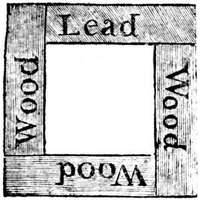
Thus, if you take, as I have done, a square bar of lead, four inches long, and one inch thick, together with three pieces of wood planed to the same dimensions, and lay them, as in the margin, on a smooth board, fixt so as not to be easily separated or moved, and pour into the cavity they form, as much melted lead as will fill it, you will see the melted lead chill, and become firm, on the side next the leaden bar, some time before it chills on the other three sides in contact with the wooden bars, though before the lead was poured in, they might all be supposed to have the same degree of heat or coldness, as they had been exposed in the same room to the same air. You will likewise observe, that the leaden bar, as it has cooled the melted lead more than the wooden bars have done, so it is itself more heated by the melted lead. There is a certain quantity of this fluid called fire, in every living human body, which fluid, being in due proportion, keeps the parts of the flesh and blood at such a just distance from each other, as that the flesh and nerves are supple, and the blood fit for circulation. If part of this due proportion of fire be conducted away, by means of a contact with other bodies, as air, water, or metals, the parts of our skin and flesh that come into such contact first draw more near together than is agreeable, and give that sensation which we call cold; and if too much be conveyed away, the body stiffens, the blood ceases to flow, and death ensues. On the other hand, if too much of this fluid be communicated to the flesh, the parts are separated too far, and pain ensues, as when they are separated by a pin or lancet. The sensation that the separation by fire occasions, we call heat, or burning. My desk on which I now write, and the lock of my desk, are both exposed to the same temperature of the air, and have therefore the same degree of heat or cold; yet if I lay my hand successively on the wood and on the metal, the latter feels much the coldest, not that it is really so, but being a better conductor, it more readily than the wood takes away and draws into itself the fire that was in my skin. Accordingly if I lay one hand, part on the lock, and part on the wood, and after it had lain so some time, I feel both parts with my other hand, I find the part that has been in contact with the lock, very sensibly colder to the touch, than the part that lay on the wood. How a living animal obtains its quantity of this fluid called fire, is a curious question. I have shown, that some bodies (as metals) have a power of attracting it stronger than others; and I have sometimes suspected, that a living body had some power of attracting out of the air, or other bodies, the heat it wanted. Thus metals hammered, or repeatedly bent, grow hot in the bent or hammered part. But when I consider that air, in contact with the body, cools it; that the surrounding air is rather heated by its contact with the body; that every breath of cooler air drawn in, carries off part of the body's heat when it passes out again; that therefore there must be in the body a fund for producing it, or otherwise the animal would soon grow cold; I have been rather inclined to think, that the fluid fire, as well as the fluid air, is attracted by plants in their growth, and becomes consolidated with the other materials of which they are formed, and makes a great part of their substance: that when they come to be digested, and to suffer in the vessels a kind of fermentation, part of the fire, as well as part of the air, recovers its fluid active state again, and diffuses itself in the body digesting and separating it: that the fire so reproduced, by digestion and separation continually leaving the body, its place is supplied by fresh quantities, arising from the continual separation. That whatever quickens the motion of the fluids in an animal quickens the separation, and reproduces more of the fire; as exercise. That all the fire emitted by wood, and other combustibles, when burning, existed in them before, in a solid state, being only discovered when separating. That some fossils, as sulphur, sea-coal, &c. contain a great deal of solid fire; and that, in short, what escapes and is dissipated in the burning of bodies, besides water and earth, is generally the air and fire that before made parts of the solid. Thus I imagine that animal heat arises by or from a kind of fermentation in the juices of the body, in the same manner as heat arises in the liquors preparing for distillation, wherein there is a separation of the spirituous, from the watry and earthy parts. And it is remarkable, that the liquor in a distiller's vat, when in its highest and best state of fermentation, as I have been informed, has the same degree of heat with the human body; that is, about 94 or 96.
Thus, as by a constant supply of fuel in a chimney, you keep a warm room, so, by a constant supply of food in the stomach, you keep a warm body; only where little exercise is used, the heat may possibly be conducted away too fast; in which case such materials are to be used for cloathing and bedding, against the effects of an immediate contact of the air, as are, in themselves, bad conductors of heat, and, consequently, prevent its being communicated through their substance to the air. Hence what is called warmth in wool, and its preference on that account, to linen; wool not being so good a conductor: and hence all the natural coverings of animals, to keep them warm, are such as retain and confine the natural heat in the body, by being bad conductors, such as wool, hair, feathers, and the silk by which the silk-worm, in its tender embrio state, is first cloathed. Cloathing, thus considered, does not make a man warm by giving warmth, but by preventing the too quick dissipation of the heat produced in his body, and so occasioning an accumulation.
There is another curious question I will just venture to touch upon, viz. Whence arises the sudden extraordinary degree of cold, perceptible on mixing some chemical liquors, and even on mixing salt and snow, where the composition appears colder than the coldest of the ingredients? I have never seen the chemical mixtures made, but salt and snow I have often mixed myself, and am fully satisfied that the composition feels much colder to the touch, and lowers the mercury in the thermometer more than either ingredient would do separately. I suppose, with others, that cold is nothing more than the absence of heat or fire. Now if the quantity of fire before contained or diffused in the snow and salt was expelled in the uniting of the two matters, it must be driven away either through the air or the vessel containing them. If it is driven off thro' the air, it must warm the air, and a thermometer held over the mixture, without touching it, would discover the heat, by the rising of the mercury, as it must, and always does in warm air.
This, indeed, I have not tried, but I should guess it would rather be driven off through the vessel, especially if the vessel be metal, as being a better conductor than air; and so one should find the bason warmer after such mixture. But, on the contrary, the vessel grows cold, and even water, in which the vessel is sometimes placed for the experiment, freezes into hard ice on the bason. Now I know not how to account for this, otherwise than by supposing, that the composition is a better conductor of fire than the ingredients separately, and, like the lock compared with the wood, has a stronger power of attracting fire, and does accordingly attract it suddenly from the fingers, or a thermometer put into it, from the bason that contains it, and from the water in contact with the outside of the bason; so that the fingers have the sensation of extreme cold, by being deprived of much of their natural fire; the thermometer sinks, by having part of its fire drawn out of the mercury; the bason grows colder to the touch, as, by having its fire drawn into the mixture, it is become more capable of drawing and receiving it from the hand; and through the bason, the water loses its fire that kept it fluid; so it becomes ice. One would expect, that from all this attracted acquisition of fire to the composition, it should become warmer; and, in fact, the snow and salt dissolve at the same time into water, without freezing.
I am, Sir, &c.
B. FRANKLIN.
FOOTNOTE:
TO THE SAME ON THE SAME SUBJECT.
London, June 17, 1758.
Dear Sir,
In a former letter I mentioned the experiment for cooling bodies by evaporation, and that I had, by repeatedly wetting the thermometer with common spirits, brought the mercury down five or six degrees. Being lately at Cambridge, and mentioning this in conversation with Dr. Hadley, professor of chemistry there, he proposed repeating the experiments with ether, instead of common spirits, as the ether is much quicker in evaporation. We accordingly went to his chamber, where he had both ether and a thermometer. By dipping first the ball of the thermometer into the ether, it appeared that the ether was precisely of the same temperament with the thermometer, which stood then at 65; for it made no alteration in the height of the little column of mercury. But when the thermometer was taken out of the ether, and the ether, with which the ball was wet, began to evaporate, the mercury sunk several degrees. The wetting was then repeated by a feather that had been dipped into the ether, when the mercury sunk still lower. We continued this operation, one of us wetting the ball, and another of the company blowing on it with the bellows, to quicken the evaporation, the mercury sinking all the time, till it came down to 7, which is 25 degrees below the freezing point, when we left off. Soon after it passed the freezing point, a thin coat of ice began to cover the ball. Whether this was water collected and condensed by the coldness of the ball, from the moisture in the air, or from our breath; or whether the feather, when dipped into the ether, might not sometimes go through it, and bring up some of the water that was under it, I am not certain; perhaps all might contribute. The ice continued increasing till we ended the experiment, when it appeared near a quarter of an inch thick all over the ball, with a number of small spicula, pointing outwards. From this experiment one may see the possibility of freezing a man to death on a warm summer's day, if he were to stand in a passage through which the wind blew briskly, and to be wet frequently with ether, a spirit that is more inflammable than brandy, or common spirits of wine.
It is but within these few years, that the European philosophers seem to have known this power in nature, of cooling bodies by evaporation. But in the east they have long been acquainted with it. A friend tells me, there is a passage in Bernier's Travels through Indostan, written near one hundred years ago, that mentions it as a practice (in travelling over dry deserts in that hot climate) to carry water in flasks wrapt in wet woollen cloths, and hung on the shady side of the camel, or carriage, but in the free air; whereby, as the cloths gradually grow drier, the water contained in the flasks is made cool. They have likewise a kind of earthen pots, unglazed, which let the water gradually and slowly ooze through their pores, so as to keep the outside a little wet, notwithstanding the continual evaporation, which gives great coldness to the vessel, and the water contained in it. Even our common sailors seem to have had some notion of this property; for I remember, that being at sea, when I was a youth, I observed one of the sailors, during a calm in the night, often wetting his finger in his mouth, and then holding it up in the air, to discover, as he said, if the air had any motion, and from which side it came; and this he expected to do, by finding one side of his finger grow suddenly cold, and from that side he should look for the next wind; which I then laughed at as a fancy.
May not several phenomena, hitherto unconsidered, or unaccounted for, be explained by this property? During the hot Sunday at Philadelphia, in June 1750, when the thermometer was up at 100 in the shade, I sat in my chamber without exercise, only reading or writing, with no other cloaths on than a shirt, and a pair of long linen drawers, the windows all open, and a brisk wind blowing through the house, the sweat ran off the backs of my hands, and my shirt was often so wet, as to induce me to call for dry ones to put on; in this situation, one might have expected, that the natural heat of the body 96, added to the heat of the air 100, should jointly have created or produced a much greater degree of heat in the body; but the fact was, that my body never grew so hot as the air that surrounded it, or the inanimate bodies immersed in the same air. For I remember well, that the desk, when I laid my arm upon it; a chair, when I sat down in it; and a dry shirt out of the drawer, when I put it on, all felt exceeding warm to me, as if they had been warmed before a fire. And I suppose a dead body would have acquired the temperature of the air, though a living one, by continual sweating, and by the evaporation of that sweat, was kept cold. May not this be a reason why our reapers in Pensylvania, working in the open field, in the clear hot sun-shine common in our harvest-time[15], find themselves well able to go through that labour, without being much incommoded by the heat, while they continue to sweat, and while they supply matter for keeping up that sweat, by drinking frequently of a thin evaporable liquor, water mixed with rum; but if the sweat stops, they drop, and sometimes die suddenly, if a sweating is not again brought on by drinking that liquor, or, as some rather chuse in that case, a kind of hot punch, made with water, mixed with honey, and a considerable proportion of vinegar? May there not be in negroes a quicker evaporation of the perspirable matter from their skins and lungs, which, by cooling them more, enables them to bear the sun's heat better than whites do? (if that is a fact, as it is said to be; for the alledged necessity of having negroes rather than whites, to work in the West-India fields, is founded upon it) though the colour of their skins would otherwise make them more sensible of the sun's heat, since black cloth heats much sooner, and more, in the sun, than white cloth. I am persuaded, from several instances happening within my knowledge, that they do not bear cold weather so well as the whites; they will perish when exposed to a less degree of it, and are more apt to have their limbs frostbitten; and may not this be from the same cause? Would not the earth grow much hotter under the summer-sun, if a constant evaporation from its surface, greater as the sun shines stronger, did not, by tending to cool it; balance, in some degree, the warmer effects of the sun's rays? Is it not owing to the constant evaporation from the surface of every leaf, that trees, though shone on by the sun, are always, even the leaves themselves, cool to our sense? at least much cooler than they would otherwise be? May it not be owing to this, that fanning ourselves when warm, does really cool us, though the air is itself warm that we drive with the fan upon our faces; for the atmosphere round, and next to our bodies, having imbibed as much of the perspired vapour as it can well contain, receives no more, and the evaporation is therefore checked and retarded, till we drive away that atmosphere, and bring drier air in its place, that will receive the vapour, and thereby facilitate and increase the evaporation? Certain it is, that mere blowing of air on a dry body does not cool it, as any one may satisfy himself, by blowing with a bellows on the dry ball of a thermometer; the mercury will not fall; if it moves at all, it rather rises, as being warmed by the friction of the air on its surface? To these queries of imagination, I will only add one practical observation; that wherever it is thought proper to give ease, in cases of painful inflammation in the flesh (as from burnings, or the like) by cooling the part; linen cloths, wet with spirit, and applied to the part inflamed, will produce the coolness required, better than if wet with water, and will continue it longer. For water, though cold when first applied, will soon acquire warmth from the flesh, as it does not evaporate fast enough; but the cloths wet with spirit, will continue cold as long as any spirit is left to keep up the evaporation, the parts warmed escaping as soon as they are warmed, and carrying off the heat with them.
I am, Sir, &c.
B FRANKLIN.
FOOTNOTE:
J. B.[16] ESQ. IN BOSTON, TO B. FRANKLIN.
Concerning the Light in Sea-Water.
Read at the Royal Society, December 6, 1756.
November 12, 1753.
**** When I was at the eastward, I had an opportunity of observing the luminous appearance of the sea when disturbed: at the head and stern of the vessel, when under way, it appeared very bright. The best opportunity I had to observe it was in a boat, in company with several gentlemen going from Portsmouth, about three miles, to our vessel lying at the mouth of Piscataqua River. Soon after we set off (it being in the evening) we observed a luminous appearance, where the oars dashed the water. Sometimes it was very bright, and afterwards, as we rowed along, gradually lessened, till almost imperceptible, and then re-illumined. This we took notice of several times in the passage. When I got on board the vessel, I ordered a pail to be dipped up, full of sea-water, in which, on the water's being moved, a sparkling light appeared. I took a linen cloth, and strained some of the water through it, and there was a like appearance on the cloth, which soon went off; but on rubbing the cloth with my finger, it was renewed. I then carried the cloth to the light, but could not perceive any thing upon it which should cause that appearance.
Several gentlemen were of opinion, that the separated particles of putrid, animal, and other bodies, floating on the surface of the sea, might cause that appearance; for putrid fish, &c. they said, will cause it: and the sea-animals which have died, and other bodies putrified therein since the creation, might afford a sufficient quantity of these particles to cover a considerable portion of the surface of the sea; which particles being differently dispersed, might account for the different degrees of light in the appearance above-mentioned. But this account seems liable to this obvious objection, that as putrid fish, &c. make a luminous appearance without being moved or disturbed, it might be expected that the supposed putrid particles on the surface of the sea, should always appear luminous, where there is not a greater light; and, consequently, that the whole surface of the sea, covered with those particles, should always, in dark nights, appear luminous, without being disturbed. But this is not fact.
Among the rest, I threw out my conjecture, that the said appearance might be caused by a great number of little animals, floating on the surface of the sea, which, on being disturbed, might, by expanding their finns, or otherwise moving themselves, expose such a part of their bodies as exhibits a luminous appearance, somewhat in the manner of a glow-worm, or fire-fly: that these animals may be more numerous in some places than others; and, therefore, that the appearance above-mentioned being fainter and stronger in different places, might be owing to that: that certain circumstances of weather, &c. might invite them to the surface, on which, in a calm, they might sport themselves and glow; or in storms, being forced up, make the same appearance.
There is no difficulty in conceiving that the sea may be stocked with animalcula for this purpose, as we find all nature crowded with life. But it seems difficult to conceive that such small portions of matter, even if they were wholly luminous, should affect our sight; much more so, when it is supposed that only a part of them is luminous. But, if we consider some other appearances, we may find the same difficulty to conceive of them; and yet we know they take place. For instance, the flame of a candle, which, it is said, may be seen four miles round. The light which fills this circle of eight miles diameter, was contained, when it first left the candle, within a circle of half an inch diameter. If the density of light, in these circumstances, be as those circles to each other, that is, as the squares of their diameters, the candle-light, when come to the eye, will be 1027709337600 times rarer than when it quitted the half inch circle. Now the aperture of the eye, through which the light passes, does not exceed one-tenth of an inch diameter, and the portion of the lesser circle, which corresponds to this small portion of the greater circle, must be proportionably, that is, 1027709337600 times less than one-tenth of an inch; and yet this infinitely small point (if you will allow the expression) affords light enough to make it visible four miles; or, rather, affords light sufficient to affect the sight at that distance.
The smallness of the animalcula is no objection then to this conjecture; for supposing them to be ten thousand times less than the minimum visibile, they may, notwithstanding, emit light enough to affect the eyes, and so to cause the luminous appearance aforesaid. This conjecture I send you for want of something better ****.
FOOTNOTE:
TO MR. P. F.[17] IN NEWPORT.
On the Saltness of Sea-Water.
London, May 7, 1760.
Sir,
**** It has, indeed, as you observe, been the opinion of some very great naturalists, that the sea is salt only from the dissolution of mineral or rock-salt, which its waters happened to meet with. But this opinion takes it for granted that all water was originally fresh, of which we can have no proof. I own I am inclined to a different opinion, and rather think all the water on this globe was originally salt, and that the fresh water we find in springs and rivers, is the produce of distillation. The sun raises the vapours from the sea, which form clouds, and fall in rain upon the land, and springs and rivers are formed of that rain. As to the rock-salt found in mines, I conceive, that instead of communicating its saltness to the sea, it is itself drawn from the sea, and that of course the sea is now fresher than it was originally. This is only another effect of nature's distillery, and might be performed various ways.
It is evident from the quantities of sea-shells, and the bones and teeth of fishes found in high lands, that the sea has formerly covered them. Then, either the sea has been higher than it now is, and has fallen away from those high lands, or they have been lower than they are, and were lifted up out of the water to their present height, by some internal mighty force, such as we still feel some remains of, when whole continents are moved by earthquakes. In either case it may be supposed that large hollows or valleys among hills, might be left filled with sea-water, which evaporating, and the fluid part drying away in a course of years, would leave the salt covering the bottom; and that salt coming afterwards to be covered with earth, from the neighbouring hills, could only be found by digging through that earth. Or, as we know from their effects, that there are deep fiery caverns under the earth, and even under the sea, if at any time the sea leaks into any of them, the fluid parts of the water must evaporate from that heat, and pass off through some volcano, while the salt remains, and by degrees, and continual acretion, becomes a great mass. Thus the cavern may at length be filled, and the volcano connected with it cease burning, as many it is said have done; and future miners, penetrating such cavern, find what we call a salt-mine. This is a fancy I had on visiting the salt-mines at Northwich, with my son. I send you a piece of the rock-salt which he brought up with him out of the mine. ****
I am, Sir, &c.
B. FRANKLIN.
FOOTNOTE:
TO MISS STEPHENSON.
On the Effect of Air on the Barometer, and the Benefits derived from the Study of Insects.
Craven Street, June 11, 1760.
'Tis a very sensible question you ask, how the air can affect the barometer, when its opening appears covered with wood? If indeed it was so closely covered as to admit of no communication of the outward air to the surface of the mercury, the change of weight in the air could not possibly affect it. But the least crevice is sufficient for the purpose; a pinhole will do the business. And if you could look behind the frame to which your barometer is fixed, you would certainly find some small opening.
There are indeed some barometers in which the body of mercury at the lower end is contained in a close leather bag, and so the air cannot come into immediate contact with the mercury; yet the same effect is produced. For the leather being flexible, when the bag is pressed by any additional weight of air it contracts, and the mercury is forced up into the tube; when the air becomes lighter, and its pressure less, the weight of the mercury prevails, and it descends again into the bag.
Your observation on what you have lately read concerning insects is very just and solid. Superficial minds are apt to despise those who make that part of the creation their study, as mere triflers; but certainly the world has been much obliged to them. Under the care and management of man, the labours of the little silkworm afford employment and subsistence to thousands of families, and become an immense article of commerce. The bee, too, yields us its delicious honey, and its wax useful to a multitude of purposes. Another insect, it is said, produces the cochineal, from whence we have our rich scarlet dye. The usefulness of the cantharides or Spanish flies, in medicine, is known to all, and thousands owe their lives to that knowledge. By human industry and observation, other properties of other insects may possibly be hereafter discovered, and of equal utility. A thorough acquaintance with the nature of these little creatures may also enable mankind to prevent the increase of such as are noxious, or secure us against the mischiefs they occasion. These things doubtless your books make mention of: I can only add a particular late instance which I had from a Swedish gentleman of good credit. In the green timber, intended for ship-building at the king's yards in that country, a kind of worms were found, which every year became more numerous and more pernicious, so that the ships were greatly damaged before they came into use. The king sent Linnæus, the great naturalist, from Stockholm, to enquire into the affair, and see if the mischief was capable of any remedy. He found, on examination, that the worm was produced from a small egg, deposited in the little roughnesses on the surface of the wood, by a particular kind of fly or beetle; from whence the worm, as soon as it was hatched, began to eat into the substance of the wood, and after some time came out again a fly of the parent kind, and so the species increased. The season in which the fly laid its eggs, Linnæus knew to be about a fortnight (I think) in the month of May, and at no other time in the year. He therefore advised, that some days before that season, all the green timber should be thrown into the water, and kept under water till the season was over. Which being done by the king's order, the flies missing their usual nests, could not increase; and the species was either destroyed or went elsewhere; and the wood was effectually preserved, for after the first year, it became too dry and hard for their purpose.
There is, however, a prudent moderation to be used in studies of this kind. The knowledge of nature may be ornamental, and it may be useful, but if to attain an eminence in that, we neglect the knowledge and practice of essential duties, we deserve reprehension. For there is no rank in natural knowledge of equal dignity and importance with that of being a good parent, a good child, a good husband, or wife, a good neighbour or friend, a good subject or citizen, that is, in short, a good christian. Nicholas Gimcrack, therefore, who neglected the care of his family, to pursue butterflies, was a just object of ridicule, and we must give him up as fair game to the satyrist.
Adieu, my dear friend, and believe me ever
Yours affectionately,
B. FRANKLIN.
TO THE SAME.
On the Bristol Waters, and the Tide in Rivers.
London, Sept. 13, 1760.
My dear Friend,
I have your agreeable letter from Bristol, which I take this first leisure hour to answer, having for some time been much engaged in business.
Your first question, What is the reason the water at this place, though cold at the spring, becomes warm by pumping? It will be most prudent in me to forbear attempting to answer, till, by a more circumstantial account, you assure me of the fact. I own I should expect that operation to warm, not so much the water pumped, as the person pumping.—The rubbing of dry solids together has been long observed to produce heat; but the like effect has never yet, that I have heard, been produced by the mere agitation of fluids, or friction of fluids with solids. Water in a bottle shook for hours by a mill-hopper, it is said, discovered no sensible addition of heat. The production of animal heat by exercise is therefore to be accounted for in another manner, which I may hereafter endeavour to make you acquainted with.
This prudence of not attempting to give reasons before one is sure of facts, I learnt from one of your sex, who, as Selden tells us, being in company with some gentlemen that were viewing, and considering something which they called a Chinese shoe, and disputing earnestly about the manner of wearing it, and how it could possibly be put on; put in her word, and said modestly, Gentlemen, are you sure it is a shoe?—Should not that be settled first?
But I shall now endeavour to explain what I said to you about the tide in rivers, and to that end shall make a figure, which though not very like a river, may serve to convey my meaning.—Suppose a canal one hundred and forty miles long, communicating at one end with the sea, and filled therefore with sea water. I chuse a canal at first, rather than a river, to throw out of consideration the effects produced by the streams of fresh water from the land, the inequality in breadth, and the crookedness of courses.
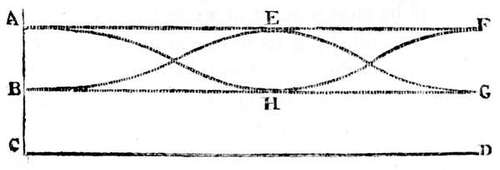
Let A, C, be the head of the canal; C, D, the bottom of it; D, F, the open mouth of it next the sea. Let the strait pricked line, B, G, represent low water mark the whole length of the canal, A, F, high water mark:—Now if a person standing at E, and observing at the time of high water there, that the canal is quite full at that place up to the line E, should conclude that the canal is equally full to the same height from end to end, and therefore there was as much more water come into the canal since it was down at low water mark, as would be included in the oblong space A, B, G, F, he would be greatly mistaken. For the tide is a wave, and the top of the wave, which makes high water, as well as every other lower part, is progressive; and it is high water successively, but not at the same time, in all the several points between G, F, and A, B.—And in such a length as I have mentioned it is low water at F, G, and also at A, B, at or near the same time with its being high water at E; so that the surface of the water in the canal, during that situation, is properly represented by the curve pricked line B, E, G. And on the other hand, when it is low water at E, H, it is high water both at F, G, and at A, B, at or near the same time: and the surface would then be described by the inverted curve line, A, H, F.
In this view of the case, you will easily see, that there must be very little more water in the canal at what we call high water, than there is at low water, those terms not relating to the whole canal at the same time, but successively to its parts. And if you suppose the canal six times as long, the case would not vary as to the quantity of water at different times of the tide; there would only be six waves in the canal at the same time, instead of one, and the hollows in the water would be equal to the hills.
That this is not mere theory, but conformable to fact, we know by our long rivers in America. The Delaware, on which Philadelphia stands, is in this particular similar to the canal I have supposed of one wave: for when it is high water at the Capes or mouth of the river, it is also high water at Philadelphia, which stands about one hundred and forty miles from the sea; and there is at the same time a low water in the middle between the two high waters; where, when it comes to be high water, it is at the same time low water at the Capes and at Philadelphia. And the longer rivers have some a wave and half, some two, three, or four waves, according to their length. In the shorter rivers of this island, one may see the same thing in part: for instance, it is high water at Gravesend an hour before it is high water at London Bridge; and twenty miles below Gravesend an hour before it is high water at Gravesend. Therefore at the time of high water at Gravesend the top of the wave is there, and the water is then not so high by some feet where the top of the wave was an hour before, or where it will be an hour after, as it is just then at Gravesend.
Now we are not to suppose, that because the swell or top of the wave runs at the rate of twenty miles an hour, that therefore the current, or water itself of which the wave is composed, runs at that rate. Far from it. To conceive this motion of a wave, make a small experiment or two. Fasten one end of a cord in a window near the top of a house, and let the other end come down to the ground; take this end in your hand, and you may, by a sudden motion, occasion a wave in the cord that will run quite up to the window; but though the wave is progressive from your hand to the window, the parts of the rope do not proceed with the wave, but remain where they were, except only that kind of motion that produces the wave. So if you throw a stone into a pond of water when the surface is still and smooth, you will see a circular wave proceed from the stone as its centre, quite to the sides of the pond; but the water does not proceed with the wave, it only rises and falls to form it in the different parts of its course; and the waves that follow the first, all make use of the same water with their predecessors.
But a wave in water is not indeed in all circumstances exactly like that in a cord; for water being a fluid, and gravitating to the earth, it naturally runs from a higher place to a lower; therefore the parts of the wave in water do actually run a little both ways from its top towards its lower sides, which the parts of the wave in the cord cannot do. Thus, when it is high and standing water at Gravesend, the water twenty miles below has been running ebb, or towards the sea for an hour, or ever since it was high water there; but the water at London Bridge will run flood, or from the sea yet another hour, till it is high water, or the top of the wave arrives at that bridge, and then it will have run ebb an hour at Gravesend, &c. &c. Now this motion of the water, occasioned only by its gravity, or tendency to run from a higher place to a lower, is by no means so swift as the motion of the wave. It scarce exceeds perhaps two miles in an hour.
If it went as the wave does twenty miles an hour, no ships could ride at anchor in such a stream, nor boats row against it.
In common speech, indeed, this current of the water both ways from the top of the wave is called the tide; thus we say, the tide runs strong, the tide runs at the rate of one, two, or three miles an hour, &c. and when we are at a part of the river behind the top of the wave, and find the water lower than high-water mark, and running towards the sea, we say, the tide runs ebb; and when we are before the top of the wave, and find the water higher than low-water mark, and running from the sea, we say, the tide runs flood; but these expressions are only locally proper; for a tide, strictly speaking, is one whole wave, including all its parts higher and lower, and these waves succeed one another about twice in twenty-four hours.
This motion of the water, occasioned by its gravity, will explain to you why the water near the mouths of rivers may be salter at high water than at low. Some of the salt-water, as the tide wave enters the river, runs from its top and fore side, and mixes with the fresh, and also pushes it back up the river.
Supposing that the water commonly runs during the flood at the rate of two miles in an hour, and that the flood runs five hours, you see that it can bring at most into our canal only a quantity of water equal to the space included in the breadth of the canal, ten miles of its length, and the depth between low and high-water mark; which is but a fourteenth part of what would be necessary to fill all the space between low and high-water mark, for one hundred and forty miles, the whole length of the canal.
And indeed such a quantity of water as would fill that whole space, to run in and out every tide, must create so outrageous a current, as would do infinite damage to the shores, shipping, &c. and make the navigation of a river almost impracticable.
I have made this letter longer than I intended, and therefore reserve for another what I have further to say on the subject of tides and rivers. I shall now only add, that I have not been exact in the numbers, because I would avoid perplexing you with minute calculations, my design at present being chiefly to give you distinct and clear ideas of the first principles.
After writing six folio pages of philosophy to a young girl, is it necessary to finish such a letter with a compliment?—Is not such a letter of itself a compliment?—Does it not say, she has a mind thirsty after knowledge, and capable of receiving it; and that the most agreeable things one can write to her are those that tend to the improvement of her understanding?—It does indeed say all this, but then it is still no compliment; it is no more than plain honest truth, which is not the character of a compliment. So if I would finish my letter in the mode, I should yet add some thing that means nothing, and is merely civil and polite. But being naturally aukward at every circumstance of ceremony, I shall not attempt it. I had rather conclude abruptly with what pleases me more than any compliment can please you, that I am allowed to subscribe myself
Your affectionate friend,
B. FRANKLIN.
TO THE SAME.
On the same Subject.
Craven-street, Monday, March 30, 1761.
My dear Friend,
Supposing the fact, that the water of the well at Bristol is warmer after sometime pumping, I think your manner of accounting for that increased warmth very ingenious and probable. It did not occur to me, and therefore I doubted of the fact.
You are, I think quite right in your opinion, that the rising of the tides in rivers is not owing to the immediate influence of the moon on the rivers. It is rather a subsequent effect of the influence of the moon on the sea, and does not make its appearance in some rivers till the moon has long passed by. I have not expressed myself clearly if you have understood me to mean otherwise. You know I have mentioned it as a fact, that there are in some rivers several tides all existing at the same time; that is, two, three, or more, high-waters, and as many low-waters, in different parts of the same river, which cannot possibly be all effects of the moon's immediate action on that river; but they may be subsequent effects of her action on the sea.
In the enclosed paper you will find my sentiments on several points relating to the air, and the evaporation of water. It is Mr. Collinson's copy, who took it from one I sent through his hands to a correspondent in France some years since; I have, as he desired me, corrected the mistakes he made in transcribing, and must return it to him; but if you think it worth while, you may take a copy of it: I would have saved you any trouble of that kind, but had not time.
Some day in the next or the following week, I purpose to have the pleasure of seeing you at Wanstead: I shall accompany your good mamma thither, and stay till the next morning, if it may be done without incommoding your family too much.—We may then discourse any points in that paper that do not seem clear to you; and taking a walk to lord Tilney's ponds, make a few experiments there to explain the nature of the tides more fully. In the mean time, believe me to be, with the highest esteem and regard, your sincerely affectionate friend,
B. FRANKLIN.
TO THE SAME.
Salt-Water rendered fresh by Distillation.—Method of relieving Thirst by Sea-Water.
Craven-street, August 10, 1761.
We are to set out this week for Holland, where we may possibly spend a month, but purpose to be at home again before the coronation. I could not go without taking leave of you by a line at least, when I am so many letters in your debt.
In yours of May 19, which I have before me, you speak of the ease with which salt water may be made fresh by distillation, supposing it to be, as I had said, that in evaporation the air would take up water but not the salt that was mixed with it. It is true that distilled sea water will not be salt, but there are other disagreeable qualities that rise with the water in distillation; which indeed several besides Dr. Hales have endeavoured by some means to prevent; but as yet their methods have not been brought much into use.
I have a singular opinion on this subject, which I will venture to communicate to you, though I doubt you will rank it among my whims. It is certain that the skin has imbibing as well as discharging pores; witness the effects of a blistering plaister, &c. I have read that a man, hired by a physician to stand by way of experiment in the open air naked during a moist night, weighed near three pounds heavier in the morning. I have often observed myself, that however thirsty I may have been before going into the water to swim, I am never long so in the water. These imbibing pores, however, are very fine, perhaps fine enough in filtering to separate salt from water; for though I have soaked (by swimming, when a boy) several hours in the day for several days successively in salt-water, I never found my blood and juices salted by that means, so as to make me thirsty or feel a salt taste in my mouth: and it is remarkable, that the flesh of sea fish, though bred in salt-water, is not salt.—Hence I imagine, that if people at sea, distressed by thirst when their fresh water is unfortunately spent, would make bathing-tubs of their empty water-casks, and, filling them with sea-water, sit in them an hour or two each day, they might be greatly relieved. Perhaps keeping their clothes constantly wet might have an almost equal effect; and this without danger of catching cold. Men do not catch cold by wet cloaths at sea. Damp, but not wet linen may possibly give colds; but no one catches cold by bathing, and no clothes can be wetter than water itself. Why damp clothes should then occasion colds, is a curious question, the discussion of which I reserve for a future letter, or some future conversation.
Adieu, my little philosopher. Present my respectful compliments to the good ladies your aunts, and to miss Pitt; and believe me ever
Your affectionate friend,
And humble Servant,
B. FRANKLIN.
TO THE SAME.
Tendency of Rivers to the Sea.—Effect of the Sun's Rays on Cloths of different Colours.
Sept. 20, 1761.
My dear Friend,
It is, as you observed in our late conversation, a very general opinion, that all rivers run into the sea, or deposite their waters there. 'Tis a kind of audacity to call such general opinions in question, and may subject one to censure. But we must hazard something in what we think the cause of truth: and if we propose our objections modestly, we shall, though mistaken, deserve a censure less severe, than when we are both mistaken and insolent.
That some rivers run into the sea is beyond a doubt: such, for instance, are the Amazons, and I think the Oronoko and the Mississippi. The proof is, that their waters are fresh quite to the sea, and out to some distance from the land. Our question is, whether the fresh waters of those rivers whose beds are filled with salt water to a considerable distance up from the sea (as the Thames, the Delaware, and the rivers that communicate with Chesapeak-bay in Virginia) do ever arrive at the sea? And as I suspect they do not, I am now to acquaint you with my reasons; or, if they are not allowed to be reasons, my conceptions at least, of this matter.
The common supply of rivers is from springs, which draw their origin from rain that has soaked into the earth. The union of a number of springs forms a river. The waters as they run, exposed to the sun, air, and wind, are continually evaporating. Hence in travelling one may often see where a river runs, by a long blueish mist over it, though we are at such a distance as not to see the river itself. The quantity of this evaporation is greater or less, in proportion to the surface exposed by the same quantity of water to those causes of evaporation. While the river runs in a narrow confined channel in the upper hilly country, only a small surface is exposed; a greater as the river widens. Now if a river ends in a lake, as some do, whereby its waters are spread so wide as that the evaporation is equal to the sum of all its springs, that lake will never overflow:—And if instead of ending in a lake, it was drawn into greater length as a river, so as to expose a surface equal in the whole to that lake, the evaporation would be equal, and such river would end as a canal; when the ignorant might suppose, as they actually do in such cases, that the river loses itself by running under ground, whereas in truth it has run up into the air.
Now, many rivers that are open to the sea widen much before they arrive at it, not merely by the additional waters they receive, but by having their course stopped by the opposing flood-tide; by being turned back twice in twenty-four hours, and by finding broader beds in the low flat countries to dilate themselves in; hence the evaporation of the fresh water is proportionably increased; so that in some rivers it may equal the springs of supply. In such cases, the salt water comes up the river, and meets the fresh in that part where, if there were a wall or bank of earth across from side to side, the river would form a lake, fuller indeed at some times than at others, according to the seasons, but whose evaporation would, one time with another, be equal to its supply.
When the communication between the two kinds of water is open, this supposed wall of separation may be conceived as a moveable one, which is not only pushed some miles higher up the river by every flood tide from the sea, and carried down again as far by every tide of ebb, but which has even this space of vibration removed nearer to the sea in wet seasons, when the springs and brooks in the upper country are augmented by the falling rains, so as to swell the river, and farther from the sea in dry seasons.
Within a few miles above and below this moveable line of separation, the different waters mix a little, partly by their motion to and fro, and partly from the greater specific gravity of the salt water, which inclines it to run under the fresh, while the fresh water, being lighter, runs over the salt.
Cast your eye on the map of North America, and observe the bay of Chesapeak in Virginia, mentioned above; you will see, communicating with it by their mouths, the great rivers Sasquehanah, Potowmack, Rappahanock, York, and James, besides a number of smaller streams, each as big as the Thames. It has been proposed by philosophical writers, that to compute how much water any river discharges into the sea in a given time, we should measure its depth and swiftness at any part above the tide; as, for the Thames, at Kingston or Windsor. But can one imagine, that if all the water of those vast rivers went to the sea, it would not first have pushed the salt water out of that narrow-mouthed bay, and filled it with fresh?—The Sasquehanah alone would seem to be sufficient for this, if it were not for the loss by evaporation. And yet that bay is salt quite up to Annapolis.
As to our other subject, the different degrees of heat imbibed from the sun's rays by cloths of different colours, since I cannot find the notes of my experiment to send you, I must give it as well as I can from memory.
But first let me mention an experiment you may easily make yourself. Walk but a quarter of an hour in your garden when the sun shines, with a part of your dress white, and a part black; then apply your hand to them alternately, and you will find a very great difference in their warmth. The black will be quite hot to the touch, the white still cool.
Another. Try to fire the paper with a burning glass. If it is white, you will not easily burn it;—but if you bring the focus to a black spot, or upon letters, written or printed, the paper will immediately be on fire under the letters.
Thus fullers and dyers find black cloths, of equal thickness with white ones, and hung out equally wet, dry in the sun much sooner than the white, being more readily heated by the sun's rays. It is the same before a fire; the heat of which sooner penetrates black stockings than white ones, and so is apt sooner to burn a man's shins. Also beer much sooner warms in a black mug set before the fire, than in a white one, or in a bright silver tankard.
My experiment was this. I took a number of little square pieces of broad cloth from a taylor's pattern-card, of various colours. There were black, deep blue, lighter blue, green, purple, red, yellow, white, and other colours, or shades of colours. I laid them all out upon the snow in a bright sun-shiny morning. In a few hours (I cannot now be exact as to the time) the black, being warmed most by the sun, was sunk so low as to be below the stroke of the sun's rays; the dark blue almost as low, the lighter blue not quite so much as the dark, the other colours less as they were lighter; and the quite white remained on the surface of the snow, not having entered it at all.
What signifies philosophy that does not apply to some use?—-May we not learn from hence, that black clothes are not so fit to wear in a hot sunny climate or season, as white ones; because in such clothes the body is more heated by the sun when we walk abroad, and are at the same time heated by the exercise, which double heat is apt to bring on putrid dangerous fevers? That soldiers and seamen, who must march and labour in the sun, should in the East or West Indies have an uniform of white? That summer hats, for men or women, should be white, as repelling that heat which gives head-achs to many, and to some the fatal stroke that the French call the coup de soleil? That the ladies summer hats, however, should be lined with black, as not reverberating on their faces those rays which are reflected upwards from the earth or water? That the putting a white cap of paper or linen within the crown of a black hat, as some do, will not keep out the heat, though it would if placed without. That fruit-walls being blacked may receive so much heat from the sun in the day-time, as to continue warm in some degree through the night, and thereby preserve the fruit from frosts, or forward its growth?—with sundry other particulars of less or greater importance, that will occur from time to time to attentive minds?—I am,
Yours affectionately,
B. FRANKLIN.
TO MR. HOPKINSON.
On the Vis Inertiæ of Matter.
Philadelphia, 1748.
Sir,
According to my promise, I send you in writing my observations on your book[18]: you will be the better able to consider them; which I desire you to do at your leisure, and to set me right where I am wrong.
I stumble at the threshold of the building, and therefore have not read farther. The author's vis inertiæ essential to matter, upon which the whole work is founded, I have not been able to comprehend. And I do not think he demonstrates at all clearly (at least to me he does not) that there is really such a property in matter.
He says, No. 2. "Let a given body or mass of matter be called a, and let any given celerity be called c. That celerity doubled, tripled, &c. or halved, thirded, &c. will be 2 c, 3 c, &c. or ½ c, ⅓ c, &c. respectively: also the body doubled, tripled, or halved, thirded, will be 2 a, 3 a, or ½ a, ⅓ a, respectively." Thus far is clear.—But he adds, "Now to move the body a with the celerity c, requires a certain force to be impressed upon it; and to move it with a celerity as 2 c, requires twice that force to be impressed upon it, &c." Here I suspect some mistake creeps in by the author's not distinguishing between a great force applied at once, or a small one continually applied, to a mass of matter, in order to move it. I think it is generally allowed by the philosophers, and, for aught we know, is certainly true, that there is no mass of matter, how great soever, but may be moved by any force how small soever (taking friction out of the question) and this small force continued, will in time bring the mass to move with any velocity whatsoever.—Our author himself seems to allow this towards the end of the same No. 2. when he is subdividing his celerities and forces: for as in continuing the division to eternity by his method of ½ c, ⅓ c, ¼ c, ⅕ c, &c. you can never come to a fraction of velocity that is equal to 0 c, or no celerity at all; so dividing the force in the same manner, you can never come to a fraction of force that will not produce an equal fraction of celerity.—Where then is the mighty vis inertiæ, and what is its strength; when the greatest assignable mass of matter will give way to, or be moved by the least assignable force? Suppose two globes, equal to the sun and to one another, exactly equipoised in Jove's balance; suppose no friction in the centre of motion, in the beam or elsewhere: if a musketo then were to light on one of them, would he not give motion to them both, causing one to descend and the other to rise? If it is objected, that the force of gravity helps one globe to descend, I answer, the same force opposes the other's rising: here is an equality that leaves the whole motion to be produced by the musketo, without whom those globes would not be moved at all.—What then does vis inertiæ do in this case? and what other effect could we expect if there were no such thing? Surely if it were any thing more than a phantom, there might be enough of it in such vast bodies to annihilate, by its opposition to motion, so trifling a force?
Our author would have reasoned more clearly, I think, if, as he has used the letter a for a certain quantity of matter, and c for a certain quantity of celerity, he had employed one letter more, and put f perhaps, for a certain quantity of force. This let us suppose to be done; and then as it is a maxim that the force of bodies in motion is equal to the quantity of matter multiplied by the celerity, (or f = c X a); and as the force received by and subsisting in matter, when it is put in motion, can never exceed the force given; so if, f moves a with c, there must needs be required 2 f to move a with 2 c; for a moving with 2 c would have a force equal to 2 f, which it could not receive from 1 f; and this, not because there is such a thing as vis inertiæ, for the case would be the same if that had no existence; but because nothing can give more than it has, if 1 f can to 1 a give 1 c, which is the same thing as giving it 1 f; (i. e. if force applied to matter at rest, can put it in motion, and give it equal force) where then is vis inertiæ? If it existed at all in matter, should we not find the quantity of its resistance subtracted from the force given?