Richard Wagner (1813-1883)
Reading edition
RICHARD WAGNER was born at Leipsic, May 22, 1813. His father was clerk to the city police court and a man of good education. During the French occupation of Leipsic he was, owing to his knowledge of French, made chief of police. He was fond of poetry and had a special love for the drama, often taking part in amateur theatricals.
Five months after Richard's birth his father died of an epidemic fever brought on by the carnage during the battle of Leipsic, October 16, 18, and 19, 1813. In 1815 his widow, whom he had left in most straitened circumstances, married Ludwig Geyer, an actor, a playwright, and a portrait painter. By inheritance from his father, by association with his stepfather, who was very fond of him, Wagner readily acquired the dramatic faculty so pronounced in his operas and music-dramas of which he is both author and composer.
At the time Wagner's mother married Geyer, he was a member of the Court Theatre at Dresden. Thither the family removed. When the boy was eight years old, he had learned to play on the pianoforte the chorus of bridesmaids from "Der Freischütz," then quite new. The day before Geyer's death, September 30, 1821, Richard was playing this piece in an adjoining room and heard Geyer say to his mother: "Do you think he might have a gift for music?" Coming out of the death room Wagner's mother said to him: "Of you he wanted to make something." "From this time on," writes Wagner in his early autobiographical sketch, "I always had an idea that I was destined to amount to something in this world."
At school Wagner made quite a little reputation as a writer of verses. He was such an enthusiastic admirer of Shakespeare that at the age of fourteen he began a grand tragedy, of which he himself says that it was a jumble of Hamlet and Lear. So many people died in the course of it that their ghosts had to return in order to keep the fifth act going.
In 1833, at the age of twenty, Wagner began his career as a professional musician. His elder brother Albert was engaged as tenor, actor, and stage manager at the Würzburg theatre. A position as chorus master being offered to Richard, he accepted it, although his salary was a pittance of ten florins a month. However, the experience was valuable. He was able to profit by many useful hints from his brother, the Musikverein performed several of his compositions, and his duties were not so arduous but that he found time to write the words and music of an opera in three acts entitled "The Fairies"—first performed in June, 1888, five years after his death, at Munich. In the autumn of 1834 he was called to the conductorship of the opera at Magdeburg. There he wrote and produced an opera, "Das Liebesverbot" (Love Veto), based on Shakespeare's Measure for Measure. The theatre at Magdeburg was, however, on the ragged edge of bankruptcy, and during the spring of 1836 matters became so bad that it was evident the theatre must soon close. Finally only twelve days were left for the rehearsing and the performance of his opera. The result was that the production went completely to pieces, singers forgetting their lines and music, and a repetition which was announced could not come off because of a free fight behind the scenes between two of the principal singers. Wagner describes this in the following amusing passage in his autobiographical sketch:
"All at once the husband of my prima donna (the impersonator of Isabella) pounced upon the second tenor, a very young and handsome fellow (the singer of my Claudio), against whom the injured spouse had long cherished a secret jealousy. It seemed that the prima donna's husband, who had from behind the curtains inspected with me the composition of the audience, considered that the time had now arrived when, without damage to the prospects of the theatre, he could take his revenge on his wife's lover. Claudio was so pounded and belaboured by him that the unhappy individual was compelled to retire to the dressing-room with his face all bleeding. Isabella was informed of this, and, rushing desperately toward her furious lord, received from him such a series of violent cuffs that she forthwith went into spasms. The confusion among my personnel was now quite boundless: everybody took sides with one party or the other, and everything seemed on the point of a general fight. It seemed as if this unhappy evening appeared to all of them precisely calculated for a final settling up of all sorts of fancied insults. This much was evident, that the couple who had suffered under the 'love veto' (Liebesverbot) of Isabella's husband, were certainly unable to appear on this occasion."
Wagner was next engaged as orchestral conductor at Königsberg, where he married the actress Wilhelmina, or Minna Planer. Later he received notice of his appointment as conductor and of the engagement of his wife and sister at the theatre at Riga, on the Russian side of the Baltic.
In Riga he began the composition of his first great success, "Rienzi." He completed the libretto during the summer of 1838, and began the music in the autumn, and when his contract terminated in the spring of 1839 the first two acts were finished. In July, accompanied by his wife and a huge Newfoundland dog, he boarded a sailing vessel for London, at the port of Pilau, his intention being to go from London to Paris. "I shall never forget the voyage," he says. "It was full of disaster. Three times we nearly suffered shipwreck, and once were obliged to seek safety in a Norwegian harbour.... The legend of the 'Flying Dutchman' was confirmed by the sailors, and the circumstances gave it a distinct and characteristic colour in my mind." No wonder the sea is depicted so graphically in his opera "The Flying Dutchman."
He arrived in Paris in September, 1839, and remained until April 7, 1842, from his twenty-sixth to his twenty-ninth year. This Parisian sojourn was one of the bitter experiences of his life. At times he actually suffered from cold and hunger, and was obliged to do a vast amount of most uncongenial kind of hack work.
November 19, 1840, he completed the score of "Rienzi," and in December forwarded it to the director of the Royal Theatre at Dresden. While awaiting a reply, he contributed to the newspapers and did all kinds of musical drudgery for Schlesinger, the music publisher, even making arrangements for the cornet à piston. Finally word came from Dresden. "Rienzi" had aroused the enthusiasm of the chorus master, Fischer, and of the tenor Tichatschek, who saw that the title rôle was exactly suited to his robust, dramatic voice. Then there was Mme. Schröder-Devrient for the part of Adriano. The opera was produced October 20, 1842, the performance beginning at six and ending just before midnight, to the enthusiastic plaudits of an immense audience. So great was the excitement that in spite of the late hour people remained awake to talk over the success. "We all ought to have gone to bed," relates a witness, "but we did nothing of the kind." Early the next morning Wagner appeared at the theatre in order to make excisions from the score, which he thought its great length necessitated. But when he returned in the afternoon to see if they had been executed, the copyist excused himself by saying the singers had protested against any cuts. Tichatschek said: "I will have no cuts; it is too heavenly." After a while, owing to its length, the opera was divided into two evenings.
The success of "Rienzi" led the Dresden management to put "The Flying Dutchman" in rehearsal. It was brought out after somewhat hasty preparations, January 2, 1843. The opera was so different from "Rienzi," its sombre beauty contrasted so darkly with the glaring, brilliant music and scenery of the latter, that the audience failed to grasp it. In fact, after "Rienzi," it was a disappointment.
Before the end of January, 1843, not long after the success of "Rienzi," Wagner was appointed one of the Royal conductors at Dresden. He was installed February 2d. One of his first duties was to assist Berlioz at the rehearsals of the latter's concerts. Wagner's work in his new position was somewhat varied, consisting not only of conducting operas, but also music between the acts at theatrical performances and at church services. The principal operas which he rehearsed and conducted were "Euryanthe," "Freischütz," "Don Giovanni," "The Magic Flute," Gluck's "Armide," and "Iphigenia in Aulis." The last-named was revised both as regards words and music by him, and his changes are now generally accepted.
Meanwhile he worked arduously on "Tannhäuser," completing it April 13, 1844. It was produced at Dresden, October 19, 1845. At first the work proved even a greater puzzle to the public than "The Flying Dutchman" had, and evoked comments which nowadays, when the opera has actually become a classic, seem ridiculous. Some people even suggested that the plot of the opera should be changed so that Tannhäuser should marry Elizabeth.
The management of the Dresden theatre, which had witnessed the brilliant success of "Rienzi" and had seen "The Flying Dutchman" and "Tannhäuser" at least hold their own in spite of the most virulent opposition, looked upon his next work, "Lohengrin," as altogether too risky and put off its production indefinitely.
Thinking that political changes might put an end to the routine stagnation in musical matters, Wagner joined in the revolutionary agitation of '48 and '49. In May, 1849, the disturbances at Dresden reached such an alarming point that the Saxon Court fled. Prussian troops were dispatched to quell the riot and Wagner thought it advisable to flee. He went to Weimar, where Liszt was busy rehearsing "Tannhäuser." While attending a rehearsal of this work, May 19, news was received that orders had been issued for his arrest as a politically dangerous individual. Liszt at once procured a passport and Wagner started for Paris. In June he went to Zurich, where he found Dresden friends and where his wife joined him, being enabled to do so through the zeal of Liszt, who raised the money to defray her journey from Dresden.
Liszt brought out "Lohengrin" at Weimar, August 28, 1850. The reception of "Lohengrin" did not at first differ much from that accorded to "Tannhäuser." Yet the performance made a deep impression. The fact that the weight of Liszt's influence had been cast in its favour gave vast importance to the event, and it may be said that through this performance Wagner's cause received its first great stimulus. The so-called Wagner movement may be said to have dated from this production of "Lohengrin."
He finished the librettos of the "Nibelung" dramas in 1853. By May, 1854, the music of "Das Rheingold" was composed. The following month he began "Die Walküre" and finished all but the instrumentation during the following winter and the full score in 1856. Previous to this, in fact already in the autumn of 1854, he had sketched some of the music of "Siegfried," and in the spring of 1857 the full score of the first act and of the greater part of the second act was finished. Then, recognizing the difficulties which he would encounter in securing a performance of the "Ring," and appalled by the prospect of the battle he would be obliged to wage, he was so disheartened that he abandoned the composition of "Siegfried" at the Waldweben scene and turned to "Tristan." His idea at that time was that "Tristan" would be short and comparatively easy to perform. Genius that he was, he believed that because it was easy for him to write great music it would be easy for others to interpret it. A very curious, not to say laughable, incident occurred at this time. An agent of the Emperor of Brazil called and asked if Wagner would compose an opera for an Italian troupe at Rio de Janeiro, and would he conduct the work himself, all upon his own terms. The composition of "Tristan" actually was begun with a view of its being performed by Italians in Brazil!
The poem of "Tristan" was finished early in 1857, and in the winter of the same year the full score of the first act was ready to be forwarded to the engraver. The second act is dated Venice, March 2, 1859. The third is dated Lyons, August, 1859.
It is interesting to note in connection with "Tristan" that, while Wagner wrote it because he thought it would be easy to secure its performance, he subsequently found more difficulty in getting it produced than any other of his works. In September, 1859, he again went to Paris with the somewhat curious hope that he could there find opportunity to produce "Tristan" with German artists. Through the intercession of the Princess Metternich, the Emperor ordered the production of "Tannhäuser" at the Opéra. Beginning March 13, 1861, three performances were given, of which it is difficult to say whether the performance was on the stage or in the auditorium, for the uproar in the house often drowned the sounds from the stage. The members of the Jockey Club, who objected to the absence of a ballet, armed themselves with shrill whistles, on which they began to blow whenever there was the slightest hint of applause, and the result was that between the efforts of the singers to make themselves heard and of Wagner's friends to applaud, and the shrill whistling from his enemies, there was confusion worse confounded. But Wagner's friendship with Princess Metternich bore good fruit. Through her mediation, it is supposed, he received permission to return to all parts of Germany but Saxony. It was not until March, 1862, thirteen years after his banishment, that he was again allowed to enter the kingdom of his birth and first success.
His first thought now was to secure the production of "Tristan," but at Vienna, after fifty-seven rehearsals, it was put upon the shelf as impossible.
In 1863, while working upon "Die Meistersinger," at Penzing, near Vienna, he published his "Nibelung" dramas, expressing his hope that through the bounty of one of the German rulers the completion and performance of his "Ring of the Nibelung" would be made possible. But in the spring of 1864, worn out by his struggle with poverty and almost broken in spirit by his contest with public and critics, he actually determined to give up his public career, and eagerly grasped the opportunity to visit a private country seat in Switzerland. Just at this very moment, when despair had settled upon him, the long wished-for help came. King Ludwig II., of Bavaria, bade him come to Munich, where he settled in 1864. "Tristan" was produced there June 10, 1865. June 21, 1868, a model performance of "Die Meistersinger," which he had finished in 1867, was given at Munich under the direction of von Bülow, Richter acting as chorus master and Wagner supervising all the details. Wagner also worked steadily at the unfinished portion of the "Ring," completing the instrumentation of the third act of "Siegfried" in 1869 and the introduction and first act of "The Dusk of the Gods" in June, 1870.
August 25, 1870, his first wife having died January 25, 1866, after five years' separation from him, he married the divorced wife of von Bülow, Cosima Liszt. In 1869 and 1870, respectively "The Rhinegold" and "The Valkyr" were performed at the Court Theatre in Munich.
Bayreuth having been determined upon as the place where a theatre for the special production of his "Ring" should be built, Wagner settled there in April, 1872. By November, 1874, "Dusk of the Gods" received its finishing touches, and rehearsals had already been held at Bayreuth. During the summer of 1875, under Wagner's supervision, Hans Richter held full rehearsals there, and at last, twenty-eight years after its first conception, on August 13th, 14th, 16th, and 17th, again from August 20 to 23, and from August 27 to 30, 1876, "The Ring of the Nibelung" was performed at Bayreuth with the following cast: Wotan, Betz; Loge, Vogel; Alberich, Hill; Mime, Schlosser; Fricka, Frau Grün; Donner and Gunther, Gura; Erda and Waltraute, Frau Jaide; Siegmund, Niemann; Sieglinde, Frl. Schefsky; Brünnhilde, Frau Materna; Siegfried, Unger; Hagen, Siehr; Gutrune, Frl. Weckerin; Rhinedaughters, Lilli and Marie Lehmann, and Frl. Lammert. First violin, Wilhelmj; conductor, Hans Richter. The first Rhinedaughter was the same Lilli Lehmann who, in later years, at the Metropolitan Opera House, New York, became one of the greatest of prima donnas and, as regards the Wagnerian repertoire, set a standard for all time. Materna appeared at that house in the "Valkyr" production under Dr. Damrosch, in January, 1885, and Niemann was heard there later.
To revert to Bayreuth, "Parsifal" was produced there in July, 1882. In the autumn of that year, Wagner's health being in an unsatisfactory state, though no alarming symptoms had shown themselves, he took up his residence in Venice at the Palazzo Vendramini, on the Grand Canal. He died February 13, 1883.
In manner incidental, that is, without attention formally being called to the subject, Wagner's reform of the lyric stage is set forth in the descriptive accounts of his music-dramas which follow, and in which the leading motives are quoted in musical notation. But something directly to the point must be said here.
Once again, like Gluck a century before, Wagner opposed the assumption of superiority on the part of the interpreter—the singer—over the composer. He opposed it in manner so thorough-going that he changed the whole face of opera. A far greater tribute to Wagner's genius than the lame attempts of some German composers at imitating him, is the frank adoption of certain phases of his method by modern French and Italian composers, beginning with Verdi in "Aïda." While by no means a Wagnerian work, since it contains not a trace of the theory of the leading motive, "Aïda," through the richness of its instrumentation, the significant accompaniment of its recitative, the lack of mere bravura embellishment in its vocal score, and its sober reaching out for true dramatic effect in the treatment of the voices, substituting this for ostentatious brilliancy and ear-tickling fluency, plainly shows the influence of Wagner upon the greatest of Italian composers. And what is true of "Aïda," is equally applicable to the whole school of Italian verismo that came after Verdi—Mascagni, Leoncavallo, Puccini.
Wagner's works are conceived and executed upon a gigantic scale. They are Shakespearian in their dimensions and in their tragic power; or, as in the "Meistersinger," in their comedy element. Each of his works is highly individual. The "Ring" dramas and "Tristan" are unmistakably Wagner. Yet how individually characteristic the music of each! That of the "Ring" is of elemental power. The "Tristan" music is molten passion. Equally characteristic and individual are his other scores.
The theory evolved by Wagner was that the lyric stage should present not a series of melodies for voice upon a mere framework of plot and versified story, but a serious work of dramatic art, the music to which should, both vocally and instrumentally, express the ever varying development of the drama. With this end in view he invented a melodious recitative which only at certain great crises in the progress of the action—such as the love-climax, the gathering at the Valkyr Rock, the "Farewell," and the "Magic Fire" scenes in "The Valkyr"; the meeting of Siegfried and Brünnhilde in "Siegfried"; the love duet and "Love-Death" in "Tristan"—swells into prolonged melody. Note that I say prolonged melody. For besides these prolonged melodies, there is almost constant melody, besides marvellous orchestral colour, in the weft and woof of the recitative. This is produced by the artistic use of leading motives, every leading motive being a brief, but expressive, melody—so brief that, to one coming to Wagner without previous study or experience, the melodious quality of his recitative is not appreciated at first. After a while, however, the hearer begins to recognize certain brief, but melodious and musically eloquent phrases—leading motives—as belonging to certain characters in the drama or to certain influences potent in its development, such as hate, love, jealousy, the desire for revenge, etc. Often to express a combination of circumstances, influences, passions, or personal actions, these leading motives, these brief melodious phrases, are combined with a skill that is unprecedented; or the voice may express one, while the orchestra combines with it in another.
To enable the orchestra to follow these constantly changing phases in the evolution and development of the drama, and often to give utterance to them separately, it was necessary for Wagner to have most intimate knowledge of the individual tone quality and characteristics of every instrument in the orchestra, and this mastery of what I may call instrumental personality he possessed to a hitherto undreamed-of degree. Nor has anyone since equalled him in it. The result is a choice and variety of instrumentation which in itself is almost an equivalent for dramatic action and enables the orchestra to adapt itself with unerring accuracy to the varying phases of the drama.
Consider that, when Wagner first projected his theory of the music-drama, singers were accustomed in opera to step into the limelight and, standing there, deliver themselves of set melodies, acknowledge applause and give as many encores as were called for, in fact were "it," while the real creative thing, the opera, was but secondary, and it is easy to comprehend the opposition which his works aroused among the personnel of the lyric stage; for music-drama demands a singer's absorption not only in the music but also in the action. A Wagner music-drama requires great singers, but the singers no longer absorb everything. They are part—a most important part, it is true—of a performance, in which the drama itself, the orchestra, and the stage pictures are also of great importance. A performance of a Wagner music-drama, to be effective, must be a well-rounded, eloquent whole. The drama must be well acted from a purely dramatic point of view. It must be well sung from a purely vocal point of view. It must be well interpreted from a purely orchestral point of view. It must be well produced from a purely stage point of view. For all these elements go hand in hand. It is, of course, well known that Wagner was the author of his own librettos and showed himself a dramatist of the highest order for the lyric stage.
While his music-dramas at first aroused great opposition among operatic artists, growing familiarity with them caused these artists to change their view. The interpretation of a Wagner character was discovered to be a combined intellectual and emotional task which slowly, but surely, appealed more and more to the great singers of the lyric stage. They derived a new dignity and satisfaction from their work, especially as audiences also began to realize that, instead of mere entertainment, performances of Wagner music-dramas were experiences that both stirred the emotions to their depths and appealed to the intellect as well. To this day Lilli Lehmann is regarded by all, who had the good fortune to hear her at the Metropolitan Opera House, as the greatest prima donna and the most dignified figure in the history of the lyric stage in this country; for on the lyric stage the interpretation of the great characters in Wagnerian music-drama already had come to be regarded as equal to the interpretation of the great Shakespearian characters on the dramatic.
Wagner's genius was so supreme that, although he has been dead thirty-four years, he is still without a successor. Through the force of his own genius he appears destined to remain the sole exponent of the art form of which he was the creator. But his influence is still potent. This we discover not only in the enrichment of the orchestral accompaniment in opera, but in the banishment of senseless vocal embellishment, in the search for true dramatic expression and, in general, in the greater seriousness with which opera is taken as an art. Even the minor point of lowering the lights in the auditorium during a performance, so as to concentrate attention upon the stage, is due to him; and even the older Italian operas are now given with an attention to detail, scenic setting, and an endeavour to bring out their dramatic effects, quite unheard of before his day. He was, indeed, a reformer of the lyric stage whose influence long will be potent "all along the line."
RIENZI, DER LETZTE DER TRIBUNEN RIENZI, THE LAST OF THE TRIBUNES
Opera in five acts. Words and music by Wagner. Produced, Dresden, October 20, 1842. London, Her Majesty's Theatre, April 16, 1869. New York, Academy of Music, 1878, with Charles R. Adams, as Rienzi, Pappenheim as Adriano; Metropolitan Opera House, February 5, 1886, with Sylva as Rienzi, Lehmann as Irene, Brandt as Adriano, Fischer as Colonna.
Characters
Cola Rienzi, Roman Tribune and Papal NotaryTenor
Irene, his sisterSoprano
Steffano ColonnaBass
Adriano, his sonMezzo-Soprano
Paolo OrsinoBass
Raimondo, Papal LegateBass
Baroncello}Roman citizens{Tenor
Cecco del Vecchio}{Bass
Messenger of PeaceSoprano
Ambassadors, Nobles, Priests, Monks, Soldiers, Messengers, and Populace in General.
Time—Middle of the Fourteenth Century.
Place—Rome.
Orsino, a Roman patrician, attempts to abduct Irene, the sister of Rienzi, a papal notary, but is opposed at the critical moment by Colonna, another patrician. A fight ensues between the two factions, in the midst of which Adriano, the son of Colonna, who is in love with Irene, appears to defend her. A crowd is attracted by the tumult, and among others Rienzi comes upon the scene. Enraged at the insult offered his sister, and stirred on by Cardinal Raimondo, he urges the people to resist the outrages of the nobles. Adriano is impelled by his love for Irene to cast his lot with her brother. The nobles are overpowered, and appear at the capitol to swear allegiance to Rienzi, but during the festal proceedings Adriano warns him that the nobles have plotted to kill him. An attempt which Orsino makes upon him with a dagger is frustrated by a steel breastplate which Rienzi wears under his robe.
The nobles are seized and condemned to death, but on Adriano's pleading they are spared. They, however, violate their oath of submission, and the people again under Rienzi's leadership rise and exterminate them, Adriano having pleaded in vain. In the end the people prove fickle. The popular tide turns against Rienzi, especially in consequence of the report that he is in league with the German emperor, and intends to restore the Roman pontiff to power. As a festive procession is escorting him to church, Adriano rushes upon him with a drawn dagger, being infuriated at the slaughter of his family, but the blow is averted. Instead of the "Te Deum," however, with which Rienzi expected to be greeted on his entrance to the church, he hears the malediction and sees the ecclesiastical dignitaries placing the ban of excommunication against him upon the doors. Adriano hurries to Irene to warn her of her brother's danger, and urges her to seek safety with him in flight. She, however, repels him, and seeks her brother, determined to die with him, if need be. She finds him at prayer in the capitol, but rejects his counsel to save herself with Adriano. Rienzi appeals to the infuriated populace which has gathered around the capitol, but they do not heed him. They fire the capitol with their torches, and hurl stones at Rienzi and Irene. As Adriano sees his beloved one and her brother doomed to death in the flames, he throws away his sword, rushes into the capitol, and perishes with them.
The overture of "Rienzi" gives a vivid idea of the action of the opera. Soon after the beginning there is heard the broad and stately melody of Rienzi's prayer, and then the Rienzi Motive, a typical phrase, which is used with great effect later in the opera. It is followed in the overture by the lively melody heard in the concluding portion of the finale of the second act. These are the three most conspicuous portions of the overture, in which there are, however, numerous tumultuous passages reflecting the dramatic excitement which pervades many scenes.
The opening of the first act is full of animation, the orchestra depicting the tumult which prevails during the struggle between the nobles. Rienzi's brief recitative is a masterpiece of declamatory music, and his call to arms is spirited. It is followed by a trio between Irene, Rienzi, and Adriano, and this in turn by a duet for the two last-named which is full of fire. The finale opens with a double chorus for the populace and the monks in the Lateran, accompanied by the organ. Then there is a broad and energetic appeal to the people from Rienzi, and amid the shouts of the populace and the ringing tones of the trumpets the act closes.
The insurrection of the people against the nobles is successful, and Rienzi, in the second act, awaits at the capitol the patricians who are to pledge him their submission. The act opens with a broad and stately march, to which the messengers of peace enter. They sing a graceful chorus. This is followed by a chorus for the senators, and the nobles then tender their submission. There is a terzetto, between Adriano, Colonna, and Orsino, in which the nobles express their contempt for the young patrician. The finale which then begins is highly spectacular. There is a march for the ambassadors, and a grand ballet, historical in character, and supposed to be symbolical of the triumphs of ancient Rome. In the midst of this occurs the assault upon Rienzi. Rienzi's pardon of the nobles is conveyed in a broadly beautiful melody, and this is succeeded by the animated passage heard in the overture. With it are mingled the chants of the monks, the shouts of the people who are opposed to the cardinal and nobles, and the tolling of bells.
The third act opens tumultuously. The people have been aroused by fresh outrages on the part of the nobles. Rienzi's emissaries disperse, after a furious chorus, to rouse the populace to vengeance. After they have left, Adriano has his great air, a number which can never fail of effect when sung with all the expression of which it is capable. The rest of the act is a grand accumulation of martial music or noise, whichever one chooses to call it, and includes the stupendous battle hymn, which is accompanied by the clashing of sword and shields, the ringing of bells, and all the tumult incidental to a riot. After Adriano has pleaded in vain with Rienzi for the nobles, and the various bands of armed citizens have dispersed, there is a duet between Adriano and Irene, in which Adriano takes farewell of her. The victorious populace appears and the act closes with their triumphant shouts. The fourth act is brief, and beyond the description given in the synopsis of the plot, requires no further comment.
The fifth act opens with the beautiful prayer of Rienzi, already familiar from the overture. There is a tender duet between Rienzi and Irene, an impassioned aria for Rienzi, a duet for Irene and Adriano, and then the finale, which is chiefly choral.
DER FLIEGENDE HOLLÄNDER THE FLYING DUTCHMAN
Opera in three acts, words and music by Richard Wagner. Produced, Royal Opera, Dresden, January 2, 1843. London, July 23, 1870, as "L'Olandese Dannato"; October 3, 1876, by Carl Rosa, in English. New York, Academy of Music, January 26, 1877, in English, with Clara Louise Kellogg; March 12, 1877, in German; in the spring of 1883, in Italian, with Albani, Galassi, and Ravelli.
Characters
Daland, a Norwegian sea captainBass
Senta, his daughterSoprano
Eric, a huntsmanTenor
Mary, Senta's nurseContralto
Daland's SteersmanTenor
The DutchmanBaritone
Sailors, Maidens, Hunters, etc.
Time—Eighteenth Century.
Place—A Norwegian Fishing Village.
From "Rienzi" Wagner took a great stride to "The Flying Dutchman." This is the first milestone on the road from opera to music-drama. Of his "Rienzi" the composer was in after years ashamed, writing to Liszt: "I, as an artist and man, have not the heart for the reconstruction of that, to my taste, superannuated work, which in consequence of its immoderate dimensions, I have had to remodel more than once. I have no longer the heart for it, and desire from all my soul to do something new instead." He spoke of it as a youthful error, but in "The Flying Dutchman" there is little, if anything, which could have troubled his artistic conscience.
One can hardly imagine the legend more effective dramatically and musically than it is in Wagner's libretto and score. It is a work of wild and sombre beauty, relieved only occasionally by touches of light and grace, and has all the interest attaching to a work in which for the first time a genius feels himself conscious of his greatness. If it is not as impressive as "Tannhäuser" or "Lohengrin," nor as stupendous as the music-dramas, that is because the subject of the work is lighter. As his genius developed, his choice of subjects and his treatment of them passed through as complete an evolution as his musical theory, so that when he finally abandoned the operatic form and adopted his system of leading motives, he conceived, for the dramatic bases of his scores, dramas which it would be difficult to fancy set to any other music than that which is so characteristic in his music-dramas.
Wagner's present libretto is based upon the weirdly picturesque legend of "The Flying Dutchman"—the Wandering Jew of the ocean. A Dutch sea captain, who, we are told, tried to double the Cape of Good Hope in the teeth of a furious gale, swore that he would accomplish his purpose even if he kept on sailing forever. The devil, hearing the oath, condemned the captain to sail the sea until Judgment Day, without hope of release, unless he should find a woman who would love him faithfully unto death. Once in every seven years he is allowed to go ashore in search of a woman who will redeem him through her faithful love.
The opera opens just as a term of seven years has elapsed. The Dutchman's ship comes to anchor in a bay of the coast of Norway, in which the ship of Daland, a Norwegian sea captain, has sought shelter from the storm. Daland's home is not far from the bay, and the Dutchman, learning he has a daughter, asks permission to woo her, offering him in return all his treasures. Daland readily consents. His daughter, Senta, is a romantic maiden upon whom the legend of "The Flying Dutchman" has made a deep impression. As Daland ushers the Dutchman into his home Senta is gazing dreamily upon a picture representing the unhappy hero of the legend. The resemblance of the stranger to the face in this picture is so striking that the emotional girl is at once attracted to him, and pledges him her faith, deeming it her mission to save him. Later on, Eric, a young huntsman, who is in love with her, pleads his cause with her, and the Dutchman, overhearing them, and thinking himself again forsaken, rushes off to his vessel. Senta cries out that she is faithful to him, but is held back by Eric, Daland, and her friends. The Dutchman, who really loves Senta, then proclaims who he is, thinking to terrify her, and at once puts to sea. But she, undismayed by his words, and truly faithful unto death, breaks away from those who are holding her, and rushing to the edge of a cliff casts herself into the ocean, with her arms outstretched toward him. The phantom ship sinks, the sea rises high and falls back into a seething whirlpool. In the sunset glow the forms of Senta and the Dutchman are seen rising in each other's embrace from the sea and floating upward.
In "The Flying Dutchman" Wagner employs several leading motives, not, indeed, with the skill which he displays in his music-dramas, but with considerably greater freedom of treatment than in "Rienzi." There we had but one leading motive, which never varied in form. The overture, which may be said to be an eloquent and beautiful musical narrative of the whole opera, contains all these leading motives. It opens with a stormy passage, out of which there bursts the strong but sombre Motive of the Flying Dutchman himself, the dark hero of the legend. The orchestra fairly seethes and rages like the sea roaring under the lash of a terrific storm. And through all this furious orchestration there is heard again and again the motive of the Dutchman, as if his figure could be seen amid all the gloom and fury of the elements. There he stands, hoping for death, yet indestructible. As the excited music gradually dies away, there is heard a calm, somewhat undulating phrase which occurs in the opera when the Dutchman's vessel puts into the quiet Norwegian harbour. Then, also, there occurs again the motive of the Dutchman, but this time played softly, as if the storm-driven wretch had at last found a moment's peace.
We at once recognize to whom it is due that he has found this moment of repose, for we hear like prophetic measures the strains of the beautiful ballad which is sung by Senta in the second act of the opera, in which she relates the legend of "The Flying Dutchman" and tells of his unhappy fate. She is the one whom he is to meet when he goes ashore. The entire ballad is not heard at this point, only the opening of the second part, which may be taken as indicating in this overture the simplicity and beauty of Senta's character. In fact, it would not be too much to call this opening phrase the Senta Motive. It is followed by the phrase which indicates the coming to anchor of the Dutchman's vessel; then we hear the Motive of the Dutchman himself, dying away with the faintest possible effect. With sudden energy the orchestra dashes into the surging ocean music, introducing this time the wild, pathetic plaint sung by the Dutchman in the first act of the opera. Again we hear his motive, and again the music seems to represent the surging, swirling ocean when aroused by a furious tempest. Even when we hear the measures of the sailors' chorus the orchestra continues its furious pace, making it appear as if the sailors were shouting above the storm.
Characteristic in this overture, and also throughout the opera, especially in Senta's ballad, is what may be called the Ocean Motive, which most graphically depicts the wild and terrible aspect of the ocean during a storm. It is varied from time to time, but never loses its characteristic force and weirdness. The overture ends with an impassioned burst of melody based upon a portion of the concluding phrases of Senta's ballad; phrases which we hear once more at the end of the opera when she sacrifices herself in order to save her lover.
A wild and stormy scene is disclosed when the curtain rises upon the first act. The sea occupies the greater part of the scene, and stretches itself out far toward the horizon. A storm is raging. Daland's ship has sought shelter in a little cove formed by the cliffs. Sailors are employed in furling sails and coiling ropes. Daland is standing on a rock, looking about him to discover in what place they are. The orchestra, chiefly with the wild ocean music heard in the overture, depicts the raging of the storm, and above it are heard the shouts of the sailors at work: "Ho-jo-he! Hal-lo-jo!"
Daland discovers that they have missed their port by seven miles on account of the storm, and deplores his bad luck that when so near his home and his beloved child, he should have been driven out of his course. As the storm seems to be abating the sailors descend into the hold and Daland goes down into the cabin to rest, leaving his steersman in charge of the deck. The steersman walks the deck once or twice and then sits down near the rudder, yawning, and then rousing himself as if sleep were coming over him. As if to force himself to remain awake he intones a sailor song, an exquisite little melody, with a dash of the sea in its undulating measures. He intones the second verse, but sleep overcomes him and the phrases become more and more detached, until at last he falls asleep.
The storm begins to rage again and it grows darker. Suddenly the ship of the Flying Dutchman, with blood-red sails and black mast, looms up in the distance. She glides over the waves as if she did not feel the storm at all, and quickly enters the harbour over against the ship of the Norwegian; then silently and without the least noise the spectral crew furl the sails. The Dutchman goes on shore.
Here now occur the weird, dramatic recitative and aria: "The term is passed, and once again are ended seven long years." As the Dutchman leans in brooding silence against a rock in the foreground, Daland comes out of the cabin and observes the ship. He rouses the steersman, who begins singing again a phrase of his song, until Daland points out the strange vessel to him, when he springs up and hails her through a speaking trumpet. Daland, however, perceives the Dutchman and going ashore questions him. It is then that the Dutchman, after relating a mariner's story of ill luck and disaster, asks Daland to take him to his home and allow him to woo his daughter, offering him his treasures. At this point we have a graceful and pretty duet, Daland readily consenting that the Dutchman accompany him. The storm having subsided and the wind being fair, the crews of the vessels hoist sail to leave port, Daland's vessel disappearing just as the Dutchman goes on board his ship.
After an introduction in which we hear a portion of the steersman's song, and also that phrase which denotes the appearance of the Dutchman's vessel in the harbour, the curtain rises upon a room in Daland's house. On the walls are pictures of vessels, charts, and on the farther wall the portrait of a pale man with a dark beard. Senta, leaning back in an armchair, is absorbed in dreamy contemplation of the portrait. Her old nurse, Mary, and her young friends are sitting in various parts of the room, spinning. Here we have that charming musical number famous all the musical world over, perhaps largely through Liszt's admirable piano arrangement of it, the "Spinning Chorus." For graceful and engaging beauty it cannot be surpassed, and may be cited as a striking instance of Wagner's gift of melody, should anybody at this late day be foolish enough to require proof of his genius in that respect. The girls tease Senta for gazing so dreamily at the portrait of the Flying Dutchman, and finally ask her if she will not sing his ballad.
This ballad is a masterpiece of composition, vocally and instrumentally, being melodious as well as descriptive. It begins with the storm music familiar from the overture, and with the weird measures of the Flying Dutchman's Motive, which sound like a voice calling in distress across the sea.

[Listen]
Senta repeats the measures of this motive, and then we have the simple phrases beginning: "A ship the restless ocean sweeps." Throughout this portion of the ballad the orchestra depicts the surging and heaving of the ocean, Senta's voice ringing out dramatically above the accompaniment. She then tells how he can be delivered from his curse, this portion being set to the measures which were heard in the overture, Senta finally proclaiming, in the broadly delivered, yet rapturous phrases with which the overture ends,

[Listen]
that she is the woman who will save him by being faithful to him unto death. The girls about her spring up in terror and Eric, who has just entered the door and heard her outcry, hastens to her side. He brings news of the arrival of Daland's vessel, and Mary and the girls hasten forth to meet the sailors. Senta wishes to follow, but Eric restrains her and pleads his love for her in melodious measures. Senta, however, will not give him an answer at this time. He then tells her of a dream he has had, in which he saw a weird vessel from which two men, one her father, the other a ghastly-looking stranger, made their way. Her he saw going to the stranger and entreating him for his regard.
Senta, worked up to the highest pitch of excitement by Eric's words, now exclaims: "He seeks for me and I for him," and Eric, full of despair and horror, rushes away. Senta, after her outburst of excitement, remains again sunk in contemplation of the picture, softly repeating the measures of her romance. The door opens and the Dutchman and Daland appear. The Dutchman is the first to enter. Senta turns from the picture to him, and, uttering a loud cry of wonder, remains standing as if transfixed without removing her eyes from the Dutchman. Daland, seeing that she does not greet him, comes up to her. She seizes his hand and after a hasty greeting asks him who the stranger is. Daland tells her of the stranger's request, and leaves them alone. Then follows a duet for Senta and the Dutchman, with its broad, smoothly-flowing melody and its many phrases of dramatic power, in which Senta gives herself up unreservedly to the hero of her romantic attachment, Daland finally entering and adding his congratulations to their betrothal. This scene closes the act.
The music of it re-echoes through the introduction of the next act and goes over into a vigorous sailors' chorus and dance. The scene shows a bay with a rocky shore. Daland's house is in the foreground on one side, the background is occupied by his and the Dutchman's ships, which lie near one another. The Norwegian ship is lighted up, and all the sailors are making merry on the deck. In strange contrast is the Flying Dutchman's vessel. An unnatural darkness hangs over it and the stillness of death reigns aboard. The sailors and the girls in their merry-making call loudly toward the Dutch ship to join them, but no reply is heard from the weird vessel. Finally the sailors call louder and louder and taunt the crew of the other ship. Then suddenly the sea, which has been quite calm, begins to rise. The storm wind whistles through the cordage of the strange vessel, and as dark bluish flames flare up in the rigging, the weird crew show themselves, and sing a wild chorus, which strikes terror into all the merrymakers. The girls have fled, and the Norwegian sailors quit their deck, making the sign of the cross. The crew of the Flying Dutchman observing this, disappear with shrill laughter. Over their ship comes the stillness of death. Thick darkness is spread over it and the air and the sea become calm as before.
Senta now comes with trembling steps out of the house. She is followed by Eric. He pleads with her and entreats her to remember his love for her, and speaks also of the encouragement which she once gave him. The Dutchman has entered unperceived and has been listening. Eric seeing him, at once recognizes the man of ghastly mien whom he saw in his vision. When the Flying Dutchman bids her farewell, because he deems himself abandoned, and Senta endeavours to follow him, Eric holds her and summons others to his aid. But, in spite of all resistance, Senta seeks to tear herself loose. Then it is that the Flying Dutchman proclaims who he is and puts to sea. Senta, however, freeing herself, rushes to a cliff overhanging the sea, and calling out,
"Praise thou thine angel for what he saith; Here stand I faithful, yea, to death,"
casts herself into the sea. Then occurs the concluding tableau, the work ending with the portion of the ballad which brought the overture and spinning scene to a close.
TANNHÄUSER UND DER SÄNGERKRIEG AUF DEM WARTBURG (AND THE SONG CONTEST AT THE WARTBURG)
Opera in three acts, words and music by Richard Wagner. Produced, Royal Opera, Dresden, October 19, 1845. Paris, Grand Opéra, March 13, 1861. London, Covent Garden, May 6, 1876, in Italian; Her Majesty's Theatre, February 14, 1882, in English; Drury Lane, May 23, 1882, in German, under Hans Richter. New York, Stadt Theatre, April 4, 1859, and July, 1861, conducted by Carl Bergmann; under Adolff Neuendorff's direction, 1870, and, Academy of Music, 1877; Metropolitan Opera House, opening night of German Opera, under Dr. Leopold Damrosch, November 17, 1884, with Seidl-Kraus as Elizabeth, Anna Slach as Venus, Schott as Tannhäuser, Adolf Robinson as Wolfram, Josef Kögel as the Landgrave.
Characters
Hermann, Landgrave of ThuringiaBass
Tannhäuser}Knights and MinnesingerTenor
Wolfram von Eschenbach}Baritone
Walter von der Vogelweide}Tenor
Biterolf}Bass
Heinrich der Schreiber}Tenor
Reinmar von Zweter}Bass
Elizabeth, niece of the LandgraveSoprano
VenusSoprano
A Young ShepherdSoprano
Four Noble PagesSoprano and Alto
Nobles, Knights, Ladies, elder and younger Pilgrims, Sirens, Naiads, Nymphs, Bacchantes.
Time—Early Thirteenth Century.
Place—Near Eisenach.
The story of "Tannhäuser" is laid in and near the Wartburg, where, during the thirteenth century, the Landgraves of the Thuringian Valley held sway. They were lovers of art, especially of poetry and music, and at the Wartburg many peaceful contests between the famous minnesingers took place. Near this castle rises the Venusberg. According to tradition the interior of this mountain was inhabited by Holda, the Goddess of Spring, who, however, in time became identified with the Goddess of Love. Her court was filled with nymphs and sirens, and it was her greatest joy to entice into the mountain the knights of the Wartburg and hold them captive to her beauty.
Among those whom she has thus lured into the rosy recesses of the Venusberg is Tannhäuser.
In spite of her beauty, however, he is weary of her charms and longs for a glimpse of the world. He seems to have heard the tolling of bells and other earthly sounds, and these stimulate his yearning to be set free from the magic charms of the goddess.
In vain she prophesies evil to him should he return to the world. With the cry that his hope rests in the Virgin, he tears himself away from her. In one of the swiftest and most effective of scenic changes the court of Venus disappears and in a moment we see Tannhäuser prostrate before a cross in a valley upon which the Wartburg peacefully looks down. Pilgrims on their way to Rome pass him by and Tannhäuser thinks of joining them in order that at Rome he may obtain forgiveness for his crime in allowing himself to be enticed into the Venusberg. But at that moment the Landgrave and a number of minnesingers on their return from the chase come upon him and, recognizing him, endeavour to persuade him to return to the Wartburg with them. Their pleas, however, are vain, until one of them, Wolfram von Eschenbach, tells him that since he has left the Wartburg a great sadness has come over the niece of the Landgrave, Elizabeth. It is evident that Tannhäuser has been in love with her, and that it is because of her beauty and virtue that he regrets so deeply having been lured into the Venusberg. For Wolfram's words stir him profoundly. To the great joy of all, he agrees to return to the Wartburg, the scene of his many triumphs as a minnesinger in the contests of song.
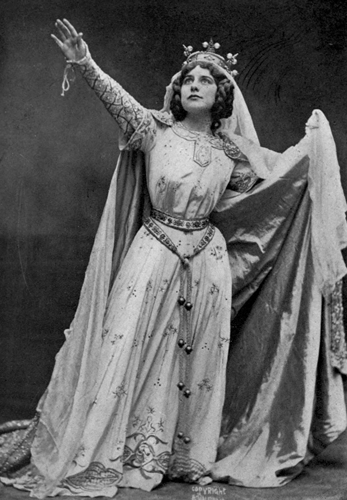
Copyright photo by Dupont
Farrar as Elizabeth in “Tannhäuser”
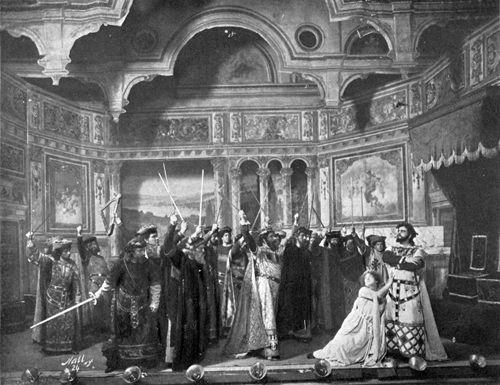
Photo by Hall
“Tannhäuser,” Finale, Act II Tannhäuser (Maclennan), Elizabeth (Fornia), Wolfram (Dean) The Landgrave (Cranston)
The Landgrave, feeling sure that Tannhäuser will win the prize at the contest of song soon to be held, offers the hand of his niece to the winner. The minnesingers sing tamely of the beauty of virtuous love, but Tannhäuser, suddenly remembering the seductive and magical beauties of the Venusberg, cannot control himself, and bursts out into a reckless hymn in praise of Venus. Horrified at his words, the knights draw their swords and would slay him, but Elizabeth throws herself between him and them. Crushed and penitent, Tannhäuser stands behind her, and the Landgrave, moved by her willingness to sacrifice herself for her sinful lover, announces that he will be allowed to join a second band of pilgrims who are going to Rome and to plead with the Pope for forgiveness.
Elizabeth prayerfully awaits his return; but, as she is kneeling by the crucifix in front of the Wartburg, the Pilgrims pass her by and in the band she does not see her lover. Slowly and sadly she returns to the castle to die. When the Pilgrims' voices have died away, and Elizabeth has returned to the castle, leaving only Wolfram, who is also deeply enamoured of her, upon the scene, Tannhäuser appears, weary and dejected. He has sought to obtain forgiveness in vain. The Pope has cast him out forever, proclaiming that no more than that his staff can put forth leaves can he expect forgiveness. He has come back to re-enter the Venusberg. Wolfram seeks to restrain him, but it is not until he invokes the name of Elizabeth that Tannhäuser is saved. A cortège approaches, and, as Tannhäuser recognizes the form of Elizabeth on the bier, he sinks down on her coffin and dies. Just then the second band of pilgrims arrive, bearing Tannhäuser's staff, which has put forth blossoms, thus showing that his sins have been forgiven.
From "The Flying Dutchman" to "Tannhäuser," dramatically and musically, is, if anything, a greater stride than from "Rienzi" to "The Flying Dutchman." In each of his successive works Wagner demonstrates greater and deeper powers as a dramatic poet and composer. True it is that in nearly every one of them woman appears as the redeeming angel of sinful man, but the circumstances differ so that this beautiful tribute always interests us anew.
The overture of the opera has long been a favorite piece on concert programs. Like that of "The Flying Dutchman" it is the story of the whole opera told in music. It certainly is one of the most brilliant and effective pieces of orchestral music and its popularity is easily understood. It opens with the melody of the Pilgrims' chorus, beginning softly as if coming from a distance and gradually increasing in power until it is heard in all its grandeur. At this point it is joined by a violently agitated accompaniment on the violins. This passage evoked great criticism when it was first produced and for many years thereafter. It was thought to mar the beauty of the pilgrims' chorus. But without doing so at all it conveys additional dramatic meaning, for these agitated phrases depict the restlessness of the world as compared with the grateful tranquillity of religious faith as set forth in the melody of the Pilgrims' chorus.

[Listen]
Having reached a climax, this chorus gradually dies away, and suddenly, and with intense dramatic contrast, we have all the seductive spells of the Venusberg displayed before us—that is, musically displayed; but then the music is so wonderfully vivid, it depicts with such marvellous clearness the many-coloured alluring scene at the court of the unholy goddess, it gives vent so freely to the sinful excitement which pervades the Venusberg, that we actually seem to see what we hear. This passes over in turn to the impassioned burst of song in which Tannhäuser hymns Venus's praise, and immediately after we have the boisterous and vigorous music which accompanies the threatening action of the Landgrave and minnesingers when they draw their swords upon Tannhäuser in order to take vengeance upon him for his crimes. Upon these three episodes of the drama, which so characteristically give insight into its plot and action, the overture is based, and it very naturally concludes with the Pilgrims' chorus which seems to voice the final forgiveness of Tannhäuser.
The curtain rises, disclosing all the seductive spells of the Venusberg. Tannhäuser lies in the arms of Venus, who reclines upon a flowery couch. Nymphs, sirens, and satyrs are dancing about them and in the distance are grottoes alive with amorous figures. Various mythological amours, such as that of Leda and the swan, are supposed to be in progress, but fortunately at a mitigating distance.
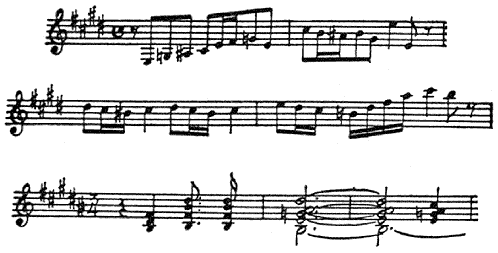
[Listen]
Much of the music familiar from the overture is heard during this scene, but it gains in effect from the distant voices of the sirens and, of course, from artistic scenery and grouping and well-executed dances of the denizens of Venus's court. Very dramatic, too, is the scene between Venus and Tannhäuser, when the latter sings his hymn in her praise, but at the same time proclaims that he desires to return to the world. In alluring strains she endeavours to tempt him to remain with her, but when she discovers that he is bound upon going, she vehemently warns him of the misfortunes which await him upon earth and prophesies that he will some day return to her and penitently ask to be taken back into her realm.
Dramatic and effective as this scene is in the original score, it has gained immensely in power by the additions which Wagner made for the production of the work in Paris, in 1861. The overture does not, in this version, come to a formal close, but after the manner of Wagner's later works, the transition is made directly from it to the scene of the Venusberg. The dances have been elaborated and laid out upon a more careful allegorical basis and the music of Venus has been greatly strengthened from a dramatic point of view, so that now the scene in which she pleads with him to remain and afterwards warns him against the sorrows to which he will be exposed, are among the finest of Wagner's compositions, rivalling in dramatic power the ripest work in his music-dramas.
Wagner's knowledge of the stage is shown in the wonderfully dramatic effect in the change of scene from the Venusberg to the landscape in the valley of the Wartburg. One moment we have the variegated allures of the court of the Goddess of Love, with its dancing nymphs, sirens, and satyrs, its beautiful grottoes and groups; the next all this has disappeared and from the heated atmosphere of Venus's unholy rites we are suddenly transported to a peaceful scene whose influence upon us is deepened by the crucifix in the foreground, before which Tannhäuser kneels in penitence. The peacefulness of the scene is further enhanced by the appearance upon a rocky eminence to the left of a young Shepherd who pipes a pastoral strain, while in the background are heard the tinkling of bells, as though his sheep were there grazing upon some upland meadow. Before he has finished piping his lay the voices of the Pilgrims are heard in the distance, their solemn measures being interrupted by little phrases piped by the Shepherd. As the Pilgrims approach, the chorus becomes louder, and as they pass over the stage and bow before the crucifix, their praise swells into an eloquent psalm of devotion.
Tannhäuser is deeply affected and gives way to his feelings in a lament, against which are heard the voices of the Pilgrims as they recede in the distance. This whole scene is one of marvellous beauty, the contrast between it and the preceding episode being enhanced by the religiously tranquil nature of what transpires and of the accompanying music. Upon this peaceful scene the notes of hunting-horns now break in, and gradually the Landgrave and his hunters gather about Tannhäuser. Wolfram recognizes him and tells the others who he is. They greet him in an expressive septette, and Wolfram, finding he is bent upon following the Pilgrims to Rome, asks permission of the Landgrave to inform him of the impression which he seems to have made upon Elizabeth. This he does in a melodious solo, and Tannhäuser, overcome by his love for Elizabeth, consents to return to the halls which have missed him so long. Exclamations of joy greet his decision, and the act closes with an enthusiastic ensemble, which is a glorious piece of concerted music, and never fails of brilliant effect when it is well executed, especially if the representative of Tannhäuser has a voice that can soar above the others, which, unfortunately, is not always the case. The accompanying scenic grouping should also be in keeping with the composer's instructions. The Landgrave's suite should gradually arrive, bearing the game which has been slain, and horses and hunting-hounds should be led on the stage. Finally, the Landgrave and minnesingers mount their steeds and ride away toward the castle.
The scene of the second act is laid in the singers' hall of the Wartburg. The introduction depicts Elizabeth's joy at Tannhäuser's return, and when the curtain rises she at once enters and joyfully greets the scenes of Tannhäuser's former triumphs in broadly dramatic melodious phrases. Wolfram then appears, conducting Tannhäuser to her. Elizabeth seems overjoyed to see him, but then checks herself, and her maidenly modesty, which veils her transport at meeting him, again finds expression in a number of hesitating but exceedingly beautiful phrases. She asks Tannhäuser where he has been, but he, of course, gives misleading answers. Finally, however, he tells her she is the one who has attracted him back to the castle. Their love finds expression in a swift and rapidly flowing dramatic duet, which unfortunately is rarely given in its entirety, although as a glorious outburst of emotional music it certainly deserves to be heard in the exact form and length in which the composer wrote it.
There is then a scene of much tender feeling between the Landgrave and Elizabeth, in which the former tells her that he will offer her hand as prize to the singer whom she shall crown as winner. The first strains of the grand march are then heard. This is one of Wagner's most brilliant and effective orchestral and vocal pieces. Though in perfect march rhythm, it is not intended that the guests who assembled at the Wartburg shall enter like a company of soldiers. On the contrary, they arrive in irregular detachments, stride across the floor, and make their obeisance in a perfectly natural manner. After an address by the Landgrave, which can hardly be called remarkably interesting, the singers draw lots to decide who among them shall begin. This prize singing is, unfortunately, not so great in musical value as the rest of the score, and, unless a person understands the words, it is decidedly long drawn out. What, however, redeems it is a gradually growing dramatic excitement as Tannhäuser voices his contempt for what seem to him the tame tributes paid to love by the minnesingers, an excitement which reaches its climax when, no longer able to restrain himself, he bursts forth into his hymn in praise of the unholy charms of Venus.

[Listen]
The women cry out in horror and rush from the hall as if the very atmosphere were tainted by his presence, and the men, drawing their swords, rush upon him. This brings us to the great dramatic moment, when, with a shriek, Elizabeth, in spite of his betrayal of her love, throws herself protectingly before him, and thus appears a second time as his saving angel. In short and excited phrases the men pour forth their wrath at Tannhäuser's crime in having sojourned with Venus, and he, realizing its enormity, seems crushed with a consciousness of his guilt. Of wondrous beauty is the septette, "An angel has from heaven descended," which rises to a magnificent climax and is one of the finest pieces of dramatic writing in Wagner's scores, although often execrably sung and rarely receiving complete justice. The voices of young Pilgrims are heard in the valley. The Landgrave then announces the conditions upon which Tannhäuser can again obtain forgiveness, and Tannhäuser joins the pilgrims on their way to Rome.
The third act displays once more the valley of the Wartburg, the same scene as that to which the Venusberg changed in the first act. Elizabeth, arrayed in white, is kneeling, in deep prayer, before the crucifix. At one side, and watching her tenderly, stands Wolfram. After a sad recitative from Wolfram, the chorus of returning Pilgrims is heard in the distance. They sing the melody heard in the overture and in the first act; and the same effect of gradual approach is produced by a superb crescendo as they reach and cross the scene. With almost piteous anxiety and grief Elizabeth scans them closely as they go by, to see if Tannhäuser be among them, and when the last one has passed and she realizes that he has not returned, she sinks again upon her knees before the crucifix and sings the prayer, "Almighty Virgin, hear my sorrow," music in which there is most beautifully combined the expression of poignant grief with trust in the will of the Almighty. As she rises and turns toward the castle, Wolfram, by his gesture, seems to ask her if he cannot accompany her, but she declines his offer and slowly goes her way up the mountain.
Meanwhile night has fallen upon the scene and the evening star glows softly above the castle. It is then that Wolfram, accompanying himself on his lyre, intones the wondrously tender and beautiful "Song to the Evening Star," confessing therein his love for the saintly Elizabeth.

[Listen]
Then Tannhäuser, dejected, footsore, and weary, appears, and in broken accents asks Wolfram to show him the way back to the Venusberg. Wolfram bids him stay his steps and persuades him to tell him the story of his pilgrimage. In fierce, dramatic accents, Tannhäuser relates all that he has suffered on his way to Rome and the terrible judgment pronounced upon him by the Pope. This is a highly impressive episode, clearly foreshadowing Wagner's dramatic use of musical recitative in his later music-dramas. Only a singer of the highest rank can do justice to it.
Tannhäuser proclaims that, having lost all chance of salvation, he will once more give himself up to the delights of the Venusberg. A roseate light illumines the recesses of the mountain and the unholy company of the Venusberg again is seen, Venus stretching out her arms for Tannhäuser, to welcome him. But at last, when Tannhäuser seems unable to resist Venus' enticing voice any longer, Wolfram conjures him by the memory of the sainted Elizabeth. Then Venus knows that all is lost. The light dies away and the magic charms of the Venusberg disappear. Amid tolling of bells and mournful voices a funeral procession comes down the mountain. Recognizing the features of Elizabeth, the dying Tannhäuser falls upon her corpse. The younger pilgrims arrive with the staff, which has again put forth leaves, and amid the hallelujahs of the pilgrims the opera closes.
Besides the character of Elizabeth that of Wolfram stands out for its tender, manly beauty. In love with Elizabeth, he is yet the means of bringing back her lover to her, and in the end saves that lover from perdition, so that they may be united in death.
LOHENGRIN
Opera in three acts, by Richard Wagner. Produced, Weimar, Germany, August 28, 1850, under the direction of Franz Liszt; London, Covent Garden, May 8, 1875; New York, Stadt Theater, in German, April 3, 1871; Academy of Music, in Italian, March 23, 1874, with Nilsson, Cary, Campanini, and Del Puente; Metropolitan Opera House, in German, November 23, 1885, with Seidl-Kraus, Brandt, Stritt, Robinson, and Fischer, American début of Anton Seidl as conductor.
Characters
Henry the Fowler, King of GermanyBass
LohengrinTenor
Elsa of BrabantSoprano
Duke Godfrey, her brotherMute
Frederick of Telramund, Count of BrabantBaritone
Ortrud, his wifeMezzo-Soprano
The King's HeraldBass
Saxon, Thuringian, and Brabantian Counts and Nobles, Ladies of Honour, Pages, Attendants.
Time—First half of the Tenth Century.
Scene—Antwerp.
The circumstances attending the creation and first production of "Lohengrin" are most interesting.
Prior to and for more than a decade after he wrote and composed the work Wagner suffered many vicissitudes. In Paris, where he lived from hand to mouth before "Rienzi" was accepted by the Royal Opera House at Dresden, he was absolutely poverty-stricken and often at a loss how to procure the next meal.
"Rienzi" was produced at the Dresden Opera in 1842. It was brilliantly successful. "The Flying Dutchman," which followed, was less so, and "Tannhäuser" seemed even less attractive to its early audiences. Therefore it is no wonder that, although Wagner was royal conductor in Dresden, he could not succeed in having "Lohengrin" accepted there for performance. Today "Rienzi" hardly can be said to hold its own in the repertoire outside of its composer's native country. The sombre beauty of "The Flying Dutchman," though recognized by musicians and serious music lovers, has prevented its becoming popular. But "Tannhäuser," looked at so askance at first, and "Lohengrin," absolutely rejected, are standard operas and, when well given, among the most popular works of the lyric stage. Especially is this true of "Lohengrin."
This opera, at the time of its composition so novel and so strange, yet filled with beauties of orchestration and harmony that are now quoted as leading examples in books on these subjects, was composed in less than a year. The acts were finished almost, if not quite, in reversed order. For Wagner wrote the third act first, beginning it in September, 1846, and completing it March 5, 1847. The first act occupied him from May 12th to June 8th, less than a month; the second act from June 18th to August 2d. Fresh and beautiful as "Lohengrin" still sounds today, it is, in fact, a classic.
Wagner's music, however, was so little understood at the time, that even before "Lohengrin" was produced and not a note of it had been heard, people made fun of it. A lithographer named Meser had issued Wagner's previous three scores, but the enterprise had not been a success. People said that before publishing "Rienzi," Meser had lived on the first floor. "Rienzi" had driven him to the second; "The Flying Dutchman" and "Tannhäuser" to the third; and now "Lohengrin" would drive him to the garret—a prophecy that didn't come true, because he refused to publish it.
In 1849, "Lohengrin" still not having been accepted by the Dresden Opera, Wagner, as already has been stated, took part in the May revolution, which, apparently successful for a very short time, was quickly suppressed by the military. The composer of "Lohengrin" and the future composer of the "Ring of the Nibelung," "Tristan und Isolde," "Meistersinger," and "Parsifal," is said to have made his escape from Dresden in the disguise of a coachman. Occasionally there turns up in sales as a great rarity a copy of the warrant for Wagner's arrest issued by the Dresden police. As it gives a description of him at the time when he had but recently composed "Lohengrin," I will quote it:
"Wagner is thirty-seven to thirty-eight years of age, of medium stature, has brown hair, an open forehead; eyebrows, brown; eyes, greyish blue; nose and mouth, proportioned; chin, round, and wears spectacles. Special characteristics: rapid in movements and speech. Dress: coat of dark green buckskin, trousers of black cloth, velvet vest, silk neckerchief, ordinary felt hat and boots."
Much fun has been made of the expression "chin, round, and wears spectacles." Wagner got out of Dresden on the pass of a Dr. Widmann, whom he resembled. It has been suggested that he made the resemblance still closer by discontinuing the habit of wearing spectacles on his chin.
I saw Wagner several times in Bayreuth in the summer of 1882, when I attended the first performance of "Parsifal," as correspondent by cable and letter for one of the large New York dailies. Except that his hair was grey (and that he no longer wore his spectacles on his chin) the description in the warrant still held good, especially as regards his rapidity of movement and speech, to which I may add a marked vivacity of gesture. There, too, I saw the friend, who had helped him over so many rough places in his early career, Franz Liszt, his hair white with age, but framing a face as strong and keen as an eagle's. I saw them seated at a banquet, and with them Cosima, Liszt's daughter, who was Wagner's second wife, and their son, Siegfried Wagner; Cosima the image of her father, and Siegfried a miniature replica of the composer to whom we owe "Lohengrin" and the music-dramas that followed it. The following summer one of the four was missing. I have the "Parsifal" program with mourning border signifying that the performances of the work were in memory of its creator.
In April, 1850, Wagner, then an exile in Zurich, wrote to Liszt: "Bring out my 'Lohengrin!' You are the only one to whom I would put this request; to no one but you would I entrust the production of this opera; but to you I surrender it with the fullest, most joyous confidence."
Wagner himself describes the appeal and the result, by saying that at a time when he was ill, unhappy, and in despair, his eye fell on the score of "Lohengrin" which he had almost forgotten. "A pitiful feeling overcame me that these tones would never resound from the deathly-pale paper; two words I wrote to Liszt, the answer to which was nothing else than the information that, as far as the resources of the Weimar Opera permitted, the most elaborate preparations were being made for the production of 'Lohengrin.'"
Liszt's reply to which Wagner refers, and which gives some details regarding "the elaborate preparations," while testifying to his full comprehension of Wagner's genius and the importance of his new score as a work of art, may well cause us to smile today at the small scale on which things were done in 1850.
"Your 'Lohengrin,'" he wrote, "will be given under conditions that are most unusual and most favourable for its success. The direction will spend on this occasion almost 2000 thalers [about $1500]—a sum unprecedented at Weimar within memory of man ... the bass clarinet has been bought," etc. Ten times fifteen hundred dollars might well be required today for a properly elaborate production of "Lohengrin," and the opera orchestra that had to send out and buy a bass clarinet would be a curiosity. But Weimar had what no other opera house could boast of—Franz Liszt as conductor.
Under his brilliant direction "Lohengrin" had at Weimar its first performance on any stage, August 28, 1850. This was the anniversary of Goethe's birth, the date of the dedication of the Weimar monument to the poet, Herder, and, by a coincidence that does not appear to have struck either Wagner or Liszt, the third anniversary of the completion of "Lohengrin." The work was performed without cuts and before an audience which included some of the leading musical and literary men of Germany. The performance made a deep impression. The circumstance that Liszt added the charm of his personality to it and that the weight of his influence had been thrown in its favour alone gave vast importance to the event. Indeed, through Liszt's production of Wagner's early operas Weimar became, as Henry T. Finck has said in Wagner and His Works, a sort of preliminary Bayreuth. Occasionally special opera trains were put on for the accommodation of visitors to the Wagner performances. In January, 1853, Liszt writes to Wagner that "the public interest in 'Lohengrin' is rapidly increasing. You are already very popular at the various Weimar hotels, where it is not easy to get a room on the days when your operas are given." The Liszt production of "Lohengrin" was a turning point in his career, the determining influence that led him to throw himself heart and soul into the composition of the "Ring of the Nibelung."
On May 15, 1861, when, through the intervention of Princess Metternich, he had been permitted to return to Germany, fourteen years after he had finished "Lohengrin" and eleven years after its production at Weimar, he himself heard it for the first time at Vienna. A tragedy of fourteen years—to create a masterpiece of the lyric stage, and be forced to wait that long to hear it!
Before proceeding to a complete descriptive account of the "Lohengrin" story and music I will give a brief summary of the plot and a similar characterization of the score.
Wagner appears to have become so saturated with the subject of his dramas that he transported himself in mind and temperament to the very time in which his scenes are laid. So vividly does he portray the mythological occurrences told in "Lohengrin" that one can almost imagine he had been an eye-witness of them. This capacity of artistic reproduction of a remote period would alone entitle him to rank as a great dramatist. But he has done much more; he has taken unpromising material, which in the original is strung out over a period of years, and, by condensing the action to two days, has converted it into a swiftly moving drama.
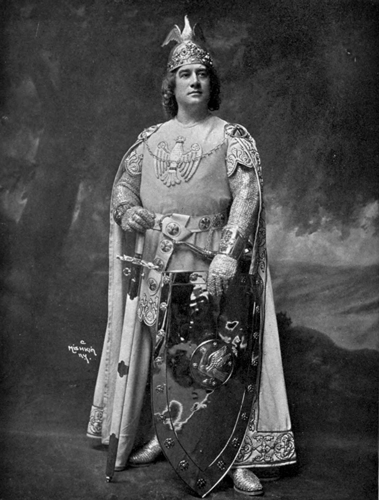
Copyright photo by Mishkin
Sembach as Lohengrin
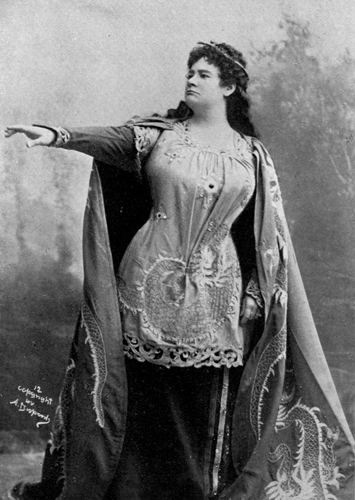
Copyright photo by Dupont
Schumann-Heink as Ortrud in “Lohengrin”
The story of "Lohengrin" is briefly as follows: The Hungarians have invaded Germany, and King Henry I. visits Antwerp for the purpose of raising a force to combat them. He finds the country in a condition of anarchy. The dukedom is claimed by Frederick, who has married Ortrud, a daughter of the Prince of Friesland. The legitimate heir, Godfrey, has mysteriously disappeared, and his sister, Elsa, is charged by Frederick and Ortrud with having done away with him in order that she might obtain the sovereignty. The King summons her before him so that the cause may be tried by the ordeal of single combat between Frederick and a champion who may be willing to appear for Elsa. None of the knights will defend her cause. She then describes a champion whose form has appeared to her in a vision, and she proclaims that he shall be her champion. Her pretence is derided by Frederick and his followers, who think that she is out of her mind; but after a triple summons by the Herald, there is seen in the distance on the river, a boat drawn by a swan, and in it a knight clad in silver armour. He comes to champion Elsa's cause, and before the combat betroths himself to her, but makes a strict condition that she shall never question him as to his name or birthplace, for should she, he would be obliged to depart. She assents to the conditions, and the combat which ensues results in Frederick's ignominious defeat. Judgment of exile is pronounced on him.
Instead, however, of leaving the country he lingers in the neighbourhood of Brabant, plotting with Ortrud how they may compass the ruin of Lohengrin and Elsa. Ortrud by her entreaties moves Elsa to pity, and persuades her to seek a reprieve for Frederick, at the same time, however, using every opportunity to instil doubts in Elsa's mind regarding her champion, and rousing her to such a pitch of nervous curiosity that she is on the point of asking him the forbidden question. After the bridal ceremonies, and in the bridal chamber, the distrust which Ortrud and Frederick have engendered in Elsa's mind so overcomes her faith that she vehemently puts the forbidden question to her champion. Almost at the same moment Frederick and four of his followers force their way into the apartment, intending to take the knight's life. A single blow of his sword, however, stretches Frederick lifeless, and his followers bear his corpse away. Placing Elsa in the charge of her ladies-in-waiting, and ordering them to take her to the presence of the King, he repairs thither himself.
The Brabantian hosts are gathering, and he is expected to lead them to battle, but owing to Elsa's question he is now obliged to disclose who he is and to take his departure. He proclaims that he is Lohengrin, son of Parsifal, Knight of the Holy Grail, and that he can linger no longer in Brabant, but must return to the place of his coming. The swan has once more appeared, drawing the boat down the river, and bidding Elsa farewell he steps into the little shell-like craft. Then Ortrud, with malicious glee, declares that the swan is none other than Elsa's brother, whom she (Ortrud) bewitched into this form, and that he would have been changed back again to his human shape had it not been for Elsa's rashness. But Lohengrin, through his supernatural powers, is able to undo Ortrud's work, and at a word from him the swan disappears and Godfrey stands in its place. A dove now descends, and, hovering in front of the boat, draws it away with Lohengrin, while Elsa expires in her brother's arms.
Owing to the lyric character of the story upon which "Lohengrin" is based, the opera, while not at all lacking in strong dramatic situations is characterized by a subtler and more subdued melodiousness than "Tannhäuser," is more exquisitely lyrical in fact than any Wagnerian work except "Parsifal."
There are typical themes in the score, but they are hardly handled with the varied effect that entitles them to be called leading motives. On the other hand there are fascinating details of orchestration. These are important because the composer has given significant clang-tints to the music that is heard in connection with the different characters in the story. He uses the brass chiefly to accompany the King, and, of course, the martial choruses; the plaintive, yet spiritual high wood-wind for Elsa; the English horn and sombre bass clarinet—the instrument that had to be bought—for Ortrud; the violins, especially in high harmonic positions, to indicate the Grail and its representative, for Lohengrin is a Knight of the Holy Grail. Even the keys employed are distinctive. The Herald's trumpeters blow in C and greet the King's arrival in that bright key. F-sharp minor is the dark, threatful key that indicates Ortrud's appearance. The key of A, which is the purest for strings and the most ethereal in effect, on account of the greater ease of using "harmonics," announces the approach of Lohengrin and the subtle influence of the Grail.
Moreover Wagner was the first composer to discover that celestial effects of tone colour are produced by the prolonged notes of the combined violins and wood-wind in the highest positions more truly than by the harp. It is the association of ideas with the Scriptures, wherein the harp frequently is mentioned, because it was the most perfected instrument of the period, that has led other composers to employ it for celestial tone-painting. But while no one appreciated the beauty of the harp more than Wagner, or has employed it with finer effect than he, his celestial tone-pictures with high-violins and wood-wind are distinctly more ecstatic than those of other composers.
The music clothes the drama most admirably. The Vorspiel or Prelude immediately places the listener in the proper mood for the story which is to unfold itself, and for the score, vocal and instrumental, whose strains are to fall upon his ear.
The Prelude is based entirely upon one theme, a beautiful one and expressive of the sanctity of the Grail, of which Lohengrin is one of the knights. Violins and flutes with long-drawn-out, ethereal chords open the Prelude. Then is heard on the violins, so divided as to heighten the delicacy of the effect, the Motive of the Grail, the cup in which the Saviour's blood is supposed to have been caught as it flowed from the wound in His side, while he was on the Cross. No modern book on orchestration is considered complete unless it quotes this passage from the score, which is at once the earliest and, after seventy years, still the most perfect example of the effect of celestial harmony produced on the high notes of the divided violin choir. This interesting passage in the score is as follows:
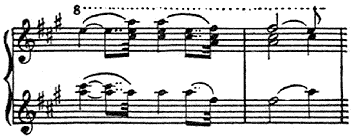
[Audio content is not currently supported on your device.
Although this is the only motive that occurs in the Prelude, the ear never wearies of it. Its effectiveness is due to the wonderful skill with which Wagner handles the theme, working it up through a superb crescendo to a magnificent climax, with all the splendours of Wagnerian orchestration, after which it dies away again to the ethereal harmonies with which it first greeted the listener.
Act I. The curtain, on rising, discloses a scene of unwonted life on the plain near the River Scheldt, where the stream winds toward Antwerp. On an elevated seat under a huge oak sits King Henry I. On either side are his Saxon and Thuringian nobles. Facing him with the knights of Brabant are Count Frederick of Telramund and his wife, Ortrud, daughter of the Prince of Friesland, of dark, almost forbidding beauty, and with a treacherous mingling of haughtiness and humility in her carriage.
It is a strange tale the King has just heard fall from Frederick of Telramund's lips. Henry has assembled the Brabantians on the plain by the Scheldt in order to summon them to join his army and aid in checking the threatened invasion of Germany by the Hungarians. But he has found the Brabantians themselves torn by factional strife, some supporting, others opposing Frederick in his claim to the ducal succession of Brabant.
"Sire," says Frederick, when called upon by the King to explain the cause of the discord that has come upon the land, "the late Duke of Brabant upon his death-bed confided to me, his kinsman, the care of his two children, Elsa and her young brother Godfrey, with the right to claim the maid as my wife. But one day Elsa led the boy into the forest and returned alone. From her pale face and faltering lips I judged only too well of what had happened, and I now publicly accuse Elsa of having made away with her brother that she might be sole heir to Brabant and reject my right to her hand. Her hand! Horrified, I shrank from her and took a wife whom I could truly love. Now as nearest kinsman of the duke I claim this land as my own, my wife, too, being of the race that once gave a line of princes to Brabant."
So saying, he leads Ortrud forward, and she, lowering her dark visage, makes a deep obeisance to the King. To the latter but one course is open. A terrible accusation has been uttered, and an appeal must be made to the immediate judgment of God in trial by combat between Frederick and whoever may appear as champion for Elsa. Solemnly the King hangs his shield on the oak, the Saxons and Thuringians thrust the points of their swords into the ground, while the Brabantians lay theirs before them. The royal Herald steps forward. "Elsa, without delay appear!" he calls in a loud voice.
A sudden hush falls upon the scene, as a slender figure robed in white slowly advances toward the King. It is Elsa. With her fair brow, gentle mien, and timid footsteps it seems impossible that she can be the object of Frederick's dire charge. But there are dark forces conspiring against her, of which none knows save her accuser and the wife he has chosen from the remoter North. In Friesland the weird rites of Odin and the ancient gods still had many secret adherents, Ortrud among them, and it is the hope of this heathenish woman, through the undoing of Elsa, and the accession of Frederick whom she has completely under her influence, to check the spread of the Christian faith toward the North and restore the rites of Odin in Brabant. To this end she is ready to bring all the black magic of which she secretly is mistress into play. What wonder that Elsa, as she encounters her malevolent gaze, lowers her eyes with a shudder!
Up to the moment of Elsa's entrance, the music is harsh and vigorous, reflecting Frederick's excitement as, incited by Ortrud, he brings forward his charge against Elsa. With her appearance a change immediately comes over the music. It is soft, gentle, and plaintive; not, however, entirely hopeless, as if the maiden, being conscious of her innocence, does not despair of her fate.
"Elsa," gently asks the King, "whom name you as your champion?" She answers as if in a trance; and it is at this point that the music of "Elsa's Dream" is heard. In the course of this, violins whisper the Grail Motive and in dreamy rapture Elsa sings, "I see, in splendour shining, a knight of glorious mien. His eyes rest upon me with tranquil gaze. He stands amid clouds beside a house of gold, and resting on his sword. Heaven has sent him to save me. He shall my champion be!"
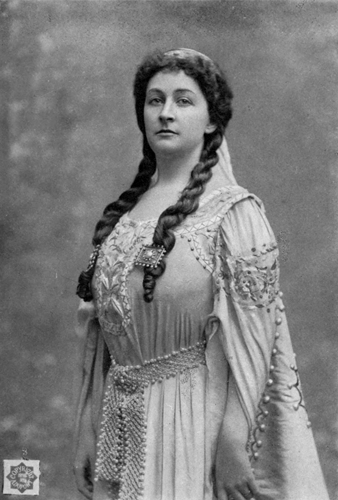
Copyright photo by Dupont
Emma Eames as Elsa in “Lohengrin”
The men regard each other in wonder. But a sneer curls around Ortrud's lips, and Frederick again proclaims his readiness to prove his accusation in trial by combat for life and death.
"Elsa," the King asks once more, "whom have you chosen as your champion?"
"Him whom Heaven shall send me; and to him, whatever he shall ask of me, I freely will give, e'en though it be myself as bride!" Again there is heard the lovely, broad and flowing melody of which I have already spoken and which may be designated as the Elsa Motive.
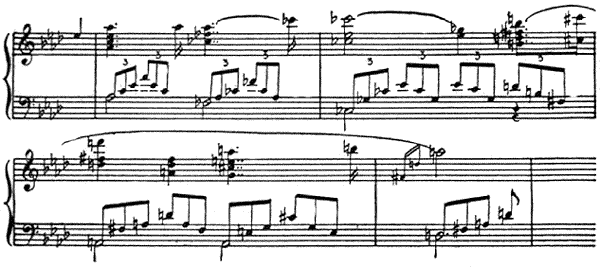
[Listen]
The Herald now stations his trumpeters at the corners of the plain and bids them blow a blast toward the four points of the compass. When the last echo has died away he calls aloud:
"He who in right of Heaven comes here to fight for Elsa of Brabant, let him step forth!"
The deep silence that follows is broken by Frederick's voice. "No one appears to repel my charge. 'Tis proven."
"My King," implores Elsa, whose growing agitation is watched by Ortrud with a malevolent smile, "my champion bides afar. He has not yet heard the summons. I pray you let it go forth once more."
Again the trumpeters blow toward the four points of the compass, again the Herald cries his call, again there is the fateful silence. "The Heavens are silent. She is doomed," murmured the men. Then Elsa throws herself upon her knees and raises her eyes in prayer. Suddenly there is a commotion among the men nearest the river bank.
"A wonder!" they cry. "A swan! A swan—drawing a boat by a golden chain! In the boat stands a knight! See, it approaches! His armour is so bright it blinds our eyes! A wonder! A wonder!"
There is a rush toward the bank and a great shout of acclaim, as the swan with a graceful sweep rounds a bend in the river and brings the shell-like boat, in which stands a knight in dazzling armour and of noble mien, up to the shore. Not daring to trust her senses and turn to behold the wondrous spectacle, Elsa gazes in rapture heavenward, while Ortrud and Telramund, their fell intrigue suddenly halted by a marvel that surpasses their comprehension, regard each other with mingled amazement and alarm.
A strange feeling of awe overcomes the assembly, and the tumult with which the advent of the knight has been hailed dies away to breathless silence, as he extends his hand and in tender accents bids farewell to the swan, which gently inclines its head and then glides away with the boat, vanishing as it had come. There is a chorus, in which, in half-hushed voices, the crowd gives expression to the mystery of the scene. Then the men fall back and the Knight of the Swan, for a silver swan surmounts his helmet and is blazoned upon his shield, having made due obeisance to the King, advances to where Elsa stands and, resting his eyes upon her pure and radiant beauty, questions her.
"Elsa, if I become your champion and right the foul wrong that is sought to be put upon you, will you confide your future to me; will you become my bride?"
"My guardian, my defender!" she exclaims ecstatically. "All that I have, all that I am, is yours!"
"Elsa," he says slowly, as if wishing her to weigh every word, "if I champion your cause and take you to wife, there is one promise I must exact: Never must you ask me whence I come or what my name."
"I promise," she answers, serenely meeting his warning look. He repeats the warning and again she promises to observe it.
"Elsa, I love you!" he exclaims, as he clasps her in his arms. Then addressing the King he proclaims his readiness to defend her innocence in trial by combat.
In this scene occurs one of the significant themes of the opera, the motive of warning—for it is Elsa's disregard of it and the breaking of her promise that brings her happiness to an end.

[Listen]
Three Saxons for the Knight and three Brabantians for Frederick solemnly pace off the circle within which the combatants are to fight. The King, drawing his sword, strikes three resounding blows with it upon his shield. At the first stroke the Knight and Frederick take their positions. At the second they draw their swords. At the third they advance to the encounter. Frederick is no coward. His willingness to meet the Knight whose coming had been so strange proves that. But his blows are skilfully warded off until the Swan Knight, finding an opening, fells him with a powerful stroke. Frederick's life is forfeited, but his conqueror, perchance knowing that he has been naught but a tool in the hands of a woman leagued with the powers of evil, spares it and bids his fallen foe rise. The King leads Elsa to the victor, while all hail him as her deliverer and betrothed.
The scenes here described are most stirring. Before the combat begins, the King intones a prayer, in which first the principals and then the chorus join with noble effect, while the music of rejoicing over the Knight's victory has an irresistible onsweep.
Act II. That night in the fortress of Antwerp, the palace where abide the knights is brilliantly illuminated and sounds of revelry issue from it, and lights shine from the kemenate, where Elsa's maids-in-waiting are preparing her for the bridal on the morrow. But in the shadow of the walls sit two figures, a man and a woman; the man, his head bowed in despair, the woman looking vindictively toward the palace. They are Frederick and Ortrud, who have been condemned to banishment, he utterly dejected, she still trusting in the power of her heathenish gods. To her the Swan Knight's chivalrous forbearance in sparing Frederick's life has seemed weak instead of noble, and Elsa she regards as an insipid dreamer and easy victim. Not knowing that Ortrud still darkly schemes to ruin Elsa and restore him to power, Frederick denounces her in an outburst of rage and despair.