Giuseppe Verdi (1813-1901)
Reading edition
VERDI ranks as the greatest Italian composer of opera. There is a marked distinction between his career and those of Bellini and Donizetti. The two earlier composers, after reaching a certain point of development, failed to advance. No later opera by Bellini equals "La Sonnambula"; none other by Donizetti ranks with "Lucia di Lammermoor."
But Verdi, despite the great success of "Ernani," showed seven years later, with "Rigoletto," an amazing progress in dramatic expression and skill in ensemble work. "Il Trovatore" and "La Traviata" were other works of the period ushered in by "Rigoletto." Eighteen years later the composer, then fifty-eight years old, gave evidence of another and even more notable advance by producing "Aïda," a work which marks the beginning of a new period in Italian opera. Still not satisfied, Verdi brought forward "Otello" (1887) and "Falstaff" (1893), scores which more nearly resemble music-drama than opera.
Thus the steady forging ahead of Verdi, the unhalting development of his genius, is the really great feature of his career. In fact no Italian composer since Verdi has caught up with "Falstaff," which may be as profitably studied as "Le Nozze di Figaro," "Il Barbiere di Siviglia," "Die Meistersinger," and "Der Rosenkavalier." Insert "Falstaff" in this list, in its proper place between "Meistersinger" and "Rosenkavalier," and you have the succession of great operas conceived in the divine spirit of comedy, from 1786 to 1911.
In the article on "Un Ballo in Maschera," the political use made of the letters of Verdi's name is pointed out. See p. 428.
Verdi was born at Roncole, near Busseto, October 9, 1813. He died at Rome, January 27, 1901. There remains to be said that, at eighteen, he was refused admission to the Milan Conservatory "on the score of lack of musical talent."
What fools these mortals be!
ERNANI
Opera, in four acts, by Verdi; words by Francesco Maria Piave, after Victor Hugo's drama, "Hernani." Produced, Fenice Theatre, Venice, March 9, 1844; London, Her Majesty's Theatre, March 8, 1845; New York, 1846, at the Astor Place Theatre. Patti, at the Academy of Music, Sembrich at the Metropolitan Opera House, have been notable interpreters of the rôle of Elvira.
Characters
Don Carlos, King of CastileBaritone
Don Ruy Gomez di Silva, Grandee of SpainBass
Ernani, or John of Aragon, a bandit chiefTenor
Don Riccardo, esquire to the KingTenor
Jago, esquire to SilvaBass
Elvira, kinswoman to SilvaSoprano
Giovanna, in Elvira's serviceSoprano
Mountaineers and bandits, followers of Silva, ladies of Elvira, followers of Don Carlos, electors and pages.
Time—Early sixteenth century.
Place—Spain.
John of Aragon has become a bandit. His father, the Duke of Segovia, had been slain by order of Don Carlos's father. John, proscribed and pursued by the emissaries of the King, has taken refuge in the fastnesses of the mountains of Aragon, where, under the name of Ernani, he has become leader of a large band of rebel mountaineers. Ernani is in love with Donna Elvira, who, although she is about to be united to her relative, the aged Ruy Gomez di Silva, a grandee of Spain, is deeply enamoured of the handsome, chivalrous bandit chief.
Don Carlos, afterwards Emperor Charles V., also has fallen violently in love with Elvira. By watching her windows he has discovered that at dead of night a young cavalier (Ernani) gains admission to her apartments. He imitates her lover's signal, gains admission to her chamber, and declares his passion. Being repulsed, he is about to drag her off by force, when a secret panel opens, and he finds himself confronted by Ernani. In the midst of a violent scene Silva enters. To allay his jealousy and anger, naturally aroused by finding two men, apparently rival suitors, in the apartment of his affianced, the King, whom Silva has not recognized, reveals himself, and pretends to have come in disguise to consult him about his approaching election to the empire, and a conspiracy that is on foot against his life. Then the King, pointing to Ernani, says to Silva, "It doth please us that this, our follower, depart," thus insuring Ernani's temporary safety—for a Spaniard does not hand an enemy over to the vengeance of another.
Believing a rumour that Ernani has been run down and killed by the King's soldiers, Elvira at last consents to give her hand in marriage to Silva. On the eve of the wedding, however, Ernani, pursued by the King with a detachment of troops, seeks refuge in Silva's castle, in the disguise of a pilgrim. Although not known to Silva, he is, under Spanish tradition, his guest, and from that moment entitled to his protection.
Elvira enters in her bridal attire. Ernani is thus made aware that her nuptials with Don Silva are to be celebrated on the morrow. Tearing off his disguise, he reveals himself to Silva, and demands to be delivered up to the King, preferring death to life without Elvira. But true to his honour as a Spanish host, Silva refuses. Even his enemy, Ernani, is safe in his castle. Indeed he goes so far as to order his guards to man the towers and prepare to defend the castle, should the King seek forcible entry. He leaves the apartment to make sure his orders are being carried out. The lovers find themselves alone. When Silva returns they are in each other's arms. But as the King is at the castle gates, he has no time to give vent to his wrath. He gives orders to admit the King and his men, bids Elvira retire, and hides Ernani in a secret cabinet. The King demands that Silva give up the bandit. The grandee proudly refuses. Ernani is his guest. The King's wrath then turns against Silva. He demands the surrender of his sword and threatens him with death, when Elvira interposes. The King pardons Silva, but bears away Elvira as hostage for the loyalty of her kinsman.
The King has gone. From the wall Silva takes down two swords, releases his guest from his hiding place, and bids him cross swords with him to the death. Ernani refuses. His host has just protected his life at the danger of his own. But, if Silva insists upon vengeance, let grandee and bandit first unite against the King, with whom the honour of Elvira is unsafe. Elvira rescued, Ernani will give himself up to Silva, to whom, handing him his hunting horn, he avows himself ready to die, whenever a blast upon it shall be sounded from the lip of the implacable grandee. Silva, who has been in entire ignorance of the King's passion for Elvira, grants the reprieve, and summons his men to horse.
He sets on foot a conspiracy against the King. A meeting of the conspirators is held in the Cathedral of Aix-la-Chapelle, in the vault, within which stands the tomb of Charlemagne. Here it is resolved to murder the King. A ballot decides who shall do the deed. Ernani's name is drawn.
The King, however, has received information of the time and place of this meeting. From the tomb he has been an unobserved witness of the meeting and purpose of the conspirators. Booming of cannon outside tells him of his choice as head of the Holy Roman Empire. Emerging from the tomb, he shows himself to the awed conspirators, who imagine they see Charlemagne issuing forth to combat them. At the same moment the doors open. The electors of the Empire enter to pay homage to Charles V.
"The herd to the dungeon, the nobles to the headsman," he commands.
Ernani advances, discovers himself as John of Aragon, and claims the right to die with the nobles—"to fall, covered, before the King." But upon Elvira's fervent plea, the King, now also Emperor, commences his reign with an act of grace. He pardons the conspirators, restores to Ernani his titles and estates, and unites him with Elvira.
Silva, thwarted in his desire to marry Elvira, waits until Ernani and Elvira, after their nuptials, are upon the terrace of Ernani's castle in Aragon. At their most blissful moment he sounds the fatal horn. Ernani, too chivalrous to evade his promise, stabs himself in the presence of the grim avenger and of Elvira who falls prostrate upon his lifeless body.
In the opera, this plot develops as follows: Act I opens in the camp of the bandits in the mountains of Aragon. In the distance is seen the Moorish castle of Silva. The time is near sunset. Of Ernani's followers, some are eating and drinking, or are at play, while others are arranging their weapons. They sing, "Allegri, beviamo" (Haste! Clink we our glasses).
Ernani sings Elvira's praise in the air, "Come rugiada al cespite" (Balmier than dew to drooping bud).

[Listen]
Come rugiada al cespite
This expressive number is followed by one in faster time, "O tu, che l'alma adora" (O thou toward whom, adoring soul).

[Listen]
O tu, che l'alma adora, Vien, vien, la mia vita infiora,
Enthusiastically volunteering to share any danger Ernani may incur in seeking to carry off Elvira, the bandits, with their chief at their head, go off in the direction of Silva's castle.
The scene changes to Elvira's apartment in the castle. It is night. She is meditating upon Ernani. When she thinks of Silva, "the frozen, withered spectre," and contrasts with him Ernani, who "in her heart ever reigneth," she voices her thoughts in that famous air for sopranos, one of Verdi's loveliest inspirations, "Ernani! involami" (Ernani! fly with me).

[Listen]
Ernani! Ernani! involami All'abborrito amplesso.
It ends with a brilliant cadenza, "Un Eden quegli antri a me" (An Eden that opens to me).

[Listen]
un Eden quegli antri a me.
Young maidens bearing wedding gifts enter. They sing a chorus of congratulation. To this Elvira responds with a graceful air, the sentiment of which, however, is expressed as an aside, since it refers to her longing for her young, handsome and chivalrous lover. "Tutto sprezzo che d'Ernani" (Words that breathe thy name Ernani).

[Listen]
Tutto sprezzo che d'Ernani
The young women go. Enter Don Carlos, the King. There is a colloquy, in which Elvira protests against his presence; and then a duet, which the King begins, "Da quel dì che t'ho veduta" (From the day, when first thy beauty).
A secret panel opens. The King is confronted by Ernani, and by Elvira, who has snatched a dagger from his belt. She interposes between the two men. Silva enters. What he beholds draws from him the melancholy reflections—"Infelice! e tu credevi" (Unhappy me! and I believed thee),

[Listen]
Infelice! e tu credevi
an exceptionally fine bass solo. He follows it with the vindictive "Infin, che un brando vindice" (In fine a swift, unerring blade).
Men and women of the castle and the King's suite have come on. The monarch is recognized by Silva, who does him obeisance, and, at the King's command, is obliged to let Ernani depart. An ensemble brings the act to a close.
Act II. Grand hall in Silva's castle. Doors lead to various apartments. Portraits of the Silva family, surmounted by ducal coronets and coats-of-arms, are hung on the walls. Near each portrait is a complete suit of equestrian armour, corresponding in period to that in which lived the ancestor represented in the portrait. A large table and a ducal chair of carved oak.
The persistent chorus of ladies, though doubtless aware that Elvira is not thrilled at the prospect of marriage with her "frosty" kinsman, and has consented to marry him only because she believes Ernani dead, enters and sings "Esultiamo!" (Exultation!), then pays tribute to the many virtues and graces of the bride.
To Silva, in the full costume of a Grandee of Spain, and seated in the ducal chair, is brought in Ernani, disguised as a monk. He is welcomed as a guest; but, upon the appearance of Elvira in bridal array, throws off his disguise and offers his life, a sacrifice to Silva's vengeance, as the first gift for the wedding. Silva, however, learning that he is pursued by the King, offers him the protection due a guest under the roof of a Spaniard.
"Ah, morir potessi adesso" (Ah, to die would be a blessing) is the impassioned duet sung by Elvira and Ernani, when Silva leaves them together.

[Listen]
Ah, morir potessi adesso O mio Ernani sul tuo petto
Silva, even when he returns and discovers Elvira in Ernani's arms, will not break the law of Spanish hospitality, preferring to wreak vengeance in his own way. He therefore hides Ernani so securely that the King's followers, after searching the castle, are obliged to report their complete failure to discover a trace of him. Chorus: "Fu esplorato del castello" (We have now explored the castle).
Then come the important episodes described—the King's demand for the surrender of Silva's sword and threat to execute him; Elvira's interposition; and the King's sinister action in carrying her off as a hostage, after he has sung the significant air, "Vieni meco, sol di rose" (Come with me, a brighter dawning waits for thee).

[Listen]
Vieni meco, sol di rose
Ernani's handing of his hunting horn to Silva, and his arousal of the grandee to an understanding of the danger that threatens Elvira from the King, is followed by the finale, a spirited call to arms by Silva, Ernani, and chorus, "In arcione, in arcione, cavalieri!" (To horse, to horse, cavaliers!).
Silva and Ernani distribute weapons among the men, which they brandish as they rush from the hall.
Act III. The scene is a sepulchral vault, enclosing the tomb of Charlemagne in the Cathedral of Aix-la-Chapelle. The tomb is entered by a heavy door of bronze, upon which is carved in large characters the word "Charlemagne." Steps lead to the great door of the vault. Other and smaller tombs are seen and other doors that give on other passageways. Two lamps, suspended from the roof, shed a faint light.
It is into this sombre but grandiose place the King has come in order to overhear, from within the tomb of his greatest ancestor, the plotting of the conspirators. His soliloquy, "Oh, de' verd'anni miei" (Oh, for my youthful years once more), derives impressiveness both from the solemnity of the situation and the music's flowing measure.

[Listen]
Oh de' verd'anni miei
The principal detail in the meeting of the conspirators is their chorus, "Si ridesti il Leon di Castiglia" (Let the lion awake in Castilia). Dramatically effective, too, in the midst of the plotting, is the sudden booming of distant cannon. It startles the conspirators. Cannon boom again. The bronze door of the tomb swings open.
Then the King presents himself at the entrance of the tomb. Three times he strikes the door of bronze with the hilt of his dagger. The principal entrance to the vault opens. To the sound of trumpets six Electors enter, dressed in cloth of gold. They are followed by pages carrying, upon velvet cushions, the sceptre, crown, and other imperial insignia. Courtiers surround the Emperor. Elvira approaches. The banners of the Empire are displayed. Many torches borne by soldiers illuminate the scene. The act closes with the pardon granted by the King, and the stirring finale, "Oh, sommo Carlo!" (Charlemagne!)
Act IV, on the terrace of Ernani's castle, is brief, and there is nothing to add to what has been said of its action. Ernani asks Silva to spare him till his lips have tasted the chalice filled by love. He recounts his sad life: "Solingo, errante, misero" (To linger in exiled misery).
Silva's grim reply is to offer him his choice between a cup of poison and a dagger. He takes the latter. "Ferma, crudele, estinguere" (Stay thee, my lord, for me at least) cries Elvira, wishing to share his fate. In the end there is left only the implacable avenger, to gloat over Ernani, dead, and Elvira prostrate upon his form.
"Ernani," brought out in 1844, is the earliest work by Verdi that maintains a foothold in the modern repertoire, though by no means a very firm one. And yet "Ernani" is in many respects a fine opera. One wonders why it has not lasted better. Hanslick, the Viennese critic, made a discriminating criticism upon it. He pointed out that whereas in Victor Hugo's drama the mournful blast upon the hunting horn, when heard in the last act, thrills the listener with tragic forebodings, in the opera, after listening to solos, choruses, and a full orchestra all the evening, the audience is but little impressed by the sounding of a note upon a single instrument. That comment, however, presupposes considerable subtlety, so far undiscovered, on the part of operatic audiences.
The fact is, that since 1844 the whirligig of time has made one—two—three—perhaps even four revolutions, and with each revolution the public taste that prevailed, when the first audience that heard the work in the Teatro Fenice, went wild over "Ernani Involami" and "Sommo Carlo," has become more remote and undergone more and more changes. To turn back operatic time in its flight requires in the case of "Ernani," a soprano of unusual voice and personality for Elvira, a tenor of the same qualities for the picturesque rôle of Ernani, a fine baritone for Don Carlos, and a sonorous basso, who doesn't look too much like a meal bag, for Don Ruy Gomez di Silva, Grandee of Spain.
Early in its career the opera experienced various vicissitudes. The conspiracy scene had to be toned down for political reasons before the production of the work was permitted. Even then the chorus, "Let the lion awake in Castilia," caused a political demonstration. In Paris, Victor Hugo, as author of the drama on which the libretto is based, raised objections to its representation, and it was produced in the French capital as "Il Proscritto" (The Proscribed) with the characters changed to Italians. Victor Hugo's "Hernani" was a famous play in Sarah Bernhardt's repertoire during her early engagements in this country. Her Doña Sol (Elvira in the opera) was one of her finest achievements. On seeing the play, with her in it, I put to test Hanslick's theory. The horn was thrilling in the play. It certainly is less so in the opera.
RIGOLETTO
Opera in three acts, by Verdi; words by Francesco Maria Piave, founded on Victor Hugo's play, "Le Roi s'Amuse." Produced, Fenice Theatre, Venice, March 11, 1851; London, Covent Garden, May 14, 1853; Paris, Théâtre des Italiens, January 19, 1857; New York, Academy of Music, November 4, 1857, with Bignardi and Frezzolini. Caruso made his début in America at the Metropolitan Opera House, New York, as the Duke in "Rigoletto," November 23, 1903; Galli-Curci hers, as Gilda, Chicago, November 18, 1916.
Characters
The Duke of MantuaTenor
Rigoletto, his jester, a hunchbackBaritone
Count Ceprano}Nobles{Bass
Count Monterone}{Baritone
Sparafucile, a bravoBass
Borsa, in the Duke's serviceTenor
MarulloBass
Countess CepranoSoprano
Gilda, daughter of RigolettoSoprano
Giovanni, her duennaSoprano
Maddalena, sister to SparafucileContralto
Courtiers, nobles, pages, servants.
Time—Sixteenth century.
Place—Mantua.
"Rigoletto" is a distinguished opera. Composed in forty days in 1851, nearing three-quarters of a century of life before the footlights, it still retains its vitality. Twenty years, with all they imply in experience and artistic growth, lie between "Rigoletto" and "Aïda." Yet the earlier opera, composed so rapidly as to constitute a tour de force of musical creation, seems destined to remain a close second in popularity to the more mature work of its great composer.
There are several reasons for the public's abiding interest in "Rigoletto." It is based upon a most effective play by Victor Hugo, "Le Roi s'Amuse," known to English playgoers in Tom Taylor's adaptation as "The Fool's Revenge." The jester was one of Edwin Booth's great rôles. This rôle of the deformed court jester, Rigoletto, the hunchback, not only figures in the opera, but has been vividly characterized by Verdi in his music. It is a vital, centralizing force in the opera, concentrating and holding attention, a character creation that appeals strongly both to the singer who enacts it and to the audience who sees and hears it. The rôle has appealed to famous artists. Ronconi (who taught singing in New York for a few years, beginning in 1867) was a notable Rigoletto; so was Galassi, whose intensely dramatic performance still is vividly recalled by the older opera-goers; Renaud at the Manhattan Opera House, Titta Ruffo at the Metropolitan Opera House, Philadelphia, both made their American débuts as Rigoletto.
But the opera offers other rôles of distinction. Mario was a famous Duke in other days. Caruso made his sensational début at the Metropolitan in the character of the volatile Duca di Mantua, November 23, 1903. We have had as Gilda Adelina Patti, Melba, and Tetrazzini, to mention but a few; and the heroine of the opera is one of the rôles of Galli-Curci, who appeared in it in Chicago, November 18, 1916. No coloratura soprano can, so to speak, afford to be without it.
Thus the opera has plot, a central character of vital dramatic importance, and at least two other characters of strong interest. But there is even more to be said in its behalf. For, next to the sextet in "Lucia," the quartet in the last act of "Rigoletto" is the finest piece of concerted music in Italian opera—and many people will object to my placing it only "next" to that other famous ensemble, instead of on complete equality with, or even ahead of it.
The "argument" of "Rigoletto" deals with the amatory escapades of the Duke of Mantua. In these he is aided by Rigoletto, his jester, a hunchback. Rigoletto, both by his caustic wit and unscrupulous conduct, has made many enemies at court. Count Monterone, who comes to the court to demand the restoration of his daughter, who has been dishonoured by the Duke, is met by the jester with laughter and derision. The Count curses Rigoletto, who is stricken with superstitious terror.
For Rigoletto has a daughter, Gilda, whom he keeps in strict seclusion. But the Duke, without being aware who she is, has seen her, unknown to her father, and fallen in love with her. Count Ceprano, who many times has suffered under Rigoletto's biting tongue, knowing that she is in some way connected with the jester, in fact believing her to be his mistress, and glad of any opportunity of doing him an injury, forms a plan to carry off the young girl, and so arranges it that Rigoletto unwittingly assists in her abduction. When he finds that it is his own daughter whom he has aided to place in the power of the Duke, he determines to murder his master, and engages Sparafucile, a bravo, to do so. This man has a sister, Maddalena, who entices the Duke to a lonely inn. She becomes fascinated with him, however, and begs her brother to spare his life. This he consents to do if before midnight any one shall arrive at the inn whom he can kill and pass off as the murdered Duke. Rigoletto, who has recovered his daughter, brings her to the inn so that, by being a witness of the Duke's inconstancy, she may be cured of her unhappy love. She overhears the plot to murder her lover, and Sparafucile's promise to his sister. Determined to save the Duke, she knocks for admittance, and is stabbed on entering. Rigoletto comes at the appointed time for the body. Sparafucile brings it out in a sack. The jester is about to throw it into the water, sack and all, when he hears the Duke singing. He tears open the sack, only to find his own daughter, at the point of death.
Act I opens in a salon in the Duke's palace. A suite of other apartments is seen extending into the background. All are brilliantly lighted for the fête that is in progress. Courtiers and ladies are moving about in all directions. Pages are passing to and fro. From an adjoining salon music is heard and bursts of merriment.
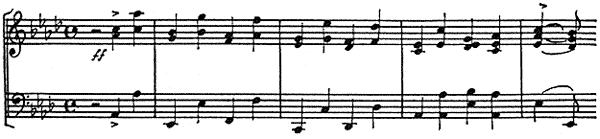
[Listen]
There is effervescent gayety in the orchestral accompaniment to the scene. A minuet played by an orchestra on the stage is curiously reminiscent of the minuet in Mozart's "Don Giovanni." The Duke and Borsa enter from the back. They are conversing about an "unknown charmer"—none other than Gilda—whom the Duke has seen at church. He says that he will pursue the adventure to the end, although a mysterious man visits her nightly.
Among a group of his guests the Duke sees the Countess Ceprano, whom he has been wooing quite openly, in spite of the Count's visible annoyance. The dashing gallant cares nothing about what anyone may think of his escapades, least of all the husbands or other relatives of the ladies. "Questa o quella per me pari sono" (This one, or that one, to me 'tis the same).

[Listen]
This music floats on air. It gives at once the cue to the Duke's character. Like Don Giovanni he is indifferent to fate, flits from one affair to another, and is found as fascinating as he is dangerous by all women, of whatever degree, upon whom he confers his doubtful favours.
Rigoletto, hunchbacked but agile, sidles in. He is in cap and bells, and carries the jester's bauble. The immediate object of his satire is Count Ceprano, who is watching his wife, as she is being led off on the Duke's arm. Rigoletto then goes out looking for other victims. Marullo joins the nobles. He tells them that Rigoletto, despite his hump, has an inamorata. The statement makes a visible impression upon Count Ceprano, and when the nobles, after another sally from the jester, who has returned with the Duke, inveigh against his bitter tongue, the Count bids them meet him at night on the morrow and he will guarantee them revenge upon the hunchback for the gibes they have been obliged to endure from him.
The gay music, which forms a restless background to the recitatives of which I have given the gist,
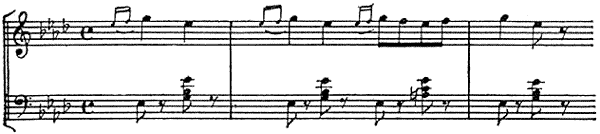
[Listen]
trips buoyantly along, to be suddenly broken in upon by the voice of one struggling without, and who, having freed himself from those evidently striving to hold him back, bursts in upon the scene. It is the aged Count Monterone. His daughter has been dishonoured by the Duke, and he denounces the ruler of Mantua before the whole assembly. His arrest is ordered. Rigoletto mocks him until, drawing himself up to his full height, the old noble not only denounces him, but calls down upon him a father's curse.
Rigoletto is strangely affrighted. He cowers before Monterone's malediction. It is the first time since he has appeared at the gathering that he is not gibing at someone. Not only is he subdued; he is terror-stricken.
Monterone is led off between halberdiers. The gay music again breaks in. The crowd follows the Duke. But Rigoletto?
The scene changes to the street outside of his house. It is secluded in a courtyard, from which a door leads into the street. In the courtyard are a tall tree and a marble seat. There is also seen at the end of the street, which has no thoroughfare, the gable end of Count Ceprano's palace. It is night.
As Rigoletto enters, he speaks of Monterone's curse. His entrance to the house is interrupted by the appearance of Sparafucile, an assassin for hire. In a colloquy, to which the orchestra supplies an accompaniment, interesting because in keeping with the scene, he offers to Rigoletto his services, should they be needed, in putting enemies out of the way—and his charges are reasonable.
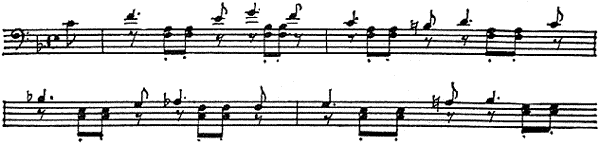
[Listen]
Rigoletto has no immediate need of him, but ascertains where he can be found.
Sparafucile goes. Rigoletto has a soliloquy, beginning, "How like are we!—the tongue, my weapon, the dagger his! to make others laugh is my vocation,—his to make them weep!... Tears, the common solace of humanity, are to me denied.... 'Amuse me buffoon'—and I must obey." His mind still dwells on the curse—a father's curse, pronounced upon him, a father to whom his daughter is a jewel. He refers to it, even as he unlocks the door that leads to his house, and also to his daughter, who, as he enters, throws herself into his arms.
He cautions her about going out. She says she never ventures beyond the courtyard save to go to church. He grieves over the death of his wife—Gilda's mother—that left her to his care while she was still an infant. "Deh non parlare al misero" (Speak not of one whose loss to me).

[Listen]
Deh non parlare al misero
He charges her attendant, Giovanna, carefully to guard her. Gilda endeavours to dispel his fears. The result is the duet for Rigoletto and Gilda, beginning with his words to Giovanna, "Veglia, o donna, questo fiore" (Safely guard this tender blossom).
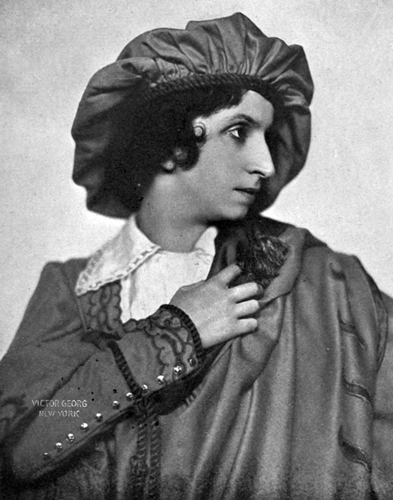
Photo copyright, 1916, by Victor Georg
Galli-Curci as Gilda in “Rigoletto”
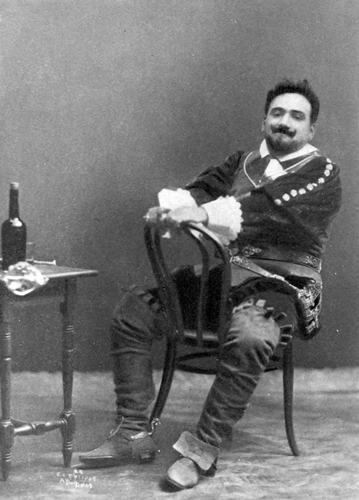
Copyright photo by Dupont
Caruso as the Duke in “Rigoletto”
Rigoletto hears footsteps in the street and goes out through the door of the courtyard to see who may be there. As the door swings out, the Duke, for it is he, in the guise of a student, whose stealthy footsteps have been heard by the jester, conceals himself behind it, then slips into the courtyard, tosses a purse to Giovanna, and hides in the shadow of the tree. Rigoletto reappears for a brief moment to say good-bye to Gilda and once more to warn Giovanna to guard her carefully.
When he has gone Gilda worries because fear drove her to refrain from revealing to her father that a handsome youth has several times followed her from church. This youth's image is installed in her heart. "I long to say to him 'I lo—'"
The Duke steps out of the tree's shadow, motions to Giovanna to retire and, throwing himself at Gilda's feet, takes the words out of her mouth by exclaiming, "I love thee!"
No doubt taken by surprise, yet also thrilled with joy, she hearkens to him rapturously as he declares, "È il sol dell'anima, la vita è amore" (Love is the sun by which passion is kindled).

[Listen]
È il sol dell'anima, la vita è amore,
The meeting is brief, for again there are footsteps outside. But their farewell is an impassioned duet, "Addio speranza ed anima" (Farewell, my hope, my soul, farewell).
He has told her that he is a student, by name Walter Maldè. When he has gone, she muses upon the name, and, when she has lighted a candle and is ascending the steps to her room, she sings the enchanting coloratura air, "Caro nome che il mio cor" (Dear name, my heart enshrines).

[Listen]
Caro nome che il mio cor Festi primo palpitar,
If the Gilda be reasonably slender and pretty, the scene, with the courtyard, the steps leading up to the room, and the young maiden gracefully and tenderly expressing her heart's first romance, is charming, and in itself sufficient to account for the attraction which the rôle holds for prima donnas.
Tiptoeing through the darkness outside come Marullo, Ceprano, Borsa, and other nobles and courtiers, intent upon seeking revenge for the gibes Rigoletto at various times has aimed at them, by carrying off the damsel, whom they assume to be his inamorata. At that moment, however, the jester himself appears. They tell him they have come to abduct the Countess Ceprano and bear her to the Ducal palace. To substantiate this statement Marullo quickly has the keys to Ceprano's house passed to him by the Count, and in the darkness holds them out to Rigoletto, who, his suspicions allayed because he can feel the Ceprano crest in basso-relievo on the keys, volunteers to aid in the escapade. Marullo gives him a mask and, as if to fasten it securely, ties it with a handkerchief, which he passes over the piercings for the eyes. Rigoletto, confused, holds a ladder against what he believes to be the wall of Ceprano's house. By it, the abductors climb his own wall, enter his house, gag, seize, and carry away Gilda, making their exit from the courtyard, but in their hurry failing to observe a scarf that has fluttered from their precious burden.
Rigoletto is left alone in the darkness and silence. He tears off his mask. The door to his courtyard is open. Before him lies Gilda's scarf. He rushes into the house, into her room; reappears, staggering under the weight of the disaster, which, through his own unwitting connivance, has befallen him.
"Ah! La maledizione!" he cries out. It is Monterone's curse.
Act II has its scene laid in the ducal palace. This salon has large folding doors in the background and smaller ones on each side, above which are portraits of the Duke and of the Duchess, a lady who, whether from a sense of delicacy or merely to serve the convenience of the stage, does not otherwise appear in the opera.
The Duke is disconsolate. He has returned to Rigoletto's house, found it empty. The bird had flown. The scamp mourns his loss—in affecting language and music, "Parmi veder le lagrime" (Fair maid, each tear of mine that flows).
In a capital chorus he is told by Marullo and the others that they have abducted Rigoletto's inamorata.

[Listen]
Scorrendo uniti remota via
The Duke well knows that she is the very one whose charms are the latest that have enraptured him. "Possente amor mi chiama" (To her I love with rapture).
He learns from the courtiers that they have brought her to the palace. He hastens to her, "to console her," in his own way. It is at this moment Rigoletto enters. He knows his daughter is in the palace. He has come to search for her. Aware that he is in the presence of those who took advantage of him and thus secured his aid in the abduction of the night before, he yet, in order to accomplish his purpose, must appear light-hearted, question craftily, and be diplomatic, although at times he cannot prevent his real feelings breaking through. It is the ability of Verdi to give expression to such varied emotions which make this scene one of the most significant in his operas. It is dominated by an orchestral motive, that of the clown who jests while his heart is breaking.

[Listen]
La rà, la rà, la la, la rà, la rà, la rà, la rà etc.
Finally he turns upon the crowd that taunts him, hurls invective upon them; and, when a door opens and Gilda, whose story can be read in her aspect of despair, rushes into his arms, he orders the courtiers out of sight with a sense of outrage so justified that, in spite of the flippant words with which they comment upon his command, they obey it.
Father and daughter are alone. She tells him her story—of the handsome youth, who followed her from church—"Tutte le feste al tempio" (One very festal morning).
Then follows her account of their meeting, his pretence that he was a poor student, when, in reality, he was the Duke—to whose chamber she was borne after her abduction. It is from there she has just come. Her father strives to comfort her—"Piangi, fanciulla" (Weep, my child).
At this moment he is again reminded of the curse pronounced upon him by the father whose grief with him had been but the subject of ribald jest. Count Monterone, between guards, is conducted through the apartment to the prison where he is to be executed for denouncing the Duke. Then Rigoletto vows vengeance upon the betrayer of Gilda.
But such is the fascination which the Duke exerts over women that Gilda, fearing for the life of her despoiler, pleads with her father to "pardon him, as we ourselves the pardon of heaven hope to gain," adding, in an aside, "I dare not say how much I love him."
It was a corrupt, carefree age. Victor Hugo created a debonair character—a libertine who took life lightly and flitted from pleasure to pleasure. And so Verdi lets him flit from tune to tune—gay, melodious, sentimental. There still are plenty of men like the Duke, and plenty of women like Gilda to love them; and other women, be it recalled, as discreet as the Duchess, who does not appear in this opera save as a portrait on the wall, from which she calmly looks down upon a jester invoking vengeance upon her husband, because of the wrong he has done the girl, who weeps on the breast of her hunchback father.
To Act III might be given as a sub-title, "The Fool's Revenge," the title of Tom Taylor's adaptation into English of Victor Hugo's play. The scene shows a desolate spot on the banks of the Mincio. On the right, with its front to the audience, is a house two stories high, in a very dilapidated state, but still used as an inn. The doors and walls are so full of crevices that whatever is going on within can be seen from without. In front are the road and the river; in the distance is the city of Mantua. It is night.
The house is that of Sparafucile. With him lives his sister, Maddalena, a handsome young gypsy woman, who lures men to the inn, there to be robbed—or killed, if there is more money to be had for murder than for robbery. Sparafucile is seen within, cleaning his belt and sharpening his sword.
Outside are Rigoletto and Gilda. She cannot banish the image of her despoiler from her heart. Hither the hunchback has brought her to prove to her the faithlessness of the Duke. She sees him in the garb of a soldier coming along the city wall. He descends, enters the inn, and calls for wine and a room for the night. Shuffling a pack of cards, which he finds on the table, and pouring out the wine, he sings of woman. This is the famous "La donna è mobile" (Fickle is woman fair).

[Listen]
La donna è mobile Qual piuma al vento,
It has been highly praised and violently criticized; and usually gets as many encores as the singer cares to give. As for the criticisms, the cadenzas so ostentatiously introduced by singers for the sake of catching applause, are no more Verdi's than is the high C in "Il Trovatore." The song is perfectly in keeping with the Duke's character. It has grace, verve, and buoyancy; and, what is an essential point in the development of the action from this point on, it is easily remembered. In any event I am glad that among my operatic experiences I can count having heard "La donna è mobile" sung by such great artists as Campanini, Caruso, and Bonci, the last two upon their first appearances in the rôle in this country.
At a signal from Sparafucile, Maddalena joins the Duke. He presses his love upon her. With professional coyness she pretends to repulse him. This leads to the quartet, with its dramatic interpretation of the different emotions of the four participants. The Duke is gallantly urgent and pleading: "Bella figlia dell'amore" (Fairest daughter of the graces).
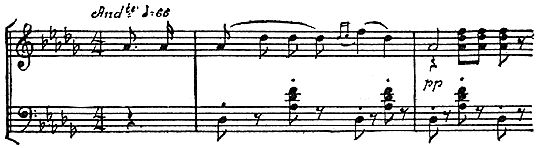
[Listen]
Maddalena laughingly resists his advances: "I am proof, my gentle wooer, 'gainst your vain and empty nothings."
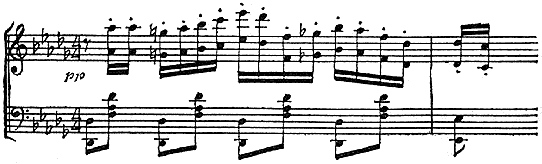
[Listen]
Gilda is moved to despair: "Ah, thus to me of love he spoke."
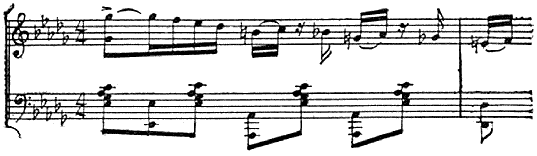
[Listen]
Rigoletto mutters of vengeance.
It is the Duke who begins the quartet; Maddalena who first joins in by coyly mocking him; Gilda whose voice next falls upon the night with despairing accents; Rigoletto whose threats of vengeance then are heard. With the return of the theme, after the first cadence, the varied elements are combined.
They continue so to the end. Gilda's voice, in brief cries of grief, rising twice to effective climaxes, then becoming even more poignant through the syncopation of the rhythm.
Rising to a beautiful and highly dramatic climax, the quartet ends pianissimo.
This quartet usually is sung as the pièce de résistance of the opera, and is supposed to be the great event of the performance. I cannot recall a representation of the work with Nilsson and Campanini in which this was not the case, and it was so at the Manhattan when "Rigoletto" was sung there by Melba and Bonci. But at the Metropolitan, since Caruso's advent, "Rigoletto" has become a "Caruso opera," and the stress is laid on "La donna è mobile," for which numerous encores are demanded, while with the quartet, the encore is deliberately side-stepped—a most interesting process for the initiated to watch.
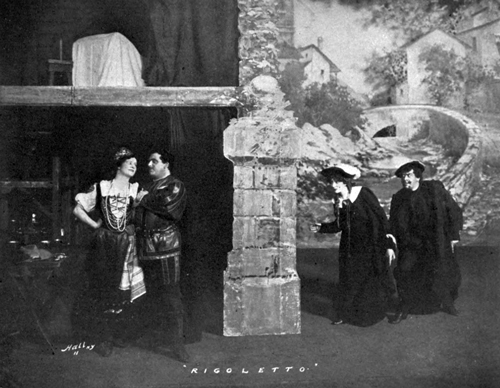
Photo by Hall
The Quartet in “Rigoletto” The Duke (Sheehan), Maddalena (Albright), Gilda (Easton), Rigoletto (Goff)
After the quartet, Sparafucile comes out and receives from Rigoletto half of his fee to murder the Duke, the balance to be paid when the body, in a sack, is delivered to the hunchback. Sparafucile offers to throw the sack into the river, but that does not suit the fool's desire for revenge. He wants the grim satisfaction of doing so himself. Satisfied that Gilda has seen enough of the Duke's perfidy, he sends her home, where, for safety, she is to don male attire and start on the way to Verona, where he will join her. He himself also goes out.
A storm now gathers. There are flashes of lightning; distant rumblings of thunder. The wind moans. (Indicated by the chorus, à bouche fermée, behind the scenes.) The Duke has gone to his room, after whispering a few words to Maddalena. He lays down his hat and sword, throws himself on the bed, sings a few snatches of "La donna è mobile," and in a short time falls asleep. Maddalena, below, stands by the table. Sparafucile finishes the contents of the bottle left by the Duke. Both remain silent for awhile.
Maddalena, fascinated by the Duke, begins to plead for his life. The storm is now at its height. Lightning plays vividly across the sky, thunder crashes, wind howls, rain falls in torrents. Through this uproar of the elements, to which night adds its terrors, comes Gilda, drawn as by a magnet to the spot where she knows her false lover to be. Through the crevices in the wall of the house she can hear Maddalena pleading with Sparafucile to spare the Duke's life. "Kill the hunchback," she counsels, "when he comes with the balance of the money." But there is honour even among assassins as among thieves. The bravo will not betray a customer.
Maddalena pleads yet more urgently. Well—Sparafucile will give the handsome youth one desperate chance for life: Should any other man arrive at the inn before midnight, that man will he kill and put in the sack to be thrown into the river, in place of Maddalena's temporary favourite. A clock strikes the half-hour. Gilda is in male attire. She determines to save the Duke's life—to sacrifice hers for his. She knocks. There is a moment of surprised suspense within. Then everything is made ready. Maddalena opens the door, and runs forward to close the outer one. Gilda enters. For a moment one senses her form in the darkness. A half-stifled outcry. Then all is buried in silence and gloom.
The storm is abating. The rain has ceased; the lightning become fitful, the thunder distant and intermittent. Rigoletto returns. "At last the hour of my vengeance is nigh." A bell tolls midnight. He knocks at the door. Sparafucile brings out the sack, receives the balance of his money, and retires into the house. "This sack his winding sheet!" exclaims the hunchback, as he gloats over it. The night has cleared. He must hurry and throw it into the river.
Out of the second story of the house and on to the wall steps the figure of a man and proceeds along the wall toward the city. Rigoletto starts to drag the sack with the body toward the stream. Lightly upon the night fall the notes of a familiar voice singing:
La donna è mobile Qual piuma al vento; Muta d'accento, E di pensiero. (Fickle is woman fair, Like feather wafted; Changeable ever, Constant, ah, never.)
It is the Duke. Furiously the hunchback tears open the sack. In it he beholds his daughter. Not yet quite dead, she is able to whisper, "Too much I loved him—now I die for him." There is a duet: Gilda, "Lassù in cielo" (From yonder sky); Rigoletto, "Non morir" (Ah, perish not).
"Maledizione!"—The music of Monterone's curse upon the ribald jester, now bending over the corpse of his own despoiled daughter, resounds on the orchestra. The fool has had his revenge.
For political reasons the performance of Victor Hugo's "Le Roi s'Amuse" was forbidden in France after the first representation. In Hugo's play the principal character is Triboulet, the jester of François I. The King, of course, also is a leading character; and there is a pen-portrait of Saint-Vallier. It was considered unsafe, after the revolutionary uprisings in Europe in 1848, to present on the stage so licentious a story involving a monarch. Therefore, to avoid political complications, and copyright ones possibly later, the Italian librettist laid the scene in Mantua. Triboulet became Rigoletto; François I. the Duke, and Saint-Vallier the Count Monterone. Early in its career the opera also was given under the title of "Viscardello."
IL TROVATORE THE TROUBADOUR
Opera in four acts, by Verdi; words by Salvatore Cammarano, based on the Spanish drama of the same title by Antonio Garcia Gutierrez. Produced, Apollo Theatre, Rome, January 19, 1853. Paris, Théâtre des Italiens, December 23, 1854; Grand Opéra, in French as "Le Trouvère," January 12, 1857. London, Covent Garden, May 17, 1855; in English, as "The Gypsy's Vengeance," Drury Lane, March 24, 1856. America: New York, April 30, 1855, with Brignoli (Manrico), Steffanone (Leonora), Amodio (Count di Luna), and Vestvali (Azucena); Philadelphia, Walnut Street Theatre, January 14, 1856, and Academy of Music, February 25, 1857; New Orleans, April 13, 1857. Metropolitan Opera House, New York, in German, 1889; 1908, Caruso, Eames, and Homer. Frequently performed at the Academy of Music, New York, with Campanini (Manrico), Nilsson (Leonora), and Annie Louise Cary (Azucena); and Del Puente or Galassi as Count di Luna.
Characters
Count di Luna, a young noble of AragonBaritone
Ferrando, di Luna's captain of the guardBass
Manrico, a chieftain under the Prince of Biscay, and reputed son of AzucenaTenor
Ruiz, a soldier in Manrico's serviceTenor
An Old GypsyBaritone
Duchess Leonora, lady-in-waiting to a Princess of AragonSoprano
Inez, confidante of LeonoraSoprano
Azucena, a Biscayan gypsy womanMezzo-Soprano
Followers of Count di Luna and of Manrico; messenger, gaoler, soldiers, nuns, gypsies.
Time—Fifteenth century.
Place—Biscay and Aragon.
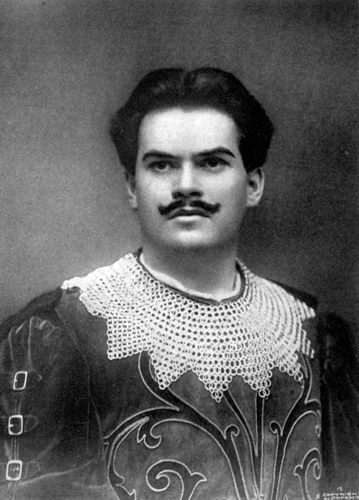
Copyright photo by Dupont
Riccardo Martin as Manrico in “Il Trovatore”
For many years "Il Trovatore" has been an opera of world-wide popularity, and for a long time could be accounted the most popular work in the operatic repertoire of practically every land. While it cannot be said to retain its former vogue in this country, it is still a good drawing card, and, with special excellences of cast, an exceptional one.
The libretto of "Il Trovatore" is considered the acme of absurdity; and the popularity of the opera, notwithstanding, is believed to be entirely due to the almost unbroken melodiousness of Verdi's score.
While it is true, however, that the story of this opera seems to be a good deal of a mix-up, it is also a fact that, under the spur of Verdi's music, even a person who has not a clear grasp of the plot can sense the dramatic power of many of the scenes. It is an opera of immense verve, of temperament almost unbridled, of genius for the melodramatic so unerring that its composer has taken dance rhythms, like those of mazurka and waltz, and on them developed melodies most passionate in expression and dramatic in effect. Swift, spontaneous, and stirring is the music of "Il Trovatore." Absurdities, complexities, unintelligibilities of story are swept away in its unrelenting progress. "Il Trovatore" is the Verdi of forty working at white heat.
One reason why the plot of "Il Trovatore" seems such a jumbled-up affair is that a considerable part of the story is supposed to have transpired before the curtain goes up. These events are narrated by Ferrando, the Count di Luna's captain of the guard, soon after the opera begins. But as even spoken narrative on the stage makes little impression, narrative when sung may be said to make none at all. Could the audience know what Ferrando is singing about, the subsequent proceedings would not appear so hopelessly involved, or appeal so strongly to humorous rhymesters, who usually begin their parodies on the opera with,
This is the story of "Il Trovatore."
What is supposed to have happened before the curtain goes up on the opera is as follows: The old Count di Luna, sometime deceased, had two sons nearly of the same age. One night, when they still were infants, and asleep, in a nurse's charge in an apartment in the old Count's castle, a gypsy hag, having gained stealthy entrance into the chamber, was discovered leaning over the cradle of the younger child, Garzia. Though she was instantly driven away, the child's health began to fail and she was believed to have bewitched it. She was pursued, apprehended and burned alive at the stake.
Her daughter, Azucena, at that time a young gypsy woman with a child of her own in her arms, was a witness to the death of her mother, which she swore to avenge. During the following night she stole into the castle, snatched the younger child of the Count di Luna from its cradle, and hurried back to the scene of execution, intending to throw the baby boy into the flames that still raged over the spot where they had consumed her mother. Almost bereft of her senses, however, by her memory of the horrible scene she had witnessed, she seized and hurled into the flames her own child, instead of the young Count (thus preserving, with an almost supernatural instinct for opera, the baby that was destined to grow up into a tenor with a voice high enough to sing "Di quella pira").
Thwarted for the moment in her vengeance, Azucena was not to be completely baffled. With the infant Count in her arms she fled and rejoined her tribe, entrusting her secret to no one, but bringing him up—Manrico, the Troubadour—as her own son; and always with the thought that through him she might wreak vengeance upon his own kindred.
When the opera opens, Manrico has grown up; she has become old and wrinkled, but is still unrelenting in her quest of vengeance. The old Count has died, leaving the elder son, Count di Luna of the opera, sole heir to his title and possessions, but always doubting the death of the younger, despite the heap of infant's bones found among the ashes about the stake.
"After this preliminary knowledge," quaintly says the English libretto, "we now come to the actual business of the piece." Each of the four acts of this "piece" has a title: Act I, "Il Duello" (The Duel); Act II, "La Gitana" (The Gypsy); Act III, "Il Figlio della Zingara" (The Gypsy's Son); Act IV, "Il Supplizio" (The Penalty).
Act I. Atrium of the palace of Aliaferia, with a door leading to the apartments of the Count di Luna. Ferrando, the captain of the guard, and retainers, are reclining near the door. Armed men are standing guard in the background. It is night. The men are on guard because Count di Luna desires to apprehend a minstrel knight, a troubadour, who has been heard on several occasions to be serenading from the palace garden, the Duchess Leonora, for whom a deep, but unrequited passion sways the Count.
Weary of the watch, the retainers beg Ferrando to tell them the story of the Count's brother, the stolen child. This Ferrando proceeds to do in the ballad, "Abbietta zingara" (Sat there a gypsy hag).
Ferrando's gruesome ballad and the comments of the horror-stricken chorus dominate the opening of the opera. The scene is an unusually effective one for a subordinate character like Ferrando. But in "Il Trovatore" Verdi is lavish with his melodies—more so, perhaps, than in any of his other operas.
The scene changes to the gardens of the palace. On one side a flight of marble steps leads to Leonora's apartment. Heavy clouds obscure the moon. Leonora and Inez are in the garden. From the confidante's questions and Leonora's answers it is gathered that Leonora is enamoured of an unknown but valiant knight who, lately entering a tourney, won all contests and was crowned victor by her hand. She knows her love is requited, for at night she has heard her Troubadour singing below her window. In the course of this narrative Leonora has two solos. The first of these is the romantic "Tacea la notte placida" (The night calmly and peacefully in beauty seemed reposing).

[Listen]
Tacea la notte placida, E bella in ciel sereno;
It is followed by the graceful and engaging "Di tale amor che dirsi" (Of such a love how vainly),

[Listen]
Di tale amor che dirsi
with its brilliant cadenza.
Leonora and Inez then ascend the steps and retire into the palace. The Count di Luna now comes into the garden. He has hardly entered before the voice of the Troubadour, accompanied on a lute, is heard from a nearby thicket singing the familiar romanza, "Deserto sulla terra" (Lonely on earth abiding).

[Listen]
Deserto sulla terra
From the palace comes Leonora. Mistaking the Count in the shadow of the trees for her Troubadour, she hastens toward him. The moon emerging from a cloud, she sees the figure of a masked cavalier, recognizes it as that of her lover, and turns from the Count toward the Troubadour. Unmasking, the Troubadour now discloses his identity as Manrico, one who, as a follower of the Prince of Biscay, is proscribed in Aragon. The men draw their swords. There is a trio that fairly seethes with passion—"Di geloso amor sprezzato" (Fires of jealous, despised affection).

[Listen]
These are the words, in which the Count begins the trio. It continues with "Un istante almen dia loco" (One brief moment thy fury restraining).

[Listen]
Un istante almen dia loco
The men rush off to fight their duel. Leonora faints.
Act II. An encampment of gypsies. There is a ruined house at the foot of a mountain in Biscay; the interior partly exposed to view; within a great fire is lighted. Day begins to dawn.
Azucena is seated near the fire. Manrico, enveloped in his mantle, is lying upon a mattress; his helmet is at his feet; in his hand he holds a sword, which he regards fixedly. A band of gypsies are sitting in scattered groups around them.
Since an almost unbroken sequence of melodies is a characteristic of "Il Trovatore," it is not surprising to find at the opening of this act two famous numbers in quick succession;—the famous "Anvil Chorus,"

[Listen]
in which the gypsies, working at the forges, swing their hammers and bring them down on clanking metal in rhythm with the music; the chorus being followed immediately by Azucena's equally famous "Stride la vampa" (Upward the flames roll).

[Listen]
Stride la vampa!
In this air, which the old gypsy woman sings as a weird, but impassioned upwelling of memories and hatreds, while the tribe gathers about her, she relates the story of her mother's death. "Avenge thou me!" she murmurs to Manrico, when she has concluded.
The corps de ballet which, in the absence of a regular ballet in "Il Trovatore," utilizes this scene and the music of the "Anvil Chorus" for its picturesque saltations, dances off. The gypsies now depart, singing their chorus. With a pretty effect it dies away in the distance.

[Listen]
Swept along by the emotional stress under which she labours, Azucena concludes her narrative of the tragic events at the pyre, voice and orchestral accompaniment uniting in a vivid musical setting of her memories. Naturally, her words arouse doubts in Manrico's mind as to whether he really is her son. She hastens to dispel these; they were but wandering thoughts she uttered. Moreover, after the recent battle of Petilla, between the forces of Biscay and Aragon, when he was reported slain, did she not search for and find him, and has she not been tenderly nursing him back to strength?
The forces of Aragon were led by Count di Luna, who but a short time before had been overcome by Manrico in a duel in the palace garden;—why, on that occasion, asks the gypsy, did he spare the Count's life?
Manrico's reply is couched in a bold, martial air, "Mal reggendo all'aspro assalto" (Ill sustaining the furious encounter).
But at the end it dies away to pp, when he tells how, when the Count's life was his for a thrust, a voice, as if from heaven, bade him spare it—a suggestion, of course, that although neither Manrico nor the Count know that they are brothers, Manrico unconsciously was swayed by the relationship, a touch of psychology rare in Italian opera librettos, most unexpected in this, and, of course, completely lost upon those who have not familiarized themselves with the plot of "Il Trovatore." Incidentally, however, it accounts for a musical effect—the pp, the sudden softening of the expression, at the end of the martial description of the duel.
Enter now Ruiz, a messenger from the Prince of Biscay, who orders Manrico to take command of the forces defending the stronghold of Castellor, and at the same time informs him that Leonora, believing reports of his death at Petilla, is about to take the veil in a convent near the castle.
The scene changes to the cloister of this convent. It is night. The Count and his followers, led by Ferrando, and heavily cloaked, advance cautiously. It is the Count's plan to carry off Leonora before she becomes a nun. He sings of his love for her in the air, "Il Balen" (The Smile)—"Il balen del suo sorriso" (Of her smile, the radiant gleaming)—which is justly regarded as one of the most chaste and beautiful baritone solos in Italian opera.

[Listen]
Il balen del suo sorriso
It is followed by an air alla marcia, also for the Count, "Per me ora fatale" (Oh, fatal hour impending).

[Listen]
Per me ora fatale,
A chorus of nuns is heard from within the convent. Leonora, with Inez, and her ladies, come upon the scene. They are about to proceed from the cloister into the convent when the Count interposes. But before he can seize Leonora, another figure stands between them. It is Manrico. With him are Ruiz and his followers. The Count is foiled.
"E deggio!—e posso crederlo?" (And can I still my eyes believe!) exclaims Leonora, as she beholds before her Manrico, whom she had thought dead. It is here that begins the impassioned finale, an ensemble consisting of a trio for Leonora, Manrico, and the Count di Luna, with chorus.
Act III. The camp of Count di Luna, who is laying siege to Castellor, whither Manrico has safely borne Leonora. There is a stirring chorus for Ferrando and the soldiers.

[Listen]
The Count comes from his tent. He casts a lowering gaze at the stronghold from where his rival defies him. There is a commotion. Soldiers have captured a gypsy woman found prowling about the camp. They drag her in. She is Azucena. Questioned, she sings that she is a poor wanderer, who means no harm. "Giorni poveri vivea" (I was poor, yet uncomplaining).
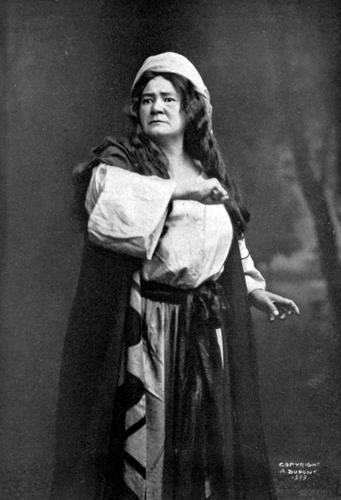
Copyright photo by Dupont
Schumann-Heink as Azucena in “Il Trovatore”
But Ferrando, though she thought herself masked by the grey hairs and wrinkles of age, recognizes her as the gypsy who, to avenge her mother, gave over the infant brother of the Count to the flames. In the vehemence of her denials, she cries out to Manrico, whom she names as her son, to come to her rescue. This still further enrages the Count. He orders that she be cast into prison and then burned at the stake. She is dragged away.
The scene changes to a hall adjoining the chapel in the stronghold of Castellor. Leonora is about to become the bride of Manrico, who sings the beautiful lyric, "Amor—sublime amore" ('Tis love, sublime emotion).
Its serenity makes all the more effective the tumultuous scene that follows. It assists in giving to that episode, one of the most famous in Italian opera, its true significance as a dramatic climax.
Just as Manrico takes Leonora's hand to lead her to the altar of the chapel, Ruiz rushes in with word that Azucena has been captured by the besiegers and is about to be burned to death. Already through the windows of Castellor the glow of flames can be seen. Her peril would render delay fatal. Dropping the hand of his bride, Manrico, draws his sword, and, as his men gather, sings "Di quella pira l'orrendo foco" (See the pyre blazing, oh, sight of horror), and rushes forth at the head of his soldiers to attempt to save Azucena.

[Listen]
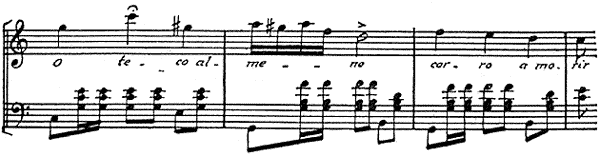
The line, "O teco almeno, corro a morir" (Or, all else failing, to die with thee), contains the famous high C.
[Listen]
O teco almeno corro a morir
This is a tour de force, which has been condemned as vulgar and ostentatious, but which undoubtedly adds to the effectiveness of the number. There is, it should be remarked, no high C in the score of "Di quella pira." In no way is Verdi responsible for it. It was introduced by a tenor, who saw a chance to make an effect with it, and succeeded so well that it became a fixture. A tenor now content to sing "O teco almeno" as Verdi wrote it

[Listen]
would never be asked to sing it.
Dr. Frank E. Miller, author of The Voice and Vocal Art Science, the latter the most complete exposition of the psycho-physical functions involved in voice-production, informs me that a series of photographs have been made (by an apparatus too complicated to describe) of the vibrations of Caruso's voice as he takes and holds the high C in "Di quella pira." The record measures fifty-eight feet. While it might not be correct to say that Caruso's high C is fifty-eight feet long, the record is evidence of its being superbly taken and held.
Not infrequently the high C in "Di quella pira" is faked for tenors who cannot reach it, yet have to sing the rôle of Manrico, or who, having been able to reach it in their younger days and at the height of their prime, still wish to maintain their fame as robust tenors. For such the number is transposed. The tenor, instead of singing high C, sings B-flat, a tone and a half lower, and much easier to take. By flourishing his sword and looking very fierce he usually manages to get away with it. Transpositions of operatic airs, requiring unusually high voices, are not infrequently made for singers, both male and female, no longer in their prime, but still good for two or three more "farewell" tours. All they have to do is to step up to the footlights with an air of perfect confidence, which indicates that the great moment in the performance has arrived, deliver, with a certain assumption of effort—the semblance of a real tour de force—the note which has conveniently been transposed, and receive the enthusiastic plaudits of their devoted admirers. But the assumption of effort must not be omitted. The tenor who sings the high C in "Di quella pira" without getting red in the face will hardly be credited with having sung it at all.
Act IV. Manrico's sortie to rescue his supposed mother failed. His men were repulsed, and he himself was captured and thrown into the dungeon tower of Aliaferia, where Azucena was already enchained. The scene shows a wing of the palace of Aliaferia. In the angle is a tower with window secured by iron bars. It is night, dark and clouded.
Leonora enters with Ruiz, who points out to her the place of Manrico's confinement, and retires. That she has conceived a desperate plan to save her lover appears from the fact that she wears a poison ring, a ring with a swift poison concealed under the jewel, so that she can take her own life, if driven thereto.
Unknown to Manrico, she is near him. Her thoughts wander to him;—"D'amor sull'ali rosee" (On rosy wings of love depart).

[Listen]
D'amor sull'ali rosee
It is followed by the "Miserere," which was for many years and perhaps still is the world over the most popular of all melodies from opera, although at the present time it appears to have been superseded by the "Intermezzo" from "Cavalleria Rusticana."
The "Miserere" is chanted by a chorus within.
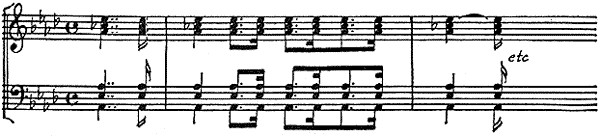
[Listen]
Against this as a sombre background are projected the heart-broken ejaculations of Leonora.

[Listen]
Then Manrico's voice in the tower intones "Ah! che la morte ognora" (Ah! how death still delayeth).
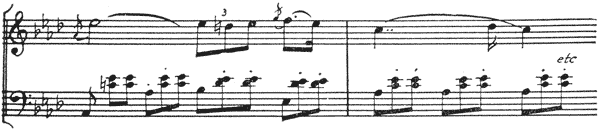
[Listen]
One of the most characteristic phrases, suggestions of which occur also in "La Traviata" and even in "Aïda," is the following:

[Listen]
a chi desia, a chi desia morir!
Familiarity may breed contempt, and nothing could well be more familiar than the "Miserere" from "Il Trovatore." Yet, well sung, it never fails of effect; and the gaoler always has to let Manrico come out of the tower and acknowledge the applause of an excited house, while Leonora stands by and pretends not to see him, one of those little fictions and absurdities of old-fashioned opera that really add to its charm.
The Count enters, to be confronted by Leonora. She promises to become his wife if he will free Manrico. Di Luna's passion for her is so intense that he agrees. There is a solo for Leonora, "Mira, di acerbe lagrime" (Witness the tears of agony), followed by a duet between her and the Count, who little suspects that, Manrico once freed, she will escape a hated union with himself by taking the poison in her ring.
The scene changes to the interior of the tower. Manrico and Azucena sing a duet of mournful beauty, "Ai nostri monti" (Back to our mountains).
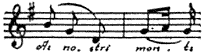
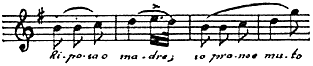
[Listen][Listen]
Ai nostri montiRiposa o madre, io prono e muto
Leonora enters and bids him escape. But he suspects the price she has paid; and his suspicions are confirmed by herself, when the poison she has drained from beneath the jewel in her ring begins to take effect and she feels herself sinking in death, while Azucena, in her sleep, croons dreamily, "Back to our mountains."
The Count di Luna, coming upon the scene, finds Leonora dead in her lover's arms. He orders Manrico to be led to the block at once and drags Azucena to the window to witness the death of her supposed son.
"It is over!" exclaims Di Luna, when the executioner has done his work.
"The victim was thy brother!" shrieks the gypsy hag. "Thou art avenged, O mother!"
She falls near the window.
"And I still live!" exclaims the Count.
With that exclamation the cumulative horrors, set to the most tuneful score in Italian opera, are over.
LA TRAVIATA THE FRAIL ONE
Opera in three acts by Verdi; words by Francesco Maria Piave, after the play "La Dame aux Camélias," by Alexandre Dumas, fils. Produced Fenice Theatre, Venice, March 6, 1853. London, May 24, 1856, with Piccolomini. Paris, in French, December 6, 1856; in Italian, October 27, 1864, with Christine Nilsson. New York, Academy of Music, December 3, 1856, with La Grange (Violetta), Brignoli (Alfredo), and Amodio (Germont, père). Nilsson, Patti, Melba, Sembrich and Tetrazzini have been among famous interpreters of the rôle of Violetta in America. Galli-Curci first sang Violetta in this country in Chicago, December 1, 1916.
Characters
Alfredo Germont, lover of ViolettaTenor
Giorgio Germont, his fatherBaritone
Gastone de LetorièresTenor
Baron Douphol, a rival of AlfredoBass
Marquis d'ObignyBass
Doctor GrenvilBass
Giuseppe, servant to ViolettaTenor
Violetta Valéry, a courtesanSoprano
Flora Bervoix, her friendMezzo-Soprano
Annina, confidante of ViolettaSoprano
Ladies and gentlemen who are friends and guests in the houses of Violetta and Flora; servants and masks; dancers and guests as matadors, picadors, and gypsies.
Time—Louis XIV.
Place—Paris and vicinity.
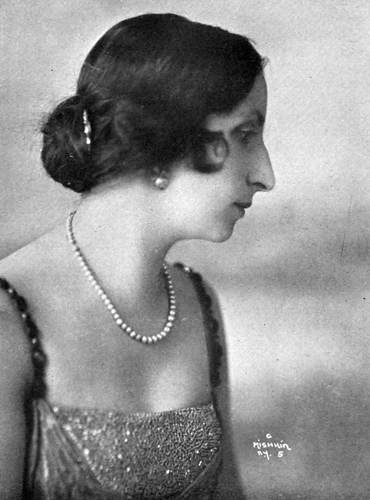
Copyright photo by Mishkin
Galli-Curci as Violetta in “La Traviata”
At its production in Venice in 1853 "La Traviata" was a failure, for which various reasons can be advanced. The younger Dumas's play, "La Dame aux Camélias," familiar to English playgoers under the incorrect title of "Camille," is a study of modern life and played in modern costume. When Piave reduced his "Traviata" libretto from the play, he retained the modern period. This is said to have nonplussed an audience accustomed to operas laid in the past and given in "costume." But the chief blame for the fiasco appears to have rested with the singers. Graziani, the Alfredo, was hoarse. Salvini-Donatelli, the Violetta, was inordinately stout. The result was that the scene of her death as a consumptive was received with derision. Varesi, the baritone, who sang Giorgio Germont, who does not appear until the second act, and is of no importance save in that part of the opera, considered the rôle beneath his reputation—notwithstanding Germont's beautiful solo, "Di Provenza"—and was none too cheerful over it. There is evidence in Verdi's correspondence that the composer had complete confidence in the merits of his score, and attributed its failure to its interpreters.
When the opera was brought forward again a year later, the same city which had decried it as a failure acclaimed it a success. On this occasion, however, the period of the action differed from that of the play. It was set back to the time of Louis XIV., and costumed accordingly. There is, however, no other opera today in which this matter of costume is so much a go-as-you-please affair for the principals, as it is in "La Traviata." I do not recall if Christine Nilsson dressed Violetta according to the Louis XIV. period, or not; but certainly Adelina Patti and Marcella Sembrich, both of whom I heard many times in the rôle (and each of them the first time they sang it here) wore the conventional evening gown of modern times. To do this has become entirely permissible for prima donnas in this character. Meanwhile the Alfredo may dress according to the Louis XIV. period, or wear the swallow-tail costume of today, or compromise, as some do, and wear the swallow-tail coat and modern waistcoat with knee-breeches and black silk stockings. As if even this diversity were not yet quite enough, the most notable Germont of recent years, Renaud, who, at the Manhattan Opera House, sang the rôle with the most exquisite refinement, giving a portrayal as finished as a genre painting by Meissonnier, wore the costume of a gentleman of Provence of, perhaps, the middle of the last century. But, as I have hinted before, in old-fashioned opera, these incongruities, which would be severely condemned in a modern work, don't amount to a row of pins. Given plenty of melody, beautifully sung, and everything else can go hang.
Act I. A salon in the house of Violetta. In the back scene is a door, which opens into another salon. There are also side doors. On the left is a fireplace, over which is a mirror. In the centre of the apartment is a dining-table, elegantly laid. Violetta, seated on a couch, is conversing with Dr. Grenvil and some friends. Others are receiving the guests who arrive, among whom are Baron Douphol and Flora on the arm of the Marquis.
The opera opens with a brisk ensemble. Violetta is a courtesan (traviata). Her house is the scene of a revel. Early in the festivities Gaston, who has come in with Alfred, informs Violetta that his friend is seriously in love with her. She treats the matter with outward levity, but it is apparent that she is touched by Alfred's devotion. Already, too, in this scene, there are slight indications, more emphasized as the opera progresses, that consumption has undermined Violetta's health.
First in the order of solos in this act is a spirited drinking song for Alfred, which is repeated by Violetta. After each measure the chorus joins in. This is the "Libiamo ne' lieti calici" (Let us quaff from the wine cup o'erflowing).

[Listen]
Libiamo, libiamo ne' lieti calici
Music is heard from an adjoining salon, toward which the guests proceed. Violetta is about to follow, but is seized with a coughing-spell and sinks upon a lounge to recover. Alfred has remained behind. She asks him why he has not joined the others. He protests his love for her. At first taking his words in banter, she becomes more serious, as she begins to realize the depth of his affection for her. How long has he loved her? A year, he answers. "Un dì felice, eterea" (One day a rapture ethereal), he sings.
In this the words, "Di quell'amor ch'è palpito" (Ah, 'tis with love that palpitates) are set to a phrase which Violetta repeats in the famous "Ah, fors'è lui," just as she has previously repeated the drinking song.
Verdi thus seems to intend to indicate in his score the effect upon her of Alfred's genuine affection. She repeated his drinking song. Now she repeats, like an echo of heartbeats, his tribute to a love of which she is the object.
It is when Alfred and the other guests have retired that Violetta, lost in contemplation, her heart touched for the first time, sings "Ah fors'è lui che l'anima" (For him, perchance, my longing soul).

[Listen]
Ah, fors'è lui che l'anima solinga ne' tumulti, solinga ne' tumulti
Then she repeats, in the nature of a refrain, the measures already sung by Alfred. Suddenly she changes, as if there were no hope of lasting love for woman of her character, and dashes into the brilliant "Sempre libera degg'io folleggiare di gioja in gioja" (Ever free shall I still hasten madly on from pleasure to pleasure).

[Listen]
Sempre libera degg'io folleggiare
With this solo the act closes.
Act II. Salon on the ground floor of a country house near Paris, occupied by Alfred and Violetta, who for him has deserted the allurements of her former life. Alfred enters in sporting costume. He sings of his joy in possessing Violetta: "Di miei bollenti spiriti" (Wild my dream of ecstasy).
From Annina, the maid of Violetta, he learns that the expenses of keeping up the country house are much greater than Violetta has told him, and that, in order to meet the cost, which is beyond his own means, she has been selling her jewels. He immediately leaves for Paris, his intention being to try to raise money there so that he may be able to reimburse her.
After he has gone, Violetta comes in. She has a note from Flora inviting her to some festivities at her house that night. She smiles at the absurdity of the idea that she should return, even for an evening, to the scenes of her former life. Just then a visitor is announced. She supposes he is a business agent, whom she is expecting. But, instead, the man who enters announces that he is Alfred's father. His dignity, his courteous yet restrained manner, at once fill her with apprehension. She has foreseen separation from the man she loves. She now senses that the dread moment is impending.
The elder Germont's plea that she leave Alfred is based both upon the blight threatened his career by his liaison with her, and upon another misfortune that will result to the family. There is not only the son; there is a daughter. "Pura siccome un angelo" (Pure as an angel) sings Germont, in the familiar air:

[Listen]
Pura siccome un angelo
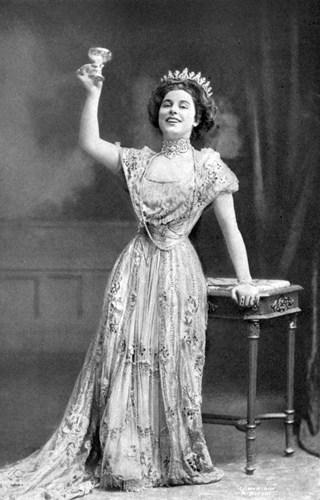
Copyright photo by Dupont
Farrar as Violetta in “La Traviata”
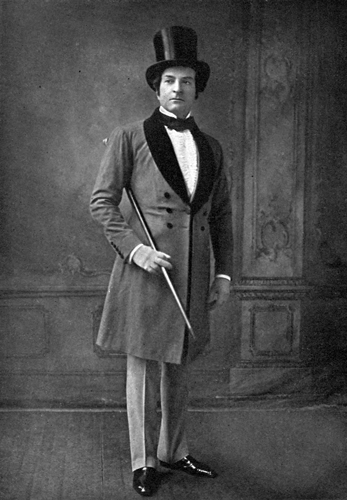
Photo by Mishkin
Scotti as Germont in “La Traviata”
Should the scandal of Alfred's liaison with Violetta continue, the family of a youth, whom the daughter is to marry, threaten to break off the alliance. Therefore it is not only on behalf of his son, it is also for the future of his daughter, that the elder Germont pleads. As in the play, so in the opera, the reason why the rôle of the heroine so strongly appeals to us is that she makes the sacrifice demanded of her—though she is aware that among other unhappy consequences to her, it will aggravate the disease of which she is a victim and hasten her death, wherein, indeed, she even sees a solace. She cannot yield at once. She prays, as it were, for mercy: "Non sapete" (Ah, you know not).
Finally she yields: "Dite alla giovine" (Say to thy daughter); then "Imponete" (Now command me); and, after that, "Morrò—la mia memoria" (I shall die—but may my memory).
Germont retires. Violetta writes a note, rings for Annina, and hands it to her. From the maid's surprise as she reads the address, it can be judged to be for Flora, and, presumably, an acceptance of her invitation. When Annina has gone, she writes to Alfred informing him that she is returning to her old life, and that she will look to Baron Douphol to maintain her. Alfred enters. She conceals the letter about her person. He tells her that he has received word from his father that the latter is coming to see him in an attempt to separate him from her. Pretending that she leaves, so as not to be present during the interview, she takes of him a tearful farewell.
Alfred is left alone. He picks up a book and reads listlessly. A messenger enters and hands him a note. The address is in Violetta's handwriting. He breaks the seal, begins to read, staggers as he realizes the import, and would collapse, but that his father, who has quietly entered from the garden, holds out his arms, in which the youth, believing himself betrayed by the woman he loves, finds refuge.
"Di Provenza il mar, il suol chi dal cor ti cancellò" (From fair Provence's sea and soil, who hath won thy heart away), sings the elder Germont, in an effort to soften the blow that has fallen upon his son.

[Listen]
Di Provenza il mar, il suol
Alfred rouses himself. Looking about vaguely, he sees Flora's letter, glances at the contents, and at once concludes that Violetta's first plunge into the vortex of gayety, to return to which she has, as he supposes, abandoned him, will be at Flora's fête.
"Thither will I hasten, and avenge myself!" he exclaims, and departs precipitately, followed by his father.
The scene changes to a richly furnished and brilliantly lighted salon in Flora's palace. The fête is in full swing. There is a ballet of women gypsies, who sing as they dance "Noi siamo zingarelle" (We're gypsies gay and youthful).
Gaston and his friends appear as matadors and others as picadors. Gaston sings, while the others dance, "È Piquillo, un bel gagliardo" ('Twas Piquillo, so young and so daring).
It is a lively scene, upon which there enters Alfred, to be followed soon by Baron Douphol with Violetta on his arm. Alfred is seated at a card table. He is steadily winning. "Unlucky in love, lucky in gambling!" he exclaims. Violetta winces. The Baron shows evidence of anger at Alfred's words and is with difficulty restrained by Violetta. The Baron, with assumed nonchalance, goes to the gaming table and stakes against Alfred. Again the latter's winnings are large. A servant's announcement that the banquet is ready is an evident relief to the Baron. All retire to an adjoining salon. For a brief moment the stage is empty.
Violetta enters. She has asked for an interview with Alfred. He joins her. She begs him to leave. She fears the Baron's anger will lead him to challenge Alfred to a duel. The latter sneers at her apprehensions; intimates that it is the Baron she fears for. Is it not the Baron Douphol for whom he, Alfred, has been cast off by her? Violetta's emotions almost betray her, but she remembers her promise to the elder Germont, and exclaims that she loves the Baron.
Alfred tears open the doors to the salon where the banquet is in progress. "Come hither, all!" he shouts.
They crowd upon the scene. Violetta, almost fainting, leans against the table for support. Facing her, Alfred hurls at her invective after invective. Finally, in payment of what she has spent to help him maintain the house near Paris in which they have lived together, he furiously casts at her feet all his winnings at the gaming table. She faints in the arms of Flora and Dr. Grenvil.
The elder Germont enters in search of his son. He alone knows the real significance of the scene, but for the sake of his son and daughter cannot disclose it. A dramatic ensemble, in which Violetta sings, "Alfredo, Alfredo, di questo core non puoi comprendere tutto l'amore" (Alfred, Alfred, little canst thou fathom the love within my heart for thee) brings the act to a close.
Act III. Violetta's bedroom. At the back is a bed with the curtains partly drawn. A window is shut in by inside shutters. Near the bed stands a tabouret with a bottle of water, a crystal cup, and different kinds of medicine on it. In the middle of the room is a toilet-table and settee. A little apart from this is another piece of furniture upon which a night-lamp is burning. On the left is a fireplace with a fire in it.
Violetta awakens. In a weak voice she calls Annina, who, waking up confusedly, opens the shutters and looks down into the street, which is gay with carnival preparations. Dr. Grenvil is at the door. Violetta endeavours to rise, but falls back again. Then, supported by Annina, she walks slowly toward the settee. The doctor enters in time to assist her. Annina places cushions about her. To Violetta the physician cheerfully holds out hope of recovery, but to Annina he whispers, as he is leaving, that her mistress has but few hours more to live.
Violetta has received a letter from the elder Germont telling her that Alfred has been apprised by him of her sacrifice and has been sent for to come to her bedside as quickly as possible. But she has little hope that he will arrive in time. She senses the near approach of death. "Addio del passato" (Farewell to bright visions) she sighs. For this solo,

[Listen]
Addio del passato bei sogni ridenti,
when sung in the correct interpretive mood, should be like a sigh from the depths of a once frail, but now purified soul.
A bacchanalian chorus of carnival revellers floats up from the street. Annina, who had gone out with some money which Violetta had given her to distribute as alms, returns. Her manner is excited. Violetta is quick to perceive it and divine its significance. Annina has seen Alfred. He is waiting to be announced. The dying woman bids Annina hasten to admit him. A moment later he holds Violetta in his arms. Approaching death is forgotten. Nothing again shall part them. They will leave Paris for some quiet retreat. "Parigi, o cara, noi lasceremo" (We shall fly from Paris, beloved), they sing.

[Listen]
Parigi, o cara, noi lasceremo
But it is too late. The hand of death is upon the woman's brow. "Gran Dio! morir sì giovine" (O, God! to die so young).
The elder Germont and Dr. Grenvil have come in. There is nothing to be done. The cough that racked the poor frail body has ceased. La traviata is dead.
Not only were "Il Trovatore" and "La Traviata" produced in the same year, but "La Traviata" was written between the date of "Trovatore's" première at Rome (January 19th) and March 6th. Only four weeks in all are said to have been devoted to it, and part of the time Verdi was working on "Trovatore" as well. Nothing could better illustrate the fecundity of his genius, the facility with which he composed. But it was not the fatal facility that sacrifices real merit for temporary success. There are a few echoes of "Trovatore" in "Traviata"; but the remarkable achievement of Verdi is not in having written so beautiful an opera as "La Traviata" in so short a time, but in having produced in it a work in a style wholly different from "Il Trovatore." The latter palpitates with the passions of love, hatred, and vengeance. The setting of the action encourages these. It consists of palace gardens, castles, dungeons. But "La Traviata" plays in drawing-rooms. The music corresponds with these surroundings. It is vivacious, graceful, gentle. When it palpitates, it is with sorrow. The opera also contains a notably beautiful instrumental number—the introduction to the third act. This was a favourite piece with Theodore Thomas. Several times—years ago—I heard it conducted by him at his Popular Concerts.
Oddly enough, although "Il Trovatore" is by far the more robust and at one time was, as I have stated, the most popular opera in the world, I believe that today the advantage lies with "La Traviata," and that, as between the two, there belongs to that opera the ultimate chance of survival. I explain this on the ground that, in "Il Trovatore" the hero and heroine are purely musical creations, the real character drawing, dramatically and musically, being in the rôle of Azucena, which, while a principal rôle, has not the prominence of Leonora or Manrico. In "La Traviata," on the other hand, we have in the original of Violetta—the Marguerite Gauthier of Alexandre Dumas, fils—one of the great creations of modern drama, the frail woman redeemed by the touch of an artist. Piave, in his libretto, preserves the character. In the opera, as in the play, one comprehends the injunction, "Let him who is not guilty throw the first stone." For Verdi has clothed Violetta in music that brings out the character so vividly and so beautifully that whenever I see "Traviata" I recall the first performance in America of the Dumas play by Bernhardt, then in her slender and supple prime, and the first American appearance in it of Duse, with her exquisite intonation and restraint of gesture.
In fact, operas survive because the librettist has known how to create a character and the composer how to match it with his musical genius. Recall the dashing Don Giovanni; the resourceful Figaro, both in the Mozart and the Rossini opera; the real interpretive quality of a mild and gracious order in the heroine of "La Sonnambula"—innocence personified; the gloomy figure of Edgardo stalking through "Lucia di Lammermoor"; the hunchback and the titled gallant in "Rigoletto," and you can understand why these very old operas have lived so long. They are not make-believe; they are real.
UN BALLO IN MASCHERA THE MASKED BALL
Opera in three acts, by Verdi; words by Somma, based on Scribe's libretto for Auber's opera, "Gustave III., ou Le Bal Masqué" (Gustavus III., or the Masked Ball). Produced, Apollo Theatre, Rome, February 17, 1859. Paris, Théâtre des Italiens, January 13, 1861. London, June 15, 1861. New York, February 11, 1861. Revivals, Metropolitan Opera House, N.Y., with Jean de Reszke, 1903; with Caruso, Eames, Homer, Scotti, Plançon, and Journet, February 6, 1905; with Caruso, Destinn, Matzenauer, Hempel, and Amato, November 22, 1913.
Characters
Richard, Count of Warwick and Governor of Boston (or Riccardo, Duke of Olivares and Governor of Naples)Tenor
Amelia (Adelia)Soprano
Reinhart (Renato), secretary to the Governor and husband of AmeliaBaritone
Samuel}enemies of the GovernorBass
Tom (Tommaso)}
Silvan, a sailorSoprano
Oscar (Edgardo), a pageSoprano
Ulrica, a negress astrologerContralto
A judge, a servant of Amelia, populace, guards, etc., conspirators, maskers, and dancing couples.
Place—Boston, or Naples.
Time—Late seventeenth or middle eighteenth century.
The English libretto of "Un Ballo in Maschera," literally "A Masked Ball," but always called by us "The Masked Ball," has the following note:
"The scene of Verdi's 'Ballo in Maschera' was, by the author of the libretto, originally laid in one of the European cities. But the government censors objected to this, probably, because the plot contained the record of a successful conspiracy against an established prince or governor. By a change of scene to the distant, and, to the author, little-known, city of Boston, in America, this difficulty seems to have been obviated. The fact should be borne in mind by Bostonians and others, who may be somewhat astonished at the events which are supposed to have taken place in the old Puritan city."
Certainly the events in "The Masked Ball" are amazing for the Boston of Puritan or any other time, and it was only through necessity that the scene of the opera was laid there. Now that political reasons for this no longer exist, it is usually played with the scene laid in Naples.
Auber produced, in 1833, an opera on a libretto by Scribe, entitled "Gustave III., ou Le Bal Masqué." Upon this Scribe libretto the book of "Un Ballo in Maschera" is based. Verdi's opera was originally called "Gustavo III.," and, like the Scribe-Auber work, was written around the assassination of Gustavus III., of Sweden, who, March 16, 1792, was shot in the back during a masked ball at Stockholm.
Verdi composed the work for the San Carlo Theatre, Naples, where it was to have been produced for the carnival of 1858. But January 14th of that year, and while the rehearsals were in progress, Felice Orsini, an Italian revolutionist, made his attempt on the life of Napoleon III. In consequence the authorities forbade the performance of a work dealing with the assassination of a king. The suggestion that Verdi adapt his music to an entirely different libretto was put aside by the composer, and the work was withdrawn, with the result that a revolution nearly broke out in Naples. People paraded the street, and by shouting "Viva Verdi!" proclaimed, under guise of the initials of the popular composer's name, that they favoured the cause of a united Italy, with Victor Emanuel as King; viz.: Vittorio Emmanuele Re D'Italia (Victor Emanuel, King of Italy). Finally the censor in Rome suggested, as a way out of the difficulty, that the title of the opera be changed to "Un Ballo in Maschera" and the scene transferred to Boston. For however nervous the authorities were about having a king murdered on the stage, they regarded the assassination of an English governor in far-off America as a quite harmless diversion. So, indeed, it proved to be, the only excitement evinced by the audience of the Apollo Theatre, Rome, on the evening of February 18, 1859, being the result of its enthusiasm over the various musical numbers of the work, this enthusiasm not being at all dampened by the fact that, with the transfer to Boston, two of the conspirators, Samuel and Tommaso, became negroes, and the astrologer who figures in the opera, a negress.
The sensible change of scene from Boston to Naples is said to have been initiated in Paris upon the instance of Mario, who "would never have consented to sing his ballad in the second act in short pantaloons, silk stockings, red dress, and big epaulettes of gold lace. He would never have been satisfied with the title of Earl of Warwick and the office of governor. He preferred to be a grandee of Spain, to call himself the Duke of Olivares, and to disguise himself as a Neapolitan fisherman, besides paying little attention to the strict accuracy of the rôle, but rather adapting it to his own gifts as an artist." The ballad referred to in this quotation undoubtedly is Richard's barcarolle, "Di' tu se fedele il flutto m'aspetta" (Declare if the waves will faithfully bear me).
Act I. Reception hall in the Governor's house. Richard, Earl of Warwick, is giving an audience. Oscar, a page, brings him the list of guests invited to a masked ball. Richard is especially delighted at seeing on it the name of Amelia, the wife of his secretary, Reinhart, although his conscience bitterly reproaches him for loving Amelia, for Reinhart is his most faithful friend, ever ready to defend him. The secretary also has discovered a conspiracy against his master; but as yet has been unable to learn the names of the conspirators.
At the audience a judge is announced, who brings for signature the sentence of banishment against an old fortune teller, the negress Ulrica. Oscar, however, intercedes for the old woman. Richard decides to visit her in disguise and test her powers of divination.
The scene changes to Ulrica's hut, which Richard enters disguised as a fisherman. Without his knowledge, Amelia also comes to consult the negress. Concealed by a curtain he hears her ask for a magic herb to cure her of the love which she, a married woman, bears to Richard. The old woman tells her of such an herb, but Amelia must gather it herself at midnight in the place where stands the gibbet. Richard thus learns that she loves him, and of her purpose to be at the place of the gibbet at midnight. When she has gone he comes out of his concealment and has his fortune told. Ulrica predicts that he will die by the hand of a friend. The conspirators, who are in his retinue, whisper among themselves that they are discovered. "Who will be the slayer?" asks Richard. The answer is, "Whoever first shall shake your hand." At this moment Reinhart enters, greets his friend with a vigorous shake of the hand, and Richard laughs at the evil prophecy. His retinue and the populace rejoice with him.
Act II. Midnight, beside the gallows. Amelia, deeply veiled, comes to pluck the magic herb. Richard arrives to protect her. Amelia is unable to conceal her love for him. But who comes there? It is Reinhart. Concern for his master has called him to the spot. The conspirators are lying in wait for him nearby. Richard exacts from Reinhart a promise to escort back to the city the deeply veiled woman, without making an attempt to learn who she is, while he himself returns by an unfrequented path. Reinhart and his companion fall into the hands of the conspirators. The latter do not harm the secretary, but want at least to learn who the Governor's sweetheart is. They lift the veil. Reinhart sees his own wife. Rage grips his soul. He bids the leaders of the conspiracy to meet with him at his house in the morning.
Act III. A study in Reinhart's dwelling. For the disgrace he has suffered he intends to kill Amelia. Upon her plea she is allowed to embrace her son once more. He reflects that, after all, Richard is much the more guilty of the two. He refrains from killing her, but when he and the conspirators draw lots to determine who shall kill Richard, he calls her in, and, at his command, she draws a piece of paper from an urn. It bears her husband's name, drawn unwittingly by her to indicate the person who is to slay the man she loves. Partly to remove Amelia's suspicions, Reinhart accepts the invitation to the masked ball which Oscar brings him, Richard, of course, knowing nothing of what has transpired.