Richard Wagner (1813-1883) (continued 2)
Reading edition
As another burst of revelry, another flash of light, causes Frederick to bow his head in deeper gloom, Ortrud begins to unfold her plot to him. How long will a woman like Elsa—as sweet as she is beautiful, but also as weak—be able to restrain herself from asking the forbidden question? Once her suspicion aroused that the Knight is concealing from her something in his past life, growing jealousy will impel her first to seek to coax from him, then to demand of him his name and lineage. Let Frederick conceal himself within the minster, and when the bridal procession reaches the steps, come forth and, accusing the Knight of treachery and deceit, demand that he be compelled to disclose his name and origin. He will refuse, and thus, even before Elsa enters the minster, she will begin to be beset by doubts. She herself meanwhile will seek to enter the kemenate and play upon her credulousness. "She is for me; her champion is for you. Soon the daughter of Odin will teach you all the joys of vengeance!" is Ortrud's sinister exclamation as she finishes.
Indeed it seems as if Fate were playing into her hand. For at that very moment Elsa, all clad in white, comes out upon the balcony of the kemenate and, sighing with happiness, breathes out upon the night air her rapture at the thought of what bliss the coming day has in store for her. As she lets her gaze rest on the calm night she hears a piteous voice calling her name, and looking down sees Ortrud, her hands raised in supplication to her. Moved by the spectacle of one but a short time before so proud and now apparently in such utter dejection, the guileless maid descends and, herself opening the door of the kemenate, hastens to Ortrud, raises her to her feet, and gently leads her in, while, hidden in the shadows, Frederick of Telramund bides his time for action. Thus within and without, mischief is plotting for the unsuspecting Elsa.
These episodes, following the appearance of Elsa upon the balcony, are known as the "Balcony Scene." It opens with the exquisite melody which Elsa breathes upon the zephyrs of the night in gratitude to heaven for the champion sent to her defence. Then, when in pity she has hastened down to Ortrud, the latter pours doubts regarding her champion into Elsa's mind. Who is he? Whence came he? May he not as unexpectedly depart? The whole closes with a beautiful duet, which is repeated by the orchestra, as Ortrud is conducted by Elsa into the apartment.
It is early morn. People begin to gather in the open place before the minster and, by the time the sun is high, the space is crowded with folk eager to view the bridal procession. They sing a fine and spirited chorus.
At the appointed hour four pages come out upon the balcony of the kemenate and cry out:
"Make way, our Lady Elsa comes!" Descending, they clear a path through the crowd to the steps of the minster. A long train of richly clad women emerges upon the balcony, slowly comes down the steps and, proceeding past the palace, winds toward the minster. At that moment a great shout, "Hail! Elsa of Brabant!" goes up, as the bride herself appears followed by her ladies-in-waiting. For the moment Ortrud's presence in the train is unnoticed, but as Elsa approaches the minster, Frederick's wife suddenly throws herself in her path.
"Back, Elsa!" she cries. "I am not a menial, born to follow you! Although your Knight has overthrown my husband, you cannot boast of who he is—his very name, the place whence he came, are unknown. Strong must be his motives to forbid you to question him. To what foul disgrace would he be brought were he compelled to answer!"
Fortunately the King, the bridegroom, and the nobles approaching from the palace, Elsa shrinks from Ortrud to her champion's side and hides her face against his breast. At that moment Frederick of Telramund, taking his cue from Ortrud, comes out upon the minster steps and repeats his wife's accusation. Then, profiting by the confusion, he slips away in the crowd. The insidious poison, however, has already begun to take effect. For even as the King taking the Knight on his right and Elsa on his left conducts them up the minster steps, the trembling bride catches sight of Ortrud whose hand is raised in threat and warning; and it is clinging to her champion, in love indeed but love mingled with doubt and fear, that she passes through the portal, and into the edifice.
These are crucial scenes. The procession to the minster, often known as the bridal procession, must not be confused with the "Bridal Chorus." It is familiar music, however, because at weddings it often is played softly as a musical background to the ceremony.
Act III. The wedding festivities are described in the brilliant "Introduction to Act III." This is followed in the opera by the "Bridal Chorus," which, wherever heard—on stage or in church—falls with renewed freshness and significance upon the ear. In this scene the Knight and Elsa are conducted to the bridal chamber in the castle. From the right enter Elsa's ladies-in-waiting leading the bride; from the left the King and nobles leading the Knight. Preceding both trains are pages bearing lights; and voices chant the bridal chorus. The King ceremoniously embraces the couple and then the procession makes its way out, until, as the last strains of the chorus die away, Elsa and her champion are for the first time alone.
It should be a moment of supreme happiness for both, and indeed, Elsa exclaims as her bridegroom takes her to his arms, that words cannot give expression to all its hidden sweetness. Yet, when he tenderly breathes her name, it serves only to remind her that she cannot respond by uttering his. "How sweetly sounds my name when spoken by you, while I, alas, cannot reply with yours. Surely, some day, you will tell me, all in secret, and I shall be able to whisper it when none but you is near!"
In her words the Knight perceives but too clearly the seeds of the fatal mistrust sown by Ortrud and Frederick. Gently he leaves her side and throwing open the casement, points to the moonlit landscape where the river winds its course along the plain. The same subtle magic that can conjure up this scene from the night has brought him to her, made him love her, and give unshrinking credence to her vow never to question his name or origin. Will she now wantonly destroy the wondrous spell of moonlight and love?
But still Elsa urges him. "Let me be flattered by your trust and confidence. Your secret will be safe in my heart. No threats, not even of death, shall tear it from my lips. Tell me who you are and whence you come!"
"Elsa!" he cries, "come to my heart. Let me feel that happiness is mine at last. Let your love and confidence compensate me for what I have left behind me. Cast dark suspicion aside. For know, I came not hither from night and grieving but from the abode of light and noble pleasures."
But his words have the very opposite effect of what he had hoped for. "Heaven help me!" exclaims Elsa. "What must I hear! Already you are beginning to look back with longing to the joys you have given up for me. Some day you will leave me to sorrow and regret. I have no magic spells wherewith to hold you. Ah!"—and now she cries out like one distracted and with eyes straining at distance—"See!—the swan!—I see him floating on the waters yonder! You summon him, embark!—Love—madness—whatever it may be—your name declare, your lineage and your home!"
Hardly have these mad words been spoken by her when, as she stands before her husband of a few hours, she sees something that with a sudden shock brings her to her senses. Rushing to the divan where the pages laid the Knight's sword, she seizes it and thrusts it into his hand, and he, turning to discover what peril threatens, sees Frederick, followed by four Brabantian nobles, burst into the room. With one stroke he lays the leader lifeless, and the others, seeing him fall, go down on their knees in token of submission. At a sign from the Knight they arise and, lifting Frederick's body, bear it away. Then the Knight summons Elsa's ladies-in-waiting and bids them prepare her in her richest garments to meet him before the King. "There I will make fitting answer to her questions, tell her my name, my rank, and whence I come."
Sadly he watches her being led away, while she, no longer the happy bride, but the picture of utter dejection, turns and raises her hands to him in supplication as though she would still implore him to undo the ruin her lack of faith in him has wrought.
Some of the most beautiful as well as some of the most dramatic music of the score occurs in these scenes.
The love duet is exquisite—one of the sweetest and tenderest passages of which the lyric stage can boast. A very beautiful musical episode is that in which the Knight, pointing through the open casement to the flowery close below, softly illumined by the moon, sings to an accompaniment of what might be called musical moonbeams, "Say, dost thou breathe the incense sweet of flowers?" But when, in spite of the tender warning which he conveys to her, she begins questioning him, he turns toward her and in a passionate musical phrase begs her to trust him and abide with him in loving faith. Her dread that the memory of the delightful place from which he has come will wean him from her; the wild vision in which she imagines she sees the swan approaching to bear him away from her, and when she puts to him the forbidden questions, are details expressed with wonderful vividness in the music.
After the attack by Frederick and his death, there is a dramatic silence during which Elsa sinks on her husband's breast and faints. When I say silence I do not mean that there is a total cessation of sound, for silence can be more impressively expressed in music than by actual silence itself. It is done by Wagner in this case by long drawn-out chords followed by faint taps on the tympani. When the Knight bends down to Elsa, raises her, and gently places her on a couch, echoes of the love duet add to the mournfulness of the music. The scene closes with the Motive of Warning, which resounds with dread meaning.
A quick change of scene should be made at this point in the performance of the opera, but as a rule the change takes so long that the third act is virtually given in two acts.
It is on the banks of the Scheldt, the very spot where he had disembarked, that the Knight elects to make reply to Elsa's questions. There the King, the nobles, and the Brabantians, whom he was to lead, are awaiting him to take command, and as their leader they hail him when he appears. This scene, "Promise of Victory," is in the form of a brilliant march and chorus, during which the Counts of Brabant, followed by their vassals, enter on horseback from various directions. In the average performance of the opera, however, much of it is sacrificed in order to shorten the representation.
The Knight answers their hail by telling them that he has come to bid them farewell, that Elsa has been lured to break her vow and ask the forbidden questions which he now is there to answer. From distant lands he came, from Montsalvat, where stands the temple of the Holy Grail, his father, Percival, its King, and he, Lohengrin, its Knight. And now, his name and lineage known, he must return, for the Grail gives strength to its knights to right wrong and protect the innocent only so long as the secret of their power remains unrevealed.
Even while he speaks the swan is seen floating down the river. Sadly Lohengrin bids Elsa farewell. Sadly all, save one, look on. For Ortrud, who now pushes her way through the spectators, it is a moment of triumph.
"Depart in all your glory," she calls out. "The swan that draws you away is none other than Elsa's brother Godfrey, changed by my magic into his present form. Had she kept her vow, had you been allowed to tarry, you would have freed him from my spell. The ancient gods, whom faithfully I serve, thus punish human faithlessness!"
By the river bank Lohengrin falls upon his knees and prays in silence. Suddenly a white dove descends over the boat. Rising, Lohengrin loosens the golden chain by which the swan is attached to the boat; the swan vanishes; in its place Godfrey stands upon the bank, and Lohengrin, entering the boat, is drawn away by the dove. At sight of the young Duke, Ortrud falls with a shriek, while the Brabantian nobles kneel before him as he advances and makes obeisance to the King. Elsa gazes on him in rapture until, mindful of her own sorrow, as the boat in which Lohengrin stands vanishes around the upper bend of the river, she cries out, "My husband! My husband!" and falls back in death in her brother's arms.
Lohengrin's narrative of his origin is beautifully set to music familiar from the Prelude; but when he proclaims his name we hear the same measures which Elsa sang in the second part of her dream in the first act. Very beautiful and tender is the music which he sings when he hands Elsa his horn, his sword, and his ring to give to her brother, should he return, and also his greeting to the swan when it comes to bear him back. The work is brought to a close with a repetition of the music of the second portion of Elsa's dream, followed by a superb climax with the Motive of the Grail.
DER RING DES NIBELUNGEN THE RING OF THE NIBELUNG
A stage-festival play for three days and a preliminary evening (Ein Bühnenfestspiel für drei Tage und einen Vorabend), words and music by Richard Wagner.
The first performance of the entire cycle of four music-dramas took place at Bayreuth, August 13, 14, 16, and 17, 1876. "Das Rheingold" had been given September 22, 1869, and "Die Walküre," June 26, 1870, at Munich.
January 30, 1888, at the Metropolitan Opera House, New York, "Die Walküre" was given as the first performance of the "Ring" in America, with the omission, however, of "Das Rheingold," the cycle therefore being incomplete, consisting only of the three music-dramas—"Die Walküre," "Siegfried," and "Götterdämmerung"; in other words the trilogy without the Vorabend, or preliminary evening.
Beginning Monday, March 4, 1889, with "Das Rheingold," the complete cycle, "Der Ring des Nibelungen," was given for the first time in America; "Die Walküre" following Tuesday, March 5; "Siegfried," Friday, March 8; "Götterdämmerung," Monday, March 11. The cycle was immediately repeated. Anton Seidl was the conductor. Among the principals were Lilli Lehmann, Max Alvary, and Emil Fischer.
Seidl conducted the production of the "Ring" in London, under the direction of Angelo Neumann, at Her Majesty's Theatre, May 5-9, 1882.
The "Ring" really is a tetralogy. Wagner, however, called it a trilogy, regarding "Das Rheingold" only as a Vorabend to the three longer music-dramas.
In the repetitions of the "Ring" in this country many distinguished artists have appeared: Lehmann, Moran-Olden, Nordica, Ternina, Fremstad, Gadski, Kurt, as Brünnhilde; Lehmann, Nordica, Eames, Fremstad, as Sieglinde; Alvary and Jean de Reszke as Siegfried, both in "Siegfried" and "Götterdämmerung"; Niemann and Van Dyck, as Siegmund; Fischer and Van Rooy as Wotan; Schumann-Heink and Homer as Waltraute and Erda.
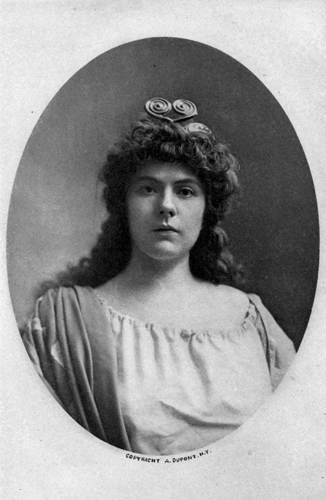
Copyright A. Dupont, N.Y.
Louise Homer as Fricka in “The Ring of the Nibelung”
INTRODUCTION
The "Ring of the Nibelung" consists of four music-dramas—"Das Rheingold" (The Rhinegold), "Die Walküre" (The Valkyr), "Siegfried," and "Götterdämmerung" (Dusk of the Gods). The "books" of these were written in inverse order. Wagner made a dramatic sketch of the Nibelung myth as early as the autumn of 1848, and between then and the autumn of 1850 he wrote the "Death of Siegfried." This subsequently became the "Dusk of the Gods." Meanwhile Wagner's ideas as to the proper treatment of the myth seem to have undergone a change. "Siegfried's Death" ended with Brünnhilde leading Siegfried to Valhalla,—dramatic, but without the deeper ethical significance of the later version, when Wagner evidently conceived the purpose of connecting the final catastrophe of his trilogy with the "Dusk of the Gods," or end of all things, in Northern mythology, and of embodying a profound truth in the action of the music-dramas. This metaphysical significance of the work is believed to be sufficiently explained in the brief synopsis of the plot of the trilogy and in the descriptive musical and dramatic analyses below.
In the autumn of 1850 when Wagner was on the point of sketching out the music of "Siegfried's Death," he recognized that he must lead up to it with another drama, and "Young Siegfried," afterwards "Siegfried," was the result. This in turn he found incomplete, and finally decided to supplement it with the "Valkyr" and "Rhinegold."
"Das Rheingold" was produced in Munich, at the Court Theatre, September 22, 1869; "Die Walküre," on the same stage, June 20, 1870. "Siegfried" and "Dusk of the Gods" were not performed until 1876, when they were produced at Bayreuth.
Of the principal characters in the "Ring of the Nibelung," Alberich, the Nibelung, and Wotan, the chief of the gods, are symbolic of greed for wealth and power. This lust leads Alberich to renounce love—the most sacred of emotions—in order that he may rob the Rhinedaughters of the Rhinegold and forge from it the ring which is to make him all-powerful. Wotan by strategy obtains the ring, but instead of returning it to the Rhinedaughters, he gives it to the giants, Fafner and Fasolt, as ransom for Freia, the goddess of youth and beauty, whom he had promised to the giants as a reward for building Walhalla. Alberich has cursed the ring and all into whose possession it may come. The giants no sooner obtain it than they fall to quarrelling over it. Fafner slays Fasolt and then retires to a cave in the heart of a forest where, in the form of a dragon, he guards the ring and the rest of the treasure which Wotan wrested from Alberich and also gave to the giants as ransom for Freia. This treasure includes the Tarnhelmet, a helmet made of Rhinegold, the wearer of which can assume any guise.
Wotan having witnessed the slaying of Fasolt, is filled with dread lest the curse of Alberich be visited upon the gods. To defend Walhalla against the assaults of Alberich and the host of Nibelungs, he begets in union with Erda, the goddess of wisdom, the Valkyrs (chief among them Brünnhilde), wild maidens who course through the air on superb chargers and bear the bodies of departed heroes to Walhalla, where they revive and aid the gods in warding off the attacks of the Nibelungs. But it is also necessary that the curse-laden ring should be wrested from Fafner and restored through purely unselfish motives to the Rhinedaughters, and the curse thus lifted from the race of the gods. None of the gods can do this because their motive in doing so would not be unselfish. Hence Wotan, for a time, casts off his divinity, and in human disguise as Wälse, begets in union with a human woman the Wälsung twins, Siegmund and Sieglinde. Siegmund he hopes will be the hero who will slay Fafner and restore the ring to the Rhinedaughters. To nerve him for this task, Wotan surrounds the Wälsungs with numerous hardships. Sieglinde is forced to become the wife of her robber, Hunding. Siegmund, storm-driven, seeks shelter in Hunding's hut, where he and his sister, recognizing one another, flee together. Hunding overtakes them and Wotan, as Siegmund has been guilty of a crime against the marriage vow, is obliged, at the request of his spouse Fricka, the Juno of Northern mythology, to give victory to Hunding. Brünnhilde, contrary to Wotan's command, takes pity on Siegmund, and seeks to shield him against Hunding. For this, Wotan causes her to fall into a profound slumber. The hero who will penetrate the barrier of fire with which Wotan has surrounded the rock upon which she slumbers can claim her as his bride.
After Siegmund's death Sieglinde gives birth to Siegfried, a son of their illicit union, who is reared by one of the Nibelungs, Mime, in the forest where Fafner guards the Nibelung treasure. Mime is seeking to weld the pieces of Siegmund's sword (Nothung or Needful) in order that Siegfried may slay Fafner, Mime hoping then to kill the youth and to possess himself of the treasure. But he cannot weld the sword. At last Siegfried, learning that it was his father's weapon, welds the pieces and slays Fafner. His lips having come in contact with his bloody fingers, he is, through the magic power of the dragon's blood, enabled to understand the language of the birds, and a little feathery songster warns him of Mime's treachery. Siegfried slays the Nibelung and is then guided to the fiery barrier around the Valkyr rock. Penetrating this, he comes upon Brünnhilde, and enraptured with her beauty, awakens her and claims her as his bride. She, the virgin pride of the goddess, yielding to the love of the woman, gives herself up to him. He plights his troth with the curse-laden ring which he has wrested from Fafner.
Siegfried goes forth in quest of adventure. On the Rhine lives the Gibichung Gunther, his sister Gutrune and their half-brother Hagen, none other than the son of the Nibelung Alberich. Hagen, knowing of Siegfried's coming, plans his destruction in order to regain the ring for the Nibelungs. Therefore, craftily concealing Brünnhilde's and Siegfried's relations from Gunther, he incites a longing in the latter to possess Brünnhilde as his bride. Carrying out a plot evolved by Hagen, Gutrune on Siegfried's arrival presents to him a drinking-horn filled with a love-potion. Siegfried drinks, is led through the effect of the potion to forget that Brünnhilde is his bride, and, becoming enamoured of Gutrune, asks her in marriage of Gunther. The latter consents, provided Siegfried will disguise himself in the Tarnhelmet as Gunther and lead Brünnhilde to him as bride. Siegfried readily agrees, and in the guise of Gunther overcomes Brünnhilde and delivers her to the Gibichung. But Brünnhilde, recognizing on Siegfried the ring, which her conquerer had drawn from her finger, accuses him of treachery in delivering her, his own bride, to Gunther. The latter, unmasked and also suspicious of Siegfried, conspires with Hagen and Brünnhilde, who, knowing naught of the love-potion, is roused to a frenzy of hate and jealousy by Siegfried's seeming treachery, to compass the young hero's death. Hagen slays Siegfried during a hunt, and then in a quarrel with Gunther over the ring also kills the Gibichung.
Meanwhile Brünnhilde has learned through the Rhinedaughters of the treachery of which she and Siegfried have been the victims. All her jealous hatred of Siegfried yields to her old love for him and a passionate yearning to join him in death. She draws the ring from his finger and places it on her own, then hurls a torch upon the pyre. Mounting her steed, she plunges into the flames. One of the Rhinedaughters, swimming in on the rising waters, seizes the curse-laden ring. Hagen rushes into the flooding Rhine hoping to regain it, but the other Rhinedaughters grasp him and draw him down into the flood. Not only the flames of the pyre, but a glow which pervades the whole horizon illumine the scene. It is Walhalla being consumed by fire. Through love—the very emotion Alberich renounced in order to gain wealth and power—Brünnhilde has caused the old order of things to pass away and a human era to dawn in place of the old mythological one of the gods.
The sum of all that has been written concerning the book of "The Ring of the Nibelung" is probably larger than the sum of all that has been written concerning the librettos used by all other composers. What can be said of the ordinary opera libretto beyond Voltaire's remark that "what is too stupid to be spoken is sung"? But "The Ring of the Nibelung" produced vehement discussion. It was attacked and defended, praised and ridiculed, extolled and condemned. And it survived all the discussion it called forth. It is the outstanding fact in Wagner's career that he always triumphed. He threw his lance into the midst of his enemies and fought his way up to it. No matter how much opposition his music-dramas excited, they gradually found their way into the repertoire.
It was contended on many sides that a book like "The Ring of the Nibelung" could not be set to music. Certainly it could not be after the fashion of an ordinary opera. Perhaps people were so accustomed to the books of nonsense which figured as opera librettos that they thought "The Ring of the Nibelung" was so great a work that its action and climaxes were beyond the scope of musical expression. For such, Wagner has placed music on a higher level. He has shown that music makes a great drama greater.
One of the most remarkable features of Wagner's works is the author's complete absorption of the times of which he wrote. He seems to have gone back to the very period in which the scenes of his music-dramas are laid and to have himself lived through the events in his plots. Hans Sachs could not have left a more faithful portrayal of life in the Nuremberg of his day than Wagner has given us in "Die Meistersinger." In "The Ring of the Nibelung" he has done more—he has absorbed an imaginary epoch; lived over the days of gods and demigods; infused life into mythological figures. "The Rhinegold," which is full of varied interest from its first note to its last, deals entirely with beings of mythology. They are presented true to life—if that expression may be used in connection with beings that never lived—that is to say, they are so vividly drawn that we forget such beings never lived, and take as much interest in their doings and saying as if they were lifelike reproductions of historical characters. Was there ever a love scene more thrilling than that between Siegmund and Sieglinde? It represents the gradations of the love of two souls from its first awakening to its rapturous greeting in full self-consciousness. No one stops to think during that impassioned scene that the close relationship between Siegmund and Sieglinde would in these days have been a bar to their legal union. For all we know, in those moments when the impassioned music of that scene whirls us away in its resistless current, not a drop of related blood courses through their veins. It has been said that we could not be interested in mythological beings—that "The Ring of the Nibelung" lacked human interest. In reply, I say that wonderful as is the first act of "The Valkyr," there is nothing in it to compare in wild and lofty beauty with the last act of that music-drama—especially the scene between Brünnhilde and Wotan.
That there are faults of dramatic construction in "The Ring of the Nibelung" I admit. In what follows I have not hesitated to point them out. But there are faults of construction in Shakespeare. What would be the critical verdict if "Hamlet" were now to have its first performance in the exact form in which Shakespeare left it? With all its faults of dramatic construction "The Ring of the Nibelung" is a remarkable drama, full of life and action and logically developed, the events leading up to superb climaxes. Wagner was doubly inspired. He was both a great dramatist and a great musician.
The chief faults of dramatic construction of which Wagner was guilty in "The Ring of the Nibelung" are certain unduly prolonged scenes which are merely episodical—that is, unnecessary to the development of the plot so that they delay the action and weary the audience to a point which endangers the success of the really sublime portions of the score. In several of these scenes, there is a great amount of narrative, the story of events with which we have become familiar being retold in detail although some incidents which connect the plot of the particular music-drama with that of the preceding one are also related. But, as narrative on the stage makes little impression, and, when it is sung perhaps none at all, because it cannot be well understood, it would seem as if prefaces to the dramas could have taken the place of these narratives. Certain it is that these long drawn-out scenes did more to retard the popular recognition of Wagner's genius than the activity of hostile critics and musicians. Still, it should be remembered that these music-dramas were composed for performance under the circumstances which prevail at Bayreuth, where the performances begin in the afternoon and there are long waits between the acts, during which you can refresh yourself by a stroll or by the more mundane pleasures of the table. Then, after an hour's relaxation of the mind and of the sense of hearing, you are ready to hear another act. Under these agreeable conditions one remains sufficiently fresh to enjoy the music even of the dramatically faulty scenes.
One of the characters in "The Ring of the Nibelung," Brünnhilde, is Wagner's noblest creation. She takes upon herself the sins of the gods and by her expiation frees the world from the curse of lust for wealth and power. She is a perfect dramatic incarnation of the profound and beautiful metaphysical motive upon which the plot of "The Ring of the Nibelung" is based.
There now follow descriptive accounts of the stories and music of the four component parts of this work by Wagner—perhaps his greatest.
DAS RHEINGOLD THE RHINEGOLD
Prologue in four scenes to the trilogy of music-dramas, "The Ring of the Nibelung," by Richard Wagner. "Des Rheingold" was produced, Munich, September 22, 1869. "The Ring of the Nibelung" was given complete for the first time in the Wagner Theatre, Bayreuth, in August, 1876. In the first American performance of "Das Rheingold," Metropolitan Opera House, New York, January 4, 1889, Fischer was Wotan, Alvary Loge, Moran-Oldern Fricka, and Katti Bettaque Freia.
Characters
Wotan}GodsBaritone-Bass
Donner}Baritone-Bass
Froh}Tenor
Loge}Tenor
Fasolt}GiantsBaritone-Bass
Fafner}Bass
Alberich}NibelungsBaritone-Bass
Mime}Tenor
Fricka}GoddessesSoprano
Freia}Soprano
Erda}Mezzo-Soprano
Woglinde}RhinedaughtersSoprano
Wellgunde}Soprano
Flosshilde}Mezzo-Soprano
Time—Legendary.
Place—The bed of the Rhine; a mountainous district near the Rhine; the subterranean caverns of Nibelheim.
In "The Rhinegold" we meet with supernatural beings of German mythology—the Rhinedaughters Woglinde, Wellgunde, and Flosshilde, whose duty it is to guard the precious Rhinegold; Wotan, the chief of the gods; his spouse Fricka; Loge, the God of Fire (the diplomat of Walhalla); Freia, the Goddess of Youth and Beauty; her brothers Donner and Froh; Erda, the all-wise woman; the giants Fafner and Fasolt; Alberich and Mime of the race of Nibelungs, cunning, treacherous gnomes who dwell in the bowels of the earth.
The first scene of "Rhinegold" is laid in the Rhine, at the bottom of the river, where the Rhinedaughters guard the Rhinegold.
The work opens with a wonderfully descriptive Prelude, which depicts with marvellous art (marvellous because so simple) the transition from the quietude of the water-depths to the wavy life of the Rhinedaughters. The double basses intone E-flat. Only this note is heard during four bars. Then three contra bassoons add a B-flat. The chord, thus formed, sounds until the 136th bar. With the sixteenth bar there flows over this seemingly immovable triad, as the current of a river flows over its immovable bed, the Motive of the Rhine.
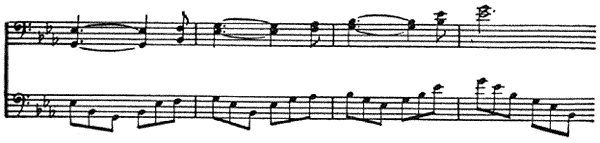
[Listen]
A horn intones this motive. Then one horn after another takes it up until its wave-like tones are heard on the eight horns. On the flowing accompaniment of the 'cellos the motive is carried to the wood-wind. It rises higher and higher, the other strings successively joining in the accompaniment, which now flows on in gentle undulations until the motive is heard on the high notes of the wood-wind, while the violins have joined in the accompaniment. When the theme thus seems to have stirred the waters from their depth to their surface the curtain rises.
The scene shows the bed and flowing waters of the Rhine, the light of day reaching the depths only as a greenish twilight. The current flows on over rugged rocks and through dark chasms.
Woglinde is circling gracefully around the central ridge of rock. To an accompaniment as wavy as the waters through which she swims, she sings:
Weia! Waga! Woge, du Welle, Walle zur Wiege! Wagala weia! Wallala, Weiala weia!
They are sung to the Motive of the Rhinedaughters.

[Listen]
Weia Waga! Woge, du Welle, walle zur Wiege! Wagala weia! wallala, weiala weia!
In wavy sport the Rhinedaughters dart from cliff to cliff. Meanwhile Alberich has clambered from the depths up to one of the cliffs, and watches, while standing in its shadow, the gambols of the Rhinedaughters. As he speaks to them there is a momentary harshness in the music, whose flowing rhythm is broken. In futile endeavours to clamber up to them, he inveighs against the "slippery slime" which causes him to lose his foothold.
Woglinde, Wellgunde, and Flosshilde in turn gambol almost within his reach, only to dart away again. He curses his own weakness in the Motive of the Nibelungs' Servitude.
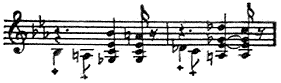
[Listen]
Swimming high above him the Rhinedaughters incite him with gleeful cries to chase them. Alberich tries to ascend, but always slips and falls down. Then his gaze is attracted and held by a glow which suddenly pervades the waves above him and increases until from the highest point of the central cliff a bright, golden ray shoots through the water. Amid the shimmering accompaniment of the violins is heard on the horn the Rhinegold Motive.

[Audio content is not currently supported on your device.
With shouts of triumph the Rhinedaughters swim around the rock. Their cry "Rhinegold," is a characteristic motive. The Rhinedaughters' Shout of Triumph and the accompaniment to it are as follows:
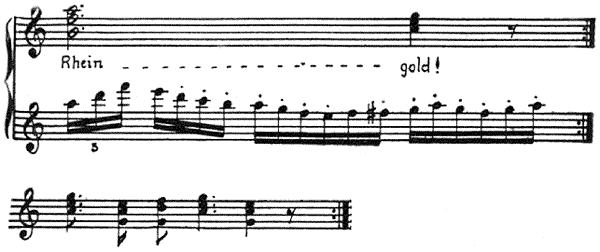
[Listen]
Rheingold!
As the river glitters with golden light the Rhinegold Motive rings out brilliantly on the trumpet. The Nibelung is fascinated by the sheen. The Rhinedaughters gossip with one another, and Alberich thus learns that the light is that of the Rhinegold, and that whoever shall shape a ring from this gold will become invested with great power. We hear The Ring Motive.

[Listen]
Flosshilde bids her sisters cease their prattle, lest some sinister foe should overhear them. Wellgunde and Woglinde ridicule their sister's anxiety, saying that no one would care to filch the gold, because it would give power only to him who abjures or renounces love. At this point is heard the darkly prophetic Motive of the Renunciation of Love.

[Listen]
Alberich reflects on the words of the Rhinedaughters. The Ring Motive occurs both in voice and orchestra in mysterious pianissimo (like an echo of Alberich's sinister thoughts), and is followed by the Motive of Renunciation. Then is heard the sharp, decisive rhythm of the Nibelung Motive. Alberich fiercely springs over to the central rock. The Rhinedaughters scream and dart away in different directions. Alberich has reached the summit of the highest cliff.
"Hark, ye floods! Love I renounce forever!" he cries, and amid the crash of the Rhinegold Motive he seizes the gold and disappears in the depths. With screams of terror the Rhinedaughters dive after the robber through the darkened water, guided by Alberich's shrill, mocking laugh.
There is a transformation. Waters and rocks sink. As they disappear, the billowy accompaniment sinks lower and lower in the orchestra. Above it rises once more the Motive of Renunciation. The Ring Motive is heard, and then, as the waves change into nebulous clouds, the billowy accompaniment rises pianissimo until, with a repetition of the Ring Motive, the action passes to the second scene. One crime has already been committed—the theft of the Rhinegold by Alberich. How that crime and the ring which he shapes from the gold inspire other crimes is told in the course of the following scenes of "Rhinegold." Hence the significance of the Ring Motive as a connecting link between the first and second scenes.
Scene II. Dawn illumines a castle with glittering turrets on a rocky height at the back. Through a deep valley between this and the foreground flows the Rhine.
The Walhalla Motive now heard is a motive of superb beauty. It greets us again and again in "Rhinegold" and frequently in the later music-dramas of the cycle. Walhalla is the abode of gods and heroes. Its motive is divinely, heroically beautiful. Though essentially broad and stately, it often assumes a tender mood, like the chivalric gentleness which every hero feels toward woman. Thus it is here. In crescendo and decrescendo it rises and falls, as rises and falls with each breath the bosom of the beautiful Fricka, who slumbers at Wotan's side.
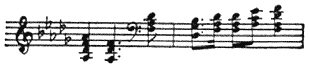
[Listen]
As Fricka awakens, her eyes fall on the castle. In her surprise she calls to her spouse. Wotan dreams on, the Ring Motive, and later the Walhalla Motive, being heard in the orchestra, for with the ring Wotan is planning to compensate the giants for building Walhalla, instead of rewarding them by presenting Freia to them as he has promised. As he opens his eyes and sees the castle you hear the Spear Motive, which is a characteristic variation of the Motive of Compact. For Wotan should enforce, if needful, the compacts of the gods with his spear.
Wotan sings of the glory of Walhalla. Fricka reminds him of his compact with the giants to deliver over to them for their work in building Walhalla, Freia, the Goddess of Youth and Beauty. This introduces on the 'cellos and double basses the Motive of Compact, a theme expressive of the binding force of law and with the inherent dignity and power of the sense of justice.

[Audio content is not currently supported on your device.
In a domestic spat between Wotan and Fricka, Wotan charges that she was as anxious as he to have Walhalla built. Fricka answers that she desired to have it erected in order to persuade him to lead a more domestic life. At Fricka's words,
"Halls, bright and gleaming,"
the Fricka Motive is heard, a caressing motive of much grace and beauty.

[Listen]
It is also prominent in Wotan's reply immediately following. Wotan tells Fricka that he never intended to really give up Freia to the giants. Chromatics, like little tongues of flame, appear in the accompaniment. They are suggestive of the Loge Motive, for with the aid of Loge the God of Fire, Wotan hopes to trick the giants and save Freia.
"Then save her at once!" calls Fricka, as Freia enters in hasty flight. The Motive of Flight is as follows:

[Listen]
The following is the Freia Motive:

[Listen]
With Freia's exclamations that the giants are pursuing her, the first suggestion of the Giant Motive appears and as these "great, hulking fellows" enter, the heavy, clumsy Giant Motive is heard in its entirety:

[Listen]
For the giants, Fasolt, and Fafner, have come to demand that Wotan deliver up to them Freia, according to his promise when they agreed to build Walhalla for him. In the ensuing scene, in which Wotan parleys with the Giants, the Giant Motive, the Walhalla Motive, the Motive of the Compact, and the first bar of the Freia Motive figure until Fasolt's threatening words,
"Peace wane when you break your compact,"
when there is heard a version of the Motive of Compact characteristic enough to be distinguished as the Motive of Compact with the Giants:

[Listen]
The Walhalla, Giant, and Freia motives again are heard until Fafner speaks of the golden apples which grow in Freia's garden. These golden apples are the fruit of which the gods partake in order to enjoy eternal youth. The Motive of Eternal Youth, which now appears, is one of the loveliest in the cycle. It seems as though age could not wither it, nor custom stale its infinite variety. Its first bar is reminiscent of the Ring Motive, for there is subtle relationship between the Golden Apples of Freia and the Rhinegold. Here is the Motive of Eternal Youth:

[Listen]
It is finely combined with the Giant Motive at Fafner's words:
"Let her forthwith be torn from them all."
Froh and Donner, Freia's brothers, enter hastily to save their sister. Froh clasps her in his arms, while Donner confronts the giants, the Motive of Eternal Youth rings out triumphantly on the horns and wood-wind. But Freia's hope is short-lived. For though Wotan desires to keep Freia in Walhalla, he dare not offend the giants. At this critical moment, however, he sees his cunning adviser, Loge, approaching. These are Loge's characteristic motives:

[Listen]
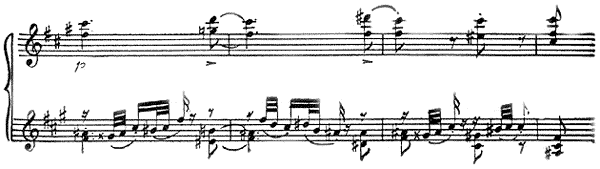
[Listen]
Wotan upbraids Loge for not having discovered something which the giants would be willing to accept as a substitute for Freia. Loge says he has travelled the world over without finding aught that would compensate man for the renunciation of a lovely woman. This leads to Loge's narrative of his wanderings. With great cunning he tells Wotan of the theft of the Rhinegold and of the wondrous worth of a ring shaped from the gold. Thus he incites the listening giants to ask for it as a compensation for giving up Freia. Hence Wagner, as Loge begins his narrative, has blended, with a marvellous sense of musical beauty and dramatic fitness, two phrases: the Freia Motive and the accompaniment to the Rhinedaughters' Shout of Triumph in the first scene. This music continues until Loge says that he discovered but one person (Alberich) who was willing to renounce love. Then the Rhinegold Motive is sounded tristly in a minor key and immediately afterward is heard the Motive of Renunciation.
Loge next tells how Alberich stole the gold. He has already excited the curiosity of the giants, and when Fafner asks him what power Alberich will gain through the possession of the gold, he dwells upon the magical attributes of the ring shaped from Rhinegold.
Loge's diplomacy is beginning to bear results. Fafner tells Fasolt that he deems the possession of the gold more important than Freia. Notice here how the Freia motive, so prominent when the giants insisted on her as their compensation, is relegated to the bass and how the Rhinegold Motive breaks in upon the Motive of Eternal Youth, as Fafner and Fasolt again advance toward Wotan, and bid him wrest the gold from Alberich and give it to them as ransom for Freia. Wotan refuses, for he himself now lusts for the ring made of Rhinegold. The giants having proclaimed that they will give Wotan until evening to determine upon his course, seize Freia and drag her away. Pallor now settles upon the faces of the gods; they seem to have grown older. They are affected by the absence of Freia, the Goddess of Youth, whose motives are but palely reflected by the orchestra. At last Wotan proclaims that he will go with Loge to Nibelung and wrest the entire treasure of Rhinegold from Alberich as ransom for Freia.
Loge disappears down a crevice in the side of the rock. From it a sulphurous vapour at once issues. When Wotan has followed Loge into the cleft the vapour fills the stage and conceals the remaining characters. The vapours thicken to a black cloud, continually rising upward until rocky chasms are seen. These have an upward motion, so that the stage appears to be sinking deeper and deeper. With a molto vivace the orchestra dashes into the Motive of Flight. From various distant points ruddy gleams of light illumine the chasms, and when the Flight Motive has died away, only the increasing clangour of the smithies is heard from all directions. This is the typical Nibelung Motive, characteristic of Alberich's Nibelungs toiling at the anvil for him. Gradually the sounds grow fainter.
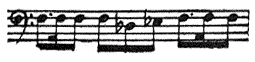
[Listen]
Then as the Ring Motive resounds like a shout of malicious triumph (expressive of Alberich's malignant joy at his possession of power), there is seen a subterranean cavern, apparently of illimitable depth, from which narrow shafts lead in all directions.
Scene III. Alberich enters from a side cleft dragging after him the shrieking Mime. The latter lets fall a helmet which Alberich at once seizes. It is the Tarnhelmet, made of Rhinegold, the wearing of which enables the wearer to become invisible or assume any shape. As Alberich closely examines the helmet the Motive of the Tarnhelmet is heard.

[Listen]
It is mysterious, uncanny. To test its power Alberich puts it on and changes into a column of vapour. He asks Mime if he is visible, and when Mime answers in the negative Alberich cries out shrilly, "Then feel me instead," at the same time making poor Mime writhe under the blows of a visible scourge. Alberich then departs—still in the form of a vaporous column—to announce to the Nibelungs that they are henceforth his slavish subjects. Mime cowers down with fear and pain.
Wotan and Loge enter from one of the upper shafts. Mime tells them how Alberich has become all-powerful through the ring and the Tarnhelmet made of the Rhinegold. Then Alberich, who has taken off the Tarnhelmet and hung it from his girdle, is seen in the distance, driving a crowd of Nibelungs before him from the caves below. They are laden with gold and silver, which he forces them to pile up in one place and so form a hoard. He suddenly perceives Wotan and Loge. After abusing Mime for permitting strangers to enter Nibelheim, he commands the Nibelungs to descend again into the cavern in search of new treasure for him. They hesitate. You hear the Ring Motive. Alberich draws the ring from his finger, stretches it threateningly toward the Nibelungs, and commands them to obey their master.
They disperse in headlong flight, with Mime, into the cavernous recesses. Alberich looks with mistrust upon Wotan and Loge. Wotan tells him they have heard report of his wealth and power and have come to ascertain if it is true. The Nibelung points to the hoard. He boasts that the whole world will come under his sway (Ring Motive), that the gods who now laugh and love in the enjoyment of youth and beauty will become subject to him (Freia Motive); for he has abjured love (Motive of Renunciation). Hence, even the gods in Walhalla shall dread him (Walhalla Motive) and he bids them beware of the time when the night-begotten host of the Nibelungs shall rise from Nibelheim into the realm of daylight. (Rhinegold Motive followed by Walhalla Motive, for it is through the power gained by the Rhinegold that Alberich hopes to possess himself of Walhalla.) Loge cunningly flatters Alberich, and when the latter tells him of the Tarnhelmet, feigns disbelief of Alberich's statements. Alberich, to prove their truth, puts on the helmet and transforms himself into a huge serpent. The Serpent Motive expresses the windings and writhings of the monster. The serpent vanishes and Alberich reappears. When Loge doubts if Alberich can transform himself into something very small, the Nibelung changes into a toad. Now is Loge's chance. He calls Wotan to set his foot on the toad. As Wotan does so, Loge puts his hand to its head and seizes the Tarnhelmet. Alberich is seen writhing under Wotan's foot. Loge binds Alberich; both seize him, drag him to the shaft from which they descended and disappear ascending.
The scene changes in the reverse direction to that in which it changed when Wotan and Loge were descending to Nibelheim. The orchestra accompanies the change of scene. The Ring Motive dies away from crashing fortissimo to piano, to be succeeded by the dark Motive of Renunciation. Then is heard the clangour of the Nibelung smithies. The Giant, Walhalla, Loge, and Servitude Motives follow the last with crushing force as Wotan and Loge emerge from the cleft, dragging the pinioned Alberich with them. His lease of power was brief. He is again in a condition of servitude.
Scene IV. A pale mist still veils the prospect as at the end of the second scene. Loge and Wotan place Alberich on the ground and Loge dances around the pinioned Nibelung, mockingly snapping his fingers at the prisoner. Wotan joins Loge in his mockery of Alberich. The Nibelung asks what he must give for his freedom. "Your hoard and your glittering gold," is Wotan's answer. Alberich assents to the ransom and Loge frees the gnome's right hand. Alberich raises the ring to his lips and murmurs a secret behest. The Nibelungs emerge from the cleft and heap up the hoard. Then, as Alberich stretches out the ring toward them, they rush in terror toward the cleft, into which they disappear. Alberich now asks for his freedom, but Loge throws the Tarnhelmet on to the heap. Wotan demands that Alberich also give up the ring. At these words dismay and terror are depicted on the Nibelung's face. He had hoped to save the ring, but in vain. Wotan tears it from the gnome's finger. Then Alberich, impelled by hate and rage, curses the ring. The Motive of the Curse:

[Listen]
To it should be added the syncopated measures expressive of the ever-threatening and ever-active Nibelung's Hate:

[Listen]
Amid heavy thuds of the Motive of Servitude Alberich vanishes in the cleft.
The mist begins to rise. It grows lighter. The Giant Motive and the Motive of Eternal Youth are heard, for the giants are approaching with Freia. Donner, Froh, and Fricka hasten to greet Wotan. Fasolt and Fafner enter with Freia. It has grown clear except that the mist still hides the distant castle. Freia's presence seems to have restored youth to the gods. Fasolt asks for the ransom for Freia. Wotan points to the hoard. With staves the giants measure off a space of the height and width of Freia. That space must be filled out with treasure.
Loge and Froh pile up the hoard, but the giants are not satisfied even when the Tarnhelmet has been added. They wish also the ring to fill out a crevice. Wotan turns in anger away from them. A bluish light glimmers in the rocky cleft to the right, and through it Erda rises. She warns Wotan against retaining possession of the ring. The Erda Motive bears a strong resemblance to the Rhine Motive.
The syncopated notes of the Nibelung's Malevolence, so threateningly indicative of the harm which Alberich is plotting, are also heard in Erda's warning.
Wotan, heeding her words, throws the ring upon the hoard. The giants release Freia, who rushes joyfully towards the gods. Here the Freia Motive combined with the Flight Motive, now no longer agitated but joyful, rings out gleefully. Soon, however, these motives are interrupted by the Giant and Nibelung motives, and later the Nibelung's Hate and Ring Motive. For Alberich's curse already is beginning its dread work. The giants dispute over the spoils, their dispute waxes to strife, and at last Fafner slays Fasolt and snatches the ring from the dying giant, while, as the gods gaze horror-stricken upon the scene, the Curse Motive resounds with crushing force.
Loge congratulates Wotan on having given up the curse-laden ring. But even Fricka's caresses, as she asks Wotan to lead her into Walhalla, cannot divert the god's mind from dark thoughts, and the Curse Motive accompanies his gloomy reflections—for the ring has passed through his hands. It was he who wrested it from Alberich—and its curse rests on all who have touched it.
Donner ascends to the top of a lofty rock. He gathers the mists around him until he is enveloped by a black cloud. He swings his hammer. There is a flash of lightning, a crash of thunder, and lo! the cloud vanishes. A rainbow bridge spans the valley to Walhalla, which is illumined by the setting sun.
Wotan eloquently greets Walhalla, and then, taking Fricka by the hand, leads the procession of the gods into the castle.
The music of this scene is of wondrous eloquence and beauty. Six harps are added to the ordinary orchestral instruments, and as the variegated bridge is seen their arpeggios shimmer like the colours of the rainbow around the broad, majestic Rainbow Motive:

[Listen]
Then the stately Walhalla Motive resounds as the gods gaze, lost in admiration, at the Walhalla. It gives way to the Ring Motive as Wotan speaks of the day's ills; and then as he is inspired by the idea of begetting a race of demigods to conquer the Nibelungs, there is heard for the first time the Sword Motive:

[Listen]
The cries of the Rhinedaughters greet Wotan. They beg him to restore the ring to them. But Wotan must remain deaf to their entreaties. He gave the ring, which he should have restored to the Rhinedaughters, to the giants, as ransom for Freia.
The Walhalla Motive swells to a majestic climax and the gods enter the castle. Amid shimmering arpeggios the Rainbow Motive resounds. The gods have attained the height of their glory—but the Nibelung's curse is still potent, and it will bring woe upon all who have possessed or will possess the ring until it is restored to the Rhinedaughters. Fasolt was only the first victim of Alberich's curse.
DIE WALKÜRE THE VALKYR
Music-drama in three acts, words and music by Richard Wagner. Produced, Munich, June 25, 1870. New York, Academy of Music, April 2, 1877, an incomplete and inadequate performance with Pappenheim as Brünnhilde, Pauline Canissa Sieglinde, A. Bischoff Siegmund, Felix Preusser Wotan, A. Blum Hunding, Mme. Listner Fricka, Frida de Gebel, Gerhilde, Adolf Neuendorff, conductor. The real first performance in America was conducted by Dr. Leopold Damrosch at the Metropolitan Opera House, January 30, 1885, with Materna, the original Bayreuth Brünnhilde in that rôle, Schott as Siegmund, Seidl-Kraus as Sieglinde, Marianne Brandt as Fricka, Staudigl as Wotan, and Kögel as Hunding.
Characters
SiegmundTenor
HundingBass
WotanBaritone-Bass
SieglindeSoprano
BrünnhildeSoprano
FrickaMezzo-Soprano
Valkyrs (Sopranos and Mezzo-Sopranos): Gerhilde, Ortlinde, Waltraute, Schwertleite, Helmwige, Siegrune, Grimgerde, Rossweisse.
Time—Legendary.
Place—Interior of Hunding's hut; a rocky height; the peak of a rocky mountain (the Brünnhilde-rock).
Wotan's enjoyment of Walhalla was destined to be short-lived. Filled with dismay by the death of Fasolt in the combat of the giants for the accursed ring, and impelled by a dread presentiment that the force of the curse would be visited upon the gods, he descended from Walhalla to the abode of the all-wise woman, Erda, who bore him nine daughters. These were the Valkyrs, headed by Brünnhilde—the wild horsewomen of the air, who on winged steeds bore the dead heroes to Walhalla, the warriors' heaven. With the aid of the Valkyrs and the heroes they gathered to Walhalla, Wotan hoped to repel any assault upon his castle by the enemies of the gods.
But though the host of heroes grew to a goodly number, the terror of Alberich's curse still haunted the chief of gods. He might have freed himself from it had he returned the ring and helmet made of Rhinegold to the Rhinedaughters, from whom Alberich filched it; but in his desire to persuade the giants to relinquish Freia, whom he had promised to them as a reward for building Walhalla, he, having wrested the ring from Alberich, gave it to the giants instead of returning it to the Rhinedaughters. He saw the giants contending for the possession of the ring and saw Fasolt slain—the first victim of Alberich's curse. He knows that the giant Fafner, having assumed the shape of a huge serpent, now guards the Nibelung treasure, which includes the ring and the Tarnhelmet, in a cave in the heart of a dense forest. How shall the Rhinegold be restored to the Rhinedaughters?
Wotan hopes that this may be consummated by a human hero who, free from the lust for power which obtains among the gods, shall, with a sword of Wotan's own forging, slay Fafner, gain possession of the Rhinegold and restore it to its rightful owners, thus righting Wotan's guilty act and freeing the gods from the curse. To accomplish this Wotan, in human guise as Wälse, begets, in wedlock with a human, the twins Siegmund and Sieglinde. How the curse of Alberich is visited upon these is related in "The Valkyr."
The dramatis personæ in "The Valkyr" are Brünnhilde, the valkyr, and her eight sister valkyrs; Fricka, Sieglinde, Siegmund, Hunding (the husband of Sieglinde), and Wotan. The action begins after the forced marriage of Sieglinde to Hunding. The Wälsungs are in ignorance of the divinity of their father. They know him only as Wälse.
Act I. In the introduction to "The Rhinegold," we saw the Rhine flowing peacefully toward the sea and the innocent gambols of the Rhinedaughters. But "The Valkyr" opens in storm and stress. The peace and happiness of the first scene of the cycle seem to have vanished from the earth with Alberich's abjuration of love, his theft of the gold, and Wotan's equally treacherous acts.
This "Valkyr" Vorspiel is a masterly representation in tone of a storm gathering for its last infuriated onslaught. The elements are unleashed. The wind sweeps through the forest. Lightning flashes in jagged streaks across the black heavens. There is a crash of thunder and the storm has spent its force.
Two leading motives are employed in this introduction. They are the Storm Motive and the Donner Motive. The Storm Motive is as follows:

[Listen]
These themes are elemental. From them Wagner has composed storm music of convincing power.
In the early portion of this vorspiel only the string instruments are used. Gradually the instrumentation grows more powerful. With the climax we have a tremendous ff on the contra tuba and two tympani, followed by the crash of the Donner Motive on the wind instruments.
The storm then gradually dies away. Before it has quite passed over, the curtain rises, revealing the large hall of Hunding's dwelling. This hall is built around a huge ash-tree, whose trunk and branches pierce the roof, over which the foliage is supposed to spread. There are walls of rough-hewn boards, here and there hung with large plaited and woven hangings. In the right foreground is a large open hearth; back of it in a recess is the larder, separated from the hall by a woven hanging, half drawn. In the background is a large door. A few steps in the left foreground lead up to the door of an inner room. The furniture of the hall is primitive and rude. It consists chiefly of a table, bench, and stools in front of the ash-tree. Only the light of the fire on the hearth illumines the room; though occasionally its fitful gleam is slightly intensified by a distant flash of lightning from the departing storm.
The door in the background is opened from without. Siegmund, supporting himself with his hand on the bolt, stands in the entrance. He seems exhausted. His appearance is that of a fugitive who has reached the limit of his powers of endurance. Seeing no one in the hall, he staggers toward the hearth and sinks upon a bearskin rug before it, with the exclamation:
Whose hearth this may be, Here I must rest me.
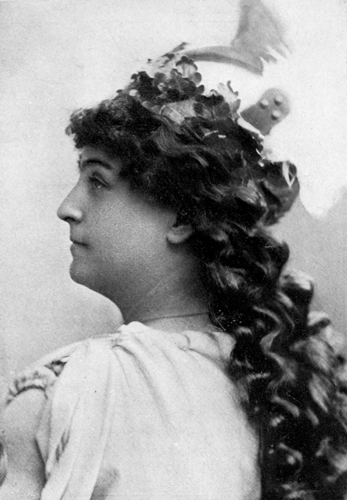
Lilli Lehmann as Brünnhilde in “Die Walküre”
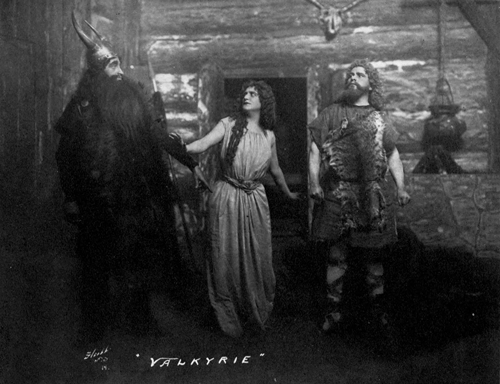
Photo by Hall
“The Valkyr.” Act I Hunding (Parker), Sieglinde (Rennyson), and Siegmund (Maclennan)
Wagner's treatment of this scene is masterly. As Siegmund stands in the entrance we hear the Siegmund Motive. This is a sad, weary strain on 'cellos and basses. It seems the wearier for the burden of an accompanying figure on the horns, beneath which it seems to stagger as Siegmund staggers toward the hearth. Thus the music not only reflects Siegmund's weary mien, but accompanies most graphically his weary gait. Perhaps Wagner's intention was more metaphysical. Maybe the burden beneath which the Siegmund Motive staggers is the curse of Alberich. It is through that curse that Siegmund's life has been one of storm and stress.

[Audio content is not currently supported on your device.
When the storm-beaten Wälsung has sunk upon the rug the Siegmund Motive is followed by the Storm Motive, pp—and the storm has died away. The door of the room to the left opens and a young woman—Sieglinde—appears. She has heard someone enter, and, thinking her husband returned, has come forth to meet him—not impelled to this by love, but by fear. For Hunding had, while her father and kinsmen were away on the hunt, laid waste their dwelling and abducted her and forcibly married her. Ill-fated herself, she is moved to compassion at sight of the storm-driven fugitive before the hearth, and bends over him.
Her compassionate action is accompanied by a new motive, which by Wagner's commentators has been entitled the Motive of Compassion. But it seems to me to have a further meaning as expressing the sympathy between two souls, a tie so subtle that it is at first invisible even to those whom it unites. Siegmund and Sieglinde, it will be remembered, belong to the same race; and though they are at this point of the action unknown to one another, yet, as Sieglinde bends over the hunted, storm-beaten Siegmund, that subtle sympathy causes her to regard him with more solicitude than would be awakened by any other unfortunate stranger. Hence I have called this motive the Motive of Sympathy—taking sympathy in its double meaning of compassion and affinity of feeling:

[Listen]
The beauty of this brief phrase is enhanced by its unpretentiousness. It wells up from the orchestra as spontaneously as pity mingled with sympathetic sorrow wells up from the heart of a gentle woman. As it is Siegmund who has awakened these feelings in Sieglinde, the Motive of Sympathy is heard simultaneously with the Siegmund Motive.
Siegmund, suddenly raising his head, ejaculates, "Water, water!" Sieglinde hastily snatches up a drinking-horn and, having quickly filled it at a spring near the house, swiftly returns and hands it to Siegmund. As though new hope were engendered in Siegmund's breast by Sieglinde's gentle ministration, the Siegmund Motive rises higher and higher, gathering passion in its upward sweep and then, combined again with the Motive of Sympathy, sinks to an expression of heartfelt gratitude. This passage is scored entirely for strings. Yet no composer, except Wagner, has evoked from a full orchestra sounds richer or more sensuously beautiful.
Having quaffed from the proffered cup the stranger lifts a searching gaze to her features, as if they awakened within him memories the significance of which he himself cannot fathom. She, too, is strangely affected by his gaze. How has fate interwoven their lives that these two people, a man and a woman, looking upon each other apparently for the first time, are so thrilled by a mysterious sense of affinity?
Here occurs the Love Motive played throughout as a violoncello solo, with accompaniment of eight violoncellos and two double basses; exquisite in tone colour and one of the most tenderly expressive phrases ever penned.

[Audio content is not currently supported on your device.
The Love Motive is the mainspring of this act. For this act tells the story of love from its inception to its consummation. Similarly in the course of this act the Love Motive rises by degrees of intensity from an expression of the first tender presentiment of affection to the very ecstasy of love.
Siegmund asks with whom he has found shelter. Sieglinde replies that the house is Hunding's, and she his wife, and requests Siegmund to await her husband's return.
Weaponless am I: The wounded guest, He will surely give shelter,
is Siegmund's reply. With anxious celerity, Sieglinde asks him to show her his wounds. But, refreshed by the draught of cool spring water and with hope revived by her sympathetic presence, he gathers force and, raising himself to a sitting posture, exclaims that his wounds are but slight; his frame is still firm, and had sword and shield held half so well, he would not have fled from his foes. His strength was spent in flight through the storm, but the night that sank on his vision has yielded again to the sunshine of Sieglinde's presence. At these words the Motive of Sympathy rises like a sweet hope. Sieglinde fills the drinking-horn with mead and offers it to Siegmund. He asks her to take the first sip. She does so and then hands it to him. His eyes rest upon her while he drinks. As he returns the drinking-horn to her there are traces of deep emotion in his mien. He sighs and gloomily bows his head. The action at this point is most expressively accompanied by the orchestra. Specially noteworthy is an impassioned upward sweep of the Motive of Sympathy as Siegmund regards Sieglinde with traces of deep emotion in his mien.
In a voice that trembles with emotion, he says: "You have harboured one whom misfortune follows wherever he wends his footsteps. Lest through me misfortune enter this house, I will depart." With firm, determined strides he already has reached the door, when she, forgetting all in the vague memories that his presence have stirred within her, calls after him:
"Tarry! You cannot bring sorrow to the house where sorrow already reigns!"
Her words are followed by a phrase freighted as if with sorrow, the Motive of the Wälsung Race, or Wälsung Motive:

[Listen]
Siegmund returns to the hearth, while she, as if shamed by her outburst of feeling, allows her eyes to sink toward the ground. Leaning against the hearth, he rests his calm, steady gaze upon her, until she again raises her eyes to his, and they regard each other in long silence and with deep emotion. The woman is the first to start. She hears Hunding leading his horse to the stall, and soon afterward he stands upon the threshold looking darkly upon his wife and the stranger. Hunding is a man of great strength and stature, his eyes heavy-browed, his sinister features framed in thick black hair and beard, a sombre, threatful personality boding little good to whomever crosses his path.
With the approach of Hunding there is a sudden change in the character of the music. Like a premonition of Hunding's entrance we hear the Hunding Motive, pp. Then as Hunding, armed with spear and shield, stands upon the threshold, this Hunding Motive—as dark, forbidding, and portentous of woe to the two Wälsungs as Hunding's sombre visage—resounds with dread power on the tubas:

[Audio content is not currently supported on your device.
Although weaponless, and Hunding armed with spear and shield, the fugitive meets his scrutiny without flinching, while the woman, anticipating her husband's inquiry, explains that she had discovered him lying exhausted at the hearth and given him shelter. With an assumed graciousness that makes him, if anything, more forbidding, Hunding orders her prepare the meal. While she does so he glances repeatedly from her to the stranger whom she has harboured, as if comparing their features and finding in them something to arouse his suspicions. "How like unto her," he mutters.
"Your name and story?" he asks, after they have seated themselves at the table in front of the ash-tree, and when the stranger hesitates, Hunding points to the woman's eager, inquiring look.
"Guest," she urges, little knowing the suspicions her husband harbours, "gladly would I know whence you come."
Slowly, as if oppressed by heavy memories, he begins his story, carefully, however, continuing to conceal his name, since for all he knows, Hunding may be one of the enemies of his race. Amid incredible hardships, surrounded by enemies against whom he and his kin constantly were obliged to defend themselves, he grew up in the forest. He and his father returned from one of their hunts to find the hut in ashes, his mother a corpse, and no trace of his twin sister. In one of the combats with their foes he became separated from his father.
At this point you hear the Walhalla Motive, for Siegmund's father was none other than Wotan, known to his human descendants, however, only as Wälse. In Wotan's narrative in the next act it will be discovered that Wotan purposely created these misfortunes for Siegmund, in order to strengthen him for his task.
Continuing his narrative Siegmund says that, since losing track of his father, he has wandered from place to place, ever with misfortune in his wake. That very day he has defended a maid whom her brothers wished to force into marriage. But when, in the combat that ensued, he had slain her brothers, she turned upon him and denounced him as a murderer, while the kinsmen of the slain, summoned to vengeance, attacked him from all quarters. He fought until shield and sword were shattered, then fled to find chance shelter in Hunding's dwelling.
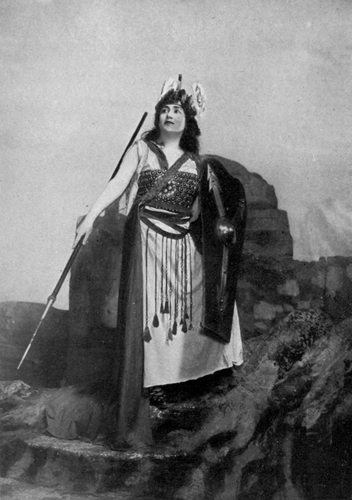
Photo by White
Fremstad as Brünnhilde in “Die Walküre”
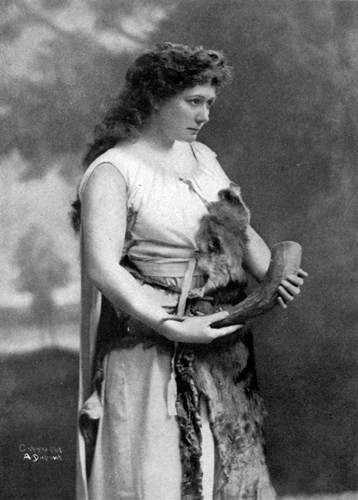
Copyright photo by Dupont
Fremstad as Sieglinde in “Die Walküre”
The story of Siegmund is told in melodious recitative. It is not a melody in the old-fashioned meaning of the term, but it fairly teems with melodiousness. It will have been observed that incidents very different in kind are related by Siegmund. It would be impossible to treat this narrative with sufficient variety of expression in a melody. But in Wagner's melodious recitative the musical phrases reflect every incident narrated by Siegmund. For instance, when Siegmund tells how he went hunting with his father there is joyous freshness and abandon in the music, which, however, suddenly sinks to sadness as he narrates how they returned and found the Wälsung dwelling devastated by enemies. We hear also the Hunding Motive at this point, which thus indicates that whose who brought this misfortune upon the Wälsungs were none other than Hunding and his kinsmen. As Siegmund tells how, when he was separated from his father, he sought to mingle with men and women, you hear the Love Motive, while his description of his latest combat is accompanied by the rhythm of the Hunding Motive. Those whom Siegmund slew were Hunding's kinsmen. Thus Siegmund's dark fate has driven him to seek shelter in the house of the very man who is the arch-enemy of his race and is bound by the laws of kinship to avenge on Siegmund the death of kinsmen.
As Siegmund concludes his narrative the Wälsung Motive is heard. Gazing with ardent longing toward Sieglinde, he says:
Now know'st thou, questioning wife, Why "Peaceful" is not my name.
These words are sung to a lovely phrase. Then, as Siegmund rises and strides over to the hearth, while Sieglinde, pale and deeply affected by his tale, bows her head, there is heard on the horns, bassoons, violas, and 'cellos a motive expressive of the heroic fortitude of the Wälsungs in struggling against their fate. It is the Motive of the Wälsungs' Heroism, a motive steeped in the tragedy of futile struggle against destiny.
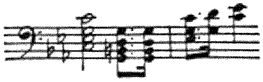
[Listen]
The sombre visage at the head of the table has grown even darker and more threatening. Hunding arises. "I know a ruthless race to whom nothing is sacred, and hated of all," he says. "Mine were the kinsmen you slew. I, too, was summoned from my home to take blood vengeance upon the slayer. Returning, I find him here. You have been offered shelter for the night, and for the night you are safe. But tomorrow be prepared to defend yourself."
Alone, unarmed, and in the house of his enemy! And yet the same roof harbours a friend—the woman. What strange affinity has brought them together under the eye of the pitiless savage with whom she has been forced into marriage? The embers on the hearth collapse. The glow that for a moment pervades the room seems to his excited senses a reflection from the eyes of the woman to whom he has been so unaccountably yet so strongly drawn. Even the spot on the old ash-tree, where he saw her glance linger before she left the room, seems to have caught its sheen. Then the embers die out. All grows dark.
The scene is eloquently set to music. Siegmund's gloomy thoughts are accompanied by the threatening rhythm of the Hunding Motive and the Sword Motive in a minor key, for Siegmund is still weaponless.
A sword my father did promise.... Wälse! Wälse! Where is thy sword!
The Sword Motive rings out like a shout of triumph. As the embers of the fire collapse, there is seen in the glare, that for a moment falls upon the ash-tree, the hilt of a sword whose blade is buried in the trunk of the tree at the point upon which Sieglinde's look last rested. While the Motive of the Sword gently rises and falls, like the coming and going of a lovely memory, Siegmund apostrophizes the sheen as the reflection of Sieglinde's glance. And although the embers die out, and night falls upon the scene, in Siegmund's thoughts the memory of that pitying, loving look glimmers on.
Is it his excited fancy that makes him hear the door of the inner chamber softly open and light footsteps coming in his direction? No; for he becomes conscious of a form, her form, dimly limned upon the darkness. He springs to his feet. Sieglinde is by his side. She has given Hunding a sleeping-potion. She will point out a weapon to Siegmund—a sword. If he can wield it she will call him the greatest hero, for only the mightiest can wield it. The music quickens with the subdued excitement in the breasts of the two Wälsungs. You hear the Sword Motive and above it, on horns, clarinet, and oboe, a new motive—that of the Wälsungs' Call to Victory:

[Listen]
for Sieglinde hopes that with the sword the stranger, who has awakened so quickly love in her breast, will overcome Hunding. This motive has a resistless, onward sweep. Sieglinde, amid the strains of the stately Walhalla Motive, followed by the Sword Motive, narrates the story of the sword. While Hunding and his kinsmen were feasting in honour of her forced marriage with him, an aged stranger entered the hall. The men knew him not and shrank from his fiery glance. But upon her his look rested with tender compassion. With a mighty thrust he buried a sword up to its hilt in the trunk of the ash-tree. Whoever drew it from its sheath to him it should belong. The stranger went his way. One after another the strong men tugged at the hilt—but in vain. Then she knew who the aged stranger was and for whom the sword was destined.
The Sword Motive rings out like a joyous shout, and Sieglinde's voice mingles with the triumphant notes of the Wälsungs' Call to Victory as she turns to Siegmund:
O, found I in thee The friend in need!
The Motive of the Wälsungs' heroism, now no longer full of tragic import, but forceful and defiant—and Siegmund holds Sieglinde in his embrace.
There is a rush of wind. The woven hangings flap and fall. As the lovers turn, a glorious sight greets their eyes. The landscape is illumined by the moon. Its silver sheen flows down the hills and quivers along the meadows whose grasses tremble in the breeze. All nature seems to be throbbing in unison with the hearts of the lovers, and, turning to the woman, Siegmund greets her with the Love Song:

[Listen]
The Love Motive, impassioned, irresistible, sweeps through the harmonies—and Love and Spring are united. The Love Motive also pulsates through Sieglinde's ecstatic reply after she has given herself fully up to Siegmund in the Flight Motive—for before his coming her woes have fled as winter flies before the coming of spring. With Siegmund's exclamation:
Oh, wondrous vision! Rapturous woman!
there rises from the orchestra like a vision of loveliness the Motive of Freia, the Venus of German mythology. In its embrace it folds this pulsating theme:

[Listen]
It throbs on like a love-kiss until it seemingly yields to the blandishments of this caressing phrase:

[Listen]
This throbbing, pulsating, caressing music is succeeded by a moment of repose. The woman again gazes searchingly into the man's features. She has seen his face before. When? Now she remembers. It is when she has seen her own reflection in a brook! And his voice? It seems to her like an echo of her own. And his glance; has it never before rested on her? She is sure it has, and she will tell him when.
She repeats how, while Hunding and his kinsmen were feasting at her marriage, an aged man entered the hall and, drawing a sword, thrust it to the hilt in the ash-tree. The first to draw it out, to him it should belong. One after another the men strove to loosen the sword, but in vain. Once the aged man's glance rested on her and shone with the same light as now shines in his who has come to her through night and storm. He who thrust the sword into the tree was of her own race, the Wälsungs. Who is he?
"I, too, have seen that light, but in your eyes!" exclaimed the fugitive. "I, too, am of your race. I, too, am a Wälsung, my father none other than Wälse himself."
"Was Wälse your father?" she cries ecstatically. "For you, then, this sword was thrust in the tree! Let me name you, as I recall you from far back in my childhood, Siegmund—Siegmund—Siegmund!"
"Yes, I am Siegmund; and you, too, I now know well. You are Sieglinde. Fate has willed that we two of our unhappy race, shall meet again and save each other or perish together."
Then, leaping upon the table, he grasps the sword-hilt which protrudes from the trunk of the ash-tree where he has seen that strange glow in the light of the dying embers. A mighty tug, and he draws it from the tree as a blade from its scabbard. Brandishing it in triumph, he leaps to the floor and, clasping Sieglinde, rushes forth with her into the night.
And the music? It fairly seethes with excitement. As Siegmund leaps upon the table, the Motive of the Wälsungs' Heroism rings out as if in defiance of the enemies of the race. The Sword Motive—and he has grasped the hilt; the Motive of Compact, ominous of the fatality which hangs over the Wälsungs; the Motive of Renunciation, with its threatening import; then the Sword Motive—brilliant like the glitter of refulgent steel—and Siegmund has unsheathed the sword. The Wälsungs' Call to Victory, like a song of triumph; a superb upward sweep of the Sword Motive; the Love Motive, now rushing onward in the very ecstasy of passion, and Siegmund holds in his embrace Sieglinde, his bride—of the same doomed race as himself!
Act II. In the Vorspiel the orchestra, with an upward rush of the Sword Motive, resolved into 9-8 time, the orchestra dashes into the Motive of Flight. The Sword Motive in this 9-8 rhythm closely resembles the Motive of the Valkyr's Ride, and the Flight Motive in the version in which it appears is much like the Valkyr's Shout. The Ride and the Shout are heard in the course of the Vorspiel, the former with tremendous force on trumpets and trombones as the curtain rises on a wild, rocky mountain pass, at the back of which, through a natural rock-formed arch, a gorge slopes downward.
In the foreground stands Wotan, armed with spear, shield, and helmet. Before him is Brünnhilde in the superb costume of the Valkyr. The stormy spirit of the Vorspiel pervades the music of Wotan's command to Brünnhilde that she bridle her steed for battle and spur it to the fray to do combat for Siegmund against Hunding. Brünnhilde greets Wotan's command with the weirdly joyous Shout of the Valkyrs
Hojotoho! Heiaha-ha.
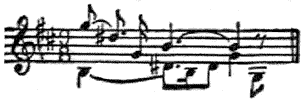
[Listen]
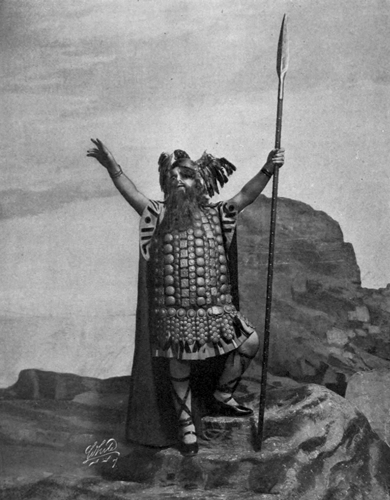
Photo by White
Weil as Wotan in “Die Walküre”
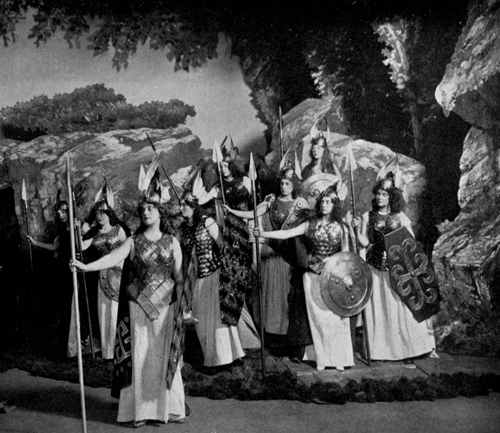
Photo by Hall
“Die Walküre.” Act III Brünnhilde (Margaret Crawford)
It is the cry of the wild horsewomen of the air, coursing through storm-clouds, their shields flashing back the lightning, their voices mingling with the shrieks of the tempest. Weirder, wilder joy has never found expression in music. One seems to see the steeds of the air and streaks of lightning playing around their riders, and to hear the whistling of the wind.
The accompanying figure is based on the Motive of the Ride of the Valkyrs:

[Listen]
Brünnhilde, having leapt from rock to rock to the highest peak of the mountain, again faces Wotan, and with delightful banter calls to him that Fricka is approaching in her ram-drawn chariot. Fricka has appeared, descended from her chariot, and advances toward Wotan, Brünnhilde having meanwhile disappeared behind the mountain height.
Fricka is the protector of the marriage vow, and as such she has come in anger to demand from Wotan vengeance in behalf of Hunding. As she advances hastily toward Wotan, her angry, passionate demeanour is reflected by the orchestra, and this effective musical expression of Fricka's ire is often heard in the course of the scene. When near Wotan she moderates her pace, and her angry demeanour gives way to sullen dignity.
Wotan, though knowing well what has brought Fricka upon the scene, feigns ignorance of the cause of her agitation and asks what it is that harasses her. Her reply is preceded by the stern Hunding motive. She tells Wotan that she, as the protectress of the sanctity of the marriage vow, has heard Hunding's voice calling for vengeance upon the Wälsung twins. Her words, "His voice for vengeance is raised," are set to a phrase strongly suggestive of Alberich's curse. It seems as though the avenging Nibelung were pursuing Wotan's children and thus striking a blow at Wotan himself through Fricka. The Love Motive breathes through Wotan's protest that Siegmund and Sieglinde only yielded to the music of the spring night. Wotan argues that Siegmund and Sieglinde are true lovers, and Fricka should smile instead of venting her wrath on them. The motive of the Love Song, the Love Motive, and the caressing phrase heard in the love scene are beautifully blended with Wotan's words. In strong contrast to these motives is the music in Fricka's outburst of wrath, introduced by the phrase reflecting her ire, which is repeated several times in the course of this episode. Wotan explains to her why he begat the Wälsung race and the hopes he has founded upon it. But Fricka mistrusts him. What can mortals accomplish that the gods, who are far mightier than mortals, cannot accomplish? Hunding must be avenged on Siegmund and Sieglinde. Wotan must withdraw his protection from Siegmund. Now appears a phrase which expresses Wotan's impotent wrath—impotent because Fricka brings forward the unanswerable argument that if the Wälsungs go unpunished by her, as guardian of the marriage vow, she, the Queen of the Gods, will be held up to the scorn of mankind.
Wotan would fain save the Wälsungs. But Fricka's argument is conclusive. He cannot protect Siegmund and Sieglinde, because their escape from punishment would bring degradation upon the queen-goddess and the whole race of the gods, and result in their immediate fall. Wotan's wrath rises at the thought of sacrificing his beloved children to the vengeance of Hunding, but he is impotent. His far-reaching plans are brought to nought. He sees the hope of having the Ring restored to the Rhinedaughters by the voluntary act of a hero of the Wälsung race vanish. The curse of Alberich hangs over him like a dark, threatening cloud. The Motive of Wotan's Wrath is as follows:
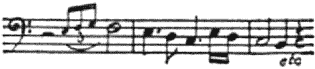
[Listen]
Brünnhilde's joyous shouts are heard from the height. Wotan exclaims that he had summoned the Valkyr to do battle for Siegmund. In broad, stately measures, Fricka proclaims that her honour shall be guarded by Brünnhilde's shield and demands of Wotan an oath that in the coming combat the Wälsung shall fall. Wotan takes the oath and throws himself dejectedly down upon a rocky seat. Fricka strides toward the back. She pauses a moment with a gesture of queenly command before Brünnhilde, who has led her horse down the height and into a cave to the right, then departs.
In this scene we have witnessed the spectacle of a mighty god vainly struggling to avert ruin from his race. That it is due to irresistible fate and not merely to Fricka that Wotan's plans succumb, is made clear by the darkly ominous notes of Alberich's Curse, which resound as Wotan, wrapt in gloomy brooding, leans back against the rocky seat, and also when, in a paroxysm of despair, he gives vent to his feelings, a passage which, for overpowering intensity of expression, stands out even from among Wagner's writings. The final words of this outburst of grief:
The saddest I among all men,
are set to this variant of the Motive of Renunciation; the meaning of this phrase having been expanded from the renunciation of love by Alberich to cover the renunciation of happiness which is forced upon Wotan by avenging fate:
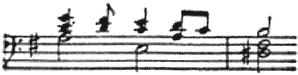
[Listen]
Brünnhilde casts away shield, spear, and helmet, and sinking down at Wotan's feet looks up to him with affectionate anxiety. Here we see in the Valkyr the touch of tenderness, without which a truly heroic character is never complete.
Musically it is beautifully expressed by the Love Motive, which, when Wotan, as if awakening from a reverie, fondly strokes her hair, goes over into the Siegmund Motive. It is over the fate of his beloved Wälsungs Wotan has been brooding. Immediately following Brünnhilde's words,
What an I were I not thy will,
is a wonderfully soft yet rich melody on four horns. It is one of those beautiful details in which Wagner's works abound.
In Wotan's narrative, which now follows, the chief of the gods tells Brünnhilde of the events which have brought this sorrow upon him, of his failure to restore the stolen gold to the Rhinedaughters; of his dread of Alberich's curse; how she and her sister Valkyrs were born to him by Erda; of the necessity that a hero should without aid of the gods gain the Ring and Tarnhelmet from Fafner and restore the Rhinegold to the Rhinedaughters; how he begot the Wälsungs and inured them to hardships in the hope that one of the race would free the gods from Alberich's curse.
The motives heard in Wotan's narrative will be recognized, except one, which is new. This is expressive of the stress to which the gods are subjected through Wotan's crime. It is first heard when Wotan tells of the hero who alone can regain the ring. It is the Motive of the Gods' Stress.

[Listen]
Excited by remorse and despair Wotan bids farewell to the glory of the gods. Then he in terrible mockery blesses the Nibelung's heir—for Alberich has wedded and to him has been born a son, upon whom the Nibelung depends to continue his death struggle with the gods. Terrified by this outburst of wrath, Brünnhilde asks what her duty shall be in the approaching combat. Wotan commands her to do Fricka's bidding and withdraw protection from Siegmund. In vain Brünnhilde pleads for the Wälsung whom she knows Wotan loves, and wished a victor until Fricka exacted a promise from him to avenge Hunding. But her pleading is in vain. Wotan is no longer the all-powerful chief of the gods—through his breach of faith he has become the slave of fate. Hence we hear, as Wotan rushes away, driven by chagrin, rage, and despair, chords heavy with the crushing force of fate.
Slowly and sadly Brünnhilde bends down for her weapons, her actions being accompanied by the Valkyr Motive. Bereft of its stormy impetuosity it is as trist as her thoughts. Lost in sad reflections, which find beautiful expression in the orchestra, she turns toward the background.
Suddenly the sadly expressive phrases are interrupted by the Motive of Flight. Looking down into the valley the Valkyr perceives Siegmund and Sieglinde approaching in hasty flight. She then disappears in the cave. With a superb crescendo the Motive of Flight reaches its climax and the two Wälsungs are seen approaching through the natural arch. For hours they have toiled forward; often Sieglinde's limbs have threatened to fail her, yet never have the fugitives been able to shake off the dread sound of Hunding winding his horn as he called upon his kinsmen to redouble their efforts to overtake the two Wälsungs. Even now, as they come up the gorge and pass under a rocky arch to the height of the divide, the pursuit can be heard. They are human quarry of the hunt. Terror has begun to unsettle Sieglinde's reason. When Siegmund bids her rest she stares wildly before her, then gazes with growing rapture into his eyes and throws her arms around his neck, only to shriek suddenly: "Away, away!" as she hears the distant horn-calls, then to grow rigid and stare vacantly before her as Siegmund announces to her that here he proposes to end their flight, here await Hunding, and test the temper of Wälse's sword. Then she tries to thrust him away. Let him leave her to her fate and save himself. But a moment later, although she still clings to him, she apparently is gazing into vacancy and crying out that he has deserted her. At last, utterly overcome by the strain of flight with the avenger on the trail, she faints, her hold on Siegmund relaxes, and she would have fallen had he not caught her form in his arms. Slowly he lets himself down on a rocky seat, drawing her with him, so that when he is seated her head rests on his lap. Tenderly he looks down upon the companion of his flight, and, while, like a mournful memory, the orchestra intones the Love Motive, he presses a kiss upon her brow—she of his own race, like him doomed to misfortune, dedicated to death, should the sword which he has unsheathed from Hunding's ash-tree prove traitor. As he looks up from Sieglinde he is startled. For there stands on the rock above them a shining apparition in flowing robes, breastplate, and helmet, and leaning upon a spear. It is Brünnhilde, the Valkyr, daughter of Wotan.
The Motive of Fate—so full of solemn import—is heard.
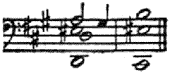
[Listen]
While her earnest look rests upon him, there is heard the Motive of the Death-Song, a tristly prophetic strain.

[Listen]
Brünnhilde advances and then, pausing again, leans with one hand on her charger's neck, and, grasping shield and spear with the other, gazes upon Siegmund. Then there rises from the orchestra, in strains of rich, soft, alluring beauty, an inversion of the Walhalla Motive. The Fate, Death-Song and Walhalla motives recur, and Siegmund, raising his eyes and meeting Brünnhilde's look, questions her and receives her answers. The episode is so fraught with solemnity that the shadow of death seems to have fallen upon the scene. The solemn beauty of the music impresses itself the more upon the listener, because of the agitated, agonized scene which preceded it. To the Wälsung, who meets her gaze so calmly, Brünnhilde speaks in solemn tones:
"Siegmund, look on me. I am she whom soon you must prepare to follow." Then she paints for him in glowing colours the joys of Walhalla, where Wälse, his father, is awaiting him and where he will have heroes for his companions, himself the hero of many valiant deeds. Siegmund listens unmoved. In reply he frames but one question: "When I enter Walhalla, will Sieglinde be there to greet me?"
When Brünnhilde answers that in Walhalla he will be attended by valkyrs and wishmaidens, but that Sieglinde will not be there to meet him, he scorns the delights she has held out. Let her greet Wotan from him, and Wälse, his father, too, as well as the wishmaidens. He will remain with Sieglinde.
Then the radiant Valkyr, moved by Siegmund's calm determination to sacrifice even a place among the heroes of Walhalla for the woman he loves, makes known to him the fate to which he has been doomed. Wotan desired to give him victory over Hunding, and she had been summoned by the chief of the gods and commanded to hover above the combatants, and by shielding Siegmund from Hunding's thrusts, render the Wälsung's victory certain. But Wotan's spouse, Fricka, who, as the first among the goddesses, is guardian of the marriage vows, has heard Hunding's voice calling for vengeance, and has demanded that vengeance be his. Let Siegmund therefore prepare for Walhalla, but let him leave Sieglinde in her care. She will protect her.
"No other living being but I shall touch her," exclaims the Wälsung, as he draws his sword. "If the Wälsung sword is to be shattered on Hunding's spear, to which I am to fall a victim, it first shall bury itself in her breast and save her from a worse fate!" He poises the sword ready for the thrust above the unconscious Sieglinde.
"Hold!" cries Brünnhilde, thrilled by his heroic love. "Whatever the consequences which Wotan, in his wrath, shall visit upon me, today, for the first time I disobey him. Sieglinde shall live, and with her Siegmund! Yours the victory over Hunding. Now Wälsung, prepare for battle!"
Hunding's horn-calls sound nearer and nearer. Siegmund judges that he has ascended the other side of the gorge, intending to cross the rocky arch. Already Brünnhilde has gone to take her place where she knows the combatants must meet. With a last look and a last kiss for Sieglinde, Siegmund gently lays her down and begins to ascend toward the peak. Mist gathers; storm-clouds roll over the mountain; soon he is lost to sight. Slowly Sieglinde regains her senses. She looks for Siegmund. Instead of seeing him bending over her she hears Hunding's voice as if from among the clouds, calling him to combat; then Siegmund's accepting the challenge. She staggers toward the peak. Suddenly a bright light pierces the clouds. Above her she sees the men fighting, Brünnhilde protecting Siegmund who is aiming a deadly stroke at Hunding.
At that moment, however, the light is diffused with a reddish glow. In it Wotan appears. As Siegmund's sword cuts the air on its errand of death, the god interposes his spear, the sword breaks in two and Hunding thrusts his spear into the defenceless Wälsung's breast. The second victim of Alberich's curse has met his fate.
With a wild shriek, Sieglinde falls to the ground, to be caught up by Brünnhilde and swung upon the Valkyr's charger, which, urged on by its mistress, now herself a fugitive from Wotan's anger, dashes down the defile in headlong flight for the Valkyr rock.
Act III. The third act opens with the famous "Ride of the Valkyrs," a number so familiar that detailed reference to it is scarcely necessary. The wild maidens of Walhalla coursing upon winged steeds through storm-clouds, their weapons flashing in the gleam of lightning, their weird laughter mingling with the crash of thunder, have come to hold tryst upon the Valkyr rock.