Giuseppe Verdi (1813-1901) (continued 2)
Reading edition
In the brilliant crowd of maskers, the scene having changed to that of the masked ball, Reinhart learns from Oscar what disguise is worn by Richard. Amelia, who, with the eyes of apprehensive love, also has recognized Richard, implores him to flee the danger that threatens him. But Richard knows no fear. In order that the honour of his friend shall remain secure, he has determined to send him as an envoy to England, accompanied by his wife. Her, he tells Amelia, he will never see again. "Once more I bid thee farewell, for the last time, farewell."
"And thus receive thou my farewell!" exclaims Reinhart, stabbing him in the side.
With his last words Richard assures Reinhart of the guiltlessness of Amelia, and admonishes all to seek to avenge his death on no one.
It is hardly necessary to point out how astonishing these proceedings are when supposed to take place in Colonial Boston. Even the one episode of Richard, Earl of Warwick, singing a barcarolle in the hut of a negress who tells fortunes is so impossible that it affects the whole story with incredibility. But Naples—well, anything will go there. In fact, as truth is stranger than fiction, we even can regard the events of "The Masked Ball" as occurring more naturally in an Italian city than in Stockholm, where the assassination of Gustavus III. at a masquerade actually occurred.
Although the opera is a subject of only occasional revival, it contains a considerable amount of good music and a quintet of exceptional quality.
Early in the first act comes Richard's solo, "La rivedrà nell'estasi" (I shall again her face behold).

[Listen]
La rivedrà nell'estasi
This is followed by the faithful Reinhart's "Alla vita che t'arride" (To thy life with joy abounding), with horn solo.
Strikingly effective is Oscar's song, in which the page vouches for the fortune-teller. "Volta la terrea fronte alle stelle" (Lift up thine earthly gaze to where the stars are shining).

[Listen]
Volta la terrea fronte alle stelle
In the scene in the fortune-teller's hut are a trio for Amelia, Ulrica, and Richard, while the latter overhears Amelia's welcome confession of love for himself, and Richard's charming barcarolle addressed to the sorceress, a Neapolitan melody, "Di' tu se fedele il flutto m'aspetta" (Declare if the waves will faithfully bear me).

[Listen]
Di' tu se fedele il flutto m'aspetta,
The quintet begins with Richard's laughing disbelief in Ulrica's prophecy regarding himself, "È scherzo od è follia" ('Tis an idle folly).
Concluding the scene is the chorus, in which, after the people have recognized Richard, they sing what has been called, "a kind of 'God Save the King' tribute to his worth"—"O figlio d'Inghilterra" (O son of mighty England).
The second act opens with a beautiful air for Amelia, "Ma dall'arido stelo divulsa" (From the stem, dry and withered, dissevered).
An impassioned duet occurs during the meeting at the place of the gibbet between Richard and Amelia: "O qual soave brivido" (Oh, what delightful ecstasies).
The act ends with a quartet for Amelia, Reinhart, Samuel, and Tom.
In the last act is Amelia's touching supplication to her husband, in which "The weeping of the violoncello and the veiled key of E-flat minor stretch to the last limits of grief this prayer of the wife and mother,"—"Morrò, ma prima in grazia" (I die, but first in mercy).
"O dolcezze perdute!" (O delights now lost for ever) sings her husband, in a musical inspiration prefaced by harp and flute.
During the masked ball there is a quintet for Amelia, Oscar, Reinhart, Samuel, and Tom, from which the sprightly butterfly allegro of Oscar, "Di che fulgor, che musiche" (What brilliant lights, what music gay) detaches itself, while later on the Page has a buoyant "tra-la-la" solo, beginning, in reply to Reinhart's question concerning Richard's disguise, "Saper vorreste di che si veste" (You'd fain be hearing what mask he's wearing).
There is a colloquy between Richard and Amelia. Then the catastrophe.
BEFORE AND AFTER “UN BALLO”
Prior to proceeding to a consideration of "Aïda," I will refer briefly to certain works by Verdi, which, although not requiring a complete account of story and music, should not be omitted from a book on opera.
At the Teatro San Carlo, Naples, December 8, 1849, Verdi brought out the three-act opera "Luisa Miller," based on a play by Schiller, "Kabale und Liebe" (Love and Intrigue). It appears to have been Verdi's first real success since "Ernani" and to have led up to that achieved by "Rigoletto" a year later, and to the successes of "Il Trovatore" and "La Traviata." "Luisa Miller" was given at the Academy of Music, New York, October 20, 1886, by Angelo's Italian Opera Company. Giulia Valda was Luisa and Vicini Rodolfo.
The story is a gloomy one. The first act is entitled "Love," the second "Intrigue," the third "Poison."
Characters
Count WalterBass
Rodolfo, his sonTenor
Miller, an old soldierBass
Luisa, his daughterSoprano
Frederica, Duchess of Ostheim, Walter's nieceContralto
Laura, a peasant girlContralto
Ladies attending the Duchess, pages, servants, archers, and villagers.
Luisa is the daughter of Miller, an old soldier. There is ardent love between her and Rodolfo, the son of Count Walter, who has concealed his real name and rank from her and her father and is known to them as a peasant named Carlo. Old Miller, however, has a presentiment that evil will result from their attachment. This is confirmed on his being informed by Wurm that Carlo is Rodolfo, his master's son. Wurm is himself in love with Luisa.
The Duchess Frederica, Count Walter's niece, arrives at the castle. She had been brought up there with Rodolfo, and has from childhood cherished a deep affection for him; but, compelled by her father to marry the Duke d'Ostheim, has not seen Rodolfo for some years. The Duke, however, having died, she is now a widow, and, on the invitation of Count Walter, who has, unknown to Rodolfo, made proposals of marriage to her on his son's behalf, she arrives at the castle, expecting to marry at once the love of her childhood. The Count having been informed by Wurm of his son's love for Luisa, resolves to break off their intimacy. Rodolfo reveals to the Duchess that he loves another. He also discloses his real name and position to Luisa and her father. The Count interrupts this interview between the lovers. Enraged at his son's persistence in preferring a union with Luisa, he calls in the guard and is about to consign her and her father to prison, when he is, for the moment, deterred and appalled by Rodolfo's threat to reveal that the Count, aided by Wurm, assassinated his predecessor, in order to obtain possession of the title and estates.
Luisa's father has been seized and imprisoned by the Count's order. She, to save his life, consents, at the instigation of Wurm, to write a letter in which she states that she had never really loved Rodolfo, but only encouraged him on account of his rank and fortune, of which she was always aware; and finally offering to fly with Wurm. This letter, as the Count and his steward have arranged, falls into the hands of Rodolfo, who, enraged by the supposed treachery of the woman he loves, consents to marry the Duchess, but ultimately resolves to kill Luisa and himself.
Luisa also has determined to put an end to her existence. Rodolfo enters her home in the absence of Miller, and, after extracting from Luisa's own lips the avowal that she did write the letter, he pours poison into a cup. She unwittingly offers it to him to quench his thirst. Afterwards, at his request, she tastes it herself. She had sworn to Wurm that she would never reveal the fact of the compulsion under which she had written the letter, but feeling herself released from her oath by fast approaching death, she confesses the truth to Rodolfo. The lovers die in the presence of their horror-stricken parents.
The principal musical numbers include Luisa's graceful and brilliant solo in the first act—"Lo vidi, e'l primo palpito" (I saw him and my beating heart). Besides there is Old Miller's air, "Sacra la scelta è d'un consorte" (Firm are the links that are forged at the altar), a broad and beautiful melody, which, were the opera better known, would be included in most of the operatic anthologies for bass.
There also should be mentioned Luisa's air in the last act, "La tomba è un letto sparso di fiori" (The tomb a couch is, covered with roses).
"I Vespri Siciliani" (The Sicilian Vespers) had its first performance at the Grand Opéra, Paris, under the French title, "Les Vêpres Siciliennes," June 13, 1855. It was given at La Scala, Milan, 1856; London, Drury Lane, 1859; New York, Academy of Music, November 7, 1859; and revived there November, 1868. The work also has been presented under the title of "Giovanna di Guzman." The libretto is by Scribe and deals with the massacre of the French invaders of Sicily, at vespers, on Easter Monday, 1282. The principal characters are Guy de Montford, French Viceroy, baritone; Arrigo, a Sicilian officer, tenor; Duchess Hélène, a prisoner, soprano; Giovanni di Procida, a native conspirator, bass. Arrigo, who afterwards is discovered to be the brutal Guy de Montford's son, is in love with Hélène. The plot turns upon his efforts to rescue her.
There is one famous number in the "The Sicilian Vespers." This is the "Bolero," sung by Hélène—"Mercé, dilette amiche" (My thanks, beloved companions).
At Petrograd, November 10, 1862, there was brought out Verdi's opera in four acts, "La Forza del Destino" (The Force of Destiny). London heard it in June, 1867; New York, February 2, 1865, and, with the last act revised by the composer, at the Academy of Music in 1880, with Annie Louise Cary, Campanini, Galassi, and Del Puente. The principal characters are Marquis di Calatrava, bass; Donna Leonora and Don Carlo, his children, soprano and baritone; Don Alvaro, tenor; Abbot of the Franciscan Friars, bass. There are muleteers, peasants, soldiers, friars, etc. The scenes are laid in Spain and Italy; the period is the middle of the eighteenth century. The libretto is based on the play, "Don Alvaro o La Fuerza de Sino" by the Duke of Rivas.
Don Alvaro is about to elope with Donna Leonora, daughter of the Marquis, when the latter comes upon them and is accidentally killed by Don Alvaro. The Marquis curses his daughter with his dying breath and invokes the vengeance of his son, Don Carlo, upon her and her lover. She escapes in male attire to a monastery, confesses to the Abbot, and is conducted by him to a cave, where he assures her of absolute safety.
Don Alvaro and Don Carlo meet before the cave. They fight a duel in which Don Alvaro mortally wounds Don Carlo. Donna Leonora, coming out of the cave and finding her brother dying, goes to him. With a last effort he stabs her in the heart. Don Alvaro throws himself over a nearby precipice.
"Madre, pietosa Vergine" (Oh, holy Virgin) is one of the principal numbers of the opera. It is sung by Donna Leonora, kneeling in the moonlight near the convent, while from within is heard the chant of the priests.
The "Madre pietosa" also is utilized as a theme in the overture.
"Don Carlos," produced at the Grand Opéra, Paris, March 11, 1867, during the Universal Exposition, was the last opera composed by Verdi before he took the musical world by storm with "Aïda." The work is in four acts, the libretto, by Méry and du Locle, having been reduced from Schiller's tragedy of the same title as the opera.
The characters are Philip II., of Spain, bass; Don Carlos, his son, tenor; Rodrigo, Marquis de Posa, baritone; Grand Inquisitor, bass; Elizabeth de Valois, Queen of Philip II., and stepmother of Don Carlos, soprano; Princess Eboli, soprano. In the original production the fine rôle of Rodrigo was taken by Faure.
Don Carlos and Elizabeth de Valois have been in love with each other, but for reasons of state Elizabeth has been obliged to marry Philip II., Don Carlos's father. The son is counselled by Rodrigo to absent himself from Spain by obtaining from his father a commission to go to the Netherlands, there to mitigate the cruelties practised by the Spaniards upon the Flemings. Don Carlos seeks an audience with Elizabeth, in order to gain her intercession with Philip. The result, however, of the meeting, is that their passion for each other returns with even greater intensity than before. Princess Eboli, who is in love with Don Carlos, becomes cognizant of the Queen's affection for her stepson, and informs the King. Don Carlos is thrown into prison. Rodrigo, who visits him there, is shot by order of Philip, who suspects him of aiding Spain's enemies in the Low Countries. Don Carlos, having been freed, makes a tryst with the Queen. Discovered by the King, he is handed over by him to the Inquisition to be put to death.
"La Forza del Destino" and "Don Carlos" lie between Verdi's middle period, ranging from "Luisa Miller" to "Un Ballo in Maschera" and including "Rigoletto," "Il Trovatore," and "La Traviata," and his final period, which began with "Aïda." It can be said that in "La Forza" and "Don Carlos" Verdi had absorbed considerable of Meyerbeer and Gounod, while in "Aïda," in addition to these, he had assimilated as much of Wagner as is good for an Italian. The enrichment of the orchestration in the two immediate predecessors of "Aïda" is apparent, but not so much so as in that masterpiece of operatic composition. He produced in "Aïda" a far more finished score than in "La Forza" or "Don Carlos," sought and obtained many exquisite instrumental effects, but always remained true to the Italian principle of the supremacy of melody in the voice.
AÏDA
Grand opera in four acts by Giuseppe Verdi. Plot by Mariette Bey. Written in French prose by Camille du Locle. Translated into Italian verse by Antonio Ghislanzoni.
Produced in Cairo, Egypt, December 24, 1871; La Scala, Milan, under the composer's direction, February 8, 1872; Théâtre Italien, Paris, April 22, 1876; Covent Garden, London, June 22, 1876; Academy of Music, New York, November 26, 1873; Grand Opéra, Paris, March 22, 1880; Metropolitan Opera House, with Caruso, 1904.
Characters
Aïda, an Ethiopian slaveSoprano
Amneris, daughter of the King of EgyptContralto
Amonasro, King of Ethiopia, father of AïdaBaritone
Rhadames, captain of the GuardTenor
Ramphis, High PriestBass
King of EgyptBass
MessengerTenor
Priests, soldiers, Ethiopian slaves, prisoners, Egyptians, etc.
Time—Epoch of the Pharaohs.
Place—Memphis and Thebes.
"Aïda" was commissioned by Ismail Pacha, Khedive of Egypt, for the Italian Theatre in Cairo, which opened in November, 1869. The opera was produced there December 24, 1871; not at the opening of the house, as sometimes is erroneously stated. Its success was sensational.
Equally enthusiastic was its reception when brought out at La Scala, Milan, February 7, 1872, under the direction of Verdi himself, who was recalled thirty-two times and presented with an ivory baton and diamond star with the name of Aïda in rubies and his own in other precious stones.
It is an interesting fact that "Aïda" reached New York before it did any of the great European opera houses save La Scala. It was produced at the Academy of Music under the direction of Max Strakosch, November 26, 1873. I am glad to have heard that performance and several other performances of it that season. For the artists who appeared in it gave a representation that for brilliancy has not been surpassed if, indeed, it has been equalled. In support of this statement it is only necessary to say that Italo Campanini was Rhadames, Victor Maurel Amonasro, and Annie Louise Cary Amneris. No greater artists have appeared in these rôles in this country. Mlle. Torriani, the Aïda, while not so distinguished, was entirely adequate. Nannetti as Ramphis, the high priest, Scolara as the King, and Boy as the Messenger, completed the cast.
I recall some of the early comment on the opera. It was said to be Wagnerian. In point of fact "Aïda" is Wagnerian only as compared with Verdi's earlier operas. Compared with Wagner himself, it is Verdian—purely Italian. It was said that the fine melody for the trumpets on the stage in the pageant scene was plagiarized from a theme in the Coronation March of Meyerbeer's "Prophète." Slightly reminiscent the passage is, and, of course, stylistically the entire scene is on Meyerbeerian lines; but these resemblances no longer are of importance.
Paris failed to hear "Aïda" until April, 1876, and then at the Théâtre Italien, instead of at the Grand Opéra, where it was not heard until March, 1880, when Maurel was the Amonasro and Édouard de Reszke, later a favourite basso at the Metropolitan Opera House, the King. In 1855 Verdi's opera, "Les Vêpres Siciliennes" (The Sicilian Vespers) had been produced at the Grand Opéra and occurrences at the rehearsals had greatly angered the composer. The orchestra clearly showed a disinclination to follow the composer's minute directions regarding the manner in which he wished his work interpreted. When, after a conversation with the chef d'orchestre, the only result was plainly an attempt to annoy him, he put on his hat, left the theatre, and did not return. In 1867 his "Don Carlos" met only with a succès d'estime at the Opéra. He had not forgotten these circumstances, when the Opéra wanted to give "Aïda." He withheld permission until 1880. But when at last this was given, he assisted at the production, and the public authorities vied in atoning for the slights put upon him so many years before. The President of France gave a banquet in his honour and he was created a Grand Officer of the National Order of the Legion of Honour.
When the Khedive asked Verdi to compose a new opera especially for the new opera house at Cairo, and inquired what the composer's terms would be, Verdi demanded $20,000. This was agreed upon and he was then given the subject he was to treat, "Aïda," which had been suggested to the Khedive by Mariette Bey, the great French Egyptologist. The composer received the rough draft of the story. From this Camille du Locle, a former director of the Opéra Comique, who happened to be visiting Verdi at Busseto, wrote a libretto in French prose, "scene by scene, sentence by sentence," as he has said, adding that the composer showed the liveliest interest in the work and himself suggested the double scene in the finale of the opera. The French prose libretto was translated into Italian verse by Antonio Ghislanzoni, who wrote more than sixty opera librettos, "Aïda" being the most famous. Mariette Bey brought his archeological knowledge to bear upon the production. "He revived Egyptian life of the time of the Pharaohs; he rebuilt ancient Thebes, Memphis, the Temple of Phtah; he designed the costumes and arranged the scenery. And under these exceptional circumstances, Verdi's new opera was produced."
Verdi's score was ready a year before the work had its première. The production was delayed by force of circumstances. Scenery and costumes were made by French artists. Before these accessories could be shipped to Cairo, the Franco-Prussian war broke out. They could not be gotten out of Paris. Their delivery was delayed accordingly.
Does the score of "Aïda" owe any of its charm, passion, and dramatic stress to the opportunity thus afforded Verdi of going over it and carefully revising it, after he had considered it finished? Quite possibly. For we know that he made changes, eliminating, for instance, a chorus in the style of Palestrina, which he did not consider suitable to the priesthood of Isis. Even this one change resulted in condensation, a valuable quality, and in leaving the exotic music of the temple scene entirely free to exert to the full its fascination of local colour and atmosphere.
The story is unfolded in four acts and seven scenes.
Act I. Scene 1. After a very brief prelude, the curtain rises on a hall in the King's palace in Memphis. Through a high gateway at the back are seen the temples and palaces of Memphis and the pyramids.
It had been supposed that, after the invasion of Ethiopia by the Egyptians, the Ethiopians would be a long time in recovering from their defeat. But Amonasro, their king, has swiftly rallied the remnants of his defeated army, gathered new levies to his standard, and crossed the frontier—all this with such extraordinary rapidity that the first news of it has reached the Egyptian court in Memphis through a messenger hot-foot from Thebes with the startling word that the sacred city itself is threatened.
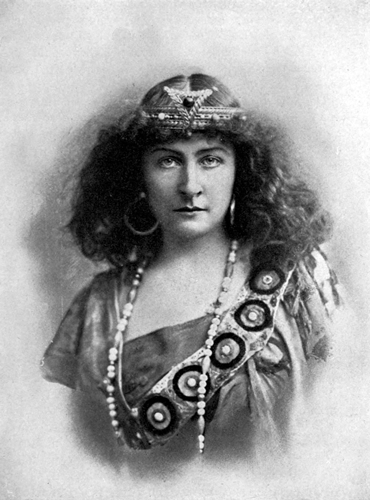
Copyright photo by Dupont
Emma Eames as Aïda
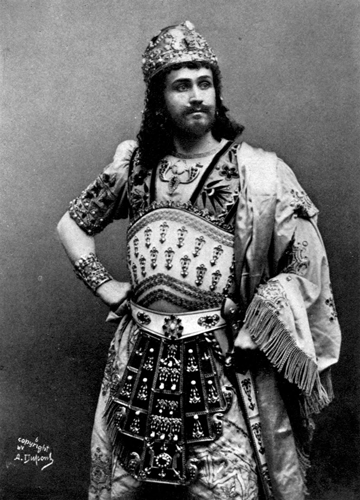
Copyright photo by Dupont
Saléza as Rhadames in “Aïda”
While the priests are sacrificing to Isis in order to learn from the goddess whom she advises them to choose as leader of the Egyptian forces, Rhadames, a young warrior, indulges in the hope that he may be the choice. To this hope he joins the further one that, returning victorious, he may ask the hand in marriage of Aïda, an Ethiopian slave of the Egyptian King's daughter, Amneris. To these aspirations he gives expression in the romance, "Celeste Aïda" (Radiant Aïda).
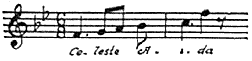
[Listen]
Celeste Aïda
It ends effectively with the following phrase:

[Listen]
un trono vicino al sol, un trono vicino al sol
He little knows that Aïda is of royal birth or that Amneris herself, the Princess Royal, is in love with him and, having noted the glances he has cast upon Aïda, is fiercely jealous of her—a jealousy that forms the mainspring of the story and leads to its tragic dénouement.
A premonition of the emotional forces at work in the plot is given in the "Vieni, O diletta" (Come dearest friend), beginning as a duet between Amneris and Aïda and later becoming a trio for them and Rhadames. In this the Princess feigns friendship for Aïda, but, in asides, discloses her jealous hatred of her.
Meanwhile the Egyptian hosts have gathered before the temple. There the King announces that the priests of Isis have learned from the lips of that goddess the name of the warrior who is to lead the army—Rhadames! It is the Princess herself who, at this great moment in his career, places the royal standard in his hands. But amid the acclaims that follow, as Rhadames, to the strains of march and chorus, is conducted by the priests to the temple of Phtah to be invested with the consecrated armour, Amneris notes the fiery look he casts upon Aïda. Is this the reason Rhadames, young, handsome, brave, has failed to respond to her own guarded advances? Is she, a princess, to find a successful rival in her own slave?
Meanwhile Aïda herself is torn by conflicting emotions. She loves Rhadames. When the multitude shouts "Return victorious!" she joins in the acclamation. Yet it is against her own people he is going to give battle, and the Ethiopians are led by their king, Amonasro, her father. For she, too, is a princess, as proud a princess in her own land as Amneris, and it is because she is a captive and a slave that her father has so swiftly rallied his army and invaded Egypt in a desperate effort to rescue her, facts which for obvious reasons she carefully has concealed from her captors.
It is easy to imagine Aïda's agonized feelings since Rhadames has been chosen head of the Egyptian army. If she prays to her gods for the triumph of the Ethiopian arms, she is betraying her lover. If she asks the gods of victory to smile upon Rhadames, she is a traitress to her father, who has taken up arms to free her, and to her own people. Small wonder if she exclaims, as she contemplates her own wretched state:
"Never on earth was heart torn by more cruel agonies. The sacred names of father, lover, I can neither utter nor remember. For the one—for the other—I would weep, I would pray!"
This scene for Aïda, beginning "Ritorna vincitor" (Return victorious), in which she echoes the acclamation of the martial chorus immediately preceding, is one of the very fine passages of the score. The lines to which it is set also have been highly praised. They furnished the composer with opportunity, of which he made full use, to express conflicting emotions in music of dramatic force and, in its concluding passage, "Numi pietà" (Pity, kind heaven), of great beauty.

[Listen]
Numi pietà Del mio soffrir! Speme non v'ha pel mio dolor.
Scene 2. Ramphis, the high priest, at the foot of the altar; priests and priestesses; and afterwards Rhadames are shown in the Temple of Vulcan at Memphis. A mysterious light descends from above. A long row of columns, one behind the other, is lost in the darkness; statues of various deities are visible; in the middle of the scene, above a platform rises the altar, surmounted by sacred emblems. From golden tripods comes the smoke of incense.
A chant of the priestesses, accompanied by harps, is heard from the interior. Rhadames enters unarmed. While he approaches the altar, the priestesses execute a sacred dance. On the head of Rhadames is placed a silver veil. He is invested with consecrated armor, while the priests and priestesses resume the religious chant and dance.
The entire scene is saturated with local colour. Piquant, exotic, it is as Egyptian to the ear as to the eye. You see the temple, you hear the music of its devotees, and that music sounds as distinctively Egyptian as if Mariette Bey had unearthed two examples of ancient Egyptian temple music and placed them at the composer's disposal. It is more likely, however, that the themes are original with Verdi and that the Oriental tone colour, which makes the music of the scene so fascinating, is due to his employment of certain intervals peculiar to the music of Eastern people. The interval, which, falling upon Western ears, gives an Oriental clang to the scale, consists of three semi-tones. In the very Eastern sounding themes in the temple scenes in "Aïda," these intervals are G to F-flat, and D to C-flat.
The sacred chant,
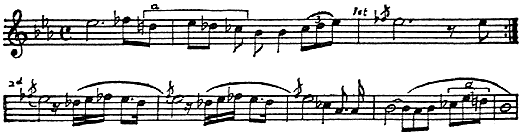
[Listen]
twice employs the interval between D and C-flat, the first time descending, the second time ascending, in which latter it sounds more characteristic to us, because we regard the scale as having an upward tendency, whereas in Oriental systems the scale seems to have been regarded as tending downward.
In the sacred dance,

[Listen]
the interval is from G to F-flat. The intervals, where employed in the two music examples just cited, are bracketed. The interval of three semi-tones—the characteristic of the Oriental scale—could not be more clearly shown than it is under the second bracket of the sacred dance.
Act II. Scene 1. In this scene, which takes place in a hall in the apartments of Amneris, the Princess adopts strategy to discover if Aïda returns the passion which she suspects in Rhadames. Messengers have arrived from the front with news that Rhadames has put the Ethiopians to utter rout and is returning with many trophies and captives. Naturally Aïda is distraught. Is her lover safe? Was her father slain? It is while Aïda's mind and heart are agitated by these questions that Amneris chooses the moment to test her feelings and wrest from her the secret she longs yet dreads to fathom. The Princess is reclining on a couch in her apartment in the palace at Thebes, whither the court has repaired to welcome the triumphant Egyptian army. Slaves are adorning her for the festival or agitating the air with large feather fans. Moorish slave boys dance for her delectation and her attendants sing:
While on thy tresses rain Laurels and flowers interwoven, Let songs of glory mingle With strains of tender love.
In the midst of these festive preparations Aïda enters, and Amneris, craftily feigning sympathy for her lest she be grieving over the defeat of her people and the possible loss in battle of someone dear to her, affects to console her by telling her that Rhadames, the leader of the Egyptians, has been slain.
It is not necessary for the Princess to watch the girl intently in order to note the effect upon her of the sudden and cruelly contrived announcement. Almost as suddenly, having feasted her eyes on the slave girl's grief, the Princess exclaims: "I have deceived you; Rhadames lives!"
"He lives!" Tears of gratitude instead of despair now moisten Aïda's eyes as she raises them to Heaven.
"You love him; you cannot deny it!" cries Amneris, forgetting in her furious jealousy her dignity as a Princess. "But know, you have a rival. Yes—in me. You, my slave, have a rival in your mistress, a daughter of the Pharaohs!"
Having fathomed her slave's secret, she vents the refined cruelty of her jealous nature upon the unfortunate girl by commanding her to be present at the approaching triumphant entry of Rhadames and the Egyptian army:
"Come, follow me, and you shall learn if you can contend with me—you, prostrate in the dust, I on the throne beside the king!"
What has just been described is formulated by Verdi in a duet for Amneris and Aïda, "Amore! gaudio tormento" (Oh, love! Oh, joy and sorrow!), which expresses the craftiness and subtlety of the Egyptian Princess, the conflicting emotions of Aïda, and the dramatic stress of the whole episode.
This phrase especially seems to express the combined haughtiness and jealousy in the attitude of Amneris toward Aïda:

[Listen]
Scene 2. Brilliant indeed is the spectacle to which Aïda is compelled to proceed with the Princess. It is near a group of palms at the entrance to the city of Thebes that the King has elected to give Rhadames his triumph. Here stands the temple of Ammon. Beyond it a triumphal gate has been erected. When the King enters to the cheers of the multitude and followed by his gaudily clad court, he takes his seat on the throne surmounted by a purple canopy. To his left sits Amneris, singling out for her disdainful glances the most unhappy of her slaves.
A blast of trumpets, and the victorious army begins its defile past the throne. After the foot soldiers come the chariots of war; then the bearers of the sacred vases and statues of the gods, and a troupe of dancing girls carrying the loot of victory. A great flourish of trumpets, an outburst of acclaim, and Rhadames, proudly standing under a canopy borne high on the shoulders of twelve of his officers, is carried through the triumphal gate and into the presence of his King. As the young hero descends from the canopy, the monarch, too, comes down from the throne and embracing him exclaims:
"Savior of your country, I salute you. My daughter with her own hand shall place the crown of laurels upon your brow." And when Amneris, suiting her action to her father's words, crowns Rhadames, the King continues: "Now ask of me whatever you most desire. I swear by my crown and by the sacred gods that nothing shall be denied to you this day!"
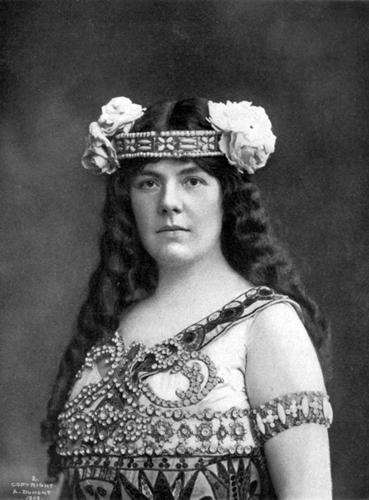
Copyright photo by Dupont
Louise Homer as Amneris in “Aïda”
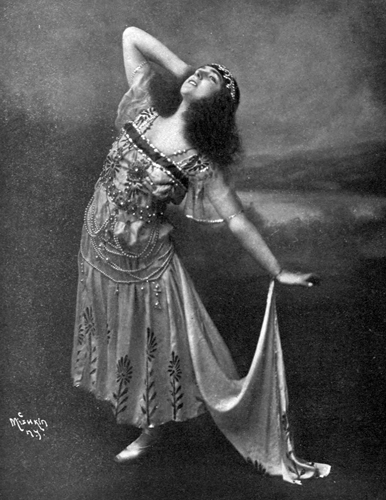
Copyright photo by Mishkin
Rosina Galli in the Ballet of “Aïda”
But although no wish is nearer the heart of Rhadames than to obtain freedom for Aïda, he does not consider the moment as yet opportune. Therefore he requests that first the prisoners of war be brought before the King. When they enter, one of them, by his proud mien and spirited carriage, easily stands forth from the rest. Hardly has Aïda set eyes upon him than she utters the startled exclamation, "My father!"
It is indeed none other than Amonasro, the Ethiopian king, who, his identity unknown to the Egyptians, has been made captive by them. Swiftly gliding over to where Aïda stands, he whispers to her not to betray his rank to his captors. Then, turning to the Egyptian monarch, he craftily describes how he has seen the king of Ethiopia dead at his feet from many wounds, and concludes by entreating clemency for the conquered. Not only do the other captives and Aïda join in his prayer, but the people, moved by his words and by his noble aspect, beg their king to spare the prisoners. The priests, however, protest. The gods have delivered these enemies into the hands of Egypt; let them be put to death lest, emboldened by a pardon so easily obtained, they should rush to arms again.
Meanwhile Rhadames has had eyes only for Aïda, while Amneris notes with rising jealousy the glances he turns upon her hated slave. At last Rhadames, carried away by his feelings, himself joins in the appeal for clemency. "Oh, King," he exclaims, "by the sacred gods and by the splendour of your crown, you swore to grant my wish this day! Let it be life and liberty for the Ethiopian prisoners." But the high priest urges that even if freedom is granted to the others, Aïda and her father be detained as hostages and this is agreed upon. Then the King, as a crowning act of glory for Rhadames, leads Amneris forth, and addressing the young warrior, says:
"Rhadames, the country owes everything to you. Your reward shall be the hand of Amneris. With her one day you shall reign over Egypt."
A great shout goes up from the multitude. Unexpectedly Amneris sees herself triumphant over her rival, the dream of her heart fulfilled, and Aïda bereft of hope, since for Rhadames to refuse the hand of his king's daughter would mean treason and death. And so while all seemingly are rejoicing, two hearts are sad and bewildered. For Aïda, the man she adores appears lost to her forever and all that is left to her, the tears of hopeless love; while to Rhadames the heart of Aïda is worth more than the throne of Egypt, and its gift, with the hand of Amneris, is like the unjust vengeance of the gods descending upon his head.
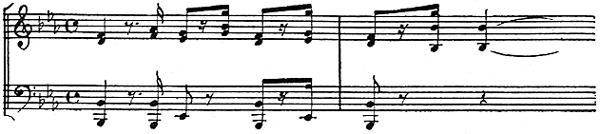
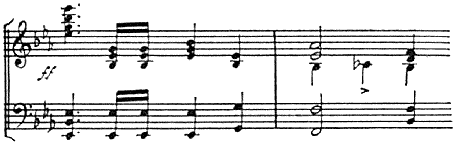
This is the finale of the second act. It has been well said that not only is it the greatest effort of the composer, but also one of the grandest conceptions of modern musical and specifically operatic art. The importance of the staging, the magnificence of the spectacle, the diversity of characterization, and the strength of action of the drama all conspire to keep at an unusually high level the inspiration of the composer. The triumphal chorus, "Gloria all'Egitto" (Glory to Egypt), is sonorous and can be rendered with splendid effect.
It is preceded by a march.
[Listen]
Then comes the chorus of triumph.
[Listen]
Voices of women join in the acclaim.

[Listen]
The trumpets of the Egyptian troops execute a most brilliant modulation from A-flat to B-natural.
The reference here is to the long, straight trumpets with three valves (only one of which, however, is used). These trumpets, in groups of three, precede the divisions of the Egyptian troops. The trumpets of the first group are tuned in A-flat.

[Audio content is not currently supported on your device.
When the second group enters and intones the same stirring march theme in B-natural, the enharmonic modulation to a tone higher gives an immediate and vastly effective "lift" to the music and the scene.

[Audio content is not currently supported on your device.
The entrance of Rhadames, borne on high under a canopy by twelve officers, is a dramatic climax to the spectacle. But a more emotional one is to follow.
The recognition of King Amonasro by his daughter; the supplication of the captives; the plea of Rhadames and the people in their favour; the vehement protests of the priests who, in the name of the gods of Egypt, demand their death; the diverse passions which agitate Rhadames, Aïda, and Amneris; the hope of vengeance that Amonasro cherishes—all these conflicting feelings are musically expressed with complete success. The structure is reared upon Amonasro's plea to the King for mercy for the Ethiopian captives, "Ma tu, re, tu signore possente" (But thou, O king, thou puissant lord).

[Listen]
When the singer who takes the rôle of Amonasro also is a good actor, he will know how to convey, between the lines of this supplication, his secret thoughts and unavowed hope for the reconquest of his freedom and his country. After the Egyptian King has bestowed upon Rhadames the hand of Amneris, the chorus, "Gloria all'Egitto," is heard again, and, above its sonorous measures, Aïda's cry:
What hope now remains to me? To him, glory and the throne; To me, oblivion—the tears Of hopeless love.
It is largely due to Verdi's management of the score to this elaborate scene that "Aïda" not only has superseded all spectacular operas that came before it, but has held its own against and survived practically all those that have come since. The others were merely spectacular. In "Aïda" the surface radiates and glows because beneath it seethe the fires of conflicting human passion. In other operas spectacle is merely spectacle. In "Aïda" it clothes in brilliant habiliments the forces of impending and on-rushing tragedy.
Act III. That tragedy further advances toward its consummation in the present act.
It is a beautiful moonlight night on the banks of the Nile—moonlight whose silvery rays are no more exquisite than the music that seems steeped in them.

[Listen]
Half concealed in the foliage is the temple of Isis, from which issues the sound of women's voices, softly chanting. A boat approaches the shore and out of it steps Amneris and the high priest, with a train of closely veiled women and several guards. The Princess is about to enter upon a vigil in the temple to implore the favour of the goddess before her nuptials with Rhadames.
For a while after they have entered the temple, the shore seems deserted. But from the shadow of a grove of palms Aïda cautiously emerges into the moonlight. In song she breathes forth memories of her native land: Oh, patria mia!—O cieli azzurri! (Oh, native land!—Oh, skies of tender blue!).

[Listen]
O cieli azzurri, o dolci aure native,
The phrase, O patria mia! mai più ti rivedrò (Oh, native land! I ne'er shall see thee more)—a little further on—recalls the famous "Non ti scordar" from the "Miserere" in "Trovatore." Here Rhadames has bid Aïda meet him. Is it for a last farewell? If so, the Nile shall be her grave. She hears a swift footfall, and turning, in expectation of seeing Rhadames, beholds her father. He has fathomed her secret and divined that she is here to meet Rhadames—the betrothed of Amneris! Cunningly Amonasro works upon her feelings. Would she triumph over her rival? The Ethiopians again are in arms. Again Rhadames is to lead the Egyptians against them. Let her draw from him the path which he intends to take with his army and that path shall be converted into a fatal ambuscade.
At first the thought is abhorrent to Aïda; but her father by craftily inciting her love of country and no less her jealousy and despair, at last is able to wrest consent from her; then draws back into the shadow as he hears Rhadames approaching.
This duet of Aïda and Amonasro is and will remain one of the beautiful dramatic efforts of the Italian repertory. The situation is one of those in which Verdi delights; he is in his element.
It is difficult to bring Aïda to make the designs of her father agree with her love for the young Egyptian chief. But the subtlety of the score, its warmth, its varied and ably managed expression, almost make plausible the submission of the young girl to the adjurations of Amonasro, and excusable a decision of which she does not foresee the consequences. To restore the crown to her father, to view again her own country, to escape an ignominious servitude, to prevent her lover becoming the husband of Amneris, her rival,—such are the thoughts which assail her during this duet, and they are quite capable of disturbing for a moment her better reason. Amonasro sings these phrases, so charming in the Italian:
Rivedrai le foreste imbalsamate, Le fresche valli, i nostri templi d'or! Sposa felice a lui che amasti tanto, Tripudii immensi ivi potrai gioir!... (Thou shalt see again the balmy forests, The green valleys, and our golden temples. Happy bride of him thou lovest so much, Great rejoicing thenceforth shall be thine.)
As she still is reluctant to lure from her lover the secret of the route by which, in the newly planned invasion of her country, the Egyptians expect to enter Ethiopia, Amonasro changes his tactics and conjures up for her in music a vision of the carnage among her people, and finally invokes her mother's ghost, until, in pianissimo, dramatically contrasting with the force of her father's savage imprecation, she whispers, O patria! quanto mi costi! (Oh, native land! how much thou demandest of me!).
Amonasro leaves. Aïda awaits her lover. When she somewhat coldly meets Rhadames's renewed declaration of love with the bitter protest that the rites of another love are awaiting him, he unfolds his plan to her. He will lead the Egyptians to victory and on returning with these fresh laurels, he will prostrate himself before the King, lay bare his heart to him, and ask for the hand of Aïda as a reward for his services to his country. But Aïda is well aware of the power of Amneris and that her vengeance would swiftly fall upon them both. She can see but one course to safety—that Rhadames join her in flight to her native land, where, amid forest groves and the scent of flowers, and all forgetful of the world, they will dream away their lives in love. This is the beginning of the dreamy yet impassioned love duet—"Fuggiam gli ardori inospiti" (Ah, fly with me). She implores him in passionate accents to escape with her. Enthralled by the rapture in her voice, thrilled by the vision of happiness she conjures up before him, he forgets for the moment country, duty, all else save love; and exclaiming, "Love shall be our guide!" turns to fly with her.
This duet, charged with exotic rapture, opens with recitativo phrases for Aïda. I have selected three passages for quotation: "Là tra foreste vergini" (There 'mid the virgin forest groves); "Di fiori profumate" (And 'mid the scent of flowers); and "In estasi la terra scorderem" (In ecstasy the world forgotten).
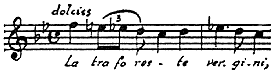
[Listen]
Là tra foreste vergini,

[Listen]
In estasi beate la terra scorderem,

[Listen]
in estasi la terra scorderem,
But Aïda, feigning alarm, asks:
"By what road shall we avoid the Egyptian host?"
"The path by which our troops plan to fall upon the enemy will be deserted until tomorrow."
"And that path?"
"The pass of Napata."
A voice echoes his words, "The pass of Napata."
"Who hears us?" exclaims Rhadames.
"The father of Aïda and king of the Ethiopians," and Amonasro issues forth from his hiding place. He has uncovered the plan of the Egyptian invasion, but the delay has been fatal. For at the same moment there is a cry of "Traitor!" from the temple.
It is the voice of Amneris, who with the high priest has overheard all. Amonasro, baring a dagger, would throw himself upon his daughter's rival, but Rhadames places himself between them and bids the Ethiopian fly with Aïda. Amonasro, drawing his daughter away with him, disappears in the darkness; while Rhadames, with the words, "Priest, I remain with you," delivers himself a prisoner into his hands.
Act IV. Scene 1. In a hall of the Royal Palace Amneris awaits the passage, under guard, of Rhadames to the dungeon where the priests are to sit in judgment upon him. There is a duet between Rhadames and this woman, who now bitterly repents the doom her jealousy is about to bring upon the man she loves. She implores him to exculpate himself. But Rhadames refuses. Not being able to possess Aïda he will die.
He is conducted to the dungeon, from where, as from the bowels of the earth, she hears the sombre voices of the priests.
Ramfis. (Nel sotterraneo.) Radames—Radames: tu rivelasti Della patria i segreti allo straniero....
Sacer. Discolpati!
Ramfis. Egli tace.
Tutti. Traditor!
Ramphis. (In the subterranean hall.) Rhadames, Rhadames, thou didst reveal The country's secrets to the foreigner....
Priests. Defend thyself!
Ramphis. He is silent.
All. Traitor!
The dramatically condemnatory "Traditor!" is a death knell for her lover in the ears of Amneris. And after each accusation, silence by Rhadames, and cry by the priests of "Traitor!" Amneris realizes only too well that his approaching doom is to be entombed alive! Her revulsions of feeling from hatred to love and despair find vent in highly dramatic musical phrases. In fact Amneris dominates this scene, which is one of the most powerful passages for mezzo-soprano in all opera.
Scene 2. This is the famous double scene. The stage setting is divided into two floors. The upper floor represents the interior of the Temple of Vulcan, resplendent with light and gold; the lower floor a subterranean hall and long rows of arcades which are lost in the darkness. A colossal statue of Osiris, with the hands crossed, sustains the pilasters of the vault.
In the temple Amneris and the priestesses kneel in prayer. And Rhadames? Immured in the dungeon and, as he thought, to perish alone, a form slowly takes shape in the darkness, and his own name, uttered by the tender accents of a familiar voice, falls upon his ear. It is Aïda. Anticipating the death to which he will be sentenced, she has secretly made her way into the dungeon before his trial and there hidden herself to find reunion with him in death. And so, while in the temple above them the unhappy Amneris kneels and implores the gods to vouchsafe Heaven to him whose death she has compassed, Rhadames and Aïda, blissful in their mutual sacrifice, await the end.
From "Celeste Aïda," Rhadames's apostrophe to his beloved, with which the opera opens, to "O, terra, addio; addio, valle di pianti!" (Oh, earth, farewell! Farewell, vale of tears!),

[Listen]
O terra addio; addio valle di pianti
which is the swan-song of Rhadames and Aïda, united in death in the stone-sealed vault,—such is the tragic fate of love, as set forth in this beautiful and eloquent score by Giuseppe Verdi.
OTELLO OTHELLO
Opera in four acts, by Verdi. Words by Arrigo Boïto, after Shakespeare. Produced, La Scala, Milan, February 5, 1887, with Tamagno (Otello), and Maurel (Iago). London, Lyceum Theatre, July 5, 1889. New York, Academy of Music, under management of Italo Campanini, April 16, 1888, with Marconi, Tetrazzini, Galassi, and Scalchi. (Later in the engagement Marconi was succeeded by Campanini.); Metropolitan Opera House, 1894, with Tamagno, Albani, Maurel; 1902, Alvarez, Eames, and Scotti; later with Slezak, Alda, and Scotti; Manhattan Opera House, with Zenatello, Melba, and Sammarco.
Characters
Othello, a Moor, general in the army of VeniceTenor
Iago, ancient to OthelloBaritone
Cassio, lieutenant to OthelloTenor
Roderigo, a VenetianTenor
Lodovico, Venetian ambassadorBass
Montano, Othello's predecessor in the government of CyprusBass
A HeraldBass
Desdemona, wife of OthelloSoprano
Emilia, wife of IagoMezzo-Soprano
Soldiers and sailors of the Republic of Venice; men, women, and children of Venice and of Cyprus; heralds; soldiers of Greece, Dalmatia, and Albania; innkeeper and servants.
Time—End of fifteenth century.
Place—A port of the island of Cyprus.
Three years after the success of "Aïda," Verdi produced at Milan his "Manzoni Requiem"; but nearly sixteen years were to elapse between "Aïda" and his next work for the lyric stage. "Aïda," with its far richer instrumentation than that of any earlier work by Verdi, yet is in form an opera. "Otello" more nearly approaches a music-drama, but still is far from being one. It is only when Verdi is compared with his earlier self that he appears Wagnerian. Compared with Wagner, he remains characteristically Italian—true to himself, in fact, as genius should be.
Nowhere, perhaps, is this matter summed up as happily as in Baker's Biographical Dictionary of Musicians: "Undoubtedly influenced by his contemporaries Meyerbeer, Gounod, and Wagner in his treatment of the orchestra, Verdi's dramatic style nevertheless shows a natural and individual development, and has remained essentially Italian as an orchestral accompaniment of vocal melody; but his later instrumentation is far more careful in detail and luxuriant than that of the earlier Italian school, and his melody more passionate and poignant in expression."
"Otello" is a well-balanced score, composed to a libretto by a distinguished poet and musician—the composer of "Mefistofele." It has vocal melodies, which are rounded off and constitute separate "numbers" (to employ an expression commonly applied to operatic airs), and its recitatives are set to a well thought out instrumental accompaniment.
It is difficult to explain the comparative lack of success with the public of Verdi's last two scores for the lyric stage, "Otello" and "Falstaff." Musicians fully appreciate them. Indeed "Falstaff," which followed "Otello," is considered one of the greatest achievements in the history of opera. Yet it is rarely given, and even "Otello" has already reached the "revival" stage, while "Aïda," "Rigoletto," "La Traviata," and "Il Trovatore" are fixtures, although "Rigoletto" was composed thirty-six years before "Otello" and forty-two before "Falstaff." Can it be that critics (including myself) and professional musicians have been admiring the finished workmanship of Verdi's last two scores, while the public has discovered in them a halting inspiration, a too frequent substitution of miraculous skill for the old-time flair, and a lack of that careless but attractive occasional laissez faire aller of genius, which no technical perfection can replace? Time alone can answer.
When "Otello" opens, Desdemona has preceded her husband to Cyprus and is living in the castle overlooking the port. There are a few bars of introduction.
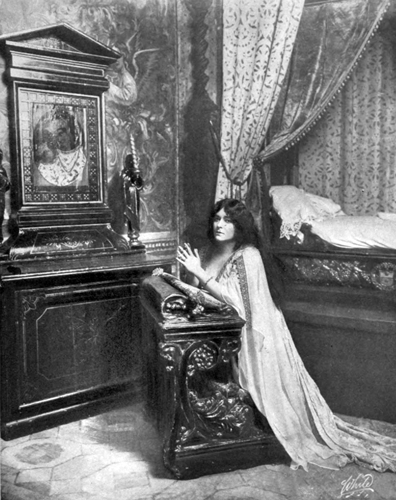
Photo by White
Alda as Desdemona in “Otello”
Act I. In the background a quay and the sea; a tavern with an arbour; it is evening.
Through a heavy storm Othello's ship is seen to be making port. Among the crowd of watchers, who exclaim upon the danger to the vessel, are Iago and Roderigo. Othello ascends the steps to the quay, is acclaimed by the crowd, and proceeds to the castle followed by Cassio, Montano, and soldiers. The people start a wood fire and gather about it dancing and singing.
It transpires in talk between Iago and Roderigo that Iago hates Othello because he has advanced Cassio over him, and that Roderigo is in love with Desdemona.
The fire dies out, the storm has ceased. Cassio has returned from the castle. Now comes the scene in which Iago purposely makes him drunk, in order to cause his undoing. They, with others, are grouped around the table outside the tavern. Iago sings his drinking song, "Inaffia l'ugola! trinca tracanna" (Then let me quaff the noble wine, from the can I'll drink it).

[Listen]
Inaffia l'ugola! trinca, tracanna,
Under the influence of the liquor Cassio resents the taunts of Roderigo, instigated by Iago. Montano tries to quiet him. Cassio draws. There follows the fight in which Montano is wounded. The tumult, swelled by alarums and the ringing of bells, brings Othello with Desdemona to the scene. Cassio is dismissed from the Moor's service. Iago has scored his first triumph.
The people disperse. Quiet settles upon the scene. Othello and Desdemona are alone. The act closes with their love duet, which Desdemona begins with "Quando narravi" (When thou dids't speak).
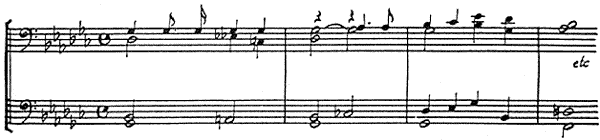
[Listen]
Act II. A hall on the ground floor of the castle. Iago, planning to make Othello jealous of Desdemona, counsels Cassio to induce the Moor's wife to plead for his reinstatement. Cassio goes into a large garden at the back. Iago sings his famous "Credo in un Dio che m'ha creato" (I believe in a God, who has created me in his image). This is justly regarded as a masterpiece of invective. It does not appear in Shakespeare, so that the lines are as original with Boïto as the music is with Verdi. Trumpets, employed in what may be termed a declamatory manner, are conspicuous in the accompaniment.
Iago, seeing Othello approach, leans against a column and looks fixedly in the direction of Desdemona and Cassio, exclaiming, as Othello enters, "I like not that!" As in the corresponding scene in the play, this leads up to the questioning of him by Othello and to Iago's crafty answers, which not only apply the match to, but also fan the flame of Othello's jealousy, as he watches his wife with Cassio.
Children, women, and Cypriot and Albanian sailors now are seen with Desdemona. They bring her flowers and other gifts. Accompanying themselves on the cornemuse, and small harps, they sing a mandolinata, "Dove guardi splendono" (Wheresoe'er thy glances fall). This is followed by a graceful chorus for the sailors, who bring shells and corals.
The scene and Desdemona's beauty deeply move the Moor. He cannot believe her other than innocent. But, unwittingly, she plays into Iago's hand. For her first words on joining Othello are a plea for Cassio. All the Moor's jealousy is re-aroused. When she would apply her handkerchief to his heated brow, he tears it from her hand, and throws it to the ground. Emilia picks it up, but Iago takes it from her. The scene is brought to a close by a quartet for Desdemona, Othello, Iago, and Emilia.
Othello and Iago are left together again. Othello voices the grief that shakes his whole being, in what Mr. Upton happily describes as "a pathetic but stirring melody." In it he bids farewell, not only to love and trust, but to the glories of war and battle. The trumpet is effectively employed in the accompaniment to this outburst of grief, which begins, "Addio sante memorie" (Farewell, O sacred memories).
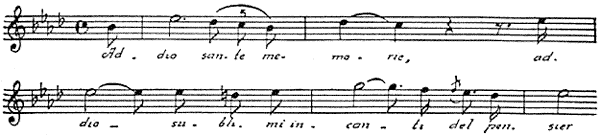
[Listen]
Addio sante memorie, addio sublimi incanti del pensier
To such a fury is the Moor aroused that he seizes Iago, hurls him to the ground, and threatens to kill him should his accusations against Desdemona prove false. There is a dramatic duet in which Iago pledges his aid to Othello in proving beyond doubt the falseness of Desdemona.
Act III. The great hall of the castle. At the back a terrace. After a brief scene in which the approach of a galley with the Venetian ambassadors is announced, Desdemona enters. Wholly unaware of the cause of Othello's strange actions toward her, she again begins to plead for Cassio's restoration to favour. Iago has pretended to Othello that Desdemona's handkerchief (of which he surreptitiously possessed himself) had been given by her to Cassio, and this has still further fanned the flame of the Moor's jealousy. The scene, for Othello, is one of mingled wrath and irony. Upon her knees Desdemona vows her constancy: "Esterrefatta fisso lo sguardo tuo tremendo" (Upon my knees before thee, beneath thy glance I tremble). I quote the phrase, "Io prego il cielo per te con questo pianto" (I pray my sighs rise to heaven with prayer).

[Listen]
Io prego il cielo per te con questo pianto
Othello pushes her out of the room. He soliloquizes: "Dio! mi potevi scagliar tutti i mali della miseria" (Heav'n had it pleased thee to try me with affliction).
Iago, entering, bids Othello conceal himself; then brings in Cassio, who mentions Desdemona to Iago, and also is led by Iago into light comments on other matters, all of which Othello, but half hearing them from his place of concealment, construes as referring to his wife. Iago also plays the trick with the handkerchief, which, having been conveyed by him to Cassio, he now induces the latter (within sight of Othello) to draw from his doublet. There is a trio for Othello (still in concealment), Iago, and Cassio.
The last-named having gone, and the Moor having asked for poison with which to kill Desdemona, Iago counsels that Othello strangle her in bed that night, while he goes forth and slays Cassio. For this counsel Othello makes Iago his lieutenant.
The Venetian ambassadors arrive. There follows the scene in which the recall of Othello to Venice and the appointment of Cassio as Governor of Cyprus are announced. This is the scene in which, also, the Moor strikes down Desdemona in the presence of the ambassadors, and she begs for mercy—"A terra—sì—nel livido fango" (Yea, prostrate here, I lie in the dust); and "Quel sol sereno e vivido che allieta il cielo e il mare" (The sun who from his cloudless sky illumes the heavens and sea).
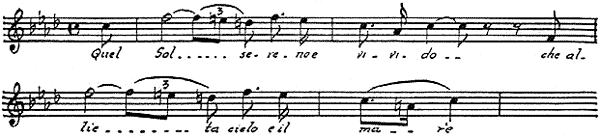
[Listen]
Quel Sol sereno e vivido che allieta il cielo e il mare
After this there is a dramatic sextet.
All leave, save the Moor and his newly created lieutenant. Overcome by rage, Othello falls in a swoon. The people, believing that the Moor, upon his return to Venice, is to receive new honours from the republic, shout from outside, "Hail, Othello! Hail to the lion of Venice!"
"There lies the lion!" is Iago's comment of malignant triumph and contempt, as the curtain falls.
Act IV. The scene is Desdemona's bedchamber. There is an orchestral introduction of much beauty. Then, as in the play, with which I am supposing the reader to be at least fairly familiar, comes the brief dialogue between Desdemona and Emilia. Desdemona sings the pathetic little willow song, said to be a genuine Italian folk tune handed down through many centuries.
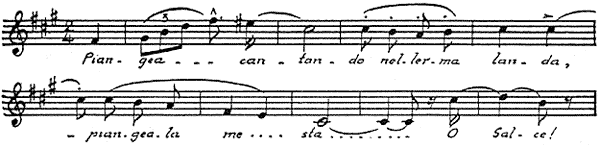
[Listen]
Piangea cantando nell'erma landa, piangea la mesta.... O Salce!
Emilia goes, and Desdemona at her prie-Dieu, before the image of the Virgin, intones an exquisite "Ave Maria," beginning and ending in pathetic monotone, with an appealing melody between.
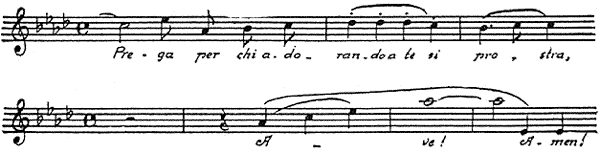
[Listen]
Prega per chi adorando a te si prostra, Ave! Amen!
Othello's entrance is accompanied by a powerful passage on the double basses.
Then follows the scene of the strangling, through which are heard mournfully reminiscent strains of the love duet that ended the first act. Emilia discloses Iago's perfidy. Othello kills himself.
FALSTAFF
Opera in three acts, by Verdi; words by Arrigo Boïto, after Shakespeare's "Merry Wives of Windsor" and "King Henry IV." Produced, La Scala, Milan, March 12, 1893. Paris, Opéra Comique, April 18, 1894. London, May 19, 1894. New York, Metropolitan Opera House, February 4, 1895. This was the first performance of "Falstaff" in North America. It had been heard in Buenos Aires, July 19, 1893. The Metropolitan cast included Maurel as Falstaff, Eames as Mistress Ford, Zélie de Lussan as Nannetta (Anne), Scalchi as Dame Quickly, Campanini as Ford, Russitano as Fenton. Scotti, Destinn, Alda, and Gay also have appeared at the Metropolitan in "Falstaff." The London production was at Covent Garden.
Characters
Sir John FalstaffBaritone
Fenton, a young gentlemanTenor
Ford, a wealthy burgherBaritone
Dr. CajusTenor
Bardolph}followers of Falstaff{Tenor
Pistol}{Bass
Robin, a page in Ford's household
Mistress FordSoprano
Anne, her daughterSoprano
Mistress PageMezzo-Soprano
Dame QuicklyMezzo-Soprano
Burghers and street-folk, Ford's servants, maskers, as elves, fairies, witches, etc.
Time—Reign of Henry IV.
Scene—Windsor.
Note. In the Shakespeare comedy Anne Ford is Anne Page.
Shakespeare's comedy, "The Merry Wives of Windsor," did not have its first lyric adaptation when the composer of "Rigoletto" and "Aïda," influenced probably by his distinguished librettist, penned the score of his last work for the stage. "Falstaff," by Salieri, was produced in Vienna in 1798; another "Falstaff," by Balfe, came out in London in 1838. Otto Nicolai's opera "The Merry Wives of Windsor" is mentioned on p. 80 of this book. The character of Falstaff also appears in "Le Songe d'une Nuit d'Été" (The Midsummer Night's Dream) by Ambroise Thomas, Paris, 1850, "where the type is treated with an adept's hand, especially in the first act, which is a masterpiece of pure comedy in music." "Le Songe d'une Nuit d'Été" was, in fact, Thomas's first significant success. A one-act piece, "Falstaff," by Adolphe Adam, was produced at the Théâtre Lyrique in 1856.
The comedy of the "Merry Wives," however, was not the only Shakespeare play put under contribution by Boïto. At the head of the "Falstaff" score is this note: "The present comedy is taken from 'The Merry Wives of Windsor' and from several passages in 'Henry IV.' by Shakespeare."
Falstaff, it should be noted, is a historic figure; he was a brave soldier; served in France; was governor of Honfleur; took an important part in the battle of Agincourt, and was in all the engagements before the walls of Orleans, where the English finally were obliged to retreat before Joan of Arc. Sir John Falstaff died at the age of eighty-two years in county Norfolk, his native shire, after numerous valiant exploits, and having occupied his old age in caring for the interests of the two universities of Oxford and Cambridge, to the foundation of which he had largely contributed. To us, however, he is known almost wholly as an enormously stout comic character.
The first scene in the first act of the work by Boïto and Verdi shows Falstaff in a room of the Garter Inn. He is accompanied by those two good-for-nothings in his service, Bardolph and Pistol, ragged blackguards, whom he treats with a disdain measured by their own low standards. Dr. Cajus enters. He comes to complain that Falstaff has beaten his servants; also that Bardolph and Pistol made him drunk and then robbed him. Falstaff laughs and browbeats him out of countenance. He departs in anger.
Falstaff has written two love letters and despatched them to two married belles of Windsor—Mistress Alice Ford and Mistress Meg Page, asking each one for a rendezvous.
The scene changes to the garden of Ford's house, and we are in presence of the "merry wives"—Alice Ford, Meg Page, and Mistress Quickly. With them is Anne Ford, Mistress Ford's daughter. Besides the garden there is seen part of the Ford house and the public road. In company with Dame Quickly, Meg has come to pay a visit to Alice Ford, to show her a letter which she has just received from Falstaff. Alice matches her with one she also has received from him. The four merry women then read the two letters, which, save for the change of address, are exactly alike. The women are half amused, half annoyed, at the pretensions of the fat knight. They plan to avenge themselves upon him. Meanwhile Ford goes walking before his house in company with Cajus, young Fenton (who is in love with Anne), Bardolph, and Pistol. The last two worthies have betrayed their master. From them Ford has learned that Falstaff is after his wife. He too meditates revenge, and goes off with the others, except Fenton, who lingers, kisses Anne through the rail fence of the garden, and sings a love duet with her. The men return. Fenton rejoins them. Anne runs back to her mother, and the four women are seen up-stage, concocting their conspiracy of revenge.
The second act reverts to the Garter Inn, where Falstaff is still at table. Dame Quickly comes with a message from Alice to agree to the rendezvous he has asked for. It is at the Ford house between two and three o'clock, it being Ford's custom to absent himself at that time. Falstaff is pompously delighted. He promises to be prompt.
Hardly has Dame Quickly left, when Ford arrives. He introduces himself to Falstaff under an assumed name, presents the knight with a purse of silver as a bait, then tells him that he is in love with Mistress Ford, whose chastity he cannot conquer, and begs Falstaff to lay siege to her and so make the way easier for him. Falstaff gleefully tells him that he has a rendezvous with her that very afternoon. This is just what Ford wanted to know.
The next scene takes place in Ford's house, where the four women get ready to give Falstaff the reception he merits. One learns here, quite casually from talk between Mistress Ford and Anne, that Ford wants to marry off the girl to the aged pedant Cajus, while she, of course, will marry none but Fenton, with whom she is in love. Her mother promises to aid her plans.
Falstaff's arrival is announced. Dame Quickly, Meg, and Anne leave Mistress Ford with him, but conceal themselves in readiness to come in response to the first signal. They are needed sooner than expected. Ford is heard approaching. Quick! The fat lover must be concealed. This is accomplished by getting him behind a screen. Ford enters with his followers, hoping to surprise the rake. With them he begins a search of the rooms. While they are off exploring another part of the house the women hurry Falstaff into a big wash basket, pile the soiled clothes over him, and fasten it down. Scarcely has this been done when Ford comes back, thinking of the screen. Just then he hears the sound of kissing behind this piece of furniture. No longer any doubt! Falstaff is hidden there with his wife. He knocks down the screen—and finds behind it Anne and Fenton, who have used to their own purpose the diversion of attention from them by the hunt for Falstaff. Ford, more furious than ever, rushes out. His wife and her friends call in the servants, who lift the basket and empty it out of the window into the Thames, which flows below. When Ford comes back, his wife leads him to the window and shows him Falstaff striking out clumsily for the shore, a butt of ridicule for all who see him.
In the third act Dame Quickly is once more seen approaching Falstaff, who is seated on a bench outside the Garter Inn. In behalf of Mistress Ford, she offers him another rendezvous. Falstaff wants to hear no more, but Dame Quickly makes so many good excuses for her friend that he decides to meet Mistress Ford at the time and place asked for by her—midnight, at Herne's oak in Windsor forest, Falstaff to appear in the disguise of the black huntsman, who, according to legend, hung himself from the oak, with the result that the spot is haunted by witches and sprites.
Falstaff, in the forest at midnight, is surrounded by the merry women, the whole Ford entourage, and about a hundred others, all disguised and masked. They unite in mystifying, taunting, and belabouring him, until at last he realizes whom he has to deal with. And as it is necessary for everything to end in a wedding, it is then that Mistress Ford persuades her husband to abandon his plan to take the pedantic Dr. Cajus for son-in-law and give his daughter Anne to Fenton.
Even taking into account "Otello," the general form of the music in "Falstaff" is an innovation for Verdi. All the scenes are connected without break in continuity, as in the Wagnerian music-drama, but applied to an entirely different style of music from Wagner's. "It required all the genius and dramatic experience of a Verdi, who had drama in his blood, to succeed in a lyrical adventure like 'Falstaff,' the whole score of which displays amazing youthfulness, dash, and spirit, coupled with extraordinary grace." On the other hand, as regards inspiration pure and simple, it has been said that there is not found in "Falstaff" the freshness of imagination or the abundance of ideas of the earlier Verdi, and that one looks in vain for one of those motifs di prima intenzione, like the romance of Germont in "La Traviata," the song of the Duke in "Rigoletto," or the "Miserere" in "Il Trovatore," and so many others that might be named. The same writer, however, credits the score with remarkable purity of form and with a sveltesse and lightness that are astonishing in the always lively attraction of the musical discourse, to say nothing of a "charming orchestration, well put together, likeable and full of coquetry, in which are found all the brilliancy and facility of the Rossini method."
Notwithstanding the above writer's appreciative words regarding the instrumentation of "Falstaff," he has fallen foul of the work, because he listened to it purely in the spirit of an opera-goer, and judged it as an opera instead of as a music-drama. If I may be pardoned the solecism, a music-drama "listens" different from an opera. A person accustomed only to opera has his ears cocked for song soaring above an accompaniment that counts for nothing save as a support for the voice. The music-lover, who knows what a music-drama consists of, is aware that it presents a well-balanced score, in which the orchestra frequently changes place with the voice in interpreting the action. It is because in "Falstaff" Verdi makes the orchestra act and sing—which to an opera-goer, his ears alert for vocal melody, means nothing—that the average audience, expecting something like unto what Verdi has given them before, is disappointed. Extremists, one way or another, are one-sided. Whoever is able to appreciate both opera and music-drama, a catholicity of taste I consider myself fortunate in possessing, can admire "Rigoletto," "Il Trovatore," and "La Traviata" as much as the most confirmed devotee of opera; but can also go further, and follow Verdi into regions where the intake is that of the pure spirit of comedy at times exhaled by the voice, at times by the orchestra.
While not divided into distinct "numbers," there are passages in "Falstaff" in which Verdi has concentrated his attention on certain characteristic episodes. In the first scene of the first act occurs Falstaff's lyric in praise of Mistress Ford, "O amor! Sguardo di stella!" (O Love, with star-like eyes). I quote the beautiful passage at "Alice è il nome" (And Alice is her name).
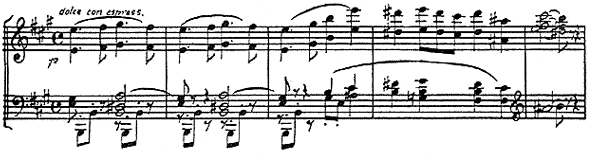
[Listen]
(Copyright, 1893, by G. Ricordi & Co.)
The same scene has the honour monologue from "King Henry IV.," which is purely declamatory, but with a remarkably vivid and characteristic accompaniment, in which especially the bassoons and clarinets comment merrily on the sarcastic sentences addressed to Bardolph and Pistol.
In the second scene of Act I, besides the episodes in which Mistress Ford reads Falstaff's letter, the unaccompanied quartet for the women ("Though shaped like a barrel, he fain would come courting"), the quartet for the men, and the close of the act in which both quartets take part, there is the piquant duet for Anne and Fenton, in which the lovers kiss each other between the palings of the fence. From this duet I quote the amatory exchange of phrases, "Labbra di foco" (Lips all afire) and "Labbra di fiore" (Lips of a flower) between Anne and Fenton.
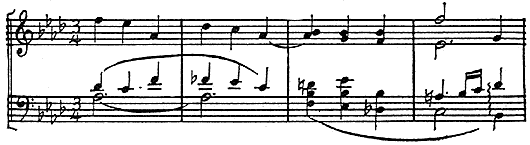
[Listen]
(Copyright, 1893, by G. Ricordi & Co.)
As the curtain falls Mistress Ford roguishly quotes a line from Falstaff's verses, the four women together add another quotation, "Come una stella sull'immensità" (Like some sweet star that sparkles all the night), and go out laughing. In fact the music for the women takes many a piquant turn.
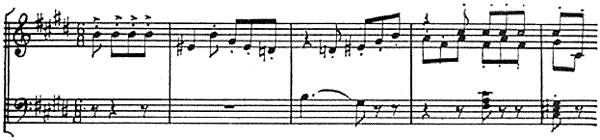
[Listen]
(Copyright, 1893, by G. Ricordi & Co.)
In Act II, the whole scene between Falstaff and Dame Quickly is full of witty commentary by the orchestra. The scene between Falstaff and Ford also derives its significance from the instrumentation. Ford's monologue, when he is persuaded by Falstaff's boastful talk that his wife is fickle, is highly dramatic. The little scene of Ford's and Falstaff's departure—Ford to expose his betrayal by his wife, Falstaff for his rendezvous with her—"is underscored by a graceful and very elegant orchestral dialogue."
The second scene of this act has Dame Quickly's madcap narrative of her interview with Falstaff; and Falstaff's ditty sung to Mistress Ford, "Quand'ero paggio del Duca di Norfolk" (When I was page to the Duke of Norfolk). From the popular point of view, this is the outstanding musical number of the work. It is amusing, pathetic, graceful, and sad; irresistible, in fact, in its mingled sentiments of comedy and regret. Very brief, it rarely fails of encores from one to four in number. I quote the following:
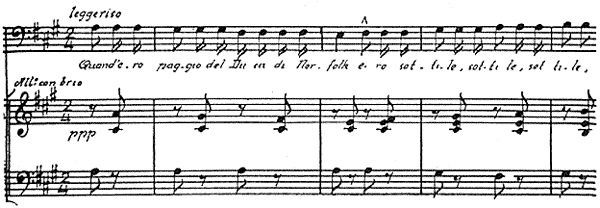
[Audio content is not currently supported on your device.
Quand'ero paggio del Duca di Norfolk ero sottile, sottile, sottile,
(Copyright, 1893, by G. Ricordi & Co.)
The search for Falstaff by Ford and his followers is most humorously treated in the score.
In Act III, in the opening scene, in which Falstaff soliloquizes over his misadventures, the humour, so far as the music is concerned, is conveyed by the orchestra.
From Fenton's song of love, which opens the scene at Herne's oak in Windsor forest, I quote this expressive passage:
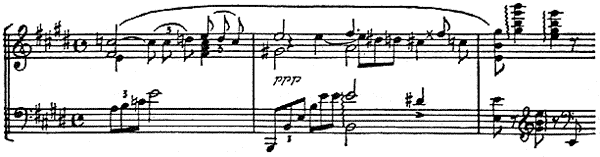
[Listen]
(Copyright, 1893, by G. Ricordi & Co.)
Another delightful solo in this scene is Anne's "Erriam sotto la luna" (We'll dance in the moonlight).
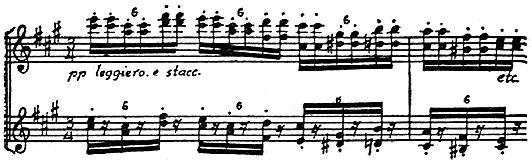
[Listen]
(Copyright, 1893, by G. Ricordi & Co.)
There are mysterious choruses—sibilant and articulately vocalized—and a final fugue.
MEFISTOFELE (MEPHISTOPHELES)
Opera in four acts; words and music by Arrigo Boïto, the book based on Goethe's Faust. Produced, without success, La Scala, Milan, March 5, 1868; revised and revived, with success, Bologna, October 4, 1875. London, Her Majesty's Theatre, July 1, 1880. New York, Academy of Music, November 24, 1880, with Campanini, Valleria, Cary, and Novara; and Metropolitan Opera House, December 5, 1883, Campanini, Nilsson, Trebelli, and Mirabella. Revivals: Metropolitan Opera House, 1889 (Lehmann); 1896 (Calvé); 1901 (Margaret McIntyre, Homer, and Plançon); 1904 (Caruso and Eames); 1907 (Chaliapine); later with Caruso, Hempel, Destinn, and Amato. Manhattan Opera House, 1906, with Renaud. Chicago Opera Company, with Ruffo. The singer of Margaret usually takes the part of Elena (Helen), and the Martha also is the Pantalis.
Characters
MefistofeleBass
FaustTenor
MargheritaSoprano
MarthaContralto
WagnerTenor
ElenaSoprano
PantalisContralto
NerenoTenor
Mystic choir, celestial phalanxes, cherubs, penitents, wayfarers, men-at-arms, huntsmen, students, citizens, populace, townsmen, witches, wizards, Greek chorus, sirens, nayads, dancers, warriors.
Time—Middle Ages.
Place—Heaven; Frankfurt, Germany; Vale of Tempe, Ancient Greece.
"Mefistofele" is in a prologue, four acts, and epilogue. In Gounod's "Faust," the librettists were circumspect, and limited the book of the opera to the first part of Goethe's Faust, the story of Faust and Marguerite—succinct, dramatic, and absorbing. Only for the ballet did they reach into the second part of Goethe's play and appropriate the scene on the Brocken, which, however, is frequently omitted.
Boïto, himself a poet, based his libretto on both parts of Goethe's work, and endeavoured to give it the substratum of philosophy upon which the German master reared his dramatic structure. This, however, resulted in making "Mefistofele" two operas in one. Wherever the work touches on the familiar story of Faust and Marguerite, it is absorbingly interesting, and this in spite of the similarity between some of its scenes and those of Gounod's "Faust." When it strays into Part II of Goethe's drama, the main thread of the action suddenly seems broken. The skein ravels. That is why one of the most profound works for the lyric stage, one of the most beautiful scores that has come out of Italy, is heard so rarely.
Theodore T. Barker prefaces his translation of the libretto, published by Oliver Ditson Company, with a recital of the story.
The Prologue opens in the nebulous regions of space, in which float the invisible legions of angels, cherubs, and seraphs. These lift their voices in a hymn of praise to the Supreme Ruler of the universe. Mefistofele enters on the scene at the close of the anthem, and, standing erect amid the clouds, with his feet upon the border of his cloak, mockingly addresses the Deity. In answer to the question from the mystic choir, "Knowest thou Faust?" he answers contemptuously, and offers to wager that he will be able to entice Faust to evil, and thus gain a victory over the powers of good. The wager is accepted, and the spirits resume their chorus of praise.
Musically the Prologue is full of interest. There are five distinct periods of music, varied in character, so that it gives necessary movement to a scene in which there is but little stage action. There are the prelude with mystic choir; the sardonic scherzo foreshadowing the entry of Mefistofele; his scornful address, in which finally he engages to bring about the destruction of Faust's soul; a vivacious chorus of cherubs (impersonated by twenty-four boys); a psalmody of penitents and spirits.
Act I. The drama opens on Easter Sunday, at Frankfort-on-the-Main. Crowds of people of all conditions move in and out of the city gates. Among them appears a grey friar, an object of both reverence and dread to those near him. The aged Dr. Faust and his pupil Wagner descend from a height and enter upon the scene, shadowed by the friar, whose actions they discuss. Faust returns to his laboratory, still at his heels the friar, who, unheeded, enters with him, and conceals himself in an alcove. Faust gives himself to meditation, and upon opening the sacred volume, is startled by a shriek from the friar as he rushes from his place of concealment. Faust makes the all-potent "sign of Solomon," which compels Mefistofele to throw off his friar's disguise and to appear in his own person in the garb of a cavalier, with a black cloak upon his arm. In reply to Faust's questionings, he declares himself the spirit that denieth all things, desiring only the complete ruin of the world, and a return to chaos and night. He offers to make Faust the companion of his wanderings, upon certain conditions, to which the latter agrees, saying: "If thou wilt bring me one hour of peace, in which my soul may rest—if thou wilt unveil the world and myself before me—if I may find cause to say to some flying moment, 'Stay, for thou art blissful,' then let me die, and let hell's depths engulf me." The contract completed, Mefistofele spreads his cloak, and both disappear through the air.
The first scene of this act gains its interest from the reflection in the music of the bustle and animation of the Easter festival. The score plastically follows the many changing incidents of the scene upon the stage. Conspicuous in the episodes in Faust's laboratory are Faust's beautiful air, "Dai campi, dai prati" (From the fields and from the meadows); and Mefistofele's proclamation of his identity, "Son lo spirito che nega" (I am the spirit that denieth).
Act II opens with the garden scene. Faust, rejuvenated, and under the name of Henry; Margaret, Mefistofele, and Martha stroll here and there in couples, chatting and love-making. Thence Mefistofele takes Faust to the heights of the Brocken, where he witnesses the orgies of the Witches' Sabbath. The fiend is welcomed and saluted as their king. Faust, benumbed and stupefied, gazes into the murky sky, and experiences there a vision of Margaret, pale, sad, and fettered with chains.
In this act the garden scene is of entrancing grace. It contains Faust's "Colma il tuo cor d'un palpito" (Flood thou thy heart with all the bliss), and the quartet of farewell, with which the scene ends, Margaret, with the gay and reckless laugh of ineffable bliss, exclaiming to Faust that she loves him. The scene in the Brocken, besides the whirl of the witches' orgy, has a solo for Mefistofele, when the weird sisters present to him a glass globe, reflected in which he sees the earth. "Ecco il mondo" (Behold the earth).
Act III. The scene is a prison. Margaret lies extended upon a heap of straw, mentally wandering, and singing to herself. Mefistofele and Faust appear outside the grating. They converse hurriedly, and Faust begs for the life of Margaret. Mefistofele promises to do what he can, and bids him haste, for the infernal steeds are ready for flight. He opens the cell, and Faust enters it. Margaret thinks the jailors have come to release her, but at length recognizes her lover. She describes what followed his desertion of her, and begs him to lay her in death beside her loved ones;—her babe, whom she drowned, her mother whom she is accused of having poisoned. Faust entreats her to fly with him, and she finally consents, saying that in some far distant isle they may yet be happy. But the voice of Mefistofele in the background recalls her to the reality of the situation. She shrinks away from Faust, prays to Heaven for mercy, and dies. Voices of the celestial choir are singing softly "She's saved!" Faust and Mefistofele escape, as the executioner and his escort appear in the background.
The act opens with Margaret's lament, "L'altra notte in fonda al mare" (To the sea, one night in sadness), in which she tells of the drowning of her babe. There is an exquisite duet, for Margaret and Faust, "Lontano, sui flutti d'un ampio oceano" (Far away, o'er the waves of a far-spreading ocean).
Act IV. Mefistofele takes Faust to the shores of the Vale of Tempe. Faust is ravished with the beauty of the scene while Mefistofele finds that the orgies of the Brocken were more to his taste.
'Tis the night of the classic Sabbath. A band of young maidens appear, singing and dancing. Mefistofele, annoyed and confused, retires. Helen enters with chorus, and, absorbed by a terrible vision, rehearses the story of Troy's destruction. Faust enters, richly clad in the costume of a knight of the fifteenth century, followed by Mefistofele, Nereno, Pantalis, and others, with little fauns and sirens. Kneeling before Helen, he addresses her as his ideal of beauty and purity. Thus pledging to each other their love and devotion, they wander through the bowers and are lost to sight.
Helen's ode, "La luna immobile innonda l'etere" (Motionless floating, the moon floods the dome of night); her dream of the destruction of Troy; the love duet for Helen and Faust, "Ah! Amore! mistero celeste" ('Tis love, a mystery celestial); and the dexterous weaving of a musical background by orchestra and chorus, are the chief features in the score to this act.
In the Epilogue, we find Faust in his laboratory once more—an old man, with death fast approaching, mourning over his past life, with the holy volume open before him. Fearing that Faust may yet escape him, Mefistofele spreads his cloak, and urges Faust to fly with him through the air. Appealing to Heaven, Faust is strengthened by the sound of angelic songs, and resists. Foiled in his efforts, Mefistofele conjures up a vision of beautiful sirens. Faust hesitates a moment, flies to the sacred volume, and cries, "Here at last I find salvation"; then falling on his knees in prayer, effectually overcomes the temptations of the evil one. He then dies amid a shower of rosy petals, and to the triumphant song of a celestial choir. Mefistofele has lost his wager, and holy influences have prevailed.
We have here Faust's lament, "Giunto sul passo estremo" (Nearing the utmost limit); his prayer, and the choiring of salvation.
Arrigo Boïto was, it will be recalled, the author of the books to Ponchielli's opera "La Gioconda," and Verdi's "Otello" and "Falstaff." He was born in Padua, February 24, 1842. From 1853 to 1862 he was a pupil of the Milan Conservatory. During a long sojourn in Germany and Poland he became an ardent admirer of Wagner's music. Since "Mefistofele" Boïto has written and composed another opera, "Nerone" (Nero), but has withheld it from production.