Richard Wagner (1813-1883) (continued 4)
Reading edition
Walther von Stolzing is in love with Eva. Her father having promised her to the singer to whom at the coming midsummer festival the Mastersingers shall adjudge the prize, it becomes necessary for Walther to seek admission to their art union. He is, however, rejected, his song violating the rules to which the Mastersingers slavishly adhere. Beckmesser is also instrumental in securing Walther's rejection. The town clerk is the "marker" of the union. His duty is to mark all violations of the rules against a candidate. Beckmesser, being a suitor for Eva's hand, naturally makes the most of every chance to put down a mark against Walther.
Sachs alone among the Mastersingers has recognized the beauty of Walther's song. Its very freedom from rule and rote charms him, and he discovers in the young knight's untrammelled genius the power which, if properly directed, will lead art from the beaten path of tradition toward a new and loftier ideal.
After Walther's failure before the Mastersingers the impetuous young knight persuades Eva to elope with him. But at night as they are preparing to escape, Beckmesser comes upon the scene to serenade Eva. Sachs, whose house is opposite Pogner's, has meanwhile brought his work bench out into the street and insists on "marking" what he considers Beckmesser's mistakes by bringing his hammer down upon his last with a resounding whack. The louder Beckmesser sings the louder Sachs whacks. Finally the neighbours are aroused. David, who is in love with Magdalena and thinks Beckmesser is serenading her, falls upon him with a cudgel. The whole neighbourhood turns out and a general mêlée ensues, during which Sachs separates Eva and Walther and draws the latter into his home.
The following morning Walther sings to Sachs a song which has come to him in a dream, Sachs transcribing the words and passing friendly criticism upon them and the music. The midsummer festival is to take place that afternoon, and through a ruse Sachs manages to get Walther's poem into Beckmesser's possession, who, thinking the words are by the popular cobbler-poet, feels sure he will be the chosen master. Eva, coming into the workshop to have her shoes fitted, finds Walther, and the lovers depart with Sachs, David, and Magdalena for the festival. Here Beckmesser, as Sachs had anticipated, makes a wretched failure, as he has utterly missed the spirit of the poem, and Walther, being called upon by Sachs to reveal its beauty in music, sings his prize song, winning at once the approbation of the Mastersingers and the populace. He is received into their art union and at the same time wins Eva as his bride.
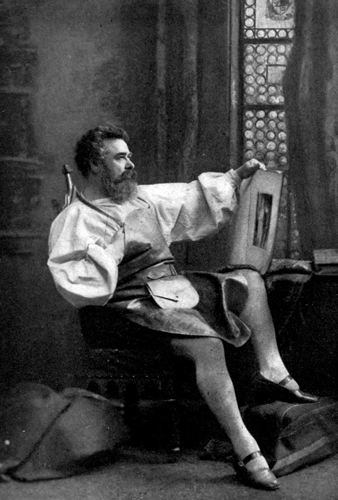
Photo by Falk
Emil Fischer as Hans Sachs in “Die Meistersinger”
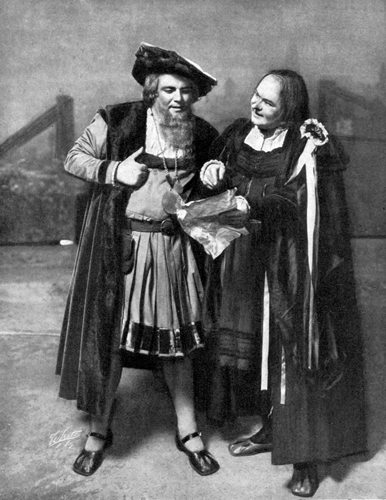
Photo by White
Weil and Goritz as Hans Sachs and Beckmesser in “Die Meistersinger”
The Mastersingers were of burgher extraction. They flourished in Germany, chiefly in the imperial cities, during the fourteenth, fifteenth, and sixteenth centuries. They did much to generate and preserve a love of art among the middle classes. Their musical competitions were judged according to a code of rules which distinguished by particular names thirty-two faults to be avoided. Scriptural or devotional subjects were usually selected and the judges or Merker (Markers) were, in Nuremburg, four in number, the first comparing the words with the Biblical text, the second criticizing the prosody, the third the rhymes, and the fourth the tune. He who had the fewest marks against him received the prize.
Hans Sachs, the most famous of the Mastersingers, born November 5, 1494, died January, 1576, in Nuremburg, is said to have been the author of some six thousand poems. He was a cobbler by trade—
Hans Sachs was a shoe- Maker and poet too.
A monument was erected to him in the city of his birth in 1874.
"The Mastersingers" is a simple, human love story, simply told, with many touches of humour to enliven it, and its interest enhanced by highly picturesque, historical surroundings. As a drama it conveys also a perfect picture of the life and customs of Nuremburg of the time in which the story plays. Wagner must have made careful historical researches, but his book lore is not thrust upon us. The work is so spontaneous that the method and manner of its art are lost sight of in admiration of the result. Hans Sachs himself could not have left a more faithful portrait of life in Nuremburg in the middle of the sixteenth century.
"The Mastersingers" has a peculiarly Wagnerian interest. It is Wagner's protest against the narrow-minded critics and the prejudiced public who so long refused him recognition. Edward Hanslick, the bitterest of Wagner's critics, regarded the libretto as a personal insult to himself. Being present by invitation at a private reading of the libretto, which Wagner gave in Vienna, Hanslick rose abruptly and left after the first act. Walther von Stolzing is the incarnation of new aspirations in art; the champion of a new art ideal, and continually chafing under the restraints imposed by traditional rules and methods. Hans Sachs is a conservative. But, while preserving what is best in art traditions, he is able to recognize the beautiful in what is new. He represents enlightened public opinion. Beckmesser and the other Mastersingers are the embodiment of rank prejudice—the critics. Walther's triumph is also Wagner's. Few of Wagner's dramatic creations equal in lifelike interest the character of Sachs. It is drawn with a strong, firm hand, and filled in with many delicate touches.
The Vorspiel gives a complete musical epitome of the story. It is full of life and action—pompous, impassioned, and jocose in turn, and without a suggestion of the overwrought or morbid. Its sentiment and its fun are purely human. In its technical construction it has long been recognized as a masterpiece.
In the sense that it precedes the rise of the curtain, this orchestral composition is a Vorspiel, or prelude. As a work, however, it is a full-fledged overture, rich in thematic material. These themes are Leading Motives heard many times, and in wonderful variety in the three acts of "The Mastersingers." To a great extent an analysis of this overture forecasts the work itself. Accordingly, again through the courtesy of G. Schirmer Inc., I avail myself of my Wagner's Music-Dramas Analysed, in the account of the Vorspiel and of the action and music that follow it.
The pompous Motive of the Mastersingers opens the Vorspiel. This theme gives capital musical expression to the characteristics of these dignitaries; eminently worthy but self-sufficient citizens who are slow to receive new impressions and do not take kindly to innovations. Our term of old fogy describes them imperfectly, as it does not allow for their many excellent qualities. They are slow to act, but if they are once aroused their ponderous influence bears down all opposition. At first an obstacle to genuine reform, they are in the end the force which pushes it to success. Thus there is in the Motive of the Mastersingers a certain ponderous dignity which well emphasizes the idea of conservative power.

[Listen]
In great contrast to this is the Lyric Motive, which seems to express the striving after a poetic ideal untrammelled by old-fashioned restrictions, such as the rules of the Mastersingers impose.

[Listen]
But, the sturdy conservative forces are still unwilling to be persuaded of the worth of this new ideal. Hence the Lyric Motive is suddenly checked by the sonorous measures of the Mastersingers' March.

[Listen]
In this the majesty of law and order finds expression. It is followed by a phrase of noble breadth and beauty, obviously developed from portions of the Motive of the Mastersingers, and so typical of the goodwill which should exist among the members of a fraternity that it may be called the Motive of the Art Brotherhood.
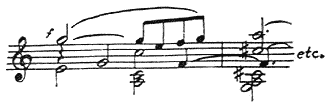
[Listen]
It reaches an eloquent climax in the Motive of the Ideal.

[Listen]
Opposed, however, to this guild of conservative masters is the restless spirit of progress. Hence, though stately the strains of the Mastersingers' March and of the Guild Motive, soon yield to a theme full of emotional energy and much like the Lyric Motive. Walther is the champion of this new ideal—not, however, from a purely artistic impulse, but rather through his love for Eva. Being ignorant of the rules and rote of the Mastersingers he sings, when he presents himself for admission to the fraternity, measures which soar untrammelled into realms of beauty beyond the imagination of the masters. But it was his love for Eva which impelled him to seek admission to the brotherhood, and love inspired his song. He is therefore a reformer only by accident; it is not his love of art, but his passion for Eva, which really brings about through his prize song a great musical reform. This is one of Wagner's finest dramatic touches—the love story is the mainspring of the action, the moral is pointed only incidentally. Hence all the motives in which the restless striving after a new ideal, or the struggles of a new art form to break through the barriers of conservative prejudice, find expression, are so many love motives, Eva being the incarnation of Walther's ideal. Therefore the motive which breaks in upon the Mastersingers' March and Guild Motive with such emotional energy expresses Walther's desire to possess Eva, more than his yearning for a new ideal in art. So I call it the Motive of Longing.

[Listen]
A portion of "Walther's Prize Song," like a swiftly whispered declaration of love,

[Listen]
leads to a variation of one of the most beautiful themes of the work—the Motive of Spring.
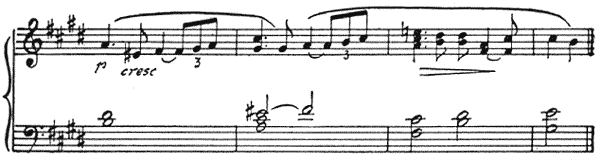
[Listen]
And now Wagner has a fling at the old fogyism which was so long an obstacle to his success. He holds the masters up to ridicule in a delightfully humorous passage which parodies the Mastersingers' and Art Brotherhood motives, while the Spring Motive vainly strives to assert itself. In the bass, the following quotation is the Motive of Ridicule, the treble being a variant of the Art Brotherhood Motive.
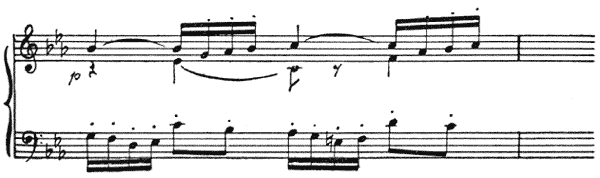
[Listen]
When it is considered that the opposition Wagner encountered from prejudiced critics, not to mention a prejudiced public, was the bane of his career, it seems wonderful that he should have been content to protest against it with this pleasant raillery instead of with bitter invective. The passage is followed by the Motive of the Mastersingers, which in turn leads to an imposing combination of phrases. We hear the portion of the Prize Song already quoted—the Motive of the Mastersingers as bass—and in the middle voices portions of the Mastersingers' March; a little later the Motive of the Art Brotherhood and the Motive of Ridicule are added, this grand massing of orchestral forces reaching a powerful climax, with the Motive of the Ideal, while the Motive of the Mastersingers brings the Vorspiel to a fitting close. In this noble passage, in which the "Prize Song" soars above the various themes typical of the masters, the new ideal seems to be borne to its triumph upon the shoulders of the conservative forces which, won over at last, have espoused its cause with all their sturdy energy.
This concluding passage in the Vorspiel thus brings out with great eloquence the inner significance of "Die Meistersinger." In whatever the great author and composer of this work wrote for the stage, there always was an ethical meaning back of the words and music. Thus we draw our conclusion of the meaning of "Die Meistersinger" story from the wonderful combination of leading motives in the peroration of its Vorspiel.
In his fine book, The Orchestra and Orchestral Music, W.J. Henderson relates this anecdote:
"A professional musician was engaged in a discussion of Wagner in the corridor of the Metropolitan Opera House, while inside the orchestra was playing the 'Meistersinger' overture.
"'It is a pity,' said this wise man, in a condescending manner, 'but Wagner knows absolutely nothing about counterpoint.'
"At that instant the orchestra was singing five different melodies at once; and, as Anton Seidl was the conductor, they were all audible."
In a rare book by J.C. Wagenseil, printed in Nuremburg in 1697, are given four "Prize Master Tones." Two of these Wagner has reproduced in modern garb, the former in the Mastersingers' March, the latter in the Motive of the Art Brotherhood.
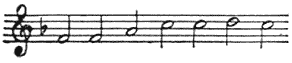

[Listen] [Listen]
Act I. The scene of this act is laid in the Church of St. Catherine, Nuremburg. The congregation is singing the final chorale of the service. Among the worshippers are Eva and her maid, Magdalena. Walther stands aside, and, by means of nods and gestures, communicates with Eva. This mimic conversation is expressively accompanied by interludes between the verses of the chorale, interludes expressively based on the Lyric, Spring, and Prize Song motives, and contrasting charmingly with the strains of the chorale.
The service over, the Motive of Spring, with an impetuous upward rush, seems to express the lovers' joy that the restraint is removed, and the Lyric Motive resounds exultingly as the congregation departs, leaving Eva, Magdalena, and Walther behind.
Eva, in order to gain a few words with Walther, sends Magdalena back to the pew to look for a kerchief and hymn-book, she has purposely left there. Magdalena urges Eva to return home, but just then David appears in the background and begins putting things to rights for the meeting of the Mastersingers. Magdalena is therefore only too glad to linger. The Mastersinger and Guild motives, which naturally accompany David's activity, contrast soberly with the ardent phrases of the lovers. Magdalena explains to Walther that Eva is already affianced, though she herself does not know to whom. Her father wishes her to marry the singer to whom at the coming contest the Mastersingers shall award the prize; and, while she shall be at liberty to decline him, she may marry none but a master. Eva exclaims: "I will choose no one but my knight!" Very pretty and gay is the theme heard when David joins the group—the Apprentice Motive.

[Listen]
How capitally this motive expresses the light-heartedness of gay young people, in this case the youthful apprentices, among whom David was as gay and buoyant as any. Every melodious phrase—every motive—employed by Wagner appears to express exactly the character, circumstance, thing, or feeling, to which he applies it. The opening episodes of "Die Meistersinger" have a charm all their own.
The scene closes with a beautiful little terzet, after Magdalena has ordered David, under penalty of her displeasure, to instruct the knight in the art rules of the Mastersingers.
When the 'prentices enter, they proceed to erect the marker's platform, but stop at times to annoy the somewhat self-sufficient David, while he is endeavouring to instruct Walther in the rules of the Mastersingers. The merry Apprentice Motive runs through the scene and brings it to a close as the 'prentices sing and dance around the marker's box, suddenly, however, breaking off, for the Mastersingers appear.
There is a roll-call and then the fine passage for bass voice, in which Pogner offers Eva's hand in marriage to the winner of the coming song contest—with the proviso that Eva adds her consent. The passage is known on concert programmes as "Pogner's Address."
Walther is introduced by Pogner. The Knight Motive:
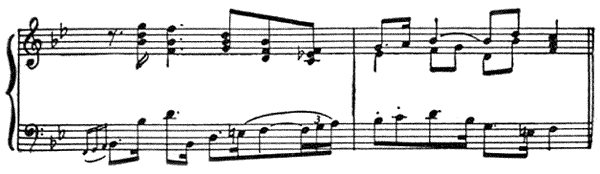
[Listen]
Beckmesser, jealous, and determined that Walther shall fail, enters the marker's box.
Kothner now begins reading off the rules of singing established by the masters, which is a capital take-off on old-fashioned forms of composition and never fails to raise a hearty laugh if delivered with considerable pomposity and unction. Unwillingly enough Walther takes his seat in the candidate's chair. Beckmesser shouts from the marker's box: "Now begin!" After a brilliant chord, followed by a superb ascending run on the violins, Walther, in ringing tones, enforced by a broad and noble chord, repeats Beckmesser's words. But such a change has come over the music that it seems as if that upward rushing run had swept away all restraint of ancient rule and rote, just as the spring wind whirling through the forest tears up the spread of dry, dead leaves, thus giving air and sun to the yearning mosses and flowers. In Walther's song the Spring Motive forms an ever-surging, swelling accompaniment, finally joining in the vocal melody and bearing it higher and higher to an impassioned climax. In his song, however, Walther is interrupted by the scratching made by Beckmesser as he chalks the singer's violations of the rules on the slate, and Walther, who is singing of love and spring, changes his theme to winter, which, lingering behind a thorny hedge, is plotting how it can mar the joy of the vernal season. The knight then rises from the chair and sings a second stanza with defiant enthusiasm. As he concludes it Beckmesser tears open the curtains which concealed him in the marker's box, and exhibits his board completely covered with chalk marks. Walther protests, but the masters, with the exception of Sachs and Pogner, refuse to listen further, and deride his singing. We have here the Motive of Derision.
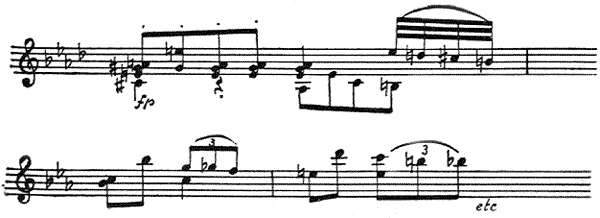
[Listen]
Sachs protests that, while he found the knight's art method new, he did not find it formless. The Sachs Motive is here introduced.
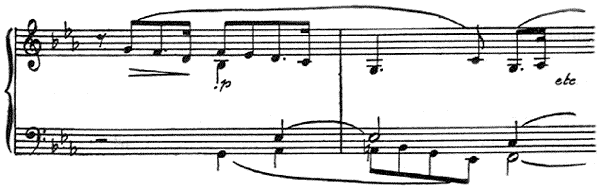
[Listen]
The Sachs Motive betokens the genial nature of this sturdy, yet gentle man—the master spirit of the drama. He combines the force of a conservative character with the tolerance of a progressive one, and is thus the incarnation of the idea which Wagner is working out in this drama, in which the union of a proper degree of conservative caution with progressive energy produces a new ideal in art. To Sachs's innuendo that Beckmessers' marking hardly could be considered just, as he is a candidate for Eva's hand, Beckmesser, by way of reply, chides Sachs for having delayed so long in finishing a pair of shoes for him, and as Sachs makes a humorously apologetic answer, the Cobbler Motive is heard.
The sturdy burgher calls to Walther to finish his song in spite of the masters. And now a finale of masterful construction begins. In short, excited phrases the masters chaff and deride Walther. His song, however, soars above all the hubbub. The 'prentices see their opportunity in the confusion, and joining hands they dance around the marker's box, singing as they do so. We now have combined with astounding skill Walther's song, the 'prentices' chorus, and the exclamations of the masters. The latter finally shout their verdict: "Rejected and outsung!" The knight, with a proud gesture of contempt, leaves the church. The 'prentices put the seats and benches back in their proper places, and in doing so greatly obstruct the masters as they crowd toward the doors. Sachs, who has lingered behind, gazes thoughtfully at the singer's empty chair, then, with a humorous gesture of discouragement, turns away.
Act II. The scene of this act represents a street in Nuremburg crossing the stage and intersected in the middle by a narrow, winding alley. There are thus two corner houses—on the right corner of the alley Pogner's, on the left Sachs's. Before the former is a linden-tree, before the latter an elder. It is a lovely summer evening.
The opening scene is a merry one. David and the 'prentices are closing shop. After a brisk introduction based on the Midsummer Festival Motive the 'prentices quiz David on his love affair with Magdalena. The latter appears with a basket of dainties for her lover, but on learning that the knight has been rejected, she snatches the basket away from David and hurries back to the house. The 'prentices now mockingly congratulate David on his successful wooing. David loses his temper and shows fight, but Sachs, coming upon the scene, sends the 'prentices on their way and then enters his workshop with David. The music of this episode, especially the 'prentices' chorus, is bright and graceful.
Pogner and Eva, returning from an evening stroll, now come down the alley. Before retiring into the house the father questions the daughter as to her feelings concerning the duty she is to perform at the Mastersinging on the morrow. Her replies are discreetly evasive. The music beautifully reflects the affectionate relations between Pogner and Eva. When Pogner, his daughter seated beside him under the linden-tree, speaks of the morrow's festival and Eva's part in it in awarding the prize to the master of her choice before the assembled burghers of Nuremburg, the stately Nuremburg Motive is ushered in.
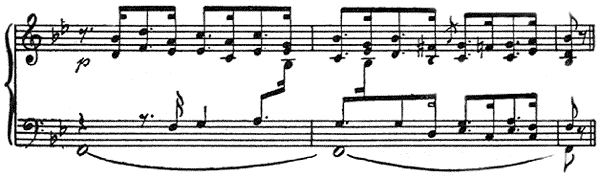
[Listen]
Magdalena appears at the door and signals to Eva. The latter persuades her father that it is too cool to remain outdoors and, as they enter the house, Eva learns from Magdalena of Walther's failure before the masters. Magdalena advises her to seek counsel with Sachs after supper.
The Cobbler Motive shows us Sachs and David in the former's workshop. When the master has dismissed his 'prentice till morning, he yields to his poetic love of the balmy midsummer night and, laying down his work, leans over the half-door of his shop as if lost in reverie. The Cobbler Motive dies away to pp, and then there is wafted from over the orchestra like the sweet scent of the blooming elder the Spring Motive, while tender notes on the horn blossom beneath a nebulous veil of tremolo violins into memories of Walther's song. Its measures run through Sachs's head until, angered at the stupid conservatism of his associates, he resumes his work to the brusque measures of the Cobbler's Motive. As his ill humour yields again to the beauties of the night, this motive yields once more to that of spring, which, with reminiscences of Walther's first song before the masters, imbues this masterful monologue with poetic beauty of the highest order. The last words in praise of Walther ("The bird who sang today," etc.) are sung to a broad and expressive melody.
Eva now comes out into the street and, shyly approaching the shop, stands at the door unnoticed by Sachs until she speaks to him. The theme which pervades this scene seems to breathe forth the very spirit of lovely maidenhood which springs from the union of romantic aspirations, feminine reserve, and rare physical graces. It is the Eva Motive, which, with the delicate touch of a master, Wagner so varies that it follows the many subtle dramatic suggestions of the scene. The Eva Motive, in its original form, is as follows:
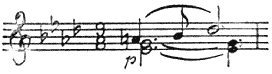
[Listen]
When at Eva's first words Sachs looks up, there is this elegant variation of the Eva Motive:
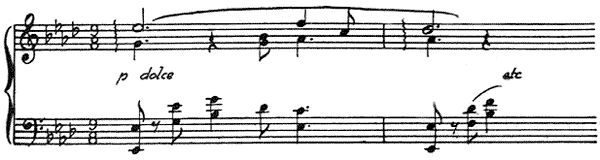
[Listen]
Then the scene being now fully ushered in, we have the Eva Motive itself. Eva leads the talk up to the morrow's festival, and when Sachs mentions Beckmesser as her chief wooer, roguishly hints, with evident reference to Sachs himself, that she might prefer a hearty widower to a bachelor of such disagreeable characteristics as the marker. There are sufficient indications that the sturdy master is not indifferent to Eva's charms, but, whole-souled, genuine friend that he is, his one idea is to further the love affair between his fair neighbour and Walther. The music of this passage is very suggestive. The melodic leading of the upper voice in the accompaniment, when Eva asks: "Could not a widower hope to win me?" is identical with a variation of the Isolde Motive in "Tristan and Isolde," while the Eva Motive, shyly pp, seems to indicate the artfulness of Eva's question. The reminiscence from "Tristan" can hardly be regarded as accidental, for Sachs afterwards boasts that he does not care to share the fate of poor King Marke. Eva now endeavours to glean particulars of Walther's experience in the morning, and we have the Motive of Envy, the Knight Motive, and the Motive of Ridicule. Eva does not appreciate the fine satire in Sachs's severe strictures on Walther's singing—he re-echoes not his own views, but those of the other masters, for whom, not for the knight, his strictures are really intended—and she leaves him in anger. This shows Sachs which way the wind blows, and he forthwith resolves to do all in his power to bring Eva's and Walther's love affair to a successful conclusion. While Eva is engaged with Magdalena, who has come out to call her, he busies himself in closing the upper half of his shop door so far that only a gleam of light is visible, he himself being completely hidden. Eva learns from Magdalena of Beckmesser's intended serenade, and it is agreed that the maid shall personate Eva at the window.
Steps are heard coming down the alley. Eva recognizes Walther and flies to his arms, Magdalena discreetly hurrying into the house. The ensuing ardent scene between Eva and Walther brings familiar motives. The knight's excitement is comically broken in upon by the Night Watchman's cow-horn, and, as Eva lays her hand soothingly upon his arm and counsels that they retreat within the shadow of the linden-tree, there steals over the orchestra, like the fragrance of the summer night, a delicate variant of the Eva Motive—The Summer Night Motive.

[Listen]
Eva vanishes into the house to prepare to elope with Walther. The Night Watchman now goes up the stage intoning a mediæval chant. Coming in the midst of the beautiful modern music of "The Mastersingers," its effect is most quaint.
As Eva reappears and she and the knight are about to make their escape, Sachs, to prevent this precipitate and foolish step, throws open his shutters and allows his lamp to shed a streak of brilliant light across the street.
The lovers hesitate; and now Beckmesser sneaks in after the Night Watchman and, leaning against Sachs's house, begins to tune his lute, the peculiar twang of which, contrasted with the rich orchestration, sounds irresistibly ridiculous.
Meanwhile, Eva and Walther have once more retreated into the shade of the linden-tree, and Sachs, who has placed his work bench in front of his door, begins hammering at the last and intones a song which is one of the rough diamonds of musical invention, for it is purposely brusque and rough, just such a song as a hearty, happy artisan might sing over his work. It is aptly introduced by the Cobbler Motive. Beckmesser, greatly disturbed lest his serenade be ruined, entreats Sachs to cease singing. The latter agrees, but with the proviso that he shall "mark" each of Beckmesser's mistakes with a hammer stroke. As if to bring out as sharply as possible the ridiculous character of the serenade, the orchestra breathes forth once more the summer night's music before Beckmesser begins his song, and this is set to a parody of the Lyric Motive. Wagner, with keen satire, seems to want to show how a beautiful melody may become absurd through old-fogy methods. Beckmesser has hardly begun before Sachs's hammer comes down on the last with a resounding whack, which makes the town clerk fairly jump with anger. He resumes, but soon is rudely interrupted again by a blow of Sachs's hammer. The whacks come faster and faster. Beckmesser, in order to make himself heard above them, sings louder and louder. Some of the neighbours are awakened by the noise and coming to their windows bid Beckmesser hold his peace. David, stung by jealousy as he sees Magdalena listening to the serenade, leaps from his room and falls upon the town clerk with a cudgel. The neighbours, male and female, run out into the street and a general mêlée ensues, the masters, who hurry upon the scene, seeking to restore quiet, while the 'prentices vent their high spirits by doing all in their power to add to the hubbub. All is now noise and disorder, pandemonium seeming to have been let loose upon the dignified old town.
Musically this tumult finds expression in a fugue whose chief theme is the Cudgel Motive.
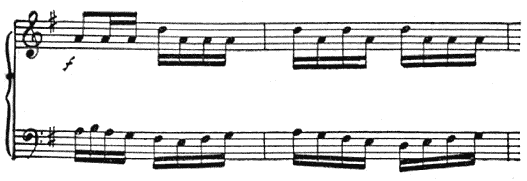
[Listen]
From beneath the hubbub of voices—those of the 'prentices and journeymen, delighted to take part in the shindy, of the women who are terrified at it, and of the masters who strive to stop it, is heard the theme of Beckmesser's song, the real cause of the row. This is another of those many instances in which Wagner vividly expresses in his music the significance of what transpires on the stage.
Sachs finally succeeds in shoving the 'prentices and journeymen out of the way. The street is cleared, but not before the cobbler-poet has pushed Eva, who was about to elope with Walther, into her father's arms and drawn Walther after him into his shop.
The street is quiet. And now, the rumpus subsided and all concerned in it gone, the Night Watchman appears, rubs his eyes and chants his mediæval call. The street is flooded with moonlight. The Watchman with his clumsy halberd lunges at his own shadow, then goes up the alley.
We have had hubbub, we have had humour, and now we have a musical ending elvish, roguish, and yet exquisite in sentiment. The effect is produced by the Cudgel Motive played with the utmost delicacy on the flute, while the theme of Beckmesser's serenade merrily runs after itself on clarinet and bassoon, and the muted violins softly breathe the Midsummer Festival Motive.
Act III. During this act the tender strain in Sachs's sturdy character is brought out in bold relief. Hence the prelude develops what may be called three Sachs themes, two of them expressive of his twofold nature as poet and cobbler, the third standing for the love which his fellow-burghers bear him.
The prelude opens with the Wahn Motive or Motive of Poetic Illusion. This reflects the deep thought and poetic aspirations of Sachs the poet. It is followed by the theme of the beautiful chorus, sung later in the act, in praise of Sachs: "Awake! draws nigh the break of day." This theme, among the three heard in the prelude, points to Sachs's popularity. The third consists of portions of the cobbler's song in the second act. This prelude has long been considered one of Wagner's masterpieces. The themes are treated with the utmost delicacy, so that we recognize through them both the tender, poetic side of Sachs's nature and his good-humoured brusqueness. The Motive of Poetic illusion is deeply reflective, and it might be preferable to name it the Motive of Poetic Thought, were it not that it is better to preserve the significance of the term Wahn Motive, which there is ample reason to believe originated with Wagner himself. The prelude is, in fact, a subtle analysis of character expressed in music.

[Listen]
How peaceful the scene on which the curtain rises. Sachs is sitting in an armchair in his sunny workshop, reading in a large folio. The Illusion Motive has not yet died away in the prelude, so that it seems to reflect the thoughts awakened in Sachs by what he is reading. David, dressed for the festival, enters just as the prelude ends. There is a scene full of charming bonhomie between Sachs and his 'prentice, which is followed, when the latter has withdrawn, by Sachs's monologue: "Wahn! Wahn! Ueberall Wahn!" (Illusion, everywhere illusion.)
While the Illusion Motive seems to weave a poetic atmosphere about him, Sachs, buried in thought, rests his head upon his arm over the folio. The Illusion Motive is followed by the Spring Motive, which in turn yields to the Nuremburg Motive as Sachs sings the praises of the stately old town. At his reference to the tumult of the night before there are in the score corresponding allusions to the music of that episode. "A glowworm could not find its mate," he sings, referring to Walther and Eva. The Midsummer Festival, Lyric, and Nuremburg motives in union foreshadow the triumph of true art through love on Nuremburg soil, and thus bring the monologue to a stately conclusion.
Walther now enters from the chamber, which opens upon a gallery, and, descending into the workshop, is heartily greeted by Sachs with the Sachs Motive, which dominates the immediately ensuing scene. Very beautiful is the theme in which Sachs protests against Walther's derision of the masters; for they are, in spite of their many old-fogyish notions, the conservators of much that is true and beautiful in art.
Walther tells Sachs of a song which came to him in a dream during the night, and sings two stanzas of this "Prize Song," Sachs making friendly critical comments as he writes down the words. The Nuremburg Motive in sonorous and festive instrumentation closes this melodious episode.
When Sachs and Walther have retired Beckmesser is seen peeping into the shop. Observing that it is empty he enters hastily. He is ridiculously overdressed for the approaching festival, limps, and occasionally rubs his muscles as if he were still stiff and sore from his drubbing. By chance his glance falls on the manuscript of the "Prize Song" in Sachs's handwriting on the table, when he breaks forth in wrathful exclamations, thinking now that he has in the popular master a rival for Eva's hand. Hearing the chamber door opening he hastily grabs the manuscript and thrusts it into his pocket. Sachs enters. Observing that the manuscript is no longer on the table, he realizes that Beckmesser has stolen it, and conceives the idea of allowing him to keep it, knowing that the marker will fail most wretchedly in attempting to give musical expression to Walther's inspiration.
The scene places Sachs in a new light. A fascinating trait of his character is the dash of scapegrace with which it is seasoned. Hence, when he thinks of allowing Beckmesser to use the poem the Sachs Motive takes on a somewhat facetious, roguish grace. There now ensues a charming dialogue between Sachs and Eva, who enters when Beckmesser has departed. This is accompanied by a transformation of the Eva Motive, which now reflects her shyness and hesitancy in taking Sachs into her confidence.
With it is joined the Cobbler Motive when Eva places her foot upon the stool while Sachs tries on the shoes she is to wear at the festival. When, with a cry of joy, she recognizes her lover as he appears upon the gallery, and remains motionless, gazing upon him as if spellbound, the lovely Summer Night Motive enhances the beauty of the tableau. While Sachs cobbles and chats away, pretending not to observe the lovers, the Motive of Maidenly Reserve passes through many modulations until there is heard a phrase from "Tristan and Isolde" (the Isolde Motive), an allusion which is explained below. The Lyric Motive introduces the third stanza of Walther's "Prize Song," with which he now greets Eva, while she, overcome with joy at seeing her lover, sinks upon Sachs's breast. The Illusion Motive rhapsodizes the praises of the generous cobbler-poet, who seeks relief from his emotions in bantering remarks, until Eva glorifies him in a noble burst of love and gratitude in a melody derived from the Isolde Motive.
It is after this that Sachs, alluding to his own love of Eva, exclaims that he will have none of King Marke's triste experience; and the use of the King Marke Motive at this point shows that the previous echoes of the Isolde Motive were premeditated rather than accidental.
Magdalena and David now enter, and Sachs gives to Walther's "Prize Song" its musical baptism, utilizing chiefly the first and second lines of the chorale which opens the first act. David then kneels down and, according to the custom of the day, receives from Sachs a box on the ear in token that he is advanced from 'prentice to journeyman. Then follows the beautiful quintet, in which the "Prize Song," as a thematic germ, puts forth its loveliest blossoms. This is but one of many instances in which Wagner proved that when the dramatic situation called for it he could conceive and develop a melody of most exquisite fibre.
After the quintet the orchestra resumes the Nuremburg Motive and all depart for the festival. The stage is now shut off by a curtain behind which the scene is changed from Sachs's workshop to the meadow on the banks of the Pegnitz, near Nuremburg. After a tumultuous orchestral interlude, which portrays by means of motives already familiar, with the addition of the fanfare of the town musicians, the noise and bustle incidental to preparations for a great festival, the curtain rises upon a lively scene. Boats decked out in flags and bunting and full of festively clad members of the various guilds and their wives and children are constantly arriving. To the right is a platform decorated with the flags of the guilds which have already gathered. People are making merry under tents and awnings where refreshments are served. The 'prentices are having a jolly time of it heralding and marshalling the guilds who disperse and mingle with the merrymakers after the standard bearers have planted their banners near the platform.
Soon after the curtain rises the cobblers arrive, and as they march down the meadow, conducted by the 'prentices, they sing in honour of St. Crispin, their patron saint, a chorus, based on the Cobbler Motive, to which a melody in popular style is added. The town watchmen, with trumpets and drums, the town pipers, lute makers, etc., and then the journeymen, with comical sounding toy instruments, march past, and are succeeded by the tailors, who sing a humorous chorus, telling how Nuremburg was saved from its ancient enemies by a tailor, who sewed a goatskin around him and pranced around on the town walls, to the terror of the hostile army, which took him for the devil. The bleating of a goat is capitally imitated in this chorus.
With the last chord of the tailors' chorus the bakers strike up their song and are greeted in turn by cobblers and tailors with their respective refrains. A boatful of young peasant girls in gay costumes now arrives, and the 'prentices make a rush for the bank. A charming dance in waltz time is struck up. The 'prentices with the girls dance down toward the journeymen, but as soon as these try to get hold of the girls, the 'prentices veer off with them in another direction. This veering should be timed to fall at the beginning of those periods of the dance to which Wagner has given, instead of eight measures, seven and nine, in order by this irregularity to emphasize the ruse of the 'prentices.
The dance is interrupted by the arrival of the masters, the 'prentices falling in to receive, the others making room for the procession. The Mastersingers advance to the stately strains of the Mastersinger Motive, which, when Kothner appears bearing their standard with the figure of King David playing on his harp, goes over into the sturdy measures of the Mastersingers' March. Sachs rises and advances. At sight of him the populace intone the noblest of all choruses: "Awake! draws nigh the break of day," the words of which are a poem by the real Hans Sachs.
At its conclusion the populace break into shouts in praise of Sachs, who modestly yet most feelingly gives them thanks. When Beckmesser is led to the little mound of turf upon which the singer is obliged to stand, we have the humorous variation of the Mastersinger Motive from the Prelude. Beckmesser's attempt to sing Walther's poem ends, as Sachs had anticipated, in utter failure. The town clerk's effort is received with jeers. Before he rushes away, infuriated but utterly discomfited, he proclaims that Sachs is the author of the song they have derided. The cobbler-poet declares to the people that it is not by him; that it is a beautiful poem if sung to the proper melody and that he will show them the author of the poem, who will in song disclose its beauties. He then introduces Walther. The knight easily succeeds in winning over people and masters, who repeat the closing melody of his "Prize Song" in token of their joyous appreciation of his new and wondrous art. Pogner advances to decorate Walther with the insignia of the Mastersingers' Guild.
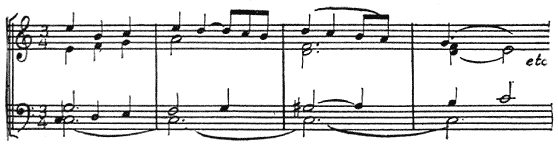
[Listen]
In more ways than one the "Prize Song" is a mainstay of "Die Meistersinger." It has been heard in the previous scene of the third act, not only when Walther rehearses it for Sachs, but also in the quintet. Moreover, versions of it occur in the overture and indeed, throughout the work, adding greatly to the romantic sentiment of the score. For "Die Meistersinger" is a comedy of romance.
In measures easily recognized from the Prelude, to which the Nuremburg Motive is added, Sachs now praises the masters and explains their noble purpose as conservators of art. Eva takes the wreath with which Walther has been crowned, and with it crowns Sachs, who has meanwhile decorated the knight with the insignia. Pogner kneels, as if in homage, before Sachs, the masters point to the cobbler as to their chief, and Walther and Eva remain on either side of him, leaning gratefully upon his shoulders. The chorus repeats Sachs's final admonition to the closing measures of the Prelude.
PARSIFAL
Stage Dedication Festival Play (Bühnenweihfestspiel) in three acts, words and music by Richard Wagner. Produced Bayreuth, July 26, 1882. Save in concert form, the work was not given elsewhere until December 24, 1903, when it was produced at the Metropolitan Opera House at that time under the direction of Heinrich Conried.
At the Bayreuth performances there were alternating casts. Winckelmann was the Parsifal of the première, Gudehus of the second performance, Jäger of the third. The alternating Kundrys were Materna, Marianne Brandt, and Malten; Gurnemanz Scaria and Siehr; Amfortas Reichmann; Klingsor, Hill and Fuchs. Hermann Levi conducted.
In the New York cast Ternina was Kundry, Burgstaller Parsifal, Van Rooy Amfortas, Blass Gurnemanz, Goritz Klingsor, Journet Titurel, Miss Moran and Miss Braendle the first and second, Harden and Bayer the third and fourth Esquires, Bayer and Mühlmann two Knights of the Grail, Homer a Voice.
Characters
Amfortas, son of Titurel, ruler of the Kingdom of the GrailBaritone-Bass
Titurel, former rulerBass
Gurnemanz, a veteran Knight of the GrailBass
Klingsor, a magicianBass
ParsifalTenor
KundrySoprano
First and Second KnightsTenor and Bass
Four EsquiresSopranos and Tenors
Six of Klingsor's Flower MaidensSopranos
Brotherhood of the Knights of the Grail; Youths and Boys; Flower Maidens (two choruses of sopranos and altos).
Time—The Middle Ages.
Place—Spain, near and in the Castle of the Holy Grail; in Klingsor's enchanted castle and in the garden of his castle.
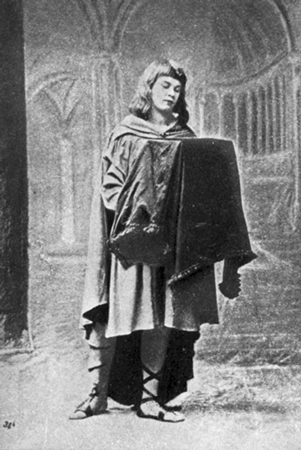
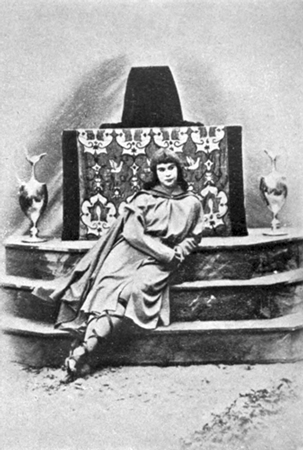
Photographs of the First Performance of “Parsifal,” Bayreuth, 1882
The Grail-Bearer
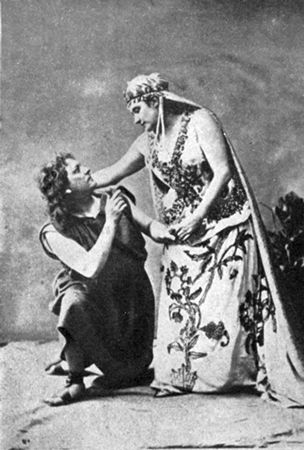
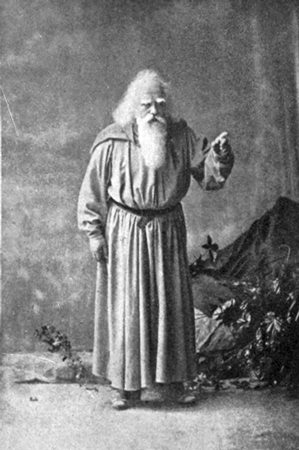
Photographs of the First Performance of “Parsifal,” Bayreuth, 1882
Winckelmann and Materna as Parsifal and Kundry Scaria as Gurnemanz
"Parsifal" is a familiar name to those who have heard "Lohengrin." Lohengrin, it will be remembered, tells Elsa that he is Parsifal's son and one of the knights of the Holy Grail. The name is written Percival in "Lohengrin," as well as in Tennyson's "Idyls of the King." Now, however, Wagner returns to the quainter and more "Teutonic" form of spelling. "Parsifal" deals with an earlier period in the history of the Grail knighthood than "Lohengrin." But there is a resemblance between the Grail music in "Parsifal" and the "Lohengrin" music—a resemblance not in melody, nor even in outline, but merely in the purity and spirituality that breathes through both.
Three legends supplied Wagner with the principal characters in this music-drama. They were "Percival le Galois; or Contes de Grail," by Chrétien de Troyes (1190); "Parsifal," by Wolfram von Eschenbach, and a manuscript of the fourteenth century called by scholars the "Mabinogion." As usual, Wagner has not held himself strictly to any one of these, but has combined them all, and revivified them through the alchemy of his own genius.
Into the keeping of Titurel and his band of Christian knights has been given the Holy Grail, the vessel from which the Saviour drank when He instituted the Last Supper. Into their hands, too, has been placed, as a weapon of defence against the ungodly, the Sacred Spear, the arm with which the Roman soldier wounded the Saviour's side. The better to guard these sanctified relics Titurel, as King of the Grail knighthood, has reared a castle, Montsalvat, which, from its forest-clad height, facing Arabian Spain, forms a bulwark of Christendom against the pagan world and especially against Klingsor, a sorcerer and an enemy of the good. Yet time and again this Klingsor, whose stronghold is nearby, has succeeded in enticing champions of the Grail into his magic garden, with its lure of flower-maidens and its arch-enchantress Kundry, a rarely beautiful woman, and in making them his servitors against their one-time brothers-in-arms.
Even Amfortas, Titurel's son, to whom Titurel, grown old in service and honour, has confided his reign and wardship, has not escaped the thrall of Klingsor's sorcery. Eager to begin his reign by destroying Klingsor's power at one stroke, he penetrated into the garden to attack and slay him. But he failed to reckon with human frailty. Yielding to the snare so skilfully laid by the sorcerer and forgetting, at the feet of the enchantress, Kundry, the mission upon which he had sallied forth, he allowed the Sacred Spear to drop from his hand. It was seized by the evil-doer he had come to destroy, and he himself was grievously wounded with it before the knights who rushed to his rescue could bear him off.
This wound no skill has sufficed to heal. It is sapping Amfortas's strength. Indecision, gloom, have come over the once valiant brotherhood. Only the touch of the Sacred Spear that made the wound will avail to close it, but there is only one who can regain it from Klingsor. For to Amfortas, prostrate in supplication for a sign, a mystic voice from the sanctuary of the Grail replied:
By pity guided, The guileless fool; Wait for him, My chosen tool.
This prophecy the knights construe to signify that their king's salvation can be wrought only by youth so "guileless," so wholly ignorant of sin, that, instead of succumbing to the temptations of Klingsor's magic garden, he will become, through resisting them, cognizant of Amfortas's guilt, and, stirred by pity for him, make his redemption the mission of his life, regain the Spear and heal him with it. And so the Grail warders are waiting, waiting for the coming of the "guileless fool."
The working out of this prophecy forms the absorbing subject of the story of "Parsifal." The plot is allegorical. Parsifal is the personification of Christianity, Klingsor of Paganism, and the triumph of Parsifal over Klingsor is the triumph of Christianity over Paganism.
The character of Kundry is one of Wagner's most striking creations. She is a sort of female Ahasuerus—a wandering Jewess. In the Mabinogion manuscript she is no other than Herodias, condemned to wander for ever because she laughed at the head of John the Baptist. Here Wagner makes another change. According to him she is condemned for laughing in the face of the Saviour as he was bearing the cross. She seeks forgiveness by serving the Grail knights as messenger on her swift horse, but ever and anon she is driven by the curse hanging over her back to Klingsor, who changes her to a beautiful woman and places her in his garden to lure the Knights of the Grail. She can be freed only by one who resists her temptations. Finally she is freed by Parsifal and is baptized. In her character of Grail messenger she has much in common with the wild messengers of Walhalla, the Valkyrs. Indeed, in the Edda Saga, her name appears in the first part of the compound Gundryggja, which denotes the office of the Valkyrs.
THE VORSPIEL
The Vorspiel to "Parsifal" is based on three of the most deeply religious motives in the entire work. It opens with the Motive of the Sacrament, over which, when it is repeated, arpeggios hover, as in the religious paintings of old masters angel forms float above the figure of virgin or saint.

[Listen]
Through this motive we gain insight into the office of the Knights of the Grail, who from time to time strengthen themselves for their spiritual duties by partaking of the communion, on which occasions the Grail itself is uncovered. This motive leads to the Grail Motive, effectively swelling to forte and then dying away in ethereal harmonies, like the soft light with which the Grail illumines the hall in which the knights gather to worship.
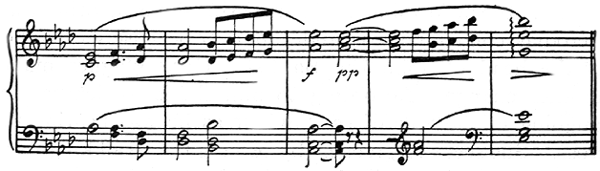
[Listen]
The trumpets then announce the Motive of Faith, severe but sturdy—portraying superbly the immutability of faith.
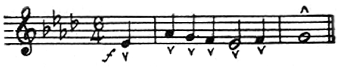
[Audio content is not currently supported on your device.
The Grail Motive is heard again and then the Motive of Faith is repeated, its severity exquisitely softened, so that it conveys a sense of peace which "passeth all understanding."
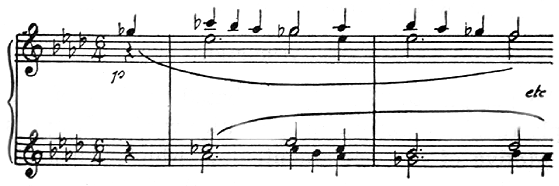
[Listen]
The rest of the Vorspiel is agitated. That portion of the Motive of the Sacrament which appears later as the Spear Motive here assumes through a slight change a deeply sad character, and becomes typical throughout the work of the sorrow wrought by Amfortas's crime. I call it the Elegiac Motive.

[Listen]
Thus the Vorspiel depicts both the religious duties which play so prominent a part in the drama, and unhappiness which Amfortas's sinful forgetfulness of these duties has brought upon himself and his knights.
Act I. One of the sturdiest of the knights, the aged Gurnemanz, grey of head and beard, watches near the outskirts of the forest. One dawn finds him seated under a majestic tree. Two young Esquires lie in slumber at his feet. Far off, from the direction of the castle, sounds a solemn reveille.
"Hey! Ho!" Gurnemanz calls with brusque humour to the Esquires. "Not forest, but sleep warders I deem you!" The youths leap to their feet; then, hearing the solemn reveille, kneel in prayer. The Motive of Peace echoes their devotional thoughts. A wondrous peace seems to rest upon the scene. But the transgression of the King ever breaks the tranquil spell. For soon two Knights come in the van of the train that thus early bears the King from a bed of suffering to the forest lake nearby, in whose waters he would bathe his wound. They pause to parley with Gurnemanz, but are interrupted by outcries from the youths and sounds of rushing through air.
"Mark the wild horsewoman!"—"The mane of the devil's mare flies madly!"—"Aye, 'tis Kundry!"—"She has swung herself off," cry the Esquires as they watch the approach of the strange creature that now rushes in—a woman clad in coarse, wild garb girdled high with a snake-skin, her thick black hair tumbling about her shoulders, her features swarthy, her dark eyes now flashing, now fixed and glassy. Precipitately she thrusts a small crystal flask into Gurnemanz's hand.
"Balsam—for the king!" There is a savagery in her manner that seems designed to ward off thanks, when Gurnemanz asks her whence she has brought the flask, and she replies: "From farther away than your thought can travel. If it fail, Arabia bears naught else that can ease his pain. Ask no further. I am weary."
Throwing herself upon the ground and resting her face on her hands, she watches the King borne in, replies to his thanks for the balsam with a wild, mocking laugh, and follows him with her eyes as they bear him on his litter toward the lake, while Gurnemanz and four Esquires remain behind.
Kundry's rapid approach on her wild horse is accompanied by a furious gallop in the orchestra.
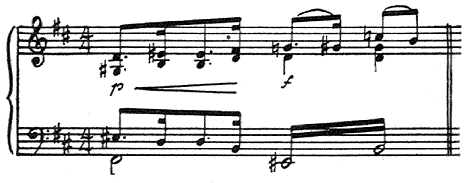
[Listen]
Then, as she rushes upon the stage, the Kundry Motive—a headlong descent of the string instruments through four octaves—is heard.

[Listen]
Kundry's action in seeking balsam for the King's wound gives us insight into the two contradictory natures represented by her character. For here is the woman who has brought all his suffering upon Amfortas striving to ease it when she is free from the evil sway of Klingsor. She is at times the faithful messenger of the Grail; at times the evil genius of its defenders.
When Amfortas is borne in upon a litter there is heard the Motive of Amfortas's Suffering, expressive of his physical and mental agony. It has a peculiar heavy, dragging rhythm, as if his wound slowly were sapping his life.
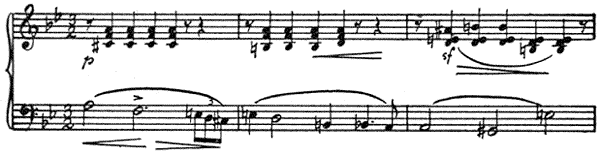
[Listen]
A beautiful idyl is played by the orchestra when the knights bear Amfortas to the forest lake.
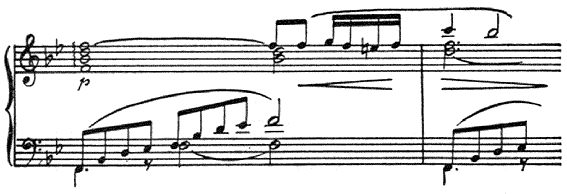
[Listen]
One of the youths, who has remained with Gurnemanz, noting that Kundry still lies where she had flung herself upon the ground, calls out scornfully, "Why do you lie there like a savage beast?"
"Are not even the beasts here sacred?" she retorts, but harshly, and not as if pleading for sufferance. The other Esquires would have joined in harassing her had not Gurnemanz stayed them.
"Never has she done you harm. She serves the Grail, and only when she remains long away, none knows in what distant lands, does harm come to us." Then, turning to where she lies, he asks: "Where were you wandering when our leader lost the Sacred Spear? Why were you not here to help us then?"
"I never help!" is her sullen retort, although a tremor, as if caused by a pang of bitter reproach, passes over her frame.
"If she wants to serve the Grail, why not send her to recover the Sacred Spear!" exclaims one of the Esquires sarcastically; and the youths doubtless would have resumed their nagging of Kundry, had not mention of the holy weapon caused Gurnemanz to give voice to memories of the events that have led to its capture by Klingsor. Then, yielding to the pressing of the youths who gather at his feet beneath the tree, he tells them of Klingsor—how the sorcerer has sued for admission to the Grail brotherhood, which was denied him by Titurel, how in revenge he has sought its destruction and now, through possession of the Sacred Spear, hopes to compass it.
Prominent with other motives already heard, is a new one, the Klingsor Motive:

[Listen]
During this recital Kundry still lies upon the ground, a sullen, forbidding looking creature. At the point when Gurnemanz tells of the sorcerer's magic garden and of the enchantress who has lured Amfortas to his downfall, she turns in quick, angry unrest, as if she would away, but is held to the spot by some dark and compelling power. There is indeed something strange and contradictory in this wild creature, who serves the Grail by ranging distant lands in search of balsam for the King's wound, yet abruptly, vindictively almost, repels proffered thanks, and is a sullen and unwilling listener to Gurnemanz's narrative. Furthermore, as Gurnemanz queried, where does she linger during those long absences, when harm has come to the warders of the Grail and now to their King? The Knights of the Grail do not know it, but it is none other than she who, changed by Klingsor into an enchantress, lures them into his magic garden.
Gurnemanz concludes by telling the Esquire that while Amfortas was praying for a sign as to who could heal him, phantom lips pronounced these words:
By pity lightened The guileless fool; Wait for him, My chosen tool.
This introduces an important motive, that of the Prophecy, a phrase of simple beauty, as befits the significance of the words to which it is sung. Gurnemanz sings the entire motive and then the Esquires take it up.
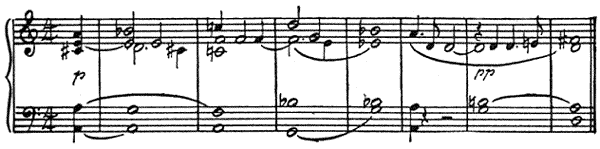
[Listen]
They have sung only the first two lines when suddenly their prayerful voices are interrupted by shouts of dismay from the direction of the lake. A moment later a wounded swan, one of the sacred birds of the Grail brotherhood, flutters over the stage and falls dead near Gurnemanz. The knights follow in consternation. Two of them bring Parsifal, whom they have seized and accuse of murdering the sacred bird. As he appears the magnificent Parsifal Motive rings out on the horns:
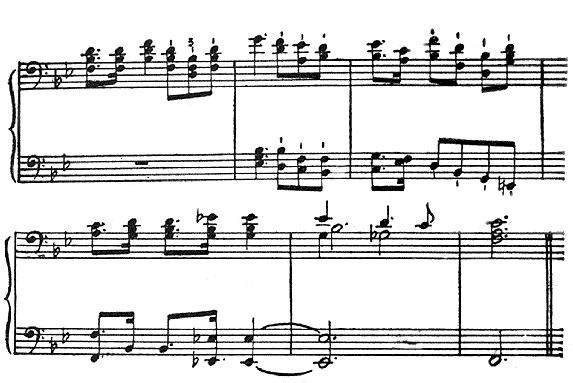
[Listen]
It is a buoyant and joyous motive, full of the wild spirit and freedom of this child of nature, who knows nothing of the Grail and its brotherhood or the sacredness of the swan, and freely boasts of his skilful marksmanship. During this episode the Swan Motive from "Lohengrin" is effectively introduced. Then follows Gurnemanz's noble reproof, sung to a broad and expressive melody. Even the animals are sacred in the region of the Grail and are protected from harm. Parsifal's gradual awakening to a sense of wrong is one of the most touching scenes of the music-drama. His childlike grief when he becomes conscious of the pain he has caused is so simple and pathetic that one cannot but be deeply affected.
After Gurnemanz has ascertained that Parsifal knows nothing of the wrong he committed in killing the swan he plies him with questions concerning his parentage. Parsifal is now gentle and tranquil. He tells of growing up in the woods, of running away from his mother to follow a cavalcade of knights who passed along the edge of the forest and of never having seen her since. In vain he endeavours to recall the many pet names she gave him. These memories of his early days introduce the sad motive of his mother, Herzeleid (Heart's Sorrow) who has died in grief.
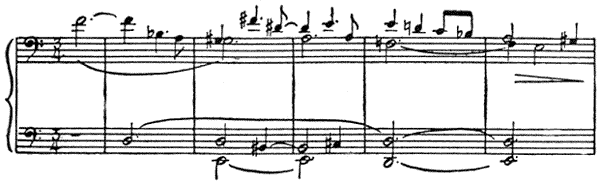
[Listen]
The old knight then proceeds to ply Parsifal with questions regarding his parentage, name, and native land. "I do not know," is the youth's invariable answer. His ignorance, coupled, however, with his naïve nobility of bearing and the fact that he has made his way to the Grail domain, engender in Gurnemanz the hope that here at last is the "guileless fool" for whom prayerfully they have been waiting, and the King, having been borne from the lake toward the castle where the holy rite of unveiling the Grail is to be celebrated that day, thither Gurnemanz in kindly accents bids the youth follow him.
Then occurs a dramatically effective change of scene. The scenery becomes a panorama drawn off toward the right, and as Parsifal and Gurnemanz face toward the left they appear to be walking in that direction. The forest disappears; a cave opens in rocky cliffs and conceals the two; they are then seen again in sloping passages which they appear to ascend. Long sustained trombone notes softly swell; approaching peals of bells are heard. At last they arrive at a mighty hall which loses itself overhead in a high vaulted dome, down from which alone the light streams in.
The change of scene is ushered in by the solemn Bell Motive, which is the basis of the powerful orchestral interlude accompanying the panorama, and also of the scene in the hall of the Grail Castle.

[Listen]
As the communion, which is soon to be celebrated, is broken in upon by the violent grief and contrition of Amfortas, so the majestic sweep of this symphony is interrupted by the agonized Motive of Contrition, which graphically portrays the spiritual suffering of the King.
This subtly suggests the Elegiac Motive and the Motive of Amfortas's Suffering, but in greatly intensified degrees. For it is like an outcry of torture that affects both body and soul.
With the Motive of the Sacrament resounding solemnly upon the trombones, followed by the Bell Motive, sonorous and powerful, Gurnemanz and Parsifal enter the hall, the old knight giving the youth a position from which he can observe the proceedings. From the deep colonnades on either side in the rear the knights issue, march with stately tread, and arrange themselves at the horseshoe-shaped table, which incloses a raised couch. Then, while the orchestra plays a solemn processional based on the Bell Motive, they intone the chorus: "To the last love feast." After the first verse a line of pages crosses the stage and ascend into the dome. The graceful interlude here is based on the Bell Motive.
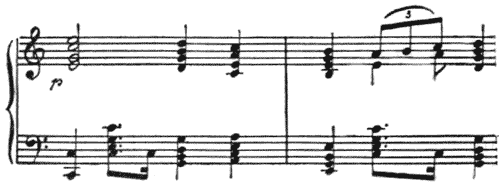
[Listen]
The chorus of knights closes with a glorious outburst of the Grail Motive as Amfortas is borne in, preceded by pages who bear the covered Grail. The King is lifted upon the couch and the holy vessel is placed upon the stone table in front of it. When the Grail Motive has died away amid the pealing of the bells, the youths in the gallery below the dome sing a chorus of penitence based upon the Motive of Contrition. Then the Motive of Faith floats down from the dome as an unaccompanied chorus for boys' voices—a passage of ethereal beauty—the orchestra whispering a brief postludium like a faint echo. This is, when sung as it was at Bayreuth, where I heard the first performance of "Parsifal" in 1882, the most exquisite effect of the whole score. For spirituality it is unsurpassed. It is an absolutely perfect example of religious music—a beautiful melody without the slightest worldly taint.
Titurel now summons Amfortas to perform his sacred office—to uncover the Grail. At first, tortured by contrition for his sin, of which the agony from his wound is a constant reminder, he refuses to obey his aged father's summons. In anguish he cries out that he is unworthy of the sacred office. But again ethereal voices float down from the dome. They now chant the prophecy of the "guileless fool" and, as if comforted by the hope of ultimate redemption, Amfortas uncovers the Grail. Dusk seems to spread over the hall. Then a ray of brilliant light darts down upon the sacred vessel, which shines with a soft purple radiance that diffuses itself through the hall. All are on their knees save the youth, who has stood motionless and obtuse to the significance of all he has heard and seen save that during Amfortas's anguish he has clutched his heart as if he too felt the pang. But when the rite is over—when the knights have partaken of communion—and the glow has faded, and the King, followed by his knights, has been borne out, the youth remains behind, vigorous, handsome, but to all appearances a dolt.
"Do you know what you have witnessed?" Gurnemanz asks harshly, for he is grievously disappointed.
For answer the youth shakes his head.
"Just a fool, after all," exclaims the old knight, as he opens a side door to the hall. "Begone, but take my advice. In future leave our swans alone, and seek yourself, gander, a goose!" And with these harsh words he pushes the youth out and angrily slams the door behind him.
This jarring break upon the religious feeling awakened by the scene would be a rude ending for the act, but Wagner, with exquisite tact, allows the voices in the dome to be heard once more, and so the curtains close, amid the spiritual harmonies of the Prophecy of the Guileless Fool and of the Grail Motive.
Act II. This act plays in Klingsor's magic castle and garden. The Vorspiel opens with the threatful Klingsor motive, which is followed by the Magic and Contrition Motives, the wild Kundry Motive leading over to the first scene.
In the inner keep of his tower, stone steps leading up to the battlemented parapet and down into a deep pit at the back, stands Klingsor, looking into a metal mirror, whose surface, through his necromancy, reflects all that transpires within the environs of the fastness from which he ever threatens the warders of the Grail. Of all that just has happened in the Grail's domain it has made him aware; and he knows that of which Gurnemanz is ignorant—that the youth, whose approach the mirror divulges, once in his power, vain will be the prophecy of the "guileless fool" and his own triumph assured. For it is that same "guileless fool" the old knight impatiently has thrust out.
Klingsor turns toward the pit and imperiously waves his hand. A bluish vapour rises from the abyss and in it floats the form of a beauteous woman—Kundry, not the Kundry of a few hours before, dishevelled and in coarse garb girdled with snake-skin; but a houri, her dark hair smooth and lustrous, her robe soft, rich Oriental draperies. Yet even as she floats she strives as though she would descend to where she has come from, while the sorcerer's harsh laugh greets her vain efforts. This then is the secret of her strange actions and her long disappearances from the Grail domain, during which so many of its warders have fallen into Klingsor's power! She is the snare he sets, she the arch-enchantress of his magic garden. Striving as he hints while he mocks her impotence, to expiate some sin committed by her during a previous existence in the dim past, by serving the brotherhood of the Grail knights, the sorcerer's power over her is such that at any moment he can summon her to aid him in their destruction.
Well she knows what the present summons means. Approaching the tower at this very moment is the youth whom she has seen in the Grail forest, and in whom she, like Klingsor, has recognized the only possible redeemer of Amfortas and of—herself. And now she must lure him to his doom and with it lose her last hope of salvation, now, aye, now—for even as he mocks her, Klingsor once more waves his hand, castle and keep vanish as if swallowed up by the earth, and in its place a garden heavy with the scent of gorgeous flowers fills the landscape.
The orchestra, with the Parsifal Motive, gives a spirited description of the brief combat between Parsifal and Klingsor's knights. It is amid the dark harmonies of the Klingsor Motive that the keep sinks out of sight and the magic garden, spreading out in all directions, with Parsifal standing on the wall and gazing with astonishment upon the brilliant scene, is disclosed.
The Flower Maidens in great trepidation for the fate of their lover knights rush in from all sides with cries of sorrow, their confused exclamations and the orchestral accompaniment admirably enforcing their tumultuous actions.
The Parsifal Motive again introduces the next episode, as Parsifal, attracted by the grace and beauty of the girls, leaps down into the garden and seeks to mingle with them. It is repeated several times in the course of the scene. The girls, seeing that he does not seek to harm them, bedeck themselves with flowers and crowd about him with alluring gestures, finally circling around him as they sing this caressing melody:
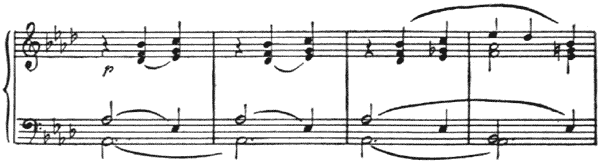
[Listen]
The effect is enchanting, the music of this episode being a marvel of sensuous grace. Parsifal regards them with childlike, innocent joy. Then they seek to impress him more deeply with their charms, at the same time quarrelling among themselves over him. When their rivalry has reached its height, Kundry's voice—"Parsifal, tarry!"—is wafted from a flowery nook nearby.
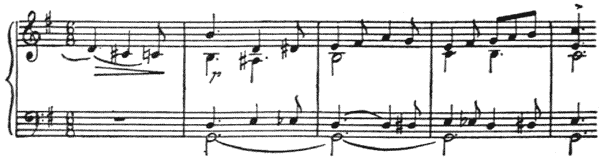
[Listen]
"Parsifal!" In all the years of his wandering none has called him by his name; and now it floats toward him as if borne on the scent of roses. A beautiful woman, her arms stretched out to him, welcomes him from her couch of brilliant, redolent flowers. Irresistibly drawn toward her, he approaches and kneels by her side; and she, whispering to him in tender accents, leans over him and presses a long kiss upon his lips. It is the lure that has sealed the fate of many a knight of the Grail. But in the youth it inspires a sudden change. The perilous subtlety of it, that is intended to destroy, transforms the "guileless fool" into a conscious man, and that man conscious of a mission. The scenes he has witnessed in the Grail castle, the stricken King whose wound ever bled afresh, the part he is to play, the peril of the temptation that has been placed in his path—all these things become revealed to him in the rapture of that unhallowed kiss. In vain the enchantress seeks to draw him toward her. He thrusts her from him. Maddened by the repulse, compelled through Klingsor's arts to see in the handsome youth before her lawful prey, she calls upon the sorcerer to aid her. At her outcry Klingsor appears on the castle wall, in his hand the Spear taken from Amfortas, and, as Parsifal faces him, hurls it full at him. But lo, it rises in its flight and remains suspended in the air over the head of him it was aimed to slay.
Reaching out and seizing it, Parsifal makes with it the sign of the cross. Castle and garden wall crumble into ruins, the garden shrivels away, leaving in its place a sere wilderness, through which Parsifal, leaving Kundry as one dead upon the ground, sets forth in search of the castle of the Grail, there to fulfil the mission with which now he knows himself charged.
Act III. Not until after long wanderings through the wilderness, however, is it that Parsifal once more finds himself on the outskirts of the Grail forest. Clad from head to foot in black armour, his visor closed, the Holy Spear in his hand, he approaches the spot where Gurnemanz, now grown very old, still holds watch, while Kundry, again in coarse garb, but grown strangely pale and gentle, humbly serves the brotherhood. It is Good Friday morn, and peace rests upon the forest.
Kundry is the first to discern the approach of the black knight. From the tender exaltation of her mien, as she draws Gurnemanz's look toward the silent figure, it is apparent that she divines who it is and why he comes. To Gurnemanz, however, he is but an armed intruder on sanctified ground and upon a holy day, and, as the black knight seats himself on a little knoll near a spring and remains silent, the old warder chides him for his offence. Tranquilly the knight rises, thrusts the Spear he bears into the ground before him, lays down his sword and shield before it, opens his helmet, and, removing it from his head, places it with the other arms, and then himself kneels in silent prayer before the Spear. Surprise, recognition of man and weapon, and deep emotion succeed each other on Gurnemanz's face. Gently he raises Parsifal from his kneeling posture, once more seats him on the knoll by the spring, loosens his greaves and corselet, and then places upon him the coat of mail and mantle of the knights of the Grail, while Kundry, drawing a golden flask from her bosom anoints his feet and dries them with her loosened hair. Then Gurnemanz takes from her the flask, and, pouring its contents upon Parsifal's head, anoints him king of the knights of the Grail. The new king performs his first office by taking up water from the spring in the hollow of his hand and baptizing Kundry, whose eyes, suffused with tears, are raised to him in gentle rapture.
Here is heard the stately Motive of Baptism:
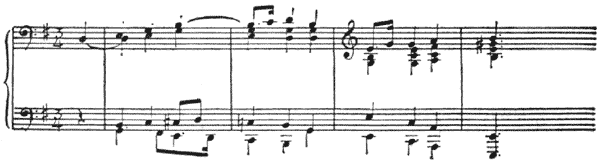
[Listen]
The "Good Friday Spell," one of Wagner's most beautiful mood paintings in tone color, is the most prominent episode in these scenes.
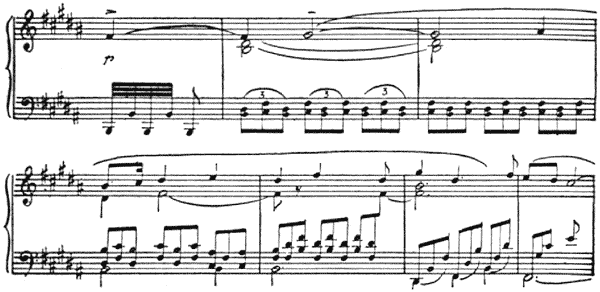
[Listen]
Once more Gurnemanz, Kundry now following, leads the way toward the castle of the Grail. Amfortas's aged father, Titurel, uncomforted by the vision of the Grail, which Amfortas, in his passionate contrition, deems himself too sullied to unveil, has died, and the knights having gathered in the great hall, Titurel's bier is borne in solemn procession and placed upon a catafalque before Amfortas's couch.
"Uncover the shrine!" shout the knights, pressing upon Amfortas. For answer, and in a paroxysm of despair, he springs up, tears his garments asunder and shows his open wound. "Slay me!" he cries. "Take up your weapons! Bury your sword-blades deep—deep in me, to the hilts! Kill me, and so kill the pain that tortures me!"
As Amfortas stands there in an ecstasy of pain, Parsifal enters, and, quietly advancing, touches the wound with the point of the Spear.
"One weapon only serves to staunch your wounded side—the one that struck it."
Amfortas's torture changes to highest rapture. The shrine is opened and Parsifal, taking the Grail, which again radiates with light, waves it gently to and fro, as Amfortas and all the knights kneel in homage to him, while Kundry, gazing up to him in gratitude, sinks gently into the sleep of death and forgiveness for which she has longed.
The music of this entire scene floats upon ethereal arpeggios. The Motive of Faith especially is exquisitely accompanied, its spiritual harmonies finally appearing in this form.
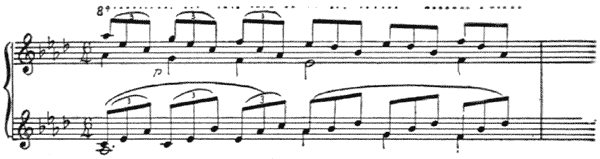
[Listen]
There are also heard the Motives of Prophecy and of the Sacrament, as the knights on the stage and the youths and boys in the dome chant. The Grail Motive, which is prominent throughout the scene, rises as if in a spirit of gentle religious triumph and brings, with the Sacrament Motive, the work to a close.