THE CENTRAL ESKIMO. (continued 7)
Reading edition
As she feared that her father might think of killing or maiming her children, she ordered the Adlet to go inland, where they became the ancestors of a numerous people. She made a boat for the young dogs, setting up two sticks for masts in the soles of her boots, and sent the puppies across the ocean. She sang: “Angnaijaja. When you arrive there across the ocean you will make many things giving you joy. Angnaija.” They arrived in the land beyond the sea and became the ancestors of the Europeans.
THE GREAT FLOOD.
A long time ago the ocean suddenly began to rise, until it covered the whole land. The water even rose to the top of the mountains and the ice drifted over them. When the flood had subsided the ice stranded and ever since forms an ice cap on the top of the mountains. Many shellfish, fish, seal, and whales were left high and dry and their shells and bones may be seen to this day. A great number of Inuit died during this period, but many others, who had taken to their kayaks when the water commenced to rise, were saved.
INUGPAQDJUQDJUALUNG.14
In days of yore, an enormous man, whose name was Inugpaqdjuqdjualung, lived in company with many other Inuit in a village on a large fjord. He was so tall that he could straddle the fjord. He used to stand thus every morning and wait for whales to pass beneath him. As soon as one came along he stooped and caught it, just as another man would scoop up some little thing that had fallen into the water, and he ate it as other men eat a small piece of meat.
One day all the natives had manned their boats to hunt a whale. Inugpaqdjuqdjualung at the time was sitting lazily near his hut, but when he saw the efforts of the men he scooped both whale and boats from the water and placed them upon the beach.
At another time, being tired from running about, he lay down on a high hill to take a nap. The Inuit told him that a couple of huge bears had been seen near the village, but he said he didn’t care, and told his friends to rouse him by throwing large stones upon him if they should see the bears coming. They did so and Inugpaqdjuqdjualung, suddenly starting up, cried: “Where are they? Where are they?” When the Inuit pointed them out he said: “What! those little things? Those are not worth the bustle; they are small foxes, not bears,” and he crushed one between his fingers, while he put the other into the eyelet of his boot and strangled it there.
THE BEAR STORY.
This story is reprinted from Hall (II, p. 240):
Many moons ago, a woman obtained a polar bear cub but two or three days old. Having long desired just such a pet, she gave it her closest attention, as though it were a son, nursing it, making for it a soft warm bed alongside her own, and talking to it as a mother does to her child. She had no living relative, and she and the bear occupied the house alone. Kunikdjuaq, as he grew up, proved that the woman had not taught him in vain, for he early began to hunt seals and salmon, bringing them to his mother before eating any himself, and receiving his share from her hands. She always watched from the hilltop for his return, and if she saw that he had been unsuccessful, she begged from her neighbors blubber for his food. She learned how this was from her lookout, for if successful, he came back in the tracks made on going out, but if unsuccessful always by a different route. Learning to excel the Inuit in hunting, he excited their envy, and, after long years of faithful service, his death was resolved upon. On hearing this, the old woman, overwhelmed with grief, offered to give up her own life if they would but spare him who had so long supported her. Her offer was sternly refused. Upon this, when all his enemies had retired to their houses, the woman had a long talk with her son—now well grown in years—telling him that wicked men were about to kill him, and that the only way to save his life and hers was for him to go off and not return. At the same time she begged him not to go so far that she could not wander off and meet him, and get from him a seal or something else which she might need. The bear, after listening to what she said with tears streaming down her furrowed cheeks, gently placed one huge paw on her head, and then throwing both around her neck, said, “Good mother, Kunikdjuaq will always be on the lookout for you and serve you as best he can.” Saying this, he took her advice and departed, almost as much to the grief of the children of the village as to the mother.
Not long after this, being in need of food, she walked out on the sea ice to see if she could not meet her son, and soon recognized him as one of two bears who were lying down together. He ran to her, and she patted him on the head in her old familiar way, told him her wants, and begged him to hurry away and get something for her. Away ran the bear, and in a few moments the woman looked upon a terrible fight going on between him and his late companion, which, however, to her great relief, was soon ended by her son’s dragging a lifeless body to her feet. With her knife she quickly skinned the dead bear, giving her son large slices of the blubber, and telling him that she would soon return for the meat, which she could not at first carry to her house, and when her supply should again fail she would comeback for his help. This she continued to do for “a long, long time,” the faithful bear always serving her and receiving the same unbroken love of his youth.
SUNDRY TALES.
(1) Two little girls, while playing about a cliff near Aivillik, with infants in the hoods on their backs, went into an opening between the rocks, which closed upon them before escape was possible. All attempts at rescue were unsuccessful, and the poor children, to whom for a time meat and water were passed, perished in the cliffs (Hall II, p. 222).
(2) Opposite to Niutang, a village in Kingnait, Cumberland Sound, there is a vein of diorite resembling a boot, and therefore called Kamingujang. A long time ago two enemies lived in the village. One day they stood on the beach ready to go hunting. Suddenly the one exclaimed, pointing to Kamingujang, “There he blows,” making his enemy believe that a whale was passing up the fjord and inducing him to look out for it. Then he killed him from behind, piercing him with the spear.
(3) At Qognung, near the head of Nettilling Fjord, there is a large white stone on each side of the fjord, somewhat resembling a bear. It is said that these stones have been bears which, being pursued by an Eskimo in the water, escaped to the land, but were transformed into these stones.
(4) A long time ago a dead boy was buried under a large stone. Before his relatives had returned to their hut the body was transformed into a hare, which jumped forth from the tomb. All hares come from this animal.
(5) It is said that albinos of seals and deer spring from an egg of about half a foot in length, which forms itself in the earth. The seal digs an underground passage to the sea, the deer a similar one to a distant part of the country, and there they rise. The albinos are said to be very quick.
I will add here an enumeration of the fabulous tribes of which I gained intelligence, but of some of them I only know the names.
(1) The Tornit, or, as they are called by the Akudnirmiut, the Tuniqdjuait (p. 634). It is remarkable that this people is considered here, as well as in Labrador, a tribe similar to the Eskimo, with whom they formerly lived in company, but who were subsequently expelled by the latter. In Greenland they are entirely a fabulous tribe, each individual being of enormous size, living inland and seldom hunting in the upper parts of the fjords. While in the western parts of the Eskimo country a more historical form of the tradition is preserved, it is entirely mythical in Greenland.
(2) The Adlet or Erqigdlit. In the tradition treating of this tribe a similar change occurs. The Labrador Eskimo call the Indians of the interior Adlet, the tribes west of Hudson Bay call them Erqigdlit. The Baffin Land Eskimo and the Greenlanders have forgotten this relation altogether, but denote with the term a fabulous tribe with dogs’ legs and a human body. The name Adla is used as far north as Cumberland Peninsula, the Akudnirmiut and the more northern tribes using the term Erqigdlit. It is difficult to account for the use of these different terms in both senses.
(3) The Ardnainiq, a tribe living in the extreme northwest. The men of this people are small, tiny, like children, but entirely covered with hair. They are carried about in the hoods of their wives, just like children. The women are of normal size. They do all the work, going out hunting in the kayaks and providing for the men.
(4) The Inuarudligang, dwarfs living in the cliffs near the shore.
(5) The Igdlungajung, a bandy legged people living inland.
(6) The Uissuit, dwarfs living in the depth of the sea (p. 621).
(7) The Ijirang.
(8) The Qailerte´tang, a people consisting of women only (p. 605).
Finally, I will mention the animals which are only known to the natives by reports of foreign tribes and are described as fabulous creatures. These are the umingmang (the musk ox), which is represented as a fierce animal with black and red streaks and larger than a bear, and the agdlaq (the black bear), which, according to their belief, is also of enormous size. It is said to live inland and to devour everything that comes near it. I am unable to decide whether the report of an enormous fish, the idluk, which is said to live in the lakes, is altogether fabulous. The natives say that if they want to catch the fish they build a snow house on the lake and cut a hole through the ice, into which they sink the hook with a deer’s ham for a bait and a stout thong for a fishing line. Six men hold the line by turns, and as soon as they feel the fish has nibbled they pull it up with all their strength.
The fabulous amaroq and avignaq of the Greenlanders are unknown, but the terms denote real animals, the wolf and the lemming.
Besides traditions of this kind the Eskimo have a great number of fables. Following is an example.
THE OWL AND THE RAVEN.
The owl and the raven were fast friends. One day the raven made a new dress, dappled white and black, for the owl, who in return made a pair of boots of whalebone for the raven and then began to make a white dress. But when he was about to try it on, the raven kept hopping about and would not sit still. The owl got angry and said: “Now sit still or I shall pour out the lamp over you.” As the raven continued hopping about, the owl fell into a passion and poured the oil upon it. Then the raven cried “Qaq! Qaq!” and since that day has been black all over.
COMPARISON BETWEEN BAFFIN LAND TRADITIONS AND THOSE OF OTHER TRIBES.
The similarity of the language and traditions of the Eskimo from Behring Strait to Greenland is remarkable, considering the distance which separates the tribes. Unfortunately the material from other tribes, except the Greenlanders, is very scanty, but it is probable that the same traditions or elements of traditions are known to all the tribes. In the following table the above traditions are compared with Rink’s Tales and Traditions of the Greenlanders and with those of other tribes:
Traditions of Greenlanders and other tribes: Traditions of the Central Eskimo:
Qagsaqsuq, Rink, p. 93. Qaudjaqdjuq, p. 630.
The man who recovered his sight, Rink, p. 99. The origin of the narwhal, p. 625.
Igimarasugsuq, Rink, p. 106. Igimarasugdjuqdjuaq, p. 633.
The man who mated himself with a sea fowl, Rink, p. 145. Ititaujang, p. 615.
Givioq, Rink, pp. 157 and 429. Kiviung, p. 621.
Tiggaq, Rink, p. 162. The visitor, p. 627.
A lamentable story, Rink, p. 239. No. 1, sundry tales, p. 639.
The sun and the moon, Rink, p. 236. (L’homme lunaire, Petitot, Traditions indiennes du Canada Nord-Ouest, p. 7. Also found by Simpson at Point Barrow.) The sun and the moon, p. 597.
The moon, Rink, p. 440. The angakoq’s flight to the moon, p. 598.
The Tornit (from Labrador), Rink, p. 469. The Tornit, p. 634.
A woman who was mated with a dog, Rink, p. 471. (Fragmentary in J. Murdoch: “A few legendary fragments from the Point Barrow Eskimos,” American Naturalist, p. 594, July, 1886.) Origin of the Adlet and the white men, p. 637.
Some of these stories are almost identical in both countries, for instance, Qaudjaqdjuq, the origin of the narwhal, &c., and it is of great interest to learn that some passages, particularly speeches and songs, occur literally in both countries, for instance, the interesting song of Niviarsiang (page 637) and the conclusion of the Kiviung tradition. The tradition of the Tornit and the form of the second tale (origin of the narwhal) resemble much more those of Labrador than those of Greenland. The elements of which the traditions are composed are combined differently in the tales of Baffin Land and Greenland, but most of these elements are identical. I give here a comparative table.
Greenland. Baffin Land.
Transformation of a man into a seal. Rink, pp. 222, 224, 469. Kiviung, p. 621.
Men walking on the surface of the water. Rink, pp. 123, 407. Kiviung, p. 622.
Harpooning a witch. Rink, p. 372. Sedna, p. 604.
Erqigdlit. Rink, pp. 401 et seq. Adlet, p. 637.
Sledge of the man of the moon drawn by one dog. Rink, pp. 401, 442. Qaudjaqdjuq, p. 631, and The flight to the moon, p. 598.
Origin of the salmon. Cranz, p. 262. Ititaujang, p. 617.
Arnaquagsaq. Rink, pp. 150, 326, 466. Sedna, p. 583.
Origin of the thunder. Cranz, p. 233; Egede, p. 207. Kadlu, p. 600.
The following is a comparison between traditions from Alaska and the Mackenzie and those of the Central Eskimo:
Traditions from Alaska and the Mackenzie: Traditions of the Central Eskimo:
Men as descendants of a dog, Murdoch, op. cit., 594. Origin of the Adlet and white men, p. 637.
The origin of reindeer, Murdoch, op. cit., p. 595. Origin of the reindeer and walrus, p. 587.
The origin of the fishes, Murdoch, op. cit., p. 595. Ititaujang, p. 617.
Thunder and lightning, Murdoch, op. cit., p. s595. Kadlu the thunderer, p. 600.
Sun and moon, Petitot, op. cit., p. 7. Sun and moon, p. 597.
Orion, Simpson, p. 940. Orion, p. 636.
The table shows that the following ideas are known to all tribes from Alaska to Greenland: The sun myth, representing the sun as the brother of the moon; the legend of the descent of man from a dog; the origin of thunder by rubbing a deerskin; the origin of fish from chips of wood; and the story of the origin of deer.
It must be regretted that very few traditions have as yet been collected in Alaska, as the study of such material would best enable us to decide upon the question of the origin of the Eskimo.
SCIENCE AND THE ARTS.
GEOGRAPHY AND NAVIGATION.
The Eskimo exhibit a thorough knowledge of the geography of their country. I have already treated of their migrations and mentioned that the area they travel over is of considerable extent. They have a very clear conception of all the countries they have seen or heard of, knowing the distances by day’s journeys, or, as they say, by sleeps, and the directions by the cardinal points. So far as I know, all these tribes call true south piningnang, while the other points are called according to the weather prevailing while the wind blows from the different quarters. In Cumberland Sound uangnang is west-northwest; qaningnang (that is, snow wind), east-northeast; nigirn, southeast; and aqsardnirn, the fohn-like wind blowing from the fjords of the east coast. On Nettilling these names are the same, the east-northeast only being called qanara (that is, is it snow?) In Akudnirn uangnang is west-southwest; ikirtsuq (i.e., the wind of the open sea), east-northeast; oqurtsuq (i.e., the wind of the land Oqo or of the lee side, southeast; and avangnanirn (i.e., from the north side along the shore), the northwestern gales. According to Parry the same names as in Cumberland Sound are used in Iglulik.
If the weather is clear the Eskimo use the positions of the sun, of the dawn, or of the moon and stars for steering, and find their way pretty well, as they know the direction of their point of destination exactly. If the weather is thick they steer by the wind, or, if it is calm, they do not travel at all. After a gale they feel their way by observing the direction of the snowdrifts.
They distinguish quite a number of constellations, the most important of which are Tuktuqdjung (the deer), our Ursa Major; the Pleiades, Sakietaun; and the belt of Orion, Udleqdjun.
BUREAU OF ETHNOLOGY SIXTH ANNUAL REPORT PL. IV
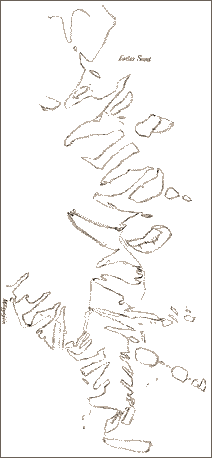
CUMBERLAND PENINSULA, DRAWN BY ARANIN, A SAUMINGNIO.
ESKIMO DRAWINGS.
As their knowledge of all the directions is very detailed and they are skillful draftsmen they can draw very good charts. If a man intends to visit a country little known to him, he has a map drawn in the snow by some one well acquainted there and these maps are so good that every point can be recognized. Their way of drawing is first to mark some points the relative positions of which are well known. They like to stand on a hill and to look around in order to place these correctly. This done, the details are inserted. It is remarkable that their ideas of the relative position and direction of coasts far distant one from another are so very clear. Copies of some charts drawn by Eskimo of Cumberland Sound and Davis Strait are here introduced (Plate IV, p. 643, and Figs. 543–546). A comparison between the maps and these charts will prove their correctness. Frequently the draftsman makes his own country, with which he is best acquainted, too large; if some principal points are marked first, he will avoid this mistake. The distance between the extreme points represented in the first chart (Fig. 543) is about five hundred miles.
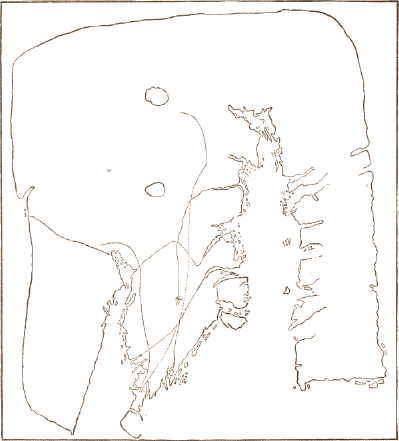
Fig. 543. Cumberland Sound and Frobisher Bay, drawn by Itu, a Nugumio. (Original in the Museum für Völkerkunde, Berlin.)
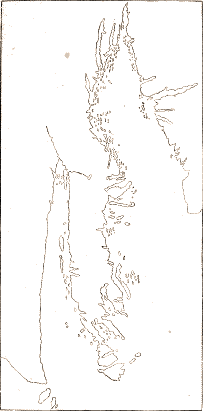
Fig. 544. Cumberland Sound and Frobisher Bay, drawn by Sunapignang, an Oqomio.
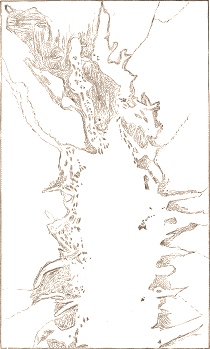
Fig. 545. Cumberland Sound, drawn by Itu, a Nugumio.
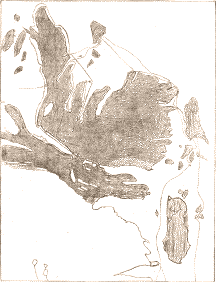
Fig. 546. Peninsula of Qivitung, drawn by Angutuqdjuaq, a Padlimio.
The Eskimo have a sort of calendar. They divide the year into thirteen months, the names of which vary a great deal, according to the tribes and according to the latitude of the place. The surplus is balanced by leaving out a month every few years, to wit, the month siringilang (without sun), which is of indefinite duration, the name covering the whole time of the year when the sun does not rise and there is scarcely any dawn. Thus every few years this month is totally omitted, when the new moon and the winter solstice coincide. The name qaumartenga is applied only to the days without sun but with dawn, while the rest of the same moon is called siriniktenga. The days of the month are very exactly designated by the age of the moon. Years are not reckoned for a longer space than two, backward and forward.
BUREAU OF ETHNOLOGY SIXTH ANNUAL REPORT PL. V
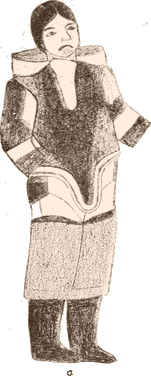
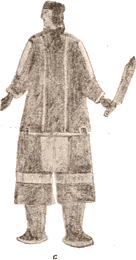
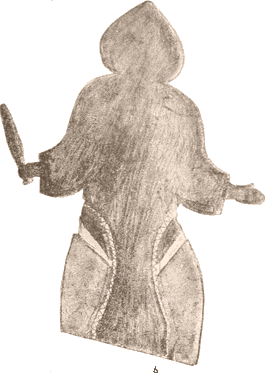
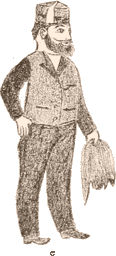
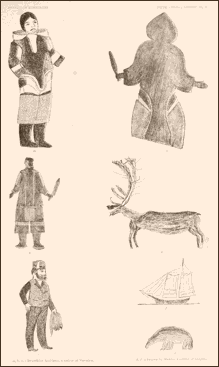
a, b, c, e Drawn by Aisē´ang, a native of Nuvujen.
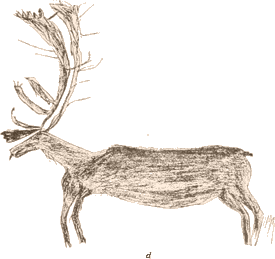
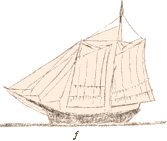
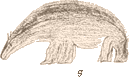
d, f, g Drawn by Maleki, a native of Imigen.
ESKIMO DRAWINGS.
Original layout of Plate V:
BUREAU OF ETHNOLOGY SIXTH ANNUAL REPORT PL. VI
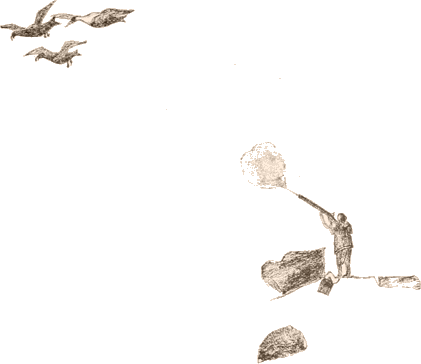
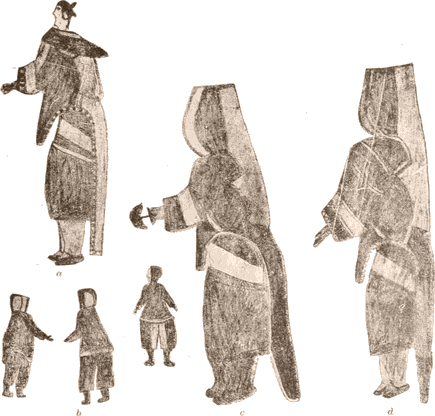
Drawn by Aisē´ang, a native of Nuvujen.
ESKIMO DRAWINGS.
The Eskimo are excellent draftsmen and carvers. Most of the drawings are similar to the bear and deer shown on Plate V (Figs. d and g) or to the illustrations of the Qaudjaqdjuq tale (see Figs. 537–541, pp. 631–633.) The rest, on Plates VI and VII, are excellently made, and by far superior to any I have seen made by other Eskimo of these regions. A number of carvings are represented on Plates VIII and IX. The narwhal and the whale are particularly admirable. Among the implements represented in this paper there are many of beautiful and artistic design.
BUREAU OF ETHNOLOGY SIXTH ANNUAL REPORT PL. VII
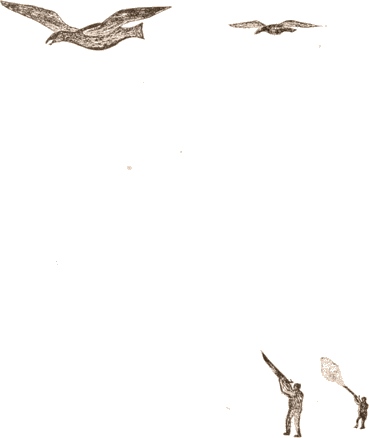
Drawn by Aise´ang, a native of Nuvujen.
ESKIMO DRAWING.
BUREAU OF ETHNOLOGY SIXTH ANNUAL REPORT PL. VIII
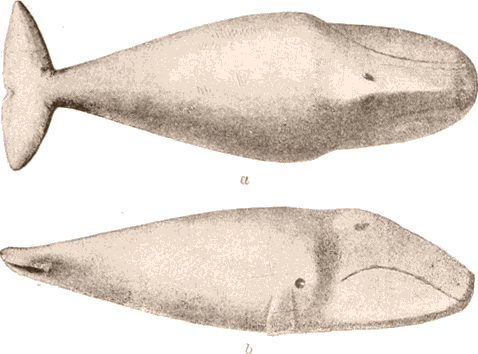
Carving representing whale. (In the possession of Mrs. Adams, Washington.) 1/1
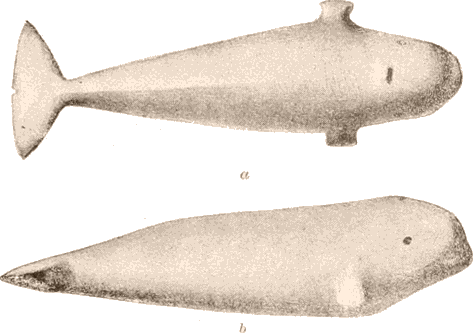
Carving representing whale. (National Museum, Washington. 29998.) 1/1
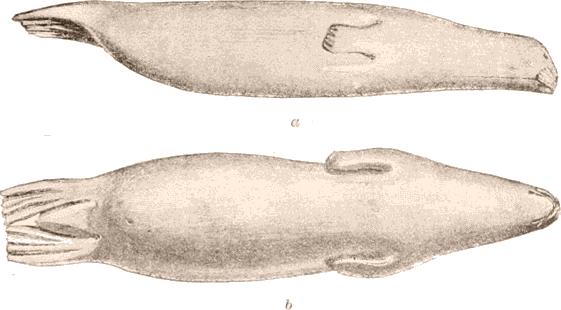
Carving representing seal. (National Museum, Washington. 29991.) 1/1
ESKIMO CARVINGS.
I also add a number of engravings of implements plainly showing the influence of European patterns (Plate X).
BUREAU OF ETHNOLOGY SIXTH ANNUAL REPORT PL. IX
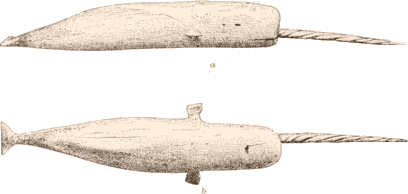
Carving representing narwhal. (In the possession of Capt. John O. Spicer, Groton. Conn.). ½
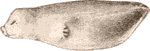
Seal. (Museum für Völkerkunde, Berlin.) 1/1

Walrus head. (National Museum, Washington. 10414.) 1/1
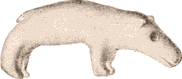
Polar bear. (Museum für Völkerkunde, Berlin.) 1/1

Sealskin float. (Museum für Völkerkunde, Berlin.) 1/1

Knife. (Museum für Völkerkunde, Berlin.) 1/1

Seal. (Museum für Völkerkunde, Berlin.) 1/1

Spyglass. (Museum für Völkerkunde, Berlin.) 1/1
ESKIMO CARVINGS.
BUREAU OF ETHNOLOGY SIXTH ANNUAL REPORT PL. X

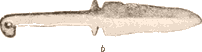

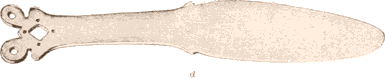

(National Museum, Washington. a, 10395; b, 68146; c, 10396; e, 10394.)
MODERN IMPLEMENTS
POETRY AND MUSIC.
Among the arts of the Eskimo poetry and music are by far the most prominent. The tales which have been related are only a small part of their stock of traditions. Besides the contents their form also is very interesting, as most of them have been handed down in unchanged form and their narration demands a great deal of art. Many traditions are told in a very abridged form, the substance being supposed to be known. A specimen of this kind is the Sedna tradition (p. 604). All these tales must be considered recitatives, many of them beginning with a musical phrase and continuing as a rhythmic recitation, others being recited in rhythmic phrases throughout. Other traditions are told in a more detailed and prosaic manner, songs or recitations, however, being sometimes included. Ititaujang, for instance, in traveling into the country looking for his wife, sings the song No. XIII, and in the Kalopaling tradition the boy, on seeing the two Inuit coming, sings:
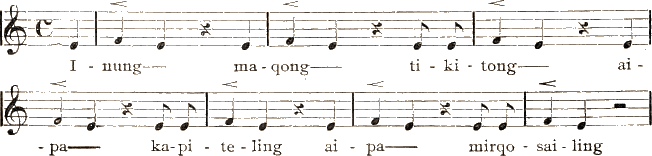
Inung maqong tikitong aipa kapiteling aipa mirqosailing
[Music]
Some Eskimo are very good narrators and understand how to express the feelings of the different persons by modulations of the voice. In addition, as a number of tales are really onomatopoetic, an artistic effect is produced. The way of reciting is always similar to the one above described by notes (p. 648).
Besides these tales, which may be called poetic prose, there are real poems of a very marked rhythm, which are not sung but recited. The following are examples:
MERRYMAKING AMONG THE TORNIT.

Pika pikagning mingepignirming qijepignirming sukadla. aq! aq!
[Music]
The Eskimo reciting this song jump up and down and to the right and left with their legs bent and their hands hanging down, the palms touching each other. In crying aq! aq! they jump as high as possible.
THE LEMMING’S SONG.
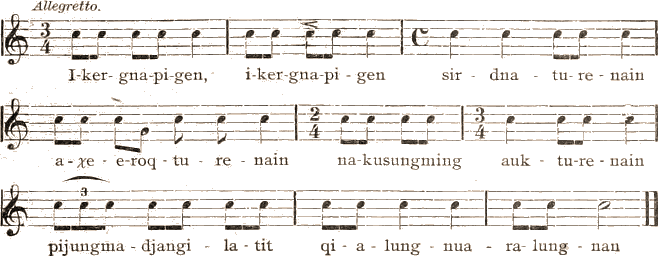
Ikergnapigen, ikergnapigen sirdnaturenain
aχe-eroqturenain nakusungming aukturenain
pijungmadjangilatit qialungnuaralungnan
[Music]
Besides these old songs and tales there are a great number of new ones, and, indeed, almost every man has his own tune and his own song. A few of these become great favorites among the Eskimo and are sung like our popular songs. The summer song (No. I) and “The returning hunter” (No. II) may be most frequently heard. As to the contents of the songs, they treat of almost everything imaginable: of the beauty of summer; of thoughts and feelings of the composer on any occasion, for instance, when watching a seal, when angry with somebody, &c.; or they tell of an important event, as of a long journey. Satiric songs are great favorites.
The form of both old and new songs is very strict, they being divided into verses of different length, alternating regularly. I give here some examples:
ARLUM PISSINGA (the killer’s song).
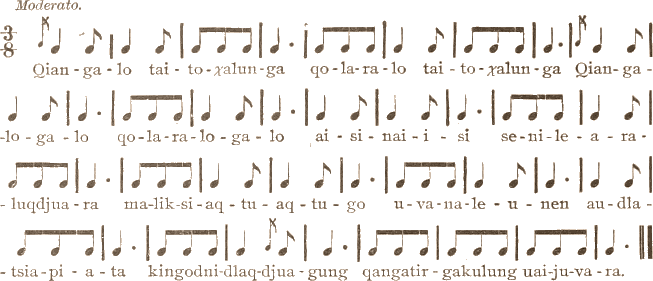
Qiangalo taitoχalunga qolaralo taitoχalunga
Qiangalogalo qolaralogalo aisinaiisi
senilearaluqdjuara maliksiaqtuaqtugo
uvanaleunen audlatsiapiata kingodnidlaqdjuagung
qangatirgakulung uaijuvara.
[Music]
The “killer” of the song title is a killer whale (arluk, gen. arluup or arlum).
I. The killer’s song:
(1) Qiangalo taitoχalunga,
Qolaralo taitoχalunga
Qiangalogalo
Qolaralogalo
Aisinaisi.15
(2) Senilearaluqdjuara
Maliksiaqtuaqtugo.
Uvanaleunen
Audlatsiapiata
Kingodnidlaqdjuagung
(3) Qangatirgakulung uaijuvara.
II. Summer song:
Aja.
(1) Ajaja adlenaipa.
Adlenaitariva silekdjua una aujaratarame
Ajaja, Ajaja!
Aja!
(2) Ajaja adlenaipa
Adlenaitariva silekdjua una tektorotikelektlune.
Ajaja, Ajaja.
Aja!
(3) Ajaja nipituovokpan!
Nipituovokpan kouvodlalimokoa nunatine aujadle
Ajaja, Ajaja
Aja!
&c.
III. Utitiaq’s song:
Aja!
(1) Adlenaipunganema adlenait.
Adlenaipunganema
Adlenaipunganema adlenait,
Aja!
(2) Sikuqdjualimena adlenait.
Atoqpoqtaromena
Tanerangitu adlenait.
Aja!
&c.
IV. Kadlu’s song:
(1) Odlaqē´, odlaqē´, odlaqē´.
Odlaqē´ saranga tutaranga atujang una ajajaja.
Odlaqē´ atedlirlungai aχigirn qodlusuaning aχiatungitunga ajaja.
Nettiulunga iχatijetingirn pinassousirdlunirn pinasuatautlirpadlirunirn.
(2) Odlaqē´, odlaqē´, odlaqē´.
Odlaqē´ saranga tutaranga atujang una ajajaja.
Odlaqē´ atedlirlungai aχigirn qodlusuaning aχiatungitunga ajaja.
Ugjurutlarunirn iχatijitingirn pinassousirdlunirn pinasuatautlirpadlirnunirn.
(3) ....&c.
Some of these verses contain only a single word, the rhythm being brought about by the chorus aja, amna aja, &c. I add two examples of this kind:
V. Song in the language of the Angakut:
Ajarpaija taitlaniqdjuaq ajarpe aitarpik ajijaija.
Ajarpaija ataqdjuaq ajarpe aitarpik ajijaija.
Ajarpaija mingeriaqdjuaq ajarpe aitarpik ajijaija.
VI. Oχaitoq’s song:
Aja.
(1) Tavunga tavunga tavunga tavunga
Tavunga tavunga tavunga tavunga tavungadlo tavunga
Aja.
(2) Pissutaramaima tavunga tavunga.
Pissutaramaima tavunga tavunga tavungadlo tavunga, &c.
The rhythm of the songs will best be understood by examining the melodies. Every long syllable may be replaced by two or even three short ones; other short syllables appear as unaccented parts before the accented part of a measure; in short, the rhythmic adaptation of the words to the melody is very arbitrary and interchanges frequently occur, so that it is impossible to speak of metric feet. At the same time this furnishes distinct proof that the musical rhythm is the decisive element in determining the form. The rhythmic arrangement of the words is regulated with considerable exactness by the quantity of the syllables, and not by the accent. While, for instance, in speaking, it would be “palirtu´gun,” in song No. IV it is “palir´tugun´,” and in No. I “tekto´roti´kelek´tlune,” instead of “tektorotikelektlu´ne,” &c. Such displacements of the accent, however, are avoided if possible, and in the best and most popular songs they hardly appear at all.
The numbers refer to the songs printed below, so “No. I” is the Summer Song, No. II above. But the quoted word “tektorotikelektlune” occurs only in the first version.
The construction of the songs corresponds entirely with that of the music, inasmuch as every melody and every rhythmically spoken song is made up of musical, that is, rhythmic, phrases which are divided by cæsuræ. Repetitions of the same phrases are very frequent. The adaptation of the melodies to our divisions of time and measure is also somewhat arbitrary, as they frequently consist of a mixture of three and four part phrases. It is for this reason that I have noted down some songs without any division into bars or measures and in those cases have only marked the accented syllables.
Among the twenty melodies and rhythmic poems we find ten of binary measures, five of triple measures, and six of mixed ones. Of the whole number, nine begin on the full bar, eleven on the arsis.
The melodies move within the following range: In a fifth (No. III), one; in a minor sixth (Nos. VII, IX, X), three; in a major sixth (Nos. II, IV, XVII), three; in a seventh (Nos. XII, XIV), two; in an octave, (Nos. I, II, V, VIII, XI, XVI), six; in a minor ninth (No. VI), one; in a major ninth (No. V), one; in a tenth (No. XIII), one.
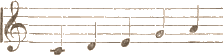
These may be divided into two very characteristic and distinct groups. The first, which would coincide with our major key, contains the following essential tones:
[Music]
The fourth and the sixth occur seldom, and then only as subordinate tones. This key is identical with the Chinese and many of the Indian ones.
In the second group, which corresponds to our minor key, we frequently find the fourth, while the sixth only appears twice and then as a subordinate tone (in No. XV). We furthermore find the major seventh in the lower position leading back to the beginning, i.e., the key note. The essential components of this key are:
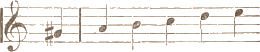
[Music]
Professor R. Succo calls attention to the fact that the relation of the melodies to their key note resembles that of the Gregorian chants, especially the psalmodic ones among them.
If we, in accordance with our ideas, suppose the melody—No. XIII, for example—to begin in C major, it nevertheless does not conclude in the same key, but in E. We would say that No. XIV is written in A minor; still it ends in E. We find the same in the Gregorian chants. They also resemble the songs of the Eskimo in the retention of the same note during a large number of consecutive syllables.
On the whole the melodies, even to our musical sense, can be traced to a key note. However, changes often occur as well (see No. VI). A very striking construction appears in No. XIII, where the oft-repeated E forms a new key note, while at the conclusion the melody leaps back without any modulation to C through the peculiar interval, ḇ, c.
I. SUMMER SONG.
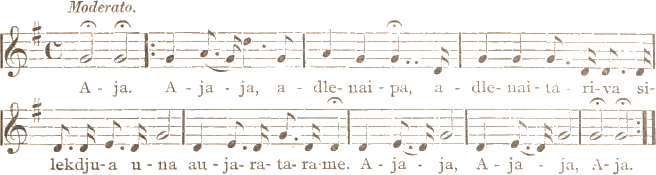
Aja.
Ajaja, adlenaipa, adlenaitariva silekdjua una aujaratarame.
Ajaja, Ajaja, Aja.
[Music]
II. THE RETURNING HUNTER.
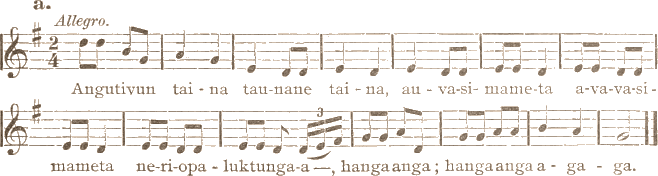
a.
Angutivun taina taunane taina,
auvasimameta avavasimameta neriopaluktunga,
hanga anga;
hanga anga agaga.
[Music (a)]
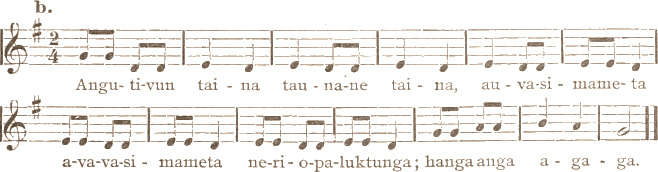
b.
Angutivun taina taunane taina,
auvasimameta avavasimameta neriopaluktunga;
hanga anga agaga.
[Music (b)]
III. SONG OF THE TORNIT.
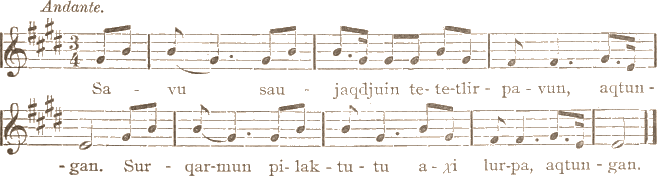
Savu saujaqdjuin tetetlirpavun, aqtungan.
Surqarmun pilaktutu aχi lurpa, aqtungan.
[Music]
IV. SONG OF THE INUIT TRAVELING TO NETTILLING.
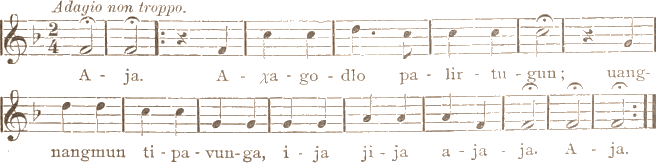
Aja.
Aχagodlo palirtugun;
uangnangmun tipavunga,
ija jija ajaja.
Aja.
[Music]
V. OXAITOQ’S SONG.
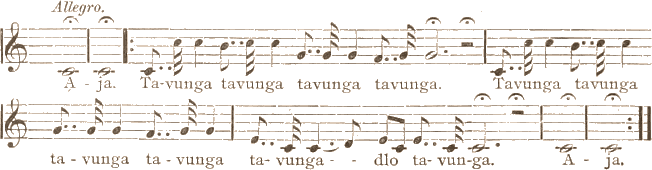
Aja.
Tavunga tavunga tavunga tavunga.
Tavunga tavunga tavunga tavunga tavungadlo tavunga.
Aja.
[Music]
VI. UTITIAQ’S SONG.
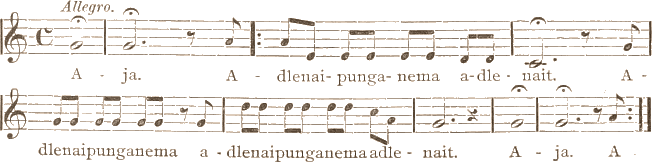
Aja.
Adlenaipunganema adlenait.
Adlenaipunganema adlenaipunganema adlenait.
Aja.
[Music]
VII. SONG.
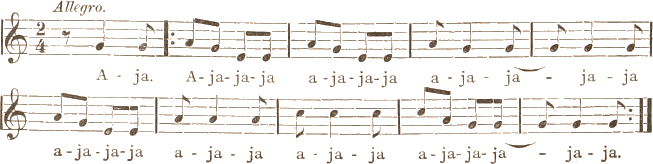
[Music]
VIII. SONG.

Hajajaja hajaja hajajaja hajaja
hajajaja hajaja hajajaja hajaja.
[Music]
IX. SONG OF THE TORNIT.
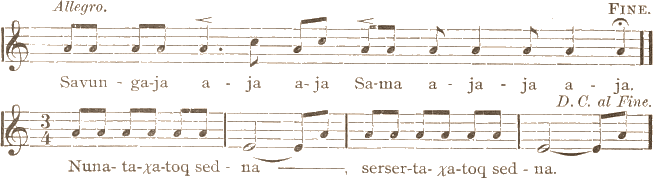
Savungaja aja aja
Sama ajaja aja.
Nunataχatoq sedna,
sersertaχatoq sedna.
[Music]
X. THE FOX AND THE WOMAN.
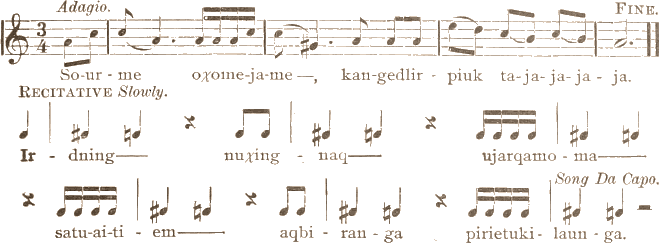
Sourme oχomejame, kangedlirpiuk tajajajaja.
Irdning nuχingnaq ujarqamoma satuaitiem
aqbiranga pirietukilaunga.
[Music: melody, recitative]
XI. THE RAVEN SINGS.

Aaja aja aja ajaja aja aja ajaja.
Aaja aja aja aja qilirsiutarata taunane.
Arnaqdjuqpun una qiavoqtung qitungnaqdjuago nutingmen.
[Music]
XII. SONG OF A PADLIMIO.
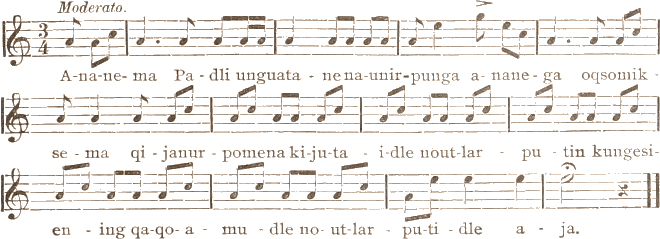
Ananema Padli unguatane naunirpunga
ananega oqsomiksema qijanurpomena kijutaidle
noutlarputin kungesiening qaqoamudle
noutlarputidle aja.
[Music]
XIII. ITITAUJANG’S SONG.
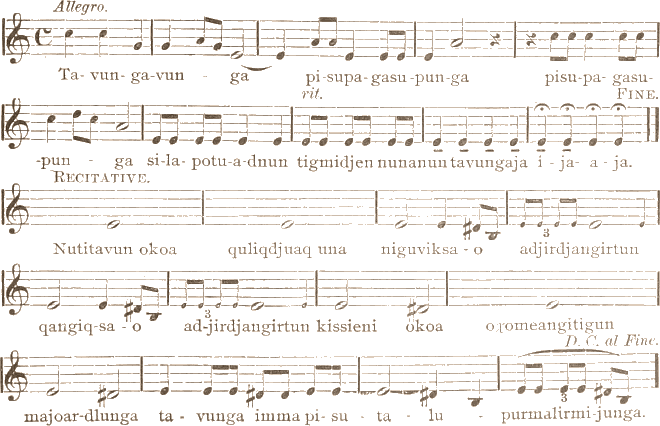
Tavungavunga pisupagasupunga pisupagasupunga
silapotuadnun tigmidjen nunanun tavungaja ijaaja.
Nutitavun okoa
quliqdjuaq una
niguviksao adjirdjangirtun
qangiqsao adjirdjangirtun
kissieni okoa oχomeangitigun
majoardlunga tavunga
imma pisutalupurmalirmijunga.
[Music]
XIV. PLAYING AT BALL.
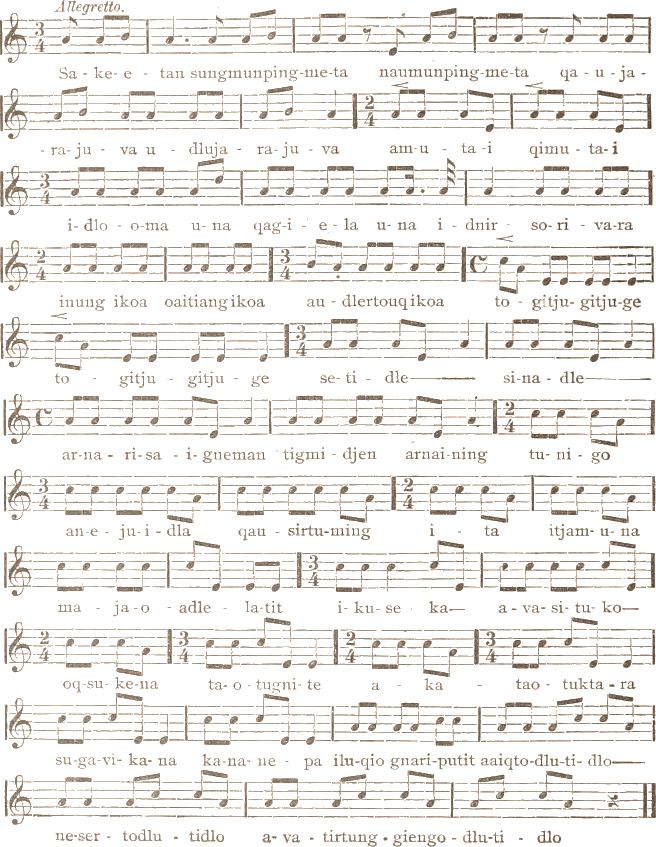
Sake-etan sungmunpingmeta naumunpingmeta
qaujarajuva udlujarajuva
amutai qimutai idlo-oma una qagiela una
idnir sorivara inung ikoa oaitiangikoa audlertouqikoa
togitjugitjuge togitjugitjuge setidle sinadle
arnarisaigneman tigmidjen arnaining tunigo
anejuidla qausirtuming ita itjamuna
majaoadlelatit ikuseka avasituko
oqsukena taotugnite akataotuktara
sugavikana kananepa iluqio gnariputit
aaiqtodlutidlo nesertodlutidlo
avatirtunggiengodlutidlo
[Music]
XV. PLAYING AT BALL.
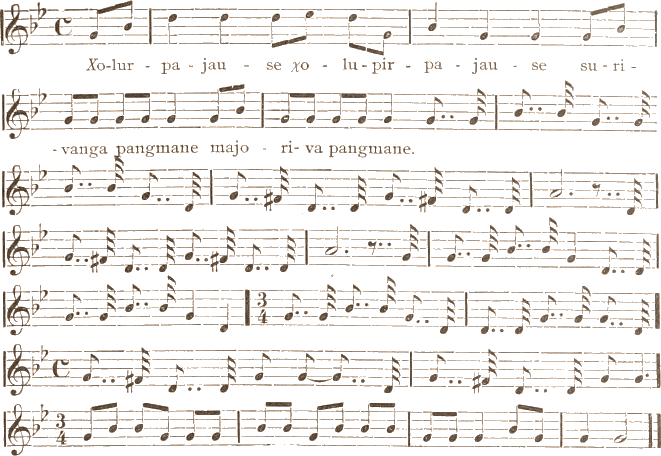
χolurpajause χolupirpajause
surivanga pangmane majoriva pangmane.
[Music]
XVI. From Parry, Second Voyage, p. 542, Iglulik.
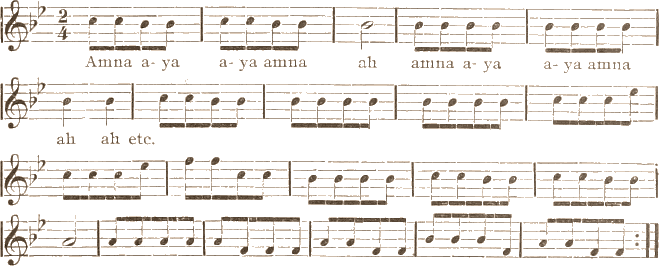
Amna aya aya amna ah
amna aya aya amna ah ah
etc.
The sixteenth bar is probably

[Music]
XVII. From Lyon, Private Journal, p. 135, Iglulik.
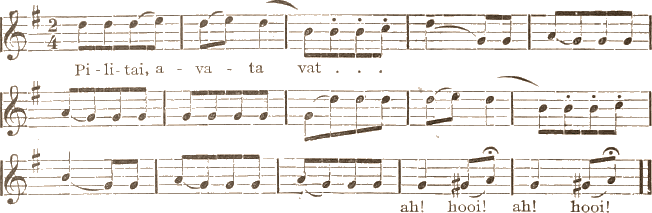
Pilitai, avata vat . . .
ah! hooi! ah! hooi!
[Music: as printed]
According to Parry, p. 542, the fourth bar of XVII is written: ; the eighth, ; Lyon bar after the twelfth bar inserted.
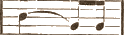
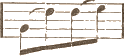
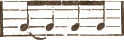
[Music: with all changes]
XVIII. From Kane, Arctic Explorations. The Second Grinnell Expedition, I, p. 383. From Ita, Smith Sound.

Amna gat amnaya amna ja amnayet.
[Music]
XIX. From Bessels’s Amerikanische Nordpol-Expedition, p. 372.
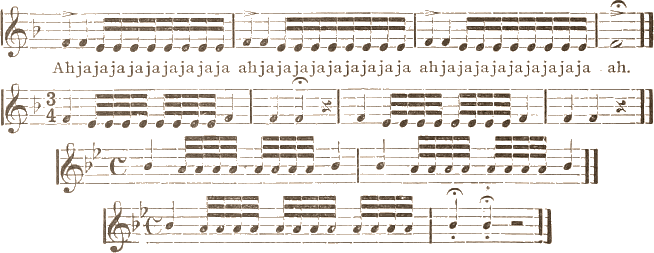
Ahjajajajajajajajaja
ahjajajajajajajajaja
ahjajajajajajajajaja ah.
[Music: line 1, line 2, line 3, line 4.]
GLOSSARY.
As in the original text, χ in Glossary entries is shown in ordinary (not small-capped) type: Eχaluq, Eχaluit.
ESKIMO WORDS USED, WITH DERIVATIONS AND SIGNIFICATIONS.
A E I K M N O P Q S T U
A.
Adlipar´miut, the inhabitants of the country farthest below; from at, below; -lirn, being in a certain direction; -pāng, superlative; -mio (plural, -miut), inhabitant of.
A´dlirn, a small lamp on the floor of the hut; from at, below; -lirn, being in a certain direction.
Adli´vun, those beneath us; from at, below; -lirn, being in a certain direction; -vun, possessive first person plural.
A´gdlag, black bear.
Agdliaq, a small spear; from ake-, across; -dlivoq, he provides with; -aq, past participle.
Ag´girn, a species of duck (Anas glacialis).
Aiss´ivang, spider.
A´jang, beam of kayak; from ajaq-, to support.
Aja´rorpoq, he plays the game cat’s cradle.
Aje´gaung, a game.
Ajokitarpoq, a game.
Ajuktaq´tung, batting the ball.
Akparaik´tung, hook for preventing the loss of harpoon.
Akud´nang, paddle handle; from ako, middle.
A´kuk, lateral strips of wood used in boat; from ako, middle.
A´lirn, harpoon line.
A´maroq, wolf.
A´ming, skin of land animals, cover of boat and kayak.
Ang´akoq, a magician, conjurer.
Angakunirn, the art of the angakoq.
Ang´akut, plural of angakoq.
Angiaq, spirit of a murdered child (Greenland).
Ang´un, paddle.
Anguta´, his father.
Angu´vigang, lance; from anguvoq, he goes sealing with the harpoon.
Aning´a, her brother (the moon).
A´no, dog harness.
A´pumang, gunwale.
Aqo´jang, stern of kayak.
Aqsar´dnirn, wind blowing down a valley.
Arau´taq, snow beater (Aivillik dialect).
Arng´oaq, amulet.
Ase´dlun, flat receptacle for the harpoon line on kayak.
Asimau´tang, piece of board or whalebone on which skins are cleaned.
Atau´ta, neck of sealskin float; from atav-, to be connected.
Audliti´ving, vault back of snow house.
Avangna´nirn, northwestern gales along the coast of Baffin Land.
Avau´tang, sealskin float.
Avautapāq´, large sealskin float; from avautang, sealskin float; -pāq, superlative.
A´vignaq, lemming.
Aχi´girn, ptarmigan.
E.
Eχalū´jang, carved ivory fish, used as bait; from eχaluq, salmon; -ujang, similar to.
Eχaluq, salmon.
I.
Idluk´, a fabulous fish.
Igdl´u, snow house.
Igdl´uarn, a vault attached to snow hut; from igdlu, snow house; -arn, small.
Igdlukitaq´tung, playing with two balls, tossing them up alternately; from igdlung, both; -kitarpoq, he uses at the same time.
Igdlu´ling, second vault of snow house; from igdlu, snow house; -ling, with.
I´gimang, ball-and-socket joint of harpoon and lance; from igipā´, he throws it off.
Ikan´, store room supported by stone pillars; from ikarpoq, it stretches from one support to another.
Ikirt´suq, wind blowing from the open sea.
Ilaga, my friend (Netchillik).
Ilupi´qang, lining of snow house; from ilo, inner.
Imiti´jung, drinking water; from imiq, fresh water.
Inetang, hoop with net of thongs to dry clothing etc. in snow house; from inivā´, he hangs it up.
In´ua, its man, owner; possessive third person of inung, man.
Inug´sung, cairn; from inung, man.
Ipar´ang, harpoon line.
Ip´un, oar, a spear.
Irqata´tung, a certain circuit among the huts.
Issumau´tang, a chief; from issu´mavoq, he thinks.
Itigega, boot (Iglulik).
Itir´bing, cross piece abaft the hole in kayak; from itiq.
K.
Kabliaqdjuq, wolverine (Iglulik).
Kaitikpoq, a game.
Kaiviti´jung, a game.
Kaki´vang, fish spear.
Kaklio´kia, hook (Iglulik).
Kalu´giang, a heavy lance (qalugiang?).
Kang´o, a species of goose.
Ka´pun, Spear; from kapivā´, he stabs him.
Ka´teng, entrance to stone hut.
Kentun, drumstick.
Kidlu´lirn, lamp standing in the rear of the hut.
Ki´glo, boat post.
Kilaut, drum.
Koukparmiu´tang, a certain amulet at point of hood.
Ku´jang, keel of kayak.
M.
Ma´ling, paddle blade.
Ma´mi, membrane or inner side of skin.
Ma´sing, cross piece before hole in kayak.
Mir´qun, needle.
Mirquss´ang, two masked persons.
Mumipoq, he dances.
N.
Nabi´ring, a loop; from nā´poq, he hinders a motion.
Na´po (plural napun), cross bar of sledge.
Naqeta´run, lashing for the sledge; from naqigpoq, it is pressed down.
Nau´lang, harpoon head.
Ne´tivang, Phoca cristata.
Ni´girn, southeast.
Niksiang, hook.
Niksiar´taung, fish hook.
Nirt´sun, small ropes used in sledge and house.
Niuq´tung, drill bow with string; from niorpoq, he drills.
Niu´tang, hoop with skin stretched over it; beam of kayak.
Nuglu´tang, a certain game.
Nu´irn, bird spear.
Nulianititi´jung, exchange of wives.
Nunajisar´tung, a certain festival.
Nuqsang, throwing board.
Nussueraqtung, a certain festival.
O.
Oqur´tsuq (Akudnirn), southeast, blowing from Oqo; from oqo, weather side.
P.
Pa, hole of kayak.
Pakijumijar´tung, game of hook and crook.
Pa´na, double edged knife.
Parti´rang, button for closing the pitu; from pārpa, he meets him.
Pauk´tun, pegs.
Pau´ting, double bladed kayak paddle.
Pi´laut, large knife.
Pilek´tung, cutting something.
Pi´main, chief, he who knows everything best by practice.
Pi´ningnang, true south.
Pir´qang, shoeing of runners of sledge.
Pitiq´se, bow.
Pitkusi´rarpoq, a certain game.
Pi´tu, a stout thong, consisting of two parts to fasten traces to sledge.
Poviu´tang, pipe for inflating skins; from pō-, to blow.
Pukiq, the white part of a deerskin.
Q.
Qadlunait, Europeans.
Qag´gi, singing house.
Qailerte´tang, a certain masked figure.
Qai´vun, drill.
Qa´jaq, kayak.
Qa´mun, sledge runner.
Qa´muting (dual of qamun), sledge.
Qana´ra, east-northeast (Nettilling); from qaning, falling snow.
Qang´ing, a toggle.
Qang´irn, a ventilating hole in snow house; from qa, above.
Qa´ning, a certain rib of kayak.
Qa´ningnang, east-northeast; from qaning, falling snow.
Qaq´djung, arrow.
Qa´reang, annex of house for an additional family.
Qar´mang (plural qarmat), stone or bone house.
Qarmau´jang, similar to a qarmang; suffix, -ujang, similar to.
Qasi´giaq, Phoca annellata.
Qatilik, a spear (Iglulik); from qatirn, ivory head of harpoon shaft; -lik, with.
Qa´tirn, ivory head of harpoon shaft.
Qatu´rang, a boot ornament.
Qaumarteng´a, days without sun, but with dawn.
Qau´mat, a kind of fire (?); from qauq, daylight.
Qaumati´vun, sun (in the sacred language of the angakut).
Qauma´vun, moon (in the sacred language of the angakut).
Qauq, daylight.
Qidja´rung, whirl; from qipivā´, he twists it.
Qijuqteng´a, harpoon shaft; from qijuq, wood.
Qilaq, sky.
Qiler´tuang, clasp for holding the coils of the harpoon line; from qilerpā´, he ties it with a knot.
Qing´ang, a hole to look out of snow house.
Qing´miaq, mouth piece of drill.
Qipeku´tang, rod to indicate approach of seal to his hole.
Qi´piq, blanket.
Qi´qirn, phantom in the shape of a huge, hairless dog.
Qoqsiuariva, the ceremony of washing children with urine.
Qudlipar´miut, the inhabitants of the country farthest above; from qu, above; -lirn, being in a certain direction; -pāng, superlative; -mio (plural, -miut), inhabitant of.
Qudlirn, a lamp; from qu, above; -lirn, being in a certain direction.
Qudli´vun, the uppermost ones; from qu, above; -lirn, being in a certain direction; -vun, possessive first person plural.
Qudluqsiu´ta, ring on a paddle.
Qu´ming, a certain lamp.
Quqar´taun, an implement to string fish.
Quvie´tung, a festival.
S.
Sadni´riaq, cross piece, a certain button, from sadne, side, across.
Sadni´run, a yard.
Sāketān´, roulette; from sakagpā´, he pushes it.
Sakie´taun, the Pleiades.
Sakurpāng´, whale harpoon; from sako, weapon; -pāng, the largest.
Sa´ving, knife.
Seligo´ung, scraper; from selivā´, he cleans a skin.
Siad´nirn (plural, siadnit), lateral strip in kayak; from siaq-, to place in a row; -nirn, being.
Siat´ko, harpoon head (Iglulik).
Siek´tung, the three stars in Orion’s belt: those standing in a row.
Sir´dloang, store room of snow house.
Siring´ilang, the excepted month in balancing Eskimo calendars, the month without sun; from sirinirn, sun; -ngilang, he has not.
Sirinikteng´a, the first days with sunlight; from sirinirn, sun; -tang, new; -a, possessive third person singular.
Sirmi´jaung, scraper for kayak; from sirming, thin ice.
Sulubaut´, bunch of hair projecting from forehead.
Sului´tung, festival in which a knife (sulung) is used.
Su’lung, wing; knife shaped like a wing.
T.
Tagusiar´bing, eye (of harpoon).
Taguta´, a thong (of harpoon).
Teliq´bing, certain piece on harpoon line.
Tesir´qun, scraper; from tesivā´, he stretches it.
Tigdluiq´djung, blow with the fist (of a stranger); from tigdlugpā´, he strikes him with the fist.
Tika´gung, support of hand in throwing harpoon.
Ti´kiq, thimble.
Tik´ping, rib of kayak.
Tiluq´tung, snow beater; from tiluqpā´, he strikes it, in order to shake something off.
Tingmi´ujang, images of birds (used for dice); from tingmiang, bird; -ujang, similar to.
To´kang, harpoon head.
Toq´sung, vaulted entrance to snow house.
Tor´naq, a guardian spirit.
Tornarsuq, the great tornaq.
To´ung, tusk, point.
Toung´a, point of spear.
Tugliga, a tress.
Tuktuq´djung, the constellation of the Reindeer, or the Great Bear, Ursa Major; from tukto, caribou (deer).
Tumi´ujang, a certain lamp resembling a footprint; from tume, footprint; -ujang, similar to.
Tuniq´djung, stern of kayak.
Tu´pilaq, spirit of a deceased person.
Tu´piq, tent.
Tupu´tang, plugs for closing wounds.
Tuta´reang, a certain buckle.
Tu´ving, strip in the boat nearest the gunwale; from tuk-, to stop a motion; tupā´, he makes it fast.
U.
Ua´dling, first vault of snow house.
Uang´nang, west-northwest, Cumberland Sound; west-southwest in Akudnirn.
Udleq´djung, Sword of Orion: following one another.
Ui´nirn, head of sledge runner.
U´kusik, soapstone kettle.
U´lo, woman’s knife.
Uluq´saq, green slate, material for women’s knives; from ulo and -saq, material for.
U´miaq, large skin boat.
Uming, beard.
U´mingmang, musk ox.
Umī´ujang, needle case.
U´nang, sealing harpoon.
Unaqiu´ta, ring on shaft of sealing harpoon; from unang; -iarpā´, he fastens it; -ta, past participle.
Unarteng´a, iron rod of sealing harpoon; from unang; -tang, belonging to; -a, possessive.
Uqsirn, implement for fastening traces to sledge.
Usujang, stern projection of kayak; from usung, penis; -ujang, similar to.
ESKIMO GEOGRAPHICAL NAMES USED, WITH ENGLISH SIGNIFICATIONS.
A E I K M N O P Q S T U
A.
Agdlinartung.
Aggirtijung, abounding with ducks.
Aggo, the weather side.
Aggomiut, the inhabitants of Aggo.
Agpan, loons.
Agutit.
Aivillik, with walrus.
Aivillirmiut, the inhabitants of Aivillik (the walrus country).
Akudnirmiut, the inhabitants of Akudnirn.
Akudnirn, the intervening country.
Akugdlirn, the central one.
Akugdlit, the central ones.
Akuliaχating.
Akuliaq.
Akuliarmiut, the inhabitants of Akuliaq.
Amaqdjuaq, the large place where children are carried in the hood.
Amartung, a woman carrying a child in the hood.
Amitoq, the narrow one.
Anarnitung, smelling of excrements.
Anartuajuin, the excrements.
Anaulereë´ling.
Angiuqaq; from angivoq, it is large.
Angmalortuq, the round one.
Angmang, jasper.
Angmartung, the open one (not frozen over).
Aqbeniling, six; so called because reached after six days’ travel.
Aqbirsiarbing, a lookout for whales.
Aqbirtijung, abounding with whales.
Aqojang; from aqo, stern.
Aqojartung; from aqo, stern.
Arligaulik.
Audnerbing, place where seals are approached by the crawling hunter.
Augpalugtijung, with many red places.
Augpalugtung, the red one.
Aulitiving, an annex of the snow house; hills lying at the foot of steep cliffs.
Auqardneling, with many places where the ice melts early in spring.
Avatutiaq.
Avaudjeling, with a low saddle.
E.
Eχaloaping, with common salmon.
Eχalualuin, the large salmon (plur.).
Eχaluaqdjuin, the small salmon (plur.).
Eχaluin, the salmon (plur.).
Eχaluqdjuaq, the shark.
Eχoleaqdjuin.
I.
Idjorituaqtuin, the only places with an abundance of grass.
Idjuk, the testicles.
Igdlumiut, the inhabitants of the other side.
Igdlungajung, the bandy legged man; so called from a fabulous tribe.
Igdluqdjuaq, the large house.
Iglulik, with houses.
Iglulirmiut, the inhabitants of the place with houses.
Igpirto, with many hills.
Igpirtousirn, the smaller place with many hills.
Ijelirtung.
Ikaroling, with a ford.
Ikerassaq, the narrow strait.
Ikerassaqdjuaq, the large narrow strait.
Iliqimisarbing, where one shakes one’s head.
Imeraqdjuaq.
Imigen, with fresh water.
Ingnirn, flint.
Inugsuin, the cairns.
Inugsulik, with cairns.
Ipiuteling, with an isthmus.
Ipiuting, the isthmus; literally, the traces of a dog.
Irtiujang.
Isiritung.
Isoa, its cover.
Issortuqdjuaq, the large one with muddy water.
Ita, food.
Itidliaping, the common pass.
Itidlirn, the pass.
Itijareling, with a small pass.
Itirbilung, the anus.
Itivimiut, the inhabitants of the coast beyond the land.
Ituatukan.
Itutonik (Etotoniq).
K.
Kaming´ujang, similar to a boot.
Kangertloa´ping, the common bay.
Kangertlua´lung, the large bay.
Kangertlukdjuaq, the large bay.
Kangertluk´siaq.
Kangertlung, the bay.
Kangia, its head, its upper part (of a bay).
Kangianga, its upper part.
Kangidliuta, nearest to the land.
Kangivamiut, inhabitants of Kangia.
Kautaq, diorite.
Kilauting, the drum.
Kingnait, the high land.
Kingnaitmiut, the inhabitants of Kingnait.
Kinipetu.
Kitigtung, the island lying farthest out toward the sea.
Kitingujang, the gorge.
Kouaqdjuaq.
Koukdjuaq, the large river.
Kouksoarmiut, the inhabitants of Kouksoaq.
Koukteling, with a river.
Kugnuaq, the small nice river.
M.
Majoraridjen, the places where one has to climb up.
Maktartudjennaq, where one eats whale’s hide.
Maluksilaq.
Manirigtung, with many eggs.
Manituling, with uneven places.
Metja, the lid.
Midlurieling, where stones are thrown (for catching white whales).
Miliaqdjuin, the small ones, which shut it up(?).
Miliqdjuaq, the large one, which shuts up(?).
Mingong, the beetle.
Misiqtung.
Muingmang.
N.
Nanuqtuaqdjung, the little bear.
Nanuragassain, abounding in young bears.
Naqoreang.
Narpaing.
Naujan, the gulls.
Naujaqdjuaq, the large gull.
Naujateling, with gulls.
Nebarvik.
Nedlung, peninsula from the point of which deer are driven into the water; from nedlugpoq, he swims.
Nedluqseaq; from nedlugpoq, he swims.
Neqemiarbing, where something is carried in the hand.
Nerseqdjuaq, the large valley.
Netchillik, with seals.
Netchillirmiut, the inhabitants of Netchillik (the seal country).
Nettilling, with seals.
Niaqonaujang, similar to a head.
Nikosiving; from nikuipoq, it stands erect.
Nirdlirn, the goose.
Niutang, hoop used in whaling.
Nudlung, the posteriors.
Nudnirn, the point.
Nugumiut, the inhabitants of the point.
Nurata.
Nuratamiut, the inhabitants of Nurata.
Nuvujalung, the large cape or point.
Nuvujen, the points.
Nuvukdjuaq, the great point.
Nuvukdjuaraqdjung, the little Nuvukdjuaq.
Nuvuktirpāng´, the greatest point.
Nuvuktualung, the only great point.
Nuvung, the point.
O.
Okan, the codfish (plural).
Okavit.
Operdniving, place where one lives in spring.
Oqo, the weather side.
Oqomiut, the inhabitants of Oqo.
Owutta.
P.
Padli, with the mouth of a river.
Padliaq, the little mouth of the river.(?)
Padlimiut, the inhabitants of Padli.
Padloping; from padlorpoq (lying on the face?).
Pamiujang, similar to a tail.
Pangnirtung, with many bucks.
Pikiulaq, Uria grylle.
Piling, with many things (i.e., game).
Pilingmiut, the inhabitants of Piling.
Pingitkalik.
Pitiktaujang.
Pujetung, with plenty of blubber.
Putukin.
Q.
Qaggilortung; from qaggi, singing house.
Qairoliktung, with plenty of seals (Phoca grœnlandica).
Qamusiojodlang.
Qariaq.
Qarmang, walls.
Qarmaqdjuin, the large walls.
Qarussuit, the caves.
Qasigidjen, Callocephali.
Qaumauang; from qauq, daylight.
Qaumauangmiut, the inhabitants of Qaumauang.
Qaχodlualung, the large fulmar.
Qaχodluin, the fulmars.
Qeqertakadlinang; from qeqertaq, island.
Qeqertalukdjuaq, the large island.
Qeqertaq, the island.
Qeqertaujang, similar to an island.
Qeqertelung, the large island.
Qeqerten, the islands.
Qeqertome itoq tudlirn, next to the island.
Qeqertuqdjuaq, the large island.
Qerniqdjuaq, the great black place.
Qidnelik.
Qimissung, the snow drift.
Qimuqsuq; from qimuqpoq, he draws the sledge.
Qingaseareang.
Qingua, its head.
Qinguamiut, the inhabitants of Qingua.
Qivitung, the hermit.
Qognung, the narrow place.
Qogulortung (Qaggilortung?).
Qordluving, where the water runs in a solid stream.
Quaiirnang.
Qudjitariaq.
S.
Sagdlirmiut, the inhabitants of Sagdlirn.
Sagdlirn, the island nearest the sea.
Sagdlua, its Sagdlirn.
Sakiaqdjung, the little rib.
Sarbaq (sarvaq), the rapids.
Sarbaqdjukulu, the small rapids.
Sarbaqdualung, the large rapids.
Sarbausirn, the smaller rapids.
Sarbuqdjuaq, the large rapids.
Saumia, its left side.
Saumingmiut, the inhabitants of Saumia.
Saunirtung, with many bones.
Saunirtuqdjuaq, the great one with many bones.
Sednirun, the yard.
Siegtung, the scattered ones.
Sikosuilaq, the coast without ice.
Sikosuilarmiut, the inhabitants of Sikosuilaq.
Sini, the edge.
Sinimiut, the inhabitants of Sini.
Sioreling, with sand.
Sirmiling, with a glacier.
Sulung, the valley through which the wind blows howling.
Surosirn, the boy.
T.
Talirpia, its right side.
Talirpingmiut, the inhabitants of Talirpia.
Tappitariaq, the pass crossing two isthmuses.
Tappitaridjen, the passes crossing two isthmuses.
Taquirbing.
Tarionitjoq, the salt water basin.
Tarrionitung, the salt water basin.
Taχolidjuin.
Tessiujang, similar to a pond.
Tikeraqdjuaq, the great point.
Tikeraqdjuausirn, the smaller great point.
Tikeraqdjung, the small point.
Tikeraqdjuq, the small point.
Tininiqdjuaq, the large beach.
Tiniqdjuaurbing, the great place with a high tide.
Tiniqdjuarbiusirn, the smaller great place with a high tide.
Tornait, Spirits.
Touaqdjuaq.
Tuarpuqdjuaq.
Tudjan.
Tudjaqdjuaq.
Tudjaqdjuaralung.
Tudjaraaqdjung.
Tukia, its farthest corner.
Tulukan, the ravens.
Tuniqten, those lying behind it.
Tunukutang.
Tununirmiut, the inhabitants of Tununirn.
Tununirn, the country lying back of something.
Tununirusirmiut, the inhabitants of Tununirusirn.
Tununirusirn, the smaller Tununirn.
Tunussung, the nape.
Tupirbikdjuin, the tent sites.
U.
Udlimauliteling, with a hatchet.
Ugjuktung, with many ground seals.
Ugjulik, with ground seals.
Ugjulirmiut, the inhabitants of Ugjulik (the ground seal country).
Uglariaq.
Uglirn, walrus island.
Uglit, the walrus islands.
Uibarun, the cape.
Ujaraqdjuin, the large stones.
Ujaradjiraaitjung; from ujaraq, stone.
Ukadliq, the hare.
Ukiadliving, the place where one lives in the fall.
Ukiukdjuaq, the great winter.
Ukusiksalik, the place with pot stone.
Ukusiksalirmiut, inhabitant of Ukusiksalik.
Umanaq, the heart-like island.
Umanaqtuaq, the great heart-like island.
Umingman Nuna, the land of the musk ox.
Ungava.
Ungavamiut.
Ussualung, the large penis.
Utiqimitung.
APPENDIX.
After the preceding paper was in type some additional information was received from whalers who returned from Cumberland Sound in the autumn of 1887. In the following notes I give the substance of these reports:
Note 1.
Page 467. Since 1883 the whalers have been more successful, and consequently more ships visit the sound. In the present winter—1887-’88—one American and two Scottish whaling stations are in operation in Cumberland Sound; a new station was established in Nugumiut two years ago, and the Scottish steamers which used to fish in Baffin Bay and the northern parts of Davis Strait are beginning to visit Cumberland Sound and Hudson Strait. The whaling in Baffin Bay shows a sudden falling off and it seems that the number of ships will be greatly reduced. This cannot be without influence upon the Eskimo, who will probably begin again to flock to Cumberland Sound and Nugumiut.
Note 2.
Page 538. In 1884 and 1885 a lively intercourse existed between Padli and Cumberland Sound, and in the spring of the latter year the dog’s disease broke out for the first time on the coast of Davis Strait, and spread, so far as is known, to the northern part of Home Bay.
Note 3.
Page 574. A peculiar game is sometimes played on the ice in spring. The men stand in a circle on the ice, and one of them walks, the toes turned inward, in a devious track. It is said that only a few are able to do this in the right way. Then the rest of the men have to follow him in exactly the same track.
One of their gymnastic exercises requires considerable knack and strength. A pole is tied with one end to a stone or to a piece of wood that is firmly secured in the snow. A man then lies down on his back, embracing the pole, his feet turned toward the place where the pole is tied to the rock. Then he must rise without bending his body.
In another of their gymnastic exercises they lie down on their stomachs, the arms bent so that the hands lie close together on the breast, palms turned downward. Then they have to jump forward without bending their body, using only their toes and hands. Some are said to be able to jump several feet in this manner.
Note 4.
Page 582. In the Report of the Hudson Bay Expedition of 1886, p. 16, Lieut. A. Gordon remarks that the same custom is reported from Port Burwell, near Cape Chidleigh, Labrador. He says: “There lived between the Cape and Aulatsivik a good Eskimo hunter whose native name is not given, but who was christened by our station men ’Old Wicked.’ He was a passionate man and was continually threatening to do some bodily harm to the other more peaceably inclined natives. ***His arrogance and petty annoyances to the other natives became at length unbearable. It appears that these unfortunates held a meeting and decided that Old Wicked was a public nuisance which must be abated, and they therefore decreed that he should be shot, and shot he was accordingly one afternoon when he was busily engaged in repairing the ravages which a storm had made in his ‘igdlu’ or snow house. The executioner shot him in the back, killing him instantly. The murderer or executioner (one hardly knows to which title he is more justly entitled) then takes Old Wicked’s wives and all his children and agrees to keep them ***so that they shall be no burden on the company.”
The fact that the custom is found among tribes so widely separated will justify a description of those events which came under my own observation. There was a native of Padli by the name of Padlu. He had induced the wife of a Cumberland Sound native to desert her husband and follow him. The deserted husband, meditating revenge, cut off the upper part of the barrel of his gun so that he could conceal it under his jacket. He crossed the land and visited his friends in Padli, but before he could accomplish his intention of killing Padlu the latter shot him. When this news was reported in Qeqerten, the brother of the murdered man went to Padli to avenge the death of his brother; but he also was killed by Padlu. A third native of Cumberland Sound, who wished to avenge the death of his relatives, was also murdered by him. On account of all these outrages the natives wanted to get rid of Padlu, but yet they did not dare to attack him. When the pimain of the Akudnirmiut in Niaqonaujang learned of these events he started southward and asked every man in Padli whether Padlu should be killed. All agreed; so he went with the latter deer hunting in the upper part of Pangnirtung, northwest of Padli, and near the head of the fjord he shot Padlu in the back.
In another instance a man in Qeqerten had made himself odious. After it was agreed that he was a bad man an old man of Qeqerten, Pakaq, attacked him on board a Scottish whaler, but was prevented from killing him.
Note 5.
Page 594. The following performance was observed in Umanaqtuaq, on the southwestern coast of Cumberland Sound, in the winter of 1886-’87: An angakoq began his incantations in a hut after the lamps were lowered. Suddenly he jumped up and rushed out of the hut to where a mounted harpoon was standing. He threw himself upon the harpoon, which penetrated his breast and came out at the back. Three men followed him and holding the harpoon line led the angakoq, bleeding profusely, to all the huts of the village. When they arrived again at the first hut he pulled out the harpoon, lay down on the bed, and was put to sleep by the songs of another angakoq. When he awoke after a while he showed to the people that he was not hurt, although his clothing was torn and they had seen him bleeding.
Another angakoq performed a similar feat on the island Utussivik in the summer of 1887. He thrust a harpoon through his body and was led by about twenty-five men through the village. It is said that he imitated the movements and voice of a walrus while on the circuit.
Still another exhibition was witnessed by the whalers in the fall of 1886 in Umanaqtuaq. An angakoq stripped off his outer jacket and began his incantations while walking about in the village. When the men heard him, one after the other came out of his hut, each carrying his gun. After a while the angakoq descended to the beach; the men followed him, and suddenly fired a volley at him. The angakoq, of course, was not hurt, and then the women each gave him a cup of water, which he drank. Then he put on his jacket, and the performance was ended. The similarity of this performance with part of the festival which is described on pp. 605 et seq. is evident.
Note 6.
Page 606. The same feast was celebrated in 1886 in Umanaqtuaq, in Cumberland Sound, where all the Talirpingmiut had gathered. The witnesses of this festival describe it exactly in the same way as I described it above. One thing ought to be added, which I did not mention because it seemed to me accidental, but as it was repeated in the same way in 1886 it must have some meaning. I noticed that the Qailertetang, after having invoked the wind, hop about, making a grunting noise and accosting the people. When doing so they are attacked by the natives and killed. According to the description of the whalers they imitate sometimes deer, sometimes walrus. Perhaps this fact gave rise to Kumlien’s description of the “killing of the evil spirit of the deer.” It is remarkable that in 1883 in Qeqerten and in 1886 in Umanaqtuaq the festival was celebrated on exactly the same day, the 10th of November. This can hardly be accidental, and does not agree with the idea sometimes advanced, that the festival refers to the winter solstice. Unfortunately Hall (I, p. 528) does not give the dates of the festival in Nugumiut. On the western coast of Hudson Bay a festival in which masks were used was celebrated about the end of January, 1866 (Hall II, p. 219), but it is hardly possible to draw conclusions from Nourse’s superficial account of Hall’s observations.
Note 7.
Page 615. It may be of interest to learn that in 1885 and 1886 two instances of this kind occurred in Cumberland Sound. There was a very old woman in Qeqerten by the name of Qaχodloaping. She was well provided for by her relatives, but it seems that one of the most influential men in Qeqerten, Pakaq, whom I mentioned above (p. 668) as the executioner of a murderer, deemed it right that she should die. So, although she resisted him, he took her out of her hut one day to a hill and buried her alive under stones. Another case was that of an old woman whose health had been failing for a number of years. She lived with her son, whose wife died late in the autumn of 1886. According to the religious ideas of the Eskimo, the young man had to throw away his clothing. When, later on, his mother felt as though she could not live through the winter, she insisted upon being killed, as she did not want to compel her son to cast away a second set of clothing. At last her son complied with her request. She stripped off her outside jacket and breeches, and was conveyed on a sledge to a near island, where she was left alone to die from cold and hunger. The son who took her there did not use his own sledge nor any other Eskimo sledge for this purpose, but borrowed that of the Scottish whaling station.