Note 1 — THE CENTRAL ESKIMO.
Reading edition
The “foot-note on p. 616” is note 9, ending “.... The full text will be found in the Verhandlungen der Berliner Gesellschaft für Anthropologie, Ethnologie und Urgeschichte, Berlin, 1888.”
1 Baffin-Land. Geographische Ergebnisse einer in den Jahren 1883 und 1884 ausgeführten Forschungsreise. Von Dr. Franz Boas. (Ergänzungsheft No. 80 zu »Petermanns Mitteilungen«.) Gotha: 1885.
2 A glossary of Eskimo geographic terms will be found on p. 662.
3 From a rather ambiguous statement (p. 355) it would seem that Owutta belongs to the territory of the Ugjulirmiut; but in later passages ample proof is found that it is inhabited by the Netchillirmiut (pp. 423, 427). I myself was formerly misled by the above passage (Zeitschr. Gesell. Erdk., p. 171, Berlin, 1883).
4 A glossary of the Eskimo words used throughout this paper will be found on p. 659.
5 According to the Museum catalogue, the point represented in this figure is from Victoria Island, Boothia, from Hall’s collection; however, it is a typical western arrow.
6 The fork first represented in this figure is evidently broken, a series of knobs having originally formed the handle.
7 Uqsurelik, with blubber, signifies in the language of the angakut the white bear; lauk, large; -leqdjorpoq, he provides himself with.
8 Since the above was written I learn from a paper by Mr. Lucien M. Turner that a similar feast is celebrated in Ungava Bay. (American Naturalist, August, 1887.)
9 Ititaujang means “similar to the anus.” This tradition is curtailed, as some parts were considered inappropriate for this publication. The full text will be found in the Verhandlungen der Berliner Gesellschaft für Anthropologie, Ethnologie und Urgeschichte, Berlin, 1888.
10 See foot-note on p. 616.
11 The man in the moon is the protector of orphans.
12 By a mistake of the Eskimo who made the drawings, four dogs are harnessed to the sledge. According to his own explanation the dappled one ought to be the only dog.
13 See foot-note on p. 616.
14 See foot-note on p. 616.
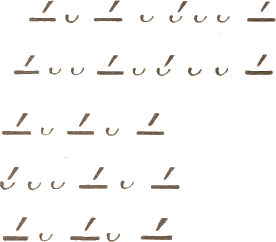
15 The stanza is scanned thus: