Chapter IV
Reading edition
THE MINISTRY, RITES, AND INSTITUTIONS OF THE PRIMITIVE CHURCH.
We gain from the testimony of the Catacombs most important information as to the organization of the church during the early Christian centuries. We see on every side records of an efficient ministry of different grades and dignities, yet wholly unlike that vast hierarchical system which claims to be its lineal descendant. We discern also evidences of a well-ordered administration of the sacraments and ordinances of religion, simple and unadorned, yet instinct with spiritual life and power, compared with which the gorgeous ritual and lifeless pomp of Romanism are more akin, in outward form at least, to the pagan homage of the Bona Dea, or to the mysteries of Mithras, than to Christian worship. So complete is this testimony as to the ministry and rites of the primitive church, that Dr. Northcote remarks that, “even if all the writings of the Fathers had altogether perished, we might almost reconstruct the whole fabric of the ecclesiastical polity from the scattered notices of these sepulchral inscriptions.”[822]
The somewhat complex ecclesiastical organization which we discover was probably a gradual development with the growth of the church, and not in its entirety the creation of the earliest times; the inscriptions referring to the subject, it must be remembered, being all or chiefly of post-Constantinian origin. The earlier books of the Apostolical Constitutions, which are probably of the second century, say almost nothing about the different grades of the ministry; but in the later ones, probably of the fifth century, a full blown sacerdotalism appears. Cornelius, bishop of Rome in the middle of the third century, records the existence of a graduated clergy like that indicated in the inscriptions of the Catacombs,[823] whose gradations Clement of Alexandria compares to the different ranks of the hierarchy of heaven.[824]
The highest office in the church of the Catacombs was that of the bishop—the chief pastor[825] or overseer of the flock of Christ. But this position was rather a preeminence of toil and peril than of dignity and honour. The supreme head of the Roman hierarchy, who lays claim to the attributes of deity himself, and sits in the seat of God as his vicegerent and infallible representative on earth, finds no precedent for his lofty assumptions in his humble predecessors of the primitive ages. These were in reality what he is only in name—servi servorum Dei. Even the title of bishop occurred but seldom. Neither Bosio, Fabretti, Boldetti, nor any other of the early explorers of the Catacombs, found a single example of it. The tomb of the first Roman bishop bore simply the name LINVS. In the so-called “papal crypt” the title first appears, but in the contracted form, ΕΠΙ and ΕΠΙϹ, and without any symbol of superior dignity whatever. The name of a bishop was first made a note of time in the latter part of the fourth century, as in the epigraphic formulæ Sub Liberio Episcopo—Sub Damaso Episcopo—During the episcopate of Liberius, (A. D. 350-366,) of Damasus, (A. D. 366-384.) But this distinction was also conferred on other bishops than those of Rome. Thus, in the year A. D. 397, we find the expression Pascasio Episcopo. Now, as there was no Roman bishop of that name, Pascasius must have presided over some of the adjacent sees, of which we know that there were many independent of Rome.[826]
The word papa, or pope, does not occur in the Catacombs till at least the latter part of the fourth century. It appears first spelled pappas, and applied to Damasus, in the margin of an inscription by that bishop, in honour of Eusebius.[827] But De Rossi admits that this is a badly executed reproduction, of the sixth or seventh century, of a previous inscription; so this title may very well belong to that late period. This is all the more probable from the phraseology of the very first line of this inscription: DAMASVS EPISCOPVS FECIT EVSEBIO EPISCOPO ET MARTYRI—“Damasus, bishop, (not pope,) to Eusebius, bishop and martyr.” Hilary (461-467) calls himself bishop and servant of Christ—“Episcopus et famulus Christi.” In an epitaph of A. D. 523, Hormisdas is called merely DOMINVS PAPA—that is, “honoured father,” or “pope,” which is probably the first application of this phrase in Christian epigraphy. In another, of date A. D. 563, John III. is designated as the “most blessed father John”—Beatissimus papa Joannes.[828]
But even this title, invested with such awful dignity and supreme authority in later days, was at first only an expression of familiar and affectionate respect, not peculiar to the bishop of Rome, nor indeed first applied to him. Its earliest use is attributed to Dionysius, bishop of Alexandria, in the latter part of the third century.[829] The Roman clergy address the bishop of Carthage in their letters as “the blessed pope Cyprian.”[830] Tertullian applies the name to any Christian bishop.[831] Jerome addresses Augustine, bishop of the little African diocese of Hippo, as the Beatissimus papa Augustinus,[832] and applies the same phrase to the superior of a monastery.[833]
The rapid extension of Christianity in the metropolis of the empire enhanced the influence and dignity of the Roman bishops.[834] With the increase of wealth and decay of piety these dignitaries became ambitious and worldly, arrogant and aspiring, and laid the foundations of that vast system of spiritual despotism which for centuries crushed the civil and religious liberties of Europe. Nevertheless, as late as the end of the sixth century, Gregory the Great, although zealous for the episcopal dignity, resents the claim of John of Constantinople to the title of œcumenical bishop in the striking words: “This I declare with confidence, that whoso designates himself universal priest, or, in the pride of his heart, consents to be so named, he is the forerunner of Antichrist.”[835] His successors of Rome have not shrunk from this malediction, but, in assumption of this universal supremacy, have placed their feet on the neck of kings, parcelled out empires, and conferred crowns at their pleasure.[836]
The next rank in ecclesiastical dignity was that of the Presbyters.[837] There was not that distinction in the primitive ages between their office and that of the bishops that afterward arose. Bishop Pearson represents their power and dignity as greater the nearer we ascend to the apostolic times. Their principal functions were the administration, in association with the bishops, of the sacraments, the enforcement of discipline, the preaching of the word, and the pastorate of the church. Their epitaphs in the Catacombs and basilicas are frequently very brief, as the following: LOCVS GERONTI PRESB—“The place of Gerontus, a presbyter;” POSITVS EST HIC LEONTIVS PRESBITER (sic)—“Here is placed Leontius, a presbyter.” Sometimes the title is expressed in a contracted form, thus: HIC QVIESCIT ROMANVS PBB. QVI SEDIT PBB · ANN · XXVIII · M · X.—“Here reposes Romanus, a presbyter, who sat a presbyter twenty-eight years ten months.”[838] Boldetti gives the epitaph of ACATIVS PASTOR, who was probably a presbyter, his title expressing his pastoral office. The following, of date A. D. 471, which is more elaborate than usual, is of some historical interest:[839]
PRESBYTER HIC POSITVS FELIX IN PACE QVIESCIT
CVIVS PVRA FIDES PROBITAS VIGILANTIA SOLLERS
PONTIFICVM CLARO PLACVIT SIC NOTA LEONI
POST LABSVM VT REPARANS VENERANDI CVLMINA PAVLI
HVIC OPERIS TANTI RENOVANDAM CREDERET AVLAM.
Felix, the presbyter, placed here, reposes in peace, whose pure faith, probity, sagacious vigilance, when known, so pleased the illustrious Leo of the pontiffs,[840] that, repairing the roof of the venerable St. Paul’s after its fall, he trusted to him the renewal of the hall of so great a work.
It appears that sometimes the primitive presbyters engaged in secular callings. Thus, an inscription from the Catacomb of Callixtus reads, ΔΙΟΝΥϹΙΟϹ ΠΡΕϹΒΥΤΕΡΟϹ ΙΑΤΡΟϹ—“Dionysius, presbyter and physician.” Another, of date A. D. 533, commemorates a deacon, who was also, perhaps before ordination, a senator and soldier. One found in Galatia mentions ΘΕΟΔΩΡΟϹ ΠΡΕϹΒΥΤΕΡΟϹ ΚΑΙ ΑΡΓΥΡΟΚΟΠΟϹ—“Theodorus, a presbyter and silversmith.” Hyacinthus, a Roman presbyter of the third century, was also an officer of the imperial household. Tertullian complains that some engaged in idolatrous trades were promoted to ecclesiastical offices.[841] Eusebius mentions a presbyter of Antioch who was head-master of one of the principal schools of the city.[842] Sozomen tells of bishops Zeno and Spiridion, who continued, the one to weave linen, the other to keep sheep, after elevation to the episcopal office.[843] Indeed, the fourth council of Carthage (A. D. 398) decreed that the clergy might devote their leisure to trade or husbandry, that the church might have greater resources for charity.[844]
The next grade in ecclesiastical rank was that of the deacons. They acted generally as assistants of the bishops and presbyters, especially in the distribution of the charities of the church.[845] They also took part in the administration of the eucharist, but not in its consecration. Before the appointment of lectors they read, and occasionally expounded, the Scriptures to the congregation, like the modern lay preachers. They also acted as instructors or catechists of the catechumens of the church. They are frequently designated Levitæ,[846] from the fancied analogy of their functions to those of the Levitical order among the Jews. In the church at Rome there were only seven deacons, in accordance with the number originally appointed in the church at Jerusalem; but in other cities the number was not thus limited.[847] Of inferior dignity were the ὑποδιάκονοι, or sub-deacons, who assisted the deacons in the discharge of their lower functions, as the care of the sacramental vessels, and the like.
Several epitaphs of both these classes have been found among the early Christian inscriptions. They are generally very brief, as the following: IVL DIACONVS—“Julius, the deacon;” DEPS · FELIX · DIAC—“Felix, the deacon, buried (Mar. 11, A. D. 435);” LOCVS EXVPERANTI DIACON—“The place of Exuperantus, the deacon.” Beneath the church of Sts. Cosmo and Damien was found the following: HIC REQVIESCIT SCVS HABVNDANTIVS DIAC ET MARTYR—“Here reposes holy Abundantius, deacon and martyr.”[848]
The following are characteristic epitaphs of sub-deacons: HIC QVIESCIT APPIANVS SVBDIACONVS QVI VIXIT ANNVS XXXII DIES XXVIIII—“Here rests Appianus, a sub-deacon, who lived thirty-two years, twenty-nine days;” LOCVS MARCELLI SVBD · REG · SEXTAE CONCESSVM (sic) SIBI ET POSTERIS EIVS A BEATISSIMO PAPA IOANNE QVI VIXIT ANN · PLM · LXVIII—“The place of Marcellus, a sub-deacon of the sixth district,[849] conceded to him and his posterity by the most blessed Father John,[850] who lived sixty-eight years, more or less.” (A. D. 564.)
The first rank of the inferior officers of the church was that of the lectors or readers. It was their duty to read in the congregations the appointed lessons from the Holy Scriptures.[851] The office was held in peculiar honour, young men of noble family, especially, aspiring to its dignity. Thus the Emperor Julian, in his youth, was a reader of the church at Nicomedia, as was also his brother Gallus.[852] Candidates for the office were ordained by the ceremony of delivering the Gospels into their hands. According to one of the Novels of Justinian,[853] they were required to be not less than eighteen years of age, but examples occur of their appointment as early as seven or eight years old.[854] Probably the latter were dedicated by their parents, like Samuel, to the service of God from their infancy,[855] and graduated through the inferior offices to those of greater dignity and influence. In the Western church they soon ceased as a distinct rank, but they lingered in the conventual orders till a comparatively late period.
The following are epitaphs of lectors from the Catacombs and basilicas: EQ HERACLIVS QVI FVIT IN SAECVLVM ANN · XVIIII · M · VII · D · XX · LECTOR R · SEC · FECERVNT · SIBI ET FILIO SVO BENEMERENTI · INP—“Equitius Heraclius, who was in this world nineteen years, seven months, twenty days, a reader of the second district. (His parents) made this for themselves and their well-deserving son, in peace;” CINNAMIVS OPAS LECTOR TITVLI FACIOLI AMICVS PAVPERVM—“Cinnamius Opas, a reader of the church of Faciolus, a friend of the poor;” MIRAE INNOCENTIAE ADQ · EXIMIAE BONITATIS HIC REQVIESCIT LEOPARDVS LECTOR DE PVDENTIANA QVI VIXIT ANN. XXIIII—“Here rests Leopardus, of wonderful innocence and remarkable goodness, a reader of the church of Pudentiana, who lived twenty-four years;” HIC REQVIESCIT IN SOMNO PACIS CAELIVS LAVRENTIVS LECTOR SANCTAE ECCLESIAE AECLANENSIS QVI VIXIT ANNOS PLM · XLVIII—“Here rests, in the sleep of peace, Cælius Laurentius, a reader of the holy church of Æclanum, who lived forty-eight years, more or less.”
The acolytes were another class which is discontinued in the protestant communion. As the name implies,[856] they were the servitors of the church, and had charge of the lamps and other ecclesiastical furniture. They were probably the offspring of the increasing pomp and dignity of the bishops, to whom they acted as personal attendants, especially in public processions and religious festivals. The only dated epitaphs of acolytes extant are of a comparatively late period. De Rossi thinks the following of the sixth or seventh century.[857] The simplicity of the primitive church had long since passed away. (P)ACE ABVNDANTIVS ACOL · REG · QVARTAE TT VESTINAE QVI VIXIT ANN · XXXIII DEP · INP · D NAT · SCI MARCI—“In peace, Abundantius, an acolyte of the fourth district, of the church of Vestina, who lived thirty-three years. Buried in peace on the birthday of St. Mark.”
The office of exorcist, from the occult and mysterious nature of its functions, was one that from the first was liable to abuse. It appears to have been known in the synagogue, and even there to have been usurped for base and venal purposes.[858] A battle between supernal and infernal powers seems to have been coincident with the conflict between Christianity and paganism. The Christians believed the oracles and idols of the gods to be animated by dæmons, who frequently usurped possession also of human beings. Tertullian,[859] Origen,[860] and others of the Fathers, claim that any private Christian could exorcise these dæmons by faith and prayer. It was probably a spiritual gift like that of “tongues,” which was granted for a special purpose and afterward withdrawn, perhaps on account of its abuse. This mysterious function did not become a distinct office till the latter part of the third century, when the exorcists were set apart by special ordination, and furnished with special forms of adjuration. This rite was then generally performed with solemn ceremonial before the baptism of converts from paganism. It was accompanied by prayer, insufflation, imposition of hands, and the sign of the cross, in order to deliver the subject from the dominion of the Prince of Darkness, and to consecrate him to the service of God. In later days this office became subject to frightful abuse, and all the grotesque and horrible adjuncts of exorcism of the Roman church—the charms, conjurations, wearing of scapulars and relics, incensings and sprinklings, were introduced—rites which find their analogues only in the magical incantations of the medicine-men of the Caffre Kraal or the Indian lodge.[861] “The best exorcism,” says Tertullian, “is by watchfulness and prayer to resist the devil, and cast out evil thoughts.” The following are epitaphs of exorcists: IANVARIVS EXORCISTA—“Januarius the exorcist;” HIC REQVIESCIT · IN · SOMNO · PACIS · CAELIVS · IOHANNIS EXHORCISTA (sic)—“Here rests, in the sleep of peace, Cælius John, an exorcist.”
The energumens, or possessed persons, were committed to the especial care of the exorcists, who employed them in the secular service of the sanctuary, as sweeping and cleaning the church, “lest idleness should become a temptation for Satan to molest them.” There is no indication of the existence of this unhappy class of persons in the church of the Catacombs, at least so far as monumental evidence is concerned.
A very numerous class in the economy of the primitive church was that of the fossors, or grave-diggers, by whose labours these vast labyrinths were excavated. They seem to have had especial charge of the subterranean cemeteries, and we have had numerous examples of the transfer and sale of graves under their authority.[862] They had also a quasi-ecclesiastical rank, and were subject to ecclesiastical discipline. “The first order of the clergy,” says Jerome, “is that of the fossors, who, after the manner of holy Tobit, are employed in burying the dead.”[863] They probably also assisted the regular clergy in the celebration of the funeral rites. The melancholy office of this pious confraternity, always a sad necessity of humanity, was particularly so to the persecuted church of the Catacombs.
The excavations were evidently under one directorate, so symmetrical and uniform is their character. A considerable degree of architectural skill is exhibited in the construction and adornment of the subterranean chapels, many of which are of quite ornamental design, and in the excavation of the multitude of galleries and different levels of this vast city of the dead, proving that the fossors were no mean civil engineers. They were also probably the artists of the rude inscriptions. The office seems sometimes to have been hereditary, as we find as many as three generations of fossors in the same family. We have seen examples of the numerous frescoes representing these lowly diggers at work, often like miners, by the light of a lamp, or surrounded by the implements of their calling.[864] The following are characteristic epitaphs of this class: MAIO FOSSORI—“To Maius, the fossor;” FELIX FOSSOR VIXIT ANNIS LXII—“Felix, the fossor. He lived seventy-two years;” DIOGENES · FOSSOR · IN · PACE · DEPOSITVS—“Diogenes, the fossor, buried in peace.”
With these were probably confounded in the earlier ages the ostiarii, or door-keepers. Their office was one of great trust and responsibility in times of persecution, when the Christian worship had often to be celebrated in secret, and protected from the intrusion of spies or of the profanely curious heathen. It was their duty to distinguish between the faithful and scoffers and traitors, and to give private notice of the secret assemblies of the Christians. The following inscription of the sixth century, as restored by De Rossi, commemorates a similar office in the basilica: LOC · DECI · CVBICVLARI · HVIVS · BASILICAE—“The place of Decius, custodian of this basilica.” We have also the epitaph of a mansionarius, a similar officer.[865]
An exaggerated commendation of the supposed superior sanctity of single life has long been a prominent characteristic of Romanism. A natural corollary of this notion was the enforced celibacy of the clergy.[866] Upon the Procrustean bed of this iron rule Rome has not scrupled to bind the tenderest and most sacred affections of the human soul. This cherished, but, as all history proves, most pernicious practice, has been the secret of much of the marvellous power of the priesthood and of the religious orders. The suppression of the domestic affections but intensified their devotion to the cause of the church, which took the place of both wife and child, and engrossed all their thoughts and all their energies. They became a priestly caste, animated by a strong esprit de corps superior to the claims of kindred or of country. But, as might have been anticipated, this anti-natural system led to frightful abuses and corruptions, and to the most flagrant innovations.
The notion of the greater sanctity of celibacy was derived, not from the teachings of our Lord or the apostles, who recognized the essential purity of marriage; but probably, as Milman suggests, from the early heresy of the Gnostics, of which this doctrine was a prominent characteristic.[867] “There was no enforced celibacy during the first three centuries,” says the judicious Bingham.[868] Indeed, marriage was regarded as enjoined on bishops, elders, and deacons, by the counsel of St. Paul.[869] The occasional passages of Scripture, in which for temporary and special reasons a single life is recommended, were in course of time wrested from their obvious meaning to a more general application; and in the writings of some of the Fathers, marriage was regarded as a necessary evil, only to be tolerated for the perpetuation of the race, and on account of the infirmity of the weak. It was not till the fourth century that the church adopted the doctrine of devils spoken of by St. Paul as “forbidding to marry.” The earliest ecclesiastical legislation on the subject was at the Spanish council of Elvira, A. D. 305, which commanded ecclesiastics who were married to separate from their wives—abstinere se a conjugibus suis—thus ruthlessly putting asunder those whom God had joined. The synods of Ancyra and Neo Cæsarea, held ten years later, and also one of the so-called apostolic canons of the same date, reversed this decree, and forbade any ecclesiastic to put away his wife on the plea of religion, under penalty of excommunication, which action was confirmed by the great council of Nice.[870] Successive attempts to extirpate the tenderest human instincts only led to their illicit gratification, and to the scandals arising from the admission of mulieres subintroductæ, or, in other words, of concubines. So demoralized did the clergy thereby become, that during the Middle Ages, as Mr. Lea remarks, “though, the ancient canons were still theoretically in force, they were practically obsolete every-where.”[871] At length Luther led the great emancipation of the clergy from this burden, so unutterably grievous to many a tender conscience; and removed the stigma of disgrace from those domestic relations which God, who setteth the solitary in families, so signally blesses.
There is no trace of the ascetic spirit or celibate clergy of the Church of Rome in the inscriptions of the Catacombs. On the contrary, numerous epitaphs commemorate the honourable marriage of members of every ecclesiastical grade. Thus, in the highest rank, Gruter[872] gives the following, which is thought to be that of Liberius, bishop of Rome, who died A. D. 366, and who was sometimes known by the name of Leo:
HVNC MIHI COMPOSVIT TVMVLVM LAVRENTIA CONIVX
MORIBVS APTA MEIS SEMPER VENERANDA FIDELIS
INVIDIA INFELIX TANDEM COMPRESSA QVIESCIT
OCTOGINTA LEO TRANSCENDIT EPISCOPVS ANNOS.
My wife Laurentia made me this tomb; she was ever suited to my disposition, venerable and faithful. At length disappointed envy lies crushed; the bishop Leo survived his eightieth year.
De Rossi gives the following, of a bishop’s son, of date A. D. 404. The relationship is boldly acknowledged, and not yet disguised under the phrase nepos or nephew: VICTOR IN PACE FILIVS EPISCOPI VICTORIS CIVITATIS VCRENSIVM—“Victor, in peace, son of Bishop Victor, of the city of the Ucrenses.” The following, of date A. D. 445, was found at Narbonne: RVSTICVS · EPIS · EPI · BONOSI · FILIVS.... “Bishop Rusticus, son of Bishop Bonosus.”
There are also numerous inscriptions in which presbyters and deacons lament the death of their wives, “chaste, just, and holy.” “Would to God,” exclaims a writer in the Revue Chrétienne, “that all their successors had such.” The following are examples: GAVDENTIVS · PRESBYTER · SIBI ET CONIVGI SVAE SEVERAE CASTAE HAC (sic) SANCTISSIMAE FEMINAE—“Gaudentius the presbyter, for himself and his wife Severa, a chaste and most holy woman;” LOCVS BASILI PRESB ET FELICITATI EIVS.... “The place of Basil the presbyter, and of Felicitas, his (wife).” Observe also the tender recognition of family ties in the following: OLIM PRESBYTERI GABINI FILIA FELIX HIC SVSANNA IACET IN PACE PATRI SOCIATA—“Once the happy daughter of the presbyter Gabinus, here lies Susanna, joined to her father in peace.”
We have already seen the epitaph of “Petronia, the wife of a deacon, the type of modesty,” with whom were buried two of her children.[873] The following, of similar character, is accompanied by the epitaph of a deacon on the same stone, probably the husband who so tenderly lamented the loss of his faithful consort.
LEVITAE CONIVX SEMPER MIHI GRATA MARIA
EXITVS ISTE TVVS PROSTRAVIT CORDA TVORVM
PERPETVAS NOBIS LACRIMAS LVCTVMQVE RELINQVENS
CASTA GRAVIS SAPIENS SIMPLEX VENERANDA FIDELIS
COMPLEVIT TVA VOTA DEVS TE NAMQVE MARITVS
TE NATI DEFLENT NEC MORS TIBI SVSTVLIT VLLVM.
Maria, the wife of a deacon, ever well-pleasing to me. That departure of thine prostrated the hearts of thy friends, leaving perpetual tears and grief to us. Chaste, grave, wise, simple, venerable, faithful. God fulfilled thy wishes; for thee thy husband, thee thy children bewail, nor did death bear any away from thee. (A. D. 451.)
Epitaphs are also found indicating the prevalence of marriage in the inferior ecclesiastical ranks, as in the following examples: CLAVDIVS ATTICANVS LECTOR ET CLAVDIA FELICISSIMA CONIVX—“Claudius Atticanus, the reader, and Claudia Felicissima, his wife;”[874] IANVARIVS EXORCISTA · SIBI · ET · CONIVGI · FECIT—“Januarius, the exorcist, made this for himself and his wife;” TERENTIVS · FOSOR · (sic) · PRIMITIVE (sic) · CONIVGI · ET · SIBI ·—“Terentius, the fossor, for Primitiva, his wife and himself.”
The primitive church early availed itself of the services of godly women, a sort of female diaconate, for the administration of charity, the care of the sick, the instruction of the young, and of their own sex, and to carry the light and consolations of the gospel into the most private and delicate relations of life, for which these gentle ministrants possessed facilities denied to the other sex. They are frequently mentioned in the writings of the Fathers under the names of διάκονοι,[875] deaconesses, viduæ, widows, or ancillæ Dei, handmaids of God. In apostolic times they were required to be of the mature age of sixty years;[876] but widows, and even the unmarried, were subsequently admitted into this class as early as forty,[877] or even twenty,[878] years of age. The unmarried, however, assumed no vow of perpetual celibacy,[879] nor of conventual life, but lived privately in their own homes, employed in offices of piety and mercy. The growing esteem of celibacy, however, in the fourth and fifth centuries, invoked ecclesiastical censure for the abandonment of the lofty vantage ground of virginhood;[880] but the Imperial law granted liberty of marriage, if the order had been entered before the age of forty. How different the practice of Rome in binding young girls, in the first outburst of religious enthusiasm, or the first bitterness of disappointed hope, by irrevocable vows to a death-in-life, and indissolubly riveting those bonds, no matter how the chafed soul may repudiate the rash vow, and writhe beneath the galling yoke. The consecrated virgin of the early church, instead of the ghastly robings, like the cerements of the grave, in which the youthful nun is swathed, the symbol of her social death, wore a sacrum velamen, or veil, differing but little from that of Christian matrons, and a fillet of gold around her hair. The custom, now part of the Romish ritual, of despoiling the head of its natural adorning, was especially denounced by some of the ancient councils.
There are several of the early Christian inscriptions illustrative of these various classes of consecrated women, of which the following are examples: OC · TA · VI · AE · MA · TRO · NAE · VI · DV · AE · DE · I.—“To the matron Octavia, a widow of God;” HIC QVIESCIT GAVDIOSA CF ANCILLA DEI QVAE VIXIT ANNOS XL ET MEN V—“Here rests Gaudiosa, a most distinguished woman, a handmaid of God, who lived forty years and five months,” (A. D. 447); IN HOC SEPVLCHRO REQVIESCIT PVELLA VIRGO SACRA B · M · ALEXANDRA—“In this tomb rests a girl, a sacred virgin, Alexandra, well deserving;” HOC EST SEPVLCRVM SANCTAE LVCINAE VIRGINIS—“This is the sepulchre of the holy virgin Lucina”—this, however, may not indicate a special class. AESTONIA VIRGO PEREGRINA QVAE VIXIT ANNOS XLI; ET · DS · VIII (sic)—”Æstonia, a travelling virgin, who lived forty-one years and eight days”—she was probably a member of a distant church, received on a letter of recommendation, FVRIA HELPHIS (sic) VIRGO DEVOTA—“Furia Elpis, a consecrated virgin.” In the fifth century this consecration sometimes took place at an early age, as the following example, of date A. D. 401: PRIE (sic) IVNIAS PAVSABET (sic) PRAETIOSA ANNORVM PVLLA (sic) VIRGO XII TANTVM ANCILLA DEI ET CHRISTI—“On the day before (the Calends of) June Prætiosa went to her rest, a young maiden of only twelve years of age, a handmaid of God and of Christ.”[881]
There is no trace in the inscriptions of the Catacombs of that ascetic spirit from which, in the fourth and following centuries, sprang the strange phenomena of monachism, with its important influence for blended good and evil on the future of Christendom. That was rather the result of the decay and corruption of primitive Christianity, and of the despair of mankind as to its regenerative power upon the world. Hence, multitudes fled from the immedicable evils of society to the solitude of the desert or the mountain.[882] Primitive Christianity, on the contrary, was eminently cheerful and social in its character. It consecrated the family life, and developed, to a degree before unknown, the domestic virtues.
The care of the primitive church for the religious teaching of the young and of heathen converts is abundantly exemplified in the inscriptions of the Catacombs. The catechumens, or learners, as the word signifies—the “Cadets of Christianity”—were a distinctly recognized class for whose instruction especial provision was made. It consisted of the children of believers born in the church, and therefore peculiarly under its care; and also of converts from paganism, who needed to be weaned from their errors, and taught the doctrines of Christianity before admission to the sacraments of baptism and the holy eucharist. For the latter, as a safeguard against the rash assumption of the Christian vows and the danger of subsequent apostacy, a certain probation was prescribed.[883] The candidates were taught the Holy Scriptures, and a formal confession of faith, probably similar to the ancient creed in which the Christian belief of the church has for so many centuries been expressed. These instructions were given by the bishop himself as chief catechist; and also by the presbyters, deacons, lectors, and other members of the inferior ministry. Deaconesses and aged women acted as instructresses of their own sex; and one of these was always present during the questioning of the female catechumens by the male catechists.
The following engraving represents a chamber in the Catacomb of St. Agnes, which, it is conjectured, was employed for the instruction of the female catechumens. On either side of the doorway are seats or chairs hewn out of the solid tufa, which were probably occupied by the catechist and the presiding deaconess. The low stone bench running around the remaining walls of the chamber would conveniently accommodate the audientes, or hearers, as they were called.
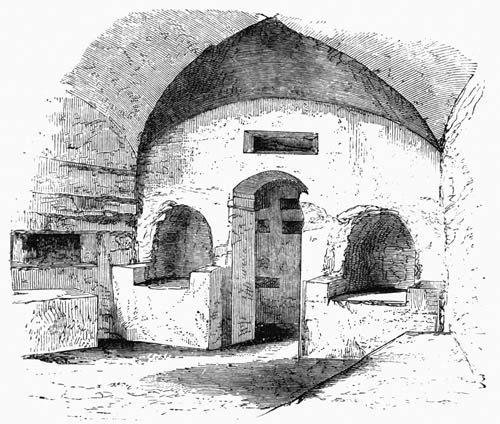
Fig. 130.—Chamber in the Catacomb of St. Agnes, with seats for Catechists and Catechumens.
Some Roman Catholic writers have asserted that these chambers were confessionals: but the chairs are too far apart if one was for the confessor and the other for the penitent, especially with an open door between; and too near, from the liability of the confessions being overheard, if each was a confessional; and in either case the necessity for the stone bench cannot be conceived. In some chambers, probably for the male catechumens, there is only one tufa chair, no deaconess being present.
Another curious chamber in the Catacomb of St. Agnes communicates with the one adjacent to it by a circular opening cut through the tufa wall about breast-high. It is conjectured that this was for the purpose of allowing the catechumens to hear the public instructions of the faithful without witnessing the celebration of the sacraments. The zeal of the candidates would thus be the more inflamed,[884] that they might be found worthy of admission to the fulness of Christian privilege and to the sacred mysteries hidden from the uninitiate and the unworthy. The following epitaph from the Lapidarian Gallery commemorates a youthful catechumen: VCILIANVS BACIO VALERIO QVE BISET ·(sic) ANN VIIII · MEN · VIII · DIES XXII CATECVM—“Ucilianus to Bacius Valerius, a catechumen, who lived nine years, eight months and twenty-two days.”
The ordinance of baptism receives several illustrations from the monumental evidences of the Catacombs. There are numerous epitaphs of neophytes—a term applied only to newly baptized persons—which indicate that this Christian rite was administered at all ages from tender infancy to adult years; in the latter case the subjects being probably recent converts from heathenism. The following are examples of this class: TEG · CANDIDIS NEOF Q · VXT · M · XXI—“The tile of Candidus, a neophyte, who lived twenty-one months;” FL · IOVINA · QVAE · VIX · ANNIS · TRIBVS · D · XXX · NEOFITA · IN PACE—“Flavia Jovina, who lived three years and thirty days, a neophyte, in peace;” MIRAE INDVSTRIAE ADQVE BONITATIS ... INNOCENTIA PREDITVS FL · AVR · LEONI. NEOFITO QVI VIXIT ANN VI · MENS · VIII DIES XI....—“Innocentia Preditus to Flavius Aurelius Leo, a neophyte of wonderful industry and goodness, who lived six years, eight months, eleven days;” ROMANO NEOFITO BENE MERENTI QVI VIXIT · ANNOS · VIII · D · XV · REQVIESCIT IN PACE—“To the well-deserving neophyte Romanus, who lived eight years and fifteen days; he rests in peace.” We have already seen the epitaph of Junius Bassus, who died a neophyte at the age of forty-one, and shall presently observe other instances of adult baptism.[885] We find also the epitaph of “two innocent brothers, one a neophyte, the other, one of the faithful.”
In course of time the rite of baptism degenerated into a superstitious charm, and was regarded as a mystical lustration which washed away all sin and was essential to salvation.[886] This change probably resulted from a reaction against the Pelagian heresy, which denied the necessity of baptism, and from the rhetorical exaggeration by the Fathers of the spiritual efficacy of this sacrament.[887] The church of the Catacombs, while duly administering the rite of baptism, did not, after the manner of the Church of Rome and other modern extreme sacramentalists, invest it with regenerative power, nor regard its involuntary omission as excluding the body from consecrated ground and the soul from heaven.[888]
Sometimes, by a beautiful metonyme derived from its spiritual significance, baptism is indicated as the palingenesis, or new birth, of which it is the appropriate symbol. The following is a characteristic example of this usage: ... CAELESTE RENATVS AQVA (sic)—... “Born again of heavenly water,” (A. D. 377.)[889] We read also of a certain Mercurius, who is described as a boy born and dying in the same year, aged twenty-four. The allusion is to the spiritual regeneration symbolized by baptism. With reference to this he was but a boy—puer—at the time of his death.[890] This rite was also called illumination, and we find in the Catacombs the epitaphs of persons said to be thus “newly illuminated.”
The testimony of the Catacombs respecting the mode of baptism, as far as it extends, is strongly in favour of aspersion or affusion. All their pictured representations of the rite indicate this mode, for which alone the early fonts seem adapted; nor is there any early art evidence of baptismal immersion. It seems incredible, if the latter were the original and exclusive mode, of apostolic and even Divine authority, that it should have left no trace in the earliest and most unconscious art-record, and have been supplanted therein by a new, unscriptural, and unhistoric method. It is apparent, indeed, from the writings of the fourth and fifth century, that many corrupt and unwarranted usages were introduced in connection with this Christian ordinance that greatly marred its beauty and simplicity. It is unquestionable that at that time baptism by immersion was practised with many superstitious and unseemly rites. The subjects, both men and women, were divested of their clothing, to represent the putting off the body of sin; which, notwithstanding the greatest efforts to avoid it, inevitably provoked scandal. They then received trien immersion, to imitate, says Gregory Nyssen,[891] the three days’ burial of Christ; or, according to others, as a symbol of the Trinity. The rite was accompanied by exorcism, insufflation, unction, confirmation, the gift of milk and honey, the administration of the eucharist even to infants, the clothing in white garments, and carrying of lighted tapers, to all of which a mystical meaning was attached.
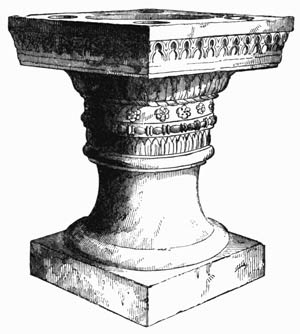
Fig. 131.—Baptismal Font.
But in the evidences of the Catacombs, which are the testimony of an earlier and purer period, there is no indication of this mode of baptism, nor of these dramatic accompaniments.[892] The marble font represented in the accompanying engraving, now in the crypts of St. Prisca within the walls, is said to have come from the Catacombs, and to have been used for baptismal purposes by St. Peter, himself; in corroboration of which legend it bears the somewhat apocryphal inscription—SCI · PET · BAPTISMV · (sic.) The tradition at least attests its extreme antiquity; and its basin is quite too small for even infant immersion. Other fonts have been found in several of the subterranean chapels, among which is one in the Catacomb of Pontianus, hewn out of the solid tufa and fed by a living stream. It is 1·45 metres long, ·92 metres wide, and 1·11 metres deep, but is seldom near full of water. It is obviously too small for immersion, and was evidently designed for administering the rite as shown in the fresco which accompanies it. (See Fig. 132.) The following inscription, from the Lapidarian Gallery, seems to have come from some such font, and perhaps contains a reference to the scripture, “Arise and be baptized, and wash away thy sins:” CORPORIS ET CORDIS MACVLAS VITALIS PVRGAT ET OMNE SIMVL ABLVIT VNDA—“The living stream cleanses the spots of the body as well as the heart, and at the same time washes away all (sins).”[893]
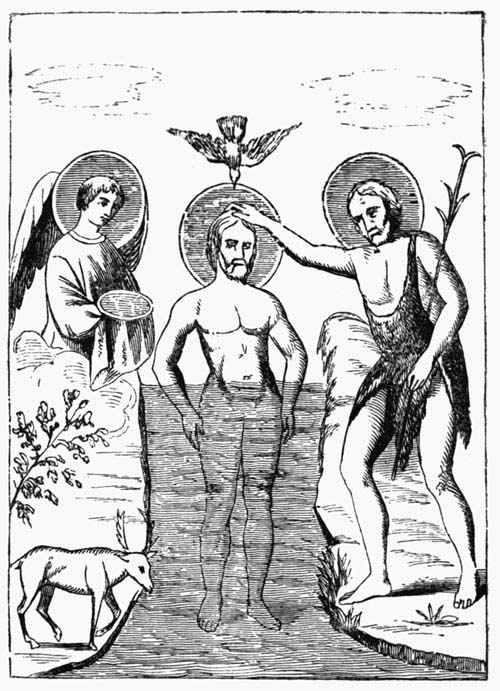
Fig. 132.—The Baptism of Our Lord.
Immediately over the font in the Catacomb of Pontianus is the elaborate fresco of the baptism of Our Lord, figured above. He is represented standing in the river Jordan, while John pours water upon his head, and the Holy Spirit descends in the form of a dove. An angel stands by as witness of the rite, and in the foreground a stag, the emblem of a fervent Christian, is drinking at the pure stream.[894]
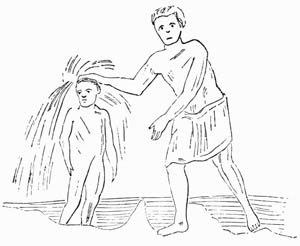
Fig. 133.—Baptismal Scene.
In a very ancient crypt of St. Lucina is another partially defaced baptism of Christ, attributed to the second century, in which St. John stands on the shore and our Saviour in a shallow stream, while the Holy Spirit descends as a dove. On the sarcophagus of Junius Bassus Christ is also symbolically represented as baptized by affusion. The annexed rude example from the Catacomb of Callixtus, probably of the third century, also clearly exhibits the administration of the rite by pouring.[895] It is accompanied by a representation of Peter striking water from the rock, an emblem, according to De Rossi, of the waters of baptism sprinkling the sinful souls that come thereto. A similar example also occurs in the cemetery of St. Prætextatus.
In ancient sarcophagal reliefs in the Vatican are representations of small detached baptisteries of circular form, crowned with the Constantinian monogram. These were necessarily of sufficient size to accommodate the number of persons who were baptized at one time, generally at Easter,[896] and were placed outside of the basilica to indicate the initiatory character of baptism as the entrance to the church of Christ.[897] In the early mosaics representing baptismal scenes, the rite is invariably administered by affusion, as in the baptistery of San Giovanni at Ravenna, in the beginning of the fifth century, in Sta. Maria in Cosmedin, at Ravenna, in the beginning, and in the ivory relief on the episcopal chair of Maximinus, at the end, of the sixth century.[898] So, also, a later example in the Lateran basilica represents Constantine kneeling naked in a laver, and Sylvester pouring water on his head.[899] This is also the method indicated in several medals, bas reliefs, frescoes, and mosaics, in almost every century from the fourth, through the Middle Ages, indicating a continuous tradition, even when immersion may have been practised, of a different mode of baptism.
The sacrament of the Lord’s Supper was the most sacred and consoling rite of the primitive church. It was at once the emblem of the Christian’s highest hopes, and the sublime commemoration of the ineffable sacrifice on which those hopes depend. It was the focus in which concentrated all their holiest thoughts, kindling the whole soul into a flame of adoring love.[900] It was the central act of worship, around which all their solemn devotions gathered, and to which they all looked. The sublime thought of the atonement of Christ and of salvation through his death, shone ever star-like over their souls, illumining even the sepulchral gloom of these subterranean crypts. Daily,[901] or as often as the vigilance of their foes in times of persecution would permit, the faithful met in the silent halls of death, far from the “madding crowd’s ignoble strife,” to nourish and strengthen their souls for fiery trial, and often for the red baptism of martyrdom, by meditation on the passion of their Lord and partaking of the emblems of his death.
Therefore, in ever-recurring and appropriate symbolism, was this holy rite set forth upon the walls of the Catacombs. Its direct representation, however, was carefully avoided; and its sacred meaning was hidden from the profane gaze of the heathen under a veil of allegory and emblem, which was, nevertheless, instinct with profoundest significance to the initiated. Thus, we find representations of seven men eating bread and fish, which are interpreted as the repast of the disciples by the sea-shore when Our Lord manifested himself in the breaking of bread, and, indirectly, as symbols of the holy eucharist.[902] They are not at all analogous to the pictures of pagan funeral banquets, to which they have been compared, but which are entirely foreign to Christian thought. The miracles of turning water into wine, and of the multiplication of the loaves, were also regarded as types of the eucharist, which was, doubtless, frequently symbolized under these figures. We have seen a copy of the remarkable fresco, twice repeated in the Catacomb of St. Lucina, of a fish bearing a basket of bread on its back, and in the midst what seems to be a chalice of wine.[903] This is considered one of the most ancient emblems of this sacred rite. This view derives singular corroboration from a passage in Jerome, which speaks of carrying the body of Christ in a basket made of twigs, and his blood in a chalice of glass.[904] The eucharist is also evidently symbolized in the representations of fish and sheep carrying small loaves of bread in their mouths. These are sometimes marked with a decussate cross, as was done to facilitate fracture during administration.
The first Christian altars were tables of wood, which, in times of persecution, could be easily removed from house to house in which worship was celebrated. The entire absence of any thing corresponding to the pagan sacrificial altar was made the subject of heathen reproach.[905] In a painting found in the Catacomb of Callixtus, which Dr. Northcote describes as “the sacrifice of the Mass, symbolically depicted,” a man stands with hands outstretched, as if in act of consecration, over a three-legged table, on which are bread and a fish, while opposite stands a female figure in the attitude of prayer. In an adjoining chamber a precisely similar table is represented, but without the accompanying figures.[906] These tables were placed, not against the wall like a Romish altar, but set out from it, so that the ministrant could stand behind it looking toward the congregation. In the “papal crypt” of the Callixtan Catacomb the sockets for the four feet of the table thus set out from the wall are distinctly visible, and Bosio and Boldetti both found examples of altars standing in the middle of the cubicula. This was also their position in the oldest basilicas of Rome.
In the sixth century a general council decreed that the altars should be of stone. This transition had already taken place in the Catacombs, and arose from the employment of the slab covering the grave in an arcosolium for the administration of the eucharist. This practice led to an increased veneration for the relics of the saints; and soon the presence of these relics became essential to the idea of an altar.[907] To this custom Prudentius refers in his hymn for Hippolytus’ day.
“Illa sacramenti donatrix mensa, eademque Custos fida sui martyris apposita: Servat ad æterni spem Judicis ossa sepulchro Pascit item sanctis Tibricolas dapibus. Mira loci pietas, et prompta precantibus ara.”
“That slab gives the sacrament, and at the same time faithfully guards the martyr’s remains; it preserves his bones in the sepulchre in hope of the Eternal Judge, and feeds the dwellers by the Tiber with sacred food. Great is the sanctity of the place, and it offers a ready altar for those who pray.”
After the consecration of the elements by the presbyter or bishop, the communion in both kinds was administered to the faithful by the deacons in the formula of its institution which we still use.[908] The consecrated elements[909] were sent to any who were sick, by the hands of deacons or acolytes, as is still the practice in the Greek and Armenian churches. In the Acts of St. Stephen, we read of a young martyr who chose to be beaten to death by a Roman mob, rather than disclose the sacred treasure entrusted to his care. This practice in time degenerated into the superstitious administration of the viaticum as a preparation for the soul’s journey to the spirit-world. Some of the gilt glasses, before described, are thought to have been used as patens and chalices for the celebration of the eucharist. With the increasing wealth and more gorgeous ritual of the church, gold and silver vessels, adorned with costly gems and rarest workmanship, took the place of the humbler material of the primitive ages.[910]
Another beautiful institution generally associated with the celebration of the eucharist in primitive times is that of the agape, or love-feast. In a subterranean chapel in the Catacomb of Marcellinus and Peter is an exceedingly interesting representation of the observance of this custom, shown in the following engraving.
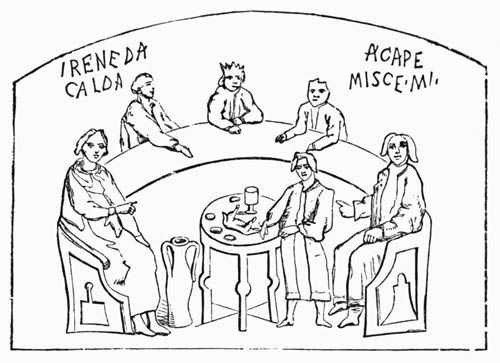
Fig. 134.—Ancient Agape.
Three guests, it will be perceived, sit at the semicircular table, at the ends of which preside two matrons personifying peace and love, with their names written above their heads. An attendant supplies them with food from a small table in front, on which are a cup, platters, and a lamb. The inscriptions, according to Dr. Maitland, should be expanded thus: IRENE DA CALDA[M AQVAM]—“Peace, give hot water;” and AGAPE MISCE MI [VINVM CVM AQVA]—“Love, mix me wine with water;” the allusion being to the ancient custom of tempering wine with water, hot or cold.
Numerous other representations of this devout feast at which Love and Peace preside attest its general observance. It would be a touching symbol of Christian unity to the persecuted saints, and would unite still closer hearts bound together by common dangers and a common hope. All the distinctions of rank were then forgotten. Gathering by stealth in these subterranean crypts from the imperial palace and the lowly abode of poverty, they break bread together in the solemn presence of the dead in token of their common brotherhood in Christ. The slave of a Roman master, but the freedman of Christ, and the patrician convert, the intellectual Greek and the once bigoted Jew, together
Celebrate the feast of love, Antedate the joys above.
This beautiful institution, first mentioned by Jude as the “feasts of charity,”[911] was usually observed in connexion with the eucharist, though not necessarily a part of it. It dates from the earliest period of the church,[912] and its corruptions among the Corinthians called forth the sharp rebuke of the Apostle Paul.[913]
Tertullian thus describes its character in the second century: “Our supper, which you accuse of luxury, shows its reason by its very name; for it is called agape, which, among the Greeks, signifies love. It admits of nothing vile or immodest. We eat and drink only as much as hunger and thirst demand, mindful that the evening is to be spent in the worship of God. We so speak as knowing that God hears. After washing our hands and bringing lights, each is asked to sing to God according to his ability, either from Scripture or from his own mind. Prayer also concludes the feast.”[914] He calls it also a supper of philosophy and discipline, rather than a corporeal feast. At the close collections were made for widows and orphans and for the poor, many of whom would be thrown out of employment by their renunciation of idolatrous trades; also for prisoners and for persons who had suffered shipwreck.[915] It is doubtless the agape which Pliny describes as “the common and harmless meal”[916] of the Christians, and at which, according to Lucian, their “sacred conversations”[917] were held. Clement of Alexandria calls the agape “the banquet of reason, a celestial food, and the supper of love; the pledge and proof of mutual affection.”[918]
The primitive church carefully guarded the celebration of the eucharist and agape from the pryings of idle curiosity or the perfidy of heathen malevolence, lest the name of God should be blasphemed, or the goodly pearls of salvation be trampled beneath swinish feet. But this very secresy and mystery became the occasion of the vilest slanders and aspersions. The Christians were accused of celebrating these rites with the most abominable orgies—feasting on human flesh and infants’ blood, and committing nameless crimes of still deeper dye. “They charge us,” say the martyrs of Lyons, “with feasts of Thyestes, and the crimes of Œdipus, and such abominations as are neither lawful for us to speak nor think.” The blameless believers were denounced as the very dregs of society, a skulking and darkness-loving race, meeting by night for profane conjuration and unhallowed banquets, as despisers of the gods, haters of mankind, and mockers at holy things,[919] and were confounded with pestilent sorcerers who in midnight caves practiced their foul incantations against human life.[920] These accusations arose partly, it is probable, from distorted accounts of the holy communion of the body and the blood of Christ, interpreted as a literal partaking of the corporeal substance; partly from the vile practices of the Carpocratians and other heretics; but chiefly from the malice of the heathen themselves, judging the character of the Christian mysteries from the obscene orgies of Venus and Bacchus.
Tertullian indignantly resents the vile calumnies, and shows them to be monstrous and absurd. “We are daily beset by foes,” he exclaims, “we are daily betrayed, we are often surprised in our secret congregations; yet who ever came upon a half-consumed corpse among us, or any other corroborations of the accusations against us?”[921] He retorts upon the heathen the charge of infanticide, human sacrifice, and unnatural crimes, and contrasts therewith the purity of the Christian character. Minucius Felix also attests the modest and sober character of the Christian feasts, which they celebrated with chaste discourse and chaster bodies.[922]
In course of time the agapæ lost in great measure their religious character, and were employed for the anniversaries of the martyrs, and for marriage and funeral occasions.[923] They were still further desecrated by their substitution for pagan festivals, in order, as St. Augustine remarks, “that the heathen might feast with their former luxury, though without their former sacrilege.”[924] These “pious hilarities” thus degenerated, in the fourth and fifth centuries, into convivial banquets and wanton revelry—a scandal and disgrace to Christendom, and provoked the indignant censure of the Fathers. “It is absurd,” says St. Jerome, “to honour with feasting the saints who pleased God with their fasts.” St. Augustine vehemently condemns those “who inebriate themselves in honour of the martyrs, and place even their gluttony and drunkenness to the account of religion.”[925] “These drunkards persecute the saints as much with their cups,” he says, “as the furious pagans did with stones.”[926] The good bishop of Nola, greatly scandalized at these semi-pagan revelries, painted with holy pictures the church of St. Felix, that as the ignorant peasants gazed more they might drink the less. It has been suggested that probably the pious figures in the gilt glasses of the Catacombs were designed for the same purpose; but many of their mottoes were of a highly convivial character, calculated rather to promote the revelry in which they were doubtlessly employed. Both the natalitia and the agapæ at length became so obnoxious in character as to excite the taunts of the pagans and the condemnation of the more devout and thoughtful Christians. The abuse of the latter beautiful institution became so intolerable that it became the object of repressive decrees of successive councils till it was finally abolished. The council of Elvira (A. D. 305) prudently forbade the presence of females at these nocturnal meetings in the Catacombs.[927] That of Laodicea (A. D. 361) enacted that the agapæ should not be celebrated in churches. The council of Carthage (A. D. 397) forbade the clergy attending them, and the council of Trullo (A. D. 706) prohibited their celebration at all, under penalty of excommunication.
This beautiful symbol of Christian unity was revived in spirit by the founder of Methodism; but, to guard against the corruptions into which it had previously fallen, the elements of its celebration were restricted to bread and water. A similar custom is also observed among the Moravian brethren, from whom, probably, Wesley borrowed it. It has also been transmitted from primitive times by the Nestorian Christians of the Malabar coast.[928]
We have thus endeavoured to give a faithful transcript of the testimony of the Catacombs relative to primitive Christianity. We have seen how consonant it is with the teachings of Holy Scripture, how opposed to all the institutions and dogmas of Rome. We have only to compare the buried relics of the past with the living present above ground to see at a glance the infinite contrast between the church of Christ and that of Antichrist. Could the simple bishops of the primitive ages behold the more than regal state and oriental pomp in which, surrounded by armed halberdiers, amid the blare of martial music and thunder of the guns of St. Angelo, their successor of to-day rides in his golden chariot from his stately palace to the majestic fane of St. Peter—the grandest temple in the world—they would feel it difficult to perceive therein any resemblance to their own humble and often persecuted estate, or to the pure and spiritual religion of the meek and lowly Nazarene. Could they witness the almost idolatrous homage which he receives, throned in state, tiaraed with a triple crown, presenting his foot for the humiliating osculation of bishops, cardinals, ambassadors, and pilgrims from every land; could they behold him summoning from the ends of the earth the prelates of Roman Catholic Christendom to record a decree of his personal infallibility and freedom from human error; they would regard as blasphemous these unhallowed assumptions, and denounce, as the prophetic Antichrist, him who laid claim to these awful attributes.[929]
Above the lowly sleepers in the crypts of the Vatican swells the mighty dome which Michael Angelo hung high in air; lofty chant and pealing anthem thrill through the vast expanse; polished shafts of porphyry, jasper, and costliest marble gleam around; priceless paintings and rarest sculpture by the hand of genius afford a still richer adorning; at an altar blazing with gold and gems a human priest in many-coloured vestments daily repeats, as he dares assert, the ineffable sacrifice of Christ; from four hundred cross-crowned campaniles baptized and consecrated bells ring forth the hours of prayer; at a thousand shrines the multitude adore, they vainly think, the real presence of the Redeemer; and perfumed incense evermore ascends, not to the many gods of the Pantheon, but to the still more numerous saints of the Roman calendar. But we feel that all the kingdoms of the world, and all the glory of them, were a poor compensation for the loss of the primitive simplicity, purity, and spiritual power of the humble service of the Catacombs. We turn away from the gorgeous ritual and hollow pomp to those lowly crypts where the Christian hymn of a persecuted remnant of the saints ascended from beside the martyr’s grave, as the truer type of Christ’s spiritual temple upon earth. In these chambers of silence and gloom we find the evidences of that undying life of Christianity which we seek in vain amid the living death of that city of churches and of priests—the Apostolic See of Christendom—the vaunted seat of Christ’s vicegerent upon earth. With a deeper significance than that with which it was first uttered, we adopt the language of Tertullian, and exclaim, ID ESSE VERUM, QUODCUNQUE PRIMUM; ID ESSE ADULTERUM, QUODCUNQUE POSTERIUS.[930]
Idem ter socios pura circumtulit unda Spargens rore levi.
INDEX.
Abraham, frescoes of, 289.
Acclamations to the departed, 441-443; pagan do., 444.
Acolytes, 517.
Adam, fall of, 224; receiving sentence, 225.
Adornment, female, 497, 498.
Agape, the, 545; abuse of, 550; suppressed, 551.
Agnes, St., Catacomb of, 192-197; legend of, 192, 193.
Altar, 543, 544; altar lights, origin of, 378, 379.
Amphitheatre, games of, 488; suppressed, 489.
Ampullæ, or blood cups (?), 369.
Anchor, symbolical, 234.
Anthropomorphism, 352-361.
Appian Way, 164-166.
Arcosolia, 25, 30.
Areas, sepulchral, 37, 56, note [45], 168-171, 183; pagan do., 59, 60.
Arenaria, 38-44, 197, 199.
Art, early Christian, 203, et seq.; compared with pagan do., 205, 209-213, 391, 392, 480; first employment of, 206, 208; sprang out of pagan do., 206-208; character of, 210, 211; pagan influence in, 210-214, 240-243, 303, 364, 388, 391, 480, 505; becomes florid, 220; avoidance of passion of Christ or martyrs, 227, 273, 274; joyous character of, 228; symbolism in, 325, et seq., see “Symbols”; Virgin Mary in, see “Mary”; Christ in, see “Christ”; God and Holy Ghost in, see “Anthropomorphism”; domestic art, 364-366.
Autun, ichthyic inscription at, 257-259.
Baptism, 532-541; subjects of, 532; patristic evidence concerning, 533, note [885]; mode of, 535, et seq.
Biblical Cycle, 282, et seq.; subjects of, see Figs. 62-103; grouping of subjects, 283, 339, 340; relative frequency of occurrence, 341, note [566].
Bishops, 507-511, 524, 525; compared with presbyters, 508, note [826], 511, note [837]; see “Martyr Bishops,” and “Pope.”
Bosio, 152-155.
Burial clubs, pagan, 66-68; Christian, 68-70.
Burial near martyrs, supposed efficacy of, 128-132.
Burial, subterranean, why adopted, 50, 54; discontinued, 122; temporary return to, 122, 123.
Cain and Abel, 285.
Callixtus, Catacomb of, 167-183; history of, 173.
Carpenter, implements of, 231.
Catacombs, origin of word, 11, note [1]; described by Prudentius, 11, 124; by Jerome, 34; present appearance of, 12, et seq., 37, 44, 45, 195; associations of, 13, 14, 45, 46, 201; extent of, 14, and note [5], 15; entrances to, 15, 16, 170, 189, 191, 195; structure of, 11, et seq., 168, et seq.; galleries, 16-19; loculi, 19-24; cubicula, 24-31; different levels of, 31-33; luminari, 34, 35; origin of, 37, 38, 49, and note [31], 55, 56, note [44], 58, 200; not pagan arenaria, 38-44; geology of, 16, 39; perils of exploring, 46-48; Jewish, 49-53, 188; not offspring of fear, 58; protected by law, 62, 63; those of first century, 73; reflect history of the church, 99-104, 124, 136, 137; a refuge from persecution, 84, 87, note [118], 100-104; secret stairway in, 101, 174; disuse and abandonment of, 150, et seq.; restoration and adornment of, 124, 136, 137; spoliation of, 137, 154; destruction of, 145-147; Mediæval employment of, 146, 147; pilgrimages to, 136, 148, 175, 176; re-discovery and exploration of, 150, et seq.; literature of, 151-163; present control of, 161; principal ones, account of, 164, et seq.; of Callixtus, 167-183; of Prætextatus, 183; of Sebastian, 184; of Domitilla, 189; of Nereus and Achilles, ib.; of St. Helena, 190; of St. Cyriaca, 191; of St. Agnes, 194-197; of Alexander, 197; of St. Priscilla, 198; art of, 203, et seq., see “Art”; Mithraic tomb in, 214-218; symbolism of, 225, et seq.; Biblical Cycle of, 282, et seq.; gilt glasses, etc., of, 362, et seq.; inscriptions of, 395, et seq.; doctrinal teachings of, 415, et seq.; evidences concerning Christian life and character, 453, et seq.; (for last six see in verbis); summary of testimony, 551-553.
Catechists, 530-532.
Catechumens, ib.
Cecilia, St., crypt of, 178; legend of, 179-181.
Celibacy of clergy, not a primitive practice, 522-524; praise of, 527, 528; practice of, 529.
Character of early Christians, 461-463, 481, 482; of pagans, 464, 479-481; see “Persecutions.”
Charity, early Christian, 483-485, 504.
Christ, youthful aspect of, in art, 342, and note [570]; traditional appearance of, 343-345; patristic testimony concerning, 343-345; early images of, 345, and note [584], 346-348; miraculous images of, 345, note [585]; degradation in art-representations of, 347-352.
Christians, early, rank of, 56, 57, and note [46], 89, 169, 417, 458-460, 480; calumnies against, 548, 549.
Christianity, spread of, 57, 116-119; persecutions of, 70, et seq., see in verbo; triumph of, ibid., 496; purifies morals, 480; cultivates charity, 483-485; protects life, 485; elevates slaves, 486, 487; suppresses games, 488, 489; raises woman, 491-493; moral triumphs of, 504.
Clement of Alexandria, quoted, 384, 385, 497, 498, and note [809].
Clergy, orders of, 507; in Greek church, ib., note [823]; bishops, 507-511, 524, 525; presbyters, 511-513, 525; deacons, 514; subdeacons, 515; lectors, 515, 516; acolytes, 517; exorcists, 517-519; multiplication of, 521, note [865]; non-celibate, 522-526.
Confessional, reputed, 531.
Conjugal affections, early Christian, 471-474; pagan do., 475, 476.
Constantine, 92, 120, 121.
Constantinian monogram, 465; genesis of, 466-468; various forms of, 267-269; becomes cross, 270-273, see “Cross.”
Cornelius, tomb of, 169.
Cross, true, relics of, 139, note [240], 140, notes [243], [244]; legend of, 271, 272, and note [456]; rare in Catacombs, 260; pagan abhorrence of, ib.; caricature of, 261, and note [429]; recognition of in nature, etc., 235, 262, 263; supposed mysterious power of, 263, 264; pre-Christian, 281, note.
Crucifixion, not represented in early Christian art, 273; symbolically indicated, 274; first example of, 275; art development of, 275-281.
Crucifix, genesis of, 279, 280.
Cubicula, 24-29, 339, 531.
Cyprian, quoted, 82, 434; death of, 84, note [108].
Damasus, 123, 175, 406.
Daniel in the lions’ den, 298, 299.
Dates of Catacombs, 73; of inscriptions, 408-410, 416, et seq.
David and Goliath, 394.
Deacons, 514; wives of, 474, 526.
Deaconesses, 526-530.
Deaths of persecutors, 93, note [135].
Decius, persecution under, 81.
De Rossi, 159, 160, 399, 400, 406.
Diocletian, persecution under, 89, and note [126], 90.
Diptychs, 393, 394.
Divinity of Christ, taught, 449, 450.
Doctrinal teachings of Catacombs, 415, et seq.; see “Purgatory,” “Resurrection,” “Trinity,” etc.
Dolls, etc., found in Catacombs, 387.
Domestic relations, evidence concerning, 465, et seq.; parental relations, 466-468; pagan, do., 468-470; filial do., 470; conjugal do., 471-474; pagan do., 475, 476; fraternal do., 476; friendly do., 476.
Domine Quo Vadis, legend of, 107, note [160].
Domitilla, Catacomb of, 55-57, and 57, note [46], 189.
Doves, symbolical, 236-239, 404.
Elijah, 294.
Energumens, 519.
Epigraphy, Christian, literature of, 399, 400; examples of, 401, et seq.; see “Inscriptions.”
Eucharist, symbols of, 250, 252, 542; celebration of, 541-545.
Filial affection, early Christian, 470.
Fish, symbolical, 252-260, 378; the word a sacred anagram, 252; an allusion to baptism, 253; a tessara, 255, 389; a eucharistic symbol, 256; Autun icththyic inscription, 257-259.
Fonts, baptismal, 537, 538.
Fossors, 132-135, 519, 526.
Fraternal affections, early Christian, 476.
Funeral rites, Christian, 499-502; pagan do., 503.
Future state, doctrine concerning, 417-431; pagan do., 436-444.
Galerius, 91.
Galleries of Catacombs, 16, et seq.
Gallienus, 86.
Gaume, Abbé, on the Catacombs, 201.
Gilt glasses, early Christian, 362; subjects represented in, 364-367; convivial inscriptions of, 367, 368; some sacramental, 368; dates of, 369.
God in art, 352-361; alleged sarcophagal example of, 354-356; symbolized in Catacombs by hand, 290, 356.
Good Shepherd, the, symbol of Christ, 245-248; statue of, 390.
Graffiti, pagan, 59, 60; Christian, 130, 148, 174, 175.
Graves, see “Loculi.”
Greek language, use of at Rome, 406, 407.
Hand as symbol of God, 293, 356.
Hebrew children, the three, 298, 299.
Helena, St., Catacomb of, 196.
Heresy, growth of, 119, note [194].
Hippolytus, statue of, 392; character of, 393.
Horse, symbolical, 382.
Iconoclasm, early, 222.
Ichthyic inscription, 257-259.
Ichthyic symbol, see “Fish.”
Ignatius, martyrdom of, 74, note [83], 125.
Image worship, 222-224.
Imprecations, pagan, 61; Christian, 64, 65.
Inscriptions, early Christian, general character of, 395, et seq.; associations of, 398; collection and classification of, 398-400; literature of, ib.; rude examples of, 66, 98, 238, 267, 268, 401, et seq.; barbarous Latinity of, 403, and note [675], 407, 422, 426; inverted, 404; reversed, ib.; brief, 238, 401-405; Greek, 406, 407; dates of, 408-410, 416, et seq.; notes of time in, 410-412, 508; doctrinal teachings of, 415, et seq., see “Purgatory,” etc.; concerning future state, 417, et seq.; pagan do., 436-444; cheerful character of, 427, 430, 443, 452; concerning the doctrine of the resurrection, 431; concerning Christian life and character, 453, et seq.; names, expressive, 454-457; pagan do., 455, note [742], 457; puritan do., 455, note [743]; evidence of early Christian character, 461-463; of pagan do., 464; of domestic relations, 465, et seq.; of parental do., 466-468; of pagan do., 468-470; of filial do., 470; of conjugal do., 471-474; of pagan do., 475, 476; age of marriage, 473, note [756]; fraternal relations, 476; friendly do., 476; evidence concerning clerical orders, 506, et seq., see “Clergy”; concerning Christian rites and institutions, 432, et seq., see “Rites.”
Invocation of saints, first examples of, 426, 446-449.
Isaac, sacrifice of, 288, 289.
Jerome, quoted, 36, 450, 498, 502.
Jews at Rome, 49; their Catacomb, 50-54, 188; epitaphs of, 53.
Job, fresco of, 293.
Jonah, story of, 299-304.
Joseph, 290.
Justin Martyr, 76.
Kip, Bishop, on the Catacombs, 162.
Labarum, legend of the, 268.
Lactantius, De Mort. Persec., 93, note [135].
Lamb, symbol of Christ, 249, 250.
Lamps, early Christian, 376-379.
Lapidarian Gallery, 395.
Lawrence, St., martyrdom of, 86, note [112]; tomb of, 192.
Lazarus, raising of, 329-331.
Lectors, 515, 516, 526.
Literature of the Catacombs, 151-163.
Loculi, 19-21; number of, 21; how closed, 22, 23; contents of, 23, 24; made during life, 65; sale of, 132.
Love-feast, see “Agape.”
Luminari, 34, 35.
MacFarlane, on the Catacombs, 45, 161.
Magi, adoration of, 305, 306.
Maitland, on the Catacombs, 161.
Marcus Aurelius, character of, 75, 76.
Mariolatry, no trace of in Catacombs, 305, 306, 310, 316, 323; development of, 312-323.
Marriage, references to, 304, 305, 471-474, 494-496; pagan do., 475, 476, 492, 493; age of, 473, note [756].
Marriott, on the Catacombs, 162.
Martyr bishops of Rome, 81-87, 94-96.
Martyrdom of Ignatius, 74, note [83]; of Polycarp, 76; of Perpetua, 79, note [94]; of Lawrence, 86, note [112]; (see antea and postea); the passion for, 112-115; effects of, ib.; references to, 372; symbols of, 17, 369-375.
Martyr epitaphs:—of Marius, 75; of Alexander, 77, note [89]; of Sixtus, 85; of Marcellus, 94; of Eusebius, 95; of Sebastian, 96; of Lannus, 98; see 106, et seq.; of St. Agnes, 193.
Martyrologies, 110-112.
Martyrs, number of, 105-108, 178; sufferings of, 108-112; festivals in honour of, 127; adornment of tombs of, 123, 124; spoliation of do., 128, 137, 145; reverence for, 123-128; burial near, 128-132; pilgrimages to tombs of, 136, 148; veneration of martyr relics, 124-128; translation of, 137, 142, 143, note [246], 144, notes [247], [248].
Mary, Virgin, legends of, 307; in art, 305-314; miraculous images of, 317, note [522]; assumption of, 318, and note [526]; hymns to, 320.
Maximin, persecution of, 81.
McCaul, Dr., on early Christian epigraphy, 162, note [289], 163, 414, 421, 541.
Mithraic monument in Catacombs, 214-218.
Mosaic, 223.
Moses on Horeb, 290; on Sinai, ib.; striking rock, 291, 292.
Ministry, rites, and institutions of primitive church, 506, et seq., see “Clergy,” and “Rites.”
Names, early Christian, expressive character of, 454, 455; pagan do., 455, note [742], 457.
Neophytes, 322, 323, 540.
Nimbus in art, 208, note [333].
Noah, story of, 286-288.
Northcote, on the Catacombs, 161.
Objects found in Catacombs, 362, et seq.; see “Gilt Glasses,” etc.
Opisthographæ, 268, 413.
Oranti, 308-310.
Pagan epitaphs, 59-62, 396, 397, 413, 414, 434-441, 460, note [750], 469, 475-478.
Pagan influence in art, see “Art.”
Paganism, decadence of, 117; social condition of, 479-481.
Paintings, see “Art,” “Symbolism,” and different subjects of.
Palm and crown, symbolical, 230; reputed sign of martyrdom, 372.
“Papal Crypt,” 170-178.
Parental affection, early Christian, 466-468; pagan do., 468-470.
Paul, St., martyrdom of, 200; in art, 336-337, and notes [557], [559], [560], [561]; see “Peter and Paul.”
Paulinus of Nola, quoted, 221.
Peacock, symbolical, 240.
Perpetua, martyrdom of, 79, note [94].
Perret, his great work on the Catacombs, 158, 159.
Persecutions, early, cause of, 70, 71; Neronian, 71; Domitian, 72; Aurelian, 76; of Commodus, 78; of Severus, 79; of Maximin, 81; Decian, 81, 82; Valerian, 83, 84; Diocletian, 88-91; extent of, 105-108; virulence of, 108-113.
Peter, St., at Rome (?), 53, and note [39]; denying Christ, 332; apprehension of, 335; in art, 337; cultus of, 338, and note [562]; relics of, 53, note [39]; font of, 537.
Peter and Paul, crypt of, 186-188; in art, 336, 337, 365, 367.
Piani, of Catacombs, 31-33.
Pilate, 333, 334.
Polycarp, martyrdom of, 76.
Prayers for dead, unknown in earliest times, 421; first example of, 442, 443; prayers to the dead, 446-449.
Prætextatus, Catacomb of, 183.
Presbyters, 511-513; sometimes had secular employment, 513, and note [844]; married, 525.
Prudentius, quoted, 11, 110, 115, 124.
Purgatory, unknown to early Christians, 420, 423, 424, 445, 446.
Relics, worship of, 124-126, 138-143, 544; traffic in, 138, 139; supposed efficacy of, 140; grotesque Mediæval do., ib., notes [243], [244], [245]; reputed martyr do., 369; misinterpretation of, 141-143, 370.
Resurrection, doctrine of, 430-433.
Rings from Catacombs, 284.
Rites and institutions of primitive church:—marriage, 471-474; funeral, 499-503; baptism, 532-541; eucharist, 541-545; Agape, 545-551; see in verbis.
Romanism, unsupported by early Christian epigraphy, 416-418, 422-424; first trace of, 425, 426, 442, 445, 446, 521-524; compared with primitive Christianity, 551-553.
Rome, fall of, 134, 135.
Romish misinterpretation of relics, 141-143; of leaf points, 227; of blood cup (?), 370.
San Greal, the, 141-142, note [245].
Sarcophagi, 334, 340-342, and 342, note [569].
Seals, early Christian, 266, 270, 384-386.
Sebastian, Catacomb and legend of, 184, 185.
Sepulchral areas, 56, note [44], 59, 60.
Sepulchres, pagan, 13, note [2], 58; sacredness of, 58-63, 69; Christian, sacredness of, 63-65, 69; violation of, see in verbo.
Sepulture, pagan, 13, note [2], 49, 58-61, 66-68, 169, 389, 390, 503; Jewish, 49-54; Christian, 499-503.
Ship, symbolical, 230, 235, 377.
Slaves and slavery, 486, 487.
Soldiers, 489, 490.
Stag, symbolical, 441, 538.
Stanley, Dean, on the Catacombs, 415.
Symbolism, 204, 225, et seq.; interpretation of, 220.
Symbols, phonetic, 229, 230; trade do., 231-233, 374; symbolical anchor, 234, 235; ship, 235, 377; crown and palm, 236; dove, 236-239; peacock, 240; phœnix, cock, ib.; stag, 241; horse, ib., and 382; lion, hare, 241; vine, balance, 242; Good Shepherd, 243-248, 390; lamb, 249-251; fish, 252-260, see in verbo; cross, 263-281, see in verbo; God symbolized by hand, 290, 356.
Tertullian, quoted, 79, 235, 451, 489, 494, 497, 547.
Time, notation of, 410-412.
Thundering Legion, 78, note [90].
Toilet articles from Catacombs, 385, 386.
Tombs, violation of, see in verbo; sacredness of, 58-63, 69.
Toys from Catacombs, 387.
Trades, symbols of, 231-234, 274; recorded in epitaphs, 459, 460; pagan do., 460, note [750].
Trinity, alleged representation of, 354-360; doctrine of, 449-452.
Valerian, persecution of, 83.
Vases, early Christian, 380; baptismal, 382.
Veronica, the, 346, note [585].
Virginity, praise of, 527, 528, and notes [880].
Virgin Mary, see “Mary.”
Virgins, epitaphs of, 528.
Wiseman, his “Fabiola,” 158.
Woman, pagan degradation of, 490-493; Christian elevation of, 493-495, and notes [797], [801], [802]; apparel of, 497, 498.
Young, the, care of primitive church for, 529, 530.
THE END.