Chapter II
Reading edition
THE SYMBOLISM OF THE CATACOMBS.
Primitive Christianity was eminently congenial to religious symbolism. Born in the East, and in the bosom of Judaism, which had long been familiar with this universal oriental language, it adopted types and figures as its natural mode of expression. These formed the warp and woof of the symbolic drapery of the tabernacle and temple service, prefiguring the great truths of the Gospel. The Old Testament sparkles with mysterious imagery. In the sublime visions of Isaiah, Ezekiel, and Daniel, move strange creatures of wondrous form and prophetic significance. In the New Testament the Divine Teacher conveys the loftiest lessons in parables of inimitable beauty. In the apocalyptic visions of St. John the language of imagery is exhausted to represent the overthrow of Satan, the triumph of Christ, and the glories of the New Jerusalem.
The primitive Christians, therefore, naturally adopted a similar mode of art expression for conveying religious instruction. They also, as a necessary precaution in times of persecution, concealed from the profane gaze of their enemies the mysteries of the faith under a veil of symbolism, which yet revealed their profoundest truths to the hearts of the initiated. That such disguise was not superfluous is shown by the recent discovery of a pagan caricature of the Crucifixion on a wall beneath the Palatine, and by the recorded desecration of the eucharistic vessels by the Apostate Julian.[357] To those who possessed the key to the “Christian hieroglyphs,” as Raoul-Rochette has called them,[358] they spoke a language that the most unlettered as well as the learned could understand. What to the haughty heathen was an unmeaning scrawl, to the lowly believer was eloquent of loftiest truths and tenderest consolation.
Although occasionally fantastic and far-fetched, this symbolism is generally of a profoundly religious significance, and often of extreme poetic beauty. In perpetual canticle of love it finds resemblances of the Divine Object of its devotion throughout all nature. It beholds beyond the shadows of time the eternal verities of the world to come. It is not of the earth earthy, but is entirely supersensual in its character, and employs material forms only as suggestions of the unseen and spiritual. It addresses the inner vision of the soul, and not the mere outer sense. Its merit consists, therefore, not in artistic beauty of execution, but in appositeness of religious significance—a test lying far too deep for the apprehension of the uninitiate. It is perhaps also influenced, as Kugler remarks, in the avoidance of realistic representation, by the fear which pervaded the primitive church of the least approach to idolatry.
Great care must be observed, however, in the interpretation of this religious symbolism, not to strain it beyond its capacity or intention. It should be withdrawn from the sphere of theological controversy, too often the battleground of religious rancour and bitterness, and relegated to that of scientific archæology and dispassionate criticism. An allegorizing mind, if it has any theological dogma to maintain, will discover symbolical evidence in its support where it can be detected by no one else.[359]
One of the most striking circumstances which impresses an observer in traversing these silent chambers of the dead is the complete avoidance of all images of suffering and woe, or of tragic awfulness, such as abound in sacred art above ground. There are no representations of the sevenfold sorrows of the Mater Dolorosa, nor cadaverous Magdalens accompanied by eyeless skulls as a perpetual memento mori. There are no pictures of Christ’s agony and bloody sweat, of his cross and passion, his death and burial; nor of flagellations, tortures, and fiery pangs of martyrdom, such as those that harrow the soul in many of the churches and picture-galleries of Rome.[360] Only images of joy and peace abound on every side. These gloomy crypts are a school of Christian love and gentle charity, of ennobling thoughts and elevating impulses. The primitive believers, in the midst of their manifold persecutions, rejoiced even in tribulation. “There is no sign of mourning,” says d’Agincourt, “no token of resentment, no expression of vengeance; all breathes of gentleness, benevolence, and love.” “To look at the Catacombs alone,” says Rochette, “it might be supposed that persecution had no victims, since Christianity has made no allusion to suffering.” There are no symbols of sorrow, no appeals to the morbid sympathies of the soul, nothing that could cause vindictive feelings even toward the persecutors of the church; only sweet pastoral scenes, fruits, flowers, palm branches and laurel crowns, lambs and doves; nothing but what suggests a feeling of joyous innocence, as of the world’s golden age.
The use of pictorial representations appears often to have been a matter of necessity. Many of the Christians could understand no other written language. Numerous inscriptions, by the extreme ignorance manifested—the wretched execution, grammar, and spelling—show the lowly and unlettered condition of those who affixed them to the walls.[361] The relatives of the deceased would naturally desire some token by which they might recognize, in that vast and monotonous labyrinth of graves, the tomb of their departed friend. To those ignorant of letters an inscription would but ill subserve this purpose. Hence we often find some pictorial representation, either with or without an accompanying inscription, on the tomb. These were sometimes rude figures having a phonetic correspondence to the name of the deceased, and sometimes the emblems of his trade. Of the former kind are the following examples copied from the walls of the Lapidarian Gallery:
PONTIVS · LEO · SE · BIVO · FECIT · SIBI ET PONTIA · MAZA · COZVS · VZVS. (sic.) FECERVNT · FILIO · SVO · APOLLINARI · BENE MERENTI ·
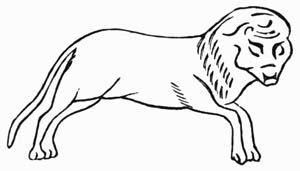
“Pontius Leo made this for himself while living. He and his wife Pontia Maxima made this for their well-deserving son, Apollinaris.”
Fig. 33.—Phonetic Symbol.
The friends of Leo were probably unable to read this inscription, whose atrocious latinity betrays the ignorance of the mason by whom it was executed, and therefore had engraved upon the stone the rude outline of a lion, the symbol of his proper name.
Another slab bears the outline of a little pig, the pictorial translation of the somewhat singular name Porcella. It was, perhaps, a term of endearment, like the obsolete English “Pigsney.”
PORCELLA HIC DORMIT IN P · Q · VIXIT ANN · III · M · X · D · XIII ·
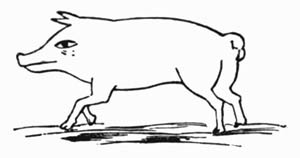
“Here sleeps Porcella in peace. She lived three years, ten months, and thirteen days.”
Fig. 34.—Phonetic Symbol.
In like manner the tombs of Dracontius, Vitulus, and Onager, bear respectively a dragon, a steer, and an ass, the phonetic synonymes of these names. These figures may in some cases be a mere pictorial paronomasia, but the explanation above suggested is the more probable one. In the following example this is almost asserted:
NABIRA IN PACE ANIMA DVLCIS QVI VIXIT ANOS XVI · M · V · ANIMA MELEIEA TITVLV FACTV APARENTES SIGNVM NABE. [sic.]

“Navira in peace; a sweet soul, who lived sixteen years and five months; a soul sweet as honey; this epitaph was made by her parents. The sign, a ship.”
Fig. 35.—Phonetic Symbol.
More frequently the figures had reference to the trade or occupation of the deceased, as in the following epitaph, probably of a wool-comber, found by Dr. Maitland built into the wall of the Piazzo di Spagna, in Rome. Many important funeral tablets, both Christian and pagan, have been thus employed for the commonest purposes. The objects in the engraving are probably the shears, comb, ladle, and an unknown instrument used for cleansing wool.
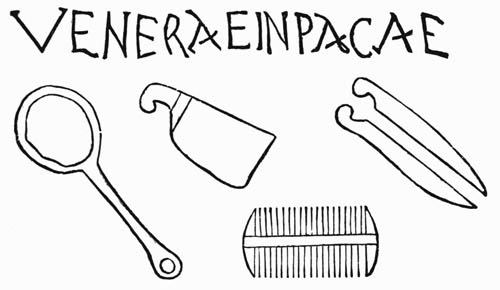
“To Veneria, in peace.”
Fig. 36.—Wool-Comber’s Implements.
The following, from the Lapidarian Gallery, indicates the trade of a carpenter. The saw and adz are very like those now employed:
BAVTO ET MAXIMA SE VIVI FECERVNT.
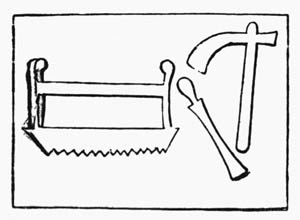
“To Bautus and Maxima. They made this during their lifetime.”
Fig. 37.—Carpenter’s Tools.
On another slab is a figure, probably of a vine-dresser, in a short Roman tunic, standing near a wine cask, the symbol of his occupation. He appears to be starting to the field with his mattock on his shoulder, and in his hand is a wallet containing, perhaps, the provision for the day.
GAVDENTIO FECERVM FRATRI QVI VICSIC ANNIS XXVIII · M · VIII · D · XVII
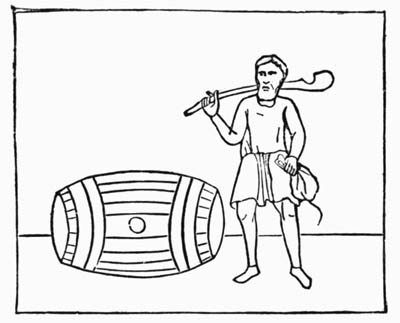
“To Gaudentius. His brothers made this. He lived twenty-eight years, eight months, seventeen days.”
Fig. 38.—A Vine-Dresser’s Tomb.
In the Catacomb of St. Agnes is a fresco of husbandmen carrying a wine butt on their shoulders, the meaning of which is probably the same. Mr. Hemans rather fantastically interprets this symbol as implying concord, or the union of the faithful bound together by sacred ties, as the staves of the cask are by its hoops.[362] Maitland translates it as standing for a proper name. We have seen examples representing fossors at work,[363] and Fabretti figures the slab of a sculptor, exhibiting the manufacture of sarcophagi. Other examples occur, in which the fuller’s tomb is indicated by mallets, the shoemaker’s by shoes or lasts, the baker’s by loaves, the wood-feller’s by an axe, the grocer’s by scales, and the like, although the meaning of some of these figures is questioned. Didron, however, presses this interpretation of these symbols much too far, making the dove, fish, anchor, and sheep, only the emblems of the occupation of the fowler, fisherman, sailor, and shepherd, respectively, thus doing violence to the acknowledged canons of epigraphic criticism to be presently indicated.[364]
But by far the larger proportion of these symbols have a religious significance, and refer to the peace and joy of the Christian, and to the holy hopes of a life beyond the grave; and many of them were derived directly from the language of Scripture. They were often of a very simple and rudimentary character, such as could be easily scratched with a trowel on the moist plaster, or traced upon the stone. They were sometimes, however, elaborately represented in excellent frescoes or sculpture.
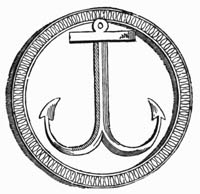
Fig. 39.—Symbolical Anchor.
The beautiful allusion of St. Paul to the Christian’s hope as the anchor of the soul, both sure and steadfast, is frequently represented in the Catacombs by the outline of an anchor, often rudely drawn, but eloquent with profoundest meaning to the mind of the believer. It assured the storm-tossed voyager on life’s rough sea that, while the anchor of his hope was cast “within the veil,” his life-bark would outride the fiercest blasts and wildest waves of persecution, and at last glide safely into the haven of everlasting rest. This allusion is made more apparent when it is observed how often it is found on the tombstones of those who bear the name Hope, in its Greek or Latin form, as ΕΛΠΙϹ, ΕΛΠΙΔΙΟϹ, SPES etc. In the accompanying example it is displayed on a Christian patera. This symbol is not unknown in classic art. It occurs on a ring from Pompeii, in the Museum of Naples, with the word ΕΛΠΙϹ, Hope.
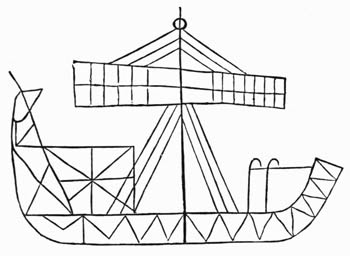
Fig. 40.—Symbolical Ship.
Of kindred significance with this is the symbol of a ship, which may also refer to the soul seeking a country out of sight, as the ship steers to a land beyond the horizon. Sometimes it may be regarded as a type of the church; and in later times it is represented as steered by St. Peter and St. Paul.[365] The symbol of “the heaven-bound ship”—ἡ ναῦς οὐραοδραμοῦσα—is mentioned by Clement of Alexandria as being in vogue in the second century. This figure was used also in pagan art as an emblem of the close of life, and may still be seen carved on a tomb near the Neapolitan Gate of Pompeii. In the Catacombs the execution of the symbol is often exceedingly rude, the design being apparently copied from the clumsy barges of the Tiber. The mast and yard sometimes present a vague imitation of the cross.[366] The accompanying figure is from the Lapidarian Gallery of the Vatican.[367]
The palm and crown are symbols that frequently occur, often in a very rude form. Although common also to Jewish[368] and pagan art, they have received in Christian symbolism a loftier significance than they ever possessed before. They call to mind that great multitude whom no man can number, with whom Faith sees the dear departed walk in white, bearing palms in their hands. The crown is not the wreath of ivy or of laurel, of parsley or of bay, the coveted reward of the ancient games; nor the chaplet of earthly revelry, which, placed upon the heated brow, soon fell in withered garlands to the feet; but the crown of life, starry and unwithering, the immortal wreath of glory which the saints shall wear forever at the marriage supper of the Lamb. They are the emblems of victory over the latest foe, the assurance that
The struggle and grief are all past; The glory and worth live on.
The palm and crown conjoined, the latter encircling the sacred monogram, are represented in the accompanying example from a slab in the Vatican Library.

Fig. 41.—Symbolical Palm and Crown.
The palm has also been claimed, but, as we shall see, without any warrant whatever, as the emblem of the martyrs and the designation of their tombs.
One of the most beautiful symbols of the Catacombs is the dove, the perpetual synonym of peace. Indeed, that word is frequently annexed to the figure as if to show more distinctly its meaning, as in Figs. 42 and 43.[369] The innocence and purity of the dove make it an appropriate emblem of the souls of departed Christians, soaring beyond the defilements of earth to the peaceful blessedness of heaven.[370] It is, therefore, in allusion to this thought sometimes accompanied by the words, anima innocens, anima simplex—“innocent soul,” “simple soul.” Perhaps there may be also a reference to the admonition of Our Lord, “Be ye, therefore, ... harmless as doves.” The gentleness and tender affection of these beautiful birds make them an emblem of endearment in every age, as is strikingly seen in the frequent allusions of the matchless Song of Songs. It may, therefore, be often employed in the Catacombs with reference to the domestic virtues of the deceased, and to the mutual constancy of husband and wife. The expression, palumbus sine felle—“a dove without gall”—is often applied in Christian epitaphs to the departed, especially in its diminutive form—palumbulus sine felle—on the tombs of little children, as if the bereaved parents presented their babes to the Lord, like the turtle-doves and young pigeons of the ancient Jewish offering of infant consecration.
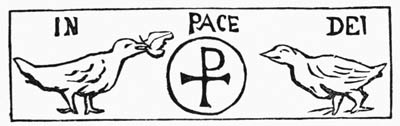
“In the Peace of God.”
Fig. 42.—Symbolical Doves.
The dove generally bears in its beak or claws an olive branch, the sign of the assuaging of the waters of Divine vengeance from the face of the earth. (See Fig. 43.) It is, then, as Tertullian expresses it, “the herald of the peace of God.”
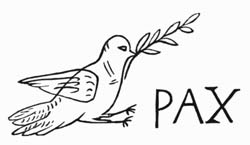
Fig. 43.—Symbolical Dove.
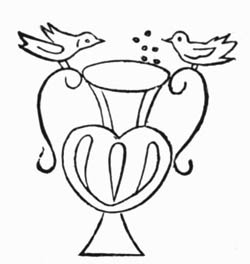
Fig. 44.—Doves and Vase.
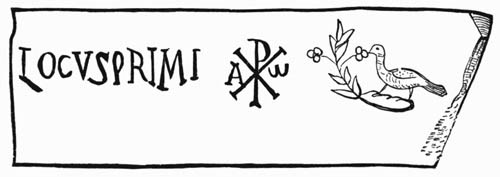
“The place of Primus.”
Fig. 45.—Dove Eating Olive Berries.
Sometimes it is seen drinking out of a vase, or pecking at grapes or olive berries, a symbol of the soul’s enjoyment of the fruits and refreshing draughts of paradise.[371] (See Figs. 44 and 45.) As seen sitting on the arms of the cross,[372] the dove is an appropriate symbol of the peace with God purchased by the death of Our Lord Jesus Christ. The dove in a cage may imply the faithful under persecution, or the soul imprisoned in the body.
The dove was also used in the Catacombs as the symbol of the Holy Spirit in representations of the baptism of Our Lord, and is described by Paulinus as similarly employed in the church of Nola.[373] Tertullian[374] applies toward the ecclesiastical edifice the expression, columbæ domus—“house of the dove”—possibly, however, with reference to the dove-like religion and character of the Christians. In Mediæval art the Holy Spirit, under the form of a dove wearing a cruciform nimbus, the symbol of divinity, is represented brooding over the face of the waters of primeval chaos, inspiring the prophets and saints, and even nailed to the cross above the crucified body of Our Lord. This sacred emblem of the Paraclete, the Divine Comforter, by a monstrous violation of propriety was emblazoned upon battle-flags, and the Holy Name given to a military order and to ships of war.[375]
This emblem was also used in pagan art. The light-winged coursers who drew the airy chariot of Venus were doves. From the oaks of Dodona doves uttered oracles of the future. A dove was also the celestial messenger of Mahomet. The olive, too, was sacred to Minerva, and as the symbol of peace was woven into the victor’s crown.
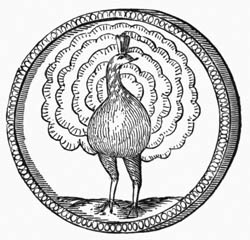
Fig. 46.—Symbolical Peacock.
Other pagan types were employed, but with a new and nobler Christian significance. Thus the peacock, the proud bird of Juno, frequently appears in the Catacombs, not as the symbol of the all-seeing eye of God, in imitation of the pagan myth of the hundred eyes of Argus, but as the emblem of immortality.[376] Associated in meaning and frequently confounded in form with the peacock was the phœnix, the marvellous story of whose rejuvenescence from the ashes of its funeral pyre Clement of Rome recounts with unfaltering faith.[377] Lactantius makes it the theme of an elaborate poem,[378] and Tertullian cites it as a striking illustration of the resurrection of the dead.[379] It was also considered a type of the new birth and of eternal felicity. The cock, generally associated with St. Peter,[380] is interpreted as the symbol of unsleeping vigilance; it is, perhaps, also an emblem or suggestion of the remorse of the apostle for his denial of his Lord.
Another adaptation of classic symbolism is the employment of the stag, the attribute of Diana, as the emblem of the Christian thirsting after the living waters. It is generally represented drinking at a stream, probably in allusion to the Psalmist’s panting after God as the hart after the water-brooks.[381] The hare sometimes occurs, an appropriate type of the persecution of the Christians, hunted amid those secret burrows in the earth like rabbits in their warrens. The horse is interpreted as symbolizing eagerness or speed in running the Christian race, or, perhaps, the course of life happily accomplished;[382] and the lion, fortitude of soul, or, from the notion that he slept with open eyes, vigilance against the snares of sin.[383] It is remarkable that the dog, a pagan symbol of fidelity, never occurs except as accessory in hunting scenes of manifestly heathen type; probably on account of the abhorrence of this, to them, unclean beast, by the Jews, who so largely impressed their characteristics on Christian thought and feeling.[384] The serpent, a common pagan symbol, and with the cock the attribute of Æsculapius, nowhere appears but in the scene of the temptation of Eve by the “Old Serpent, the Devil.”
The vine is an appropriate symbol of the intimate union of the believer and Christ, and the olive tree of a life fruitful in good deeds, or of the church, in whose sheltering arms all souls may find rest, as the fowls of the air in the boughs of a tree. Flowers and fruits may be the emblems of future beatitude; and a loaf, of the bread of life or of the holy eucharist. The fountain is a type of the living waters, and the lyre, of the influence of the Divine Orpheus. The lamp and the light-house are the emblems of spiritual illumination through the gospel. The balance may refer to the just dealing of the deceased, or perhaps to the final judgment and the Eastern notion of psychostasy.[385] The house probably indicates the tabernacle of the body, or perhaps the last long home of the grave, or the house not made with hands on high. Most of the symbols, however, refer to the person and work of Christ, as the central and dominating idea of the church of the Catacombs. Some of these are of such importance and of so frequent occurrence as to demand a more detailed examination.
One of the most striking and beautiful of these symbols is that which represents Christ as the Good Shepherd, and believers as the sheep of his fold. While the doves, as we have seen, may be regarded as emblematic of the beatified spirits of the departed, the sheep more appropriately symbolize those who, still in the flesh, go in and out and find pasture. Suggesting the thought of that sweet Hebrew idyl[386] of which the world will never grow tired; which, lisped by the pallid lips of the dying throughout the ages, has strengthened their hearts as they entered the dark valley; and to which Our Lord lent a deeper pathos by the tender parable of the lost sheep—small wonder that it was a favourite type of that unwearying love that sought the erring and the outcast and brought them to his fold again. With reiterated and manifold treatment the tender story is repeated over and over again, making the gloomy crypts bright with scenes of idyllic beauty, and hallowed with sacred associations.
This symbol very happily sets forth the entire scope of Christian doctrine. It illustrates the sweet pastoral representations of man’s relationship to the Shepherd of Israel who leadeth Joseph like a flock,[387] and his individual dependence upon him who is the Shepherd and Bishop of all souls.[388] But it especially illustrates the character and office of Our Lord, and the many passages of Scripture in which he represents himself as the Good Shepherd, who forsook his eternal throne to seek through this wilderness-world the lost and wandering sheep, to save whom he gave his life that he might bring them to the evergreen pastures of heaven.
This subject undergoes every possible variety of treatment and is endlessly repeated—rudely scratched on funeral slabs, elaborately sculptured on sarcophagi, moulded on lamps and vases, graven on seals and rings, traced in gold on glass, and painted in fresco, generally in the most prominent and honourable position, in the vaulting of the chambers and tympana of the arcosolia.[389] The Good Shepherd is generally represented as a youthful beardless figure in a short Roman tunic and buskins, bearing tenderly the lost sheep which he has found and laid upon his shoulders with rejoicing. This is evidently not a personal image, but an allegorical representation of the “Lord Jesus, that Great Shepherd of the sheep.” He is generally surrounded, as in Fig. 47, by a group of fleecy followers, whose action and attitude indicate the disposition of soul and manner of hearing the word. Some are listening earnestly; others are more intent on cropping the herbage at their feet, the types of those occupied with the cares and pleasures and riches of this world. A truant ram is turning heedlessly away, as if refusing to listen; and often a gentle ewe nestles fondly at the shepherd’s feet or tenderly caresses his hand. An early Christian writer, contemporary with this primitive art, furnishes an interpretation of these pictures. He compares the poor of this world to sheep in a barren desert; finding no allurements here below, they seek after those things which are above. The rich, on the contrary, are like sheep in a pleasant pasture, with heads and hearts always intent on the things of earth. Frequently a shower of rain, or of water from a rock—the emblem of the dews of grace or the waters of salvation—falls, abundantly on the listening sheep, scantily on those that are feeding, not at all on the one that is turning away.
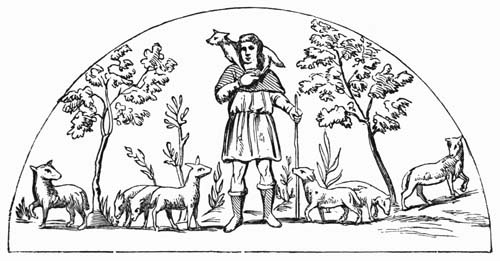
Fig. 47.—The Good Shepherd.
Sometimes the sheep appears to nestle with an expression of human tenderness and love on the shepherd’s shoulders; in other examples it is more or less firmly held with one or both hands, as if to prevent its escape. In a few instances the fold is seen in the background, which seems to complete the allegory. Frequently the shepherd carries a staff or crook in his hand, on which he sometimes leans, as if weary beneath his burden. He is sometimes even represented sitting on a mound, as if overcome with fatigue, thus recalling the pathetic words of the Dies Iræ:
Quærens me sedisti lassus.
Occasionally he is represented with a musical instrument, like the classical syrinx or Pan’s-pipe, in his hand, as in Fig. 48, as if to indicate the sweet persuasive influence of his word. In allusion to this thought Gregory Nazianzen remarks, “The Good Shepherd will at one time give his sheep rest, and at another time lead and direct them, with his staff seldom, more generally with his pipe.” In a fresco in the Catacomb of St. Agnes the shepherd’s tenderness and pity are contrasted with the mercenary harshness of the hireling who careth not for the sheep, and who rudely seizes by the leg one that struggles to get free, while the Good Shepherd merely calls his sheep, and they hear his voice and follow him. Sometimes an Orpheus, to whose lyre the sheep seem to listen with pleased attention, takes the place of the Good Shepherd.
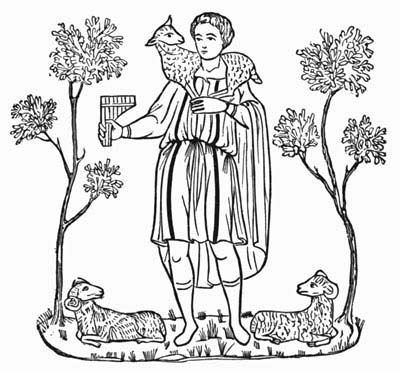
Fig. 48.—Good Shepherd with Syrinx.
Sometimes the shepherd is represented as leading or bearing on his shoulders a kid or goat instead of a sheep or lamb. This apparent solecism has been thought a careless imitation of pagan figures of the sylvan deity Pan, who frequently appears in art in this manner. It is more probable, however, that it was an intentional departure from the usual type, as if to illustrate the words of Our Lord, “I am not come to call the righteous, but sinners to repentance,” and to indicate his tenderness toward the fallen, rejoicing more over the lost sheep that was found than over the ninety and nine that went not astray. It was also, probably, designed as a protest against the rigour of the Novatians in refusing reconciliation to penitent apostates. Sometimes Our Lord, thus symbolically represented, is accompanied by one or more of his disciples, as under-shepherds to whom is given command to feed the flock of Christ, over which the Holy Ghost had made them overseers.
In the Catacomb of St. Agnes is a remarkable fresco of a lamb between two wolves, over which is written the word SENIORES, evidently an allegorical representation of the story of Susanna and the elders, and in mystic form an image of the church surrounded by persecution, or an illustration of the words of Our Lord, “Behold, I send you forth as sheep in the midst of wolves.”
The figure of the Good Shepherd has been a favourite symbol in every age, and was common in pagan art. Mercury was worshipped under the name Criophorus, or the Ram-bearer, and was thus represented in painting and statuary.[390] More frequently the god Pan appears under that figure, generally bearing in his hand the simple instrument to which he has given his name. The Roman poets employ this sweet pastoral image in their beautiful eclogues[391] to illustrate the shepherd’s tender care for his flock, gently bearing the lambs in his arms or on his shoulders, recalling the inspired language in which Isaiah depicts the Almighty’s loving-kindness toward his people.[392] From this outward resemblance between the pagan and Christian themes, Raoul-Rochette has imagined that the frescoes of the Catacombs were careless imitations of the heathen type, overlooking their distinctively Christian interpretation. But the naked fauns dancing with the nymphs of pagan art, as in the tomb of the Nasos, are infinitely removed from the sweet and tender grace of the Christian “Pastor Bonus.” Tertullian, in the second century, speaks of chalices on which were paintings of the Good Shepherd and the lost sheep.[393] Eusebius says that Constantine placed a statue of this subject in the forum of Constantinople. It also appears in mosaic at Ravenna, A. D. 440, and in a Catacomb at Cyrene in Africa.[394]
But Our Lord is sometimes represented as a lamb instead of a shepherd.[395] Indeed, this symbol is no less appropriate than the one just considered, and has equally the sanction of Scripture. The manifold sacrifices of the tabernacle and temple all pointed to the Lamb slain from the foundation of the world, the true Passover of mankind. The immaculate purity, gentleness, and divine affection of the Redeemer, and his patience under affliction and persecution, make this beautiful symbol an appropriate type of his innocence and sufferings as he was led as a lamb to the slaughter, and, as a sheep dumb before its shearers, opened not his mouth.[396] In the devout recognition of Our Lord by John the Baptist,[397] and in the sublime visions of the Apocalypse,[398] he is thus figuratively represented; and to this divine Lamb is chanted evermore the song of praise and honour and thanksgiving.[399]
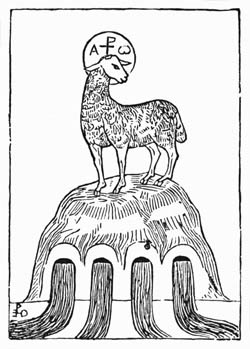
Fig. 49.—Lamb as Symbol of Christ.
In the accompanying engraving from a sarcophagus in the Lateran, of the fourth or fifth century, the lamb, wearing the nimbus in which are inscribed the sacred monogram and the letters Alpha and Omega, the emblems of divinity, is standing upon a hillock, perhaps intended for Mount Zion,[400] from which flow four streams, probably the “river of water of life,... proceeding out of the throne of God and of the Lamb,” and dividing toward the four quarters of the earth. These streams are also variously interpreted as signifying the four evangelists, and the four rivers of paradise.[401] On a sarcophagus of later date Our Lord is represented in human form with a scroll in his hand, standing on a mound from which the four mystical rivers flow, and by his side a lamb bearing a Latin cross on its head. On either side are lambs, personifications of the apostles, to whom he is giving the final commission to preach in all lands the gospel contained in the scroll which he holds, and to baptize with the sacred waters at their feet. Sometimes twelve lambs are represented approaching one in the centre, as in frescoes in St. Clement’s at Rome, and at Ravenna. On a gilt glass patera in the Vatican Library the lambs are seen to issue from Jerusalem and Bethlehem, as indicated by their names written above, and to approach Mount Zion, from which flow the four evangelical streams united in the mystical Jordan. This is perhaps emblematic of the twelve tribes, or of the gentiles coming from the east and west to drink of the water of life. Paulinus describes a mosaic in his basilica of Fondi, where a cross symbolical of Christ was placed on the rock, and two flocks, of sheep and goats respectively, stood around it. “The shepherd turns away,” he says, “the goats on the left, and embraces with his right hand the well-deserving lambs.”[402] This was perhaps the first of that series of art-presentations of the last judgment which culminates in the tragic terrors of the Sistine Chapel.
Sometimes a milk-pail is represented near a lamb, or hanging on a crook by its side, or even resting on its back. Sometimes also it is carried by the Good Shepherd. This has been magnified without due evidence into a symbol of the eucharist. It might more naturally be regarded as an emblem of the blessings of salvation, set forth by Isaiah under the figure of wine and milk, or it may refer to the soul’s being fed with the sincere milk of the word.
On the sarcophagus of Junius Bassus in the crypts of St. Peter’s, of date A. D. 359, are exhibited several scenes from scripture history, which will be hereafter described. In the spandrels of the arches over these is a series of bas reliefs, in which lambs are naively shown as enacting other scriptural scenes. In one a lamb, the personification of Moses, strikes a rock from which the water bursts forth, and another receives the law from the hand of God. Three lambs in a fiery furnace represent the three Hebrew children in the furnace of Nebuchadnezzar. Our Lord is symbolized by a lamb on whose head another, personifying John the Baptist, is pouring the waters of baptism, while the Holy Ghost in the form of a dove breathes divine grace. A lamb, the personification of Christ, multiplies the loaves, and brings forth Lazarus from the grave.
One of the most remarkable and important, in its theological significance, of the symbols of the Catacombs is that of the fish. It is one of the oldest in the entire hieratic cycle. It is found accompanying the first dated inscription which bears any emblem whatever,[403] and nearly a hundred examples occur which are attributed to the first three centuries. It was also one of the first to be discontinued. During the fourth century it rapidly fell into disuse, and by the beginning of the fifth had almost entirely disappeared from religious art.[404]
The abandonment of this remarkable figure may be explained by its mysterious and anagrammatic character. It is a striking illustration of that disciplina arcana of the primitive church which employed signs whose secret meaning its heathen foes could not understand. When the age of persecution passed away there was no longer the necessity to conceal under allusions and emblems, known only to the initiated, religious truths which were openly proclaimed on every hand. Hence this purely conventional sign fell into disuse.
This symbol probably derived its origin from the fact that the initial letters of the names and titles of Our Lord in Greek—Ἰησοῦς Χριστὸς, Θεοῦ Υἱὸς, Σωτήρ, Jesus Christ, Son of God, the Saviour—make up the word ΙΧΘΥΣ, a fish. “This single word,” says Optatus, “contains a host of sacred names.”[405] The same word also occurs acrostically in the initial letters of certain so-called Sibylline verses quoted by Eusebius[406] and Augustine,[407] which were doubtless of Christian origin. The symbol is first mentioned by Clement of Alexandria,[408] and probably had its origin in the allegorizing school of Christianity which sprang up in that city.[409]
There appears also to have been an allusion in this figure to the ordinance of baptism. “We are little fishes,” says Tertullian, “in Christ our great fish. For we are born in water, and can only be saved by continuing therein,”[410] that is, through the spiritual grace of which baptism is the visible sign. “This sign,” says Clement, “will prevent men from forgetting their origin.” “He (that is, Christ) is that fish,” says Optatus, “which in baptism descends in answer to prayer into the baptismal font, so that what was before water is now called, from the fish, (a pisce,) piscina.”[411] Even the mythical fish mentioned in the apocryphal book of Tobit,[412] occasional pictures of which occur in the Catacombs, is interpreted by some of the Fathers as typifying Our Lord. “That fish which came alive out of the river to Tobias,” says Augustine, “whose heart, (liver,) consumed by passion, put the demon to flight, was Christ.”[413]
This sacred sign was also regarded as an emblem of the sufferings of Our Lord and the benefits of his atonement. “The Saviour, the Son of God,” says Prosper of Aquitania, “is a fish prepared in his passion, by whose interior remedies we are daily enlightened and fed.”[414] “ΙΧΘΥΣ is the mystical name of Christ,” says Augustine, “because he descended alive into the depths of this mortal life as into the abyss of waters.”[415] “The fish in whose mouth was the coin paid as the tribute money,” says Jerome, “was Christ, at the cost of whose blood all sinners were redeemed.” Origen merely speaks of him as “figuratively called the fish.”[416] “Thus this symbol became,” says Dr. Northcote, “a sacred tessera, embodying with wonderful brevity and distinctness a complete abridgment of the creed—a profession of faith, as it were, both in the two natures and unity of person, and in the redemptorial office, of Our Blessed Lord.”[417]
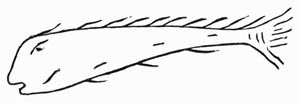
Fig. 50.—Symbolical Fish.
Few symbols, if any, were more common than this. It occurs rudely scratched on funeral slabs, painted in the cubicula, sculptured on the sarcophagi, moulded on lamps,[418] engraven on rings and seals,[419] carved in ivory, mother-of-pearl, and precious stones, and cast in bronze or glass. These last, often pierced in order to be worn like an amulet, were frequently given to the neophyte at baptism to remind him of the privileges and obligations which it conferred, and they are often found buried with the dead. One of these has engraved upon it the word ΣΩΣΑΙΣ—“Mayest thou save us;” and a sepulchral lamp, besides representations of fishes, bears the word ΙΧΘΥΣ, and, as if in explanation, the cyphers Α. Ω., ΙΗ. ΧΘ. ΣΩΤΗΡ—that is, The First and the Last, Jesus Christ, the Saviour. A slab, on which are engraved two fishes and an anchor, bears the inscription, ΙΧΘΥΣ ΖΩΝΤΩΝ—“The fish of the living.” Sometimes this sacred sign is inscribed on pagan tombstones used to close the loculi of the Catacombs, in order to give them a Christian character. Frequently the execution is exceedingly rude, as in Fig. 50; occasionally it is of a more artistic form, as in Fig. 51. It seldom occurs alone, however, but associated with other Christian emblems, as the anchor or dove, (see Figs. 52 and 53,) as if to indicate that the deceased rests in Christ, in hope and in peace. Sometimes the fish bears a wreath in its mouth, perhaps in allusion to the crown which Christ will give to all his saints. Didron objects to applying these symbols to Christ, because the fish does not wear the nimbus. But the nimbus was not worn at all at this early period; such a criterion is therefore inadmissible.
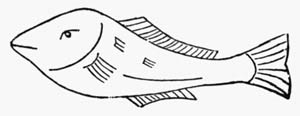
Fig. 51.—Symbolical Fish.
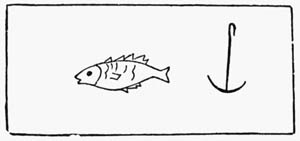
Fig. 52.—Fish and Anchor.
From the Catacomb of Hermes. Earliest dated example, A. D. 234.
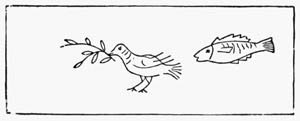
Fig. 53.—Fish and Dove.
From the Catacomb of St. Priscilla.
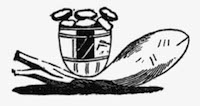
Fig. 54.—Eucharistic Symbol.
This sacred fish is sometimes represented, as in Fig. 54, from the crypt of St. Lucina, bearing what seems to be a basket of bread and a flagon of wine on its back, or occasionally a loaf of bread in its mouth. In these cases there is probably a reference to the bread of life which Christ breaks to his disciples, or possibly to the holy eucharist. Sometimes a bird is pictured as deriving nourishment from the mouth of a fish, the symbol of a soul receiving refreshment from Christ. The eucharist is also thought to be indicated by frequent representations of a fish and bread on a table, sometimes with a figure in prayer standing by; and also by a picture of seven persons eating a repast of bread and fish together, probably Christ dining with the disciples by the sea-shore after his resurrection.
Melito of Sardis speaks of Our Lord under the figure of a fish broiled on the fire of tribulation.[420] A mystical interpretation was also given to the loaves and fishes multiplied by Christ for the feeding of the multitude, as indicating the sevenfold gifts of the Spirit and the dispensations of the law and the gospel.[421]
A remarkable Greek inscription, found about thirty years ago in an ancient Christian cemetery at Autun, in France, throws much light on the profound religious significance of the symbol of the fish.[422] Its date, as indicated by the character of the epigraphy, in the opinion of the most eminent critics, is about the year 400.[423] The language is of Homeric purity and vigour, which is accounted for by the fact that Autun was, during the fourth and fifth centuries, a sort of “French Eton,” where Greek, the tongue “of Homer and the gods,” was sedulously cultivated. The following is the text as restored and translated by Marriott. It will be perceived that the word ΙΧΘΥΣ occurs acrostically in the initial letters of the first five lines, and is found four times in the body of the inscription. It is conjectured that the figure of a fish was also engraved, though now unhappily obliterated, at both the lower corners, where spaces for it seem to have been left.
ΙΧΘΥΟϹ οὐρανίου ἅγιον γένος, ἤτορι σεμνῷ Χρῆσε, λαβὼν ζωὴν ἄμβροτον ἐν βροτέοις Θεσπεσίων ὑδάτων· τὴν σὴν, φίλε, θάλπεο ψυχὴν Ὕδασιν ἀενάοις πλουτοδότου Σοφίης, Σωτῆρος δ'ἁγίων μελιηδέα λάμβανε βρῶσιν. Ἔσθιε πεινάων ΙΧΘΥΝ ἔχων παλάμαις. ΙΧΘΥΙ χεῖρας ἄραρα· λιλαίεο δέσποτα Σῶτερ Εὐθύ μοι ἡγητήρ, σε λιτάζομε, φῶς τὸ θανόντων. Ἀσχανδῖε πάτερ, τῷ 'μῷ κεχαρισμένε θυμῷ, Σὺν μητρὶ γλυκερῇ καὶ πὰσιν τοῖσιν ἐμοῖσιν ΙΧΘΥΝ ἰδὼν υἵου μνήσεο Πεκτορίου.
“Offspring of the heavenly Ichthus, [Christ,] see that a heart of holy reverence be thine, now that from divine waters thou hast received, while yet among mortals, a spring of life that is to immortality. Quicken thy soul, beloved one, to ever fuller life, with the unfailing waters of wealth-giving wisdom, and receive the honey-sweet food of the Saviour of the saints. Eat with longing hunger, holding Ichthus [the Divine Food] in thy hands. On Ichthus [Christ] my hands are clasped; in thy love draw nigh unto me and be my guide, my Lord, and Saviour; I entreat thee, thou Light of them for whom the hour of death is past. My father, Aschandeius, dear unto my heart, and thou, sweet mother, and all I love on earth, oft as you look on Ichthus [the holy sign of Christ] so often think of me, Pectorius, your son.”[424]
In this beautiful expression of primitive faith and hope Romish interpretation has discovered evidence of prayers for the dead, of the invocation of the Virgin Mary, the doctrine of transubstantiation and communion in one kind, and mention of the “sacred heart of Jesus.” Marriott has well shown the grammatical and other difficulties which these forced interpretations create, and the absurdity of importing into antiquity “controversial phrases of comparatively modern theology, utterly unknown to the early church.”
Sometimes, by a confusion of metaphor common to both pictorial and literary figurative expression, the symbol of the fish is applied to men as well as to Our Lord. Indeed, this may have been its primary application, and has the sanction of the scriptural designation of the apostles as “fishers of men.” The Greek liturgy adopts the same figure, and, in pursuance of the metaphor, speaks of the rod of the cross, the hook of preaching, and the bait of charity.[425] There are also frequent representations on the sarcophagi and in the frescoes of the Catacombs, doubtless in allusion to this function of the Christian ministry, of men drawing fish out of the water. These, however, must not be confounded with the occasional fishing scenes copied from pagan art; and the symbolical fish must be carefully discriminated from the dolphins which frequently occur on the sarcophagi, and from the “great fish” which swallowed Jonah. It is remarkable that a bronze image with a chalice and fish was found at Autun, in the neighbourhood of the inscription above given. The figure occurs also on certain ancient coins, and in representations of the Phœnician Dagon or fish-god.
It is noteworthy that there are in the Catacombs comparatively few representations of the cross, that sacred sign of salvation which in after years became perverted to such superstitious uses; and when it does occur it is generally in some disguised form, and not in that by which it is now generally indicated, familiarly known as the Latin cross. There is probably a twofold reason for this. The very sanctity of the symbol, and the detestation in which it was held by the heathen, conspired to prevent the early Christians from exposing it to their profane gaze. It is almost impossible to conceive the abhorrence in which the cross was held in the early centuries by the Greek and Roman mind. It has for ages been hallowed by the most sacred and venerable associations, and invested with the most sublime and solemn interest as the emblem of the world’s redemption. It has waved on consecrated banners, and been quartered on the arms of earth’s proudest monarchs. It has shone on cathedral spire and dome, and, emblazoned with gold and costly gems, has gleamed on many a sacred shrine. It has been marked on the infant brow in baptism, and held before the filming eyes of the dying; and has been associated with the deepest emotions and holiest hopes of the soul.
Not so in the earliest ages of the church. It was then the badge of infamy and sign of shame—the punishment of the basest of slaves and the vilest of malefactors. It was regarded with a loathing and abhorrence more intense than that in which the felon’s gibbet is held to-day. Its very name was an abomination to Roman ears,[426] and it was denounced by the prince of Roman orators as a most foul and brutal punishment, an infamous and unhappy tree.[427] Hence this Christian emblem became the object of scoffing and derision by the persecuting heathen. An illustration of this is seen in the blasphemous caricature of the Crucifixion, found upon the walls of the palace of the Cæsars and attributed to the time of Septimius Severus.[428] It represents a figure with an ass’s head attached to a cross, which another figure, standing near, salutes by kissing the hand, or adores in the classical sense of the word. Beneath is a rude scrawl which has been interpreted thus: Ἀλεξόμενος σέβετε (sic) Θεὸν—“Alexomenos worships his god,” probably the sneer of some Roman legionary at a Christian soldier of Cæsar’s household. Lucian also contemptuously speaks of Our Lord as a “crucified impostor.”[429]
The Christians, therefore, reverently veiled this sacred sign from the multitude; but they cherished it in their hearts, and in times of persecution gladly bore its reproach. The early Fathers, both Greek and Latin, recognize the occurrence of this symbol everywhere throughout the universe, and expatiate with fervent eloquence on its mystical meaning. The points of the compass, says Jerome, and the fourfold dimensions of space as mentioned by the apostle,[430] set it forth. Its form was assumed by birds in their flight, by men in the act of swimming and in the attitude of prayer, and is seen in the masts and yards of vessels.[431] “The cross,” says Justin Martyr,[432] “is impressed on all nature; there is scarcely a craftsman but employs the figure of it among the implements of his industry.” It was seen in the beam and share of the plough, and in the forms of flowers and leaves. It was typified in countless analogies of Scripture, in the measurement of the ark, the number of Abraham’s servants, the shape of Jacob’s staff, and the roasting of the paschal lamb; in the rod of Moses, the seven-branched candlestick, and the wave-offerings of the temple service; and it was the hallowed sign marked in blood on the lintels of the Hebrews’ houses. It healed the envenomed wounds of the serpent-bitten Israelites in the desert, routed the Amalekites in battle, and restored to life the son of the widow who gave bread to the prophet. It was the mark of God on the saints of Jerusalem, and was to be the sign of the Son of man in the heavens. The Christians wore the sacred token like a banner on their foreheads,[433] and the form at which men once shuddered, says Chrysostom, became the badge of highest honour, so that even emperors laid aside the diadem to assume the cross. “Let him bear the cross,” says Paulinus, “who would wear the crown.”[434] Christians were known as “devotees of the cross,”[435] and this sign of Christ[436] was employed to hallow every act of their lives, their down-sitting and up-rising, their going out and coming in.[437] It was especially adopted, as several of the Fathers remark,[438] as the attitude of prayer, and Chrysostom quotes in explanation the words of the Psalmist, “Let the lifting up of my hands be as the evening sacrifice.”[439] Tertullian and Asterius Amasenus[440] expressly declare that thus is set forth the passion of Our Lord.
This symbol acquired at length in popular apprehension the power of a sacred talisman to banish demons, vanquish Satan, avert evil, protect in time of danger or temptation, and to shut the mouths of lions about to devour the intrepid confessors of the faith.[441] The sign of the cross on the forehead and heart, says Prudentius, banishes all evil.[442] Another poet of the fifth century recommends the mystical charm as an antidote to diseases of cattle. Into such superstition had Christianity already degenerated.[443]
More common than any other Christian symbol in the Catacombs is the so-called Constantinian monogram, ☧. The first certain example of this is the following, which bears the date A. D. 331:[444]
ASELLVS ET LEA PRISCO PATRI BENEMERENTI IN PACE QVI BIXIT ANNIS LXIIII MENSIBVS III DIES N XII.
IN SIGNO

Asellus and Lea to Priscus, their well-deserving father, in peace, who lived sixty-four years, three months, twelve days. In the sign of Christ.
Fig. 55.—Earliest dated Constantinian Monogram.
A somewhat similar form occurs with the date A. D. 291, but De Rossi thinks it is only an ornamental point.[445] The following fragment may possibly belong to the year 298, when one of the consuls was named Gallus; but it cannot be proved that he is the one mentioned in the inscription: [VI]XIT ... ☧ ... GAL . CONSS.—“He lived in Christ ... and Gallus being consuls.”[446]
In the year 339 the second dated example occurs, enclosed in a circle. In A. D. 341 three examples are found, and in A. D. 343 it occurs four times in one inscription. After this it becomes exceedingly common, and is even employed as a mark of punctuation between the words.
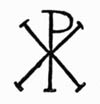
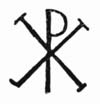
This monogram is formed, as will be perceived, by the combination of the Greek characters Χ and Ρ, the first two letters of the word ΧΡΙΣΤΟΣ, or Christ. It may, indeed, be regarded rather as a contracted form of writing that word than as a proper symbol, just as we sometimes write Xt. and Xmas. for Christ and Christmas. Indeed, it most probably originated in the prevalent practice of contracted and monogrammatic writing, of which we have so many examples in these inscriptions. That the monogram stands for the name of Our Lord will be apparent from an examination of a few of the inscriptions in which it occurs, as, for instance, the very first dated example, above given. See also the following: IN PACE ET IN ☧ DEO—“In peace and in Christ God;” BIBAS IN ☧—“May you live in Christ;” IN ☧ VICTRIX, which probably meant “Victrix (a woman’s name) victorious in Christ.” Marangoni gives the accompanying impression of a seal on the plaster of a grave. See figure 56.

“Hope in Him,” i. e., in Christ.
Fig. 56.—Christian Seal.
This monogram soon became almost universal in the Catacombs, on sepulchral slabs, lamps, vases, rings, seals, weights, gems, etc., and in every conceivable modification of form, some of which are shown in the illustration on next page. See also the vignette on title page, copied from an alabaster slab in the Collegio Romano, originally from the Catacombs.
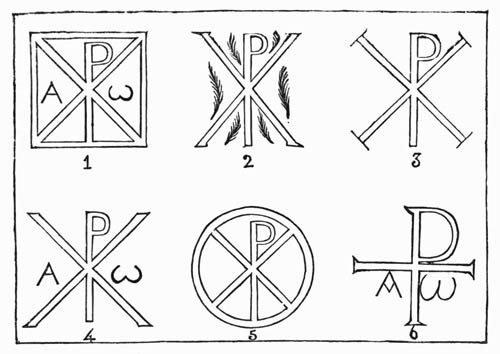
Fig. 57.—Various Forms of the Constantinian Monogram.
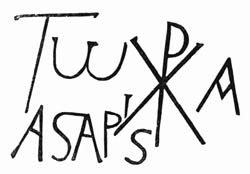
Fig. 58.—“Tasaris in Christ, the First and the Last.”
Frequently the Greek letters Alpha and Omega accompany the monogram, as in numbers 1, 4, and 6 of Fig. 57, in allusion to the sublime passage in the Revelation descriptive of the eternity of Christ.[447] Sometimes the order of the letters is reversed, probably through the ignorance of the artist, as in the accompanying rude example, Fig. 58. The whole was sometimes placed obliquely, or even turned upside down, doubtless for the same reason. Even in its simplest form it was considered sufficient to give a Christian character to a tombstone which had been originally pagan. Such inscriptions are called opisthographæ, that is, written behind. In the following example from Aringhi the letters D. M., for the heathen formula DIS MANIBVS,—“To the Divine Manes,” are partially obliterated, and the consecrating sign substituted instead.
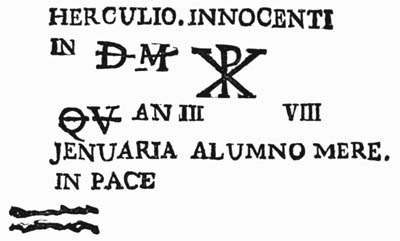
Fig. 59.—Opisthographic Inscription.
This monogram has been supposed to have been adopted from the celebrated Labarum, or battle-standard of Constantine, which bore this sacred figure. This was derived in turn, it was feigned, from the image which the imperial convert saw, or thought he saw, traced in the sky in characters of fire brighter than the noon-day sun, before the battle of the Milvian Bridge. Probably a solar halo of unusual splendour was magnified by the eager imagination of Constantine into a token of divine assistance, and the legend Ἐν τούτῳ νίκα was an after addition of the credulous historian. The Christian emblem, according to Prudentius,[448] was worn upon the shields and helmets of the whole army as well as on the imperial standard; “and so,” says Milman, “for the first time the meek and peaceful Jesus became a God of battle; and the cross, the holy sign of Christian redemption, a banner of bloody strife.”[449]
Probably there is allusion to the above mentioned legend in the following inscription from Bosio:
IN HOC VINCES
SINFONIA ET FILIIS. In this thou shalt conquer. In Christ. Sinfonia, also for her sons.
On a remarkable sarcophagus in the Lateran Museum is a representation of the monogram[450] supported on a cross and surrounded by a wreath, at which doves are pecking; probably a symbol of the souls of the blessed feeding on the hope of an immortal crown and the sweetness of eternal bliss. Beneath are crouched two soldiers, types, it is thought, of the Christian warriors not yet entered into rest, whose only place of safety is at the foot of the cross; or they may refer to the Draconii, or imperial guard of the Labarum, who, according to Eusebius, passed unhurt amid showers of javelins.
The following enlarged copy of an early Christian seal exhibits the triumph of the cross over the Old Serpent, the Devil, while it is the symbol of salvation to the saints represented by the doves at its foot. In later art the figures of lions, eagles, falcons, peacocks, doves, and lambs, grouped around the cross, seem to signify its power to subdue evil passions and to inspire holy virtues.
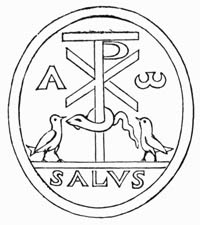
Fig. 60.—Early Christian Seal.
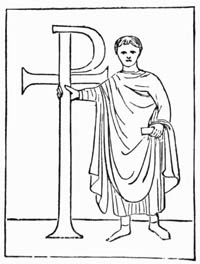
Fig. 61.—Monogram, united with the Cross.
The change of the monogram into the cross was very gradual. First one stroke of the X became coincident with the vertical part of the P, and the other at right angles to it, as in No. 6, Fig. 57. At length the loop of the P disappears and the Greek cross results. In the other examples of Fig. 57 the cross, if cross it was at all, was neither in the Greek nor Latin form, but in that known as St. Andrew’s. Finally the lower arm was lengthened till it assumes the form shown in the accompanying engraving, which was found on the grave of a neophyte four years old. The first dated example of a simple undisguised cross in the Catacombs does not occur till A. D. 407;[451] but during the latter part of the fifth century it became quite common. It also became more ornate in form, and was frequently adorned with gems and wreathed with flowers, especially in the later bas reliefs. In the fourth century it had already become an object of such superstitious veneration as to call forth the reproaches of Julian and the extravagant laudation of many of the Christian fathers.[452] In the time of Chrysostom the alleged discovery of the true cross by the Empress Helena was universally received, and “materialized at once,” says Milman, “the spiritual worship of Christianity.”[453] Its position was revealed in a vision and its genuineness proved by the miraculous cures which it performed, as recorded by St. Cyril, afterward bishop of Jerusalem, a reputed eye-witness of the event. The precious relic, distributed throughout Christendom[454] and in minute portions worn as sacred talismans, did much to cultivate a spirit of superstition which culminated in the Romish festivals of the Invention and Exaltation of the Cross, and in the hymns and offices of the church, often bordering, at least, upon idolatrous homage.[455] It also led to the conception of the marvelous legend of the cross in the apocryphal gospels and ancient traditions.[456]
The cross thus gradually assumed the form in which it is now generally represented; but it was a sign of joy and gladness, crowned with flowers, adorned with precious stones, “a pledge of the resurrection rather than a memorial of the passion.”[457] It was like the rainbow in the cloud to Noah after the flood—a promise of mercy, not a symbol of wrath. It was not the dead Christ but the glorified Redeemer that the primitive Church presented to the imagination. She lingered not by the empty sepulchre, but followed by faith the risen Lord. The persecuted saints shared the triumph of His victory over death and the grave, and felt that because He lived they should live also.
The early believers carefully avoided, as though prevented by a sacred interdict, any attempt to depict the awful scenes of Christ’s passion, the realistic treatment of which in Roman Catholic art so often shocks the sensibilities and harrows the soul. This solemn tragedy they felt to be the theme of devout and prayerful meditation rather than of portraiture in art. Hence we find no pictures of the agony and bloody sweat, the mocking and the shame, the death and burial of Our Lord. “The Catacombs of Rome,” says Milman, “faithful to their general character, offer no instance of a crucifixion, nor does any allusion to such a subject of art occur in any early writing.”[458] “The passion is not represented literally,” says Dr. Northcote, a strenuous advocate of Roman Catholic views, “but under the veil of secresy. It is not our Beloved Lord, but some other who bears his cross. The crown which is placed on his head is of flowers rather than of thorns, and corresponds better with the mystical language of the Spouse in the Canticles[459] than would a literal treatment.”[460] With this agrees the assertion of the distinguished Prussian archæologist, Prof. Piper, of Berlin. Speaking of the series of art representations, belonging to the first five centuries, of scenes in the life of Our Lord, which extend from his nativity to his appearance before Pilate, he says, “Further, however, this series does not go: the death and resurrection of Christ have not at all been made the subject of representation in this period.”[461]
In the fifth century Paulinus of Nola speaks of Christ as represented by a snowy lamb standing at the foot of the cross.[462] Sometimes a lamb bore the cross, at others it was couchant in the midst of it; and, as if to bring the sacrificial emblem more vividly to mind, the lamb was represented as wounded and bleeding, an innocent victim given to an unjust death.[463]
In A. D. 692 the Quinisextan Council decreed that the historic figure of Christ in human form should be substituted for paintings of the lamb[464] —an evidence that the earlier representations were purely allegorical. The lamb, however, still continued to be employed, and it required the reiterated injunction of Pope Adrian, in the eighth century, to enforce uniformity of usage; and even after that time a reversion to the former practice sometimes occurred.
The oldest extant representation of the crucifixion is a miniature in a Syrian evangelarium, of date A. D. 586, now in the Laurentian Library at Florence. The treatment of the subject is exceedingly rude, bordering on the grotesque. The figure of Our Lord is crowned with a nimbus and clothed with a long purple robe The soldiers on the ground are casting lots for his garments, and the sun and moon look down upon the scene. A companion picture represents the ascension of Christ and the effusion of the Holy Spirit. “These are the oldest pictorial representations,” says Prof. Piper, “of the earthly life of Jesus and of his exaltation.... At a somewhat later period,” he continues, “they appear also in the west.”[465]
Gregory of Tours, about the end of the sixth century, mentions, apparently as an unusual innovation, a picture in the church at Narbonne which represented the crucifixion of Our Lord.[466] About the same time Venantius Fortunatus mentions what seems to have been a metallic cross bearing the image of Christ.[467]
The figure of Jesus first appeared standing at the foot of the cross, frequently with outstretched arms as if in prayer, which type was common in the eighth century. Sometimes the bust only was exhibited at the top of the cross, or even hovering over it, as in a reliquary presented to Theodelinda by Gregory the Great, the head being crowned with a nimbus, but without any expression of pain.
In the ninth century the form of Christ is raised to the centre of the cross; but he is still alive, with open eyes and head erect, as if to indicate that the divine nature was not subject to death. The hands are not nailed, but extended in prayer; the darkened sun and moon look down upon the awful tragedy; but still a feeling of reverence prevented the depicting of any expression of suffering on the countenance of the Redeemer. It was not till the eleventh century that art attempted to represent either the agony or death of the Son of God.[468] From this time he is exhibited lifeless upon the cross, his hands and feet transpierced with nails and a spear wound in his side, from which the flowing blood sometimes falls on the head of the spectators, as if indicating the efficacy of the atonement; and in the thirteenth century the head drops heavily to one side.[469]
The arrangement of the drapery differs greatly in these paintings. In the tenth century the form of the divine victim is entirely clothed with a long robe with sleeves, the hands and feet alone being uncovered. In the eleventh and twelfth centuries the robe becomes shorter and the sleeves disappear; in the thirteenth it is reduced to a short tunic; and in the fourteenth it is little more than a narrow girdle about the loins, at which stage it has since remained. The suppedaneum, or support for the feet, is generally represented. It is frequently in the form of a globe, or of a chalice. The support for the body is never shown in art. Sometimes the sepulchre, with the angel and the two Marys, is seen in the background. One example, in St. John’s Lateran, exhibits the gate of paradise and the tree of life.
The expression of the face also underwent a change—a dire eclipse of woe—no less painful to behold. In the earlier pictures of the crucifixion the countenance of the Redeemer is still gentle and benign, the type of tenderness and truth; but it gradually becomes more and more strongly marked with the expression of sorrow and physical anguish, till all the divine fades away, and only the human agony of the wan and furrowed face remains. The serene and joyous aspect which, as we shall see, the representations of Our Lord always wore in the Catacombs, vanishes, and he is depicted as the “man of sorrows,” crushed with hopeless grief, crowned with thorns, transpierced with nails, and stained with dropping blood from the ghastly spear-wound in his side. Art exhausted its power in delineating the intensest forms of anguished suffering, sinking lower and lower in the depths of a brutal materiality and ferocity of treatment of this sacred theme. Even the genius of Michael Angelo only renders more painful the contrast between the tender and pitiful Good Shepherd of the Catacombs and the relentless Judge of the Sistine Chapel, menacing the guilty with the thunderbolts of wrath—a pagan Zeus rather than the Christian God of Mercy. This striking change but too faithfully represents the corresponding degradation and materialization of religious belief.
The crucified Christ was not only depicted in his dying agonies on earth, but this human anguish is even introduced into representations of heaven, bringing gloom upon its glory and sadness amid its joy. The Divine Father is frequently portrayed as sitting on the throne of his majesty, and holding in his hand a cross on which hangs the agonized body of his Son.[470]
In the East the development of image worship seems to have been earlier than in the West.[471] During the eighth century its corruptions provoked the iconoclastic zeal of the Isaurian Leo; and a general council condemned as idolatrous all symbols of Christ except the holy Eucharist.[472] Their destruction was rigorously prosecuted in the Eastern Empire; but Gregory II. became the champion of image worship in the West, and Italy, adhering to her ancient pagan instincts, substituted this new idolatry for that which she had abandoned.
The development of the graven representation of the passion was more gradual than its treatment in graphic art. This was the work of the sculptors. At first the figure of Our Lord was merely painted on a flat surface of wood or metal. This was afterward incised in outline, and exhibited in low relief, as on an ivory diptych of date A. D. 888 in the Vatican Museum. In this the sun and moon, as genii, hold torches above the cross; and by a singular association of ideas, Romulus and Remus, suckled by the wolf, appear at its foot, probably in allusion to Christ’s spiritual subjugation of the Roman Empire.[473] The treatment of this sacred theme passed gradually through the stages of basso, mezzo, and alto relievo, becoming more and more detached, till, in the fourteenth century, the figure of Our Lord upon the cross stood out, the completed and portable crucifix.[474] From this, through rapid stages, we arrive at the gross and ghastly images which abound throughout Roman Catholic Christendom; in every church and at every shrine; in the homes alike of prince and peasant; at the street corners and by the way side; often in popular apprehension endowed with the power of weeping, motion, speech, and working miracles.[475] By such gradations between the soul of man and the living Saviour came the image of the dead Christ, diverting the thoughts from the faith in a living Lord to an idolatrous veneration of a lifeless symbol.
Thus, as Dr. Maitland remarks, in painting sight superseded faith, and in sculpture touch superseded sight. But still another resource of sensuousness was to be discovered; and in the year 1223, “when the world was growing cold,”[476] as the Roman Church, with a deeper meaning than it knew, asserted, Saint Francis of Assis is feigned to have received the stigmata of the five wounds of Christ, and thenceforth to have borne about in his body—a living crucifix—the marks of the Lord Jesus. This miracle was afterwards frequently repeated; but the Church, seeking amid the growing darkness of the times to walk by sight and not by faith, wandered ever further and further from the central source of light and power, and lost all ability to communicate to a cold and dying world any spiritual life and warmth.
The sad lesson of the history we have been tracing is but too plain. In the early ages, and in the fervent glow of primitive faith, no outward symbol was necessary to reveal to the soul the presence of the Divine, or to interpret the profound meaning of the atonement. The Church required no sensuous image of Him, whom having not seen she loved, to prevent that love from growing cold. As the fervour of faith failed she relied more on the visible sign to quicken her languid devotion; but not till six centuries of gathering gloom had passed over her head after her fatal alliance with imperial power did degenerate art dare to portray to the eye of sense the death pangs and throes of mortal agony of the suffering Son of God. In the church of the Catacombs these images of sadness and gloom have no place. All is bright, cheerful, and hope-inspiring. In the following chapter we shall see that these characteristics are strikingly manifested in all the representations of Our Lord that there occur.
Note.—We have made no reference in the foregoing remarks to the pre-Christian crosses, of which so many examples occur. It is not remarkable that this perhaps simplest of all geometrical figures should have attracted the notice of many diverse and ancient races, and even have been regarded as a sign of potent mystical meaning. This subject has been treated with a good deal of fantastic theory by S. Baring-Gould, M.A., (Curious Myths of the Middle Ages, pp. 341, et seq.;) more philosophically by Creuzer, (Symbolek, pp. 168 et seq.,) and by various travellers and observers of ancient remains in many lands. Sir Robert Ker Porter mentions the hieroglyph of a cross, accompanied by cuneiform inscriptions, which he saw on a stone among the ruins of Susa. (Travels, vol. ii, p. 414.) Prescott mentions its occurrence among the objects of worship in the idol temples of Anahuac, (Conquest of Mexico, vol. iii, pp. 338-340.) It was found on the temple of Serapis at Alexandria, which fact was urged by the pagan priests to induce Theodosius not to destroy that building. (Socrates, Eccl. Hist., v, 17.) It was probably a Nilometer, or perhaps the so-called “Key of the Nile,” frequently held in the hand of Egyptian deities as the emblem of life, or the symbol of Venus, probably of phallic significance. (Tertul., Apol., c. 16.) It is found also on Babylonian cylinders, on Phœnician and Etruscan remains, and among the Brahminical and Buddhist antiquities of India and China. (Medhurst’s China, p. 217.) It was also the sign of the Hammer of Thor, by which he smote the great serpent of the Scandinavian mythology. On rather slender evidence S. Baring-Gould attributes its use to the pre-historic lake-dwellers of Switzerland. It was also found, he asserts, combined with certain ichthyic representations in a mosaic floor of pre-Christian date, near Pau in France, in 1850. This example was probably post-Christian.

Fig. 32.—To Berpius, (or Verpius,) in Peace.
Bone Pastor, panis vere, Jesu, nostri miserere, Tu nos pasce, nos tuere; Tu nos bona fac videre, In terra viventium.
Tu qui cuncta scis et vales, Qui nos pascis hic mortales Tuos ibi commensales Cohæredes et sodales Fac sanctorum civium.
Jesu dulcissime, e throno gloriæ Ovem deperditam venisti quærere! Jesu suavissime, pastor fidissime, Ad te O trahe me, ut semper sequar te!
Hic agnus mundum restaurat sanguine lapsum,
Mortuus et vivus idem sum, pastor et agnus.
Petram superstat, ipse petra ecclesiæ, Ex qua sonori quatuor fontes meant, Evangelistæ, viva Christi flumina.
Et quia celsa (crux) quasi judex de rupe superstat,
Bis geminæ pecudis discors agnis genus hædi
Circumstant solium; lævos avertitur hædos
Pastor et emeritos dextra complectitur agnos.
... Πίστις δὲ προσῆγε
Καὶ παρέθηκε τροφὴν, Ἰχθὺν θείας ἀπὸ πηγῆς,
Παμμεγέθη, καθαρὸν, ὃν ἐδράξατο παρθένος ἁγνή·
Καὶ τοῦτον ἐπέδωκε φίλοις ἔσθειν διὰ παντὸς,
Οἶνον χρηστὸν ἔχουσα, κέρασμα διδοῦσα μετ'ἄρτου.
Fac cum vocante somno Castum petes cubile, Frontem locumque cordis, Crucis figura signet. Crux pellit omne noxium.—Hymn vi.
Alpha et Ω cognominatus; ipse fons et clausula
Omnium quæ sunt, fuerunt, quæque post futura sunt.
Christus purpureum gemmanti textus in auro,
Signabat labarum, clypeorum insignia Christus
Scripserat: ardebat summis crux addita cristis.
Ardua floriferæ Crux cingitur orbe coronæ.
O crux, ave, spes unica! Piis adauge gratiam; Reisque dele crimina.
O croce, fammi loco! E le mie membre prendi! Che del tuo dolce foco Il cor e l’alma accendi! La croce e l’ crocifisso, Sia nel mio cor scolpito, Ed io sia sempre affisso In gloria ov’egli è ito!
Cross of my Lord, give room! give room! To thee my flesh be given! Cleansed in thy fires of love and praise, My soul, rise pure to heaven! Ah! vanish each unworthy trace Of earthly care or pride; Leave only graven on my heart The Cross, the Crucified.
Pes crucis est cedrus, corpus tenet alta cupressus,
Palma manus retinet titulo lætabor oliva—