Chapter III
Reading edition
THE BIBLICAL CYCLE OF THE CATACOMBS.
The “Circlo Biblico,” or Biblical Cycle, of the Catacombs, as De Rossi has called it, partakes of the same symbolical character as their other art-creations. It has, for the most part, a twofold object: first, the literal presentation of certain historical events; and, second, a typical or allegorical reference to the spiritual truths of Christianity, especially to the cardinal doctrines of the sacrifice, resurrection, and ascension of Our Lord. The range of this art cycle comprehends the grand drama of redemption, from the fall of man to his restoration through the greater Man, Christ Jesus; with the careful avoidance, however, of the scenes of the passion, which are nowhere exhibited except under the veil of allegory or symbol. These numerous and varied biblical representations imply a remarkable familiarity of the primitive Christians with the holy scriptures, in striking contrast with the prevalent ignorance of these sacred books in the papal Rome of to-day. Indeed, these storied crypts must have been a grand illustrated gospel, impressing upon the mind of the believer the lessons of holy writ, and probably furnishing to the catechumens of the faith and recent converts from paganism a means of instruction in these sacred themes. The execution may often be coarse, and the drawing uncouth; but to the devout mind this primitive Christian art is invested with a profounder interest than all the triumphs of genius in the galleries of the Vatican.[477]
In consequence of its symbolical purpose this hieratic series is rather eclectic than cyclopædic in its character. Of the great variety of available topics, the number selected for art-presentation was comparatively limited; and the artist, in the treatment of these, frequently contented himself with the constant and unvaried reiteration of the same types, which were often of the rudest and most conventional form. “The incidents that exemplified the leading doctrines of the faith,” says Kugler,[478] “were chosen in preference to others.” Hence the very fixedness of these doctrines imparted somewhat of their own character to the pictorial representations employed.
Subjects from the Old Testament are more numerous in proportion to the whole than would have been anticipated. This is also a result and illustration of the allegorical nature of the series. “Rome,” says Lord Lindsay, “seems to have adopted from the first, and steadily adhered to, a system of typical parallelism—of veiling the great incidents of redemption, and the sufferings, faith, and hopes of the church under the parallel and typical events of the patriarchal and Jewish dispensations.”[479] We can refer in detail to only the more striking of these biblical scenes. For convenience of treatment we will include here those sculptured on the sarcophagi as well as those painted on the walls. The temptation and fall of our first parents is a frequent subject, and meets with considerable variety of treatment.[480] They are generally shown as standing by the tree of knowledge, around which the serpent coils, and receiving from him the fruit
“Whose mortal taste
Brought death into the world and all our woe.”
In the following example from the Catacomb of Callixtus, the fig-leaf aprons with which they try to hide their guilty shame indicate that the act of disobedience has been already consummated.
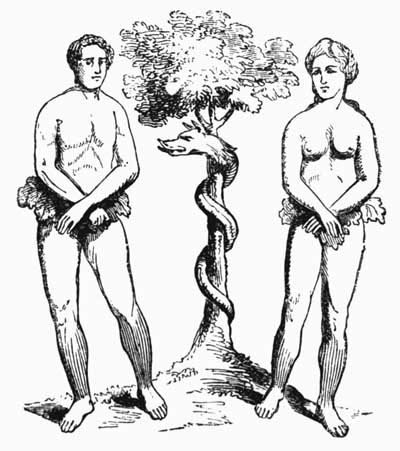
Fig. 62.—The Temptation and Fall.
On a sarcophagus in the Lateran Museum is a bas relief in which Our Lord, as the representative of the Eternal Father, is seen standing between Adam and Eve, and giving to the former a sheaf of grain, the symbol that by the sweat of his brow he should eat bread, and to the latter a lamb, that she may work diligently with her hands in the domestic employment of spinning—the allotted labour of woman in every age. Perhaps, also, as Dr. Northcote suggests, the lamb was a symbol and mute prophecy of “the Lamb of God whom the second Eve was to bring forth to atone for all the evil that the first Eve had brought upon mankind.”
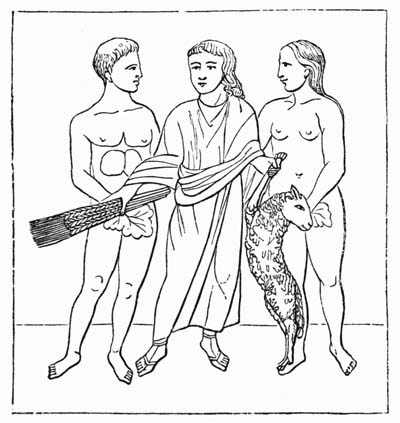
Fig. 63.—Adam and Eve Receiving their Sentence.
On another sarcophagus in the same museum is a bas relief of Cain and Abel offering their respective sacrifices of the fruits of the ground and the firstlings of the flock. This subject, however, is exceedingly rare in the Catacombs.
One of the most frequently recurring figures in this series is that of Noah in the ark. This is always repeated in one unvarying phase of the most jejune and meagre character. There is no attempt at historical representation of the actual scenes of the deluge. Instead of a huge vessel riding upon the waves, with its vast and varied living freight, there is only a small pulpit-like enclosure,[481] in which Noah stands and receives in his hand the returning dove with the olive branch in its mouth. The following engraving, which, although apparently out of perspective, is an accurate copy of a painting in the Catacomb of Callixtus, is a characteristic example.
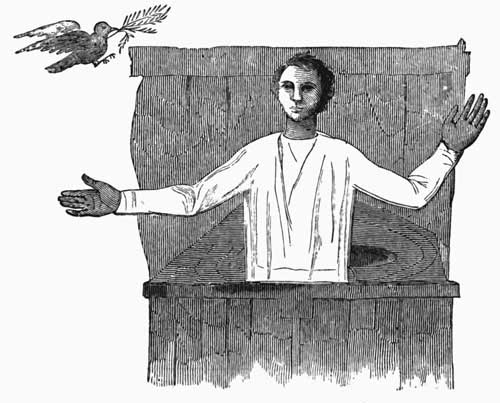
Fig. 64.—Noah in the Ark.
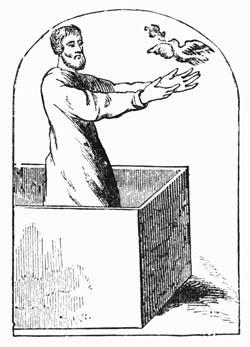
Fig. 65.—Noah in the Ark.
Occasionally the position of the patriarch is slightly altered, as in Fig. 65, from the Catacomb of St. Priscilla; but this is all the variety of treatment of which the artistic genius of the age seemed capable.
In the bas reliefs the treatment of this subject exhibits a still greater degree of degradation and constraint, as in the following examples from Christian sarcophagi of the fourth century.
Sometimes the figure ludicrously resembles the toy called “Jack in a box,” which resemblance is heightened by the lid being half open and a lock being carved on the front.
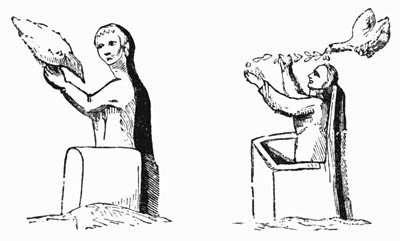
Fig. 66.—Noah in the Ark.
This rude representation, however, was regarded, in accordance with the exposition of St. Peter,[482] as a symbol of Christian baptism; while the ark was the figure of Christ’s church, in which believers “may so pass the waves of this troublesome world that finally they may come to the land of everlasting life.” The dove and olive branch may further imply, that the weary soul, being justified by faith, found peace with God and entered into endless rest.[483]
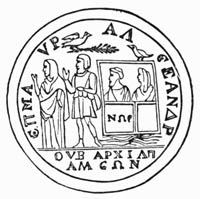
Fig. 67.—Apamean Medal.
Another favourite subject of the early Christian artists was the sacrifice of Isaac, an appropriate type of the greater sacrifice to be offered up when, in the fulness of the time, God should provide himself a lamb for an offering. From this theme the persecuted Christians doubtless often derived spiritual comfort amid the fiery trials of their faith to which they were exposed. It taught also the duty of self-consecration. “May I, like the youthful Isaac,” says Paulinus, “be offered to God a living sacrifice, and, bearing my wood, follow my Holy Father beneath the cross.”[484] This subject is repeated, with considerable variety of treatment, both in frescoes and in sculpture. In Fig. 68, from the cemetery of St. Priscilla, Isaac is seen bearing the wood for the sacrifice. In Fig. 69, from the Catacomb of Marcellinus, he is already bound, and Abraham has stretched forth his hand to slay his son, while the divinely substituted lamb appears from behind the altar.
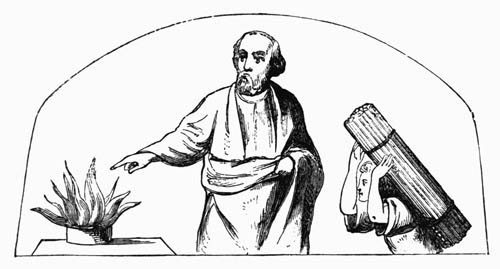
Fig. 68.—The Sacrifice of Isaac.
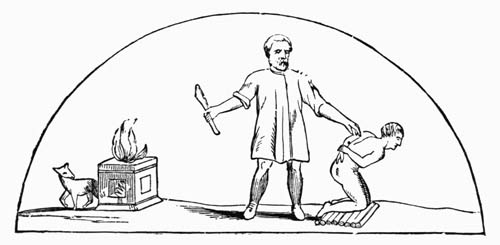
Fig. 69.—The Sacrifice of Isaac.
In several examples a hand stretched forth from on high seizes the knife to prevent the consummation of the sacrifice. (See Fig. 107.) It is recorded that Gregory of Nyssa frequently shed tears on reading this pathetic story.
Joseph, sold by his brethren and afterward saving them alive, was a striking type of Him who redeemed with his own blood the guilty race which caused his death. It is, therefore, a subject that appears with peculiar propriety among the tombs of the primitive Christians.
Several scenes from the life of Moses are delineated in this biblical cycle. One of these, as sometimes treated, for classic grace and dignity reminds one of some noble antique. It is Moses on Mount Horeb putting off his shoes from his feet. This act is interpreted by some of the Christian Fathers[485] as an emblem of the renunciation of the world, the flesh, and the devil demanded of the servants of Christ. The accompanying example, Fig. 70, is from the cemetery of Callixtus.
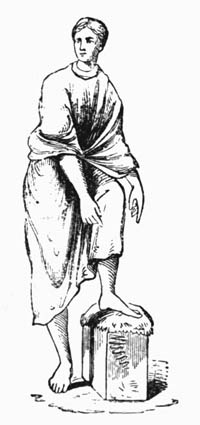
Fig. 70.—Moses on Mount Horeb.
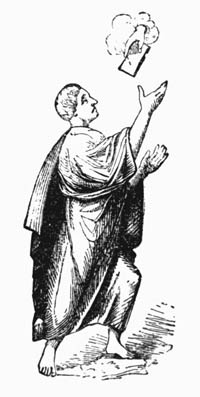
Fig. 71.—Moses Receiving the Law.
Fig. 71, from a sarcophagus in the Lateran, represents Moses on Mount Sinai receiving from the hand of God the law, which was to be the schoolmaster to bring men to Christ. Moses is sometimes exhibited, also, as breaking the tables of the law on his descent from the mount.
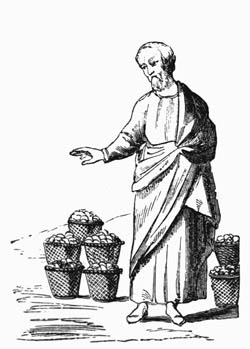
Fig. 72.—Moses and the Baskets of Manna.
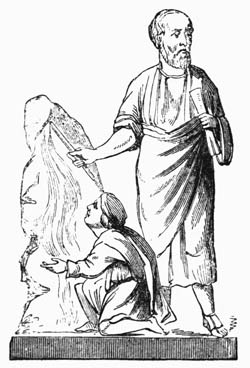
Fig. 73.—Moses Striking the Rock.
In the Catacomb of St. Cyriaca is a unique picture of the descent of the manna—the emblem of the “True Bread which came down from heaven.” It is seen falling in a copious shower, and gathered in the vestments of four Israelites. According to Martigny the accompanying engraving, Fig. 72, from the Catacomb of St. Priscilla, and another in the Callixtan Catacomb, represent Moses standing among the baskets of manna gathered in the wilderness. But for the severe and aged expression of countenance, so different from the youthful aspect of Our Lord in the frescoes of the Catacombs, they might be taken for pictures of Christ and the seven baskets of fragments left after feeding the multitude.
More frequently recurring than any other scene in the history of Moses is that of his striking water from the rock, an emblem of the spiritual blessings flowing to the church through the sufferings of the Messiah, “For they drank of that spiritual Rock which followed them; and that Rock was Christ.”[486] The illustration in Fig. 73 is taken from a sarcophagus found in the cemetery of St. Agnes. That in Fig. 74 is from a fresco of earlier date in the Catacomb of Marcellinus.
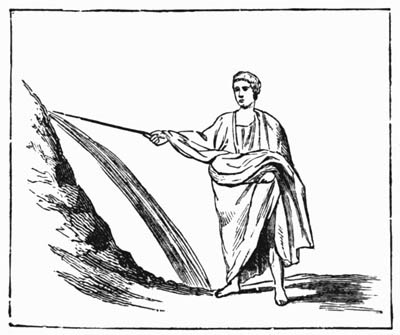
Fig. 74.—Moses Striking the Rock.
In two or three of the gilded glasses to be hereafter mentioned, which are of comparatively late date, this scene is rudely indicated, and over the head or at the side of the figure is the word Petrvs or Peter. From this circumstance Roman Catholic writers have asserted that in many of the sarcophagal and other representations of this event it is no longer Moses but Peter, “the leader of the new Israel of God,” who is striking the rock with the emblem of divine power—a conclusion for which there is absolutely no evidence except the very trivial fact above mentioned.[487]
The sufferings of the patriarch Job form the subject of a few of these scriptural illustrations. In the accompanying illustration, taken from the cemetery of Marcellinus, he is seen sitting in his sorrow and bemoaning the day that gave him birth. Amid their fiery trials of persecution the primitive Christians doubtless often found comfort in contrasting their sufferings with the still more terrible afflictions of the patriarch of Uz.
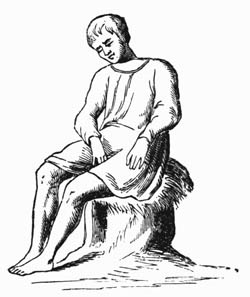
Fig. 75.—The Sufferings of Job.
The sarcophagus of Junius Bassus exhibits a bas relief of Job comforted by his friends. The complaint of the patriarch that even his wife had abhorred his breath—so reads the Vulgate translation of Jerome, which was in use at this period—is grotesquely illustrated by a female figure, who holds a handkerchief to her nose.[488]
The victory of the stripling David over the great champion of the enemies of Israel seemed strikingly to prefigure the triumph of primitive Christianity over the colossal paganism to which it was opposed. It was also the symbol of the victory of Our Lord over a mightier foe than the insolent Philistine; and by some of the Fathers the stones and sling of the Jewish shepherd-lad were likened to the cross of Christ, by which Satan is vanquished and his kingdom overthrown. The devout monarch of Israel was also a recognized type of Him who was the root and the offspring of David, who should inherit his throne, and reign over the house of Jacob forever.
The translation of Elijah was frequently depicted as being typical of the ascension of Our Lord, which was regarded as too sacred a theme for direct presentment in art. The chariot generally resembles the classic quadriga. In a sarcophagal example in the Lateran Museum Elisha is represented as reverently receiving the mantle of Elijah, the emblem of the double measure of his spirit that rested upon him. In the background two sons of the prophets gaze with apparent astonishment on the scene. Two bears, which are also indicated, are probably intended for those that devoured the children who mocked the prophet Elisha on his way to Bethel.
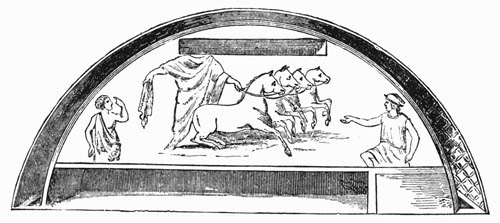
Fig. 76—The Translation of Elijah.
In Fig. 76, from a fresco of earlier date in the Catacomb of Callixtus, it will be seen that graves have been made in the back of the arcosolium, cutting off the head of Elijah and the feet of the two lower figures.
According to the strained mode of interpretation of Roman Catholic writers on this subject, the gift of the mantle of Elijah to his successor in office is a type of Christ’s bestowment of authority upon St. Peter as the “Prince of the Apostles,” and his especial representative on earth. “It would certainly,” says Dr. Northcote, “have reminded the Roman Christians of the pallium, the symbol of jurisdiction worn by the bishops of Rome, and given by them to metropolitans as from the very body of St. Peter—De Corpore Sancti Petri.”[489] A more improbable assumption it would be difficult to imagine. Nobler in conception, which, as well as more scriptural, is the interpretation of this type given by St. Chrysostom: “Elias, in ascending into heaven, let his mantle fall on Elisha: Jesus, when he, too, ascended thither, left the gift of his graces to his disciples—graces which constitute not merely a single prophet, but an infinite number of Elishas, much greater and more illustrious than that one.”[490]
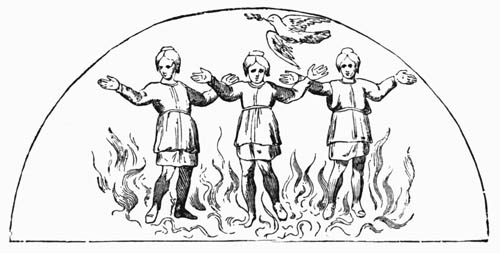
Fig. 77.—The Three Hebrew Children.
The persecuted saints who dared to encounter death and danger in their most dreadful forms rather than deny their faith, found great consolation in the remembrance of God’s deliverance of his servants in the days of old. With the bloodthirsty cry of the ribald plebs of Rome—Christiani ad leones—still ringing in their ears, and, it may be, with the roar of the savage beasts of prey crashing on their shuddering nerves, they were sustained by the thought of the fidelity of those ancient worthies who, for their integrity to God, braved the flames of the fiery furnace and the perils of the lions’ den. The three Hebrew children are generally exhibited with the oriental tiara and tunics. In the foregoing example from the cemetery of St. Priscilla, a dove is shown bringing an olive branch, the pledge of victory and peace.
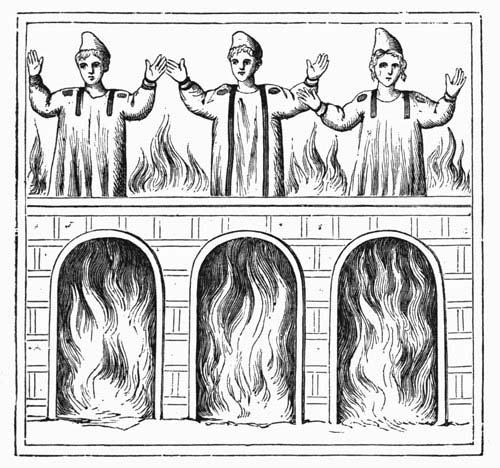
Fig. 78.—The Three Hebrew Children.
In Fig. 78, from the cemetery of Hermes, they are shown as standing in a “burning fiery furnace,” whose flames, though heated seven times hotter than their wont, play lambently around them without even singeing their garments.
In the following example from the Catacomb of St. Agnes the furnace is reduced to a shallow vessel in which the Hebrews stand unhurt. This has been incorrectly interpreted as a representation of martyrdom by boiling in oil. Its association, however, with the figure of Daniel in the lions’ den, and its general resemblance to other groups of the same subject, unquestionably indicate its true character.
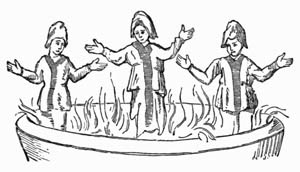
Fig. 79.—The Three Hebrew Children.
In all these the expression of countenance and attitude of the immortal three—more dauntless than even the brave Horatii of classic story—as they stand calmly amid the flames, indicates the presence with them in their fiery trial of the Almighty Deliverer of his saints. It is noteworthy, however, that the fourth figure, “like the Son of God,” is never shown in these groups. It was reserved, as will be hereafter seen, for mediæval art to attempt the representation of the Divine.
The faith and heroism of many of the primitive Christians in refusing to burn incense on the heathen altars, or to salute the statues of the Cæsars, was no unworthy imitation of the fidelity of these Hebrew youths in refusing to worship the great golden image set up on the plains of Dura.
Daniel in the den is generally represented by a nude figure standing between two lions, with his hands stretched out as if in supplication, and thereby, says St. Gregory, conquering the lions by prayer. While, generally, the type of the deliverance of God’s people, it may sometimes by association have been a memorial of the Christian martyrs devoured by wild beasts in the neighbouring Coliseum, whose sands were so often drenched with their gore. The following fresco from the Catacomb of St. Priscilla is a characteristic example. See Fig. 80.
Sometimes another figure, interpreted as “the prophet Habaccuc,” is depicted as borne by an angel by the hair of the head and offering food to Daniel, as described in the apocryphal story of Bel and the Dragon. Another fresco represents Daniel as giving to the monster the cake which he had prepared for its destruction. The story of Tobias and the fish, and of Susanna and the elders, are also illustrated in this remarkable series of paintings. These last are of interest as indicating a familiar acquaintance with the apocryphal books in the early centuries. Figures interpreted as Isaiah, who seems, like the Magi, to come from afar to lay his gifts at the feet of Christ, and as Ezekiel in the valley of dry bones, also occur in the Catacombs.
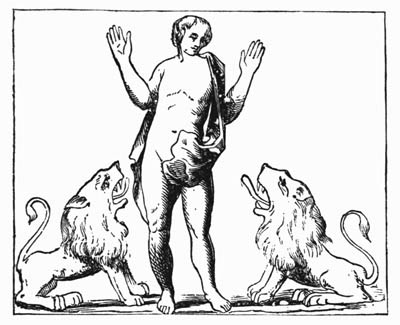
Fig. 80.—Daniel in the Lions’ Den.
One of the most common, and, if we may judge from the style of execution, one of the favourite subjects of mural and sarcophagal presentation in this biblical cycle, is the history of Jonah. It is repeated over and over again with a high degree of picturesqueness, and with greater variety of treatment than, perhaps, any other. It appears also on lamps, vases, medals, gilt glasses, and funeral slabs. The story is generally represented in a series of four scenes: the storm, and the monster of the deep swallowing the prophet; his deliverance from its horrid jaws, and restoration to land; his reclining under the shadow of the gourd for refreshment and rest; and his gloom and anger when the gourd has withered away and he lies in his misery beneath the burning sun. Sometimes the four scenes occupy the four walls of the cubiculum, or the compartments of a vaulted ceiling; or only two may be exhibited, as in the engraving on the opposite page, from the cemetery of St. Priscilla, in which Jonah is portrayed as a child issuing from the mouth of the sea-monster, and afterward reclining under the booth.
Sometimes the whole history is compressed into one crowded scene, as in the following example. (Fig. 81.) The character of the little bark is much like that seen in pagan frescoes.
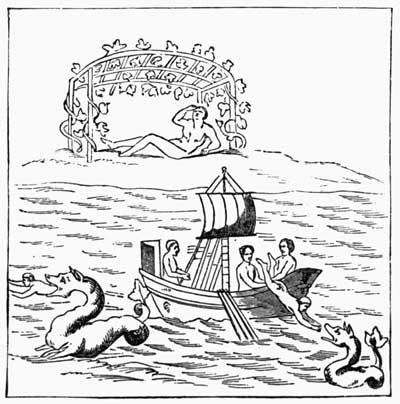
Fig. 81.—The History of Jonah.
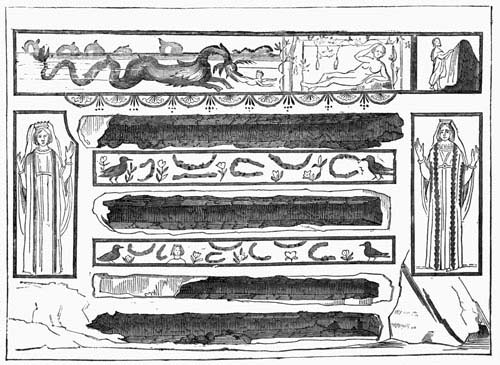
Fig. 82.—Jonah, Moses, and Oranti.
In some instances the “ship” is reduced to a mere boat, and the “mariners” to a single individual, as in Fig. 83, from the cemetery of St. Priscilla.
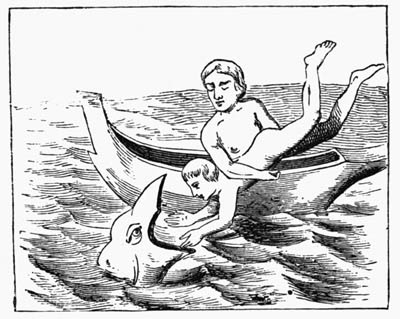
Fig. 83.—Jonah Swallowed by the “Great Fish.”
In the following sarcophagal example, (Fig. 84,) the somewhat startling anachronism of Noah receiving the dove from the prow of Jonah’s vessel appears in the background. The “sea” is here a narrow stream; and the “fish,” a monster with the head and paws of a quadruped, on one side of the boat is swallowing the disobedient prophet, and on the other is casting him forth upon the rocky shores. Such solecisms are by no means uncommon in these groups.
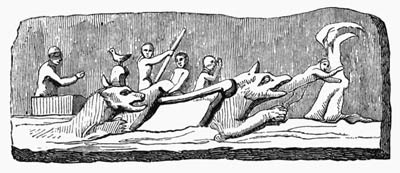
Fig. 84.—Noah and Jonah.
On another sarcophagus in the Lateran Museum the influence of pagan thought may be observed. The storm is personified by a triton blowing through a convoluted shell, and Iris, hovering with floating scarf above the vessel, indicates the calm which followed the casting out of the prophet.
The “great fish” in these scenes bears no resemblance to any living thing. It is generally a monster with contorted body, a long neck and large head, sometimes armed with horns, (see Figs. 81, 82,) probably to distinguish it from the symbolical fish, the emblem of Our Lord, or as a type of “the old serpent, the devil.” The form may have been derived from the mythological representations of the marine monster from whose jaws Andromeda was rescued by Perseus. The latter story, like that of Deucalion and many others in the Greek mythology, probably had its origin in holy scripture.
This subject was naturally dear to the early Christians, inasmuch as it was set forth by Our Lord himself as a type of his own resurrection and that of his disciples. Therefore as the persecuted believers met in those solemn and silent chambers of the dead, they inscribed on the sepulchral slabs which hid the mouldering dust of the departed from their view, or on the walls of the cubicula in which they worshipped, this symbol of faith and hope in the glorious resurrection. It also conveyed a lesson of sublimest meaning to the primitive Christians, called to be witnesses for God in a city greater and more wicked and idolatrous than even Nineveh. It was a potent incentive to fidelity even unto death. The storm-tossed bark, the ravening monster, and the prophet’s booth and gourd, were the types of life’s rough voyage, the yawning grave, and the speedy transit to the bowers of everlasting bliss and the refreshing fruits of the tree of life.
A long and acrimonious controversy was waged between Jerome and Augustine as to the nature of the plant which overshadowed the prophet. Jerome called it ivy; but Augustine retained the word gourd of the older Italic version, and excluded from his diocese of Hippo the Vulgate version of Jerome containing the obnoxious translation. It is a curious commentary on an ancient dispute in the church, and a proof of the antiquity of the Catacombs, that their frescoes seem to have followed the older version, and to have given their testimony against the innovation of Jerome. See Fig. 85, a copy of a broken sepulchral slab, in which the prophet’s booth is reduced to a single branch of a gourd.
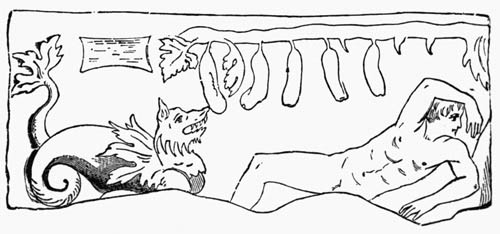
Fig. 85.—Jonah’s Gourd.
Here ends this Old Testament cycle, so rich in holy teaching, all whose types and symbols point to the great Antitype of whom Moses and the prophets spake. The New Testament series will in like manner be found to cluster around the person and work of the Redeemer; to the exclusion, however, of the solemn scenes of the transfiguration, the passion, resurrection, and ascension, which are the principal themes of later religious art; and without the slightest indication of that idolatrous veneration of Mary which is the chief feature of modern Romanism, thus showing how far that church has departed from the usage of apostolic times.
The first subject of this New Testament cycle is the manifestation of Our Lord to the Magi by the star in the east, the sign that the Bright and Morning Star had risen upon the world.[491] Over twenty repetitions of this scene are found in the Catacombs.
The following sarcophagal example, from the Catacomb of Callixtus, represents the Magi bearing their gifts, and led by the star to the place where the young child lay. The babe is seen wrapped in swaddling-clothes and lying in a manger. An ox and an ass stand near the divine child, probably in fanciful allusion to that scripture, “The ox knoweth his owner, and the ass his master’s crib;” as well as in historical illustration of the scene. Joseph and Mary appear in the background as mere accessories of the group.
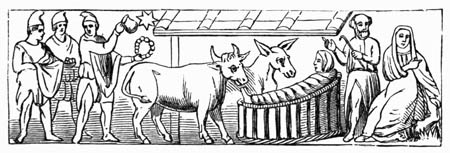
Fig. 86.—The Adoration of the Magi.
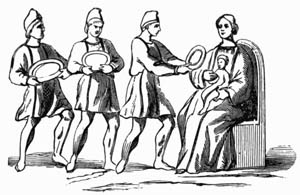
Fig. 87.—Adoration of the Magi.
In the accompanying engraving of a fresco in the cemetery of St. Marcellinus the virgin mother is represented as seated in the calm attitude and dress of a Roman matron, holding the infant Christ in her arms, but not in the least suggesting the modern Madonna.[492] The Magi bring their offerings as the first-fruits of the homage of the world. Sometimes the number is increased to four or reduced to two, in which case they are arranged on either side of the Virgin, to preserve the balance and symmetry of the picture.[493] The figure of Joseph sometimes completes the group, but generally as a young and beardless man, in contradiction to the Romish tradition of his old age, derived from the apocryphal gospels. These legends supply the theme of much of the religious art of the fifth and following centuries; but Dr. Northcote admits that “before that time Christian artists seem strictly to have been kept within the limits of the canonical books of the holy scripture.”[494]
A fresco in the Catacomb of Nereus and Achilles, attributed to the second century, is supposed to be the oldest extant art-presentation of the Virgin Mary. In these early pictures she is generally exhibited as veiled, and expressing dignity and modesty in her attitude and dress, and only in her historical relation to the divine child. Not till later does she appear alone, or even as the principal figure. Dr. Northcote, indeed, cites one example apparently of Joseph,[495] Mary, and the infant Jesus, concerning which he says that the Virgin does not enter into the composition as a secondary personage, but herself supplies the motive to the whole painting.[496] In the engraving which he gives, this indeed appears to be the case; but in the original, and in the copy given by De Rossi,[497] which shows the entire painting, the figure of the Virgin is only a very small and subordinate portion of an elaborate decorative design, and its position is not upright, as if it were the principal object, but horizontal, as being only accessory to the main grouping. All these early presentations of the Virgin Mary, says Mr. Marriott,[498] occur only in such connexion as is directly suggested by holy scripture, and none of them would appear out of place in an illustrated English Bible, so different are they from the Madonnas of Roman Catholic art.
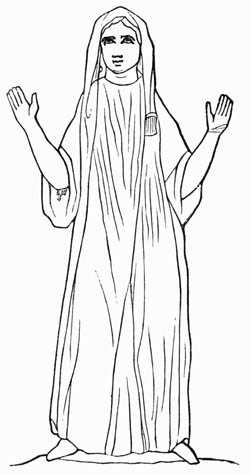
Fig. 88.—Orante.
There are numerous frescoes in the Catacombs of persons, both male and female, in the attitude of prayer, hence called Oranti, (see Fig. 82,) and the accompanying simpler example from the cemetery of Sts. Peter and Marcellinus. These are frequently found on sepulchral slabs, the sex and apparent age of the Orante always corresponding with that of the person named in the inscription. They are generally regarded, therefore, as portraits of the departed, and as probably indicating that they lived a life of prayer, and died in the faith. Thus the oranti, in Fig. 82, are thought by Perret to be intended for Priscilla, in whose cemetery it is found, and her companion.[499] It is at least most likely that they represented the deceased and not another, in the same manner as modern sepulchral effigies, and as the pictures of fossors, vine-dressers, and handicraftsmen in the Catacombs. Dr. Northcote at one time admitted this explanation of these figures. “We can scarcely err,” he says, “in supposing them to be the persons, whoever they were, who were buried in these chambers.”[500] But in his later work on the Catacombs he says, “Possibly this conjecture may sometimes be correct, but in the majority of instances we feel certain that it is inadmissible;”[501] and he claims them as representations of the Virgin Mary, or as symbols of the Church, the Bride of Christ, whose life on earth is a life of prayer. This is manifestly the intention, he asserts, when, as is frequently the case, the figure is found as a companion to that of the Good Shepherd; and he gives an engraving from Bosio of one such, which is catalogued as the “Good Shepherd and the Blessed Virgin.”[502] But in referring to Bosio this figure is found to be not the Virgin Mary at all, but a Christian martyr, as is indicated by the attribute of a plumbata, or leaden scourge, painted beside her, which is omitted in Dr. Northcote’s engraving, (inadvertently, as he explains;) and she is designated by Bosio, Una Donna Orante—a woman in the act of prayer. And this figure is the only one out of all figured by Bosio and Aringhi which at all agrees with Dr. Northcote’s description. The others when associated with the Good Shepherd are either in groups of two or more, or are mixed with male oranti, the existence of which Dr. Northcote seems to ignore.
But even if the Virgin Mary were referred to in these paintings it would prove nothing in favour of modern Mariolatry. Indeed, nothing could be more striking than the contrast between these simple praying figures, undistinguished by any attribute from others of the pious dead, and the crowned Queen of Heaven receiving the homage of mankind, of later Roman Catholic art. But that they are such is an entirely gratuitous and unwarranted assumption; and with equal propriety, or rather lack of it, they have been interpreted by the monkish ciceroni of the Catacombs as symbols of martyrdom, as portraits of living persons praying to the dead, and as saints in heaven praying for men on earth.[503]
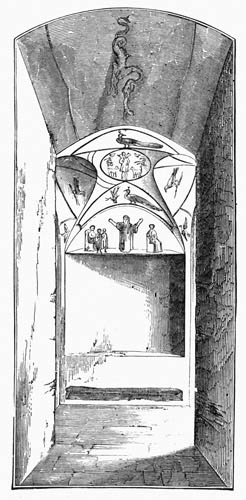
Fig. 89.—Supposed Madonna.
In the gilded glasses, to be hereafter described, which belong to a period of very degraded art, probably from the fourth to the sixth century, representations of the Virgin mother sometimes occur, recognized by her name written above her head after the Byzantine manner. She appears either alone, or between figures of the apostles Peter and Paul. This honour, however, is shared by other female saints, especially by Saint Agnes. In one example Mary wears a nimbus, a proof of comparatively late date.
One fresco in the Catacomb of Sts. Thraso and Saturninus has been supposed to have some reference to the Virgin Mary. It is figured in the lunette of the vault in the accompanying engraving. (Fig. 89.)[504] It is interpreted, however, by Bottari, a distinguished Romanist antiquary, as not a painting of the Madonna at all, but simply of a family group.
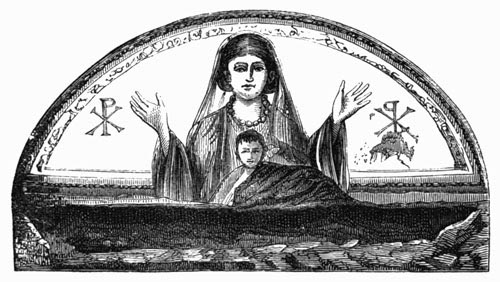
Fig. 90.—The Earliest Madonna.
The first art-presentation of the Virgin Mary bearing any resemblance to the conventional Madonna, which has been so endlessly reproduced and so idolatrously honoured throughout Roman Catholic Christendom, is one in an arcosolium in the Catacomb of St. Agnes. (See Fig. 90.) The head of the Virgin is veiled, a necklace of pearls adorns her person, and her hands are extended in prayer. The infant Christ is not seated, but standing before her, as is common in a favourite type of the Greek church, especially in Russia—an indication that this was probably painted by a Byzantine artist, as was most of the later work at Rome. But even in this picture the early Christians, unprescient of the Mariolatry of the future, would see the expression only of a loving regard for her who was pronounced the “blessed among women.” The sacred monogram on either side assigns a date not earlier than the fourth century to this painting; and Martigny, an eminent Romanist authority, thinks it is later than the Council of Ephesus, in the fifth century,—A. D. 431.
By this time a sad departure from primitive orthodoxy of belief had already taken place. The blasphemous title Theotokos, Mother of God, since so unhappily familiar,[505] had been applied to the Virgin Mary, at first in protest against the Arian heresy which denied the divinity of Our Lord, and not in exaltation of his virgin mother. Nestorius strongly objected to the unwarranted and antiscriptural title, and suggested that of the mother of Christ. An angry controversy resulted, to appease which Theodosius the younger assembled the Council of Ephesus. Nestorius was judged without being heard, degraded from the episcopal dignity, and sent into exile; and the obnoxious epithet was confirmed through the exercise of fraud and violence. Flavianus, a member of the Council, actually died of wounds received in that turbulent assembly; and amid these disgraceful scenes was first formulated this dogma, which has been fraught with such perilous consequences to both Greek and Latin Christianity.
The artistic embodiment of this doctrine underwent a rapid decline. The sweet and tender grace of the virgin mother disappears, the modest veil gives place to a crown, she becomes vulgarized in expression, jewels bedizen her person, the attitude becomes stiff and lifeless, the countenance darkens and assumes an expression of pain rather than that of gentleness and peace, and the innocent smile of the Divine Infant gives place to an unnatural severity and gloom. The beginning of this decline is seen in the Madonna already described, (Fig. 90), in which the person of Mary is adorned with a showy necklace of jewels. This type passes by rapid gradations, during the gathering gloom of the dark ages, into the anguished pictures of the Mater Dolorosa, bowed down with sevenfold sorrows, and the gross images of Our Lady of the Bleeding Heart, her bosom transpierced with a naked sword.[506] But even in this is seen the striking moral contrast between the spirit of Christian and that of pagan art. The loftiest ideal of the latter is the expression of mere corporeal beauty, while the former exhibits the noblest type of purity, sorrow, and love the world has ever seen. With the Renaissance this ideal became the inspiration of art, and gave birth to those triumphs of genius which kindle admiration in the coldest nature, and invest with a spell of pathos and power a dogma which the judgment rejects.
The silence of the primitive Fathers concerning the worship of Mary is a striking evidence of its non-existence, and their language when they do speak of her still more strongly demonstrates that fact. Tertullian seems to infer her lack of faith in the mission of Our Lord, and compares her unfavourably with Martha and Mary.[507] Prudentius refuses to ascribe to her absolute sinlessness.[508] Augustine asserts the natural depravity of her flesh.[509] Chrysostom boldly accuses her of ambition and thoughtlessness,[510] and says, “She shall have no benefit from being the mother of Christ unless in all things she doeth what is right.”[511] Cyril of Alexandria, Basil of Cæsarea, and Hilary of Poitiers, speak in similar unequivocal terms, which Petavius, the Roman theologian, says are not fit to be uttered.[512] The Collyridian heretics, indeed, rendered idolatrous homage to Mary;[513] but Epiphanius vehemently denounces the practice as blasphemous and dangerous to the soul. “Let Mary be held in honour,” he says, “but let her not be worshipped.”[514] Irenæus first points out the fanciful antithesis between Mary and Eve, which was afterward so remarkably elaborated in Roman thought and diction.[515] Ephraem Syrus and Gregory Nazianzen, indeed, speak of her invocation in prayer, but this was an honour already bestowed on numerous other saints. The heathen writers, moreover, who accused the Christians of worshipping a mere man, as they considered Christ, would surely have brought a similar accusation on account of the worship of Mary if it were known; but we nowhere find that this was done. Indeed, it is probable that the contumely and opprobrium with which the heathen spoke of the mother of Our Lord may have intensified into superstitious veneration the loving reverence with which she was regarded in the primitive ages. Tertullian quotes the blasphemous pagan epithet, “the harlot’s son,” applied to Christ in allusion to his miraculous birth.[516] It has been reserved for a gifted modern poet, as pagan and skeptical in sentiment as Lucretius, to parallel, or even surpass, this revolting impiety.[517]
The testimony of the early Christian inscriptions is not less strikingly opposed to the modern Mariolatry of the church of Rome. “In the Lapidarian Gallery,” says Maitland, “the name of the Virgin Mary does not once occur. Nor is it to be found in any truly ancient inscription contained in the works of Aringhi, Boldetti, or Bottari.”[518] No Ave Maria or Ora pro nobis, no Theotokos or Mater Dei, occurs in any of the subterranean crypts or corridors of the Catacombs. Even the name Maria, now so commonly applied in varying forms to both males and females throughout Roman Catholic countries, does not occur till the year 381, and only twice afterward, in 536 and 538—an evidence of the entire absence of that devotional regard now lavished upon the Virgin Mary.[519]
This religious homage was only gradually developed to its present full-blown idolatry. Its traces in early Christian art are extremely infrequent and obscure. In the numerous mosaics of the fifth and sixth century at Rome and Ravenna, the figure of Mary very rarely occurs, and never but as accessory to the Divine Child in the Nativity or Adoration of the Magi. In these there was no attempt at literal portraiture, but only the expression of the virtues that adorned her character; “that,” as Ambrose expresses it, “the face might be the image of her mind, the model of uprightness.”[520] Indeed, Augustine expressly asserts that we are ignorant of her appearance.[521]
During the seventh century, along with a progressive barbarism of treatment may be observed a gradual exaltation of Mary in the Roman mosaics to those places previously devoted to the image of Christ.[522] In the eighth century, according to D’Agincourt, “the homage paid to her was no longer distinguished from that rendered to the Lord of all;”[523] and the Council of Constantinople decreed, “that whoever would not avail himself of the intercession of Mary should be accursed.”[524] In extant pictures of the ninth century she is exhibited in bejewelled purple robes as the crowned Queen of Heaven, receiving the homage of the four and twenty elders and of the celestial hosts.[525] In this century also the legend of her bodily assumption to the skies, which has since become such a prominent theme in Roman Catholic art and doctrine, is first represented in the crypts of St. Clement’s at Rome.[526]
In the twelfth and thirteenth centuries the apotheosis of Mary is complete. In a fresco at Rome, of date 1154 A. D., Popes Callixtus II. and Anastasius IV. are shown embracing her feet in adoration, and transferring to the human mother the homage due alone to the Divine Son. She is now worshipped co-ordinately with Christ, or, indeed, almost to his exclusion, her name being substituted for his in many of the collects of the church. Much of the language of Scripture was also blasphemously perverted from its proper application to her. The glowing images of the Song of Songs, addressed to the church as the spouse of Christ, were also applied to Mary as her right; and one of Rome’s most common and popular books of devotion of this period, the psalter of her “Seraphic Doctor,” St. Bonaventura, has a shocking parody on the book of Psalms, in which the name of God was every-where expunged and that of Mary substituted instead.[527] The Ave Maria, with its human additions, was regarded as of equal importance and value with the Lord’s Prayer, and was made the basis of the vain repetitions of the rosary. Mary now shares the government of heaven and earth, “raised higher than cherubim and seraphim,”[528] throned in glory, sitting on a rainbow, enveloped in an aureole, clothed with the sun, the moon beneath her feet, a crown of stars upon her head,[529] and radiating from her person beams of light, the proper attribute of deity.[530] She is frequently represented, even in heaven, with the infant Christ in her arms, a mere accessory to indicate her personality, as if to show his relative inferiority.[531] She becomes, too, herself the object of prayer, having a special litany and numerous offices in the liturgy of the church; while her praises are chanted in some of its noblest lyrics. She is addressed as the gate of heaven,[532] the morning star,[533] and the refuge of sinners;[534] and is exhorted to succor the wretched,[535] protect from enemies, receive in the hour of death,[536] and intercede with God for men.[537] She is endowed with the faculty of omniscience and ubiquity, and is made almost to thrust the Eternal from his throne by her usurpation of his divine prerogatives.[538]
But this impious blasphemy seems to have culminated in the Italian frescoes of the fifteenth century, in which the infamous Giulia Farnese is exhibited in the character of the Madonna, and Pope Alexander VI., the execrable Borgia, kneeling as a votary at her feet. The Florentine churches, too, were desecrated by portraits of well-known harlots, flaunting their meretricious beauty as the personations of the mother of Our Lord. For his denunciation of these profanations and of other impieties Savonarola perished at the stake.[539]
The rapid development of Mariolatry, the great corruption of Christianity, as Hallam has justly called it, may to some extent be regarded as a reaction against the harsh and austere character which was given to Our Lord both in art and dogma. He was enthroned in awful majesty as the dreadful Judge of mankind. Removed from human sympathy, inspiring only terror to the soul, he was no longer Christ the Consoler, but Christ the Avenger.[540] Religion was darkened by dismal bodings of endless doom, and embittered by the fierceness of polemic strife; and the moral atmosphere seemed lurid with the hurtling anathemas of rival sects. To the yearning hearts of mankind; to the multitude of the weary and the heavy laden, to whom the Saviour’s voice, “Come unto me, and I will give you rest,” was inaudible amid the conflicts of the times; and especially to those bowed down with a sense of sin and sorrow, and trembling at the thought of the severe, inexorable Judge, the gentle gospel of Mary came with a sweet and winning grace that found its way into their inmost souls. All images of tenderness and ruth surrounded her. The blending
Of mother’s love with maiden purity[541]
touched the hidden springs of feeling which exist in the rudest natures, and made the worship of Mary a religion of hope and consolation. She became the new Mediatrix between the sinful human soul and the Father in heaven. Those who shrank from God fled for succour to the virgin mother. The pitifulness of her human nature was esteemed a stronger ground of confidence than that infinite compassion and everlasting love which was manifested in the agony and bloody sweat of Gethsemane and the cross and passion of Calvary. Hence Mary has often been regarded as a sort of tutelar divinity by the ferocious brigand who stained with blood the scapular which he wore as a sacred talisman; and by the daughter of shame who, in strange blending profligacy and devotion, cherished her image in the very lair of vice.
But, as there is a soul of goodness in things evil, so even the antiscriptural perversions of Mariolatry were not without some moral benefit to mankind. In a coarse, rude age a new ideal of excellence was developed. A morose asceticism was spreading on every side, denouncing the sweet and gentle charities of hearth and home, and forbidding the love of wife and child to those who would attain to the heights of holiness. Woman was degraded as a being of inferior nature, regarded as “a necessary evil,” and forbidden, as unworthy, to touch with her hand the sacred emblems of the passion of Christ. But this cultus of Mary raised woman to a loftier plane of being, invested her with a moral dignity and power infinitely superior to any thing known to pagan times, and called forth a deeper reverence and more chivalrous regard.
This example of all womanhood, So mild, so merciful, so strong, so good, So patient, peaceful, loyal, loving, pure,[542]
ennobled and dignified the entire sex, and therefore raised and purified the whole of society. The worship of sorrow softened savage natures to more human gentleness, and ameliorated the horrors of long dark centuries of cruelty and blood.
We have dwelt thus long on this development of Romanism on account of the remarkable prominence and enhanced dignity it has received by the bull of the Immaculate Conception, issued on the individual authority of the present pontiff,[543] and by the decree of his personal infallibility imposed on all Roman Catholic Christendom. We have seen how alien it is to the entire spirit and teachings, both in art and literature, of the primitive church, and have traced its growth with the decline of Christianity, like a fungus on a dying tree, till it has sapped its very life, and concealed its early beauty and strength beneath deformity and decay.
The other groups of the New Testament cycle are chiefly scenes in the life of Our Lord, together with representations of some of his principal miracles and two or three illustrations of the parables. This series, it must be confessed, is of exceedingly meagre character and limited range, being remarkable as much for what it omits as for what it contains. Out of the vast number of subjects which have been treated in later religious art, a comparatively few have been selected, which are over and over repeated with unvarying iteration of type.
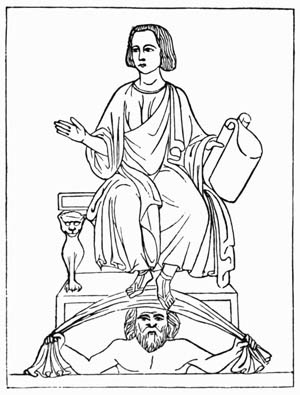
Fig. 91.—Christ with the Doctors.
The accompanying bas relief, from the sarcophagus of Junius Bassus, (A. D. 359,) is probably intended for Christ “sitting in the midst of the doctors, both hearing them and asking them questions.”[544] He is here shown seated on a curule chair, wearing a Roman toga, and holding a half open scroll in his hand. His feet rest on a scarf held by an allegorical figure, probably a personification of the earth—a conception borrowed from Pagan art.
Frescoes of the baptism of Our Lord occasionally occur;[545] but the scenes of the temptation, the subject of such grotesque treatment in mediæval art, nowhere appear in the Catacombs.
On a sarcophagus in the Lateran Museum is an illustration of Our Lord’s first miracle at Cana of Galilee, in which he is touching the water-pots with his rod of power and turning the water into wine.
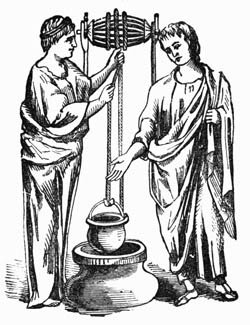
Fig. 92.—Christ and the Woman of Samaria.
Christ talking with the woman of Samaria at the well of Sychar is a subject that is frequently repeated in fresco and relief. In the accompanying example from a sarcophagus in the Lateran, a windlass of primitive construction, like those still common in the Campagna, is shown.
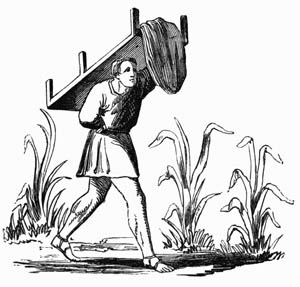
Fig. 93.—The Healing of the Paralytic.
The healing of the paralytic has been regarded as a type of the restoration of the soul paralyzed by sin. Ingenious Romanists have discovered herein a symbol of “the Sacrament of Penance,” and also of “Baptism and the Remission of Sins.” In the frescoes of the Catacombs the man is represented in the act of obeying the command, “Take up thy bed and walk.” Sometimes the bed is a mere reticulated frame-work. It is also shown as in the foregoing example from the Catacomb of Callixtus. See Fig. 93.
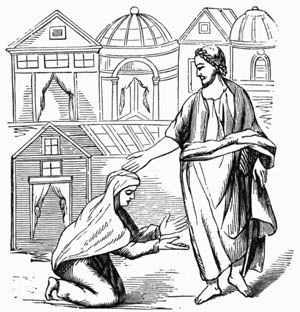
Fig. 94.—Christ Healing the Woman with the Issue of Blood.
Our Lord healing the infirmity of the woman with the issue of blood, who drew nigh and touched the hem of his garment, is a frequent subject of both sarcophagal and mural presentation. In the accompanying example from a bas relief of the fourth century the Saviour is apparently uttering the words, “Daughter, be of good comfort, thy faith hath made thee whole.” In the background is seen, in confused perspective, a Christian basilica of the period, with its semicircular absis and detached baptistery. The doors are hung with heavy curtains to exclude the noontide heat, as is still common in Italian churches.[546]
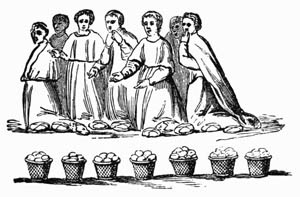
Fig. 95.—The Miracle of the Loaves and Fishes.
The miracle of the multiplication of the loaves and fishes is a theme of frequent treatment in early Christian painting and sculpture, and was regarded in the writings of the Fathers as a eucharistic type of Him who, as the true Bread from heaven, gave his body to be broken for the life of the world. Sometimes, as on a sarcophagus in the Lateran, Our Lord stands between two disciples blessing with either hand the food which they hold. Occasionally, as in the foregoing fresco from the cemetery of St. Priscilla, the scene is represented by a group of disciples kneeling on the ground as if they had just received the food so marvellously multiplied. At their feet are seen the loaves and fishes, and in the foreground stand the seven baskets full of fragments that remained.
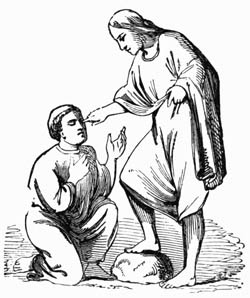
Fig. 96.—Christ Opening the Eyes of the Blind.
The miracle of opening the eyes of the blind, which was at once a fulfillment of the ancient prophecies concerning the Messiah and a type of that moral illumination which he should impart, appropriately found a place on the tombs of those who had been called from darkness into God’s marvellous light. The preceding example is from the Catacomb of Callixtus.
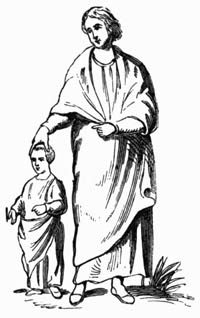
Figure 97.—Our Lord blessing a little Child.
Our Lord laying his hand in blessing on the head of a little child, or probably teaching humility and rebuking the ambition of his disciples by setting a child in their midst, is a frequently recurring subject in this primitive cycle. It was a lesson which the early Christians of Rome had often to learn: that he that would be greatest among them must be the servant of all; that exaltation of office was only pre-eminence of danger and of toil. The example above given is from the Catacomb of Callixtus.
A bas relief in the Kircherian Museum, of the parable of the sower and the seed, appropriately symbolized the sowing in the furrows of society of the good seed of the kingdom, from which should spring a harvest of righteousness. The frequent representations of fishing scenes may refer to the occupation of several of the first disciples of Our Lord, or to their spiritual vocation as fishers of men. In these, however, Roman Catholic writers have fancied an allusion to the sacrament of baptism. We have already seen in the ever-recurring figure of the Good Shepherd an illustration of the beautiful parable of the lost sheep, and a most appropriate symbol of the Shepherd and Bishop of all souls. In the Catacomb of St. Agnes is a fresco of the five wise virgins of the parable going forth to meet the bridegroom, and it is so designated by Bosio.[547] Each of the virgins bears in her hand the vessel of oil to replenish her lamp; the foremost holds a torch or candle of wax, anciently much used in Roman marriage processions,[548] as it still is; while the others bear branches of palm in token of festivity. A distinguished Roman theologian has, however, with perverted ingenuity, discovered in the vessels of oil the modern ecclesiastical situlæ, or holy-water vases, and in the radiant torch of the foremost figure the tufted aspergillum with which the holy water is sprinkled.[549]
The story of Lazarus, as we may easily conceive, was an especial favourite of the early Christian artists. It spoke to the deepest feelings, and inspired the loftiest hopes of the primitive believers. Rescued from the darkness and despair of paganism as to the future state of the soul, they grasped with intensest fervour the glorious doctrine of its immortal existence and of the resurrection of the body. Amid the gloom of the Catacombs, and surrounded by the silent congregation of the dead, they heard with joy the thrilling words, “I am the Resurrection and the Life,” and laid their loved ones to their rest, not with everlasting farewells and passionate complainings at the gods, but exulting in the hope of a blessed immortality. Therefore they engraved on the funeral slab, or painted on the tomb, this record of Christ’s triumph over death, as a symbol of that hope which kept their hearts strong in life’s trial hour. These representations are of every degree of artistic merit, from the rudely scratched and scarcely intelligible outline, to the elaborately sculptured bas relief on the costly sarcophagus. Of the former the annexed is perhaps the simplest example to be found. It is of date A. D. 400.
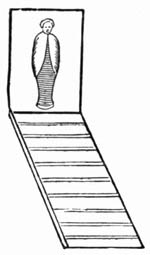
Fig. 98.—Lazarus.
Lazarus is generally exhibited as a mummy-like figure, “bound hand and foot with grave-clothes,” standing in a temple-shaped tomb or ædicula, like those which line the Appian Way. This figure Our Lord, the Prince of Life, is touching with the rod of his power, as shown in the accompanying fresco from the Catacomb of Sts. Peter and Marcellinus.
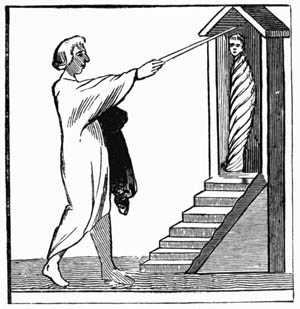
Fig. 99.—The Raising of Lazarus.
The figure of Mary, frequently of very diminutive size, setting all proportion at defiance, is often depicted as crouching at the feet of Jesus, and sometimes as kissing his hand in gratitude for restoring her brother to life. Sometimes, also, Martha is seen standing by the tomb, and the disciples standing around Jesus. The following engraving, from a sarcophagus in the Lateran, is a characteristic example of the ordinary type.
A much less frequent subject of art-presentation was Mary Magdalene holding in her hands the “alabaster box of very precious ointment,” wherewith she anointed Our Lord.
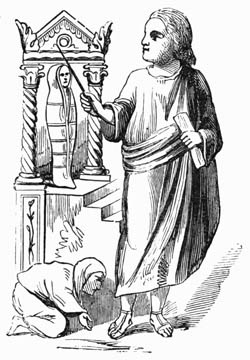
Fig. 100.—Raising of Lazarus.[550]
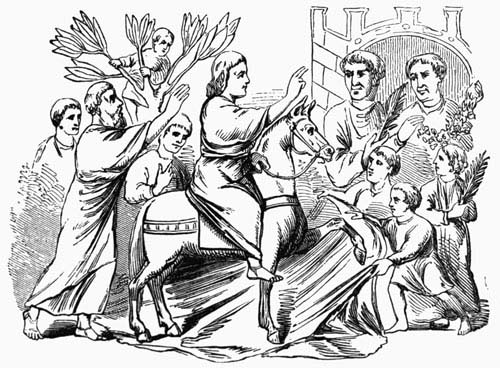
Fig. 101.—Christ’s Triumphal Entry into Jerusalem.
Christ’s triumphant entry into Jerusalem, the presage and symbol of his final victory in the world and entrance as the King of Glory into the New Jerusalem on high, occurs with great frequency and considerable variety of treatment. Although dissociated from this scene in the gospel narrative, Zacchæus is almost invariably connected therewith in this primitive art, and generally appears mounted in a a tree gazing at the procession. At times the scene is reduced to its simplest elements; at others, as in Fig. 101, from a sarcophagus in the Lateran, it is more elaborately treated, exhibiting the multitudes spreading their garments, and strewing branches of palm before the meek conqueror.
Peter’s denial of his Master is a theme that is frequently repeated. The cock, whose crowing awoke the disciple’s late remorse, without which it would sometimes be impossible to discriminate the scene, is generally shown, as in the following sarcophagal example from the Lateran Museum.
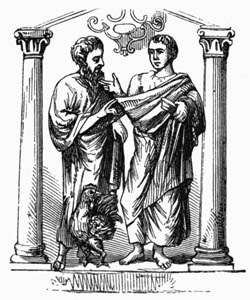
Fig. 102.—Peter’s Denial of Christ.
As we have already remarked, the tragic scenes of the passion of Our Lord find no place in this primitive cycle. These were felt to be subjects for devout meditation rather than for pictorial treatment. The early Christians preferred to contemplate Christ rather as the victor over death and hell, than as the victim of suffering and shame. “The agony, the crown of thorns, the nails, the spear,” says a distinguished critic of this primitive art,[551] “seem all forgotten in the fullness of joy brought by his resurrection. This is the theme, Christ’s resurrection, and that of the church in his person, on which, in their peculiar language, the artists of the Catacombs seem never weary of expatiating; death swallowed up in victory, and the victor crowned with the amaranth wreath of immortality, is a vision ever before their eyes, with a vividness of anticipation which we, who have been born to this belief, can but feebly realize.”
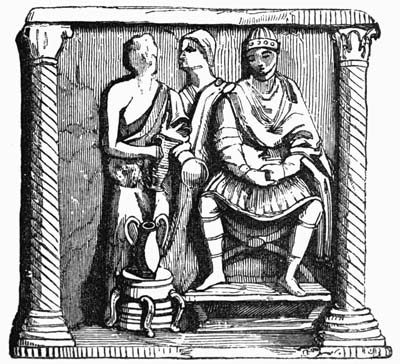
Fig. 103.—Pilate on the Judgment Seat Washing his Hands.
The only scenes connected with the passion, besides that of the denial, already given, are those which occurred in the judgment-hall of Pilate, and a unique example of Simon bearing the cross. One scene in particular seems to have been selected rather as a testimony of Christ’s innocence than of his sufferings. It is that in which Pilate declares, “I have found no fault in this man;” and calling for water washes his hands, as if to blot out the damning guilt of that judicial murder. In the accompanying engraving, from a mutilated bas-relief in the Lateran Museum, this scene is exhibited. In the original the face of the irresolute governor seems to express compunction at this perversion of justice to which he is yielding. In the background is seen the profile of his wife, as though uttering her solemn admonition against the impending crime. The servant with the ewer and empty basin appears in conformity with the oriental ablutionary custom of pouring water upon the hands.
In the last compartment to the right of the remarkable sarcophagus in the Lateran, represented in Fig. 104, this scene is repeated. Associated therewith in the next adjoining compartment are two figures interpreted as Christ, guarded by a Roman soldier, witnessing a good confession before Pontius Pilate. The crown above the head of the latter, if not a mere architectural decoration, may indicate the reward of those who confess Christ before men.
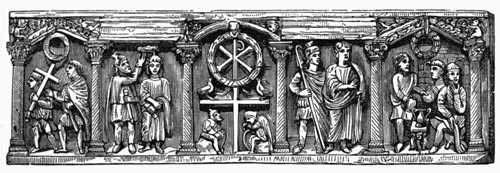
Fig. 104.—Sarcophagus in the Lateran Museum.
This sarcophagus exhibits, as Dr. Northcote admits, “the nearest resemblance to the later representations of Our Saviour’s Passion to be found in early Christian art.”[552] The Constantinian monogram in the central compartment has been already described.[553] To the left is seen the figure of Christ crowned, not with thorns, but, as if symbolizing his crown of rejoicing on high, with a garland of flowers. The last compartment exhibits Our Lord, or, more probably, Simon the Cyrenian, bearing the cross under the guard of a Roman soldier. “But there are none of the traces of suffering,” says Dr. Northcote, “with which later artists have familiarized our imagination, and the crown above points to the reward for bearing the cross after our suffering Master.”[554] In one instance the Roman soldiers are shown smiting Our Lord on the head with a reed;[555] but no nearer approach to the consummation of the supreme sacrifice of Calvary is ever attempted.
Neither are the august themes of Christ’s resurrection and ascension historically treated in this biblical cycle, but only under the Old Testament types of Jonah and Elijah. One group, hypothetically interpreted as the Noli me tangere, or Our Lord saying to Mary on the morning of the resurrection, “Touch me not, for I am not yet ascended to my Father,” more probably represents the gratitude of Mary for the resurrection of her brother Lazarus. Numerous frescoes of seven men eating a repast of bread and fish may refer to Our Lord’s appearing to his disciples on the sea-shore, or to the celebration of the Agape.
We find only one event subsequent to the ascension occasionally represented on the early Christian sarcophagi, namely, the apprehension of Peter,[556] which was probably regarded as a type of his being finally bound for his crucifixion. He is to be discriminated from Our Lord arrested by the Roman soldiers by his bearded face, and by the Jewish caps, which mark the satellites of Herod Agrippa. It is remarkable that so little reference is made to St. Peter in this early Christian sculpture, and that little indicating no degree of superiority over the other apostles; and the fact is inexplicable on the Roman theory of his primacy in the so-called Apostolic College. In the still earlier frescoes of the Catacombs he is nowhere especially designated by name or attribute. The only apostle distinguished from the rest of the twelve is St. Paul, who, in a fresco in the Catacomb of St. Priscilla, is seen side by side with the Good Shepherd, and indicated by the inscription—PAVLVS PASTOR APOSTOLVS.[557] Indeed, this was the especial title of St. Paul as being “in labors more abundant” than any of the apostles.[558] Even on the sarcophagi St. Peter is only once or twice exhibited as bearing the symbolical rod of power, and these examples may be of the fifth or sixth century. In certain of the gilt glasses already mentioned he is allegorically portrayed, instead of Moses, as smiting the rock, implying the opinion that he was in some sense the representative of the latter in the New Testament economy. But these glasses are of comparatively late date, when the notion of the primacy of St. Peter was already partially developed; and even in these St. Peter and St. Paul are often found side by side, without any sign of the superiority of the former.
It is easy to discriminate in early Christian art between the two apostles so highly honoured at Rome[559] by the strongly marked conventional types to which their portraits almost invariably conform. St. Paul is characterized by the nobler form of face, a high, bold forehead, aquiline Jewish nose, dark hair and eyes, a flowing and pointed beard, and a refined and thoughtful expression of countenance as became one brought up at the feet of Gamaliel and instructed in all the wisdom of Greek philosopher and Hebrew sage. The Galilæan fisherman is represented with strongly-knit frame, broad rustic features, short gray hair, a thick and closely curling beard, generally of silvery white, and an expression of much force and energy of character.[560] It is probable that these types were derived from authentic tradition if not from actual portraits.[561] Eusebius, Augustine, and others of the Fathers, claim to have seen representations of these apostles preserved in painting; and the reputed portraits alleged to have been sent by Pope Sylvester to the Emperor Constantine are annually exhibited at St. Peter’s for the veneration of the faithful.[562]
Nowhere in the Catacombs do we find the least support for the notion that St. Peter is in any sense the founder of the church in Rome, much less the rock on which the church universal is built. That honour is assigned in early Christian art, as it is by the apostle himself, to Jesus Christ, the “chief corner-stone, elect, precious.”[563]
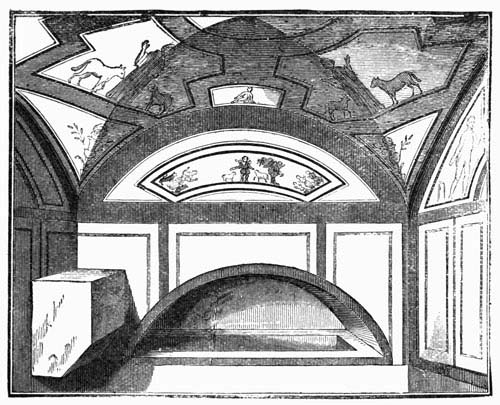
Fig. 105.—Painted Chamber in the Catacomb of St. Agnes.[564]
These biblical pictures, we may here remark, are not grouped indiscriminately, but are often arranged in a regular order having reference to their doctrinal signification. The walls and ceilings of the cubicula are frequently divided into compartments of geometrical design, as shown in the preceding engraving of a chamber in the Catacomb of St. Agnes. See also Figs. 82 and 89.
Sometimes the paintings of a chamber are as closely related as the parts of a chapter in systematic theology. Thus on account of their common reference, as he conceives, to the sacraments of baptism and the eucharist, De Rossi designates as liturgical paintings certain pictures in the Catacomb of Callixtus.[565] An allegorizing spirit, however, will often discover a meaning in a fresco or relief altogether unthought of by the original artist. Thus Dr. Northcote interprets as personifications of the church or of the Virgin Mary, certain praying figures nowise differing from the ordinary oranti.
The sarcophagi are almost exclusively occupied with scenes from the biblical cycle, generally arranged in two rows in a continuous series, like the figures on the frieze of a Grecian temple. Frequently ten or twelve groups, embracing nearly forty figures, are found on the side of a sarcophagus. Sometimes the separate groups occupy a rhythmical arrangement of panel-like compartments, divided by columns of more or less ornamental character. (See Figs. 102, 103, and 104.) The busts of the deceased persons, man and wife, are often exhibited in bold relief in a concave recess in the centre, like the half of a bivalve shell. The table in the footnote on the following page exhibits the relative frequency of occurrence of the different subjects already described, as observed in fifty-five sarcophagi in the Lateran Museum by Mr. Burgon, and as shown in forty-eight examples copied by Bosio.[566]
The massiveness of the sarcophagi would during the ages of persecution prevent their use even for the wealthy, as their preparation and conveyance from the city would involve an amount of publicity that would imperil the safety of the living. After the time of Constantine the increased riches and perfect immunity of the Christians permitted the adoption of this costly entombment. The sarcophagi were no longer hidden in the subterranean crypts, but were exposed to view in the vestibules of the stately basilicas erected above ground.[567]
Hence, Chrysostom speaks of Constantine being buried in the fisherman’s porch,[568] and of emperors occupying the place of porters at the graves of the apostles. Numerous sarcophagi, however, have been found in the Catacombs, some even reputed to be of the first century. These were generally of simpler design, and adorned only with the series of doubly curving lines known as wave ornaments. They were frequently buried in the floor of the cubicula.[569]
The reader, in examining the foregoing representations of the person of Our Lord,[570] must have been struck with their remarkably youthful and joyous character in this primitive cycle, as contrasted with the older aspect and more severe expression of the prevalent types of later art. This difference is indicative of a corresponding change of religious feeling, from the genial cheerfulness of the early centuries to the gloomy asceticism of the Middle Ages. In the art of the Catacombs Our Lord is represented, for the most part, in an ideal manner, and not in an historical sense; or, to use the language of Lord Lindsay, “as an abstraction, as the genius, so to speak, of Christianity.”[571] He is almost invariably exhibited as a youthful, beardless figure, to signify—say the ancient writers—“the everlasting prime of eternity;” with, where any definite expression is attempted, a countenance of sweet and tender grace, full of mildness and benignity.
That there was in these primitive types no attempt at realistic portraiture is evident from the opinion of many of the early Fathers as to the personal appearance of Our Lord. This opinion was founded upon an erroneous interpretation of certain passages of Scripture, expressive of Christ’s voluntary humiliation and abasement. Thus Justin Martyr speaks of his appearance as ignoble and uncomely.[572] Tertullian, with his usual vehemence, asserts Christ to have been devoid, not only of divine majesty, but even of human beauty,[573] to have lacked grace and dignity beyond all men.[574] “But however mean his aspect, however vulgar and dishonoured,” he exclaims, “he shall be still my Christ whom I adore.”[575] Clement of Alexandria, Origen, and Basil agree in this opinion as to the outward appearance of Our Lord; and Cyril of Alexandria audaciously declares that he was the most ugly of the sons of men.[576]
But a juster interpretation of Scripture, and a more worthy conception of the person of Christ, at length prevailed. The glowing imagery of the Song of Songs and of the prophetic Psalms was applied by several of the Fathers of the fourth century to the person, as well as to the character, of Our Lord. Jerome conjectures that there must have been something celestial in his countenance and look, or the apostles would not immediately have followed him;[577] and that the effulgence and majesty of the divinity within, which shone forth even in the human countenance, could not but attract at first sight all beholders.[578] Chrysostom and Gregory of Nyssa in the East adopted this nobler conception, as also did Ambrose and Augustine in the West. The latter exclaims, “He was beautiful on his mother’s bosom, beautiful in the arms of his parents, beautiful upon the cross, and beautiful in the sepulchre;” although he admits that the countenance of Christ was entirely unknown, and was painted with innumerable diversities of expression.[579]
There was therefore, as M. Rochette remarks,[580] and as Dr. Northcote admits,[581] no authentic portrait of Christ recognized by the early church; nor was any strictly uniform type adopted. Eusebius, indeed, mentions reputed portraits of Our Lord associated with those of St. Peter and St. Paul;[582] but they were apparently objects of mere local superstition, as was also the alleged statue of Christ at Cæsarea Philippi, in which he was supposed to be represented as healing the woman with the issue of blood.[583] The earliest acknowledged images of Christ were attributed to the Gnostic heretics, and were honoured with those of Homer, Pythagoras, Orpheus, and other heroes and sages by the eclectic philosophers of Rome.[584]
The silence of early tradition, as well as of Scripture, concerning the outward form of the Saviour of mankind, seems providentially designed to turn the mind from a sensuous regard for his person to a spiritual apprehension of his saving grace. The spurious epistle of Publius Lentulus, an imaginary contemporary of Christ, which is of uncertain and probably late date, contains the first written portraiture of Our Lord, which already indicates a departure from the generally youthful type of the Catacombs. “His countenance,” says this account, “is severe and expressive, so as to inspire beholders at once with love and fear.... In reproving or censuring, he is awe-inspiring; in exhorting and teaching, his speech is gentle and caressing. His expression is of wonderful sweetness and gravity. No one ever saw him laugh, though he has been often seen to weep.”[585]
The oldest extant picture of the head of Christ treated separately is a profile brought from the Catacomb of Callixtus, now in the Christian Museum of the Vatican, and figured in the engraving on the following page. It is in imitation of mosaic, about life-size, and of a different type from the figure of Our Lord in composition in the frescoes and sculptures of the Catacombs. He is portrayed as of adult age, his calm, smooth brow shaded by long brown hair which is parted in the middle and falls in masses on the shoulders. The eyes are large and thoughtful, the nose long and narrow, the beard soft and flowing, and the general expression of countenance serene and mild. This became the hieratic type of many of the noblest pictures of later Italian art, and, according to the Abbé Brivati, inspired the genius of Da Vinci, Raphael, and Caracci.
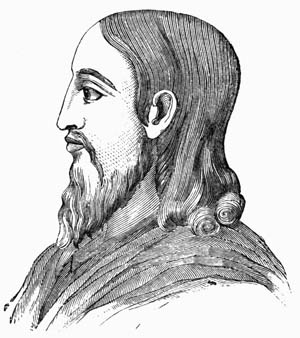
Fig. 106.—The Oldest Extant Picture of Our Lord.
In the Catacomb of Sts. Nereus and Achilles the head and bust of Christ form a medallion in the centre of a vaulted ceiling. The face is of a noble and dignified expression, mingled with benevolence; but it is older in aspect, and probably of considerably later date, than that here given. Kugler, however, claims for it priority of origin. Both of these were probably of the latter part of the fourth century, and were executed not by the Christians of the purest ages of the church, but by those who had begun to walk by sight and not by faith. The primitive Christians, we have seen, had no professed portraits of Christ, but only allegorical representations of the Good Shepherd, or a youthful figure regarded as the abstractions or genius of Christianity. “We must not,” says a Father of the second century, “cling to the sensuous, but rise to the spiritual. The familiarity of daily sight lowers the dignity of the divine, and to pretend to worship a spiritual essence through earthly matter is to degrade that essence to the world of sense.”[586]
On a terra cotta medallion, found not in the Catacombs themselves, but in the rubbish near the mouth of the cemetery of St. Agnes, is a head of Our Lord of the same general type as Fig. 106, but of much superior execution. The face is of exquisite beauty, and is characterized by a sweet and tender grace of expression. But with the decline of art and the corruption of Christianity this beautiful type disappeared, and a more austere and solemn aspect was given to pictures of Christ. Although the technical means of execution were diminished, and the rendering of form became more and more incorrect, yet for powerful effect, strength of character, and depth of feeling, Christian art exhibited resources beyond any thing to be found in the Catacombs. It burst the narrow limits in which it was there confined, and found ample scope in the frescoes and mosaics of the stately basilicas which were everywhere rising. In those vast and shadowy interiors the principal figure was that of Christ, surrounded by saints and angels, looking down upon the worshippers with awe-inspiring power, holding in his left hand the book of life, and raising his right in solemn menace or warning.
The first example of the art-presentation of Christ under this stern and sullen aspect, according to that accomplished critic, Mr. Hemans, is a large mosaic composition of the fifth century in the Ostian basilica of St. Paul. The colossal figure of the Saviour dominates over every other object, with an effect at once startling and repulsive. “Nor can we help,” says Mr. Hemans, “seeing in this strangely unworthy conception the evidence of deterioration in the religious ideal, even more than of decline in the technical treatment peculiar to the age.”[587] Of this character is the head of Our Lord in the crypt of St. Cecilia. The expression is grave, the eyes large and solemn; the book of the gospels is in his hand, and his head is surrounded by a nimbus in the form of a Greek cross.
This type became more and more rigid and austere as the gathering shadows of the Dark Ages mantled on the minds of men. The gloomy asceticism of the monastic orders also left its impress on the art of the period, especially in the East, where the Basilian monks too faithfully illustrated the stern, austere judgments of their founder concerning the person of Christ. The rudeness of execution of this Byzantine school was only equalled by the meanness of conception of the harsh, stiff and blackened portraits of Our Lord, in which he was exhibited as emphatically “a man of sorrows and acquainted with grief.”
Toward the close of the tenth century art sank into its deepest degradation as the long night of the Dark Ages reached its densest gloom. The year one thousand was regarded in popular apprehension as the date of the end of time, and of the final conflagration of the world so intensely realized in the sublime hymn,
Dies iræ, dies illa, Solvet sæclum in favilla.
The excited imagination of mankind, brooding upon the approaching terrors of the Last Day, found expression in the sombre character of the art of the period. The tender grace of the Good Shepherd of the Catacombs gave place to the stern inexorable Judge, blasting the wicked with a glance and treading down the nations in his fury. Christ was no longer the Divine Orpheus, charming with the music of his lyre the souls of men, and breathing peace and benediction from his lips, but the “Rex tremendæ majestatis,” a dread Avenger striking the imagination with awe, and awakening alarm and remorse in the soul. All the stern denunciations of the Hebrew prophets and the weird imagery of the Apocalypse found intensely realistic treatment in art. Christ smites the earth with a curse, and consumes the wicked like stubble. “A fire goeth before him, and burneth up his enemies round about.”[588] The great white throne is set, and from beneath it a flame bursts forth devouring the guilty objects of his wrath. Like an angry Jove,[589] he hurls the thunderbolts of his fury and blasts with the lightning of his power. The angels tremble in terror at his frown, and even the intercession of the Virgin Mother avails not to mitigate the dread displeasure of her Divine Son. Down to the period of the Renaissance the tragic scenes of the last judgment continue to be favourite subjects of art treatment, and exhibit some of its most remarkable achievements; but not all the genius of Orcagna or of Michael Angelo can reconcile our minds to the savage sternness and ferocity of the frescoes of the Campo Santo and the Sistine Chapel.
Christ is also frequently depicted in Mediæval art with his staff and scrip, his “scallop hat and shoon,” setting out upon his weary, mortal pilgrimage; returning to heaven as a toil-worn man leaning heavily upon his staff,[590] or showing to the Father sitting on his throne his wounded hands and side. He is also seen, as in the sublime vision of St. John, riding in majesty on his white horse, accompanied by the armies of the sky; as trampling beneath his feet the lion and dragon, and as chaining death and hell. In Greek art, especially, he is exhibited as a throned archbishop, arrayed in gorgeous vestments, receiving the homage of saints and angels, or offering the sacrifice of the mass as the great High Priest entered into the holiest of all.
One of the most striking contrasts between the art of the Catacombs and that of later times is the entire absence in the former of those gross anthropomorphic images of the persons of the Holy Trinity, either together or separately—except Our Lord under his proper human form—of which the latter, in striking offence against piety and good taste, exhibits so many painful examples. In the earlier ages a solemn reverence forbade the attempt to depict the Eternal Father or the Holy Spirit except by means of symbolical types. The universal testimony of Christian antiquity is opposed to this practice so common in Mediæval art. Origen, Ambrose, and Augustine unite in prohibiting the representation of the Deity by any material object. The latter declares it to be impious for any Christian to set up such an image in the church, and much more to do it in his heart,[591] or to conceive it possible that the Divine Being may be circumscribed by the limits of the human frame.[592] Paulinus of Nola, in his account of the symbolism of the Holy Trinity in the church of St. Felix, describes Christ as represented by a lamb, the Holy Spirit by a dove, but for the Father nothing but a voice from heaven.[593] Gregory II., the champion of image-worship, denies that it is lawful to make any representation of the Divine nature, but only of Our Lord, his mother, and the saints.[594] Such figures were also condemned by the second Council of Nice.[595] John Damascenus, a zealous defender of the images of Christ and the saints, yet declares it is as great impiety as it is folly to make any image of the Divine nature, which is incorporeal, invisible, without material or form, incomprehensible, not to be circumscribed, nor to be figured by the art of man.[596] Urban VIII. ordered all representations of the Trinity to be burnt, and Benedict XIV. forbade the depicting of the Holy Ghost in human form. Dupin asserts that the most zealous defenders of images have condemned these;[597] and the learned and judicious Bingham declares that “in all ancient history we never meet with any one instance of picturing God the Father, because it was supposed that he never appeared in any visible shape, but only by a voice from heaven.”[598]
Some recent Roman Catholic writers, however, assert the contrary of this to be the case, and refer for proof of the assertion to one or two sarcophagal bas reliefs of the fourth or fifth century. One of these represents Cain and Abel bringing their gifts to an aged and bearded figure sitting on a stone, who is interpreted by the Romanists as the Omnipotent Jehovah. But that distinguished archæologist, Raoul Rochette, himself a Romanist, opposes this view. “I doubt,” he says, “the reality of this explanation, contrary to all that we know of the Christian monuments of the first ages, where the intervention of the Eternal Father is only indicated in the abridged and symbolic manner proper to antiquity, by the image of a hand.”
The other alleged sculpture of the Godhead requires more careful examination. “The Holy Trinity,” says Dr. Northcote, “is nowhere represented, as far as I know, in the paintings of the Catacombs.”[599] But he asserts that a sculptured example occurs on a sarcophagus of the fifth century, from the Ostian basilica of St. Paul’s, now in the Lateran Museum. The group referred to consists of three bearded figures of advanced age, and of grave and strongly-marked features. One of these, whom Dr. Northcote designates “the Eternal Father, the source and fountain of Deity,”[600] is seated in a raised chair or sort of throne. Behind the chair stands another described as representing the Holy Ghost, and in front of it the third, identified as the “Eternal Word.”[601] At the feet of the latter are two diminutive figures, one standing, the other prostrate, said to represent the creation of Eve from the side of the sleeping Adam. Padre Garrucci, who has published a monograph on this subject, identifies none of the adult figures in the same manner as Dr. Northcote, but describes the one seated as the Son, the one behind him as the Father, and the third as the Holy Ghost.[602]
We can accept neither of these explanations, both of which are so strongly opposed to the entire spirit and character of early Christian art. The formulization of the doctrine of the Trinity by the Council of Nice, in that noble creed which still expresses the faith of Christendom, left, it is true, its impress on Christian art and literature. Both in pictorial representation, and, as we shall hearafter see, in inscriptions, is there a recorded protest against the Arian heresy which at this period convulsed and rent the church. De Rossi cites eight examples in early Christian art which he conceives to have reference to this doctrine; but in seven of these it is indicated by the association of the sacred monogram with the triangle, the symbol of tri-unity, and the eighth is the unique and anomalous bas relief under discussion.
We have seen that Christ is uniformly exhibited in this primitive art as youthful and beardless; and on this very sarcophagus, side by side with this so-called sculpture of the Trinity, he is thus seen as the representative of the Deity giving the wheat-sheaf to Adam and the lamb to Eve. Yet we are asked to believe that in the very next group he is shown, in defiance of the uniform practice, as heavily bearded and of advanced age; and that the Almighty Father, who is substitutionally represented by the Son in the adjoining scene, is here exhibited, as well as the Eternal Spirit, in human form. Another remarkable discrepancy also occurs. The so-called figures of Adam and Eve are of most diminutive size, and not nearly as large as the infant Christ in his mother’s arms in the scene of the adoration of the Magi immediately below;[603] and of these the prostrate figure supposed to represent the sleeping Adam is considerably the smaller of the two, and of the more feminine aspect. This incongruity is the more striking from the immediate proximity of the adult figures of Adam and Eve, to which the smaller ones bear no resemblance. The whole group seems to correspond better to Solomon’s celebrated judgment concerning the living and the dead child than to the creation of Eve.
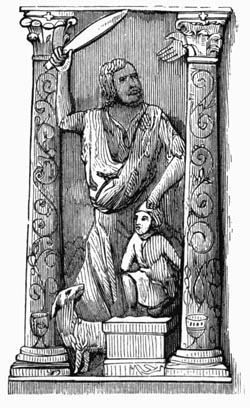
Fig. 107.—God Symbolized by a Hand appearing to Abraham.
So careful, indeed, were the early Christian artists to avoid any representation of “the King eternal, immortal, invisible,” that in the scenes where God spake from heaven to Abraham and to Moses he is only symbolically indicated by a hand stretched out to stay the knife of the patriarch, or surrounded by clouds, as if to show more strongly its figurative character, giving the tables of the law to the leader of Israel. The annexed suggestive example of this treatment, of which many others might be adduced, is from a sarcophagus in the Lateran. See also Fig. 71, p. 290.
Throughout the whole range of sacred mosaics at Rome from the fourth to the fourteenth century, according to Mr. Hemans, the Supreme Being is never represented except symbolically by means of a hand, usually holding a crown over the head of Christ, the Virgin, or the saints. In later art the hand is sometimes surrounded by a cruciform nimbus, to indicate more clearly its divine character. It is also seen stretched out from heaven in pictures of Christ’s baptism and transfiguration, of the agony in the garden, the passion, and ascension.[604]
It was long before the most audacious hand dared to represent in painting or sculpture the omnipotent Jehovah or the infinite Spirit, who sustain and pervade the universe. M. Emeric David says that the French artists of the ninth century had first the “happy boldness”—heureuse hardiesse—to depict the Eternal Father under human form.[605] M. Didron asserts that it was not till the twelfth century that the Divine Being was personally represented,[606] being previously invariably indicated by the symbol of a hand, or by the divine name written in a triangle surrounded by a circle. Previous at least to the earlier of these dates, the work of creation and other acts popularly regarded as proper to the Father are always represented as performed by the Son, “who is the image of the invisible God,” “by whom also he made the worlds.”[607] Christ is also painted as commanding Noah to build the ark, as conversing with Abraham, and as speaking to Moses out of the burning bush. He is frequently represented also in the gigantic frescoes of the Byzantine cupolas clothed with awful majesty and bearing the title Ο ΠΑΝΤΟΚΡΑΤΩΡ, the Almighty; but the addition of the letters IC XC, the contraction for Jesus Christ, assure us that it is not the Father but the Son who is meant.
But the literal conception of the age was not content with a symbolical indication of the Deity. By degrees the arm as well as the hand was portrayed, and art, gradually growing bolder, attempted the representation of that face which inspiration declares no man can see and live. But at first it is the face alone that is shown.[608] Then, with progressive daring, the bust and upper part of the body are painted as reaching forth from the clouds, and finally the entire figure appears under various aspects and in different characters. The Almighty is represented armed with sword and bow, as the God of battles; as crowned, like a king or emperor;[609] and finally, as Pope, wearing the pontifical tiara and vestments. In the following example from a stained-glass window of the sixteenth century, at Troyes, in France, the everlasting Father, throned in glory, crowned with a quintuple tiara and robed in alb and tunic, supports a cross on which hangs the lifeless body of the Divine Son.
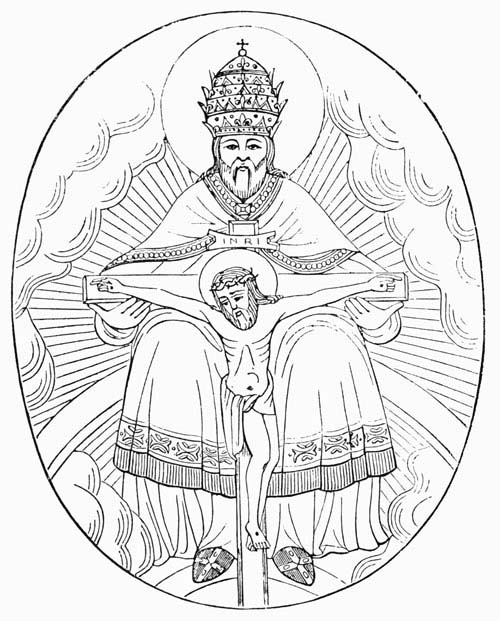
Fig. 108.—God the Father as Pope.
The omnipotent Jehovah is sometimes portrayed as “the Ancient of Days,” under the form of a feeble old man bowed down by the weight of years, and fain to seek support by leaning heavily on a staff, or reposing on a couch after the labours of creation.[610] The treatment becomes more and more rude, even to the borders of the grotesque,[611] and the conception becomes mean, coarse, and vulgar, till all the Divine departs and only human feebleness and imbecility remain, indicating at once the degradation of taste, decline of piety, and corruption of doctrine.
But this grossness of treatment reaches its most offensive development in the impious attempt to symbolize the sublime mystery of the Holy Trinity by a grotesque figure with three heads, or a head with three faces joined together, somewhat after the manner of the three-headed image of Brahma in the Hindoo mythology.[612] In other examples the Trinity is represented by three harsh stiff and aged figures,[613] identified by the attributes of the tiara, cross, and dove, enveloped in one common mantle, and jointly crowning the Virgin Mary in heaven, whose flowing train the angels humbly bear. By this degradation of Deity and exaltation of Mary we may mark the infinite divergence in faith and practice of the modern church of Rome from the simplicity, purity, and orthodoxy of the ancient church of the Catacombs, as evidenced by that primitive art and symbolism whose priceless monuments we have been examining.
Hostia viva Deo tanquam puer offerar Isaac,
Et mea ligna gerens, sequar almum sub cruce patrem.
Ruth sequitur sanctam, quam deserit Orpa, parentem;
Perfidiam nurus una, fidem nurus altera monstrat.
Præfert una Deum patriæ, patriam altera vitæ.
Solus labe caret peccati conditor orbis,
Ingenitus genitusque Deus, Pater et Patre natus.
—Apotheosis, 894.
Quod Eva tristis abstulit Tu reddis almo germine.
Salva vincla reis, Profer lumen cæcis, Mala nostra pelle, Bona cuncta posce.
O Roma felix, quæ duorum Principum Es consecrata glorioso sanguine; Horum cruore purpurata ceteras Excellis orbis una pulcritudines.
—Office for the Festival of St. Peter and St. Paul.
Salve, Sancta facies Mei Redemptoris, In qua nitet species Divini splendoris. Impressa panniculo Nivei candoris, Dataque Veronicæ, Signum ob Amoris.
Quatuor haec Dominum signant animalia Christum:
Est homo nascendo, Vitulusque sacer moriendo,
Et Leo surgendo, cœlos Aquilaque petendo.
O summo Giove,
Che fosti ’n terra per noi crocifisso.—Purgat., canto vi.
“Père,” dist Jhésus, “retourné Suis á toy, et ai consummé Ce que faire me commandas Quant jus ou monde m’envoyas, Dont bien je m’en feusse passé.” —Romant des Trois Pélerinages, A. D. 1358.
Pleno coruscat Trinitas mysterio; Stat Christus in agno; vox Patris cœlo tonat; Et per columbam Spiritus Sanctus fluit.
“The rope with its twisted cordage three Denoted the scriptural Trinity.”