WALTHAM ABBEY.
Reading edition
“Ki ke volt çeo saver, A Walteham, ultre le halt auter, Meimes cel croiz purra trover, E roi Haraud gisant en quer.”—Continuation of Wace’s ‘Brut.’
THE Abbey of Waltham owes most of its celebrity to its connexion with the last of the Anglo-Saxon monarchs. Our early forefathers were distinguished by their attachment to the pleasures of the chase; and the vast forest with which this district was covered must have been a favourite resort of the East-Saxon kings, as it was, after the subversion of their independence, of the thanes of Essex. One of these, named Tovi or Thovi, who held the high office of stallere (or steward) in the household of Canute the Dane, built himself a hunting residence in the rich meadows on the banks of the Lea, in the same neighbourhood where King Alfred had drawn away the waters of that river in order to cut off the retreat of the Danish fleet. This hunting-house was the weald-ham, or residence in the wood, from which the town afterwards received its name.
The “weald-ham” was a favourite residence of Earl Tovi, and was soon surrounded with the houses and huts of his retainers, thus becoming gradually a village, occupied, as we are informed in the early half-legendary history of the place, by threescore and six householders. The erection of a church followed as a matter of course: although the monks of the Abbey afterwards built there published a wild legend—how a cross, miraculously discovered on the summit of a hill in Somersetshire, then called Lutegaresberi, but since known by the name of Montacute, which was also the property of Tovi, was no less miraculously conveyed to this spot, and gave to it the subsequent appellation of Waltham Holy Cross.[207] Tovi (who was lord of “Enefeld, Edelmetone, Cetrehunt, Mimmes (?), and of the barony which afterwards, under the Normans, passed into the family of the Mandevilles”) placed in his church two canons, endowed it with lands in Waltham, “Chenleuedene, Hyche, Lamhee, Luketune, and Alwaretune,” and gave to it the sword with which he had been first girt when he was made a knight. His wife Glitha, a very pious woman, added to these gifts a crown or wreath of pure gold. Their son Athelstan did not, however, inherit the virtues and wisdom of his parents; for, shortly after their death, he lost the manor of Waltham, which, with others in the neighbourhood, appears to have been forfeited to the Crown. Edward the Confessor gave it to his brother-in-law Harold.
Harold appears to have received these lands with the avowed purpose of founding a religious house, by which, while according to the superstitious belief of that age, he was securing the salvation of his own soul, he flattered the monastic prejudices of King Edward. In the twelfth century, the monks of Waltham had also a legendary account of this second foundation: they said that Earl Harold, on his return from the conquest of the Welsh, was visited by a dangerous attack of paralysis, which defied the skill of the physicians, until it was miraculously cured by a visit to the Holy Cross.[208] From that moment, it is pretended the Earl never relaxed in his attachment to Waltham: in place of the small foundation of Tovi, he built a magnificent church; and there are strong reasons for supposing that, in spite of his patriotic feelings and his known hatred to foreigners, he employed Norman artists and workmen. The Waltham writers of the twelfth century, who saw Harold’s church in its original form, speak of it in the most enthusiastic terms, and tell us how, under the hands of his builders, the walls and columns rose up in lofty majesty, while the latter were connected by numerous arches, and the walls supported a roof groined within and protected by lead without.[209] The interior of the building was covered with “plates of brass, gilt;” and the bases and capitals of the columns, with the “bendings” of the arches, were ornamented with sculpture.[210] It is now ascertained, that in early times the interior of churches, and also of other buildings, was painted in bright colours, and gilt: the gilding being probably executed on thin plates of metal which were attached to the stone-work. This mode of ornamentation afterwards gave place to elaborate sculpture and carving. The mouldering remains of these buildings, although still imposing by their grandeur, convey to us only a slight idea of the effect which they must have produced when adorned with paintings and glittering with gold. The Interior of Waltham Abbey Church, degraded and mutilated as its ornaments and proportions are at the present day, conveys to our mind no mean idea of the former splendour of Harold’s church, of which we can hardly doubt that it forms a genuine portion. As we survey its rows of massive columns, and compare them with the humble objects around, we feel ourselves mentally carried back eight hundred years to the festive scene which followed their erection. At the consecration of those walls, were present, besides the founder Earl Harold, the last King and Queen of the regal line of the Anglo-Saxons—Edward the Confessor, and the fair and interesting Edith, with two archbishops—Stigand of Canterbury and Aldred of York, eleven bishops (among whom the most
eminent were Hereman of Salisbury, Leofric of Exeter, and Gyso of Wells), eleven abbots of important monastic houses, and a great number of princes and nobles. In their presence was read publicly the royal charter, which is still preserved, and bears the signatures of the King and Queen, Harold, the two archbishops, and the bishops, abbots, and thanes, who were assisting at the ceremony. The feast on this occasion lasted eight days; and the guests were not only served profusely, but large vessels full of wine and mead were placed in the fields and public roads, in order that even accidental passers-by might drink their full.
Harold increased the number of canons from two to twelve. By the charter just mentioned, they were put in possession of the manors of “Passefelda, Walde, Upminster, Walhfare, Pippedene, Alwaretune, Wodeforda, Lambehithe, Nesingnan, Brickendune, Melnho, Alichsea, Wormeleia, Nettleswelle, Hicche, Lukintone, and Westwaltham.” Portions of these lands were assigned to each canon to supply him with food and clothing, those of which the rents were applied to the latter purpose being distinguished by the name of scrud-land, or clothing-land. Westwaltham was appropriated to the dean, in addition to his share with the rest. Each canon had also assigned to him fifteen acres in Waltham of what were termed the Northlands, in order that they might not be distressed by any accidental stoppage of their supply from the out-farms. According to the directions of the founder, the canons of Waltham received extremely liberal rations of food. The daily allowance of each was two loaves of very white bread, and one of a coarser quality, the three being sufficient for six men; six bowls of ale, sufficient for ten men at one drinking bout; and six dishes of different kinds each day. In addition to this allowance, on feast days they were served with “pittances,” or delicacies: if it were a feast of the first dignity, each canon was to have three pittances; if of the second dignity, he was allowed two pittances; and if of the third dignity, one. A pittance, from Michaelmas-day to Ash-Wednesday, consisted of twelve blackbirds, or two “agauseæ,” or two partridges, or one pheasant; during the rest of the year, it consisted of goose or chickens. On Christmas-day, Easter-day, and the day of Pentecost, and on the two feasts of the Holy Cross, wine and mead were allowed.[211] The object in giving the canons this profuse allowance of provisions, was to provide for strangers, and for the poor and needy, the latter receiving each day what was sent away from the Abbey table. The dean had a larger share than the others, because more persons depended upon his charity and hospitality than upon those of a simple canon.[212] In former times, when from the want of means of conveyance the produce of the land was necessarily consumed on the land itself, hospitality of this kind was universally practised. Even in the houses of private gentlemen there was a servant named an almoner, whose office it was to collect and distribute to the poor at his master’s gate what remained of the meat and drink served at the table; and the person who distributed the bread to the guests, laid the first loaf in the alms-dish as an offering to God.
The consecration of the church of Waltham occurred a little before Whitsuntide, in the year 1062: in less than four years after this event, Harold was
advanced to the throne of England. During his short but eventful reign, he conferred innumerable benefits on the Abbey, which were remembered with gratitude long after the destruction of the Anglo-Saxon dynasty. In his return from the defeat of the Danish invaders in the north, to stop the progress of his Norman rival, Harold visited Waltham for the last time. The brotherhood received him with sorrowful countenances, for their minds were filled with gloomy forebodings; and when, on the morning of his departure, Harold humbled himself in prayer before the Holy Cross, which was surrounded by the relics and precious gifts which he had conferred, one of the canons, whose eyes were fixed on the image, declared that the wooden face suddenly assumed an air of sadness, and that he saw the head bend downwards. His brethren were struck with consternation; and, unable to restrain the king from exposing his own person in an unequal combat, they sent with him two of the elder canons, named Osegode Cnoppe and Ailric Childemaister,[213] to watch the course of events, and to bring home the body of their benefactor in case he should be slain. The result of the battle of Hastings is too well known to need repeating on the present occasion.
Much obscurity still hangs over Harold’s fate. The old historians not only differ in various circumstances in their account of the manner in which he was killed, but some of them have declared their belief that he escaped from the field of battle with his life. Even the canons, and afterwards the monks, of Waltham were divided in their opinions on this subject; and each party consigned their reasons to writing, in separate treatises, which were long treasured up in the Abbey library, and which are fortunately still preserved. According to the most probable of these two versions of the story, when Osegode and Ailric saw that their presentiments had been but too well founded, they repaired to the Conqueror to obtain permission to seek for Harold’s body, and to carry it to Waltham for interment. With some difficulty they succeeded in their suit; but, after a long and fruitless search, Osegode was sent back to Waltham with the intelligence that they could find no traces of their king among the multitude of naked and stiffening corpses with which the field was strewed. By the advice of the other canons, Osegode took with him to Hastings Harold’s beautiful mistress, Editha Swanneshals (or Edith with the Swan’s neck), who recognized the body of her lover by secret marks which were known only to herself. Osegode then placed it on a bier which he had prepared for the purpose, and it was carried in solemn procession to Battle Bridge, whither the whole brotherhood of Waltham had come to meet it. They carried the corpse to Waltham, and buried it with honour in the choir of the Abbey Church.[214]
Those who held a contrary opinion concerning Harold’s fate, said that Edith had mistaken another corpse for that of her paramour; and that the body of Harold had been found among a heap of corpses by some Saxon women, who visited the field to administer aid and comfort to their wounded and expiring countrymen. Finding him still breathing, they carried him away from the spot, ignorant that it was their king; but he was recognized by two countrymen, who took him to Winchester, where he remained in concealment two years. At the end of that period, having entirely recovered from the effects of his wounds, he went to Germany, in the hope of inducing the old Saxons and Norwegians to assist him in the deliverance of his country from the oppressions of the Normans; but failing in this project, and becoming weary of the vanities of the world, he determined to pass the rest of his days in retirement, and he first visited Rome. From thence he returned in disguise, under the assumed name of Christian, to England, and lived ten years as a hermit, with one faithful attendant, among the rocks in the neighbourhood of Dover. He next repaired to the borders of Wales, where he lived long in solitude, exposed to the insults of the Welsh, over whom he had so often triumphed in the days of his worldly glory. He finally removed to Chester, where he died at an advanced age in a little cell attached to the church of St. John, having, according to the story, confessed on his death-bed that he was King Harold.[215] Such is the improbable legend which found credit with one or two of the most esteemed of our early writers.
Waltham Abbey appears to have experienced little favour from the first Anglo-Norman kings. William the Conqueror, or (according to other accounts) his son Rufus, carried away much of the valuable plate, gems, and rich vestments which had been given by Harold, to enrich his two churches at Caen in Normandy; but he seems to have left the landed possessions of the Abbey untouched.[216] As a sort of reparation for this injury, William Rufus is said to have given to the canons those lands of Harold in Waltham which his father had conferred upon Walcher, bishop of Durham, who made this place his residence when he came to attend the court at London. The two queens of Henry I. were almost the sole benefactors of this foundation during the first century after the Norman Conquest:—the first, Matilda of Scotland, gave to the secular canons the mill at Waltham; while Adeliza of Lorraine, Henry’s second wife, bestowed upon them all the tithes of Waltham, as well those of her demesne lands as those of her tenants.
In the latter half of the twelfth century, the canons of Waltham experienced the same fate which had already struck most of the similar Anglo-Saxon institutions. As the power of the pope gained strength in England, it had constantly brought with it the dissolution of the ancient colleges of secular priests, to make way for the introduction of the more rigid discipline of the regular monks, who were literally the “soldiers” of papal Rome. It is probable that the secular canons of Waltham had relaxed in discipline and religion since their foundation, placed as they were amid the “fatness of the earth.” During the period of which we are now speaking, we find among them few traces of learning or literary taste, and the name of Waltham scarcely occurs in the political history of the twelfth century. Yet the few remaining writings of the monks of this place are full of vivid descriptions of the richness and beauty of the Abbey lands.
“O Waltham! pro te fecit manus Omnipotentis Multum in mentis, semper et hinc amo te. Nam dedit ipse tibi similem sibimetque figuram, Excelsam, puram, quæ veneratur ibi. * * * * Tu ditaris ita, nam prata foves meliora; Stas inter nemora dite loco posita. Te cingit fluvius necnon percurrit amœnus, Piscibus et plenus: est situs egregius. Et licet orneris pratis latis et agellis, Structuris bellis, floribus et teneris.”[217]
So sang in quaint and jingling rhymes one of the historians of Waltham in the reign of Henry II. The flower-decked meads which surrounded the Abbey are not unfrequently alluded to; and that which has preserved to modern times the name of Harold’s Park, was celebrated in a proverbial leonine,—
“Haroldi parca florum bene dicitur archa.”
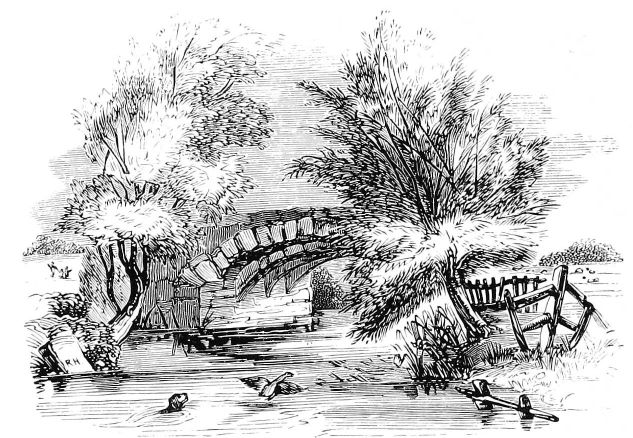
The numerous little streams into which the river is here divided added to the richness and diversity of the scenery, and were crossed by a number of picturesque bridges. In the time of Leland (the reign of Henry VIII.) there were “a 7 or viii. bridges in the towne of Waltham: for there be divers socours of streamelettes breking out of the thre principalle partes of Luye ryver.” The ruins of one of these little Bridges may still be seen over a “streamelette,” about two hundred yards to the north-east of the Abbey, forming an extremely picturesque feature in the landscape. It consists of an elliptical arch, supported or strengthened by three strong ribs, and appears to be a work of considerable antiquity.
The beauty of the scenery and the richness of the soil seem to have been the chief delight of these pampered canons. They were accused (how justly it is now difficult to decide) of luxurious living and great relaxation of discipline; and their last dean, Guido Rufus, was suspended from his office by Richard, Archbishop of Canterbury, the immediate successor of Thomas Becket. The king was at this time seeking opportunities of appeasing the church of Rome for the murder of Becket, and, influenced by the persuasions of the archbishop, he went to Waltham on the eve of Pentecost, in the year 1177, and having expelled the secular canons, he established in their place sixteen regular canons of the order of St. Augustin, taken out of three of the older English monasteries, namely, six from Cirencester, six from Oseney, and four from Chiche. Walter de Gaunt, a canon of Oseney, was elected the first Abbot of Waltham. The Abbey itself was declared, as formerly, free from all episcopal jurisdiction; and a few years afterwards the abbot was allowed the use of the pontificals, and Waltham was raised to the rank of a mitred abbey. King Henry, judging, as he states in the charter, that the church thus reformed, “as a new spouse of Christ, ought to have a new dower,”[218] added to its former possessions the manors of Siwardston and Epping.
From this period the Abbey of Waltham was, during several reigns, a favourite resort of the English monarchs; and, separated by its woods from the “busy hum” of the world around, it seems to have escaped the troubles and turmoils of baronial strife. Henry’s son and successor, the lion-hearted Richard, gave the monks a new charter, confirming all their possessions and privileges; and by a separate charter he bestowed on the church the whole of his manor of Waltham, with the great wood, and the park called Harold’s Park, three hundred acres of assart land, the market of Waltham, and the village of Nasing (a member of Waltham), with three hundred and sixty acres of assart land there, for all which they were to pay yearly to the king’s exchequer sixty pounds. King Richard also gave them the manor of Copt Hall, which afterwards became a favourite residence of the abbots. Henry III., who frequently visited Waltham, was also a munificent benefactor; and among other favours he granted them the privilege of holding a fair during seven days annually. In this reign considerable alterations appear to have been made in the buildings of the Abbey, The church was re-dedicated in the year 1242, by the Bishop of Norwich, in the King’s presence;
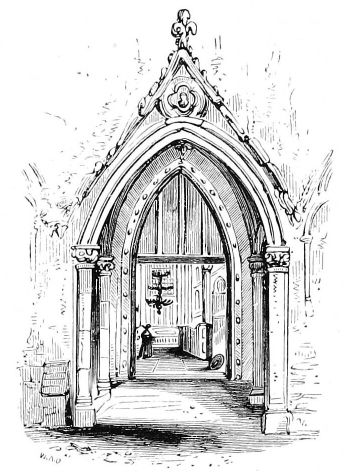
and it has been conjectured, that at that time was built Our Lady’s Chapel on the south side of the present church: this chapel still exists, although it has been long converted into a school-room. It has been supposed also that the Inner Porch, under the present steeple, was built about the end of this reign, or early in that of Edward I.
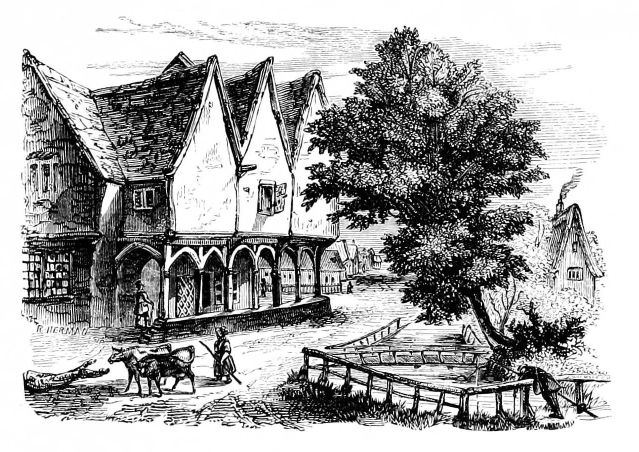
In spite of the royal favour and protection, the monks of Waltham were engaged in several vexatious disputes during the reign of Henry III. The kind of lordship which the abbot exercised over the town, the mode in which the Abbey possessions and business became intermixed with those of the townsmen, and the frequent and unavoidable clashing of their several interests, led to much mutual ill-will. A great number of the townsmen were tenants of the abbot. We still find in several parts of the town some remains of the old houses on the Abbey domain, particularly those standing in what is called Baker’s Entry, which have an appearance of great antiquity. But the most serious disputes arose out of the contending claims to rights connected with the common lands.[219] Simon de Seham was elected Abbot of Waltham in 1248; and the same year the townsmen went in a riotous manner into the marsh, where they claimed rights in opposition to those enjoyed by the abbot, and killed four of the abbot’s mares, worth at least forty shillings sterling, and drove away the rest. Simon de Seham allowed this act of violence to pass without punishment; but when the men of Waltham came to him the year following, on the Tuesday before Easter, and summoned him to remove his mares and colts out of the marsh, he refused to listen to them, and deferred the matter till the Tuesday after Easter. On that day the men and women of the town assembled tumultuously at the Abbey gate to receive the abbot’s answer; but he again deferred the matter to a further day, stating in excuse that he had been busily occupied in preparing for a journey into Lincolnshire to meet the justices itinerant. Then the townspeople reviled the abbot in presence of Richard, Earl of Cornwall, the king’s brother, who had come to Waltham Abbey the same day; and, hastening to the marsh, they drove away the abbot’s mares and colts—drowning three, valued at twenty shillings; spoiling ten more, worth ten marks; and beating the keepers who resisted them, even to the shedding of blood. On the abbot’s return from Lincolnshire, the people of Waltham, apprehensive of the consequences of their violent proceedings, desired a love-day to settle the dispute; but suddenly changing their minds, they went to the king at London, and made a complaint against the abbot, that he was infringing their rights, introducing new customs, and, as they expressed it, that he was “eating them up to the bones.” The abbot, in retaliation, excommunicated them; and they impleaded him at the common law. After many hearings, the abbot, as the stronger party, gained the cause; and the people of Waltham were obliged to acknowledge that they had done him wrong, and they were fined twenty marks; but, on their submission, he remitted the fine, and relieved them from the sentence of excommunication.[220]
In the same reign, the abbot of Waltham became involved in a lawsuit with the lord of the neighbouring manor of Cheshunt, who was, at that time, Peter Duke of Savoy, the king’s uncle, and therefore a powerful opponent. Both parties laid claim to certain meadow lands which lay between two branches of the river Lea, one asserting that the eastern stream, the other that the western stream, was the boundary line between their respective estates. After an obstinate dispute, the lord of Cheshunt agreed to yield up his claim to the abbot; but these meadows were frequently afterwards a subject of litigation. A new lawsuit was begun in the time of the last abbot of Waltham; and the question remained undecided when the Abbey was surrendered to King Henry VIII.
Until the reign of this monarch, Waltham continued to receive frequent visits from the English kings, who are said to have possessed a small house within the parish, at a spot known in more recent times by the name of Romeland, where occasionally they sought pleasure and retirement. Richard II. was residing here at the time of Wat Tyler’s insurrection. It was also a favourite retreat of King Henry VIII.; and Fuller has preserved a traditionary anecdote relating to one of Henry’s visits, which (though a similar story has been told of other kings in like circumstances) loses nothing by being repeated. The king was one day hunting in the forest; and, wandering from his companions, he came to the Abbey, about dinner-time, in the disguise of one of his own guard. He was immediately invited to the abbot’s table, and a sirloin of beef was placed before him. The king was hungry, and ate very heartily, to the great admiration of the abbot, whose pampered stomach had been spoilt by the good fare of his house. “Well fare thy heart!” he said to his guest: “here is a cup of sack, and remember the health of his Grace thy master. I would willingly give a hundred pounds on condition that I could feed as heartily on beef as thou dost. Alas! my weak stomach will hardly digest a wing of a small rabbit or chicken.” The king pledged his host, and then, thanking him for his hospitality, departed as secretly as he had arrived. Shortly afterwards, a pursuivant suddenly made his appearance at Waltham; and, to the consternation of the whole fraternity, the abbot was carried to London, and committed a close prisoner to the Tower, where he was kept for some days strictly confined to a diet of bread and water. The severity of his imprisonment was then as suddenly relaxed, and a sirloin of beef was set before him, on which, to use the quaint expression of the old narrator of this story, “he fed as heartily as a farmer of his own grange.” The king immediately entered from a small lobby, where he had been looking on unobserved, and demanded of his prisoner a hundred pounds, the sum promised to him who should restore his lost appetite, which the abbot paid immediately, and lost no time in returning again to enjoy the good cheer of his own refectory.
We can trace, but with uncertainty, the progress of destruction with which this noble building was visited after its Dissolution. Part of the church, with the offices and other parts of the Abbey, were probably demolished for the sake of the materials, the nave only being reserved to the people of Waltham to serve as a parish church. The commissioners were so unscrupulous in their plunder, that they even offered for sale the five bells in the steeple, which, however, were purchased by the parishioners. In the old books of the churchwardens, we find, under the date 1544, the item, “Received of Adam Tanner the overplus of the money which was gathered for the purchase of the bells, two pound four shillings and eleven-pence.” The ancient steeple stood in the middle of the church: it had been left in so dangerous a condition, that it was found necessary to take down the bells as soon as purchased, and to erect for them a wooden belfrey at the south-east end of the churchyard, where there stood formerly two yew-trees. A few years afterwards, in the beginning of the reign of Queen Mary, the steeple fell down: in 1556, there is an entry in the parish books, “For coles to undermine a piece of the steeple which stood after the first fall, two shillings.” The parishioners immediately began to build the present Steeple, at the west end of the church, at a very considerable expense, which was furnished from the money they had collected by the sale of the old church furniture, by subscriptions for the occasion, and by the sale of materials from the ruins of the Abbey; and, to finish it, they were at last obliged to sell the bells which they had before patriotically rescued from the fate that had absorbed so much of the rich plate and furniture of the Abbey. Several of the entries in the parish books at this time show us how the work of demolition was gradually proceeding. In 1558, at the beginning of the reign of Elizabeth, the sum of three shillings and two-pence was paid for taking down the rood-loft. In 1562, there was “paid for a bay nagge, given to Mr. Henry Denny for the Abbey wall, three pound seventeen shillings.” “Item, to labourers which did undermine the said wall, forty-nine shillings and nine-pence.” This Abbey wall was a building which extended eastward beyond the old steeple; and the churchwardens for some years afterwards carried on a great trade in the sale of lead, stone, and timber taken from it.[221] In 1563, “for the old timber in the little vestiary of St. George’s Chapel, fifteen shillings.” All memory of the site of this chapel appears to be long lost. In the same year, “for taking down the stairs in the Abbey, seven shillings eight-pence;” and “for taking down the lead from the charnel-house, and covering the steeple, eighteen shillings.”
In 1547, King Edward VI. made a grant of the conventual estate of Waltham, for thirty-one years, to Sir Anthony Denny, one of the executors of Henry VIII., who dying soon afterwards, the reversion in fee was purchased by his widow. Their grandson, Sir Edward Denny, was created Baron of Waltham by King James I., and Earl of Norwich by King Charles I. From him the estate passed by marriage to James Hay, Earl of Carlisle; and it subsequently came into the possession of the family of Wake.
The Abbey of Waltham, when entire, was very extensive, including within its walls many acres of ground. The remains of the Entrance Gateway, approached by an old bridge, stand at some distance to the north of the church. This gateway is of stone, repaired with large bricks, and consists of a larger and a smaller pointed arch, with delicate mouldings; the exterior mouldings springing from figures of angels, which support shields containing the royal arms of England as they were drawn in the reign of Edward III. which appears to be the date of this part of the building. This gateway
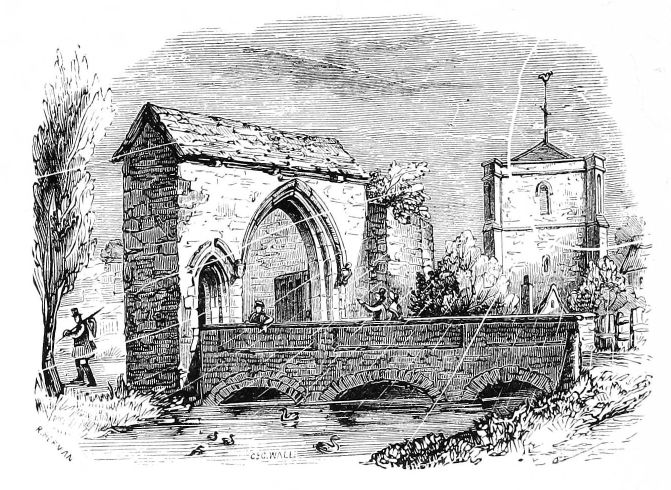
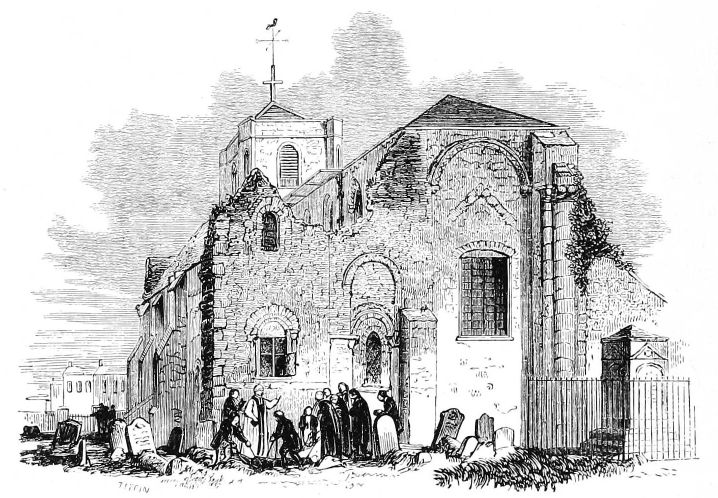
and the church are all that now remain standing of this once noble edifice.[222] The present parish church is formed of the nave of the ancient church, which had the form of a cross. The choir, which was a continuation of the present building towards the east, with the two transepts, and the Lady Chapel, appear to have been demolished immediately after the dissolution of the Abbey. The steeple stood at the intersection of the choir and nave with the transepts; and it appears to have fallen spontaneously a few years after the transepts and choir were taken down. By that accident, the nave was left open at the east end, and it was built up with modern masonry, which, mixed with the old circular arches and windows of the original building, and with the two great western supports of the steeple which are still visible, give to this part of the church externally a singularly dilapidated appearance.
The Choir appears to have been very extensive; for the site of Harold’s Tomb, which we know was in that part of the church, perhaps near the high altar where the Holy Cross stood, is still pointed out by tradition at a spot about forty yards to the east of the present church. This choir was probably built in the reign of Henry II., when that monarch changed the character of Harold’s foundation. At that period the relics of King Harold were translated thither from a former tomb; and the author of the treatise ‘De Inventione Sanctæ Crucis Walthamensis,’ who wrote in the latter part of the twelfth century, assures us that he was present on that occasion, and that he saw the wounds on Harold’s body.[223] Fuller, speaking from tradition, says that the sepulchre of Harold was a plain tomb of grey marble, supported by “pillarets,” with a “sort of cross fleury” sculptured upon it; and he asserts that he had one of its pedestals in his own possession. Farmer, in his History of Waltham Abbey, has given an engraving of a mask, which, he says, (probably without any good reason,) was one of the ornaments of the same tomb. It is equally improbable, that the coffin discovered in the latter end of the reign of Queen Elizabeth, by a gardener in the service of Sir Edward Denny, was that which contained the body of the martyr of Hastings.[224] Fuller, writing in the time of the Commonwealth, says that “a picture of King Harold in glass was lately to be seen in the north window of the church, till ten years since some barbarous hand beat it down under the notion of superstition.” About half a century ago another coffin was found near the same spot, containing an entire skeleton enclosed in lead. Many persons of distinction appear to have been buried at Waltham; among them are mentioned the names of Hugh Nevil, protho-forester of England, who, dying in 1222, was interred here under a noble engraved marble sepulchre; of his son John Nevil; and of Robert Passelew, archdeacon of Lewes, one of the favourites of Henry III.
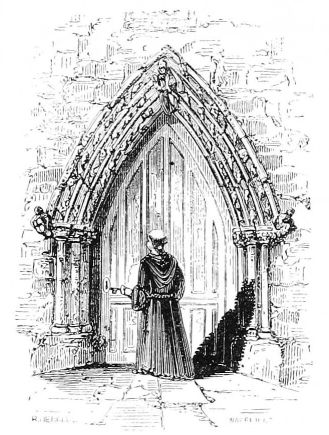
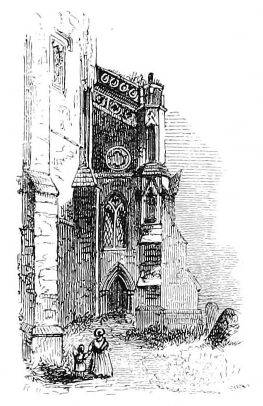
A very elegant pointed arch, now forming the entrance from the tower to the interior of the church, of which we have given a representation on a preceding page, appears to be of the reign of Henry III.; the defects observed in the upper part of its ornaments were caused by some barbarous hand, which cut away part of the sculptured stone, in order to introduce a new erection, with which the workman appears to have proceeded no farther. The Principal Entrance, which is also an elegant sharply-pointed arch, is supposed to date from the reign of Edward III. At the south-east extremity of the present building is a chapel, which bears evident marks of the age of the Tudors, although much defaced and altered. Nearly the whole of the church itself, with the exception of the modern alterations which it has undergone, is the erection of King Harold, and formed perhaps the principal part of the church as he left it. The interior, which in modern times has been miserably disfigured by thick coats of plaster and whitewash, possesses still an appearance of solemn grandeur, although its groined roof has been taken down, and its place supplied by a lower flat ceiling. The close resemblance between this interior and the interior of the nave of Durham Cathedral (built a few years after the Conquest) has frequently been noticed. The body of the nave is separated from the side aisles by two rows of large and massive cylindrical pillars, ornamented with spiral and zig-zag grooves, like the similar pillars in the nave at Durham. These pillars support large circular arches, with zig-zag mouldings. Above these on each side is a second row of large arches, supported by short columns; and above these is a third series of treble arches, each consisting of one large arch, with a smaller one on each side. These latter front the principal windows by which the interior of the church is lighted. In the second or middle tier of arches there were once central columns, with arched mouldings, dividing each of the large arches into two. Between each series of arches a three-quarter pilaster moulding rises to the ceiling, and appears formerly to have sustained the groined roof. Two of the circular arches of the lower row have been altered, probably at the time
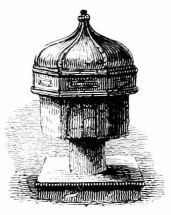
when the present steeple was erected, to pointed arches, and carried up to the string course of the clerestory. The only remnant of the furniture and utensils of this old church is its ancient Font. The east end of the nave has been railed in to form a chancel. The whole length of the nave is a hundred and six feet; and its breadth fifty-three feet, including the aisles. The interior height is at present forty-six feet. The most interesting monument in Waltham Abbey Church is that of Sir Edward Denny and his lady, which is situated near the eastern extremity of the south aisle. Near the altar rails is a defaced grey slab, which once bore a mitred figure, probably one of the abbots.
The steeple is a massive square tower, eighty-six feet high, embattled, and supported by strong buttresses. It was erected, as has been already stated, during the reign of Queen Mary, at the expense of the parishioners. It appears from the parish books that for the first fifty-three feet the expense of building, independent of the materials, was 33s. 4d. a foot, and that the upper part cost 40s. a foot, the difference arising probably from the increase in the value of labour in the reign of Elizabeth, when the tower was completed. The principal modern alterations in this church appear to have been made between the years 1668 and 1680.[225]
The out-buildings attached to the church are on the South Side. They consist of a vestry and school-room, occupying what was formerly the Lady Chapel. This has been so much modernized, that very little of the original building can now be seen. It appears that a large portion of the money expended on reparations in the latter part of the seventeenth century was applied to the building and furnishing of the school-room. Underneath this
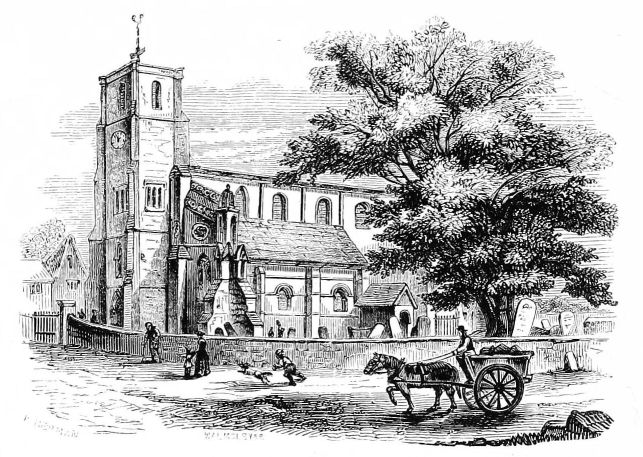
building is a crypt, curiously groined, which is now used as a charnel-house. This Lady Chapel, from the style of what remains of the original architecture, and the ornamental Buttresses which still exist, has been supposed to be as old as the time of Henry III.
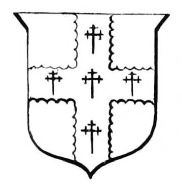
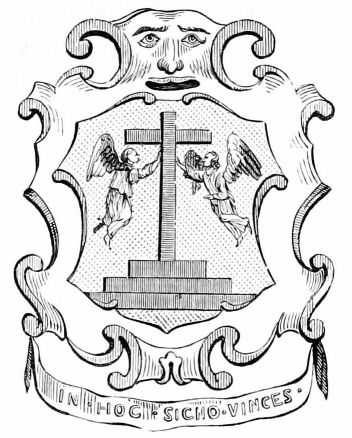
Waltham Abbey can boast of fewer learned men than most of the old monastic houses. Fuller mentions Roger de Waltham, canon of St. Paul’s, a writer in the thirteenth century, and John de Waltham, keeper of the privy seal to King Richard II. The same historian places Robert Fuller, the last abbot of Waltham, among the literary men of that house, because he had written a history of his abbey, which Thomas Fuller professes to have consulted: it is probable, however, that this “history” was nothing more than the register of charters and other deeds of the abbey, still preserved in the Harleian Library, which would reduce Abbot Fuller’s claim to literary honours within very modest limits. It was from a deed of Abbot Fuller, that Farmer gave one Coat of Arms belonging to this abbey, which is gules, two angels or, flying with their wings extended, with their hands holding between them a cross argent. A different coat (which is represented in a former cut) is given by Fuller the historian, along with the arms of the other mitred abbeys. At the time of its surrender in 1539, Waltham was one of the richest abbeys in the kingdom, the gross amount of its revenues being, according to Speed, nearly eleven hundred pounds a-year: according to the Monasticon, the clear income was nine hundred pounds.
The Abbey of Waltham, as we have before stated, makes no great figure in history after the Norman Conquest. An early collection of narratives of miracles supposed to have been performed by the virtues of the Holy Cross, furnishes us with some curious details of the misfortunes which befel the town and church in the days of King Stephen.[226] At that turbulent period, when every man was at war with his next neighbour, and which is naïvely characterized in the legends referred to as being seditionis tempore, the town of Waltham, as part of the dower of Adeliza, Queen of Henry I., belonged to her second husband, William de Albini, Earl of Arundel, between whom and the outlawed baron, Geoffrey de Mandeville, a deadly feud had arisen. We shall probably have another occasion to speak at large of the exploits of Geoffrey de Mandeville. One day he brought or sent to Waltham a body of his Flemish auxiliaries, who set fire to the town, and the flames spreading quickly, communicated with the houses of the canons. In the midst of the confusion, the invaders penetrated to the church, where the town’s-people had deposited the most valuable part of their effects. The canons, who appear to have considered themselves entitled to the special protection of Geoffrey de Mandeville (as Earl of Essex), after vain endeavours to prevail with his men by fair words to desist from their enterprise, had recourse to what was then looked upon as a last and desperate expedient—they dragged from its place above the altar the Holy Cross, which was supposed to spread its protection over the neighbourhood, and threw it upon the floor: and it was handed down as a tradition of the place, that in the very hour of the throwing down of the Cross, Geoffrey de Mandeville received his death-wound at the siege of Burwell. The canons of Waltham boasted that their church was rescued from the rage of the plunderers by divine interposition; and that five Flemings, who had already filled their sacks with precious articles, were thrown miraculously into such a state of mental confusion that they could not find their way out of the church, but remained wandering among the boxes and packages with which the interior of the church was encumbered, until they were taken by the townsmen on their return from the pursuit of their enemies, whom they had driven away. The canons now rescued the offenders from the vengeance of the people of Waltham, and, after having administered to them the monastic discipline, namely, a severe flogging, they set them at liberty. One of their leaders, named Humphrey de Barentone, who, entering the church on horseback, had been active in inciting the Flemings to plunder and violence, is said to have been struck with madness (perhaps with paralysis) as he was leaving the town: he was carried back to the church, and died within three days; but not till he had repented and made some compensation to the church of Waltham, by giving to it fourteen acres of land in ‘Luchentuna.’
Environs.—The neighbourhood of Waltham presents a few historical sites, and some interesting localities. The river Lea was the scene of Isaac Walton’s piscatory rambles. It is now chiefly remarkable as giving motion to a number of powder-mills. The neighbouring hamlet of Waltham Cross contains one of the few that remain of the crosses erected by Edward I., in memory of his beloved queen Eleanor. To the south of Waltham is Enfield Chase; and a short distance to the west is the site of the Palace of Theobald. To the north may still be seen the mouldering ruins of the Nunnery of Cheshunt, said to have been founded in the reign of Henry III.
There is still a vague legendary tradition of a subterranean communication between the Abbey of Waltham and Cheshunt Nunnery. But the monks of the former house, who are accused of having sought comfort among the gentle occupants of the latter for the troubles and vexations they received from the litigious lords of the manor, appear to have sought no such hidden road by which to pay their visits to the nunnery. The tales which continued to be current in the time of Fuller, show that there must have been some ground for the scandal. The following story has found a place in the “Church History:”—
“One Sir Henry Colt, of Nether Hall in Essex, much in favour with King Henry VIII. for ‘his merry conceits,’ came to Waltham late at night, being informed by spies that the monks were on a visit at Cheshunt Nunnery. In order to intercept them on their return, he pitched a buckstall (which was used to take deer in the forest) in the narrowest place in the marsh, where he knew the monks must pass, and placed some of his confederates to watch it. The monks, as was expected, ran all into the net; where they were secured till next morning, when Sir Henry Colt brought the king to show him his game. The merry monarch is said to have burst into a loud fit of laughter, and to have declared that, ‘although he had often seen sweeter, he had never seen fatter venison.’”
Authorities.—Michel, Chroniques Anglo-Normandes.—The Legend De Invent. Sanct. Crucis Walthamensis, MS. Harl. 3776.—Miracles of the Holy Cross, MS. Cotton Julius, D. VI.—Fuller.—Farmer’s History of Waltham Abbey, Lond. 1735.—Wace’s Chronicle of the Norman Conquest.—Leland, &c.
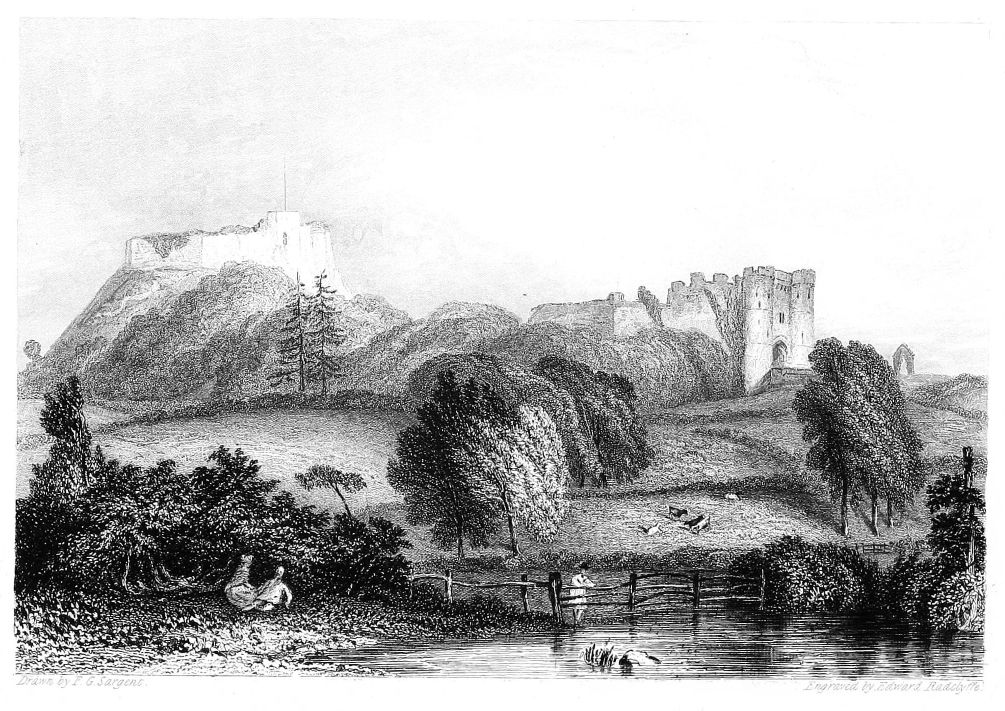
CARISBROOKE CASTLE,
ISLE OF WIGHT.