THE CASTLE OF ARUNDEL,
Reading edition
Sussex, PRINCIPAL SEAT OF HIS GRACE THE DUKE OF NORFOLK, K.G.
Since William rose and Harold fell, There have been Counts of Arundel; And Earls old Arundel shall have, While rivers flow and forests wave.
The Castle of Arundel enjoys a twofold celebrity, in its great antiquity and in its peculiar privilege of conferring the title of Earl on its possessor. The former reverts to a period much anterior to the conquest; the latter was hereditary in the eleventh century, and confirmed by Act of Parliament in the sixth year of the reign of Henry the Sixth. But its chief and enduring interest is derived from the long list of warriors and statesmen whose names are identified with the place; and whose deeds, during the lapse of eight centuries, have shed lustre on the national history.
The earliest recorded notice of Arundel occurs in the will of the Great Alfred[2], in which he bequeaths it, along with other lordships, to his brother’s son Athelm. It is described in that document[3] as a manor, but without any specific distinction in its privileges from those of Aldingbourn, Compton, and Beeding, with which it is associated; and to Godwin and his son Harold, who were successively earls of Sussex[4], it passed, in all probability, in the same form. It was not till the overthrow of the Saxon dynasty[5], however, that Arundel assumes a prominent station in history as a native fortress of strength and importance[6]. Among the train of warlike barons who attended the Norman in his successful expedition to our coast, was 1066-1070 Roger de Monte Gomerico, or Montgomery, nearly related to the Conqueror by blood, and possessing extensive territories in Normandy[7]. At the battle of Hastings, which placed the British crown on the head of William, Montgomery led the
centre division of the army[8], and contributed to the victory. In return for this important service, and to bind him more firmly to his interests, the Conqueror four years afterwards bestowed upon him the two comtés, or earldoms, of Shrewsbury and Arundel[9]. Of the six rapes[10] into which Sussex is divided, two, comprising Chichester and Arundel, and calculated to contain eighty-four knights’ fees[11] and a half, were set apart to form the honour[12] of Arundel. Of this and his other princely territories, Montgomery retained possession during a period of twenty years; and the ample revenues which they produced enabled him to support that dignity, splendour, and host of retainers which bespoke the rank of one of the great vassals of the crown. He was a man, according to Orderic[13], of exemplary prudence and moderation; a great lover of equity, and of discreet and modest persons. When he perceived his end approaching, the attachment which he had always felt for a religious life induced him to solicit admission to the Abbey of Shrewsbury, which he had founded; and there, three days after he had assumed the monastic habit[14], he expired in the month of July, 1094. Of his family, consisting of five sons and four daughters, an account will be found in the Appendix.
On the death of Roger Montgomery, his English possessions descended by will to Hugh, his younger son, whose life, like that of his brother Robert, was spent in wars of retaliation and aggression; seconding the enterprises of the turbulent nobles of his period; alternately opposing, and punished by, the king. 1098-1102 When an attempt was made upon the island of Anglesea by the king of Norway[15], Hugh made all haste to give him a warm reception; but although the enemy was put to flight, one of his arrows taking effect upon the Earl of Arundel[16], entered at the eye, and passing through the brain, struck him dead from his horse. He was buried in Shrewsbury. From Hugh the earldom passed to his elder brother Robert, Comte of Belesme, in La Perche, on payment of a fine to the king of three thousand pounds—an immense sum at that period. But on the revolt of the latter, when his possessions were forfeited to King Henry the First, the honour and castle of Arundel were resumed as property of the Crown.
By Henry they were settled in dower upon his second queen, Adeliza, daughter of Godfrey, Duke of Lorraine, who on the death of the king conveyed them by a second marriage to William de
Albini, lord of Buckenham in Norfolk, of whose descendants we shall make more deliberate mention hereafter. When the Empress Matilda, daughter of Henry the First, and mother of Henry the Second, landed in England in 1139, to assert her claims against the usurper Stephen, she was received, as will hereafter be noticed, at Arundel, and lodged with her retinue in the castle—an event which served greatly to advance and establish the fortunes of Albini. For the news of her landing having alarmed the Usurper, he drew his forces immediately under the walls, and laid close siege to the castle. Albini, however, not only preserved his royal guest from violence, but, by good generalship or caution, secured for her a safe-conduct to Bristol, from which she took shipping and returned to the Continent.
On the accession of her son, Henry the Second, this and other faithful services were not forgotten by the sovereign, who, to testify the sense in which he viewed Albini’s devotion to his cause, confirmed to him and to his heirs for ever the honour and castle of Arundel[17]. He died in 1176, and William, his son and successor, in 1196.
William de Albini, the third in regular descent who enjoyed the earldom of Arundel, is well known in history as one of the barons who signed the Magna Charta, and otherwise evinced himself one of the most talented and enterprising men of his day. Having died on his way home through Italy in 1221, he was succeeded by his son William, the fourth earl, who dying early, without issue, was succeeded by his brother, Hugh de Albini, the last of the race. Hugh died in 1243, leaving four sisters, or their representatives, as his co-heirs, amongst whom, under a special commission from the Crown, his manorial estates were divided. Of these four sisters, the second, Isabel, had married Fitzalan of Oswaldestre; and to her son John Fitzalan, as nephew to the late Earl Hugh, the castle of Arundel and all its appurtenances descended by inheritance. This was the beginning of a new line of Earls—the Fitzalans of Arundel, six of whom in succession held that distinguished rank in the state.
The Fitzalan Family, like those of Montgomery and Albini, was of Norman origin, and descended from Alan, the son of Fleald, who attended the Conqueror at the battle of Hastings, and received, amongst other spoils of the vanquished, the castle of Madoc-ap-Meredith in Wales, with the lordship of Oswaldestre in Salop. His wife was a daughter of Warren-the-Bald, sheriff of Shropshire, and consequently grand-niece of Roger Montgomery. By her he had two sons; William, who, adopting his patronymic, was called Fitz-Alan; and Walter, who, pursuing his fortunes in Scotland and being appointed by King David grand-steward of the kingdom, became the progenitor of the royal family of Stuart[18]. William Fitzalan, the elder brother, married Ellen, daughter of William Peverel, and niece of Robert, Earl of Gloucester, and with her obtained a large accession of property in Bretagne. He defended Shrewsbury against Stephen, fought with the Empress Matilda at Winchester, and at the accession of Henry the Second was appointed sheriff of Shropshire. At his death he left an only son, William, whose marriage with Isabel, daughter and heiress of Ingelram-de-Say, added the extensive lordship of Clun to the patrimonial possessions of the family; when the titles of Clun and Oswaldestre were first united, and continue in the Howard family to the present day. After the death of William, the first lord of these honours, his son and successor survived him only five years, and leaving no issue, the property devolved on his brother, John Fitzalan, who, in concert with the Barons, opposed the tyrannical measures of the king, and was appointed by Henry the Third one of the Lords Marchers in Wales. At his death he was succeeded by his only son, the subject of this notice, and first of his family who was Earl of Arundel.
On two occasions, however, the family honours and property were alienated by attainder, and given in the first instance to Edmund, Earl of Kent; and in the latter to Holland, Duke of Exeter. This took place in the persons of Edmund the third, and Richard the fifth earl; but in both cases their sons were restored to that station and inheritance which their own political offences had forfeited.
1415 Thomas, the sixth earl of the Fitzalan line, dying without issue, left three sisters as his co-heirs. But his grandfather, Richard, in order to prevent the further division of the honour, had entailed it first upon his Countess for the term of her natural life; and then on the heirs male of his own body, by the said Countess Alianor, with remainders over. In pursuance of this arrangement, therefore, the castle and estates of Arundel passed, on the demise of Earl Thomas, to his second-cousin, John Fitzalan, Lord Maltravers, from whom it again descended through a succession of seven earls of the united families of Fitzalan and Maltravers—many of them highly distinguished, and terminated in Henry, the twenty-second Earl of Arundel.
Henry’s only son, a youth of splendid accomplishments, had died at Brussels; and of his two daughters, Joan, the elder, was married to Lord Lumley; and Mary to Thomas Howard, fourth Duke of Norfolk. But the latter, having died after giving birth to a son, Philip Howard; and the other, Lady Lumley, having been married twenty years without issue; a fine was levied in 1570, by which the earl, ten years previous to his death, entailed the castle and honour of Arundel, with a numerous list of parks, forests, lands, estates, &c., upon Lord Lumley and Joan, his wife, for the term of their separate lives, remainder to the lawful heirs of the said Joan, remainder to Philip, son of Mary, Duchess of Norfolk, and his heirs.[19]
1581 Philip, first of the Ducal House of Howard invested with the title of Earl of Arundel, continued in the enjoyment of his honours only during the short period of eight years, when, as will hereafter appear, he was attainted in 1589, and his estates forfeited to the crown. Fifteen years later, however, they were restored to his son Thomas, on the accession of King James, who was anxious to redress the wrongs of the father, by extending the hand of royal favour to the son. This event in the fortunes of the Howard family took place in 1604; and from that period down to the present time, the title has passed without interruption through a line of descendants—
Cui genus a proavis ingens, clarumque paternæ Nomen erat Virtutis.
With this brief and hasty sketch of the origin of the Castle of Arundel and its powerful lords, whose deeds and destinies shed around its history feelings of mingled sympathy and admiration; we turn aside to view the fortress, whose apartments have been the hereditary asylum and berçeau of patriotism, chivalry, piety, and British independence, during a period of eight centuries.
Combien de souvenirs ici sont retracés! J’aime à voir ces glacis, ces angles, ces fossés, Ces vestiges épars des siéges, des batailles, Ces boulets qu’arrêta l’épaisseur des murailles.
To the great antiquity of Arundel Castle we have already adverted. Bevis[20]—a hero of romance—is currently believed to have been its founder; but however easily this may be disputed, the fact of its having been a royal fortress, long before the Conquest, seems fully established. The earliest recorded evidence to this effect appears in the Domesday Survey, where it is stated that, in the time of Edward the Confessor, the castle of Arundel[21] rendered for a certain mill forty shillings, for one pasture twenty shillings; and that between the town, the port, and the customs of the shipping, it rendered twelve pounds, and was worth thirteen.
But as the name and epoch of its founder remain in total obscurity[22], conjecture, however plausible or ingenious, would here be fruitless; and leaving the fanciful antiquary and etymologist to indulge their several tastes in exploring the labyrinth of fable, we turn at once to the broad noon of history, to draw from authentic sources such facts as may appear in some respects more extraordinary than fiction.
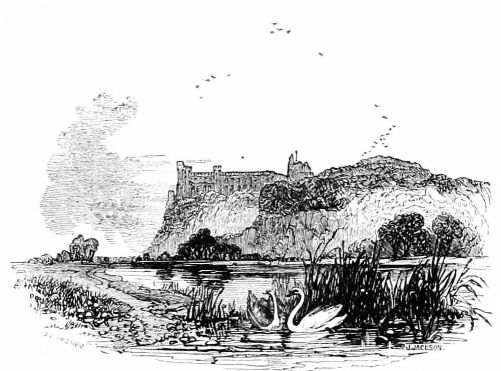
The Castle of Arundel, in point of situation, presents every advantage which could be desired for the erection of a military fortress. At the southern extremity of the elevated platform on which it stands, a strong wall inclosed the inner court, containing upwards of five acres; on the north-east and south-east a precipitous dip of the hill, to at least ninety feet, rendered the castle inaccessible. On the remaining sides, a deep fosse, protected on the north by a double vallation, and cutting off all external communication in that direction, secured the garrison against any sudden incursion or surprise. Or, if assailed,—
From gate and battlemented tower Fell the warder’s iron shower— And swift and sharp, from twanging yew, The feathered shafts incessant flew.
In the centre of this spacious area, rose the donjon or Keep, circular in form, of enormous strength, crowning a lofty artificial mound, and commanding a wide and uninterrupted view of all the neighbouring approaches. The height of the mount, from the bottom of the fosse on the external side, was seventy feet; on the internal, sixty-nine; and with that of the walls and battlements, by which it was crowned, presented a commanding elevation on the east of ninety-six feet; and on the west, of one hundred and three. The walls, measuring from eight to ten feet in thickness, inclosed a nearly circular space, varying between fifty-nine and sixty-seven feet in diameter, which afforded accommodation for the garrison. The apartments, judging from the corbel stones still remaining, appear to have been arranged round the walls, converging towards the centre, from which they received their light, as from an open cupola. Externally there were neither loop-holes nor openings in the masonry, from which, as in other keeps, an army could be annoyed; so that it was only from the ramparts and battlements that the garrison could repel an assault.—See Dallaway’s Rape of Arundel and Horsted’s History.
Such in all probability was the ‘Castrum de Harundel’ when the Conqueror placed it in the hands of Roger Montgomery, and such as it had been when erected by the wise policy of King Alfred. At this time the Keep appears to have comprised the whole strength of the place, the barbican or outer rampart excepted; so that to give it the strength and space of a Norman castle, by contributing those improvements which the circumstances of the time demanded, and of which its natural position was highly susceptible, engaged the first care of its Norman possessor. The external walls, accordingly, were faced with a new casing of Caen stone; the whole structure was supported at intervals by broad flat buttresses; and on the south-east side of the Keep an improved
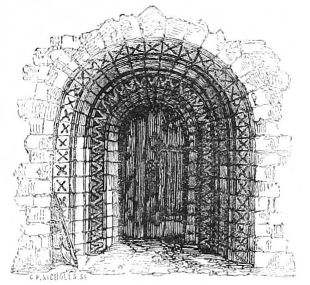
entrance was effected, where the Norman art is still visible. It is a wide semicircular archway cut through the solid wall, ornamented on the inner side with a plain torus moulding, and terminated on the outer by a smaller arch, richly carved with the chevron and other ornaments in common use during the latter part of the eleventh century.[23]
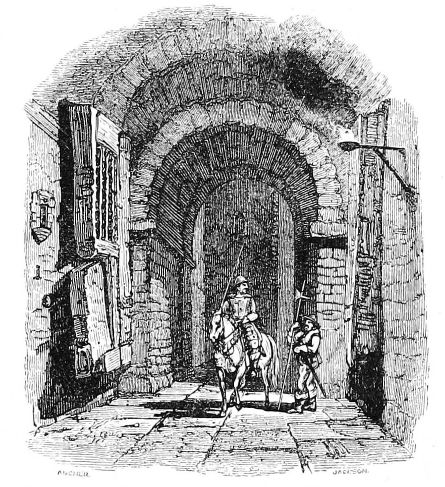
But of all the architectural improvements effected by Roger Montgomery in the wide area beneath the Keep, the most conspicuous in the present day is the great Gateway. It consists of a square tower standing over an arched way, which forms the entrance to the court, and communicates with the Keep by a raised passage carried across the moat, and terminated by a flight of steps. The upper part of this tower is supposed to be the work of the thirteenth century; but the lower portion, comprising the whole of the covered-way, retains its original stamp, and presents a striking specimen of Norman taste. The arch is circular, without a keystone, and quite destitute of ornament. The arch, as well as all that remains of the ancient front of the tower, is composed of square blocks of Pulborough stone, the angles of which still preserve their original sharpness. A portcullis was formerly placed at the outer extremity of the passage, which was probably still further strengthened by a drawbridge over the fosse immediately beneath it.[24]—See the engravings.
The Barbican, or Bebis’ Tower, as it is generally called, is another of those warlike adjuncts by which the Norman baron strengthened and improved his new residence. It occupies the north-west side of the ditch by which the Keep is surrounded, and, notwithstanding the ravages of siege and storm, presents many of the characteristic features of Norman architecture. It is an oblong tower, supported by a huge buttress at each of its angles, and originally was of considerable elevation; but during the Parliamentary siege, about to be noticed, the upper part was destroyed, and the temporary roof which now covers it was supplied at a later period. The whole is now invested with a luxuriant mantle of ivy, and presents, like the adjoining Keep, a green pyramidal mass of foliage, through which at intervals the grey stone and white mortar are discernible. It is haunted ground—
For there, ’tis said, ’mid scenes forlorn, When midnight spreads her dreary pall, The blast of Bebis’ bugle-horn Rings loudly from its ramparts tall. While, starting to the unearthly sound, Warrior spectres gather round; And dismal through the dusky air, Banners gleam and torches glare— Till all, at cock-crow, to their shrouds Shrink away like fleeting clouds.
Under the east end of the Castle is an immense vault, described by a late historian of the Castle as sixty-six feet in length by nearly twenty-one feet in width, and upwards of fourteen feet high. The arches are circular, and formed of square blocks of chalk strengthened by four transverse ribs of massive stone. The walls, varying in thickness, present at different parts externally a compact mass of seven feet and upwards. This is the dismal receptacle in which the unhappy captive whom the fortune of war had placed at the mercy of his feudal lord, or the culprit who had violated the laws, were shut up in miserable durance. Few have ever traversed that dreary vault without an involuntary shudder, as imagination conjured up the scenes of human agony that must have transpired unheard, unpitied, under the veil of its sepulchral darkness—
Where oft, at the dark and midnight watch, As the sentry walks his round, The wail of pain, and the clanking chain, Send forth a dismal sound.
1404 A curious instance of escape from this dungeon, in connexion with the law of sanctuary, is recorded by Mr. Tierney, on the authority of Bishop Rede’s Register:—A person named John Mot, having been committed on a charge of robbery, contrived to elude the vigilance of his keepers, passed the
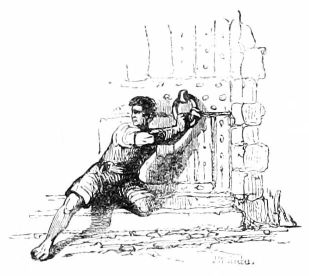
enclosure of the castle, and had nearly succeeded in effecting his retreat, when his flight becoming known, the constable, assisted by a part of the inhabitants, followed in close pursuit. Finding that he was likely to be overtaken, the fugitive turned to the College of the Holy Trinity, and seizing the ring attached to the gate, claimed the rights of sanctuary. The constable, however, appears to have doubted the validity of this appeal to ecclesiastical protection, and the captive was forcibly disengaged, and hurried back to prison. But the circumstance got wind; rumours of the occurrence soon spread through the neighbourhood; the immunities of the church and the laws of sanctuary were said to have been violated; two of the parties who had aided the constable in securing the offender were summoned before the bishop, to answer the charge in person. Being questioned, and found guilty, they were ordered to make a pilgrimage on foot to the shrine of St. Richard, at Chichester, to present an offering there according to their ability; to be cudgelled (fustigati) five times through the church of Arundel, and five times to recite the Pater-noster, the Ave, and the Creed, upon their knees before the crucifix at the high-altar. Before, however, this sentence could be carried into execution, it was ascertained that, on discovery of the error which had been committed, the captive had been “restored to the church.” The cudgelling was therefore ordered to be remitted; and an offering of a burning taper by each of the offending parties at the high-mass on the following Sunday, was substituted in its place.[25]
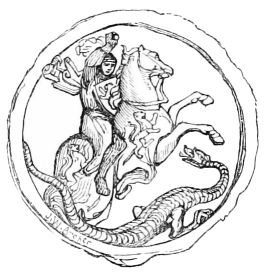
Of the Baronial Chapel, believed to have been erected at the same time, and now converted into the modern dining-room of the castle, little is known, beyond the fact of its having existed in the latter part of the thirteenth century[26]. During the minority of Richard Fitzalan, a royal patent was issued, by which we learn that the king, in right of the wardship which he possessed, presented to “the chapel of St. George, within the castle of Arundel.”[27] From that early period, down to the close of the last century, when the late Duke entered upon his plans for restoring the castle to its original splendour, this hallowed apartment had served as the family oratory of the Montgomeries, the Albinis, the Fitzalans, the Howards. But the rich and beautiful Gothic temple which the Duke has substituted has, in some degree, compensated for the metamorphosis to which the primitive altar of the family has been subjected. The spot, however, where an altar had stood for centuries—at which so many generations had knelt in their joy or their sorrow; had paid the tribute of gratitude in prosperity, and implored succour in adversity; at which the marriage benediction, the baptismal rite, and the solemn service for the dead, had been so long and often celebrated—such a spot, however transformed by the hand of man, to whatever secular purposes converted, possesses that inherent sanctity which no disguise can obliterate—
Unseen a hallowed incense fills the air, And mystic voices peal the notes of prayer. Still round that shrine where once the VIRGIN smiled, And kings and shepherds hailed the SAVIOUR-CHILD, A seraph watches with extended wing, And angel-quires their songs of triumph sing.
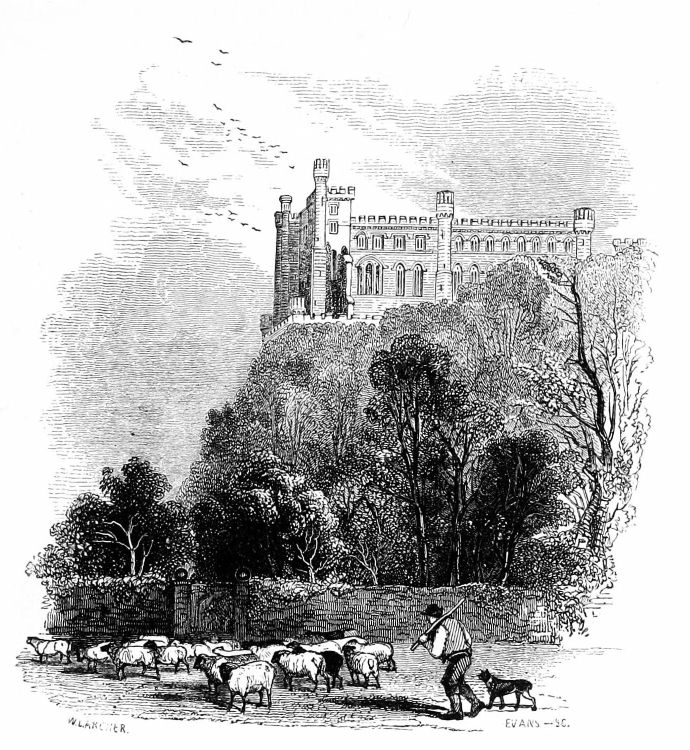
The South-east front of Arundel Castle, which crowns an abrupt descent overlooking the river Arun, appears, in common with the dungeon already described, to have been the work of Montgomery, and contemporary with the adjoining tower. This opinion is confirmed by the close resemblance of its external masonry to that of the keep; as well as by the remains of some double round-headed windows, still visible in the walls, and which strictly correspond with double arches in Winchester Cathedral, built about the same epoch by Walkelin, cousin of William the Conqueror.
1094 Whatever appears to have been necessary for the strength and security of a Norman baron and his retainers, seems to have been fully and expeditiously effected by Earl Roger, whose experienced eye and warlike spirit soon detected the weak points of Arundel Castle, and supplied a remedy in those massive walls and outworks, which, with a well-disciplined garrison, must have rendered it impregnable in all the ordinary extremities of foreign or domestic warfare. The earl who next employed his taste and munificence in the work, was Richard Fitzalan, the third of his family, to whom we shall return in a subsequent notice. Having obtained a patent, authorising him to strengthen the defences of the town, by enclosing it on the exposed sides with walls, he appears to have availed himself of the same opportunity to rebuild the upper part of the old gatehouse, which had now stood upwards of a century, and to enlarge it on the west by the erection of an external gateway, a correct engraving of which is here introduced.
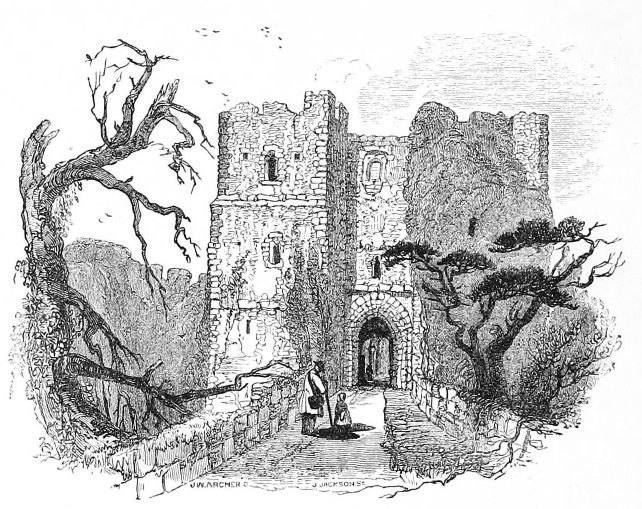
It consists of a long covered passage, “approached originally by a drawbridge over the fosse;” the entrance is under an “obtusely-pointed arch without machicolations, defended by a portcullis, and flanked by two square embattled towers, which are divided into four stories of apartments.” The lowest of these comprises the dungeons, entirely dark, and sunk to a depth of nearly fifteen feet below the bottom of the fosse. The upper rooms are lighted externally by narrow label-headed windows; and at the west corner a chamber, which extends along the whole of the covered-way, communicates with one of these apartments. This central chamber is still perfect, and accessible, by a spiral stone staircase, from the passage below. In the north wall of the archway is the ancient sally-port[28], which opens into the ditch. The foundation of the well-tower, and the construction of the present entrance to the Keep, are of similar origin with the gateway. Originally it was of considerable elevation; but having suffered by the united efforts of time and violence, the upper part was taken down by order of the late Duke, and the rubbish thrown into the well, which, according to our cicerone, was three hundred feet in depth[29]. In most of the ancient fortresses, situated on lofty and commanding situations, the garrison-well was always an object of paramount interest. The labour and ingenuity with which it was constructed, and the almost incredible depth to which it was often found necessary to perforate, before an adequate supply of that indispensable requisite, pure water, could be secured, are sufficient to excite our curiosity and admiration.
In the square tower immediately adjoining, on the east side, is “the present entrance to the Keep. Its narrow pointed arch is concealed beneath the dark projection of the tower; whilst the portcullis which once closed its approach, and the steep winding ascent which conducts to it, must have rendered the position of this garrison impregnable”—so far as that could be accomplished by art; for it is only in the hands of the truly brave that any place can be pronounced impregnable[30].
The tower, which is a continuation of that built over the well, is curiously contrived: its eastern wall is built against the old Norman door-way, in such a manner as to include within it about one-third of the open space of the arch. Parallel with this wall, on the inner side, is another erected about three feet distant, forming a long narrow slit within the tower, which, by means of the enclosed portion of the ancient arch, opens a direct communication with the interior of the Keep. Over this covered space is a sort of stone funnel, resembling a chimney, with an opening into a chamber above; and immediately below, at the base of the outer wall, is a very small pointed arch, which is supposed to have been intended either as a sally-port, or as a private entrance to the fortress when other avenues were necessarily closed. Scarcely rising above the surface, it escaped observation, and enabled a spy to disappear almost as if he had sunk into the earth; whilst, in case of discovery or of an enemy attempting to force a passage by this aperture, the funnel above presented a prompt sluice, through which melted lead, boiling water, and other destructive missiles could be discharged upon the heads of the intruders, so as completely to cut of all access to the interior[31].
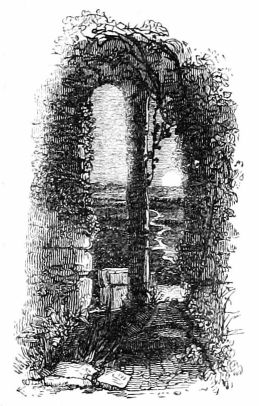
The ancient Chapel or Oratory of the garrison is another of those architectural features which owe their foundation to Richard Fitzalan. It was dedicated to St. Martin, and together with that of St. George—the Baronial Chapel already noticed—is mentioned in Domesday Survey, as enjoying an annual rent of twelve-pence, payable by one of the burgesses of Arundel[32]. The view from this consecrated spot, as observed through the opening of its mutilated arches, offers one of the finest coups-d’œil in this romantic and commanding position. The chapel is a relic of great interest—but only a relic, for
Now loud, now fainter The gale sweeps thro’ its fretwork, and oft sings The owl his anthem, where the silenced quire Lie with their hallelujahs quenched like fire.
The Keep of Arundel Castle,—for so many ages the residence of a warlike garrison,—is now abandoned to the ‘owls and bats.’ Of the former, the breed is peculiar to the place, and the largest in the kingdom. To the student of natural history, a visit to their domicile is a treat of no common interest. Strangers often resort from a great distance to make acquaintance with them; and many who attach little importance to Minerva, are struck with the gravity of her representatives in Arundel-Keep.
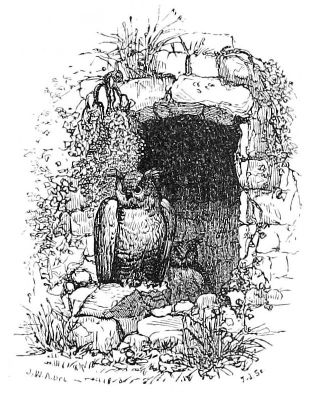
The “portraits,” here introduced, were taken from life, with a peep into their domestic economy, which is conducted in the old niche-like fire-place of the garrison, where the steel-clad warrior of other days has often prepared his hasty mess, or chafed his limbs after a cold night-watch on the battlements. There is here, perhaps, no fox to look out from the loophole and bay the moon; but these Owls are no unpoetical substitutes to proclaim the changes that have come over this once thickly peopled fortress.
When we visited them in October last, they consisted of three couples, and in size and appearance fully justified the character we had heard of them. They are not permitted, however, to remain at large; a strong circular netting is thrown over the Keep, and under this awning they may enjoy everything—except liberty. They have the advantage also of separate niches for the enjoyment of connubial happiness: but it is easy to observe that, not having freedom, they fancy they have nothing worth having. The custodé, in order to show them off to advantage, dislodged a couple; and certainly the expanse of wing which they showed in their flight to the opposite side, was much more like that of an eagle than an owl. At that moment the fact of their being prisoner seemed to have been forgotten; for when removed from their perch by an unceremonious ‘poke’ of the keeper’s rod of office, they made an ambitious attempt to soar at once into the sky; but the netting was too strong, and, compelled to keep a horizontal flight, they dropped sulkily into a niche in the opposite wall, with a peculiar barking sound, very expressive of indignation and disappointment.
Several of these horned owls, as curious specimens of natural history, have been stuffed, and advanced to posthumous honours in the Castle gallery. With one of them, the patriarch of the family, an anecdote is connected, which in justice to his memory we think it our duty to record:—Some years ago an elderly gentleman on his way through Arundel, took advantage of a short halt at the Norfolk Arms to visit the Castle. He was much pleased, as all sensible visitors must be, with everything he saw, but most with the grave moping owls of the Keep. But of all the family, one in particular had a sagacity of expression which appeared to engross the whole attention of his visitor. His horns long, and horizontally projecting from either temple; his scarlet-coloured eyes, that seemed as if they had become inflamed by long-continued study; his wings that hung loosely about him like a professor’s gown; his face, his feet—every feature in short, seemed to say—This is no common owl.
‘He’s a sagacious fellow, this!’ observed the stranger. ‘Very, sir,’ said the keeper, ‘very!—We always calls him the Chancellor.’ ‘The what? the chancellor?’ ‘Yes, sir; sometimes the chancellor and sometimes Lord Eldon—he’s so very wise!’—the stranger was highly amused at finding a namesake under the ivy in Arundel Keep; and we need scarcely add that the visitor was, in fact, the chancellor himself—the late venerable and learned Lord Eldon.
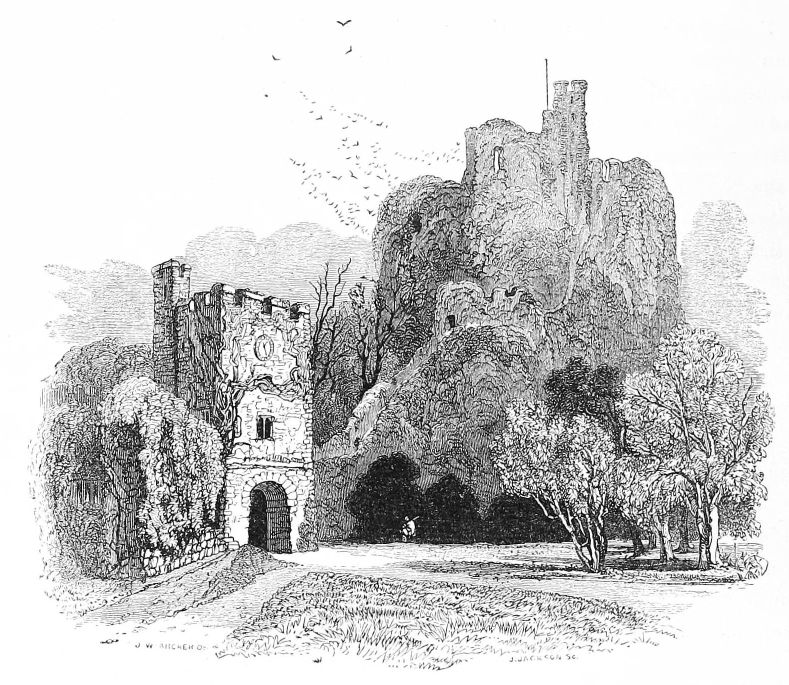
s an ‘ivy-mantled tower,’ this Keep is without a rival in all we can recollect of foreign and domestic castles. The artificial mound on which it stands, is a dense mass of ornamental trees and shrubs—half girdled by a solitary walk along the bottom of the ancient fosse, over which the redundant verdure throws a delicious freshness. On the side facing the open court, the masonry of the Keep is concealed under a thick mantle of ivy, which climbs to the very summit, and in its ascent, flings its luxuriant festoons over every projecting fragment. The interior is clothed with the same perennial drapery; and once deserted by man, nature has taken the ruin under her own immediate protection—repairing the shattered walls, filling up every blank, and mantling the whole in her own livery.
To those who are fond of romantic scenes and impressions, it would be difficult to select a more congenial spot than the Keep in question; particularly by moonlight, when all the rich and waving outline of the ruin is brought forward in bright silver tracery. In certain conditions of that luminary, the effect of light and shade is peculiarly striking; and it requires but little assistance from imagination to embody, among its isolated projections, the airy forms of sentinels planted at various intervals; their arms coming every now and then into sudden relief, as the moon touches the glittering leaves with her
fitful light, and the night breeze communicates to the detached branches a sort of temporary, life-like movement. It is then that airy visions are said to haunt the place, and not unfrequently cross the path of the intruder:—
For oft on the mouldering Keep by night Earl Roger takes his stand, With the sword that shone at Hastings’ fight, Firm grasped in his red right hand! Then he calls his spectre-knights by name— To their spectre-Chief they fly When each gauntlet rears its bristling spears, To their Norman battle-cry! But beware—beware to wander there, At the mass of the blessed Yule When, with spectral forms in glittering arms, That haunted Keep is full! ’Tis then they shout, as they shouted once When our Saxon standard fell; And the Norman blade its carnage stayed At the sound of Harold’s knell! etc.—MS
Of the four original towers, planted at regular intervals around the enclosed space beyond the Keep, all, with the exception of the barbican already mentioned, appear to have been the work of the period in question. They are of the same form as that of the outer gateway, and have the facilities of free intercourse by means of a connecting walk along the ramparts. They were all dismantled during the last siege; but in the ruins which still remain, the characteristic style of Earl Richard is apparent. Two sally-ports of the same date, and at opposite sides of the enclosure, may still be seen in a state of preservation.—See ‘History of the Castle.’—50.
The next embellishment bestowed upon the Castle of Arundel was the great Hall. It was erected by Richard, grandson of the Richard Fitzalan whose taste and munificence had contributed the addition already mentioned.
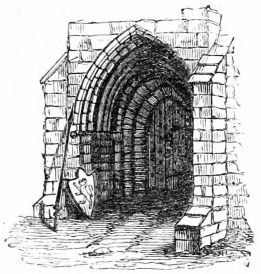
It was in the style of Edward the Third; with an entrance from the court, through a deep pointed doorway, under a plain projecting porch. The hall itself was entirely demolished during the Parliamentary siege referred to in these pages; but the remaining doorway continued to indicate the splendour of the original design, till its place was occupied by a still more striking and elaborate structure—the Barons’ Hall of the present century.
The last addition to this baronial seat of so many illustrious families, was the wing on the north-east side; but when the restoration of the Castle was commenced under the auspices of the late Duke, this was removed to make room for the great library. The character of its architecture was that of the time of Henry the Eighth. It consisted of the family apartments, with a splendid gallery, a hundred and twenty feet in length, lighted by eight windows looking into the court, and erected by Earl Henry, the last of the Fitzalans.
In the preceding outline we have endeavoured to convey a general idea of the Castle of Arundel, as it appeared at the commencement of the seventeenth century—enriched by the labour of centuries, and the accumulated fame of the Montgomeries, the Albinis, the Fitzalans, and the Howards; all of whom had manifested a strong attachment to the place, strengthened by associations which connected them with the most brilliant events of English history, and identified their names and fortunes with those of Arundel. But at the disastrous period of the great civil war, the noble proprietor was an exile. The succession of calamities, which had given the family history of his immediate predecessors such mournful interest, was still felt in its consequences, and contributed, with other causes, to invest the fortress of his ancestors with many bitter as well as bright remembrances. Under these circumstances, the possession of Arundel Castle became an object of sanguinary contention between the Royal and Parliamentary leaders, and, being alternately taken and retaken, was as often delivered up to the reckless fury of its captors.
1642. Sir Ralph Hopton having received orders to dislodge the Parliamentary troops, marched from his head-quarters at Winchester, and laid siege to Arundel. The garrison was not in a condition to offer any effectual resistance, and on the third day the Royal standard was floating from the Keep. Placing the fortress in as defensive a position as time and circumstances would permit, and delegating the command to Sir Edward Ford, Hopton returned to Winchester. This was too favourable an occasion to be lost sight of by the Parliament, and Sir William Waller was instructed to take instant measures for the recovery of the Castle. His march was greatly facilitated by a severe frost, so that the cross-roads, which would otherwise have been impassable, were sufficiently hard to admit of his transporting the cavalry and heavy ordnance to the scene of action; and on Tuesday, the nineteenth of December, his guns were directed against the Castle.
On the Friday following, a despatch from Waller was read in the House of Lords, in which he details the progress of the siege in terms so characteristic of the times, that we cannot omit its insertion in this place:—“My Lords, According to your commands, I advanced the last Lord’s day from Farnham to this place. I could not reach that night past Haslemere; the nexte day I marched to Cowdray, where we understanding there were four troopes of horse and one hundred foote, I resolved to give them the good night; and to
that end I despatched away two regiments of horse to lay the passage round; but they were too nimble for me, and escaped hither, where I overtook them on Tuesday night. The next morning, after we had taken a view, and found out a place where we might flank their line with our ordnance, we fell in upon the north side of the workes; and we did so scower a weedy hill in the park, on the west side of the pond, with our pieces, that we made it too hot for them, which gave such courage to our men, that with the same breath they assaulted an entrenchment newly cast up, and which was very strong. It was drawn from the town gate down to the aforesaid pond near the mill. At the same time we fell on a narrow passage near the mill, where they had likewise a double work and very strong; but in a short time, by the good hand of God, we forced both, and entered the town with our horse and foote, notwithstanding a brave sally made by their horse. We beat them into the castle, and entered the first gate with them; the second they made good and barricaded; and they are there welcome to stay. I am resolved to block them up, for I know they are in a necessitous condition. God hath been pleased to blesse me hitherto with a gracious successe, his great and holy name be praysed! But truely, my Lord, I am very weake in foote, and my horse so hackneyed out that they are ready to lie down under us. I expect Colonel Behre and Colonel Morley here this day.”
The progress of the siege is too lengthy for detail in this place; but we proceed with a few extracts characteristic of the spirit with which it was conducted:—“To-day,” says the relation, “Major Bodley did a notable exploit; he, perceiving divers in the castle looking forth in a balcone, took unto himself and twelve others their muskets into a private place of advantage, from whence they already discharged into the said balcone, and slew and wounded divers of the enemy.” A very ‘notable exploit’ indeed! the said Major appears to have been one of those heroes who like ‘to shoot round a corner.’ “The same day,” continues the narrative, “two sacres were planted in the steeple with divers musquetiers, who, on Friday morning betimes, played hotly on the enemy, which appeared on the top of the Castle. (The church steeple is within easy musket-shot of the battlements.) The same day divers were taken in their intended escape from the Castle: also, the contents of a pond being drained, it emptied the wells of water within the Castle, so that now the enemy began to be distressed with thirst; divers fled from the Castle and were taken prisoners.” “On Sunday,” agreeably to the record, “divers more fled; many horses were turned forth, of which our soldiers made a good purchase; only one of them was shot by the enemy, whose bloody crueltie and inhuman malice did mightily appear against us, in that they took and hewed him all to pieces, which, doubtlesse, they would have done to us, had we been likewise in their power. On Tuesday the enemy made shew of a salley, but hereupon the drums did beat and the trumpets sounded; all our men were presently gathered together in a fit posture to charge the enemy, when they presently took to their heels, and so manfully retreated. On Tuesday we planted ordnance in a new place against the Castle, which made the enemy that they durst not peep over the walls to shoot at us. On Wednesday divers came forth again into the balcone, having forgot the former danger, whereupon we placed divers musquetiers in the ruins of an old chappel, from whence we did good execution upon them”—adopting, it is presumed, the aforesaid practice of Major Bodley, of shooting round the corner. “On Thursday more of the enemies were taken escaping out of the Castle, and that afternoon the enemy hung out a white flag pretending a parley, and calling to some of our men, delivered them letters directed to our Generall, in which they desired sack, tobacco, cards and dice to be sent unto them, to make merry this idle time, promising to return for them beef and mutton; but the truth is,” says the narrator, “they wanted even bread and water, and that night did put divers live oxen over the walls of the Castle, for want of fodder.” In another place he mentions that “some of the enemies fled out of the castle, and escaped by the river Arun, in a boat made of a raw oxe hide.” There was also skirmishing between Hopton’s and Waller’s horse, to the advantage of the latter. “On Friday the fifth of January, on the eve of capitulation, the enemy,” says he, “began to feel the fruits of their deserts, being extremely pinched with famine.”
The next letter, dated January 6, 1643, is addressed by Waller to Lieut.-General the Earl of Essex:—“My Lord, on Thursday the enemy sent a drummer to me, signifying their willingness to surrender the Castle, if they might have honourable conditions. I returned answer, that, when I first possessed myself of the town, I summoned them into the Castle to yield upon fair quarter; I now took them at their word, and bid them yield to mercy. That
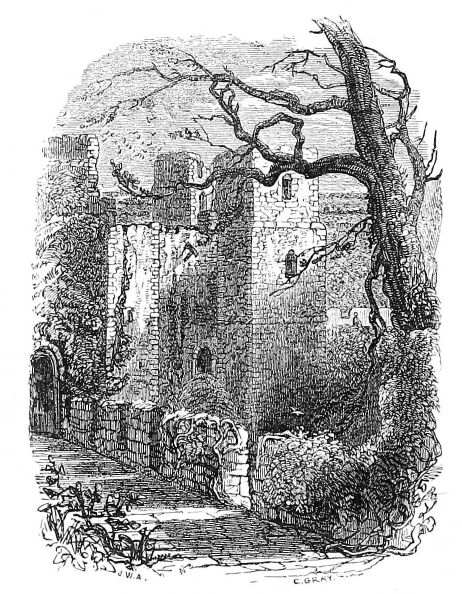
night I heard no more of them; but the next morning the drummer came to me again, with another letter, wherein they disavowed that answer to my trumpet, laying the blame upon one who, they say, had no more soldiery than civility, that without their assent or knowledge had given that language. I sent them answer, that I was very well satisfied, that, in this disavowing that rashness, they had made room for courtesy; and that I was contented to give them fair quarter, and that, according to their desire formerly expressed, if they would send out to me two officers of quality, I would employ two of equal condition to treat with them about the particulars of the surrender. Within a short time after, there came out unto me Colonel Bamfield and Major Bodvil, who pressed very much that they might have liberty to march away like soldiers, otherwise they would choose death rather than life; and so broke off. About two hours after they sent out unto me Lieut.-Colonel Rawlins and Major Moulin, who, after some debate, came to an agreement with me that this morning they would deliver the castle into my hands by ten of the clock, with colours and arms undefaced and unspoiled; and that the gentlemen and officers should have fair quarter and civil usage, and the ordinary soldiers quarter. For the performance of these covenants, Sir Edward Ford and Sir Edward Bishop were immediately to be yielded to me, which was accordingly done.
“This morning we entered, and are now, blessed be God, in possession of that place. We have taken seventeen colours of foot, and two of horse, and one thousand prisoners, one with another, besides one hundred and sixty, which we took at the first entering of the town, and such as came from the enemy to us during the siege. I humbly desire that the London regiments may be sent hither to secure this important place, while I advance with what strength I have towards the enemy, who lye at Havant.—I humbly rest,” &c.
The result of this siege was ruinous to the Castle. Its successive occupation by two hostile garrisons; the destructive means employed from within for its defence, and from without for its reduction, left its halls roofless, its noble apartments unlatticed; its Keep, gates, and battlements rent and neglected; and from that day
“Its huge old halls of knightly state, Dismantled lay and desolate.”
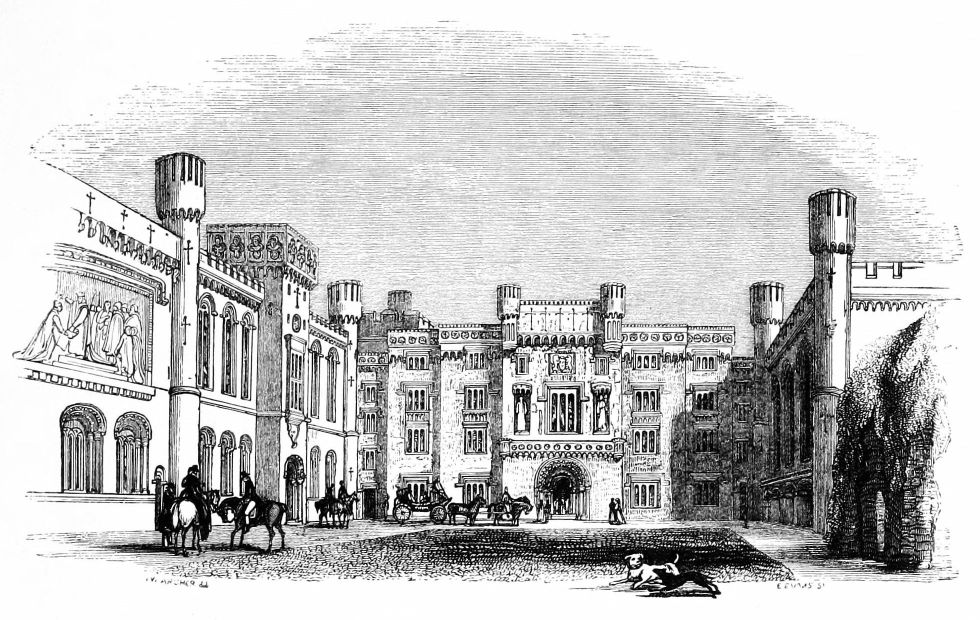
At length, after an interval of seventy years, Thomas Duke of Norfolk, having determined to rescue the baronial seat of his ancestors from utter destruction, repaired the old and added new apartments, till it was once more in a habitable condition. But the restoration to which we have more especially to refer in this place, was commenced in 1786 by the late Duke, who continued it till his demise in 1815—an interval of nearly thirty years, during which, although he is said to have expended six hundred thousand pounds in the execution of his plan, it is still incomplete. The noble proprietor, himself an amateur in the science of architecture, superintended all the designs; and wherever any precious relique of antiquity was to be found, it was carefully drawn or modelled by skilful artists, and introduced into the plan of the Castle. Hence the richness and variety observable in the doors, windows, niches, and architectural ornaments so profusely employed on three sides of the quadrangle.
The grand entrance to the court-yard of the Castle is formed by a lofty arched gateway of immense bulk, and generally admired for the architectural dignity and grandeur of the design. The effect is striking at first sight, and conveys to the mind of the visitor a feature highly characteristic of a feudal residence. The arch is pointed, surmounted by a heavy machicolation, and flanked by two hexagonal towers, which, according to the original design, were to have been ‘encircled with an external gallery, terminating at each angle in a turret,’ but the design remains unfinished. Compared, however, with the old gateway, which speaks so audibly of other times, the modern structure possesses no interest; and to enjoy the impression, the stranger must endeavour to divest his mind of the fact that it is a building of yesterday, otherwise he will be apt to exclaim with Delille, in his indignation of modern imitations:—
“Mais loin . . . . . Ces restes d’un château qui n’exista jamais: Ces vieux ponts nés d’hier, et cette tour gothique, Ayant l’air délabré sans avoir l’air antique, Artifice à la fois impuissant et grossier.”
On entering the court through this gateway, the first object that strikes the eye is a large bas-relief on the opposite side, representing Alfred the Great instituting the trial by jury on Salisbury Plain. The spot chosen was by the side of a dead wall. In his left hand is a roll of parchment, half unfurled, with the Saxon sentence:—“That man fiœbbe gemot on œlcum wœpentace.” “That man in every hundred shall find twelve jury.” It occupies a large portion of the front of that part of the Castle next to the great library, and bearing the appropriate title of the ‘Alfred Saloon.’ But from the
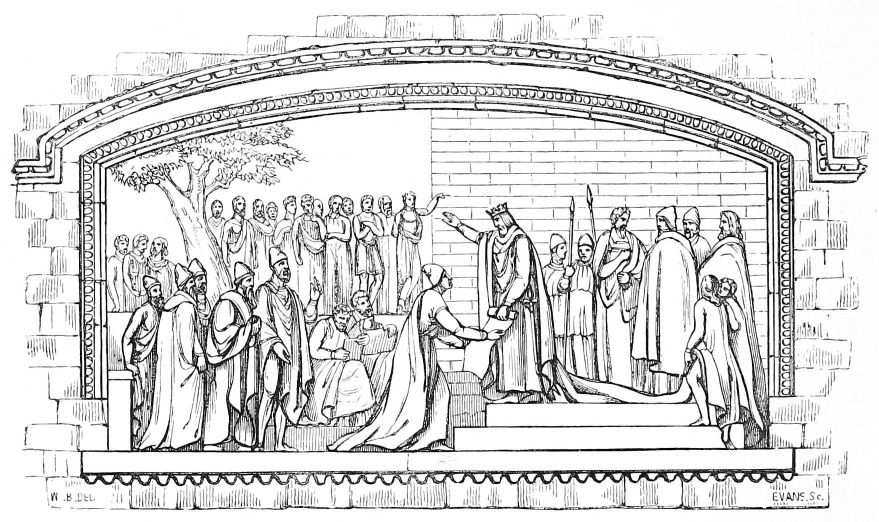
faithful and spirited etching here introduced, the reader will obtain a much clearer idea of the subject than from any description. It is strictly historical, and was designed by Rossi. It is probable, however, that this admirable institution did not originate with Alfred, but that it was only improved and perfected by him[33].
On the right of the gateway stands the Baronial Chapel, a modern erection of florid Gothic, with pinnacles, niches, buttresses, all in the best taste and of elaborate workmanship. The interior is not finished, but the duke intended to have done so after the models of ancient Saxon and Norman churches, copies of which had been already procured at the time of his demise.
Adjoining the chapel is the Barons’ Hall or banquet-chamber, a building much admired. Over four beautiful Saxon arches is a raised parapet, along the base of which are seen, sculptured in stone, a variety of hieroglyphic figures, taken from antique designs, illustrative of the family history, and procured from the Herald’s College, of which his Grace is hereditary Earl Marshal.

The south side of the quadrangle is part of the ancient structure, restored from the ruinous condition in which it had been allowed to continue from the last siege, down to the accession of the late Duke to his family honours. It consists of an entirely new front of massive stone, which differs from the others in exhibiting the insignia of the Howards in union with those of their predecessors. The grand entrance is in the Norman style. It is twenty-eight feet wide from the abutments, fronted with Portland stone, curiously carved, and worked with infinite intersections of wreathed vine-leaves, roses, laurel, oak, acorns, and other vegetable emblems. The top is finished with a line of artificial stone in the shape of fence-work, a little elevated. On the right of the doorway is a colossal statue of Hospitality; and on the left is another of Liberty, as seen in the view of the Court already introduced.
The north-east wing, which contains the Library, was commenced in 1801. Its basement is formed upon the Norman model; its upper part is in the style of Henry the Sixth, with a projecting square tower in the centre, and lighted from an oriel window. The sculpture and carving upon the windows and doorways exhibit much delicacy and beauty of workmanship. Those under the bas-relief, in front of the Alfred Saloon, are of elegant design and finish. The Library here mentioned is an apartment of great magnificence; it measures one hundred and seventeen feet in length by thirty-five in width, and is, beyond doubt, one of the finest specimens of modern Gothic in England. It displays the grandeur of ancient designs under the delicate finish of modern art, and brings into one view specimens of almost every ornament of which, during the fourteenth and fifteenth centuries, the graceful Gothic presented so many exquisite combinations. The book-cases and reading-galleries are supported by fifteen columns wrought out of the richest Spanish mahogany; while the ‘spidered roof’ displays a beauty of workmanship and delicacy of carving, enriched with fruit-foliage, which have seldom been surpassed. It is divided into several compartments for reading recesses, and communicates with the Alfred Saloon by two magnificent folding-doors. At present, however, the shelves are sparingly furnished, and the mahogany—rich and elaborate as it is—offers a striking contradiction to those ideas of antiquity which the Gothic carving might otherwise convey. The chimney-pieces are of fine Carrara marble, and in their sculpture exhibit pure classical taste.
The great Drawing-room is a spacious noble apartment, and commands an extensive view of the winding vale of the Arun. It is chiefly remarkable, however, for the family portraits which adorn its walls and, to the eye of the historian, throw open a vast and interesting field of retrospection:
“For, by dim lights, the portraits of the dead Have something ghastly, desolate, and dread. . . . . . Their buried locks still wave Along the canvas; their eyes glance like dreams On ours, as stars within some dusky cave; But death is imaged in their shadowy beams.”
Of these portraits we noticed about sixteen, one of which is a beautiful historical piece, by Mather Brown, representing Thomas Howard, Earl of Surrey, vindicating himself before Henry the Seventh for the part he took at the Battle of Bosworth. Henry upbraided him with having served in the cause of the late usurper and tyrant, Richard the Third. “Sir,” replied Surrey, “he was my crowned king. If the authority of Parliament had placed the crown on that stake, I would have fought for it. Let it place it on your head, and you will find me as ready in your defence.” In the back-ground of the painting, the Princess Elizabeth, sister of the young princes who were smothered in the Tower, is seen displaying the red rose as an emblem of the two houses.
Another interesting portrait is that of “Jocky of Norfolk,” father of the preceding, who fell with Richard at the battle of Bosworth. A third is the portrait of Henry Howard, Earl of Surrey, “the delight and ornament of his age and nation,” whose bright life and tragical end are familiarly known to every reader.—But to this we purpose to return in a subsequent part of the work. A fourth is that of Thomas, Duke of Norfolk, painted by Holbein, whose evil fortunes are so closely associated with those of Mary Queen of Scots. Also the portraits of his wife, Mary Fitzalan, the last of her family, who died in her eighteenth year; and of her only brother, Henry Fitzalan, Lord Maltravers, painted at Brussels.
There are also portraits of the celebrated Cardinal Howard, of “belted Will Howard,” and of various other members of the same house, by the eminent painters of the day.
In the furnishing of these state apartments there is little to excite attention; it combines elegance with simplicity, but contains nothing gorgeous in colour or texture. The woodwork is nearly mahogany throughout. Nothing, however, could be more out of place—a wood that has been known in this country little more than a century, is ill associated with the Gothic ornaments of a baronial hall. Old English oak is, beyond doubt, that which best harmonizes with our ideas in such places. A piece of old oak carving is an object of never-failing interest to the mind of an antiquary; but in Arundel Castle we observed no specimens of native ‘gnarled oak,’ except in the “Windsor rooms.”
The Dining-room—formed, as we have already mentioned, out of the ancient family chapel—is a lofty, spacious, well-proportioned room, and chiefly remarkable for its great window of stained glass, which still throws “a religious light” over the banquet. It is quite modern, and the historical subject selected for its embellishment is the Meeting of Solomon and the Queen of Sheba—portraits of the late Duke and Duchess-dowager of Norfolk. “On each side is a beautiful transparency on plate-glass—one representing the Mercy-seat in the Jewish tabernacle, the pillars protected by cherubim, with Aaron’s pitcher and rod lying at the foot of the altar; the other is a fine representation of the Interior of the Tabernacle, as transmitted to us in the Biblical account; and both serving to soften and modify the light as it falls on the great painting in the centre[34].

The interior of the Barons’ Hall, however, is by far the most interesting apartment in the Castle, and claims a high station among the banquet-rooms of modern times. It was designed, in connexion with the chapel already noticed, to commemorate the triumph of the Barons over King John, by the signing of the Great Charter at Runnymede. Its architecture, like that of the appendant chapel, is in the style of the fourteenth century. It is seventy-one feet in length by thirty-five in breadth, lofty in proportion, and, as a whole, produces a striking effect on the spectator. The roof consists of Spanish chestnut, elaborately carved in imitation of the richest Gothic originals, with numerous combinations, emblematical groups, and curious workmanship. The windows are of the acutely-pointed form; the canopies over the arches, which are ornamented with the lozenge, rest on corbel-heads of kings; and the transoms form the lower compartment of each light into a plain unadorned parallelogram. The windows, however, are the grand attraction, for in these the story of English freedom is brilliantly told. They are thirteen in number, nine of which are finished, and filled with stained glass.
The great window illustrates the ratification of Magna Charta by King John, who, with ‘an indignant but powerless frown, seems to pause in the act of affixing his signature to the instrument, as if to upbraid the uncompromising patriotism of the Barons.’ On his right stand Cardinal Pandolfo, the Pope’s Legate, and the Archbishop of Dublin, who turns his head in conversation with other prelates behind him. On his left are seen Cardinal Langton, a mediator between the King and the Barons, but who administered an oath to the latter, never to pause in the struggle till they had obtained full concession of their liberty. Behind the Archbishop stands Almeric, Master of the Knights Templars[35]. In the foreground appears Baron Fitzwalter[36], with his page[37]; and behind him are the Lord Mayor[38] of London, and the attendant guards. In the background is a distant view of the Camp at Runnymede. For chasteness of drawing, depth of colouring, and sparkling brilliancy, this window is considered a masterpiece of modern art.
The other eight windows, executed by Edgington, the talented artist already mentioned, contain full-length figures of eight Barons, progenitors of the Norfolk family, who were instrumental in procuring the Great Charter[39]. They are habited in chain-armour, the military costume of the thirteenth century, each with his armorial bearings emblazoned on his surcoat and shield. The heads are actual portraits of various distinguished members of the house of Howard, some of whom are still living. The effect is superb, and, at first sight, there is some difficulty in drawing the distinction between the real and the ideal. The scenes are so finely isolated, and the single portraits so

prominent, that each appears as if he had the free and unimpeded use of his limbs, and could step down into the banquet-hall at his pleasure,
“To curb a despot and to save the state.”
The door of this magnificent Hall was first thrown open on the 15th of June, 1815, being the six hundredth anniversary of the great foundation of English liberty. For the joyful celebration of this glorious epoch in the old baronial style, a brilliant assembly of rank and title had arrived from various parts of the country, among whom were twenty-two representatives of the ancient Howards. Complete suits of armour, in which the ancient chivalry of England had gathered the spoils of victory—some at Agincourt, others at Cressy—were arranged in military order around the walls. Swords, that, by the evidence on their blades, had “done the state some service;” helmets that had been worn by the Howards at Flodden, or by “Belted Will” in some of his Border forays; chain and scale armour; spears and lances that had often gleamed in strife and tournament—all the implements of ancient warfare, from the thick iron casque of the archer, to the elaborate and richly-gilded harness of the baron, were all reburnished and brought into unexpected light for this occasion. Nothing, in fact, was omitted that could increase the interest, by giving an air of striking reality to the scene. If the spirits of the ancient Barons could have looked down upon the hall in this hour of gorgeous festivity, they would have rejoiced to see what a bright inheritance their patriotic struggles had bequeathed, and have felt that they had become, indeed, immortal in the hearts of their descendants,
At this banquet nearly three hundred guests assisted. At the upper end of the table was a noble “baron of beef,” surmounted by the ducal coronet and the banners of the House of Norfolk. The evening was ushered in by a splendid ball, at which ‘castled Arundel’
“Had gather’d then Her beauty and her chivalry, and bright The lamps shone o’er fair women and brave men.”
The ball was opened by the Duke of Norfolk and the Marchioness of Stafford—late Duchess-Countess of Sutherland—followed by about fifty couples, who kept up the dance, enlivened by admirable music, till one o’clock in the morning, when supper was announced, and the Sussex Band struck up the patriotic air of “The Roast Beef of Old England,” as an expressive welcome to the hospitable board. The festal scene was continued till the mailed warriors, niched in the walls and casements, caught the morning light on their armour; when King John and Baron Fitzwalter appeared to signify, that as the Grand Charter was now fully ratified, lord and dame were at “liberty” to retire—wishing
“To each and all a fair good night, With rosy dreams and slumbers light.”
Among the original Ecclesiastical foundations in Arundel, was the Alien Priory, or Cell of St. Nicholas, already mentioned. Roger Montgomery, who had restored the Benedictine Abbey of Seez, in Normandy, granted to the 1102-1380. monks of that establishment, liberty to erect a priory within the town of Arundel, and the building having been completed, five monks from the parent abbey arrived and took possession accordingly. In the early part of the same century, the priory was vacated; and the rectorial residence adjoining the church, of which William de Albini was patron, was converted into a residence for the prior and four monks. Thus occupied, it continued during two centuries to be known as the Convent or Priory of St. Nicholas. But Richard, Earl of Arundel, having resolved to connect it with the chapel of his college then about to be established, obtained from King Richard the Second a grant for that purpose, and on the site of the ancient priory arose the College of the Holy Trinity, a quadrangular structure, inclosing a square yard, or court, partly occupied by cloisters, and partly devoted to other purposes of
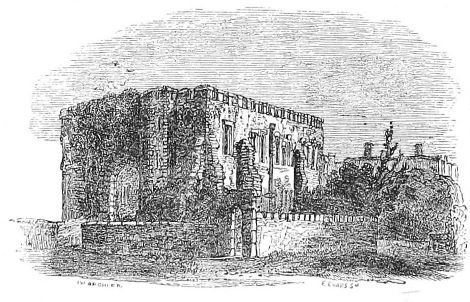
a monastic establishment. On the north side was the Collegiate Chapel, forming an apparent chancel to the parochial church; on the east were the refectory and various domestic offices connected with it; and the remaining sides on the south and west, were occupied by the members of the fraternity. Within the court was the Master’s house, attached to the south-east angle of the chapel, with which it communicated by a small stone balcony on the first story, and a flight of steps, which still remain, behind the high altar. As the collegiate church was intended to be the family sepulchre of the founder, every preparation was made to insure its monumental splendour; and the tomb of his son, Earl Thomas, was the first of a magnificent series. No stranger can enter this chapel without being strongly impressed with the classic beauty and elaborate sculpture of its family monuments. But during the siege already noticed, these sacred walls were given up as barracks for Waller’s soldiers; and many of the sepulchral antiquities, with which the place was so richly adorned, were wantonly mutilated.[40] Six monuments, however, still remain to fix the attention, and excite the admiration, of all who are lovers of the arts, or given to the study of Gothic remains. In the centre is that of Earl Thomas, son of the founder, and his Countess Beatrix, daughter of John, King of Portugal. It is a large sculptured altar-tomb of alabaster, formerly painted and gilt, and adorned with effigies of the earl and countess, in their robes of state. A rich canopy rises behind the head; and at the feet of the earl is a horse, the Fitzalan cognizance. At the feet of the countess, two lap-dogs hold in their mouths the extremity of her mantle. Arranged in niches around the tomb, are twenty-eight priests, each with an open book in his hand; and guarding the rim is a series of forty family shields, originally emblazoned. On the south side of the high Altar is a lofty sacellum, consisting of an arcade and canopy, composed of elaborate tabernacle-work, and, in its original state, richly painted and gilt.—But it would far exceed the limits of this work to convey even a general idea of these splendid memorials of departed greatness. We were glad to observe, on our late visit, that the restoration of this chapel is daily advancing, under the direction of the Duke of Norfolk; and in a few years, it is to be hoped, may recover something of its original splendour.
The Church, which forms a principal feature in the general view of the castle, is a spacious and handsome structure, consisting of a nave, two aisles, and a transept, surmounted by a low square tower, terminating in a spire, and forming a conspicuous landmark for mariners. A row of circular windows inclosing quatrefoils, in the clerestory; an ancient octagon stone font; a pulpit richly tabernacled in the same material; several monumental inscriptions, and a roof of Irish oak, proverbial for its durability, are among the
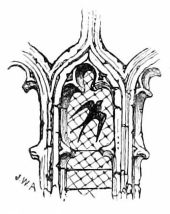
objects that deserve attention. In one of the chapel windows is the figure of a swallow on the wing, which may claim attention from the etymologist, as pointing to the oft-contested origin of the name Arundel; for history and geography, says Mr. Tierney, “the realms of fancy and romance have all been explored in order to discover its etymon. One author has amused himself with a rebus founded on the resemblance between the words Arundel and Hirondelle; and it is not improbable that the migratory bird here introduced may have been selected as an appropriate emblem for the chapel window. The conjecture is, at least, as plausible as another that has been advanced; namely, that Arundel is derived from Hirondelle[41], the name of Bevis’s horse.”
The Park of Arundel, which contains much picturesque scenery and many thriving plantations, was originally the hunting-forest of the ancient
Counts, and covered a great extent of country, which is now either under cultivation, or converted into pasture. Beyond the pleasure-grounds, immediately under the Keep, is the Inner Park, entirely surrounded by an artificial earth-work, still perfect, and adorned with magnificent elm and beech trees. The new, or Outer Park, comprises an extent of nearly twelve hundred acres, enclosed by a high wall with lodges, and stocked with a thousand head of deer. The scenery is variegated by numerous undulations of surface—alternate ridge and ravine, grove and glade, and watered by rivulets that derive their source from the neighbouring Downs.
At a short distance from the entrance to the Park, on the south side, is Hiorne’s Tower, the subject of the accompanying view. It is a triangular building, about fifty feet in height, with a turret at each angle, and in design and execution presents an admirable specimen of Gothic architecture. The merit of the design is due to the late distinguished architect, Mr. Hiorne, who superintended its erection, and left it as a monument to his name. The view from this tower, under a favourable atmosphere, presents a magnificent
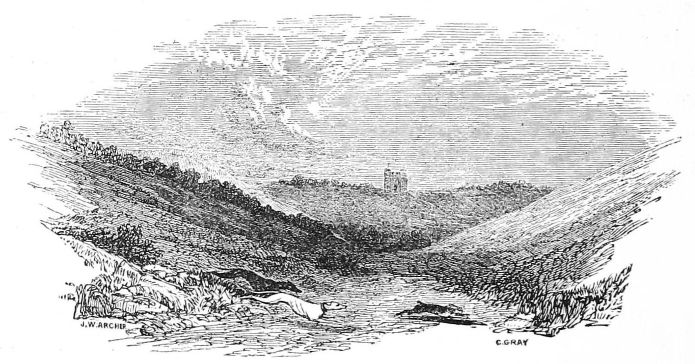
prospect of the adjoining Park. The soft pastoral hills that trace their bold outline on the sky; the umbrageous woods that cover the nearer acclivities; the villages, hamlets, and isolated dwellings that infuse life and activity into the picture; the herds of deer that are seen at intervals through the trees; the distant channel with its shipping, and the shining meanders of the river Arun—all present, in combination, one of the most richly diversified landscapes on which the eye of poet or of painter could love to expatiate.
To the readers of romance this scene is rendered doubly interesting by its immediate vicinity to Pugh-dean, where the graves of Bevis, the giant castellan of Arundel, and his horse Hirondelle, carry us back to the days of King Arthur and his knights. To this personage we have already adverted[42]; “but of his connexion with the Castle of Arundel,” says Tierney, “it were difficult to trace the origin, although there can be little doubt that it existed at a very early period. At the bottom of the valley called Pugh-dean, the locality now under notice, is a low oblong mound, resembling a raised grave in its form, and known in the traditions of the neighbourhood as ‘Bevis’s burialplace.’ It is about six feet wide, and not less than thirty feet long. It is accompanied by several
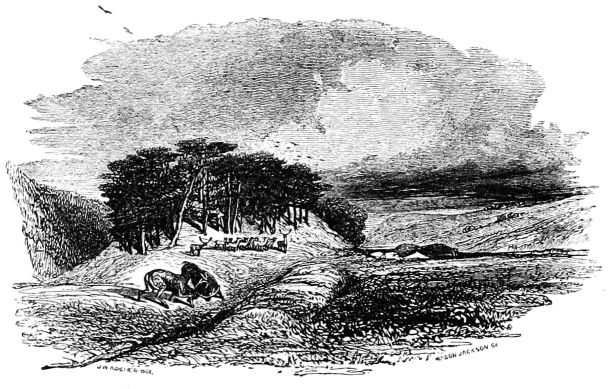
smaller but similar mounds; and although peculiar in its shape, as compared with Roman and other tumuli which have been examined at different times, has, nevertheless much of a sepulchral character in its appearance. It was lately opened to a depth of several feet, but nothing was discovered in it. In the middle, however, at the bottom to which the ground was originally made to shelve from each end, a level space of about six feet in length had been left, as if for the reception of a deposit; and as the lightness of the soil above seemed to indicate that it had been merely removed, it is not improbable that this deposit may have rewarded some antiquary more fortunate than those who were engaged in the late excavation.”
Not far from this retired valley a different interest is excited by its having been the site of the chapel and hermitage of St. James—an hospital for lepers, and built soon after the middle of the thirteenth century, for the reception of the unhappy outcasts who were afflicted with that loathsome malady. The clump of trees observed in the view marks the locale of this ancient sanctuary, which must have enclosed a very considerable area.
A pleasing incident in the history of Arundel, is the visit of the Empress Matilda to her step-mother, Queen Adeliza, as already alluded to in our notice of Albini. Accompanied by her natural-brother, Robert of Gloucester, and a retinue of one hundred and forty knights, she was received within the walls of the Castle, and treated with all the distinction which her own dignity and the affection of her relative could bestow. The news of her arrival, however, threw the army of King Stephen into immediate motion, and brought the engines of war under the walls of the Castle. Fearful of the consequences, Queen Adeliza determined to try the effects of policy in lieu of force, and appealed to the chivalrous feelings of the incensed Monarch, in behalf of her illustrious but ill-timed visitor. She assured him that the only object of her royal guest in making this visit, was to gratify those feelings of love and relationship, which might be reasonably supposed to exist between mother and daughter; that the gates of the Castle had been thrown open to her, not as a rival to the throne, but as a peacefully disposed visitor, who had a longing desire to see her native land, and who was ready to depart whenever it should please the King to grant her his safe-conduct to the nearest port. It was, moreover, delicately insinuated, that to lay siege to a Castle, where the only commander of the garrison was a lady, and where the only offence complained of was a mere act of hospitality to a female relation, was surely an enterprise neither worthy of a hero such as his Majesty, nor becoming in him who was the crowned head of the English chivalry.
The result of this appeal, or of some more convincing argument[43], has been already stated in the safe retirement of Matilda from the scene of danger, and her return to Normandy. But a small chamber over the inner gateway enjoys
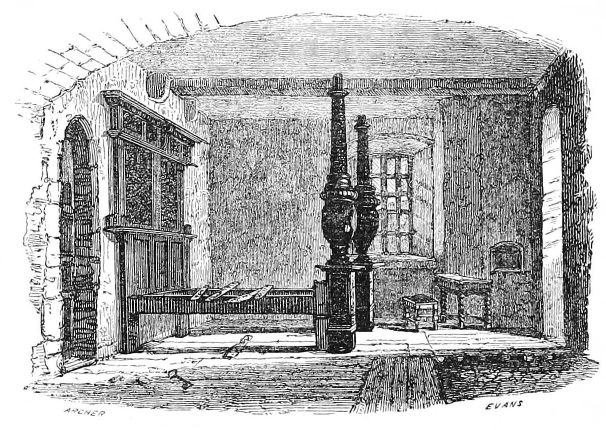
the traditionary fame of having been her sleeping room, during her sojourn in the Castle. It is a low square apartment, such as the castellan might have occupied during a siege. But, as an imperial chamber, it never could have had more than one recommendation, namely its security, in times when security was the chief object to be kept in view; and six centuries ago it was no doubt a very eligible state chamber. The bedstead on which the Empress is said to have reposed—for we would not disturb any point of popular and poetical faith—is certainly a relic of considerable antiquity. Its massive walnut posts are elaborately carved, but so worm-eaten, that, unless tenderly scrutinised, the wood would be apt to fall into powder in the hands of the visitor. Looking upon this, as a relic of the twelfth century, it may be imagined with what feelings the daughter of a King, the consort of an Emperor, and mother of a King, laid her head upon that humble couch, reflected on her checkered fate, and felt the shock of warlike engines under the battlements.
“’Mid crash of states, exposed to fortune’s frown, Uneasy lies the head that wears a crown.”
The other events and incidents which give Arundel particular distinction among the ancient baronial seats of England, are partly owing to the regal dignity of its visitors. It was here that Alfred and Harold are believed to have resided; and it was in the castle of Arundel that William Rufus, on his return from Normandy, celebrated the feast of Easter.[44] In 1302, King Edward the First spent some time within its walls: and from the fact of its containing an apartment familiarly known as the ‘King’s Chamber,’ it is probable that, in later times, it was often graced by the royal presence.[45] The luxury and splendour of its apartments are amply attested by the minute inventories of the costly materials employed in their decoration; while the princely revenues of many of its lords permitted them to indulge in a style of hospitality to which few subjects could aspire. It was frequented by the élite of our English chivalry; beauty and valour were its hereditary inmates; its court resounded to the strains of music; while military fêtes and religious solemnities gave alternate life and interest to its halls. Many a plan, afterwards developed in the field or the senate, was first conceived and matured in the baronial fastness of Arundel. One of the dark yet dramatic scenes of which it has been the theatre, is the conspiracy, in which the Earls of Arundel, Derby, Marshall, and Warwick; the Archbishop of Canterbury, the Abbot of St. Alban’s and the Prior of Westminster, met the Duke of Gloucester, for the final ratification of the plot. After receiving the sacrament, says the Chronicle, they solemnly engaged, each for himself, and for one another, to seize the person of King Richard the Second; his brothers, the Dukes of Lancaster and York; and, finally, to cause all the lords of the King’s Council to be ignominiously put to death. This plot, however, was happily divulged in time to defeat its execution; and Arundel was brought to the block on the evidence of his son-in-law, Earl Marshall, then deputy-governor of Calais.[46]
So great, says Caraccioli, “was the hereditary fame of Arundel Castle, and so high its prerogative, that Queen Adeliza’s brother, Joceline of Lorraine, though a lineal descendant of Charlemagne, felt himself honoured in being nominated to the title of its Castellan.” From William de Albini, Joceline received in gift Petworth, with its large demesne; and on his marriage with Agness, heiress of the Percies, took the name of Percy—and, hence, probably, the origin of “Percy’s Hall,” an apartment which has existed from time immemorial in Arundel Castle.
Of Isabel de Albini, the widow of Earl Hugh, the following anecdote is preserved:[47]—Having applied to the King for the wardship of a certain person, which she claimed as her right, and failing in her suit, she addressed him in these spirited words:—“Constituted and appointed by God for the just government of your people, you neither govern yourself nor your subjects as you ought to do. You have wronged the Church, oppressed the nobles, and to myself, personally, have refused an act of justice, by withholding the right to which I am entitled.” “And have the Barons,” said the King, “formed a charter, and appointed you their advocate, fair dame?” “No,” replied the Countess; “but the King has violated the charter of liberties given them by his father, and which he himself solemnly engaged to observe; he has infringed the sound principles of faith and honour; and I, although a woman, yet with all the freeborn spirit of this realm, do here appeal against you to the tribunal of God. Heaven and earth bear witness how injuriously you have dealt with us, and the avenger of perjury will assert the justice of our cause.” Conscious that the charge, though boldly spoken, was the voice of public opinion, and struck with admiration of her frank spirit, the King, stifling resentment, merely rejoined, “Do you wish for my favour, kinswoman?” “What have I to hope from your favour,” she replied, “when you have refused me that which is my right? I appeal to Heaven against these evil counsellors, who, for their own private ends, have seduced their liege lord from the paths of justice and truth.”
We now take a short retrospect of the public services, patriotic achievements, and traits of personal character, which have distinguished the thirty-two lords of Arundel from the period of the Conquest down to our own times. Of several of these, however, our notice must be exceedingly brief.—Of Roger Montgomery and his family we have little to add beyond what has appeared in Mr. Tierney’s elaborate History of Arundel, to which we have so often referred in the preceding pages. Of William de Albini, the fourth earl, the following historical incident is recorded:—When at length, after
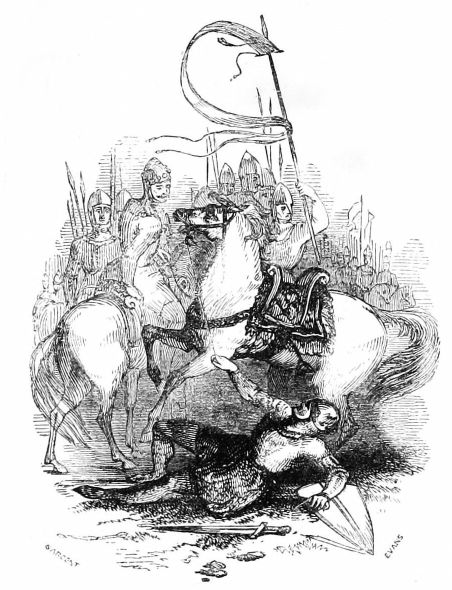
much fruitless warfare, Henry Plantagenet appeared in England at the head of the nobles who espoused his rights, Albini had the happiness to achieve what may be justly considered greater than any victory; he prevented the effusion of blood. Henry’s army was then at Wallingford, where Stephen, at the head of his forces, was arranging the line of battle. The armies were drawn out in sight of each other; Stephen, attended by Albini, was reconnoitring the position of his opponent; when his charger becoming unmanageable, threw his rider[48]. He was again mounted; but a second and a third time a similar accident occurred, which did not fail to act as a dispiriting omen upon the minds of those who were witnesses of the occurrence. Taking advantage of the superstitious dread thus excited among the troops, Albini represented in emphatic terms to Stephen the weakness of his cause when opposed by right and justice, and how little he could calculate upon men whose resolution in his service had been already shaken by the incident which had just occurred. His counsel was taken in good part; Stephen and Henry, adds the historian, met in front of the two armies: an explanation ensued, reconciliation was effected; and in the course of the year a solemn treaty was ratified, by which Stephen adopted the young Plantagenet as his successor to the throne. The most important affair in which Albini’s service was called for, was the splendid embassy to Rome, the object of which was to counteract the effect of à-Becket’s personal representations at the papal court. That mission failed in effecting the reconciliation intended, owing to the intemperate language of the prelates who were associated with Albini in the cause. His own speech, as recorded by Grafton, is characteristic of good sense and moderation:—“Although to me it is unknown, saith the Erle of Arundell, which am but unlettered and ignorant, what it is that these bishoppes here have sayde, (their speeches being in latin,) neyther am I in that tongue able to expresse my minde as they have done; yet, beyng sent and charged thereunto of my prince, neyther can, nor ought I but to declare, as well as I may, what the cause is of our sendyng hether; not to contende or strive with any person, nor to offer any iniury or harm unto any man, especially in this place, and in the presence here of such a one unto whose becke and authoritye all the worlde doth stoope and yelde. But for this intent in our Legacy hether directed, to present here before You and in the presence of the whole Church of Rome, the devocion and loue of our king and master, which ever he hath had and yet hath still toward You. And that the same may the better appere to yr. Excellencie, hee hath assigned and appointed to the furniture of this Legacy, not the least, but the greatest; not the worst, but the best and chiefest of all his subiects; both archbishoppes, bishoppes, erles, barons, with other potentates mo, of such worthinesse and parentage, that if he could have found greater in all his realme he would have sent them both for the reverence of Your Person and of the Holy Church of Rome,” &c.
But this oration, “although it was liked for the softnesse and moderation thereof, yet it failed of its object; it could not perswade the bishop of Rome to condescende to their sute and request, which was to have two legates or arbiters to be sent from him into England, to examine and to take up the controversie betwene the kinge and the archbishoppe.”
Subsequently to this, Albini was sent on a more agreeable mission, that of conducting the Princess Matilda into Germany, on the eve of her marriage with Henry, Duke of Saxony; and five years later was selected by the king as one of his “own trustees to the treaty of marriage between his son Prince John, and the daughter of Hubert, Count of Savoy.” Shortly afterwards he commanded the royal forces at Fornham in Suffolk, and gained a complete victory over the rebellious sons of King Henry—in whose unnatural cause the disaffected at home had been joined by a numerous body of foreigners—and took prisoners the Earl of Leicester, with his Countess and all his retinue of knights. Albini was a great benefactor of the church; he built “the abbey of Buckenham; endowed various prebends in Winchester; founded the priory of Pynham, near Arundel; the chapel of St. Thomas at Wymundham,” and died at Waverley in Surrey.
To Albini’s son and grandson we have already adverted, but conclude with a brief incident in the life of William, the third earl of his family.
When the banner of the cross was waving under the walls of Damietta, and the chivalry of Christendom flew to the rescue, the gallant Albini was too keenly alive to the cause to resist the summons. In that severe
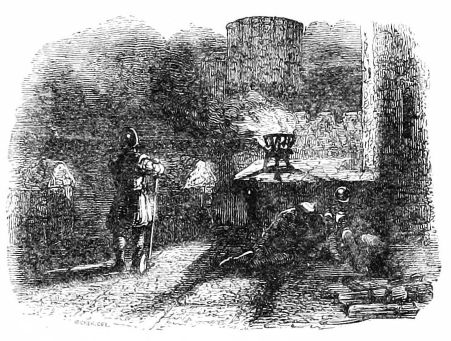
struggle, he hoped to acquire those laurels which would leave all other trophies in the shade; and with the flower of our English chivalry embarked for the Holy Land, and served at the siege of that fortress. Two years he remained a staunch supporter of the cross—a soldier whom no dangers could dismay, no difficulties intimidate; and long after his companions had returned to the white cliffs of Albion, the lion-standard of Albini shone in the van of the Christian army. On his way home, however, he had only strength to reach an obscure town in the neighbourhood of Civita Vecchia, near Rome, where he was taken ill and expired. His eldest son, the fourth earl, died without issue; and the short life of his successor, Hugh de Albini, appears to have passed without any remarkable event or incident, save latterly in active warfare in France, where, at the battle of Taillebourg, in Guienne, he displayed, though ineffectually, the hereditary valour of his family.
The first of the Fitzalans who held the title and estates of Arundel was appointed one of the Lord Marchers, or Wardens of the Welsh Border; and found to his cost that the Ancient Britons did not submit to the daily encroachment made upon their rights and hereditary privileges, without having frequent and formidable recourse to arms. He maintained a high station at court, was admitted to the royal confidence, and had the “command of the Castle of Rochester when the approach of the King’s forces compelled the disaffected Barons to raise the siege.” At the battle of Lewes he distinguished himself in the royal cause; but at the close of that disastrous field—along with the two princes, Edward and Henry—fell into the “hands of the victorious Barons.”
Of the battle of Lewes, we select the following graphic picture from Grafton:—“Upon Wednesday the 23rd of May, early in the morning, both the hostes met; where, after the Londoners had given the first assault, they were beaten back, so that they began to drawe from the sharpe shot and strokes, to the discomfort of the Barons’ hoste. But the Barons encouraged and comforted their men in such wise, that not all onely, the freshe and lustye knights fought eagerly, but also such as before were discomfited, gathered a newe courage unto them, and fought without feare, in so much that the King’s vaward lost their places. Then was the field covered with dead bodyes, and gasping and groning was heard on every syde; for eyther of them was desyrous to bring others out of lyfe. And the father spared not the sonne, neyther yet the sonne spared the father! Alliaunce at that time was bound to defiaunce, and Christian bloud that day was shed without pittie. Lastly the victory fell to the Barons; so that there was taken the King, and the King of Romaynes, Sir Edward the King’s sonne, with many other noblemen,” among whom was Fitzalan, Earl of Arundel, “to the number of fifteen barons and banerets; and of the common people, that were slain, about twenty thousand, as saith Fabian.”
This was Fitzalan’s last appearance in the field; and, as a security for his good behaviour, he was required “to surrender the Castle of Arundel or deliver his son as a hostage,” into the hands of the Earl of Leicester. “For their safe keeping, the prisoners were sente unto dyverse castellis and prysons, except the King, his brother the King of Almayne, and Sir Edwarde his sonne; the which the barons helde with them vntill they came to London.”
Richard the third earl takes an eminent station in the family history. He first travelled in France and Italy, in compliance with the rules of his order[49]; then served in Wales, performed several exploits against Madoc; became distinguished among the chivalry of his day; held a command in the expedition organised for the subjugation of Scotland; fought at Falkirk; and subsequently took part at the siege of Caerlaverock Castle, where in the language of the minstrel, “who witnessed the fray,” he is complimented as—
“Richard le Conte de Aroundel, Beau chivalier, et bien aimé, I vi je richement armé; En rouge au lyon rampart de or—[50]”
and in various capacities appears to have done the state much acceptable service.
1306. During the life of Edmund, the fourth Earl, the affairs of Scotland assumed a threatening aspect; and the King, exasperated by the murder of Comyn, resolved to march an army across the frontier. Great preparations were made to render the expedition, in all respects, worthy of the grand object in view. The royal armies were ordered from their cantonments, and hastened into the field under the command of Aymer de Valence, Earl of Pembroke.
In preparation for the expedition, “proclamation was made, that a grand national fete would solemnise the movement; that the Prince of Wales
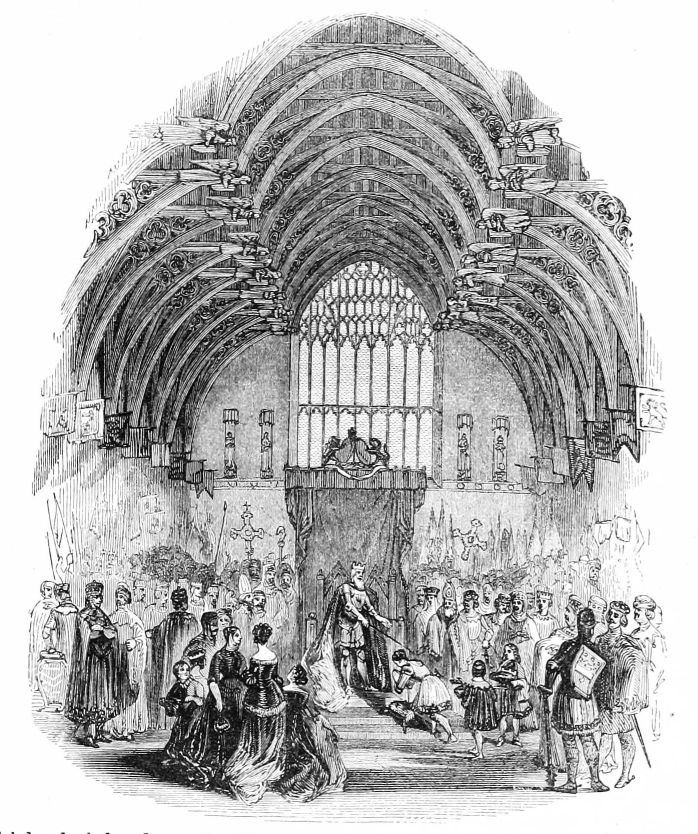
would be knighted on the Feast of Pentecost; and all the young nobility of the kingdom were summoned to appear at Westminster to receive that honour along with him. On the eve of the appointed day (the 22nd of May) 270 noble youths, with their pages and retinues, assembled in the Gardens of the Temple, in which the trees were cut down that they might pitch their tents; they watched their arms all night, according to the usage of chivalry; the prince, and some of those of highest rank, in the Abbey of Westminster; the others in the Temple Church. On the morrow, Prince Edward was knighted by his father in the Hall of the Palace, and then proceeding to the Abbey, conferred the like honour on his companions. A magnificent feast followed, at which two swans covered with nets of gold being set on the table by the minstrels, the King rose, and made a solemn vow to God and to the swans, that he would avenge the death of Comyn and punish the perfidy of the Scottish rebels. Then, addressing his son and the rest of the company, he conjured them, in the event of his death, to keep his body unburied until his successor should have accomplished this vow. The next morning the prince, with his companions, departed for the Borders; Edward himself followed by slow journeys, being only able to travel in a litter.”
Such was the bright morning of Edmund Fitzalan’s life; and the annexed gives us the dark contrast in his tragical end.
1326. The citizens, says Froissart, seeing they had no other means of saving the town, their lives, and their fortunes, acceded to the Queen’s terms, and opened their gates to her. She entered the town attended by Sir John de Hainault, with all her barons, knights, and esquires, who took their lodging therein. The others, for want of accommodation, remained without. Sir Hugh Spencer and the Earl of Arundel were then delivered to the Queen to do with them according to her good pleasure. The Queen then ordered the elder Spencer and Arundel to be brought before her eldest son and the barons assembled, and said that she and her son would see that Justice should be done unto them according to their deeds. “Ah, madam,” said Spencer, “God grant us an upright judge and a just sentence; and that if we cannot find it in this world, we may find it in another.” The charges against them being read, an old knight was called upon to pass sentence; and her son, with the other barons and knights, pronounced the prisoners guilty. Their sentence was, that they, the said Earl of Arundel and Spencer, should be drawn in a hurdle to the place of execution, there to be beheaded, and afterwards to be hung on a gibbet. “The which was duly carried into effect on the feast of St, Denis,” at Bristol—or, according to others, at Hereford.
Richard, the son and successor of Edmund, became highly distinguished among the great men of his time. His life and exploits make no inconsiderable figure in the national annals.
When a fleet of cruisers, sent out by the French for the annoyance of British commerce in the Channel, had made prizes of many of our best merchant ships, pillaged several towns on the coast, and caused much consternation to all who were interested in the prosperity of commerce, Arundel
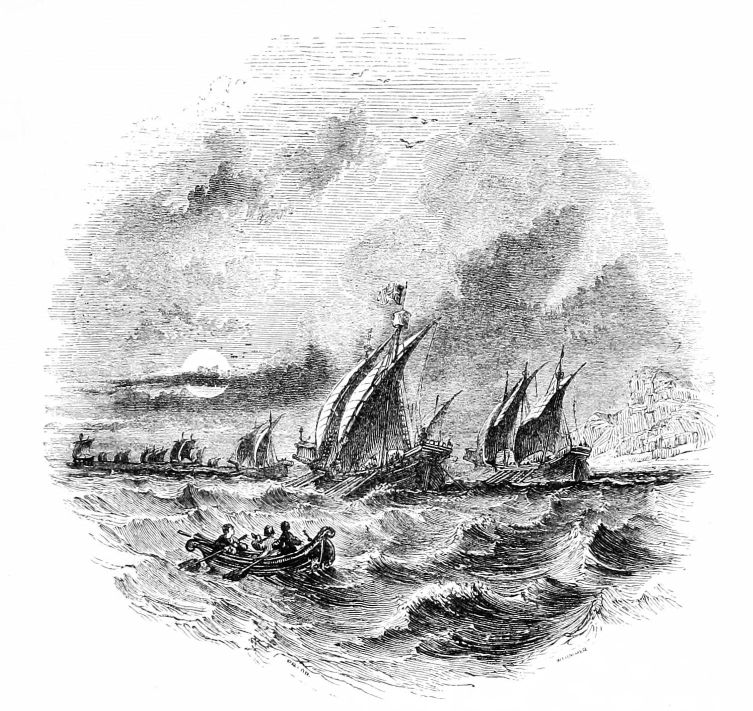
hoisted his flag on board the “Admiral,” and put to sea. Another fleet was ordered to co-operate with him in the eastern coast; the first cruise checked the audacity of the enemy, and re-established public confidence and good order.
1340. His next public service was off the harbour of Sluys, where, in an engagement with the French fleet, he was second in command under King Edward the Third, and gained a complete victory.
“When the king’s fleet,” says the chronicler, “was almost got to Sluys, they saw so many masts standing before it, that they looked like a wood. The king asked the commander of his ship what they could be, who answered that he imagined they must be that armament of Normans which the King of France kept at sea, and which had so frequently done him much damage, had burnt the good town of Southampton, and taken his large ship the ‘Christopher.’ The king replied, I have for a long time wished to meet with them, and now, please God and St. George, we will fight with them; for in truth they have done me so much mischief, that I will be revenged upon them if possible.”
The large ships under Lord Arundel, the bishop of Norwich, and others, now advanced, adds Froissart, and ran in among those of Flanders: but they had not any advantage; for the crossbow-men defended themselves gallantly under their commander Sir John de Bucque. He and his company were well armed in a ship equal in bulk to any they might meet, and had their cannons on board, which were of such a weight, that great mischief was done by them. This battle was very fierce and obstinate, for it continued three or four hours; and many of the vessels were sunk by the “large and sharply-pointed bolts of iron which were cast down from the maintops, and made large holes in their decks.” When night came on, they separated, and cast anchor to repair their damage and take care of the wounded. But at the next flow of the tide, they again set sail and renewed the combat; yet the English continually gained on the Flemings, and, having got between them and Blanquenberg and Sluys, drove them on Cadsand, where the defeat was completed.
So great was the disaster to the French monarch on this day, that none of his ministers would venture to communicate to him the amount of life and property which had been sacrificed. What the minister, however, durst not reveal, the king’s jester found means to divulge. “What arrant cowards are those English!” said the jester. “How so?” demanded Philip. “Because,” answered zany, “they had not courage to jump overboard, as the French and Normans did lately at Sluys[51].” This opened the king’s eyes, and prepared him for the disastrous tidings that were now poured in upon him.
Six years later, Arundel was appointed admiral of the king’s fleet, and conveyed the great military expedition from Southampton to Normandy. When the troops were disembarked at La Hogue, he was created constable of the forces; and with Northampton and other noblemen commanded the second division at the battle of Cressy[52].
During the heat of the combat, when Prince Edward was surrounded by the enemy and in personal jeopardy, Arundel and Northampton hastened to his support; ordered their division forward, and closed with the enemy. The English rushed upon their assailants with renewed ardour; the French line was charged, broken, and dispersed; “earls, knights, squires, and men-at-arms, continuing the struggle in confused masses, were mingled in one promiscuous slaughter.” When night closed, King Philip, with a retinue of only five barons and sixty knights, fled in dismay before the cry of “St. George for England!” Eleven princes, twelve hundred knights, and thirty thousand soldiers, had fallen on the side of the French.