APPENDIX.
Reading edition
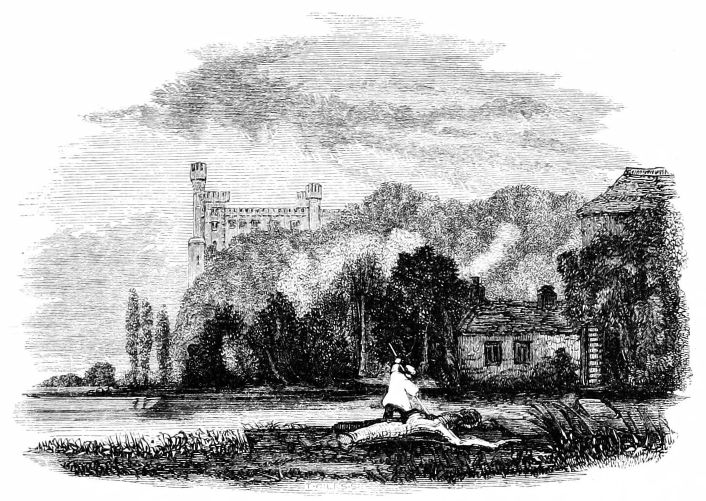
RUNDEL CASTLE.—King Alfred’s Will.—The portion from which the text is a translation is thus given in Asser. de Ælfredi Reb. Gestis, fol. 23: “Athelmo, vero fratris mei filio, do villā de Edingburn et de Cumptune et de Erundele, et de Bedingn et de Dinghā, et de Burnham, et de Thumesfelde, et de Aschōgum.”—“Forty-nine Castles are enumerated in Domesday Book; that of Arundel only as existing in the time of Edward the Confessor. Many single towers were built during the Heptarchy and by King Alfred. The Castle of Arundel dates perhaps its true origin from that monarch.”—Dallaway.
“Fama verò tota est ex castro quod Saxonico imperio floruit; et statim ab ingressu Normanorum. Rogerum de Montgomericum restaurasse legimus, qui inde Arundeliæ Comes dictus.”—Camden.
Harold, Earl of Sussex, A.D. 1053.—Ingulph, relating the death of Earl Godwyn at the royal table, adds “Comitatusque Westsaxoniæ Haroldo filio suo datus est”—fol. 510, 540. Hardyng, page 229, after his manner relates the same in two stanzas:—“And as Kynge Edwarde,” &c.
Roger Montgomery, pp. 8, 9.—“Prædictus autem Rogerus de Montegummerici bello Anglico interfuit, et a Willelmo rege Anglorum Comitatus Arundelli et Sálopesberiæ dono áccepit.”—Wilhelm. Gemitens. De Ducib. Normannis. fol. 686. “Rex Gulielmus Rogerio de Monte Gomerici in primis Castrum Arundellum et urbem Cicestram dedit; cui posteà comitatum Scrobesburiæ quæ in monte super Sabrinam fluvium sita est, adjecit. Hic sapiens et moderatus et amator æquitatis fuit, et comitatem sapientum et modestorum dilexit. Tres sapientes clericos Godebaldum, Odolerium, ac Herbertum, diutiùs secum habuit; quorum consilium utiliter paruit,”—p. 254. “Warino autem calvo, carpore parvo, sed animo magno, Aimeriam neptem suam et Præsidatum Scrobesburiæ dedit: per quem Guallos aliosq’ sibi adversantes fortiter oppressit, et provinciam totam sibi commissam pacificavit. Guillelmum cognomento Pantalfum, et Picoldum atque Corbatum filiosque ejus, Rogerium et Rodbertum, aliosque fideles fortissimosq’ viros comitatui suo præfecit; quorum sensu et viribus benigniter ajutus inter maximos optimates maximè effloruit.”—Order. Vital. de Guliel. primo.
His pious retirement from the world and death in the cloisters is thus related by Orderic—the authority referred to in the text:—“Having by the hands of Reginald, then Prior of Shrewsbury, obtained from the house of Cluni, in Burgundy, the coat of St. Hugh, some time abbot there, for himself to put on, he caused himself to be shorne a monk in the said Abbey of Shrewsbury, with the consent of his wife; where it is observed of him, that three days before his death he wholly applied himself to divine conference and devout prayers with the rest of that convent; and died on the sixth of the Kalends of August, 1094.”—Baron. i. 28. “Monachile scema devotus suscepit ... et tribus diebus in colloquiis divinis et oratione inter servos Dei permaneit. Tandem Kal. Augusti mortuus est.”—Ord. Vital. p. 708.
Hugh Montgomery, page 9.—The death of this nobleman, as briefly mentioned in the text, is taken from Giraldus Cambrensis, Itin. Camb. p. 194, and thus rendered by Dugdale, Bar. i. 28. “There is in this island of Anglesey a church of St. Teuredaucus the Confessor, in which Earl Hugh, after he had subjugated these parts of Wales, having kennelled his dogs all night, found them every one mad next morning; and that he himself died a miserable death within a month thereafter. For hearing that certain pirates were come to the haven of this island in long-boats, and making haste to oppose their landing, the principal commander of them, called Magnus, standing at the fore end of the boat with a bow in his hand, let flie an arrow at our earl, then armed cap-à-pié, so that no entrance could be made except through his helmet, at the sights for his eyes; but so fatally was the arrow directed, that it passed through his head-piece upon his right eye, and piercing his brain, caused him to fall (from his horse) headlong into the sea.” Girald. Cambrensis erroneously attributes it to Hugh, Earl of Chester, but by all other authorities it is related as having occurred to Hugh Montgomery. Polyd. Virgil. fol. 173, says—“Hugo Comes Salopiæ obvium factus ex ictu sagittæ periit.” After which, “within a few days, his body being earned to Shrewsbury, was there buried in the cloister of the abbey, with great lamentation.”—Dugd. i. 28. Roger Hovedon, fol. 268, mentions his death in nearly the same terms: “Sagitta percussus—interijt.” Also, Speed, fol. 445.
Mabel, Roger Montgomery’s first wife, was the only daughter, and heiress, of William Talvace—grandson of Ivo de Belesmo—a person of great power and note in the time of Richard, Duke of Normandy, with whom he had a large inheritance. But this lady, says the monk of Utica, “caused his abbey to be greatly burthened with quartering of soldiers; for which, and other oppressions exercised towards the nobility, she was murdered in her bed.” By this wife Earl Roger had issue, as briefly mentioned in the text, five sons and four daughters:—Robert de Belesme; Hugh de Montgomery; Roger of Poictou; Philip, a priest; Arnulf, a soldier of fortune, Lord of Dyvet, now Pembrokeshire, who, like his father, was liberal in his benefactions to the church. Of his four daughters, Emma, the eldest, was Abbess of Almanisca; Maud was the wife of Robert de Moreton, half brother to the Conqueror; Mabel married Hugh de Novo Castello; and Sibyl became the wife of Robert Fitz-Hamon, whose name and family have been noticed in our account of Tewkesbury. For his second wife, Earl Roger espoused Adeliza, daughter of Ebrard de Pusaic, and by her had issue one son, called after his grandfather Ebrard, who, entering on a course of ecclesiastical discipline, became one of the chaplains to King Henry I. Of the Countess Adeliza, a monastic writer records the following anecdote:—Being on her first passage by sea, from Normandy to England, there happened so great a storm that the mariners were in imminent danger of shipwreck. A priest, who was the countess’s private chaplain or confessor, and attended her in the voyage, being much wearied with anxiety and watching, fell fast asleep. And lo! while he slept, there stood before him a comely matron, who addressed him in these words: ‘If thy lady would be preserved from the danger of this dreadful tempest, let her vow to God forthwith, that she will build a church to the honour of Sainte Marie Magdalene in the place where she shall first meet the Earl Roger, her husband, in England; and especially where an old hollow oak groweth near a hogstye.’ Now all this, when he woke up, the priest told to his Mistress, who, gladly accepting deliverance on such terms, made her vow accordingly; whereupon the winds were hushed, the sea became tranquil, and she came safely to land with all her attendants. At length, after several days’ journey to meet her husband, she found him near Quadford, hunting in the out-forest, at a certain place where a hollow oak tree, like that described in the vision, was then growing. Relating to him without loss of time what had happened, she so prevailed upon him that he agreed to fulfil her vows, and accordingly built and amply endowed a church in honour of Sainte Marie Magdalene, and gave it to his collegiate chapel in the Castle of Bridgenorth, in Shropshire, one of his many lordships. Like the monk who told his dream to Robert Fitz-Hamon (see Tewkesbury), Adeliza’s confessor—“monachiliter somniavit”—dreamed to good purpose. It is truly remarkable, that, so far as the interests of their order were concerned, these worthy monks always slept with their eyes open—
“By day with praying, plotting, scheming; By night o’er beads and reliques dreaming; They still contrived to lay their hand Upon the fatness of the land.”
The Fitzalan Family, Text, p. 10.—The account of this Norman family is taken from that of Dugdale and the monastic writers, on whose report the genealogy is founded, namely, Ord. Vital., Matth. Paris, &c.; and the reader who may be curious in such matters, will find the whole subject fully detailed in the Baronage, i. p. 314, and Monasticon, vol. i., the sources from which the materials of all the later accounts which we have seen have been taken.
As progenitors of the royal family of Stuart, the claim is supported by Chalmers in his Caledonia, vol. i. p. 572, 573. Alan, the son of Flaald, a Norman, acquired the manor of Oswestrie, in Shropshire, soon after the Conquest—married the daughter of Warine, the famous sheriff of Shropshire—had two sons, Walter and William. Influenced by the Earl of Gloucester, the powerful partizan of his sister the Empress Maud, William seized Shrewsbury in September 1139, and held it for her interest—attended her at Winchester in 1141—adhered to her interests, and was rewarded by her son Henry II. By the marriage of his son with Isabel-de-Say, Clun in Shropshire was added to the Fitzalan estates. Oswestrie, or Oswaldestre, was the original seat of Alan on the Welsh border. Lord Hailes acknowledges that Walter (the son of Alan), who flourished under David I. and his successor Malcolm IV., was indeed the Stewart of Scotland. John Fitzalan, Lord of Clun and Oswestrie, by marrying Isabella, second sister of William de Albini, became Earl of Arundel.
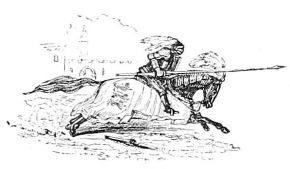
De Albini, p. 9.—William-with-the-Strong-hand.—Dugdale gives the genealogical history of this family in the work above mentioned, vol. i. p. 118. The following anecdote, highly characteristic of the age in which he lived, is narrated with amusing gravity by our old Norroy king-at-arms, as one of the credible adventures in the life of this hero:—“I now come,” says he, “to William, who was called William-with-the-Strong-hand, in regard that, among his valiant exploits, he slew a fierce lion, the occasion of which was thus: It happened that the Queen of France, being then a widow, and a very beautiful woman, became much in love with a knight of that country, who was a comely person, and in the flower of his youth: and because she thought that no man excelled him in valour, she caused a Tournament to be proclaimed throughout her dominions, promising to reward those who should
exercise themselves therein, according to their respective merits; and concluding, that if the person whom she so affected should act his part better than others in these military exercises, she might marry him without any dishonour to herself. Hereupon divers gallant men from foreign parts hasting into Paris, amongst others came this our William de Albini, bravely accoutred; and in the tournament excelled all others, overcoming many, and wounding one mortally with his lance, which being observed by the Queen, she became exceedingly enamoured of him, and forthwith invited him to a costly banquet; and afterwards bestowing upon him certain jewels, offered him marriage. But, having plighted his troth to the Queen of England, then (also) a widow, he refused her; whereat she grew so much discontented, that she consulted with her maids how to take away his life; and in pursuance of that design enticed him into a garden, where there was a secret cave, and in it a fierce lion, into which she descended by divers steps under colour of showing him the beast. And when she told him of his fierceness, Albini merely answered, ‘that it was a womanish, and not a manly quality, to be afraid thereof.’ But having him there, by the advantage of a folding door, she thrust him into the lion’s den. Being therefore in this danger, he folded his mantle about his arm, and putting his hand into the mouth of the beast, pulled out his tongue by the root; which done, he followed the Queen to her palace, and gave it to one of her maids to present to her.”—On his return to England, the lion was given him for his arms, and he was thenceforward distinguished as “William-with-the-Strong-hand.” Commenting on this marvellous portion of Albini’s adventures, Vincent expresses regret that the hero did not, when once in, thrust his hand further, so as to catch the lion by the tail and “turn him inside out”—an operation which would certainly have been an improvement on the other, as well as an agreeable addition to the family arms. This valiant act was afterwards, it appears, revived by a royal crusader, and with still better success; for he extracted the ‘lion’s heart at a grasp!’
Text, p. 9. “Illa (Adeliza), rege defuncto, Gulielmum de Albineto in maritum assumpsit, qui cū Matildi Augustæ contrà Stephanum regem studeret, et hoc castrum contrà illum propugnaret, in navatæ operæ præmium Arundeliæ Comitis titulum, à Matilde Augusta Anglorum domina (hoc enim usa est titulo) accepit: cùmq’ post quartum ab eo comitem, proles ejus mascula deficeret, Richardum Fitzalanum jure uxoris in eum honorem evexit Rex Edwardus Secundus,” &c. With respect to the fourth Earl, Brooke, in his “discoveries,” has stated objections, p. 32, 33.
With respect to the part taken by Albini subsequent to his marriage with Adeliza, queen dowager, on the part of the Empress Maud, her son, and King Stephen at Wallingford—as well as the embassy in which he took the lead—as mentioned p. 42, Dugdale has condensed the particulars under the head of “Will. de Albini Pincerna,” i. 118, as well as all others of any importance respecting the descent of the Castle of Arundel through the families of the Fitzalans and Howards. Albini is thus complimented in the old Rhyming Chronicle; and the orthography shows the pronunciation in that day:—
¶ Wyllyam, the Earle of Arundell that hyght, Awbeny (Albini) by his surname full well then knowe, At Wimondham, in Northfolke buryed ryght, Father was of Philyp full yonge unknowe [That full courteous was both to hye and lowe] That after him was Earle of Arundell, As Chronycles wryten can clerely tell. P. 273.
Robert de Belesmo, Text p. 9.—“Supradictus Comes Robertus de Belesmo qui comitatum etiam Pontinensis pagi rexit eo tempore, ac in Normannia Castella possedit quam plurima; civitatem Scrobesbiriam et castellum in ea situm, castella quoque Arundel et Tikehil, alimentis machinis, armis, militibus, et peditibus contra regem Henricum fortiter munivit. Muros quoque, ac tunes castellorum, videlicet Brige et Carracoue, die noctuque operando perficere modis omnibus festinavit.... At Rex sine delatione Castellum ejus Arundel primitùs obsedit, et castellis ante illud firmatis, recessit; deinde Robertus Lindicolniæ civitatis episcopum cum parte exercitûs Tykehil obsidere jussit. Illè autem Brige cum exercitu penè totius Angliæ obsedit, machinas quoque ibi construere et castellum firmare præcepit. Interim Walanos, &c. Infra igitur triginta dies civitate et omnibus castellis redditis inimicum suum Robertum superavit etignominiosè de Anglia expulit.”—Hov. Annal. Hen. pr. 269.
Text p. 39.—“Junior Wilhelmus anno decimo regni sui cū Normanniam, quam à Roberto fratre suo ad Jerusalem profecto, in vadimonium acceperat pro libitu suo disposuisset, redijt ad Vigiliam Paschæ in Angliam, appulit apud Arundel.”—Henric. Huntingd. lib. vi. p. 216.
King Stephen, p. 38.—“Statim namque filia regis Henrici, quæ fuerat Romanorum imperatrix, cui Anglia juramento fuerat addicata, venit in Angliam; quam cum Rex Stephanus obsedisset apud Arundel, vel perfida credens consilia, vel quia castrum videbat inexpugnabile, ire permisit ad Bristowe.”—Hoved. Steph. Rex. fol. 278.
The Empress Maud, p. 41.—Holinshed, on the authority of Polydor, relates a “scandalous story” affecting the character of this lady, which, if true, robs William de Albini of the credit so generally given him, for having been the pacificator between King Stephen and young Duke Henry. It is very quaintly told by the old chronicler, p. 63, and by Polydor. Verg. lib. xij.:—“Sunt qui tradunt aliam fuisse causam qua Stephanus flexus sit ad pacem, qui referūt Mathildē amicā potius q’ inimicā Stephani fuisse, et eam, cum videret rem inter ipsum Stephanū et Henricū filiū eò deductā, ut armis finienda esset, clàm ad Stephanū adivisse atq’ sic eum allocutā: Ecquid, impie ac tui generis immemor, facere tētas? Decet ne patrem perdere filiū? an fas est ut filius patrem occidat? Amabo te, des locum iræ, projiciasq’ tela manu, nā Henricū, uti probè scis, ex te enixa sum! Et his dictis, ordine cōmemorasse quem admodum paullo antèq’ Gaufredo nuberet, ab eo compressa fuisset; ac ijs verbis Stephanū motū pacē fecisse.”
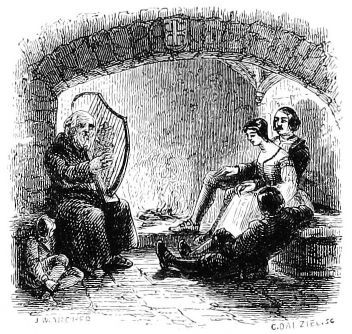
Syr Bevis, Text 37.—For the groundwork of the following legend, as connecting Sir Bevis with Arundel Castle, we are indebted to a lady resident near the spot. Sir Bevis, as noticed, p. 326, is familiar to every reader of romance; and the traditional history of his prowess has often been heard at the baron’s hearth, when the spirit of chivalry was fanned by the approving smile of beauty, and the sound of the harp sweetened the intervals of repose.
“O, who has not heard of Bevis the Bold? Whose sword was the theme of harpers old; Compared with which, like a willow-wand Was the sword that gleamed in Paynim hand. And oft through the Pagan’s steely array, For the Cross of St. George, it had cleft his way. Syr Bevis was stout of heart and limb: And his meekest look was so stern and grim, That even his squire grew deadly pale, As he buckled for battle Syr Bevis’ mail! And wherever for knightly feats he went, Equipped for battle or tournament, His very shadow refused to stay, And shrunk like a craven thing away. So fierce and fell was the hero’s stroke, ’Twould have cleft at a blow the forest oak; While around him heads of Saracen lay, Paving with helms Syr Bevis’ way. But at length, in old Arundel’s Castellan, When chilly and slow the life-blood ran, And he bask’d his old frame in its evening sun, And dreamed o’er the battles his youth had won; As musing he sat on yon battled keep, O’erlooking the forest and distant deep— Come, bring me,’ quoth he, ‘my trusty sword!’ And swiftly his squire obeyed the word. Then swift from his seat Syr Bevis sprung, And thrice round his head the blade he swung— ‘Now mark me well,’ said the chief, ‘and obey The command I leave, and the word I say: Where ye find again this trusty glaive, There hollow the ground for Bevis’s grave! For my eyes wax dim and my blood runs cold, And my heart of life hath lost its hold.’ He said: and fleet from his hand he threw The deadly weapon so tried and true; And away—as impelled by some nameless charm— Like a shaft that’s shot by a wizard’s arm; Away the falchion glanced, and fell In the depth of Pugh’s deserted dell.— That night there was mass for a parted soul; At St. Martin’s gate there was Christian dole; Where priest and vassal the dirge began, For Syr Bevis the warlike Castellan! Then they searched the shadowy forest round, And they hollowed a grave where the sword was found; And there they have laid each stiffened limb Of the brave Syr Bevis, the wise and grim. Where at noon the trooping deer convene, Where at night the timid hare is seen, Where the monk of St. Lazarus counts his beads, They have laid him down in his warrior’s weeds; They have monks to chant, and bells to toll— And all for the rest of Syr Bevis’ soul. Now ye who visit that haunted dell, To count your beads in St. James’s cell, Or haply to slay Montgomery’s deer, Tread light on the ashes that slumber here.”
The anecdote related at p. 40 of the text, is thus told in the Latin of Father Matthew of St. Albans, p. 853:—“A.D. 1252. Tempore quoque sub eodem domino rege adhuc moram Londini continuante, venit ad eum in cameram suam Isabella, comitissa Harundelliæ, relicta Comitis Harundelliæ H. et ejusdem regis cognata; ut pro jure suo de quadam custodia ipsam contingente verba faceret sibi profectura. Rex autem vultum ei primò protendens serenum, posteà cum verbis asperioribus objurgans, nihil quod postulavit comitissa favorabiliter exaudivit; vindicavit enim sibi rex custodiam cujusdam custodiæ ratione particulæ, ipsum regem contingentis. Unde ipsa comitissa, licèt mulier, non tamen muliebriter respondit imperterrita. ‘O domine rex quare avertis faciem tuam à justitia? Jam in curia tua quod justum est nequit impetrari, medius inter Dominum et nos constitueris; sed nec teipsum nec nos sanè regis, nec ecclesiam veritus es multipliciter perturbare; quod non tantum in presentiarum, sed multoties est experta. Nobiles insuper regni modis variis vexare non formidas vel erubescis.’ Quod cùm audîsset rex, corrugans nares et subsannans, voce dixit elevata: ‘Quid est hoc, ô domina Comitissa? Confeceruntne Magnates Angliæ Chartam, et pepigerunt tecum, ut fieres eorum quia eloquens es, advocata, et prolocutrix?’ Ad quod comitissa, licèt juvencula non tamen juveniliter respondit: ‘Nequaquam mihi, domine, regni tui primates chartam confecerunt; sed tu chartam, quam confecit pater tuus, et tu eam concessisti, et jurasti observare fideliter et irrefragabiliter, et multoties ut eam observares à fidelibus tuis pecuniam de libertatibus observandis eorum extorsisti, sed tu semper eis impudens transgressor extitisti. Unde fidei læsor enormis, et sacramenti transgressor manifestus esse comprobaris. Ubi libertates Angliæ toties in scripta redactæ, toties concessæ totiesque redemptæ? Ego igitur, licèt mulier, omnesque indigenæ et naturales ac fideles tui appellamus contrà te antè tribunal tremendi Judicis: et erunt nobis testes cœlum et terra, quoniam iniquè nimis nos tractus insontes, et nos Deus ultionum dominus ulciscatur.’ Ad hæc Rex siluit confusus, quia dictante propria conscientia cognovit, quoniam a tramite veritatis non exorbitavit Comitissa, et ait: ‘Nonne postulas gratiam eò quòd mihi cognata sis?’ At illa: ‘Ex quo mihi quod jus expostulat denegâsti, quo modo spem concipiam, ut mihi gratiam facias postulanti? Sed et contra illos ante faciem Christi appello, qui te fascinantes et infatuantes consiliarii tui sunt, et te à via veritatis avertunt, suis tantummodo commodis inhiantes.’ His igitur auditis Rex siluit, satis civiliter redargutus.”
Knighthood, p. 45.—The grand festival mentioned in the text is thus described by Matthew of Westminster; and in Anstis’ Order of the Bath, p. 12:—“The king, to render his expedition into Scotland more splendid and numerous, caused proclamation to be made throughout England, whereby all persons entitled or compellable to take knighthood by right of hereditary succession, that is, by lands descended to them, or who had estates sufficient to support that degree, were required, on the Feast of Pentecost, to attend at Westminster, where every one of them should receive severally out of the king’s wardrobe, at the king’s expense, all things belonging to the habit of knighthood, except what related to the furniture of his horse (or armour for such knight). At the time and place appointed, there was an appearance of three hundred young gentlemen, sons of earls, barons, and knights, to whom was distributed in ample measure, according to their different qualities, purple, fine linen, furs, and mantles embroidered with gold; and because the Royal Palace, though spacious, was not of extent sufficient to accommodate so great a number, they repaired to the New Temple, where they erected tents and pavilions, having first cut down the trees in the orchard, and levelled the walls of it, that they might separately and more commodiously dress themselves in their splendid habits. That night as many of them performed their vigils in the Temple Church as the place would well contain; but the Prince of Wales, by command of the king his father, kept his vigils in the Church of Westminster, with some other persons of the first dignity. There the noise of trumpets and pipes was so great, and the acclamations of the people so loud and extended, that the voices in one choir could not be distinctly heard in another. On the day following, the king invested his son with the military belt, and consigned to him the Duchy of Aquitain. The prince, being knighted, went to the Church of Westminster, that he might confer the like military honour on his companions; there the press, occasioned by a promiscuous concourse of people, was so great before the high altar, that two knights were stifled, and several fainted away; for every knight had at least three other knights to conduct and support him. But the prince was obliged, by reason of the tumultuous crowd, to invest his companions upon the high altar, having, by his guards, made way for them to pass through the people. Then were brought and presented two Swans, introduced with much pomp, and covered with golden nets, adorned and embossed with golden studs, a solemnity highly grateful to the spectators. The king offered a vow to God, upon the presentation of the Swans, that he would make a descent upon Scotland, with a design, whether he should live or die in the attempt, to revenge the death of John Comyn, and the violated faith of the Scots, &c.
“In the celebration of this great festival there is a particular article, which is thus explained:—A vow, made upon the exhibition before-mentioned of two swans, in conformity to an usage continued for some ages; according to which, when any hostile expedition was intended, the commanding prince formally and solemnly bound himself to execute it, upon the oblation of some bird, as a visible test or signal of such engagement.”
Page 62.—In the letter here quoted—supposed to have been the last ever written by Norfolk, on the eve of Bosworth Field—the duke directs his well-beloved friend, John Paston, to bring with him such company of tall men, and “ordain them jackets of my livery.” The Duke of Norfolk’s livery, on the authority of Fenn, was particoloured of blue and tawny—a yellowish dusky brown orange colour—having the left side of the former of these, and the right side of the latter, and both dark shades of their respective colours.
T. ALBAN’S ABBEY.—Humphrey, Duke of Gloucester.—The anecdote of this worthy, referred to in the text, is thus told by Grafton in his Chronicles, ii. 630:—“This Humphrey, Duke of Gloucester, descending of the blood royal, was not only noble and valyant in all his actes and doings, but sage, politique, and notably well learned in the ciuile law. And among his other worthy prayses, this followyng is not to be forgotten, which most liuely and plainley declareth him to be both prudent and wyse, and to his great laude and prayse is written, and set forth by Sir Thomas Moore, knight, in this wyse following:—‘In the reign of King Henry the Sixt,’ saith he, ‘there came to the towne of Sainct Albons a certaine beggar with his wyfe, and there was walkeng about the towne begging fiue or six dayes, before the kinges comming thether; sayeing that he was born blinde, and never sawe in all his lyfe, and was warned in hys dreme that he should come out of Berwike, where he saide that he had ever dwelled, to seke Sainct Albon, and that he had been at hys Shrine, and was not holpen, and therefore he would go seeke him at some other place: for he had heard some saye sinse he came, that Sainct Albons body should be at Colyn (Cologne), and indede such a contention hath there bene. But of a truth, as I am certainly informed,’ sayth Sir Thomas Moore, ‘he lyeth here at Sainct Albons, saveing some reliques of him which theye there shewe shryned. But to tell you foorth, when the kinge was come, and the towne full of people, sodainely this blinde man at Sainct Albones Shryne had his sight, and the same was solemnly rong for a miracle, and Te Deum songen; so that nothing was talked of in all the towne but this miracle. So happened it then, that Duke Humffrey of Gloucester, a man no lesse wise than also well learned, having great joy to see suche a miracle, called the poore man unto him, and first shewyng himself joyous of God’s glorie, so shewed in the getting of hys sight, and exhorting him to meeknesse, and to no ascrybing of any part of the worship to himselfe, not to be prowde of the people’s prayse, which would call hym a good and a godlie man thereby. At last he looked well upon his eyen, and asked whether he could ever see any thing at al, in all hys lyfe before. And when as well hys wyfe as himselfe affirmed fastlie ‘No!’ then he looked advisedly upon hys eyen agayne, and sayde, ‘I beleue you very well, for methinketh that ye cannot see well yet.’ ‘O yes, Sir,’ quoth he, ‘I thanke God and his holy martir, I can see now as well as any man.’ ‘You can,’ quod the duke; ‘what colour is my gowne?’ Then anon the beggar tolde hym. ‘What colour,’ quod he, ‘is this man’s gowne?’ He told him also, without anye stayeng or stombling, and told the names of all the colours that coulde be shewed. And when the duke sawe that he bade him, walke faytoure, that is to say, vagabond; and made him to be set
openly in the stockes: for though he could have seen sodaynely, by miracle, the difference betwene dyvers coloures, yet could he not by sight so sodainely tell the names of all these coloures, except he had knowne them before, no more than he coulde name all the men whom he should sodainely see.’ Thus far Maystir Moore.” Reference has been already made to the play in which Shakspeare has made use of the above, as the ground of a very amusing dialogue, into which he has infused much additional humour; and thus concludes:—
“Glo. Then, Saunder, sit thou there, the lying’st knave In Christendom. If thou hadst been born blind, Thou might’st as well have known our names, as thus To name the several colours we do wear. Sight may distinguish colours; but suddenly To nominate them all’s impossible. My lords, Saint Alban here hath done a miracle; And would ye not think that cunning to be great That could restore this cripple to his legs again,” &c.
Gloucester accordingly advises the application of the whip, and finds that the cripple is suddenly transformed into an athlete, with the full and free use of his limbs. Such were the devotees usually met with in places of pilgrimage—and such the miracles that obtained ready belief in the vulgar mind.
The Priory of Tinmouth in Northumberland was a cell of St. Alban’s Abbey. “One Simon of Tinmouth claimed a right to two corodies, or the maintenance of two persons in the priory; but which the prior and monks denied. This cause was brought before the Abbot of St. Alban’s and his Court-baron, who appointed it to be tried by combat on a certain day before him and his barons. Ralf Gubion, prior of Tinmouth, appeared at the time and place appointed, attended by his champion, one William Pegun, a man of gigantic stature. The combat was fought. Pegun was defeated, and the prior lost his cause; at which he was so much chagrined, that he immediately resigned his office.” This judicial combat is the more remarkable, that it was fought in the court of a spiritual baron, and that one of the parties was a priest.
LTHAM HALL, p. 111.—It was whilst residing at his Palace of Eltham that King Richard II. resolved upon the murder of the Duke of Gloucester. “Unable,” says Froissart, “to conceal any longer the great hatred he bore to his uncle, he determined to have him cut off according to the advice given him, namely, that ‘it was more advisable to destroy than to be destroyed.’ Accordingly, the king having rode to the Castle of Pleshy, about thirty miles from London, with fair words cajoled the duke out of his castle, and was attended by him to a lane that led to the Thames, where they arrived between ten and eleven o’clock at night. Here the Earl-Marshal, who there lay in ambush, arrested him in the king’s name, and forced him towards the Thames in spite of his cries to the king to deliver him. He was conscious, from the moment of his being thus arrested, that his end was resolved on; and it was confirmed to him by the king turning a deaf car to his complaints, and riding on full gallop to London, where he lodged that night in the Tower. The Duke of Gloucester had other lodgings; for whether he would or not, he was forced into a boat that carried him to a vessel at anchor in the Thames, into which he was compelled to enter. The Earl-Marshal embarked also with his men, and having a favourable wind and tide, they fell down the river, and arrived late on the morrow evening at Calais, without any one knowing it but the king’s officers. The Earl-Marshal, as governor, could enter Calais at all hours, without any one thinking it strange: so he carried the duke to the castle, and there placed him in confinement.... In the meantime King Richard, leaving the Tower at an early hour, rode to his palace of Eltham and there remained; while the same day toward evening, the Earls of Arundel and Warwick were both brought to the Tower and there confined, to the great surprise of the citizens. But to return to Calais: When the Duke of Gloucester saw himself shut up in the castle, abandoned by his brothers, and deprived of his attendants, he began to feel alarmed; and addressing himself to the Earl-Marshal—‘For what reason,’ he inquired, ‘am I thus carried from England, and confined here? Do you mean to retain me a close prisoner? Let me go and view the castle, the garrison, and the people of the town.’ ‘My lord,’ replied the earl, ‘I dare not comply with your demands; for you are consigned to my guard, under pain of death. The king, our lord, is at this moment somewhat wroth with you; and it is his orders that you abide here awhile in banishment with us, which you must have patience to do until we have other news, and God grant that it may be soon! for as the Lord liveth, I am truly concerned for your disgrace, and would cheerfully aid you if I could;
but knowing the oath I have taken to the king, you know I am bound in honour to obey.’ This was the only answer the Duke of Gloucester could obtain; he too well judged from appearances, that his life was in jeopardy; and asked the priest who had said mass, if he would confess him. This he did with great calmness and resignation; and with a devout and contrite heart, cried before the altar of God, the Creator of all things, for his mercy and forgiveness. He was repentant of all his sins, and lamented them greatly. He was right thus to exonerate his conscience, for his end was nearer than he imagined: for being on the point of sitting down to dinner, while he was washing his hands, four men rushed suddenly out from an adjoining chamber, and, throwing a towel round his neck, strangled him by two drawing one end and two the other. When he was quite dead they carried him to his chamber, undressed him, and placed the body between two sheets with his head on a pillow, and covered him with furred mantles. They then re-entered the hall, properly instructed what to say and how to act, and declared that the Duke of Gloucester had been seized with an apoplexy as he was washing his hands before dinner, and that they had great difficulty to carry him to bed. This was the report published in the garrison and the town, where some believed it, and others not. Within two days after, it was published abroad that the duke had died in his bed at the Castle of Calais; and in consequence the Earl-Marshal, who was the duke’s near relation, put on mourning, as did all the knights and squires in the town of Calais.” As to the manner of his death, it appears by the confession of Hall, one of the accomplices, that the duke was smothered with pillows, not strangled, as Froissart was informed.
EWKESBURY, p. 167.—By papers in the Bodleian Lib. Hist. of Tewkesb. 107, 1574, it appears, that on the twenty-fourth of July, being fair day, such a quantity of bats came floating down the river Avon, at Tewkesbury, that they covered the surface of the water for above a land’s length, in heaps above a foot thick, which so dammed up the mills for three days, that they could not go till the bats were dug out with shovels!
Page 189, A.D. 1578.—In the churchwardens’ book of accounts for this year, are the items here annexed:—“Payd for the plaiers geers six sheepskins for Christ’s garments,” ibid. 1585. “Order eight heads of hair for the Apostles, and ten beards, and a face or visor for the Devel,”—which show that mysteries, as plays were then called, were probably acted in the churches. In Italy the practice is still kept up, as every traveller in that and other parts of the Continent has observed; particularly during the Christmas festival, when nearly every church and convent have exhibitions of the Saviour’s birth, and the miraculous circumstances attending it.
ENILWORTH CASTLE, p. 211.—Thomas de la Moore, in his Life and Death of Edward II., relates the following, as part of the cruel and insulting treatment to which the unhappy sovereign was subjected by his keepers, on leaving Kenilworth for Berkeley Castle. It is of a serio-comic nature; but no reader who ever held a razor, but will sympathize with the wretched monarch in his stipulations for at least the indulgence of warm water, under such an operation:—“Attestamur et scribimus quæ luce clariora innotuerunt mundo, si non timor æmulorum regis devotissimi adhuc superstitis clarere prohiberet, quæ non poterint occultare. Tum abducitur Edwardus (ut præscriptum est) versus Berkleyam à satrapis Sathanæ equitans stipatus, duxerunt etiam exemplar patientiæ per grangias Castri Bristollii, ubi de fœno factam coronam capiti jumdudum oleo sancto consecrato imposuit nefarius ille de Gorney, ausus contingere Christum Dei, cui illudentes ironia nimis acerba milites dixerunt, Fareforth Syr Kynge. Metuentes maligni, ne pariter directè incedentibus obuiaret aliquis amicus Edwardi et manus misericors ipsum liberatura, declinauerunt ad Smischam per mariscum ad flumen Sabrinæ terminatum. Excogitârunt inimici Dei quomodo Edwardum deformarent, ne foret facilè notus. Vnde cauariem et barbam radendas cōstituerunt. Venientes proinde in itinere ad fossam, iusserunt ipsum radendū descendere. Cui assidenti super cujusdam talpæ monticulum pelvim aqua frigida de fossa recepta attulit barbitonsor. Cui et aliis asserentibus quod aqua talis pro tune deberet sufficere, ait Edwardus—Velitis, nolitis, habebimus pro barba aquas calidas; et ut promissum consequeretur veritas, cepit profuse lachrymare. Ita mihi retulit viuens post magnam pestilentiam Gulielmus Bischop, qui ductoribus Edwardi sodalis, unde confessus et contritus pœnituit, sub spe misericordiæ divinæ.”—P. 602, edit. Francofort.
“This Kyng Herolde at Waltam, which he found, Of foure score chanons, full fayre was buryed At the hye aulter, and as a kyng was crownde, All yf he were intrusor notifyed, And in batayl slayne and victoryed, Of gentylnesse the Conquerour bad so As yf he were afore his mortall fo.”—Hardyng, 3234.
ALTHAM.—Death of Harold, Text, p. 266.—“Ipse carens omni decore quibusdam signis nequaquam facie recognitus est, et in castra Ducis delatus qui tumulandum eum Guillelmo agnomine Maletto concessit, non matri pro corpore delectæ prolis auri par pondus offerenti.” The quantity of gold which Harold’s mother is here related to have offered to the victorious duke for the body of her son, may be reasonably estimated, as Maseres has shown in a note on this passage of the “Gesta Guillelmi,” at eleven thousand pounds. The supposed visit of Harold’s mother to the field of battle in search of his body, and that of Edith with the Swan’s neck—mentioned in the text, who finally discovered it by some secret token—are thus described in a MS. ballad on the subject:—
“The day is lost! The din of war is hushed on Hastings’ field: In triumph rolls the Norman car o’er England’s trampled shield. ‘Prepare the feast!’ Duke William cries. The midnight feast is spread; And there, in gilded canopies, they banquet ’midst the dead! The bowl is drained, the oath renewed of fealty to their Chief; But how shall gilded tents exclude the wail of woman’s grief! ‘Where is my son?’ a mother cries; ‘his corse but to behold, And lay it where his kindred lies, I’ll give its weight in gold!’ ‘Thy son is slain! his crown is sold! Duke William wears it now; We’ll give thee iron for thy gold—Lady, what more would’st thou?’ She heard and wept—then faltered on: her heart with anguish bled, As wistfully she gazed upon the faces of the dead! But ’midst the thousand forms of death that show’d the ghastly wound. And weltering strew’d the gory heath, her Harold was not found! She sat her down and wept aloud: and sighed—‘Undone—undone! Now lay me in the hallowed shroud that should have wrapt my son!’ * * * * * At length the gentle Edith came, led by a holy man, And, lighted by a taper’s flame, again the search began. Darkly her raven tresses hung upon her neck of snow, And still her lily hands she wrung in ecstacy of woe! Around her, Harold’s warriors true lay heaped upon the plain, Where high the Norman banner flew insulting o’er the slain; A friar of Waltham’s Holy Rood stood in that mournful ring, And wiping off the clotted blood—‘Oh, Christ! is this the king?’ Down to the earth fair Edith bent, upraised the lifeless head, And ’neath the light that taper lent, gazed wildly on the dead! One pause of fearful agony—a breathless, deep suspense— Was visible in every eye, and felt in every sense!
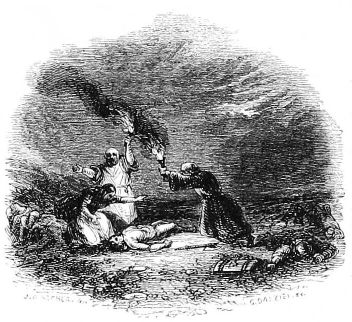
There, like a cedar in his pride struck down, a warrior lay; And here extended at his side a chieftain’s proud array. They scann’d his features o’er and o’er, but ’wildered was their view, Until the secret mark appeared, which Edith only knew— And then a shrill and piercing shriek the fearful truth confess’d, The hue of death was on her cheek—she sunk upon his breast! But Harold’s lip and Harold’s eye, in cold forgetfulness For ever sealed, made no reply to Edith’s frantic kiss. Oh, must I see thee thus, and live? Yet Heaven be witness here, How gladly would thy Edith give her bosom for thy bier!’” * * * * *
OCHESTER CASTLE.—Anno dominicæ incarnationis DCCCI. nativitatis autem Ælfredi regis xxxiv. exercitus in duas turmas divisit. Una etenim turma in orientalem Franciam perrexit; et altera ad Britanniam veniens, Cantium adiit; civitatemq’, quæ Hrofceastre Saxonicè dicitur, in orientali ripa fluminis Medwæg sitam obsedit. Ante hujus portam pagani Castellum ibimet firmum subitò fabricauerunt. Nec tamen illam civitatem expugnare potuerunt; quia cives illi se viriliter defenderunt, quousque Ælfred rex cū magno exercitu adiutorium illis conferens superuenit. Et tunc pagani relicta arce sua et omnibus equis, quos de Francia secum adduxerant derelictis; maxima parte nec non captiuorum suorum in arce dimissa adueniente subitò rege, ad naues suas confestim confugiunt. Et Saxones statim derelictos à paganis captiuos et equos diripiunt.—Asser. de Ælfred. Reb. Gest. fol. 11.
ARISBROOKE CASTLE, p. 284.—Of the circumstances mentioned in the text, the following is the relation given by the learned monk already quoted:—“Rogerius verò de Britolio, Comes Herefordensis ad curiam regis vocatus venit, et inquisitus manifestam toti mundo proditionem negare non potuit. Igitùr secundùm leges Normanorum judicatus est, et amissa omni hæreditate terrena, in carcere Regis perpetuò damnatus est. Ibi etiam Regi multoties detraxit, et contumacibus actis, implacabiliter offendit. Nam quondam, dum plebs Dei Paschale festum congruè celebraret, et Rex structum preciosarum vestium Rogerio Comiti per idoneos satellites in ergastulo mitteret; ille pyram ingentem antè se jussit præparari, et ibidem, Regalia ornamenta, chlamydem sericamq’ interulam, et renonem de preciosis pellibus peregrinorum murium subitò comburi. Quod audiens Rex iratus dixit: ‘Multùm superbus est qui hoc mihi dedecus fecit; sed, per splendorem Dei, de carcere mea in omni vita mea non exibit.’ Sententia regis tàm fixa permansit, quòd nec etiam post mortem Regis ipse, nisi mortuus, de vinculis exiit. Rainaldus et Rogerius filii ejus, optimi tirones, Henrico Regi famulantur et clementiam ejus—quæ tardissima iis visa est—in duris agonibus præstolantur.” In commenting upon the above passage, a learned writer has made the following remarks:—“It appears from the text that Roger, Earl of Hereford, was brought to his trial before the king’s court, or council of the proceres, or great men of the kingdom, and was condemned by them to suffer perpetual imprisonment, with the loss of all his inheritance. So that, in this instance, as well as in the case of Ralph de Guader, the said court or council appear to have acted as a court of criminal jurisdiction. But it seems remarkable that the judgment they passed upon this great and notorious rebel, who could not, and did not, deny the crime he was charged with, should not have extended to his life; more especially, as Waltheof, Earl of Northampton, who had refused to have any share in the rebellion raised by the other two earls, and had only been guilty of concealing his knowledge of their intentions, was, in a short time after, condemned to lose his life for that lesser offence, and was, as stated in the text, actually beheaded at Winchester. One would almost suspect that they were tried by two different laws; namely, Roger, Lord of the Isle of Wight, who was a Norman, by the law of Normandy; and Waltheof, Earl of Northampton, who was an Englishman, by the law of England; and that the Norman law of that period did not punish high treason with death, although the English law did. With respect to the garments sent by the king to this haughty prisoner, they are understood by commentators on the original passage to have consisted of—First, an outer
garment or coat; secondly, an inner garment or waistcoat, made of silk; and thirdly, a short cloak to be thrown over the shoulders, and that reached only to the waist, made of the rich furs of some foreign animals, which the author calls mice (murium), and were probably either ermines or martins. It is also conjectured that the present thus sent to the earl was a set of robes, suited to the rank and office of Earl of Hereford, which he had lately held, and to which it might have been King William’s intention to restore him, “if his inconceivable pride had not prevented it.”
In his interesting notice of the lives and fortunes of this great family, the learned monk of Utica concludes with these striking moral reflections on the transitory nature of all human grandeur:—“Verè gloria mundi, ut flos fœni decidit et arescit; ac, velut fumus deficit et transit. Ubi est Gulielmus Osberni filius, Herefordensis Comes, et Regis Vicarius, Normanniæ dapifer, et magister militum bellicosus? Hic nimirùm primus et maximus oppressor Anglorum fuit, et enormem causam per temeritatem suam enutrivit, per quam millibus ruina miseræ mortis incubuit. Verùm justus Judex omnia videt, et unicuique, prout meretur, redhibet. Proh dolor! ecce Gulielmus corruit, audax athleta recipit quod promeruit. Ut multos ense trucidavit, ipse quoque ferro repentè interiit. Denique post ejus occasum antequam lustrum compleretur annorum, spiritus discordiæ filium ejus et generum contra dominum suum et cognatum hostiliter excivit, qui Sichimitas contrà Abimelech (quem occicis LXX. filiis Jerobaal sibi præfecerant) commovit! En veracitur à me descripta est offensa, pro qua Guillelmi progenies eradicata sic est de Anglia, ut nec passum pedis, nisi fallor, jam nanciscatur in illa.” Duchesne—Excerp. Order. Vital. De Gul. primo rege Anglorum 322. Selecta Monumenta.
That the Conqueror’s philosophy was not proof against any little disappointment of the palate is evident from the following anecdote:—“When his prime favourite, William Fitz-Osborne, steward of his household, served him with the flesh of a crane scarcely half roasted, he was so highly exasperated that he lifted up his fist, and would have struck him had not Eudo, appointed ‘dapifer,’ immediately after warded off the blow.”—Warner, i. 307.
It was to the Isle of Wight that the Earl of Warwick—when brought to trial along with the Earl of Arundel—was banished in these terms: “Earl of Warwick! this sentence is very favourable, for you have deserved to die as much as the Earl of Arundel; but the handsome services you have done in time past to King Edward, of happy memory, and the Prince of Wales, his son, as well on this as on the other side of the sea, have secured your life; but it is ordered, that you banish yourself to the Isle of Wight, taking with you a sufficiency of wealth to support your state so long as you shall live, and that you never quit the island.”—Froissart.
The passage referred to Monstrelet in the text, is as follows:—“In this year Waleran, Comte de St. Pol, assembled at Abbeville, in Ponthieu, about sixteen hundred fighting men: among whom were numbers of the nobility, who had made great provisions of salted meats, biscuits, wines, brandy, flour, and other things necessary on board of ships. From Abbeville the Count led them to Harfleur, where they found vessels of all descriptions ready to receive them. When they had remained there some days, to arrange their matters and to recommend themselves to St. Nicholas (the sailors’ patron-saint), they embarked on board these vessels, and sailed direct for the Isle of Wight. Landing on the island, they made a bold countenance to face their enemies, of whom they had seen but little on their landing; for all, or at least the greater part of the islanders, had retreated to the woods and fortresses. In the meantime several new knights were created by the Count; namely, Philippe de Harcourt, Jean de Fosseux, Lord of Guiency, and others, who went to burn some miserable villages, and set fire to some other places. In the meanwhile a sensible priest of the island came to the Count to treat for the ransom and security of the island; for which he gave the Count to understand that a very large sum of money would be paid to him and his captains. The Count lent a ready ear to this proposal; but it was a mere ruse on the part of the priest to delay their operations, till the military force of the island could be brought together. Waleran discovered the plot, but it was too late to take revenge; and re-embarking his men in all haste, set sail, and returned home without doing anything more. The nobles were much displeased at this conduct; for they had expended large sums in laying in stores for the expedition, which, after all, was completely defeated by a single priest.”—Monstrelet, vol. i. 32.
ETLEY ABBEY. The following incident—interesting as connected with the ruins—is related by Digby in his Mores Catholici:—“I found a stranger,” says he, “once in Netley, on the eve of St. John, standing contemplative, who, after some space, accosted me. It was some holy solitary man, who told me he had been singing vespers to himself within the ruins of the church, and a thought had been suggested to him by a verse of the Magnificat, which he was eager to communicate. ‘The poor persecuted monks,’ said he, ‘are now for ever blessed in the centre of all felicity, while the proud, who made their dwelling-place a heap of ruins, as we see, have been scattered in the conceit of their heart, and dispersed through all the wastes of doubt, distrust, and error.’ Thus did the ruins assist his meditation.” The elder Pliny observes, that the houses which had been once inhabited by heroes of a noble race, lamented when they passed to new and unworthy masters; and that the very walls reproached the cowards who entered a place consecrated by the monuments of virtue.” A modern author also says, “It may be generally remarked, that the more nobly a mansion has been tenanted in the day of its prosperity, the viler are its inhabitants in the day of its decline. Thus, boors are the only inhabitants of Croyland, gipsies of Netley, while other religious houses are now possessed by the same class as that which caused their overthrow.”
FOOTNOTES: