THE ABBEY OF ST. ALBANS.
Reading edition
“————————————- Claustrum Martyris Albani, sit tibi tuta quies! Hic locus ætatis nostræ primordia novit, Annos felices lætitiæque dies! Hic locus ingenuis pueriles imbuit annos Artibus, et nostræ laudis origo fuit. Hic locus insignes magnosque creavit alumnos. Felix eximio martyre, gente, situ, Militat hic Christo, noctuque dieque labori Indulget sancto religiosa cohors.”
THE profound interest connected with the Abbey of St. Albans, has been much increased of late years by the prospect still held out of seeing its magnificent church converted into a cathedral. That this may be speedily and permanently effected, is a hope which every admirer of ecclesiastical architecture, every lover of that soil which has been hallowed by the blood of martyrs, will rejoice to see realised.
In the short historical introduction to this subject, we shall adopt the testimony of the old chroniclers, whose names, with other authorities, will be found, chronologically arranged at the end of the chapter, so that the reader may know where to apply for such copious details as cannot be comprised within the limits of the present work. This plan will be carefully adhered to in the successive portions of the work, so that the inconvenience arising from a multiplicity of notes, and the frequent repetition of names and authorities, in the same chapter, may be effectually obviated.
That the first bishops in England were of Roman origin is obvious from their very names: and that wherever St. Augustin appointed a bishop he founded a monastery, is a fact established by the history of every cathedral. But in cases where the metropolitan did not found a monastery and appoint a bishop at the same time, it appears that a monastic establishment was formed shortly after by the newly appointed bishop. By the time of Offa, king of the Mercians, about twenty great monasteries had been established in England, with nearly the same number of episcopal sees. Of the latter, several were not conjoined with the former; the general design of both being to civilise and instruct mankind by inculcating the doctrines of divine truth and revelation; but in ways that differed much in after ages, not only between the several bodies, but also between the superiors to whom they respectively adhered. Offa’s zeal prompted him to do, what many of his crowned predecessors had done before him; and feeling perhaps the acute pangs of a guilty conscience, in reference to the death of Ethelbert, he sought peace of mind and reconciliation with Heaven, by erecting some splendid monument of his penitence and remorse. It were needless to remind the reader how many of the great ecclesiastical establishments of Christendom have originated from similar causes: how many propitiatory Altars have been raised, only to attest those “compunctious visitings” by which their noble or royal founders were driven from the glittering pageants of state, to seek hope and refuge in the sanctuaries of religion—in the lowly cell
of the anchorite. What made monastic endowments part of a dying man’s charity, was the special provision it secured for his safety and welfare in another world. Here was an institution in which the “rich profligate” was deeply interested; in which, after he himself had long passed away, he might still benefit by the prayers and devotion of those who ministered within its walls, and blessed the munificence of the founder. Such were the hopes, such was the resolution, of King Offa, when intending to finish a life of great earthly glory, sullied with many crimes, he bethought him of building “a house where God might dwell.”
With regard to the precise site of the Abbey in contemplation, and the name of the saint under whose tutelar guardianship it was to be placed, Offa seems to have been undecided; till a miraculous intelligence, says the legend, removed his perplexities and settled the question, to the entire satisfaction of himself and his prelates. “Being then at Winslow, the king prayed earnestly to God that, as he had often delivered him from the dangers and assaults of his enemies, and from the snares and subtilty of his wife, so he would vouchsafe him further light and information to enable him to complete his vow of founding a Holy Monastery, in token of his devotion. He entreated his friends, at the same time, that they would unanimously and devoutly beseech God to enable him to carry his intentions into effect. Hereupon all retired into the adjoining chapel to pray; and having prayed longer than ordinary, and offered up the same petition as the king had dictated, a sudden light from heaven filled the place with more than meridian splendour. This was viewed as the acceptable token of God’s favour, and the king determined to grant the royal manor of Winslow for the new foundation. But by another vision this pious intention was defeated. At the dead of night, while the king lay at Bath, shortly after, he was graciously accosted by an angel, as he thought, who admonished him to raise out of the earth the first British martyr, Albanus, and place his remains in a shrine with more becoming ornament. Hereupon, attended by the prelates of his court and a multitude of followers, King Offa set out in quest of those sacred relics, which had now been entombed upwards of five hundred years. Journeying onward, divine assistance was once more interposed in favour of the king: a light, resembling a mighty torch, was seen blazing over the very city of the saint—yet the difficulty was where to find his grave. But they were not kept in long or painful suspense: a ray of fire stood over the place, like the star that conducted the Magi to the Holy Child Jesus at Bethlehem. The ground was opened; and, in the presence of Offa, the body of the English martyr was found, together with some relics, in a wooden coffin, at the very spot where he had suffered five hundred and seven years before. Great was the joy of the king and his faithful subjects at this auspicious event. A circlet of gold was placed round the martyr’s skull, with an inscription to signify his name and title: a shrine was prepared for its reception, richly adorned with gold and silver, till a more noble and befitting repository could be designed and finished.” This is said to have happened in the year seven hundred and ninety-one.
Assembling the prelates and officers of state in full council, Offa laid before them his plan for the foundation and endowment of a new temple for the service of God. His zeal and devotion were highly applauded by the court; and, with their consent and approbation, Offa prepared to set out on a pilgrimage to Rome, there to obtain advice and sanction from the great head of the church. This pilgrimage to the holy city forms no unimportant event in English history, for, in return for the immunities and privileges granted by the sacred conclave to the new abbey, Offa engaged to levy an annual tax upon his subjects, amounting to one penny in every thirty, as a tribute to the see of Rome—a tribute which was long rigorously exacted and faithfully paid by Offa and his successors under the name of Peter’s-pence. On his return from Rome, Offa took measures for carrying the grand object of his life into execution. He made ample provision for its maintenance; special revenues were set apart for the exercise of hospitality; so that the devout pilgrim, the wayfaring stranger, the poor and the sick, might be indiscriminately entertained at its gate, and the new abbey become the foster-mother of active charity and Christian benevolence.
It is not our intention to enter into the question which has been started by very learned antiquarians, as to the verity of the above; nor would we remove one stone from the temple which tradition and history have alike ascribed to Offa—
“Offa, who deem’d that abbey which he built Might well atone the Mercian monarch’s guilt, To saintly odour deadly sins convert, And lay the accusing ghost of Ethelbert.”
The building, now finished under his immediate inspection, was opened for the reception of a hundred monks of the Benedictine order—men who had been selected with great care from the celebrated monasteries of the day. The royal founder, however, was not destined to find a tomb where he had found so much pious and soothing occupation. He was buried in a chapel near the river Ouse, of which not a vestige is left—the water, it is said, having overflowed its banks, and completely destroyed the chapel and its saintly deposit. The abbot, we are informed, was anxious to have secured the dust of the founder as a precious treasure for the monastery; but Offa’s son and successor having refused compliance, the worthy abbot took it so much to heart that he did not long survive the royal benefactor.
Viewed externally, this Abbey is a grand and imposing feature in the landscape, and never fails to inspire the stranger with feelings of awe and admiration. Its lofty square tower meets the eye of the traveller in every approach to the ancient Verulam, and conjures up a host of names and events that have made a figure in history during the long lapse of centuries—
“Since first along the Ver’s embattled banks The Roman leader stretch’d his martial ranks, Till Henry’s mandate struck the fated shrine And sadly closed St. Alban’s mitred line.”
But without occupying further space in the dry routine of description, we enter at once into the sanctuary, and notice such of the noble and majestic features as may best convey to the reader some adequate idea of its internal magnificence. Although familiarly acquainted with the finest specimens of monastic buildings on the Continent, yet so much were we struck on our last visit to this noble pile in January, that it seemed to take precedence of all that we could remember; and, as we passed before its shrines, through its
pillared avenues, paused in its choir, and stood in awe in front of its great altar, compelled us to ejaculate—“We have seen nothing finer than this.”
“Bold is the Abbey’s front, and plain; The walls no shrined saint sustain, Nor tower nor airy pinnet crown; But broadly sweeps the Norman arch Where once in brighten’d shadow shone King Offa, on his pilgrim-march, And proudly points the moulder’d stone Of the high vaulted porch beneath, Where Norman beauty hangs a wreath Of simple elegance and grace; Where slender columns guard the space On every side, in cluster’d row, The triple arch through arch disclose, And lightly o’er the vaulting throw The thwart-rib and the fretted rose.”
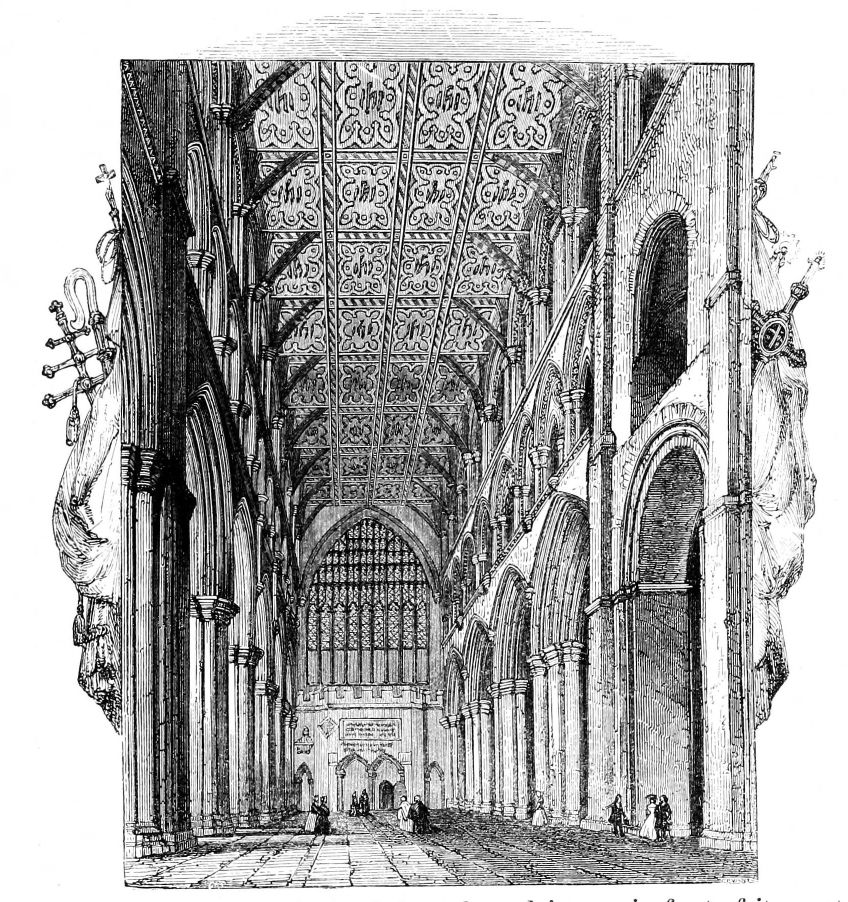
The fresh florid painting of the chestnut roof, upon which not a brush has been employed for three centuries or more, is very remarkable, and shows that the secret of mixing colours for the eye of posterity has not descended to the present day. In the several compartments of this roof, as faintly seen i h s Jesu Hominum Salvator. in the foregoing view, the three initial letters are the only ornament; and being in the Saxon form, the effect is rather pleasing than otherwise.—But in order to give the reader a more correct notion of the interior, we proceed to the particular features selected for illustration. Among these is
The Nave, to which we have slightly alluded, and on the spectator few things can be imagined more likely to make a strong and lasting impression. From whatever point it is contemplated, laterally or longitudinally, grandeur of design and elaborate execution are the leading characteristics. To enter into minute detail of its architectural beauties were impossible in our narrow compass. The general effect is all that we can presume to describe; and of this, assisted by the very correct view prefixed, the reader will have little difficulty in forming a just estimate of the magnificence that reigns in this venerable temple of our ancestors. There is one feature particularly deserving of notice, as a boundary line between two grand epochs in ecclesiastical architecture: this is, the point where the Saxon and Gothic meet in the same column. From the great western entrance, right and left, the massive clustered pillars have been evidently chiselled, at vast labour and expense, out of the original Saxon—thus engrafting the new style upon the primitive stock. The point where the Gothic ceases and the Saxon remains, and marking where the progressive work of transformation had been arrested by some public event, forms an admirable contrast, and shows the Gothic to infinite advantage. But the Saxon arches, still untouched by the reformer’s chisel, will be viewed by every lover of native art as precious relics of antiquity.
“In Saxon strength that abbey frown’d, With massive arches, broad and round, That rose alternate, row and row, On ponderous columns, short and low.”
Near the centre of the pavement is a remarkable echo, limited to one particular position, and quite inaudible as we diverge from the spot. The voice, or clapping of the hands, is reverberated with a noise like the discharge of cannon, or the roll of distant thunder; at first, loud and multiplied, and then dying gradually away in languid undulations.
St. Cuthbert’s Screen,[71] which divides the nave from the choir, forms an imposing boundary to the coup-d’œil; but over its top the spectator’s eye penetrates the lofty transept, takes in the whole space between the high altar and the western portal, and wanders over the richly emblazoned ceiling with feelings of mingled awe and admiration. To the right and left are objects that rivet his attention to the spot: the names and monuments of the dead; the tablets that encrust the walls, or mix with the pavement, are eloquent of the past, and address him in terms of solemn admonition. The dust of many abbots, the remains of unnumbered monks, rest within its walls; ‘these all died in the faith,’ and, from the steps of the altar, descended into the regions of silence. They, too, who had circled the monarch’s throne, swayed the senate, fought his battles, fostered science, and enriched their country with the spoils of nations, have all in their turn craved, like Wolsey at last, the favour of a little hallowed earth to rest their weary heads on. To enumerate the illustrious dead who have here taken up their last abode, is not within our limits; but we must not omit, even in the most cursory notice, to mention the famous traveller who saw, or feigned, more wondrous things than ever fell to the lot of any other “pilgrim of the nations.” We mean Sir John Mandeville, a native of the place, whose tomb, covered with a massive slab of grey marble, and verified by an inscription on the adjacent column, bears record to his eventful history. But as he died at Liege in 1372, after thirty-four years spent in travelling, doubts must necessarily arise as to the fact of his being buried here. The evidence by which it is supported, however, is equal to that of his travels.
The Choir, comprising the whole space between the western arch of the tower and the great altar, is indisputably grand. Flanked by two magnificent tombs right and left; closed on the east by the celebrated altar screen, canopied, niched, and carved—magna componere parvis—with all the fanciful, yet classic elegance of an ivory fan, the stranger is almost bewildered by the profusion of objects that here claim his notice and admiration. To dwell upon these in anything like minute description, would preoccupy the space which we must reserve for other particulars; but a few words are indispensable for
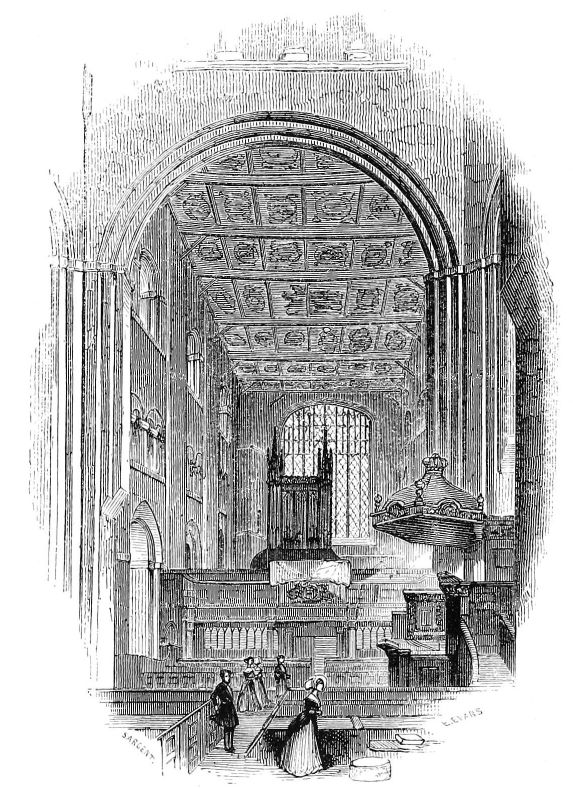
the sake of the engraved view. The light, which is finely modified by the means usually adopted, falls from the centre of the tower upon the various objects in the choir, with a subdued religious effect which greatly adds to the general impression. In this position, surrounded by the varied labours of many centuries, we can fancy in part the scenes and events which have transpired within these arches, before that altar, at which so many kings and peers have bent the suppliant knee in penitence and confession. In those early times it was a blessing, that when outrage, violence, and injustice were irrepressible by any other means, the strong arm of the church was sufficient to restrain—and when it could not effectually restrain, to punish with its stigma—the licentious baron, the crowned despot, and make the culprits quail at the very head of their armies and retainers. Where the law was weak, religion was strong, and, like the voice of God, heard upon earth, encouraged the prostrate, and brought the rebellious under subjection. Without its power and influence—its holy exercises and humanizing studies—without the spiritual arm to check aggression, to redress grievances, the baser passions must have revelled without control, and life have become a scene of continued warfare. These considerations are nowhere felt with more obvious truth than on the spot where we now stand, where so many deadly feuds have given way to religious exhortation; where they who had met as foes quitted the altar as friends—friends at least in act, if not in heart—and returned the guilty sword to its scabbard. But we need not detain our readers with what is manifest to every reflecting mind—that if justice and redress were anywhere to be found in those times, it was rather in the abbeys, than either in the Star Chamber or Westminster Hall.
The Screen of the great altar, or “Wallingford’s screen,” was begun and finished in the reign of Edward the Fourth, and is one of the best—if not the very best—specimens of the style and architecture of that epoch. It was the munificent taste of Abbot Wallingford, and his liberal encouragement of the arts, which have bequeathed this precious morceau to the admiration of posterity. It has suffered little from the lapse of time and the momentous changes which have passed over the abbey; and for beauty of design and elegance of workmanship is worth a pilgrimage. Its front consists of three divisions—a centre and two wings, the latter being perfectly symmetrical; the lower part of the centre displays a double series of small niches with rich canopies. On great festivals of the Church this splendid tabernacle was covered with cloth of gold or crimson, and, drooping from its lofty pinnacles in ample folds, must have produced an effect worthy of the gorgeous taste of Wolsey himself, who carried the “state ecclesiastical” to a higher pitch than any of his predecessors.
The Pulpit, which is a fine specimen of oak carving, though not apparently of a remote date, is well deserving of attention; and in recalling the splendid ceremonial of former times, with the impressive but simple and decorous service of the present day, the mind is prepared to weigh and contrast the spiritual energies which, exercised under that canopy, have expounded the doctrines and enforced the duties of a religious life. The pulpit of St. Albans would be no bad subject in the hands of another Boileau.
On the right of the altar, and closely adjoining the screen, is the tomb of Abbot Ramryge—an elaborately carved Gothic chapel or shrine, greatly admired for the beauty and delicacy of its workmanship, which is in high preservation.
Opposite to this, and occupying the corresponding arch, is another but less ornamental shrine to the memory of Abbot Whethamstead. Both are of native stone—of a remarkably fine close texture, procured from the quarry of Tottenhoe, light Portland colour, and capable of being wrought into the most delicate tracery. Of this material all the finest chisel-work of the abbey is composed.
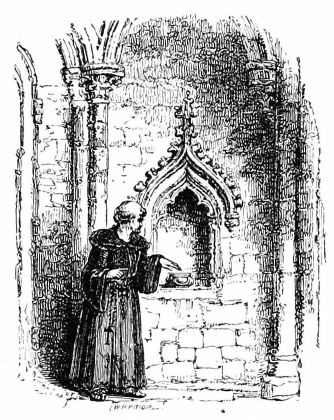
Erected against the south wall of the church, where a door formerly existed, is a beautiful Piscina, represented in many engravings. It has all the marks of antiquity, and is said to occupy the spot where, in the earliest times of Christianity in this country, two devout Eremites had chosen their cell, and there, by a life of austere penance and mortification, left a holy example for their brethren in after times. As a fragment of the colossal Abbey, this traditionary relic is of itself a gem, and never fails to secure a full share of the stranger’s attention.[72] On one of the windows of the south aisle, was “a representation of the martyrdom of St. Alban” in painted glass, only a few fragments of which remain. On the wall below was an inscription, now almost obliterated, beginning thus:—
“This image of our frailty, painted glass, Shews where the life and death of Alban was. A knight beheads the martyr, but so soon His eyes dropt out to see what he had done; And leaving their own head, seemed with a tear To wail the other head laid mangled there,” &c.
Between the east façade of the great screen and the end of the church wall, is the space occupied by the modern Vestry, containing several objects well deserving of notice, and long hallowed in the eyes of priest and pilgrim as the spot on which the Shrine of the protomartyr had stood for centuries, and drawn much tribute from the devout of all nations. Deeply cut in the pavement near this spot, is the following inscription:
St. Albanus Verulamensis Anglorum Protomartyr. xvii. Junii. ccxcvii.
In the pavement six small artificial grooves mark the spot where rested the pillars of the shrine, weighed down by the accumulated riches with which it was loaded in the shape of votive offerings.
On the north side is the Rood-loft—a carved Gothic shrine of oak, in the upper part of which, behind a lattice-work, the monks kept constant watch over the sacred treasures, while the pilgrims knelt at the shrine. In the floor several hollows are observable around the spot—worn, it is said, by the successive crowds whose “penitential knees” subjected the stone during centuries to perpetual friction and pressure. Such an effect is by no means improbable. Whoever has witnessed the fervour with which that ancient bronze, the statue of St. Peter at Rome, is saluted by a continual stream of pilgrims, will not be surprised to find that the same spirit of devotion has left a deep impression on the hard pavement of St. Albans. We do not “speak irreverently;” where so many tears have undoubtedly been shed, so many sins confessed, it is pleasing to indulge the belief that the sincerity, if not the form, was accepted; that many a heavy heart, many an oppressed conscience, has here found relief, and formed lasting resolutions of amendment.
“Prostrate on this cold stone, what tears and sighs Have pour’d from breaking hearts the sacrifice!”
The clerk, who is well informed, and a professed collector of curiosities, showed us several skulls and bones which had been found in the adjoining fields[73]—some of which, from their gigantic proportions, are worth inspection.
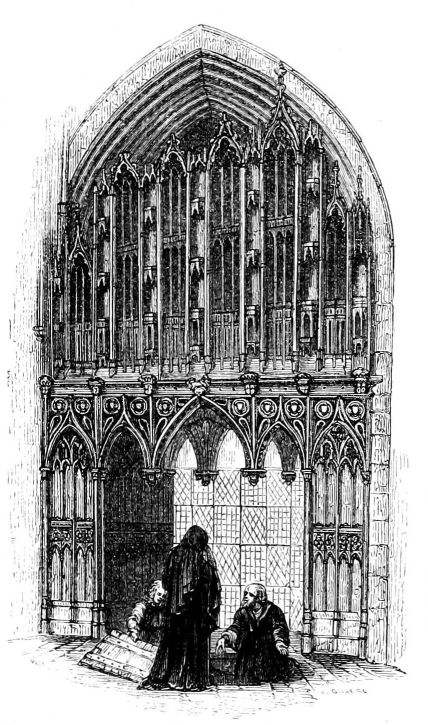
One or more sepulchral brasses are also deserving of notice, one in particular—that of an Abbot, richly carved, of large dimensions, and affording a fine specimen of the state of the art in his day. How it escaped the soldiers of Cromwell—the greatest “collectors” of their age—is a mystery The guide has taken some very good impressions of this and other objects by a very simple process, for the accommodation of intending purchasers. But the grand object of attraction is the Shrine-Tomb of the good Duke Humphrey of Gloucester, whose unhappy destiny is familiar to every reader of English history. This tomb was erected during the abbacy of Whethamstead, who, for his taste and knowledge of architecture, has been justly styled the “Wykeham” of his time. The description, which may be seen in the printed history, and equally applicable at all times, is here omitted; for, where the engraving of the subject is presented to the reader, the necessity of description is much obviated, and the writer is thus permitted to dwell at greater length on the interesting portion of history with which the subject is connected.—A detailed account of this shrine is given in Blore’s “Sepulchral Antiquities,” Part the third.
The character of this unfortunate Prince has been represented under different aspects by the writers of his day; but by far the majority bear willing testimony to his virtues, to his personal accomplishments, to his liberal encouragement of science and literature, in which he himself had acquired some merited distinction. At that epoch, however, the sword was too indispensable, peace and tranquillity were too little felt and enjoyed, to allow much scope for the more humanizing studies and pursuits. The dawn of science was still but an indistinct speck in the horizon; and the few who had already tasted the sweets of literature were continually roused from their intellectual feast by the clang of arms, and the shouts of fresh combatants.
It was under such unpropitious circumstances that Humphrey the Good gave his heart to letters; but with armed hand sought those means for its prosecution which were never to be realized. The history of his life and death may be comprised in a few sentences, and in doing so we give a ready preference to the authority of old Grafton, with only slight alterations in the orthography:—“Divers articles,” says he, “both heynous and odious, were laid to hys, the Duke’s, charge in open counsayle, and in especial one, that he had caused men, adjudged to die, to be put to other execution than the law of the land had ordered or assigned: for surely the Duke, being very well learned in the law civil, detesting malefactors, and punishing their offences, gat great malice and hatred of such as feared to have condign reward for their ungracious actes and mischievous doings. Although the Duke, not without great laud and praise, sufficiently answered to all things to him objected; yet, because his death was determined, his wisdom little helped nor his truth smally availed; but of this unquietness of mind he delivered himself, because he thought neither of death, nor of condemnation to die, such affiance had he in his strong truth, and such confidence had he in indifferent justice. But his capital enemies and mortal foes, fearing that some tumult or commotion might arise, if a prince so well beloved of the people should be openly executed and put to death, determined to trap and undo him ere he thereof should have knowledge or warning. So, for the furtherance of their purpose, a parliament was summoned to be kept at Bury, whither resorted all the Peers of the realm, and amongst them the Duke of Gloucester, which, on the second day of the session, was by the Lord Beaumont, then High Constable of England, accompanied by the Duke of Buckingham and others, arrested, apprehended, and put in ward, and all his servants sequestered from him, and thirty-two of the chief of his retinue sent to divers prisons, to the great admiration and surprise of the common people. The night after his imprisonment the Duke was found dead in his bed, being the twenty-fourth day of February, and his body showed to the Lords and Commons, as though he had died of a palsey or impostume. But all indifferent persons well knew,” continues the Chronicle, “that he died of no natural death, but of some violent force; some judged him to be strangled, others write that he was stifled or smoldered between two feather-beds.”
“The dead corpse of this Duke was caryed to Saint Albans, and there honourably buryed. Thus this noble prince, son, brother, and uncle to kings, which had valiantly and politiquely, by the space of twenty-five years, governed this realm, and for his merits was called ‘The good Duke of Gloucester,’
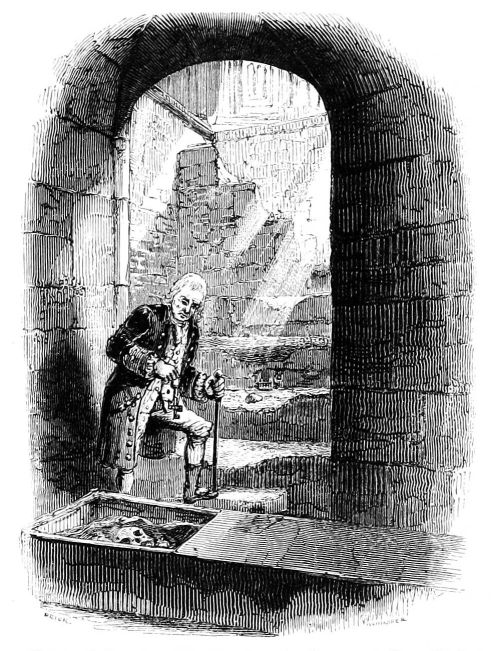
was, by a bone cast by his enemies, choked and brought to his fatal fine and last ende.” This Duke Humphrey was “not only valyant and noble in all his acts and doings, but sage, politique, and notably well learned in the civil law.”[74] In proof of this, the reader may refer to an amusing anecdote of him in Sir Thomas More’s “Dialogue concerning Heresies,” &c., chap. xiv.; also, to Shakspeare’s Henry VI., Act II., Scene I. The good Duke is also said to have “builded the Divinitie Schole at Oxford, which is a rare pece of worke.”
The Vault in which the “good Duke’s” remains had been deposited, was only discovered by accident early in the last century. When “first opened, the body was found in a leaden coffin, in perfect preservation, and floating in a strong pickle, which, however, on being exposed, soon evaporated and left the body to decay. At the foot of the coffin was painted on the wall a picture of the crucifixion, with a chalice at each hand, a second at the side, and a third at the feet, to receive the blood trickling from the Saviour’s wounds, with a hand extending from the dust with this scroll—“Blessed Lorde haue mercye on mee.” This painting is still visible on the stone of the vault, which was remarkably dry in January last, and of a temperature considerably higher than that of the chancel above. The skull, which shows the intellectual characteristics of the phrenologists, and a great portion of the skeleton, are still left; but no care having been taken of it for many years after its discovery, various portions were appropriated by relic-hunters, and other conveyancers of anatomy.
In the summer of 1765—as related in the Topographical Library, article Hertfordshire—David Garrick and Quin, who was remarkably fond of good living, made a trip to St. Albans; where, on visiting the Abbey church, and being shown the bones of Duke Humphrey, Quin jocosely lamented that so many aromatics and such a quantity of spirits should have been wasted in preserving a dead body. After their return to dinner, and whilst the wine was circulating, Garrick took out his pencil and composed the following verses, which he termed
QUIN’S SOLILOQUY.
A plague on Egypt’s arts, I say! Embalm the dead! On senseless clay Rich wines and spices waste! Like sturgeon, or like brawn, shall I Bound in a precious pickle lie, Which I can never taste? Let me embalm this flesh of mine With turtle fat, and Bourdeaux wine, And spoil th’ Egyptian trade! Than good Duke Humphrey, happier I, Embalmed alive, old Quin shall die A Mummy ready made!
The Chapel of Our Lady, which is now converted into a public school, presents in its architecture the same style and embellishments which distinguish the most highly-finished ecclesiastical structures of its time. The entrance from the south in the “olden time,” as here represented in the engraving, is one of the most effective points of view. To describe minutely, would be only to load our pages with unnecessary repetition; for nothing in the form of words can adequately convey the great elegance and beauty which predominate throughout the whole edifice. To be rightly understood and appreciated, it must be seen; and of this the admirers of antiquity seem fully aware, for the numbers who continually resort to the Abbey church for the study and improvement of architectural science, bear ample testimony to the exquisite materials which it offers for that purpose. The erection of new churches, and the restoration of others in a dilapidated state, are greatly facilitated by the numerous models, in every department, which are here thrown open for imitation. Artists are seen taking casts; others measuring the proportions, comparing the drawings, selecting the beauties, and copying the example of whatever is chaste in design or exquisite in workmanship. In short, the Abbey of St. Albans may be considered as a vast museum, or school of arts, where the student may improve and perfect his designs upon the best models; and which, were every other lost, might still supply the elements for constructing a masterpiece of ecclesiastical Architecture.
All the subjects in this superb Abbey, to which we have thus briefly adverted, are more or less striking in their kind; yet the effect is peculiarly enhanced or diminished according to the season and hour selected for the visit. The glare of noon, and the sober light of evening, produce effects which are scarcely credible to those who are not familiarized to such contrasts; but in no instance have we ever seen this venerable and majestic pile to such advantage as during our recent visit, when we resolved to take a view after the twilight had passed away, and the still deep shadows of night had thrown their mantle over the scene. One of our party, who is an excellent judge and an enthusiastic admirer of “Gothic grandeur,” strongly advised us to make a survey by torch-light; but to this certain objections were started, which it became necessary to respect. Reluctantly abandoning the torch, we sallied forth into the sacred precincts under the dim light of a westering moon, and, sauntering along in a silent contemplative mood, enjoyed a treat of which the noon-day visitor can form no adequate conception. It afforded what may be truly called a “night at St. Alban’s,” and seemed to address us in the words of the poet—
“Ye, whose high spirit dares to dwell Beyond the reach of earthly spell, And tread upon the dizzy verge Of unknown worlds, or downward urge, Thro’ ages dim, your steadfast sight, And trace their shapes of shadow’d light; Oh! come with meek, submitted thought, With lifted eye by rapture taught, And o’er your head the gloom shall rise Of monkish chambers, still and wide, As once they stood: and to your eyes Group after group shall slowly glide, And here again their duties ply— As they were wont, long ages by.”
The entrance to Lady-chapel from the north, of which a view has been already given at page 80, is particularly characteristic and picturesque. The massive square tower, showing at intervals its Roman materials and ancient masonry, throws a solemn and stately grandeur over the scene. It seems, while we look upon its scars, as if covered with hieroglyphics which embody the sacred and political history of a thousand years, during which it has been a cherished landmark to the pilgrim, a home to the weary, and an object of sanguinary contention between rival armies.
“Here to its hospitable gate, In want or woe, the pilgrim came; For at its portal Pity sate, To dry the tears of sin and shame. And here have armies on their march, And monarchs with their chiefs of fame, Paused, as beneath that lofty arch Their lips invoked St. Alban’s name.”
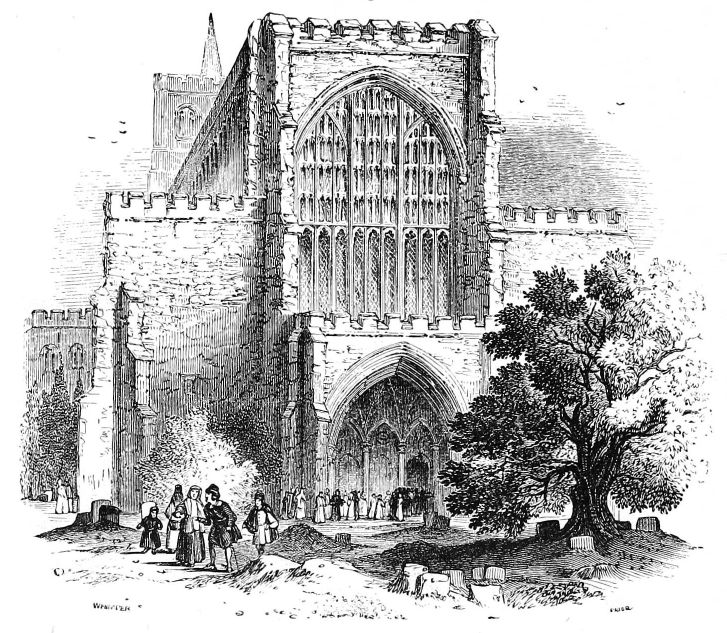
The great western entrance has a very imposing aspect, and conveys to the spectator’s mind those ideas of ecclesiastical magnificence which can only be inspired by the noblest constructions of art—such as are here presented to his contemplation. It consists of a projecting porch, elaborately ornamented, niched and pillared, and subdivided into numerous compartments, upon which the artist’s chisel has been most skilfully employed.
“Beside this porch, on either hand, Giant buttresses darkly stand, And still their silent vanguard hold For bleeding knights, laid here of old; And Mercian Offa and his queen, The portal’s guard and grace, are seen. This western front shows various style, Less ancient than the central pile. It seems some shade of parted years Left watching o’er the mouldering dead, Who here for pious Henry bled; And here, beneath the wide-stretch’d ground Of nave, of choir, of chapels round, For ever—ever rest the head.”
Over the entrance is the magnificent window, shown in the steel plate: it occupies nearly the whole breadth of the nave, and through its numerous mullioned and transomed squares, pours a flood of light upon the long Gothic aisles as far as the high Altar. To see the interior of the church to the greatest advantage, the spectator should take his station at this entrance, and at that hour after mid-day when the light and shade are brought into strongest contrast.
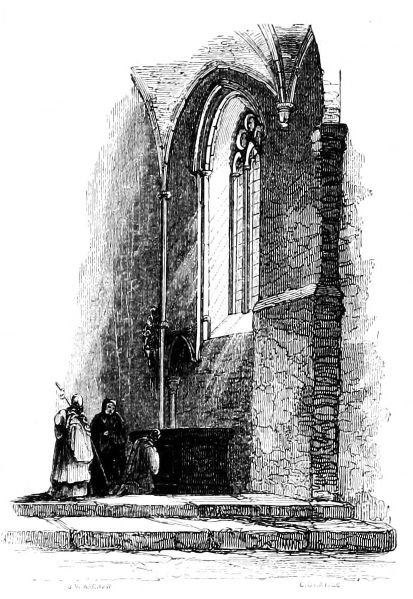
In the south Aisle, nearly opposite the steps leading into the Chapel of St. Alban, is the subject of the annexed cut. It is an oblong table of stone, covered with a massive slab of dark marble, which is considered to be of a rare and precious quality. It is marked with several small crosses, rudely traced, and, as we were told by our cicerone, is the original Altar-table of the Monastery, which, after the suppression of the latter in 1539, was removed from the choir.
This Aisle, including the exterior of Abbot Whethamstead’s monument on the left—that of Duke Humphrey in the distance—the entrance to the shrine of the patron saint between, and with the outer doorway arches, windows, and altar on the right, is one of the most interesting scenes in the church. Standing by this altar of a thousand years, the lines of the French poet possess a force which in any other situation would be scarcely felt:
Les arcs de ce long clôitre, impénétrable au jour, Les degrés de l’autel usés par la prière, Ces noirs vitraux, ce sombre et profond sanctuaire, Où peut-être des cœurs, en secret malheureux, A l’inflexible autel se plaignoient de leurs nœuds, Et, pour des souvenirs encore trop pleins de charmes, A la religion dérobaient quelques larmes— Tout parle, tout émeut dans ce séjour sacré!
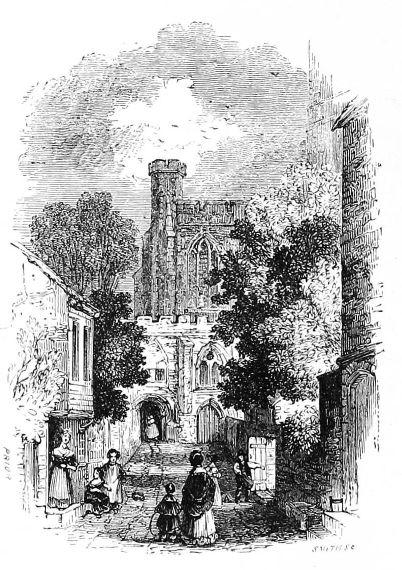
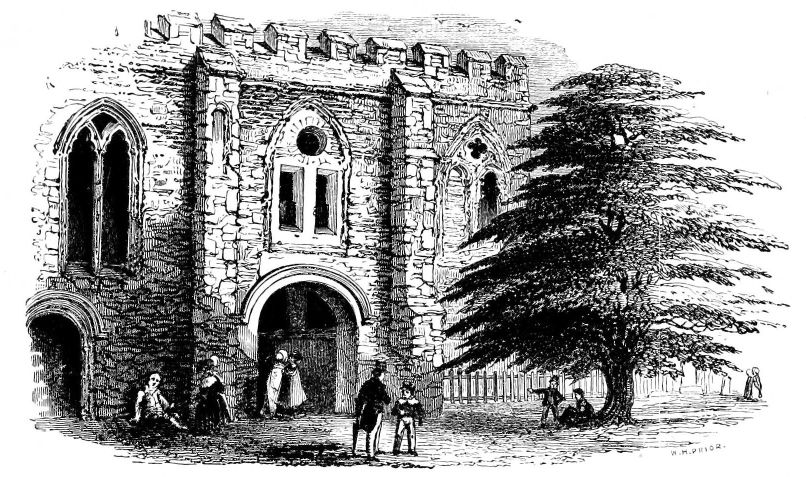
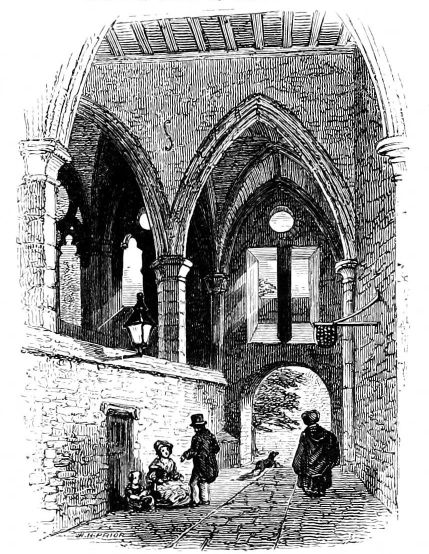
The Gate-House, with its ponderous oaken doors still closing the lofty pointed archway, is a massive and cumbrous pile of building, and has all the rude
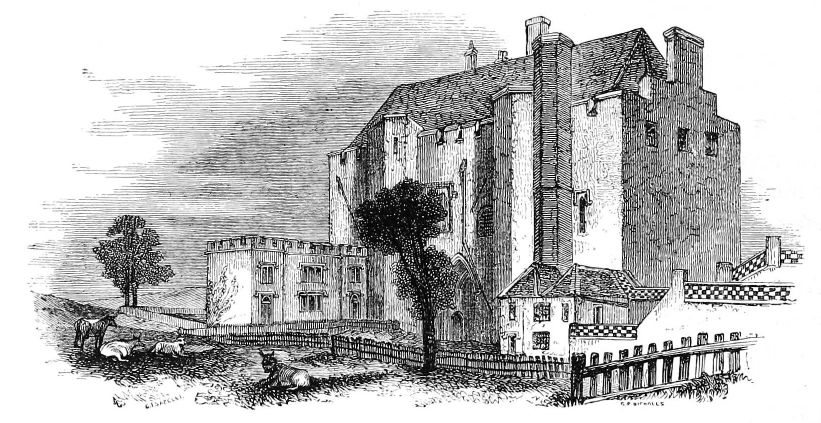
strength of a fortress crowned with embattled walls. It stands parallel with the west end of the church, at the distance of about one hundred and fifty feet, and formed the original grand entrance to the Abbey-court, which was bounded, at the distance of about three hundred feet, by a lower gate leading to the Abbey Mills. Both these gateways were originally crowned with turrets. The smaller gate has long since disappeared; and the larger fabric, which still survives the shock of centuries, has undergone many alterations in recent times, as is sufficiently apparent in the view annexed. The massive oak doors, still firm on their hinges, are good specimens of ancient carpentry. This gate is said to have been built in the reign of Richard the Second, and is every way characteristic of that age of treason and feudal splendour. The lower apartments were appropriated to malefactors under the jurisdiction of the Lord Abbot; and, with the exception of the order having been reversed—by converting the upper rooms to a similar purpose—it is still the prison for the borough and liberty of St. Albans.
The high and distinguishing privileges enjoyed by the spiritual lords of this Abbey gave them precedence of every other in the kingdom. “The king,” says Weever, “could make no secular officer over them but by their own consent; they were alone quit from paying that apostolical custome and rent which was called Rom-scot, or Peter-pence; whereas neyther kinge, archbishop, bishop, abbot, prior, nor any one in the kingdom, was freed from the payment thereof. The Abbot also, or monk appointed archdeacon under him, had pontifical jurisdiction over all the priests and laymen, of all the possessions belonging to this church, so as he yielded subjection to no archbishop, bishop, or legate, save onely to the Pope of Rome. This Abbot had the fourth place among the Abbots which sate as Barons in the Parliament House.” “Howsoever, Pope Adrian the Fourth, whose surname was Breakspeare, born hereby at Abbots-Langley, granted this indulgence to the Abbots of this monasterie, namely—that as Saint Alban was distinctly known to be the first martyr of the English nation, so the Abbot of this monasterie should at all times, among other Abbots of England, in degree of dignity, be reported first and principal. The Abbot and convent of this house were acquitted of all toll throughout England. They made Justices ‘ad audiendum et terminandum,’ within themselves, and no other Justice could call them for any matter out of their libertie. They made Bayliffes and Coroners; they had the execution and returne of all writs, the goodes of all outlaws, with gaole and gaole deliverie within themselves.”—These particulars have been carefully embodied in a poem on the subject, from which we have already quoted. In the prosperous days of the Abbey, several apartments were built exclusively for the use of strangers.[75] These adjoined the cloisters; and beyond them, in a separate range of buildings, were the king’s and the queen’s apartments.[76] But notwithstanding this preparation for visitors, and these indirect invitations, it would seem, on the authority of Matthew Paris, that some of the earlier “monarchs came too often, or at least with too cumbrous suites.”
The princely state which the Abbots maintained in their style of living, in their table and retinue, partook much more of regal splendour than of religious restriction. The scene, as exhibited on a festal day in the Abbey, is thus effectively sketched by Mrs. Ann Radcliffe:—
. . . The stately walls, with tapestry richly dight, Of the Abbot’s banquet-hall, where, as on throne, He sat at the high dais, like prince alone, Save when a Royal guest came here, Or papal Legate claimed a chair. Here marble platforms, flight o’er flight, Slow rising through the long-lined view, Showed tables spread at different height, Where each for different rank he knew. And, with pleased glance adown the hall, Saw Bishops in their far-sought palle, The Abbey’s noble Seneschal; Barons and Earls in gold array, And warrior knights in harness gray. There was the Prior’s delegated sway; The grave Archdeacon sat below, And the hundred Monks in row and row, Not robed in dismal sable they Upon a high and festal day, But all in capes most costly and most gay. There too the Abbey Marshal shone; And there, beside the Abbot’s throne, Chaplain of honour from the Pope alone.”
The battles, of which the immediate vicinity of St. Albans has been the theatre, are familiar to every reader of history.[77] In connection with our immediate subject, however, we may briefly advert to them as melancholy contrasts to that peace and religious tranquillity which were supposed to be the cherished inmates of this magnificent sanctuary.
The first battle. 1455. It was now, says Newcome, when the first battle of St. Albans happened; the causes of which it is unnecessary to relate. Suffice it to say, that the king attended with his nobles, or such as were of his council, and a number of armed troops came down from London; and probably with the view that a treaty with the Duke of York might be carried on with less interruption or danger from the military. The duke was coming from the north; and brought with him 3000 men of that body which he had raised there, and took part in the great field on the east side of the town, called Key-field. The king’s men had barricadoed all the avenues on that side. The cry among the Yorkists was, “Give up the Duke of Somerset;” but no concession of this sort being made, the duke’s men broke into St. Peter’s Street; and being there met by the royalists, a dreadful conflict ensued; where, after many were slain, the king’s party lost courage and fled, leaving their sovereign alone, and standing under his standard. He, perceiving himself thus deserted, walked away into a small house, that of a baker; and here the duke finding him, led him out, and conducted him to the Abbey, where he first placed him close to the shrine, whether for safety and sanctuary, or to induce him to return thanks for his safety. He then conducted him to the royal apartments, and the next day to London. The effeminacy of the king’s men, and to which is ascribed the loss of the battle, is thus described by our author, who saw both parties, and writes of them thus:—
Quicquid ad Eoos tractusque regni tepores Vergitur, emollit animos Clementia Cœli: et Omnis in arctois sanguis quicunque pruinis Nascitur, indomitus bellis, et mortis amator.
The duke’s men fell to plundering the town, but, by the commands of the duke, they abstained from doing any injury to the Abbey; but the Abbot
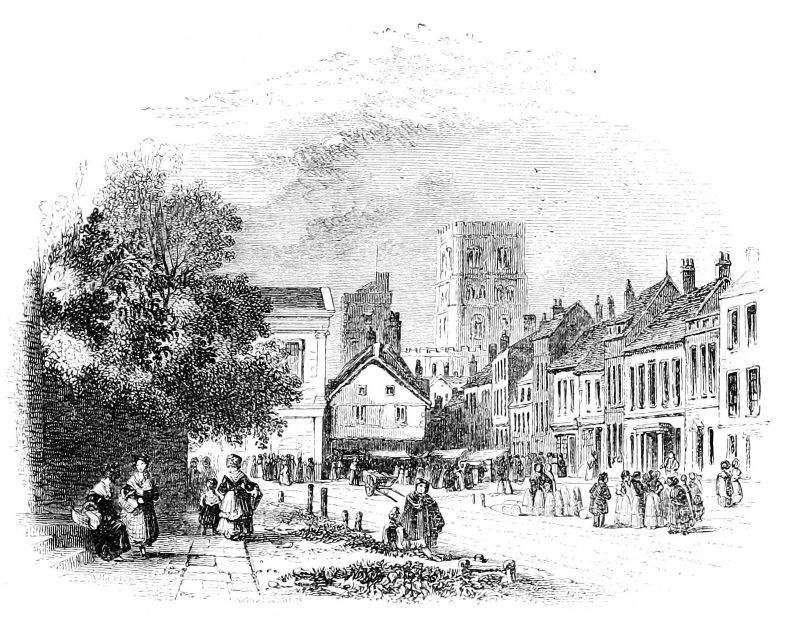
thought it necessary to send out to them great quantities of victuals and wine, and this, together with the protecting hand of the martyr, as my author asserts, preserved the Abbey and church from any injury by spoil and depredation. The slain lay thick in the upper street, and at the division of the ways about the market; and among them were seen the dead bodies of Edmund Beaufort, Duke of Somerset; of Henry Percy, Earl of Northumberland; and of Thomas Clifford, Lord Clifford. But because they were persons well known to be hateful to the Duke of York when alive, none ventured to prepare for their funerals, or showed any decent regard to their dead bodies. Whereupon Abbot John addressed the duke, and begged him to spare the vanquished, and suffer some honours to be paid to the deceased—“Not enemies will I call them,” says he, “but your relations by blood,—your fellow patriots.” And saying more to recommend moderation in his victory, the duke commanded him to take the bodies and provide for their funerals. The Abbot then caused some of the brethren to go forth and take up the deceased. This being done, and the dead bodies received into the church and laid out in decent order, in a few days the funeral obsequies were performed, and the bodies had interment in the chapel of the Blessed Virgin. They were laid in the ground “lineali ordine, juxta statum, gradum, et honorem, dignitatis. Unde de his dominis et de eorum sepulturâ scribitur in ista formâ:”[78]—
Quos Mars, quos Martis sors sæva suæque sororis, Bello prostrarunt, villæ medioque necarunt. Mors sic occisos tumulaverat his simul ipsos, Postque necem requiem causavit habere perhennem, Est medium sine quo vult sic requiescere nemo: Hic lis, hic pugna, mors est quæ terminat arma; Mors, sors, et mavors, qui straverunt dominos hos.
During a period of more than seven centuries, “this Abbey continued to flourish with various improvements, under the government of no less than forty-one Abbots, many of whom enriched it with additional buildings and treasures; so that its extent was in proportion to its immense estates, and more resembled a town than a religious establishment. To its apartments we have already adverted. Here, in 1215, King John, during his opposition to the Barons, ‘held a grand consultation’ in the Chapter-house; here also Louis the Dauphin, who arrived shortly after, exacted a heavy contribution for carrying on the war, in which he had been invited to take part. Henry the Second and Henry the Third were often entertained by the Abbots of St. Albans, and were liberal benefactors to the monastery;” but the eighth Henry, as every reader is aware, pursued the opposite course. Its funds were appropriated to state purposes, its privileges abolished, its inmates dismissed; but the fabric itself, comparatively, suffered little from the violence of the transition.
In a careful perusal of the history of this monastery, the reader will find abundant materials for reflection. The lives of the Abbots, as recorded by a member of their own body, present many instructive anecdotes and examples of the civil and religious government, the state of society, the progress of science, and that encouragement of the arts over which they exercised so direct and beneficial an influence. “Although originally subject to the Diocesan, the Lord Abbot gradually advanced in external splendour till the Abbey-church became a rival to the Cathedral; and this,” as Newcome has observed, “went on till, at the Dissolution, the mitred Abbots, who had laboured for pre-eminence, outnumbered the Bishops in the House of Lords, amounting in 1514 to twenty-eight, whilst the Bishops were only eighteen or nineteen.”
There were many other considerations that tended to give the Monks power and consequence; and Abbeys were found to be such beneficial institutions, that they would have stood their ground to the present day, had not their great possessions and revenues tempted indigent courtiers “to combine and plot against them.” “Their utility,” continues the same author, “appeared in these respects, that they exercised great hospitality towards the poor; and this was done at one-tenth of the expense which the poor now (1790) create, by being maintained by a legal provision. The monastery was the house of reception for all the sick, who were here nursed, spiritually consoled, and cured. The monastery generally employed masters to teach the poor children of the neighbourhood; entertained all persons who were ingenious in any art or science, and transcribed books when few understood the art, or could undertake it. There is now extant a chronicle composed and printed at St. Albans, in 1484, under the countenance then given to this particular Abbey by Richard the Third.”
“These old religious houses kept public registers of all great public transactions; and to them we are indebted for all our English historians down to the period of the Dissolution. They were possessed of all the learning that was in any repute at the time prior to the coming of the friars. The monasteries, in general, furnished the men who were fit for embassies abroad, or for offices of trust and distinction at home: and to their honour it is recorded, that all the inferior officers, both in the courts of law and in the civil departments of the Government, who are called clerks, owe this appellation to the religious houses, Abbeys or Cathedrals, from which the first officers were taken. The landed property belonging to these houses at the time of the Dissolution was so great, that it was computed at one-third of the kingdom. Yet, whatever were their temporal possessions, they were always found to be good landlords, ever ready to forward improvements, and accomplishing many great works in draining, enclosing, and planting, which could never have been undertaken by individuals.” “In truth,” adds the historian quoted, “they did more to civilize mankind, and to bring them within the comforts of society, than any set of men of any denomination have ever done. And yet the ungrateful world, that was enjoying the fruits of their labours and their riches, now that it beheld the edifice completed, cast down the builders and the scaffoldings as if no longer useful! In spite of all the calumny thrown out against these monastic institutions, nothing so well proclaims their utility as this—that they maintained themselves in credit and repute, some of them a thousand years; and many of them during the space of three hundred, four hundred, and five hundred years; and that, when they were dissolved, Edward the Sixth and his counsellors found it necessary to endow new hospitals, to build new schools, and to provide new relief for the poor and helpless.”
Such is the testimony of a liberal-minded clergyman of the Church of England, who spent a great portion of his leisure in investigating the history of monastic institutions, particularly that of St. Albans. “These religious foundations,” he adds, “fell with such undeserved calumny and slander, that it is but common justice to restore their character, and give them their due praise, wherever that can be done; and if all others were as free from corruption and ill government as the Abbey of St. Albans, it would be seen how unjustly they were accused, and that their overthrow was effected for other reasons than pretended misrule and corruption. But as they had been ever the main pillar and support of the Papal dominion, it was natural and consistent to abolish the members after the Head was rejected. They were bodies so nearly allied to the Papal power, that they must of necessity fall with it; and although a gradual reformation might have been effected in them, yet, in the new plan of church government, they were deemed unnecessary; for the new Head of the
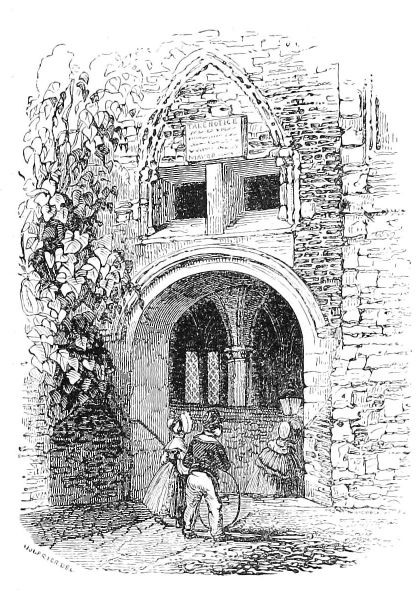
Church and his counsellors wished to have as few subjects in the Church to be governed as might be. Accordingly, by dissolving the regular clergy, and limiting the Church, to the episcopal order of seculars, they rejected above one hundred thousand of the former, and retained about eight thousand of the latter. Whatever was the pretext, the real truth appears to have been this—that their temporal power and wealth tempted their downfall; and in spite of all the good and real merit that was to be found in them, they fell a prey and spoil to an extravagant monarch, and his ‘needy and profligate’ courtiers. In the legislature of those times, there were many great and able men; but whatever cause there may be to charge them with want of piety, there is no room to accuse them of any want of worldly wisdom, or of their embracing that self-denial and contempt of the world, which they were so ready to condemn in the monks. They made laws and ordinances to support a new religion, when they could enrich themselves by suppressing the old.” “But,” continues this able writer, “the bright examples of the bishops and clergy who submitted to the flames at that time, will appear more illustrious when it is seen how just and rational was their opposition to the worship then in use, as well as to the doctrine; the first having in it as little of true piety and devotion, as the latter had of reason and revealed truth. It was the blood of those men who could die for the truth, that gave the new Establishment a firm and solid foundation, when neither the will of the Prince nor the laws of his Parliaments could have been able, without that cement, to effect a new construction and edifice.”[79]
The Abbey of St. Albans has the credit of having introduced a printing press soon after the invention of types; and may thus truly be said to have fostered within itself the elements of its own dissolution. One of the first works issued was by the lady prioress of the adjacent nunnery of Sopwell, Dame Juliana Berners, who composed several treatises on hawking, hunting, and heraldry, which were so well received that two editions were printed at St. Albans, between 1481 and 1486.
The local scenery around St. Albans is pleasing, occasionally picturesque, and, owing to its including the ancient Verulam, is never without deep interest to all who have a knowledge of ancient history, and a taste for antiquarian research.
The finest point of view is that which was chosen by the artist for the steel engraving, namely—from the south near the walls of the ancient city; the streets of which are still discernible in the green field, by the thin short grass that covers them, and under which the Roman brick yet retains its original bed. A great portion of the ancient substructure, matted with weeds and shaded with trees and brushwood, still invites the curious stranger, and offers him every facility for investigation. But, except the horizontal layers of brick, mortar, and shingle—the brick generally carbonized in the centre—there is nothing left to repay investigation. The soil has been ransacked too effectually by the antiquaries of monastic times to encourage further research; but the situation will please every one who delights in classic associations, while the Abbey, which crowns the adjoining eminence, gives a rich hallowing interest to the whole scene:—
“Whose Norman tower lifts its pinnacled spire: Where the long Abbey-aisle extends, And battled roof o’er roof ascends; Cornered with buttresses shapely and tall, That sheltered the Saint in canopied stall.”
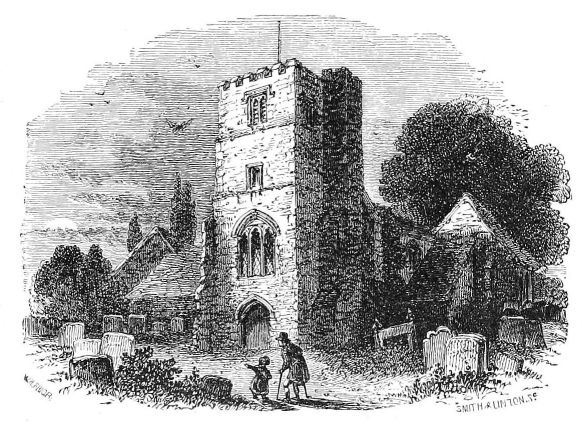
There is no single object, however, after the Abbey, half so attractive as the old church of St. Michael’s, the sacred repository of the great Lord Bacon. It is built within the precincts of the ancient city, and, crowning a gentle undulation of the surface, forms a beautiful feature in the landscape. The interior still preserves its simple antique appearance, and is rich in sepulchral objects. It was founded about the middle of the tenth century, by Abbot Ulsinus; and its massive piers and plain semicircular arches still show unquestionable evidence of the original Saxon architecture. It is kept remarkably neat, and has, what we have rarely observed in other churches, small fire-places in several of the family pews.
But the tomb and statue of Bacon soon arrest the eye, and claim, for a time, the stranger’s undivided attention. The statue we need not describe; it speaks for itself in the beauty of the sculpture, and in the classic elegance of the inscription. But how appropriate are these lines:—
“Unfit to stand the civil storm of state, And through the rude barbarity of courts, With firm but pliant virtue, forward still To urge his course; him for the studious shade Kind nature form’d, deep, comprehensive, clear, Exact and elegant; in one rich soul, Plato, the Stagyrite, and Tully joined. The great deliverer he! who, from the gloom Of cloister’d monks, and jargon-teaching schools, Led forth the true Philosophy, there long Held in the magic chain of words and forms.”—Thomson.
Lord Bacon, “the illustrious subject of the following inscription, was the son of Sir Nicholas Bacon, lord-keeper of the great seal under Elizabeth, who was married to Anne, daughter of Sir Anthony Cooke, a lady of the most profound erudition and brilliant talents. Francis, the illustrious son of such distinguished parents, was born in the year 1560, and even in his infancy gave indications of the most uncommon abilities, united with the greatest and most unwearied assiduity in the pursuit of knowledge and investigation of truth; his cleverness gained him, even in his earliest youth, the admiration of Elizabeth. At Cambridge, where
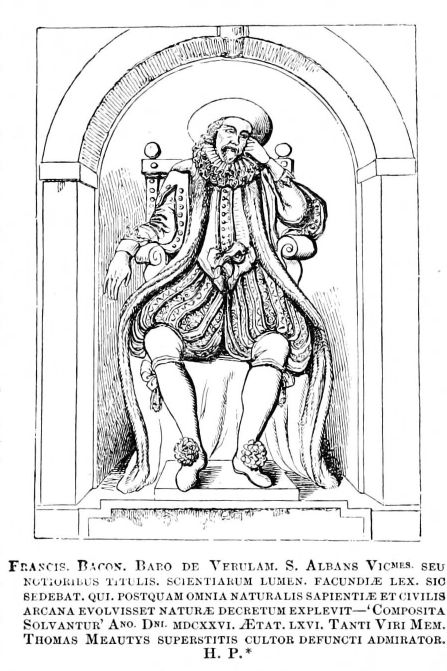
Francis. Bacon. Baro de Verulam. S. Albans Vicᵐᵉˢ. seu notioribus titulis. scientiarum lumen. facundiæ lex. sic sedebat. qui. postquam omnia naturalis sapientiæ et civilis arcana evolvisset naturæ decretum explevit—‘Composita Solvantur’ Aⁿᵒ. Dⁿⁱ. mdcxxvi. Ætat. lxvi. Tanti Viri Mem. Thomas Meautys Superstitis cultor defuncti admirator. H. P.0[80]
he completed his education, his talents obtained universal applause. While prosecuting his studies at the university, he detected the fallacies of the then customary mode of philosophizing, which at a more mature age he published to the world, and laid down those laws which opened the way to all the brilliant and surprising discoveries of modern days. His university education being completed, he commenced his travels, from which the unexpected death of his father suddenly recalled him; upon which he applied himself to the study of the common law, at Gray’s Inn, and soon elevated himself to the highest dignities of his profession. But his character was not without a blemish—‘humanum est errare;’ and even the illustrious Bacon fell from the giddying height he had so proudly attained. After his disgrace, he applied himself wholly to literary and philosophical pursuits, enriching the world with his discoveries, and enlightening it by his reasonings. His love for philosophy was the immediate cause of his death, of which the following narrative is given by Aubrey, in his MSS., which are now deposited in the Ashmolean Museum at Oxford:—
“The cause of his lordship’s death was trying an experiment as he was taking the aire in the coach with Dr. Witherborne, a Scotchman, physitian to the king, towards Highgate: snow lay upon the ground, and it came into my lord’s thoughts, why flesh might not be preserved in snow, as in salt. They were resolved they would try the experiment presently. They alighted out of the coach, and went into a poor woman’s house at the bottome of Highgate-hill, and bought a hen, and made the woman exenterate it, and then stuffed the body with snow; and my lord did help to do it himself. The snow so chilled him he immediately fell so ill, that he could not return to his lodgings (I suppose then at Gray’s Inn), but went to the Earl of Arundell’s house at Highgate, where they put him into a good bed, warmed with a panne; but it was a damp bed, that had not been lain in for about a yeare before, which gave him such a cold, that in two or three days, as I remember he told me, he died of suffocation.”—Topographical Library, page 113-5.
Sopwell Nunnery is thus described in the History of the Abbey. It was founded by “Abbot Geoffry about 1140, on his observing two poor women dwelling there in a wretched hut of their own constructing, and living a most austere life on bread and water, and in regular devotion to God. Their piety induced him to build a house for their comfortable living; and to bestow on them some possessions. He appointed also a chapel and a church-yard; ordaining that none should be buried there except the nuns; none to be admitted into that house but maidens; and the number not to exceed thirteen.
“Henry de Albini or Albeney, of the house of Todenei, gave to this house two hides of land, with his wife’s consent, in their manor of Cotes, in Beaulieu. His son Robert, and his mother Cicely, gave a rood more, in the same manor. Richard de Tany, or Todenei, gave them the land called Black hides in Ridge parish.
“Abbot Michael, about 1338, ordained certain rules for the regulation of this house, and enjoined a better order and observance than they had before practised. They are as follows: 1. That the commemoration of St. Alban should be kept as usual. 2. That no more than three nuns should sit in the chapter. 3. That silence be observed, as by the rule of St. Benedict, in the church or chapel, in the cloister, in the refectory, and the dormitory. 4. That a little bell do ring in the morning, as notice to rise and appear; and that none leave the dormitory before the bell rings. 5. That the garden door be not opened (for walking) before the hour of prime, or first hour of devotion; and in summer, that the garden and the parlour doors be not opened until the hour of none (nine) in the morning; and to be always shut when the corfue rings. 6. That no sister hold conversation in the parlour without her cowl on, and her face covered with her veil. 7. That tailors, or other artists, be persons of good character, but to work in some place assigned them without the monastery; and never to be admitted into chambers or other private places. 8. That if any sister be under a sentence of penance, this shall not exclude her from the duties of the church. 9. The sick to be kept in the infirmary. 10. No nun to lodge out of the house; and no guest within it. 11. All the sisters to be present at the mass of our Lady.”—History of St. Albans, page 468.
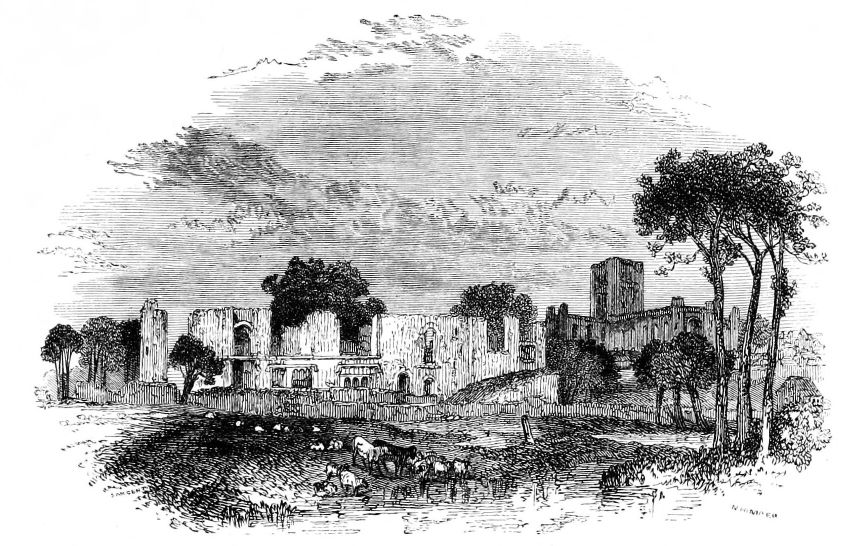
Returning from the ruins of Sopwell, we take a parting view of the great west entrance to the Abbey Church, the principal features of which we have already noticed, page 94. The ground in front of the porch is entirely occupied as a public cemetery; but none of its sepulchral antiquities are of a character to demand particular notice as works of art.
The ceremony represented in the woodcut is the “distribution of alms,” which usually took place at the church door, on particular festivals, when “give-ale” and the “dole” drew together the neighbouring poor. The “give-ale,” so called, was distributed on anniversaries, often with bread and other dole, to the poor, for which purpose land had been left to the church by the person whose birth-day, saint’s-day, or burial-day, was to be commemorated. Anniversaries were sometimes kept on the birth-day of a donor, during his life-time, or on the saint’s-day of the church where it was appointed. The doles of money and bread were distributed at some altar in the church, or at the tomb of a deceased benefactor. The “give-ale,” being chiefly allotted to great festivals, was usually distributed in the church-porch, where the people assembled, and where they sometimes remained wassailing in the church-yard till it became a scene of merriment and tumult. Some of these anniversaries, as it is well known, gave rise to Fairs, which were once most improperly held in churchyards.—Gaston de Blondeville, vol. iv. p. 68.
In the preceding notice of St. Albans, the narrow limits assigned to this work has made it necessary to confine our sketches and observations to the more striking features of the Abbey and its vicinity. Where the materials are so abundant and inviting, and where only a few characteristic portions can be admitted, their selection must be always attended with more or less difficulty; but in the present instance, it is hoped, the order of subjects has been so arranged as to present the reader with a faithful picture of the Abbey as it now is, and such as, with the vast improvements in contemplation, it may continue to be for ages to come. For the lives and acts of its “forty abbots and one,” we must refer our readers to the chronicles of the Abbey, and the other sources of information hereunto annexed.
“Now closes the scene; and here,” in the words of the historian, “may we behold fallen and set for ever the glory and splendour of this and all other of those religious corporations, which, with most pious intentions in the founders, with general good conduct in the rulers, with most grateful acceptance in the sober and virtuous of all ranks, had provided for the wants and necessities of men; and the revenues, which had cheered the hearts of the naked and hungry, now turned out of the channel of hospitality and beneficence, to be dissipated and wasted in the voluptuous pleasures and base gratifications of the court and its followers.”
“Here forty abbots have ruled and one, Twenty with palle and mitre on, And bowed them to the Pope alone. Their hundred monks, in black arrayed, The Benedictine rules obeyed; O’er distant lands they held their sway; Freed from Peter’s-pence were they; The gift of palle from Pope they claimed, And cardinal-abbots were they named; And even old Canterbury’s lord Was long refused the premier board; For this was the first British martyr’s bier, And the Pope said ‘His priest shall have no peer.’ Now know ye St. Alban’s bones rest here! Kings and heroes here were guests In stately halls, at solemn feasts. But now, nor dais nor halls remain; Nor fretted window’s gorgeous pane Twilight illuminated throws, Where once the high-served banquet rose.”—Anne Radcliffe.
Appendix.[81]—1. The present roof of the Abbey was erected at the expense of Abbot Whethamstead, after the original, which is said to have been of stone, had been blown down in a tempest. The “Wallingford Screen” was built, in 1480, by the Abbot of that name, at an expense of eleven hundred marks. It reaches from the ground to the eastern window, and for beauty and magnitude is said to surpass everything else of the kind in Europe. It was adorned, in the palmy days of the Abbey, with “a profusion of gold and silver ornaments;” but in its present condition, stripped of all such glittering ornaments, and its elegant simplicity so much more apparent, it is thus “unadorned, adorned the most.”
2. The Abbey Church of St. Albans was “chiefly erected by Paul, the first Norman Abbot, early in the reign of William Rufus, at which period the edifice erected by Offa had become extremely ruinous. The Norman architecture is consequently preserved in the greater part of the building, particularly in the choir, nave, transepts, and great tower; but a very considerable portion has been rebuilt in the various styles of the times when repairs became necessary, the particulars of which may be seen in the lives of the different Abbots. For the purposes of repair, the materials were chiefly furnished by the ruins of Verulam; among which was a profusion of Roman brick.”—Archt. of St. Albans.
3. We are aware of the difference of opinion which once subsisted among writers as to the true era and character of the round and pointed arches which distinguish the Abbey Church. But the round arches which were formerly considered Norman, have been lately, we understand, pronounced Saxon by a distinguished architect, who has bestowed great pains in the investigation; and has at last, it is to be hoped, settled the question
“And proved, when Mercian Offa was anointed, Arches were broad and round—not lancet-pointed.”
4. P. 87.—The epitaph on the two hermits, Roger and Sigarius, states, that thinking themselves unworthy to rest within the church, they chose a resting-place in the wall below. Legendary inscriptions on the clustered pillars are still dimly visible through the modern whitewash.

ARMS OF ST. ALBANS.
5. This Abbey Church, venerable alike for its antiquity, and admirable for its design and workmanship, “possesses all the magnitude and dignity of the largest Cathedral. It is cruciform, measures from east to west, including the Lady Chapel, six hundred and six feet in length; the extreme breadth, at the intersection of the transepts, is two hundred and seventeen feet. The height of the body is sixty-five feet, and that of the tower is one hundred and forty-four feet.”
Authorities:—M. Paris.—Grafton.—Harding.—Holinshed.—Speed.—Camden.—Archæologia.—Newcome.—Clutterbuck.—Topography of Great Britain.—Guide to St. Albans Abbey.—St. Augustine.—Radcliffe’s St. Albans Abbey.—Holcroft’s Margaret of Anjou.—Memoir of Lord Bacon.—Blome’s Britannia.—Weever.—Willis.—Tyrrell.—Burnet.—Dugdale.—Visit to St. Albans, January 1842, MS. Notes by an Artist, MS.
The Society of Antiquaries has published very splendid illustrative plans, elevations, and sections of the Abbey Church of St. Albans.
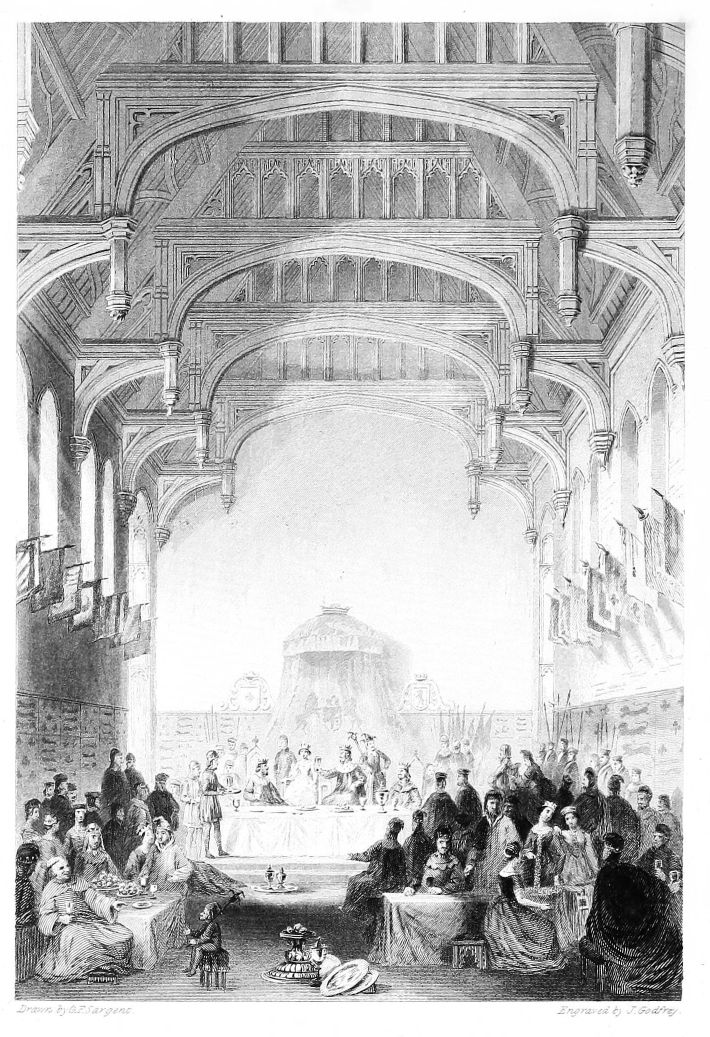
HALL OF ELTHAM PALACE.
A.D. 1365.
LONDON. GEORGE VIRTUE.
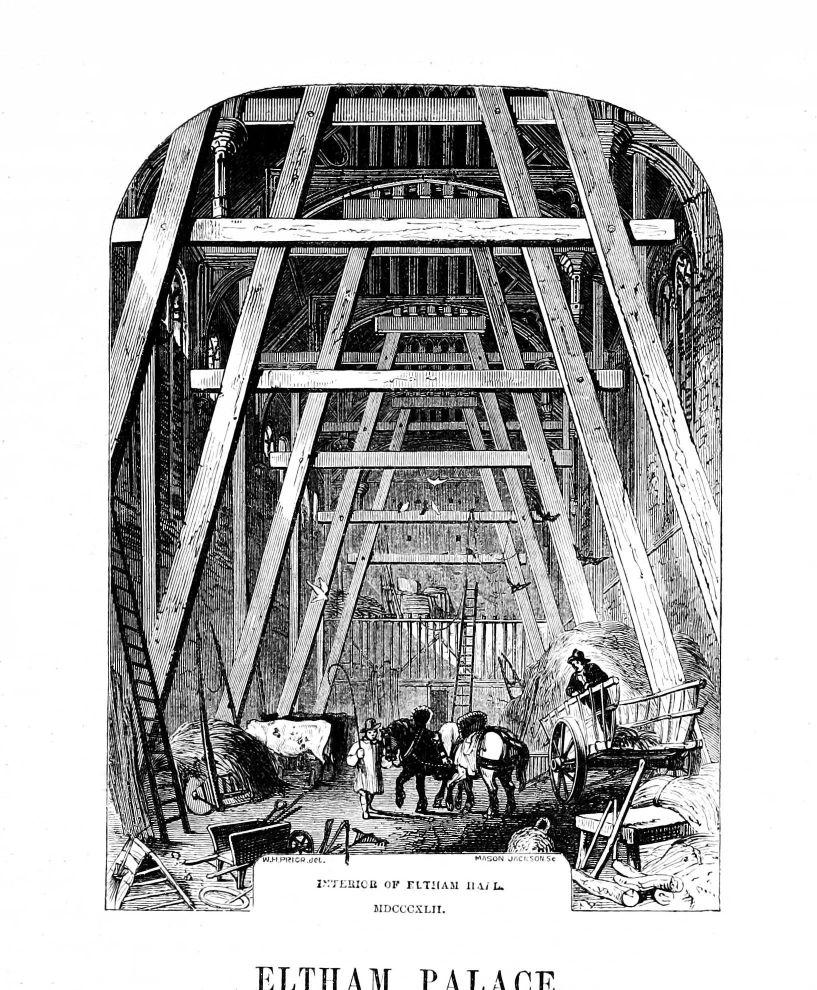
INTERIOR OF ELTHAM HALL.
MDCCCXLII.