THE CAPTAIN OF THE WIGHT (continued 6)
Reading edition
"That'll do; keep her going so. Ay, ay, my beauty, I sees ye; but ye need not be in such a hurry--we're a-waiting for you, but 'twon't do to let you think it; so now up with the helm, and let her fall off a bit. There, keep her jogging like that: they'll be alongside in another minute."
From where Ralph stood, by screwing his head a little he could just see the top of the masts and the round "crow's nests" in the "tops." The main and fore yards were braced square, and the great bellying sails stretched out tight as drums before the fresh breeze. The masts looked so close, he thought she must be aboard of them, and expected every moment to hear a crash as her stem cut into the broad stern of his own ship.
"Halloa! you there! you'll be aboard o' us an' you take no more care," sung out the Master through a speaking-tube.
But no answer came back; and Ralph was suddenly startled by seeing a long black pole slowly come creeping past the side of their ship, followed by a high black mass, and then the whole of the fore part of the vessel seemed to grow suddenly up abreast of where he was standing. He could plainly hear the sound of the sea as it dashed against the bluff bows and hurtled between the two hulls.
"Hola! Messieurs les Anglais! rendez-vous," bawled a hoarse voice.
"Come aboard, then, and take us!" called out the Master, at the same time motioning to the helmsman to put the helm down, so as to let her range alongside.
The two vessels were now broadside to broadside, and were both surging through the sea. The Frenchman had shortened sail so as to keep alongside of the Captain's vessel. Ralph could see a crowd of people on board. In another moment a stout rope with a grapnel attached was thrown on board the Captain's vessel at the stern, and another caught in the fore chains forward. The two ships were now lashed alongside.
"'Tis all right now, my lord," called down the Master; "I'll see to their not getting away while you tackles them on deck."
The Frenchmen had already begun to board the Captain's ship. A burly Norman seaman, wielding a formidable pike, had leapt over the bulwark on to the deck, and was rushing forward to knock down Dicky Cheke, who had suddenly caught sight of his cheese, when the Frenchman stepped upon it and instantly slipped up with a fearful exclamation.
"You villain! 'tis my cheese, and you have spoilt it for ever!" shrieked Dicky Cheke, in a rage.
And without a moment's hesitation he drove his sword into the Norman's body, amid the cheers of Ralph and the crew, who had watched the scene.
But now the men-at-arms and archers came pouring up from below. The Captain, closely followed by Ralph, sprang forward, shouting "St George for England!" And the Frenchmen, seeing they had caught a Tartar, sprang back to their own ship, followed fiercely by the men of the Wight.
The Frenchmen offered but a feeble resistance. They were not nearly so numerous as the English, and were armed with far less complete armour. It was an age of cruel reprisals, and it would have been thought no reflection on the humanity of the Captain of the Wight had he put the crew of the captured vessel to the sword. But beyond the few who were killed in the first excitement of the moment, no further bloodshed followed, and the French prisoners were transferred to the Captain's vessel, while a sufficient crew was placed on board the prize, with orders to keep in company and sail for Guernsey.
This was a glorious beginning, and every one hailed it as a joyous omen.
The glow of the coming sun flushed up over the pale grey sky. Creamy and crisp the crests of the tumbling sea sparkled and flashed in the ruddy light, and the sea dew glittered on spar and mast and straining sail.
Ralph never tired of watching the bows of the prize as she crashed through the curling waves, and he felt more than ever the joy of the full pulse of healthy, vigorous life.
Dicky Cheke had quite recovered his spirits. He felt his reputation was now firmly established, and he was rendered quite happy by discovering his ham inside his oil-skin hat. It was soaked in salt water, it was true, but, as he wisely remarked, that would only improve the flavour, after it had been dried before the galley fire.
The sun now rose out of the tumbling, restless sea, and Ralph and the two boys went below to turn in for a short sleep. In another three hours a loud cry on deck roused them suddenly out of their troubled doze.
Hastening on deck, they saw a few dark specks, and a high rock, over which the sea was dashing and leaping; beyond it a black mass loomed up like a tall hay-cock, and away over the grey sea was the dim shadow of some high land.
"Where are we? what is it?" asked Ralph.
"'Tis Alderney, and yon is the Casketts, and the Ortach; and there's a swingeing tide carrying us through," answered an old seaman.
And so it seemed, for they flew past the rocks, and staggered along before the still fresh breeze.
Ralph went below, and dozed off once more. When he awoke again the motion of the vessel had ceased, but the noise on deck was great.
"Rouse up, Ralph," called Dicky Cheke. "Here's Guernsey, and we're to wait here for those heavy-sailing tubs of ours, that haven't got as far as Alderney yet, I'll warrant."
The whole of that day they spent at anchor off Peter Port. Ralph admired the grey castle Cornet, and the picturesque outlines of Herm, Jettou, and Sark, and marvelled greatly at the wonderful maze of rocks.
About mid-day the masts of the other vessels could be seen round the south-eastern point under St Martin's, and in a short time they dropped anchor abreast of the Captain's ship. Their arrival was greeted by loud cheers from the latter vessel, and the ringing cheers which came back showed that the others had seen the captured Frenchman lying inshore of the Captain's ship, with the Cross of St George waving over the Lilies of France.
The same evening they weighed anchor again, but as the wind dropped, and the tide was on the turn, the Master thought it better to run in for Jersey and wait for morning.
The next day at early dawn, with a favouring breeze, they once more weighed anchor, and stood out of St Helier's Bay. In another two hours they sighted the high land of Cape Frehel, and with a fresh breeze and flowing tide they entered the intricate channel of St Malo.
"So, this is France, is it?" said Dicky Cheke. "Marry, 'tis a barren place enough. I thought they called it a fertile land. They must be parlous odd plants as would grow on these bare rocks. Did you ever see such a lot of stones? Why, they've so many of them, they've been forced to throw them into the sea, and so fill up their harbour; or did they place them here to frighten strangers away?"
They were scudding past the Cezembre, and all its dangerous reefs; past the Grand Jardin, and in a short time had dropped anchor in St Malo roadstead.
The arrival of such a squadron as five English ships was an event in the usually tranquil lives of the inhabitants of St Malo. The town was held for the Duke of Brittany by a force of men-at-arms and demi-lances, and a force of Swiss or Allemaynes, as the English called them, had already arrived, sent by the King of the Romans to assist his betrothed wife.
The Captain of the Wight was speedily visited by the Governor of the place, and Ralph was delighted to see, accompanying that official, his old friend the Sire de la Roche Guemené, who greeted him with frank courtesy, and welcomed him to Brittany. The capture of the French vessel was looked upon as a lucky omen.
In the course of the afternoon the vessels were able to come into the harbour and lie alongside the quay, when the Captain of the Wight landed in state, and was escorted to his quarters in the town.
Dicky Cheke was in raptures at the size of the town, there being no place at all to compare with it in the Isle of Wight. Southampton was the only port with which he could compare it; and he was astonished at the volubility of the French children.
"What scholars they be," he said. "They all talk French as easy as I talk English. But--faugh! I say, Ralph, they like it strong about here. Oh! I say, these French don't mind rank smells. Phew!"
"Humph! It is something out of the common," said Maurice.
But this was their first experience of French towns and French sanitation. Not that the towns of England were much better in those days. But the English, like most Teutonic races, had a habit of spreading their towns rather more, and the love of a plot of ground, so inherent in the English mind, kept freer currents of air in their back premises than in the narrow, cooped up streets of the French municipalities, hemmed in with lofty walls, and whose enormously tall houses shut out all daylight from the streets below.
The next few days were occupied in drilling the expeditionary force, and the Bretons admired the tall, stalwart figures of the men of the Wight, their martial bearing, and thorough equipment.
The knights and men-at-arms gave a tourney in the level plain at the back of St Malo, in return for the jousts which the Breton knights had given in Carisbrooke Castle, and many gallant feats were done, Ralph Lisle distinguishing himself greatly. Both he and the other young men enjoyed themselves very much, and they won universal praise by their courteous bearing and gallant looks.
Hawking and hunting, and the many duties of garrison life, passed away the time pleasantly enough. But Ralph longed for a more active scene. He did not care for dances and the gaieties of the lively French society, and while Dicky Cheke was in his element talking execrable French with easy self-assurance, Ralph was moping on the ramparts, or leaning over the parapet of the harbour mole, watching the fishing-boats and the busy life of the crowded harbour. He made many expeditions up the Rance and among the numerous islands of the rocky archipelago, and was fast becoming a hardy sailor, well acquainted with the set of the tides and the intricacies of the many dangerous channels. One long expedition he made with Maurice Woodville as far as the harbour of Cancalle, through the difficult passage of La Bigne, and gazed upon the marvellous pile of Mont St Michel, rising out of the desert of sand, and he longed to visit it. But it was held by a French garrison, the most proud and enterprising in all France; for there, in the noble "Salle des Chevaliers," had been instituted in a solemn chapter the Knights of the Order of St Michel, in 1469, to commemorate the fortress never having fallen into the hands of the English, and to perpetuate the brave defence of Louis d'Estouteville in 1427.
There was some danger in this trip, not only from the sunken rocks and eddying tides, but from the chance of capture by the boats belonging to the garrison of Mont St Michel; and once they had a narrow escape from one of these latter, for as they emerged behind one great pile of granite they saw a boat drawn up on the rocks on the other side, left high and dry by the tide, and the crew were busy collecting shellfish on the rocks below. They heard one man shout out, "Voila! les Anglois," and they saw the others hasten up to look after them; but evidently they thought it hopeless to try to catch them, as before they could launch their unwieldy boat the light shallop of the two boys would be far beyond their reach. It was a narrow escape, however, and Ralph determined not to go so far away again.
There was no danger in making expeditions up the Rance, for Dinan was garrisoned for the Duke of Brittany, and all away to the west towards St Brieuc and Treguier was faithful to its native prince. One day, as Ralph returned from one of these expeditions, he was surprised to see a great stir in their camp. The Allemaynes had already marched out, and their long pikes and swaggering plumes could be seen over the hedges, on the road to Rennes. He hastened up to the Captain's quarters, and learned that orders had come to break up their camp and march at once to relieve Fougéres.
This was joyful news. The little force was by this time perfectly disciplined, and in a very short time the tents were struck. The squad was drawn up, the companies formed, and the column awaiting the order to march. The two Breton knights were directed to accompany the English and act as guides.
The Captain of the Wight, in full armour, attended by Sir John Trenchard and his esquires, put himself at the head of the main body, and ordered his banner to be unfurled. The trumpets sounded, and the order to march immediately followed. To Ralph was assigned the honourable post of accompanying Tom o' Kingston with the advanced guard.
As they left the sea, the country became more and more fertile. Sunny orchards and rich pastures, interspersed with pleasant farm-houses, bore witness to the truth of the proverbial fertility of France; but traces were also seen of the ravages of war. They were now approaching Dol, whose grey cathedral could be seen to the east of a rising bluff, conspicuous in the level landscape. Great care was requisite in passing this town. The Swiss were halted in a neighbouring field, and the whole force marched past the walls in battle order, for Dol had lately been taken by the French troops, and an attack might be made on the column as it defiled past the grey old town.
As it was, Ralph saw for the first time in his life a shot fired with murderous intent. The garrison of Dol, more from defiance than with hope of doing any execution, trained a coleuvrine upon the head of the column which was marching past with banners displayed, drums beating, and trumpets sounding, in all the insolent pomp and bravery of war. But the shot fell short, and a derisive shout was set up by the Switzers and English archers. The rest of the march to Rennes was performed without further adventure. They encamped the first night at the Chateau de Combourg, near the little stream of the Dore, which belonged to the Comte de Chateaubriand, who was then marching upon Rennes with the Duke of Orleans, and the rest of the army of the Duke of Brittany.
The hearts of all beat high as they approached Rennes, and heard the sounds of martial music, and saw the glint of spears, and flash of steel helmet and polished cuirass. Ralph felt very proud as he rode in front of the English division, beside Tom o' Kingston, clad in complete armour, and carrying his lance erect, while he entered the streets of Rennes, the capital of Brittany. The populace had all turned out to see the redoubted English and Swiss march through their streets, as allies and friends, and they were greeted cordially. A very splendid appearance they presented. The uniform of the men of the Wight, their complete equipment, and their soldierly bearing, were loudly admired, while the swash-bucklering air of the Swiss pikemen, with their huge puffed leathern jerkins, great bonnets lined with steel, and ornamented with feathers, their long swords and stout pikes, excited much astonishment, for this formidable mercenary force was as yet only just beginning to be appreciated, and had never been seen before in Brittany.
There were eight hundred of the Swiss, all wearing the black imperial two-headed eagle on their padded and slashed buff jerkins. They marched through the city, and were encamped outside the walls, on the north.
Fresh troops were continually arriving, and in three days afterwards the main body, under the Duke of Orleans, the Prince of Orange, and the Lord d'Albret, marched into the city. Ralph attended upon the Captain of the Wight, who was sometimes called Lord Rivers by the Bretons, and enjoyed the spectacle of all this fine body of men and so many well-known nobles and knights defiling before him. There was the ducal ermine of Brittany; the golden lilies of France, with the silver label of Orleans--the lilies quartering the purple of Albret, the silver bend sinister abating the regal lilies of Dunois; and the red cross, with its silver escallops, blazing in a golden shield, with its azure eagles, for Laval. Ducal, princely, noble banners passed in gay procession before the eyes of the delighted page, while the splendidly armed cavaliers, attended by their esquires and varlets, rode past at the head of their squadrons. There were four hundred steel-clad men-at-arms, and eight thousand foot, with a large train of artillery, the first that Ralph had ever seen for use in the field, for the English still trusted to their own peculiar weapon, the famed long bow of England, for winning victories in the open field.
In addition to the great names of the feudal chiefs, there were other Breton lords. The Marechal de Rieux, lately returned to his allegiance to his lawful Duke; the Lords of Chateaubriand, Leon, Crenettes, Pont l'Abbé, Plessis, Balines, and Montigny Montuet, and Ralph was astonished at the gallant show and numbers of the Breton force.
He little knew what fatal jealousies were burning in the hearts of those baronial figures as they proudly rode past to the great square before the Parliament House of Rennes.
There was a great council of war held in the ancient steep-roofed building. The Captain of the Wight attended, and received a flattering greeting, as uncle of the Queen of England, and son of the Lady of Luxemburg. But it was at once apparent to his observant eye how many difficulties were to be surmounted in handling this heterogeneous band of high-spirited, proud, and impracticable men. There were present representatives of five languages--the German, the French, the Breton, the Basque, and the English; while the guttural speech of the Gascon nearly made a sixth. And the aims and objects of their leaders were as diverse as their tongues. Two suitors for the hand of the Duchess Anne were present in person; the troops of a third were there to enforce his claims; while opposed to them all were the armies of the fourth candidate. The jealousies of personal rivalry were increased by the prejudice of race. The Bretons disliked and mistrusted the French. The French, with their amour propre and personal conceit, were disgusted at the braggadocio and pugnacity of the Gascons; and the English and Germans did nothing to disguise their natural antipathy and contempt for the Latin races; while the stubborn Breton opposed with national and hereditary obstinacy every plan he did not himself see the use of, or which would bear directly upon the interests of his land.
After long debate nothing was decided; only the differences of the Duke of Orleans and the Lord d'Albret were rendered more conspicuous, and the nobles dispersed to their respective quarters.
The following week was spent in inaction, much to the disgust of the Captain of the Wight. The French army, under the celebrated young commander, Louis de la Tremouille, Vicomte de Thouars, was pressing hard upon Fougéres, and all men longed to march to its relief. At last all differences appeared to be accommodated, and the Duke of Orleans, who was appointed Commander-in-Chief, gave the order for the army to march. The following night the whole force encamped at Andouille, a small village half-way between Combourg and Fougéres. Here another two days were wasted in settling a somewhat serious quarrel that had broken out at night between the Gascon followers of the Lord d'Albret and the French followers of the Duke of Orleans. In the midst of these bickerings, a dusty and heated messenger arrived to say Fougéres had fallen, and that the victorious French army was marching to attack them.
Instantly all was confusion. But the startling news had this good effect--all, with one consent, agreed they must march at once on Orange, with a view to occupying St Aubin du Cormier, which lay on the direct road from Fougéres to Rennes.
They also hoped to be able to effect a junction with the garrison of Fougéres, who had surrendered upon terms that they might march out with bag and baggage.
But on reaching Orange, which was a small hamlet some six miles from St Aubin, they heard that the French army was close upon them. They therefore halted, and spent the night there, prepared to fight a decisive battle the next day.
"Well, Ralph, we shall see some fun to-morrow," said Dicky Cheke. "'Tis Sunday, too; our good folks at Mottestone will be in church."
"Ay, and where shall we be?" said Ralph thoughtfully.
CHAPTER XXV.
OF ST AUBIN DU CORMIER.[*]
[*] So called from the Service Tree, or Serb Apple Tree, which grows in profusion all round the village, and to distinguish it from St Aubin d'Audigné nearer Rennes.
The grey mists of early morn were clinging to the dank earth when Ralph awoke after such snatches of sleep as he could get amid the noise of that large body of ill-assorted men.
It was Sunday morning, the 27th of July--a day Ralph well remembered, for it was this very day a year ago he had left his father's house to seek his fortune in the household of the Captain of the Wight. What events had taken place since then! He thought of it all, and his heart beat as he turned to look over the leafy woods, the steep slopes of the hilly country, with its fresh valleys, whence, amid the rich foliage of orchard and copse and wide-reaching forest, the spires of the village churches and the steep gables of nestling farm-houses rose above the steaming verdure, or peeped out in shy suggestion. The birds were warbling blithely all around. There was a tinkle of distant bells, a hum of awakening life, and the soft, warm fragrance of a midsummer night still floated in the balmy morning air.
Ralph could not believe that in another few hours he and all that host of lusty, careless men would be fighting for fame and name, and very life itself. He had only twice had experience of the fierce struggle of deadly fight. But his whole training had accustomed him to it, and he gave little thought to the battle. But the deep bells from a neighbouring monastery stirred softer thoughts. He thought of his mother and father, of Thruxton Manor away over the sea, and then of his cousin Yolande and his promise.
But the trumpets sounding the réveille interrupted all softer thoughts. The reality of life had begun.
"Well, Ralph, my boy," said the cheerful voice of Dicky Cheke, "'tis a fine morning for our sport. Marry, I trust you and I will win our spurs to-day. But come to breakfast. There's a right pleasant smell of fried eggs and bacon over yonder, and thy man Humphrey hath gotten a rare fat capon out of some farm hard by. I've asked young De Rohan to come and share with us, 'twill improve thy French; only he talks it with such a sad Breton accent I fear me he will mar my fine tongue. But come along--there he is."
Ralph sauntered back with Dicky. The four boys were soon laughing and talking over their breakfast. The young Seigneur de Rohan was a merry addition to their party, and kept them in constant laughter by his attempts to talk English.
By eight o'clock orders came from the Duke of Orleans for their division to prepare to march. There had been a very stormy council of war, and the suspicions of the Breton infantry were so strong, that to quiet them it was arranged that the Duke of Orleans and the Prince of Orange should dismount and fight on foot among the pikemen, a very dangerous service, and one which showed their courage in the highest degree. But the jealousies between the infantry and cavalry had reached such a high pitch, that it required very strenuous exertions to prevent the former marching off the ground; the Bretons affirming that the French princes only used them to make cat's-paws of them.
Young De Rohan astonished the pages by saying that seventeen hundred of the Breton infantry were going to wear the same uniform as the men of the Wight, in order to make the French think there were more English than there were. This was a great compliment, and rejoiced Dicky's heart, for he knew how much more important the Captain of the Wight would be if he commanded two thousand instead of four hundred men.
In another hour the whole army was equipped and marching to its position to the right of a vast forest, the Forêt de la Seve, and there was already promise of the great heat the coming noon would bring. The bells of Orange were sounding for morning service, and the faint tinkle of the other village bells could be heard over the forest and hills. A deep blue sky spread overhead, and a mellow haze floated over the horizon. There was scarcely a breath of air, and the banner of the Captain of the Wight hung in white and crimson folds down its gilded shaft.
The men of the Wight were now drawn up--the men-at-arms on the right, the infantry in the centre, and the mounted archers on the left. All were completely armed, and they had now become a thoroughly well-disciplined, splendid body of men, typical of the British army--"The best in the world, if only there were more of them." The Captain of the Wight, mounted on his black charger, armed like himself in full plate-armour, rode in front of the line, and glanced down it with martial pride. Only a few words he said, but they were fiery, knightly, encouraging words, such as a brave leader and chivalrous knight knew how to say. He told them of the compliment the Duke of Orleans was paying them in reinforcing them with seventeen hundred Breton foot all clad to look like Englishmen. He reminded them of Crecy, Poictiers, and Agincourt. He bid them think that the eyes of England, of France, and of their own dear island home were upon them; and he bid them fight as became the ancient valour of their name and race. Their quarrel was a just one, and their foe the natural enemy of their hearths and homes.
"Men of Yaverland and Brading, remember Sir Theobold Russel, and how he died for you. Men of Newport, remember Deadman's Lane and Neddie's Hill. Men of Yarmouth and Newtown, remember your burning homes and ruined boroughs. Men of the Wight, you are here to show your manhood, your skill, and your hardihood; that Frenchmen may see and feel how vain are their vapourings, how keen are our swords. And here before you all, in the glorious light of that splendid sun, I draw my blade, vowing never more to sheath it till the victory is won, or my hand can hold it no more."
As the Captain of the Wight spoke, his sword-blade flashed in the sun, while he held it aloft over his crested helm.
A ringing cheer answered these stirring words, and Dicky Cheke murmured to Ralph,--
"In sooth, he is a hero, this Captain of ours, and I am sorry for the French. We won't be too hard on them, Ralph. I sha'n't ask for more than a couple of thousand crowns for my prisoners, unless I take the Sire de la Trimouille himself, and then, as it won't do to spoil the market, I must make him pay a good round sum--perchance fifty thousand pistoles, or so; only I will let him off the last ten if he pays up well;" and Dicky Cheke became quite pensive as he thought how he would spend his money, and bumped against Sir John Trenchard, who had ridden down the line with the Captain to inspect the men.
And now the Breton infantry marched up, all clad alike, and the eye of their commander kindled as he welcomed them to his battalion.
"They are sturdy little fellows," said Dicky, surveying them with a critical air. "But they want beef; they haven't got our breadth of chest and length of limb."
"You atom, you imp, you," said Maurice Woodville, "when will you be done with your coxcombery? Why, they are all big enough to eat you, boots and all."
"Now, Maurice, none o' your sauce. You've never been the same varlet since you fell into the mud at St Malo, when you were so frightened by the old cherry woman from whom you filched those cherries."
Maurice was going to give Dicky a cuff, only Sir John Trenchard happened to look round, and he drew in his hand again, muttering, "I'll give it you afterwards; you look out this evening."
But all further talk was put an end to by the arrival of the Marechal de Rieux, an old and experienced warrior, who had lately had his castle and town of Ancenix burned to the ground by the French, and who was eager to revenge himself upon his enemies. He saluted the Captain of the Wight and his division, and briefly exchanged a few words with the former. After which Lord Woodville turned to his escort and said with satisfaction,--
"We have been paid one more courtesy. We are to be the vanguard of the army, and the very puissant knight the Comte de Rieux is to lead us."
The order to march now came, and the whole division broke into column, and took the road to St Aubin, the old Marshal and the Captain of the Wight with drawn sword riding at their head.
After marching some three miles, and when the houses of St Aubin du Cormier were just visible over the orchards, they came to a highroad which their road intersected. Here a halt was called, and the men were allowed to refresh themselves. The heat was getting very oppressive.
Ralph and Dicky Cheke wandered off to see the rest of the army come up.
"Oh, I wish I had put a cabbage leaf inside my helmet," groaned Dicky. "I shall be roasted like a chestnut inside its coat. I'm stewing in my own juice--oh!"
"'Tis a lucky chance we are wearing tabards; look at those men-at-arms riding with my Lord d'Albret; they must needs be grilled. They've neither lambrequin nor surcoat, and shine in the sun like fresh-caught mackerel," answered Ralph.
"What a fine lot they all look! and look at those Allemaynes! I do like those swash-bucklering varlets. Certes we are a fine show! I get more and more pitiful when I think of those jackanapes of Frenchmen yonder. If only they knew it, how much better it would be, and what a lot of waste of moist humours it would save, if they just came in and sorted themselves out among us. What a comfort it would be! Ugh! how parlous moist I am!"
"Look, Dicky, at those coleuvrines and dragons! I am all agog to see them fire; we've a right plentiful store of artillery, I trow!" said Ralph. "Not but what I don't believe our archers are worth a hundred of them, and more, too; but we shall see. Oh, I wish they would begin. Where are the French, I marvel. Look, our men are falling in; let's hasten back. There's something going on."
And so there seemed. The English division, forming, with some Breton men-at-arms and the seventeen hundred infantry, the vanguard of the army, was standing to its arms. The cavalry were mounting, and a body of mounted archers was thrown forward under Tom o' Kingston.
The rest of the army had come up, and the main battle, or middle ward, as it was called, under the Lord d'Albret, in which was the fine body of Swiss infantry, conspicuous among whom were the Duke of Orleans and the Prince of Orange, was drawn up to support the vanguard.
The rear ward was commanded by the Comte de Chauteaubriand, whose castle had also been lately razed to the ground by the army of Charles VIII. The artillery was brought up and placed upon the flanks of the vanguard, and a small body of mounted archers was drawn up in support of the clumsy cannon.
As the two boys rode back to their lord, they could see the general disposition of the army, and their hearts beat high with pride and excitement.
"This is something like!" said Dicky. "They'll think great things of us at home when I tell them. I would give a crown our old varlet, Nick Goodall, saw me here. He'd never say I wasn't good for much again. Ah! and I wish that saucy little wench who called me a tom-tit could just see me too. Tom-tit, indeed! Tom-tit, quotha!"
When they reached their own division, they saw the mounted archers halted on the brow of the rise in front, and the burly form of Tom o' Kingston sitting his powerful horse, with lance resting on his steel solleret.
The sun was now pouring down its unclouded heat. The divisions of the army were all in battle array at half a bow-shot's length from each other, and were echeloned along the high road from Fougéres to Rennes, with the great wood of La Seve in their rear.
As Ralph, sitting his horse, his cousin Yolande's present, by the side of the Captain of the Wight, turned round to look at the splendid sight behind him, where helm, and crest, and spear point flashed in the glowing sun, and where the gay banners of the nobles gently fluttered in the light summer air, he heard a whizz, and turned quickly round.
"Hullo, Ralph!" said Maurice Woodville, "what's that archer tumbled off his horse for? Is he in a swoon from the heat, think you? and look, they're beginning to shoot. Why, it must be the enemy on the other side of the hill."
"We shall know directly. Look, there's old De Rieux going forward, and so are we. Now, Dicky, you'll get your money, look to your lance," said Ralph, as the Captain of the Wight and his esquires put spurs to their horses and rode up to the crest of the hill.
"Ma foi, c'est de l'Hôpital, et ses gaillards. Je le connais par ses armoiries. Et voila! Gabriel de Monfalzois, c'est lui, a gauche, le petit, monté sur le grand hacquené. Aha! mon rusé soudard, c'est toi qui a brulé mon chateau," said the Marechal de Rieux, pointing to a squadron of men-at-arms who had halted out of bow-shot in the valley below. Two or three arbalisters had dismounted, and one had advanced within shot, and it was his quarrel which had struck the English archer off his horse; but Ralph was delighted to see a shot from one of their own men, who had also dismounted, take effect on the Frenchman, for he threw up his hands and fell to the ground.
"Who's that?" said Lord Woodville, who had seen the shot. "What! is't thou, David Urry? here's a gold piece for thee for having dropped the first Frenchman to-day."
"Shall we charge them, my lord," said the Captain, turning to the old baron.
"Mais non, milord, ce n'est rien," replied the tough Marshal.
The vanguard, however, was advanced to the brow of the hill; the cannon were also brought forward, and the enemy retired.
Another hour of broiling heat ensued. The men became restive. Murmurs at this prolonged inaction could be heard on all sides; and here and there the cry so fatal to French arms, and, at the same time so useful to explain their defeats, was heard--"Nous sommes trahis."
At last, about one o'clock, the gleam of lances could be seen among the trees which skirted the road below, and the cloud of dust, which rose above the foliage, told of a moving host.
"They're coming now, Dicky," said Ralph; "we shall soon begin."
"Poor fools!" said Dicky, contemptuously; "I am sorry for them; but, after all, 'tis what we've come for. I shall keep my eye on a knave in a good suit of armour, and well mounted, too. None of your scurvy beggars for me. And, Ralph, I'll stand you a good supper to-night, if I am not all melted away. Marry, I am hot!"
"Look at the cannon they are bringing up," said Maurice. "Humph! I hope our fellows will knock them over."
"They've brought them near enough. Why ever don't our knaves begin? Ah! there they go," added Dicky, as a flash and cloud of smoke flew out, and a loud report followed, causing all the horses of the men-at-arms to prance and rear, and unseating several of their riders.
"Well, that did do a parlous deal of harm! there's more off on our side than there is on the other," said Dicky. "But, mercy on us, what a whizz!" he added, ducking his head; "whose head's off, I marvel!" as a round shot came hurtling through the air, without doing any harm, however.
"We'd best retire our men behind the brow of the hill," said Lord Woodville. The division was, therefore, ordered back a few yards, and moved a little to the right, so as to be out of the line of fire.
The artillery duel greatly amused the boys, and Dicky longed to dismount and catch one of the iron balls as they came bounding along, until he saw one strike a stout Swiss pikeman, and knock him down, where he lay a dreadful sight.
"Certes! I'm glad I thought better of it," said Dicky. "Who'd have thought there was such might in those bumping iron bowls."
"'Tis a game where you'd best not be a ninepin," said Ralph; "but when are we to move? Oh! I am roasted alive! I would I could look over the brow of the hill and see what our artillery is doing. Ah! there goes another. Mercy on us! but it's knocked over four at once--and--ah! 'tis a fearful sight. How they writhe! Poor wretches! Look! there's Tom o' Kingston down, and Oglander, and--ah! why don't we charge; they've got our distance. Ah! they've stopped, thank the saints!" and Ralph became calmer as the noise ceased.
"Look, Ralph, there's a smash! Cannon, and master gunner, and all, gone to bits. What a shot!"
But this was the last shot. The smoke blew away, causing Dicky to sniff and sputter at the smell of the saltpetre.
"Faugh, what a foul mixture. Phew! Ah, it's got down my throat. Hullo, what are we up to now? Oh, I see, we're to become footmen. Well, I'd rather be a-horseback. But there, there; it's all one in this roasting heat. Body o' me, I'm swimming in my harness."
But only the Captain of the Wight, and Ralph, with the rest of the esquires, and the Marshal de Rieux, dismounted. Dicky Cheke and Maurice Woodville were ordered to take their lords' horse, with the other animals, to the rear, and bring them back when the fight was over. This was grievous news to the two boys. But there was no help for it, and they retired with a very crestfallen air.
The dismounted knights and esquires had barely time to get inside the square of pike men when the fluttering pennons of the enemies' men-at-arms could be seen over the brow of the hill.
"Here they come," said Tom o' Kingston, who had had his horse killed under him, but was not otherwise hurt. "Now, my knaves, think what they'll say at home, and let us play the man."
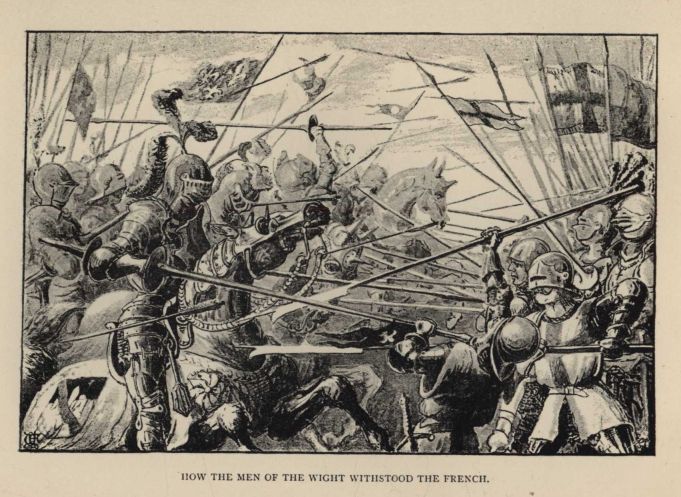
HOW THE MEN OF THE WIGHT WITHSTOOD THE FRENCH.
And now the serried ranks of the French men-at-arms, their helms well down, the shields before their left arms, and with lances in rest, came cantering over the rise in front.
"Now, archers, let fly your shafts," cried the Captain of the Wight, and a twanging sound instantly followed, for every archer knew what was coming, and had already put his arrow on the string. The rushing sound which fluttered in the air was succeeded by a splintering crack or dull thud, or heavier groan, as the shafts flew home. And many a gallant man-at-arms fell to the ground in the death sob. But still fresh ranks came topping the hill, and fierce shouts arose. "A bas les Anglais! Tuez les!" from the steel-clad figures who cantered onward in grim resolve.
Some few of the foe would not be refused, and in spite of cloth yard shaft and sturdy pike, pushed home into the first ranks of the square, but only to perish under the daggers of the footmen, or be kept as prisoners to be held to ransom afterwards.
The bravery of these men-at-arms was very conspicuous. They rode up to the face of the square and thrust fiercely with their long lances at the pikemen, and bodies of two or three would charge at full speed upon the halberds, and then leap their horses over the first ranks. But the men of the Wight stood firm, and although a heavy groan or occasional scream would tell of a deadly wound or ghastly thrust, no opening had been made, and still the grey goose shaft did its deadly and silent work.
"Well done, my merry men," called out the clear voice of the Captain of the Wight. "We will tell of this round many a cheerful yule-tide fire."
But Ralph did not like this way of fighting. He had pictured the battle to himself as a charge of gallant knights, where individual prowess would have a chance of distinction. As yet he had exchanged no blows, and he longed to get out of the stifling mass of crowded infantry.
There now came a lull. The closely thronging men-at-arms seemed daunted by the bold face of the English footmen. They drew off, and retired behind the brow of the hill, followed by the deadly arrows of the archers.
"Bravo, Messieurs les Anglais," said the deep voice of the tough old Marechal de Rieux. "I vish nevare to be vid more better fantassins. I mak you mes felicitations."
The hill became thick with lances, and a tall and very graceful knightly figure could be seen riding amid a press of splendidly armed knights.
"Aha, voila, Monsieur de la Trimouille! C'est un jeune homme tres capable, et un chevalier sans peur et sans reproche. Il est Capitaine pour le Roi, et Vicomte de Thouars. Enfin notre affaire, va commencer!"
The cavalry seemed now to avoid the vanguard, and the men of the Wight had every reason to be proud of themselves. They had driven off the foe, and had made themselves respected. Most of the young men of the Wight thought the victory was won, and exchanged many a merry jest at the expense of the defeated French.
CHAPTER XXVI.
HOW "THE FLOWERS OF THE FOREST WERE A' WEDE AWAY."
In this pause of the battle, Dicky Cheke and Maurice Woodville, with the custrels and varlets who were looking after the horses of the dismounted knights and esquires, took refuge in the square, and the men began to take the affair a little more easily.
The dismounted knights got on horseback again, and Ralph was delighted to see that the time was coming when they would be the attacking party. He longed to break a lance with some of those swaggering French men-at-arms who rode past them, waving their spears and jeering them with taunting words. But the time had not come yet. In the interval the wounded were attended to. Surgical science was at a very low ebb, but what little the surgeon-barbers did know, was applied to the relief of the sufferers, most of whom, however, bled to death. The men of the Wight had hitherto suffered very little; two men had been killed outright by a cannon-ball, and some dozen or so had received more or less serious lance thrusts. The men who served the artillery, however, had been very severely handled, and the Isle of Wight men, few of whom had seen cannon-shot wounds, were shocked at the awful results of those few minutes of artillery practice at close quarters.
Clumsy and badly served as those primitive guns were, the execution they did was murderous; and the Captain of the Wight, who possessed such large experience of mediæval warfare, noted the change those deadly weapons must produce, and determined to urge upon King Henry the importance of employing more largely in the field these engines of destruction.
Dicky, Ralph, and Maurice were all mounted and standing together. From their superior position on horseback they could see through their visors all that was going on, as far as it was possible to make out anything in that forest of spears. The boys could not understand why they stood inactive spectators.
"Marry, Ralph, why don't we give it these varlets as they ride past us? A good charge now would knock over dozens, and I am longing for my prize-money. Look at that fat Frenchman! did you ever see such a jack-pudding?"
"T wish I could make out what is going on," said Ralph, who had been trying to pierce the bewildering masses of steel-clad men, who seemed never to end as they trotted past with lance on hip and fluttering pennon. "Hullo, here come the footmen; now look out."
But the free archers only drew up out of bow-shot, and watched the men-at-arms. It was evident by their gestures they could see something the vanguard could not see.
The Captain of the Wight seemed uneasy and restive. He was urging something in a low tone on the old Marshal de Rieux, who only shook his head and muttered,--
"Pas à present; ce n'est pas le moment."
"Then it will never be the moment," said the Lord Woodville impatiently. "Look there!"
"Body o' me, Ralph!" said Dicky in consternation, "the Bretons and Gascons are running away. Look, there goes the banner of Laval; down goes the golden flag with its fiery cross and blue eagles; there goes d'Albret. Fie on its golden lilies and purple flag! where are Orleans and Orange! Look! the Allemaynes are being cut down. Mercy on us! see how the sword-strokes flash. Why don't we charge?"
The impatience of all the men of the Wight became very great. They uttered their grumblings aloud.
"Let's charge them, my Lord Captain. Don't be kept back by that old dotard of a Frenchman. He's changed sides twice; maybe he'd fain do it a third time."
This was a very awkward suspicion, and one at such a moment most sinister in its influence on the minds of the English and Breton troops.
The Captain of the Wight saw he could restrain them no longer. He also longed to take an active part in the battle. He turned to the Marechal de Rieux.
"Sir, I can keep my people together no longer. We must charge and retrieve the fortunes of the day, or die in the attempt."
"Comme vous voulez," said the Marshal, shrugging his shoulders. "Mais tout est perdu. On ne peut plus."
The Captain of the Wight turned in his saddle--he raised his sword.
"Men of the Wight, now is our time. Men-at-arms, close your ranks. Archers and billmen, prepare to charge. Let all men follow me."
A loud and ringing cheer broke from all that eager band of armed men, and with a fierce alacrity the square broke up. The little force of men-at-arms in front, the infantry forming their serried ranks behind.
"'Tis too late!" muttered Tom o' Kingston, and many of the older and cooler heads agreed with him.
"'Twould be better to march off the field as we are," said Sir John Trenchard; "they'll never dare to touch us--they've had too much of it already, and we could join the garrison of Fougéres, who are marching upon Rennes."
But these experienced soldiers kept their grumblings to themselves, and prepared to do their duty, even though they knew death to be the reward.
As Dicky Cheke rode behind his chief, he noticed a wounded archer, and was struck by his calm courage. The man had lost one leg from a cannon shot, but he was still sitting up supporting himself on the other and shooting steadily at the French. When he saw his comrades were about to leave him, without a word or thought of himself, he called out to his comrade,--
"Dickon, have thou mine arrows, I can go no more. There are still three left. Take them and riddle yonder Frenchmen. Give my love to Sue, poor lass! I'll just lay me down a while."
And so the archers parted; and Dicky rode on more grave than he had ever been in his life.
"Ralph," he muttered; "Ralph, dear boy, if I should be left behind too, there's a gold chain I would like thee to have, and my goshawk, she's been well trained, and thou wilt be kind to her, I know. There's little Alice, my sister, too, give her my bells and jesses; and to mother--No, certes, Ralph, I'll not play the girl. Art not ashamed of me, Ralph?" and Dicky tried to whistle a tune, but it only came in a melancholy pipe from out his barred helm. "Marry, 'tis the heat," said Dicky ruefully.
"Nay, Dicky, cheer up. There's thy Frenchman in the gay armour a-head. Think of the ransom thou art going to get."
"Ah, Ralph, my boy, methinks 'tis the ransom Sir John Merlin told us had been paid for all of us long years gone by that I shall win to-day. I wish I had paid more attention to my prayers--But marry, come up! here we go! Oh! this is something like! Have at them! A Cheke! a Cheke! say I. St George for merry England!--Ah!"
His voice suddenly changed, and the poor boy reeled in his saddle, as a fierce and burly French man-at-arms drove his lance into his corslet and broke off the point. Dicky's head fell forward. He dropped his lance and clutched the pommel of his saddle. Everything swam before his eyes, and he fell from his horse with a groan.
But Ralph had well revenged him. His lance caught the Frenchman under the gorget, driving the chain shirt into his neck, and bore the man-at-arms out of his saddle to the ground.
The melée had now become fierce. The French, who were well handled by their skilful young leader, the Vicomte de Thouars, who was only twenty-seven years old, had kept a body of men-at-arms behind their infantry in reserve, and to watch the movements of the Breton vanguard. This fine body of troops, under the celebrated James Galliotti, seeing the change of formation of the square, charged at once, and took the vanguard in flank. The infantry were cruelly handled, and orders were issued to spare not a single man who wore a red cross. Out-generalled, and abandoned by the rest of the army, for the main battle had been utterly broken, the Swiss pikemen were doggedly holding their ground, or slowly retiring before the fierce onslaught of the French, while the rearward, seeing how hardly the battle was going, had fled without striking a blow. The men of the Wight and their Breton comrades were gallantly upholding the honour of their race. Shoulder to shoulder, and back to back, the pikemen stood, fiercely exchanging thrust for thrust with the eager warriors of Gaul. But numbers were against them, and gradually their ranks were thinned.
The Captain of the Wight, boldly seconded by his knights, esquires, and men-at-arms, had plunged into the midst of the French cavalry.
Three knights the Lord Woodville had himself unhorsed, his lance was gone, but his sword still flashed, and rose and fell, and Ralph still rode beside his lord.
Seeing how fierce was the little band of men around the Captain of the Wight, the French men-at-arms turned aside to easier conquests, and the battered and wounded knights and esquires were fain to rest grimly on a little rising ground they had gained to the right of the battle-field.
How different was the scene from the morning. Of all that gallant, gay, and careless army, no coherent mass remained. The dusty road was covered with piles of dead and dying men. Broken pikes, splintered lances, pools of blood lay all around. Here and there fainting men, sore stricken, leant upon the end of their halberds, or sank swooning to the ground. A weary group of English still held together, and repelled the relentless onslaught of the French; but they had no hope, and had nowhere to go. No quarter was offered or asked, and their only object was to sell their lives as dearly as possible.
Ralph looked wearily round. Dicky Cheke had gone. Maurice, poor lad, could scarcely sit his horse. His head ached, and his pulses throbbed with the fearful heat of the day, and he had received a terrible blow from a bill across his thigh. The taces of his armour had saved his leg, but it had shorn away the upper part of his genouilliere, or knee-piece, and exposed the bone of the knee.
Ralph himself was badly wounded on the left arm, but he could still wield his mace. His sword had been broken long ago, and he knew scarcely anything of the fight. His head swam, and he felt giddy and faint. The Captain of the Wight was also desperately wounded, and had raised his visor for more air. Tom o' Kingston leant forward on his horse's neck, and Sir John Trenchard reeled in his saddle. Master Meux had gone. No other knight or esquire remained. They could be seen, easily distinguished by their white surcoats and red crosses, lying still and motionless, either apart or amid a pile of their enemies.
At this moment a fresh body of men-at-arms, among whom were two or three knights in very rich armour, rode back from the pursuit of the flying Bretons.
"They give us no quarter: let us die in harness," said the Captain of the Wight. "Yonder are all that are left of our gallant fellows; let us go and die with them."
No one answered. Ralph still thought of his promise. Although Yolande would never know it, he would save his lord from death, or die with him. But they were utterly weary with fighting. Their arms were stiff and nerveless. Ralph could form no thought, he only kept saying to himself, "I will do my duty, I will do my duty."
"Now, gentlemen," said the Captain, in a voice still clear and resolute, although feeble from pain and weariness, "this is the last time we shall speak to each other on earth. My friends and comrades, do you pardon me for having brought you into such great misery? I humbly ask your forgiveness, and it sore repenteth me of the dolour I have caused."
"My lord, say no more," said Sir John Trenchard: "may God assoil thee as freely as I do. 'Tis the lot of all men to die. We have done our duty, and shall do more yet before we go hence. Let us charge the enemy."
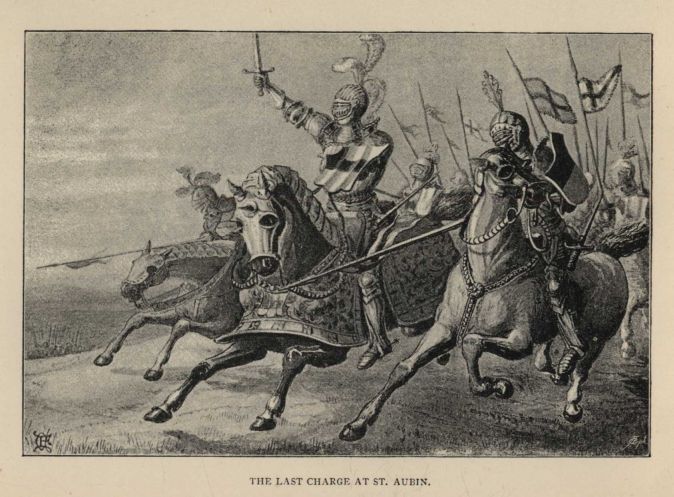
THE LAST CHARGE AT ST. AUBIN.
"Ay, before our wounds grow stiff," muttered Tom o' Kingston. "But I would fain some one could tell Polly Bremskete how I played the man."
But Ralph thought of nothing that was said. He only saw a grey mist--a crimson sunset glow--brown purply foliage, and a lovely face with large blue eyes, a crown of waving yellow hair, and two soft lips saying, "Thou will watch over him, Ralph;" and he kept saying to himself. "I will do my duty."
And now the time had come. The group of weary horsemen rode down to meet their death. Grimly they settled themselves in their saddles, and sternly they handled their weapons. The setting sun glowed on their battered armour, their fluttering tabards, and on the blood-red cross on their breasts--
"The deare remembrance of their dying Lorde."
All the gay splendour of pompous war was gone, there only remained the iron will of stern and fixed resolve animating those war-worn figures, awful in their grim and reckless daring. They rode to seek their death.
The French men-at-arms, seeing them coming, were struck with admiration at their gallant bearing; but the orders of their captain were strict. No one who wore a red cross was to be spared. They therefore prepared to meet the little troop. Their leader was no less a person than Sir James Galliotti himself. With generous chivalry, seeing the Lord Woodville had no lance, he threw away his own, and drew his sword. The little squadrons met, and for a moment it was difficult to tell how the shock had gone. But in a minute more it was seen that the Captain of the Wight was still on horseback, and fighting against fearful odds. But the gallant Sir James Galliotti was down, and so were Tom o' Kingston and Sir John Trenchard. The former had singled out a huge Frenchman, and cleft his helm in twain, but had, at the same time, been pierced through his visor into his brain by another man-at-arms. Sir John had also killed his man, but had received a mortal wound in doing so, and lay grimly still waiting for death to relieve him. "I would my good dame could have had my body for burial, for she ever kept such fine linen for my winding-sheet. But it is as God wills, and it will serve for her own cere-cloth. 'Tis hard for her I die, seeing her own age. I misdoubt me if she can find another husband now. But 'tis ever as God wills."
Ralph still struggled beside his lord. He had set his teeth, and his gauntlet seemed to have grown to his mace. In front of him was a well-armed cavalier, who was aiming a deadly thrust at the Captain of the Wight. Ralph smote down the spear, and attacked the foe with such strength as was left him. He threw himself upon the man-at-arms, and split his helmet with his mace. But his antagonist had also struck him, and the fierce back-handed stroke shore off the upper part of his casque, exposing Ralph's wavy fair hair and weary eyes.
"What! Is it thou, De Lisle?" cried the voice of his foe. "Then I am right joyous. Never more shalt thou leave this field. I have sought for thee everywhere to-day. At last my hour hath come."
"Ay, and so it hath," said Maurice Woodville, who with a last faint effort, thrust his dagger through the visor of the man-at-arms, and both fell to the ground together.
Ralph, still thinking only of his lord, and heeding nothing that concerned himself, turned round to see where he was. In wild despair he leapt from his horse. The Captain of the Wight was down; but over him stood a tall knight, who was defending him against the thrusts and blows of the enemy. Ralph rushed forward, parrying a fierce cut at his exposed head with his wounded left arm, and the Frenchman, seeing no more glory was to be won, turned away to look after their fallen leader. Ralph stooped down over his lord. His head swam, he reeled and fell. All sense left him, and he lay in a dead faint. He must have lain some time unconscious, for when he was recalled to life by some cooling bandage to his head, the sun had sunk, and the pale primrose of the evening sky was fading into the ashy grey of night. There were faint sounds near, voices, and dreary moans, and above, the stars were shining down on that grim scene of woe, as they had shone on thousands before and would shine on thousands after. He listened to the faint voices near. Was he in England? Who were they?
"Then I have thy pardon, noble knight? Would to God I could have His too! Ah, evil have been my days, and fierce my life, but from henceforth I vow to humble myself before Him, and lay aside the sword for ever."
Ralph listened. Who could it be?
A faint voice answered with great difficulty and many pauses.
"I thank God I have had this meeting before I die--He hath ever been merciful to me, sinful man that I am--but in no wise hath His mercy been more marvellously proven than in saving me from the sin thou wottest of.--Thou didst her and me cruel wrong. I say no more of that--I thank God I die, and I thank Him all the more in that thou knowest now how guiltless she and I have been. Not of mine own strength did I resist temptation, but, as is written in Holy Writ, 'Noe temptacion hath o'ertaken thee, but what God will withe ye temptacion alsoe makke a waie to escape.' I am near my end now." The voice became weaker. "I cannot forgather my thoughts. Thou wilt see her. Tell her--ah!--I shall see her too, where there is neither marrying nor giving in marriage, but where we 'are as the angels of God in heaven.'" And the voice, scarcely audible in the last few gasps, ceased for ever.
The other voice broke out,--
"Ah, Sir Edward Woodville, noble Captain, gentle knight, how thou wert head of all Christian knights, and now thou liest dead! Ever wast thou the pattern of all true knights. The courtliest wast thou, that ever bare shield, the truest friend to thy lover that ever bestrode horse. Ever wast thou the goodliest person that ever came among press of knights. The meekest and the gentlest that ever loved woman. The sternest to thy mortal foe that ever laid spear in rest. And now thou art dead! And I live. Ah, me. What dolour and grief is this; that I could not give my life for thy life! Ah, sinful man that I am. How shall I atone for my evil life? How dolorous hath been this day. And the departing out of this world of all this meynie of joyous and gentle men!"
Ralph listened, as in a dream. The voices ceased, and the whirr of a night-jar hummed above the low wail of the deserted battle-field. The faint sound of inarticulate pain rose and sank on the gentle night breeze. The still air seemed to vibrate with pain.
Presently a soft hand touched his brow. He looked round. A slight form was bending over him, and a gentle voice murmured,--"'Tis a friend; but speak no word, there is yet danger around."
Ralph lay still, his senses had not yet recovered their usual vigour. He liked lying still, as the balmy night air of midsummer fanned his brow, watching the solemn stars blinking down, and the flitting bats as they flickered to and fro. He felt desperately thirsty, and turned his head to see if the mysterious figure were near.
"Father!--father!--ah me, how dolorous is the time! Father, shall we not get hence? Alack! he heareth not! Father! the night grows damp, thy wounds will stiffen. Alack! alack! he heedeth not!"
Again all was silent over that dismal scene. The heaps of dead men glinted in the starlight, and the night wind stirred the torn and tattered tabards till they rustled in the wind.
Ralph began to recover his senses as the chill air of night fanned his forehead, but as he awoke to the reality of life, a numbing sense of bitter pain passed through his heart. Where were all his friends? Where were those gallant four hundred who had gone in all the pride of strength and joyous manhood to win fame, and name, and fortune in the sunny land of France? Where was Dicky Cheke? Alas, poor Dicky! Did he need no ransom now? Had his thoughts come true? Was the only ransom he would ever require the great ransom paid for all? There they lay, with solemn upturned faces, whiter than their white tabards, and signed with the ruddy sign of their "deare Lord." The solemn stars shone for their funeral torches, and the rustling leaves of the deep, still forest whispered a dirge for the silent dead.
CHAPTER XXVII.
"OF THE CRAWLING TIDE."
What happened during the days immediately following the fatal battle of St Aubin du Cormier, Ralph Lisle never clearly knew. All he could remember was an indistinct nightmare of strange faces, rough and coarse, sometimes fierce and cruel, but amid them all he always saw a pale oval face, with large, wistful, brown eyes, and masses of wavy, dark hair, and then he felt quiet. He could recollect nothing until one night he seemed suddenly to awake, and found himself in a low, rough room, with a strong smell of burnt peat, and a fresh breeze blowing in through an opening in one side. It was nearly dark, save where the bright light of the moon fell upon the rude clay floor, all littered with straw and refuse. Through the opening, which served for window and door alike, he could see a broad gleam of glancing light which he did not trouble himself to think about. He wondered where he could be. There were no sounds in the room. He raised his head to look round. He could not do it. Was he still in a dream? he wondered. Why could he not move himself easily? He lay still again, and must have dozed off, for when he again looked round there were some figures in the room, and one--that of a girl--was softly stealing away from him towards a tall man, and he could hear her say in a low tone,--
"He is sleeping gently."
"That is well, my daughter, go thou to rest now. Marie will see that he is cared for."
Ralph made a little movement; the girl stopped, and looked round. There was a small rushlight on a table; its light fell on her face. Where had he seen that gentle, winsome head and eyes? Ralph said,--
"Where am I? What has happened? Why, what's come to my voice?"
"Oh, father, I am so glad!" cried the girl, and turned quickly back to the couch where Ralph lay. The tall man stepped across the room, taking the rushlight in his hand.
Ralph could not recall the face or figure; he felt sure he had never seen either, and yet he had heard the voice.
"Thou art on the road to health, my son," said the man. "Thou hast been like to die for a week past."
"Where am I?"
"Safe in the cottage of a hind. But thou shalt know all to-morrow an thou art in trim to hear news."
So saying, the tall figure removed the light, and in a few minutes more all was quiet in the cottage.
The next morning found Ralph much better. He now learnt where he was, and who had saved him.
"But there is great risk still," said the girl, "and I know not how we may fare. Jean is very rough, and I doubt he is not to be trusted far. His wife Marie is as true as steel, but alack! we English are not overmuch liked, and I hear there are men-at-arms beating the country side. But now thou art better, we can move," she added cheerily.
Ralph saw how nobly these strangers had acted by him. He could not understand why. They had risked their lives to save him, and this, too, when the chances were very small that they could ever nurse him through the fever, which resulted from the exhaustion, heat, and wounds of that dreadful day of St Aubin. He did not yet know all.
"But who are you?" he asked languidly.
"Ah, now, who do you think?"
"You are not--no, you can't be. Well, I don't know who you are. But I seem to have seen you before."
"Where? Can't you call it to mind?"
"Was it in the lists at Carisbrooke?"
"In sooth it was," said the girl, laughing; "and somewhere else, too."
"Not at Appuldurcombe, was it?"
"Ay, marry was it, and elsewhere, too. At it again." But then seeing the effort of memory was too much for Ralph in his weak state, the girl added,--"There, you can't think now. Lie still, and I will tell you. Do you mind lending some poor vagrants a pony at Thruxton? Do you mind a certain night, when you were nigh going over the edge of a cliff near St Catherine's Down? You never knew who it was that spoke to you that night in the mist? And you never knew who sent you the glove? Ah, well! 'twas lucky for you you wore it, or father would have knocked you off like all the others. And why do you think I did it?" she said, with an arch smile.
"I can't tell," said Ralph, dreamily.
"Well, but you might think." Then seeing that Ralph's thoughts were far away, she added, in a pitying tone,--"Why, because thou wast so kind to father and me that day at Thruxton. You little knew who I was."
"And who are you?" said Ralph absently.
"Oh, that is a merry conceit. Don't you know now?"
"No; tell me. How can I tell?"
"Why, I'm Aunt Yolande's niece."
"Aunt Yolande's niece!" cried Ralph in amazement, utterly astounded at the unexpected answer, and not at all able to take in the truth of the remark.
"Yes I am, although you may find it hard to credit, and my father is Sir George Lisle, and he fled for his life from the field of Stoke, trusting to the generosity of the Captain of the Wight, who, he thought, was his greatest enemy, but whom he knew to be a very noble knight."
"And he was not wrong," said Ralph, sadly but proudly.
"Nay he was not wrong. But he tried to give his life for the Captain's, when he found out how great an injury he had done him. Do you remember Sister Agnes that day I saw you at Appuldurcombe? Do you know who she is?"
"No. Who is she?"
"She is my mother," said Magdalen, softly and sadly.
"Your mother!" said Ralph in astonishment. "But she is a nun."
"Yes, she is now; but she was Lady Lisle. I can't call her much to mind at that time, for she left me when I was only four years old."
"Why did she leave you?" said Ralph, becoming more interested.
"'Tis a sad story, and I know not if I know all myself. But she was not happy, and could not bear her life. She took the veil in London, and became a Sister of St Clare."
"And how did you find out she was your mother?"
"Do you mind that night in the snow when father and the Captain fought? You did not know it was the Hermit of St Catherine's and I who came. I only found out too late; but I could not have done anything to prevent their fighting had I known sooner. After father was so sore wounded, the Hermit, who has been a knight himself, and knew father as a boy, took him to the good Sisters of Appuldurcombe to be nursed, and for a long time father was between life and death. In his ravings, Sister Agnes--that's my mother, you know--who took her turn to nurse him with the others--but not at first, because she had been very ill herself--heard him call her by her real name, and she knew him, of course, directly she saw him. She then for the first time heard how cruelly he had mistrusted her in her flight, and that he--well, she made up her mind to tell him everything if he should get well. I don't know what happened, but father became quite altered. He was a long time getting well; and then you all went on that dolorous journey. But you never saw me passing you that evening near Wootton. Father's life was at stake if he should be discovered; and he heard that there were spies of the King's looking out for him; for a rumour had got abroad of an unknown knight, wearing a Yorkist collar, having been at a tourney at Carisbrooke--and it might have been the missing Lord Lovell. Well (but I shall never get done), we managed to get on board a Norman ship of St Vaast, come over with salt, which took us over to Barfleur; and then we heard for the first time that Eustace Bowerman had gotten over there, and was being made much of because he said he could tell the French governor of the province all about what was going on here. I also heard he had vowed to kill some one against whom he had a deadly hate, and I knew that must be you. As Master Bowerman was a likely-looking youth, and well spoken, and not wanting in a ready address and lying tongue, he got on marvellous well, and indeed he helped the French; for they, who thought the Captain of the Wight was a very powerful prince, seeing he was uncle to our Queen, and who dreaded he would bring over a very powerful meynie, were full glad to hear how small a force he could muster, and that made them right hardy and joyous; so that they fought on that bitter day with greater heart than they are wont to do when they meet with us. For they knew right well that those other seventeen hundred in red crosses were but poor weak Bretons. My father, who was a well-known Yorkist, all of which faction were welcome in France as being useful to keep our King in check, was readily allowed his freedom, and he offered his sword to the Seigneur de la Trimouille in the hope he might save some of our poor men's lives, but most of all he longed to save the Captain of the Wight, and to tell him how sad he was at the wrong he had done him. He never knew how vilely those caitiffs had set upon you until I told him, and he always hated Bowerman ever after, and Bowerman returned his hate."
This account had astonished Ralph. It seemed so surprising--so like a tale told by a jongleur. That he should have helped his relative, Yolande's brother, and her own niece, in such an accidental way; that this should have led to his triumph at the tourney, and finally to the saving of his own life, seemed so like a romance, that he could not think it was all true.
"And so that is your father, Sir George Lisle, and you are my cousin after all," said the young man dreamily. "Well, I shall believe it all, I dare to say, some day, but now I seem more in a dream than ever."
"But here is father himself," said Magdalen, as the tall figure of the knight entered the room.
Ralph would have risen and done reverence due to the rank and kinship of this man who had so mysteriously interfered in his life, since he left Thruxton without his knowing it.
Sir George, however, forbade his moving, and greeted his young kinsman as kindly as his somewhat austere manner would let him.
"So thou knowest all now, my young cousin. The next matter is to get thee safe to St Malo or Dinan, where I hear the Marechal de Rieux is holding out. Ah, the bad captainship of that old soldier! Had--but there, 'tis no use--'tis no use," broke off Sir George Lisle sadly, and almost fiercely.
Magdalen tried to turn the conversation to other matters, but after several attempts she gave it up, and they all became silent.
As Ralph grew stronger, his memory came back to him, and he asked for details of the battle. He knew they were defeated, but he did not know the extent of the catastrophe. Gradually the fearful nature of the defeat dawned upon him; but it was long before he could realise it. The noble Captain of the Wight, Maurice Woodville, all these strong and lusty men, Dicky Cheke, all gone! It was too much. Ralph turned away, and sobbed. The utter desolation of it all, his own physical prostration, and the dreary prospect before him, completely overwhelmed him, although he did not think of himself. He wished he had died. He did not care to live. For some days after he learnt the news, Ralph was listless and morose, and the knight seemed nearly as miserable. It was with the utmost difficulty the girl was able to get either to take any food, and she, poor child, at last was beginning to lose all interest in anything. Their life was very uncomfortable. There was nothing to divert them from their own sad thoughts. The Breton peasants with whom they had taken refuge belonged to one of the Breton nobles, who had fallen at St Aubin, and had hitherto proved themselves faithful enough. But there was nothing beyond their natural good nature to keep them so. It was true the money the fugitives had brought with them was ample payment for the services performed, but when that was gone there seemed little left to restrain the Bretons betraying them. In spite of the proud boast of the Seigneur de Rohan--"Jamais Breton ne fit trahison"--there was only too much likelihood that in a few days the three fugitives would be delivered up to their enemies.
One day as they were sitting listlessly outside the cottage on a boulder of granite, gazing wistfully at the sea sparkling among the innumerable rocks which encumbered the large bay before them, the peasant woman came out, and looking about her, approached the girl. After talking earnestly for some time she went back to the house, and the girl turned to her father with a face paler than usual.
"Father," she said, "we must get away at once. Marie says she has heard men-at-arms are coming this evening, and we have but little time to escape. She has given us warning at the peril of her life, so she says; and there is an Englishman, she tells me, who has been asking about us all round the country. He is a one-eyed young man, she says."
Ralph looked up. He had now heard of the treachery of Bowerman. He now knew that the knight who had saved him was no other but Sir George Lisle, and that the girl whose glove he had worn in the tournament was Magdalen Lisle, niece of Yolande, and heiress to all the Lisle estates, if only her father were restored to his proper position.
Magdalen had taken no pains to conceal her dislike of Bowerman, and her pleasure on finding that her father no longer trusted him, and that he equally shared her dislike, was very great. In the necessity of their prompt escape from the battlefield, all examination of the dead was precluded, and neither Sir George Lisle nor his daughter knew whether Bowerman had survived. But now Marie told them of this Englishman, the girl's fears were aroused. Bowerman had urged his suit with her father during their intercourse in France, and Sir George Lisle had received his advances very coldly, and Magdalen dreaded his finding them, especially as her father's conduct in defending the wounded Captain of the Wight must have been observed.
The danger was imminent. The little hut where they had taken refuge was on the edge of a rocky bay not far from St Malo, but the intervening country was scoured by the French troops, and escape by land was next to impossible.
"We must go by sea," said Sir George. "There is Jean's old boat."
"But the tide is out, father! look where it is!" said Magdalen, pointing in dismay to the long stretch of sand, strewn with boulders and piles of sharp rocks protruding in all directions, while away on the edge of this waste the sea was breaking on a reef of ugly points of granite, black with the weather and time, and grinning like the teeth of some wild animal, amid the foam and froth of the sea. It was too true; the tide would not come in enough to float the clumsy boat before it would be dark, and from what Marie said, the men-at-arms would be there before dusk.
"We must try and push the boat down," said Sir George.
They went back to the hut, and searching in the shed where the few tools belonging to the labourer were kept, Ralph found some spars that would serve for rollers.
Sir George had taken the precaution, when they escaped under cover of the darkness from the field of St Aubin, to bring his own armour and that of Ralph Lisle with him. He had dismissed his servants, bidding them shift for themselves, and the horses had been sold by Jean to provide money for their expenses, and also to prevent suspicion arising, if such animals were seen in the neighbourhood of his cottage.
Carrying to the boat the few effects they intended taking with them, and hastily collecting such food as Marie could provide them with, the fugitives went down the beach to where the boat lay. They anxiously looked at her. It seemed utterly impossible they could move her. Ralph was still very weak, and they soon found their fears were too true. They could not possibly move it.
"'Twill be three hours yet before she floats," said Sir George.
"Any way, we can carry out the anchor as far as this warp will let us," said Ralph, "'twill give us greater help to pull her out, and here's an old sail we can set all ready for the first lift of the tide. The wind is right off the land."
Anything being better than standing still doing nothing, they set up the mast, and got the old brown sail ready for hoisting. Everything was now in, when Magdalen suddenly exclaimed,--
"Why, see how fast the tide is rising! It is already past that reef of rocks there! It won't be nearly as long before she floats as we thought."
The tide was indeed rising fast, and the distant reef of rocks had disappeared entirely. A few jagged peaks were sticking up here and there on some of the higher patches of rock, soon to be hidden by the inrushing tide, leaving their sharp points a few feet below the surface, with nothing to show their dangerous position.
The sun was setting over the low, sandy shore on the western side of the bay. The long shadows of some of the strangely-shaped rocks stretched far across the yellow sand, and the shrill cry of the sea-mew called to its mate. In a few minutes more the sun would set, and the grey mist of the sea would come creeping over the hot land from the cool ocean. The tide had now reached the boat; the anchor was already covered.
"Get in Magdalen," said her father; "we will stay to push her off, if may be."
Sir George and Ralph had both taken off their shoes, and, bare-legged, were standing in the fast rising tide.
Suddenly Magdalen saw a shadow moving over the sand--she looked round.
"Oh father, there they are," she cried in horror.
CHAPTER XXVIII.
HOW THE SEA MIST ROSE IN TERQUETE BAY.
The startled cry of Magdalen called the attention of the others to the shadows flitting over the sand.
There, against the red glory of the departed sun, were figures of horsemen looming up on the dark line of jagged rocks which edged the western sky.
"There are three, four, five--ay, a dozen or more, and they are coming apace. Up with the sail, Ralph," cried Sir George Lisle, jumping into the boat.
There was already a foot or more of water all round her, and the sea spreading out over the flat sand made the boat look as if she were far out in deep water.
The sail was run up the mast, and Ralph, still in the water, pushed with all his might, while Sir George Lisle hauled hard at the warp.
"She's moving, she's moving," cried Magdalen, in an ecstasy of excitement, jumping about, and trying to help with an oar. At the same time, a fierce cry came over the water, and the distant sparkles on the edge of the ripples told of a horseman having plunged into the sea.
"Push, push," cried Magdalen, "or they will be here after all."
They strained and tugged, but the boat would not move. The splashes sounded nearer, the fierce cries became louder.
"Oh! oh! if only there were quicksands," cried Magdalen.
"There are," said her father. "The bay is full of them as the tide rises."
"Sir George Lisle! Sir George Lisle!" called out a well-known voice. "Your life is safe, and that of Mistress Lisle, if you attempt no escape--and no escape is possible; but I cannot vouch for your safety if you persist in trying to get away."
But the fugitives gave no answer.
"There she goes," gasped Ralph, as he strained more than ever with his shoulder against the square stern of the ill-shaped boat.
"Oh, Ralph, you will do yourself a mischief," said Magdalen, "and you hardly well yet from your illness."
The boat was moving, however. Sir George Lisle kept pulling in the warp, and the sand was stirred up all round.
"Ah, what's that?" said Sir George, as something whizzed past him and stuck in the sail. "Lie down, child, they are shooting from their crossbows."
The splashes of the approaching horsemen seemed very close; one especially was urging his horse to its utmost speed.
"'Tis Bowerman," said Magdalen despairingly.
But their boat was really moving now. Hand-over-hand the warp kept coming in. The breeze off the shore came fresh and strong.
"Jump in, Ralph," cried Sir George.
With a last push and a violent leap, Ralph clambered over the stern, and fell in a heap into the bottom of the boat.
"Thank the saints we are off," said the knight, as he pulled in the rude anchor over the bows of the old boat, which was now rippling through the water.
Ralph had picked himself up, and was looking astern at the splashing figures of two or three men-at-arms who were still pressing on through the shallow water.
"Aha, my friends, you'll have work enough to scour your harness after this, but you won't--Marry, what's the matter!" he broke off in alarm, as the sail came tumbling down on their heads.
"'Tis a quarrel hath cut the halyards," said Sir George in a smothered voice, as he tried to disengage himself from the thick sail.
A loud shout of triumph from their pursuers told how near the enemy were, and of their certainty of success.
"Not yet, my fine custrils," shouted Ralph, as he quickly climbed the mast to reeve the broken end of the rope through the sheaf again. A dangerous work, considering the excellence of the crossbow practice; and so it proved, for had not Ralph put on his back and breast-pieces before leaving the hut, he would have been mortally wounded, for one of the bolts rattled against the cuirass like a hammer riveting iron.
"'Tis done, Messieurs, thank you," said Ralph, sliding down, and quickly bending the rope on to the yard, the old sail was run up the mast again amid a defiant cheer from Ralph and Magdalen.
"Look at them," said Ralph, "you can see them safely through that hole in the gunwale. They are floundering along finely. Nay, my fine sir, 'tis not to your mind, I can see. Aha! 'tis best to go back. There they go; they have given it up," and Ralph bust into a roar of derisive laughter, in which Magdalene joined with her merry rippling voice.
One cavalier alone seemed loth to give up the chase.
The water had already risen up to the girths of his horse, but he kept spurring the reluctant animal all the time.
"I will have thee yet," shouted the man-at-arms, through his visor, as he shook his gauntleted hand at the boat. "Ralph Lisle, thou shall not escape me this time.
"What! is it thou, Bowerman?" called back Sir George Lisle. "Nay, man, get thee back before the sea swallow thee, and repent thee of thine evil deeds and treachery ere it be too late. There are quicksands, man, and the tide is rising apace. Thou gettest us not this time."
The grey mist of evening was rising all around. Out to sea a livid wall of impalpable vapour was veiling the breaking crests of the waves as they surged among the countless points of rock, whose sharp peaks projected in bewildering danger on all sides. The breeze had died down, and the brown sail flapped idly against the mast. The tide was still only at half flood, and was sweeping into the bay.
"We must row," said Sir George. "Magdalen, do thou take the helm. Steer between yonder black rocks."
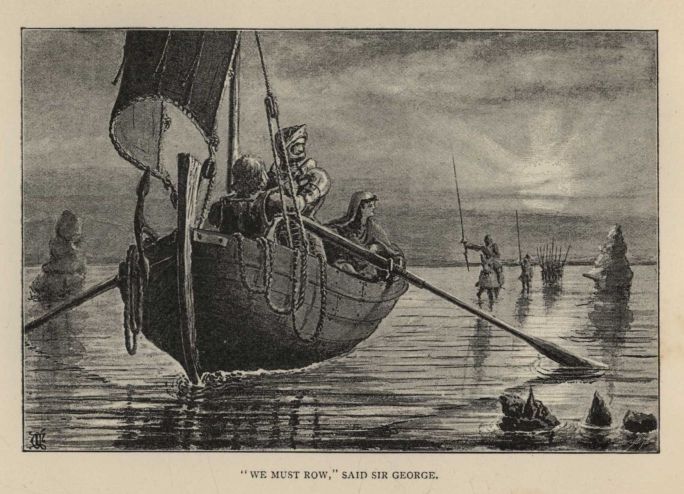
"WE MUST ROW," SAID SIR GEORGE.
The two men took the clumsy oars, and soon the swish and gurgle under the bows told of the progress they were making. They had escaped. Their pursuers could go no further. After rowing silently for about ten minutes, Magdalen suddenly called out in perplexity,--
"Where are the rocks? I don't see them."
Sir George looked round. There was nothing to be seen but the bows of the boat as she lifted over a longer swell than usual, or surged down into the long trough of the heaving water. All else was grey, indistinguishable gloom.
"'Tis the sea mist. We must have a-care, or we shall be on some of these rocks," said Sir George.
They rested on their oars. Astern they could still see the dim figure of the horseman, who was now urging his horse as hastily to land as he had spurred it towards the boat. But the creeping mist was fast pursuing him. Even now the yellow streak behind the purple shore was becoming bleared and blotted, and the harsh voices of the troopers, as they called to each other, or laughed at the struggles of their more hardy comrades, came deadened by the thickening air across the shallow water of the rock-strewn bay.
"I doubt if ever Bowerman will reach the land," said Sir George, after looking at the dim speck which was now all but invisible in the gloom.
But their own situation called for all their wits. It was most important that they should reach the head of the western point before the horsemen, who would be sure to ride there, and perhaps get a boat from the fishermen who lived in the bay round the promontory. The great danger now lay in the innumerable rocks which lay all round. After pulling for a few minutes, Magdalen called to them to stop. She was sure there was a rock near. She had heard a sharp sound.
They all listened attentively. The surging of the sea under the bows was all that they could hear.
"There! don't you hear it?" said Magdalen? as a sawing sound, sharp and swishing, rose over the silence of the waves.
"'Tis the sea grinding against a sharp rock," said Sir George, "and 'tis not far off. Can'st tell where it is, Ralph, thine ears are keener than mine?"
Again they all listened. The boat had lost all way, and was lying still in the glassy sea. All round was impenetrable gloom. It was not absolutely dark. They could distinguish each other in the boat, but they could see nothing, even an oar's-length away. All was grey, impalpable, vague opacity.
The sound of the sea among the points of the rocks grew fainter.
"The tide is setting us in shore," said Sir George; "we must row again."
Just as they were about to take to their oars a shout came over the water. It was a shout of terror, a blood-curdling shriek of agony.
Magdalen shivered.
"'Tis some of those men-at-arms; they have lost their way in the mist, and the rising tide has overtaken them," said Ralph, and he began to row, in order to deaden the noise, and distract the girl's attention.
But the cries became more piercing, they seemed to be nearer.
"We can't have turned round?" said Sir George. "Are we rowing ashore?"
They again paused. All was silent as the grave. The breeze seemed to have got up a little. Their sail began to fill, and the water rippled under the stern.
"This is getting parlous hazardous. I would we knew which way we are going. Put thine oar over the side and see if thou cans't feel the bottom," said Sir George Lisle.
But before Ralph could do what he was told, and while he was standing up to fathom with the oar, there was a crash--a grinding, splintering sound, and Ralph was thrown over the after-thwart into Magdalen's lap, who gave a little scream and then sat still.
They well knew what had happened. It did not need the water, which was fast rising in the boat, to tell them they had struck upon a rock, and were rapidly filling with water.
All three were used to danger, and they did not lose their presence of mind. Ralph, as soon as he had picked himself up, went forward and looked over the side. He could just see a brown patch through the clear water. He sounded with his oar. It was not more than six inches below the surface. He called to Sir George Lisle to sound over the stern and to their dismay they found that the oar could only just touch the bottom when held at arm's length under the sea. The boat was fast filling, and would soon slip off and sink in deep water. Without a moment's hesitation Ralph jumped over on to the rock. He took out the anchor, and wading as far as he could, he threw it out on the other side of the rock, and was glad to see it sank some depth. Then going back, he pulled as hard as he could on the warp, and thus prevented the chances of the boat slipping off.