THE CAPTAIN OF THE WIGHT (continued 2)
Reading edition
"His horse didn't bolt," said Dicky hotly; "you know right well Lisle spurred him in the way."
"Nay, Master Dicky malapert, I know no such thing."
"Then you don't know much, as I always said," retorted Dicky.
"Marry, Dicky, I'll have to wallop thee once more, I see. You're growing saucy again."
"Wallop me i' faith!" sneered Dicky; "I'd like to see you doing it."
"Wait till we get on board the barge then, and you'll soon be satisfied."
Willie Newenhall never engaged in these wordy contests. He only thought of his appearance, when he was going to feed again, or of the danger he was always in from the fair sex, by reason of his own good looks. The other pages knew well his weak points, and would always chaff him on the risks he ran from his many fascinations.
"I' faith, Willie, there's a pretty lass looking at thee; and that's her brother, or sweetheart, with her. How fierce he looks. Ah, if you look at her that way, he'll be murdering you presently," added Dicky, as Willie looked round nervously, to see the group his comrade was referring to, only to meet with a jeering remark from the apprentice who was standing by the girl, of "Hi, young round knave, pudding chops or pig's eyes, what do you lack here?" or some equally elegant observation, which caused Maurice and Dicky to laugh derisively, and the men-at-arms and archers, who were close behind, to grin broadly.
But Willie was far too stupid to make any retort, he only grunted angrily, and leered at the people on the other side of the street.
Then they passed through Southampton, under the noble Bargate, with its figure of Bevis of Hampton, and the giant Ascapart, whose reality all true townsfolk believed in, and of whose doughty deeds with Guy of Warwick Ralph had often heard and longed to emulate. The cavalcade rode down the long street under the old west gate tower, and outside the splendid old walls, on to the town quay.
Oh, the sight of the gleaming water! Ralph had never seen the sea before--how it glanced and sparkled in the mid-day sun of June. The dim haze of the opposite shore, where stretched the New Forest away and away far into the land and down the coast, with all its memories of ancient times. The splash of the little waves, rippling before the fresh north breeze, as they sparkled against the bluff bows of the unwieldy barges or straighter stems of the swifter galleys. How stately was the curve of a high-prowed, lofty-pooped merchant ship as she came round to the helm, while all her sails fluttered in the breeze as her bows ran up in the wind, and the heavy splash told of the weighty anchor dropping to the muddy bottom of the Teste.
Then the smells, the sounds, the cries. Ralph had never enjoyed life before. All the instincts of his race came out in him,--of that ancient race of the island, whose origin was lost in the dim vista of antiquity, whose lands belonged to the mysterious sons of Stur long before the Norman Conquest, and passed by marriage to De Lisle, if indeed De Lisle was not simply the Norman form of expression for the original lord of the island, for who could more worthily be called "de insula" or "of the island" or "De Lisle" than that family which was above all others "of the island?" since the possessions of the "filius Azor" or "Stur" are the most important of any, as recorded in Domesday book.
The instincts of his sea-girt ancestors rose in him, and Ralph Lisle gazed at the dancing water with eager delight.
The scene of confusion that then followed delighted him still more. The getting the horses on board, the telling off the various parties each to its own barge, the excitement of pushing out into the stream, or warping the larger vessels off to their kedge anchors, which were dropped in the middle of the fairway, all this was delicious, and Ralph felt he was in a wonderful dream.
"Mind your eye, young Popinjay!" bawled a burly seaman. "Stand clear o' that warp now," as Ralph took his stand on a large coil of rope near the bows. "Such a gay bird as you should know better than to stand on a warp that way. Did yer think 'twas a doormat?"
In a few minutes the barge was hauled out into the stream, the anchor was right up and down.
"Haul away there," called the captain.
Out flapped the big foresail in the breeze, the jib was run out, the anchor was up, and hanging at the bows, already the water was chattering under her stem.
"Now then, my lads, shake out that mainsail. Look alive there!" bawled the skipper, and the great white sail dropped down from the mainmast and longyard, where it had been brailed up, and swelled out in the breeze, louder chattered the wavelets under the bow, and merrily the seamen sheeted home the ropes.
Ralph had now time to look round him. He was on the same barge as Lord Woodville and his immediate escort. The horses with the grooms and men-at-arms were on a large barge that was running alongside of them. On their right, but a little astern, was another barge containing the rest of the troop, and among them Ralph was glad to see the beggar man and his daughter.
The baggage and vanguard had gone on early in the morning, under the charge of Tom o' Kingston.
Ralph looked up at the swelling sails and the tall masts. The barge was bluff-bowed and high-sterned, like those remnants of the Middle Ages the Breton and Norman chasses marées of modern times, and like them she carried three large lug sails, and one jib, set far out on a high peaked bowsprit.
As this was the barge of the captain of the Island, she was far better appointed than the other vessels. Her sails were white, and adorned with the arms of the Lord Woodville, argent, a fess, and canton, gules, while the mainsail bore the arms of Newport, the capital of the Island. The ropes were all white and new, and the decks and bulwarks were scrupulously clean, and the latter fresh varnished.
Ralph was never tired of looking aloft at the large blocks or pulleys, the strong ropes, the stout masts, and the swelling sails lazily falling in graceful folds as the breeze died down, or bellying out to the fresher puffs of the fair weather wind.
He leaned over the side and watched the ripple of the water as the hull glided through it. How dark green the sea looked on the side where the shadow of the hull and sails fell, how mellow and blue it sparkled on the side where the sunlight shone upon it. He looked at the other barges; they were rippling through the sea, a little fount of water spouting up under the cutwater, and glancing off the bows in a lovely curve of spray, the one vessel all shadow, the other all bright and gleaming in the sun.
The tide was running out strongly. Swiftly they flew past Netley, its abbey towers rising out of the green woods, the toll of its bell sounding over the water the hour of nones; gaily they flew past the mouth of the Hamble, and in a short time were gliding out by Calshott Spit, running before the breeze into the stronger ripple of the main tide of the Solent.
But long ere this Ralph had been summoned to dinner, and for the first time he was called upon to wait upon his lord. It was his duty to serve him with wine, and deftly he performed his task, for he had been well taught at home. The motion of the vessel was scarcely perceptible, and his hand was very steady. After the Captain of the Wight and his guests had been served, the pages sat down apart to their repast, and Ralph was astonished at his own appetite.
"I tell you what it is, little eyes," cried Dicky, "you'll have to look after yourself, or Lisle will leave you nothing to eat."
To this Willie Newenhall made no answer, but glanced askance at Ralph, and eat away harder than ever.
"There, there, Willie, dear, don't be afraid; he'll leave you a bit, if you are a good lad, I don't doubt," laughed Maurice.
It had been Bowerman's duty to attend closely upon his lord, and he had found no opportunity to put his threat in execution. However, now the repast was over, he began to remember what had passed.
"Dicky," he said, "come hither."
"Not I," said that lively young gentleman. "You can come here, if you want me."
"Be quiet, varlets!" called out Sir John Trenchard, who was sitting on a settle on the deck not far off. "If you want to jangle, wait till you get ashore."
They were now splashing through the tide, which ran swiftly over the Brambles, the steersman keeping the vessel's head well up to it, so as not to be carried down past the Newport river.
Larger and larger loomed up the island. Away to their left lay Portsmouth and the ridge of Portsdown; to their right they could see far down the Solent, point after point standing up in ever-decreasing clearness, until the distant Node Hill, above Freshwater, where the land trended away to the south-west, loomed up faint and grey in the shimmering haze of the lovely afternoon.
Nearer and nearer they drew to the island, and as they approached the land Ralph saw that a fine stretch of water opened up ahead.
"The tide's making out amain yet," said the skipper, approaching Lord Woodville, with cap in hand. "What will be your lordship's pleasure? Shall we run in and anchor, and land your lordship, or will it please you that we try to stem the tide? Natheless it will be but a poor job we shall make of it till the tide turns; and then we sha'n't have water far up for some while."
"Run us ashore at Northwood,[*] we will ride up to Carisbrooke. Our baggage can come up afterwards, in the evening, when the tide makes enough to float you up to Newport Quay."
[*] Cowes as yet (1487) was not. The building of the castles by Henry VIII., sixty years afterwards, was the beginning of Cowes.
"Ay, ay, my lord."
Ralph watched the movements of the crew with curiosity. As they ran in before the wind, which was very fitful, he saw them brail up the mainsail, then as they ran up past the land, which was all covered with woods and bush, they took in the foresail, and gently, under the light pressure of the jib, the barge slithered on the mud, close to a shingle hard, where it was possible to disembark at low tide.
And now again all was confusion. The other barges ran in alongside the Captain's. The gangways were lowered down. The horses with great difficulty were partly lowered, partly driven out on to the shingle. The grooms and men-at-arms got out, and led the horses up to form their ranks on the grass sward at the foot of the woods, which then stretched in unbroken verdure from Northwood Church to Gurnard Bay and Thorness, forming part of the King's Forest of Alvington, Watchingwell, or Parkhurst.
The Lord Woodville, when all was ready, disembarked with his guests, and, attended by his pages, he mounted his horse on the green grass above, great state being observed, and great care taken, by laying down mats and cloths, that he should not soil his feet on the muddy shingle.
As soon as he was mounted, the order to advance was given, and the cavalcade set off for Carisbrooke, through the green woods by the side of the blue Medina, glancing through the stems of the trees by the roadside. More than ever Ralph felt grateful to the Abbot of Quarr for having presented him to so puissant a chief, and one under whom he should learn such courtesy and gentleness. He felt sorry to leave the sea and the ships, but rejoiced that their journey lay along the water side.
Humphrey had disembarked with him, and Ralph, looking back, saw that the beggar man and his daughter were still on the other barge.
"We shall have to look sharp after our pony, Master Ralph," grumbled Humphrey.
As they rose over the hill by Northwood Church, where the churchyard was being prepared for the approaching consecration, for up to this year the few inhabitants had to go all the way to Carisbrooke to bury their dead, Ralph looked back, and thought he had never seen anything so pretty. Below, lay the Newport creek, clothed in thick woods on each side; beyond, stretched the blue Solent, the yellow line of the Hampshire coast and the grey distance blending with the mellow haze of the sky. The three barges, with their masts sloping at different angles, their great yards swinging athwart each other, and the sails only partially furled, giving animation and picturesqueness to the foreground, while above all spread the blue vault of heaven, cloudless and serene.
CHAPTER VI.
HOW THEY CAME TO CARISBROOKE CASTLE.
The cavalcade as it drew near Newport was formed into more precise array. It behoved the Captain of the Wight to enter the capital of his little kingdom in becoming state.
The vanguard, under Tom o' Kingston, had been sent on earlier in the day, the bailiffs and burgesses of Newport had therefore received ample notice to prepare for the reception of their Lord and Captain.
The military force of the island at this time was much improved. After the conclusion of the civil war, Edward IV. appointed Anthony Woodville, Lord Scales, the most accomplished knight as well as finished gentlemen of his time, to be lord and Captain of the Wight, in succession to his father, Richard, Lord Woodville, Earl Rivers. Under the martial rule of this skilled warrior, the defences of Carisbrooke Castle and the military force of the island seem to have been put on a sound footing, and the military tenures of the landlords who held their lands of the "honour of Carisbrooke Castle" were carefully inquired into, and their services duly enforced. The large powers possessed by the Warden of the Island, in the reign of Edward III., as evidenced in the commission granted to John de Gattesdon, show that a vigorous Captain had ample means at his disposal for mustering a formidable force, and that only the supineness, or corruption, or absenteeism of the lord of the island or his deputies could have allowed the inhabitants to have fallen into such a state of despair as two petitions, presented to the King and Parliament in 1449, show that they had yielded to. In short, if the Captain of the Wight was a keen soldier and able man, the forces of the island were smart and serviceable, and if he were not, they fell into indiscipline and inefficiency.
Sir Edward Woodville, now Captain of the Island, was in all respects a "righte hardie, puissant, and valyant knighte," and took pains that all under his command should be well-appointed and well-disciplined, and as his appointment vested in his person the supreme civil as well as military command, his influence and authority were wide reaching--in other words, he was a "strong" Captain.
The chief officials in Newport were the bailiffs, for there was no mayor or court of aldermen for more than a hundred and seventeen years after this date, and they acted as deputies for the Captain of the Wight in all matters relating to the business of the borough of Newport. These officials now came out, arrayed in all the dignity of their office, accompanied by the chief burgesses of the town, and attended by Tom o' Kingston and the body of archers and men-at-arms he commanded. The populace, naturally eager to see all pageants, crowded out of their houses, and by the time the procession, issuing from the town over the bridge to the north, had reached the Priory of St Cross, it had attained to very considerable proportions. Several of the neighbouring gentry had ridden in and joined the concourse, with their servants and dependants. Chief among these was conspicuous a martial figure, attended by a very lovely girl, and followed by four stalwart yeoman, well mounted and appointed. When the cortège had reached the gate of the Priory of St Cross it halted, and in the meadows at the foot of Hunny Hill the concourse found room to see the reception of their Lord and Captain.
Soon after the arrival of the bailiffs and their attendants, the gleam of spear points, bills, and halberds showed over the brow of the steep hill that descended abruptly to the little town. Soon afterwards the Lord Woodville himself appeared, attended by his household and guests, and followed by the main body of his mounted archers and men-at-arms.
As Ralph looked down into the valley below he was struck by the gay prospect. The bright tabards and glancing weapons of the men-at-arms gave colour and life to the picture, mingling as they did with the soberer dresses of the townsfolk, with their wives and daughters. The high pointed head-dresses of some of the dames, and the horned caps of others, whence transparent draperies hung in the wind, much to the annoyance of their male relatives, who had either to take care not to become entangled in them, or else to run the risk of sharp reprimand or scornful look, added a quaint variety to the scene. The banner of Newport flaunted its blazon in the breeze, side by side with the arms of Woodville and the royal arms. Beyond were the red tiles of the old houses, the streets, neat and orderly, the tower of the Church of St Thomas, rising above the houses, and, behind all, the steep down of St George's to the left, and the range of downs stretching away to the right, with the vale of the Medina between, from which the mist of approaching evening was already beginning to rise, while from out the valley to the right the noble pile of Carisbrooke Castle rose clear and grand in all its feudal beauty, lately restored, and rendered wellnigh impregnable to the forces of mediæval warfare. How splendid it looked, its walls and battlements, turrets and bastions, lighted up by the westering sun, the dark shadow of the smooth slope of Buccomb down forming a background to the ruddy pile, and the donjon keep standing up grim and distinct amid the lesser towers and roofs, flinging defiance to the assaults of men and time alike in the flag on its summit.
Such was the scene Ralph looked upon, but as they descended the steep hill his eyes became fixed on the throng of people awaiting them, and once more he felt a sense of shyness come over him. He was not yet used to being looked at. His fellow-pages, however, were quite unconcerned, and were passing remarks freely among themselves under their breath, as they recognised faces in the crowd.
"Marry! there's old Billy Gander. How red his nose is! Why didn't he get some of thy powder thou art so fond of, Bowerman?"
"And look! there's Dicky Shide. By St Anthony! but he's got a worse squint than of old. Poor old Squint Eye!"
"Willie, my swain, there's Polly Bremeskete. I wouldn't let her see thee, that I wouldn't. She told Tom o' Kingston she meant to marry thee, come next Peter's day. And she always keeps her word."
"By'r lady, there's Yolande de Lisle; she looks more lovely than ever!" And Eustace Bowerman drew himself up, and sat his horse with greater importance than before, while even Richard Cheke and Maurice Woodville looked conscious, and glanced at their dress, squared their toes, and sat more erect on their steeds, holding their horses tighter with their knees, and making them step in lighter action.
Ralph glanced to where Bowerman had descried the object of all this homage, curious to see who it was that bore his name. He had heard that a great-uncle of his had returned to the island home of his ancestors in King Harry the Fourth's reign, but he had forgotten all about it, and had never given such remote genealogical questions a thought. However, now he heard the name mentioned, he recollected what he had been told, and what his father had said about the disinherited son, and the only daughter.
He had not to search long for the young lady who created so much admiration among the pages.
Sitting her palfrey with easy grace, and perfectly at home amid the noisy crowd and free manners of the rough troopers, was a girl or rather young woman of about eighteen or twenty, of very graceful, although somewhat robust, proportions, but remarkable for her brilliant complexion, lovely features, and sparkling blue eyes. Fun and health glowed in every line of her face, in her masses of wavy fair hair, which refused to be confined under the prim cap and horned head-dress in which the fashion of the time struggled hard to reduce them to order, in her soft cheeks, red lips, and graceful rounded figure. Ralph thought there never was anyone so lovely in the whole world. He forget everything. He gazed at her in rapt admiration, utterly oblivious of all that was going on.
"By my halidome, Master Page, whither goest thou?" said the grating voice of Sir John Trenchard, against whom Ralph bumped with a sudden jerk, as the troop stopped for Lord Woodville to receive the homage of his subjects. "Canst not see where thou goest, or keep a fitting distance from thy betters? Draw back to thy fellows, I say."
Thus roughly aroused, Ralph, much abashed, reined up his horse, and backed it to a line with the other pages, who were grinning from ear to ear at his luckless mistake; but what made him more uncomfortable still, was that he saw the fair object of his admiration had witnessed it all, and was smiling meaningly at Eustace Bowerman. He began to envy that page in a way he would not have thought possible before.
But Bowerman was all smiles and amiability now. He nodded familiarly to one person, haughtily to another, and most expressively to the lady on horseback. But she, after the first glance of recognition and amusement, looked no more his way, being occupied with gazing at the Captain of the Wight and the two French knights who were with him.
Ralph, as soon as he had recovered from his mortification, tried to keep his eyes away from Mistress Lisle, and watched what was going on.
After the bailiffs had done homage, and congratulated Lord Woodville on the success of his expedition, the burgesses came forward and performed their part of the ceremony, being greeted kindly by the Captain, who was evidently very popular. Ralph noticed that the old knight who sat his horse so firmly, and held up his head so proudly, was greeted with especial respect by Lord Woodville, who also exchanged very courteous salutations with the lovely lady of the golden hair, to whom he presented the two French knights, who, with their proverbial gallantry, seemed to be paying her compliments which, as they could not be too flattering, seemed not unwillingly received.
The ceremonies over, the cavalcade reformed. The bailiffs and the burgesses heading the procession, they then defiled over the bridge, and passed into the town.
Ralph had now recovered himself sufficiently to ask who that old knight was who looked so striking, and to whom Lord Woodville had paid so much attention.
"Ay, certes, you may well ask," said Maurice Woodville, "for he is, or ought to be, a kinsman of thine own, seeing he beareth the same name as thyself, and, for aught I know, the same coat armour."
"Nay, for the fair lady weareth on her mantle a coat argent with a chief gules charged with three lions rampant of the field, whereas my father beareth or a fess between two chevrons sable."
"Well, you must e'en settle that as best pleaseth you; all I know is that he is called Sir William de Lisle of the Wood, or, as our chaplain would have it, 'Dominus de Insula de Bosco,' which, to my thinking, isn't half as pretty as the English."
"And is that his daughter?" asked Ralph shyly, thinking of his father's words with keener interest.
"Ay, marry is she, and the loveliest demoiselle in all the Wight, and the world to boot, say I!" answered Maurice, with enthusiasm.
At the corner of St James Street, where it intersected the High Street, there was a halt. Here the Abbot of Quarr took leave of Lord Woodville, for his road lay down High Street, and so to his monastery. Sir William Lisle and his daughter, much to her regret, also took leave; but Lord Woodville, before parting with the Abbot and the old knight, called to Ralph to come up; who, with some embarrassment, rode forward, and was by Lord Woodville presented to Sir William Lisle and the fair Yolande.
"Sir William, I have a kinsman of yours I would fain make you acquainted with. This fair youth hath already begun right manfully, and I dare vouch will prove a full knightly twig of thy own worshipful stock."
Sir William de Lisle looked at Ralph, as he thought somewhat sternly, but his words were kind.
"Fair young sir, I am right pleased to hear thee so well reported of. 'Twill give our daughter and me joy to see thee at our poor home of Briddlesford, whenever thy noble Captain can spare thee. Thou wilt find good sport for thy hawk in the woods and creek of Wodyton, and along the banks of King's Quay; only beware how thou fliest him over the lands of the Abbot of Quarr, for he is a strict preserver of his own demesne."
As Sir William said this, he glanced at the Lord Abbot, and a merry twinkle was in his eye, for many had been the discussions over the rights of the respective demesnes, for the lands of the Lisles bordered on those of Quarr Abbey, and hot had been the complaints of Sir William that idle monks had been caught setting traps in his lands, which had led to counter charges on the part of the monks.
"And forget not, fair cousin, if thou shouldest be tempted our way, to bring over some of thy fellow pages with thee; for without them thou wilt be parlous dull, seeing there is naught at home to amuse thee saving my poor self; and one poor girl is but sorry sport for a merry page," said Yolande, with a demure smile, as she turned her palfrey to accompany her father.
Ralph longed to say something that would become him, but he felt very shy amid all that concourse of people, with his comrades watching, and the French knights and Lord Woodville all looking at him; he could only stammer out his thanks, and bow low over his saddle.
"Fare-thee-well, kinsman mine," said the Abbot; "give diligent heed to thy instructors, reverence those in authority over thee, and attend carefully to the ministrations of worthy Sir Simon Halberd, who will give me frequent account of thee when he cometh to Quarr."
"Grammercy, my Lord Abbot, I owe thee many thanks for thy great kindness in giving me to so noble a lord," said Ralph, who, now that the bright eyes of his fair kinswoman were not gazing at him with the amused look which so disconcerted him, felt his presence of mind returning, and was able to answer with his customary boldness.
And so the cavalcades parted, Mistress Yolande giving a farewell glance of Parthian destructiveness at the French knights, but deigning no more to notice such simple things as innocent pages.
"By St Nicholas, Bowerman, you are always to be luckless now!" laughed Maurice. "But yestere'en you helped Lisle to the best bit of good fortune he's likely to have for some time; and now he's called up before all of us to be presented to our fair princess of the golden hair. Didst see how kindly she smiled on him?" he added mischievously.
"Body o' me! an' you hold not your jabbering tongue, I'll flay you when we get to the castle!" said Bowerman savagely.
"Nay, fair youth, be not wroth; 'tis not I who got Lisle all this good luck. Virtue is its own reward. Be happy! sweet damoiseau, and rejoice in thy good nature. 'Tis true, 'tis not often you do a fellow a good turn; so be happy when you do."
"All right, my young cockerel, tarry but the nonce. My time will come anon," said Eustace, in furious dudgeon.
Ralph had fallen back as the procession moved on. All the pages were well known in Newport, and the doings of the little court at the castle were intimately discussed. The characters of each of the principal members of the garrison were well known, and any new arrival was critically examined and freely talked about.
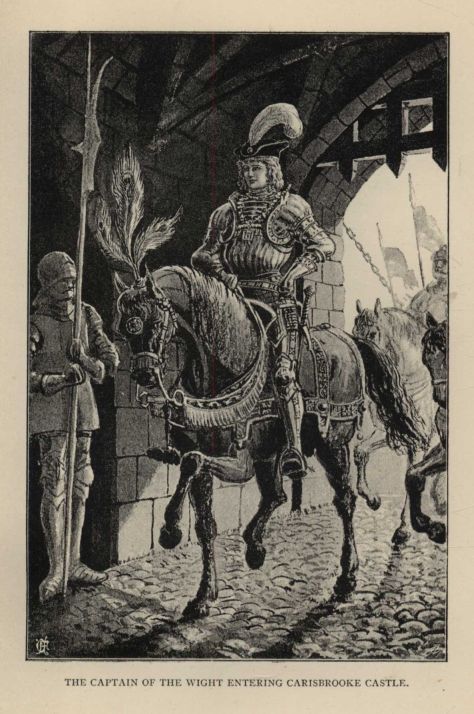
THE CAPTAIN OF THE WIGHT ENTERING CARISBROOKE CASTLE.
The worthy burgesses' wives and their fair daughters much regretted that the Captain of the Island was not married. The lady of Sir John Trenchard presided over the domestic part of the castle, and did the honours when ladies paid it a visit. But she was not of an amiable disposition, and it was popularly reported that her worthy lord's little asperities of temper, and sourness of look, arose in great measure from the austere frigidity of this eminently respectable matron, who, however, as Ralph subsequently found, was at heart a very kind and sweet lady. The reasons for Lord Woodville being still a bachelor were variously stated, and all hotly asserted by their different supporters, who one and all had their information on undoubted private authority, which they were not at liberty to divulge. The only fact that really was known, however, was the simple one that there was no Lady Woodville. The head of the column was now mounting the steep ascent to the castle, and Ralph noticed the splendid position of this noble fortress. The sun was getting low on the western horizon; the level rays bathed all the long valley away to the west in a rich golden haze, falling full on the grandly-proportioned towers of the main guard. The massive walls, pierced for archery, and crowned with their projecting machicolations and graceful parapets, were not yet clothed with the growth of yellow and grey lichen which has been slowly painting them for the last four hundred years. The stone was yet fresh from the hand of the mason, and above the great gate, high up on the parapet, could be seen the arms of Lord Scales.
"My grandfather had that done!" said Maurice proudly, pointing up to the noble gateway as they tramped over the drawbridge, and passed out of the warmth of the sunlight under the heavy portcullis, and between the massive iron-studded oak doors, which were swung back to allow the Captain of the Wight and his "meynie" to enter, and then slowly and harshly swung back as the last man-at-arms clanked over the drawbridge, shutting out the sunlight and the outside world.
The guard under the archway presented arms, the trumpets sounded a flourish, and out into the sunlight, whose rays just passed between the towers, and touched his plume, rode the lord of the castle, and of all those stalwart men.
CHAPTER VII.
HOW THE COCKEREL SHOWED FIGHT.
The days passed rapidly by after Ralph Lisle had become part of the retinue of the Captain of the Wight. Each day brought its busy round of occupation. There was the early practice, before the morning meal, at throwing the bar, running at the quintain, and leaping over the wooden horse. Every exercise was directed to bringing fully into play all the muscles of the body, and especially such as were most needed in the handling of the lance, and the management of the war horse. After the morning meal, at which the pages had their table apart in the hall of the Lord Woodville's apartments, which at that period were very much in the same position as the Governor's lodgings were at a later time, when added to and repaired by Sir George Carey, those pages who were not on duty went through a course of "grammar and rhetoric," under the instruction of Sir Simon Halbard, the chaplain of St Nicholas within the walls. The whole garrison, or at least such part of it as could be spared from their duties, always attended mass every morning, for the Lord Woodville was a strict disciplinarian, and enforced the precept of the Church with the rigid punctuality of a Grand-Master of the Temple.
The "book-learning," as the pages called it, occupied about three hours, and then preparations were made for the mid-day meal, the most important of all the meals of the day. This repast was served in much state, all the pages being required to attend to carve and hand the dishes, and pour out the wine for the Captain of the Wight and his guests, or the knights of his household. After those of highest rank were served, the pages sat down to their repast, presided over by the senior esquire.
The afternoons were spent either in attendance on their lord, or in private amusements and exercises of their own. No one of the pages was allowed out of the precincts of the castle without Sir John Trenchard's leave, but this was usually very easily obtained.
So passed the days in healthy exercise and wholesome occupation. There had been many little bickerings, and even personal struggles between the pages, but, boy-like, they had been brief, and, on the whole, the life was very pleasant. Ralph had ridden over with Maurice Woodville to pay his relatives a visit at Briddlesford. They had met his fair cousin, who was riding out to fly her hawk; and as they accompanied her to a high hill, whence a lovely view was obtained all over the Solent and far inland from the New Forest and Beaulieu on the left to Chichester and even the hills above Arundel on the right, they were surprised to meet one of the Breton, or French Knights, as they called them, riding out there, quite unattended.
There had been much talk about the business of these Bretons with the Captain of the Island. Merchant ships, bringing salt and other commodities to Newport from Nantes and St Malo, had reported how unsettled was the state of Brittany, how the Duke of Orleans and the Prince of Orange, both nephews of the old Duke of Brittany, had fled to him, to his castle of Malestroit, and how the armies of the King of France, who was himself but a boy, but whose affairs were wonderfully managed by that very wise and puissant lady the Dame de Beaujeu, his sister, had entered the country, and how all would go to utter ruin, unless King Henry sent force of knights and men-at-arms to assist the Duke of Brittany and his fair young daughter the Duchess Anne. Such news was bruited abroad, and there was no young knight in England who did not burn with ardour to lay lance in rest for so great a princess, and against the hereditary foe of England. All men knew, therefore, that the Sire de Kervignac and the Vicomte de la Roche Guemené were come to solicit men-at-arms and archers, and there was not one of the garrison of Carisbroke Castle who did not heartily wish they might succeed, and perhaps no one wished it more than Master Eustace Bowerman.
After the customary courtesies had been exchanged, Mistress Yolande urged the two pages to fly their hawks at a heron, which was busily feeding on the rich weeds far out on the mud at the mouth of a creek called King's Quay. The boys, nothing loth, cast off their birds, and rode eagerly after them. But whether it were that the wood was too thick, or the country too rough, the lady did not follow them, while the knight stayed, as in duty bound, to escort her, and so the boys lost sight of them for the rest of the afternoon. And not only did they suffer this disappointment, but, what was almost worse, Ralph's falcon killed the bird, but fell with it so far out on the mud that it was impossible to get at it, although the boys did everything they could to urge their dogs to go on to the treacherous slime, and bring the quarry to land. The tide was quite low, and they had to give up all hopes of obtaining more sport. It was with much difficulty, and after long waiting, that they were able to get the falcon to fly back to fist, for it was taught not to leave its prey until some one came to take it. When at last they did recover the bird, the afternoon was too far advanced for them to return by Briddlesford to inquire after Mistress Yolande, and bid good-bye to Sir William de Lisle, which Ralph would dearly have liked to do; and he was, besides, in such a state of mud from having tried to recover the bird, that they thought it best to return to Carisbroke without being seen by any one. Riding home as fast as they could, they made a détour, to avoid passing through Newport, and reached the castle just before the gates were shut for the evening. When they got back, and related the events of the afternoon, they found Eustace Bowerman, who was already sulky enough at not having been asked by Ralph to accompany him instead of Maurice Woodville, in a towering temper.
"You blind moles," he growled, "why did ye not cleave to Mistress Lisle and that jackanapes of a Frenchman? What geese ye must have been, to have been shaken off like that. But I'll talk to that jackanapes anon, that I will. What does he mean by coming over here and sporting in our covers?" and Eustace Bowerman flung himself out of his chair, and went to the oriel window, which looked out into the courtyard of the castle.
"I' faith, Eustace, my Trojan, don't you call me a goose again," said Ralph good-humouredly, but with a determination in his tone.
"And prythee why not?" said Eustace, who was glad of anything to vent his ill-humour upon. "None but a goose would show the white feather as you did, riding away from that dandified Frenchman."
"I never showed the white feather yet," said Maurice hotly, "and if you say that I did, you lie in your throat."
Eustace was not in a humour to take things quietly. In a passion at these words of Maurice, he rushed across the room, and would have flung himself upon him, had not Ralph put out his foot, and tripped him up. He fell heavily to the ground, greeted by a roar of laughter from Dicky Cheke, who scented the battle from afar, and chuckled at the approaching crisis.
"Oh, cocks and pies, my swaggering imp, look you there! You've split your new trunk hose all down the leg. Fie, man, you're not fit to be seen; run away and get old Gammer Tibet to sew it up for you."
But Eustace rose in a more towering rage than ever. He turned upon Ralph, and struck at him with all his force. But Ralph had not been learning martial exercises for nothing, and although he was four years junior to Eustace Bowerman, yet in height and activity he was in no way his inferior, although his frame was not as well set, or his weight and strength as great as that of his assailant. With ease, therefore, he knocked down the blow that Eustace aimed at him, but refrained from replying by a blow in return.
"Bowerman, I don't want to fight," said Ralph quietly; "why get into a rage about nothing?"
"So you don't want to fight, eh? I thought not," sneered Eustace, who was in a very evil mood. "Then I want to thrash you, so you'd best take it quietly."
Ralph, seeing that there really was nothing else for it, although he was of a very peace-loving, happy disposition, stepped back, and awaited his antagonist's assault.
Bowerman, who saw how reluctant Ralph was to fight, mistook this backwardness for cowardice, utterly forgetting, or else wilfully misinterpreting, the brave action of the boy at Winchester.
He advanced upon him with a fierce scowl of concentrated hate, and aimed a blow right at Ralph's face; but the boy guarded it with his right arm, and at the same time with his left dealt his assailant a swift and well-planted blow full in his chest, causing him to stagger back and gasp for breath.
"Well done, Lisle!" cried Dicky Cheke, in an ecstasy of joy and excitement. "Do it again, my lusty lambkin; follow it up with one on his nose that'll spoil his beauty for some time."
"Why don't you give it those little bodikins?" stormed Eustace to his ally Willie Newenhall, as he prepared to attack Ralph again.
"Because he's afraid, the big booby," laughed Dicky derisively.
Bowerman, seeing that his antagonist was not to be despised, determined to close with him and overpower him by his superior weight. Stepping back therefore, to gather way for a rush, he was about to spring upon Ralph, when that boy, with the instinct of a general, anticipated him, darting forward to meet him, and pounding him with blows.
The delight of Dicky was a treat to behold. He danced, jumped, sang, whistled, and at last, forgetting everything in the wild madness of the moment, he flung himself upon Willie, and belaboured him right manfully. That stolid youth was looking on with a lack-lustre expression on his fat face, and marvelling to see how Ralph dared to stand up to Bowerman, whom he had always looked upon as invincible. He was roughly aroused from his stupid contemplation of the contest, by Dicky Cheke's unprovoked assault. When once aroused, however, his greater age and weight told heavily in his favour, and poor Dicky would have paid dearly for his temerity, by being crushed under the dead weight of "Pig's Eyes," as he called him, had not Maurice Woodville assailed him with vigour in the rear.
The uproar now waxed furious. Ralph, who had gained a decided advantage by becoming the assailant, was pounding his adversary with hearty alacrity, not without receiving, however, very severe blows in return. The two smaller boys had got Willie down, and were pummelling him with right good will, while he roared lustily to Bowerman to come and take "these little fiends off him."
In the midst of the confusion the door opened, and the Captain of the Wight appeared, attended by the other Breton knight, the Sire Alain de Kervignac.
So busy were the combatants, that none of them noticed the interruption, and for a second or two fierce blows were exchanged before any one was aware that there were spectators.
Dicky Cheke was the first to catch sight of the calm face of his lord, over which an amused expression flitted.
"Holy saints!" he gasped, suddenly stopping in the act of planting a well-directed blow in the prostrate Willie's eye, who was at the same moment pounding Maurice in the chest, "here's the Captain," and he sprang up, breathless and confused, hastily adjusting his disordered dress as best he could.
The others were equally startled, and for a second or two there was a very awkward pause.
"Well, young gentlemen, I see you have taken the lessons of the tilt-yard to heart; but I should wish you to remember that it better becomes you to tilt at the quintain, or even at each other, with lances, than grovel on the ground, and spoil your clothes in this unseemly brawl."
The youths all looked very much abashed, but Lord Woodville would not see that it was a real fight that was going on; he treated it as a mere trial of strength, and continued:--
"I have brought this noble Breton knight to see you, for he purposes, together with his right valiant companion in arms, the sire de la Roche Guemené, to hold a joust against all comers, and he fain would see if I cannot spare the stoutest of my pages to make a trial of arms before the ladies of our island. How like you this, my varlets?"
There was no need to ask. The flushed faces and bright eyes showed how welcome such news was; only the three younger boys looked a little crestfallen, for they knew they were too young to be allowed to tilt in the lists, even supposing the two others were so highly favoured.
"I see by your looks you like the news well. Master Bowerman and Master Newenhall, I hear from Sir John Trenchard that you are now of an age when you may make public trial of arms, I therefore appoint you my esquires, and give you permission to joust with spears on the first six courses, but not to take part in the tourney with swords." Then seeing the looks of disappointment in the faces of Ralph Lisle, and his two comrades, he added,--"And you, fair pages, must rest you content for another year, when you be grown older. And now, my masters, set your dress in order--contend no more; and do thou, Ralph Lisle, come hither with me." So saying, Lord Woodville left the room, followed by the Breton knight, and speedily joined by Ralph, who stayed a second to put his dress tidy.
"My page," said Lord Woodville to Ralph, as soon as he had come up with them, "take this missive to the hermit who dwells on St Catherine's hill. Thou knowest the way--'tis where thou wentest hunting with me last week. Take the best horse out of my stable, and ride like the wind; wait for an answer, and bring me back word right quickly. I have chosen thee for thy good riding, and fealty to me. Talk to no man, but do my bidding straightway."
Ralph was delighted at this mark of confidence. He took the note, and turned away to go to the stables. As he was going out of the door of the hall, he heard Lord Woodville say,--
"I marvel where sire Amand de la Roche Guemené hath gotten to? I have not seen him all day."
Ralph paused.
"My lord, I saw him this afternoon. He met us with Mistress Lisle, and we left them together when we flew our hawks."
"Marry you did!" said the Captain of the Wight, glancing at his companion; and adding, in a voice not intended for Ralph's ear,--"Fair knight, we shall have to take care that thy gentle companion doth not spoil our island of its comeliest damoiselle."
As Ralph rode across the courtyard, he met Humphrey, who was astonished to see his young master riding forth so late, for the sun was just setting, and the gates were shut for the night; but Ralph with great pride told him, he was riding forth in all haste on the business of the Captain, and the worthy varlet shared in his young master's importance.
At the sight of the pass given to Ralph by Sir John Trenchard, the captain of the guard ordered the gates to open, and the heavy rattle of the chains showed that the drawbridge was being let down, and in another moment Ralph rode out into the glorious light of the after-glow which illumined all the sky to the west.
With a light heart he heard the heavy drawbridge creak up again, and, rejoicing in his freedom, he put spurs to his horse and rode fast over the hill, away towards the distant downs to the south. His horse was fresh, and, under Ralph's light weight, cantered swiftly along. He knew the way, or at least thought he did, and took no notice of objects; his mind was full of the approaching tilt, and his one idea was how he could obtain leave from Lord Woodville to let him splinter a lance. And so he cantered on in the ever-increasing gloom, not seeing how dim it was growing, or how damp a mist from the sea was drifting down the valley. The few roads that went through the island were bad in the most frequented parts, but in the cross tracks over the downs to the back of the island they were little more than muddy quagmires in wet weather, and ruts hard as rock in fine. Ralph galloped past Gatcombe, belonging to the Bremshotts, the last male of which family was then very old, and his lands were about to pass away to other names. Little did Ralph know that he was passing what once had belonged to his ancestors, and how that fair manor had come down, through three successive ladies, from the Fitz Stuar to the Lisles, and thence, in the female line, to the Bremshotts, whose daughters again would share it with the Dudleys and the Pakenhams. He breathed his horse up the steep slope that led past Chillerton Down, and as he descended on the further side, he first felt how damp was the night air, and noticed how difficult it was to find his way. Mindful, however, of his lord's injunction to make all the speed he could, he urged his horse to a reckless pace, and it was not until he had ridden for another half-hour that he began to be anxious as to his whereabouts. The air seemed much keener than it had been, and there was a salt freshness in it, that ought to have told him he must be near the sea. Could he have mistaken his way? There was no building he could see anywhere, and the track had entirely ceased. Ralph got off his horse to examine the ground. He was on rough, coarse grass, with large stones cropping up here and there. This might be the slope of St Catherine's down, or it might be anywhere. Ralph mounted his horse again. The mist was dense, there was no star or light to be seen in any direction, nor was there any sound of human life. But there was a sound--what was it? Ralph could hear a dull roar, and seething, swishing sound. He could not tell what it was. He had never lived by the sea, or he would have known that it was the swell of the Channel rolling on the shore, and breaking in surf among the rocks of that dangerous coast. He spurred on his horse once more. But after a few strides the horse refused to go further, and backed and reared, as he had never done before. In vain Ralph struck his spurs into his flanks, and urged him or by word and rein. The horse only reared and snorted the more, and swung round on his hind legs, plunging in utterly uncontrolled rebellion.
Ralph could not make it out. Never since the animal had been given to him had he known him to be so unmanageable. Seeing how useless it was to press the horse any further, he ceased to try to subdue him to his will, trusting to get the mastery when he had quieted down.
As the horse stood still, his flanks quivering with excitement, Ralph noticed a smell of smoke: his senses had become keener since he had lost his way.
This smell of smoke caused him to feel more hopeful; where there was smoke there must be a fire, and probably a human habitation. He turned his head round to ascertain where the smell came from, and, as he sniffed the air in various directions, he came to the conclusion that it must be in front of him.
Once more he urged his horse forward, but the animal was as determined as ever not to go that way.
"What can it be?" thought Ralph, who was beginning to feel a little superstitious, as the tales of goblins and spirits came back to his mind, suggested by the unaccountable noise, the mysterious smoke, and, above all, the remarkable stubbornness of his horse, usually so docile and manageable.
For the third time he stuck his spurs against his horse's sides, encouraging him by his voice at the same time, but with the same result--not one step forward would the animal take.
"Young man, didst thou never hear of Balaam?" said a deep voice, proceeding, apparently, directly from under the horse's head, and in another moment a tall black figure rose out of the darkness, so close as almost to touch Ralph, who could not restrain a shudder of supernatural dread at the suddenness of the strange appearance.
CHAPTER VIII.
HOW THE COCKEREL GOT A FALL.
"What art thou?" stammered Ralph, as soon as he had recovered from his surprise. "What dost thou mean by thy talk of Balaam?"
"Look, boy, and thou wilt see," answered the dark figure, which every second was becoming more clearly defined in the gloom.
Without Ralph having noticed it, the mist had been growing lighter for the last quarter of an hour. The atmosphere, while still densely thick, was yet paler and more luminous, and immediate objects were more easily distinguished.
Hardly had the strange figure spoken the words, than the vapour which enveloped them parted, and a wonderful sight presented itself to the eyes of the awe-struck boy.
Was it all a dream? or was he really standing, or floating in mid air? He could hardly repress a shudder of unutterable awe, so strange was the sudden change from the blackness of night to the brilliantly weird scene before him.
He was standing on the very verge of a fearful precipice, so close that he could peer over from the saddle down, down, far down to a rocky shore below, where the sea, in seething surf, was beating and grinding and gnawing at the black rocks scattered in wildest confusion on the strand. At his side was a vast, yawning black chasm impossible for him to fathom, shrouded as it was in the deep shadow of the bold headland beyond. Tophet itself could hardly be blacker or more fearful looking. The grim gloom of this awful abyss, at the very edge of which he was standing, made the flesh creep on his bones. One step more, and he would have plunged he knew not whither. Above this terrible place the clinging mist still veiled the scene. But Ralph could see that the hills and cliffs went soaring up till lost in obscurity.
Right from the feet of the dazed boy, but far, far down, a broad path of dancing light stretched away and away till a grey and silver cloud under the clear full moon hid it in its soft embrace, as it lay brooding over the sea.
How lovely was the dancing sea, how glorious the moon, how wondrous the violet of the deep sky of night. Ralph had never seen anything like it, and yet how near to awful death had he been.
The ghostly mist curled up over the edge of the cliff, the strange white shapes went silently floating by like ghosts of the shipwrecked dead, or a still army of spirits flying inland to visit their midnight homes. Silently as the strange scene had opened, so stilly and impalpably it faded away. In another moment all was gone, and the boy and the dark figure were alone in the thick fog, nothing visible of all that wondrous scene but themselves and the few feet of turf on which they stood. Ralph could hardly believe it was reality. Surely it must be all a dream.
"Now, my young master, believest thou? Dost understand where thou art?"
"Nay, not I; it seemeth to me I dream."
"Ay, marry, that wouldest thou soon, if indeed men do dream in that sleep which they call death," said the deep voice bitterly.
Ralph could not make out this dark figure. He had not looked at it during the fitful light which opened up that strange sight only to disappear in greater obscurity than before. He now tried to examine the form of him who uttered such enigmatical remarks in so well-cultured a voice.
He saw a tall figure, strong and well made, with a hood over its head, such as were worn by the courtiers of ages long gone by, and which Ralph had seen depicted in tapestry and illuminations of King Edward the Third's time. A tight-fitting tunic strapped at the waist by a belt, from which gleamed the hilt of a dagger, and the head of a small axe, showed he was both active and well-armed. But Ralph could see nothing of the man's face, or make out whether his clothes were of those of gentle birth or of the common stuff worn by the country men and labourers.
"Well, my master, and how long may it please you to stay here, and what may be your business?"
Ralph did not like the tone of bantering superiority the other assumed; he answered:--
"Marry, good fellow, what is that to thee? An thou canst tell me where I am, and whither to go to St Catherine's down, that is all I want of thee."
"So thou wouldest go to St Catherine's down, wouldest thou? And what may be your business there?"
"Thou art parlous curious, good knave," said Ralph haughtily. "I pray you ask me no questions, but tell me what I wish to know."
"Body o' me, this is a fine springald," said the other. "But before I tell thee what thou wouldest know, thou must tell me what I would know."
"And what is that?"
"What is thy business at this hour from the Captain of the Wight with the hermit of St Catherine's?"
"That shalt thou never know!" cried Ralph hotly.
"Then thou mayest grope here in the darkness until thy carcase becometh a prey to the sea-mews, or a feast for the crabs on yonder beach."
"Base churl! thou deservedst chastisement for thine insolence!" cried Ralph, whose temper was becoming provoked. "But I will e'en do without thy niggard help." And Ralph got off his horse, and prepared to grope his way to where the smell of smoke still met his nostrils.
"Nay, Sir Page, thou goest not thus," said the man, stepping in front of him, and at the same time putting his finger to his mouth he gave a prolonged whistle like the shrill scream of a sea-bird.
Ralph laid his hand on his sword, seeing there was evidently mischief intended. But before he could draw it, his wrist was held as in a vice, and in a second his other arm was grasped, and with a quick trip of the foot, he found himself prostrate on the grass, the man kneeling on him, and holding him immovable.
"Struggle not, young master, or thou wilt suffer. Thou art powerless to do aught, so better lie still."
But Ralph was furious. With the rage of mortified pride--for he had never been mastered before--he struggled, kicked, and writhed, and even tried to bite the hands that held him with a grasp of iron. He had never felt such power in human hands before.
"Marry, 'tis a fierce youth and a strong," muttered the man. "I shall have to do him a mischief, an they come not soon. Ah! would you?" he said, as Ralph's hand wriggled to get at his poignard, and in a trice the arm was wrenched out stiff and straight, and kept pinioned to the ground. Never had Ralph believed man could be so strong. But, still unconquered, the boy struggled with his legs, and raised himself off the ground with his heels. By a violent uplifting of his knees, he hit his captor a fierce blow in the back, causing him to fall forward on his face. With a desperate heave the boy pursued his advantage, and in another moment would have upset his adversary, when he felt his legs caught and pulled roughly down, once more he was utterly powerless.
"Now, stripling," said his first assailant, still holding his arms stretched out, but getting off the boy's chest, where he had been crushing the breath out of his body, "I told you it would be all for naught your wrestling like that. Will you tell me what you have come here for?"
"Never," said Ralph resolutely.
"Then, Bill," said his captor, "we shall even have to search him."
Before Ralph knew what was happening, he felt his arms held by another man, while the first speaker carefully searched his pockets.
"There's naught here," he said, in a disappointed tone, as he turned out the contents of Ralph's small clothes and tunic, and examined the miscellaneous collection of utterly useless articles which boys, from the earliest days down to the present, have set their hearts on forming, to the detriment of their pockets, the aggravation of their female relatives, and the marring of their own figure.
"Nay, but there is," said the man who held his legs; "look'ee there, there's summat whoite i' the grass."
"Marry, so there is!" and the first speaker picked up the missive of the Captain of the Wight and turned it over.
"You base villains," said Ralph, "an you touch that, you will repent it!"
A loud laugh greeted this remark; and the first speaker, rising, held the paper up to see if he could make anything out of it.
"I can't make it out," he said. "I must e'en take it to the light."
"And what are we to do wi' the lad while you be gone? Shall us knife un and pitch un over to cliff?"
"Body o' me, no! Do him no harm; hold him till I come back."
So saying, the first speaker disappeared from Ralph's line of sight.
The moon had again come out, and as Ralph lay on his back, he could just manage, by wriggling his head, to look on each side of him. He could see that the men who held him were rough figures, clad in coarse hairy clothes, possibly skins of animals. The moonlight fell on their hair and beards, giving them a wild and ferocious appearance; and long knives, whose hilts stuck out of their belts, gleamed in the silver light. Who were they, and what could they mean by attacking him? and, above all, how could they dare, in so small an island, to defy so powerful an authority as that of the Captain of the Wight? As he lay on his back, Ralph caught sight of a light; at first he took it for a star, but it flickered and flared in so strange a way, that he soon knew it could not be.
Surely it must be a fire, and, if so, there must be men near. Ralph felt a hope of aid; he tried to shout aloud, but the first sound he uttered caused the man who was holding his arms to clap his hand over his mouth, and effectually to stop all further cries. In vain Ralph seized his arm with his disengaged hand. The other man, who was tired of holding his legs, had seated himself upon them; his arms were therefore free. He leant forward, and grasped Ralph's hand, and roughly made him let go his grip of his companion.
"Best give it up, young 'un," he said gruffly, as he held the arm in no gentle hold. "There's naught can hear thee save the Gaffer and the sea mews."
"Then what's that light?" asked Ralph, as the man relaxed the pressure on his mouth.
"'Tis the light on St Catherine, and 'tis a good mile or more away."
"Then where am I?"
"Where are you? Why, on the ground, to be sure," laughed the man.
Ralph's anger rose, but it was utterly useless, he could do nothing. After lying still for another minute or more, one of the men said,--
"The Gaffer is a long while; maybe he can't spell out them words."
"Surely he's larnt his chriss-cross row long ago," said the other derisively.
"Ay, right enough, mate, but them letters may be t'other sort."
"Well, and if they be, ain't he got Mistress Magdalen to read it for him?"
"Hold your tongue, you lubber; here he comes."
Ralph could just manage to see the head of his captor rising out of the mist, and from the distinctness with which he saw his figure develop, he knew the edge of the cliff must be very near, as indeed he had already seen.
"Master Page, here's thy missive; there's naught in it that concerneth me, so thou mayest e'en take it to the Hermit of St Catherine's; but when thou returnest to the Castle, give this message to thy lord; thou needest not to say who gave it thee--he will ask no questions."
Ralph now felt his captors relax their hold, in another second he was free. He rose to his feet, the men had already disappeared. He looked round; there was nothing to be seen of any living being; only his horse was browsing tranquilly a few paces off, and two white bits of parchment lay on the grass.
Picking these up, he went to the edge of the cliff. The sea was restlessly seething and surging among the rocks, each ripple and wave rolling like molten silver to the iron-bound coast. Every crevice and rock stood out sharp and clear in the brilliant moonlight, only marking in blacker contrast the hideous gloom of the yawning chasm at his side. He could see no path, yet the men must have gone down that way, or else he would have seen them had they ventured to clamber down the precipice in front. He stood up and looked round--the light had disappeared. Had they told him the truth about that light? Was it the Hermitage of St Catherine's? But there was none to ask, and he felt as bewildered as ever, nay, more so, for he had utterly lost his bearings.
And then he thought of his lord's command, and of the urgency of the matter. What should he do? With the recklessness of despair, he bawled aloud,--
"You varlets, which way am I to go to get to St Catherine's?" But only the echo from the blackness beyond answered mockingly "Catherine" in quivering note, and the waves surged ceaselessly below. He cried again,--"You caitiffs, you, why don't you answer?" and the echo laughed back "answer," but none other answer came. "'Tis little use," he muttered, in sullen bitterness of spirit; "but I will yet find out where that smoke came from." He looked at his horse, how should he tether him? He saw beyond, and nearer the head of the chasm, a few bushes growing. Carefully he led his horse along the edge of the abyss, marvelling how he had escaped so awful a death, and regretfully thinking how he had chidden his noble horse, whose sensible instinct had saved both their lives.
When he reached the bushes, he saw that he was on the brink of a deep gully, but the ground was all broken and boggy, and covered with closely-growing bush, bramble, and scrub. The mist was gathering up afresh. Great banks of vapour were scudding across the moon, and flitting up the black chasm, suddenly appearing in the moonlight out of the darkness below, like steam out of a cauldron.
While he was debating what to do, he was startled by a gentle voice almost at his elbow. Turning quickly round, he saw a graceful figure standing on the edge of the gully, looking like black marble against the broad path of silver glory that stretched across the sea behind it.
"Fair sir, whither wouldst thou go?" said the voice.
"If thou art of real flesh and blood, gentle damoiselle, I would thank thee to tell me which is my way to St Catherine's Hermitage."
"And thou wouldst not thank me if I were not real flesh and blood?"
"Ay, marry would I, an' thou wert Sathanas himself!" cried the youth impatiently, "if only I could escape from this quagmire of a hole."
"Thou art not over-courteous, Sir Page," said the gentle voice.
"Certes, fair damsel, I crave thy pardon, but I am much belated, and have been sorely bested. I cry your mercy. But tell me, an thou canst, how I can find the Hermit of St Catherine's?"
"Right easily, fair sir. Seest thou yonder hill to thy right?"
"The fire I saw was to the left, I'll wager my falcon," said Ralph; then he added aloud, "Marry, do I, fair damsel."
"Then ride straight up that hill--there is naught save a few rough stones to hinder thee; only walk thy horse carefully till thou gettest upon hard ground, as 'tis all quick about here. Nay, I will show thee," added the figure quickly; "'tis but a poor return for thy kindness to us."
"And when did I show kindness to thee, gentle damsel?" said Ralph, in astonishment.
"Thou quickly forgettest thy good deeds, I see," said the girl. "'Tis a good sign of one gently nurtured."
"But when saw I thee before?"
"I did not say thou hadst seen me before!"
"Marry, fair damsel, thou speakest in riddles. I did thee a kindness, and yet did not see thee! A-read me the riddle?"
"Nay, 'tis best to forget the kindnesses you do, so long as they to whom they are done keep them in mind. There, now, thou art on safe ground. Ride boldly up the hill. At the summit thou wilt see the beacon light. Fare-thee-well."
"But, damsel, wilt thou not tell me thy name? Who are those caitiffs who wrought me such wrong? Where dwellest thou? How camest thou here?"
"And then men call us poor women curious and prying," laughed the girl. "Good-night, gentle sir, mayest thou prosper, and have a pleasant journey;" and before Ralph realised she was gone, she had disappeared down the head of the gully.
"Well, 'tis little use following her," thought Ralph; "my business is up there. I marvel whether she told me truth; but I shall soon see."
He mounted his horse, and pursued his way as fast as he could, consistently with the steepness of the ascent.
So steep was the hill in some places, that he dismounted once more, and led his horse up. He had no idea the hill was so high or so difficult to climb, from the view he had had of it below, but at length he found the steep incline becoming rounder and more level. Mounting again, he set spurs to his horse, and galloped over the smooth, close-cropped, wind-shorn grass.
After riding a few hundred yards, he saw a bright glow before him, and in another minute he was trotting up to a low building with a small octagonal tower, on the top of which was a cresset holding a mass of flaming tow and faggots, which cast a lurid glare all over the summit of the lofty down. It was St Catherine's Chapel and Hermitage.
As Ralph rode up, the figure of a man in a monk's dress emerged in the tower, and attended to the fire.
"Art thou the Hermit of St Catherine?" called out Ralph.
The monk turned round.
"Who is it that calls?"
"One of the Captain of the Wight's pages, who has come with a missive for thee."
"Tarry, my son, till I come down," said the Hermit.
The figure then disappeared, and shortly afterwards a low door at the base of the tower opened, and the Hermit came out, holding a lantern in his hand. He carefully scrutinised Ralph without saying anything, and took the paper the page handed to him.
After reading it attentively, he said,--
"Tell my lord there hath been no strange sail seen to-day, but as it is parlous thick to-night, and was so the greater part of the afternoon, a vessel might have passed without my seeing. Tell his lordship I will be sure to keep a trusty look-out."
"Is that all, holy father?"
"Yes, my son; get thee back as soon as may be, for it behoveth him to take measures in case a schallop hath gotten past unperceived."
Ralph turned his horse's head; the mist was now far down below, and dispersing before it spread inland. His road lay clear before him. Clapping spurs to his horse, he galloped off, and in the course of another hour was hallooing to the guard at the outer gate of the Castle to open and let him in. In a few minutes more he had dismounted at the Captain's apartments, given his horse to Humphrey, who was sitting up for him, and in another second was ushered into the presence of the Captain of the Wight.
CHAPTER IX.
HOW THE COCKEREL LEARNT HARDIHOOD.
When Ralph pushed aside the heavy curtain which hung inside the ill-fitting but massive oak door, he was for a moment dazed by the brilliant light within the room.
The chambers of the more luxurious nobles were at this time fitted up with much profusion of rich draperies, gorgeous tapestries, and splendidly carved and gilded furniture. Lord Woodville inherited and shared all the lavish tastes of his mother and his family. His brother, the ill-fated Lord Scales, had been the patron of Caxton, having himself translated and composed some of the earliest works published by the Father of Printing, and the Captain of the Wight upheld the traditions of his house.
Seated before an elaborately-carved desk, lighted by long wax candles standing in exquisitely-designed brass candlesticks, whose bold bosses and delicate spiral work reflected the light in countless sparkles and scintillations, sat the Lord Woodville, his handsome face in conspicuous distinctness with the light shining full upon it, while behind hung a gorgeous tapestry from the looms of Flanders, which had belonged to his mother, Jacquetta of Luxemburg. He was clad in a close-fitting short tunic of black stamped velvet, made very full across the chest and shoulders, and drawn in with narrowing pleats at the waist, where it was confined by a magnificent belt of scarlet Cordovan leather, richly studded with gold and jewelled mountings. A finely-chased silver-hilted poignard hung at his right side, and his shapely legs were set off to fullest advantage by his tight-fitting hose, which, after the fashion of the time, were parti-coloured, of light blue and white in alternate pieces. Long and fanciful scarlet Cordovan slippers encased his feet, and a rich purple mantle, lined with the fur of the silver fox, hung over the back of his chair. One elegantly-formed hand rested on the desk, where a few characters had been inscribed on a sheet of paper before him, while the other arm hung negligently over the back of his chair. There was a dreamy, far-away look in his eyes, and no one could have realised in that slightly effeminate figure, and almost womanish face, with its sensitive mouth and finely-chiselled nose and broad brow, round which the long hair fell in waving masses, the warrior who had fought in nearly all the bloodiest battles of those fierce civil wars, and had borne himself in ranged field or tented lists "righte hardilie, valyentlie, and of full lusty prowess." For the conflict on the battle-field was then no child's play as regards the noble, to whom quarter in those bloody civil wars was rarely or never given.
It was probably the refined tastes of the Woodvilles, while rendering them such favourites with the luxurious Edward IV. and the ladies of his court, which caused the ruder barons of that rough age to hate them so bitterly. The taunt flung in the face of Lord Rivers and his son by Warwick, when he was brought before him a prisoner at Calais, showed the malignity of hate and contempt the nobles felt for the family, a hatred arising, no doubt, from jealousy at the Woodvilles' sudden rise to distinction, but aggravated by a contempt for their accomplishments, which were considered totally inconsistent with the stern realities of life. How was it possible that a hardy knight and well-seasoned man-at-arms could find time to paint, write, or even read? Such occupations were for jongleurs or monks, not belted knights and stout barons.
As Ralph dropped the curtain behind him, the Captain of the Wight rose from his chair, the dreamy look of abstraction giving place to the alertness of real life.
"Well, Master Lisle, thou hast been a dullard on the way; what hath made thee so late?"
"There was a thick mist abroad, my lord."
"Oh, and thou lost thy way? Like enough. These sea fogs are sudden in their uprising. But thou gavest my missive to the Hermit?"
"Yea, my lord, and he bid me say that he had seen no sail, but that, as the mist had overspread the land and sea the latter part of the day, it were very possible for a schallop to have gotten past unnoticed."
"Yea, forsooth, he sayeth well," said the Captain thoughtfully; then he added, "There was no other message?"
"None my lord, save--" and Ralph hesitated, for he did not like to tell of his mishaps, and as he thought of the strange adventure on the wild cliff, in the brilliant light of that luxurious room, he could scarcely believe it was not a dream. The utter contrast between the present moment, the elegant surroundings, the absolute security of that splendid castle, with all its guards, walls, men-at-arms, bastions, archers, and turrets, and the wild weirdness of that solitary wrestle on the verge of the black precipice, in the cold light of the moon, and the ghostly vapour, seemed too impossible. Surely he must have dreamt it.
"Save what, my child?" said Lord Woodville.
"Save that I lost my way, and--" and again he hesitated.
"Well, my page, and what?"
"And I was set on by a base caitiff."
"Ay, marry--who has dared to lay hands on one of my pages?"
"That I know not, my lord," and then Ralph narrated the adventure as best he could.
Lord Woodville listened to the end, his countenance expressing no feeling until Ralph came to the part where the man bid him take a note to the Captain of the Wight. He then looked up gravely, and said,
"Where is it, my child?"
Ralph fumbled in his pocket; he searched everywhere--he could not find it. Seeing his nervousness, the Lord Woodville said, smiling,--
"Nay, fair page, take it quietly; thou mayest have overlooked it. Search each of thy pockets one by one, and so we shall arrive at a just conclusion."
Ralph did as he was told, and displayed but few things to the amused eyes of Lord Woodville, for he had not troubled to replace the rubbish which the man had left upon the grass when he turned out his pockets. When all had been gone through, there was nothing found.
"My lord," said Ralph, abashed, "I must have dropped it when I delivered thy missive to the Hermit of St Catherine's."
"Like enough, my page; but thou shouldest be more careful. An thou didst, I shall get it in the morning; or thou canst ride in search of it. But thou art sure thou hast not been dreaming?" added Lord Woodville, with a smile.
"Nay, my lord, that I will warrant, for thou mayest see the stain of the grass and the earth on my surcoat and hose."
"Well that is somewhat, certes, but 'tis a quaint tale. Who could they be who would attack thee, do thee no harm, take no gold from thee, or strip thee of thy rich poignard and gaudy dress? For I see they have left thee thy purse and gold pieces."
"Nay, my lord, I know not; but I can show thee the place to-morrow, an thou wilt ride thither."
"What was the man like who captured you? Didst thou see his face?"
"Nay, my lord, for he ever came between me and the moon; but he was of marvellous strength, and of a wondrous bigness; and he spoke like one in authority, and of gentle birth and breeding."
"Well, 'tis a strange adventure, in sooth, and we will take thought for it to-morrow. Perchance thou mayest find the missive in thy saddle housings, or in thy dress, as thou retirest to sleep. But it groweth late; get thee now to thy rest. I shall need thee to-morrow."
So saying, Lord Woodville nodded kindly to the boy, as a sign for him to retire, and Ralph left the room, glad enough to have escaped so easily, marvelling more than ever whether what had happened had really been a dream.
Meanwhile the Captain of the Wight stood musing before his fire, for there was now need for a fire, since the season was drawing on, and it was near the end of September, while the thick stone walls of the strong building were damp and cold.
Presently he went to his desk, pressed a spring, and out of a drawer at the side he took a little scented leathern case. Opening this, he took out two very faded flowers, a long lock of wavy soft brown hair, and a golden heart. He gazed at the silent relics, his lips moved, and he crossed himself devoutly. He then, after pressing them to his lips, put them back in the case, shut the case up, and replaced it in the drawer, which he carefully fastened again.
This done, with a heavy sigh he stepped across to a prie dieu, and devoutly kneeling before a richly-carved crucifix, he remained absorbed in prayer. When he rose up, his face looked white and haggard. Before retiring to rest, he drew aside the curtain over his door, opened it, and called to the archer on guard to pass the word to the man who relieved him, to usher, without question, any monk who should come to him in the morning.
When Ralph awoke next morning, the events of the previous night seemed more than ever like a dream. The commonplace realities of everyday life, the bright morning sun, the boyish chaff of his companions, and the decisive tone of Tom o' Kingston as he put them through their exercises, seemed so utterly out of keeping with the romantic adventure of the night before.
Dicky Cheke seemed somewhat crestfallen this morning, and he and Maurice Woodville had each a rather swollen cheek and lip, while Willie Newenhall was decidedly puffy and red about the eye.
Even Bowerman showed signs of the manful handling given him by Ralph, who had almost forgotten the scuffle, in the greater excitement that had followed.
"I' faith, Ralph," said Dicky Cheke, "there'll be war anon, and Bowerman shall grin. What do you think? After you had gone, and the Captain had gotten well away, that rogue 'Pig's Eyes' got Bowerman to attack us; but we gave them enough work before we gave in, and that's why his eye's so wadged up, and Bowerman's nose looks so red about the bridge."
"Now, Master Cheke," called out Tom o' Kingston, "are you going to give over gossiping? I hear there's talk of a tilt toward, and that Sir John thinks two of you young men can break a lance in it. Now I'd be loth you bore yourselves boorishly, so please to give heed to all I've to say to you. Master Bowerman, you look but sadly this morning; what's come to your nose?"
"Never mind my nose, Tom," said that youth sulkily. "It's no business of yours if my nose is well or amiss. Let me have a run at you with the lance; I want to practise against a live man."
"Not this morning, Master Bowerman; you've enough to do to hit the Saracen fairly. Now are you ready. Go!"
The boys were all mounted on their hackneys horses that formed part of the stud of the castle garrison, and which were trained for the work. Each boy carried a lance about thirteen feet long, and they were this morning going to tilt at a large and roughly-made figure of a Saracen, who held a shield in one arm, and a loose club in the other. The figure, when hit on the shield, spun round, and, unless the performer were quick in his movements, caught its assailant a more or less violent blow in the back, depending upon the force with which the shield was hit.
At the word of command of Tom o' Kingston, Bowerman dug his heels into his horse's side and rode at the figure. He hit the shield fairly, and galloped past untouched, raising his lance as he trotted round.
"That's well done, but give him a harder buffet next time. Now, Master Newenhall!" cried the instructor.
Willie Newenhall was but half awake. He was yawning desperately when he received the order to go. He had scarcely fastened up his clothes, and he looked a sodden mass of sleepy stupidity. His half-washed face, squat nose, and little eyes, which were now smaller than ever, owing to the events of the night before, did not look prepossessing, and not the uttermost vagaries of the most vivid imagination would have thought that the owner of that countenance and that appearance fancied himself to be a dangerous lady-killer, a cause of disquiet alike to the anxious husband as well as the fond father. But the nights of fancy are proverbially wild, and had anybody suggested to Willie Newenhall that he was anything else than a very handsome, irresistible youth, he would have regarded that person with the pitying scorn justly due to the envious and the blighted. Sleepy, and unfinished in the matter of his toilette--for it was seven o'clock in the morning, and Willie dearly loved his bed--he heard the order to put his horse in motion at the quintain. With another prolonged yawn he shook his horse's reins, and trotted lazily towards the post. It so happened that he had not fastened up his tunic properly. As the pace of the horse increased, and he prepared to level his spear to hit the shield, the tunic flew open, and got in the way of his arms. Forgetting, or not noticing, how near he was to the quintain, he moved his arm up to clear the dress, thus bringing the lance across his body, and before he had time to recover his position, the long spear struck athwart the quintain, and got askew between the shield and the wooden post on which it revolved, with the effect of its becoming jammed and immovable. As Willie's horse was well trained, and had increased his speed on nearing the quintain, his rider was swept out of his saddle, and over the crupper, falling to the ground like a sack of flour.
The onlookers greeted this mishap with a roar of laughter, and their instructor, with whom Willie Newenhall was no favourite, scoffingly bid him pick himself up, and "not lie there like a trussed pullet."
Ruefully the sleepy page, now rudely awakened, got up, and came limping back.
"Pick up thy lance, stupid, and go after thy nag. Beshrew me, but an I were the Captain, I'd as lief have a turnip for a page as thee. For you both grow, and that's all; saving that a turnip is good to eat, which is more than can be said o' thee." Then turning to Ralph, Tom o' Kingston said, "Now, Master Lisle, do thou show them how to do the matter."
Ralph dearly loved these exercises, and had become an apt pupil. Sticking spurs to his horse, he cantered eagerly forward. As he neared the post, with knees and voice he encouraged his horse, and with loose reins and gathering speed he struck the quintain a vigorous blow; then, raising his lance aloft, galloped on, untouched by the swiftly-revolving club.
"By my faith, 'twas well done, young master! You'll make the best lance of them all. But, when all's said and done, that's not much praise neither."
"You're a bit grumpy this morning--Tom," said Dicky Cheke. "What's gone wrong? Has Polly Bremeskate been unkind to thee?"
"Now, Master Cheke, mind your work, and let me have none of your sauce," said Tom o' Kingston, who was supposed to cherish a fatal passion for this very buxom and florid spinster, who was the inheritor of certain lands and tenements sufficient to be a powerful attraction, over and above her other charms, to the yeomen of the island. Her suitors therefore were numerous, and she gave herself airs of importance becoming in one so happily placed.
Dicky and Maurice went through the performance very well, and after the exercise had been repeated several times, the little group was joined by the Breton knight and Sir John Trenchard.
The arrival of these important spectators caused the performers to try their best, and even the stolid Willie was roused into something like emulation.
"How do they tackle to their work, Master Tom?" asked Sir John.
"There's naught amiss, Sir John, with Master Bowerman and Lisle; they'll bear themselves well enough--leastways the last-named gentleman will; and so, for their size, will the other two young masters. But as for Master Newenhall, you'd as well mount Betty the scullery wench on Jenny the donkey, and give her a broomstick, as let him ride among press of knights."
"Go in, boys, and don your breastpieces, brassarts, gauntlets, and burgonets, and get your targets. This worshipful knight and I would see how you can bear yourselves in a tilt."
It was delightful news to all the pages, except Willie Newenhall, who in his heart detested the whole thing, and would much rather have sat at the window where Lady Trenchard's maids were looking at the sports, than have been down there, jeered at by the others, and with a strong probability of receiving hard knocks. If only he could gossip, he was happy. He could scarcely open his mouth among men, but with a garrulous woman--if only she were married, or beyond the chance of having designs upon himself--he was quite at home, and would discuss by the hour the latest fashion in 'cotes hardies,' or 'furbelows,' or any other of the mysteries usually never spoken of by men, or, if referred to at all, mentioned with bated breath, as though conscious of venturing on unknown ground, and with the usual result of bringing ridicule upon themselves, by the utter ignorance they displayed. But not so with Willie. He was as much at home when discussing women's dress or idle gossip and scandal, as his companions were at handling the lance or throwing the bar.
In a few minutes more the pages all re-appeared, armed entirely from the waist upwards in polished steel their faces looking bright and boyish under their raised visors, with their shields on their left arms. At the word 'Mount,' they vaulted into the saddle, or attempted to do so, for although they were practised every day at this exercise, yet it was a difficult matter to accomplish in armour. Bowerman and Ralph, owing to the advantage of height, were able to do it gracefully enough, but poor Dicky ignominiously failed, while Maurice managed to scramble up with loss of dignity, but ultimate success. Willie had also failed, and received a sharp rebuke from Sir John Trenchard. When at last, by dint of great struggles, the two unfortunates had got on their horses, they were ranged in a line, sitting motionless with lance erect and visor raised.
The scene was pretty. The morning drill took place in the castle yard properly so called; the place of arms outside the walls, on the east of the castle, not being used for the lesser exercises. The five martial figures of the youths, their fresh boyish faces, contrasting with their warlike panoply, the graceful figure of the Breton knight, in his close-fitting tunic and picturesque dress, set off to advantage by the grizzled head and weather-beaten appearance of Sir John Trenchard, formed a becoming contrast to the burly form and soldierly bearing of the esquire, sitting his horse to the right of the little squad, and completing the group on the yellow gravel of the yard. Behind all, the towering keep, with its base hidden by thick brushwood, carefully trimmed and topped, stood up dark and grim against the eastern sky. To the south east, Mountjoy's Tower, and the long line of wall between, cast their deep shadows over the barracks and store-houses below; while opposite, in the bright sunlight, was the old chapel of St Nicholas, the chaplain's room, guard-room, and the noble towers of the main gateway. The Captain's apartments, on the north, commanded a view on three sides into the yard, and the boys were made more eager than ever to do well, by seeing the Captain of the Wight standing in the oriel window, looking down upon them.
About the quadrangle were grouped, some in shadow some in bright sunlight, the picturesque figures of the garrison of the castle who were off duty, while the flitting shadows on the parapet of the eastern walls showed where the sentries were pacing to and fro on their beat.
Above the keep floated the standard of England, and from the main tower the banner of the Captain of the Wight flung its blazon in the breeze.
CHAPTER X.
HOW THE COCKEREL VAUNTED HIMSELF.
"Let the varlets tilt according to size, Master Tom," said Sir John Trenchard. "Master Bowerman, do you and Master Newenhall begin: close your visors."
This was bad news for Willie. As he turned his horse's head to take up his place, that disconsolate youth murmured through the bars of his closed visor,--
"Bowerman, I say, there's little need to tilt in earnest. I won't hit you hard, if you'll only rap on my breastpiece lightly."
But Bowerman only laughed. He was delighted to have so easy an adversary.
"Marry, 'Pig's Eyes,'" he replied, "do thy best, there's the Captain looking on."
With a deep sigh of woe-begone anticipation, poor Willie, whose bones still ached from his last fall, wheeled his horse round at the word of command, and sat facing Bowerman.
"At the word 'Ready,'" said Tom o' Kingston, in a dry, monotonous voice, "you will lay your spears in rest, holding the point on a level with your own eye, and the hand pressed well into the side, keeping the guard well up to the rest. At the word 'Go,' you will clap spurs to your horses, and ride straight for each other."
There was a pause for the combatants to settle themselves well in their saddles, look to any part of their armour that might be amiss, and generally pull themselves together.