THE CAPTAIN OF THE WIGHT (continued 3)
Reading edition
"Ready!" called out the esquire.
Down came the lances in a graceful sweep, and the two pages sat waiting for the next word.
"Go!" shouted the instructor, and the previously motionless figures dug their spurs into their horses, and rode at each other.
The two lances struck almost at the same moment, but Bowerman adroitly caught Newenhall's lance on his polished shield, and thus caused it to glance over his left shoulder. His own spear struck his adversary under the rim of the breastplate, where it turned over to protect the gorget. Sliding along the smooth surface of the steel, it held under the roundel which protected the right shoulder, and the miserable Willie was lifted out of the saddle, and hurled once more over the crupper to the ground, while Bowerman, raising his lance aloft, after the proper fashion, trotted round to his own place again, saluting the Breton knight and Sir John Trenchard as he rode past.
"Well and manfully done, Sir Page!" cried the latter warrior.
"Ma foi! oui! il a fait son devoir en bon soudard," said the sire Alain de Kervignac.
The hapless Newenhall lay still upon the ground; not that he was really hurt, beyond being considerably shaken, and bumped about the head; but he wisely thought if it were seen that he were hurt he might be sent indoors, and allowed to sit in Lady Trenchard's room, and be made a fuss of, a state of affairs he dearly loved.
"Is he hurt, think you?" said Sir John Trenchard. "I would be loth that he really got a hurt."
"Nay, Sir John," said Tom o' Kingston, winking at his chief in a knowing fashion, "he'll be all right anon. I know the habits of the lad." Then he called out, "Master Newenhall, the others are going to begin; you'd best get out of the way."
But that astute youth determined not to move. "They'll never be such caitiffs as to ride over me," he thought. However, it looked very much like it, for without any concern the esquire called out,--
"Now, Master Cheke and Master Woodville, 'tis your turn. Lower your beavers."
"You'd best take care, Maurice," said Dicky, as they rode off. "I mean to do my best, and I'm sorry for thee."
"None of thy peppercorn wit, Dicky. I'll topple thee out of thy saddle like a pint pot off a brown jack."
And so the two boys took up their positions, waiting for the word. It was soon given. Down came the lances.
"Go," called the esquire, and the two boys rode at each other manfully enough. They were very equally matched, and struck each other full on their breastplates; but in Dicky's case the lance of his adversary glanced off the sharp edge of the convex corslet, and slipped under his arm, doing him no injury, while his own lance also glanced aside, and the two boys were nearly unseated by their horses' impetus. Had they not both held on tightly by the reins, and been prevented from going backwards by the high-peaked saddle, they must have fallen to the ground. As it was, they remained with their horses stationary, each spear locked under the other's arm.
"Maurice, I shall do thee a mischief," cried Dicky Cheke, through his visor. "Thou hadst best give up, and fall off thy horse. I won't hurt thee then."
"Grammercy for thy gentleness, Master Dicky, but I'll soon have thee down," and the two boys pushed at each other, with the guards of their spears pressing against their breastplates.
"Maurice, I say, don't be such an obstinate pig! I'll give thee all my share of the marchpane of strawberries when we have it again, if thou wilt only fall off this once. I'll promise I'll do it for thee another time."
"That is gammon! Marry come up, my pipkin!" said Maurice ironically, and, pushing and wriggling his lance harder than ever, to the great aggravation of Dicky Cheke, he almost lifted him out of the saddle.
"Maurice, I shall get mad soon," said Dicky, "and then I shall hurt thee. Ah! would'st thou?" and Dicky, dropping his reins, and gripping the saddle with his knees, grasped Maurice's lance with his left hand, and tried to force it back out of his hold.
The two horses were pushing against each other. Suddenly Maurice grasped Dicky's lance, and at the same time backing his horse, he pulled that young gentleman out of the saddle forward, who, however held on all the time to the lance, and thus broke his fall. The moment he was on the ground, he rose to his feet, holding the spear all the time, and fiercely tried to push Maurice out of the saddle. But Sir John Trenchard called out that all was fairly done, and that both had done their devoir as right hardy varlets, but that natheless Woodville had gotten most honour, for he kept his seat while the other was dismounted.
"That's as may be," said the unquenchable Dicky, "albeit, had it been in real lists, I should have driven thee against the barrier, and so I should have won the prize."
Willie Newenhall, when he saw that the boys really were to tilt across the very place where he was lying, with no more concern for him than if he had been a log of wood, vowing vengeance on the two youngsters, rolled out of the way, and got up sulkily enough, limping back to the place where his well-trained horse was standing, and appearing in great distress. But as no one took any notice of him, with a growl of disgust at their heartlessness, he gave up the game, and stood watching the others.
"Now, Master Bowerman, an thou art in good wind again, here's Master Lisle ready for a course with thee."
"Right willing I am," answered Bowerman, who felt highly elated at the success of his first essay, and the praises he had received. In addition to this, he had long hoped to have an opportunity of effectually quenching Ralph, to whom he had taken a dislike the moment he saw him, and which had been increased by many circumstances since.
The two took up their respective positions and awaited the word of command. There was a certain swagger of easy self-assurance in Bowerman as he trotted his horse to his post, saluting the Captain of the Wight, who was standing at his window.
By this time there was a considerable concourse of spectators, for it was drawing near chapel time, and the garrison was assembling to fall in.
Tom o' Kingston glancing at the two figures, who looked very equally matched, called out "Ready," quickly followed by the command to go.
The well-trained horses hardly needed the spur, so perfectly accustomed were they to the words of command. They broke at once into a canter, and with levelled lances the two combatants met exactly in the middle of the ground. Bowerman's lance struck Ralph full and fair under the gorget, and flew into a thousand splinters. The blow was a rude one, and Ralph staggered under it; but his own lance had been aimed at his antagonist's visor, and took far more severe effect than he intended. The visor was forced violently up, and a splinter from Bowerman's own lance, struck him full under the eye at the same moment, inflicting a severe wound. The shock of Ralph's well-aimed blow, together with the pain of the splinter cut, caused Bowerman to reel in his seat, and as the spear had caught in the bars of the visor, he was borne backwards out of the saddle, and hurled to the ground.
"My faith,'twas well done!" cried Sir John Trenchard, while all the bystanders raised a shout of congratulation, for Ralph was already a great favourite with them all.
But Ralph, directly he saw what had happened, thought no more of the tilt, and how he ought to have ridden round and saluted the judges and spectators. He only saw Bowerman on the ground, bleeding from the severe wound under the eye, which looked worse than it really was. He instantly reined in his horse, threw down his spear, and leaped to the ground.
"Oh, Bowerman, I am so sorry!" he cried, as he stooped down to help to raise him.
"Get up, you fool!" answered Bowerman, in furious wrath. "Do you think I am a girl, that I want your whinings and whimperings? Get away, you viper you, had my lance not gone all to pieces, you'd have been lying on your back instead of me. Tom ought to have given me a new one. He should have known it was sprung in the first course."
So saying, and fiercely wrathful, Bowerman spurned all offer of assistance from Ralph, and rose from the ground. The others had now come forward, seeing the blood flowing from the wound, and Bowerman was taken to Lady Trenchard to have the cut attended to.
The bell was now tolling, and the other pages had no time to doff their armour. Hastily walking their horses over to the stables, they hurried into chapel.
When the service was over they withdrew to their common room, in the north-west side of the Captain's apartments, and talked over the events of their first trial at real tilting in armour, while they ate their meal.
Newenhall was very sulky. He complained of severe pains in his head, and said it was a great shame he was not allowed to go to the sick-room,--that Bowerman was no worse than he was, and he was always treated unfairly.
Dicky and Maurice nearly had their harmony spoilt by bickering over their contest; and Ralph was very much distressed at the accident that had happened to Bowerman, and of which he was the unwilling cause, while he was still more grieved at the evident animosity with which Bowerman regarded him.
"I tell thee what, Lisle," said Dicky, who was in a very rasping mood, "it was lucky for thee that Bowerman's spear went all to pieces, or he would have had thee out of the saddle as roughly as he knocked over 'Pig's Eyes.'"
"No he wouldn't," said Maurice. "I saw it all, and it would have gone just the same had Bowerman's spear kept sound. Lisle had got him neatly in the beaver--nothing could have kept him in his seat."
"That's all you know about it! Why, couldn't he have held on to the reins?"
"And what'd be the use of that, when he was being knocked over sideways?"
And so the boys wrangled until they were set to work by the chaplain.
After they had been working rather less steadily than usual, and Dicky had drawn down upon his head some very severe rebukes from Sir Simon Halberd, while "Pig's Eyes" was so very much more stupid than ordinary that even the gentle Sir Simon's commonly placid spirit was ruffled, and he complained loudly of his dulness, a message came that Ralph Lisle was wanted in the Captain's room.
Wondering what was the matter, Ralph hastily complied with the summons. On opening the Captain's door, he found Lord Woodville pacing up and down the room. Seeing Ralph enter, he stopped, and greeted him with a kindly smile.
"My child," he said, "thou bearedst thyself right gallantly this morning, and I liked thy courtesy and gentleness even more than thy prowess. Go on like that and thou wilt make a full, gentle, perfect knight; for gentleness, courtesy, and thought for others become a good knight quite as much as hardihood and masterfulness."
Ralph's face glowed with joy at these commendations from his lord, and he rejoiced to hear this renowned and skilful warrior using very nearly the same words as his father had done on the eve of his quitting home.
"I have sent for thee, my page, to tell thee I have heard no news of thy lost missive. Thinkest thou now that the whole matter was but a dream?"
Ralph had by this time forgotten all about the last night's adventure. It all came before him in its startling reality. It could not have been a dream.
"My lord," he answered, "I think it was no dream; how could my clothes have been all soiled with grass and earth if it were a dream?"
Lord Woodville smiled at the earnestness of the boy, and said,--
"Well, we will go a-hawking that way this afternoon, and thou shalt come with us to show us this terrible scene--perchance we may find trace of thy strange caitiffs. Thou must even don thy best, for thy fair kinswoman, the Mistress Yolande, is to be of our company."
Ralph would have given worlds not to have coloured up as he did, but he was never master of himself when that fair lady's name was mentioned.
"We shall be a large band; I would that Bowerman could be of it, but I hear his hurt needs care; it is parlous near his eye, and was a marvellous narrow chance."
As Ralph left the room he could have danced with joy at the delightful prospect before him. He went out to direct Humphrey to get his horse well groomed, and have his smartest attire put out for him, and, brimful of happiness, was returning to the room where the studies were still going on. As he passed the chapel door he found a concourse of men standing round it. Pushing in among them, he saw a parchment affixed to the door, and two shields of arms hanging up. His heart leaped within him. It was the public announcement of the tilt or joust.
Not many of the bystanders could read, and the two or three who were laboriously spelling out the words for the benefit of the rest, were bidden to stand aside to let Ralph read it aloud. Pleased to be able to make use of his superior advantages, Ralph read out, in a loud voice, the long and wordy cartel or general challenge, which was the formal way of announcing a tilt, joust, or tourney. After reciting the names and degree of the challengers, or appellants, which took up several lines, the proclamation went on to say that "they were prepared to meet all comers at a joust, to run in jousting harness along a tilt, and that they do this, not out of presumption, but only for the laud and honour of the feast"--it was to take place on St Michael and All Angels' Day--"for the pleasure of the ladies, and their own learning and exercise of deeds of arms, and to enserve the ancient laudable customs." It further went on to declare that "the said worshipful knights, Sir Alain de Kervignac and Sir Amand de la Roche Guemené, would be at the tilt-yard of Carisbrooke Castle by eleven of the clock before noon, to run six courses with any comer ensuing, the comers to choose their own spears; and if the said six courses be finished before sundown, then they may be at liberty to begin other six courses. And if any man's horse faileth before he be disarmed, then his fellow may go on and finish the course for his companion."
The prizes were a ruby ring and a diamond ring. The cartel was signed by the Breton knights, and scaled with their signets, and it was countersigned by "Edward Wydevil, knight, commonly called the Lord Woodville, Lord and Captain of the Isle of Wight," and sealed with his coat of arms. It also further set forth that on the second day there would be a tourney with sword strokes. There were to be eighteen hand strokes, but no knight was to "foine" or thrust with the sword point, on pain of instant dismissal from the lists. The strokes were to be given on foot, and with sword and axes at barriers.
There was a general hum of applause after Ralph had finished.
"Marry, these Frenchman have done full knightly," said one.
"Ay, you may say so! but I would we had more knights," said another. "There's none now in the island who are skilled in the joust."
"There'll have to be some overrunners[*] asked over," said a third.
[*] The local name for newcomers or "foreigners" from the mainland to the Isle of Wight.
"If only that right hardy knight Sir George Lisle of Briddlesford, old Sir William's son, were in these parts now," said the first speaker.
"I never heard tell of him," replied the other.
"Why should you, comrade? 'Tis many years since he's been heard of. There's some as said he were lately come over with the Lord Lincoln to Stoke field, and died there in harness, fighting with his face to the foe, by the side of the Lord Geraldine, Captain Martin Swartz, Sir Thomas Broughton, and all those lusty Allemaynes who gave us such hard knocks ere we made them give in. But I were with the Herald when we searched the field, and never saw him there; and I should have known him alive or dead anywhere. We were boys together down Briddlesford way."
"Now you've named Sir George Lisle, that minds me," said the second soldier, "that when King Edward was alive, he was in rare favour with the king, who gave him in marriage a right lovely lady. But there was some talk of his lady, how, when he was away in France with old Bear and Ragged Staff, she went off with some one, I don't rightly remember who."
"Silence, man, an you value your tongue!" said his comrade. "That's a tale you'd best not call to mind hereabouts," he added significantly.
Ralph, full of the news, was going off to the pages' room, when he noticed the shields.
"What are they for?" he asked of the old man-at-arms who had just spoken so pointedly to his more garrulous comrade.
"I' faith, when a knight wants to take up their challenge, he smiteth on these shields, and his name and lineage are taken down by the clerk or herald appointed to put in the roll of the tilt the names of those who come to take their challenge."
Ralph longed to be able to hit that shield.
"Are any who are not knights admitted to the joust?" he asked..
"Sometimes, but very rarely. Howbeit, the judges have the right to let in whomsoever they choose, provided he be of noble or gentle birth."
This was enough for Ralph. He would leave no stone unturned to obtain leave to splinter a lance in the approaching jousts. As he thought of it, the colour came into his face; he pictured himself riding in the lists, armed cap-à-pié, winning the prize under the lovely blue eyes of the fair Yolande. As he crossed the yard, deep in this delightful thought, he ran against a man in a monastic dress, who had just entered by the main gate.
"Certes, my son, thou shouldest give heed to thy steps," said the monk, as he staggered under the unprovoked assault.
CHAPTER XI.
HOW JOYOUSLY LIFE GOETH.
The midday meal was spread in the large hall of the Captain's apartments. Sir William Lisle and his fair daughter had arrived. Gaily Yolande was chatting in the large, deep, bay window at the upper end of the hall, amid a group of young men, conspicuous among whom were the strongly-marked features, bullet head, and broad chest of Sir Amand de la Roche Guemené. Beside him, but topping him by some inches, although he was more than ten years his junior, stood the strong, active figure and boyish, honest face of Ralph Lisle, gazing at Yolande with rapturous admiration, but saying never a word, listening to all she said, and to all that was said to her, with simple enjoyment. No thought of selfish jealousy crossed his mind. All men must admire so lovely a girl--what harm in that? Did not he admire her too? would not he have willingly suffered anything for her? would not he be her dog to fetch and carry, do her slightest wish, be her devoted slave, and ask for nothing more than to be near her? No greater privilege could he have than to do her behests. The boy paid her the most absolute homage of his whole soul and body. It never occurred to him to ask for anything in return. He did not know he wanted anything more than to be allowed to be always near her, adore her, minister to her slightest whims. Whatever so lovely a being did, was sure to be right. To question the acts of so glorious a beauty, was like doubting divinity. Ralph was under the glamour of the most potent spell that ever worked on a pure and generous nature. To give utterly to the object of his worship, was to him the simplest thing. He would have given his last farthing to help a poor beggar; what would he not give to her, who was in his eyes the noblest, loveliest, purest thing in creation? Only would she want anything? There was the pain. What could he give her that she could need? Had she not everything?--homage, wealth, youth, beauty?
"And so, my fair cousin, I hear thou hast done right knightly this forenoon," said Yolande, addressing him at last, for after the first greeting he had stood aside to let the more vivacious and older Breton knights pay their respects to his cousin.
As Yolande spoke, she glanced at his large build, powerful chest, and tall figure, and then she let her eyes drop sideways on the smaller proportions of the Breton knight who stood beside him. She noticed the breadth of shoulders, bull neck, and length of arm of this latter, and thoughtfully said, without paying any attention to what Ralph blurted out,--
"And so, Sir Amand, you have proclaimed a joust. 'Twas well done of you; and all we poor damoiselles of the island owe you many thanks. But I fear me we have no knights now here will do us poor ladies justice. Alas that my stepbrother is not here!"
"Surely, fair lady, thou wilt let me be thy knight?" said the Breton gentleman. "I could not have a fairer queen for whom to lay lance in rest."
"Nay, fair sir, thou surely mockest. I have heard that the damoiselles of France are the loveliest in the world."
Yolande spoke dreamily; she still glanced sideways at her cousin, and then at the Breton knight.
"I wonder will the Captain tilt?" she asked absently, toying with a gold chain round her neck.
"Pardie, mademoiselle, I trust he will do us that honour: but it would be a marvellous gracious act."
Ralph was yearning to say something to his cousin, but he could not find the opportunity. While all were chatting gaily, waiting lor the Captain of the Wight, a varlet came up the hall and spoke a few words to Sir John Trenchard, who directly afterwards said in a loud voice,--
"The noble Captain is detained by some slight matter. He prayeth you all to forgive him, and in especial that the fair ladies will grant him their pardon; and desireth that we tarry no more for dinner. Master Gamelyn, bring in the covers."
The guests all sat down, and quickly the dishes were brought in. The Lord Abbot of Quarr was there; the Prior of Carisbrooke Priory, now belonging to the great Carthusian Monastery of Sheen; and the two Bailiffs of Newport, and their wives and daughters, who, however, sat at another table. The Chaplain of the castle said grace, and the dinner began.
Gracefully the pages handed and carved the dishes, assisted by the varlets and serving-men; but the absence of the noble host caused a slight depression.
Yolande, as the lady of highest birth there, was placed next the vacant chair of the Captain of the Wight, and on her left sat Sir Amand de la Roche Guemené; while on the other side of the empty chair sat Lady Trenchard, and on her right the other Breton noble. The remaining guests were placed, according to their degree, all down the long table.
The conversation turned upon the approaching tilt, and all were loud in their praises of the public spirit of the two foreigners.
The chief Bailiff of Newport, who sat opposite Sir Alain de Kervignac, was deploring the sad state of the island, saying how different it was fifty years ago, when he was a lad.
"Then, my lord, there were ten thousand fencible men, and above thirty knights and esquires. But within ten years after, the which ten thousand men were anentised through pestilence and wars, and some voided because of extortioners, that there were scarce twelve hundred of fencible men, and knights never one, and esquires no more but Harry Bruyn, esquire of His Majesty's household, that might labour about wars."
"Ay, Master Gander, thou sayest truth," said Sir John Trenchard. "But my Lord of York gave heed somewhat, although he was sorely let and hindered by reason of the grievous jealousies he was subject to, and being sent over to Ireland, could never do all he minded to; but we shall show these noble gentlemen fine sport yet, I'll warrant."
"Certes, Sir John," said the other Bailiff, "you are ever i' the right. But I mind me how Master John of Newport, who is but lately dead, I hear, so peeled and oppressed the townsfolk and fencible people of this island as to cause most part of the better sort to leave the isle. And then he, being discharged by the Duke of York for his misgovernance, with others of his sect, took to the sea, and sore threatened and jeopardised the king's people of the isle, so that there was not fifteen fencible people left, and no staff of men nor archers. Truly we were in parlous sad case."
"Marry, Master Farseye, doubtless it was as you say; but we are now full powerful and well stored. And there are, as you may see, looking round at this table, and down yonder hall, plenty of stout limbs and brave hearts that will give a sensible account of themselves and the enemy in time of need, even as well and manfully as they did in the time of King Richard the Second, when Sir Hugh Tyrell, that right valiant knight--on whose soul may God have mercy--cut off the Frenchmen and utterly routed them, in so much that the lane now called Deadman's Lane, and Neddie's Hill, were covered with the bodies of the slain."
"Ay, truly, 'twas so; but albeit 'twas a glorious battle, yet our fathers got not off scathless, for besides that Sir Theobald Russell was slain in a former attack, thirty-seven years before, Francheville and Yarmouth were burnt to the ground, and the French retired not afore they had levied a fine or ransom of 1000 marks, and our fathers had given pledges that they would submit to the Frenchmen for a whole twelve months."
"Not so bad as that, Master Farseye: they were only to submit if they should come over again," said Master Gander.
The Abbot of Quarr was engaged in pleasant converse with a buxom and jovial dame, the heiress of the old family of the Roucleys, who had come into the Manor of Brooke by marriage with the last of the Glamorgans, one of six ladies who inherited the estate from their brother Nicholas de Glamorgan, Lord of Brooke, the last male heir. This lady was Dame Joanna Bowerman, who was lately married to the eldest brother of Eustace Bowerman, and who, ten years afterwards, had the honour of entertaining King Henry VII. in her house of Brooke.
Ralph determined to have a few minutes' private talk with his kinsman the Abbot, and as he bent over him to hand him a dish of trout in jelly, a great luxury, he whispered,--
"An it please you, my Lord Abbot, may I have a word with you anon?"
"Surely, my son; there is naught amiss, I hope?"
"Nay, my lord; 'tis a matter of small import."
At this moment Lord Woodville entered the hall. All rose to do the Captain of the Wight honour. Craving pardon for his lack of courtesy, he prayed them to be seated, and then took his seat next Mistress Yolande, who greeted him with a radiant smile.
"My lord, I am right glad thou hast come. Sir Amand here hath used up all his pretty conceits, and very nearly his appetite."
"You amaze me, fair lady! Can a French gentleman fail in one or the other, and with such a theme as thy fair self to discourse of."
"Ay, truly, and with such a banquet as thy noble self hath provided. But, most puissant Captain, is it true that thou are going to break a lance in the approaching tilt?"
"Not that I know of, fair lady," said Lord Woodville coldly.
"But thou wilt an thou art asked?" said Yolande, fixing her soft blue eyes full upon his.
"Marry, fair lady, there are younger knights than me to ride courses for love of ladies. I am getting past the age for such pastimes."
"Now, nay! a thousand times, nay! Sir Amand, help me to gain our end!"
"Pardie, an so lovely a lady cannot soften the heart of the noble Captain, how can the prayers of a poor simple knight like me do it?" said the knight, shrugging his shoulders.
"Well, Sir Captain," said Yolande, "if thou wilt not grant that request, at least thou wilt not refuse my other prayer. Wilt thou let my cousin Ralph run a course? I hear he hath done right hardily to-day."
"With right goodwill, fair mistress. I saw how well he bore himself this forenoon. I had even now minded to make him an esquire of my body."
Yolande glanced across to look for Ralph, but he was standing close behind her, and had heard every word. His joy was so great that he could scarcely fulfil his duties. In his eagerness to have an excuse to say something to his lovely kinswoman, he picked up the first dish that came to hand, and, as he bent over her to offer it, he whispered,--
"Thank you, cousin, thank you! 'tis the kindest service you could do me."
"But, fair kinsman, that is no reason you should offer me 'pasties of venison roast,' with 'plums in paste,' which I happen to be eating. 'Tis but a poor return for my kindness."
Ralph, much abashed, drew back; not, however, before Dicky Cheke saw his mistake, who made a hideous face at him, and as he passed dug his knuckles into his back, saying at the same time,--
"Poor witling! how parlous awkward it is; 'twill never make a good serving page."
Fortunately for Ralph there was a general move soon afterwards, and the horses were being brought round to the hall door. In the midst of the confusion Ralph took the opportunity of going up to the Abbot and telling him his business.
"What!" said the Abbot, amazed; "and thou calledst that a matter of small import, quotha?"
Ralph was a bad hand at asking favours--those who give easily usually are. However, he could not abandon this request.
"My lord," he said, "'tis but to advance me such sums that I may appear as becometh the ancient house of Lisle. You gave me to my lord, you would not have me disgrace my name and lineage."
Seeing how earnest the boy was, and how reasonable was his request, the Abbot began to relent.
"Marry, lad, thou art a brave youth and a good, thou shalt have the wherewithal to caparison thyself. Go to Master Longstoke, who dwelleth in Lugley Street, by the sign of the Blue Boar, he will purvey for thee what thou needest. I will look in upon him as I ride home to-night. He will then have my warranty."
All things seemed joyous to Ralph to-day. With profusion of thanks he helped the Abbot of Quarr on to his horse, and then hastened to look after his cousin; but she was already mounted, and chatting gaily with the Captain of the Wight and his Breton guests.
When all were mounted the cavalcade rode out through the large gateway. It was a gay sight to see the long lines of varlets, with the dogs and falcons, the fair ladies riding amid groups of gentlemen, with hawk on fist, and riding-whip in hand. The crowd that had collected at the castle gates greeted each knight and lady as they came out with freely-expressed remarks; and when the Captain of the Wight appeared with Yolande Lisle riding by his side, the two Breton knights a little behind her with her old father, there were loud shouts of applause, and many complimentary cheers for the noble foreigners who were going to provide so much amusement.
The cavalcade took the way down to Shide Bridge and so up the valley of the Medina, intending to fly their hawks at the quarry that was sure to be met with among the low lands between the Medina and the Yare.
They were not disappointed; a fine heron was soon started, and the Captain's bird--a noble peregrine falcon--was cast off after it. As Lord Woodville watched the flight of his bird, he called Ralph up to him, who, as in duty bound, had been in close attendance on his person.
"Thy missive hath been found, my child," said his lord gravely. "Thou didst not dream: I would that thou hadst."
Ralph remained silent. Lord Woodville went on, in rather an abstracted tone,--
"'Twas a bold game, and I marvel how he hath gotten into the island; but he knoweth he is safe from me, except in so far as I myself may chastise him for his insolence. He hath done me far more wrong than ever he thinketh that I have done to him."
The rest of the cavalcade, now that the Captain's bird had been flown, had dispersed after their own hawks, which only waited for this signal to be cast off.
"My lord, thy falcon hath gotten a long way ahead, and maketh toward the high land yonder," said Ralph, who saw his cousin cantering gaily ahead, escorted as usual by her faithful admirer the Breton knight. Before disappearing over a rise in the land she reined up, turned round to Lord Woodville, and waved her whip aloft, inviting them to follow.
"There is Mistress Lisle beckoning to thee, my lord," said Ralph.
"Marry, is she? then we will even follow, Master Lisle, if it pleaseth thee," said the Captain, with a smile.
As they cantered over the marshy land, followed by a few varlets on foot, whose business it was to carry fresh birds on a wooden framework suspended round their necks by straps, Ralph kept close behind the Captain. When they reached the top of the rising ground where they had last seen the graceful figure of Mistress Yolande, a strange sight met their eyes. The Breton knight's horse was sunk over its fetlocks in a quagmire, and its rider was in an almost kneeling position on its back, with the evident desire of getting as far away from the treacherous slime as possible.
"I told him not to go," said Yolande, laughing at the sad plight of the poor gentleman.
The attendant varlets were directed to assist the knight out of his difficulties, while Yolande rode off with the Lord Woodville and Ralph, who was delighted at the change.
As they rode rapidly across the lower ground towards Godshill, the page told with eager joy to his cousin how the Abbot of Quarr had promised to equip him gallantly, and he entered into all the details of the horse he would buy, the armour, and the device he would wear upon his shield.
"You must have a lady's favour, Ralph. Is there anyone you would like?" asked Yolande, smiling at him.
Ralph coloured up, and he answered shyly,--
"Cousin Yolande, will you give me yours?"
"Well, now, I am highly favoured. And you really would not rather have that of Mistress Bremskete, or the fair Mistress Susan Gander?"
But Ralph was not good at raillery, he was far too much in earnest to enter into a joke, and Yolande saw the shafts of her wit would only fall flat or be misunderstood.
"But, cousin Ralph, I have promised my favour elsewhere."
Ralph looked at her with bitter disappointment.
"'Tis true 'tis as well to have two strings to one's bow, and why you did not say so I don't know, for I might never have thought of it myself, and so you might have lost a very good chance. Well, what do you say; shall I give you one as well?"
"But, Yolande, may a lady have two knights in the same tourney?"
"Why, marry, yea! At least I see no reason why not. One can have them everywhere else. Let us ask the Captain."
Lord Woodville had been riding on lost in abstraction. They had left Godshill on their right. They were now skirting the high hills, the outlying spurs of Week Down. Hearing his name mentioned, the Captain of the Wight turned round; as he did so, he caught sight of a figure, and instantly his face became as pale as death, and then flushed up with angry fire.
The quick eyes of Yolande did not fail to detect the change. Her eyes glanced in the direction of Lord Woodville. She saw a man in a common dress standing by the side of an old thorn bush.
"'Tis only a hind belonging to the Priory of Appuldurcombe. I marvel what hath come to the Captain," she murmured.
The man had been standing watching the little calvacade approach, but as it drew nearer he stepped back on to a more rugged piece of ground at the foot of the steep hill behind, and which was difficult for horses, being all broken and covered with gorse.
Lord Woodville rode forward, motioning to the others to remain behind. Ralph could not help thinking he had seen that figure before. Where had he seen it?--he could not recollect.
"Marry, Ralph, 'tis a bold hind; see how he scowls on the Captain. By St Bride, he hath broad shoulders, and bears himself as if of gentle blood. I would give a good deal to know what the Captain is saying to him. I shall ride nearer."
But the Captain of the Wight heard the steps of her horse; he looked back with a stern glance, and said gravely,--
"Mistress Lisle, under your leave, I would say a few words alone."
There was no help for it; with a pettish air, but not at all disconcerted, Yolande said her nag wanted to browse on that sweet bit of grass there, and returned to Ralph.
After the interchange of a few words, the Captain rejoined the others, and the man disappeared into the tall furze behind the old thorn bush.
"We've lost our heronshaw," said Mistress Yolande, pouting.
"Nay, the varlets will bring the quarry in," said the Captain. "But what building have we here."
"'Tis the nunnery of Appuldurcombe," said Yolande. "Marry, I am sore athirst. Prythee, let us go there, and ask the kind sister for a draught of ale or hippocras."
"Right gladly, fair mistress," said Lord Woodville, and they cantered over the smooth turf towards the grey stone wall which surrounded the picturesque roofs and gables of the old Priory of Appuldurcombe, now a cell of the convent of the order of Saint Clare, without Aldgate, in the City of London. As they rode up, the chapel bell was tolling to vespers.
"Marry, 'tis later than I thought," said Yolande.
CHAPTER XII.
HOW THE COCKEREL FELT HE WAS BUT A COCKEREL.
The old Priory of Appuldurcombe was situated in a most lovely spot, nestling in thick woods whose brown and russet foliage climbed the steep sides of the lofty downs surrounding it; the high-pitched gable of the little chapel, and the quaintly-grouped pile of grey buildings, looked serene and peaceful in that sequestered nook amid the ever-lasting hills.
Originally granted by the piety of stout Earl Richard de Redvers to his new foundation of Montsburg in Normandy, it was used as a cell for a prior and two monks to look after their farms of Appuldurcombe, Sandford, and Week. But, sharing the fate of other alien foundations, it was taken from them by Henry IV. and granted to the nuns of St Clare, without Aldgate, who eventually obtained a grant of it from the Monastery of Montsburg, and so possessed it until the dissolution of the monasteries.
The Convent of St Clare, without Aldgate, at this time was accustomed to send two sisters and a prioress to look after their interests, and used the cell as a place of peaceful resort and change of air from London. The sisters could walk in these retired woods and sheltered groves without fear of observation or molestation, and were much beloved by the labourers on the farms belonging to the Nunnery. It is quite evident from Chaucer that the nuns did not always observe the strictest seclusion, even in the Metropolis; and how well some at least of them were versed in the pleasures and technicalities of field sports is abundantly clear in the works of Dame Juliana Berners, popularly supposed to have been Prioress of Sopewell, near St Albans.
As the Captain of the Wight rode up with Yolande and Ralph, the chapel bell ceased.
"We will wait till their orisons be over," said Lord Woodville.
They had now leisure to look round, and even the matter-of-fact Ralph and high-spirited Yolande were impressed with the still loveliness of the scene. The blue smoke from the conventual kitchen and labourers' cottages curled into the quiet air, and floated away amid the rich brown leaves of the autumnal wood. The grass, green and soft, like velvet to the tread, showed the fertility of the soil, and the lowing of the cows, which were being driven from their pasture, added a pastoral melody to the sylvan scene.
An old woman and a young girl came out of a small door pierced in the high stone wall which surrounded the little settlement, and hid the lower storey from outward observation.
"What a pretty child!" said Yolande, with generous admiration. "Did you ever see such eyes?"
Ralph looked as he was told, but, boy like, paid little attention to the looks of a girl evidently younger than himself. Besides, in comparison with the brilliant Yolande, whose every movement was grace, and every word fascination, how could he admire aught else? And was not Yolande, in addition, at least four years older than himself?
The soft eyes of the girl, however, seemed to recognise Ralph. She gave him a shy little nod of welcome and acknowledgment.
"Why, my cousin, she knoweth thee!" said Yolande. "Who is she?"
"Nay, I know not," said Ralph, not quite pleased at being nodded to in that familiar way by so poorly clad a little girl.
"Good mother," said the Captain of the Wight, "wilt thou ask the Lady Prioress if she will grant this fair lady a draught of ale or hippocras?"
The old woman only shook her head, but the girl glanced up at the Captain's face, and then said,--
"Noble sir, Gammer Audrey is deaf. I will run in and ask Sister Agnes," and the child drew her hand out of that of the old woman, and disappeared through the door.
"'Tis strange!" muttered the Lord Woodville; "her eyes are wondrous like, and the voice--old memories are stirring, methinks, to-day."
In a few minutes the figure of a nun carrying a tray on which were a flagon and some pewter cups, appeared at the narrow door, followed by the girl, bearing a dish with a few apples piled upon it.
The nun had hardly passed out of the door when she gave a little stagger, and nearly dropped the things she was carrying. Recovering herself with an effort, she approached Yolande.
"My faith, my Lord Woodville, if the girl were lovely, what think you of the sister?" said Yolande.
Lord Woodville looked at the nun, as she approached, and became deadly pale.
"How could it be!" he murmured. "I heard she was dead!"
"Well," observed Yolande, "of all strange things, this is the most parlous bewildering! Who'd have thought the unmoved Lord Woodville could be so passing stirred twice in the same hour?"
The nun poured out the hippocras, and offered it to Yolande, who took it from the fair hand of the draped and veiled figure, with the curiosity and awe which all women feel when brought face to face with one of their own sex who is utterly dead to the world. The air of mystery, romance, and sanctity which surround the convent life was not then probably so powerful as now. Then, the nuns lived more openly, and were a part of the everyday life of society. But to Yolande, with her strong love of life, its amusements, its follies, and its excitement, it seemed like being confronted with death to look at that pale face, downcast eyes, and shrouded figure.
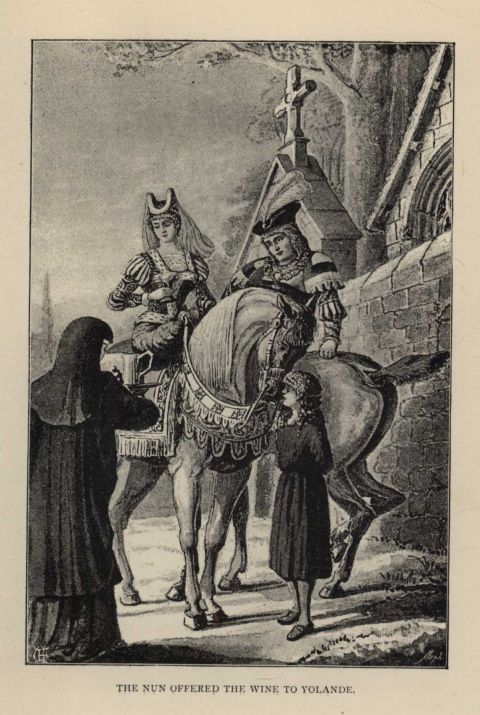
THE NUN OFFERED THE WINE TO YOLANDE.
The nun's face was strikingly beautiful. Her features were very straight, with splendid eyebrows, and a sweet mouth, whose full lips were rendered almost more attractive by the little droop at each corner producing a soft dimple in the rounded cheek. The long lashes lay like a fringe over her magnificent dark hazel eyes, and as she stood, quite impassive and expressionless, only deadly pale, Yolande felt drawn towards her as she had never felt drawn to any woman before.
The Captain of the Wight kept his eyes fixed on the sweet face.
"Pious lady," he said, "we are greatly indebted to thee for thy hospitable courtesy. Hast thou been in these parts long?"
Obliged to answer, the nun, still keeping her eyes, however, steadily on the ground, said, in a low, deep melodious voice,--
"Noble sir, Sister Ursula and I came hither but three months since."
"Holy saints!" muttered the Captain, "'tis her very voice!"
Then, after a pause, he said,--
"Thou art happy and peaceful here? There is naught that frights or disturbs you?"
A little flicker passed over the statue-like features. A slight tremor of the mouth, and a quiver of the eyelids, showed the nun was suffering from some not quite controlled emotion. Bending her head a little down, and keeping her eyes more than ever on the ground, she said, in her bell-like voice,--
"Noble sir, there is naught that frights us."
"And this girl, who is she?" asked the Captain.
"'Tis a child which hath been brought hither for our Prioress to tend."
"Hath she no relatives here?"
"Nay, I know not; but she is well with us," said the nun, looking at the child with affection. It was the first expression of softer feeling that had yet come into her face.
The child returned her look with love and bright confidence.
"Thou art happy here?" said Yolande.
"Ay, truly am I," replied the girl; "now I know father will be safe."
"And who is thy father, sweet child?"
"He is a noble knight, but I may not tell his name," said the girl.
"Dost thou know, holy sister?" said Yolande, unable to repress her natural curiosity.
The nun looked a trifle surprised, as if not expecting such a breach of manners in so high-born a damsel, but she replied, as coldly as ever,--
"Nay, I know naught that passeth in the world. None who enter here have name, or kin on earth."
Yolande shivered. It seemed like talking to a ghost.
As her thirst was now assuaged, and none of the others would take any more--although Lord Woodville took an apple from the pretty child, and in doing so availed himself of the opportunity of slipping a gold coin on to the dish, the nun withdrew as silently as she came, and the girl accompanied her, giving another nod of friendly farewell to Ralph.
"'Tis getting late, Lord Woodville, and I must be riding home," said Yolande. "Where my father hath gotten to, I know not; and as for my poor Breton, good lack!" and she broke into a merry laugh.
They rode away from the peaceful vale, the long shadows of evening falling across the plain, and the chill mist of the marshland rising in white film around. They were a silent party. Lord Woodville was plunged in deep reverie. Yolande could not strike any sparks of wit out of Ralph, who worshipped her far too seriously to be quite at home and at his ease, and took in serious dudgeon the playful raillery with which his cousin treated him on the subject of the dark-eyed damsel.
"You silly boy, you think you are fond of me; but when you reach the age of manhood, and are of an age to marry, the lady of your choice will be one who is now a girl of just that little one's age. You mark my words."
"And what do you call the right age to marry?" asked the crestfallen Ralph.
"Oh, not before you are thirty or forty, or fifty or sixty. There! I'll marry you when I am sixty. So now go and be happy, and grow as fast as you can; in wisdom, at least, for your body is big enough, good lack!"
As they rode back into the more cultivated land they met parties of two or three of the expedition returning from the chase; and as they passed Arreton Church they fell in with Sir William Lisle, who had been looking for his daughter, accompanied by Sir Amand de la Roche Guemené, who was mounted on a fresh horse.
"Marry, Sir Amand, where's thy horse?" laughed Yolande.
"Pardie, mademoiselle, zat I cannot tell. I left 'im in ze vase."[*]
[*] "Vase," Anglicé "mud."
"What vase?" said the astonished Yolande. "It must be a mighty big one if it can hold a horse."
"Foi de mon ordre! no; it would sallow 'im as easy as anyzing, and me too, 'ad I been ze fool to stop on 'im."
"Good lack! a vase swallow a horse and man? The poor man's lost his wits!" cried Yolande, while Ralph looked very much astonished, and began to laugh.
"Vat you go for to laugh, young man?" said the disconcerted and puzzled Breton. "Is zere anyzing drole in ze vase svalloving a man?"
"Why, beshrew me, there is!" said old Sir William Lisle. "Thou hast got hold of the wrong word; 'tis mud thou meanest, not a vase. Good lack! good lack! how these munseers do show their ignorance."
As Yolande and her father were not going back to Carisbrooke Castle, they took leave of their noble host, and rode away across the downs to Briddlesford, which lay at the head of the long winding creek which flowed in from the Solent, while the others pursued their way back to the castle.
The Captain of the Wight seemed plunged into a deeper reverie than ever, and scarcely spoke one word the whole way back. Ralph's mind was full of the tournament, and of the Abbot's promise to let him have money enough to equip himself as became an aspirant to chivalry.
As soon as he had an opportunity, he took Maurice Woodville and Dicky Cheke aside and told them of his good fortune.
"My faith, Lisle, you are in luck. How much will he give you?"
"I don't know; but he said he would tell old Langstoke to let me have what I wanted."
"Well, an I were you, I'd strike while the iron is hot. I should get leave from old Jack-in-Harness to go down to-night, and lose no time. There's only six days before the Feast of St Michael," said Maurice Woodville.
"Ay, so should I," said Dicky Cheke. "And, I say, Lisle, ask him to let us go too. We can help you; you're such a simpleton, any chapman can cheat you. You big fellows always are stupid and easily overreached."
Giving Dicky Cheke a tweak of the nose, which caused that young gentleman to rush after him as he left the room, and kick violently against the door, which Ralph prudently shut, with happy promptitude, behind him, Master Lisle went off to look for Sir John Trenchard.
He tapped at the door of the knight's apartments, and hearing a voice say "Come in," he opened the door, and found Bowerman reclining on a couch, his head bandaged and his eyes closed. He was alone.
"Who's that?" said the wounded page.
"Oh, Bowerman, I am grievous sad to see you look in such parlous case," said Ralph, his conscience pricking him for not having inquired after, or been to see, his wounded comrade before.
At the sound of Ralph's voice, Bowerman's face flushed up; and in a voice whose tones expressed concentrated hate, he said,--
"You fiend you! who asked you to come here?"
"Well, Bowerman, I don't see why you should bear me such ill-will. 'Twas not my fault you met with your mishap."
"Yes, it was. If you had not aimed at the beaver,[*] which you know well enough is the weakest part of the whole armour, I should not have got that splinter in my cheek."
[*] The visor.
"But," said Ralph, taken aback by this novel ground of accusation, "you could have aimed at mine; and, besides, the beaver would never have come open, had it been tightly clasped."
"That's all as may be! but I knew you had never done anything of the kind before, so I hit you where there was least danger; and in return for my good nature, you took a cowardly advantage of me."
Ralph coloured up.
"Bowerman, I have told you I am grieved you are hurt--if I could do anything to help you, I would; but, because you are wounded, you have no right to say such unjust and untrue things."
"There, that's just like your mean, lily-livered nature. Here I lie, unable to get up and punish you, all through your own base fault, and then you come in when no one is here, and tell me I tell lies!"
Ralph felt his temper rising, but he kept as calm as he could.
"You know, Bowerman, you are not just. But as you are suffering, I will not get angry. I can do nothing for you, then?"
"Ay, marry can you, and that speedily--get out of this room!"
At this moment Lady Trenchard entered.
"Ah, Master Lisle, that is right courteous of you, and as one of gentle birth should do, to come and visit your discomfited comrade. I marvelled you had not come afore. But I heard you were out with the Lord Captain, and so I told Master Bowerman."
Ralph felt a little uncomfortable. He did not deserve these excuses, for he had forgotten all about Bowerman. Lady Trenchard went on.
"Tell us now what sport you had. 'Twill cheer us up, and be as good as a tale for your comrade. 'Twill be kind in him, will it not, Master Bowerman?"
But the wounded page only tossed on his couch and uttered a sound, half groan, half smothered exclamation of furious rage.
"Ah, poor lad! he suffers much. I fear me these are febrile signs. 'Twill be well to have the worthy and pious Sir Simon Halbard to bleed him. He is something of a leech, and was infirmarer once, I heard, at Quarr Abbey; but thy tale will solace him, and take away his thoughts from the pain of the wound."
Ralph longed to get away, but he was too polite to refuse to do what Lady Trenchard asked him. He began--determining to make the narrative as brief as possible--to tell the chief events of the afternoon.
As he told of the Breton knight being stuck in the mud, a grunt of satisfaction proceeded from Bowerman.
"Ah! thou seest, Master Lisle. I told thee thy tale would solace him, and help to drive away his pain," said Lady Trenchard complacently.
When Ralph came to the nuns, and told how they had so willingly brought refreshment for Yolande, of whom, by the way, he scarcely spoke at all, Lady Trenchard remarked,--
"Ah, the Lady Abbess of Saint Clare, without Aldgate, wrote to me to go over and see the two new sisters who have come down of late. I am glad thou hast reminded me of this, fair page. There is one in whom she taketh much concern, as fearing for her health. She hath had trials in the world, and hath not yet gotten cured of them. And so thou rodest all day with the fair Mistress Yolande?" added the grave and erect Lady Trenchard, with a penetrating glance.
Ralph grew very red.
"Yea, my lady--that is, nay. She rode with my Lord Captain, and I waited on him, as was my duty."
"Ay, and so she rode with the Captain? Like enough, like enough!" Then, after a pause she added, as if in a soliloquy, "Ah well, she won't make much of him, poor lass. His heart's been broke these twelve years or more. 'Tis a sad story, and not one you lads would care to hear."
"Yes, I should, Dame Trenchard," said Bowerman shortly, while Ralph looked up surprised. It had never crossed his mind that so exalted a person, and so rigid as the Captain of the Wight, could possibly have a weakness or a romance.
"Nay, nay," said Lady Trenchard, sorry she had aroused their curiosity, "'tis a long and sad story, and not one that will give you joy. Besides, 'twas a kinsman of Master Lisle who married the fair girl, sore against her will; but her own true knight was away, and her father's and the king's will had to be obeyed, and so she was wed. But not for long--she soon died, they said; but who knows? 'Twas a sad story."
And Lady Trenchard nodded her head gravely, then shook it sadly, as if she saw some sad mistake occurring, and lapsed into silence.
"But what of the Captain of the Wight, Dame Trenchard?" said Bowerman. "What hath he to do in all this?"
"The Captain of the Wight! what of him?" said Lady Trenchard absently. Her thoughts had gone off to the shortcomings of her maids, and whether Dame Joanna Bowerman would not have looked better in a black cote hardie, and lemon-coloured taffeta kirtle, than the yellow one which she wore, with a bright blue bodice.
"Not but what she tireth herself well, does Joanna Bowerman. I mind her when she was little Joanna Roucley. She always did have a liking for smart things, and she's a woman that bears them well--I will say that for her. But she lacked skill in colour."
"But what of the Captain?" persisted Bowerman.
"Well! what of the Captain?" said Lady Trenchard, with some slight asperity. "I know naught of the Captain. He hath come back, I trow?"
"Yea, but you were telling me of some love affair of his."
"Marry, was I? not that I know of. You sleep now, Master Bowerman; 'twill be best for you," said Lady Trenchard decisively.
Eustace Bowerman muttered something that sounded very like "old hag," and "obstinate old harridan," which was quite unheeded by Lady Trenchard; and Ralph took the opportunity to slip out of the room.
CHAPTER XIII.
OF THE SHARPENING OF THE COCKEREL'S SPURS.
And now the morning of the Feast of St Michael had come. All the preparations were complete, and the lists were ready decked. The green sward between the stout palings, gaily painted and bedizened with flags, was divided in the middle by a barrier, which was covered with a gorgeous hanging, and parted the lists lengthways into two equal divisions.
As Dicky Cheke and Ralph Lisle strolled round in the early morning--for there was no drill that day, and all ordinary exercises were suspended--they were delighted at the handsome appearance of the preparations. The covered gallery or grand-stands for the ladies; the numberless poles, gilded and painted, from which gay shields of arms were hung, and still gayer banners and banderoles fluttered; the lavish adornment and laborious preparations, struck them with astonishment, although they had seen the work going on for some days past.
"In sooth, Dicky, there's been great charges here. Who pays the cost?"
"Why the Captain, certes, though the Bretons pay some of it; but 'tis rarely done, i' faith. Thou'rt a lucky wight, Ralph, but thou wilt get a fall to-day, for 'tis not 'gainst 'Pig's Eyes' or Bowerman thou wilt ride, so make up thy mind to comfort thy broken bones."
"Ay, marry will I," said Ralph, laughing. "But I trust to do my devoir without disgrace. But 'twas a sad mischance Black Tom went lame," added the boy, changing his merry tone to a sad one. "He was the horse of all others for a tilt. Such depth of chest, such limbs and wind! Beshrew me if I can think how he could have gone lame like that, and only yesterday too. 'Twas a rare mischance," and Ralph looked very downcast.
With the money, or rather the order which the Abbot of Quarr had given to pay for all things needful to the merchant, Master Langstoke, Ralph had bought two very serviceable horses, one a great bargain. He had been guided in his choice by Humphrey, who was a likely man at buying cattle. This horse had belonged to an esquire who had been killed at the battle of Stoke, and was thoroughly broken to all the work of the tilt-yard and the battlefield. Ralph had been delighted at getting such an animal, and the congratulations he received upon it. Many old hands had told him that a good horse was more than half the battle, and all who saw Black Tom were loud in their praises of his good points.
"Ye see, Master Lisle, 'tis this way," remarked Lord Woodville's head varlet or groom. "A 'oss that's too quiet be't no good, nor a 'oss that's all fire. What you wants is a animal that's used to the work, and this 'un be, for I knows 'un."
The horse was perfectly sound the night before last. Ralph had ridden him that afternoon at a little quiet practice at the quintain first, and then at a light tilt with Tom o' Kingston, and nothing could have been better. But the next morning Humphrey came early with a very long face to say that he didn't "like the looks o' Black Tom at all, he were so tender on his near fore leg, and the pastern were all swollen like and hot."
This was bad news. All the authorities of the castle were consulted, and a careful examination of the tender hoof was made, with the result that it was found that a sharp nail had penetrated the hoof, causing severe inflammation. It was impossible that the poor animal could be ridden for some weeks, perhaps for some months.
But how had it happened? There was the mystery; and several old hands shook their heads, and did not hesitate to say that there had been foul play. Ralph's disappointment was intense, and Maurice Woodville and Dicky Cheke were profuse in their expressions of sympathy. Every one in the castle felt for Ralph's mishap, for he was now a universal favourite, his modesty, good nature, and brave bearing having endeared him to every one; and he was also well known and liked in the town of Newport, so that the news of the strange accident had spread round the neighbourhood in very little time.
The days before the tournament had been spent in perpetual practice at the quintain, and tilting against each other in half armour and with very light lances, made so slight as to break with but little force. In this way the boys had become excellent hands at aiming their spears to the best advantage, and in becoming used to the shock of the blow, so as to grow accustomed to the knack of holding on to the saddle with their knees at the exact moment without losing their nerve. In these encounters Dicky Cheke and Maurice Woodville were very fairly matched, and such falls as they had were pretty evenly balanced, although Dicky, if he got the worst of it, invariably had some excellent reason for his mishap, and was voluble in his explanations, while Maurice took it quietly, and was even a little disconcerted by his misfortune.
Bowerman had nearly recovered, and was to be allowed to take part in the forthcoming tourney, but he was not allowed to practise at the tilting with the others, for fear of opening his wound again by any mischance. He had therefore practised at the quintain, and other exercises that taught him to aim and strike, without, however, receiving a blow in return.
Willie Newenhall had thus been left to tilt always with Ralph Lisle, and although the latter, when he had knocked his antagonist off once or twice, refrained, out of pure good nature, from putting forth all his strength and dexterity, yet "Pig's Eyes" was very wrath and sore at being so manifestly inferior to one so much younger than himself.
More than ever the five pages were divided into sides. Newenhall and Bowerman scarcely ever spoke to the other three, and never lost a chance of getting them into trouble if they could, or of making them do work which was unpleasant to themselves.
Ralph was very good-natured, and would have done anything for Bowerman, in spite of his violent language and the manifest hatred the latter bore him. But Dicky Cheke resented their treatment, and took every opportunity of annoying or crossing the others. He and Woodville were frequently the victors in this sparring of rival wits; and if only they could get "Pig's Eyes" alone, he had a very uncomfortable time of it.
Ralph had provided for the approaching pageant with considerable wisdom, in spite of Dicky Cheke's mistrust of his powers. He had been able to buy, besides the two horses, a very fine suit of tilting armour, and two splendid tunics, and close-fitting hose, with a fur mantle of the latest fashion. The tunics were slashed, and one was made of large stripes of orange tawny satin and delicate grey, with rich ruby velvet, and slashed at the shoulders, elbows, and across the chest, while the hose were also made in large stripes, but of white and pale lemon-coloured satin; rich Cordovan leathern slippers of crimson colour protecting and adorning his feet. This suit was for wearing after the tournament the first day. The other suit was equally magnificent; for those who took part in the tilt were dispensed from wearing the livery of the Captain of the Wight for that day.
He had received by an unknown hand, a tiny silk glove, and a little scrap of paper, on which was written in a very scrawling hand,--
"An ye ware thys, ye last course ynne,
Ye shall eke lyfe and honour winne."
This was brought him by Humphrey, wrapped up in a little packet. It had been left for Ralph by a man who was unknown at the castle, but was believed to live at the back of the island, and to be a fisherman. He had been loitering about for some days past, and had latterly been accompanied by another man, who was also believed to be a fisherman, and who used to live at Wodyton, some years back. Ralph had been surprised at the enclosure, and still more so at the legend, and had secretly determined he would put the glove in his helmet before the last course, and see what would come of it. He had not yet received any favour from his cousin, and felt very moody and disconsolate in consequence.
As the boys were walking round admiring the arrangements, the light of the early sun falling on the eastern walls, towers, and battlements of the grand old castle, while the blue mist still hung over the valley, hiding the town of Carisbrooke, out of which the fine tower of the Priory church or chapel stood up like a tall rock in some grey lone sea, a varlet came out of the postern gate and called to Ralph Lisle to come into the castle-yard, where he was wanted immediately.
Ralph and Dicky Cheke followed hastily, and as they turned the corner by the well-house they saw, standing in the full light of the sun, a splendid horse, held by a groom in the livery and wearing the badge of the Lord of Briddlesford, Sir William de Lisle.
As Ralph drew near, the man held up a note, saying to Ralph, to whom he was well known,--
"My young mistress, the Lady Yolande, sends you this, with my lord's leave. 'Tis a well-trained horse, if ever there was one, and hath borne one in tilt and tourney, whom I'd like well enough to see here again. But as that mayn't be, and you bear the name of Lisle, you are to ride him; he's yours for the day--and maybe for ever."
Ralph was utterly surprised. He took the note mechanically, opened it, and read it. It was from Yolande, and said that as she could not give Ralph her favour, which he would see worn elsewhere, she had sent him the best thing she could for him to win it. She deeply deplored the accident to Black Tom, and hoped White Will would make up in some slight way for the disappointment he had suffered. The horse had belonged to her half-brother, and was well used to his work. "Therefore," she added, "ride boldly, as I know you will, and fear not to press the horse, for 'tis your own Good luck--your loving cousin--YOLANDE."
Ralph's joy was boundless. He instantly vaulted on to the noble animal, and rode him round the yard, to the admiration of every one, excepting Bowerman and Newenhall, the former of whom looked on with scowling brow and sneering mouth; the latter in blank stolidity.
"I sha'n't be able to do for him to-day," muttered Bowerman; "but to-morrow, in the fight with axes and hand-strokes, I can do somewhat."
"But you are not allowed to take part in it, Bowerman," said Willie.
"Gammon! I'll do it somehow, trust me," answered Bowerman fiercely.
While the pages were having their breakfast, they talked of nothing but the tournament, and who were coming.
Bowerman and Newenhall, from their superior age and knowledge of the island, as well as from having seen a tournament before at London, when Lord Woodville had been one of the challengers, were able to lay down the law upon all points connected with the tilt; and Dicky Cheke, who prided himself on his great acquirements, was rather quenched.
"And the two Bretons will have two other knights to join them," Bowerman was saying. "There's Sir Richard Cornwall, a very valiant knight, and much skilled in tilts and jousts; but who the other is no one knows, but I have a good guess--leastways, he is sure to be brave, and well skilled in warlike feats."
"Well, then," said Dicky Cheke, "let's see who there is for us. There's my brother, he'll be a good one; then there's Sir John Keineys, he who married old Hackett's daughter, of Knighton Gorges."
"What do you know of Knighton Gorges?" broke in Bowerman. "You hold your tongue, and listen to your betters. There's Keineys, and John Meaux, and John Leigh of Landgard, Tichborne from Lemerston, young Trenchard from Shalfleet, old Jack-in-Harness's nephew, Will Bruyn from Affeton, and Dick Oglander. They are all fair enough, but I wish they were better trained. They've all got rusty since these peaceful times have come."
"You've forgotten Dineley of Woolverton; and I hear old Bremshot of Gatecombe has sent over to young Dudley, who married his daughter; and there's--"
"Oh, you have done!" broke in Bowerman angrily. "You're always talking, and get hold of the wrong end of the story, and--"
"He doesn't," said Maurice; "and he knows as much of the island as you do, and more, too--"
"Ay, marry, do I! And what's more, before ever your beggarly family came here, the Chekes of Mottestone were lords of Mottestone for more than a hundred years--"
A blow from Bowerman was the rejoinder to this remark, which Dicky foresaw, and avoided by ducking under the table, while Maurice and Ralph interposed to prevent any further quarrelling.
"And when do we ride our courses, Bowerman?" said Ralph, always ready to receive information, and totally devoid of all personal vanity.
"Oh, you'll know soon enough; leastways, yours'll come after mine, and then you'll find out."
It was now but an hour and a half before the tilt would begin. The two boys who were to act as pages to Lord Woodville hastened to dress, and attend upon him. It appeared he was not going to tilt, but would act as judge and umpire with Sir John Trenchard and Sir Nicholas Wadham.[*]
[*] Afterwards Captain of the Isle of Wight under Henry VII. and Henry VIII.
The three pages who were going to take part in the tilt went to get ready also, and were carefully instructed in their duties by Tom o' Kingston.
The space around the lists was becoming crowded. There was no more popular amusement than a tourney, and as the arrangements were very costly, they did not very often occur in the provinces. But in a garrison like that of Carisbroke Castle, there was always to be found some one who would share in the expense, and earn popularity and experience at the same time.
There was a greater amount of interest than usual on this occasion, because there was something international in the contest, and it was known that several of the island gentry were going to take part in it.
Punctually at a quarter to eleven the sergeant-at-arms and a body of men-at-arms drew up in front of the apartments of the Captain of the Wight. Another company of mounted archers followed, and drew up on their left. Then came four trumpeters, splendidly attired in tabards, blazoned with Lord Woodville's coat-of-arms, and another body of mounted archers followed, succeeded by a squadron of men-at-arms, who all formed to the left of the first detachment. The three knights-challengers now came out of the dining-hall, armed cap-à-pié, and looking splendid in their gleaming tilting armour. Each knight was distinguished by his shield-of-arms, slung round his neck, and hanging over his left shoulder, and his crest proudly surmounting his tilting helm. Their esquires were waiting outside, and their varlets were leading their horses, armed with complete body armour, and gorgeously caparisoned, up and down. The fourth knight had not yet appeared.
As each knight mounted, there was a flourish of trumpets from the four trumpeters; and as he settled himself in the saddle, and took the heavy tilting-lance, richly painted and gilded, into his mailed hand, the war-horse reared and pranced, and shook its crested head, as if proud of the noble sport awaiting it.
When the three knights were on horseback, they drew up in front of the trumpeters, attended by their esquires and varlets on foot, all splendidly attired.
The Captain of the Wight had invited the chief families of the island, and the most important of the official world, represented by the Bailiffs of the three boroughs of Newport, Newtown or Frencheville, and Yarmouth, and the Bailiffs of the various ecclesiastical bodies who held land in the island--such as the Priory of Christchurch, the Monastery of Whoreley, and of Winchester College--but the Abbot of Quarr took precedence over all the other ecclesiastics who had been invited, although scarcely any came. In fact, the Abbot ranked next to the Captain of the Wight in insular precedence.
Among the ladies who looked down from the oriel window of the Captain's apartments, the lovely face of Yolande de Lisle could be seen, and the faces of several other well-known Isle of Wight ladies.
But as soon as the knights-challengers were mounted, there was a general scramble of the guests to get good places in the stand erected for their benefit. Yolande, however, had been asked by the knights-challengers to give away the prizes, and act as queen of the tourney, she therefore stayed to be escorted in state with the Captain of the Wight, who was to conduct her to her throne.
And now it was the turn of the Lord Woodville and the judges of the jousts to take up their position in the pageant. Preceded by two gorgeously-dressed yeomen of his household, carrying silver-gilt halberds, the Captain of the Wight took the hand of Yolande, and led her to the hall, followed by her two maids-of-honour, who also belonged to leading island families, and were chosen by Mistress Lisle--one was a niece of Sir John Trenchard, the other a daughter of Master Keineys, of Yaverland. Sir John Trenchard and Sir Nicholas Wadham followed, with Dicky Cheke and Maurice Woodville in immediate attendance on the Lord Woodville.
The appearance of the Captain of the Wight and the Queen of the Tournament was greeted by a prolonged flourish. Their horses were in waiting. Lord Woodville placed Yolande on her palfrey, and then mounted himself, his nephew holding his stirrup for him.
When all were mounted, the trumpets gave another flourish. The squadron wheeled to the right. The two leading detachments marched towards the great west gateway, the trumpeters followed, then the three knights-challengers fell in, with their varlets and esquires, succeeded by the Captain of the Wight, riding beside Yolande, attended by the other Judges and their escort, and then the remaining two squadrons of archers and men-at-arms closed in the procession.
The cavalcade rode round over the drawbridge and under the north walls of the castle to the rising ground which led up to the place of arms, not yet closed in, or forming part of the castle, as it subsequently did in Elizabeth's reign.
As they approached the lists, they were greeted with loud shouts from the people, who had now assembled in crowds.
Mounted archers kept the ground, and yeomen in liveries, and armed with partisans, surrounded the lists.
All those who were seated in the pavilion rose as Lord Woodville approached. Lifting Yolande off her horse, he handed her to her throne, which was proclaimed by three prolonged blasts of the trumpets. The Captain of the Wight then took his own seat, after bowing to the assembled gentry and people.
The knights-challengers had meanwhile ridden slowly into the lists, and after pacing round them, had halted at the further end, having previously saluted the Captain of the Wight, the Queen of the day, and the Judges.
All was now ready. But another ceremony--for it was an age which dearly loved ceremonies--had to be gone through.
First of all the herald belonging to the household of Lord Woodville entered the lists and read out in a loud voice the licence for holding the tournament; then he read over the names of three of the knights-challengers, simply describing the fourth knight "as a right hardie and worshipful knight." After which he proclaimed the rules of the jousts. The most important of which were, that whoever was unhorsed or disarmed was to be considered vanquished, and that no one, by deed, word, or sign, was to interfere with the jousts.
Meanwhile the knights and esquires who were to encounter the knights-challengers had collected at the other end of the lists, and after riding round and saluting their antagonists, and the Judges, had taken up their position outside the lists, at the opposite end to that of their opponents.
CHAPTER XIV.
HOW THE COCKEREL USED HIS SPURS.
As the tilt which was now about to take place was merely a friendly display of knightly prowess, and "for the honour of ladies and their delectation," the knights were to encounter with blunted lances and swords. The Marshal of the Lists having examined the arms, all who were in the enclosure were ordered out, and the knights only awaited the signal to begin.
Each knight was to ride three courses separately with his antagonist, and then three courses again afterwards.
There was now a lull in the busy hum of conversation that had been going on in the large crowd. Every one was on tip-toe of expectation to see the two knights who were first to encounter.
There they sat erect, a little in front of their comrades, their lances upright, the steel-clad figures stiff and immovable on their gorgeously-trapped horses. Not a movement could be seen in one or the other, only their pennons flickered in the light air, and the lambrequin or slashed cloth mantling of their helmets blew out from time to time.
As the names of the knights and esquires who were going to take part in the tilting had been affixed in the market-place of Newport, as well as on the gate of Carisbrooke Castle, for some days past, together with their coats-of-arms, the people all knew who was who.
"That's the sturdy Breton knight at that end, him in the white tabard, with the gold dragon on his breast," said a stout yeoman, who was one of a group of several men round a fair and buxom dame, whom Tom o' Kingston, being on duty, could only ogle from under his visor, and who was no other than the irresistible Polly Bremskete.
"And who's that at the other end; he looks a tough wight?"
"What, him in the gold coat and a green lion with a forked tail? That's young Sir John Dudley, him as married Mistress Bremshott up to Gatcombe."
"Marry! now who'd have thought such a small man would have looked so big. 'Tis the armour surely--how it do swell them out."
"Hush! they're going to begin."
The trumpets gave a flourish. The Marshal, after a pause, called out in a loud voice,--
"Laissez aller!"
At the first sound of the trumpet the two knights had brought their lances to the rest with a simultaneous and graceful sweep, causing the gay pennons to flash in the sun, they then remained motionless as before.
At the last word, they clapped spurs to their horses and rode straight for each other, bending their heads low down, leaning well forward, and covering themselves with their shields.
"Lord! what a crack!" cried Mistress Bremskete, in admiration.
"He's off! he's off!"
"No, that he bean't."
"He was parlous nigh anyway! I lay a yard o' broadcloth he'll be off next bout. But 'twas well done, leastways: that's what I will say."
The two knights had met with a violent splintering of spears in the midst of the lists. The Breton seemed never to feel the shock at all, for he rode on, tossing away the broken handle of his lance, after waving it aloft in the air. But the English knight reeled in his saddle; only he recovered himself directly, and rode up to the other end of the lists, where he turned, reined in his horse, and waited for his esquire to bring him another lance.
The trumpet sounded. The herald shouted,--"Well done, noble knights; remember the brave deeds of your ancestors. The ladies' eyes are upon you."
When the knights had received new lances, they once more awaited the signal. It soon came, and again the gleaming figures met in the rude shock. This time Sir John Dudley's lance struck the helmet of his opponent, and carried away the crest and part of the lambrequin, while the Breton knight's lance glanced off the ridged breast-plate, and, passing under the arm, the guard struck full against the cuirass of Sir John Dudley, and the two knights were both nearly unseated. Had they not been practised riders, and reined in their horses at the same moment, they must have fallen. As it was, they remained locked together for a moment, and so stood until the herald called out,--"Enough! 'tis well done; unloose."
They then disengaged, and rode back to their own end of the lists, amid the shouts of applause of the populace, and the music of the trumpeters.
"They are right skilful knights! I don't know as I ever saw better," said Tom o' Kingston to Humphrey, who stood near him holding a spare lance for his young master. "But there they go again. Holy Thomas! but he's off; good lack, I am parlous grieved. I would it had been the other."
A groan and shout of applause mingled together, while a dull thud and clang of metal falling, announced that one of the knights had been thrown.
"Marry, I am sorry 'tis poor young Sir John; and there's his wife looking on now! Well, 'tis a pity, to be sure," said Mistress Bremskete.
"Ay, but she takes it mighty comfortable anyway. See how she's laughing with the Lord Abbot of Quarr there."
"Well then she hadn't ought, that's what I say, Look! they're picking of him up. Alack, poor man, how he do bleed! 'Tis from the mouth, seemingly. Well-a-day! well-a-day! but 'twas a rude knock."
And so amid the plaudits of the crowd and the clarion blasts of the trumpets, the Breton knight returned to his end of the list, and took his station next the last of the challengers, receiving their congratulations as he rode up, while his luckless antagonist was helped out of the lists, to be attended to in the tent set aside for the reception of those wounded in the tilt.
The next knight who rode out from the challengers' end was Sir Amand de la Roche Guemené. As he took up his place, he turned towards Yolande and bowed low to his saddle-bow.
"Why, he's wearing the same colours she's got on! Well, to be sure, that's a merry jest! Can't she find among all our island gentry one to her taste, but she must go giving away her favours to them jackanapes Frenchmen? But 'tis ever the way with your high-born wenches; they always goes after what's strange, never mind how ugly it be, if only it be something new. It all comes of so many running after them."
"Then, Mistress Bremskete, you ought to like those Breton gents, seeing the many suitors you have," said the ready yeoman by her side, with a knowing leer, giving his buxom companion a nudge with his elbow.
"Go along with ye, Master Paxhulle! you're always fooling us poor wenches with your soft tongue."
"I'll have to trounce that Paxhulle, I see," said Tom o' Kingston savagely, to Humphrey, upon whom the merry glance of Mistress Bremskete, and the leer of her companion, were in no way lost.
"I say, that's Sir John's nephew there. I do hope he'll do well! 'Tis a nice youth; but they're all too young, to my mind. These Breton knights have been well tried in many tilts, and are tough and skilled. But there they go! Good luck go with him--ah!--'Twas well done! He's a brave youth."
After splintering their lances without any further damage, the two cavaliers cantered on to the end of the lists, wheeled round and faced each other, taking the fresh lances handed them by their esquires.
Whether it were that young Trenchard really bore himself with greater skill and address, or that his antagonist, out of knightly courtesy to the trusty friend of his host, the Captain of the Wight, forebore to use all his skill and strength, it happened that the three courses were ridden without any mishap beyond a plentiful splintering of lancewood, and a rending of knightly finery.
Sir John Trenchard was evidently pleased, and accepted the congratulations of Lord Woodville and Mistress Lisle with but half-dissembled satisfaction.
"'Tis a good lad, and will do well," he said, "an the ladies spoil him not; for he is comely, and of fair manners."
The next knight to ride out from the challengers' end was Sir Richard Cornwall, a very powerful, strong knight in magnificent armour. His appearance was greeted with a hum of applause.
"Now, that's what I call a hardy knight, and something like a man. None of your little jackanapes of Frenchmen and raw youth. Look at his bone--look at his breadth of chest. 'Tis a pity he's an overrun."
"But 'tis a strong man he's got against him. 'Tis Master Meaux o' Kingston."
"Marry! that's right. 'Tis a good Island name, and he's a stout Island gentleman, too. 'Twill be a rare tussle."
The words of caution were given. The order to go followed, and the two strong figures on their powerful horses met in the midst.
There was a shout of applause from every one. The two lances flew up into a thousand splinters, the two horses fell back on their haunches, and the steel-clad figures, erect and firm, wheeling them round, rode back for fresh spears.
"'Twill be a marvel an one of them does not get an ugly knock," said Humphrey.
"Ay, marry will it; they're tough men-at-arms--but I wish one o' them splinters would hit that Paxhulle in the eye!" said Tom o' Kingston savagely; "it 'ud stop his leering for some time."
Once more the signal was given, and this time something was bound to go. The shock was tremendous.
"Holy Thomas! he's off! he's down! Mercy! but 'twas a fine stroke! Ah! my gay gentleman, but you're on your back now. Well done, Master Meaux! The Island for ever! A Meaux! A Meaux!"
The shouts of joy and the braying of the trumpets were long sustained and hearty. It was the first triumph of the popular side, and the enthusiasm was intense.
Sir Richard Cornwall had been overthrown without any disgrace to himself. In such a shock it was clear that every leather and strap of the horses' harness would be tried to the uttermost, and the girth of his saddle breaking, and the poitral also, he was borne backwards over the crupper to the ground, saddle and all going with him, and his horse nearly falling over backwards; for, like the good knight he was, he never let go of the reins.
"'Twas a pity Master Meaux was not matched against the Frenchman," said Humphrey.
"Ay; but he'll have to meet him before all's done. Who's coming now? Oh, I see, 'tis Master Bruyn. He won't be o' no account; he's been brought up too soft," commented Tom o' Kingston.
The first Breton knight now rode out again. It looked ominous for the Squire of Affeton.
But as if divining the popular wish, and in no way desirous of winning fame only at the spear-point, Sir Alain de Kervignac rode the three courses with great skill of horsemanship, but little exercise of strength. And so the Island knight got off scatheless and with honour.
"He's a right gentle knight that Breton. He could have knocked that poor youth all to pieces had he liked; he's as courteous as he's stout." And all the crowd agreed with Master Paxhulle, and shouted their approval.
There still remained five knights, without counting Bowerman, Newenhall, and Ralph, who were eager to try their prowess with the challengers. The day was getting on; there did not seem a chance of being able to finish the courses unless some of the combatants were disabled in their first tilt. This became apparent to the knights-challengers. They therefore said that as enough had been done for courtesy and love of the ladies, and time was getting on, they would now tilt hardily, and sparing neither man nor horse, and that as they knew there were some youths among their antagonists, they gave this notice to prevent their being hurt.
"The coxcombs," said Bowerman, when this was announced, "do they think to frighten us away by words? They are getting afeard for their cattle; but I'll do my best," and Ralph Lisle agreed with him heartily though silently. Not so thought Newenhall, and he determined he would willingly miss his turn when it came, and so let the others get the knocks instead of himself.
Three other knights also signified their intention of giving those who were more desirous of the honour of encountering the challengers than they were, the priority of place.
These were Sir John Keineys and Masters Dineley and Leigh, who were all men past the prime of life, and who had merely entered to support the manhood of the Island. Thus only the three pages of the Captain of the Wight, with Dick Oglander, from Nunwell, were left; for Master Tichborne, from Lemerston, had not arrived yet. Master Bowerman now offered himself.
He was greeted with applause, for the crowd had heard the announcement of the challengers, and admired the pluck of the young aspirants to fame who were left.
Everyone knew that it was the page's first tilt, and the accident from which he had been suffering, combined with the pluck he showed in not retiring when he might easily have done so without loss of honour, created a strong feeling in his favour.
The Breton knight was loth also to hurt him, and in their first encounter he hit Bowerman very lightly on the shield, receiving the lance of his opponent on his own helmet, from which the last remnant of his crest was shorn.
"Well done, Master Bowerman, thou'rt upholding our Island right manfully," called out some of the bystanders.
The next course was very well ridden also, the lances splintering, and Bowerman, although reeling from the shock, kept his seat and rode on to the end. Elated by his success, the natural boastfulness of the young man came out.
"Look to your seat, Sir Breton," he called out before the last course, "for I mean to topple thee out of it."
"Beshrew the lad for a braggart!" growled Sir John Trenchard, scandalised alike at the breach of etiquette and the boastfulness of the boy.
The Sire de Kervignac said nothing; he only courteously bowed, and awaited the signal to charge. It soon came, and they met as before, but with a different result.
The Breton knight, as expert as he was brave and strong, seeing how eager and boastful the young man was, determined to read him a lesson. As Bowerman leant well forward, too much so for a firm seat, instead of aiming his spear at the page's body, or, indeed, directing it at all, the Sire de Kervignac struck a violent blow with the handle or butt-end of his lance over the lance of his antagonist, beating it down, and breaking it all to pieces, with the further result that Bowerman, who was preparing to push with all his might against the expected resistance of the body of his opponent, meeting with no obstacle, and drawn still further over by the blow on his lance, overbalanced himself, and before he could recover his seat, a rude knock from the butt-end of his antagonist's spear, as he rode past, completed his discomfiture, and he fell headlong to the ground.