THE CAPTAIN OF THE WIGHT (continued 5)
Reading edition
"Who lived in great joy and felicitie,
With his fair ladie, dear pretty Bessie."
When she had neatly put all the things away on some ledges of the cave which served for shelves, she went to the entrance and looked out. She noticed that the old boat, which was usually hidden under a deep cleft in the rock, out of reach of the highest tides, was now hauled down, and lying ready for launching, and that there were sundry kegs and bundles in it, looking as if there were preparations for an expedition.
The salt smell of the sea came up fresh and keen from the tumbling waves below, and the girl looked wistfully towards the south.
She felt very lonely, more so now than ever, for her father, always preoccupied before, seemed gloomier of late, and to notice her less than he used. There had been much going to and fro on the part of the seamen, and Magdalen had herself brought a missive from the Hermit only the day before, which had caused a great display of feeling on the part of her father, a flush of fierce joy passing over his countenance, as he muttered, after reading the cartel,--
"At last! Thank the saints! the matter will be settled once for all."
While Magdalen stood looking down the strange water-worn chasms, she was startled by hearing Bowerman say in a scoffing voice, but in an undertone, to Simon,--
"Marry, Simon, we are to take no part in the fray, eh?"
And then he laughed derisively, while the seaman added gruffly,--
"Not us! Well, I never; that be a good 'un. But I'll have some of their fine harness and gew-gaws, if I swing for it."
"Tush, man! thou canst have them easy enough; but 'tis their lives first we must have. He's sure to be there. He makes such a stir about him; all the more since this wound of his. Curse the weak stroke! why couldn't it have gone home?" broke off the esquire bitterly.
"Ay, ay, 'twas a bungling business that. He was but a greenhorn at that sort of work, whoever he was," said the seaman, eyeing Bowerman with a grim twinkle in his bleared eyes, as he went on furbishing up a steel breastpiece. "But he's a fine youth, that I will say," he added.
Magdalen changed her position so as to get a view of the faces of the speakers, but trying to draw as little attention to herself as possible. She noticed a flush pass over Bowerman's face as he bit his lip, but said nothing, only he felt the edge of a sword he had been scouring.
"We'll make better work of it, Simon, this time--eh?"
"Faith we will, or you may call me landlubber for the rest of my days. I owe him a grudge for having had me put in the stocks for nothing at all. 'Tis a chance will never come again. Think of his being such a fool as to trust hisself alone in a fight with our master. But he won't live long to repent it, if I get this knife into him," added the man, with an ugly "job" of the blade into a balk of timber on which he was sitting.
Magdalen shuddered. What were they talking about? She dreaded to think. There was something terrible going to take place. How should she find out? She resolved to ask her father. She stepped past the two men, and entered the cave. She found her father busied with the unusual and difficult operation of writing. He took no notice of her, and she sat still by his side, watching him laboriously forming his awkward letters.
"Father, can't I help you?" she ventured to say at last.
"What, little wench, you here still? I thought you were gone long since. What will the worthy Prioress say?"
"Oh, she won't mind; she bid me stay as long as I could help thee. But Sister Agnes looks most after me."
"Ay, and who is Sister Agnes? But there," seeing the child was going to enter upon a long account of her doings at the nunnery, "I am parlous busy now. Thou canst stay an thou mindest, and in the evening Bowerman can see thee on thy way home."
This was not at all to Magdalen's taste.
"But may I not aid thee now, father? Thou knowest I can write; and I have become a better scribe lately?"
"Hast thou so, my little wench?" said her father, stroking her head. "But these are matters beyond thee." He paused, and then went on. "Magdalen, my child, thou wilt always be a good girl, and do what the worthy Prioress tells thee. If aught taketh me away, thou wilt mind what I have said, and there will be those who will care for thee. Thou must learn to look kindly on Master Bowerman, and thy fortunes may one day be happier than now seemeth likely. But leave me now; I must settle these matters, and the time is not over long."
Magdalen, well knowing the reserved nature of her father, and not caring for the escort of Master Bowerman, especially after what she had overheard, resolved to go back to the nunnery; but she also made up her mind she would see the Hermit of St Catherine's on her way, and tell him of her anxiety.
She therefore took leave of her father, who seemed more affectionate than usual; and declining Bowerman's offer of accompanying her, she climbed the difficult path up the cliff, and disappeared over the brow of the gorge.
CHAPTER XX.
HOW THE CAPTAIN KEPT TRYST.
It was about a month after the tourney, when Ralph, who had entirely recovered from his wound, was summoned to attend the Captain of the Wight.
On entering the Lord Woodville's room, he found that nobleman standing before the fire in a contemplative attitude, and Ralph stood for a few moments in respectful silence.
Presently Lord Woodville looked up, and, noticing Ralph, resumed at once his usual manner.
"My young esquire," he said, "I have sent for thee because there is no one of my household whom I can trust more than thee."
Ralph coloured up with pleasure; he noticed with pride the change of title. He was no longer a page, but esquire to his lord. But what went to his heart far more than this was being addressed in such affectionate and trusting terms. Lord Woodville had won the boy's heart from the first by his noble bearing, handsome appearance, and lonely life. In the midst of a gay and martial household, always dignified, placid, and reserved, Lord Woodville seemed to him like some hero of romance, some knight-templar who had consecrated his life to God, and, unlike the common herd of monks, who withdrew from the world in timidity or selfish sloth, he remained in it to face the temptations, the pleasures, and the vices, and to face them not merely as an idle spectator, but as a splendid protest against the vanity of the world. Not pledged or bound by any such bonds as those by which weaker mortals sought to guard themselves from the allurements of life; not fleeing for protection to the feeble chains of monastic institutions, or even the semi-monastic life of the great military order which alone survived, but like a stout pinnacle of indestructible granite round which some stream for ever dashes its ceaseless waves, now striving to wear it away with the soft embrace and gentle murmurs of its softly wooing current, then dashing against the calm rock in the wild tumult of its turbid waters, and seeking to topple it from its base with the rage of its fierce turmoil, so stood out the life of the Lord Woodville in its tranquil strength.
Outwardly cold, but inwardly burning with the desire of martial fame; always the first in all warlike enterprise; a strict disciplinarian, but a most kind and gentle knight to all in distress or suffering, the Captain of the Wight was the beau ideal of a preux chevalier. In every battle of the fierce civil wars he had shown himself a daring man-at-arms, as well as a prudent chieftain, and, like his accomplished brother, he was devoted to the arts in times of peace. He was a strict observer of the religious life of the times, and although not blind to the many shortcomings of the clergy, yet he did all in his power to promote the influence of religion, and to improve all with whom he came in contact.
A deep sorrow had fallen upon him in his domestic relations. His gallant father, the Earl of Rivers, together with his brother, Sir John Woodville, had been beheaded barbarously by the orders of the great Earl of Warwick. His brilliant brother, the Lord Scales, died under the executioner's sword at the cruel mandate of Richard, Duke of Gloucester, for no other crime than attachment to his nephews and his widowed sister. His two nephews had perished, no man knew how, in the Tower of London; and he himself had been blighted in his affections at an early age. His mother had laboured under the accusation of sorcery and witchcraft--a most dangerous charge in those days. His sister, the lovely Elizabeth Woodville, was mistrusted by the cold and calculating Henry; while his niece, the young and still more beautiful Elizabeth, although consort of the King, was not yet crowned Queen, in spite of having been married more than a year and a half, and having borne an heir to the two rival houses.
To relieve his active mind and vigorous frame from these anxieties, the Captain of the Wight welcomed every chance of wielding his sword or plying his lance in the stern excitement of war.
At this moment there was going on across the water a contest which had peculiar fascinations for a chivalrous mind. The aged and weak Francis, Duke of Brittany, with his young daughter, the celebrated Anne, the future wife of two kings, and mother of one Queen of France, was now being besieged by the whole force of that kingdom. The English King was repeatedly solicited to bring or send over assistance, and he was strongly tempted to interfere in the quarrel, on the urgent grounds of private gratitude and national policy; but, only just secured on his throne by a victorious battle over a desperate enemy, and well aware how many secret foes he had, Henry VII. was unwilling to draw upon himself the active hostility of France, as well as the perpetual machinations of the Dowager Duchess of Burgundy. He therefore listened to the ambassadors of both the contending powers, but publicly refused to interfere by men or money.
Many, however, of Henry's subjects, tired of inaction, and early inured to arms, longed to take part in the struggle, and no one believed that the King would really be sorry if private adventurers undertook what he was prevented from doing ostensibly from reasons of State policy.
The Lord Woodville was well acquainted with the cautious, cold, and calculating disposition of Henry VII. He had known him in exile, when they both fled to the hospitable Court of the Duke of Brittany, where the young Earl of Richmond had given promise of his virtues and his faults, and he had little doubt that, although he would forbid publicly any interference in the wars in Brittany, he would secretly be grateful to any one who would help to save that province from becoming an actual part of France, and thus inflict another blow on England's hereditary enemy. For no one then doubted that whatever weakened a neighbour was a gain to oneself.
The Captain of the Wight had lately pondered deeply over these matters, and he was urged by his inclination, as well as by motives of ambition, to take part in this struggle. He was also influenced by a strong impulse. His life had latterly become well nigh unbearable. Old memories of the lady he had loved so ardently had been strangely stirred. He had been strongly reminded of her by the face of the nun. He knew he was accused by his lost love's husband of having received her when she fled from her home--driven away by her own misery and the cruelty of her husband. Pledged to each other by mutual affection in early youth, Sir Edward Woodville had been separated by the animosities of the time, and his own want of fortune, from the object of his youthful love. Her father, a fierce Lancastrian, had died in the merciless battle of Towton, and the young lady, by the death of her father now become a ward of the Crown, was given, as a reward for his support, to young George Lisle, who had disobeyed his father, and taken part in the civil wars, on the side of the White Rose. The young esquire was knighted by Edward IV. on the battlefield, and from that time forward was first in tilt and fight, and the most devoted of the adherents of the House of York. But as the marriage was the result of compulsion on the one side, and of ambition on the other, no happiness could ensue; and the neglect of the husband, combined with his fierce temper and ungovernable ways, acting upon the passionate disposition of his wife, who fought against her destiny like some imprisoned bird against the bars of its cage, caused such misery to result, that at last, after the birth of an only daughter, the wretched wife fled, no one knew whither; but all men who knew her story suspected to her old love, Sir Edward Woodville, who was in exile. The successful fight of Bosworth Field reversed the situation, and the husband had to become the exile in turn, while Sir Edward Woodville, restored to his rank and position, succeeded his murdered brother in the lordship of the Wight. The two rivals had never met since the marriage, excepting once, about a month after that event. It was at a tournament, and Sir Edward Woodville purposely chose the opposite side to that on which Sir George Lisle was challenger. The shock was fierce, and both knights were unhorsed; but Sir Edward Woodville, in the second encounter, hurled his antagonist from the saddle, and carried off the prize of the tourney. After this, Sir Edward Woodville was employed on affairs of State which kept him away from the Court, and during the whole of the last reign he had resided abroad.
Equally with the rest of the world he was ignorant as to what had become of Lady Lisle; and although he was well aware that he was credited with aiding in her flight, and, indeed, of secretly providing her with a refuge, he was far too haughty to take any steps to contradict this statement, merely contenting himself by remarking that, 'if men wished to believe lies, certes he could not prevent them.'
"Ralph," said Lord Woodville, "I have need of a trusty esquire. I have noticed thy hardihood and devotion to me; wouldst thou wish to be put still more to the proof?"
"My lord, only try me; there is naught I would not do in thy service."
"Then, my fair esquire, as thou art now full strong again, and art in good trim to ride forth in harness, at ten o' the clock this evening thou must be on the road to Gatcombe, armed cap-à-pié, and mounted on thy stoutest charger. Thou wilt wait there, at about a mile from the castle, until I meet thee, and wilt go forth with me where I shall lead. It may be a dangerous service; that, I know well, will only make thee all the more wishful to go. But I would not willingly imperil thy young life, and I fain trust there is naught that will do thee hurt. Thou must tell no man, and prepare thee for the coming venture. Go now, therefore, and take rest, eat well, and make all ready against the time appointed."
Full of joyful pride at the thought of his lord's confidence, and delighted at the prospect of the mysterious adventure to be undertaken alone with the Captain of the Wight, Ralph retired.
"Why, Ralph, how joyous thou seemest," said Dicky Cheke, whom he met in the courtyard. "What's come to thee, man?"
But Ralph only gaily twitched his ear in passing, and went out to the stables to look at his horse, his favourite, White Willie. The injury to his other war-horse was so severe that it was still unfit for service, and those learned in horse-flesh gave it as their opinion that it was doubtful whether he could ever be of use again.
Although very careful search had been made for Eustace Bowerman, he had not been seen or heard of since the night of the attempt on Ralph's life. In the inquiry that followed, the fact of Newenhall having given Ralph the message which sent him to the gate told very greatly against that young man. Asked to explain, he said he was told to give the message to Ralph by an unknown man; and when asked to describe the stranger, he said it was so dark he could not make him out. As all this was very unsatisfactory, and as his conduct was totally unsuited to a page or esquire in the service of so martial a chief as the Captain of the Wight, Newenhall had been dismissed, and was now, much to the delight of the other pages, enjoying the tranquillity of his own home. Two new pages had lately come to take the place of Bowerman and Newenhall, who were merry, high-spirited boys, and with whom Dicky Cheke and Maurice Woodville got on very much better. Ralph had so greatly distinguished himself that he was far removed over the heads of the others, and, had it not been for his naturally sweet disposition, might have become spoilt by such rapid advancement.
The rest of the day was passed by Ralph in carefully examining his arms. Humphrey had seen to everything during the time his young master was laid by, and all the parts of his armour, or harness, as it was called, were in first-rate condition. In addition to his sword and lance, Ralph took a beautifully-made and accurately-weighted martel de fer, or mace, a most deadly weapon for close combat, where its keen and powerful edges, combined with its weight, told terribly in breaking up an opponent's armour.
As the hour approached, Ralph's impatience became more and more uncontrollable, and in order to hide it, he went for a stroll on the castle battlements.
It was now the second week in November. The weather had been mild for the time of year. As Ralph stepped out into the courtyard, he noticed that the moon, now at its first quarter, was rising over Mountjoy's Tower, projecting the shadow of its well-proportioned battlements across the quadrangle. A yellow haze round the moon gave signs of a change in the weather, and the breeze seemed to come keener over the north-east wall, causing the ivy to rustle and the vane over the chapel belfry to creek and rattle. As the young esquire paused, a melodious boom vibrated on his ear. It was the big bell of Quarr Abbey sounding the curfew.
"The wind is in the east," thought Ralph; "there will be snow anon; but 'tis time Humphrey came to arm me. I marvel he cometh not. Ah, there he is," he added, and joyfully turned to go to his room.
The arming did not take long, and clad in complete steel, wearing a plain tabard, with only the red cross of St George on it, like any other man-at-arms, Ralph strode down to the hall door. He had told no one of his coming expedition, and had carried out his lord's commands as to secrecy implicitly.
Humphrey soon brought round his noble war horse, and the young esquire mounted immediately.
How exciting it seemed to him as the horse's iron shoes clanked over the drawbridge, and he heard the massive chains grating over the wheels as it was drawn up again. He rode out into the misty night, and turned his horse's head southward.
This was the first time in his life he had gone forth on a service of danger fully armed and prepared to face a foe. There was something thrillingly exciting in this night adventure alone with the Captain of the Wight. What could it mean? What danger could there be? And why, if there were any, should he, the lord of the island, go forth attended but by one esquire to affront it alone? The delight of uncertainty and mystery hung round the future, and heightened still more the glory of being the only sharer in his Captain's peril. Ralph felt he could dare anything in the presence and on behalf of such a master.
He had now reached a lonely part of the rough track which had been his road on the night when he was so nearly being dashed to pieces over the edge of that cliff. Ralph had not visited the place since, and the whole adventure seemed more than ever like a dream. As he recalled the circumstances, his thoughts reverted to the tournament, and as he thought, he suddenly recollected the curious episode of the little glove. He had never before dreamt of connecting the wearing of that glove with his success in the tilt. It now all came before him, and he pondered deeply on the strange circumstance. While thus lost in thought, he did not notice the distant sound of a horse's hoofs, and was abruptly recalled to life by seeing a steel-clad figure gleaming in the moonlight coming steadily towards him.
With the prompt action of one well trained in the skill of a man-at-arms, Ralph grasped his lance, which he had hitherto been carrying slung behind him, and placed it in rest, holding his horse in readiness to charge, and wheeling him round so as to face the newcomer, for he could not tell whether he were friend or foe.
But in another moment he brought his lance to its erect position again, and saluted his lord. It was the Captain of the Wight. He was fully armed, and wore a tilting helmet, but perfectly plain, only a little ribbon fluttered in the breeze from the spike on the crown of the helm. He looked a splendid figure of knightly grace and strength, as he sat with perfect seat his powerful horse. Round his gorget was suspended his shield, but there was no blazon on it, and he wore no tabard or surcoat over his magnificent suit of ribbed Milanese armour. The light of the moon gleamed on his steel helmet, his globular corslet, and the taces cuisses, or thigh pieces, and steel jambs which protected his legs. He carried his long lance slung from his right arm, and the butt resting in a socket at his right stirrup.
"Well met, Master Lisle," called out Lord Woodville through his closed helm. "Thou art true to tryst; 'tis a fair promise of thy worth. But haste we onward. I would be loth to be last in the field."
Wheeling his horse round, Ralph rode after his lord, keeping at a respectful distance. In this way they rode for some three miles, when the Lord Woodville called to Ralph to come up.
"My son," he said gravely, "I have sure trust in thee, as I have told thee before; that is why I have brought thee with me. As no man knoweth what may be in store for him, I have left on my table, in a casket of wrought metal, a missive. In case aught should befall me, thou wilt ride back, and have a care to take that casket with the missive to Appuldurcombe Nunnery, and leave it for Sister Agnes. Thou comprehendest perfectly? But whatever befalls, bear in mind that no word of what I have told thee get to other ears."
Ralph promised obedience, and they once more lapsed into silence.
After riding steadily for some two miles more, Lord Woodville left the beaten track, and descending a steep slope in the downs, from which the open sea was visible in all its sparkling beauty, he rode along a secluded dell towards the bold height of St Catherine's down. Having reached an old withered thorn-bush which grew in weird loneliness by the sedgy bank of a little stream, the Captain of the Wight halted.
"Certes, we are on the ground first: I see no signs of aught living."
Ralph scanned the surrounding landscape. There was a haze abroad, hindering the view for any distance. All he could see was a level sward extending towards the sea, and of considerable width, covered with close herbage, and admirably suited for a tilting match, forming a natural list.
Meanwhile the Lord Woodville had dismounted, and was tightening his horse's girths.
"Pace thy horse down the centre of yon lawn, Ralph," said his lord, "and when thou hast ridden some bow-shot length, turn back, but mark well the ground, to see if it be rough or swampy."
Ralph did as he was bid.
"There is not a hole or spongy place anywhere, my lord," he said, as he returned to Lord Woodville.
"Aha! here they come--but," said the Captain of the Wight, "I did not count on more than one."
As he spoke, Ralph looked round and saw four figures approaching. Two were mounted, and two were on foot. The mounted figures were also in complete armour, and Ralph had an impression that he had seen both before.
Lord Woodville mounted the moment he saw the new-comers approaching, and rode slowly forward to meet them, at the same time bringing his lance round, and holding it on his hip in readiness for use. Ralph having no orders, thought it best to imitate his chief, and holding his lance prepared for instant action, he followed the Captain of the Wight. When the two little groups had approached within speaking distance, Lord Woodville reined up, and lowered his lance in courteous salute to the knight opposite him--a courtesy the latter returned with much formality. Ralph noticed that the man-at-arms, who rode a little behind his chief, reined up his horse out of hearing of Lord Woodville, and appeared to be giving some directions to the two foot men, who seemed well-armed, sturdy knaves. He determined to keep a close watch on the movements of these latter, especially as he thought he recognised them as the same men who had attended on the unknown knight, and one of whom seemed intimate with Bowerman.
CHAPTER XXI.
OF THE COMBAT À OUTRANCE.
After the Captain of the Wight and the stranger knight had gravely saluted each other, there was a pause. The silence was broken by Lord Woodville.
"Sir Knight," he said, "you have challenged me to mortal combat. You have flung charges in my teeth that are false and foul. You have aspersed the name which you, of all men, ought most to reverence, and yet, rebel as you are, you have put yourself in my hands as Captain for the King. I come here as plain Edward Woodville, knight and simple gentleman. The Captain of the Wight has laid aside his authority to give the lie to your words, and to prove on your body the truth of his. But before we try the judgment of battle, for the sake of one who is utterly free from the vile taunts you have flung forth, I would fain tell you that as that moon floats pure and serene in yonder azure sky, so that name is as unsullied, and that life as chaste. If you are still fain to try the hazard of battle, maugre my solemn statement, here am I ready to meet you, as man to man, and may Heaven defend the right. Thou well knowest thou hast done to me the cruellest wrong one man can do to another on this earth. Thou hast blighted two lives, and thou wouldst defame them as well. If any man longed for vengeance, 'twere certes I who ought to pray for it. Yet, Heaven knoweth, I harbour no thoughts of revenge, and I would be well content that thou and I should never meet. Thou hast taken a bold step, and one that doeth credit to my knightly honour more than all thy base aspersions have done to assail it, by coming to my government, and putting thyself in my power, well knowing that for a private wrong no belted knight who deserved the name would use the power of his office to wreak vengeance on a personal foe by means of the authority given him by the King. But in sparing a fugitive from Stoke field, and in not handing him up to the royal power, I may be tried for my life, and lose all worldly renown in a traitor's death. Knowing this, thou hast put it to the hazard, and to wreak vengeance on me hast cared naught that in sparing thee I am running the chance of dying on the block. Trusting to my chivalry, and safe from my authority, because thou knewest I would use no power over thee but such as my own arm and stout lance could give me, thou hast yet dared to jeopardise my life and fame, only to meet me in mortal fight. Sir Knight, thou hast done ill, but no worse than thou hast done in all thy life."
The strange knight listened silently to the Lord Woodville. He waited to hear if he were going to say more; but after a little pause, seeing that the Captain of the Wight had finished his speech, he replied, briefly and bitterly,--
"Sir Edward Woodville--commonly called Lord Woodville,--I am here to fight, not to bandy words. I believe thou art a full worshipful knight, and therefore I did thee the honour of trusting to thy courtesy, and I was not mistaken; but as for what thou sayest, I believe not one word. Well know I that the trained and pretty merlin will return to the hand of him who trained her--while even the lanner will go back at the call of the lure. Say no more. That thou hast left me unmolested, I thank thee; for the ill thou hast done, I hate thee, and mean on thy body to take full vengeance for mine own dishonour. Let us waste no more words, but begin; I scorn thee, hate thee, and thirst to be revenged on thee."
No more words were spoken. The two knights wheeled round their horses, and paced back a sufficient distance. Then turning about, they faced each other.
The scene looked strange and spectral. The moon, blurred by a flitting mist, which flickered over its face, shone down on the ghostly figures of the gleaming horsemen. The two esquires, encased, like their lords, in complete harness, sat motionless on their horses a little behind the chief actors in the coming duel. The dark forms of the two foot men were dimly to be seen to the left of the horsemen; while beyond the silent group, the grey sea stretched away and away until it seemed to rise to the leaden clouds which hung like a livid pall beneath the silvery moon. On either side rose the dim downs, and over all a light mist clung to the shimmering landscape, making the weird figures seem more phantomlike in their faint and misty vagueness. There was nothing human in the scene. The grim forms, the strange-shaped helmets, the utter absence of all external signs of life in those steel-cased horsemen, their powerful chargers weirdly hidden in polished steel, all combined to make them look like huge monsters of a far-gone age returned to visit by the pale moonlight the haunts of their prehistoric life. Only the steam from the nostrils of the warhorses gave the least sign of actual existence to the scene. Around were the everlasting hills; beyond, the ever restless sea; above, the infinite vault of space, with the scarred and blighted face of the vapourless moon looking down on the puny strife of men whose little lives and passions are to the universe but as the indistinguishable pulses of the tiniest of microbes or as the froth of a bubble floating in infinity.
Without waiting for any word, the two knights, as if by a common impulse, clapped spurs to their chargers, and with lance in rest, and bodies well down under their shields, rode fiercely for each other. This was no gentle tilt with blunted lances, but each knight knew his existence was at stake, and that in the keen thrust of the gleaming spear-point lay life or death. They met in a hurtling crash, and the noise of splintering wood and clanging metal rang through the silence of the night. For a moment no one knew what had happened; but as the two horses broke away, it was seen that they trotted off without their riders.
Scarcely waiting to see what had happened, Ralph caught his lord's war-horse, and returned to his place. Eagerly he looked to see what had been the result. One knight had risen from the ground; the other was attempting to do so, but only feebly moved. Ralph rode nearer, and the other three figures advanced also. The excitement in Ralph's heart was intense: what should he do if his dearly loved lord were slain? A fierce thought rose. He would hurl himself on the others, and either avenge his master, or die in the attempt.
But as he drew nearer, his bitter anxiety was changed to joy. It was Lord Woodville who was on his feet, and standing over the writhing body of his antagonist.
"Yield thee, Sir George Lisle!" said the Captain of the Wight, in a stern, but feeble voice.
"I yield to no man!" came back the fierce answer, still more faintly hissed through the closed helm. "Do thy worst!"
For a moment Lord Woodville seemed uncertain what to do. He held his keen poignard in his left hand, and his drawn sword in the other, and held the point of it to the narrow opening in the close-shut helm.
But before he could form a decided resolve, a fierce voice called out,--
"Upon him, and revenge your lord."
And with lowered lance the man-at-arms charged the Captain of the Wight, while the two sturdy varlets sprang at Ralph. But the young esquire, hearing the words and seeing the movement, with a touch of the spur leaped his horse in front of his lord, and received the lance-thrust of the man-at-arms on his shield, dealing his assailant a fierce buffet in return.
"Ah, caitiff!" cried Ralph. "Vile traitor that thou art, thou shall rue thy villainy!"
"Shall I, in sooth, sir upstart?" sneered a well-known voice. "Thou hast escaped me once, but now I have thee. See, thy lord is falling to the ground."
Ralph turned instinctively to look, and at the same moment received a stunning blow on the side of his helmet which nearly knocked him out of the saddle; but he quickly recovered himself, and flinging down his lance, he seized his martel de fer, or mace, and reining his horse backwards, he dealt the varlet who was attacking Lord Woodville a terrific blow on the head, instantly felling the man to the ground. But it was true, Lord Woodville had fallen to the ground, and the other footman was upon him. Ralph, without a moment's hesitation, sprang from his horse and struck wildly at the man, who was just wrenching off Lord Woodville's helmet. The blow took only partial effect, but it drew the attention of the man to him, and with an oath he turned savagely upon the young esquire.
The odds were terribly against him.
"Have at the coxcomb, Dan; he's only good for tilting before ladies, and only then when they bribe their lovers to spare his dainty youth," called out the man-at-arms, as he prepared to strike Ralph again with his uplifted sword. But Ralph did not yet lose hope. The love of life was strong in him. He closed with the half-armed varlet, and dealt him a blow with his poignard, which he had now drawn. The man uttered a fearful imprecation, and cut at Ralph with his axe; but the harness of the young esquire was good, and the weapon only glanced aside. Seeing how little use was his axe, the man dropped it, and drew his dagger also, closing with Ralph, and trying to drive the point through the bars of his visor. But the boy had been well taught, and he parried the thrust on his steel gauntlet, dealing his foe a deep stab with his right hand.
"Strike him, youngster, strike him!" shouted the man, in fierce rage. "What art standing there for seeing him murdering me?"
"How can I strike him without doing thee a mischief, old stockfish? Get thyself away, and I'll soon do for him."
But Ralph fully understood his advantage, and wrestled with the man until they both fell to the ground over the prostrate body of Lord Woodville.
The man-at-arms now got off his horse and came to the assistance of the varlet who had fallen upon Ralph, but was severely wounded.
"Drive thy sword through his visor," gasped the man, whose arms were held by Ralph, who was struggling to regain his feet.
The keen point played around the helmet of the esquire, who by twisting and turning his head prevented the thrust from taking effect, but, held as he was by the weight of the varlet above him, he could not hope to avoid the blow much longer.
"Wrench off his helm, man!" cried the impatient man-at-arms.
"How can I? Don't you see he's got hold of my arms?" said the other, in a gruff voice, which was growing fainter. "Stab him! why don't ye? Stab him!"
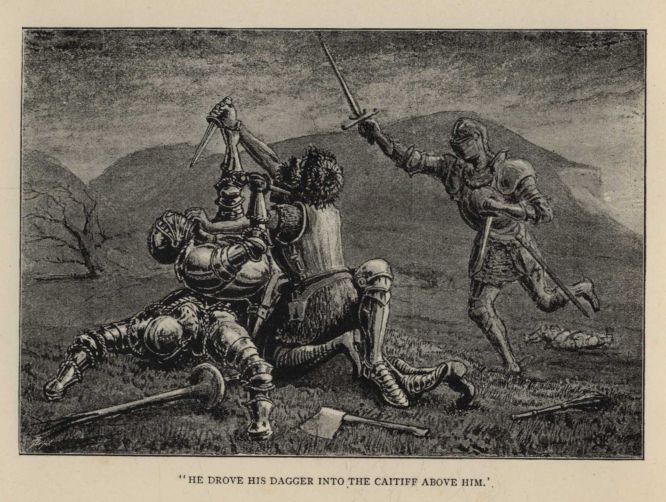
"HE DROVE HIS DAGGER INTO THE CAITIFF ABOVE HIM."
Ralph made one more desperate effort; he drove his dagger into the caitiff above him, who with a deep groan ceased struggling and rolled over, thus freeing Ralph, who sprang to his feet and turned upon the man-at-arms.
The young esquire still had his mace hanging from the chain slung round his right arm. Seizing it in his gauntleted hand, and transferring his dagger to his left, he struck furiously at the steel-clad figure before him, parrying at the same time with his dagger a dangerous thrust aimed at his visor. The mace crashed on the helmet of his foe, and a smothered exclamation of pain and rage came from out the barred morion.
Cutting wildly at the gorget of the young esquire, the man-at-arms turned and made a dash for his horse.
"Stay, man-at-arms! Turn, caitiff that thou art!" called Ralph after him. "Ah, recreant esquire, get thee gone, then, coward that thou art!" and Ralph, who was thinking more of his lord than of the pursuit of his cowardly assailant, turned back from following him to attend to his prostrate chief.
As he bent over Lord Woodville, he noticed a dark patch on his shining armour. There was a deep dent in the globular breast-plate, and the broken end of a lance head was sticking in it.
Ralph was in despair; the Captain of the Wight lay motionless in his harness; the silence was broken only by the cry of a sea-fowl as it circled over head, and the distant thud of the sea as it rolled on the shore below. Was Ralph the only living thing in that lonely valley among the solemn hills?
He undid the buckle of his lord's helmet, and reverently removed the cumbrous tilting-helm. As he did so he heard a faint sigh from the stricken knight, and as the moonlight fell on his noble features he opened his eyes.
"My lord, my lord, thou art not dead!" cried Ralph in joy. But no answer came back, the eyes had closed again, and despair once more seized on the young esquire.
What could he do? He looked round. What was it that flickered against his face? The air was piercingly cold, and the moon had become obscured by a thickening of the air. Ralph had opened his visor, that he might attend his lord more easily. Again something flickered in his face, cold and feathery. It was snowing.
Here was a fresh cause for anxiety. Alone in that sequestered valley, who could bring them help? And he did not dare to leave his lord alone, for fear that caitiff should return to finish the murderous work. As Ralph looked round in despair at the dreary scene, his heart sank within him. The landscape was fast becoming one grey indistinguishable blot, and the feeble light of the hidden moon was turning to a sickly livid hue. In a short time, too, he knew the moon would set.
A faint noise on the left caused Ralph to look round. The four bodies lay still and stark; but there was something moving out of the grey obscurity of the distance. Ralph closed his visor and handled his sword. The dark object drew nearer, and a yellow spark seemed to be coming with it. Ralph called out,--
"Whoever thou art, hasten thy steps; if foe, that I may handle thee, or if friend, that thou mayest help my lord."
"'Tis a friend, my son, and I come apace as fast as my stiffening joints will let me," cried a deep voice.
"Thank Heaven!" murmured the esquire. "Then my lord will not die."
By this time the dim shadow had come nearer, and Ralph saw that there were two figures--one tall and burly, the other short and slight. Both were draped in long cloaks, partially covered with the fast-falling snow. The taller of the new comers carried a lantern.
Dim and ghostly the figures looked in their peaked hoods and long mantles, entirely concealing face and form.
"Ah! we have come in time: no, no, too late!" and the slighter figure uttered a shrill and bitter cry of pain, as it bent over the lifeless mass of armour which held the unknown knight.
"Look to my lord first," said Ralph shortly.
"My son, 'tis the young child's father; my lord will wait," answered the elder stranger mildly, as he went to help his childish companion.
But Ralph barred the way.
"Whoever thou art, thou shall see to my lord first," he cried, in a resolute tone.
Seeing the fierceness of the youth, the old man quietly answered,--
"As thou wilt, my son; but thou shouldest respect youth, old age, and filial grief. But go thou and help the child, while I attend to thy lord."
Ralph, rebuked, did as he was told, there was such dignity, gentleness, and authority in the voice and manner of the tall stranger.
It was now very difficult to see. The moon had set, and the snow was falling fast, while the wind sighed mournfully through the withered boughs and twigs of the lonely thorn tree.
"May God have mercy on all dying souls!" murmured the dim shadow as it bent over the pale face of Lord Woodville; and Ralph could have sobbed aloud in anguish of heart as he felt his lord was dead.
"Oh, help me! help me! Master Lisle!" cried the agonised voice of the other stranger, shivering with cold and pain of heart. "Undo his helm or he will die, an he be not gone already," and a piteous sob of utter woe broke from the crouching figure.
Ralph, thinking only of his sorrow, did not notice the keen grief of the other, but he hastened up nevertheless, and speedily undid the helm.
"Oh, father! father!" sobbed the shivering voice; "speak, father!"
But no sound came from the set mouth, and the child broke out into piteous distress, sobbing and choking as though her heart would break.
Ralph was touched. Even in his own stony sorrow he felt for the poor child.
"Nay, nay, he may not be dead," he said, trying to comfort her. "See, he moves!" he cried, noticing a quiver of the gauntleted hand.
"Let me look, my son," said the gentle voice of the other stranger. "Go thou, catch yonder horse; thy lord lives, and will recover."
"Will he?" cried Ralph joyously, springing up and going in search of the horses, which, well trained as they were, were standing under the shelter of the thorn-bush out of the fast-driving snow.
When he returned leading the two horses, he was delighted to find Lord Woodville sitting up.
"My fair boy," said the Captain of the Wight, in a faint voice, "thou must help me on to my charger and lead me home. I have been hard stricken, albeit the wound is not mortal. But before thou aidest me, see to the state of Sir George Lisle: I would be loth he should die."
Lord Woodville spoke with difficulty, and paused between his words.
Ralph did as he was told, and found the two shrouded figures still bending over the inanimate knight.
"The Lord Woodville hath sent me to make inquiry of the knight--how fareth he?"
"Make answer that he is sore stricken, and in parlous case; but an we may get him to a place of shelter, he may do well."
Ralph returned and reported the message.
"Is there no other horse but mine? If not, take mine and leave me here," said Lord Woodville simply.
He had drawn his sword, and was holding it by the blade before him. The sword thus held had all the proportions of a Latin cross.
"'Thou shalt love thine enemies. Do good to those who hate thee,'" murmured the wounded Captain of the Wight.
"My lord, there is the knight's own horse, or he can have mine."
"Haste thee, then! gentle youth, for his wounds and mine are growing stiff, and there is need of shelter," faintly gasped the wounded Captain.
With rather more difficulty Ralph caught the other horse, and led it up to the little group in the snow. Then, by dint of hard exertion, the Hermit of St Catherine's--for it was he who had come to their aid--and Ralph lifted the wounded knight on to his horse, and the old man holding him in his high-peaked saddle, with the slight figure leading the horse by its bridle, they disappeared in the grey obscurity.
Ralph now returned to his lord. To his surprise and joy he found the Captain of the Wight had risen to his feet. The Hermit had removed the corslet, extracted the spear-head, and staunched the wound with some balsam and simples for healing sword or lance wounds. With effort he was able to mount his horse, and with Ralph holding the bridle, and ready to steady his lord in his saddle should he feel faint or giddy, the two figures wended their way over the snow towards Carisbrooke Castle.
It was a weary journey, and Ralph never felt so relieved in his life as when he descried the noble pile standing up black and grand in the midst of the white landscape.
With wonderful courage and resolution Lord Woodville sat erect in his saddle as they entered by the little postern gate, at which only one archer was on guard. He so carried himself until they reached the door of his own apartments, then, dismounting with Ralph's aid, he staggered to a settle in the hall and fainted away.
Ralph had presence of mind enough not to disturb the house. He went to Lady Trenchard's apartments and called her. That prudent lady soon came, and with her husband's assistance they managed to get the Lord Woodville to his room. Seeing his lord in safe hands, Ralph left to look after the horses. But Humphrey had already led them away, and in a few moments more Ralph, with the aid of his trusty varlet, had taken off his harness, and was soon fast asleep.
When he awoke next morning, the chapel bell was tolling, and he could hear the merry voices of the other pages as they lounged round the hall door before going into chapel. All things seemed as usual, but one more strange adventure had added its experience to the life of Ralph. He could scarcely believe it was little more than half a year since he had left his home.
CHAPTER XXII.
OF THE VOICE OF THE CHARMER.
During the next two months events of importance had occurred. The Captain of the Wight had recovered from his wound in time to attend the splendid ceremony of his niece's coronation, and his faithful young esquire had accompanied him to London. It was a joyful time. On their march from Southampton to the metropolis, Ralph obtained leave to visit his home.
Attended by Humphrey, he separated from the retinue of the Captain of the Wight at Southampton, to join it again at Guildford. By riding fast he would be able to make up for the longer distance, and would thus obtain time to spend one night at home.
The talk of all the garrison of Carisbrooke Castle and indeed of all the south of England, was the approaching war with France. No man doubted, and all men wished, that Henry VII. would be driven to take the part of his old benefactor, Francis, Duke of Brittany, in the defence of his duchy against the troops of France, led by the young King Charles VIII. It was so obviously the policy of England to prevent this powerful duchy being united to the French crown, which was already giving signs of the power it possessed, under the crafty rule of Louis XI., that far-seeing English statesmen like the Bishop of Ely, Master Christopher Urswick, and Sir John Edgecomb, the prototypes of England's diplomatists, could not doubt that Henry must see the vast importance of keeping France disunited, and of maintaining such an "imperium in imperio" as Brittany in semi-independence. Englishmen still longed to wipe out the disgrace of their expulsion from France, and any prospect of war with that country was hailed with joy. For war meant, according to the views of the time, not an impoverishment of both contending nations, but an increase of wealth to one or the other. Every esquire or common soldier might return a rich man. If, now-a-days, young men go forth to the ends of the earth to dig for gold, or spend their young lives in isolated exile in the wilds of the far West, or the savannahs of South America, or the rainless plains of Australia, with what eagerness would they have turned to war, where strength of arm and average good fortune meant glory, social distinction, and personal wealth? The capture of a rich prisoner in war meant the payment of a large ransom; and, as a wise man-at-arms knew, the best investment of his money was in forming a troop; the capture of one rich prisoner resulted in the decrease of power to his country's foe, as well as the personal aggrandisement of his captor. And all this brilliant prospect of success was enhanced by the scene in which the aspirant to fame displayed his prowess. Not drearily working at dull, monotonous manual labour far from the surroundings of civilisation, but in the very heart of social life carving out wealth, and fame, and name. No wonder war was popular.
To the eyes of the English people there never had been a time better suited for recovering the Duchies of Normandy, Guienne, and Gascony, since their final loss, but thirty years before. France's extremity had always been England's opportunity; and it was through Brittany and Normandy that English men-at-arms had poured to the conquest of France--to such splendid victories as Crecy and Agincourt. As Scotland was the thorn in England's side, so Brittany and Burgundy were the sharp points wherewith to rasp the French.
By a strange coincidence, the two capitals of Burgundy and Brittany, similar in name--Nancy and Nantes--received the mortal remains of their two last dukes within ten years of each other. In 1477 the last male of the house of Burgundy was borne from the field of battle to his splendid tomb in Nancy, leaving his only daughter to be despoiled of her inheritance by the craft of Louis XI.; while in 1488 the last male of the house of Brittany was entombed in the magnificent pile erected to his memory in the church of the Carmelites at Nantes, leaving also an only daughter to be fought for by an emperor, a king, a royal duke, and a puissant lord of the Pyrenees. And, by another singular fatality, the same Prince became the husband of both heiresses. Maximilian won, but speedily lost, both Mary of Burgundy and Anne of Brittany.
The common talk of all men, therefore, was the expedition that would shortly sail for France. The Captain of the Wight made no secret of his intentions, but determined to obtain the royal sanction first.
Full of the exciting prospects before him, and proud of his rapid progress, Ralph rode eagerly home.
With what joy he saw the blue smoke curling over the brown trees which hid the old manor house.
"See, Humphrey, there's the gilded vane on the west gable, and now I can see the stacks of chimneys. Whoop, lad, get on;" and the joyous boy urged his horse to a quicker pace. In a few minutes more he had turned the corner of the road, and before him lay the picturesque range of old gables and low windows.
He had not been able to let his parents know of his coming. He cantered up to the gate, jumped off his horse, and in another minute was in his mother's arms.
There is no need to describe the pride and joy of his parents, or the half-concealed awe of his brother Jasper. His younger brother had gone to Oxenford, and sent home from time to time accounts of his progress. After a delightful visit, all too short for Ralph and his parents, the young esquire set out to rejoin his lord. He arrived in time at Guildford, and the next day they entered the capital.
The King had already returned with his nobles and men-at-arms from the progress he had been making in the north, and the next day the ceremony of the coronation of the Queen was to take place. Ralph was in immediate attendance on his lord, who, as uncle of the Queen, held a high place of honour in the ceremonies. The esquire was witness of the installation of fourteen Knights of the Bath, and was astonished at the grandeur, solemnity, and state of the proceedings. But what amazed him most was the gorgeous procession of barges, all gilded and bedecked with flags, which accompanied the Queen on the Thames. He was forcibly reminded of Yolande as he saw the lovely young Queen, with her fair yellow hair rippling in golden masses down her back, intertwined with strings of jewels, and crowned with a golden crown; dressed in "white cloth of gold of damask," and with a richly furred ermine mantle over her shapely shoulders. But the palm of beauty was carried off by her second sister Cicely, the loveliest woman of her time, whose romantic life had not yet reached its most romantic period. Ralph little knew that that exquisite face and queenly figure would one day reside in a humble manor-house but three miles from his future home, and that her husband would be lower in social station than himself.
He attended on the Captain of the Wight as one of the suite, at the coronation banquet in the great hall, and Ralph was again surprised at the gorgeous pageant. But he did not like to see two such fair damoiselles as the Lady Catherine Grey and Mistress Ditton sitting under the table at the lovely Queen's feet, and could not understand why the Lady Oxford and the Lady Rivers should hold up, from time to time, a handkerchief before that sweet face, while he pitied their having to kneel through such a long state ceremony.[*]
[*] Leland. Collectanea.
He heard how urgently his lord strove to obtain the sanction of Henry VII. to enlist men-at-arms and archers for the aid of the Bretons. But the presence of the French Ambassadors, chief among whom were the Lord Daubigny, a Scotch nobleman in the service of the French crown, combined with a fear of internal troubles in case he should engage in foreign wars, kept that cautious monarch from giving any permission.
It was the opinion, however, of Lord Woodville, as well as of most of the English nobles and statesmen, that the King would not be at all averse to an expedition being fitted out privately, which he could disavow in public. Indeed most men thought he would be very much gratified by such an exhibition of zeal.
Full of these ideas, and encouraged by the promises of assistance he received from many experienced knights, as well as by numerous offers of service from men of lesser rank, Sir Edward Woodville returned to his island government.
The coronation had taken place in November; it was now the middle of January 1488. The next two months were employed in sounding the principal inhabitants of the island.
The Breton gentlemen had gone back to Brittany trusting to the promised aid, and carrying with them exaggerated ideas of Lord Woodville's position and power.
Ralph and the other pages enjoyed their lives as healthy boys engaged in the manly employments of life in a mediæval castle must have enjoyed them. Hawking, hunting, daily drill and exercise, boating and fishing, such were their occupations. Ralph had never breathed a word of the midnight duel, nor did he know what had become of the wounded knight. The Captain of the Wight never referred to it, and he kept his own counsel. The valley was once revisited by him, as far as he could recollect its whereabouts; but in the coombes and dells of the downs there were so many level swards at their base, that he was in doubt whether he had come across the right one. There were no traces of any combat about them, there was the thorn bush in one and another, and a little sedgy stream, but no fresh mounds or splintered spears.
Ralph had seen much of his cousin Yolande, and his affection and admiration for her were unbounded; but he could not disguise from himself that although she treated him with absolute candour and sisterly affection, yet she always grew silent if the Captain of the Wight were near, and hung on every word that nobleman spoke. It never crossed Ralph's mind to be jealous, only he wished the Captain of the Wight did not appear quite so often upon the scene.
But the thoughts of that nobleman were far removed from such trivial subjects, if credence was to be placed in his words and actions. By sound of trumpet and proclamation the inhabitants of the Isle of Wight were summoned to a general muster at Shide Bridge, a place already celebrated by a previous muster to take account of the military strength of the island in the reign of King Edward the Second, held by John de la Hoese and John de Lisle.
Thither on the day appointed the gentry of the island, with the yeomen and country people, wended their way. The Bailiffs of Newport, Newtown, Yarmouth, and Brading, accompanied by the richer of the burgesses of those boroughs, attended. There were the bailiffs and stewards of the various estates held by the ecclesiastical bodies of Winchester College, Whorwell Monastery, Christchurch Priory, and Ashey; while the Abbot of Quarr, the Prior of Carisbrooke, representing the Carthusian monastery of Shene, and the Bailiff of Appuldurcombe, for the nunnery of St Clare, without Aldgate, were also present. There came, besides, the reeves of the manors belonging to the imprisoned Earl of Warwick, from Brixton and Swainston. There were representatives of all the island families: Sir Nicholas Wadham, Sir John Oglander, Sir William Lisle of Wootton, Master Meaux, recovered from his rough handling of five months before, a Bowerman from Brooke, Trenchards from Watchingwell and Shalfleet, a Dineley from Woolverton, a Cheke from Mattistone, the Bowermans of Austerborne or Osborn, John Racket of Knighton, and his relative by marriage, Leigh of Woolverton in Bembridge, a Hawles of the ancient family of De Aula from Stenbury Manor. There were Urrys, Keyneys, De Heynos, Bruyns, with many others too numerous to mention, and a crowd of the lesser yeomen and common people. When all were assembled, the Captain of the Wight, in full armour, but with bare head, mounted on his splendid charger, and surrounded by his seneschals, esquires, and pages, addressed the crowd.
In a stirring speech he explained the situation. He told how many evils the French had inflicted upon their forefathers. How in Edward the First's reign they had threatened the island, but were daunted by the stout preparations of the ancestors of many there present. How again in Edward the Third's time they harassed the island by their evil depredations, until under the brave Sir Theobald Russel of Yaverland, who gave his life for his people, they were driven out with loss and shame. How again in Richard the Second's reign the whole island was overrun, and cruel damage inflicted, when all their towns were in flames, and no place safe but the Castle of Carisbrooke. But here again the ancient valour of their race broke out, and under the stout Sir Hugh Tyrrel, "that right hardy knight," they chased the false Frenchmen to their ships, slaying them by scores, "insomuch that from that day Deadman's Lane went by no other name, and Neddie's Hill is still there to show the burial place of the marauders." Again how valorously they drove off Waleran de St Pol, that "noble knight of haut lineage," and frightened away the caitiffs again a few years after; while in Henry the Fifth's time they slew many who were running away to their ships.
"Shall we then," went on the Captain, "not recover from these false robbers the wealth they have gotten from us? Shall we not avenge on them the wrongs they have done to us? Think, all ye brave knights and sturdy yeomen, of the wealth ye will gain. Think all ye young esquires and right hardy varlets of the honour and renown ye will acquire in the eyes of your fair mistresses. And, above all, think of the glory of being the first to lead the way to victory, and recover for England and our King the ancient lands and duchies of which she hath been so foully robbed. I will stake life and fortune on the venture. I will warrant all men against loss. You will do an action pleasing to all England, and will save an oppressed people, an aged duke, and a fair princess from the cruel hands of the ravisher. They are Bretons, so are we. They hate the French, so do we. The tongue they speak is the native tongue of our sovereign lord the King. Their hero is Arthur; their country is the home of Lancelot-du-lac, Merlin, and all whom we reverence as our own. Shall we not bring help, if in so doing we enrich ourselves, destroy our enemies, win everlasting fame and name, and save our lives and the lives of our children from future outrage? Shall we not bring help? Who are our allies? The King of the Romans, Lord of Austria, Italy, Allemayne, Brabant, and Flanders; the Duke of Brittany, the Duke of Orleans, the Prince of Orange, the Lord d'Albret, and many more of high lineage, great estate, and mighty valour. Did fate ever offer such a chance? and shall we throw it all away? Rather than let France, our bitter foe, rule over our ancient ally, I myself will go with only my own household, and with my single lance will venture my life for such a cause, losing it with ready will, if so it must be. But, noble knights, gallant esquires, worthy burgesses, and sturdy yeomen, shall we not all go together? Shall we not win wealth, renown, safety, and the everlasting gratitude of our King, our country, and our children?"
There was a deep murmur of applause. Every one was moved. Even the more reflecting portion of the crowd recognised the truth of many passages in the rousing speech of their Captain. The enthusiasm of the younger men was wild. They applauded vociferously, drawing their swords and waving them over their heads, and it was with difficulty the voice of Sir William Lisle could be heard. He was speaking in support of their Captain, and relating the terror the fears of French invasions had roused throughout the island, so much so that his own ancestor had withdrawn to the mainland, like many others of the island population.
When he had finished, many other speakers followed; and at last it was resolved that the Captain of the Wight should be asked to select such as would be most serviceable in the cause, while such as could not go should give of their substance to properly equip the poorer sort.
So ended this memorable meeting; and, greatly pleased with the success of the day, Lord Woodville returned to Carisbrooke.
In the course of the next week, so many gentlemen and yeomen presented themselves eager to go on the expedition, that Lord Woodville and his officers had some difficulty in making a selection. But by the end of the week forty gentlemen, and about four hundred yeomen, were enrolled, and directed to hold themselves in readiness to sail early in the following week.
The excitement in the island was at this time intense. The inhabitants felt the eyes of England were upon them; they felt proud of themselves and of their gallant Captain; and there was scarcely a family, whether rich or poor, which did not contribute some member--in many cases several--to the forthcoming expedition.
Ralph was very busy, like every one else in the castle. Weapons and armour were given out, drill was incessantly going on, and all the tailors in Newport were hard at work making surcoats for the men-at-arms and archers. Every man of the expedition was to wear a white tabard with the red cross of St George blazoned on it.
At last the important day arrived. Ralph had received permission to visit his relations the evening before. It was an exquisite spring evening, and the scene was lovely as he rode over the long hill between Newport and Wootton.[*] Before him lay the winding creek embowered in thick oak woods--those woods which gave the name to his kinsman's branch of the Lisle family, and perhaps a name to the little hamlet of Wodyton. Beyond stretched the undulating land which hid the Monastery of Quarr, whose deep-toned bell was sounding to complines across the still woods and glassy waters of the creek; while away in the purple distance stretched the gleaming Solent, unruffled by the slightest breeze, and bounded by the dim Sussex shore.
[*] Wootton, in Domesday Book "Odetone;" called Wodyton in Bishop Woodlock's Return of the Parishes in the Island; Woditone in the account of the watches kept in the 18th of Ed. II., and in Cardinal Beaufort's Valuation, Woodyton; and in the 8th of Ed. III. Wodyton.
Ralph rode down into the valley, where the grey mist floated in mysterious wreaths, from out of which the blue smoke of Briddesford Manor rose like a faint column in the still atmosphere, only to hang above the mist in a greyer cloud.
The young esquire felt sad for the first time. He found his cousin awaiting him in the dark old porch. After a few words of friendly greeting, Ralph became silent.
"Why, cousin Ralph, what aileth thee?" said his cousin.
"I hardly know, sweet cousin mine, and yet I do know, only thou wilt laugh at me; and so I would not say what yet I fain would."
Yolande smiled a sad smile, but she said quietly,--
"Nay, fair cousin, say it not. I know what thou thinkest. It may never be. I told thee months ago. Thou wilt some day know how true I spoke. We cannot all have what we wish; and even if we could, we should soon wish for something else."
"Well, I would like to try," said Ralph bluntly.
"Ay, and so should I," sighed Mistress Yolande. "But, Ralph, promise me thou wilt look well after thy lord. He is over venturesome, and, I fear me much, he careth naught for life; indeed I sometimes think he would rather go hence." Yolande's voice became tremulous. She recovered herself after a pause. "Thou wilt watch over him, Ralph? I know not why, but I feel I shall never look upon him more!"
And so his lovely cousin had no more words for him than that he should take care of his lord? No matter, Ralph felt he only lived for her. He would willingly die to give her happiness. He simply answered,--
"I will do my duty."
They then went into the house, and Ralph took a respectful adieu of old Sir William Lisle.
"Go forth, my kinsman, thou art a worthy son of our noble house. I would well that thou, when thou returnest, shouldst take daughter and lands, and rear up a stalwart line. But it will be as God wills it. Take my blessing, and go forth to victory."
So Ralph left his kinsfolk, sadder at heart than he had ever been in all his life, but resolved to bring back his lord in safety and glory to the Wight, or die with him in France.
As he rode back over St George's Down--for he took a longer way back, being in a dreamy and melancholy mood--the soft light of the young moon shone in the pale primrose of the western sky. The night-jar uttered its melancholy note, and flapped heavily past in the silence of the evening, while a distant owl raised its plaintive cry from the dark woods which faded in the grey and ghostly mist of the northern valley. This was his last night in England. How many would see their homes again of all that gallant band of high-spirited men?
But a step near at hand roused him from his reverie. Two figures passed him almost unobserved. The slighter one turned to look, gave a little sigh, and went on with its taller companion, who seemed to walk with difficulty.
CHAPTER XXIII.
HOW THEY LEFT THE WIGHT.
The stirring sound of trumpets awoke Ralph at an early hour the next morning. All the castle-yard was already busy with hurrying men-at-arms, archers, and varlets. Sir John Trenchard, Tom o' Kingston, and the other officers were giving orders and getting the men into their places.
The great gates of the castle were wide open, the drawbridge was lowered. Lady Trenchard and the domestics of the Captain's apartments were looking down from the oriel window. The chapel bell was ringing, and as many as could find room in the little building were reverently assisting at the Mass, the last they should ever hear in England performed by their worthy chaplain, who was going with them.
In another hour the troops were drawn up, and a fine body of men they looked. All those from the West Medene, or western division of the island, had mustered at the castle. Those from the East Medene were to muster at St Helens, where the embarkation was to take place. But in spite of being little more than half their strength, the small body of about two hundred and fifty men looked very smart and serviceable.
On the right of the line drawn up in the courtyard were the men-at-arms, a body of some forty cavaliers, armed from head to foot in complete plate armour, and wearing the picturesque white tabard with the red cross over their breastplates; behind these were the custrils and grooms, all armed also, but with less complete body armour. All this body of cavalry carried lances, daggers, and stout long swords, while the men-at-arms, in addition, had the formidable mace hanging from their saddle-bow.
Next to the men-at-arms, on their left, were the mounted archers--a most serviceable force--nearly all armed with back and breastpieces, over a stout leathern jerkin, with plates of steel strapped on their sleeves and thighs, and armed with round targets, crossbows, slung behind their backs, long swords and knives. On their heads they wore the salade, or open helmet, with the gorget and chin-piece to protect their necks and upper part of the chest. Many of them wore chain-shirts, or brigandines, under their steel breast-plates, while these, like the men-at-arms, wore the white tabard and red cross of St George.
The mounted archers rode stout ponies, called hobbies, and were attended by another body of grooms, drawn up behind them. To the left of all were the infantry, composed of the archers, armed with their long bows, the celebrated weapon to which England owed all her victories, and cloth-yard shafts hung in their quivers, a stout sword on thigh, and a long keen knife in the belt. Some were protected by defensive armour, but most were simply clad in leathern jackets and stout leggings, with a steel cap on the head. Like all the rest of the force, they wore the white tabard and red cross. The billmen were armed and equipped like the archers, without the long bows. Behind this division were the grooms and camp followers, while on the left of all were the pack animals and baggage train.
A loud flourish of trumpets now proclaimed that the Captain of the Wight was mounting at the door of his hall, and in another minute Sir Edward Woodville, in complete armour, only wearing a velvet bonnet ornamented with an ostrich plume placed jauntily on one side of his head, rode out in front of the line--
"On his brest, a bloodie crosse he bore,
The deare remembrance of his dying Lord,
For whose swete sake that glorious badge he wore,
And dead--as living ever--him adored.
Upon his shield the like was also scored--
For soveraine hope, which in His helpe he had."
Glancing down the line, and acknowledging the general salute with which he was greeted, the Captain of the Wight gave the order to march, and placing himself with his esquires and pages in the centre of the column, the little force moved off. They tramped over the drawbridge, amid the cheers of the small body of men left to garrison the castle, and defiled down the steep road to Newport. The march through the town was one long leave-taking.
Master Paxhulle looked at the cavalcade with mingled feelings of satisfaction and chagrin. He was glad to have so formidable a rival as Tom o' Kingston removed out of his way, but he did not at all like to see the interest Mistress Bremskete took in him, or the sobs of grief, intermixed with ejaculations of admiration, which broke from her from time to time.
"Marry, Master Paxhulle, that's what I call a man. Oh! when shall I see his like again?"
"Cheer up, Mistress Bremskete, there's a-many as good as he, and much more likely to make an honest woman comfortable."
"Nay, nay; 'tis a parlous brave man, and one of a brave heart withal. 'Tis a tender man, and one as'd let a woman have her own way. And to think of his going to be killed in France!"
"Nay! Now nay! Mistress Bremskete, 'tis the French they're going to kill!"
"Ah, well, 'twill be a weary time for many a loving heart 'till they be come back again."
And so it seemed, to judge by the weeping women who were bidding their friends good-bye. The head of the column was now passing over Copping Bridge, and their glancing spear-points and fluttering pennons could be seen over the hedges of the long lane which led up to the central ridge of the island. After they had mounted the crest of Arreton Down, which divided the fertile and sunny vale of Newchurch from the dense woods of the northern shores of the island, a glorious view met their eye. The gleaming bay of Sandown, bounded by the beetling cliffs of Culver on the east, looking like walls of ivory rising from the azure sea; while on the west loomed up the grandly swelling ridge of Boniface Down, and the dim headland of Dunnose. Below lay the fertile land, smiling in the morning sun, with hamlet, farm-house, and church nestling in sheltering copse or woody dell.
"'Tis a fair land and a rich," said Lord Woodville, reining in his horse to look at the lovely view. His glance took in the steep acclivity above Appuldurcombe, and rested upon the darker shadow which marked where the little Priory stood. With a sigh the Captain of the Wight shook the reins of his horse and turned to pursue his march. He gave no look to Briddelsford, which lay amid the northern woods, and towards which Ralph was looking with wistful eyes, and spake but little until they reached the end of Ashey Down.
Then a cry broke from the head of the column, for there lay the ships that were to take them over the sea to the sunny land of France, and it came home to all men that they might be looking on their own fair home for the last time.
They descended to the valley below, and passing through Ashey village they crossed the Brading road a little to the north of that borough, where they were joined by a large body of men led by young Oglander of Nunwell; they then skirted the beautiful Brading creek, until rising once more they reached St Helens Green, and descended for the last time to the old church by the sea. Here they found all the rest of the band, and a great crowd of relations and friends come to bid them God speed.
Ralph revelled in the busy scene, and, together with Dicky Cheke and Maurice Woodville, superintended the embarkation of the baggage. The four ships which were to take over the expedition were lying in the narrow channel at the entrance to Brading Haven.
As the expedition marched down the steep declivity from St Helens to the sandy spit thrown up by the winds and waves to form a breakwater for the broad expanse of Brading Haven, the vessels were being warped alongside the shingly beach. The tide was falling fast, and by the time the baggage animals had reached the sea beach, the sea had left the wide extending flat of sand and shingle, so as to allow of all going alongside the flat-bottomed unwieldy hulks of the transport vessels.
The work of embarkation went on all day, and by the time the tide had risen over the beach again, every one was on board.
It was an exquisite evening, and its still beauty impressed all hearts.
Astern of Ralph's ship lay the three other awkwardly-built, high-prowed vessels, the rising tide seething past their anchor cables, which quivered and vibrated in the rushing eddy. Every rope and pulley, mast and yard, and fluttering bannerole stood out velvety brown against the pale primrose, the orange gold, the purple and grey of the western sky, while the still waters of that large mere reflected the solemn shadowy hills, and the brilliant light of the departed sun. The grey green mist of evening was creeping over the distance, and the evening star flickered its glinting light across the purling water. There was silence in nature, but not in man. Sounds of merriment arose from the idly floating ships; songs and laughter, and shouts to their friends upon the shore, where the flickering firelight showed that many were camping out to take the last view of their relatives.
Ralph could have wished to be alone: the noises jarred upon his feelings. He moved away from the taffrail, where he had been sitting watching the bubbles of the tide as it eddied under the stern post.
Dicky Cheke met him. That youth had already assumed quite a nautical air, and was casting his eye aloft with all the assurance of an old sea dog.
"Well met, Ralph," he said. "We shall have an air o' wind anon, when the moon's set, and the tide's done flowing. You mark my words. And hark ye, my son, doubtless as this is thy first trip to sea thou'lt feel squeamish a bit, I reckon. Now, take my advice, eat a hunk o' fat bacon, and quaff off a pint or so of good ale; 'twill fortify thy stomach, and things won't come so much amiss afterwards. I'm going to have a right merry feed with Maurice by-and-by. Thou hadst best join us." And Master Cheke rolled off in proper sea-going fashion, whistling, much to Ralph's amusement.
But certainly that part of his remarks about the breeze was true. A crisp little puff came off the land, blurring the soft reflection of wood and hill, and star and purple sky; and as the tide had nearly done, the skipper of the Captain's ship gave orders to weigh anchor and set sail.
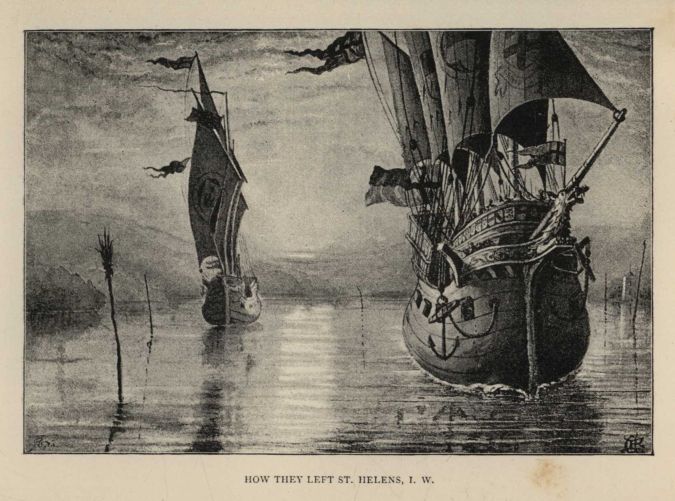
HOW THEY LEFT ST. HELENS, I.W.
This was joyous news. The cable was shortened until it was nearly up and down. The large jib was run up to the foremast, and the foresail dropped down from the yard, and with a "Yeo, heave, yeo, break her out, my boys," the heavy anchor was hauled up to the cathead, and the voyage had begun. Slowly the ship moved through the still flowing tide, but as each sail was set, and the night breeze came stronger, she gathered way and rippled through the whispering sea. The vessels astern had followed the example of the Captain's ship, and were stemming the tide behind.
Cheer upon cheer came from the shore, answered by ringing shouts from the ships. The decks and rigging were crowded with lusty men, waving scarves and caps, and cheering till the welkin rang again.
The enthusiasm was unbounded, and Ralph had never felt such excitement, not even when he won the prize of the tourney.
As the ship drew out from the land the breeze came fresher still; and the creaking yards and bellying sails, with the gurgling sound of the rushing sea, told how well they were going.
Overhead the stars were shining in brilliant glitter, and the dark outline on their right faintly indicated their island home. Should they ever see it again? But scarce one of all that crew of lusty men gave a thought to such a foreboding. For them, life and wealth, and name and fame, lay away in the south across the sea, and the present was joyous. What more could they want?
"Well, Ralph, my son, we are well at sea now. They'll be shifting over those cloths, I'm thinking, for the breeze is coming more over her stern. Ah! I thought so; look out for that lee sheet, thou hast got thy leg foul of the slack. I' faith! what a thing it is to be a landlubber."
"Certes, Dicky, thou art a mariner--at least thou thinkest so; but art sure all thy terms are rightly applied?" said Ralph, laughing at the nautical Dicky, who had now put on a suit of yellow oiled clothes, and smelt very unpleasantly. "Faugh! Dicky, how parlous nasty thou art! and why hast put on this strange suit?"
"Certes, Ralph, thou art simple! 'tis a right proper dress, and one that suiteth the sea; had I had time, I would have bid thee get one too," said Dicky, who secretly had determined to surprise his comrades by his thorough knowledge of nautical matters, and would not have told them beforehand for worlds.
They had now lost sight of the island, and the ship was made snug for the night--strict discipline was observed on board, and watches set, only the pages were allowed to stay up on deck as long as they liked.
Dicky Cheke now prepared for his feast. He chose a sheltered place under the weather gunwale; and finding three coils of rope ready to hand, he placed his various luxuries in their protecting folds. There was a large game pasty, a very substantial ham, a conserve of plums, and a cheese, with new bread and a large jar of ale.
Ralph and Maurice Woodville sat down on some old sails and helped to arrange the feast. Dicky Cheke had become more nautical than ever, and would insist on walking about. The breeze had gradually freshened, and they were surging through the sea in splendid style. The other ships were hull down astern, not one of them being such a fast sailer as the ship which carried the Captain of the Wight.
Maurice Woodville had arranged the places, and bid Dicky sit down. But that young gentleman would persist in showing them how well he kept his feet in spite of the rolling of the ship, which was now running through the strong eddies of St Catherine's. However pride, as ever, goeth before a fall. He was bending down, with legs astride, to adjust the game pasty before he opened it, when the ship gave a heavier roll to port, and Master Dicky sat down abruptly in a pail which Maurice Woodville had thoughtfully put to catch him if he should fall. Dicky's collapse caused the pail to capsize, and the luckless youth, together with the pail, went rolling over into the lee-scuppers, bumping against the main hatchway in his fall.
"Blessed Thomas!" ejaculated Dicky, "what in the name of all sticky things is this?" He had caught hold of the fore halyards, and so recovered his feet again, but he found he could not relax his fingers: they were all glued together. "Ralph! Maurice! come hither! I am bewitched! There's some vile trick been played upon me. I am all stuck together: my coat's sticking to my arms. I can't move my sleeves, and my hands are stuck to this rope. Mercy on me! come quick!"
But Maurice and Ralph were choking with laughter, and could not, or would not, go to his help. At this moment, to make Dicky's discomfort still greater, the ship gave a heavy yaw, and sank down in the trough of a wave, while the man at the wheel brought her head up again to the next sea somewhat too rapidly, with the effect of sending a deluge of water over the head of the unfortunate Dicky, whose hat had come off, and was lying under the lee gunwale. Dicky, gasping, shivering, and spluttering, was violently thrown off his legs, and waved in the air for a moment; then he banged his shins against the sharp end of a heavy iron cleat, uttering a howl of anguish; and finally, with a violent wrench, he got his hands free from the rope, and scrambled over the slippery deck to his friends and guests.
"Well, Dicky, what's the matter with thee?" said Ralph, scarcely recovered from his fit of laughter.
"Body o' me knows," said Dicky ruefully; "but methinks I am bewitched. I can't lift up my arms; and oh! mercy! I'm stuck together every way; and and how the water does trickle down my neck. Ugh! it's got down my back now: I feel it running down my backbone. Ugh! oh! hold on, one of you, or I shall be off again," and Dicky grasped at the coil of rope nearest to him, to save himself going backwards once more as the ship rolled over again.
But he had caught hold of a treacherous support. The rope flew out of the coil, and once more Dicky rolled over. But this was not the worst of the mishap. The ham, the conserve of plums, and the cheese had been placed in this secure receptacle. They were displaced by the running rope, and followed the struggling Dicky. The cheese only hit him on the nose, and rolled merrily on to join the hat, which was floating in the salt water in an angle of the bulwark stanchions, where both were quickly joined by the ham; but the conserve of plums broke from its cover, and the luscious fruit, with its fragrant but sticky syrup, were thrown in the face of their miserable owner.
"Oh! ah!" gurgled Dicky, as a large and mellow plum caught him in the eye, already smarting from the salt water, while further remarks were rendered incoherent by another one going plop into his open mouth.
Ralph and Maurice were in imminent danger of joining the struggling Dicky. They were convulsed with laughter, and were totally incapable of helping him. At last Dicky once more scrambled up again, very wet, miserable, and disconsolate. He sat down with his back to the gunwale, and broke out into dismal grumbling.
"Well, you are scurvy knaves; you might at least have lent me a hand; and--why, where's the cheese? and I don't see the ham: it couldn't have been that which hit me on the nose! Oh, misery! and to think, after all, that beautiful ham and cheese are gone overboard! I chose them both myself! But perhaps they're only over there to leeward. Just step over, Maurice, and see."
"Nay, Dicky, let's stow the game-pie first, 'twill be best to get that out of the way," said Maurice, who had been longing to begin on the noble pie before him for some time.
"Marry! that's sound advice--hand it over here. Why, what's gone wrong with my jacket? I'm all stuck together. Oh, murder! whatever is this?"
Maurice again burst into a roar of laughter, which made Dicky furious.
"Maurice, you addled egg you, what do you see to laugh at?"
But Maurice only laughed the more.
"Ralph! rap him over the costard for me, and then do thou cut that pie. I'm too sticky to do it myself; and, to tell truth, my appetite's a'most gone with all this wet, and banging and shaking. I don't marvel I've got a headache, and feel a bit queer. Ugh! oh! oh, my! I wish she would not roll and pitch so," said poor Dicky ruefully.
Ralph did as he was told, and by the bright light of the stars and the lantern which swung in the rigging aloft to show the Captain's ship, he cut a large slice, and handed it to Dicky. But poor Dicky shook his head, and gave a little groan.
"I'll go and shift my clothes," he said, in a shivering voice. "I'm as wet as a drowned rat; and I can't think why I am so parlous sticky. I hope you fellows will eat up the pie, and have a merry time," added poor Dicky bravely.
This touched Maurice.
"Certes, Dicky, you are out of luck. But I'm grievous sad I put that--"
He broke into a peal of laughter, and could not go on, as he thought of the ridiculous scene.
"Well, Maurice, I don't see there's much to laugh at," grumbled Master Cheke.
"Oh--oh--I'm soothly grieved," gasped Maurice repentantly, trying to speak gravely, and then bursting out into a fresh fit of uproarious mirth.
At this moment the gruff voice of a man in the bows sung,--"Sail ho!" "Where away?" rang out from the Master. "On the starboard beam," came back the answer. "She's bearing up to cross us."
"Lower away that lantern, and luff a bit--so, steady," sung out the Master, who, after scanning the strange sail, went below to tell the Captain.
In a few moments more the crew came tumbling up the hatches, and the Captain of the Wight appeared in his armour.
Ralph and his fellow-pages went hastily below. The report had spread through the vessel that the stranger was a French ship, and that they intended fighting her. This was exciting news to the boys; they quietly armed themselves, and were returning on deck, when the piteous voice of Dicky Cheke stopped them.
"Oh! I am so bad, and I can't get off my coat!--whatever has come to it?"
"Why, it's all over tar," said Ralph. "You've sat down in a tar bucket."
Maurice's laughter again broke out uncontrolled, but Dicky, who now saw the trick that had been played upon him, made a sudden dash upon him, and pushed his tar-covered elbow in Maurice's face, which effectually stopped all further laughter, and the two boys fell over on the floor of the cabin, tussling and struggling, until a kick from the sergeant-at-arms made them get up and separate; and a ludicrous sight they both presented as they stood looking at each other. Dicky's yellow oilskin suit was all blotched and stuck together by great splashes of tar, while his hair and face were smeared with the same adhesive substance. Maurice was in very much the same condition. There was a large smear over his mouth and nose, and one eye and the side of his cheek were completely blackened.
"Well you be nice young gentlemen to be pages to the Lord Captain," said the man-at-arms sarcastically. "You'd best get some one to scrape you. I'm too busy;" so saying, the sergeant left them, to follow Ralph on deck, where nearly the whole ship's company was assembled under arms.
"They means to lay us aboard, my lord," said the Master.
"Certes, let them," answered the Captain of the Wight.
"Then all hands had best lie down--some along the lee gunwale, but most under hatches--or else, as they range up, they'll be afeared when they see how strong we muster," said the crafty old seaman.
This order was promptly given, and in another minute the decks looked as deserted as usual, only the ordinary watch required for working a merchant vessel being left visible.
CHAPTER XXIV.
OF "LA BEALE FRANCE."
There was a faint, pale light away in the north-east, telling of the coming dawn. Looming up dim and indistinct against the grey horizon, Ralph, who was armed, and stood near the Captain of the Wight, saw a dark hull and lofty sails.
The breeze was fresh, and they were now about mid-channel. The strange sail came topping the waves, which curled and seethed under her broad bow as she rose on their crests and dipped again in the trough of the sea. Swiftly she ran down before the salt sea breeze, and a gallant sight she looked.
"You'd best hide the gleam of your harness, my lord," said the old master, "or they'll be smelling a rat."
Without stopping to inquire how a gleam could assist a sense of smell, the Captain of the Wight, accompanied by Ralph, stepped off the lofty poop and took their stand under the lee gunwale.
"Luff!" sung out the Master, who was carefully watching the movements of the stranger; and a cloud of spray dashed over the bow as the head of the ship came more round to the sea.