THE CAPTAIN OF THE WIGHT (continued 4)
Reading edition
"'Twas all his own fault," said Tom o' Kingston. "The Frenchman never meant to hurt him, and would have left him alone, had he not been such a braggart. It ought to do him good."
It was so evident to all the crowd that Bowerman had drawn this fall upon himself that they applauded the knight, and had no words of sympathy for the esquire.
The only antagonist left who had not yet tried his luck was Ralph Lisle.
"That surely can't be Master Lisle, the new page?" said Mistress Bremeskete.
"Ay, but 'tis though; he sits stiffly, don't he?"
"And what a size he looks. He'll be a great knight one day. As 'tis, he looks as if he could swallow the little Frenchman at the other end."
"Marry, you're right, and 'tis a fine horse he's on. 'Twas Mistress Lisle sent him that this morning."
"My! you don't say so! And she gives her favour to that French knight, and a horse to her kinsman. Well, I'd rather be her kinsman. Leastways, he's got something."
Ralph's heart was bounding with excitement. He tried to remember all the instructions he had received. He could see Yolande seated amid the beauty and rank of the Island. She was looking his way, not at the knight who wore her favour. She had bidden him win it with the horse he bestrode. His blood rose; he would do all he could. He sat his horse with thews strung tight and nerves braced.
"Are you ready?"
Down came his lance.
"My faith! he looks a gallant knight," said the Captain of the Wight to Yolande. "I trust Sir Amand will spare him."
"I'faith, Sir Captain, I think 'twill be the other way," said Yolande. "He's well skilled, I hear, and as for strength and weight, look at horse and man."
Lord Woodville glanced at Yolande a questioning glance, and smiled.
"It's no use your smiling like that, my Lord Woodville. I know what you are thinking about; but do you, with your knowledge of the world, think I should fall in love with a boy?" and Yolande laughed a scornful laugh.
Lord Woodville made no answer; he only sighed, and turned to look at the lists. The last word had been said.
With vigorous determination in Ralph's bent back, lance close pressed in rest, and helm well under shield, the boy went straight for his prize. He had selected a heavy lance, seeing how many others had splintered, and feeling confident in his strength to wield it. With sure aim he struck the upper part of his antagonist's visor, and, forcing it up with the violence of the well-planted blow, he bent the metal back, and, still keeping his spear jammed in the twisted iron, while his well-trained horse pressed on with all his force, Ralph actually pulled the knight backwards out of his saddle, and tumbled him over to the ground.
The shouts of applause and astonishment were deafening. The people jumped, and surged, and shouted, and waved their caps and handerchiefs in a perfectly bewildering way. For some time nothing could be heard or seen but the hilarious cries and struggling crowd. It was with the utmost difficulty the men-at-arms and yeomen could keep the lists clear. Men were crowding forward to shake Ralph's hand.
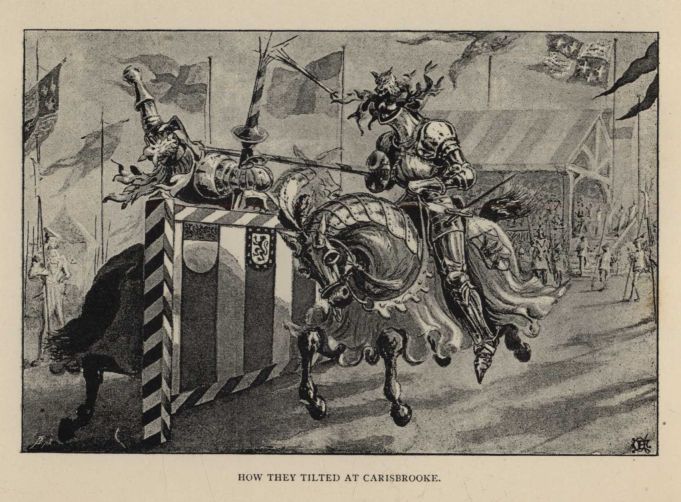
HOW THEY TILTED AT CARISBROOKE.
At last order and silence were somewhat restored, and then it was seen that the Breton knight was on his legs, and had pulled off his helmet, while blood was trickling down his face from the sharp edge of the broken visor having cut his forehead. In spite of this, he was loudly praising Ralph, and saying how glad he was the boy had got the victory.
This made him very popular, and the crowd raised cheer after cheer for the noble Breton knight and Master Ralph Lisle.
"There's no older name in the island, and 'tis a right noble line," said Tom o' Kingston. "'Tis right well done, and truly a marvellous feat of arms."
Meanwhile Ralph had ridden round the lists, and had taken up his place again with perfect modesty next to Master Meaux, young Trenchard, and Master Oglander, the only survivors of their party who could ride again.
CHAPTER XV.
HOW THE COCKEREL CROWED.
It was yet early in the afternoon, for the last courses had been finished much more speedily than was anticipated.
By the laws of the tilt, it was incumbent on the remaining knights-challengers to meet each one of the other knights who had not been unhorsed, if they desired to go on with the joust. Each of the knights who was unhorsed was disqualified from taking further part in that day's tilting.
Sir Alain de Kervignac, therefore, was left to encounter alone each of the other esquires who survived from the previous jousting. The fourth knight-challenger had not yet appeared. If he arrived before his companion was defeated, or before sundown, he might take part in the tilt.
After a little consultation with his comrades and the Marshal of the Lists, and a notification from Master Meaux that he and his companions demanded a completion of the courses, it was proclaimed that the right valiant, very hardy, and most illustrious knight, Alain de Kervignac, would tilt in succession with each of his opponents. This was delightful news to the crowd, and they cheered him vociferously, while the Captain of the Wight and Yolande sent him their greetings by the Marshal of the Lists.
It was now a little after four o'clock. The sun would not set for another two hours. The other challenger might arrive at any moment, and the chances would then be a little more equal.
Of the assailants of Sir Alain de Kervignac only two could really be reckoned formidable. Master Meaux and Ralph Lisle, from their having already tilted successfully, as well as from their greater bulk and weight, were dangerous antagonists; and although Sir Richard Cornwall had been unhorsed by an unfortunate accident, yet it was quite sufficiently evident that Master Meaux was a very formidable man-at-arms; and as for Ralph, it was abundantly manifest what he could do, in spite of his youth and inexperience.
While these preliminaries were going on, refreshments were handed round, and the competitors were regaling themselves with copious draughts of wine and hippocras. But Ralph had only taken a very moderate draught, having been warned by Sir John Trenchard not to take much refreshment of any kind while there was an immediate prospect of more work before him, as it was likely to unsteady the eye and hand.
Bowerman's mortification at his defeat was rendered tenfold more bitter by the success of Ralph. If he hated him before, his hatred had now become ruthless and implacable, and being naturally of an ungovernable disposition, he became utterly reckless of how he expressed or concealed his rage.
The all-engrossing thought was how could he injure this swaggering upstart, this minion of fortune, this stripling successful only because of the favouritism of his antagonist?
"Don't tell me," said Bowerman fiercely to the stolid Newenhall, for the twentieth time, "don't tell me that it was not all thought on beforehand. That giddy Yolande had got the Breton jackanapes, when she gave him her favour, to promise he would be gentle to her cousin, out of kindness to her family, and then, of course, he got a fall before that blundering lout. But he shall have a fall before I've done," he added savagely.
To all these fierce threats Newenhall only stolidly grunted, until at last Bowerman's fury, eager for an object immediately to vent itself upon, turned upon the luckless Willie, and hitting him a furious blow with the haft of his broken spear, which he still held in his hand, "Pig's Eyes" was knocked off his horse, to the great delight of the bystanders.
"You egg, you, why don't you answer sensibly instead of grunting?" said Bowerman, as he struck Newenhall.
Somewhat refreshed by this exhibition of his superiority, for "Pig's Eyes" was too much bumped by his clanging armour, and felt too dispirited, to retaliate, Bowerman sat on his horse amid the crowd that had gradually encroached upon the space round the lists, outside of which those knights who were disqualified from taking further part in the jousts were standing, or sitting on their horses.
There was a decided movement of the crowd going on, and the heads of the people near the tent set apart for the knights-challengers' use, were all turned towards the pavilion.
Bowerman turned also to see what was passing. All he could see was the head of a tall man, half concealed under the folds of a voluminous hood which he wore, not unlike that worn by the jesters of the time, and very raggedly dressed. A common man, looking like a sailor, but of very powerful build, and with a swaggering expression of utterly reckless daring, was leading after him a horse, big-boned and vicious looking, and which bit at the crowd as it was led among them. On the horse's back was tied a large bundle, and two very strong lances were carried by another man of nearly as truculent appearance as that of his fellow. They were both armed with stout bills, bows and arrows, and axes stuck in broad leathern belts, strapped round their cowhide jerkins, which were undressed, and with the hair still adhering in several places.
The men forced their way up to the gate which led into the railed-off enclosure round the challengers' pavilion, and which was decorated with the four banners and shields of arms of the knights, excepting that the shield and banner of the fourth knight were perfectly plain, with no blazon on them. Arrived at the entrance, the leading man spoke a few words to the yeoman on guard, who looked very much astonished, and after eyeing the ragged individual suspiciously, remained erect and firm before the entrance, but beckoned to one of his comrades to come and speak with him.
The result of their conference was that this latter went off, and in a few minutes returned with the Marshal and Herald.
The ragged man awaited them with perfect composure, and while they were looking at him curiously, he saluted them with easy confidence, and handed the Herald a paper.
This official opened it, and scrutinised it carefully. He then in an amazed way handed it to the Marshal, who read it over very carefully also. This done, they conferred for a few moments apart, and then the Marshal said gravely,--
"Sir, will it please you to enter? The jousts are not yet over."
The ragged man bowed to the official ceremoniously, and bid the varlets who followed him lead the horse into the enclosure, which he also entered, and disappeared in the tent.
"'Tis the packhorse and baggage of the unknown knight," said one of the bystanders.
"Well, to be sure, but he do have odd varlets! and 'tis a shabby turn out."
"But where's the knight?" asked another.
"Oh, he's follering, surely!"
"Then he'd best look sharp, for there's the Breton knight going to begin."
All eyes were now turned upon the lists again.
The Marshal and Herald had returned. After speaking a few words to the Captain of the Wight, and handing him a note which the ragged man had given them, they took up their positions, and once more proclaimed silence.
The Captain of the Wight unfolded the scrap of paper, and with evident difficulty read the contents. His brow contracted, and a deep flush passed over his face.
"By St Nicholas, but 'tis too bold! He presumes over much on my knightly courtesy and the generosity of my nature," he muttered.
And now the mail-clad figures had taken up their positions.
The cautioning words came, soon followed by the order to go, and they rode for each other. The Breton well knew the importance of avoiding any catastrophe. Being a smaller and far lighter cavalier than the heavy man-at-arms opposed to him, he determined to husband his strength. He tilted therefore in such a way as to receive the least possible shock from his antagonist's spear, while he was little careful of doing him any harm, so long only as he maintained his own seat.
Being very skilful, Sir Alain de Kervignac attained his object completely, riding rather wide of the barrier, and so receiving the lance thrust of his adversary more athwart than directly on his breastplate.
The first two courses were ridden with no damage to either, but in the last one the Breton was struck so fiercely by Master Meaux that a part of his vambrace was bent back, and had it not broken off he must have been unhorsed; as it was, he recovered his seat to the admiration of every one, and rode back to the end of the lists, waving his spear aloft.
It was now young Trenchard's turn. No scruples of courtesy interfered any longer: the Breton was tilting for honour and to win the prize.
Changing his tactics, he charged the young man with fierce ardour, and the poor youth was hurled backwards over the crupper.
"Alack, poor lad!" said Mistress Bremeskete, "but he did right manfully."
"Now, surely that weakly Master Oglander will never try his luck?"
But it seemed otherwise, for he rode out to take up his position.
At this moment there was a loud murmur from the crowd. Shouts of derision and astonishment were heard on all sides.
"Mercy on us, what a rusty suit of armour! Surely he might have spent a little more money on his outside!" said one.
"'Tis one he's fished out o' the sea, and forgot to scrape the whelks off!" cried another.
"But he's surely no knight--only a poor hobbler," said Humphrey.
"Nay, he's a knight, sure enough; look at his gold spurs, and the collar round his neck--why, 'tis the 'suns' of York. He'd best be well befriended if he wears that; who can he be?" said Tom o' Kingston, eyeing the martial figure, firm seat, and knightly bearing of the new-comer, who, in spite of his somewhat old armour, which had been furbished up as brightly as possible, but which long use and many rough campaigns had soiled with rust and dints beyond all the labour of a diligent esquire to eradicate, looked every inch a tough man-at-arms.
"'Tis a powerful vicious-looking beast he rides, too; but where can he have come from? I never saw him go into the tent. The only man as I see go in was that mountebank sort of chap in that old hood," said Humphrey.
"Well, 'tis a parlous strange matter! We shall see something though," answered Tom o' Kingston.
One of the sailor-looking men accompanied him, carrying another strong spear. The other man had gone into the crowd again, and soon returned leading a girl by the hand; and, elbowing his way to the front, he secured a good position for his young companion and himself close to the lists, and not far from the Judges' gallery.
"Why, Lord Captain," said Yolande, "there's the little damsel with the large eyes we met at Appuldurcombe Priory."
Lord Woodville looked in the direction indicated, and was immediately moved in the same unaccountable way he had been at the time when he first saw her. "The same eyes, the very same eyes and brow," he murmured.
The "Rusty Knight," as the crowd called him, cantered to the end of the lists, saluted his companions, to whom he was apparently quite unknown, and also bowed gravely to the Captain of the Wight. He was entirely encased in armour, and the heavy tilting helmet hid his head and face completely.
Sir Alain de Kervignac was just preparing to tilt with young Oglander when the "Rusty Knight" entered the lists. He saluted the new comer, and offered him his place, which "he of the rusty armour" declined.
"Don't be rough on weakly Johnny," called out some of the crowd, as they saw the Breton prepare to charge him, but their kindly remonstrances were of little use, beyond serving to unnerve the youth they were intended to aid. His spear feebly struck the shield of his antagonist, while at the same time he received that of the Sire de Kervignac on his helmet, and was unseated immediately.
It was now Ralph's turn, and as he rode out to take up his place, the interest of the crowd was very great.
"'Tis only 'rusty irons' you've got to tackle, Master Lisle."
"Hit him where they've been a-scouring the whelks off of him," called out another; "the iron's sure to be thin there. You'll soon skewer him."
"Silence, you caitiffs!" called out the Master of the Lists, "or I'll have you whipped. Sergeant, smite one of those scurvy knaves over the costard."
This produced tranquillity for a short time, and the increasing excitement helped to keep the crowd quiet.
"Well now, 'tis just like David fighting Goliath!" cried Mistress Bremeskete, in admiration.
"Maybe," said Master Paxhulle; "but Goliath's got parlous rusty harness; and as for David, we can't see if he be ruddy or of a fair countenance; besides, I can't mind that ever they fought a horseback--"
"Nay, marry, what do that matter? we know Master Lisle's face is ruddy enough inside--"
"Oh, ay! I don't doubt. We's mostly ruddy inside, but David was ruddy outside."
"Marry! and good lack for your poor wits, Master Paxhulle! I don't mean his insides, but inside his helmet--but look at that little damsel with the large eyes. What's she doing?"
"Which? What, that little wench next the rough-looking varlet there?"
"Ay, that's her--she's making signs to Master Lisle surely."
"Well, now, so it seems. But he don't take no notice."
"What a state she is getting in! she'll begin crying soon. Poor little thing, be there no one to notice it for her?"
"Why, you see, Master Lisle is that cased in in his iron harness he couldn't see Bevis o' Hampton himself, or the giant Ascupart neither, if they was i' this crowd, so how is it likely he'd see a small wench like that?"
"Couldn't you, Master Paxhulle, go and jog his arm?"
"What, and get rapped over the costard by the Marshal's men?--not I."
"Well then I shall have to ask Master Tom o' Kingston. How fine he do look, to be sure, in his armour."
"Oh, I'll go, Mistress Bremeskete, with right good will, too, if it's to pleasure you; but what shall I say?"
"Tell him a little maid in the crowd is wishful to speak with him."
"Well, but I don't know as how that'll do much good. There's a good many wenches i' the crowd as 'ud like to speak with so fine a gallant as Master Lisle; but I'll try, if it's to please you, Mistress Bremeskete."
So saying, with much difficulty Master Paxhulle forced his way down to the other end of the lists, and requested one of the yeoman on guard to tell Master Lisle's varlet that a young wench in the crowd was making earnest signs to him.
"Tell him," added Master Paxhulle, "she's holding up a little glove, and waving it at him."
Humphrey was soon after seen speaking to Ralph, who instantly remembered the note and the enclosure he had received.
"Give me that glove I gave you to mind for me, Humphrey," said Ralph.
When he had taken it from his varlet, he looked in the direction where the little girl was, and waved the tiny glove in answer; then he bent down his head so that his esquire could place it in his helmet. This done, he sat erect, awaiting the order to charge. It was not long in coming.
"Are you ready?" Down came the spears. "Are you ready? Laissez aller." And away the two steel-clad figures sped to meet in the rude shock of the tilt.
"That knight don't mean to get unhorsed yet awhile," said Tom o' Kingston, who had been watching him narrowly.
"No, nor he don't mean to do Master Lisle any harm. Look how wide he rode, and how lightly he smote him," said Humphrey.
Bowerman was in a furious passion.
"What do they all mean by letting that upstart have it all his own way? Why, that 'Rusty one' could knock him all to bits an he liked. What is it that lets him from doing it? It is a vile plot to win favour."
But he had no one to listen to him now, for Newenhall, disgusted at his treatment, had moved away.
Ralph rode his three courses manfully with the unknown knight. However hard he strove to unseat his antagonist, it was quite clear that "the Rusty one," as the mob called him, did not mean to tilt in earnest with Ralph. This evident partiality for the young favourite of the crowd evoked a feeling of sympathy for the unknown knight.
"If he's rusty, I can see he's trusty," said Master Paxhulle, attempting a feeble joke.
"An they didn't make your outside very bright, you've got a good heart inside, I can see," said Mistress Bremeskete approvingly.
Fortune seemed now to smile on the assailants, for in the next course Sir Alain de Kervignac was unhorsed by the superior weight and freshness of Master Meaux. His fall was greeted by loud shouts of applause, mingled with consoling remarks, such as "There's no shame to you, Master Breton, you've done right manfully; a horse and man can't go on for ever. Never did knight do better than you've done." To all which, Sir Alain, who had mounted his horse again, bowed his acknowledgments.
Master Meaux and Ralph Lisle were now left to tilt against the new comer.
"Let Master Meaux tackle him," shouted the crowd. "You've done enough, Master Lisle."
After a little consultation, it was agreed that the unknown knight should encounter Master Meaux. The interest again became very intense.
"'Twill be a tough bout this time, but I'd lay odds on Master Meaux."
"I dunno, Master Tom, 'tis a big 'oss the other rides, and he's a good lance. Ah! he's off. Body o' me, what a crash!"
There was a universal shout from the spectators, of amazement and disappointment.
"The Rusty Knight," as he was ignominiously called, had entirely changed his tactics, riding closely along the barrier, and urging his large horse to its utmost speed. With helm well down behind his shield, and his body bent forward, he struck Master Meaux a fierce blow with his powerful lance; there was no resisting the vigour of that thrust, and the weight of horse and man propelling it. The blow was aimed at the right shoulder, and blunt as the spear-point was, it broke through the steel pauldron, or shoulder-piece, and, driving in the gusset of chain mail, inflicted a severe wound, carrying the unfortunate Master Meaux over the saddle backwards.
The success was as complete as it was unexpected. No one, not even the most experienced knight there, had any idea that the new comer would have displayed such skill and enormous strength. For to unhorse a man-at-arms of the weight and address of Master Meaux, required a very great exercise of both qualities. There now only remained one survivor on each side. There could be no doubt of the issue, after such an exhibition of power.
"'Tis the best lance I have seen," said Sir John Trenchard.
"Ay, he's a stout lance, but I have seen a better," said the Captain of the Wight, smiling; "but let us see what he will do now."
To the astonishment of everyone, the unknown knight rode the next three courses exactly as he had previously done in his last encounter with Ralph, only in the last round he carried off the little glove on the point of his lance, which fluttered in Ralph's helmet.
As this closed the day's proceedings, the knights who had taken part in the tilting had now to ride round the lists, with their faces uncovered, that all might see who had done bravely. There was great curiosity to see the face of the unknown knight, but he, after having spoken a few words to the Marshal of the Lists, who communicated with Lord Woodville, did not open his visor, to the great disappointment of the crowd.
"Certes, 'tis like Sir Launcelot, or Sir Tristram, when they came among press of knights disguised," said Yolande; "I marvel who he is! Do you know, Lord Captain?"
"'Tis a custom the laws of the tourney allow," said the Lord Woodville, "so long as the Herald and the Judges know; but they are bound to secrecy."
This was a very evasive answer, but it was the only one Yolande was likely to get.
As the competitors rode round the lists--such of them, that is, as could appear--there were loud shouts of applause for the two Breton knights, Master Meaux, and, above all, for Ralph Lisle.
The strange knight would have received applause, had not his refusal to comply with the usual custom created a feeling of resentment in the crowd.
"I don't know but that he bean't as crusty as he is rusty," said Master Paxhulle.
"Maybe his face isn't that pleasant that we'd be any the better for seeing it," said Mistress Bremeskete, with a toss of the head.
As Ralph Lisle passed the place where the little girl was standing smiling at him with a happy smile, he looked at her, curious to discover who she could be, and was startled at seeing in her the same poor beggar maid whose old father he had befriended at Thruxton, when he met them as he was flying his gerfalcon for the first time.
She was holding up the other tiny glove, the fellow to the one he had worn in his helmet, and which he did not know he had lost.
"I am so glad," said the little girl, as he rode past.
CHAPTER XVI.
HOW THE COCKEREL WAS PETTED.
Ralph Lisle had now reached the happiest hour of his life, and, in common with all humanity, he discovered that no happiness existed without alloy.
As he rode round the lists, somewhat embarrassed at the shouts of applause with which he was greeted, the openly expressed opinions of the more matronly part of the fair sex, and the less public, but scarcely veiled admiration of the younger members of that all-powerful half of humanity, Bowerman, who rode next to him, kept saying, in a tone of intense scorn and hatred,--
"Certes, Lisle, you are an impudent braggart, an you take all this balderdash to yourself. You know full well you'd never have gotten off as you did had you not been shamefully favoured."
Ralph felt very angry. He was deeply mortified, for he could not help knowing that there was great truth in the assertion, the power and address of the unknown knight having been clearly proved in his joust with Master Meaux.
"You can't say it was by favour I unhorsed the Sire de la Roche Guemené."
"Ay, but I can, and do. 'Twas that minx of a cousin of yours who brought that about."
"Bowerman," said Ralph, his face flushing up, and his mouth working, "if you dare to call my cousin a minx, I'll beat you to a jelly."
"Marry, will you? Forsooth, this braggart is growing apace! I shall call whom I like what name I like; and if you think you are going to stop me, you had better try. So there, master upstart!" and Bowerman snapped his fingers in Ralph's face in utter contempt and malignant defiance.
As they were exchanging these hasty words, they were passing, on their way out of the lists, the little girl and her rough attendant. This latter eyed Bowerman significantly, and seeing that he did not notice him, for both Ralph and Bowerman were too heated with their words to take notice of anyone in the crowd, the man nudged the leg of the latter as he passed, and so drew his attention to him.
As soon as Bowerman saw who it was, he changed colour.
"Hullo, my Trojan, what do you want?" he said, assuming a careless air.
"Take this, 'twill tell its own tale," said the man, handing Bowerman a dirty scrap of paper.
Meanwhile Ralph had noticed the little girl, and seeing how pleased she seemed, he reined up his horse and spoke to her.
"Well, little maid, and where have you left your old father?"
An amused expression passed over the child's face, and her eyes shone with mischief, as she replied,--
"Ah, poor old man! He's so infirm, think you, as to be scarce able to walk? Well, 'twas very kind of you to lend us your pony, and you will never be sorry for it."
"Where do you live?" asked Ralph, surprised at her voice, and trying to remember where he had heard it.
"Why, you know you saw me at Appuldurcombe Priory."
"Marry, so I did, but I was busy with my Lord Captain then."
"Ay, and with some one else, too. No marvel you had no eyes for me."
This was a remark Ralph did not appreciate.
"And what are you doing there?"
"I'm being brought up by the nuns. But, do you know, Sister Agnes--'twas she who brought out the hippocras--has been ill ever since you came? She did nothing but sigh and weep, and weep and sigh, from the time she got in till now. The only thing that comforts her is when I am with her, and I ought never to have left her to-day, only father sent orders for me to come here."
"Why, your poor old father sending orders to the Prioress of Appuldurcombe! that is a likely tale," said Ralph, smiling incredulously.
"And who do you think my father is?"
"Why, that poor old beggar whom I put on my pony, sure enough."
The girl broke out into a merry laugh.
"Like enough, like enough," she said; and then went on in a different tone,--"So you found the Hermit of St Catherine's, did you? 'Twas a rare foggy night, wasn't it?"
"Why, what do you know about that?" cried Ralph, in astonishment.
But again the only answer was a merry, mischievous laugh, and before Ralph, who did not like being mystified, could ask her any more questions, the rough man who was taking care of her, having finished his conversation with Bowerman, came up, and led her away, giving Ralph a peculiar look as he passed.
The crowd had now become a disorganised mob. The lists were invaded, and children were picking up the broken splinters of the gaily-painted lances, or gazing in awe at the fine ladies who were being escorted from the pavilion. The great centre of attraction was the tent of the knights-challengers. Every one hoped to obtain a glimpse of the mysterious knight as he came out, but in this they were disappointed; no one came out except those who were well known, and at last, after waiting in hopeful curiosity for some time, the people gave it up, and went off in search of other amusements.
"Certes, Master Ralph," said Dicky Cheke, who met that successful youth as he was dismounting in the courtyard, amid the plaudits of the garrison and the congratulations of the visitors, who were standing about waiting for the evening festivities, which would shortly begin, preluded by a state banquet in the Captain's hall,--"certes, Master Ralph, you are in luck's way; but why that should make a little wench in the crowd pinch my arm, I can't tell. 'Twas the oddest thing! The little quean asked me if I was your friend. I stared at her, and said,--'Ay, marry; but I didn't see that gave her a right to pinch my arm.' Whereupon she laughed. 'What are you laughing for?' said I. 'Because you're such a merry little boy,' said she. 'Grammercy, little girl,' said I. Whereupon she began to laugh more than ever; and I had to say I'd send the leech from the castle to give her something to stop her going on like that before she made an end of it; and when she did, she finished up with,--'Oh, do let me tell you what I wanted to, before I die of laughing at such a merry little tom-tit.' There! I solemnly declare she called me a tom-tit, though, certes, I doubt if you'd credit it."
"Well, what's all this about? when are you coming to the point?" said Ralph.
"Marry! that is just what I said to the little wench, and she did nothing but laugh. At last she quieted down, and said, if I was your friend, I was to be sure and look after you and Bowerman. She said she did not like that boy--fancy Bowerman's joy! I'll tell him she called him a boy; and there I agreed with her. She seemed to think Bowerman meant to do you a mischief, and i'faith I shouldn't marvel. 'Twas he who had something to do with laming Black Tom, I'll wager; and he's as mad with rage and spite against you as 'tis possible to be without choking. I only wish he would! So now, young man, I shall look after you. Don't be down-hearted; I am near you; I'll take care of you. But who'd have thought it! She called me a tom-tit! Dicky Cheke a tom-tit! Richard Cheke, page-in-waiting to the high and mighty Captain of the Wight, tom-tit! Good lack! good lack!"
"Well, 'tis a comfort you'll take care of me, in sooth," said Ralph, as he went up the narrow winding stairs to his room, which he shared with Dicky, and which was next that of Bowerman, at the top of a turret overlooking the courtyard.
Humphrey followed his young master, and unbuckled his armour.
"Marry! Master Ralph, what'll they say down Thruxton way?"
"'Tis a piece of luck, Humphrey, and I can't claim any credit in the tilt. But why do you think that unknown knight showed me such favour?"
"Beshrew me if I know; but 'tis clear enough he did let you off. Well, no matter! I'faith, all the better, say I. You'll be sure to have the ruby ring: I heard every one say so."
"Do you think I shall have the prize?" cried Ralph, astonished and delighted.
"Ay, marry, do I! That rusty one won't have it, albeit he deserves it. They always give it to a young one like you, if they can in reason."
"Well, I almost wish I may not get it," said Ralph thoughtfully.
"And why, Master Ralph?"
"Because of course I don't deserve it, and 'twill make Bowerman more jealous of me than ever, and he will have cause, certes, for saying I have been favoured."
"Oh, never fear him! You take my advice, and give him a good trouncing. You can easily do it, and he'd be all the better for it. Not but what he's a spiteful lad; and 'tisn't only me as thinks he knows more about Black Tom going lame than he'd like any one to say."
"Have you heard who that knight was?"
"Ay, there's a many as knows. Some says 'tis Sir Robert Clifford, him as is a known Yorkist, and who's been looked for for some time past. Others say 'tis my Lord Lovell, who's never been heard of since Stoke field. There's some as say even 'tis King Richard himself, got well of the wounds as laid him low at Bosworth. I'faith, there's no end to the tales they all swear is the truth."
"And what do you think, Humphrey?"
"Well, I doesn't just know what to think; but I'se sure he be a Yorkist, because of his collar. But then I can't think why the Captain didn't have him placed in safe keeping. 'Twill look ugly at Court, I'm thinking, and the King won't be best pleased when he hears of it."
By this time Ralph had stripped off all his armour, and was dressing himself in his gay new suit, which set off his well-knit, graceful figure to perfection. As he finished, and Humphrey was admiring his young master, the step of somebody ascending the narrow stairs could be heard, and soon afterwards Bowerman entered his room and shut his door.
When Ralph came into the hall he was almost dazzled by the brilliancy of the scene. He found himself the centre of attraction, and it would have been strange if his head had not been a little turned by the attentions he received. While standing in the lower part of the hall, Dicky Cheke, who was now splendidly dressed, but in the livery of a page, came up to him with an air of great importance.
"Lisle," he said, in a loud tone, and looking superciliously at the guests who were talking to Ralph, "the Lord Captain of the Wight is wishful to discourse with thee."
This was a high honour; and Ralph, bowing to the worthy esquire to whom he was talking, followed Dicky to the dais at the end of the hall, where Sir Nicholas Wadham was talking to the Sire de Kervignac, and Yolande was gaily chatting to the Captain of the Wight and the other Breton knight. Ralph felt very shy as he came up, all eyes following his splendidly-dressed, graceful figure. He held his plumed velvet bonnet in his hand, and his wavy brown hair hung in luxuriant masses on each side of his frank, boyish face.
Lord Woodville greeted him very kindly.
"My fair esquire," he said, "I am right joyous at thy gallant bearing. Thou wilt make a good knight ere long; and albeit thou hast won thy fame by the favour of thine adversary, yet thou hast shown to all men how well thou canst tilt, and what promise there is hereafter."
"Ma foi!" said the Sire de la Roche Guemené, shrugging his shoulders, and smiling; "I vould zat ze damoiseau had shown me a leetle favour. It vas a rude knock he gave me."
"Cousin Ralph," said Yolande, smiling at him with her sunny, radiant smile, "I am full glad thou art so puissant a chevalier, and right proud am I that thou and I bear the same name. 'Tis the noblest name in the island, and full nobly hast thou held up its fame."
Ralph could only look intensely pleased; he could not speak a word. He simply gazed at his cousin with eyes brimful of admiration and affection.
Seeing his confusion, the Captain of the Wight said,--
"Noble Judges, we are all here now. To whom shall we award the prize in this day's tilt?"
Sir Nicholas Wadham gave his opinion in favour of the unknown knight, but the Captain of the Wight produced a scrap of paper, part of which was torn off in which it was declared, on behalf of the unknown knight, that he tilted for no prize, looking for a higher guerdon and more deadly tilt a entrance as his reward hereafter.
"That, then, settles the matter," said Sir John Trenchard, "for the only other man-at-arms who was not unhorsed was Master Lisle."
"Then, my noble friends, I may take it that we all agree the prize belongs to Master Lisle?"
The others assenting, the Captain of the Wight made a signal to the trumpeters, who gave a prolonged flourish, after which, amid dead silence, the Captain briefly declared the opinion of the Court, praising the courtesy and generosity of the Breton nobles, and significantly declaring that "he knew all men there were right wishful to requite courtesy by courtesy, and would fain send back over the seas such a goodly company as would show their Breton kinsmen how greatly they valued their friendship and good fellowship against their common enemy of France," a sentiment which was received with gravity by the older knights and esquires present, but was rapturously applauded by the younger men. After this Lord Woodville handed to Yolande the ruby ring in its casket, declaring Ralph Lisle to have duly won it by his skill and hardy prowess.
There was prolonged cheering as Lord Woodville finished, and the shouts were deafening as Ralph knelt down and received the ring from his cousin, who handed it him with a sweet smile and gentle words. He took it rapturously, and stammered a few words of thanks to her, the queen of the tourney, and to the Breton nobles who had given the prize; and then, before rising from his knee, he gave it back to his cousin, asking her to keep it in remembrance of that day, and for his sake. Yolande took the trinket with evident pleasure, and a well-feigned air of surprise, thanking Ralph cordially, who rose from his kneeling position, and was about to retire, when old Sir William Lisle, who was standing by, a smile of pleasure softening his grim and determined features, said,--
"By'r Lady, Ralph, thou art a damoiseau in sooth, or thou wouldest know there is another prize thou canst claim, an thou likest, and the guerdon, by all the laws of the tourney, may not be withholden."
Ralph looked up with a puzzled air, while Yolande held down her fair head, and pouted with a half-vexed air.
"Nay, father, cousin Ralph knows full well what is best to be done. Go, fair cousin, 'tis a custom better honoured in the breach than the observance."
"Humph!" chuckled Sir William. "An thou callest it by that--"
But Lord Woodville hastily interrupted, well knowing the humour of the old knight.
"Master Lisle," he said, smiling, "Sir William means that by the laws of the tourney and chivalry the winner the most laud and guerdon may claim a favour from the Queen of the Tilt, which she may not refuse. In other words thou mayest--"
"Nay, nay, my Lord Captain," broke in Yolande, "thou hast said enough. Cousin Ralph, the ceremony is over," she added hastily, and with a heightened colour; "thou art keeping all the company from their converse and pastime."
Ralph stood looking on somewhat abashed, and at last, making a low bow, and dropping once more on one knee, he gracefully took his cousin's fair hand, and imprinted a kiss of respectful love and homage. Then rising, amid the hum of congratulation from the company, he retired into the body of the hall.
"Well, times are changed," said Sir Nicholas Wadham; "I'd never kiss a fair maid's hand if I could have her lips, and cheek, for the asking or taking."
"Then you are a ruder man than I took you for, Sir Nicholas, and I shall tell Lady Wadham what you have said. I am glad my cousin hath learnt better ways," said Yolande, tossing her head, and giving Sir Nicholas a severe look.
The guests were now all assembled, and the banquet was ready. A prolonged blast on the silver trumpet of Lord Woodville's trumpet-major announced the beginning of the feast, and soon the hum of voices gave place to the clatter of knives and jingle of plate. There was the usual medley of fish, flesh, and fowl served up in the quaint fashion of the time, and succeeding each other, with fantastic sweets intervening, after the mode of the age. Subtleties and jellies, baked meats and roast; soups of divers sorts, and some resembling rather sweet syrups than the modern soups, rapidly succeeded each other, or adorned the long tables set down the hall, while gaily-dressed serving-men and varlets handed the dishes and washed up the plates, at a large table or dresser at one end. In a gallery above, the musicians played tunes both gay and plaintive, according to the taste of the age, for fair ladies were supposed to be quite as much pleased with the sufferings of their knights as with their valiant deeds, and a gentle knight who could not suffer becomingly, had not learnt a very important part of his education in the court of chivalrous romance. In the intervals of the music a jongleur recited the adventures of Sir Tristram and the fair Yseult, while the jester belonging to the household of the Captain of the Wight interrupted him from time to time with broad jokes, dry remarks, or riddles which he answered himself.
After the banquet, the tables were hastily cleared, while most of the company adjourned to the castle-yard and sauntered round the noble quadrangle, where the soft light of the moon threw quaint shadows down over the grass and walls of the castle.
The minstrels took up their position on a platform near the wellhouse, and the gentlemen and ladies paired off in readiness for the dancing to begin. The music soon struck up, and away the couples went in the stately "Pas de Brabant."
Ralph was standing in a state of dreamy joy watching the graceful figures of the ladies, before whom each chevalier bent the knee as he revolved in the intricacies of the dance. He was thinking how lucky he was, and how kind and lovely Yolande looked as she danced with sweet grace in a set with the Captain of the Wight for her partner, and the Sire de la Roche Guemené, with a pretty girl dressed in exquisite taste, as their vis-à-vis.
As Ralph stood looking on, Newenhall came up to him.
"Lisle, there's a young damsel wishes to speak with thee. She's outside the main gate, and cannot come in. Jock Osborn's sergeant of the guard; he'll let thee out, an there's any hindrance."
Ralph's thoughts instantly flew to the events of the tilt. Somehow this little girl seemed to have a strange influence on his destiny.
He went to the gate. The deep shadows of the huge towers were impenetrable in their opaqueness. He stepped out of the bright moonlight, his graceful figure gleaming in its gay attire, and flashing in the silver light, before he disappeared into the black shadow. The guards were keeping but a lazy watch. He pushed aside the little wicket-gate in the huge iron-studded door, and stepped out into the blackness, rendered all the blacker by the brilliancy of the landscape beyond. The shadow of the two noble towers and main ward was thrown clear and distinct across the drawbridge and road outside, while all beyond shone and sparkled in the moonbeams. A silver haze spread over the valley in the distance, and the sounds of music and revelry gaily vibrated behind.
Ralph could see no one. He looked into the shadow of the great gate. There was a sound there--a faint rustle.
"Little maid, is that you?" said Ralph.
A sharp spasm, a burning pain, was the sudden answer, and Ralph knew no more.
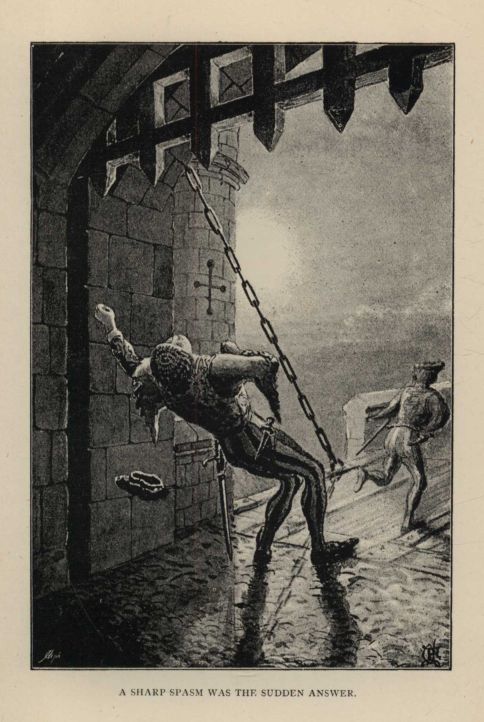
A SHARP SPASM WAS THE SUDDEN ANSWER.
Half a minute after, and Dicky Cheke sprang through the door.
"Ralph," he cried, "Ralph, come back, 'tis a trap!" but all he saw was a figure disappearing in the silver haze over the brow of the steep hill.
CHAPTER XVII.
HOW THEY WERE AT FAULT.
As Dicky Cheke darted after the figure which disappeared in the mist, he stumbled over some obstacle on the ground, and nearly fell. Recovering himself hastily, he stooped down to see what it was. The moon had risen higher, and the black edge of the shadow of the castle was receding before the silver light.
"Holy Saints!" gasped Dicky, as he stooped down, and saw with horror that what had caused him to tumble was the body of Ralph Lisle, the gleam of his gay dress plainly telling who it was. "I have come too late."
Then springing up, he called to the guard to bring a light, and run for a leech. The shouts of the boy soon brought assistance. Three archers on guard hurried out of the gate, carrying a lighted cresset with them. By the lurid glare of the smoky light Dicky, who was kneeling down by his insensible friend, could see a dark stain marring the rich colours of the tunic, and a black pool under the right side of the prostrate boy.
"He's been hard stricken," said one of the men.
"Here's been foul play. But who'd hurt Master Lisle?" said another.
"Now, none of your talking," said Dicky. "Get some water and cloths." At the same time he tore up his fine white linen tabard and laid the pieces over the small puncture from which the blood was welling in ominous streams. "I' faith, the poor lad will bleed to death, an the leech comes not."
"Here he comes," said the other archer, as a tall figure in a long fur gown came out of the wicket-gate, attended by several others, among whom the weather-beaten face of Sir John Trenchard was visible.
"How's this? how's this?" he inquired peremptorily. "How came the lad out here?"
No one answered.
"Which of you men was on guard?"
"Please your worship, 'twas my guard," said one of the men, knowing that Sir John Trenchard would be sure to find out, and thinking it best to make a virtue of necessity.
"Then how came this about?" said the Seneschal sternly.
"Marry, Sir John, 'tis more than I know. 'Tis parlous dark under the gateway, and belike he slipped out while my back was turned."
"Get you to the guard-room. There'll be more of this anon," said Sir John sharply. Then turning to the leech, he asked, "Is the boy dead?"
"Nay, Sir John; 'tis a deep wound, but not mortal. There's no artery severed, as thou mayest see by the darker colour of the blood. Had it been of a scarlet colour, 'twould have been useless for me to come. The flow is already stayed. We must get him to his bed, but that gently."
While the archers were raising Ralph with great care, Sir John Trenchard closely questioned Dicky Cheke as to how he came to find Ralph, and elicited from the page how the mysterious warning had been given him by the little girl, and how Bowerman had been designated as cherishing vengeful designs on Ralph.
"Where is Bowerman?" said Sir John Trenchard.
"Nay, I have seen him not," answered Dicky Cheke.
"Bid the pages be called to my apartment," said Sir John to one of the yeomen who attended on him. Then turning to Dicky, he said, "And who is this little wench?"
"I know not, Sir John. I never saw her before to-day."
"Hast thou any cause to suspect any one? Thou mayest speak freely; 'tis a case will have to be carefully inquired into."
Dicky Cheke hesitated; he had the natural disinclination all honest, manly natures have to incriminate any one, or harbour a thought that might do an injustice to another. Like all the rest of the garrison, he strongly suspected that Bowerman was at the bottom of the cruel trick which had been played on Black Tom, and he more than mistrusted him in this present case.
"Well, Master Cheke, hast thou no answer to give? 'Tis a grave matter. Thou wilt have to answer. Dost thou mistrust Eustace Bowerman?"
"Yes, Sir John," said Dicky, slowly and reluctantly.
"Ay, marry, and so do I. But we shall see anon."
They had now entered the courtyard. At the sight of the little procession--the four stalwart men walking in time, and the pale face of the insensible boy--the dancers all stopped, and came crowding round; but at a word from Sir John Trenchard, and a polite request from the Captain of the Wight to continue their festivity, the guests resumed their dancing, only Yolande insisted on going into the hall with her injured cousin, and old Sir William Lisle attended her. The leech now carefully examined the wound, and his verdict was anxiously awaited.
The usual remedies were resorted to for restoring animation, and, to the joy of Yolande, after a little quiver of the eyelids, they slowly opened, and Ralph once more looked upon the world.
The leech, seeing that all immediate danger was over, and that the hæmorrhage was yielding to the treatment, directed a bed to be made ready in a room adjoining the hall, and then dilated upon the excellencies of his remedies, to the great impatience of Yolande.
"But, Master Leech, will he get well? Is it a dangerous wound?"
"Nay, fair Mistress Lisle, science answereth not such bold questions as these but with silence. To get well is in the hands of God; we can but speak of how science and medicine knoweth what is the best course to adopt. 'Tis well known to those admitted to the occult arcana of the heavenly influences that the celestial bodies exercise a strange influence on our poor bodies of clay. Sol draweth unto him during the day the blood of our systems, gentle Mater Nox appeaseth the heat of our sanguine flow, and settleth the blood in our extremities. As at the third hour the bile subsideth, so that its acrid properties be not blended with the flow of the blood, so also at the second hour the atrabilis subsides, and in the eventime the phlegm abateth--"
"Marry, Master Surgeon Barber, thy discourse causeth my head to buzz. Tell me plainly an thou canst, is my cousin in danger of death?"
"Noble lady, to give a short answer becometh not the dignity of my art. There are hopes in that chaste Luna is in the ascendant, and Æsculapius ruleth the seventh house, that what is natheless a deadly thrust may yield to my remedies. But as the learned Averroes--than whom my old master, the worshipful Master Thomas Morstede, knew no--"
"Beshrew me, Master Barber, thou wilt drive me mad!" cried the impatient Yolande. "Canst thou not answer me plainly, instead of talking thy jaw-breaking jargon?"
But the leech or barber was incensed at this want of respect, especially coming from a young lady, and he briefly replied he must wait before giving an opinion until Aldeboran reached the third house.
Compelled to be satisfied with this answer, Yolande saw her cousin moved to his new couch, and then, recognising the absolute necessity of not disturbing him, she returned to the festivities, over which a cloud had been cast by this strange event.
Meanwhile Sir John Trenchard had gone to his apartment, and thither Maurice Woodville, Willie Newenhall and Dicky Cheke followed him.
"Where's Master Bowerman?" inquired the Seneschal.
No one answered.
"Who saw him last?" was the next question.
Newenhall moved uneasily, but looked as stolid as ever.
"Master Newenhall, thou art the eldest; tell me where you last saw Master Bowerman."
"An it please you, Sir John, 'twas after the banquet was over."
"Well, where was he? Was he dancing?"
"He was dancing."
"How long agone was that?"
Newenhall twisted his cap round, and looked more stupid and vacant than ever.
"Come, Master Newenhall, brush up thy wits and give a short answer--time presses."
"Maybe 'twas an hour ago," said the page sullenly.
Sir John Trenchard, seeing that Newenhall, either through stupidity or on purpose, would give no useful information, turned to Dicky Cheke and bid him narrate all the circumstances of his finding Ralph.
When he heard of the figure disappearing over the steep declivity on the other side of the road, Sir John rated Master Cheke soundly for not having bid one of the archers pursue him; and in spite of Dicky's protestations that he was so flurried by the sight of Ralph's body lying bleeding in the road, as to think only of helping him, that young gentleman was severely reprimanded for his absence of mind.
"One who would be a useful knight, and serve his prince well, should never forget what is the right course, never mind what may be the obstacles," said the Seneschal, with stern sententiousness.
Maurice Woodville could give no information; he had been in close attendance on the Captain of the Wight, and had not seen Bowerman at all.
Orders were now issued to have the castle searched for the missing page, but with no result. He was not found, and no one had any doubt that it was Eustace Bowerman who had struck the blow.
The guests all dispersed to their homes soon afterwards, many of them being accommodated for the night in the castle as guests of the Captain of the Wight; among whom Sir William Lisle and his daughter, with the Abbot of Quarr, were the most honoured.
The next morning, the first visitor to inquire after Ralph was his cousin Yolande. It was joyful news to her to hear that he had passed a quiet night, and, although very weak and faint from loss of blood, was doing well. No one had as yet questioned him on the strange accident, and it was still a mystery why he had gone outside the castle at all.
"'Tis a rare mischance, Maurice," said Dicky Cheke, as they went downstairs together to begin the duties of the day; "Ralph might have gotten the prize of this day's tourney also."
"'Twas Bowerman that dealt the foul stroke," said Maurice, without heeding the other's remark. "Where can he have gotten to?"
"Ay, where indeed? But he can't escape; I hear there's orders been sent out to search all boats that leave the island."
"Marry! why he could have gotten clear off before the alarm was raised. They ought to have scoured the country for him last night, they'd have taken him then withouten any doubt."
Dicky looked rather foolish. He remembered how he had been rated by Sir John Trenchard the night before.
"Dost think Newenhall knows aught of the matter?"
"Humph!" answered Dicky. "He didn't like Ralph, and he wouldn't stop any harm coming to him, but I don't think he's got the pluck to do him a wrong himself."
"His ways were odd last night. Didst mark how he couldn't answer old Jack-in-Harness's questions?"
"Couldn't? Wouldn't, you mean," said Dicky. "Ay, I marked it sure enough. Well, old Jack's as sharp as a needle--he'll find it all out."
The conversation was interrupted by their arriving at the door of their lord's apartment, and being ordered to enter by the archer on guard.
The account of Ralph Lisle's favourable condition was joyfully received throughout the garrison, and the news had already spread to Newport.
"So I hear there was a young lad slain last night in a drunken brawl after the revels," said the same rough fisherman who had spoken with Bowerman the day before, to a countryman whom he met coming out of Carisbroke.
"Ay, so they say; leastways, if it warn't two or three as was killed. Holy Thomas! they castle folk be a woundy lot of gallants. They'd as soon kill each other as the French, so long as there's nought else to kill."
"Marry, and you're right; but I hear there'll be blows anon."
"Ay, sayest so? Well, well; but where away? All's quiet i' the land, bean't it?
"Seemingly. But there's them as'll be moving soon. They've not done with the White Rose yet. Howsever, 'tis blows in France as'll soon be going. 'Tis rumoured over t'other side o' the water that our Captain's a-going over there with a power of men."
"No! you don't say so; and who's he going to fight?"
"Why the French, to be sure; all along o' the Duke of Bretagne having helped King Henry when he were in hiding there."
"Then 'tis the King of France as backs the t'other side--eh?"
"Ay, ay; and another powerful princess."
"Oh! and who's that?"
"Why, 'tis the good Duchess of Burgundy, as was sister to our brave king, to be sure."
"What, she as I heard say gave that Simnel lad so much money? Well, now, she be a kind lady. But, i' faith! I'm sick o' wars. 'Tis the ruin of all our lives and fortunes; and surely we've had enough i' the past years."
"Marry! my lad, there's always a picking when knights are pricking. 'Tis wars makes poor men rich, and rich men poor, an you only know the way."
"Ay, ay, but you beant as old as I be. I've worked on Swainston Manor for a matter o' twenty-four year come next Lammas. My lord then were the great King-maker, as he were called--Old Bear and Ragged Staff. And what came to him? why, he were slain in battle at Barnet field. Then arter him, my lord were the Duke of Clarence. Well what came to him? why, all along o' being a king's brother, and not having such a good headpiece as t'other brother, he were put i' a butt o' Malmsey--so they sez, leastways--and so were drowned. And now, who's my master? why him, poor lad, as they've got mewed up i' Lunnon Tower. And all for what? because, poor lad, he's his father's son, and bears the name of Warwick, like his grandfather; and like enough he'll come to a bloody end too."[*]
[*] He was executed for trying to escape from the Tower with Perkin Warbeck, in 1498.
"Well, well, I shall be late for the sword strokes an I stop here. Are you coming, gaffer?"
"Marry am I. There'll be a sight worth seeing, I hear. Who'll win the prize to-day, think you?"
"Certes, there's not much question. 'Twill be the stout knight in the plain armour."
"Oh, ay! and who be he?"
"That'll be known soon enough; but come along."
So saying, they walked off to the place of arms, where the tilting had taken place the previous day.
There was the same concourse of spectators, but the interest was not nearly so great as it had been the day before, the hand-to-hand encounter with swords not affording such opportunities for spectacular effect as the mounted contests.
However, there were some very fierce encounters, Sir Alain de Kervignac exchanging several hard blows with Sir John Dudley, who had recovered sufficiently to take part in the proceedings. It was unfortunate that the only combatants on the assailants' side who could fight at all on equal terms were incapacitated by the severe wounds they had received; and in order to prevent the sport becoming too tame, permission was given by the Judges to Sir Richard Cornwall and the unknown knight to meet the two Breton knights.
That evening Ralph was so much better that Dicky Cheke and Maurice Woodville were allowed to see him. The lively account given of the day's proceedings by the former young gentleman will describe the fighting better than a mere narrative of the sword-strokes exchanged.
"'Tis a pity, Ralph, thou wast not there. 'Twas rare sport. Sir Richard Cornwall caught the Breton--the Sire de Kervignac, I mean--such a crack over the costard, I thought he had split his skull; but he's a tough little wight, that he is. He no more minded it than if it had been a fleabite. Up he sprang, and waving his sword in the air, he brought it down like a flash of lightning right athwart Sir Richard's sword, which he held to guard his head; he hit so hard that he cut it right in two, and then, swinging it round, he gave him a buffet on the side of his salade--for he wore a salade and not a burgonnet to-day--that, big man as Sir Richard Cornwall is, he staggered, so that I verily bethought me he was going to fall to the ground, and thou knowest how big a man Sir Richard is. And all the while Sir Richard had no sword to smite in turn; but he made a brave fight of it, for he rushed out round the barrier and seized the small Breton in his arms. Then we did shout; oh, how I shouted!"
"Yea, and got rapped over the costard for doing it," said Maurice Woodville. "And serves you right, too; I felt quite grieved for thy want of manners."
"Now that is a scurvy tale! Why, Maurice, thou knowest thou wast going to shout too, only thy mouth was so full of apple puff that thou hadst filched from Polly Bremeskete's basket, which was open as thou chancest to pass, that thou couldst not make a sound saving a gruesome, pig-like snort. Come, that won't do."
"Marry will it. I did not make a braying jackass of myself, as thou didst."
"No, because thou hadst already made a pig of thyself. But there! 'twill be long ere I finish my tale, if thou breakest in in this way."
"Then cut it short, Dicky, or, better still, I'll go on. Well, Ralph, the Marshal stopped them. He bade Sir Richard let go, and said both had done their devoir full well. But the best sport of the whole was when the Rusty Knight--I marvel who he is--tackled the other Breton--him whom thou toppledst over, thou knowest. There was a slashing and rashing! The sparks flew like the sparks at the armourer's forge when Tom works the bellows, and at last the Rusty one smote the Breton so fierce a blow that he fell to the ground and never moved, and all men thought him dead. Then the people shouted, and--"
"Yes! and thou hadst finished thine apple puff then, so thou shoutedst too," broke in Dicky, who was fuming and fidgetting at the story being taken out of his mouth.
"Thou wert told to be still, and not make a noise, Dicky. We shall have old Mother Trenchard after us an thou art not quiet. Well, as I was saying, the Rusty Knight having no--"
"You weren't saying it!" broke in Dicky again. "You were saying--"
"What an egg thou art, Dicky! Wilt thou be still, and let me finish?"
"Why, 'twas I who began, and I ought to finish."
But here Lady Trenchard was attracted by the rising voices, and coming in, bade both the boys begone.
Placing her cool hand on Ralph's brow, the kind lady remarked she was glad to see him looking so well; and then, sitting by his side, she went on with her work, while she told him, in a more connected way, the events of the day.
Ralph was relieved to hear that Sir Amand de la Roche Guemené was not seriously hurt, only stunned by the terrific blow of his antagonist.
"But who is he, Lady Trenchard?--knowest thou?"
"'Tis a deadly foe to the Lord Captain, for he openly challenged him to mortal combat," said Lady Trenchard gravely.
"What! he dared to challenge the Captain of the Wight?" cried Ralph, in amaze; "and what said he?"
"He accepted his challenge."
CHAPTER XVIII.
HOW THE RUSTY KNIGHT LET THE SUN GO DOWN ON HIS WRATH.
On the evening of the last day of the jousts, just as the sun was setting in a blaze of stormy grandeur, tingeing crag and headland and far-off swelling down and beetling cliff with fiery glow, two men were making their way from the steep summit of the high down above the dark fissure in the cliffs where Ralph Lisle had so nearly met his death.
"'Vengeance is mine, I will repay,' saith the Lord," the older and less active figure was saying to his companion.
"Maybe, maybe," said the other testily. "And I never counted much of disputation, but I know this, that even in Holy Writ evil-doers were punished, and made to atone for their wrong-doings."
"But their punishment came not from those who were wronged. 'Evil shall hunt the wicked man,' it is true, but it says not we are to be the instruments of our revenge--and, as I have often-times told thee, there is not the least proof that thou hast received any wrong at his hands."
"Man, man, talk not with me thus!" broke in the other with hot passion. "She loved him or ever she saw me--and she hated me from the time she took me for her lord and master, even if she hated me not from the time of first seeing me; and when a woman hateth one and loveth another, and the one is her husband and the other her--"
"Listen, my son," interrupted the older man in turn, "and thou wilt learn how little thou reckest of all he hath done for thee, in his knightly courtesy and chivalrous forbearance, framing his conduct on the model of the most noble of Christian champions."
"I will not listen, an thou art going to give him, my mortal foe, laud and honour. I have sworn to have his blood, and his blood I will have, or he mine; and he hath given me his word he will meet me," added the speaker, with an evil glitter in his flashing eye. "So say no more, worthy friend; I know my duty, and I will do it. In slaying him, I shall be doing my devoir to my liege lord, my country, and to my own honour. And slay him I will, ere this moon shall have run her last course, for to this end he hath plighted his word as a belted knight."
"My son, I have been a knight, as thou well knowest, and in mine hot youth I also bore a feud against one who, in sooth, had wronged me. I slew him, and albeit there was no question of his evil-doing, yet I rue me of his blood, and in my lonely orisons I implore mercy for my blood-guiltiness. I would fain spare the lonely hours of sorrow and remorse that will await thee, if thou livest,--him, if he slay thee. For the dolour to him will be great; and as I well know his knightly heart and gentle and joyous nature, so--"
"Now beshrew me for a soft-hearted chitling an I hearken to aught more of his laud. If thou hast no more but this to say, I will e'en take my leave, holy father. The sun is set, and I have matters to hasten withal."
"Fare thee well then, my son," answered the old man, with a sigh. "At least be mindful of thy daughter; and if evil betide thee, see that as little as may be befall her, pretty innocent. But fear not. As is my bounden duty, all that I know of thy party, thy plots, and thine hopes is sunk deep in the inmost chambers of my mind, and thou needst not fear that I will bewray thee. I urged but thy duty as a Christian, and minding well the words, 'Blessed are the peace-makers.' Mayhap the time will come soon, sooner than thou or I know, when thou wilt wish thou hadst hearkened to the voice of the Lord, through me, and hadst not hastened thy feet to shed blood. Farewell, my son, and fain would I that I could say, with any hope of its being true, Pax vobiscum!"
So saying, the old man turned away, and took the path, or rather sheep-track, which led over the down behind him. When he had climbed some distance up the steep, wind-shorn slope of brown grass, he paused, and turned to look over the lovely view behind him.
The sun had set, and storm-clouds were working up on the horizon. Above their deep, livid masses a clear, pale yellow sky, flecked with golden and purple patches of wind-torn vapour, told of the change that would shortly come.
The wide-stretching "wine-dark sea" lay far below, as yet still and glassy, its surface only heaving with the long swell which rolled into the Channel, telling of a storm far off in the mysterious deserts of the yet boundless Atlantic.
The roar of the surf, grinding among the rocks on that iron-bound coast, surged up to the giddy height whence the Hermit of St Catherine gazed out to the west and mused on the monotony of earthly passions, their dreary recurrence, and how they are blotted out by death and eternity.
"'Lord, what is man that Thou art mindful of him, or the son of man that Thou so regardest him? Man is but a thing of naught, so soon passeth he away and he is gone.' Ay, truly! but Thy word abideth."
And with a weary sigh the old man once more turned to climb the steep-backed hill.
Meanwhile the other had disappeared over the edge of the cliff. A path scarcely to be made out led down the face of the western wall of the fearful chasm. Tufts of grass, and a few wind-cropped, stunted bushes, gave foothold or hand-grasp to the hardy climber. When he had nearly reached the middle of the chasm, and was but half-way down, he paused and looked about him.
"Ay, ay," he muttered, "'tis all right. They've not come back yet. There's the plank, where it ought to be."
The man then climbed down a little further to where a ledge in the cliff allowed a little more room to move. Against the face of the precipice was a somewhat larger bush of stunted thorn. Protruding from underneath its boughs was the end of a plank. The man drew it out. It was long and heavy. With ease, however, it was drawn to the edge of the little platform, and balanced for launching out to rest on the edge of a similar platform in the face of the opposite precipice.
After swinging the plank backwards and forwards two or three times, the man at last darted it violently forwards, and with such vigour and dexterity that it rested some inches on the opposite ledge. He then proceeded to walk steadily across it, and, having reached the further side, he drew the plank over after him. In this way he cut off all access to his standing-place. Behind him were a few bushes; stepping up to the largest of these, he disappeared behind it.
Had any one been observing him, it would have seemed that he had vanished into the face of the cliff, so close did the bush grow, and so bare and beetling did the face of the rock seem.
But behind the bush was a narrow rent in the cliff, wide enough to allow one man to pass through, and opening out inside into a space of sufficient size to accommodate three or four people.
Striking a light with a flint and steel, the man soon kindled a fire, the smoke of which, instead of curling out through the entrance, found its way to the upper air by some other exit.
Having thrown more fuel on the fire, the man sat down on a spar, which looked as if it had come from some wreck, and fell into a deep reverie.
The flickering light fell full upon his face and figure, showing dark, weather-beaten features, marked with deep lines, but bearing evidence of a strong will, high courage, and pride. His frame was very powerful, although the rough dress he wore did little to set it off. But the sinewy hands and strong neck, combined with great breadth of chest, showed a man capable of vast exertion. In spite of the rude dress, there was a certain air and look which told at once of superior position, and any stranger meeting him would at once have addressed him respectfully, in spite of his surroundings and attire.
"And so the hermit bids me lay aside thoughts of revenge," he muttered. "'Tis easy to say that, when he himself confessed that he had taken his revenge. Can I have been mistaken? Did she not run to him? The pretty wanton, having made me her sport, she spread her wings to other lures. But now he shall atone for it. Dead is she? 'Tis all a lie; part of the false fooling of his wanton wit. Traitor hath he been to his party, to his king, and to the cause. But his day is over. Mistrusted by Henry, he will be led away by his own conceit. Abandoned by a subtle and cold-blooded tyrant, he will die on the scaffold, or on the battlefield, sold to France, to secure his master's ends, if he die not by my own hand, as I devoutly pray he may. And as for me? What hath my life been, and what hath been his? Because I have been true to my king and cause, I am disinherited by my father, and am a beggar, a fugitive, and an exile. Because he hath a fair sister, forsooth, he rises into favour, then changes sides when he sees which way the wind blows, abandons his party, and becomes a noble, a high power in the land, and Captain of the Wight. But his day will soon be over. And what hath life left to offer me? My father hath cast me off, my friends are mostly slain, and there are dark rumours of traitorous practices among such as are left. The gold of Henry of Richmond is doing its deadly work. But there's Simon's voice," he broke off, as a loud halloo interrupted his sombre thoughts.
Getting up, he went to the door of the cave. It was now dark, and no objects could be distinguished in the depth of that gloomy chasm. The tide had risen, and the damp mists from the sea mingled with the spray which dashed among the fallen boulders far below. One step, one false move, and the man would have been dashed to pieces on the rocks beneath.
"Sir Knight, art there?" bawled a gruff voice out of the blackness opposite.
"Ay, Simon; I'll place the plank anon."
The wind had now risen a little, and whistled and moaned amid the fissures of the gorge; but above it, or in lulls of the breeze, the knight thought he heard sobs.
"Marry, Simon, whom hast thou there?"
"'Tis the little wench, master. She would come. I found her on the hill yonder coming from Appuldurcombe."
"Why, what's come to her?"
But before the man could answer, a tearful voice called out,--
"Oh, father, they've killed Master Lisle," and then the sobs broke out in uncontrolled emotion.
"Nay, nay, fair daughter, he is well enough; I learnt that much before I left the lists."
The plank having now been safely adjusted, two figures advanced over it, and stepped into the light of the fire, which gleamed in fitful glimmer out of the fissure behind the bush. The childish figure threw itself into the arms of the stalwart gentleman, crying out as she did so,--
"Oh, I am glad! I should have grieved so sadly had aught evil happened to Master Ralph."
"Humph! Sweet wench, thou takest over much thought for the safety of thy young kinsman. But 'tis a brave lad and a true. I grieve he should have suffered harm. But come in. Simon, I have heard news. I would I could get me to France."
While father and daughter were talking together, the serving-man, who was the same rough fisherman who had spoken to Bowerman after the tourney was over the evening before, had lighted a torch, and was spreading a simple meal on the top of a chest, which served for a table. There was the same strange mixture of gorgeousness and squalor in the appointments of the repast as in the food itself. A richly-chased silver flagon contained wine, which, from its fragrance and colour, seemed the very choicest Burgundy. Coarse bread flanked an enamelled bowl of Limoges ware which held the butter, stale and rancid from the time it had been there. A meat pasty was served in a pewter dish, while a richly-chased knife was ill assorted with a wooden trencher.
After they had eaten, the knight and his varlet talked earnestly for some time. The young girl sat apart. After putting away the remains of the supper, and washing up the things, she sat down on a chest near the fire, and seem to pay no heed to the conversation of the others.
She was a pretty child, with long dark-brown hair, which waved and strayed from under her little close-fitting red cap. Her large soft brown eyes had a wistful expression in them, and her flexible mouth, which usually was parted in merry smiles, or arch fun, was now pursed up in grave thought. Her face was sunburnt, and her dress simple and patched.
Suddenly her attention was caught by hearing her father mention a name she knew.
"Oh, father!" she broke in, unable to master her suspicions, and her impulsive indignation overcoming her habitual awe of her father, "I hope they will catch that Bowerman. What a base caitiff, to stab his friend so foully!"
"Marry, little wench, who told thee to speak?" said her father, stroking the glossy hair.
The child was always in much awe of her father, and nothing but the hot impulse of her anger would have made her burst out as she had done.
She now hung her head a little lower, but looking up shyly after a moment, she said, in a soft, winning tone,--
"But, father, think of it! You are noble, and would never injure your foe save in fair fight and face to face. How I wish all this fighting was over, and there were no such things as foes. Oh dear," she sighed, "I am so tired of it all!"
"Tush, child, you should not have come away from Appuldurcombe: the sisters should not let you roam like this."
"'Twasn't their fault, father; I stole out to help John see to the cows, and then I thought I would come on over here and see you."
"But, by St George, thou must not play these pranks, little wench. Thou hast had too much freedom by far. No marvel," he broke off, with a fierce look of anger, "when thou hast been left to bring thyself up, with only such care as I can give thee."
"But, father, thou dost not like that Bowerman?"
"Marry, wench, what is that to thee? He is a friend to the cause, and, though young, is useful, and may be more so. How know I whether he gave the stroke or not? Wait till thou knowest before thou judgest."
"Ay, but I know full well," added the girl, under her breath, not, however, daring to speak her thoughts aloud.
At this moment a noise was heard outside.
They all kept quite still, and the fisherman dropped a sail across the entrance, so as to prevent the firelight being seen outside.
The noise was repeated. It sounded like a groan.
"Go, Simon, see what it is," said the knight.
The man passed outside; the other two listened.
A groan, as of some one in pain, could be distinctly heard, and then a few half-uttered words.
"Who can it be, father?" whispered the girl, drawing closer to her father.
She was not a timid child, but the strange sounds in that gloomy chasm recalled the tales she had heard of the place being haunted.
"'Tis the plaint of some one in dolour," said her father.
"Simon, ask who it is."
The moaning ceased as the seaman's voice resounded in the echoing chasm.
"'Tis a water-sprite, my lord, that's what it be," said the man, coming in.
"Tush, man! 'tis some one in pain, who hath fallen over the cliff maybe. Stay with the child while I go and see."
Taking the torch in his hand, the knight went to the entrance, the girl and seaman following him close.
It was a weird scene, as the lurid light of the flickering torch shone on the wall of rock opposite, while the inky blackness of the gorge, yawning at their very feet, caused a shudder to pass through the child as she thought how near they all were to a fearful death.
"Holy saints!" a faint voice gasped, in awe-struck accents; "are these spirits or fiends? and have I fallen to the bottomless pit?"
"'Tis as I thought," said the knight. "'Tis some poor wight fallen down, and, by some marvel, he hath lighted on the only ledge that could save him. 'Tis the hand of Providence hath saved him from rolling into that black pit." Then he added, in a louder tone,--"Art hurt, man? Canst stand upon thy feet? Who art thou?"
No answer came. All was silent as the grave.
"Put the plank over, Simon; I will go see who it is."
In a few moments the plank was put across.
"Oh, father, take care! Maybe 'tis a trap to catch thee!" cried the girl in terror.
"May be, my lord, 'tis even so," added the seaman; "best let me go."
"Nay, man, nay; hold the torch while I step across."
So saying, the knight handed the light to his attendant, and, drawing his sword, stept warily over the plank.
The other two remained in breathless silence.
"Hold the torch higher," called the knight.
Again there was deathly silence.
"Father! father! what is it?" called the girl.
"I know not; I can see naught--ay, but I can! Why, my fair master, what mayest thou be doing here?" added the knight, addressing some one.
Then he called out in a relieved tone,--
"Come here, Simon; 'tis Master Bowerman, and he hath swooned away."
CHAPTER XIX.
OF THE PERPLEXITY OF THE LITTLE MAID.
"Bowerman!" said Magdalen, intensely astonished as well as relieved; "what could he have been doing here?"
However, there was no longer any cause for anxiety, either on the score of her father's safety or from the vague terrors of superstition.
With considerable difficulty the knight and his servant carried the senseless esquire over the plank and into the cave. On examination, it was found that the young man had cut his head against some point of rock in his fall, and had received other injuries, none of which, however, seemed severe.
"'Twas a marvellous chance," said the knight.
"Ay, truly: but now he's come, he'll be of rare use to us, an he getteth over this," said the seaman.
"Humph! he was of more use where he was," was the knight's comment.
Then, looking at his daughter and seeing she was listening eagerly, he added sharply,--
"Now, child, bestir thyself; get water and bandages, and give Master Bowerman a cup of wine."
With evident reluctance the girl obeyed her father, sighing to herself,--"Ah, me! why must my father take so much concern for this Bowerman, who, I know full well, tried to kill Master Lisle?"
It was not long before the wounded esquire opened his eyes and stared round him in amazement.
"Marry, Master Bowerman, thou knowest us not. Recall thy wits, and bethink thee of what hath happened," said the knight.
But Bowerman had not yet recovered the full use of his faculties.
"Newenhall, thou dolt!" he muttered, "what art cowering here for? why art not a man for once? The horse will never hurt thee. There, 'tis done--ah, he won't ride him for some time," and Bowerman chuckled mockingly.
"I knew it! I knew it!" cried the girl; "the cowardly caitiff. He hath confessed he lamed Black Tom."
"Silence, wench," said her father sternly. "Dost not see the lad raveth?"
Gradually the young man recovered his senses, but it was some time before he could be made to understand what had happened. At last he recognised the rough seaman, and then he knew who the other man was. He would have risen to do him reverence, but the knight restrained him.
"Nay, Master Bowerman, this is no time for idle courtesies; I know thy breeding. Take another draught of this, and turn thee to sleep; thou canst talk to-morrow morn, an thou art well enough."
The air of authority with which this was said helped to pacify the injured man even more than the draught, and he soon sank into a deep sleep.
The knight now turned to his daughter, and bid her retire to a recess in the cavern, where a couch, made of old sails and other lumber, served as a bed, before which a sail was hung as a curtain.
After the child had disappeared, the two men entered into a deep conversation in low tones.
"There be a story afloat of a new plot," said the man. "But there be naught in it, be there?"
"Maybe there is, but matters are not ripe yet. An we could only get Henry embroiled with France, we should have better help than from the Dowager of Burgundy. And I have hopes that he will send a force to aid the Bretons. But I can do naught until I have met Woodville."
"And when will that be, your worship?"
"Not for a few weeks, I fear me. He hath other matters, and this attack on his esquire hath put him out."
"Thou wast wondrous kind to the lad at the tilt. All men marvelled what could be the cause."
"A wish of my daughter's, as thou knowest. The lad was passing gentle to us as we came hither; and he is a good lad, and one of my own house too."
"But he's parlous sweet on Mistress Yolande, and there's them as says she means to marry him, and old Sir William is going to make him his heir."
The knight's face grew black.
"Enough! enough! I would I could get me to France. I hear the Lord Daubigny will be returning shortly. We must join him at Southampton. Dan has got the old boat mended?"
"Ay, ay; she'll do for us as far as Southampton, or, for that matter, we could make shift over to Barfleur in her ourselves."
"That's well; and now leave me, I would think awhile."
The next morning Magdalen was sent back to the cell at Appuldurcombe, much to her discontent. Before she left, however, she had the further dissatisfaction of learning that Master Bowerman was not only in a fair way of recovery, but that he so plausibly accounted for his being in hiding, and having run away from Carisbrooke Castle, that her father not only seemed to believe him quite guiltless of the attack on Ralph Lisle, but even appeared to look upon him with much favour as an injured man, and a sufferer by reason of his inclinations towards the exiled Yorkists.
It was important to make as many friends as possible, and the Bowermans were likely to become more influential in the island by reason of their recent alliances.
The story Bowerman gave was, that being outside the castle on the evening of the first tilt, he had heard of the mysterious assault on Ralph as he came back, and well knowing how he would be suspected, and being also--he could not deny it--disgusted with the favour shown that fortunate young man, he had determined to get away. He had had some previous relations with the other seaman, who had smuggled articles into the castle for him, and had been useful to him in many other ways before; and he had been already sounded on the subject of the late plot to annoy the Government, and had entered into correspondence with the Yorkist secret agents. Although he knew about the fugitives, he did not know where they were in hiding, the knight's two retainers being far too cautious and trusty to betray their secret. He, however, resolved to remain in concealment until he could get away, and for that purpose he had come over to the wildest part of the island, as being the safest place, and also where he was most likely to meet with Dan the fisherman.
The account he gave of his accident was, that having been hard pressed that day by some of the garrison of Carisbrooke who had been sent out to find him, he had climbed down the cliff and remained there until dusk. Hearing fresh steps, he had tried to get further round the face of the cliff, and had slipped on to the ledge where they found him. That he was partially stunned, and seeing the light in that awful place, he had thought they were spirits, and he had fainted away, as a result of physical exhaustion and supernatural dread.
It suited the knight's purpose to listen favourably to this tale, and with an air of belief, and he even went so far as to sympathise with Master Bowerman in his wrongs and grievances, and the accident to Ralph Lisle was never afterwards referred to.
Magdalen, who was allowed very often to see her father, whose secret appeared fully known to the Prioress of the little community, and who belonged to a well-known Yorkist house, was dismayed to find how very intimate Bowerman had become, and was still more embarrassed to discover that he was desirous of ingratiating himself with her. One morning, about a month after the tourney, when she had come over earlier than usual, the girl noticed a decided stir going on in the little cave. Armour was being burnished up, and a couple of stout lances were being critically examined by her father. There was never much effort at keeping matters secret from Magdalen, and the conversation, or rather few remarks which fell from her father, were hardly interrupted by the arrival of the young girl, who brought over a supply of fresh butter and eggs, with a few other necessaries. Magdalen had always to be very careful when she came near the gorge, lest any stray country folk should see her. But this part of the island was thinly populated, and she had never yet met with any one. The Hermit of St Catherine's knew her secret, and she looked upon the good old man as one of her best friends. While she was arranging the contents of her basket, she heard her father say,--
"Thou wilt see that all is ready, and in case of ill befalling, I trust to thy bearing this missive to Sir John Clifford. Dan will go with thee. The boat is all ready."
"In sooth, my lord, I will do thy bidding. But I fear no mischance. I have seen myself thy prowess, and heard more. He cannot stand before thee for one course even."
"Humph! 'Tis a good lance, and there are risks always; but I have my just cause, and I trust in the right."
"Thou wilt have Dan and Simon there also?"
"Ay, ay. They can come, and fully equipped, too; but they must take no part, whate'er betide."
Magdalen noticed a peculiar look in Master Bowerman's eye, and detected a meaning glance exchanged between him and the most sinister-looking of the seamen.
What could they be talking about? she wondered. She always dreaded some terrible fate befalling her father. She knew his stern, fearless disposition, and she also knew that he nursed the most inveterate hatred to the Captain of the Wight. He had never told her why, but if ever his name were mentioned, she noticed that he seemed to lose all control over himself, and would utter the most dreadful maledictions on his name and family.
"There is going to be some fearful fight, I know there is," she murmured. "Oh, if only I could find out when it takes place and where. Perhaps Bowerman would tell me. He seems to wish to please me; why, I don't know."
She little knew that if only the Yorkist party, whose hopes were centred on the imprisoned Earl of Warwick, could upset the present government, her father would be a person of great distinction, and she would be the heiress of the Lisle property. It was well worth Bowerman, or any other aspiring youth, doing all he could to win her favour. Besides these substantial worldly advantages, she was a very sweet girl, with a fair face and noble nature. Entirely unspoilt by luxury, and brought up in the severe school of poverty and hardship, she had often compared herself to the "Blind Beggar's Daughter of Bednall Green," and would shyly wonder if her fate would be like that of "pretty Bessie," and whether her adventures would end "with joy and delight," and she should have for a bridegroom "the gentle young knight