Volume 10 — CHAPTER II (continued 2)
Reading edition
In a few mammals there is a kind of dentition known as the monophyodont, in which only one series of teeth reaches maturity; where in fact there is no replacement of a milk series by a permanent dentition. Of the monophyodont dentition Whales form an example. The Marsupials are very nearly an instance of the same phenomenon; for Sir W. Flower showed, and Mr. Thomas confirmed his discovery, that only one tooth, according to Mr. Thomas the fourth premolar, is replaced in that group. But even the purely monophyodont dentition of the Toothed Whales is a more apparent than real contrast to the diphyodont dentition elsewhere prevalent. An investigation of the embryos of various Toothed Whales by Dr. Kükenthal and by Dr. Leche has brought to light the highly important fact that two dentitions are present, but that one only comes to maturity; from this fact obviously follows the interesting question:—To which of the two dentitions of more normal Mammalia does the monophyodont dentition of the Whales and Marsupials belong? To this question a clear answer is fortunately possible. As has been pointed out in the foregoing sketch of tooth development, and has been illustrated in the figures, the milk teeth develop as lateral outgrowths of the common enamel germ, while the permanent teeth arise from the end of the same band of tissue. This fact enables it to be stated apparently beyond a doubt that in the Whales and in the Marsupials it is the milk dentition which is the only one to arrive at maturity. Thus the earlier theoretical conclusion that the Marsupial dentition "is a secondary dentition with only one tooth of the primary set left," is proved on embryological grounds to be untrue. But there are other monophyodont animals than those already mentioned.[25] Orycteropus, the Cape Anteater, is an example. Mr. Thomas has lately discovered that in this Edentate there is a set of minute though calcified milk teeth which probably never cut the gum; here we have a different sort of monophyodontism, in which the teeth belong to the second and not to the first set. Between the latter condition and the diphyodont state are intermediate stages. Thus in the Sea Lions the milk teeth are developed but disappear early, probably before the animal is born.
In the typical diphyodont dentition, such as is exhibited for example in Man and the vast majority of mammals, the milk teeth eventually completely disappear and are entirely replaced by the permanent set of teeth, with the exception, of course, of the molars, which though they are developed late belong to the milk series.
Their correspondence with the milk series is shown in an interesting way by the close resemblance which the last milk premolar often bears to the first molar. These two extremes of dentition, i.e. purely monophyodont and, excepting for the molars, purely diphyodont, are however connected by an intermediate state of affairs, which is represented by more than one stage. In Borhyaena (probably a Sparassodont) the incisors and the canines and two out of the four premolars belong to the permanent dentition, while the two remaining premolars and of course the three molars are of the milk series. Prothylacinus, a genus belonging to the same group, has a dentition which is a step or two further advanced in the direction of the recent Marsupials. We find, according to Ameghino,[26] whose conclusions are accepted by Mr. Lydekker, that the incisors, canines, and two premolars belong to the milk series, while the permanent series is represented only by the two remaining premolars. We can tabulate this series as follows:—
(1) Purely monophyodont, with teeth only of the first set—Toothed Whales.
(2) Incompletely monophyodont, as in the Marsupials, where there is a milk dentition with only one tooth replaced.[27]
(3) Incompletely diphyodont, with the dentition made up partly of milk, partly of permanent teeth, as in Borhyaena.
(4) Diphyodont, where all the teeth except the molars are of the second set; this characterises nearly all the mammals.
As we pass from older forms to their more recent representatives there is as a rule a progressive development of the form of the teeth. This is especially marked among the Ungulata. The extremely complicated type of tooth found in such a form as the existing Horse can be traced back through a series of stages to a tooth in which the crown is marked by a few separated tubercles or cusps. Arrived at this point, the differences between the teeth of ancestral Horses and ancestral Rhinoceroses and Tapirs are hard to distinguish with accuracy; and the same difficulty is experienced in attempting to give a definition of other large orders by the characters of the teeth, such as will apply to the Eocene or even earlier representatives of these families. Fig. 36 (p. 51) illustrating a series of mammalian teeth will illustrate the above remarks. That there is such a convergence in tooth structure shows that it is, theoretically at least, possible to determine the ancestral form of the mammalian tooth. Practically, however, the difficulties which beset such theorising are great; that there are such divergent and such strongly-held antithetical views is sufficient proof of this. Two main views hold the field: one, which has found most favour in America, and is due chiefly to the labours and persuasiveness of Professors Cope, Scott, Osborn, and others, is known as "trituberculy."[28] The alternative view, as urged by Forsyth Major, Woodward, and Goodrich, attempts to show that the dentition of the original mammal included grinding teeth which were multicuspidate or "multitubercular." There is much to be said for both views, and something to be said against both.
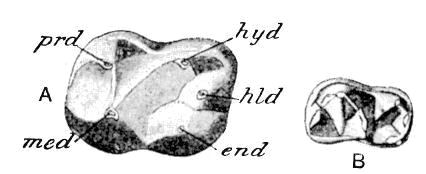
Fig. 38.—Molar teeth of A, Phenacodus, and B, the Creodont Palaeonictis. End, endoconid; hld, hypoconulid; hyd, hypoconid; med, metaconid; prd, protoconid. (After Osborn and Wortman.)
This question is, however, wrapped up in a wider one. Its solution depends upon the ancestry of mammals. If the Mammalia are to be derived from reptiles with simple conical teeth, then the first stage in the development of trituberculy is proved. On the other hand, however, the evidence is gradually growing that the Theromorpha represent more nearly than any non-mammalian group with which we are acquainted the probable ancestral form of the mammals. These animals offer some support to both the leading views. Cynognathus had triconodont teeth which, as will be pointed out later, are a theoretically intermediate stage in the evolution of tritubercular teeth; on the other hand, the teeth of Diademodon and some others are multituberculate, and have been very properly compared to the multitubercular teeth of such primitive mammalia as the Ornithorhynchus. Professor Osborn is no doubt correct in italicising a remark of an anonymous writer in Science to the effect that in Diademodon the teeth, though multitubercular, show the prevalence of three cusps arranged in the tritubercular fashion. But this may be only a proof that the multitubercular antedates the tritubercular. It may be, indeed, that the mammalian tooth was already differentiated among the mammal-like Saurians and that from such a form as Cynognathus the Eutheria and other forms in which a tritubercular arrangement can be detected were evolved, and from such form as Tritylodon the Monotrematous branch of the mammals. This way of looking at the matter harmonises a much-disputed question, but involves a diphyletic origin of the mammals—an origin which for other reasons is not without its supporters.
We shall now attempt to give a general idea of the facts and arguments which support or tend to support "trituberculy." As a matter of fact the name is inaccurate; for the holders of this view do not derive the mammalian molar from a trituberculate condition, but in the first place from a simple cone such as that of a crocodile!
To this main and at first only cusp came as a reinforcement an additional cusp at each side, or rather at each end, having regard to their position with reference to the long axis of the jaw. This stage is the "triconodont" stage, and teeth exist among living as well as extinct mammals which show this early form of tooth. We have, indeed, the genus Triconodon, so named on that very account. Among living mammals the Seals and the Thylacine all show some triconodont teeth. A Toothed Whale, it may be remarked, is a living example of a mammal with monoconodont teeth. The three primary cusps, as the supporters of Cope's theory of trituberculism denominate them, are termed respectively the protocone, paracone, and metacone, or, if they are in the teeth of the lower jaw, protoconid, paraconid, and metaconid. At a slightly later stage, or coincidently, a rim partly surrounded the crown of the tooth; the rim is known as the cingulum, and from a prominent elevation of this rim a fourth cusp, the hypocone, was developed. The three main cones then moved, or rather two of them moved, so as to form a triangle; this is the tritubercular stage. Teeth of this pattern are common, and occur in such ancient forms as Insectivora and Lemurs, besides numerous extinct groups. An amendment has been suggested, and that is to term the teeth with the simple primitive triangle "trigonodont," and to reserve the term tritubercular for those teeth in which the hypocone has appeared. The platform bearing the hypocone widened into the "talon"; and this ledge became produced into two additional cusps, the hypoconule or hypoconulid, and the ectocone or ectoconid. Thus the typical sextuberculate tooth of the primitive Ungulate, and indeed of many primitive Eutherians, is arrived at. From this the still further complicated teeth of modern Ungulates can be derived by further additions or fusions, etc.[29] On the other hand, the development of the Primate molar stops short at the stage of four cusps.
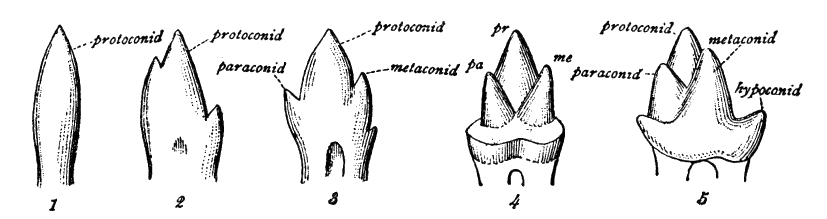
Fig. 39.—Epitome of the evolution of a cusped tooth. 1, Reptile; 2, Dromatherium; 3, Microconodon; 4, Spalacotherium; me, metaconid; pa, paraconid; pr, protoconid; 5, Amphitherium. (After Osborn.)
That such a series can be traced is an undoubted fact. Every stage exists, or has existed. But whether the stages can be connected or not is quite another question. It is by three main lines of argument that the view here sketched out in brief is supported. In the first place, the tracing of the pedigrees of many groups of mammals has met with very considerable success; and it is clear that as we pass from the living Horse and Rhinoceros, with their complicated molars, to their forerunners, we find that both can be referred to a primitive Ungulate molar with but six cusps. Going still further back to the lowest Eocene and ancestral type as it appears, Euprotogonia, we still find in the molar tooth the sextubercular plan of structure. We can hardly get further back in the evolution of the Perissodactyles with any probability of security. On the other hand, many facts point to a fundamental relationship between the primitive Ungulates and the early Creodonts. The latter frequently show plainly tritubercular molars. Such Ungulates as Euprotogonia and Protogonodon, though sex- or quinque-tubercular as to their molars, have a distinctly prevailing trituberculism, when the size and importance of three of the cusps is taken into account. But this lacks finality as a convincing proof of the tritubercular tooth as a primitive Ungulate tooth.
Professor Osborn has ingeniously utilised certain deviations from the normal type of tooth structure (for the group) in favour of his strongly-urged opinions. If the stages of development have been as he suggests, a retrogression would naturally be in the inverse order; thus the "apparently 'triconodont' lower molar of Thylacinus" may be interpreted as a retrogression from a tritubercular tooth. In the same way may be explained the triconodont teeth of Seals and of the Cetacean Zeuglodon. Finally, the modern Toothed Whales have retrograded into "haplodonty."
Embryological evidence has also been called in, and with some success, to contribute towards the proof of the tritubercular theory of teeth. Taeker has shown that in the Horse and the Pig, and some other Ungulates, there is first of all a single hillock or cusp, and that later the additional cones arise separately. An apparent stumbling-block raised by these investigations is that it is not always the protocone or its equivalent in the upper jaw which arises first, as it obviously ought to do phylogenetically. This, however, is not a final argument in either direction. We know from plenty of examples that ontogenetic processes sometimes do not correspond in their order with phylogenetic changes. Thus in the mammalian heart the ventricle divides before the auricle; and of coarse, phylogenetically, the reverse ought to occur, since a divided auricle precedes a divided ventricle. This method of development has, moreover, been interpreted otherwise. It has been held to signify that the complex teeth of mammals are indeed derived from simple cones but by the fusion of a number of those cones.
On the other hand there are the claims of the multitubercular theory of the origin of mammalian teeth to be considered. The palaeontological evidence has been already, to some extent, utilised. The occurrence of such teeth among the possible forerunners of mammals, and in some of the most primitive types of Mammalia, has been referred to. Señor Ameghino dwells upon the sextubercular condition of many primitive mammals even belonging to the Eutheria. In a recent communication[30] he attempts to identify six tubercles in the molars of types belonging to a variety of Orders. The same condition, as has been noted, characterises that ancient Ungulate form Euprotogonia. Even where the teeth seem at first sight to be tritubercular a detailed study shows traces of otherwise vanished cusps.
It must be remembered in basing arguments upon the early Jurassic and Cretaceous mammals, that our knowledge of them mainly depends upon lower jaws, the teeth of which are usually simpler in pattern than those of the upper jaws. Moreover, another fact, not always insisted upon, must not be lost sight of. In many of those creatures the jaws were of small size, and yet accommodated a large series of molar teeth. Amphitherium, for example, had six molar teeth, and five is a number frequently met with. As the teeth are so numerous and the jaws so small it seems reasonable to connect the simplicity of the structure of the teeth with the need for crowding a number together. The same argument may partly account for the superabundant teeth of many Toothed Whales. It is true that the Manatee has very numerous grinders which are yet complex; but then in this animal there is a succession, and the jaw does not hold at a given time the entire series, with which it is provided in relays. On the other hand, where there are few molars they are often of the multitubercular type, or at least approach it; of this the Multituberculate Polymastodon is a good example; so, too, the molars of Hydrochoerus, and of many other Rodents.
It is well known that the fourth deciduous molar of the upper jaw, which is replaced by a permanent premolar in the fully adult animal, is of a more complex structure than its successor. This may indeed be extended to premolars earlier in the series. In the Dog "the second and first milk molars closely resemble the third and second premolars"; now the milk premolars belong evidently to the same dentition as the permanent molars, and they are earlier teeth than the later-developed replacing teeth. It is therefore significant that these earlier teeth should be more cuspidate than the later teeth. It tells distinctly in favour of the simplification as opposed to the complication of teeth in time, in the groups concerned.
These facts may possibly be applied in explanation of the simple teeth of some of the Jurassic and Cretaceous mammals. It has been mentioned that absolute trituberculy is exceedingly rare among those ancient creatures; more generally there are to be found at least traces of more cusps. Now in some of them we may be dealing with instances of a complete tooth change; the suppression, save for one tooth, which is found in Marsupials, was probably not developed in at least some of these early mammals. The simplicity may therefore have been preceded by complexity, and may have been merely an adaptation to an insectivorous diet.
Alimentary Canal.—The mouth of the Mammalia is remarkable for the fact that with a few exceptions, such as the Whales, there are thick and fleshy lips. The office of these is to seize the food. The roof of the mouth is formed by the "hard palate" in front, which covers over the maxillary and palatine regions. This region is often covered with raised ridges, which have a symmetrical disposition, and are particularly strong in Ruminant animals. They are much reduced in the Rodents, where the anterior part of the palate is ill-defined owing to the way in which its sides fade into the lateral surface of the face. It has been shown that these ridges, in the Cat at least, develop as separate papilliform outgrowths, and it has been suggested that these papillae, which later become united to form the ridges, are the last remnant of palatine teeth such as occur in lower vertebrates.
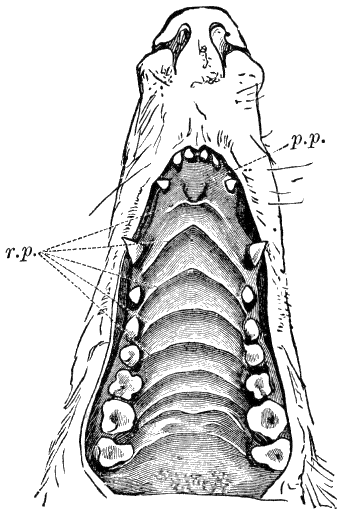
Fig. 40.—Palatal folds of the Raccoon (Procyon lotor). p.p, Papilla palatina; r.p, palatal folds. (From Wiedersheim's Structure of Man.)
The tongue is a well-developed organ, usually playing a double part. It acts as an organ of prehension, especially in such animals as the Giraffe and the Anteater, where it is long and protrusible beyond the mouth for a considerable distance. It also carries gustatory organs, which serve for the discrimination of the nature of the food. Beneath the tongue there may be a hardish plate, known as the sublingua. This is especially prominent in the Lemurs, where it projects as a horny structure below the tongue, and has an independent and free tip. It is supported in some of these animals by a cartilaginous structure. It is held by Gegenbaur that this organ is the equivalent of the reptilian tongue, and that in the skeletal vestiges which it contains are to be found the equivalents of the hyoid skeletal cartilages which support the tongue in lizards. In this case the tongue of mammals is a subsequently added structure.
The oesophagus leads from the mouth cavity to the stomach. The latter organ has commonly a distinctive shape in mammals. This is well shown in Man. The orifices of the oesophagus and intestine are somewhat approximated; and this causes a bulging of the lower border of the organ, usually spoken of as the greater curvature. A stomach of this typical form is found in many orders of mammals, and is unlike the stomach in any of the groups of lower vertebrates in shape. Sometimes the shape of the organ is greatly altered: it may be drawn out, sacculated, or divided, as in the Ruminants and Whales, into a series of differentiated chambers, each of which plays some special part in the phenomena of digestion.
The intestine of mammals is always long and much coiled, though the length and consequent degree of coiling naturally varies. On the whole it is perhaps safe to say that it is shorter in carnivorous than in vegetable-feeding beasts. Thus the Paca has an intestine of 39 inches total length, while the Cat, an animal of about the same size, has an intestine which is only 36 inches long. A fish diet, however, to judge from the Seals, is associated with a long intestinal tract. The intestine is divisible in the vast majority of mammals into a small and a large intestine. The two are separated by a valvular constriction save in certain Carnivores; and in the majority of cases the distinction is also emphasised by the presence at the junction of a blindly-ending diverticulum, the caecum. This latter organ varies greatly in length, being very short in the Cat-tribe and exceedingly long in Rodents. Its size is, to some extent, dependent upon the flesh-eating or grass-eating propensities of the animal in which it occurs. One of the longest caeca is possessed by the Vulpine Phalanger, in which the organ is one-fifth of the length of the small intestine; while the opposite extremity is reached by Felis macroscelis, which has a small intestine one hundred times the length of the caecum.
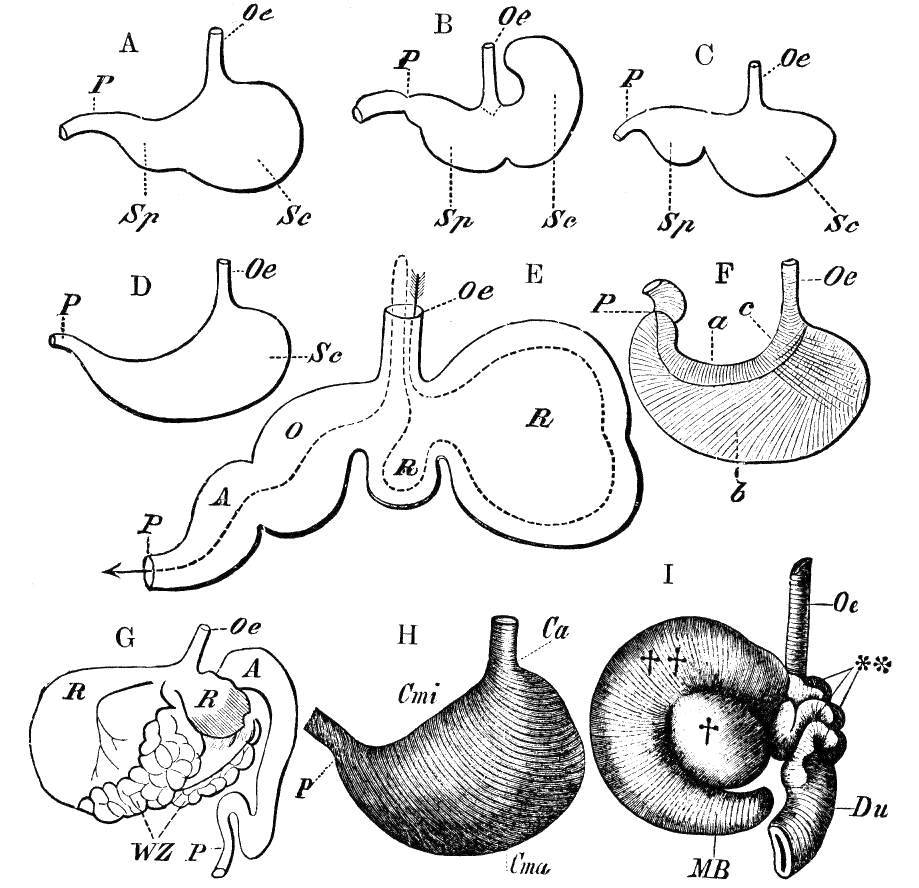
Fig. 41.—Different forms of the stomach in Mammals. A, Dog; B, Mus decumanus; C, Mus musculus; D, Weasel; E, scheme of the Ruminant stomach, the arrow with the dotted line showing the course taken by the food; F, Human stomach. a, Minor curvature; b, major curvature; c, cardiac end. G, Camel; H, Echidna aculeata. Cma, Major curvature; Cmi, minor curvature. I, Bradypus tridactylus. Du, Duodenum; MB, coecal diverticulum; **, outgrowths of duodenum; †, reticulum; ††, rumen. A (in E and G), Abomasum; Ca, cardiac division; O, psalterium; Oe, oesophagus; P, pylorus; R (to the right in E and to the left in G), rumen; R (to the left in E and to the right in G), reticulum; Sc, cardiac division; Sp, pyloric division; WZ, water-cells. (From Wiedersheim's Comparative Anatomy.)
An interesting point in connexion with the gut of mammals is the varying proportion of the small to the large intestine. As a general rule the former is very considerably longer than the latter; in Paradoxurus, for instance, the small intestine may be fifteen times the length of the large. The excess of length of one section over the other is not generally so marked as this. In Phalanger maculatus the two sections of the gut are as nearly as possible equal in length, while in Phaseolarctos the large intestine is considerably longer than the small, the lengths being respectively 160 inches and 111 inches. It is common among the Marsupials and also among the Rodents for these proportions to exist, i.e. for the large intestine to be as long as, or longer than, the small. But there are so many exceptions that no general statements can be extracted from the facts.
Some few details will be found in the systematic part of this book. Mr. Chalmers Mitchell has brought forward some reasons for associating a great length of large intestine with an archaic systematic position, in the birds at any rate. The facts here briefly touched upon are not at variance with the extension of such a view to the mammals.
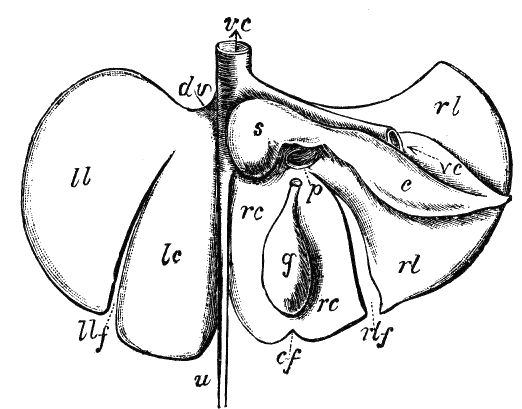
Fig. 42.—Diagrammatic plan of the liver of a Mammal (posterior surface). c, Caudate lobe; cf, cystic fissure; dv, ductus venosus; g, gall-bladder; lc, left central lobe; ll, left lateral lobe; llf, left lateral fissure; p, portal vein entering transverse fissure; rc, right central lobe; rl, right lateral lobe; rlf, right lateral fissure; s, Spigelian lobe; u, umbilical vein; vc, post-caval vein. (After Flower and Lydekker.)
Appended to the alimentary tract are three glands or sets of glands. Opening into the mouth cavity are the salivary glands, which are of enormous size in Anteaters, and small or absent in Whales. In their number and position these glands are characteristic of mammals. Into the intestine open the ducts of the pancreas and liver, two glands which the mammals share with lower vertebrates. The form of the liver is, however, generally characteristic of mammals. It is divided as a rule into a right and a left half, the line of division being marked by the insertion of the umbilical ligament, a vestige of the primitive ventral mesentery. Each half is again commonly subdivided into central and lateral lobes. In addition to these, two other divisions are often to be seen—the Spigelian and the caudate lobe. The liver is less divided in Cetacea and some others, very much subdivided in Rodents and other groups. The degree of subdivision and the proportions of the several lobes frequently offer valuable systematic characters. The gall-bladder may be present or absent; it is always a diverticulum of the hepatic duct. The two are never separate, as in birds, for instance.
Organs of Circulation.—The heart of all mammals is a completely four-chambered organ. In the adult heart there is no communication between the right and left halves. The auricles are comparatively thin-walled, the ventricles thick-walled, in relation to the amount of work that they have severally to perform. The right ventricle, moreover, which has only to drive the blood into the lungs, is much thinner-walled than the left ventricle, which is concerned with the entire systemic circulation. The exits of the arteries and the auriculo-ventricular orifices are guarded by valves, which are so arranged as only to permit the blood to flow in the proper direction. But these valves have a morphological as well as a physiological interest. At the origin of each artery, the aorta and the pulmonary, there is a row of three watch-pocket valves, as they have been generally termed on account of their form. These three valves meet accurately in the middle of the lumen of the arterial tube when liquid is poured into them from above, and thus completely occlude the orifice. The auriculo-ventricular valves differ in structure in the two ventricles. That of the left ventricle has only two flaps, and is therefore often spoken of as the bicuspid or mitral valve. Both these flaps are membranous, and together they completely surround the exit from the auricle into the ventricle. The edges of the valve are bound down to the parietes of the heart by numerous branching tendinous threads, the chordae tendineae, which often take their origin from pillar-like muscles arising from the walls of the heart, the so-called musculi papillares. The valve of the right ventricle is composed of three flaps, and is therefore often spoken of as the tricuspid valve; it is in the same way membranous, and has chordae tendineae and musculi papillares connected with it. The disposition of the musculi papillares and their number differ in different mammals, but no exhaustive study has as yet been made of the arrangements in different groups; the amount of individual variation even is not known, though it is certainly considerable in some cases, for instance in the heart of the Rabbit. The heart of the Monotremata presents differences of some importance from those of other Mammalia; the modern knowledge of the Monotrematous heart is mainly due to Gegenbaur[31] and Lankester,[32] in whose memoirs references to the older literature will be found. The principal features of interest in which the heart of the Monotremata differs from that of the higher Mammalia are these. When the two ventricles are cut across transversely, the cavity of the right is seen to be wrapped round that of the left in a fashion precisely like that of the bird's heart; on the other hand in the higher mammal the two cavities lie side by side. The main difference between Monotremes and other Mammals concerns the right auriculo-ventricular valve. The differences which it presents from the corresponding structure of the rest of the Mammalia are two: in the first place, the valve itself does not completely surround the ostium; it is only developed on one side; the septal half (i.e. that turned towards the interventricular septum) is either entirely absent or more generally represented by a small bit of membrane; nevertheless I found[33] recently in an Ornithorhynchus heart a complete septal half to the right auriculo-ventricular valve. The second point of interest in connexion with this valve is, that the musculi papillares instead of ending in chordae tendineae attached to the free edge of the valve are directly attached to the valve, and in some cases pass through its membranous flap, to be attached to its origin at the boundary of the auricle and of the ventricle. The invading of the valve-flap by muscle in this way is highly interesting, as it recalls the heart of the bird and of the crocodile. The imperfect condition of the valve (from which, as has already been stated, the septal half is as a rule nearly absent) is a point of resemblance to the heart of the bird; the corresponding valve of the crocodile's heart being complete.
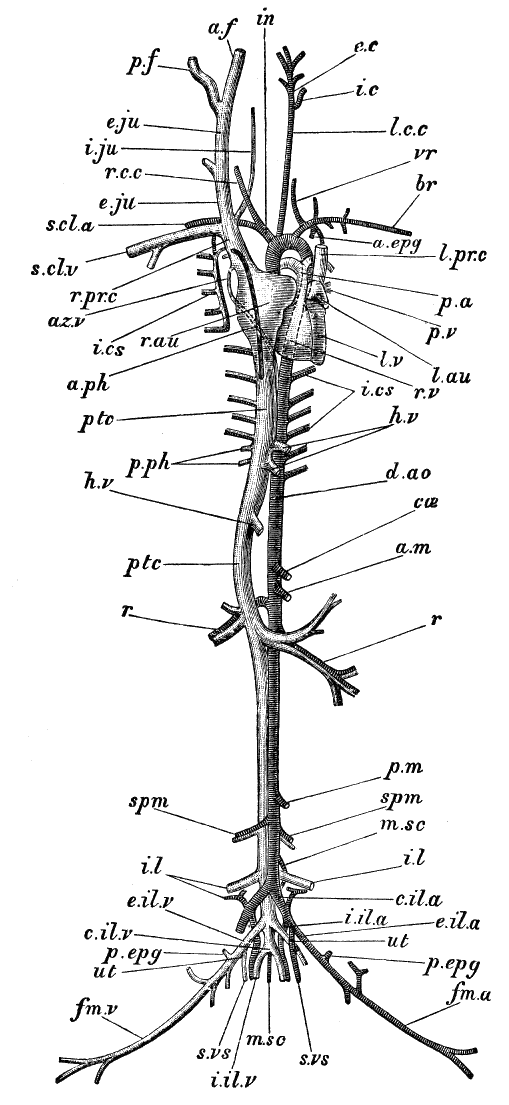
Fig. 43.—Lepus cuniculus. Ventral view of the vascular system. The heart is somewhat displaced towards the left of the subject; the arteries of the right and the veins of the left side are in great measure removed. a.epg, internal mammary artery; a.f, anterior facial vein; a.m, anterior mesenteric artery; a.ph, anterior phrenic vein; az.v, azygos vein; br, brachial artery; c.il.a, common iliac artery; c.il.v, common iliac vein; cœ, coeliac artery; d.ao, dorsal aorta: e.c, external carotid artery; e.il.a, external iliac artery; e.il.v, external iliac vein; e.ju, external jugular vein; fm.a, femoral artery; fm.v, femoral vein; h.v, hepatic veins; i.c, internal carotid artery; i.cs, intercostal vessels; i.il.a, internal iliac artery; i.il.v, internal iliac vein; i.ju, internal jugular vein; i.l, iliolumbar artery and vein; in, innominate artery; l.au, left auricle; l.c.c; left common carotid artery; l.pr.c, left pre-caval vein; l.v, left ventricle; m.sc, median sacral artery; p.a, pulmonary artery; p.epg, epigastric artery and vein; p.f, posterior facial vein; p.m, posterior mesenteric artery; p.ph, posterior phrenic veins; pt.c, post-caval vein; p.v, pulmonary vein; r, renal artery and vein; r.au, right auricle; r.c.c, right common carotid artery; r.prc, right pre-caval vein; r.v, right ventricle; s.cl.a, right subclavian artery; s.cl.v, subclavian vein; spm, spermatic artery; s.vs, vesical artery; ut, uterine artery and vein; vr, vertebral artery. (From Parker's Zootomy.)
There are also features in the system of arteries and veins which are eminently distinctive of mammals. In the first place, the aorta leaving the heart and conveying blood to the body is only a half arch, and bends to the left side as seen in Fig. 43. The right and left halves are present in reptiles, and meet behind the heart. In the bird the right half alone has remained. This fact, therefore, shows that the mammal cannot have been derived from a bird-like ancestor, but that both must have independently come from an ancestor with both halves of the aortic arch present, of which one half has disappeared in one group, and the other half in the other. It is an interesting fact, too, to notice that the four cavities of the mammal's heart, which fourfold division it shares with birds alone, do not exactly correspond compartment for compartment with those of the bird's heart, at least in so far as concerns the ventricles. For the reptilian heart is provided with only one ventricle, and therefore the division of that cavity must have been independently accomplished in mammals and in birds.
There are two features in the venous system which distinguish all the Mammalia (with the exception of Echidna in one of these points) from vertebrates standing lower in the series. The hepatic portal system is limited to a vein which conveys to the liver blood derived from the alimentary tract; in no mammal except in Echidna is there any representative of the anterior abdominal vein of lower vertebrates. In that animal there is such a vein, which apparently arises from a capillary network upon the bladder and passes up, supported by a membrane, along the ventral wall of the abdomen to the liver, thus emptying blood into that organ exactly as does the anterior abdominal vein of the frog. In no mammal is there any trace of a renal portal system. The kidneys derive their blood from the renal arteries only.
Many mammals have two superior venae cavae; this is the case, for instance, in the Elephant and the Rodents and other types lying comparatively far down in the series. In most if not in all mammals there are considerable remains of one of the posterior cardinals, in the form of the azygos vein, which opens into the vena cava superior or pre-caval vein, i.e. the superior cardinal just before the latter debouches into the heart. This one posterior cardinal is usually on the right side; but it may be on the left side, for instance in Trichosurus vulpecula. In Halmaturus bennettii there are two azygos veins, one left and one right, of which the left is rather the larger.[34]
Urinary Organs.—The kidneys in the Mammalia have a compact form, which contrasts with the somewhat diffuse and vaguely-outlined kidneys of the Sauropsida. In mammals the organ is as a rule of that peculiar shape which is called "kidney-shaped"; a depression termed the hilum, which receives the ducts of the glands, indenting the border of an otherwise oval-shaped gland. In some few mammals the kidney is broken up into lobules; this is the case with the Whales, the Bears, the Oxen, and a few other forms. A curious fact about the kidneys of the Mammalia is their very general asymmetry of position. One of them usually lies in a more advanced position than the other. The ureters lead from the kidneys to the urinary bladder, which in its form and relations is quite distinctive of the Mammalia. The bladder is formed out of the remains of the allantois, and is therefore not the exact homologue of the bladder of the frog, which is the equivalent of the entire sac which grows out of the cloaca in the mammal, and is the foetal allantois. The ureters open into the bladder in the higher Mammalia, but lower down in the urino-genital passage in the more primitive mammals.
The Body Cavity.—The Mammalia differ from all other living vertebrates by the arrangement of the body cavity in which lie the viscera. That cavity is divided into two by a partly muscular and partly tendinous partition, the diaphragm. No other vertebrate has this precise disposition of the coelom. The diaphragm lies usually transversely to the longitudinal axis of the body, but gets a much more oblique arrangement in the Cetacea and the Sirenia, whose needs demand a more expanded chamber for the lungs. For in front of the diaphragm lie the lungs and heart; behind it the stomach, liver, intestines, and the organs of reproduction and excretion. The diaphragm is used in respiration; when its muscles contract, the surface directed toward the pleural cavity becomes less convex, and the cavity of the lungs is thus increased, allowing them to expand under the pressure of the entering air.
The Lungs.—The lungs of the Mammalia differ from those of animals lying lower in the series by the fact, just referred to, that they occupy a pleural cavity completely shut off from the abdomen by the diaphragm. As a rule the lungs of the Mammalia are to be distinguished by their more or less extensive lobation. In the Whales, however, and in the Sirenia, they are not much divided, but present the appearance of the simple sac-like lungs of the reptiles. In some mammals there is a median and posterior unpaired lobe of the lung, which lies in the post-pericardial cavity behind the pericardium. This is not universally present. The lungs are very frequently not symmetrical in their lobation, the number of separate lobes on the right side and on the left being different. The lungs of mammals agree with those of the lower reptiles in being freely suspended within their coelomic cavity, and in not being, as in birds, crocodiles, and the Varanidae among lizards, tied down to the dorsal surface of that cavity by a sheet of peritoneum covering them.
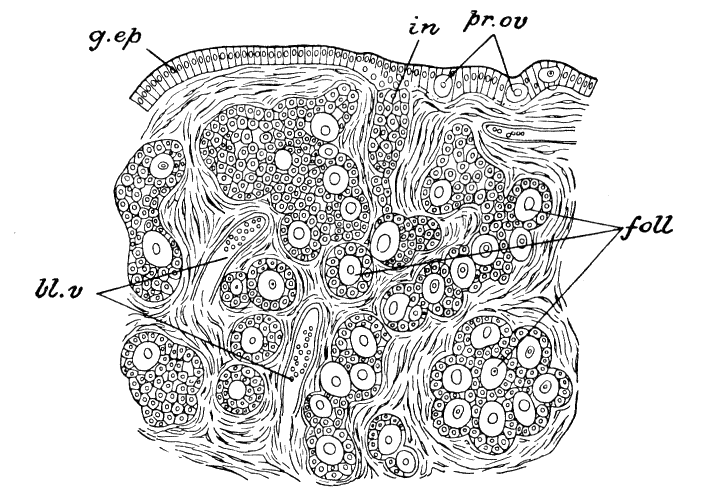
Fig. 44.—Part of a sagittal section of an ovary of a child just born. bl.v, Blood-vessels; foll, strings and groups of cells derived from the germinal epithelium becoming developed into follicles; g.ep, germinal epithelium; in, ingrowing cord of cells from the germinal epithelium; pr.ov, primitive ova. (From Hertwig, after Waldeyer.)
The Gonads (Ovaries and Testes).—The ovary in the Mammalia is always paired; there is never a partial or complete abortion of one gonad as in birds—except of course in pathological cases. The ovaries are small, and lie in the abdominal cavity behind the kidneys. In the immense majority of the Mammalia the ova which are produced within the ovaries are of minute size; those of even the colossal Rorqual are, so far as we know, not markedly larger than the ova of a Mouse. The smallness of size of these reproductive elements implies necessarily an absence of much nutritive yolk; and as a consequence the developing embryo, since it is not hatched in an early stage as a free living larva, has to be nourished by the mother, to whose tissues it is attached through the intermediary of the placenta, a structure partly composed of foetal structures derived from the embryo, and partly of portions of the lining membranes of the uterus of the mother. The ova of the Eutherian mammals, including the Marsupials, are very small as compared with those of any other vertebrates, excepting only Amphioxus, where the young are hatched early as free swimming larvae. They also differ in a highly characteristic way in the mode of their development within the ovary. These processes are to some extent illustrated in Fig. 44. The main framework of the ovary is formed of the so-called "stroma," which is a mass of tissue formed of more or less connective-tissue-like cells. Within this are numerous cavities, the Graafian follicles. The very young follicles consist of but a single layer of follicular cells surrounding the ovum, which lies centrally. The follicular cells gradually increase in number until the ovum lies in the midst of several layers of cells. At this period a vacuity is formed between some of these cells, and grows into a large cell-free cavity; the ovum does not lie loosely in this space, but is connected at one side with the follicular cells, which still line the interior of the Graafian follicle by the so-called discus or cumulus proligerus. The egg or ovum has, moreover, a layer of cells immediately surrounding itself. All these facts can be gathered by an inspection of Fig. 45. It has been shown that, as in lower vertebrates, the cells immediately surrounding the ovum are connected with it directly by delicate processes which penetrate the actual membrane of the egg.
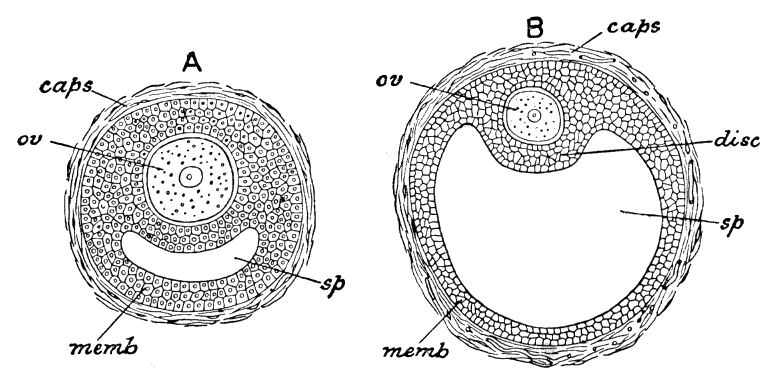
Fig. 45.—Two stages in the development of the Graafian follicle. A, With the follicular fluid beginning to appear; B, after the space has largely increased. caps, Capsule; disc, cumulus proligerus; memb, membrana granulosa; ov, ovum; sp, space containing fluid. (After Hertwig.)
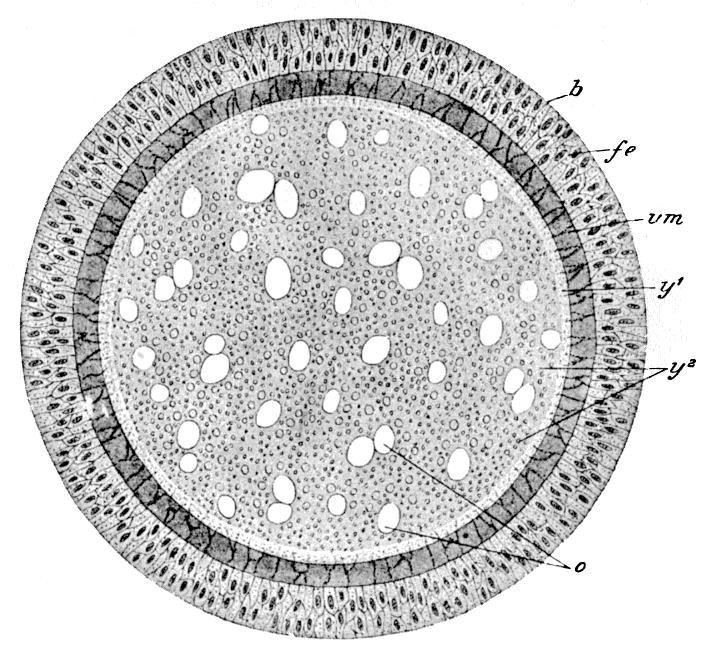
Fig. 46.—Ovarian egg of Echidna. b, Basilar membrane; fe, follicular epithelium; o, oil globules; vm, vitelline membrane; y1, y2, yolk. (Partly after Caldwell.)
The only ova which depart at all in structure from that above described are those of the Monotremata. The credit of this discovery rests with Owen and with Professor Poulton, who pointed out in 1884,[35] that the ovum of Ornithorhynchus is very large as compared with those of other Mammalia (6 mm. as against .2 mm.), that it is filled with yolk, and that it completely fills the follicle, being surrounded by two layers of follicular cells only. This latter fact was proved by Caldwell. Subsequently Gyldberg[36] and I[37] described the ovarian ovum of Echidna, showing it to be identical with that of Ornithorhynchus. Later still a more elaborate and beautifully illustrated paper was published by Caldwell[38] upon the early stages of development in the Monotremata and Marsupials, in which the ovum of the former was accurately described (see Fig. 46). In the particulars mentioned above, the ovum of the Monotremata is practically identical with that of the large-yolked ova of the Sauropsida.
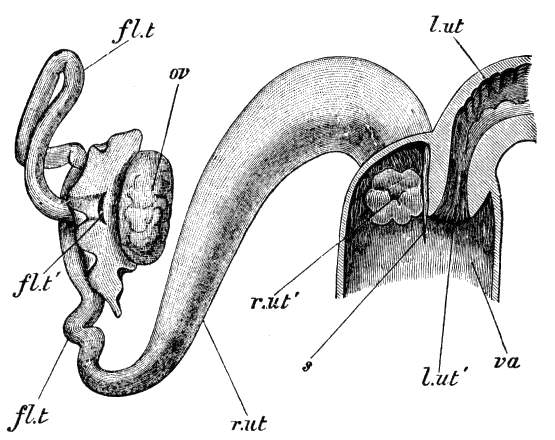
Fig. 47.—Lepus cuniculus. The anterior end of the vagina, with the right uterus, Fallopian tube, and ovary. (Nat. size.) Part of the ventral wall of the vagina is removed, and the proximal end of the left uterus is shown in longitudinal section, fl.t, Fallopian tube; fl.t′, its peritoneal aperture; l.ut, left uterus; l.ut′, left os uteri; ov, ovary; r.ut, right uterus; r.ut′, right os uteri; s, vaginal septum; va, vagina. (From Parker's Zootomy.)
It is the general rule among vertebrate animals that the ovaries are completely independent of the ducts which convey their products to the exterior. In certain fishes, however, there is an absolute continuity between the two structures, which is believed to be due to a simple concrescence between the originally distinct ovary and oviduct. The latter has grown round the former, an obvious advantage in preventing the eggs from wandering into the abdominal cavity and becoming lost. In the Mammalia we find discontinuity as a general rule. But in quite a number of forms folds of the lining membrane of the abdominal cavity are developed, which practically ensure the passage of the ova into the oviduct when they are extruded from the ovaries. The oviduct, moreover, has a large and fimbriated mouth, called in human anatomy—which is provided with a number of fanciful names—the morsus diaboli. This almost wraps round the ovary, and thus prevents the ova from straying in the wrong direction. Moreover, the ovary itself is often so arranged that it can easily be withdrawn into a pocket of the peritoneum, from which the obvious exit is by the gaping mouth of the oviduct. This disposition of the generative parts is still further modified in a few animals, such as the Rat[39] and the Kinkajou.[40] In these animals the mouth of the oviduct actually opens into the interior of a closed chamber which contains the ovary. In this case there is but one route for the extruded ova to follow. This series of steps in the perfecting of the mode of safe extrusion of the ova is highly interesting, and is a piece of evidence in favour of the high position of the mammals.
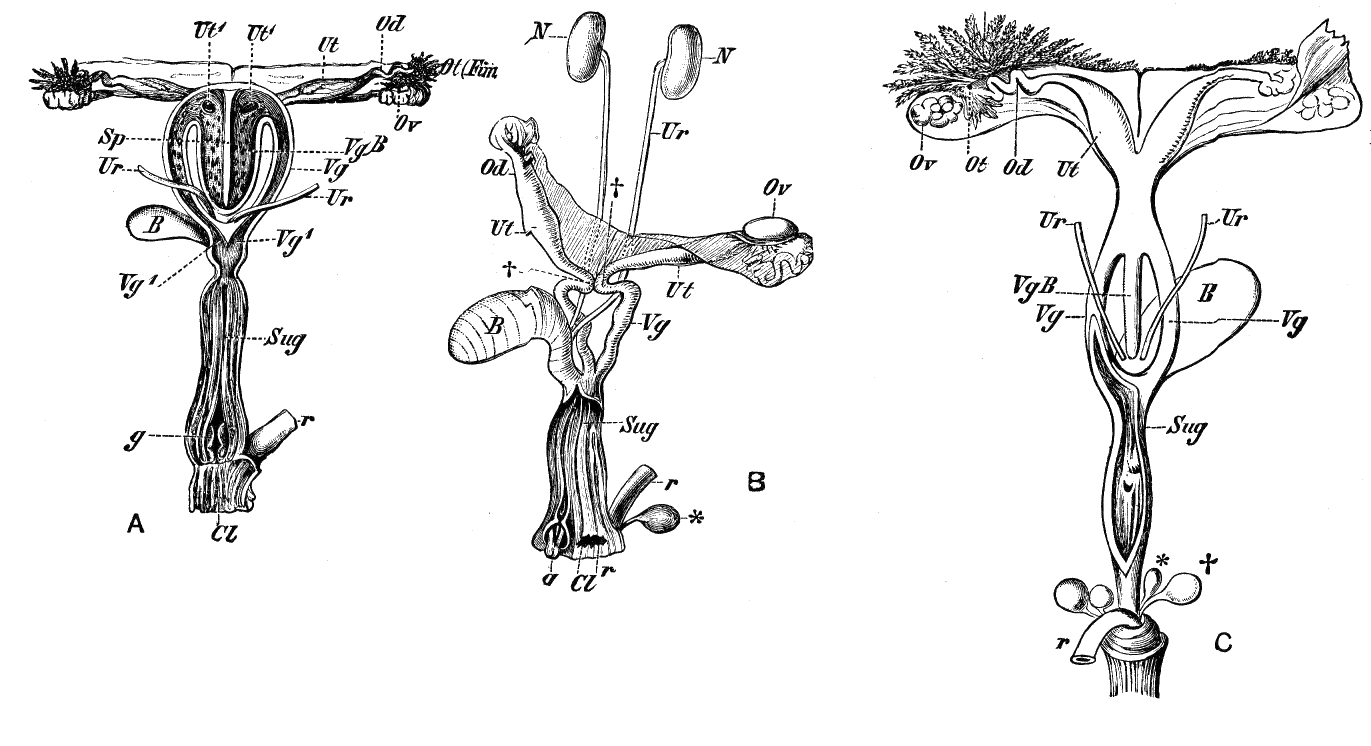
Fig. 48.—Female urino-genital apparatus of various Marsupials. A, Didelphys dorsigera (young); B, Trichosurus; C, Phascolomys wombat. B, Urinary bladder; Cl, "cloaca"; Fim, fimbriae; g, clitoris; N, kidney; Od, Fallopian tube; Ot, aperture of Fallopian tube; Ov, ovary; r, rectum; Sp, septum dividing vagina; Sug, urino-genital sinus; Ur, ureter; Ut, uterus; Ut′, opening of the uterus into the median vagina (VgB); Vg, lateral vagina; Vg′, its opening into the urino-genital sinus; † (in B), point of approximation of uteri; † (in C) and *, rectal glands. (From Wiedersheim's Comparative Anatomy.)
The oviducal apparatus of the mammal is more specialised than that of lower vertebrates. It is most simple, as might be imagined, in the egg-laying Monotremes, where, indeed, it is on the same level as that of reptiles. But in the Eutheria the fimbriated mouth of the oviduct passes into a narrow and winding tube, the Fallopian tube; this widens into a uterus, and the two uteri combine into a single tube in the higher forms. They are called the Monodelphia on this account. In the Marsupials the uteri are distinct though they often join above, and from this junction depends a median "uterus." After the uterus or the uteri follows in every case a single vagina.
The testes of the Mammalia, like those of other vertebrates, occupy primitively a position within the body cavity precisely corresponding to that of the ovaries. And in the lowly-organised Monotremata, and some other forms, such as the Whales, they retain that primitive position within the body. It is, however, distinctive of the Mammalia as opposed to lower vertebrates that the testes descend later into a scrotum, which is simply a protrusion of the skin of the body surrounded by muscles, and, of course, containing a section of the body cavity in which lie the testes. The penis of the Mammalia, represented by the clitoris and associated structures in the female, is of a structure entirely peculiar to this group.
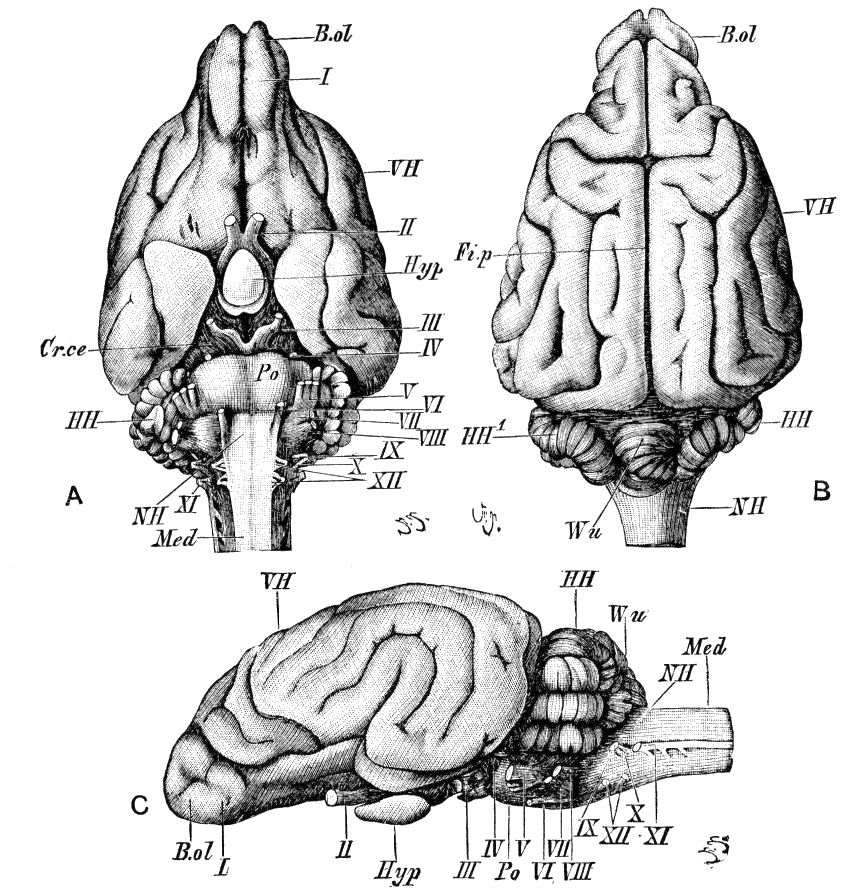
Fig. 49.—Brain of Dog. A, ventral; B, dorsal; C, lateral aspect. B.ol, Olfactory lobe; Cr.ce, crura cerebri; Fi.p, great longitudinal fissure; HH, HH1, lateral lobes of cerebellum; Hyp, hypophysis; Med, spinal cord; NH, medulla oblongata; Po, pons Varolii; VH, cerebral hemispheres; Wu, middle lobe (vermis) of cerebellum; I-XII, cerebral nerves. (From Wiedersheim's Comparative Anatomy.)
The Brain.—Inasmuch as Professor Wiedersheim has said with perfect truth that "the brain of the extinct Ungulate Dinoceras shows so striking a likeness to that of a lizard that one would be compelled to explain it as that of a lizard without a knowledge of the skeleton," it is clear that to define the mammalian brain is a difficult matter. The existing Mammalia, however, all possess brains which can be readily distinguished from those of vertebrates lying lower in the scale. They are of relatively large size, brought about mainly by the dimensions of the cerebral hemispheres, which have an importance in this class of vertebrates that they have not elsewhere. Coupled with this large size of the hemispheres is a more elaborate system of transverse commissures uniting the two; and this culminates in the higher Mammalia, where the corpus callosum attains a large size and great physiological importance. A very marked feature, moreover, of the mammal's brain is the development of regular fissures upon its surface, which fissures are only absent from Ornithorhynchus, various small Rodents, Bats, and Insectivores, among living mammals. It is sometimes, but erroneously, said that the more complicated the fissures of the brain are, the higher in intelligence and "zoological position" is the possessor of that brain. Instances can undoubtedly be quoted to support such a view; but they are merely selected cases, which do not indicate a wide applicability of such a generalisation. Thus it is true that the brain of a Man is more elaborate in its furrows and convolutions than is that of a Cat. The real fact of the matter is, that the complexity of the brain from this point of view increases with the size of the animal within the group.
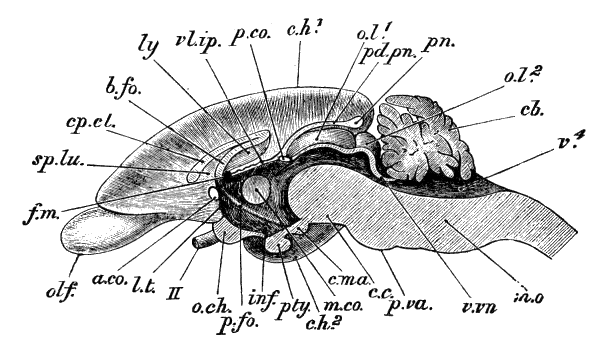
Fig. 50.—Lepus cuniculus. Longitudinal vertical section of the brain. (Nat. size.) a.co, Anterior commissure; b.fo, body of the fornix; cb, cerebellum, showing arbor vitae; c.c, crus cerebri; c.h1, parencephalon or cerebral hemisphere; c.h2, temporal lobe; c.ma, corpus mammillare; cp.cl, corpus callosum; f.m, foramen of Monro; inf, infundibulum; l.t, lamina terminalis; ly, lyra; m.co, middle commissure; m.o, medulla oblongata; o.ch, optic chiasma; o.l1, o.l2, corpora quadrigemina or optic lobes; olf, olfactory lobe; p.co, posterior commissure; pd.pn, peduncle of the pineal "gland," pn; p.fo, anterior pillar of the fornix; pty, pituitary body; pv.a, pons Varolii; sp.lu, septum lucidum; v4, fourth ventricle; vl.ip, velum interpositum; v.vn, valve of Vicussens; II, optic nerve. (From Parker's Zootomy.)
The Gorilla and the Chimpanzee have a more furrowed brain than has the little Marmoset; the Bear a more complicated brain than the Weasel, etc. The most highly-convoluted brains of all mammals are those of the Elephants, and there does not seem in the Ungulates to be so marked a relation between size and abundance of fissures as there is among other mammals. A regular plan of the fissures can be detected with certainty for each group considered by itself; but it is not so easy to homologise the details of arrangement from group to group. This is so far in accord with the view that the existing groups of mammals have diverged from each other ab initio.
Another marked characteristic of the mammalian as opposed to other brains is the relatively small importance in size and yet the fourfold nature of the optic lobes. What was the case with the optic lobes of the early Ungulates is difficult to understand, on account of the fact that the casts are necessarily imperfect. Altogether the enormous progress in the complexity of the brain from the early Tertiary mammals down to the present, is one of the most remarkable revelations of palaeontology. It goes perhaps some way in explaining the remarkable diversity in mode of life exhibited by the mammals as compared, for example, with the birds, whose brains have not diverged so much or in so many directions from the primitive form.
The present Distribution of the Mammalia.—In the following pages some of the principal facts in the geographical range of the orders, families, and many of the genera of Mammalia will be given. It has been justly observed by Mr. Sclater that the habitat of an animal is as much a part of its definition as is its structure or external form. No systematic account of the Mammalia would therefore be complete without such geographical facts. But that branch of zoology which is concerned with the past and present distribution of animals is wider in scope than this. Zoogeography deals not only with the actual facts in the range of animals, but with the inferences as to past changes in the relations of land and sea which the facts seem to indicate, and with speculations as to the place of origin of the different groups, of which more than hints are sometimes given by their past and present distribution. In addition to this, the earth can be mapped out into provinces and regions which are definable by their animal inhabitants. In the present volume, dealing only with the Mammalia, it will be obviously impossible to enter fully into the entire subject of zoogeography. All that will be attempted is a brief general survey of the science so far as it can be illustrated by the Mammalia. For fuller knowledge the reader is referred to the treatises mentioned below.[41]
There are certain facts in the distribution of animals which are commonplaces of knowledge, but which may be set forth with definiteness. Everybody knows that an animal has a given range: Elephants, for example, are found in India and certain adjacent parts of Asia, and again in Africa; the Rhinoceroses have roughly the same range; the Tiger is limited to Asia; the Jaguar to America, and so forth. The entire expanse of country which is inhabited by an animal is called its area of distribution. Such areas are larger or smaller. The Lion ranges over the whole of Africa, a small part of India, and some neighbouring countries; on the other hand, the Insectivore Solenodon is limited to Cuba and Hayti, a separate species to each. Among other groups of animals are instances of an even more restricted range. There are humming-birds confined to the slopes of a single mountain, and fishes limited in their range to a single small lake.
A species may be found everywhere within the area of its distribution, or it may be confined to a number of limited tracts within that area. In this case it is usual to speak of "stations." In such cases the species in question is generally suited to some particular kind of environment. Thus the Otter and other aquatic mammals will only be found where there is water; and intervening tracts of waterless country will contain no Otters. Goats and Chamois live only upon mountains; the intervening plains are destitute of them. This discontinuity of distribution within the area is very general. But a discontinuity of area is also seen—not so commonly however; and, indeed, when it does occur, it is a matter of a genus and not of a species. Thus the Tapir is found in the East Indies on the one hand and in South and Central America on the other, being absent in the intermediate tracts.
It is clear that tracts of country eminently suitable for the housing of a particular mammal do not always possess that kind, or even an allied form. Africa, for example, possesses no arboreal Anteaters; there are no Anteaters at all (of the order Edentata) in Australia, though there are plenty of ants for them to feed upon, and tropical conditions of climate prevail. But as in these cases the inference may be denied on the grounds that no experiments exist to prove or to disprove the assertion, the matter may be better emphasised by such cases as the introduction of the Rabbit into Australia, and various mammals, such as Goats, into oceanic islands. The plague caused by the former is a matter of notoriety. But although climate and conditions and animal inhabitants do not march accurately together, there is certainly some connexion between temperature and the range of animals. Mr. Lydekker writes on this point as follows: "The llama-like animals, respectively known as vicunas and guanacos, are met with in company on the highlands of the Cordillera in Peru and Ecuador, but as we go farther south the latter are found on the plains of southern Argentina and Patagonia, as well as on the island of Tierra del Fuego at the sea level. Here then is a clear proof of the intimate connexion existing between temperature and station; the guanaco being an animal which can only live in cold or temperate climates, finds suitable conditions for its existence in tropical latitudes solely at a height of so many thousands of feet, although farther south it is able to thrive at the sea level." This, however, cannot be pushed too far—the world cannot be mapped out into areas bounded by parallels of temperature as was once attempted—since there are plenty of cases like that of the Tiger, which is as much at home in a tropical jungle as on the icy plains of Northern Asia.
Seeing that there are in many cases no climatic barriers to the spreading of a given race of animals over a larger area of distribution than it actually occupies, it becomes important to inquire why there are so many cases of restriction in range.
It is possible to see, at any rate, three causes which are responsible for a large number of such cases. In the first place, a given species of animal must have originated at a certain spot; its multiplication in individuals must always be a slow matter, since enemies, and untoward events generally, would conspire to check the natural multiplication by geometrical progression. A long time might therefore elapse before the species greatly extended its range. A restricted distribution may therefore, in some cases, mean a modern race. In the second place, there are definite physical barriers which check the migration of species. The terrestrial Mammalia cannot cross wide arms of the sea; that they can and do swim for considerable distances has been proved in several instances; but, as has been pointed out, it is unlikely that a purely terrestrial mammal would voluntarily swim out into an unknown sea. And then if it did, and successfully reached the opposite side, nothing would happen unless it were a pregnant female; or, if not pregnant, till a male swam very soon afterwards in exactly the same direction. Many travellers have told of floating islands, formed of torn-up trees and brushwood, which have been seen at the mouths of large rivers, with animal passengers upon them. These are, however, so much at the mercy of currents and storms, that but little reliance can be placed on them as a means of transit; besides, here again, two individuals, or a pregnant female, would be required to effect a settlement on a foreign shore. The existence of oceanic islands is often urged as a proof of this inability to cross tracts of sea; even those which are comparatively near an extensive continent, such as, for example, Fernando Noronha in the Atlantic, are destitute of mammals (except, indeed, the ubiquitous Mouse, which is believed to have been carried there, often in company with the equally widely-spread Rat, in ships). This argument, however, is not so conclusive as might appear; it doubtless is in the case of far-distant islands. But the size of the islands has to be taken into account. For there are islands, such as the Galapagos, or, to take a less contested instance, some of the islands of the Malagasy Archipelago, undoubtedly continental, which have an exceedingly reduced number of mammals. An area of a certain size seems to be a necessity.
The converse of this is in many cases easy to show, that is, the wide range of animals when there are no marine barriers to stop their spreading. John Hunter, the celebrated anatomist and surgeon (not often quoted, however, as an authority upon geographical distribution), observes: "It is a curious circumstance in the natural history of animals to find most of the northern animals the same both on the continent of America and what is called the Old World, while those of the warmer parts of both continents are not so. Thus we find the bear, fox, wolf, elk, reindeer, ptarmigan, etc., in the northern parts of both.... The reason why the same animals are to be found in the northern parts is the nearness of the two continents. They are so near as to be within the power of accident to bring the animals, especially the large ones, from one continent to the other either on the ice or even by water. But the continents diverging from each other southward, so as to be at a very considerable distance from each other even beyond the flight of birds, is the reason why the quadrupeds are not the same."
There is no doubt, in fact, that the ocean is the most insuperable of all barriers to the dispersal of mammals. In a less degree mountain ranges and deserts are also barriers. The Desert of Sahara is a striking instance to the point; it separates two exceedingly different faunas.
A third cause of more or less limited range is the barrier due to competition. If the ground is already taken up, there is no room for new immigrants. There is obviously a limit to the number of Antelopes or Deer that can graze upon a given tract of grassy plain. These two groups of Ungulates illustrate the matter well: the Antelopes are African and Indian, especially the former, while Africa has no Deer at all; America, on the other hand, has plenty of Deer but no Antelopes, save the Prong-horn. The more nearly akin the two species or groups of species are, the fiercer will be the competition; for a near kinship will at least often imply similar habits, the need for similar food, and other likenesses which will prevent both from successfully occupying the same tract of country. The remarkable fauna of Australia is believed to afford an example of this. In that country the prevalent inhabitants are the Marsupials. The Monotremes are found there also, and nowhere else save in New Guinea and Tasmania. The remaining mammals are inconspicuous; they embrace a few Rodents and Bats, and the doubtfully indigenous Dingo-dog. Now the Marsupials are fitted to every variety of life. We have the grazing Kangaroos and Wallabies, the burrowing Wombats, the arboreal Phalangers, and the carnivorous Dasyures. In the second place, it is an unquestioned fact that the Marsupials are an older race than are the existing Eutherian mammals; they were the dominant mammals during the Secondary epoch. At that time they were more widely distributed than at present. In most parts of the world they are now absent, since they have been successfully ousted by the more highly organised groups of Eutheria. But at that period, when the higher Eutheria were in the ascendant, Australia and the islands to the north became cut off from Asia, and thus became freed from inroads of Eutheria, which were partly prevented by the physical barrier of the sea from effecting a settlement, and partly perhaps prevented owing to the ground being already taken up by the Marsupials. Likeness of habit gave the older inhabitants victory in the struggle for existence.
The general statements that have been here made are in accord with current opinion upon the factors of geographical distribution. But the past range of animals appears to be less consonant with the received views. In the Tertiary period, groups of animals had often a far wider range than at present. To-day the Rhinoceroses are limited to Asia and Africa, and to quite limited parts of the former continent. In the past, these animals were abundant in Europe and North America. Wild Horses now have a range which is not widely different from that of the Rhinoceroses, save that they extend into the more northern regions of Asia. Their remains are abundant both in North and South America. The Hippopotamus, now confined to Africa, once ranged over Europe, Madagascar, and India. There were plenty of American and European Lemurs. Elephants were nearly world-wide in their range; and, in short, restricted distribution seems to be on the whole a characteristic of animals of the present day.
These statements, however, though perfectly true, must not lead to erroneous inferences. It is rather impressed upon the reader, in books which contain sections dealing with geographical distribution, that animals on the whole occupy more restricted areas at present than in the past. There are, however, plenty of examples of groups of extinct creatures which had, so far as we know, quite a restricted range. Thus the Toxodonts were purely South American, as were the Glyptodonts and some other forms. And, on the other hand, the Cervidae of to-day are as widely, if not more widely, distributed than at any other time. The Hares and Rabbits are now nearly universal in range; the Cats almost so. We meet with Bovidae, even excluding the Sheep and Goats, in all the four quarters of the globe, excluding only South America and, of course, Australia. The Camelidae are still common to both the Old and the New Worlds.
During certain periods of the Tertiary epoch it is true that there was more similarity between Europe and North America than there is at present. It would have been quite necessary to unite both into a Holarctic area, such as is now insisted upon by many; but the reasons for this union would then have been stronger. The fact is, however, that the closer resemblances were due to the larger number of families of animals which existed then than now; these have decayed away from both continents, and allowed the unlikenesses between the mammalian fauna of both to become evident. But the likenesses which still survive have led many to associate the two regions closely together.
So far as the history of a genus or family or larger division can be traced, it results as a conclusion that from a given area of origin the group in question migrated in all directions where possible to a varying degree; it then died out in intervening tracts, or was left only in a certain part of its former and more extensive area of range.
Zoological Regions.—Seeing that each species of animal has its own definite range, it is clear that the earth's surface can be apportioned into divisions which are characterised by their animal inhabitants. We shall divide the earth into realms, which are the largest divisions; then into regions; and finally into subregions. It must be borne in mind that the various groups of the animal kingdom are of different ages, geologically speaking, and have therefore had less or more time, as the case may be, to settle down into their present distribution, and that different animals differ greatly in their rate of multiplication, their power of migration, and their susceptibility to the effectiveness of various natural and other barriers to distribution. It is not, therefore, possible to divide the world into realms and regions which shall express the facts of distribution of the entire animal kingdom. Such divisions, which are common in text-books of zoology having but a small section devoted to zoogeography, are at best mere approximations and averages; no good is gained by taking such a comprehensive view of the matter, as the essential object of subdividing the earth's surface is thereby lost sight of. The zoogeographical division of the earth which will be adopted here is that originally recommended by Dr. Blanford, and now accepted by a number of authorities. There are three "realms," to which a fourth may perhaps be added—though on negative grounds, and merely for the purpose of emphasising the parts of the world to which mammals have not gained access. The realms are again divisible into regions, at least in the case of one of them, and the regions may be again separated into more or less distinct subregions or provinces. The three primary divisions or realms which contain mammals are the Notogaean, including Australia and certain islands to the north of it; the Neogaean, or the South American continent and Central America; the Arctogaean, including the continents of North America, Europe, Asia, and Africa, together with the adjacent islands, such as the West Indies, East Indies (exclusive of those which fall within the realm of Notogaea), and Madagascar; and finally, the realm of Antarctogaea or Atheriogaea, which embraces New Zealand, the Antarctic continent, and a series of islands such as South Georgia and Kerguelen, and possibly even the extreme south of Patagonia. This latter quarter of the globe will need no further reference, as it has no truly indigenous terrestrial mammalian inhabitants. We cannot include the Bats in this statement, as their distribution is due to different powers of extending their range, and to different barriers from those which govern the range of other groups of mammals.
(1) Notogaea.[42] This realm is characterised by the exclusive possession of the Monotremes:—that is to say, one of the two primary divisions of the Mammalia is absolutely restricted to this area. It contains, moreover, the vast majority of the Marsupials. Further, the realm of Notogaea is to be distinguished by the entire absence of the higher mammals, with the exception of a few small Rodents. (The Bats are ignored for the reasons stated, and the Dingo is believed to have been an importation.) It cannot be disputed that this is a very distinctly-marked area of the earth's surface.
(2) Neogaea. The continent of South America has no Monotremes and only a few Marsupials, all of which, with the exception of Caenolestes, belong to the Polyprotodont division of that order, and to a peculiar family, Didelphyidae. The recent discovery of other fossil Marsupials, however, to some extent favours Huxley's view that Neogaea and Notogaea form one realm as opposed to the rest of the world. Besides this, Neogaea possesses the Edentata, which are found nowhere else;—that is, the division of the Edentata to which the name is now restricted by some authorities. It is also characterised by the nearly entire absence of the important order of Insectivora; and, as minor marks of distinction, by the absence of Antelopes, Oxen and Sheep, of the Ichneumon tribe, of Horses, and of Lemurs. It has the exclusive possession of the Hapalidae and Cebidae, and of several families of Rodents.
(3) Arctogaea. This vast realm is clearly capable of subdivision into four regions, which will be considered in detail later. In the meantime the points of likeness between these subdivisions is more marked than are either the resemblances or the differences of any one of them to either of the two realms which have just been defined. The two realms that have been discussed retain their distinctness from each other and from Arctogaea for a considerable way back into the Tertiary period. It is not until we reach very early Tertiary times that Edentates are met with in North America; and then it cannot be regarded as absolutely settled that the Ganodonta are really the forerunners of the Armadillos, Sloths, etc. Nor do we find Marsupials in Europe until far back in time, and at a corresponding period in North America. Indeed the fauna of South America in late Tertiary times was even more distinct than it is now; for then we had confined to that region the Toxodonts, Glyptodonts, Macrauchenia, and other forms, while in Australia there were still Marsupials. In late Tertiary times Europe and India were by no means so distinct from Africa as they are to-day. North America does not resemble the Old World quite so much as the subdivisions of the Old World resemble each other; but, as will be pointed out later, there are and were very substantial agreements. The Elephants, Rhinoceroses, Giraffe, Hippopotamus, Orycteropus, are now distinctively African or Indian animals; but all these genera, or at least families (in the case of the Giraffe), have occurred in Europe during quite recent times. Lycaon indeed, now confined to Africa, is thought to have had a European origin from its occurrence in caves there. The Hyaena and the Lion, certain members of the Horse tribe, Apes, and other animals, were also but are not now European.
India again, and the Oriental region generally, once possessed the Hippopotamus, the Chimpanzee, Giraffidae, the Antelopes, Cobus, Hippotragus, Strepsiceros, and Orias, which are now purely African animals. It shares at present with the Ethiopian region the Catarhines, including the Anthropoid Apes, the Lemurs, Tragulina (the genus Dorcatherium is also known from fossils in India), Manis, Hyaena, the Cheetah, Elephant, Rhinoceros, and the Ratel. There is, in fact, no order of mammals which is now absent from one of these three regions though present in the others, save the Lemurs, and they occurred in past times in Europe. The Tapir of India is known fossil in Europe, and the latter continent had its Monkeys and even Anthropoids. On the other hand, North America is more distinct. It has no Lemurs, Apes, Elephants, Rhinoceroses, Tapirs, Old World Edentates (Effodientia), Viverridae, Horses, or Antelopes, excepting Antilocapra, a type of a separate division of Bovidae. But since several of these groups have been represented in recent times, no primary line of division can be profitably drawn.
Arctogaea as a whole may be characterised by both negative and positive characters. As negative features may be mentioned;—the entire absence of Edentates (Necrodasypus of Filhol is rather doubtful, see p. 164, n.), though a few crept up into the Nearctic region from Neogaea during past times; and of Hapalidae, Cebidae, and Marsupials, except an Opossum in North America. This realm has, on the other hand, all the Lemurs, all the Insectivores with the exception of the West Indian Solenodon, all the Proboscidea, Rhinoceroses, Horses, Deer, Antelopes, the last group including the Oxen and a variety of other important families. It is in fact the headquarters of all the Eutheria with the exception of the Edentata and Marsupials.
The subdivisions of this realm have been variously effected. The classical subdivisions are of course those of Mr. Sclater, who would recognise (1) the Nearctic, North America; (2) the Palaearctic, including Europe, Northern Asia, and Japan; (3) the Oriental, including Asia south of the Himalayas and the islands of the Malay Archipelago as far east as the Australian region; and (4) the Ethiopian, i.e. tropical Africa and Madagascar. Some would alter this by uniting America and the north of the Old World into a Holarctic region, separating off the southern parts of the North American continent into a Sonoran region. To some, the claims of Madagascar to form a separate region are convincing. To distinguish the boundaries of the several regions is a difficult task; they dovetail into each other on the frontiers with the complex curves of a puzzle-map. The difficulty has been grappled with by the suggestion of intermediate transitional areas; but this proceeding really doubles the difficulty, for there are then two frontiers to delimit in each case instead of only one. The animal inhabitants must be expected to mingle somewhat at the lines of junction of one region with another.
The Sonoran region does not appear to us to have great claims to recognition. It shows a mingling of southern with northern forms exactly as might be expected. An Armadillo and Didelphys have, as it is believed, invaded it from the Neogaeic realm; it possesses also the South American genera, Dicotyles, Nasua, Conepatus, Sigmodon. On the other hand, the Sonoran genera Antilocapra, Cynomys, Procyon, and the Insectivora Blarina and Scapanus, extend further north. Peculiar to this region are only six genera of Rodents, which seems an insufficient reason for raising the Sonoran province to the dignity of a region. Considered from the point of view of numbers of peculiar forms, the Thibetan subregion has more claims to distinction as a region; for confined to that area we have the genera Nectogale, Aeluropus, Eupetaurus, Pantholops, Budorcas; while by slightly extending its limits, a number of other peculiar forms might be added. Madagascar has distinctly more claims to regional division. Absolutely confined to it are eleven of the seventeen existing genera of Lemurs, the family Centetidae among the Insectivora, which contains seven genera, and another recently discovered and peculiar genus, Geogale; it has six peculiar genera of Viverridae; it has five peculiar genera of Rodents. In addition to this it is negatively characterised by the absence of the following typical African animals, Felidae, Proboscidea, Rhinocerotidae, Equidae, Monkeys, etc. It seems to be impossible to avoid allowing the rank of a region to this part of the world.
In separating the Nearctic from the Palaearctic region, stress must be laid rather upon the absence of Asiatic and European forms from North America than upon the existence in the northern half of the New World of many peculiar forms. Peculiar to the Nearctic are the Goat genus Haploceros, the Rodents Erethizon, Zapus, and the family Haplodontidae. The Mole genus Condylura is also restricted to this part of the New World. Even so it has more peculiar forms than the Sonoran. If we add to this the absence of Horses, Antelopes except Antilocapra, Pigs, Hyaenas, etc., there are strong grounds for retaining this division. It must be agreed, however, that it comes rather nearer to the Eurasian district than the latter does to the Oriental.
The Oriental region has many characteristic animals. It has among the Anthropoid Apes the Orangs and Gibbons; of Old World Apes it has confined to its own area the genera Semnopithecus and Nasalis. Of Lemurs there are Loris and Nycticebus, and Tarsius, representing a family of that order, or even a sub-order. The Galeopithecidae are entirely Malayan. There are many Rodent, Carnivorous, and Insectivorous genera; the Rhinoceroses and the Elephant of this region differ from those of Africa. Tragulus concludes a sample from a very rich list of peculiar forms.
The Ethiopian region has also its Anthropoids, the Gorilla and the Chimpanzee, but they belong to genera or a genus different from those which include the Oriental forms. There are five peculiar genera of Cercopithecidae. The Lemurs restricted to this region are Galago, Perodicticus and Arctocebus. The peculiar Insectivorous families Macroscelidae and Chrysochloridae are only found here, besides many other peculiar genera. Africa is especially the home of Antelopes, and the Giraffe is not found now outside its borders. The Elephant and the Rhinoceroses are of different species from those of India. There are many peculiar Rodents and Ungulates.