Volume 10 — CHAPTER XIII (continued 2)
Reading edition
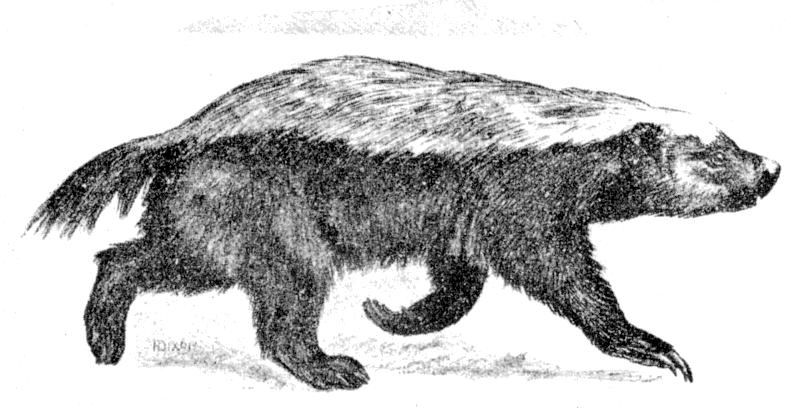
Fig. 222.—Ratel. Mellivora capensis. × ⅛.
The structure of Helictis has been described by the late Professor Garrod,[297] as well as by Sir W. Flower in his general account of the Carnivorous skeleton. The animal, which is a native of East Asia, is sometimes gaily coloured. H. subaurantiaca, the species dissected and figured by Garrod, is a varied black and orange. The genus is arboreal, and the tail may be moderately long and bushy. The ears are small; the nose is grooved; the palms are naked, but the soles of the feet are hairy. There are fourteen dorsal vertebrae. The molar formula is Pm 4/4 M 1/2.
The Zorilla, Ictonyx, is the last of the Old-World genera of Melinae. It is African, ranging from the tropical parts of the continent to the Cape. "In colour and markings," remarks Dr. Mivart, "as well as in the odour of the secretion of its anal glands, the one or two species which form this genus resemble the skunks; so much so that did they inhabit the same region, and were they devoid of an offensive secretion, they would certainly be said to mimic the skunks." The molar formula of the genus is Pm 3/3 M 1/2. There are fifteen dorsal vertebrae. The nose is grooved and the soles partly hairy.
The American Badger, Taxidea, is a burrower of omnivorous tastes, and correlated with the former habit are the immense claws of the fore-paws. It is North American, but gets into Mexico. The molar formula is as in the American genera Mephitis and Conepatus, and as in the Old-World Ictonyx, and it thus differs from that of Meles. Besides the great size of the claws upon the hand, which are larger relatively than those of any other Carnivore, the genus Taxidea is to be distinguished from all Arctoids (indeed, from all Carnivora) except Mydaus, by the fact that the pelvic limb is of the same length as the pectoral. The muzzle is furry except at the very extremity; this is grooved. The animal is carnivorous, subsisting upon the following very varied kinds of food—"Spermophiles, Arvicolas, birds' eggs, and snails, also honey-comb, wax, and bees."
The Skunk, Mephitis, is an American animal with several species, which range from North to Central America. The black-and-white colour distinguishes the genus, which is furthermore marked by the fact that the third digit of the hand is relatively longer than in any other Carnivore except Taxidea. The soles are partly hairy. It is a terrestrial fossorial animal with well-known powers of protecting itself from aggression. But nevertheless the Skunk has its enemies, and is not quite so unmolested as is sometimes popularly supposed. The Puma, Harpy Eagle, and the Great Horned Owl will at least occasionally attack and devour it. The molar formula is Pm 3/3 M 1/2. There are sixteen dorsal vertebrae.
Conepatus is a more southern form of Skunk, extending down into South America. Its dentition is like that of Mephitis save for the loss of an upper premolar. This genus, which has been further subdivided, differs from Mephitis in the fact that the soles of the feet are wholly naked, whereas in Mephitis those of the hind-limbs are partially hairy. It has no groove on the nose. Its tail is shorter than that of Mephitis. This Skunk has the same habits as the last. In certain parts of South America the animals are so abundant and their odour so powerful that in the evening there is generally a recognisable smell about. This is said to be good for the headache!
Sub-Fam. 3. Lutrinae.—Of this sub-family there are at least two genera. Enhydris (Latax),[298] the Sea-Otter, is confined to the shores of the North Pacific. It is more purely aquatic than are other Otters. Specimens have been seen swimming fifteen miles from land. The gait of the creature when on land is suggestive of a marine animal; the webbed hind-feet are doubled back upon the knuckles during progression upon land, and locomotion is effected by a series of short springs from these feet; the Otter does not walk "in ordinary acceptance of the term." The tail is flattened, being twice as broad as it is thick, and ends in a bluntish point. Enhydris feeds mainly upon crabs and sea-urchins, but also upon fish. Its dental formula is peculiar by reason chiefly of the reduction of the lower incisors. The formula runs as follows: I 3/2 C 1/1 Pm 3/3 M 1/2.
The molar teeth of this creature, in accordance with its diet, have lost the sharp points of the Mustelidae in general; the crowns are flattened, and the tubercles very blunt. In this it contrasts with Lutra, and presents some resemblance to the Crab-eating Raccoon, Procyon cancrivorus; but the teeth are still further blunted. Enhydris feeds largely upon sea-urchins and shell-fish, and needs blunt teeth for the crushing of the hard shells of its prey. It is interesting to notice that the habits of this animal have been altered by the interference of man. The creature has been hotly pursued for a long time on account of its valuable fur. Instead of feeding and breeding upon the shore in places readily accessible to its pursuers, the Sea-Otter has now taken to the open sea in a greater degree. It utilises masses of floating seaweed for those purposes, and hunts for its food in the deeper water at a greater distance from the shore. In conjunction with the increasing rarity of the Sea-Otter the price of its skin has enormously increased: whereas in 1888 the average price per skin was £21:10s., the value of a fine skin now is at least £100, and as much as £200 and even £250 has been given. The animal is captured by netting and by clubbing and spearing.[299] From the Miocene Siwalik beds remains of an allied form, Enhydridon, have been obtained, whose teeth are somewhat intermediate in their crowns between Lutra and Enhydris.
Lutra, including the Otters, is widely distributed. Both manus and pes are webbed. The ears are small and hairy. The nose is not grooved, and the naked part is very circumscribed; the claws upon the hind-feet are flattened and somewhat nail-like. There are about ten species, but of course, as is so universally the case, a great many more names have been given. The molar formula is like that of Enhydris save that there is an extra premolar in the upper jaw. There are fourteen pairs of ribs, of which eleven pairs reach the ten-jointed sternum. The caudals are twenty-three. The Cape Otter, the "clawless" Otter, has been separated as a genus Aonyx. So too has the South American Pteronura brasiliensis. But in neither case is the separation allowed by Mr. Thomas in a recent revision of the genus.[300] The latter species has the reputation of being very fierce, and is known in Uruguay by the name of "Lobo de pecho blanco." The British species, L. vulgaris, reaches a length of 2 feet or so, with a tail of 16 inches; it ranges over the whole of Europe and a large portion of Asia. This Otter often burrows in the banks of the streams which it frequents; and in the burrow in March or April the female brings forth her young, three to five in number. It will also frequent the sea-coast.
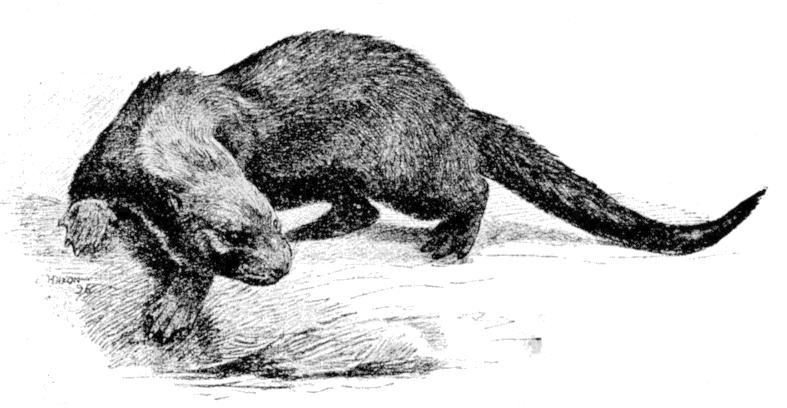
Fig. 223.—Otter. Lutra vulgaris. × 1⁄6.
Fossil Mustelidae.—Besides a number of the existing genera there are fossil members of this family which cannot be referred to existing genera. These latter extend back into time as far as the Eocene. Stenoplesictis, one of these Eocene forms referable to the sub-family Mustelinae, is to be distinguished from living Mustelines by its comparatively long legs. In this genus as in several others there are two upper molars.
Fam. 8. Ursidae.—This family is nearly universal in distribution, and consists of but three genera, Ursus, Melursus, and Aeluropus.
Ursus has the palms and soles naked except in the Polar Bear, which needs a furry sole to walk with ease upon ice surfaces. The ears are fairly large, and the nose may or may not be traversed by a median groove.[301] The molar formula[302] is Pm 4/4 M 2/3. The brain is naturally (because of the size of the animals of this genus) richly convoluted. The lobate kidneys have already been mentioned in defining this family (see p. 426).
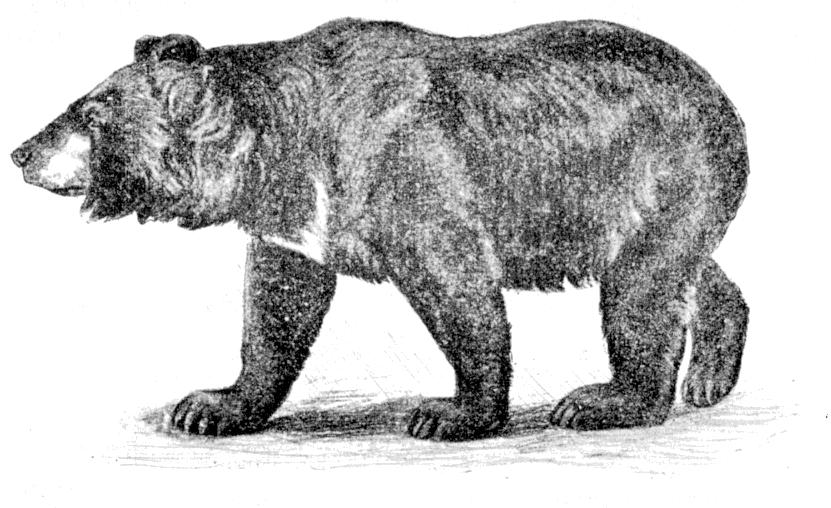
Fig. 224.—Himalayan Bear. Ursus tibetanus. × 1⁄15.
A very large number of species of Bears have been described. But it is the opinion of Mr. Lydekker[303] and of others that many of these are really to be referred to the European Brown Bear; in this event the Grizzly of North America, the Isabelline Bear, the Syrian Bear, a Bear from Algeria, the Kamschatkan and Japanese Bears, besides the extinct Ursus fossilis of Pleistocene caves, are to be regarded as slight modifications of Ursus arctos. On the other hand, the great Cave Bear, U. spelaeus, and the Thibetan Blue Bear (U. pruinosus) are distinct species, not to be confounded with U. arctos. Neither, of course, are the Peruvian U. ornatus and the Sun Bear, U. malayanus.
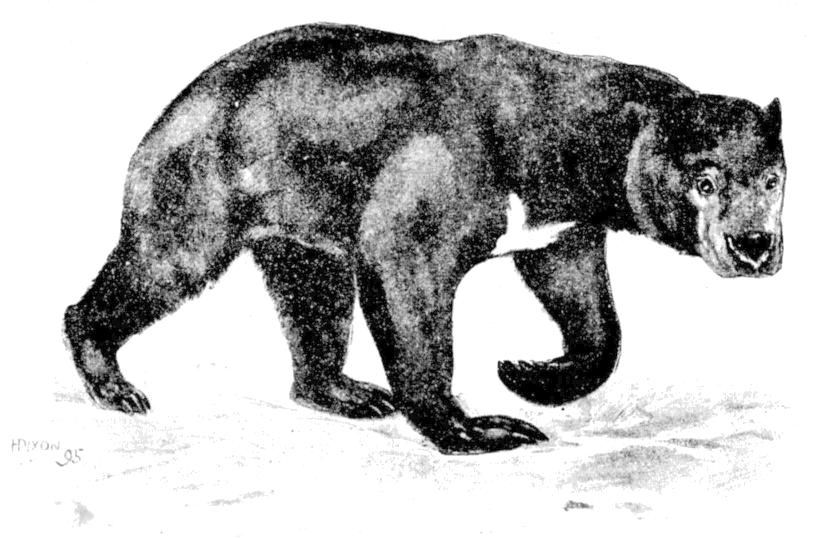
Fig. 225.—Malayan Bear. Ursus malayanus. × 1⁄12.
The Polar Bear has even been placed in a separate genus, Thalassarctos, a proceeding which is quite unnecessary. The white colour of this Bear tends to become browner with age. It is one of the few mammals which extend right round the pole; the Polar Bear is of course a purely Arctic animal. The chief food of the Polar Bear is Seal. Out of thirty Bears examined, Mr. Koettlitz found that only fifteen had animal remains in their stomachs, and these remains were invariably Seal. The animal apparently hunts by scent rather than by sight or hearing, both of which senses seem to be somewhat dull. The males and females wander separately, except of course during the breeding season. The Bears dig holes in which they may remain for some time, but there is no hibernation. In Pleistocene times, the Polar Bear extended as far south as Hamburg. The female has four mammae, pectoral in position.
Melursus includes only M. labiatus, the Sloth Bear of India. This animal has an upturned snout, which is described as closely resembling that of Mydaus, the Teledu. The snout has no groove. All Bears are largely vegetarian and insect feeders; but this Bear is especially so. It delights in the nests of Termites, and its energy in destroying these hills for the sake of their inhabitants is so great that the name of "sloth" appeared to Sir Samuel Baker to be an entire misnomer.
Aeluropus, a rare Carnivore with but one species, A. melanoleucus, is not inferior in size to the Brown Bear, and is distinguished by its largely white coloration. It was discovered in the mountains of East Thibet by Père David, and described by Milne-Edwards[304] as a distinct and new genus, the discoverer himself having named it as a species of Ursus. It is a vegetable-feeding creature and bulky in form, with a rudimentary tail and a short broad head; in fact, more like a Bear than a Procyonid (with which group it is placed by some). The width of the head, however, is greater than in any other Carnivore; it is most closely approached in this by Aelurus and by Hyaena. The molar formula is Pm 4/3 M 2/3. The soles are hairy. There is no alisphenoid canal. The molars are especially large and multicuspid.
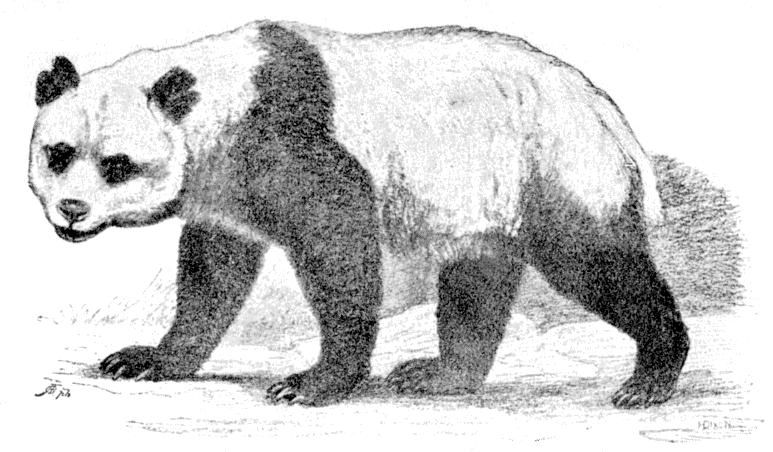
Fig. 226.—Aeluropus melanoleucus. × 1⁄12.
Fossil Ursidae.—The genus Ursus itself goes back to Pliocene times. The well-known Cave Bear, Ursus spelaeus of Pleistocene times, was one of the commonest of Carnivorous creatures during the very early times of the present era. It was as huge as a Polar Bear or a Grizzly. The skull is remarkable for the fact that the first three premolars, which are small in all Bears, dropped out early in life. An immense number of names have been given to what are in all probability the same species as this Cave Bear of remote antiquity.
Hyaenarctos is the oldest genus of true Ursidae. It goes back into Middle Miocene times, and ranged over Europe and North Africa.
Arctotherium is an American genus of Pleistocene times. The likeness of some of the extinct Canidae to Bears has been already commented upon.