Volume 10 — CHAPTER XI (continued 2)
Reading edition
Plesiomeryx, also European, and from the same geological horizon, is a very closely allied form.
Fam. Xiphodontidae.—This family consists of slender, small Artiodactyles which are, like the Caenotheriidae, related to the Pecora. They are confined in their range to Europe.
The type genus Xiphodon has selenodont molars and elongated, slender, cutting premolars. The dentition was complete and the canines not highly developed. Like Caenotherium, Xiphodon was a hornless creature, but with only two toes, the two lateral digits being represented by the merest rudiments of metacarpals. The other metacarpals were unusually long.
Amphimeryx (also called Xiphodontotherium) is much more imperfectly known, but belongs to this family or to that of the Caenotheriidae. Dichodon is another member of the same family.
Fam. Oreodontidae.—This family, consisting of numerous genera, is limited to the North American continent. Its range in time is from the Eocene to the Lower Pliocene. The family as a whole is to be distinguished by a number of primitive characters. The dentition is complete; the feet are four- or even five-toed; the orbit is sometimes open behind. The canines of the lower jaw are not more pronounced than the incisors. The characteristics of the group will be further developed by a consideration of some of the principal genera which are included in this family.
Oreodon is a Miocene form about as large as a Peccary. The skull has a short face with a completely-closed orbital cavity. In front of the orbit is a deep pit, not a mere deficiency of ossification, such as occurs in many Artiodactyles. This is placed on the lachrymal bone, and is in fact a lachrymal fossa, such as occurs in other forms. The odontoid process of the axis vertebra is somewhat cheese-taster shaped, as in recent Artiodactyles. There are fourteen dorsal vertebrae and a very large number of caudals. The radius and the ulna are completely separated, as are the carpals. There are five digits to the fore-limbs. The fibula is complete and independent. The hind-foot is four-toed. Several species of the genus are known.
Merycochoerus is an allied Miocene genus. It is more massive in form than the last, but otherwise does not present differences of importance.
Mesoreodon is another genus of this family which presents some curious features of organisation. In the skull and teeth there is nothing very noteworthy, but the hyoid is remarkable. This appendage of the skull is by no means always preserved, and when it is, it might be denied that it belonged to any particular skull. In the present case there appears to be no doubt as to the identity of the bones, which resemble the corresponding bones of the Perissodactyla much more than they do those of other Artiodactyles. Associated with the bones an ossified thyroid cartilage of the larynx was found. As the skull was that of a male, this character may be a sexual one. It is quite comparable to the ossification of the same cartilage in the American monkey Callithrix. "The function of the bone," observes Professor Scott,[212] "was probably similar to that performed by the enormously-inflated basihyal of the howling monkeys, and must have given to these animals most unusual powers of voice." Another important anatomical fact about Mesoreodon is the apparent existence of a clavicle. It is of course conceivable that the remains of some other animal have got mixed up with that of the individuals upon which the present genus is founded; but failing that, here is a clavicle in an Ungulate. The spine of the scapula possesses a metacromion. This greater development of the spine of the scapula in Artiodactyles than in Perissodactyles is, it is suggested, to be correlated with the earlier loss of the clavicle in the latter group of Ungulates.
Cyclopidius (synonymous with Brachymeryx) is a kind of pug form of Oreodon. The skull is short and broad, and the end of the snout a little turned up. The upper incisors are small and drop out early. On each side of the nasals is a large oval vacuity which is perhaps to be compared to the lateral deficiency to be found in other Artiodactyles. One species of this singular-looking form is appropriately called C. simus.
Other allied genera are Merychyus and Leptauchenia. The former extends as far down as the Lower Pliocene, and is thus one of the newest forms of Oreodontidae.
Agriochoerus[213] (Fig. 178) is placed in a separate sub-family from the types which have just been considered. It is Miocene in range. It differs from Oreodon and its closer relatives by the fact that the orbit is open behind and not closed. The most remarkable fact about this creature is that the terminal phalanges of the digits (five in the fore- and four in the hind-feet) being pointed, seem to suggest their encasement with claws rather than hoofs. The pollex, though small, seems to have been opposable. As with other Oreodonts, the molars are selenodont. The premaxillae are toothless—at least in adults, for two teeth are present in the young. There are several species. Agriochoerus, like Oreodon and primitive Ungulates in general, had a long tail. The genus thus shows a mixture of ancient and specialised characters.
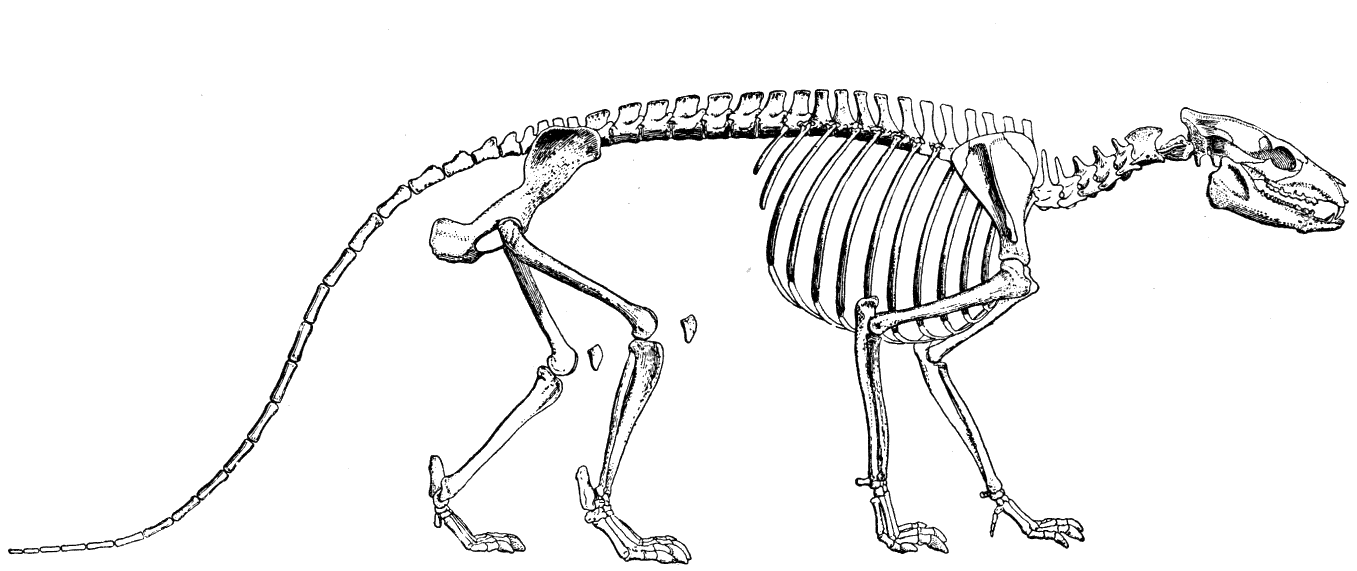
Fig. 178.—Skeleton of Agriochoerus latifrons. × ⅛. (After Wortman.)
The most ancient form of Oreodont is Protoreodon. This is Eocene, and became extinct during that period. It had a complete dentition, open orbit, and no lachrymal fossa. The fore-feet were five-toed, the hind four-toed.
Fam. Anoplotheriidae.—This family is entirely Eocene in point of time, and is unknown outside Europe. The dentition of the group is complete; the molars are seleno-bunodont, like those of the Anthracotheriidae. The bones of the carpus, tarsus, metacarpus and metatarsus are all free; the toes are four to two in number on each foot. The orbit is widely open behind. The tail is long, as in Xiphodon, etc.
These general characters only just serve to differentiate the family; but they illustrate its archaic character, in which it resembles the Xiphodontidae, and even more the Anthracotheriidae. A survey of some of the genera which have been assigned to the family will bring out other features in the organisation of these very ancient Artiodactyles.
Anoplotherium is so called on account of the fact that it is, like all ancient Artiodactyles, without horns or claws. Tusks it might have, but as a matter of fact has not. There are, as in Artiodactyles generally, nineteen dorso-lumbar vertebrae; the long tail has numerous chevrons. The shoulder blade has a well-marked acromion and a distinct coracoid process; it is wide proximally. The bones of the fore-arm and fore-leg are, as is usual in primitive Artiodactyles, separate.
In the skull the chief features, in addition to that mentioned in the definition of the family, are the large size of the paroccipital processes; there is no fossa lachrymalis or deficiency in the side of the face. The animal is three-toed, both in the fore- and hind-limbs. The second toe is nearly as large as the Artiodactyle third and fourth. There are tiny rudiments of the two remaining fingers. The hind-foot is also three-toed, and there is a trace of the hallux. The fingers are so widely separated and divergent from each other that it has been suggested that the animal had webbed feet and inhabited marshes, in which it swam by the aid of its long tail. The creature was the size of a Tapir.
Closely resembling Anoplotherium are a number of other genera.
Diplobune ( = Hyracodontotherium) was much like the last, but was a more delicately-formed animal. The fingers and toes (three of each) end in such sharply-pointed phalanges that claws seem to be almost suggested. There are several species of this genus. Dacrytherium differs by the presence of a lachrymal fossa.
Dichobune has four-toed extremities, of which the lateral ones are more slender and shorter than the two middle ones. As in other Anoplotheriidae, the anterior premolars are furnished with a sharp cutting edge.
Order V. SIRENIA.
Aquatic Mammalia, with but few scattered hairs; hind-limbs absent; fore-limbs paddle-shaped; tail flattened, and either Whale-like or rhomboidal to circular in form. Nostrils on upper surface of not specially-elongated snout. Clavicles are absent. The scapula has the normal mammalian form, with a well-developed and roughly median spine. The bones of the arm and hand articulate together, as in land animals; the phalanges show at most traces of increase in number above the normal. Pelvis represented by a vestige, more highly developed in some fossil than in recent forms. Stomach complex, consisting of several chambers. Lungs simple and not lobulated. Diaphragm oblique and very muscular. Brain peculiar in form and but slightly convoluted. Testes abdominal. Teats two, and pectoral in position. Placenta non-deciduous and zonary.[214]
This limited group consists of purely aquatic forms, which are both marine and fresh-water in their proclivities. They have been placed in the immediate vicinity of the Whales; but it is now believed by most zoologists that the likenesses which they undoubtedly show to the Cetacea are of an adaptive kind and related to their similar mode of life. The group is a readily-definable one. Externally they are marked by their dark coloration, somewhat Whale-like though of clumsier build, and by the total absence of external ears and hind-limbs; the latter are, however, as will be pointed out shortly, marked by certain rudimentary bones. There is a flattened tail, which in the Dugong and Rhytina is precisely like that of a Whale. It is interesting to note that the former genus, whose tail is, judging it at least by the standard of the Whales, more completely modified for the aquatic life, should also show other features which indicate their longer life as marine creatures. For the flippers are more Whale-like in that the fore-arm is completely enclosed within the body, or nearly so, and the nostrils have a more decidedly superior position than in the Manatee. The fore-limbs of this group, as may be inferred from what has just been said, are flipper-like; but, contrary to what we find in Whales, the phalanges do not as a rule show any traces of multiplication, so characteristic a feature of the Cetacean hand, and the individual bones are connected by well-formed joints. Beneath the thick skin, which is sparsely provided with stout hairs in the Dugong, is a layer of blubber. Dr. Murie has called attention to the fact that this layer in the Manatee[215] differs from the blubber of the Whale in that there is no free oil anywhere.[216]
The skeleton of the Sirenia is strong and massive, thus contrasting with the loosely-textured bones of the Cetacea. The cervical vertebrae are, as a rule, free, but the second and third are fused in Manatus and the extinct Halitherium. It is noteworthy that in Rhytina the cervical vertebrae have the exceedingly thin centra that characterises the neck vertebrae in Whales. The ribs are most of them firmly articulated by two heads. The breastbone is generally reduced, as in Whales; and but few ribs are attached thereto. The vertebrae, moreover, are well locked together by zygapophyses, and not loosely attached as in Whales.
The shoulder blade is long and narrow, and not unlike that of the Seals. It is totally unlike the peculiarly-modified scapula of the Whale tribe. But, as in the latter, there are no clavicles.
The hind-limbs are only represented by the pelvis; and this is a rudimentary structure, varying, however, in the degree of its degeneration. That of the extinct Halitherium recalls the pelvis of the Rorqual. There is a single triradiate bone with an acetabular cavity for the rudiment of the femur in the centre; it suggests that here the three normal elements of the pelvis have become fused into a single bone. In the Dugong there are two small bones on each side.
The Manatees (Manatus)[217] are found in the fresh-waters and along the Atlantic coasts of South America and Africa. It appears that there are four species, of which one only is African, the others American. Report asserts the former occurrence of this genus on the shores of St. Helena.
The Manatee is provided with only six cervical vertebrae, a fact which distinguishes it from the other existing genera of its group. A remarkable feature which it exhibits is the large number of molar teeth. These apparently go on increasing indefinitely during its life, the suggestion being that they are worn away by the nature of the food—algae with much sand intermixed. As many as twenty molar teeth have been counted in one half of the jaw, and there is no reason to forbid the assumption that they may get still more numerous. This large number of grinding teeth is obviously suggestive of the Whales, with which the Sirenia are believed by some to be allied. It is at least a remarkable coincidence that these two aquatic groups of mammals should both have assumed the same indefinite tooth formula. It is correct to say assumed, since extinct forms of Manatees, such as Halitherium and Prorastoma, have not a continuous succession of molars. The brain of the Manatee is, contrary to the usual arrangement among aquatic mammals, smooth, and only marked by one or two fissures.
The Manatee[218] is black in colour, its thick skin being wrinkled. The animal is assisted in feeding by a curious mechanism of the upper lip; this is split in two, and the two halves, which are furnished with strong bristles, can play upon each other like the points of a pair of forceps. The flippers are furnished with nails, save in M. inunguis, but in the nailed forms it is not every finger which is thus armed.
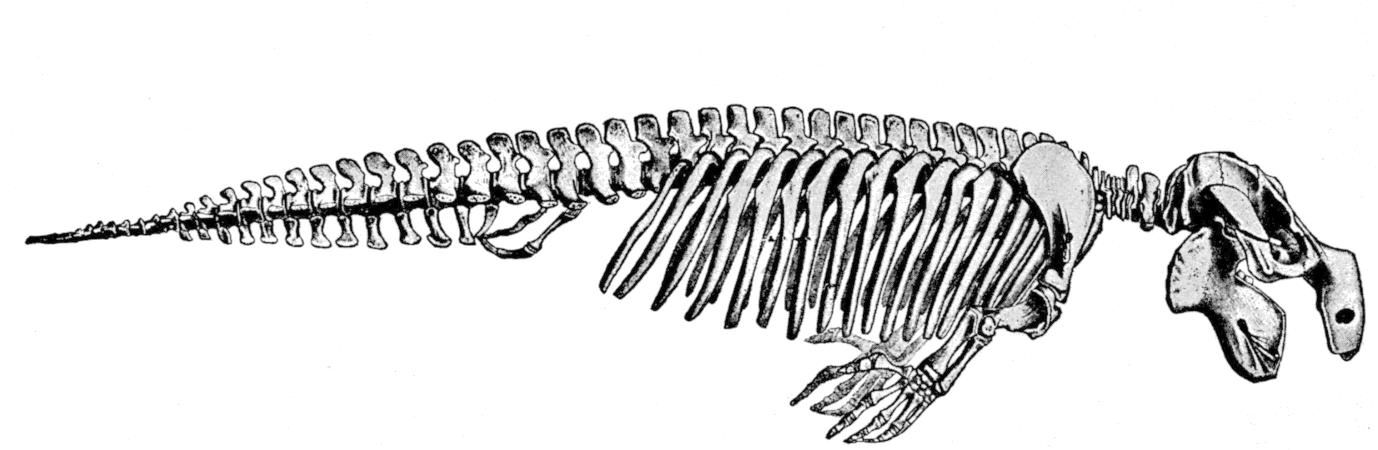
Fig. 179.—Skeleton of Dugong. Halicore australis. (After de Blainville.)
Halicore,[219] the Dugong, is an entirely Oriental and Australian form; there appears to be but a single species, though more than one name has been given to supposed distinct species. As already mentioned, it differs from the Manatee in the possession of a Whale-like tail; the nostrils, too, are more upon the upper surface of the head, and there are no nails upon the flipper. The peculiar cleft lip of the Manatee is not so well developed in the Dugong, but there are traces of it; and in the foetus the likeness to the Manatee in this respect is very striking. It would thus appear that Halicore is a stage in advance upon Manatus; that the remarkable mechanism of the lip of the latter has been possessed, but has been lost, by the Dugong. The skull of the Dugong is distinguished by the stout premaxillary bones, which bear a tusk in the male. In the female the tooth is there, but is lodged within the bone. This incisor has a milk forerunner. The back teeth of the Dugong (there are no canines) are few in number (four or five, even six), thus showing a gradual reduction when compared with Manatus; and this culminates in the toothless Rhytina. It is also interesting to notice that in the massive lower jaw there are traces of an incisor. Were this to be developed into a tusk, the jaw would present a curious resemblance to that of Dinotherium.
The Dugong, H. dugong, has the reputation of being the original of the mermaid legends, since the young is held to the pectorally-situated breast with one flipper. "But it should be remembered," justly observes Dr. Blanford, "that stories of beings half man or woman, half fish, are as common in temperate as in tropical seas, and that some of them are more ancient than any European knowledge of the Dugong."
Extinct Sirenians.—The earliest genus that can be with certainty referred to this order is the Oligocene Prorastoma. This genus, though offering no particular skull-characters that assist in the determination of the much-debated affinities of the Sirenia, shows a remarkable condition of the teeth that may afford a clue. The species P. veronense, recently described by Mr. Lydekker,[220] is founded upon a fragment of the skull which contains two teeth apparently representing the third and fourth upper milk molars. The interest attaching to these teeth lies in the fact that they clearly exhibit the buno-selenodont condition characteristic of certain early Artiodactyles, e.g. Merycopotamus.
Halitherium is a later genus, which is known by the nearly complete skeleton. The skull is like that of other Sirenia, with the down-turned premaxillary region. But the nasal bones, lost, or at least rudimentary, in recent forms, are well developed; the likeness of ancient to living forms in this respect being exactly paralleled by the Zeuglodonts, when compared with recent Whales. The vertebral centra exhibit distinct epiphyses, which have disappeared in living Sirenians. The cervical vertebrae are seven, of which the second and third are occasionally fused. There are nineteen pairs of ribs, and there are three lumbar vertebrae. The sternum consists of three separate pieces. There is a rudimentary femur.
The recently-extinct Steller's Sea-cow, belonging to the genus Rhytina, was a huge beast, seen in the flesh up to nearly the end of the last century. It frequented the shores of Bering's Straits. Its remains occur in the peat on the shores of those seas. It reaches a length of some 20 to 30 feet. The external characters were much like those of other recent Sirenians. The nostrils were above the fore part of the snout, the latter being truncated and obtuse. The tail was of the Cetacean pattern, and thus like that of Halicore. The head of this Sirenian was small, and the teeth had entirely vanished save for the apparent existence as transitory structures of two small incisors in the upper jaw. The absence of teeth was compensated by the presence of a horny palate for the trituration of the sea-weeds which constituted the food of Steller's Sea-cow. The fore-limbs seem to have possessed no nails, but were covered at the extremity with short, bristly hairs, no doubt serving the purpose of keeping the animal moored in safety to the slippery beds of Fucus upon which it browsed.
There are nineteen pairs of ribs. The vertebrae of the cervical region are the customary seven, and the centra are thin and plate-like as in the Cetacea, the animal being thus short-necked like those marine creatures.