Volume 10 — CHAPTER XV (continued 2)
Reading edition
Fossil Rodents.—Quite a large number of existing genera of Rodents are known from even the earlier strata of the Tertiary period. The Squirrels (and even the genus Sciurus itself) occur in the Upper Eocene. So, too, do the genera Myoxus, and (in South America) Lagostomus. Spermophilus, Acomys, Hystrix, Lagomys, Lepus, Hesperomys are known from Miocene rocks. Rhizomys, Castor, Cricetus, Mus, Microtus, and some others appear to have originated so far as we know in the Pliocene, while a still larger series of existing genera are Pleistocene. It is interesting to note that some of the extinct genera were much larger than recent forms. At present, Hydrochoerus is the biggest Rodent; but the genus Megamys from the Pampas formation of Argentina was "nearly as large as an ox." The wider range of genera in the past is illustrated by Hystrix, which, now an Old-World form, is represented by remains in the Miocene and Pliocene of America.
It is a significant fact that of living genera Sciurus is the oldest; for it has been pointed out that in a number of features the Squirrels are among the most primitive of Rodents. The zygomatic arch is slender, and has thus not acquired the specialisation that is to be found in that part of the skull in other Rodents; moreover, the "jugal bone is not supported by any process from the maxilla exactly as in the primitive Ungulata." The feet, too, are unspecialised, though that is the case with many other genera. It may also be pointed out that the teeth bear not a little likeness to those of Ornithorhynchus in their multituberculate character.
Some few fossil forms have already been dealt with in the preceding pages.
The two genera Castoroides and Amblyrhiza, from the Pleistocene of North America and the West Indies, are usually regarded as forming a family. The skull of the former genus indicates an animal of the size of a Bear. It is compared to that of Castor, but it has a wide infra-orbital foramen. The teeth are four in each jaw, and are formed of three to five lamellae; the incisors of this animal are powerful but short. Amblyrhiza, on the other hand, has long incisors which are longitudinally grooved anteriorly. It has a free fibula. This latter as well as other characters have led Tullberg to remove it from association with Castoroides.
Order X. TILLODONTIA.
This group of Eocene mammals is to be defined by a number of characters, of which the more important are the following:—The incisors are enlarged, grow from persistent pulps, and are coated with enamel upon the outer surface only; they are those of the second pair only, the first and third having disappeared or become small. The canines are reduced in the later forms.
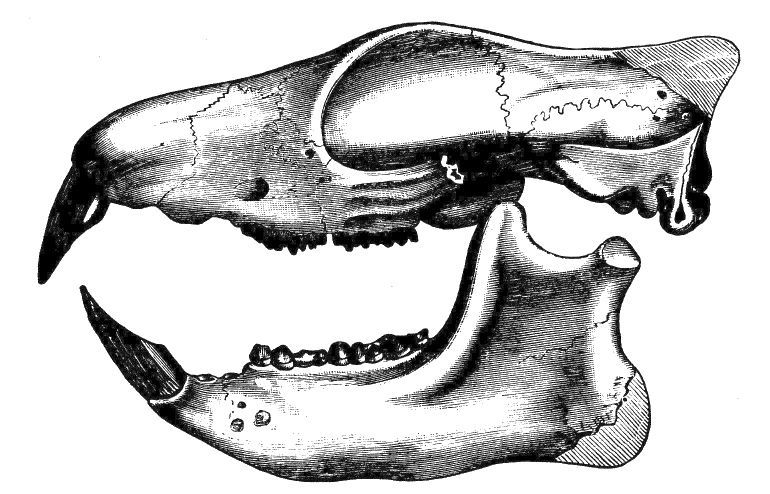
Fig. 247.—Tillotherium fodiens. Left lateral view of skull. (From Flower, after Marsh.)
These animals have been regarded as ancestral Rodents, to which the tooth characters just mentioned clearly show likenesses. The earliest known form is Esthonyx. This genus shows such primitive characters, compared with its later representatives, as the existence of all three pairs of incisors in the upper jaw, but only two in the lower jaw. The enlarged incisors of both jaws do not seem to have grown from persistent pulps.
Anchippodus, a later form, still preserves the upper pair of first incisors in a vestigial form; the strong second incisors grew from persistent pulps. The most recent genus, Tillotherium, shows the characteristics of the group at their height. The strong Rodent-like, chisel-shaped incisors, which are reinforced by a small additional pair in the upper jaws only, are persistent. The grinding teeth are of the tritubercular pattern; there are three of each kind in the upper jaw, but in the lower jaw only two premolars on each side. This is at any rate the case with some, while others have three. The canine, though present in both jaws, is insignificant. As in many ancient types, there is an entepicondylar foramen in the humerus. The feet were five-toed, and bore sharp, laterally-compressed claws. The skull has been compared in general aspect to that of a Bear.