Volume 10 — CHAPTER XVII (continued 2)
Reading edition
The Orang seems to be usually of a fairly mild disposition; it will rarely attack a man unprovoked. But Dr. Wallace, who has accumulated a large number of observations upon these animals, describes a female Orang who "on a durian tree kept up for at least ten minutes a continuous shower of branches, and of the heavy-spined fruits as large as 32-pounders, which most effectually kept us clear of the tree she was on. She could be seen breaking them off and throwing them down with every appearance of rage, uttering at intervals a loud pumping grunt, and evidently meaning mischief." The name given by the Dyaks to the Orang is Mias Pappan.[430]
Fossil Anthropoid Apes.—Undoubtedly the most interesting of fossil Anthropoids is the now famous Pithecanthropus erectus. Our knowledge of it is due in the first place to Dubois.[431] But there is hardly an anatomist or an anthropologist who has not had his say upon this regrettably very incomplete remnant. The creature is only known by a calvarium, two separate teeth, and a femur. And the femur, moreover, is diseased. M. Dubois discovered these remains in the island of Java in andesite tufa of Pliocene or at least early Pleistocene age. The remains were found in company with Stegodon, which is now extinct, and Hippopotamus, which is no longer found in that part of the world. The name Pithecanthropus was given to it by the discoverer in order to furnish with a definite habitation and a name the theoretical Pithecanthropus of Haeckel. Even the most particular of students of mammalian nomenclature will hardly object to the utilisation of a name for a second time which is with some clearness a nomen nudum! The animal when erect must have stood 5 feet 6 inches high. The contents of the cranium must have been 1000 cm., that is to say 400 cm. more than the cranial capacity of any Anthropoid Ape, and quite as great as or even a trifle greater than the cranial capacity of some female Australians and Veddahs. But as these latter are not 5 feet in height, the Ape-like man had really a less capacious cerebral cavity. The skull in its profile outline stands roughly midway between that of a young Chimpanzee (young in order to do away with the secondary modifications caused by the crest) and the lowest human skull, that of Neanderthal Man. This creature is truly, as Professor Haeckel put it, "the long searched for 'missing link,'" in other words represents "the commencement of humanity."
The remains of Apes, more distinctly Apes than Pithecanthropus, are known from Miocene strata of France. Two genera, Pliopithecus and Dryopithecus, are known. The former appears to be close to Hylobates. Dryopithecus is more Man-like than any other, and seems to have been as large as a Chimpanzee. The incisors are human in their relatively small size. But it has been pointed out that the long and narrow symphysis of the lower jaw is a point of likeness to the Cercopithecidae.
Fam. 3. Hominidae.—Apart from Pithecanthropus, which perhaps is a member of this family, but whose remains permit us to leave it among the Simiidae, at least for the present, the family Hominidae contains but one genus, Homo, and probably but one species, H. sapiens. The characters of the family may therefore be merged in those of the genus.[432]
Though it is easy enough to distinguish a Man from an Ape, it is by no means easy to find absolutely distinctive characters which are other than "relative." As Professor Haeckel has pointed out, there are really only four characters which differentiate Man: these are the erect walk, and the consequent modification of the fore- and hind-limbs to that position; the existence of articulate speech; the faculty of reason. Whether one body of psychologists are right who argue that reason is a distinctive human attribute, not to be confused with the apparent reasoning powers of lower animals, or whether others are justified in separating Man only in degree from the lower animals, it is clear that this very diversity of opinion prevents us for the present from utilising such characters as absolute differences. In any case the discussion of these matters is beyond the scope of the present book.
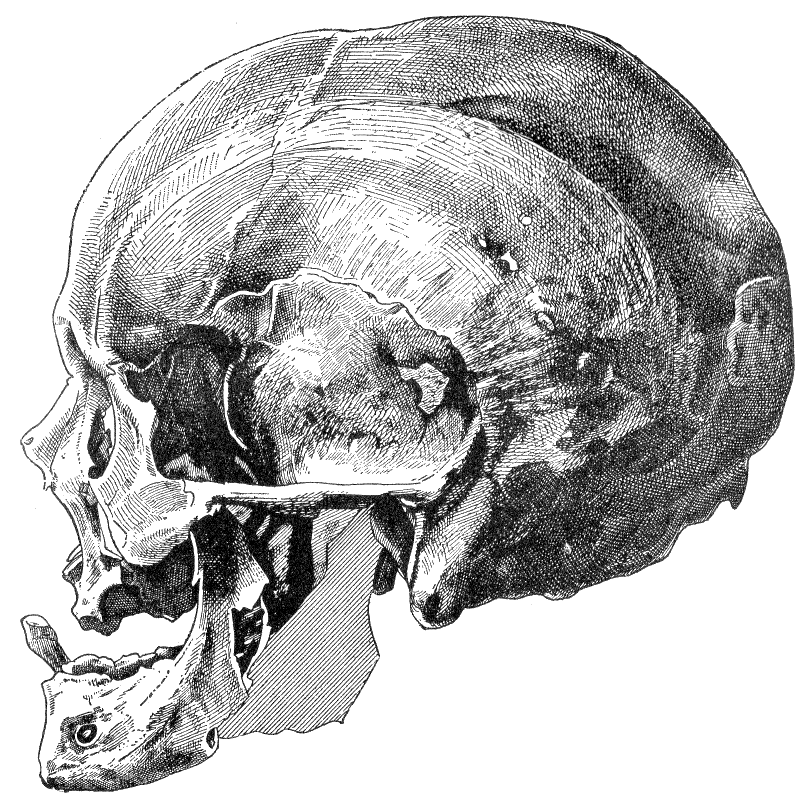
Fig. 281.—Skull of Immanuel Kant. (After C. von Kupffer.) The great size of the cranium is a noteworthy feature. (From Wiedersheim's Structure of Man.)
Anatomically there are a number of small points which distinguish Man; but they are mainly due to the erect gait. It is sometimes attempted to divide Man as a naked animal. But this is an apparent difference only; the hair is not so much developed upon the body as in the Apes, save in occasional abnormalities, such as the various hairy men and women who can be seen in travelling shows, and to a less extent the Japanese Ainos, but it is present everywhere, as is shown by microscopical investigation of the skin. The skull in Man "is a smooth and imposing, rounded or oval bony case," which contrasts with the smaller and deeply ridged skull of the Anthropoid Apes. The shape of the skull is largely in accord with the large brain. The face does not project so much as in the Anthropoid Apes, though this character must not be insisted upon too strongly, as in some American Monkeys the face is as little projecting. Still we are now comparing Man with his undoubtedly nearest relatives the Simiidae. In the lower jaw the anterior line at the symphysis is an approximately straight one, that is at right angles to the long axis of the jaw, while Apes have a more retreating chin. The "beautiful sigmoid curve formed by the lumbar and dorsal vertebrae" is more pronounced in Man, but exists not only in the Anthropoids, but in other Apes.[433]
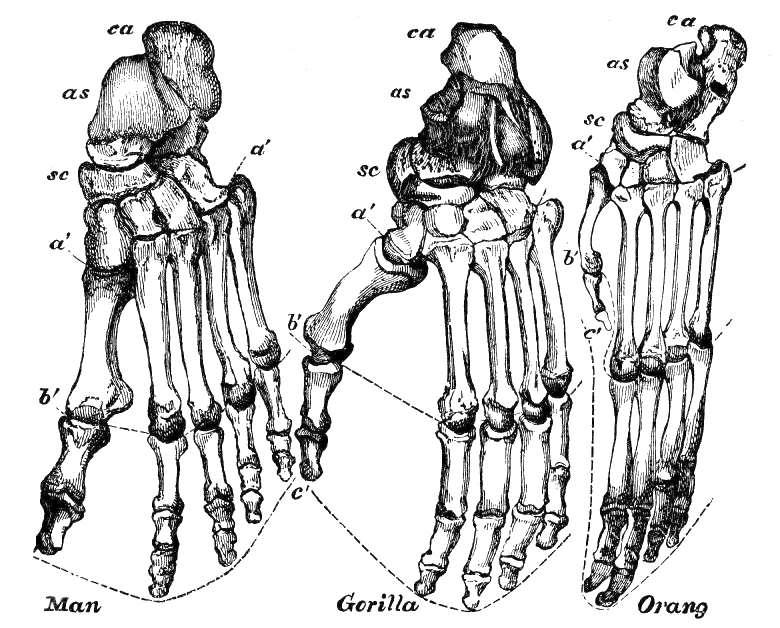
Fig. 282.—Foot of Man, Gorilla, and Orang of the same absolute length, to show the difference in proportions. The line a′a′ indicates the boundary between the tarsus and metatarsus; b′b′, that between the latter and the proximal phalanges; and c′c′ bounds the ends of the distal phalanges. as, Astragalus; ca, calcaneum; sc, scaphoid. (After Huxley.)
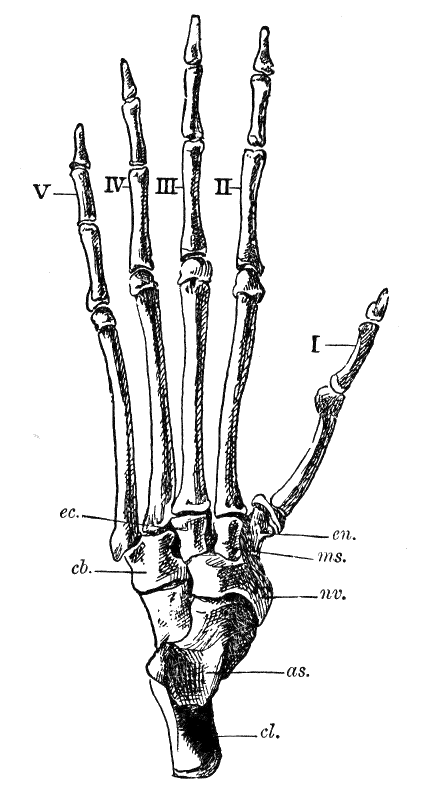
Fig. 283.—Skeleton of the left pes of a Chimpanzee. (Dorsal aspect.) as, Astragalus; cb, cuboid; cl, calcaneum; ec, ectocuneiform; en, endocuneiform; ms, mesocuneiform; nv, navicular; I-V, digits. (From Wiedersheim's Structure of Man.)
The fore-limbs are relatively short, the extreme length of the arm being such that the outstretched hand does not reach the knee. The thumb is a large and useful digit in Man, much more so than in the Anthropoids. On the other hand the hallux is not opposable. This is, of course, correlated with the upright attitude, as is also the greater relative thickness of that digit, upon which the greatest stress is laid in walking. As to muscles, the glutaeus maximus is more developed in Man—the Ape which most nearly approaches him being the Gorilla, in which animal the life is less thoroughly arboreal than in some others. The so-called "scansorius" is only present in Man as an occasional occurrence. The rudimentary character of the ear muscles for the movement of the external ear in Man has often been insisted upon, as also their occasional functional activity. But here and elsewhere, so numerous are the abnormalities, that "the gap which usually separates the muscular system of Man from that of the Anthropoids appears to be completely bridged over." These are words of Professor Wiedersheim quoted from Testut, and express a final summary of the matter of muscles in Man and the Apes.
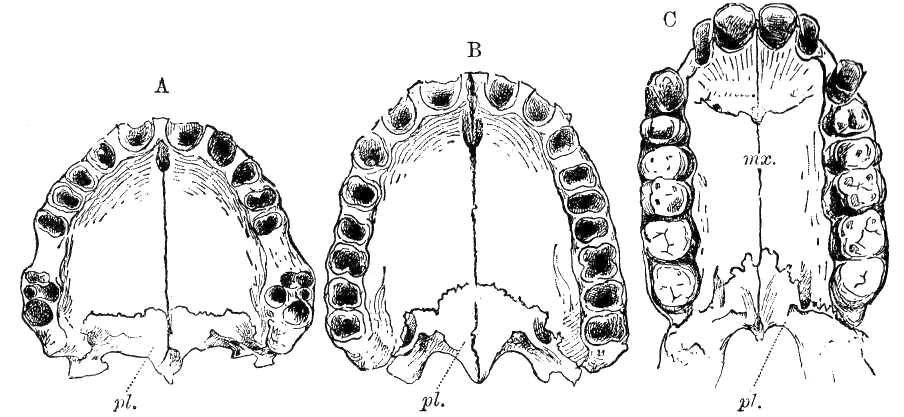
Fig. 284.—The hard palate, A, of a Caucasian; B, of a Negro; C, of an adult Orang-Utan, showing the differences in shape of the bones. The palate of the Negro represents a type transitional between that of the Caucasian and that of the Orang. mx, Maxilla; pl, palatine; p.mx, premaxilla. (From Wiedersheim's Structure of Man.)
In his teeth Man differs by the small exaggeration of the canines, which hardly, if at all, differ in the two sexes. There is also a complete absence of a diastema. The teeth are also on the whole weaker than in the Anthropoids, though Hylobates is very human in this particular.
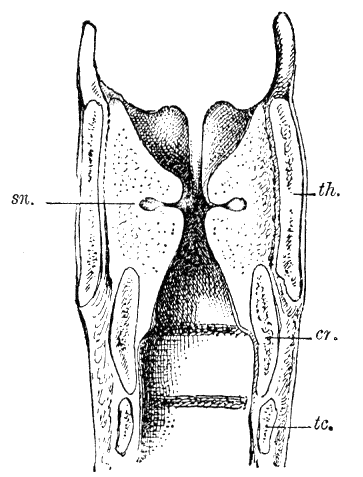
Fig. 285.—Human Larynx in frontal section. cr, Cricoid cartilage; sn, sinus of Morgagni; t.c, first tracheal cartilage; th, thyroid cartilage. (From Wiedersheim's Structure of Man.)
There is a tendency in Man towards the disappearance of the upper outer incisors, and more markedly still of the wisdom teeth, which appear very late, and are often imperfect. In a large number of cases the tooth does not appear at all. In the larynx there is no great development of the great throat pouches of the Anthropoids. The minute diverticula of that organ, known to human anatomists as the ventricles of Morgagni, alone remain to testify to a former howling apparatus in the ancestors of Man.
INDEX
Every reference is to the page: words in italics are names of genera or species; figures in thick type refer to an illustration; f. = and in following page or pages; n. = note.
Aard Vark, 187 Aard Wolf, 413 Abderites, 148 Aceratherium, 258; A. incisivum, 259 n.; A. platycephalum, molar teeth of, 51; A. tridactylum, 259 Achaenodon, 279 Acodon, 480 Acomys, 472; A. cahirinus, 473 Aconaemys, 488 Acrobates, 142 Adapis, 553 Addax, 315; A. nasomaculata, 315 Aeluroidea, 390 Aeluropus, 444; Ae. melanoleucus, 444 Aelurus, 431 Aepyceros, 311; Ae. melampus, 311 Aepyprymnus, 137; Ae. rufescens, 137 Aëthurus, 463; A. glirinus, 463 Agouti, 495 Agriochoerus, 331; skeleton of, 332; A. latifrons, 332 Ai, 171 Alactaga, 486; A. decumana, 486; A. jaculus, 486 Alcelaphus, 308 Alces machlis, 297, 298 Alimentary canal, 61 Allodon, 99 Allotheria, 105 Alouatta, 558 Alpaca, 286 Ambergris, 364 Amblotherium, 99 Amblydactyla, 206 Amblypoda, 205 f. Amblyrhiza, 506 Ammodorcas, 313; A. clarkei, 313 Amorphochilus, 531 Amphicyon, 423; A. giganteus, 424 Amphilestes, 99, 100 Amphimeryx, 330 Amphiproviverra, 160 Amphitherium, 99; A. prevostii, 100 Amphitragulus, 301 Anaptomorphidae, 552 Anaptomorphus, 552; A. homunculus, 552 Anchippodus, 507 Anchitherium, 248; A. aureliense, 249; A. equinum, 249 Ancodus, 329; A. brachyrhynchus, 329; A. velaunus, 329 Ancylopoda, 211 f. Ancylotherium, 211 Angwantibo, 547 Anisodon, 211 Ankle, 43 Anoa, 317; A. depressicornis, 317 Anomaluridae, 462 Anomalurus, 462; A. peli, 463 Anoplotheriidae, 332 Anoplotherium, 333 Ant-eater, 166 Antechinomys, 153; A. lanigera, 153 Antelopes, 307 f. Anthops, 527; A. ornatus, 527 Anthracotherium, 328 Anthropoid Apes, 570 f. Anthropoidea, 554 f. Anthropopithecus, 580; A. calvus, 580; A. troglodytes, 579 Anthropops, 570 Antidorcas, 312; A. euchore, 312 Antilocapra americana, 306 Antilocapridae, 306 Antilope, 311; A. cervicapra, 311 Antlers; see Horns Antrozous, 529 Anurosorex, 518, 519 Aodon dalei, 369 Aonyx, 441 Apar, 177 Apes, 554 f. Aphelops, 260 Archaelurus, 401 Archaeoceti, 384 Arctic region, mammals of, 81 Arctictis, 407; A. binturong, 407 Arctocebus, 547 Arctogaea, 85 Arctogale, 408; A. leucotis, 408; A. stigmatica, 408 Arctoidea, 424 Arctomys, 465; A. bobac, 466; A. caudatus, 465; A. marmotta, 466; A. monax, 466 Arctonyx, 432; A. collaris, 432 Arctotherium, 445 Argyrocetus, 383; A. patagonicus, 384 Armadillo, 177 Arteries, 66 Artiodactyla, 209 Artionyx, 211; five-toed, 271; extinct; forms of, 328 Arviacanthis, 473 Arvicola, 477 Ass, Wild, 242 Astrapotherium, 210, 216 Ateles, 557; A. ater, 558 Atelodus, 254 Atheriogaea, 85 Atherura, 499; A. africana, 501; A. fasciculata, 501 Auchenia, 286 Aulacodus, 489 Aurochs, 318, 321 Avahis, 539; A. laniger, 539 Aye-aye, 548; legends relating to, 550 Babirusa, 277; B. alfurus, 278 Baboon, 566 Badger, 432 Balaena, 358; B. australis, 359; B. biscayensis, 360; B. glacialis, 359; B. mysticetus, 359; bones of hind-limbs of, 353; cervical vertebrae of, 352; sternum of, 352 Balaenidae, 358 Balaenoptera, 355; B. australis, 356; B. borealis, 356; sternum of, 33; B. musculus, 356; sternum of, 352; B. patachonica, 356; B. rostrata, 356; B. sibbaldii, 356 Balaenopteridae, 355 Baleen, 354 Bandicoot, 156 Banteng, 317, 318 Bassaricyon, 428; B. alleni, 428; B. gabbii, 428 Bassariscus, 428; B. astutus, 429 Bat, 521 f.; wings of, 522 Bathyergus, 481 Batomys, 473, 474; B. granti, 473 Bdeogale, 410 Bear, 442; Grizzly, 442; Himalayan, 442; Malayan, 443; Polar, 443; Sloth-, 443 Beatrix Antelope, 314 Beaver, 467 Behemoth, equivalent to Mammoth, 228 Beisa, 315 Beluga, 372 Berardius, 368; B. arnouxi, 368; B. vegae, 369 Bettongia, 137; B. lesueuri, 138 Bezoar stones, 287, 325 Bibos frontalis, 317, 318 Binturong, 407 Bison, 318; B. americanus, 319; B. europaeus, 318 Blaaubok, 314 Blarina, 518 Blarinomys, 480 Blessbok, 309 Boar, Wild, of Europe, 275, 276 Body cavity, 69 Bolodon, 99 Boneia, 526 Bontebok, 309 Bos, 317; B. alleni, 319; B. antiquus, 319; B. bonasus, 318; B. depressicornis, 320; B. ferox, 319; B. frontalis, 318; B. gaurus, 317; B. grunniens, 320; B. latifrons, 319; B. mindorensis, 320; B. primigenius, 321; B. sondaicus, 318; B. taurus, 320 Boselaphus, 316; B. tragocamelus, 316 Bovidae, 307 Brachymeryx, 331 Brachyodont, 48 Brachytarsomys, 480 Brachyuromys, 480 Brachyurus, 560; B. calvus, 560; B. melanocephalus, 561; B. rubicundus, 560 Bradypodidae, 170 Bradypus, 170; B. tridactylus, 171; skull of, 171; skeleton of, 172 Brain, 75 of Dog, 76; of Rabbit, 77; of Echidna, 110, 117; of Wallaby, 118 Bramatherium, 306 Brontops, 264 Brontotherium, 264 Bruta, 161 Bubalis, 308; B. caama, 308 Buffalo, 321 Bunodont, 272 Bush Dog, 414 Cachalot, 363; ferocity of, 365; food of, 365 Cadurcotherium, 264 Caenolestes, 146; C. obscurus, 146 Caenopus, 262 Caenotheriidae, 329 Caenotherium, 329 Calamodon, 192; C. simplex, 192 Callignathus, 367 Callinycteris, 526 Callithrix, 559; C. gigot, 560 Caloprymnus, 138; C. campestris, 138 Camel, 285 Camelidae, 285; ancestry of, 289 Camelus, 285; C. bactrianus, 285, 286; C. dromedarius, 285 Canidae, 413 Canine teeth, 49 Canis, 416; C. aegyptiacus, 419; C. antarcticus, 418; C. anthus, 420; C. aureus, 420; C. azarae, 418; C. cancrivorus, 414; C. chama, 418; C. chanco, 421; C. dingo, 421, 422; C. familiaris, 422; C. ferus, 422; C. hodophylax, 418; C. jubatus, 414; C. lagopus, 419; C. laniger, 421; C. lateralis, 420; C. latrans, 417; C. lupus, 420; C. magellanicus, 418; C. mesomelas, 420; C. mikii, 422; C. niger, 418; C. pallipes, 418; C. parvidens, 415; C. primaevus, 423; C. rudis, 418; C. urostictus, 415; C. variegatus, 420; C. velox, 418; C. virginianus, 418; C. vulpes, 419; C. zerda, 417; Cannabateomys, 488; C. amblyonyx, 488 Caperea, 358 Capra, 324 C. aegagrus, 325; C. falconeri, 325; C. ibex, 325; C. jemlaica, 324; C. pyrenaica, 325; C. sinaitica, 325 Capreolus, 295; C. capraea, 295 Capromys, 489, 490; C. melanurus, 490; C. pilorides, 490 Capuchin Monkey, 557 Capybara, 491 Cardinal vein, 68 Cariacus, 295; C. chilensis, 296; C. macrotis, 295; C. rufus, 296 Carnivora, 386 f.; C. Fissipedia, 387 f.; C. Pinnipedia, 446 f. Carpomys, 473; C. melanurus, 473; C. phaeurus, 473 Carterodon, 489 Castor, 467; C. canadensis, 468; C. fiber, 468 Castoridae, 467 Castoroides, 506 Cat, Domestic, 10, 14, 392, 400; -tribe, 390; coloration of, 392; Wild, 399 Catarrhines, 555, 562 Cavia, 493; C. porcellus, 493 Caviidae, 491 Cavy, 493; Patagonian, 492 Cebidae, 557 Cebus, 557 Celaenomys, 474; C. silaceus, 474 Cenoplacentalia, 103 Centetes, 511; C. ecaudatus, 511; skull of, 512 Centetidae, 511 Cephalogale, 423 Cephalophus, 309 Cephalorhynchus, 380 Cephalotes, 526 Ceratorhinus, 254, 257 Cercocebus, 564 Cercolabes, 498; C. villosus, 42, 499; C. insidiosus, 498 Cercolabidae, 497 Cercoleptes, 429; C. caudivolvula, 430 Cercomys, 489 Cercopithecidae, 562 Cercopithecus, 565; C. diana, 565; C. lalandii, 565; C. moloneyi, 565; C. stairsi, 566; C. talapoin, 565 Cervicapra, 311; C. isabellina, 18 Cervidae, 291 Cervulus, 295 Cervus, 293; C. dama, 293; C. davidianus, 293; C. duvauceli, 291; C. elaphus, 293; C. luehdorffi, 294; C. sedgwicki, 301; C. sika, 291 Cetacea, 339 f.; primitive position of, 120 Chaenohyus, 280 Chaetomys, 499 Chalicotherium, 211 Chalinolobus, 530 Chamois, 326 Cheetah, 400 Chestnuts of Horse, 240 Chevrotain, 282 Chillingham Cattle, 321 Chilomys, 480 Chimarrogale, 518, 519 Chimpanzee, 576; brain of, 577; species of, 579 Chinchilla, 496; C. lanigera, 496 Chinchillidae, 496 Chirogale, 543; C. coquereli, 544 Chiromyidae, 548 Chiromys, 548; C. madagascariensis, 548 Chironectes, 156 Chiropodomys, 473 Chiroptera, 521 f. Chiru, 311 Chiruromys, 472 Chlamydophorus, 173, 176 Choeropotamus, 280 Choeropsis, 273 Choeropus, 158; C. castanotis, 158; manus of, 157 Choloepus, 170; C. didactylus, 170; C. hoffmanni, 171; scapula of, 164 Chriacidae, 552 Chriacus, 552 Chrotomys, 474; C. whiteheadi, 474 Chrysochloridae, 514 Chrysochloris, 514; C. trevelyani, 515 Chrysothrix, 559; C. sciurea, 559 Civet Cat, 406 Clavicle, 38 Claws, on tip of tail of Lion and Leopard, 41; see also Nails Coaitas, 557 Coassus, 296 Coati, 430 Cobus, 310; C. ellipsiprymnus, 310; C. maria, 311; C. unctuosus, 310 Coelogenys, 493; C. paca, 493; C. taczanowskii, 494 Coelops, 527; C. frithii, 527 Coendou, 498 Cogia; see Kogia Colobus, 567 Condylarthra, 202 f. Condylura, 518 Conepatus, 439 Conilurus, 473 Connochaetes, 309; C. albogulatus, 309; C. gnu, 309; C. taurinus, 309 Conoryctes, 193 Conoryctidae, 193 Coracoid, 38 Cormura, 531 Corpus callosum, 77, 125 Coryphodon, 207; C. eocaenus, 207; C. radians, skeleton of, 208 Cotton Rats, 479 Coypu; see Myopotamus Crateromys, 474 Craurothrix, 473 Creodonta, 449, 455 f. Cricetomys, 472 Cricetus, 479; C. frumentarius, 479 Crocidura, 518 Crocuta, 411; C. maculata, 412 Crossarchus, 410 Crossopus, 518; C. fodiens, 519 Crumen, of Antelopes, 13; of Deer, 299 Crunomys, 474; C. fallax, 474 Cryptophractus, 178 Cryptoprocta, 404; C. ferox, 405 Ctenodactylidae, 490 Ctenodactylus, 490; C. gundi, 490 Ctenomys, 488 Cuniculus, 478; C. torquatus, 478 Cuscus, 140 Cyclopidius, 331; C. simus, 331 Cycloturus, 167; C. didactylus, bones of manus of, 169 Cynaelurus, 400; C. brachygnatha, 401; C. jubatus, 400; C. lanigera, 401 Cynictis, 410; C. penicillata, 410 Cynocephalus, 566; C. anubis, 566; C. hamadryas, 566; C. maimon, 566; C. mormon, 566; C. porcarius, 566; C. thoth, 566 Cynodesmus, 424 Cynodictis, 423 Cynogale, 409 Cynomys, 465; C. ludovicianus, 465 Cynopithecus niger, 566, 567 Cynopterus, 526 Cyon, 416; C. dukkunensis, 416; C. primaevus, 416 Cystophora, 453; C. cristata, 453 Dacrytherium, 333 Dactylomys, 488; D. dactylinus, 488 Dactylopsila trivirgata, 141 Daedicurus, 185 Damaliscus, 309 Daphaenus, 424 Dasymys, 472 Dasypodidae, 173 Dasyprocta, 494; D. aguti, 495 Dasyproctidae, 493 Dasypus, 173; D. minutus, 178; D. sexcinctus, skull of, 174; pelvis of, 176; D. villosus, 178; manus of, 175 Dasyure, 151 Dasyuridae, 149 Dasyuroides, 154; D. byrnei, 154 Dasyurus, 151; skull of, 152; D. geoffroyi, 152; D. hallucatus, 153; D. maculatus, 152; D. ursinus, 18; D. viverrinus, 152 Deer, 11, 291 f. Delphinapterus, 372; D. kingii, 373; D. leucas, 373 Delphinidae, 372 Delphinus, 377; D. delphis, 377; D. longirostris, 377; D. roseiventris, 377 Dendrohyrax, 234 Dendrolagus, 135; D. bennetti, 136; D. inustus, 136 Dendromys, 472, 476; D. mesomelas, 476 Deomys, 476; D. ferrugineus, 476 Dermal plates, in Armadillos, 173; in Whales, 342 Dermoptera, 520 Desman, 518 Desmatippus, 248 Desmodus, 532; D. rufus, 532 Diabolus, 151 Diaphragm, 69 Diceratherium, 259 Dichobune, 333 Dichodon, 330 Diclidurus, 531 Dicotyles, 279; D. tajaçu, 278 Dicotylidae, 278 Dicroceras, 301 Didelphyidae, 155 Didelphys, 155; D. crassicaudata, 156; D. dimidiata, 13; D. virginiana, 155 Dinictis, 401 Dinoceras, 210 Dinocerata, 210 Dinomyidae, 495 Dinomys, 495; D. branickii, 496 Dinotheriidae, 231 Dinotherium, 231; D. giganteum, skull of, 231 Diphylla, 532 Diphyodonty, definition of, 51 Diplobune, 333 Diplomesodon, 519 Dipodidae, 484 Dipodomys, 484; D. merriami, 484 Diprotodon, 146; D. australis, 147 Diprotodontia, 128 f. Dipus, 485; D. aegyptius, 485; pes of, 485; D. hirtipes, 484 Distaechurus, 141 Distribution, geographical, 78; in the past 83 Dogs, 413; Raccoon-like, 415 Dolichotis, 493; D. patachonica, 492 Dolphin, 372 Dorcatherium; see Hyomoschus Dorcopsis, 135; D. luctuosa, 135, 136; D. macleani, 136; D. muelleri, 136 Dorcotragus, 313; D. megalotis, 313 Dormouse, 470 Doroucouli, 560 Dremotherium, 301 Dromatherium, 98 Dromicia, 141; D. nana, 141 Dromiciops, 156 Dryolestes, 99 Dryopithecus, 585 Duck-billed Platypus; see Platypus and Ornithorhynchus Dugong, 336; skeleton of, 336 Duplicidentata, 502 f. Dymecodon, 518 Echidna, 110; egg of, 72; E. aculeata, 111; skull of, 108; shoulder girdle of, 109; brain of, 110; E. hystrix (= E. aculeata), 15; shoulder girdle of, 37 Echidnidae, 110 Echinomys, 488 Echinops, 512 Echiothrix, 473 Edentata, 161 f. Eland, 316 Elaphodus, 294; E. cephalophus, 294; E. michianus, 294 Elasmognathus, 251 Elasmotherium, 259 Elephant, 217; observations of Pliny and Aristotle upon, 225 Elephantidae, 217 Elephas, 218; E. africanus, 221, 222; skull of, 218; E. antiquus, 229; E. falconeri, 229; E. indicus, 221, 223, 224; foot of, 198; E. melitensis, 229; E. meridionalis, 229; E. planifrons, 229; E. primigenius, 226; E. priscus, 226 Eligmodontia, 480 Eliomys, 471 Eliurus, 480 Elk, 297 Ellobius, 479 Elotherium uintense, 279 Emballonura, 530 Emballonuridae, 530 Enhydridon, 440 Enhydris, 439 Enhydrocyon, 423 Eohippus, 248 Eonycteris, 526; E. spelaea, 526 Epanorthidae, 145 Epanorthus, 148 Epicondylar foramina, 39 Epipubes of Monotremes and Marsupials, 116 Episternum, 33, 34, 35 Epomophorus, 525 Equidae, 237 Equus, 239; E. africanus, 243; E. asinus, 243; E. boehmi, 245; E. burchelli, 244, 245; E. caballus, 239; E. grevyi, 244; E. hemionus, 242; E. hemippus, 242; E. onager, 242; E. przewalskii, 241; E. quagga, 244; E. sivalensis, 246; E. somalicus, 244; E. stenonis, 246; E. taeniopus, 243; E. zebra, 244 Erethizon, 498 Ergot, of Horse, 240 Ericulus, 512; E. setosus, 512 Erinaceidae, 509 Erinaceus, 510; E. europaeus, 510 Ermine, 436 Eschatia, 290 Esthonyx, 507 Eubalaena, 358 Euchoreutes, 485 Eupetaurus, 467; E. cinereus, 467 Euphyseter, 367 Eupleres, 403; E. goudotii, 403 Euprotogonia, 204; E. puercensis, 204 Eurhinodelphis, 383 Eusmilus, 402 Eutatus, 179 Eutheria, 116; earliest forms of, 102 Evotomys, 479 Fallow Deer, 293 Felidae, 390 Felis, 391; F. baileyi, 397; F. caffra, 400; F. canadensis, 397; F. catus, 399; F. concolor, 399; F. eyra, 399; F. leo, 39;3 F. lynx, 397; F. maniculata, 400; F. nebulosa, 396; F. onca, 398; F. pardalis, 398, 399; F. pardina, 397; F. pardus, 395; F. rufa, 397; F. tigris, 394; F. uncia 396; F. viverrina, 397 Feresia, 377 Fiber, 477; F. osoyoosensis, 478; F. zibethicus, 478 Flying Fox, 524; skeleton of, 523 Flying Squirrel, 466 Fore-limb, 39 Fossa, 405 Fossa, 407; F. daubentoni, 407 Fossil mammals, 96 Fox, 419; Arctic, 419 Fur Seals, 451 Furia, 531 Galago, 543; G. crassicaudatus, 543; G. garnetti, 543; G. senegalensis, 543 Galeopithecidae, 520 Galeopithecus, 521; G. volans, 520 Galera, 434 Galeriscus, 434 Galictis, 433; G. barbara, 433 Galidia, 404; G. elegans, 404 Galidictis, 404; G. vittata, 404 Ganodonta, 190 f. Gaur, 317 Gayal, 318 Gazella, 312; G. loderi, 312 Gelada, 566 Gelocus, 283 Gemsbok, 315 Genet, 406 Genetta, 406; G. vulgaris, 406 Geogale, 513; G. aurita, 513 Geomyidae, 483 Geomys, 483 Georhychus, 481 Gerbillus, 475; G. aegyptius, 475; G. pyramidum, 475 Gibbon, 570 Giraffa, 301; G. attica, 305; G. australis, 303; G. camelopardalis, 302; G. sivalensis, 305 Giraffidae, 301 Glands, of skin, 12; of Lemurs, 12, 537; of Marsupials, 13; of Skunk, 13, 439; on feet of Rhinoceros, 13, 254; temporal,of Elephant, 12; musk, 13, 300; mammary, 16 Glauconycteris, 530 Gliridae, 470 Globicephalus, 374; G. brachypterus, 375; G. indicus, 375; G. melas, 375; hand of, 345; G. scammoni, 375 Glossophaga, 531 Glossotherium, 180 Glutton, 435 Glyptodon, 184; G. clavipes, skeleton of, 184 Glyptodontidae, 184 Gnu, 309 Goats, species of, 324 Golunda, 473 Gomphotherium sternbergi, foot of, 197 Goral, 327 Gorilla, 572, 573; brain of, 575; habits of, 576 Gorilla, 572; G. gorilla, 572 Grampus, 375 Grampus, 375; G. griseus, 375 Graphiurus, 471 Gravigrada, 179 Greenland Whale, 358 Grisonia, 433; G. allamandi, 434; G. vittata, 434 Ground Sloths, 179 Grypotherium, 182 Grysbok, 310 Guinea-pig, 493 Gulo, 435; G. luscus, 435 Gymnobelideus, 141 Gymnura, 509; G. rafflesii, 509 Gymnuromys, 480 Habrocoma, 487; H. bennetti, 487 Hair, structure of, 6; sensory, 10; tuft of elongated, on wrist, 10; of Whales, 341 Halichoerus, 452; H. grypus, 452 Halicore, 336; H. australis, skeleton of, 336; H. dugong, 337; H. indicus, 33 Halitherium, 335 Hallomys, 480 Hamster, 479 Hapale, 556; H. pygmaea, 556 Hapalemur, 541; H. griseus, 541; arm of, 537; H. olivaceus, 541; H. simus, 541 Hapalidae, 556 Hapalomys, 473 Hapalotis, 473 Haploceros montanus, 326 Haplodon, 469; H. major, 469; H. rufus, 469 Haplodontidae, 469 Hare, 504; Cape Jumping, 486; -Kangaroo, 134; Variable, 504 Harnessed Antelopes, 315 Harpyia, 526 Harpyionycteris, 526 Hartebeest, 309 Heart, 65; of Monotremata, 66 Hedgehog, 510 Helaletes, 250 Helictis, 438; H. subaurantiaca, 438 Heliphobius, 481 Helladotherium, 306; H. duvernoyi, 306 Helogale, 410 Hemicentetes, 512 Hemigale, 408; H. hardwicki, 408; H. hosei, 408 Hemigalidia, 404 Hemiganus, 191; H. otariidens, 191 Herpestes, 409; H. albicauda, 409, 410; H. ichneumon, 409; H. urva, 409 Heterocephalus, 481; H. glaber, 481; H. phillipsii, 481 Heterodont, 47 Heteromyidae, 484 Heteromys, 484 Hexaprotodon, 274 Hind-limb, 42 Hipparion, 250 Hippopotamidae, 273 Hippopotamus, 273; H. amphibius, 273, 274 Hipposiderus, 527 Hippotigris, 246 Hippotragus, 314; H. equinus, 314; H. leucophaeus, 314; H. niger, 313 f. Hodomys, 480 Holochilus, 480 Holomeniscus, 290 Homacodon, 280; H. vagans, 280 Homalodontotherium, 212, 216 Hominidae, 585 Homo, 585; skull of, 586; foot of, 587; palate of, 589; H. sapiens, 585 Homocamelus, 290 Homodont, 47 Homunculus, 570 Hoolock, 571 Hoplophoneus, 402 Horns, 200, 307 Horse, 239; Wild, 240; striping of, 240; Domestic, 241; ancestry of, 247 Howling Monkeys, 558 Humpback Whale, 356 Hunterius, 358 Hunting Dog, 416 Hutia, 490 Hyaena, 411; H. crocuta, 412; H. spelaea, 413; H. striata, 412 Hyaenarctos, 445 Hyaenictis, 413 Hyaenidae, 411 Hyaenodon, 455 Hybrid Oxen, 317 Hydraspotherium, 306 Hydrochoerus, 492; H. capybara, 491 Hydromys, 474; H. chrysogaster, 474 Hydropotes, 296; H. inermis, 296, 297 Hylobates, 570; H. agilis, 571; H. hainanus, 571; H. hoolock, 571 Hylomys, 509; H. suillus, 509 Hyomoschus, 283; H. aquaticus, 283 Hyopotamus, 329 Hyotherium, 280 Hyperoodon, 23, 41, 370; H. planifrons, 371; H. rostratum, 371 Hypogeomys, 480 Hypselodont, 48 Hypsiprymninae, 131 Hypsiprymnodon, 138; H. moschatus, 138 Hypsiprymnodonitinae, 138 Hyrachyus, 262; H. agrarius, 262 Hyracodon, 146, 262; H. nebrascensis, 260 Hyracodontotherium, 333 Hyracoidea, 232 f. Hyracops, 203 Hyracotherium, 247 Hyrax, 232; H. capensis, 233; manus of, 198 Hystricidae, 499 Hystricomorpha, 487 Hystrix, 499; H. cristata, 499, 500 Ibex, 325 Ichneumon, 409 Ichthyomys, 480; I. hydrobates, 480; I. stolzmanni, 480 Icticyon, 414; I. venaticus, 414 Ictonyx, 438 Idiurus, 463; I. macrotis, 463; I. zenkeri, 463 Incisor teeth, 48 Indris, 538; I. brevicaudata, 538 Indrodon, 552; I. malaris, 552 Inia, 381; I. geoffrensis, 382 Iniopsis caucasica, 383 Insectivora, 508 f. Intercentra, 24 Intestine, 62; large and small, 64 Isectolophus, 250 Isomys, 473 Ivory, of Elephant, 227 Jackal, 420 Jaguar, 398 Jerboa, 484 Jerboa Rat, 473 Kanchil, 283 Kangaroo, 132; Tree-, 136 Kerivoula, 529; K. picta, 529 Kiang, 242 Kidney, 68 Killer Whale, 341, 375 Kinkajou, 430 Klipspringer, 310 Koala, 142, 143 Kogia, 366; K. breviceps, 367; K. floweri, 367; K. pottsi, 367; K. simus, 367 Kudu, 316 Lagenorhynchus, 378; L. acutus, 378; L. albirostris, 378 Lagidium, 496; L. cuvieri, 496 Lagomyidae, 505 Lagomys, 505; L. ladacensis, 505; L. roylei, 505 Lagorchestes, 134; L. conspicillatus, 134; L. leporoides, 135 Lagostomus, 496; L. trichodactylus, 496, 497 Lagostrophus, 137; L. fasciatus, 137 Lagothrix, 557; L. humboldti, 557 Lagotis, 496 Lama, 286; L. huanacos, 286, 287; L. vicugna, 286 Langur, 568 Latax, 439 Leggada, 472 Lemming, 478 Lemur, 541; L. catta, 542; N. leucomystax, 542; L. macaco, 542; L. nigerrimus, 542; L. rufipes, 542; L. varius, 12, 542 Lemur, Gentle, 540 Lemuridae, 538 Lemuroidea, 534 Leopard, 395; Snow, 396; Hunting, 400 Lepilemur, 540; L. mustelinus, 540 Leporidae, 502 Leptarctus, 431; L. primaevus, 431 Leptauchenia, 331 Leptomeryx, 284 Leptonyx, 453; L. weddelli, 453 Lepus, 502; L. americanus, 504; L. crawshayi, 504; L. cuniculus, 502; brain of, 77; L. europaeus, 504; L. timidus, 504; L. whytei, 504 Lestodon, 183 Limacomys, 476 Limnofelis, 456 Limnogale, 512; L. mergulus, 513 Linsang, 406 Lion, 393 Liponyx, 526 Listriodon, 279 Lithocranius, 313 Litopterna, 267 Liver, 64 Loncheres, 489; L. guianae, 489 Lophiodon, 250 Lophiodontidae, 247 Lophiomys, 476; L. imhausi, 476 Lophodont teeth, definition of, 51 Lophotragus michianus, 294 n. Lophuromys, 472 Loris, 23, 547; L. gracilis, 547 Lungs, 69 Lutra, 440; L. vulgaris, 441 Lycaon, 416; L. anglicus, 416; L. pictus, 416 Lycyaena, 413 Lyncodon, 437; L. luganensis, 437 Lynx, 397 Lytta, a rod formed of connective tissue within the tongue, 416 Macacus, 563; M. cynomolgus, 564; M. inuus, 563; M. leoninus, 564; M. nemestrinus, 564; M. priscus, 569; M. rhesus, 564; M. silenus, 564; M. sinicus, 564; M. speciosus, 564; M. tcheliensis, 563, 564 Machaerodontidae, 401 Machaerodus, 402; M. palmidens, 402 Macleayius, 358 Macrauchenia, 267 Macraucheniidae, 267 Macroglossus, 526 Macropodidae, 129 Macropodinae, 131, 132 Macropus, 132; M. brunii, 133; M. giganteus, 132; M. irma, 133; M. rufus, 132 Macrorhinus, 453; M. leoninus, 454 Macroscelidae, 515 Macroscelides, 515 Macrotherium, 211 Malacomys, 472 Malacothrix, 476 Mammals, position in Vertebrate series, 1; characters of, 3; coloration of, 10, 11; Reptilian ancestors of, 90; earliest known forms, 96 Mammoth, 226 Man, 585 Manatee, 335 Manatus, 335; M. inunguis, 336 Mandrill, 566 Mangabeys, 564 Manidae, 188 Manis, 188; M. gigantea, 190; M. macrura, 25; M. tricuspis, 31 Manteoceras, 267 Marine Mammals; see Sirenia, Cetacea Marmosa, 156 Marmoset, 556 Marmot, 465; Prairie-, 465 Marsupial Mole, 159 Marsupials, 122; imperfectly born young of, 124 Marsupium or Pouch, 14; of Monotremata, 15; of Marsupials, 17; rudiments of, in higher Mammals, 23, 18 Marten, 435 Massoutiera, 490 Mastacomys, 473 Mastodon, 230 Meerkat, 410, 411 Megachiroptera, 524 f. Megaderma, 528; M. lyra, 528 Megaladapididae, 554 Megaladapis insignis, 554; M. madagascariensis, 554 Megaloglossus, 526 Megalomys, 480 Megalonychidae, 183 Megalonyx, 183 Megamys, 506 Meganeuron kreffti, 366 Megaptera, 356; M. capensis, 357; M. indica, 357; M. lalandii, 357; M. longimana, 357 Megatherium, 183 Meles, 432; M. anakuma, 432 n.; M. taxus, 432 Mellivora, 437; M. capensis, 438 Melonycteris, 526 Melursus, 443; M. labiatus, 443 Meniscoessus, 101 Meniscotherium, 203 Menodus, 264 Mephitis, 439 Meriones, 475 Mermaids, 337 Merychyus, 331 Merycochoerus, 330 Merycopotamus, 329; M. nanus, 329 Mesohippus, 248 Mesomys, 489 Mesonyx, 456 Mesopithecus pentelici, 569 Mesoplacentalia, 103 Mesoplodon, 369; M. bidens, 369; M. europaeus, 369; M. hectori, 369; M. layardi, 369; M. stejnegeri, 369 Mesoreodon, 330 Metamynodon, 264; M. planifrons, skeleton of, 263 Metatheria, 116 Microbiotherium, 160 Microcebus, 544; M. smithii, 564 Microchiroptera, 526 f. Microdipodops, 484 Microgale, 512; M. longicaudata, 25 Microlestes, 98; M. antiquus, 98 Microtus, 477; M. agrestis, 477; M. amphibius, 477; M. glareolus, 477 Midas, 556; M. bicolor, 557; M. leoninus, 556; M. nigricollis, 556; M. rosalia, 556 Mimicry, in Bassaricyon, 428; in Tupaia, 511 Minopterus, 529; M. scheibersi, 529 Mioclaenidae, 205 Mioclaenus, 205 Miohippus, 248 Miopithecus, 565 Mixocebus, 540; M. caniceps, 540 Molar teeth, 51 Mole, 517; sternum of, 31; fore-foot of, 40; Golden, 515 Mole Rat, 481 Molossus, 531 Monachus, 453; M. albiventer, 453; M. tropicalis, 453 Mongoose, 409 Monkeys, 554 f. Monodon, 373; M. monoceros, 373 Monophyodonty, definition of, 53 Monotremata, 105 f. Moose, 297, 298 Moropus, 211 Morse, 451 Moschinae, 299 Moschus, 299; M. moschiferus, 299, 300 Mouflon, 324; Cyprus, 322 Mouse, 472; Pharaoh's, 409 Multituberculata, 98 Multituberculy, definition of, 59 Muntjac, 295 Muridae, 471 Mus, 471; M. decumanus, 472; M. musculus, 472; M. minutus, 472; M. rattus, 472 Muscardinus, 470; M. avellanarius, 470 Musk, 300; Deer, 12, 13, 299; Kangaroo, 138; Ox, 327 Musquash, 477 Mustela, 435; M. foina, 435; M. martes, 435; M. putorius (= Putorius foetidus), 436; M. zibellina, 435 Mustelidae, 431 Mycetes, 34, 558 Mydaus, 433; M. meliceps, 433 Mylodon, 179; M. robustus, 179; skeleton of, 180 Mylodontidae, 179 Myocastor, 489 Myodes, 478; M. lemmus, 478 Myogale, 518 Myomorpha, 469 Myopotamus, 489 Myoscalops, 481 Myosorex, 518 Myoxus, 470; M. glis, 470 Myrmecobius, 154; M. fasciatus, 155 Myrmecophaga, 166; M. jubata, 166; skull of, 167, 168; hand of, 169; vertebrae of, 163 Myrmecophagidae, 166 Mystacoceti, 353 f. Myxopoda, 529 Nail-tailed Wallaby, 134 Nails, 14 Nandinia, 408 Nannosciurus, 464 Narwhal, 373; "horn" of, 49 Nasalis, 569 Nasua, 430; N. nasica, 431; N. rufa, 430, 431 Natalus, 529 Native, Bear, 142; Cat, 152 Necrodasypus, 164 n. Necrogymnura, 510 Nectogale, 518; N. elegans, 520 Nectomys, 480 Nelomys, 488 Nelsonia, 480 Nemorrhaedus, 326; N. crispus, 326; N. goral, 327 Neobalaena, 361; N. marginata, 362 Neofiber, 478; N. alleni, 478 Neogaea, 85 Neomeris, 374; N. phocaenoides, 374 Neomylodon listai, 181 Neotoma, 480 Neotragus pygmaeus, 310 Nesodon, 215 Nesokia, 472 Nesonycteris, 526 Nesopithecus, 553; N. australis, 553 New Zealand, absence of terrestrial mammals from, 85 Nilgai, 316 Nimravus, 401; N. gomphodus, 401 Noctilio, 530; N. leporinus, 530 Nomarthra, 186 f. Nothocyon, 415 Notiomys, 480 Notiosorex, 518 Notogaea, 85 Notopteris, 526 Notoryctes typhlops, 159 Notoryctidae, 158 Nototherium, 148; N. mitchelli, 148; skull of, 148 Nyctereutes, 414; N. procyonides, 415 Nycteridae, 527 Nycteris, 528; N. javanica, 528 Nycticebus, 545; N. tardigradus, 546; foot of, 537 Nycticejus, 530 Nyctinomus, 531 Nyctipithecus, 560 Nyctophilus, 529 Ocapia johnstoni, 305 Oceanic islands, mammalian fauna of, 81 Ocelot, 398, 399 Ochotona, 505 Octodon, 487; O. degus, 487 Octodontidae, 487 Odobaenus, 451 Odontoceti, 362 f.; fossil forms of, 383 Ogmorhinus, 453 Okapi, 305 Ommatophoca, 453; O. rossi, 453 Onohippidium, 247 n. Onychodectes, 193; O. tissonensis, 193 Onychogale, 134 Onychomys, 479 Opolemur, 544 Opossum, 155; Thick-tailed, 156; Virginian, 155 Orang Utan, 580, 581, 582, 583, 587, 589 Orca, 375; O. gladiator, 341, 375 Orcella, 376; O. brevirostris, 376; O. fluminalis, 376 Oreinomys, 475 Oreodon, 330 Oreodontidae, 330 Oreopithecus bambolii, 569 Oreotragus saltator, 310 Orias, 316; O. canna, 316; O. livingstonii, 316 Ornithodelphia, 106 Ornithorhynchidae, 112 Ornithorhynchus, 112; O. anatinus, 112; shoulder girdle of, 34; skeleton of, 114 Orohippus, 248 Orycteropodidae, 187 Orycteropus, 187; teeth of, 188; O. aethiopicus, 188; O. capensis, 187; O. gaudryi, 188 Oryx, 314; O. beatrix, 314; O. beisa, 315; O. leucoryx, 314 Oryzomys, 480 Oryzoryctes, 513 Otaria, 451; O. gillespiei, 451; O. hookeri, 451; O. jubata, 448; O. nigrescens, 451; O. pusilla, 450; O. ursina, 451 Otariidae, 450 Otocyon, 415; O. megalotis, 415 Otomys, 475; O. unisulcatus, 475 Otonycteris, 529 Otter, 441; Sea, 439 Ouakari Monkey, 560; Red-faced, 560 Oulodon grayi, 380 Ounce, 396 Ourebia, 310 Ova, 71; of Monotremes, 72 Ovaries, 70 Ovibos moschatus, 327 Oviduct, 73; of Marsupials, 74 Ovis, 321; O. blanfordi, 323; O. burrhel, 322; O. montana, 322; O. musimon, 324; O. nahura, 324; O. ophion, 322; O. poli, 321; O. tragelaphus, 323; O. vignei, 321 Oxen, 317 Oxymycterus, 480 Paca, 493 Pachynolophus, 248 Pachyrucos, 213 Pachyuromys, 475 Palaeochoerus, 280 Palaeoerinaceus, 510 Palaeonictis, molar teeth of, 56 Palaeosyops, 266 Palaeotragus, 306 Palate, 61 Palm Civet, 407 Pancreas, 64 Panda, 431 Pangolin, 188 Pangolin gigantesque, 211 Panochthus, 185 Panther, 395 Pantholops, 311 Pantolambda, 206; P. bathmodon, 207; skull of, 206 Pantolestidae, 328 Paradoxurus, 407; P. grayi, 407; P. niger, 407 Patriofelis, 449, 456 Peccary, 278 Pecora, 290 f. Pectinator, 490; P. spekii, 491 Pectoral girdle, 35 Pedetes, 486; P. caffer, 486 Pedetidae, 486 Pelea, 311; P. capreolus, 311 Peltephilus, 186 Peludo, 177 Pelvis, 41 Peraceras, 262 Peragale, 156; P. lagotis, 157 Perameles, 158 Peramelidae, 156 Peramus, 99 Peramys, 156 Perascalops, 518 Periptychus, 204; P. rhabdodon, 205 Perissodactyla, 235 f. Perodicticus, 547 Perodipus, 484 Perognathus, 484 Peromyscus, 479 Petauroides, 142 Petaurus, 141; P. breviceps, 142 Petrodromus, 516; P. tetradactylus, 516 Petrogale, 134; P. penicillata, 134; P. xanthopus, 134 Petromys, 488 Phacochoerus, 277; P. aethiopicus, 277; P. africanus, 277 Phalanger, 140; P. maculatus, 140 Phalanger, 138; Flying, 141; Striped, 141; Ring-tailed, 141 Phalangeridae, 138 Phalangista vulpina, 140 Phascolarctos cinereus, 142, 143 Phascologale, 153; P. virginia, 153 Phascolomys, 144; skull of, 145; P. latifrons, 145; P. mitchelli, 145; P. ursinus, 145; P. wombat, 144 Phascolonus, 148 Phascolotherium, 99; P. bucklandi, 99 Phatagin, 188 Phenacodus, 202; P. primaevus, skeleton of, 196; molar teeth of, 56 Phenacomys, 479 Phlaeomys, 473 Phoca, 452; P. groenlandica, 452; P. hispidia, 452; P. vitulina, 452; skeleton of, 447 Phocaena, 374; P. communis, 374; P. dallii, 374; P. spinipennis, 374; P. tuberculifera, 342 Phocidae, 452 Pholidotus, 188 Phyllorhina, 527 Phyllostomatidae, 531 Phyllotis, 480 Physeter, 363; P. macrocephalus, 363; P. tursio, 366 Physeteridae, 362 Physodon, 383 Pichy-ciego, 176 Pig, 275; sternum of, 32; foot of, 199; solid-hoofed, 270 Pika, 505 Pinnipedia, 446 f. Pithecanthropus erectus, 584 Pithechirus, 473 Pithecia, 562; P. albinasa, 561; P. cheiropotes, 562; P. satanas, 562 Placenta, 125 Plagiaulax, 99 Plagiodontia, 489 Platacanthomys, 471; P. lasiurus, 471 Platanista, 380; P. gangetica 381 Platanistidae, 380 Platycercomys, 486 Platypus, 113 Platyrrhines, 555, 556 Plecotus, 529; P. auritus, 529 Plesiomeryx, 329 Pliopithecus, 585 Poebrotherium, 288; P. labiatum, foot of, 197; P. wilsoni, skull of, 288 Poecilogale, 437; P. albinucha, 437 Poephagus grunniens; see Bos grunniens Pogonodon, 401 Poiana, 407 Polecat, 436 Polycladus, 301 Polyprotodontia, 149 f. Pontoporia, 382; P. blainvillii, 382 Porcula salvania, 276 Porcupine, 499, 500; Tree, 498; Brush-tailed, 501 Porpoise, 374 Potamochoerus, 278 Potamogale, 513; P. velox, 513 Potamogalidae, 513 Potoroinae, 131, 137 Potorous, 138 Potto, 547 Pouch; see Marsupium Prairie-dog, 465 Praopus, 178 Prepollex, 41 Primates, 533 f. Priodon, 173, 179; P. giganteus, hand of 175 Prionodon, 406; P. pardicolor, 406 Priscodelphinus, 384 Proaelurus, 401 Proboscidea, 216 f. Procamelus, 289; P. angustidens, 290; P. occidentalis, foot of, 197 Procavia, 232 Procyon, 427; P. cancrivorus, 427; P. lotor, 427; P. nigripes, 427 Procyonidae, 426 Prodelphinus, 377 Proechidna, 111; P. bruijnii, 111; P. nigroaculeata, 111 Pronghorn, 306 Propalaehoplophorus, 185 Propithecus, 539; P. coquereli, 540; P. verreauxi, 540 Prorastoma, 336; P. veronense, 337 Prosqualodon, 384 Proteles, 413; P. cristata, 413 Protelotherium, 280 Prothylacinus, 160 Protoceras, 284 Protoceratidae, 284 Protochriacus, 553 Protogonia, 204 Protohippus, 249 Protolabis, 289 Protoreodon, 332 Protorotheriidae, 268 Protorotherium, 268 Protoselene, 205 Prototheria, 105 f. Protylopus, 287; P. petersoni, feet of, 197 Protypotherium, 213 Psammomys, 475 Pseudamphicyon, 424 Pseudochirus, 141 Pseudorca, 376; P. crassidens, 376; P. meridionalis, 376 Pseudorhynchocyon, 516 Psittacotherium, 191; P. multifragum, 191 Pteralopex, 526; P. atrata, 526 Pteromys, 466; P. alborufus, 466; P. petaurista, 466 Pteroneura brasiliensis, 441 Pteropodidae, 524 Pteropus, 524; P. edulis, 524; P. fuscus, skull of, 524; P. nicobaricus, 526; P. poliocephalus, 525 Ptilocercus, 511; P. lowi, 511 Ptilodus, 101 Pudua, 296 Puma, 399 Putorius, 435; P. brasiliensis, 437; P. erminea, 436; P. foetidus (= Mustela putorius), 436; P. hibernicus, 437; P. vulgaris, 437 Pygmy, Hog, 276; Right Whale, 361 Pyrotherium, 232 Quagga, 244, 246 Rabbit, 502; skull of, 503; oviduct of, 73; brain of, 77 Raccoon, 427 Rangifer tarandus, 298, 299 Raphiceros, 310 Rasse, 406 Rat, 472; -Kangaroo, 137 Ratel, 437, 438 Red Deer, 293 Reed Buck, 311 Reindeer, 292, 298, 299 Reithrodon, 480 Reithrodontomys, 480 Reithrosciurus macrotis, 464 Reproductive organs, 70 Respiratory organs; see Lungs Rhachianectes, 357; Rh. glaucus, 357 Rhinoceros, 254; Rh. bicornis, 257, 258; Rh. indicus (= Rh. unicornis), 255; femur of, 43; Rh. lasiotis, 257; Rh. schleiermacheri, 258; Rh. simus, 257; Rh. sondaicus, 256; Rh. sumatrensis, 256; hand of, 199; Rh. tichorhinus, 259 Rhinoceros, White, 257; Black, 257 Rhinocerotidae, 253 Rhinogale, 410 n. Rhinolophidae, 527 Rhinolophus, 527; Rh. ferrum equinum, 527; Rh. hipposiderus, 527 Rhinonycteris, 527 Rhinopithecus, 569 Rhinopoma, 530 Rhipidomys, 480 Rhizomys, 482; Rh. badius, 483; Rh. pruinosus, 482; Rh. sumatrensis, 482 Rhynchocyon, 516; Rh. chrysopygus, 516 Rhynchogale, 410 Rhynchomys, 474; Rh. soricioides, 474 Rhynchonycteris, 531 Rhytina, 338 Ribs, 29; single-headed, of Whales and Monotremes, 30 Risso's Dolphin, 375 River Hog, Red, 278 Roan Antelope, 314 Rodentia, 458 f.; brain of, 461; teeth of, 459 Roe Deer, 295 Romerolagus, 504 Rorqual, 355 Ruminantia, 280 f.; stomach of, 281 f. Rupicapra, 326 Sable, 435; Antelope, 313 Saccopteryx, 531 Saccostomus, 472 Sacrum, 24 Sagmatias, 376 Saiga, 311; S. tartarica, 311 Saki monkey, 562 Salivary glands, 64 Samotherium, 305; S. boissieri, 306 Sarcophilus ursinus, 151; skull of, 149 Scales, 9; of Anomaluridae, 463; of Manidae, 188 Scalops, 518 Scapasius, 518 Scapteromys, 480 Scaptonyx, 518 Scapula, 36; of Whales, 37 Scelidotherium, 180 Schizodon, 488 Schizotherium, 211 Sciuridae, 463 Sciuropterus, 467; S. volucella, 467 Sciurus, 463; S. castaneiventris, 464; S. laticaudatus, 511; S. maximus, 464 Scleropleura, 179; S. bruneti, 179 Scotophilus, 529 Scotozous, 530; S. dormeri, 530 Seal, 452; Bladder-nosed, 454; compared with Zeuglodonts, 385; Elephant, 454; Eared, 450; hooded, 453 Sea-Lion, 450; see Otaria Sealskin, 9 Sea Serpent, 368 Selenodont, 272 Selenodontia, 280 Semnopithecus, 568; S. entellus, 568; S. schistaceus, 569 Sewellel, 469 Sheep, Barbary, Blanford's, and other species of, 321 f. Shoulder girdle, 35; of Ornithorhynchus, 34; of Echidna, 37 Shrew, 518; Elephant-, 515 Siamang, 571 Sibbald's Rorqual, 2, 356 Sigmodon, 479 Simia satyrus, 580, 581; skeleton of, 582; skull of, 583; nest of, 583 Simiidae, 570 Simocyon, 423 Simplicidentata, 462 f. Sing-sing Antelope, 310 Siphneus, 479 Sirenia, 333 f. Sivatherium, 306 Size, of Mammals, 2; progressive secular increase in, 103; of Whales, 342 Skull, 25; of Human embryo, 27; of adult, 586; of Dog, 25, 29; comparison of, with that of Anomodontia, 28 Skunk, 439 Sloth, 170; Ground-, 180 Smilodon, 402; S. neogaeus, 402 Sminthopsis, 153; S. virginiae, 153 Sminthus, 486 Smutsia, 188 Solenodon, 514; S. cubanus, 514 Solenodontidae, 513 Sorex, 518; S. alpinus, 519; S. minutus, 519; S. vulgaris, 519 Soricidae, 518 Soriculus, 518 Sotalia, 378; S. gadamu, 379; S. guianensis, 378; S. lentiginosa, 379; S. pallida, 382; S. sinensis, 378; S. teüszii, 378 Souslik, 464 Spalacidae, 482 Spalacopus, 487; S. poeppigi, 487 Spalacotherium, 99 Spalax, 482; S. typhlus, 482 Sparassodonta, 160 Speke's Antelope, 315 f. Speothos, 423 Sperm Whale, 363 Spermaceti, 363 Spermophilus, 464; S. tredecimlineatus, 465 Sphingurus, 498; S. prehensilis, 498 f. Spider Monkey, 558 Spiny Anteater; see Echidna Springbok, 312 Squalodon, 384 Squalodontidae, 384 Squamata, 188 Squirrel, 463; Pygmy, 464; Ground, 464; Flying, 466 Steatomys, 473, 476 Stegodon, 229; S. ganesa, 229 Steinbok, 310 Steller's Sea-cow, 338 Steno, 379; S. perniger, 379 Stenodelphis, 382 Stenoplesictis, 441 Stenops, 545 Stenorhynchus, 453 Stentor, 558 Stereognathus, 99 Sternum, 31; of Whales, 32, 33, 352; of Dugong, 33 Stoat, 436 Stomach, 62; of various mammals, 63; of Whales, 347 Strepsiceros, 316; S. imberbis, 316; S. kudu, 316 Stylacodon, 99 Stylinodon, 193; S. cylindrifer, 193; S. mirus, 193 Stylinodontidae, 191 Sublingua, 61 Suidae, 275 Suricata, 410; S. tetradactyla, 411 Sus, 275; S. barbatus, 276; S. erymanthius, 279; S. salvania, 276; S. scrofa, 275; S. sennaariensis, 275; S. verrucosus, 276; S. vittatus, 276 Synaptomys, 479 Synetheres, 498 Synotus, 529; S. barbastellus, 522, 529 Systemodon, 250 Tachyoryctes, 483 Talpa, 517; T. europaea, 517 Talpidae, 516 Tamandua, 167; sternum of, 168 Tamarin, 556 Tamias, 464 Taphozous, 531 Tapir, 11 Tapiridae, 250 Tapirus, 250; T. bairdi, 251; T. dowi, 251; T. ecuadorensis, 251 n.; T. indicus, 252; T. leucogenys, 251 n.; T. roulini, 251; T. terrestris, 251 Tarsiidae, 550 Tarsipedinae, 140, 145 Tarsipes, 145 Tarsius, 550; T. spectrum,foot of, 551 Tasmanian, Devil, 151; Wolf, 150 Tatusia, 173; T. novemcincta, 178 Taurotragus oryx, 316 n. Taxidea, 438 Tayra, 433 Teeth, 43; minute structure of, 44; development of, 52; brachyodont (with short roots), 48; bunodont, 272; diphyodont, 51; heterodont, 47; homodont, 47; hypselodont (with long roots), 48; lophodont, 51; monophyodont, 53; selenodont, 272 Teledu, 433 Teleoceras, 259 n.; T. fossiger, 261 Telmatotherium, 267; T. cornutum, 267 Temperature of Monotremata, 112 Tenrec, 511 Testes, 75 Tetraceros, 310 Tetraprotodon, 274 Thalassarctos, 443 Theropithecus, 566 Thoatherium, 268 Thomomys, 483 Thrinacodus, 489; T. albicauda, 489 Thrynomys, 489; T. swindernianus, 489 Thylacinus, 150; T. cynocephalus, skull of, 150 Thylacoleo, 147; T. carnifex, skull of, 147 Thyroptera, 529 Tiger, 394 Tillodontia, 506 f. Tillotherium, 507; T. fodiens, 507; skull of, 507 Tinoceras, 210 Titanops, 264 Titanotheriidae, 264 Titanotherium, 264; T. coloradense, 264; T. elatum, 265; T. heloceras, 264; T. platyceras, 265, 266; T. ramosum, 266; T. trigonoceras, 265 Tolypeutes, 173; T. tricinctus, 176, 177 Tomitherium, 552 Tongue, 61 Toxodon, 214 Toxodontia, 214 f. Tragelaphus, 315; T. gratus, 316; T. spekii, 315; T. sulvaticus, 316 Tragulidae, 282 Tragulina, 281 Tragulus, 282; T. meminna, 282; T. napu, 283; T. stanleyanus, 283 Tree- Porcupines, 498; Kangaroos, 136 Triaenops, 527 Trichechidae, 451 Trichechus, 451 Trichomys, 488 Trichosurus, 140; T. vulpecula, 140 Trichys, 501; T. lipura, 501 Triclis, 149; T. oscillans, 149 Triconodon, 99 Trituberculata, 99 Trituberculy, definition of, 56 Tritylodon, 98 Troglodytes, 576; T. aubryi, 579; T. kooloo-kamba, 579; T. savagei, 576 Trogontherium, 469 Tubulidentata, 186 Tuco-tuco, 488 Tupaia, 511; T. belangeri, 511; T. tana, 511 Tupaiidae, 511 Tursio, 379; T. borealis, 380: T. peronii, 380 Tursiops, 379; T. abusalam, 379; T. tursio, 379 Tusks, 49 Tylomys, 480 Tylopoda, 285 f. Typhlomys, 471 Typotheria, 212 f. Typotherium, 213 Uintacyon, 424 Uintatherium, 210 Unau, 170, 171 Ungulata, 195 f. Urinary organs, 68 Uromys, 473 Uropsilus, 518 Urotrichus, 518 Ursidae, 442 Urson, 498 Ursus, 442; U. arctos, 442; U. fossilis, 442; U. malayanus, 443; U. ornatus, 443; U. pruinosus, 443; U. spelaeus, 442, 444; U. tibetanus, 442 Urus, 321 Vampire, 532 Vampyrus, 531; V. spectrum, 531 Vandeleuria, 473 Vansire, 404 Veins, 67; anterior abdominal, in Echidna, 68 Vena cava, double in Elephants, 68 Vertebrae, 19; cervical, 21, 22; dorsal, 20, 23; lumbar, 20, 23; caudal, 24 Vespertilio, 529; V. murinus, 529 Vespertilionidae, 528 Vesperugo, 528; V. discolor, 528; V. leisleri, 528; V. noctula, 528; V. pipistrellus, 528; V. serotinus, 528 Vicuna, 286 Vishnutherium, 306 Viverra, 405; V. civetta, 406 Viverricula, 406 Viverridae, 403 Vizcacha, 497 Vole, 477 Vulpine Phalanger, 140 Wallaby, 129; skeleton of, 130; Nail-tailed, 134 Walrus, 451 Wapiti, 292 Wart Hog, 277 Waterbuck, 310 Water Chevrotain, 283 Weasel, 437 Whalebone, 354 Whalebone Whales, 354 Whales, 339; hunting of, 360 White Whale, 372 Wild Boar of Europe, 276 Wild Cat of Europe, 399 Wisent, 318 Wolf, 420 Wombat, 144; skull of, 145 Wrist, 40; tactile hairs of, 10 Xenarthra, 166 f. Xenomys, 480 Xenurus, 173, 178; X. unicinctus, 178 Xeromys, 474 Xerus, 464 Xiphodon, 329 Xiphodontidae, 329 Xiphodontotherium, 330 Yak, 320 Yapock, 156 Zaglossus, 111 n. Zamicrus, 184 Zapus, 486 Zarrhachis, 384 Zebra, 244; Burchell's, 245; Common, 244; Grevy's, 244 Zenkerella, 463 n. Zeuglodon, 384 Zeuglodontidae, 384 Ziphius, 367, 370; Z. cavirostris, 370; Z. novae zelandiae, 370 Zoological regions, 84 Zorilla, 438
THE CAMBRIDGE NATURAL HISTORY
Edited by Sir S. F. Harmer, K.B.E., Sc.D., F.R.S., and A. E. Shipley, G.B.E., M.A., F.R.S.
In Ten Volumes. Fully Illustrated. Medium 8vo. 21s. net each.
FIELD.—"The Cambridge Natural History series of volumes is one of very great value to all students of biological science. The books are not intended for popular reading, but for utilisation by those who are desirous of making themselves thoroughly acquainted with the branches of zoology of which they treat."